Tiger Times 01
重新认识guilty pleasure: 偶尔”罪恶“一下
错了吗?
讲师丨Connie 来源丨Reader's Digest 日期丨2020.08.14 Fri.
▶ “刷剧”、“刷抖音”的“刷”英语怎么说?
▶ “lowbrow“和”low“有关系吗?“lowbrow”和“highbrow”为
什么一个是高雅,一个是低俗?
▶ 为什么我们会为娱乐活动感到愧疚?愧疚背后有什么文化根源?
▶ 心理学上,适量的娱乐活动有什么好处?
▶ “guilt”和“shame”有何差别?哪一个能给我们的行为带来积极改变?
扫码听课
听课笔记
In Praise of Guilty Pleasures
讲解正文
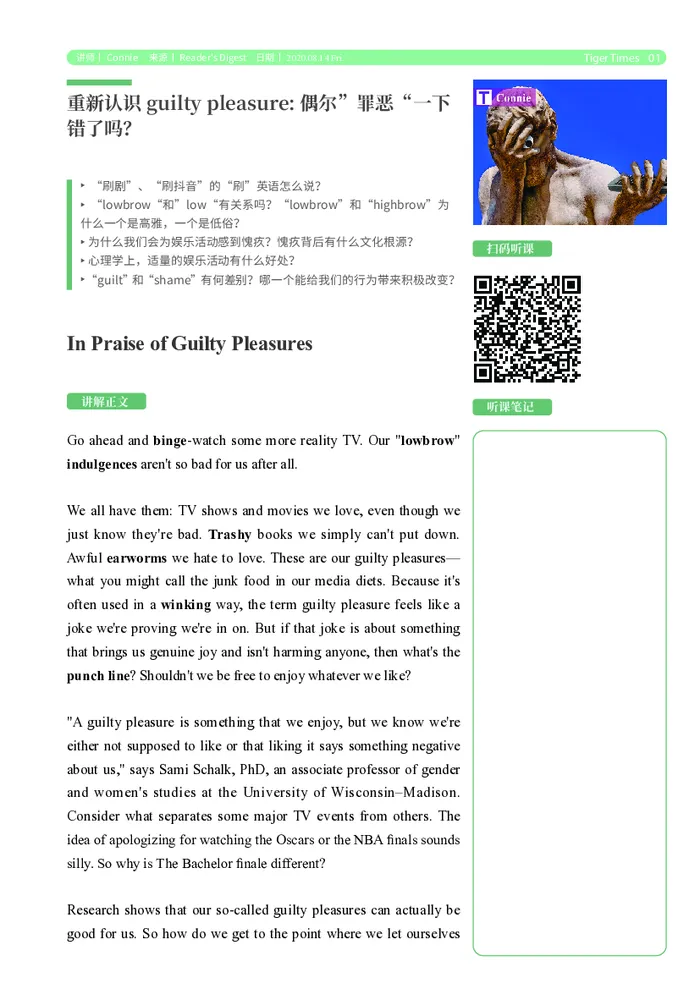
Go ahead and binge-watch some more reality TV. Our "lowbrow"
indulgences aren't so bad for us after all.
We all have them: TV shows and movies we love, even though we
just know they're bad. Trashy books we simply can't put down.
Awful earworms we hate to love. These are our guilty pleasures—
what you might call the junk food in our media diets. Because it's
often used in a winking way, the term guilty pleasure feels like a
joke we're proving we're in on. But if that joke is about something
that brings us genuine joy and isn't harming anyone, then what's the
punch line? Shouldn't we be free to enjoy whatever we like?
"A guilty pleasure is something that we enjoy, but we know we're
either not supposed to like or that liking it says something negative
about us," says Sami Schalk, PhD, an associate professor of gender
and women's studies at the University of Wisconsin–Madison.
Consider what separates some major TV events from others. The
idea of apologizing for watching the Oscars or the NBA finals sounds
silly. So why is The Bachelor finale different?
Research shows that our so-called guilty pleasures can actually be
good for us. So how do we get to the point where we let ourselves
enjoy what we enjoy?
Beyond the fear about how others will perceive us, we tend
to grapple with a perfectionism that stems from the "deeply
puritanical roots" of our culture, one in which pleasure is seen "as
sinful and bad and self-indulgent," says Schalk.
Or at the very least, we have to earn it. How often do we say things
to ourselves such as, "I've been good all week, so I deserve some ice
cream" or "I walked this morning, so I'm going to veg out tonight"?
But all this guilt goes against our human nature.
"There's a reason why our bodies, literally at the nerve level,
are wired to feel pleasure," says Adrienne Maree Brown, author
of Pleasure Activism: The Politics of Feeling Good. For her,
pleasure activism—spreading the message that we deserve to enjoy
ourselves—is about combating the oppressive idea that pleasure
isn't a natural part of life or that only certain people deserve to enjoy
themselves.
“ 我们的身体,实际上是在神经层面被连接起来才能感到愉悦,
是有原因的,”《愉悦行动主义:感觉好的方法》一书的作者艾
德里安娜· 马里· 布朗说。对她而言,愉悦行动主义—— 传播
我们值得享乐的信息—— 是在与一种压制性观念作斗争,(在
这种观点下)享乐不是生活的自然组成部分,或者只有某些人
值得享乐。
She suggests asking, "Why do I feel so much shame around this if it's
not causing harm to me or anyone else?"
她问道:“ 如果不对我或其他人造成伤害,为什么我对此感到如
此羞耻?”
After all, binge-watching seven episodes of Real Housewives or
"wasting" the afternoon watching back-to-back classic baseball
games isn't going to melt our brains. In fact, studies suggest that
"playing a video game or watching a movie or television show can
Tiger Times
02
restore some psychological resources," says Robin Nabi, PhD, a
professor of communication at the University of California, Santa
Bar- bara, who specializes in the effects of media on emotions.
Though the benefits have yet to be studied long-term and our
problems don't magically disappear once we turn off the tube, rest
can reduce stress levels. Perhaps more important, Nabi says, "your
perception of your ability to handle it improves." Giving ourselves
permission to enjoy some downtime is also a key part of self-
compassion, which helps combat anxiety and depression.
"When we rest, we think we're supposed to use that time
productively," says Kristin Neff, PhD, an associate professor in the
department of educational psychology at the University of Texas
at Austin. While that "may be good for survival," she points out,
constantly running through hypothetical problems "is not very good
for happiness."
Taking a mental break and enjoying something that doesn't require
intense intellectual focus gets us out of problem-solving mode, says
Nabi. That is healthy for us on many levels. "Flow states," such as
meditating, playing sports, and, yes, consuming media, can help our
brains rest and recover by providing a reprieve from problem-solving
mode. Such breaks can also improve our ability to deal with stress
and recharge our batteries, so to speak.
纳比说,精神上的休息和享受不需要高强度智力专注的事情会
使我们脱离解决问题的模式。这在许多方面对我们来说都是健
康的。 “ 流动状态”,例如冥想,运动以及媒体消费,可以通过
提供一个暂缓让我们的大脑休息并从解决问题的模式恢复。可
以说,这样的休息还可以提高我们应对压力和为自己充电的能
力。
"We have this cultural value of media consumption being edifying,
and that what we do should be about growing and achieving,"
says Nabi. "We don't focus as much on relaxation and playing and
enjoyment and fun, and these are such important aspects of being
Tiger Times
03
a human being." And feeling guilty about activities we enjoy, or
disparaging them, can detract from the benefits they offer us.
For one thing, if we stigmatize a behavior and then engage in it,
it's easy to go overboard, which can leave us feeling guilty and
less satisfied. In one study, dieters who had been coached in self-
compassion were less likely to overeat after consuming unhealthy
food, while those who simply followed restrictive diets were harsher
on themselves.
While guilt can sometimes be a healthy motivator to push us to
change behaviors we don't like, its counterpart, shame—the painful
feeling that our behavior makes us horrible people—is never
productive. When we disparage our TV viewing habits, for example,
we typically aren't describing a behavior we hope to change, so the
negative feelings aren't particularly productive or helpful.
Brown reminds us that it's normal and even healthy to embrace our
need for pleasure. She adds one caveat, though: a reminder that
too much of a good thing is never a good thing— which is why
understanding and accepting what brings us pleasure is crucial to
finding the right balance.
Shedding our self-imposed embarrassment about our interests can be
empowering, which is why it's time to ditch the term guilty pleasure
from our collective vocabulary.
Tiger Times
04
Tiger Times
05
binge /bɪndʒ/ v. 放纵;大吃大喝
○ (informal) to do too much of something, such as eating or
drinking, in a short period of time
○ e.g. Whenever she's depressed, she binges on chocolates.
每当情绪低落时她就狂吃巧克力。
○ binge-watch /ˈbɪndʒ ˌwɒtʃ/ v. 刷剧
○ to watch many or all episodes of (a TV series) in rapid
succession
lowbrow /ˈləʊbraʊ/ adj. 文化层次不高的,庸俗的〔含贬义〕
○ lowbrow entertainment, newspapers, books etc. are easy
to understand and are not concerned with serious ideas about
art, culture etc.–used to show disapproval
○ e.g. His choice of subject matter has been regarded as low
brow. 他选择的主题被认为是浅薄的。
○ highbrow /ˈhaɪbraʊ/ adj.〔书籍、电影等〕严肃的,高雅的;
深奥难懂的
indulgence /ɪnˈdʌldʒəns/ n. 嗜好;爱好
○ something that you do or have for pleasure, not because
you need it
○ e.g. An occasional glass of wine was his only indulgence.
偶尔喝杯葡萄酒是他唯一的嗜好。
○ indulge /ɪnˈdʌldʒ/ v. 沉迷;放纵
○ indulgent /ɪnˈdʌldʒənt/ adj. 放纵的
trashy /ˈtræʃi/ adj. 质量极其粗劣的;毫无价值的
○ of extremely bad quality
○ e.g. trashy novels 垃圾小说
earworm /'ɪəwɜ:m/ n. 洗脑音乐
○ a tune that you keep thinking about in your head, even
when you do not want to
wink /wɪŋk/ v. 闪烁,明灭
○ to shine with a light that flashes on and off
○ e.g. a Christmas tree with lights winking on and off 灯光
闪烁的圣诞树
○ winking /ˈwɪŋkɪŋ/ adj. 闪烁的,眨眼的
punch line /ˈpʌntʃlaɪn/ n.〔笑话或故事中最后点题或抛出
笑料等的〕妙语,画龙点睛的结尾语
○ the last few words of a joke or story, that make it funny or
surprising
grapple /ˈɡræpəl/ v. 扭打;搏斗
○ to fight or struggle with someone, holding them tightly
○ e.g. Passers-by grappled with the man after the attack. 袭
击之后过路人便与这男人扭打起来。
○ grapple with sth. 尽力解决,设法理解(难题)
○ e.g. The Government has to grapple with the problem of
unemployment. 政府必须尽力解决失业问题。
stem from sth. 源于,来自;由… 引起
○ to develop as a result of something else
○ e.g. Part of the problem with treating childhood obesity
stems from the fact that parents do not always recognize that
their children are obese. 治疗肥胖儿童的困难部分源自父
母有时并不认为自己的孩子肥胖。
词汇
puritanical /ˌpjʊərəˈtænɪkəl/ adj. 道德作风〔尤指性方面〕
极端严谨的,清教徒式的〔含贬义〕
○ very strict about moral matters, especially sex – used to
show disapproval
○ e.g. The atmosphere at the school was oppressively puri
tanical. 那所学校是清教徒式的风气,显得很压抑。
veg out 懒散地打发时间
○ to be very lazy and spend time doing very little
○ e.g. Ralph vegged out in front of the TV all day again. 拉
尔夫又整天坐在电视机前打发时光了。
edifying /ˈedɪfaɪɪŋ/ adj. 教诲的;启迪的;陶冶情操的〔有
时为幽默用法〕
○ an edifying speech, book etc. improves your mind or moral
character by teaching you something – sometimes used hu
morously
○ e.g. a morally edifying film 陶冶情操的电影
disparage /dɪˈspærɪdʒ/ v. 贬低,贬损
○ to criticize someone or something in a way that shows you
do not think they are very good or important
○ e.g. Matcham's theatres were widely disparaged by archi
tects. 马彻姆设计的剧院遭到了建筑师的普遍贬损。
stigmatize /ˈstɪɡmətaɪz/ v. 被视为可耻,受到蔑视
○ (= stigmatise) to be treated by society as if you should feel
ashamed of your situation or behaviour
○ e.g. Single mothers often feel that they are stigmatized by
society. 单身母亲常常觉得自己受社会歧视。
go overboard 做事(说话)过分,走极端
○ to do or say something that is too extreme for a particular
situation
○ e.g. I hope politicians will not go overboard in trying to
control the press. 我希望政客们在控制媒体方面不要做得
太过分。
caveat /ˈkæviæt/ n. 警告,提醒,告诫
○ a warning that something may not be completely true,
effective etc.
○ e.g. She will be offered treatment, with the caveat that it
may not work. 她将接受治疗,但医生提醒她治疗不一定
有效。
Tiger Times
06
今日习题
1. 根据英文释义写出文中出现的对应词
______: to do too much of something, such as eating or drinking, in a short period of time
______: a warning that something may not be completely true, effective etc.
2. 一词多义
Which of the following underlined words is closest in meaning to the one in the sentence "Beyond the fear
about how others will perceive us, we tend to grapple with a perfectionism that stems from the 'deeply
puritanical roots' of our culture... "? ____
A. He cut the plant off at the base of the stem.
B. The stem of "winded" is "wind".
C. The measures are meant to stem the tide of illegal immigration.
D. His headaches stemmed from vision problems.
3. 翻译:根据给定中文回译英文
不再强迫自己为兴趣爱好而感到内疚,可以增强我们的掌控感,这也是为什么现在是时候从我们
的词汇库中剔除掉罪恶快感这个词了。
_____________________________________________________________________________________
_______________________________________________________
习题答案
1. binge; caveat
2. D
3. Shedding our self-imposed embarrassment about our interests can be empowering, which is why
it's time to ditch the term guilty pleasure from our collective vocabulary.
编辑丨艺涵