© Writing Group of English, Yilin Press and Oxford University Press (China) Limited 2019
“Oxford” is a registered trademark of Oxford University Press
©《普通高中教科书·英语》编写组、译林出版社和牛津大学出版社 (中国) 有限公司2019
Oxford 为牛津大学出版社的注册商标。
版权所有。未经版权所有人书面许可,不得在任何地区以任何形式、任何媒介、任何文字
翻印、仿制或转载本书的内容、文字或图片。
普通高中教科书·英语[选择性必修 第一册]
主 编 王守仁 何 锋
副 主 编 顾爱彬 范红升
编 写 Jo Kent 连 凯 张 淳 马绯璠 刘菁健 李秋颖 魏 惠 郑 楠
责任编辑 丁晓红 梁 健 马绯璠 潘志娟 高睿君 丁 婧
装帧设计 译林出版社 韦 枫 胡 苨 黄 晨
牛津大学出版社 (中国) 有限公司 设计部
出 版 译林出版社
地 址 南京市湖南路1 号A 楼
邮 箱 jiaocai@yilin.com
购买热线 400—928—9069
教材热线 025—83658349, 83672889
发 行 江苏凤凰出版传媒股份有限公司
印 刷 江苏凤凰通达印刷有限公司
开 本 890 毫米×1240 毫米 1/16
印 张 8
版 次 2020 年12 月第1 版
印 次 2022 年5 月第4 次印刷
标准书号 ISBN 978—7—5447—8128—2
定 价 9.74 元
版权所有 · 侵权必究
译林版图书若有印装错误可向出版社调换,质量热线:025—83658316
同学们:
欢迎使用《普通高中教科书·英语》!本册教材围绕“人与社会”的主题语境,
依托话题丰富、文体多样的语篇,引领你通过一系列英语学习活动,发展英语学科核
心素养。现在,让我们走进教材,开启一段有趣的英语学习之旅。
每个单元首页的 Welcome to the unit 板块是你单元学习的起点,借助视频、
图示、文字等形式多样的语篇激发你的学习兴趣,帮助你初步了解单元主题,为单
元学习做好热身准备。随后,你将进入一个非常重要的学习环节——Reading 板
块。在这里,你将有机会阅读关于饮食文化、音乐作品、绘画流派以及诗歌鉴赏等
话题的语篇,感受真实、地道、优美的英语,了解中外优秀文化。你可以通过一系列
多维度、分层次的阅读活动,深入探究主题意义,提升语言能力、文化意识和思维品
质。来到 Grammar and usage 板块,你将在语篇中观察、探究语法现象,自主归
纳语法规则,并在新的语境和活动中正确使用语法。接下来,在 Integrated skills
板块,你将综合运用听、说、读、看、写的技能,完成语言技能融合的活动。随后,
在 Extended reading 板块,你将进行拓展阅读,通过观点表达等活动,进一步探
究主题意义,获得对饮食文化的新认识,提升对文学艺术的鉴赏能力。在 Project
板块,你将和同学一起开展合作学习、探究学习,完成一项综合性、实践性活动。
Assessment 板块以开放性问题的形式提供自评、互评等多种评价方式,促使你及
时反思并调整学习行为,提升学习能力,使学习更有成效。在 Further study 板块,
你可以根据自身的学习情况来选择教材推荐的资源在课后进行自主学习、拓展学
习,继续体验英语学习的快乐。
祝你在这段英语学习之旅中,带着梦想,快乐而自信地前行!
《普通高中教科书·英语》编写组
2020 年12 月
前 言
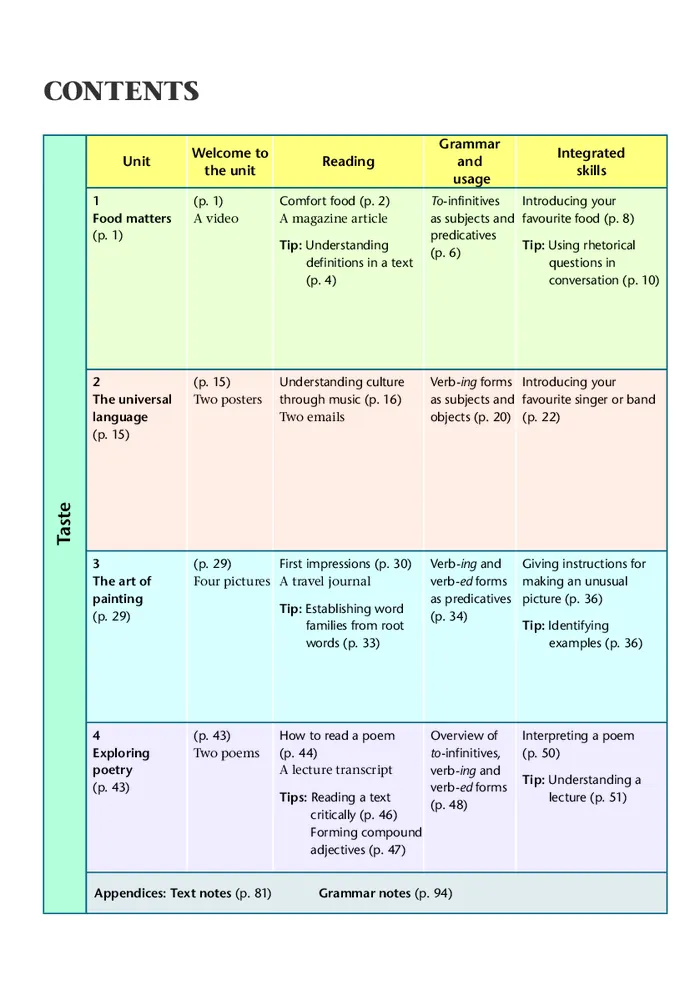
Unit
Welcome to
the unit
Reading
Grammar
and
usage
Integrated
skills
1
Food matters
(p. 1)
(p. 1)
A video
Comfort food (p. 2)
A magazine article
Tip: Understanding
definitions in a text
(p. 4)
To-infinitives
as subjects and
predicatives
(p. 6)
Introducing your
favourite food (p. 8)
Tip: Using rhetorical
questions in
conversation (p. 10)
2
The universal
language
(p. 15)
(p. 15)
Two posters
Understanding culture
through music (p. 16)
Two emails
Verb-ing forms
as subjects and
objects (p. 20)
Introducing your
favourite singer or band
(p. 22)
3
The art of
painting
(p. 29)
(p. 29)
Four pictures
First impressions (p. 30)
A travel journal
Tip: Establishing word
families from root
words (p. 33)
Verb-ing and
verb-ed forms
as predicatives
(p. 34)
Giving instructions for
making an unusual
picture (p. 36)
Tip: Identifying
examples (p. 36)
4
Exploring
poetry
(p. 43)
(p. 43)
Two poems
How to read a poem
(p. 44)
A lecture transcript
Tips: Reading a text
critically (p. 46)
Forming compound
adjectives (p. 47)
Overview of
to-infinitives,
verb-ing and
verb-ed forms
(p. 48)
Interpreting a poem
(p. 50)
Tip: Understanding a
lecture (p. 51)
Appendices: Text notes (p. 81) Grammar notes (p. 94)
Taste
CONTENTS
Extended reading
Project
Assessment
Further study
Workbook
Eating in China (p. 11)
Three blog entries
Making a dish (p. 13)
(p. 14)
(p. 14)
Exploring language
(p. 57)
Building skills (p. 59)
Appreciating
language (p. 62)
Beethoven: a
remarkable life (p. 25)
A magazine article
Tip: Identifying
flashback in a text
(p. 26)
Making a profile of an
English song (p. 27)
(p. 28)
(p. 28)
Exploring language
(p. 63)
Building skills (p. 65)
Appreciating
language (p. 68)
Qingming Scroll (p. 39)
An essay
Making a poster about a
painter (p. 41)
(p. 42)
(p. 42)
Exploring language
(p. 69)
Building skills (p. 71)
Appreciating
language (p. 74)
Li Bai and his romantic
poetry (p. 53)
An essay
Giving a poetry recital
(p. 55)
Tip: Reading a poem
aloud (p. 55)
(p. 56)
(p. 56)
Exploring language
(p. 75)
Building skills (p. 77)
Appreciating
language (p. 80)
Wordlists (p. 98) Irregular verbs (p. 119)
1
Food matters
UNIT
1
Food matters
Food is as fundamental to man as the people are to the state.
—Chen Shou
In this unit, you are going to:
• read a magazine article about comfort food;
• write an article about your favourite food;
• read three blog entries about some traditional
Chinese foods;
• make a dish.
1 Which of the dishes in the video would you like to try most? Why?
2 What do you think is the most typical Chinese food?
Welcome to the unit
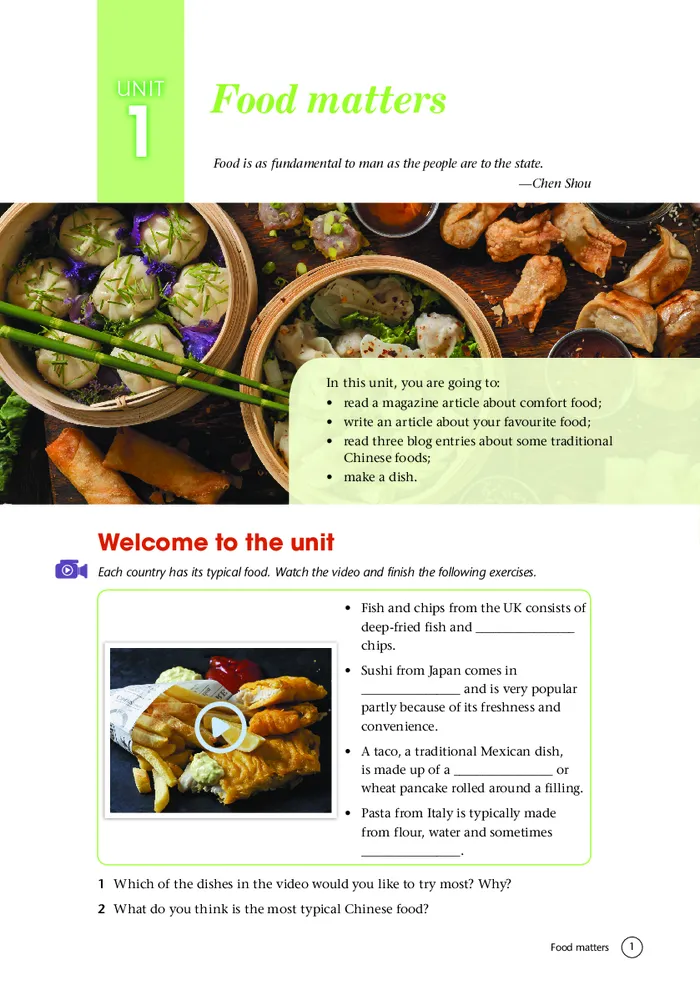
Each country has its typical food. Watch the video and finish the following exercises.
• Fish and chips from the UK consists of
deep-fried fish and _________________
chips.
• Sushi from Japan comes in
_________________ and is very popular
partly because of its freshness and
convenience.
• A taco, a traditional Mexican dish,
is made up of a _________________ or
wheat pancake rolled around a filling.
• Pasta from Italy is typically made
from flour, water and sometimes
_________________.
2
Unit 1
Whenever I feel lonely, I have a secret recipe that never fails: rice, milk and sugar,
cooked low and slow. No matter how bad my mood is, that perfect combination is
always enough to lift my spirits. Sometimes the smell alone can do the trick, not to
mention the lovely creamy flavour, which works like a time machine immediately
transporting me back to my sunny childhood. With pleasure, I remember the lazy
Sunday afternoons I used to spend in the warmth of my grandma’s flat, listening
to her wonderful stories and greedily eating bowl after bowl of her delicious rice
pudding. I take my time over every spoonful, gently rolling the silky dessert around
my mouth and enjoying the perfect marriage of rice and milk. Before I know it, I’m
happy again.
My experience with rice pudding illustrates the unique power of “comfort food”.
In its broadest sense, comfort food refers to any food that makes us feel better.
In this article, we will talk about a particular type of comfort food whose power
mainly lies in the associations it calls to mind. It often makes up for bad feelings by
helping us recall happy memories of the people, things or places we love.
Our comfort foods are highly individual. They vary from person to person,
depending on our own unique experiences that have shaped our lives. If we grow
Food keeps us healthy and energetic. It can also do more than that. The article below, from a
food magazine, discusses the idea of comfort food. Before you read the article, think about the
following questions:
• What do you think the article will talk about according to the title?
• What foods can have an impact on your feelings?
Reading
5
10
15
3
up eating certain foods in our family, then those foods tend to be linked with
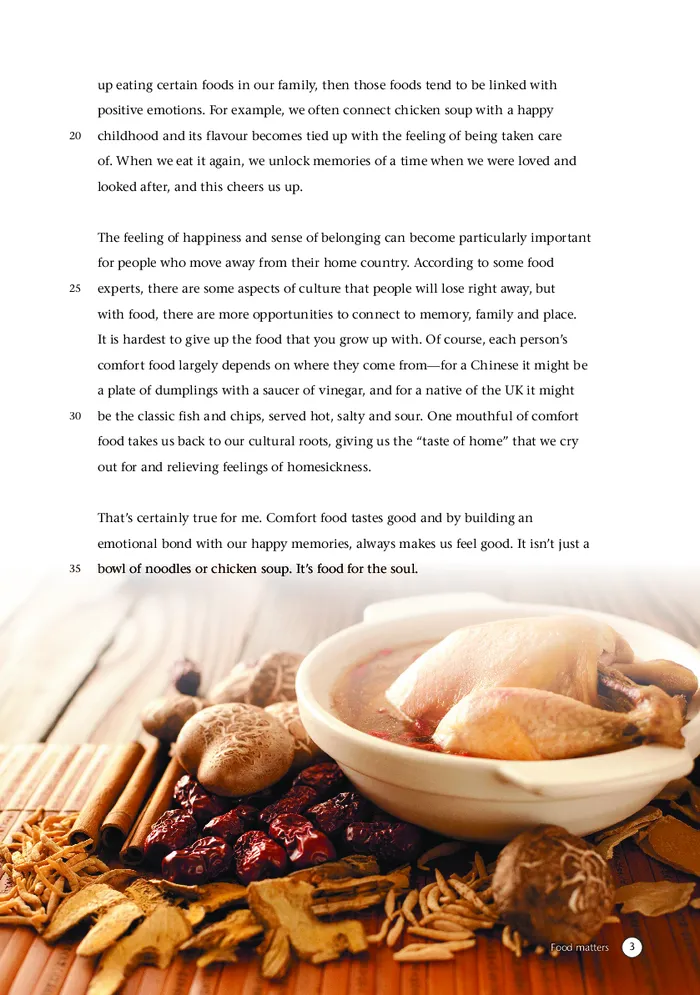
positive emotions. For example, we often connect chicken soup with a happy
childhood and its flavour becomes tied up with the feeling of being taken care
of. When we eat it again, we unlock memories of a time when we were loved and
looked after, and this cheers us up.
The feeling of happiness and sense of belonging can become particularly important
for people who move away from their home country. According to some food
experts, there are some aspects of culture that people will lose right away, but
with food, there are more opportunities to connect to memory, family and place.
It is hardest to give up the food that you grow up with. Of course, each person’s
comfort food largely depends on where they come from—for a Chinese it might be
a plate of dumplings with a saucer of vinegar, and for a native of the UK it might
be the classic fish and chips, served hot, salty and sour. One mouthful of comfort
food takes us back to our cultural roots, giving us the “taste of home” that we cry
out for and relieving feelings of homesickness.
That’s certainly true for me. Comfort food tastes good and by building an
emotional bond with our happy memories, always makes us feel good. It isn’t just a
bowl of noodles or chicken soup. It’s food for the soul.
20
25
30
35
Food matters
4
Unit 1
A3 In pairs, discuss the following questions.
1 How does the author introduce the topic of comfort food? What do you think of
this technique?
2 What foods can remind you of your happy memories? Describe the memories
they recall.
3 In your opinion, is there any difference between one’s comfort food and
favourite food? Give your reasons.
A2 Read the article again carefully and answer the following questions.
A Understanding the text
A1 Read the article and complete the chart below with the main idea of each paragraph.
Para. 1: Rice pudding cheers me up whenever I feel unhappy.
Para. 2: ____________________________________________
Para. 3: ____________
_____________________
_____________________
_____________________
Para. 4: ____________
_____________________
_____________________
_____________________
Para. 5: ____________________________________________
1 What does the author compare the flavour of the rice pudding to in
the first paragraph?
_________________________________________________________________
2 What is comfort food in its broadest sense?
_________________________________________________________________
3 According to the third paragraph, how does comfort food such as
chicken soup cheer us up?
_________________________________________________________________
4 For people who move away from their home country, what largely
determines their comfort food?
_________________________________________________________________
Tip
In some texts
definitions are given to
key concepts with such
expressions as refer to.
In some cases, in a
broad sense or in a
narrow sense is used to
make the definition
more accurate.
Understanding
definitions in a text
5
Food matters
B3 The article uses different phrases to express “to make sb think of sth” and “to make sb
feel better”. Find these expressions in the article and improve the sentences below by varying
the language.
Learn this It is important to vary your language in your writing so that readers
do not get bored. To achieve this, you can use words and phrases with similar
meanings.
Breakfast is an important meal and what people eat for breakfast is quite different.
People from different places and with different eating habits tend to eat different
things for breakfast.
B2 The article uses several phrasal verbs with “up”. Complete the sentences with the correct
forms of the phrasal verbs in the left box. There are two phrasal verbs you do NOT need to
use. Then think of more phrasal verbs with “up”.
When we are in low spirits, we may (1) _________________ things that give us
comfort and a sense of security. Since it brings back happy memories of the past
or offers an opportunity to connect with our home culture, comfort food can
often (2) _________________. However, there is another type of comfort food, which
generates positive (3) _________________ in a different way. Food high in calories may
also make us feel better. As (4) _________________ like cakes are digested, blood sugar
levels can go up quickly. As a result, we will be in a better (5) _________________ after
eating the comfort food. However, the sharp increase in blood sugar will cause
the body to produce a special chemical to remove it. When the chemical lowers
blood sugar levels, we are likely to feel sad again and will (6) _________________ eat
more comfort food. There is then the danger of entering a cycle of highs and lows
where more and more comfort food, high in carbohydrates, needs to be eaten. This
(7) _________________ with health problems like being overweight.
Comfort food is an important tool in helping us (8) _________________ tension and
feel good about ourselves. However, be aware of the hidden dangers of high-calorie
comfort food!
greedily
emotion
link
cry out for
mood
dessert
relieve
do the trick
B Building your language
B1 The passage below is about a different kind of comfort food. Complete the passage with
the correct forms of the words and phrases in the box below.
cheer up
make up for
give up
take up
keep up
set up
show up
1 I find it hard to _________________ my energy right after lunch.
2 I waited for half an hour, but he never _________________.
3 Let’s help _________________ the stage for the show.
4 Have you _________________ any new hobbies recently?
5 The good days can _________________ the bad ones.
6
Unit 1
Grammar and usage
To-infinitives as subjects and predicatives
A Exploring the rules
Below is a blog entry about eating out and eating at home. Find the sentences that use
to-infinitives as subjects or predicatives and fill in the table below. The first ones have been
done for you.
Working out the rules
• When the to-infinitive is used as a subject, we usually use the preparatory
subject (1) _________________ at the beginning of the sentence.
• The to-infinitive can also be used as a predicative. It usually comes after
the verb (2) _________________.
Grammar notes page 94
Not that long ago, my first thought at mealtimes was to eat at a restaurant. I was
eager to try new restaurants. To eat out was also a social activity, allowing me to
enhance the relationship with my friends. I often ate out until last month, when I
came across a cooking app. There are a variety of recipes in the app to choose from.
They are uploaded by users, and offer detailed instructions so that others can follow
them step by step. Most of the recipes include photos or videos, which are very
useful for beginners. When I picked a popular recipe and gave it a try, I discovered
that it was not that difficult to make a simple and tasty dish. In the last few weeks,
I’ve thrown myself into home cooking, from boiling noodles in the pot to frying
steak in the pan. I hardly eat out any more. Not only is cooking at home cheaper,
but I can cook exactly what I want. It’s healthier too. No wonder people say nothing
beats home cooking!
Now I am good at cooking a couple of dishes. My plan is to invite my friends over
at the weekend to show them my new-found skills. I hope that they will like my
cooking!
To-infinitives
as subjects
To eat out was also a social activity, …
To-infinitives
as predicatives
…, my first thought at mealtimes was to eat at a restaurant.
7
Food matters
B2 Below is a lifestyle magazine article. Complete the article with the correct forms of the
verbs in the brackets.
As long as you are not afraid of heights, you will be impressed by Sky Buffet, the
latest restaurant in the city centre. (1) _________________ (locate) at the top of Tower
88, it gives you an amazing view of the bay. Better still, its entire seating area turns
slowly and it is enjoyable (2) _________________ (see) the scenery outside while having
your meal. Since it takes about an hour (3) _________________ (turn) the full 360
degrees, you are unlikely to get bored with the scenery. If you want to get the most
wonderful views, your best bet is (4) _________________ (sit) by the window an hour
before sunset and watch how the sky changes colours. The atmosphere is lively and
modern, with its walls (5) _________________ (paint) white and light blue. Sky Buffet
serves a menu full of eye-catching Asian dishes, (6) _________________ (range) from
Chinese food to Japanese food. It will be a good idea (7) _________________ (invite)
your family and friends over for dinner. Sky Buffet is considered by many locals
(8) _________________ (be) the perfect location for a special occasion.
B3 Imagine your friend has taken you out to dinner at Sky Buffet. Write a thank-you note to
your friend, offering to return the favour by inviting him or her to your home for dinner next
weekend. Remember to use to-infinitives. Use the expressions below to help you.
B Applying the rules
B1 Rewrite the following sentences using to-infinitives according to the requirements in the
brackets.
1 The next dish that the cook will prepare is Kung Pao Chicken. (attributive)
____________________________________________________________________________
2 The preparation of home-cooked meals is easy and enjoyable. (subject)
____________________________________________________________________________
3 Her dream is that she will open a restaurant some day. (predicative)
____________________________________________________________________________
4 We will put the potatoes in the pot first in order that they will be cooked quickly.
(adverbial of purpose)
____________________________________________________________________________
5 I consider the Soup of the Day as the best option on the menu. (object complement)
____________________________________________________________________________
Expressions
I am writing to …
It was so kind of you to …
It was wonderful to …
I have always wanted to …
I would like/love to …
My plan is to …
8
Unit 1
Integrated skills
Introducing your favourite food
A Jake’s teacher, Mr Guan, is making an announcement about the school Food Festival.
Listen and finish the exercises below.
A1 Listen to the announcement and decide whether the following statements are true (T) or
false (F).
A2 Listen to the announcement again and complete the notes below.
Cooking classes
Learn how to make different food, e.g. (1) ____________________________
Food stands
• Present different kinds of food for students to try
• Think of (2) ____________________________ and make some food
according to it
• Decorate your food stands to (3) ____________________________ as many
people as possible
A writing competition
• The article should be of no less than (4) ____________________________.
• You should tell us what your favourite food is and
(5) ____________________________ more than other foods.
• You should hand in the article before (6) ____________________________.
1 The first school Food Festival took place last year.
T / F
2 This year’s Food Festival will be held on 15 March.
T / F
3 Students can learn about food from many different countries at the Food
Festival.
T / F
4 Changes can be made to the programme.
T / F
5 The writing competition will begin on the day of the Food Festival.
T / F
Events at the Food Festival
9
Food matters
B
Jake and his friend Amy have written about their favourite foods for the competition.
Read their articles and pay attention to the descriptions of food.
My favourite food is a popular Italian dessert called tiramisu. I first
tried it about two years ago, when I visited a bakery with my parents.
Each spoonful of this amazing dessert is a light, creamy experience to
remember. There are three layers of the cake and the cheese is between
the layers, making the dessert feel soft and smooth.
There is also a bitter taste of coffee but this flavour
is not very strong. Tiramisu does not look very
attractive—it’s brown, because of the coffee and
dark chocolate, and white, because of the cream and
cheese—but all these ingredients make it taste delicious!
Since I tried it for the first time, tiramisu has become my favourite
dessert. I have also learnt that the name tiramisu means “cheer me up”
in Italian. Whenever I feel unhappy, I eat this dessert and it does make
me feel better!
Tiramisu cheers me up
By Amy Xu
Of all the foods I have ever tried, the mooncake is my favourite. There are
many versions of mooncakes from different places around China. They
have a variety of fillings and among them I love
the sweet red bean filling best. I remember trying
my first mooncake with my family when I was
very little. We sat outside in my grandparents’ yard
while the full moon shone above us. It was a very
special moment. My elderly grandmother still bakes
mooncakes for the whole family every year. She can turn the flour and red
beans into wonderful mooncakes like magic. When she places them on
the table, they look adorable—small, round and shiny golden-brown. The
delicious smell soon reaches my nose and my mouth starts to water. When
I pick up a mooncake, it feels warm and heavy in my hand. As I take each
bite, the sweet and mild flavour of the red bean filling slowly fills my
mouth. The mooncake is always my favourite because of its satisfying taste
that is out of this world and the happy memories it brings to mind.
Mooncakes: a taste that is out of this world!
By Jake Zhao
10
Unit 1
C In pairs, talk about your favourite food. Use the following questions to help you.
D Write an article about your favourite food. Use your ideas from part C and the
information in parts A and B to help you.
• What is your favourite food?
• Why do you like it? (How it looks,
smells, tastes and feels in your mouth,
how you associate it with a particular
experience, etc.)
Tip
A rhetorical question is a figure of speech in the
form of a question that is asked to emphasize a
point or to express feelings and attitudes. For
example, when you ask “How can I forget such a
tasty dish?”, you are actually emphasizing that you
always remember the dish.
Using rhetorical questions in conversation
Planning your writing
• Learning about the text type
An article about your favourite food is a piece of descriptive writing which can
create a vivid picture in readers’ minds through plenty of sensory details.
• Learning about the structure
When writing an article about your favourite food, you can follow the structure
below:
State clearly what your favourite food is.
Mention your experiences of tasting it, especially for the first time.
Describe the characteristics of the food, such as its appearance, smell, taste and
way of cooking.
• Learning about the language
When you describe food, you can use adjectives to create an image of the food
in the mind of the reader. Adjectives commonly used to describe food include
smelly, bitter, sweet, salty, juicy, creamy, silky, smooth, soft, crisp, etc.
Checking your writing
Remember to check your writing after you finish and exchange drafts between you
and your partner. Pay attention to the following aspects:
Punctuation
Spelling
Grammar
Choice of words
Style (formal/informal)
Structure
Self-review
• Do you use adjectives to describe the
food? Is your description vivid enough?
• What changes can you make to
improve your writing?
Peer review
• Does your partner think there are
enough sensory details in your writing?
• Which part does your partner find most
interesting?
11
Food matters
Extended reading
Read the following entries from the blog of a food critic who is eating his way through
traditional Chinese foods.
7 March, Sichuan hot pot
The mouth-watering hot pots of Sichuan are as famous overseas as they are in
China, and the hot flavour is enough to heat up a cold midwinter evening or to let
loose rivers of sweat on a summer afternoon. I gave it my first
try last night, together with a few local friends. As the soup
bubbled slowly over a gas burner in the middle of the table,
its surface was covered with a beautiful layer of chillies,
Sichuan peppers, spring onions and red oil. Slowly at first,
and then faster and faster, we tipped plates of fresh meat, fish and
vegetables into the pot. The hot flavour quickened our laughter and conversation,
making the meal the perfect way to relax with friends.
Sichuan hot pots are perfect for the damp, foggy climate in which they were
invented. They are believed to have started off in the late Qing Dynasty as a way
for boatmen on the Yangtze River to keep warm during the cold and wet winters.
In the beginning, the delicious dish was made simply by boiling vegetables,
chillies and Sichuan peppers in water. Over time, it has expanded to include
multiple options of soups, vegetables, meats and sauces, appealing to people of
different tastes. What I love best about Sichuan hot pots is that they offer a great
opportunity to socialize with friends since a meal can last for hours. I instantly
became a big fan of Sichuan hot pots and I’ll soon be back for more!
12 August, Nanjing salted duck
Salted duck is Nanjing’s most famous food export. Served plain in thin, white
slices, the meat is juicy and salty. Each Nanjing salted duck takes several days to
5
10
15
20
prepare, and the process includes salting, drying, boiling
and cooling. As I finished my first helping on a recent
afternoon in Nanjing, my host, Chef Zhang, told me a
little more about the dish.
The countryside around Nanjing has been famous for
its ducks for centuries; its countless waterways make the area perfect for raising
waterbirds. A local history book from the late Qing Dynasty praised salted duck in
particular, saying it was without equal. Traditionally, duck is considered to have
cooling properties, so it is appropriate for the hot summer months. Nowadays,
people eat salted duck all year round and it is estimated that tens of thousands of
ducks are consumed every day in Nanjing! It definitely hit the spot when I tried it,
and it has become one of my personal favourites.
8 December, Cantonese dim sum
In Guangzhou, morning tea is such an essential part of the daily routine that “Have
you had your tea?” has become the local version of “Good morning.” Though
teahouses have been common in China since the Tang Dynasty, the Cantonese
innovation of the mid-19th century was to serve tea
together with a variety of light dishes, or dim sum. The
concept took off, and today Guangzhou’s restaurants
stimulate customers’ appetite with over a thousand
offerings, each more delicate and delicious than the last.
The Cantonese do not hurry over their breakfasts, as I found when I visited a
restaurant in Guangzhou’s old city centre this morning. The emphasis is rather
on conversation about business, family or pleasure, and locals can spend hours
together chatting, drinking tea and working their way through the menu. From
beef balls to rice noodle rolls, there are various dishes that have been baked, boiled,
steamed or fried. A single visit is not enough to appreciate everything, and I have a
long list of dim sum I still need to try.
25
30
35
40
45
50
12
Unit 1
A Write a summary of each of the three traditional Chinese foods.
B
What dish is popular in your hometown? Introduce it to a foreign traveller. Explain its
popularity, history and features.
13
Food matters
Dumplings
Main ingredients
500 grams of meat, Chinese
cabbage, dumpling wrappers
Instructions
• Mix together the meat and the
Chinese cabbage.
• Fill the dumpling wrappers
with the mixture. Stick
the edges of the dumpling
wrappers together.
• Boil the dumplings.
• Set the cooked dumplings on
a plate and serve with vinegar.
Dos
• Before mixing, salt the Chinese
cabbage, let it rest for 15
minutes and press out extra
water.
• Use water to stick the edges
together if necessary.
Don’ts
• Don’t put the dumplings into
the water when it is not boiling.
• Don’t overfill the dumplings,
or they will fall apart when you
boil them.
B
As a group, research the recipe for your chosen dish. Use the example below to help you.
A As a class, discuss dishes from around the world or new dishes you would like to create.
Then in groups, choose a dish to research.
Project
Making a dish
C As a group, make a
video or take some photos
of how you make the dish.
Use the example to help you.
Then present your video or
photos to the rest of the class.
14
Unit 1
Ratatouille is an animated film about Remy, a young rat who
dreams of becoming a chef in a famous restaurant. His dream
is encouraged by the restaurant’s original owner, who believes
that anyone can cook, but only the fearless can be great. Watch
this film and join in Remy’s food adventures.
“What Happens in Your Brain When You Taste Food” is a video
talk given by neuroscientist Camilla Arndal Andersen. She
reveals surprising information about how our brains “taste”
food and hopes that her discoveries can help create healthier
foods without sacrificing taste. Watch the video talk to find out
more about her fascinating research.
Further study
Assessment
Answer the following questions to assess your performance. Then work in groups and
exchange your answers with your partners.
1 Which key characteristics of comfort food can you identify?
2 What do you think of your writing about your favourite food? List 2 or 3
sentences that you are the most satisfied with.
3 What can you learn from the blog entries to help you introduce a popular
dish in your hometown?
4 Did you have any difficulty doing the project of this unit? If yes, what was it?
5 What new words have you learnt from this unit? List some of them. *
6 What grammar have you learnt from this unit? Make a sentence with the
grammar. *
7 What tips have you learnt from this unit? Make a list of them.
8 How are you going to improve your overall performance? Make an action
plan.
* Assess your learning of vocabulary and grammar by doing language practice on pages 57–58.
The universal language
15
1 Search online for the pieces of music mentioned in the posters. How do you feel
when listening to them?
2 What other musical instruments and famous musical pieces or musicians do you
know about?
UNIT
2
Music is the utmost pleasure in life; music is the clear spring of life;
music is the furnace of temperamental refinement.
—Xian Xinghai
The universal language
In this unit, you are going to:
• read two emails by exchange students about their
experiences of discovering new music;
• write an article about your favourite singer or band;
• read a magazine article about a classical musician;
• make a profile of an English song.
Welcome to the unit
Musical instruments come in a wide range of types. Read the posters below about two
important musical instruments and the musicians, and discuss the following questions in pairs.
lid
keyboard
pedals
strings
Piano
—Invented in Italy in the early 18th century
Erhu
—Invented in China in the Tang Dynasty
Hua Yanjun
• Also known as A Bing, a blind erhu
artist
• Famous for Moonlight on the Second
Spring
Liu Tianhua
• Improved the erhu
instrument and
its performing
techniques
• Famous for Moon
Night and Birdsong
over Empty Mountain
Wolfgang Amadeus Mozart
• An Austrian composer
• Famous for Symphony No. 41 (the
Jupiter Symphony) and Piano Concerto
No. 23
Frédéric François
Chopin
• A Polish
composer and
pianist
• Famous for the
Minute Waltz
head
pegs
bow
stick
soundbox
strings
By Jessie Cable
25 December
Unit 2
16
A great way to learn about a new culture is through its music. The emails below are written
by two exchange students who are discovering new music in their host countries. Before you
read the emails, think about the following questions:
• What information do you think the emails contain according to the subjects?
• Have you watched a music performance live or on TV? What was it like?
Reading
Hi Lucy,
So glad to get your email. I hope everything is fine with you. Last night,
I watched a performance of Butterfly Lovers, a beautiful violin concerto
composed by He Zhanhao and Chen Gang. It’s a piece that really deserves to
be heard.
The music took me through the twists and turns of a classic story about
a young couple torn apart by their families. When the two lovers, Liang
Shanbo and Zhu Yingtai, first meet, the music is light and pleasant, as if
whispering to the audience. It is followed by a fast and cheerful section
which represents their three happy years of school. Then the music gets
dramatic with heavier notes and that is when the lovers are separated because
Zhu’s father forces her to marry another man. Angry and sad, Liang falls
sick and dies. Zhu weeps bitterly over the loss of her love. Overcome with
sorrow, she jumps into his grave. Finally, during the most exciting part, the
music takes a softer turn and ends on a bittersweet note, telling us how the
couple transform into butterflies and fly away to be together forever. It is an
amazing journey!
Butterfly Lovers combines Chinese and Western musical elements: it is played
on Western instruments such as the violin, but more significantly, much
of the music has its roots in Chinese Yue Opera. This unique combination
has made me realize that music is indeed a universal language. You should
definitely listen to Butterfly Lovers—I bet you’ll like it!
All the best,
Alice
Alice Duncan
Lucy Becker
Butterfly Lovers
From
To
Subject
Send
5
10
15
20
The universal language
17
Dear Stephen,
Life here in Nashville is as interesting as I thought it would be. My host family
are big fans of country music, so I can always rely on them to introduce me to
some great songs. I love learning about country music and I keep asking them
questions about it all the time!
It turns out that country music became popular right here in the south of
America in the 1940s and then spread across the nation. It grew out of such
music types as the blues and folk music, so the musicians use many similar
instruments, such as the guitar. The tunes are easy to sing, and the lyrics
often leave you deep in thought. Most of the songs are about hardship and
heartbreak, but also about hope—with plenty of humour thrown in for
good measure. You can feel an emotional connection between you and the
musicians.
Country music shows the peaceful green fields and simple life of the
countryside. Obviously I don’t know what it’s truly like to grow up in rural
America, but the masters of country music, like John Denver, can make you
feel like you’re there. The simple tunes and beautiful natural images are often
very suggestive of countryside surroundings:
Almost heaven, West Virginia
Blue Ridge Mountains, Shenandoah River
Life is old there, older than the trees
Younger than the mountains, growing like a breeze
(From “Take Me Home, Country Roads” by John Denver)
Why don’t you try to listen to some great country music? I guarantee you’ll
enjoy it!
Best wishes,
Harry
To
From
Subject
5
10
15
20
25
Stephen Lin
Harry Yu
Country music
A2 Read the emails again carefully and complete the notes below.
A3 In pairs, discuss the following questions.
1 The violin concerto Butterfly Lovers is a combination of Chinese and Western
musical elements. What do you think of this combination?
2 What can you know about rural America from “Take Me Home, Country Roads”?
3 Both Alice and Harry enjoyed their experiences of music from another culture.
What do you think of Alice’s opinion that “music is indeed a universal language”?
The violin concerto Butterfly Lovers
takes us through the story of a young
couple (1) ___________________________.
This beautiful piece of music
expresses different moods—
first light and pleasant, then
(2) ___________________________, next
dramatic with heavier notes and finally
bittersweet. The piece is a perfect
combination of Chinese and Western
musical elements—it is played on
(3) ___________________________ such as
the violin but has its roots in Chinese
Yue Opera.
Country music grew out of such
music types as
(4) ___________________________.
It became popular in the
south of America in the 1940s
and then spread across the
nation. The tunes are easy
to sing, and the lyrics often
leave you deep in thought.
Most of the songs are about
(5) ___________________________.
Country music makes you
think of the green fields and
(6) ___________________________.
Unit 2
18
A Understanding the text
A1 Read the emails and write down the main idea of each paragraph.
Alice’s email
Para. 1: I watched a performance of Butterfly Lovers last night.
Para. 2: __________________________________________________________________________
Para. 3: __________________________________________________________________________
Harry’s email
Para. 1: __________________________________________________________________________
Para. 2: __________________________________________________________________________
Para. 3: __________________________________________________________________________
Para. 4: You should listen to some country music.
B2 The emails use some music-related vocabulary. Find the words in the emails and think of
more on your own. Complete the chart with as many music-related words as you can.
The universal language
19
B Building your language
B1 The passage below is an introduction to a concert. Complete the passage with the correct
forms of the words and phrases in the box below.
B3 Alice uses personification when she describes the violin concerto Butterfly Lovers. Find
the sentence and describe your favourite piece of music using personification.
Learn this With personification, a thing is described like a human being. This way,
the description becomes more vivid and interesting, enabling the reader to look at
the thing in a new and different way.
combine
overcome
transform
rely on
deserve
pleasant
guarantee
for good measure
Music has the power to (1) _________________ our lives. To give the public more
access to music, we will put on a series of free concerts. Music in different styles,
from classical to jazz, will be played. You can (2) _________________ us to show you
some of the world’s best-known works. The first of these concerts will be held in
front of the arch in the downtown square at eight next Friday evening. Come and
spend a (3) _________________ evening with us!
At the concert you will enjoy the Yellow River Piano Concerto, one of China’s greatest
contributions to classical music. Like the violin concerto Butterfly Lovers, this piano
concerto also (4) _________________ Chinese and Western musical elements and is
well received across the world. The musical piece, an adaptation of Xian Xinghai’s
Yellow River Cantata, tells how the Chinese people, led by the Communist Party
of China, fought to (5) _________________ the Japanese invaders. It consists of four
movements: “The Song of the Yellow River Boatmen”, “Ode to the Yellow River”,
“The Yellow River in Anger” and “Defend the Yellow River”. The difficult piano
solo in particular (6) _________________ a mention. The concert will end with some
short pieces of violin music (7) _________________. We (8) _________________ that you
will enjoy this concert!
Music
Instruments
_________________
_________________
_________________
Types
_________________
_________________
_________________
Jobs
Performers
_________________
_________________
_________________
People behind
the scenes
_________________
_________________
_________________
Grammar and usage
Verb-ing forms as subjects and objects
A Exploring the rules
Below is a story about a musician and his friend in ancient China. Find the sentences that use
verb-ing forms as subjects or objects and fill in the table below. The first ones have been done
for you.
In China’s Spring and Autumn and Warring States periods, there lived a man named
Boya, who was a master of the qin. Playing the qin was his life. He played so well
that everyone enjoyed listening to his music and thought highly of his techniques.
However, Boya believed no one could understand his music until he met Zhong Ziqi.
Boya did not say anything before playing the qin, yet Zhong Ziqi was able to paint
a picture of great mountain ranges in his mind. When Boya continued playing,
Zhong Ziqi said he had heard the sound of a river flowing quickly. In fact, Boya had
intended to call the piece High Mountains and Flowing Water. Having someone that
really understood his music pleased Boya, who never got tired of sharing his music
with Zhong Ziqi. The two soon became great friends and before going their separate
ways, they agreed to meet at the Mid-Autumn Festival the next year. However,
Zhong Ziqi failed to show up on that day. When Boya learnt about Zhong Ziqi’s
death, he was overcome with sorrow. He played High Mountains and Flowing Water
in front of Zhong Ziqi’s grave. After he finished playing the piece, he destroyed the
qin and said, “Since the only person that
understands my music is gone, it’s no
use keeping the qin.”
Verb-ing forms
as subjects
Playing the qin was his life.
Verb-ing forms
as objects
… everyone enjoyed listening …
Unit 2
20
Grammar notes page 94
• When the verb-ing form is used as the subject of a sentence, we can
sometimes use the preparatory subject it at the beginning of the sentence.
• The verb-ing form can also be used as the object of a (1) _________________
or a (2) _________________.
Working out the rules
B2 Below is an article about the music sent into space. Complete the article with the correct
forms of the verbs in the brackets.
The universal language
21
B Applying the rules
B1 Circle the mistakes and write down the correct forms in the blanks.
B3 In pairs, discuss how traditional Chinese music can be appreciated by a larger audience.
Make a list of measures, using verb-ing forms as subjects or objects. Use the example below to
help you.
1 Listen to music is my favourite thing to do.
______________
2 I really enjoy to read biographies of musicians.
______________
3 It’s no use try to play the violin if you’re not going to give it your
best shot.
______________
4 Would you mind to teach me how to play the guitar?
______________
5 These instruments were meant for play traditional Chinese music. ______________
If you have to choose music from the Earth to send into space, what music do you
think is capable of (1) _________________ (represent) mankind? The sound of the
Chinese qin is one answer to this question. In 1977, two spacecraft called Voyager 1
and Voyager 2 were sent out (2) _________________ (explore) the solar system. On both
spacecraft, there is a selection of music from our planet. (3) _________________ (send)
music into outer space was the idea of the famous scientist Carl Sagan, who believed
intelligent life existed on other planets. The music was intended as a universal
language to greet intelligent life in space (if there is any). A group of scientists and
artists got down to (4) _________________ (choose) suitable music. Of course, they had
trouble (5) _________________ (select) which pieces of music to include. In the end,
27 different pieces of music (6) _________________ (last) 90 minutes were put on the
spacecraft. China is represented by a recording of Guan Pinghu (7) _________________
(play) an ancient piece called Flowing Water on the Chinese instrument qin. It is said
that Boya wrote it.
It took about 40 years for the Voyager spacecraft (8) _________________ (enter) the
space between the stars. We do not know what will happen in the end, but maybe
the sound of the qin will one day be heard on a distant planet.
Example
Holding music festivals will give the public more chances to appreciate traditional Chinese
music.
Unit 2
22
Integrated skills
Introducing your favourite singer or band
A Jacky is listening to a school radio programme about music. Listen and finish the exercises
below.
A1 Listen to the radio programme and decide whether the following statements are true (T)
or false (F).
1 Hot Hits and Super Sounds is being broadcast for the first time.
T / F
2 The programme lasts for an hour every day.
T / F
3 Listeners can choose songs to be played for their friends.
T / F
4 Listeners’ stories will be shared on the radio every other week.
T / F
A2 Listen to the radio programme again and complete the notes below.
When is the programme?
At 12 noon every (1) ____________________________
What is broadcast?
• (2) ____________________________ as well as old catchy tunes
• Different types of music, from the blues to jazz, from pop
to (3) ____________________________
• Stories about (4) ____________________________
How can listeners take part?
• Let the host know what they want to hear by getting in
touch on (5) ____________________________
• Share their personal musical journey and be invited to be
(6) ____________________________
Hot Hits and Super Sounds
The universal language
23
The
Fab Four
I remember getting ready for school one morning when the radio
presenter announced that he was going to play the latest single by
the Beatles. I rushed down the stairs as fast as I could to get nearer
to the radio. This was 1965 and the whole country was in a state of
“Beatlemania” … and I was their biggest fan! I turned up the volume
and stood staring at the radio, holding my breath and waiting for the
first notes of the song.
It was definitely the Beatles. Paul McCartney’s voice was unmistakable
but the sound was different. When the song had finished, I stood not
knowing whether I liked it or not. However, this was not unusual.
Different beats, tunes and a combination of different instruments meant
that it took time for me to uncover the beauty of the song. Once that
happened, I knew I would love the song forever. Yes, I was their biggest
fan and I couldn’t wait to hear this song again and again until it became
my favourite song from my favourite band.
During the 1960s, the Beatles were not just a band; they were a force for
change. They exploded onto the music scene in 1962 as four young men
with unique haircuts. They immediately grabbed the attention of young
people and soon the youth of the country were being swept along on
waves of joyous rock and roll music and the hope for a better future.
Today, I have in my collection every disc ever made by the Beatles.
I truly love their music and enjoy looking at their musical journey
from basic rock and roll, through their experimentation with more
complicated and progressive sounds, and then back to the less
complicated music of their final records. Whenever I listen to “She Loves
You”, I am instantly taken back to my teenage years. I can picture my
bedroom decorated with posters of the Fab Four smiling down at me
and I can see myself riding my bicycle through country lanes singing
“yeah, yeah, yeah” at the top of my voice. Yes, the Beatles’s music has
accompanied me throughout my life. It has helped me look to the future
with expectation and now it helps me reflect on my life with quiet
satisfaction.
B
After listening to the radio programme, Jacky has found an article about his favourite
band. Read the article and pay attention to its structure.
Unit 2
24
C In pairs, talk about your favourite singer or band. Use the following questions and
expressions to help you.
• Who is your favourite singer or band?
• What do you like about the singer or band?
• What are your favourite songs by the singer or band? How do you feel when you
listen to them?
• What are the highlights of the singer’s or band’s music career?
• Can you think of a memorable time when you listened to the singer’s or band’s
songs? What was it like?
D Write an article about your favourite singer or band. Use your ideas from part C and the
information in parts A and B to help you.
Expressions
Asking for further information
Could you tell me more about ...?
I wonder if you could say more about ...
I’d like to know more about ... Could you tell me something about that?
I’m really interested in ... Could you tell me a little bit more?
Planning your writing
• Learning about the structure
When writing an article about your favourite singer or band, you can follow the
structure below:
Give some basic information of your favourite singer or band.
Introduce the features and influences of the singer’s or band’s music and
explain why you like the singer or band.
Describe an unforgettable memory related to the singer or band. This can also
be put at the beginning of your writing.
• Learning about the language
Use words about emotions to tell readers how you feel. Adjectives expressing
positive feelings include amazed, delighted, joyous, overjoyed, cheerful, excited,
satisfied, relieved, energetic, calm and peaceful. You might use such words as lonely,
anxious, nervous, bored, depressed, frustrated, upset, worried and stressed when you
describe how the music helps you get rid of negative feelings.
Checking your writing
Remember to check your writing after you finish and exchange drafts between you
and your partner. Pay attention to the following aspects:
Punctuation
Spelling
Grammar
Choice of words
Style (formal/informal)
Structure
Self-review
• What mistakes do you find in your
writing?
• How can you correct them?
Peer review
• What suggestions does your partner give
to improve your writing?
• How can you improve your writing?
Beethoven:
a remarkable life
The universal language
25
Extended reading
Read the magazine article about the great classical musician Ludwig van Beethoven.
5
10
15
20
On 7 May 1824, a crowd of music lovers streamed into a theatre in Vienna to hear
the first-ever performance of the great Ludwig van Beethoven’s Symphony No. 9. The
crowd immediately recognized that they were listening to something truly special,
and they broke into enthusiastic cheers at the end of the symphony. Beethoven,
who was almost completely deaf at this point in his life, was unaware of the
audience’s response until one of the singers turned him around to face the crowd.
Before him, he saw a sea of people all standing, clapping, and waving their hats and
handkerchiefs to express their appreciation of his masterwork.
Symphony No. 9 was Beethoven’s last major piece of music in a vast body of works
written throughout his remarkable life. As a gifted child, Beethoven was pushed by
his father to study music day and night. Not long after, he began to be appreciated
for his piano performances. By the time he was a teenager, he had already enjoyed
a reputation as a wonderful young musician. Many important figures in the music
world, including the brilliant musician Mozart, started making predictions about
Beethoven’s extraordinary future. However, life took a sharp turn. In his late
twenties, Beethoven suffered one of the worst possible twists for a musician: he
started to lose his hearing.
The loss of his hearing deeply depressed Beethoven. He was so upset that, at first,
he wanted to keep it a secret. In a letter to his brothers, he wrote, “… how could
I possibly admit a weakness in the one sense which should be more perfect in
Tip
In some texts, the events are not
put exactly in time order;
instead, an event that happened
earlier is put in the middle of
the main story, which is called
flashback. You can tell you are
reading a flashback when the
story goes back to the past with
a change of scene. There is
usually a transitional sentence
indicating the change.
Identifying flashback in a
text
Unit 2
26
A In pairs, discuss the following questions.
1 What is the structure of the article?
2 What was the biggest problem Beethoven faced in his life?
How did he try to overcome this problem?
3 How can you briefly introduce Beethoven’s Symphony No. 9
using the information in the article?
25
30
35
40
me than in others, a sense which I once possessed in the greatest perfection …”
Even in his darkest moments, however, Beethoven never abandoned hope. Despite
his hearing loss, he was determined to find a way to continue living a life full of
music. He used a variety of hearing aids to try to increase the amount of sound
he could take in. When composing music at the piano, he would put one end of
a pencil in his mouth and place the other end against the instrument so that he
could feel the notes. Although Beethoven was able to continue composing music,
it became increasingly difficult for him to perform in public. When Beethoven
presented Symphony No. 9 in Vienna in 1824, it was his first time on stage in over
ten years.
Since that day, Beethoven’s Symphony No. 9 has become one of the most famous and
treasured pieces in the history of classical music. The first movement starts quietly,
but all of a sudden the whole orchestra breaks into an energetic theme. You can
soon feel the determination—a quality Beethoven understood well because of his
hearing difficulties—coursing through the music. The next two movements are full
of desperate lows and uplifting highs which perhaps reflect both his suffering and
his strong will to fight it. The music moves through technically difficult sections
with ease, showing his genius as a composer. Finally, in the fourth movement, he
connects all of the different variations into a joyful chorus.
As Beethoven’s last great work, his Symphony No. 9 was also a grand finale to his
life—he died less than three years after the concert in Vienna, aged 56. For his
amazing achievements and for his determination even in his darkest days,
Beethoven is regarded as one of the most remarkable musicians who ever lived.
B
What do you think makes a great musician? Make a list of the
qualities and explain why they are important.
The universal language
27
Project
Making a profile of an English song
A As a class, discuss English songs you know and like. Then in groups, choose a song to
research.
B
As a group, research your chosen song. Use the ideas below to help you.
C As a group, put together your information to make your profile. Use the example below to
help you. Then present your profile to the rest of the class and sing the song as a group.
• It is the theme song from
Disney’s 2016 hit film
Zootopia.
• It was sung by Shakira,
who took on the role of a
pop singer named Gazelle
in the film Zootopia.
• It combines rhythms
from Western and Latin
American pop music.
• It has a strong beat and
a catchy chorus.
It has an uplifting message about
the determination to work hard
towards your goals.
Try
Everything
Basic information
Style
Meaning
Song
Background
Singer/Band
Lyrics
Style
Meaning
Unit 2
28
Further study
The Sound of Music is a musical drama film about how a family
strengthen their love for each other through music. This long-
lasting classic film is widely known around the world and its
catchy songs are still well loved today. Watch it to find out more
about this touching story.
Vie de Beethoven, a book by Romain Rolland, reveals a lifelike
impression of Beethoven. Readers can get to know that
Beethoven was a strong and pure man, and that despite all his
sufferings, he never gave up and emerged as a conqueror. Read
the English version of the book to learn more about the talented
musician.
Assessment
Answer the following questions to assess your performance. Then work in groups and
exchange your answers with your partners.
1 In the exchange students’ emails, what shows that music is a good way to
learn about culture?
2 Did you have any difficulty when you wrote the article about your favourite
singer or band? If yes, what was it?
3 How does the article about Beethoven’s remarkable life inspire you during
difficult times?
4 While doing the project of this unit, what contribution did you make to your
group?
5 What new words have you learnt from this unit? List some of them. *
6 What grammar have you learnt from this unit? Make a sentence with the
grammar. *
7 What tip have you learnt from this unit? Provide an example to show how it
helps you with your learning.
8 How are you going to improve your overall performance? Make an action
plan.
* Assess your learning of vocabulary and grammar by doing language practice on pages 63–64.
The art of painting
• Portrait painting
• Still life painting
• Landscape painting
• Cityscape painting
• Real-life painting
• History painting
UNIT
3
The art of painting
Painting is silent poetry, and poetry is painting that speaks.
—Simonides of Ceos
In this unit, you are going to:
• read a travel journal about a visit to an art museum;
• write instructions on how to make an unusual
picture;
• read an essay on a famous Chinese painting;
• make a poster about a painter.
Welcome to the unit
The art of painting has a long history and there are different types of painting. Look at the
paintings below and discuss the following questions in pairs.
1 Which type do you think each of
the paintings belongs to? Why?
2 What famous painters and
paintings do you know about?
Below is a list of some popular
types of painting:
1 3
2 4
29
Unit 3
3 June
Paris, France
As a huge art fan, I knew exactly what I was looking forward to most about my
trip to Paris: visiting the Musée d’Orsay. Housed in an old railway building, this
world-famous art museum features some of the best-known paintings from the
Impressionist movement of the 19th century.
As I wandered through the Impressionist gallery, I appreciated masterpieces like
The Ballet Class and The Card Players. Even though I had admired them hundreds
of times on my computer screen, nothing could have prepared me for the wonder
I felt when I finally laid eyes on the real thing. While it was hard to pick a
favourite painting out of so many amazing works, the artists who made the deepest
impression on me were two of the greatest Impressionist painters, Claude Monet and
Pierre-Auguste Renoir.
I could see from Monet’s works that he was greatly inspired by nature. In the last
three decades of his life he painted mostly scenes from his garden. One of these
scenes is shown in the famous piece Blue Water Lilies, which I studied for quite a
while in the gallery. I couldn’t believe it when I heard he did around 250 paintings
Visiting museums is a very rewarding experience. The travel journal below is about a visit to
an art museum. Before you read the travel journal, think about the following questions:
• What do you think the travel journal talks about according to the title and the
pictures?
• Why do people visit art museums?
Reading
5
10
15
30
The art of painting
of the same water lily pond, all in different colours and styles. It is amazing that
every time Monet studied this simple scene, he brought the pond’s beauty to the
canvas in a unique way.
Renoir, I noticed, preferred to paint scenes of everyday life. For me, the most
interesting of his paintings is his 1876 masterpiece Dance at Le Moulin de la Galette,
which shows life in a busy neighbourhood of Paris on a Sunday afternoon. When
I saw it up close, I was struck by the small areas of light across the painting, and the
way the soft edges of the figures seemed to mix together. There’s so much going on,
but so little clear detail. This effect makes the lively movement of the dance almost
jump out at the viewer.
Although the paintings had very different settings, it was their similarities that
stayed with me long after I left the Musée d’Orsay—similarities which can be seen
throughout the Impressionists’ paintings. Monet and Renoir, along with other
like-minded artists, sought liberation from the rules of the old style. Everyday
subject matter was the main focus of their works, as opposed to the history
paintings that had traditionally dominated European art. They employed free
brushwork and used colours to show the effect of light on things, creating paintings
that were far less realistic than the works that came before. To me, these techniques
are the essence of the Impressionist view of art. Impressionist artists did not try to
paint every detail in a scene—just a brief “impression” they had at that moment,
burning with vivid colours and light, before it disappeared.
The Impressionists’ vision inspired a whole new generation of Post-Impressionist
painters such as Vincent van Gogh and Paul Gauguin, whose works are also
displayed at the Musée d’Orsay. It is also worthy of note that Post-Impressionist
painters were not the only ones to be influenced by Impressionism—the movement
has had a lasting influence on modern art, encouraging artists to look at the world
from an entirely new point of view. It certainly left a lasting impression on me too!
20
25
30
35
40
31
A2 Read the travel journal again carefully and decide whether the following statements
are true (T) or false (F). Note down the sentences in the travel journal that support the true
statements and correct the false statements.
A3 In pairs, discuss the following questions.
1 Which of the following do you think is most likely to be an Impressionist
painting? Give your reasons.
2 If you were a tour guide of the Musée d’Orsay, how would you introduce the
museum to the visitors?
Unit 3
A Understanding the text
A1 Read the travel journal and write down the main idea of each part in the chart below.
Para. 1
Paras. 2–4
Paras. 5–6
1 The author was most impressed by Monet and Renoir.
T / F
_______________________________________________________________________________
2 Renoir’s masterpiece Dance at Le Moulin de la Galette is very detailed.
T / F
_______________________________________________________________________________
3 The Impressionists tried to paint extremely realistic paintings. T / F
_______________________________________________________________________________
4 The Impressionists showed the effect of light on things with colours. T / F
_______________________________________________________________________________
5 Van Gogh was influenced by Impressionism.
T / F
_______________________________________________________________________________
_______________________________________________________
_______________________________________________________
_______________________________________________________
32
Vincent van Gogh was one of the most gifted artists of his generation. He began
working in an art (1) _________________ when he was 16 years old. However, it was
not until more than a (2) _________________ later that he started to seriously consider
being an artist himself.
Van Gogh became depressed after he moved to London. In 1880, he took up
painting, from which he drew much comfort. As he began to (3) _________________ a
talent for painting, he realized that art was his true calling. He was very impressed
by the artworks of the master painter Rembrandt when he (4) _________________
them. In 1886, he moved to Paris to live with his brother, who introduced him to
some Impressionist artists. He began to form his own style, (5) _________________
thick, unmixed paint. This resulted in (6) _________________ colours, similar to
those in the Impressionist paintings. However, Van Gogh’s works had strong lines,
(7) _________________ the softer edges of Impressionism. He made friends with Paul
Gauguin, who shared the same (8) _________________, and they became known as
Post-Impressionists.
Although he was a genius, Van Gogh was not yet appreciated in the art world. He
only sold one painting during his lifetime, but these days, his works are enjoyed by
people around the world.
The art of painting
Verbs
Nouns
Adjectives
impress
impression, Impressionism, Impressionist
impressive
dominate
liberation
employ
influence
Tip
B3 The travel journal uses several words and structures to make comparisons. Find the
examples of comparison in the travel journal and improve the sentences below.
Learn this When describing either the similarities or the differences between two
things, pay attention to the following expressions:
Describing similarities: share, be similar to, like, as ... as
Describing differences: as opposed to, in contrast to, be different from, than, unlike
The Louvre Museum is located in Paris. It houses more than 7,500 paintings
ranging from the 13th century to 1848. The Musée d’Orsay is also located in Paris.
It is mainly devoted to French art between 1848 and 1914.
employ
display
decade
lay eyes on
gallery
vision
vivid
as opposed to
B2 The travel journal uses some words created from the same root word. Note the following
words and think of more words from the same root word. Then fill in the table below with as
many words as you can.
B Building your language
B1 The passage below is about the great painter Vincent van Gogh. Complete the passage
with the correct forms of the words and phrases in the box below.
We can form some English
words by adding suffixes to
the same root word and
together they form a word
family. Establishing word
families is an effective way
to enlarge your vocabulary.
Establishing word families
from root words
33
Grammar and usage
Verb-ing and verb-ed forms as predicatives
A Exploring the rules
Below is a blog entry about appreciating art in the digital age. Find the sentences that use
verb-ing or verb-ed forms as predicatives and fill in the table below. The first ones have been
done for you.
Unit 3
Grammar notes page 95
• When used as the predicative, the verb-ing or verb-ed form is connected to
the subject by a (1) _________________.
• The (2) _________________ form is often used to describe a thing or a situation;
the (3) _________________ form is often used to describe how a person feels.
As I wandered in the National Gallery, I was amazed to see all the paintings.
I wondered at the skill of the artists, their use of colour and how they played
with light and shade. I observed the brushwork they used to enhance their works.
I enjoyed the whole experience—to be able to bathe my senses in this palace of
human creativity. It was surprising then to see so many people viewing important
and precious artworks through their smartphones. It might sound shocking, but
they seemed more interested in taking photos and recording videos of artworks
than appreciating them with their own eyes. How was it possible, I wondered, to
truly appreciate the human touch of a great painting when it was reduced to a few
million pixels? Looking at artworks through smartphones, I thought, was like trying
to appreciate the countryside without being able to hear the birds sing, feel the
breeze against my face or smell the flowers. Moving slowly through the National
Gallery, I was determined to keep my smartphone in my bag and appreciate each
individual painting with the best camera in the world: my own eyes.
Verb-ing forms
as predicatives
It was surprising then ...
Verb-ed forms
as predicatives
..., I was amazed to see all the paintings.
Working out the rules
34
B2 Below is a magazine article discussing measures taken by museums to encourage people
to appreciate art with their own eyes. Complete the article with the correct forms of the verbs
in the box below.
The art of painting
B Applying the rules
B1 Complete the following sentences using the correct verb-ing or verb-ed forms of the verbs
in the brackets.
B3 In pairs, describe the paintings below using verb-ing and verb-ed forms as predicatives.
1 The art show in town next week sounds _________________ (appeal).
2 The old man was _________________ (amaze) by the paintings on show.
3 I find the soft colours in this painting very _________________ (relax).
4 The public were _________________ (please) that they would have free access to
these exhibitions.
5 The gallery staff looked very _________________ (tire) after working all day.
You walk into a museum, stop in front of a masterpiece and wish to observe it up
close. Instead of having a good view of it, however, you see nothing but raised arms
and smartphones! Isn’t it (1) _________________?
Nowadays, the use of smartphones in museums continues to rise and art experts
are (2) _________________ about how to get people to truly appreciate artworks
rather than simply take photos or record videos to post on social media. Some
museums do not allow photography, which is less about camera flashes and more
about encouraging people to enjoy the experience. Amsterdam’s Rijksmuseum,
for example, has waged the Big Draw campaign, where visitors are encouraged to
keep their smartphones in their pockets or bags and pick up paper and pencils
instead. The national museum is hoping to help visitors discover and appreciate
the beauty of art, architecture and history through drawing. Some museums are
also asking people to get (3) _________________ before their visit by learning about
the artworks first. Hopefully, with these measures, the experience of visiting
museums will be more (4) _________________ than simply recording everything with
a smartphone. There have already been some signs of improvement, which is very
(5) _________________, but there’s still a long way to go.
prepare concern encourage satisfy surprise
35
Unit 3
Integrated skills
Giving instructions for making an unusual picture
A Lisa has found a TV programme about the use of unusual materials in art. Watch the TV
programme and finish the exercises below.
A1 Watch the TV programme and answer the following questions.
1 What do many creative artists use to make their artworks?
____________________________________________________________________________
2 What is Jane Perkins well known for?
____________________________________________________________________________
3 What may an artist think of the things that we regard as rubbish?
____________________________________________________________________________
4 What plays an important role in finding inspiration for your art from nature?
____________________________________________________________________________
A2 Watch the TV programme again and complete the notes below.
Jane Perkins’s ideas
• Where she finds unusual art materials
In rubbish bins
(1) ____________________________
At car boot sales
• Unusual art materials she has used
(2) ____________________________
(3) ____________________________
The speaker’s suggestions
• How to find inspiration for your art
(4) ____________________________ outside
• Easily found art materials
Leaves
(5) ____________________________
(6) ____________________________
Sand
Tip
The speaker often uses
examples to help the
audience understand the
main idea better as well
as to present the topic in
a more interesting way.
When you listen, pay
attention to expressions
that signal examples, e.g.
for example, for instance,
such as.
Identifying examples
Using unusual materials in art
36
The art of painting
B
Lisa wants to create art using unusual materials and she has found some instructions for
making unusual pictures. Read the instructions and pay attention to the structure.
Have you ever tried to make art out of food? It’s simple! Follow the steps
below to see just how easy it can be to make bright, colourful portraits out of
common food in the kitchen.
What you need
• A large piece of toast
• A variety of vegetables
• A knife
What to do
Step 1: Lay your toast out on the table.
Step 2: Cut the vegetables to create different parts of the face. For example, red
peppers can be used to make the mouth. Slices of garlic can be used to
create teeth. Mushrooms can be used for eyes.
Step 3: Arrange the vegetables on the toast to create your portrait.
The best part about this art project is that you can eat it when you’re done! But
before you do, make sure you take a photo of it. That way, your art can live on
long after dinner time!
Making a seashell picture
A day at the beach is a perfect start to this art project! Making pictures out of raw
materials like seashells can be a fun challenge. Seashells come in many varieties,
so there are endless possibilities for the kinds of pictures you can create.
Things you need
• Seashells
• A piece of cardboard
• Glue
Procedures
Step 1: Collect a bag of seashells from the beach.
Step 2: Decide what image you want to create with your seashells and select
seashells of different shapes and sizes.
Step 3: Arrange your seashells on the cardboard to create your image.
Step 4: Stick each seashell to the cardboard using glue.
Display your seashell picture for your family and friends to see!
How to make an amazing food portrait
37
D Write your step-by-step instructions for creating an unusual picture. Use your ideas from
part C and the information in parts A and B to help you.
Unit 3
C In pairs, discuss how you will create a picture using unusual materials. Use the following
questions and expressions to help you.
• What image will you create?
• What materials and tools will you use for your picture?
• What steps will you take to create the picture?
Expressions
Describing procedures
first/firstly/to begin with/to start with
it is followed by .../the next step is ...
at the same time
as soon as ...
in the end/finally/lastly
Planning your writing
• Learning about the text type
Instructions are the written information that tells readers how to do or use
something. This type of writing is supposed to include enough details so that
readers can follow easily.
• Learning about the structure
When writing step-by-step instructions for creating an unusual picture, you can
follow the structure below:
Start with a brief introduction explaining what kind of unusual picture will be
created.
List the things needed to make the picture. You can use a heading like “What
you need”, “Things you need” or “Materials and tools”.
Give well-organized directions under the heading of “What to do”,
“Procedures” or “Directions”. You can use numbers when listing the steps in
order. Make sure to include key points and important warnings.
• Learning about the language
Make your sentences short and clear.
Use the imperative mood or passive voice in each step.
Checking your writing
Remember to check your writing after you finish and exchange drafts between you
and your partner. Pay attention to the following aspects:
Punctuation
Spelling
Grammar
Choice of words
Style (formal/informal)
Structure
Self-review
• Does your writing include all the
important information?
• How can you improve your writing?
Peer review
• What steps does your partner advise you
to improve?
• What changes can you make
accordingly?
38
Qingming Scroll
The art of painting
Zhang Zeduan’s Qingming Scroll is a masterwork of Chinese art. Painted on a
five-metre-long silk scroll, it offers an important insight into life in China in the
12th century. It is commonly believed that the city described in the painting is
Bianjing (present-day Kaifeng), the capital of the Northern Song Dynasty. The ancient
scroll has survived the test of time remarkably well, and is currently housed in the
Palace Museum in Beijing.
The scroll consists of three main sections. The first section presents a peaceful
scene of rural life near Bianjing, featuring crop fields, a river winding through the
landscape, and farmers hard at work. The second section shows the riverbanks and
the central bridge alive with activity as boats sail in and out of Bianjing. Civilians
can also be seen walking through the city gate in both directions. The third and
final section pictures life inside the city itself. Here, hundreds of people from all
walks of life, including butchers, hairdressers and government officials, can be seen
going about their daily business. The combination of these three sections gives the
viewer an idea of what life was like for the people of Bianjing.
Zhang’s amazing artistic technique is apparent all across the scroll. Using ink on
silk, he creates realistic images of scenery, buildings and people, and displays a
remarkable mastery of perspective. The most impressive aspect of the painting,
however, is probably Zhang’s precise brushwork. This well-developed ability, as well
as the scroll’s ambitious size, allows Zhang to show an enormous amount of detail—
you could study the painting for hours and still discover something new.
Read the essay on the famous Chinese painting, the Qingming Scroll.
5
10
15
20
Extended reading
39
Unit 3
25
30
35
40
45
Thanks to all this fine detail, the Qingming Scroll provides a comprehensive look at
life during the Northern Song Dynasty. It reveals a great deal about the
12th-century Chinese customs, clothing, transportation methods, business
practices, and a wide range of buildings, such as temples, teahouses and government
structures. At first sight, the overall scene of life in the capital city appears peaceful
and cheerful. However, some critics suggest that on closer inspection, the painting
actually exposes serious political and social problems. Some boats carrying food
do not seem to belong to the government, which suggests that the government has
lost control of food supplies and transportation. Also in the painting are soldiers
who appear to ignore their duties. There are some less obvious indicators of trouble
too. For example, in the centre of the scroll, a boat is in danger of crashing into
the bridge. These sorts of details point to a crisis developing in the city. In fact, the
Northern Song Dynasty was in decline by this stage. About twenty years after the
painting was completed, it was overthrown.
Zhang’s timeless scroll is an important example of realism in the history of Chinese
paintings. Its value is down not only to its great scale, artistic quality and attention
to detail, but also to its representation of daily life. Such is its worth that several
later emperors even asked the most talented artists of their day to make copies of
the scroll. Some of these copies are now regarded as precious works of art in their
own right. With the Qingming Scroll, Zhang made an outstanding contribution to
Chinese art and greatly influenced generations of future artists.
The original scroll is still in one piece despite its age, but it is extremely delicate.
Because of this, it is not often displayed to the public. The last time it was on
exhibition, crowds waited in line for hours for the rare chance to see the famous
painting with their own eyes. The public’s continued enthusiasm about the
Qingming Scroll, even after all these centuries, speaks volumes about the power of
this historic piece of art.
A Write a summary of the essay. Use the following questions to help you.
B
Museums may choose not to display some masterpieces to protect them from damage,
but at the same time the public wish to have more access to them. How can we deal with this
issue? Make a list of possible measures.
• What is the painting about?
• What technique does the painter use?
• What message does the painter want to get across?
• What is the value of the painting?
40
The art of painting
Project
Making a poster about a painter
A As a class, discuss painters from different cultures and time periods who represent various
artistic styles. Then in groups, choose a painter to research.
B
As a group, research your chosen painter. Use the ideas below to help you.
C As a group, put together your information to make your poster. Use the example below to
help you. Then present your poster to the rest of the class.
• Personal information
• Famous works
• Painting style
• Achievements
Famous works
• Portrait of Ms Jenny (1939)
• Six Galloping Horses (1942)
Painting style
• painted mostly in the traditional
Chinese style
• a master of both oils and Chinese ink
• combined Chinese brush and ink
techniques with Western painting
methods to create a new form of art
• well known for his ink paintings of
animals, especially horses and birds
Personal information
• born in Yixing, Jiangsu
Province
• began his artistic career by
studying calligraphy
• studied art in Japan and France
Achievements
• Started modern Chinese art education
• Greatly influenced realist art in modern China
(1895–1953)
41
Unit 3
Further study
The website of the National Gallery in the UK provides a vast
body of information about artwork exhibitions as well as artists.
The site includes high-resolution pictures of art exhibits. Visit
this site and take a virtual tour to learn more about the museum
and the artworks in it.
The French Impressionists (1860–1900) is a book that covers
interesting facts about Impressionism and important
Impressionist painters. It not only describes the beginning
of the movement that produced some of the world’s most
famous painters, but also provides detailed analyses of artists’
techniques and pictures of selected paintings. Read it and find
out what is behind the creation of Impressionist art.
Assessment
Answer the following questions to assess your performance. Then work in groups and
exchange your answers with your partners.
1 What difficulty did you have when reading the travel journal about the visit
to the Musée d’Orsay? What are you going to do when reviewing the journal?
2 Are you satisfied with your instructions on how to make an unusual picture?
Why or why not?
3 What can you learn from the essay on the Qingming Scroll to help you
appreciate other historic Chinese paintings?
4 What is the best part of your poster about a painter? Why?
5 What new words have you learnt from this unit? List some of them. *
6 What grammar have you learnt from this unit? Make a sentence with the
grammar. *
7 What tips have you learnt from this unit? Provide an example to show how
one of them helps you with your learning.
8 How are you going to improve your overall performance? Make an action
plan.
* Assess your learning of vocabulary and grammar by doing language practice on pages 69–70.
42
A Spring Morning
By Meng Haoran
This spring morning in bed I’m lying,
Not to awake till birds are crying.
After one night of wind and showers,
How many are the fallen flowers!
(Translated by Xu Yuanchong)
Dreams
By Langston Hughes
Hold fast to dreams
For if dreams die
Life is a broken-winged bird
That cannot fly.
Hold fast to dreams
For when dreams go
Life is a barren field
Frozen with snow.
Exploring poetry
UNIT
4
Exploring poetry
Poetry is an expression of one’s will. What is kept in the heart is the
will, but when expressed in words, it is poetry.
—“Preface to The Book of Songs”
Welcome to the unit
Poetry is a significant form of literature. Read the two poems below and discuss the following
questions in pairs.
In this unit, you are going to:
• read a lecture transcript on how to read poems;
• write about your understanding of a famous poem;
• read an essay on a Chinese poet;
• give a poetry recital.
1 How do you like the two poems?
2 What other poems or poets do you know about?
43
Unit 4
People with the impression that poetry is difficult to understand often hesitate about reading
poetry. The lecture transcript below explains how to better understand and appreciate poems.
Before you read the lecture transcript, think about the following questions:
• Why do people read poems?
• What aspects of a poem do you pay attention to when you read it?
Poetry is a combination of “sound” and “sense”. More than any other type of
literature, it usually implies a deeper meaning beyond the words on the page. So,
how to reveal this hidden dimension?
First, follow your ears. While you may ask “What does it mean?” as you begin
reading a poem, it is better to ask “How does it sound?” Even if its true meaning
appears to be beyond your grasp, you can always say something about how the
poem sounds when you read it aloud. Do you detect a rhythm? Are there any
repeated words, rhymes or other special effects? All of these are good qualities to
notice, and they may lead you to a better understanding of the poem in the end.
Read these lines to feel how they sound.
Sweet and low, sweet and low,
Wind of the western sea,
Low, low, breathe and blow,
Wind of the western sea!
Over the rolling waters go,
Come from the dying moon, and blow,
Blow him again to me;
While my little one, while my pretty one, sleeps.
(From “Sweet and Low” by Alfred Tennyson)
Second, approach the poem as if you were an explorer in an unfamiliar landscape.
Ask some basic questions about the poem. Who is talking? Who is being talked to?
What is being described? Is there a sense of place? Are there other people or objects
there? As you explore the poem, you will begin to see images in your mind. What
are those images, and what happens when they are put together? This combination
Reading
5
10
15
20
44
Exploring poetry
is often complex or even contradictory. As you slowly explore your
surroundings, you will start to dig up clues that give you a greater
understanding of the poem. Read these lines, pay attention to the
image of the caged bird and try to find out what it means.
The caged bird sings
with a fearful trill
of things unknown
but longed for still
and his tune is heard
on the distant hill
for the caged bird
sings of freedom.
(From “Caged Bird” by Maya Angelou)
Third, if you are still struggling to interpret the meaning of a poem
even with much painstaking effort, just have some patience. You
cannot really understand a poem that you have only read once.
Sometimes reading a poem can be a lifelong job. So if you do not
get it, set the poem aside and come back to it later. As an explorer,
you will not reach your goal immediately—you need to go on a
journey to a remote and unknown destination. This may seem
difficult at first, but when you finally make your great discovery,
your efforts will be rewarded. Poems that are easy to understand are
often less interesting than those that constantly reveal deeper and
previously unrecognized meanings. Read these lines and try to find
out what they mean.
Whose woods these are I think I know.
His house is in the village though;
He will not see me stopping here
To watch his woods fill up with snow.
(From “Stopping by Woods on a Snowy Evening” by Robert Frost)
Finally, remember that you do not have to fully understand a poem
to appreciate it. You might need to abandon logical thinking to
discover its true inner beauty. As long as the journey of poetry
reading makes you feel something or lets you perceive another level
of meaning, it will have been worth your effort.
Poetry’s combination of “sound” and “sense” makes you see the
world in a new way and allows you to go beyond normal reality for
the everlasting beauty. Enjoy your journey in the world of poetry!
25
30
35
40
45
50
55
60
45
Unit 4
A Understanding the text
A1 The lecture transcript gives four tips on how to understand a poem from two aspects.
Read the lecture transcript and complete the chart below.
A2 Read the lecture transcript again carefully and answer the following questions.
A3 In pairs, discuss the following questions.
1 Choose one of the poems in the lecture transcript
and think about the sound and sense of the poem.
How does it make you feel?
2 The lecturer says that one does not need to fully
understand a poem to appreciate it. Do you agree?
Support your opinion with your own experience
of reading poetry.
1 How is poetry different from other types of literature?
____________________________________________________________________________
2 What aspects should you pay special attention to when you read a poem aloud?
____________________________________________________________________________
3 What are the basic questions you should ask to understand a poem?
____________________________________________________________________________
4 What does the lecturer think of poems that are easy to understand?
____________________________________________________________________________
Poetry
Follow your ears and ask
“(3) _________________________________”
(1) _________________
(2) _________________
Approach the poem like
(4) __________________________________.
Be (5) _______________________________.
Remember that it is not necessary to
(6) __________________________________.
Tip
Reading a text critically
Reading critically means having a dialogue
in your head with the author, relating the
text to your own reasoning and experiences,
and forming your own ideas about the text.
Ask yourself questions about what the
author says and think for yourself. Soon
enough, you will build up a pretty good
sense of what needs more research and
form your own opinion.
46
Exploring poetry
I love reading poetry and I try to (1) _________________ some time each day to read
poems. Poetry can take me to (2) _________________ mountaintops covered with mist;
it can also take me inside someone else’s mind. Poetry can describe things that are
too (3) _________________ to express in any other way; it can also display the hidden
beauty of simple and ordinary things.
I like poems that are (4) _________________: it is exciting when the poet starts with
one particular image, and then adds something that seems to be out of place—it is
the lines which stick out that make a poem interesting.
(5) _________________ poetry can be difficult, but what I love about poetry is that it
makes me wonder—sometimes it is like a riddle that I want to solve, or a question
that I want to answer. When I start reading a new poem, I may say to myself,
“This is confusing—I don’t like it.” However, many of my favourite poems are the
ones I did not like at first. With poetry, I know I have to be patient: I will not be
(6) _________________ immediately, but when I finally understand a poem, it will stay
with me for a long time. Also, when I read poetry regularly, I (7) _________________
discover new things—even in poems that I have read many times before. Reading
poetry is like trying to find and (8) _________________ a treasure: I can use a poem as
a treasure map that will eventually guide me to exciting new discoveries.
B3 Find the lines in the lecture transcript that rhyme and write lines of your own using words
in rhyme.
Learn this In poetry, it is common to have lines that rhyme; that is to say, these lines
have a repetition of the same sound at the end. This makes poetry sound beautiful.
B Building your language
B1 The passage below is about a student’s experience of reading poetry. Complete the
passage with the correct forms of the words and phrases in the box below.
complex
constantly
contradictory
dig up
interpret
remote
reward
set aside
B2 The lecture transcript uses some compound adjectives. Note the following words and
think of more compound adjectives formed in similar ways. Then fill in the table with as many
compound adjectives as you can.
noun + verb-ing
painstaking
noun + verb-ed
snow-covered
noun + adjective
lifelong
adverb + verb-ing
everlasting
Tip
Forming compound adjectives
Compound adjectives are formed
with two or more words. Some of
them are written together as one
word and some are joined by one
or more hyphens. You can look
them up in the dictionary for the
right forms.
47
Unit 4
Grammar and usage
Overview of to-infinitives, verb-ing and verb-ed forms
A Exploring the rules
Below is an introduction to Romantic poetry. Find the sentences that use to-infinitives, verb-ing
or verb-ed forms and fill in the table below. One has been done for you.
• The to-infinitive often refers to an action that will happen in the future; the
verb-ing form, a continuing action; and the verb-ed form, a past action.
• Generally speaking, the verb-ing form expresses a(n) (1) _________________
(active/passive) meaning, while the verb-ed form expresses a(n)
(2) _________________ (active/passive) meaning.
• The to-infinitive can be used as the (3) _________________ of a sentence.
The verb-ing form can be used as the (4) _________________ of a sentence.
The verb-ed form can be used as the (5) _________________ of a sentence.
*You can choose more than one answer for each blank.
a subject
c object
e attributive
b predicative
d complement
f adverbial
Grammar notes pages 95–97
Subjects
Predicatives
The aim of the Romantics was to break with ...
Objects
Complements
Attributives
Adverbials
Working out the rules
Romanticism was a cultural movement from the late 18th to the mid-19th century.
It was a time when many painters, musicians, novelists and poets looked at the
world in new and different ways. The aim of the Romantics was to break with
the ideals of the 18th century: they refused to follow rigid rules; instead, they
put emphasis on the importance of imagination and feeling, the love of nature
and a return to the past. In England, the greatest achievements of the Romantic
movement lay in poetry, especially that of William Wordsworth, Samuel Taylor
Coleridge, George Gordon Byron and Percy Bysshe Shelley. During that time,
England was undergoing a process called industrialization. Large factories were
being built and people were made to work long hours. Romantic poets were often
not pleased with what was happening in their country and they were not always
interested in the improvements in science. Instead, they advocated going back
to nature. As a result, celebrating the beauty of nature and country life became a
common theme in Romantic poetry. The poets also wrote about individual feelings
and beliefs. Exploring the world of emotion and showing the beauty of nature, the
poetry of the Romantic era is one of the greatest treasures in Western literature.
48
B Applying the rules
B1 Rewrite the following sentences using to-infinitives, verb-ing or verb-ed forms.
B3 Write about the importance of reading poems. Think of at least one reason and give
supporting details, using to-infinitives, verb-ing or verb-ed forms. Use the example below to
help you.
B2 Below is an article about the English poet William Wordsworth. Complete the article with
the correct to-infinitives, verb-ing or verb-ed forms of the verbs in the brackets.
Born in 1770, William Wordsworth was one of the (1) _________________ (lead)
poets of the Romantic movement in England. (2) _________________ (grow) up in
the beautiful Lake District, Wordsworth had a childhood that was perfect for a
developing poet. (3) _________________ (educate) at Cambridge, Wordsworth received
his degree in 1791. He spent a lot of time (4) _________________ (tour) in Europe.
Travelling obviously provided Wordsworth with plenty of ideas for his poems. In
1795, he met Samuel Taylor Coleridge and the two talented young men became close
friends. (5) _________________ (meet) Coleridge had a huge impact on Wordsworth.
Lyrical Ballads, a collection of poems (6) _________________ (write) together with
Coleridge, was Wordsworth’s first great work. It was published in 1798 and marked
the start of the Romantic era in poetry. Wordsworth explained that they wanted
to write poetry that ordinary people could use (7) _________________ (express) their
feelings. Many of the poems in the collection were about returning to nature. Like
other Romantics, Wordsworth preferred (8) _________________ (live) in the country
rather than in the city.
1 Romantic poets experimented with new poetic forms. They were particularly
interested in it.
Romantic poets were particularly _______________________________________.
2 Romantic poets often mentioned the effect of beauty on the poet’s imagination
when they described natural scenes.
Romantic poets often mentioned the effect of beauty on the poet’s imagination
when _______________________________________.
3 Poems that focus on nature often stress the moment of inspiration.
Poems _______________________________________ often stress the moment of
inspiration.
4 Many Romantic poems are filled with descriptions of magic and ancient themes,
and contain rich sensory details.
_______________________________________, many Romantic poems contain rich
sensory details.
5 Since Romantic poets were highly colourful and independent individuals, finding
concerns common to all of them is sometimes difficult.
Since Romantic poets were highly colourful and independent individuals, it is
sometimes difficult _______________________________________.
Example
Reading poems helps me understand the beauty of language. There are a lot of poetic
devices employed in poems, such as rhyme and metaphor. When reading these beautifully
written lines, I can enjoy the beauty of the language.
Exploring poetry
49
Integrated skills
Interpreting a poem
A Read Robert Frost’s poem “The Road Not Taken”.
By Robert Frost
Two roads diverged in a yellow wood,
And sorry I could not travel both
And be one traveler, long I stood
And looked down one as far as I could
To where it bent in the undergrowth;
Then took the other, as just as fair,
And having perhaps the better claim,
Because it was grassy and wanted wear;
Though as for that the passing there
Had worn them really about the same,
And both that morning equally lay
In leaves no step had trodden black.
Oh, I kept the first for another day!
Yet knowing how way leads on to way,
I doubted if I should ever come back.
I shall be telling this with a sigh
Somewhere ages and ages hence:
Two roads diverged in a wood, and I—
I took the one less traveled by,
And that has made all the difference.
The Road Not Taken
Unit 4
50
B
A teacher is giving a lecture introducing Robert Frost and his poem “The Road Not
Taken”. Watch the video and finish the exercises below.
B1 Watch the video and answer the following questions.
1 What is Robert Frost’s writing style like?
____________________________________________________________________________
2 When was “The Road Not Taken” first published?
____________________________________________________________________________
3 What does the image of the two roads stand for?
____________________________________________________________________________
4 What was the difficult path the poet took?
____________________________________________________________________________
B2 Watch the video again and complete the notes below.
About the poet
• Robert Frost was a famous American poet.
• He lived from 1874 to (1) ____________________________.
• He won (2) ____________________________ Pulitzer Prizes.
• He often used rural scenes to explore deep questions about
(3) ____________________________.
About the poem
• The story behind the poem
The poem was inspired by Frost’s (4) ____________________________
in the countryside with Edward Thomas.
Thomas often spent a long time choosing which path to
take and afterwards, he would complain that he had picked
(5) ____________________________.
• How to understand the poem
When faced with two paths, people have no choice but to make
a decision and see what will happen.
Many people assume that the poet encourages the reader to
take (6) ____________________________ through life. You can have
your own understanding of the poem.
Robert Frost and his poem
“The Road Not Taken”
Exploring poetry
Tip
Understanding a
lecture
While listening to a
lecture, you can read
the PPT slides, which
usually give the outline
of the lecture. If the
lecturer stresses a
certain word or phrase,
or repeats it, it is
probably a key point
and you must pay
special attention to it.
51
C In pairs, discuss the poem “The Road Not Taken”. Use the following questions and
expressions to help you.
D Write an article about your understanding of “The Road Not Taken”. Use your ideas from
part C and the information in parts A and B to help you.
• What message do you think the poem is trying to get across to readers?
• Have you ever been in a similar situation? Connect your personal experience
with the poem.
Expressions
Confirming understanding
• The listener
Do you mean ...?
Are you saying ...?
I think you mean ... Am I right?
• The speaker
Do you know what I mean?
Do you see my point?
You understand what I mean, don’t you?
Planning your writing
• Learning about the text type
An article about your understanding of a poem is called a poetry review, in
which you describe the symbolic meaning of the words and images in a poem,
and provide a personal understanding of the poem.
• Learning about the structure
When writing an article about your understanding of the poem, you can follow
the structure below:
Introduce the poet and the poem briefly.
Analyse and evaluate the artistic characteristics of the poem, such as its sound,
images and figurative devices.
Give your understanding of the poem’s meaning. It is a good idea to refer to
your personal experience or emotion in this part.
• Learning about the language
To express your opinion, you can use expressions such as in my opinion, from
my point of view, in my eyes, I think/find/suppose/assume, my opinion/view/belief/
impression is that, as for me, and it seems to me that.
Checking your writing
Remember to check your writing after you finish and exchange drafts between you
and your partner. Pay attention to the following aspects:
Punctuation
Spelling
Grammar
Choice of words
Style (formal/informal)
Structure
Self-review
• Is your understanding of the poem
conveyed in a clear way?
• What do you find the hardest when
writing the article?
Peer review
• Does your partner agree with you on
your understanding of the poem?
• How can you improve your writing to
make it more convincing?
Unit 4
52
Li Bai and
his romantic poetry
Extended reading
Read the essay on the life and works of the famous Chinese poet Li Bai.
A hundred feet the temple towers;
I can reach out for the stars in the sky.
But I dare not speak in a voice loud,
For fear of scaring dwellers on high.
(“A Night Stay at a Mountain Temple”)
It is believed that this poem was written by Li Bai in his teenage years. With striking
imagination in expressions like “scaring dwellers on high”, this early poem already
displayed signs of a romantic style, which was later to characterize Li Bai’s poetry.
Li Bai’s love of reading and travelling from an early age contributed to his romantic
style. He started studying the classics when he was only five years old, and was
reading ancient philosophers of different schools at the age of ten, including
Confucianism and Taoism. By reading books of all kinds, from legends to
historical stories, he familiarized himself with classical Chinese culture, and more
importantly, he acquired the wisdom of previous generations.
Driven by a burning desire for adventure and travel, Li Bai left home and started to
travel around in his early twenties. His footsteps covered almost the whole country.
During his travels, he visited famous mountains and great rivers, encountering
different customs and practices. These travelling experiences also nourished his love
of nature and inspired him to write numerous poems in the romantic style.
Li Bai’s romantic style was also deeply rooted in the social and historical context
in which he lived. Li Bai grew up in the most glorious period of the Tang Dynasty,
Exploring poetry
5
10
15
20
53
a time of economic boom and social stability. This open and tolerant atmosphere
allowed Li Bai the liberty to develop a free and unconstrained personality, which, in
turn, had a huge impact on his poetic production.
Given his personal experiences and the historical background, it is only natural
to see that the majority of Li Bai’s poems are characterized by the romantic style.
Even the most uninformed reader would not fail to be impressed by the poet’s rich
imagination. The moon and stars in the sky, the natural landscape and the figures
in legends all become a vehicle for his imagination. Equally impressive is Li Bai’s
free expression of strong feelings, which breathes vitality into the lifeless objects he
describes, and which distinguishes him from other landscape poets. These features
are inseparable from Li Bai’s wide use of exaggeration, metaphor and other artistic
techniques. The poem below, written in his fifties, is representative of his romantic
style:
My silver hair is three thousand feet long,
Because my sorrow is deep and strong.
How can the autumn frost white
Be cast into the mirror bright?
(“Autumn Frost”)
With his extraordinary imagination, free expression of strong feelings and mastery
of language, Li Bai is widely recognized as the greatest romantic poet after Qu Yuan.
Generations of poets, both in China and abroad, owe a debt to his inspirational
poems. One such poet is Ezra Pound, a 20th-century American poet. He was
fascinated by Li Bai’s poems and translated some of them in his 1915 poetry
collection entitled Cathay. Today Li Bai’s poetry continues to be enjoyed by
countless readers around the world.
A Write a summary of the essay on Li Bai’s life and poetry.
B
Analyse the following poem by Li Bai to find out more about his romantic style.
Unit 4
25
30
35
40
45
Leaving the White Emperor Town at Dawn
Leaving at dawn the White Emperor crowned with cloud,
I’ve sailed a thousand miles through canyons in a day.
With monkeys’ sad adieus the riverbanks are loud;
My skiff has left ten thousand mountains far away.
(Translated by Xu Yuanchong)
54
If you can keep your head when all about you
Are losing theirs and blaming it on you;
If you can trust yourself when all men doubt you,
But make allowance for their doubting too;
If you can wait and not be tired by waiting,
Or being lied about, don’t deal in lies,
Or being hated, don’t give way to hating,
And yet don’t look too good, nor talk too wise:
If you can dream—and not make dreams your master;
If you can think—and not make thoughts your aim;
If you can meet with Triumph and Disaster
And treat those two impostors just the same;
…
If you can fill the unforgiving minute
With sixty seconds’ worth of distance run,
Yours is the Earth and everything that’s in it,
And—which is more—you’ll be a Man, my son!
If—
By Rudyard Kipling
Project
Giving a poetry recital
C As a group, recite the poem in front of the rest of
the class. Make sure to speak loudly, clearly and slowly.
Use the example below to help you.
B
As a group, practise reciting the poem.
A As a class, discuss your favourite poems.
Then in groups, choose a poem for your recital.
It can even be one of your own poems!
Exploring poetry
Tip
• Read with a full, clear voice and speak
slightly slower than normal so that the
audience will hear you clearly.
• Read with emotion.
• Pay attention to the tone and the rhythm,
stressing the most important words.
• Stop briefly between short sentences and
in the middle of long sentences, and stop
longer between stanzas.
• Use body language when necessary.
Reading a poem aloud
55
Further study
Poetry is an art form that has existed for thousands of years. It
uses language in an imaginative and unique way. Reading poem
collections is a good way to discover different poetry styles used
by poets through the ages and from around the world. Find a
poem collection and read it to learn more about this timeless
art form.
The documentary Du Fu: China’s Greatest Poet looks at the
life story of Du Fu through the places he visited and lived in.
Experts provide interpretations of Du Fu’s works from different
perspectives. Watch it and discover the importance of Du’s
poetry in China and its influence on the world.
Unit 4
Assessment
Answer the following questions to assess your performance. Then work in groups and
exchange your answers with your partners.
1 How can the tips given in the lecture transcript help you appreciate a poem?
2 Are you interested in the writing topic of this unit? Why or why not?
3 How well do you know about Li Bai’s life and his romantic poetry?
4 How do you like your experience of giving a poetry recital? Do you want to
try again? Why or why not?
5 What new words have you learnt from this unit? List some of them. *
6 What grammar have you learnt from this unit? Make a sentence with the
grammar. *
7 What tips have you learnt from this unit? Make a list of them.
8 How are you going to improve your overall performance? Make an action
plan.
* Assess your learning of vocabulary and grammar by doing language practice on pages 75–76.
56
Unit 1 Food matters
Workbook
A Fill in the blanks with the correct forms of the words in the brackets.
1 The exhibition offers a _________________ (vary) of modern artworks.
2 Jessie took a deep breath, feeling _________________ (relief) that she had finally
solved the troublesome problem.
3 The food in my hometown never fails to _________________ (impression) tourists
from around the world.
4 Careful cost _________________ (estimate) is essential to successful project
management.
5 Tom knew it was dangerous to drive in _________________ (fog) weather, but he
set out all the same.
6 The filling of dumplings is usually a _________________ (mix) of meat, vegetables
and seasoning.
7 For reasons of _________________ (secure) the door is always kept locked.
8 The length of time needed will depend on a _________________ (combine) of
factors.
B
Fill in the blanks with the correct forms of the phrases in the box below.
1 Terry seems to be ______________________ today. Let’s go and cheer him up.
2 After years of hard work his career began to ______________________.
3 Jessie’s skill in painting portraits is ______________________ in our class.
4 If you want your room to look sweet, a soft warm colour on the walls will
______________________.
5 We know a volcano erupts when the forces inside are ______________________,
but it is hard to predict when this will happen.
6 His world ______________________ when his wife left him.
7 The company is ______________________ fresh new talent.
8 Since she stopped working as an actress, she ______________________ charity work.
let ... loose
do the trick
in low spirits
take off
throw oneself into
without equal
fall apart
cry out for
57
Food matters
Exploring language
C Fill in the blanks with the correct forms of the verbs in the box below.
decide hear complete update spend free look be shut lower
1 It is a good idea _________________ up a word in the dictionary when you are
not sure how to use it.
2 He left his home, never _________________ from again.
3 Whether to take the train or to fly there is for you _________________.
4 He went out, _________________ the door behind him.
5 The machine doesn’t work. Something seems _________________ wrong with it.
6 I still remember the happy days _________________ with the students from other
cities at the summer camp.
7 My task is _________________ the project by the end of the week, so I will be as
busy as a bee.
8 He stood in shame, his head down and eyes _________________.
9 _________________ our body of tension, we need to do some sports and relax
ourselves.
10 It’s important for the software _________________. Otherwise the computer will
slow down.
D Translate the following sentences into English. Use the words and phrases in the brackets.
1 他的房间很简朴,没有华丽的装饰。(plain)
2 保护古代建筑是城市规划中必不可少的一部分。(essential)
3 旅游业可以为当地人创造许多工作机会。(generate)
4 我们的英语老师特别强调学习词汇的重要性,让我们尽可能多背单词。(emphasis)
5 我们非常喜欢这样轻松活泼的课堂氛围,课常常不知不觉就结束了。(atmosphere)
6 据说有的食物具有缓解压力的特性,有的食物能使人精神振奋。(property; lift one’s
spirits)
7 良好的学习方法可以提高学习效率。(enhance)
8 我该怎么弥补失去的时间?唯一的方法是更加努力。(make up for)
9 我试着咬了一口,它真的合我口味。(hit the spot)
10 我们的音乐老师经常播放优美的歌曲,来激发我们学习音乐的兴趣。(stimulate)
58
Unit 1
People all around the world have enjoyed noodles for thousands of years. But
did you ever stop to think: who made the very first noodle? People first started
growing wheat and making flour in the Middle East around 10,000 years ago.
But no one had ever found a prehistoric noodle—until 2002. Archaeologists
discovered an upside-down clay bowl in the ruins of an ancient Chinese
village. When they lifted it, they found a 4,000-year-old noodle. This “mummy”
noodle was made from millet. Traders brought wheat to China about the time
this ancient noodle was cooked. The Chinese eventually mastered the art of
stretching wheat dough into long noodles. Today, an expert chef can turn a
ball of dough into 3-metre noodles in just minutes.
Some people claim that Marco Polo brought pasta to Italy. The tale says that
when he visited China, he tried noodles for the first time and liked them so
much that he took the recipe home. But it is probably not true! In fact, it was
likely made up by an American magazine to try to get Americans to eat more
pasta. According to Marco Polo, wheat was used for making thin noodles, not
bread, in China. Since Marco Polo described Chinese noodles by comparing
them to Italian noodles, it is clear that in Marco Polo’s Italy, noodles were
already on the menu.
So, if Marco Polo did not bring noodles to Italy, who did? The oldest written
mention of pasta outside China comes from the Middle East, about 1,600 years
ago. The text describes how to eat dried noodles, a popular travel food in the
Middle East and Central Asia. Dried noodles were perfect for long trips. They
were tasty, easy to carry, and never went bad. Some historians believe that
dried noodles spread out from the Middle East or Central Asia. Traders packed
their noodles and travelled to other parts of the world. Wherever they got the
recipe, Italians were eating pasta long before Marco Polo.
So who REALLY invented noodles? We may never know—the history of
noodles is as twisted as a bowl of spaghetti. But whoever invented them, we’re
sure glad they did!
1 What does the underlined word “Archaeologists” in the first paragraph mean?
2 Why were dried noodles a popular travel food?
59
Food matters
Building skills
A Reading and speaking
A1 People all over the world eat different kinds of noodles. Read the magazine article about
the history of noodles and answer the questions below.
A2 In pairs, role-play a conversation between a Chinese student and an exchange student
who wants to try different kinds of Chinese noodles in a food court. Use the example below to
help you and pay attention to the expressions in bold.
A: Wow, this food court is really big. Can you recommend me a typical Chinese
noodle dish?
B: There are many kinds of noodles to choose from. Over here, you can get a
famous dish from the north-western part of China—it’s called Lanzhou lamian.
As you can see, these are hand-pulled noodles in a rich beef soup.
A: That looks delicious—the colour of the soup is really appetizing!
B: There are some mouth-watering fried rice noodles over here. This dish is called
chao mixian. It’s from Yunnan, in the south-west of China. These rice noodles
are quite chewy.
A: It’s going to be really hard to choose what to eat. What are those wide noodles
over there?
B: That’s a dish called liangpi. It’s a kind of cold noodles made from flour. It’s a
speciality of Shaanxi Province.
A: I see. The sauce looks too spicy for me, though.
B: Yes, and the flavour is quite acid as well. It contains lots of vinegar. Maybe you
should try these Shanghai-style cold noodles in a sweet and creamy peanut
sauce. It’s a light dish, perfect for a hot day like this.
A: Good idea. I’ll try it!
B Listening and writing
B1 The award-winning chef Paul Martin is speaking on the radio about his food journey.
Listen to the conversation and decide whether the following statements are true (T) or false (F).
Circle the incorrect information in the false statements and correct it in the blanks.
1 Paul has been interested in food since the age of 16.
T / F
__________________________________________________________________________________
2 Paul’s grandmother encouraged him to apply to a cooking school in Paris. T / F
__________________________________________________________________________________
3 Paul’s grandmother used to be a cook.
T / F
__________________________________________________________________________________
4 Paul learnt how to hold a knife correctly at school.
T / F
__________________________________________________________________________________
5 When he started attending the cooking school, Paul knew more than the other
students.
T / F
__________________________________________________________________________________
6 Paul became the head chef of a famous restaurant five years after leaving school.
T / F
__________________________________________________________________________________
60
Unit 1
B2 Listen to Paul Martin speaking at the opening of his new restaurant and complete the
notes below.
I would like to open __________________________________________________________
_______________________________________________________________________________
_______________________________________________________________________________
The target customers are _____________________________________________________
_______________________________________________________________________________
_______________________________________________________________________________
The menu will consist of _____________________________________________________
_______________________________________________________________________________
_______________________________________________________________________________
What is special about this restaurant is that __________________________________
_______________________________________________________________________________
_______________________________________________________________________________
New restaurant opens in Avignon
Name
• Chez Paul or “(1) ________________________”
• The chef gave his restaurant this name because he wanted people to feel as if
they were (2) ________________________.
Location
• Just off the (3) ________________________ of Avignon
• The chef chose Avignon because it was home to (4) ________________________.
Menu
• A combination of (5) ________________________ and modern cuisine
• Paul’s signature recipes (6) ________________________ by his grandmother and
the cooking school
Seating
• Altogether (7) ________________________ tables
• Two tables for walk-ins, which cannot be (8) ________________________
B3 If you are given the chance to open a restaurant of your own, what kind of restaurant
will you open? Write an article introducing your restaurant.
Title: __________________________________
61
Food matters
Appreciating language
Food is an important part of festivals. Read aloud the excerpt below about a poor family
having a Christmas dinner.
There never was such a goose. Bob said he didn’t believe there ever was such a
goose cooked. Its tenderness and flavour, size and cheapness, were the themes
of universal admiration. It was a sufficient dinner for the whole family;
indeed, as Mrs Cratchit said with great delight (surveying one small atom of
a bone upon the dish), they hadn’t eaten it all at last! Yet every one had had
enough, and the youngest Cratchits, in particular, were steeped in sage and
onion to the eyebrows! But now, the plates being changed by Miss Belinda,
Mrs Cratchit left the room alone—too nervous to bear witnesses—to take the
pudding up, and bring it in.
Suppose it should not be done enough! Suppose it should break in turning
out! Suppose somebody should have got over the wall of the backyard and
stolen it, while they were merry with the goose—a supposition at which the
two young Cratchits became furious! All sorts of horror were supposed.
Hallo! A great deal of steam! The pudding was out of the copper. A smell like
a washing day! That was the cloth. A smell like an eating-house and a pastry
cook’s next door to each other, with a laundress’s next door to that! That was
the pudding! In half a minute Mrs Cratchit entered—flushed, but smiling
proudly—with the pudding, like a speckled cannonball, so hard and firm,
blazing in ignited brandy, and decorated with Christmas holly stuck into the
top.
Oh, a wonderful pudding! Bob Cratchit said, and calmly too, that he regarded
it as the greatest success achieved by Mrs Cratchit since their marriage.
Mrs Cratchit said that, now the weight was off her mind, she would confess
she had her doubts about the quantity of flour. Everybody had something to
say about it, but nobody said or thought it was at all a small pudding for a
large family. Any Cratchit would have blushed to hint at such a thing.
(Adapted from A Christmas Carol, by Charles Dickens)
62
Unit 1
Unit 2 The universal language
Exploring language
Exploring language
A Fill in the blanks with the correct forms of the words in the brackets.
1 William apart, none of them seems _________________ (suit) for the job.
2 Some classics are still greatly enjoyed and remind us of the _________________
(distance) past.
3 Sometimes it’s hard to live up to the _________________ (expect) of our parents.
4 Jack has made _________________ (remark) progress in English since last year.
5 The _________________ (compose) is one of the frequent visitors to our town.
6 The teachers are highly _________________ (enthusiasm) about their work.
7 _________________ (determine), courage and confidence are important qualities if
you want to succeed.
8 Teachers need to be aware that students might be _________________ (gift) in
different ways: some are good at language while others at science.
B
Fill in the blanks with the correct forms of the phrases in the box below.
1 Let’s ______________________ business right away—we’ll stop for coffee later.
2 You can have the sofa for $800 and I’ll ______________________ the table as well.
3 Everyone experiences some ______________________ in life, which is not
necessarily a bad thing.
4 Nowadays people increasingly ______________________ computers for work, for
study and for entertainment.
5 My routine diet ______________________ fruit, milk, vegetables and rice.
6 We were all ______________________ by his enthusiasm and decided to join him.
7 A decade ago the economy in that country ______________________ for the worse.
8 ______________________ all the lights in the room went out.
rely on
sweep along
take a sharp turn
throw in
consist of
all of a sudden
get down to
twists and turns
63
The universal language
D Fill in the blanks with proper words or the correct forms of the words in the brackets.
Days before the “Top 10 Singers” competition, I was making (1) _________________
(predict) about who might win. Everyone was preparing for it. The competitors
from my class grabbed every chance to practise, and some even (2) _________________
(composer) their own music!
The great day came. The singers from each class performed their songs. Some of
them were (3) _________________ (company) by a friend on the piano or guitar. Most
of the songs were (4) _________________ the pop style. Some were (5) _________________
(adapt) of traditional songs. Some were simple songs (6) _________________ some
were rather complicated. The singing was beautiful and two hours
(7) _________________ (be) gone before we realized it. Ten students were selected as
the top singers of our school, but I think every one of us deserved a prize for our
efforts.
The competition was (8) _________________ (ordinary) successful. It was great fun
and we all enjoyed it. More importantly, such activities reflected our dreams and
our passion and transformed our understanding of life.
C Fill in the blanks with the correct forms of the verbs in the box below.
repair volunteer go be see change recognize watch protest come
1 _________________ offers us a chance to help those in need.
2 We all think the sofa is perfect but he is considering _________________ it.
3 It’s quite hot today. Do you feel like _________________ for a swim?
4 There’s no use _________________. I won’t change my mind.
5 _________________ kind and understanding is an important aspect of effective
communication.
6 What I have to do now is _________________ my computer.
7 I know ball games are good for health, but I prefer _________________ football to
playing it.
8 _________________ as different from other kids when I was very young had an
effect on my later life.
9 We are going to have a party at the weekend to celebrate New Year and we are
looking forward to your _________________.
10 Many famous people wear sunglasses so that they can go to public places
without _________________.
64
Unit 2
Building skills
A Listening and speaking
A1 Tom is listening to the radio programme Opera Hour introducing Aida. Listen to the
programme and number the events in the order they happen in Aida.
______ Radames asks the Egyptian king not to kill the Ethiopians.
______ Radames helps Aida and her father escape.
______ The Ethiopian king and his army go to Egypt.
______ Aida is taken to Egypt.
______ The Egyptian army wins the battle.
______ The Egyptians start preparing for the wedding.
______ The Egyptian king orders Radames to stop the Ethiopian army.
______ Radames is ordered to marry the Egyptian king’s daughter.
Aida
Theatre
The theatre was (1) ________________________.
Performance
• The singers’ voices were (2) ________________________ and emotional. The
lady who played Aida sang for (3) ________________________ hours.
• The performers acted so well and (4) ________________________.
Music
The musicians were fantastic. I was swept away by the music.
Set
• The stage was pretty special. The 3-D technology made
(5) ________________________.
• I was actually a little (6) ________________________ during the battle scenes.
Story
• The most impressive part was that Radames had to make a difficult choice
between (7) ________________________.
• The ending was so moving that some people in the audience
(8) ________________________.
A2 Tom has seen the opera Aida and is talking to his mum about it. Listen to their
conversation and complete the notes below.
65
The universal language
A3 Have you attended or watched any musical performance, such as a concert, a musical or
an opera? In pairs, talk about your experiences. Use the example below to help you and pay
attention to the expressions in bold.
A: What did you think of the New Year’s concert?
B: Although I don’t usually listen to classical music, I really enjoyed it. I had never
seen a symphony orchestra before! The members of the orchestra were highly
skilled musicians. They looked very serious at first, but they were clearly having
lots of fun when they played the fast pieces.
A: What pieces did they play?
B: The theme of the concert was “French composers”. They began with a piece by
Claude Debussy called La Mer. It’s about the sea, and I felt as if I were out on the
sea when listening.
A: Interesting. What else did they play?
B: The second piece was called Boléro, and it was composed by Maurice Ravel. The
beginning of the piece was very simple: all I could hear was a drum beating
out a steady rhythm. After a short while, the drum was joined by a flute. I
thought it was boring at first because they kept playing the same melody over
and over. However, the music gradually became louder and louder, and the
ending was incredibly powerful!
A: Wow, that sounds amazing. What did you like best about the concert?
B: The last piece they played! It was from the opera Carmen by Georges Bizet. That
was really exciting and everyone at the concert loved it!
What comes to your mind when you think of music in Austria? You might
think of classical composers, such as Mozart. Or you might remember the
film The Sound of Music, whose story takes place in Austria. But Austrian music
started off quite differently.
One of the earliest types of Austrian music may not seem like music at all.
Yodelling is a form of yelling that alternates in pitch between low and high.
It is thought to have begun as a way for animal herders in the mountains to
communicate or to call their animals. Even today, yodelling is often used in
other kinds of music, including pop, rock and country music.
However, Austria is best known for its many famous classical composers. In
the 18th and 19th centuries, the Austrian royal family were patrons of the
arts, and they drew many musicians to Vienna. The city soon became known
as a centre for musical innovation and performance. Composers such as
Wolfgang Amadeus Mozart, Ludwig van Beethoven, Johann Strauss II and
B Reading and writing
B1 Austria is famous for its long musical tradition. Read the magazine article about music in
Austria and answer the questions below.
66
Unit 2
B2 Write an article introducing Kun Opera. Include information about its origin, features,
famous pieces and influences on other music types.
Franz Schubert lived in Vienna. Some of them even used traditional Austrian
folk songs or tunes in their works.
Opera has also been a popular music form in Austria, and it was not just
wealthy Austrians who attended performances. Many popular classical
composers also wrote operas, which regular citizens of Vienna flocked to
hear. Even today, there are opera productions performed every year at the
St Margarethen Opera Festival. This festival is held outdoors, in a very unusual
location: the rocky sandstone backdrop of a quarry. It now serves as a stage
for opera, and also jazz and pop concerts. They all take place in the open air
under the stars, taking advantage of the quarry’s unusual acoustics.
Speaking of The Sound of Music, it was originally a Broadway musical and was
made into a film in 1965. Most of the scenes were filmed in or near Salzburg,
Austria. The story is based on the real-life story of the Von Trapp family, who
fled from the country when the Nazis invaded Austria. Over 50 years after its
release, the film is still very popular, and visitors to Salzburg can take special
tours that include most of the film’s famous landmarks.
Austria has a long and rich musical history, from folk songs and dances to
classical symphonies and operas. No matter what kind of music you like,
chances are that you’ll be able to find it in one of the country’s many theatres
or small cafés. The sounds of Austrian music are everywhere.
Title: __________________________________
_______________________________________________________________________
_______________________________________________________________________
_______________________________________________________________________
_______________________________________________________________________
_______________________________________________________________________
_______________________________________________________________________
_______________________________________________________________________
_______________________________________________________________________
_______________________________________________________________________
_______________________________________________________________________
1 Why did Vienna become a centre for classical music?
2 Why is the St Margarethen Opera Festival held outdoors?
Providing
detailed
information
Giving a
summary
Introducing
your topic
67
The universal language
Appreciating language
My dear, my good Amenda, my warm-hearted friend,
I received and read your last letter with deep emotion, and with mingled pain
and pleasure. How often I wish that you were with me, for your Beethoven is
very unhappy. You must know that one of my most precious faculties, that of
hearing, has become very defective. Even while you were still with me I felt
indications of this, though I said nothing; but it is now much worse. Whether
I shall ever be cured remains yet to be seen; it is supposed to proceed from
the state of my digestive organs, but I am almost entirely recovered in that
respect. I hope indeed that my hearing may improve, but I scarcely think so,
for attacks of this kind are the most incurable of all. How sad my life must
now be!
To my great comfort, a person has returned here with whom I can enjoy the
pleasures of society and disinterested friendship—one of the friends of my
youth. I have often spoken to him of you, and told him that since I left my
fatherland, you are one of those to whom my heart specially clings.
Oh! How happy I would be if I had my full sense of hearing! I would then rush
to visit you; whereas, as it is, I must withdraw from everything. My best years
will thus pass away, without effecting what my talents and powers might have
enabled me to perform. How melancholy the resignation is! I had determined
to rise superior to all this, but how is it possible?
If in the course of six months my illness be pronounced incurable then,
Amenda! I shall appeal to you to leave all else and come to me, when I intend
to travel, and you must be my companion. You will not, I know, refuse my
request; you will help your friend to bear his burden and his suffering. I
duly received all your letters, and though I did not reply to them, you were
constantly present with me, and my heart beats as tenderly as ever for you. I
beg you will keep the fact of my deafness a profound secret, and not confide
it to any human being. Write to me frequently; your letters, however short,
comfort and cheer me, so I shall soon hope to hear from you.
Your faithful and truly attached
L. V. Beethoven
Ludwig van Beethoven got much comfort from his friends when he was in depression. Read
aloud the letter below that Beethoven wrote to his friend Amenda.
68
Unit 2
Unit 3 The art of painting
Exploring language
Exploring language
A Translate the following sentences into Chinese. Pay attention to the underlined words.
1 a As he was about to give up, a good idea struck him.
b In July some coastal areas were struck by a typhoon.
c I was struck by the beauty of the snow-covered rural landscape.
d When I was touring in France, the railway workers were on strike.
2 a According to the survey, car sales in the first quarter declined slightly.
b Jack declined my invitation to dinner, saying that he was too busy.
3 a We stood in the shade because the sun was burning hot.
b When spring comes, the valley takes on every shade of colour.
4 a The company employed only 10 people in its early years.
b Our English teacher often employs different methods to teach us grammar.
5 a This programme aims to help children born with poor vision.
b The car went past her and moved outside her field of vision.
c He had a grand vision for the future of his company.
B
Fill in the blanks with the correct forms of the phrases in the box below.
1 We think critically, ______________________ just copying from books.
2 The new members of the sports club come from ______________________.
3 ______________________, they found the vase was made in the Song Dynasty.
4 Your body language will ______________________ you even before you say
anything.
5 Industry in the city has been ______________________ since the 1970s.
6 His success ______________________ his hard work and good luck.
7 Here you can see animals ______________________ in their natural environment.
8 The building ______________________ broken stones in the earthquake.
be down to
be reduced to
as opposed to
on closer inspection
all walks of life
up close
in decline
speak volumes about
69
The art of painting
C Fill in the blanks with the correct forms of the verbs in the box below.
encourage move challenge limit please keep lose connect relax bore
1 It seems that he is not very _________________ to see us.
2 The research proved more difficult than expected, but the success of the
experiment was _________________.
3 Jack sat on the couch, looking completely _________________.
4 Though living far away from each other, my friend and I stay _________________
through the Internet.
5 The teacher’s love for his students was very _________________.
6 The journey to the top of the mountain was really _________________.
7 My knowledge of the German language is quite _________________.
8 What the librarian wanted was for everybody _________________ quiet in the
reading room.
9 We got _________________ and ended up miles away from our intended destination.
10 Some stories never grow _________________ to children no matter how many
times they have listened to them.
D Translate the following sentences into English. Use the words in the brackets.
1 电子设备应该是我们的工具,而不应该主宰我们的生活。(dominate)
2 他在背景上加了几根线条,效果非常显著。(impressive)
3 如今很多孩子都近视,这个问题值得我们关注。(worthy)
4 我们沿着蜿蜒的山间小路,走到小树林旁边,在那里搭建了帐篷。(wind)
5 这本新出的书使我们对世界的不同文化有了深入的了解。(insight)
6 我们可以为你提供一本全面介绍当地酒店和餐厅的指南。(comprehensive)
7 该报告揭露了现代医疗体系的不足。(expose)
8 展馆距市区太远,我们正在考虑安排免费接送服务。(exhibition; arrange)
9 他们有个宏伟的计划——开更多的连锁店来扩大业务。(ambitious)
10 你对自己一天能完成的工作量要现实一点。(realistic)
70
Unit 3
Building skills
A Listening and speaking
A1 Laura and Dan are talking about the artist Salvador Dali after their Art class. Listen
to their conversation and decide whether the following statements are true (T) or false (F).
Circle the incorrect information in the false statements and correct it in the blanks.
1 The teacher showed them a painting of soft watches in class.
T / F
__________________________________________________________________________________
2 The painting shown by the teacher is one of Dali’s most famous works.
T / F
__________________________________________________________________________________
3 Dan has not heard of the painter’s name before.
T / F
__________________________________________________________________________________
4 Dali was a famous Danish surrealist painter.
T / F
__________________________________________________________________________________
5 Dan thinks Dali probably had a distinctive personality.
T / F
__________________________________________________________________________________
6 Dan will do some research on Dali right away.
T / F
__________________________________________________________________________________
Salvador Dali
Dali the person
• Dali was born in (1) ____________________________ in Spain.
• Dali died in 1989.
• Dali and his wife lived in Spain for (2) ____________________________.
• They lived in the US for (3) ____________________________.
Dali the artist
• Dali’s famous paintings include The Persistence of Memory, Swans Reflecting
Elephants and (4) ____________________________.
• Dali was good at combining (5) ____________________________ and reality to
make his paintings dreamlike.
• Dali was one of the most (6) ____________________________ artists of the 20th
century.
Ø He created (7) ____________________________ paintings.
Ø He also designed jewellery and (8) ____________________________, made
sculptures and furniture, and did a little film-making and advertising.
A2 Laura leaves Dan a voice message after she has done some research on Dali. Listen to
the message and complete the notes below.
71
The art of painting
B Reading and writing
B1 Andy Warhol’s paintings are among the most recognizable artworks of the 20th century.
Read the article about Warhol’s influence on art and answer the questions below.
While there are many painters I like, I would have to say that Wu Guanzhong is
my personal favourite. There is something about his style that sets him apart
from other painters.
Wu Guanzhong’s painting style can be described as a mix of Western and
Chinese painting traditions. However, his style is very modern: many of his
paintings are strikingly simple, but also very elegant.
Wu Guanzhong mastered the use of white space. My favourite painting is this
one, called Zhou Village, in which he used this technique very effectively. Like
many of his other works, it’s very stylish. Wu used a striking combination of
black strokes and white space to depict traditional Chinese buildings in a water
town. There is something beautiful and strange about the whitewashed houses
in the painting: they rise up like mountains. Perhaps he wanted to create an
impressive landscape painting to represent a simple small-town scene. The river
is in the foreground, and at its centre is a small bridge. When you look at the
painting, it is as if you were about to cross the bridge and enter another world.
A3 In turns, present your favourite painter or painting to each other. You may introduce
the painter’s overall style first. Use the example below to help you and pay attention to the
expressions in bold.
Napoleon once claimed that “a good sketch is better than a long speech”.
The visual arts, such as paintings, photographs, films and TV shows, affect us
in ways that other forms of communication do not. In other words, art is a
critical part of any society.
Andy Warhol was one of the artists who influenced society a lot. He made
us think of art in an entirely new way. For that reason, he is considered to be
one of the most influential artists of the 20th century. Besides being a painter,
Warhol was also a film-maker, an author, a music producer and a magazine
publisher. His studio, known as “The Factory”, was a gathering place for New
York City’s artists, musicians, film-makers, etc. He saw himself as a businessman
as well as an artist, and his success story is a model for many creative artists.
Warhol was part of the pop art movement. This group of artists believed
that the existing definition of art was too narrow and excluded too many
people from appreciating it. At the time, people generally thought that only
unique, one-of-a-kind pieces dealing with serious subjects could be considered
art. Pop artists, however, believed that art could (and should) be made with
72
Unit 3
____________________________________________________________________________
____________________________________________________________________________
____________________________________________________________________________
____________________________________________________________________________
____________________________________________________________________________
____________________________________________________________________________
____________________________________________________________________________
____________________________________________________________________________
____________________________________________________________________________
____________________________________________________________________________
____________________________________________________________________________
____________________________________________________________________________
____________________________________________________________________________
____________________________________________________________________________
Title: __________________________________
B2 Andy Warhol redefined art and made people think of art in a new way. What do you
think is good art? Write an article to express your opinion.
recognizable, mass-produced, “popular” items that surround us.
Warhol painted pictures of cola bottles, dollar bills, and most famously, the 32
varieties of a famous soup brand. While criticizing America’s consumer culture,
Warhol also made people think about ordinary objects in a new way.
Warhol and pop art became enormously popular in the 1960s and 1970s, but
his attitude towards fame was complicated. About forty years before online
videos and reality TV programmes, he predicted that “in the future, everyone
will be world-famous for 15 minutes”. Warhol disliked fame, but he frequently
painted celebrities and appeared on television. By making fun of American
celebrity culture, he ended up becoming a celebrity himself.
Like all great artists, rather than providing simple answers, Andy Warhol
ultimately asked the question, “What is art?” Every art gallery visitor needs to
answer that question themselves.
1 What can be considered art according to pop artists?
2 In what ways did Andy Warhol change people’s understanding of art?
Stating your
opinion
Giving a
summary
Supporting
your opinion
with reasons
73
The art of painting
Appreciating language
The Dutch painter Vincent van Gogh wrote many letters to his brother Theo. Read aloud the
letter below about Van Gogh telling his brother about his two paintings.
Dear Brother,
You must not take it amiss if I write to you again so soon. I do so only in order
to tell you how extraordinarily happy painting makes me feel.
Last Sunday I began something which I had had in mind for many a day.
It is the view of a flat green field, dotted with piles of hay. A path running
alongside a ditch crosses over it. And on the horizon, in the middle of the
picture, there stands the sun. The whole thing is a blend of colour and tone—
a vibration of the whole scale of colours in the air. First of all, there is a pale
purple mist through which the sun shines, half hidden by a dark violet bank
of clouds with a thin brilliant red lining. The sun contains a bright red colour,
and above it there is a strip of yellow which shades into green and, higher up,
into a bluish tint that becomes the most delicate azure. Here and there I have
put in a light purple or grey cloud brightened with the sun’s colours.
The ground is a strong carpet-like texture of green, grey and brown, full of light
and shade and life. The water in the ditch sparkles on the clay soil. It is in the
style of one of Emile Breton’s paintings.
I have also painted a large stretch of hills of sand. I put the colour on thick and
treated it broadly.
I feel quite certain that, on looking at these two pictures, no one will ever
believe that they are the first studies I have ever painted.
Truth to tell, I am surprised myself. I thought my first things would be
worthless; but even at the risk of singing my own praises, I must say that they
really are not at all bad. And that is what surprises me so much.
I believe the reason of it is that before I began to paint, I made such a long and
careful study of drawing and perspective that I can now sketch a thing as I see
it.
Now, however, since I have bought my brushes and painting materials, I have
slaved so hard that I am dead tired—seven colour studies straight off! … I
literally cannot stand, and yet I can neither forsake my work nor take a rest.
74
Unit 3
Unit 4 Exploring poetry
Exploring language
Exploring language
A Fill in the blanks with the correct forms of the words in the brackets.
1 He turned on the light and examined his _________________ (surround).
2 What he said is stupid beyond _________________ (believe).
3 Her eyes, so big and bright, were her most _________________ (strike) feature.
4 The country was then enjoying a period of relative _________________ (stable).
5 When we are fond of someone, we tend to be _________________ (tolerance) of his
or her mistakes.
6 The advice you receive can be _________________ (contradict) sometimes and you
have to make decisions for yourself.
7 It is very cold here and the ground is _________________ (freeze) all year round.
8 She _________________ (constant) talks about her husband and two children.
B
Fill in the blanks with the correct forms of the phrases in the box below.
1 Busy as I am, I ______________________ an hour every day for exercise.
2 It is high time to ______________________ the past and begin a new life.
3 The popular writer said he did not ______________________ the traditional view of
women’s role in the family.
4 I take notes when I have a great idea or see something new. When the pieces are
______________________, they form the material for my writing.
5 You must ______________________ the procedures before you start your work.
6 This feeling of insecurity ______________________ childhood.
7 You have to ______________________ the fact that he is under much pressure these
days.
8 The students complained that the biology lecture was ______________________.
set aside
be rooted in
put together
make allowance for
hold to
familiarize oneself with
break with
beyond one’s grasp
75
Exploring poetry
C Fill in the blanks with the correct forms of the verbs in the brackets.
1 The system has the ability _________________ (run) more than one program at
the same time.
2 _________________ (approach) the lake, we found many people taking exercise.
3 Literature is a great treasure waiting _________________ (discover).
4 _________________ (struggle) with the problem for hours, Tom finally went to his
teacher for help.
5 _________________ (see) in this light, the matter is not as serious as people
generally suppose.
6 Many rooms need _________________ (clean), your bedroom in particular.
7 I was so shocked that I found myself _________________ (lose) for words.
8 _________________ (judge) by his accent, we guess he is from the south.
9 I know she is upset but I don’t regret _________________ (tell) her about it. She
needs to know the truth.
10 The young man was considered _________________ (have) great promise.
D Translate the following sentences into English. Use the words and phrases in the brackets.
1 她对中国文化非常了解。(grasp)
2 他注意到她情绪发生了一点变化,好奇发生了什么。(perceive)
3 很多专家主张少用塑料袋。(advocate)
4 我们遇到了严重的问题,不得不停止这个项目。(encounter)
5 我们输了比赛,他把这归咎于我。(blame sth on sb)
6 这个房间有一个很难被发现的秘密出口。(detect)
7 他们到达了一个远离苏格兰海岸的小岛。(remote)
8 这个国家最近经历了巨大的变化。(undergo)
9 这本小说是他写作风格的代表。(be representative of)
10 他的绘画作品的特点是色彩明亮。(be characterized by)
76
Unit 4
A Reading and speaking
A1 Homer, a famous poet of ancient Greece, is believed to have created the classic stories of
the Iliad and the Odyssey. Read the magazine article introducing Homer and his works and
answer the questions below.
Building skills
The Iliad, as we know it today, consists of 15,693 lines of poetry. We call it
an epic poem because of its length and because it tells a dramatic story about
gods and heroes from long ago. Yet, the Iliad is based on a historical event,
and archaeologists have even identified an actual site of where it took place—
Troy. This city flourished during the Mycenaean Age, a time of palaces and
wealth in ancient Greece. Around the 12th century BCE, Troy was destroyed,
along with many other palace-centres.
Sometime in the 8th century BCE, the Greeks began to recover, and a new
system of writing developed. Around 750 BCE, Homer composed the Iliad
and, later, the Odyssey. Both became well known in the ancient world, and,
for centuries, the Greeks considered Homer to be their first and best poet. Yet,
even in antiquity, Homer’s identity was a mystery.
When you read the Iliad, you will soon notice that certain phrases, lines, and
even entire sections are repeated. A closer look at the Iliad reveals that certain
types of scenes are found again and again. For a long time, scholars were
puzzled by these repetitions. Then, in the 1930s, Professor Milman Parry from
Harvard made an exciting discovery. He travelled to what was then Yugoslavia
and studied how illiterate bards performed songs from memory. He concluded
that Homer’s poems traced their origin to a similar oral tradition.
Imagine this: bards are travelling around ancient Greece, singing stories from
memory. At each performance, they repeat phrases and lines, because that
makes it easier to keep the story going. They also “borrow” ideas from each
other and, in time, their verses become more and more alike. Over hundreds
of years, countless bards have a hand in shaping these tales until they become
the poems we now know as the Iliad and the Odyssey.
Today, scholars generally agree that the Iliad and the Odyssey grew out of an
oral tradition. Still, many questions remain. Who was Homer? How much of
the Iliad and the Odyssey is the work of a single person, and how much the
product of centuries of oral poetry? Who first wrote them down? To be sure,
the mystery surrounding Homer continues. Yet, what does seem certain is that
the Iliad and the Odyssey will continue to be regarded as two of the greatest
works of Western literature.
1 What does the underlined word “flourished” in the first paragraph mean?
2 Why are there so many repetitions in the Iliad?
77
Exploring poetry
The timeline of events in Robert Burns’s life
1759
Robert Burns was born in Ayrshire, Scotland.
(1) _________________________ Robert Burns started writing poems.
(2) _________________________ Robert Burns’s father died.
1786
Robert Burns published his first book of poetry.
(3) _________________________ Robert Burns began working as a tax collector.
(4) _________________________ Robert Burns passed away.
Poetic achievements
He became famous across the nation after the publication of Poems, Chiefly
in the Scottish Dialect.
He is regarded as a (5) _________________________ of the Romantic movement.
He also collected, revised and adapted (6) _________________________ from
across Scotland into poems.
•
•
•
•
•
•
A2 In pairs, role-play an interview between a student and an expert on Homer. Use the
example below to help you and pay attention to the expressions in bold.
A: I wonder whether the Iliad is in some way true, or if it’s all legend.
B: Judging from the many fantastical elements in the story, such as gods and
goddesses, it’s not a historical document. There might be a grain of truth in
it, though.
A: There are a few other things that I find puzzling. I can’t understand why, even
in antiquity, Homer’s identity was a mystery.
B: As is often the case with figures from ancient history, we know very little
about Homer, and we cannot be sure that he even existed. It is said that
Homer was a blind man from the island of Chios, but of course, we have no
way of knowing for sure.
A: Suppose that Homer didn’t exist—who wrote the Iliad?
B: The Trojan War happened a long time before Homer supposedly wrote the
Iliad, so the text was probably developed over the centuries, by different people.
A: If that is the case, then surely there must be several versions.
B: You’re absolutely right. Already in antiquity, there was a lot of discussion
of what the “real” version was. However, if the Iliad was the work of many
different bards, there would never be one single original version to begin with.
It’s entirely possible that Homer was the person who put various versions of
the story together into a larger poem. That would be no mean feat, if he really
was blind and illiterate.
B Listening and writing
B1 Robert Burns is considered to be the national poet of Scotland. Listen to the radio
programme introducing Robert Burns and complete the notes below.
78
Unit 4
B2 In the second half of the radio programme, the host interviews an expert on Robert
Burns. Listen to the interview and complete the notes below.
Robert Burns’s poetry
“A Red, Red Rose”
It was written in Scots, a language spoken in Scotland, and is full of
(1) ____________________________.
The poet expresses his love by describing melting rocks and
(2) ____________________________.
“Address to a Haggis”
In it, Burns (3) ____________________________ for this traditional Scottish dish.
It is read when the haggis is served on Burns Night, the evening of
(4) ____________________________.
“Auld Lang Syne”
Burns wrote it based on (5) ____________________________.
The poem is about friendship and remembering old times.
Singing “Auld Lang Syne” has become an important New Year’s Eve tradition
across the (6) ____________________________ world.
B3 Write an article introducing your favourite poet and his or her major works. You can
include information about his or her life, poems and influences.
Why you like
the poet
Who your
favourite
poet is
____________________________________________________________________________
____________________________________________________________________________
____________________________________________________________________________
____________________________________________________________________________
____________________________________________________________________________
____________________________________________________________________________
____________________________________________________________________________
____________________________________________________________________________
____________________________________________________________________________
____________________________________________________________________________
____________________________________________________________________________
____________________________________________________________________________
____________________________________________________________________________
____________________________________________________________________________
Title: __________________________________
Conclusion
79
Exploring poetry
Spring is a theme that poets return to again and again. Read aloud the two poems below
addressing this timeless topic.
Appreciating language
Happy Rain on a Spring Night
By Du Fu
Good rain knows its time right;
It will fall when comes spring.
With wind it steals in night;
Mute, it moistens each thing.
O’er wild lanes dark cloud spreads;
In boat a lantern looms.
Dawn sees saturated reds;
The town’s heavy with blooms.
(Translated by Xu Yuanchong)
Written in March
By William Wordsworth
The cock is crowing,
The stream is flowing,
The small birds twitter,
The lake doth glitter,
The green field sleeps in the sun;
The oldest and youngest
Are at work with the strongest;
The cattle are grazing,
Their heads never raising;
There are forty feeding like one!
Like an army defeated
The snow hath retreated,
And now doth fare ill
On the top of the bare hill;
The Ploughboy is whooping—anon—anon:
There’s joy in the mountains;
There’s life in the fountains;
Small clouds are sailing,
Blue sky prevailing;
The rain is over and gone!
80
Unit 4
Unit 1
1
Food is as fundamental to man as the people are to the state. —Chen Shou (page 1)
国以民为本,民以食为天。——陈寿
该句出自三国及西晋时期史学家陈寿(233—297)的《三国志·吴书十六·潘濬陆凯
传》。这句话说明了食物在人们生活中发挥着重要的作用。
2
Sometimes the smell alone can do the trick, not to mention the lovely creamy
flavour, which works like a time machine immediately transporting me back to my
sunny childhood. (page 2, lines 3–5)
有时只是闻到气味就有这种效果,更不用说那美妙的奶油的味道了,这种味道就像一
台时光机,立刻把我带回阳光灿烂的童年。
(1) 句式结构上,not to mention 引出附加成分,which 引导一个非限制性定语从
句,修饰the lovely creamy flavour,后面transporting me back to my sunny
childhood 作为后置定语修饰名词短语a time machine。
(2) 句中do the trick 意为“奏效,起作用,达到目的”。如:
A bit more sugar should do the trick.
再加一点糖应该就可以了。
3
I take my time over every spoonful, gently rolling the silky dessert around my
mouth and enjoying the perfect marriage of rice and milk. (page 2, lines 8–9)
我细细品尝每一勺,让丝滑的甜点在我的口中轻轻转动,享受米糊和牛奶的完美融合。
句中take one’s time over sth 意为“慢慢做……,从容不迫地做……”,其他常用表
达还有take one’s time to do sth/doing sth。如:
I like to take my time over breakfast.
我喜欢慢慢享用早餐。
4
Of course, each person’s comfort food largely depends on where they come from—
for a Chinese it might be a plate of dumplings with a saucer of vinegar, and for a
native of the UK it might be the classic fish and chips, served hot, salty and sour.
(page 3, lines 27–30)
当然,每个人的治愈系食物在很大程度上取决于他们来自哪里——对于中国人来说,
它可能是一盘饺子,配上一碟醋,而对于土生土长的英国人来说,就可能是一份经典
的炸鱼薯条,热腾腾地端上来,吃起来咸中带酸。
81
Text notes
Appendices
炸鱼薯条源自英国,顾名思义,它是由炸鱼和薯条两部分组成的,吃的时候还会配上
不同口味的调味料。炸鱼薯条常作为外带食品,最早一般用旧报纸包装,现在基本用
白纸或者纸盒包装。炸鱼薯条在英国十分受欢迎,被视为英国的一个文化符号。
5
One mouthful of comfort food takes us back to our cultural roots, giving us the
“taste of home” that we cry out for and relieving feelings of homesickness. (page 3,
lines 30–32)
吃一口治愈系食物让我们回到自己的文化根源,带来我们迫切需要的“家的味道”,以
解思乡之情。
(1) 句中cry out for 意为“迫切需要”。如:
Many schools in the countryside are crying out for good English teachers.
许多乡村学校迫切需要优秀的英语教师。
(2) 句中relieve 意为“缓和,减轻”。如:
Listening to music can help relieve stress.
听音乐有助于缓解压力。
(3) 句中homesickness 意为“乡愁,思乡”。如:
He greatly suffered from homesickness during his first few months abroad.
出国头几个月他特别想家。
6
To eat out was also a social activity, allowing me to enhance the relationship with
my friends. (page 6)
外出吃饭也是一种社交活动,让我可以加强我和朋友们的关系。
句中enhance 意为“提高,增进”。如:
This sauce will enhance the flavour of the turkey.
这种调味汁会使火鸡肉更具风味。
7
As I take each bite, the sweet and mild flavour of the red bean filling slowly fills
my mouth. (page 9)
我每咬一口,唇齿间渐渐充满红豆沙馅料的味道,甜而不腻。
句中mild 意为“清淡的,不浓烈的”,mild 还可以表示“(气候)温和的”的意思。如:
This dish is characterized by its pleasant, mild flavour.
这道菜的特点是味道清淡可口。
The area had a mild winter last year.
该地区去年冬天很暖和。
8
Sichuan hot pots are perfect for the damp, foggy climate in which they were
invented. (page 11, lines 12–13)
四川火锅非常适合其发源地潮湿多雾的气候。
(1) 四川盆地属亚热带季风气候,太阳照射较少,自古就有“蜀犬吠日”之说,且空气
潮湿,吃火锅可以祛除体内湿气。
82
(2) 句中damp 意为“潮湿的,湿气重的”。如:
The winter in our city is cold and damp.
我们城市冬天寒冷潮湿。
9
Served plain in thin, white slices, the meat is juicy and salty. (page 11, lines 22–23)
鸭肉端上来是简单的、白白的薄片,肉质多汁且带有咸味。
句中plain 意为“不修饰的,朴素的,简单的”, plain 还可以表示“清楚的,明显的,浅
显的”的意思。如:
She preferred clothes that were plain but elegant.
她更喜欢朴素而雅致的衣服。
The meaning of the article is plain to see.
这篇文章的意思一目了然。
10 As I finished my first helping on a recent afternoon in Nanjing, my host, Chef
Zhang, told me a little more about the dish. (page 12, lines 25–27)
最近一天下午,我在南京吃完我的第一份(盐水鸭)后,招待我的张大厨向我介绍了更
多有关这道菜的事情。
句中helping 意为“(食物的)一份,一客”。如:
She asked for a double helping of ice cream.
她点了双份冰激凌。
11 It definitely hit the spot when I tried it, and it has become one of my personal
favourites. (page 12, lines 34–35)
我尝了盐水鸭,真的太对我胃口了,
(现在)它已经成了我最喜欢的食物之一。
句中hit the spot 意为“发挥正当作用,适得其用,恰到好处”。如:
I was dying of thirst, and that cup of ice tea hit the spot.
我渴得要命,那杯冰茶正好解渴。
12 The concept took off, and today Guangzhou’s restaurants stimulate customers’
appetite with over a thousand offerings, each more delicate and delicious than the
last. (page 12, lines 41–44)
这个观念流行起来,如今广州的各家餐厅用一千多种点心使食客们胃口大开,一道更
比一道精致、美味。
(1) 句中stimulate 意为“促进,激发”。如:
His interest in reading was stimulated by his parents.
他对阅读的兴趣是他的父母激发的。
(2) 句中delicate 意为“精致的”,delicate 还可以表示“易损的,易碎的,脆弱的”的
意思。如:
The food is served on a delicate plate with a beautiful pattern of flowers.
食物盛在一个带有漂亮花朵纹饰的精致盘子里端上来。
83
Tourists often disturb the delicate balance of nature on the island.
观光客常常扰乱岛上脆弱的自然生态平衡。
13 The emphasis is rather on conversation about business, family or pleasure, and
locals can spend hours together chatting, drinking tea and working their way
through the menu. (page 12, lines 46–48)
重点而是在谈生意、话家常或消遣,当地人可以花好几个小时聚在一起聊天、喝茶,慢
慢吃遍菜单上所有的点心。
(1) 句中emphasis 意为“重点,强调”。如:
He places great emphasis on time management.
他非常重视时间管理。
(2) 句中work one’s way through 意为“自始至终做……”。如:
The board are still working their way through the application forms.
委员会仍在审阅所有申请表。
Unit 2
1
Music is the utmost pleasure in life; music is the clear spring of life; music is the
furnace of temperamental refinement. —Xian Xinghai (page 15)
音乐,是人生最大的快乐;音乐,是生活中的一股清泉;音乐,是陶冶性情的熔炉。
——冼星海
该句出自中国近代著名音乐家冼星海(1905—1945)。这句话意在说明音乐可以带来
愉悦,放松身心,陶冶情操。
2
Erhu (page 15)
二胡是一种中国传统拉弦乐器,基本构造包括琴头(head)、琴轴(peg)、琴弓(bow)、
琴杆(stick)、琴弦(string)、琴筒(soundbox)等。
3
Piano (page 15)
钢琴是一种键盘乐器,基本构造包括琴盖(lid)、琴弦(string)、键盘(keyboard)、踏板
(pedal)等。
4
Last night, I watched a performance of Butterfly Lovers, a beautiful violin concerto
composed by He Zhanhao and Chen Gang. (page 16, lines 2–4)
昨晚,我看了《梁祝》的演出,这是一首优美的小提琴协奏曲,由何占豪和陈钢创作。
(1) 小提琴协奏曲《梁祝》是何占豪与陈钢的作品,1959 年 5 月首演并获得广泛好
评。它综合采用交响乐与我国民间戏曲音乐表现手法,以“草桥结拜” “英台抗
婚” “坟前化蝶”三个情节为主要内容,整部音乐作品一气呵成,极富感染力。
(2) 句中compose 意为“作曲,创作(音乐)”,compose 还可以表示“组成,构成”的
意思。如:
84
He composed a large number of fine musical pieces in his lifetime.
他一生创作了大量优美的乐曲。
The team is composed of ten top engineers.
该团队由十位顶级工程师组成。
5
The music took me through the twists and turns of a classic story about a young
couple torn apart by their families. (page 16, lines 6–7)
这首乐曲带着我体验了一个跌宕起伏的经典故事,故事讲的是一对被双方家庭拆散
的年轻情侣。
(1) 句中twists and turns 意为“(故事或情况的)转折,转变,突然变化”。如:
The story has many unexpected twists and turns.
这则故事有许多意想不到的转折。
(2) 句中tear apart 意为“使(关系亲密的人)分离,分开”。如:
They believe nothing can tear them apart.
他们相信什么都不能让他们分开。
6
Overcome with sorrow, she jumps into his grave. (page 16, lines 13–14)
她悲痛欲绝,于是跳进了梁山伯的坟墓。
(1) 句中overcome 意为“受到……的极大影响”,overcome 还可以表示“克服,解
决”的意思。如:
Overcome with curiosity, he opened the box.
他在好奇心的驱使下打开了盒子。
I found it very hard to overcome my fear of flying.
我发现很难克服乘坐飞机的恐惧。
(2) 句中sorrow 意为“悲伤,悲痛,悲哀”。如:
His death brought great sorrow to everyone who knew him.
他的去世让所有认识他的人都悲痛万分。
7
At the concert you will enjoy the Yellow River Piano Concerto, one of China’s
greatest contributions to classical music. (page 19)
你将在音乐会上欣赏到《黄河钢琴协奏曲》,这首协奏曲是中国对古典音乐的最大贡
献之一。
《黄河钢琴协奏曲》是我国最具影响力的钢琴协奏曲之一,改编自抗日战争时期的救
亡歌曲《黄河大合唱》。这部钢琴协奏曲以抗日战争为背景,以黄河象征中华民族,运
用了古典钢琴协奏曲的表现手法,融入了船夫号子等中国民间传统音乐元素。作品
饱含激情,自诞生以来激励了几代中国人拼搏奋进。
8
It consists of four movements: “The Song of the Yellow River Boatmen”, “Ode to
the Yellow River”, “The Yellow River in Anger” and “Defend the Yellow River”.
(page 19)
85
它由四个乐章组成:《黄河船夫曲》《黄河颂》《黄河愤》《保卫黄河》。
句中consist of 意为“由……组成,由……构成”,不用于进行时态。如:
The group consists mainly of teenage students.
该小组主要由十几岁的学生组成。
9
This was 1965 and the whole country was in a state of “Beatlemania” ... and I was
their biggest fan! (page 23)
当时是1965 年,整个国家都处在“披头士热”中……而我是他们的头号歌迷!
句中Beatlemania 是新闻媒体用于形容披头士乐队(又称甲壳虫乐队)一次演出
的标题,这个词很快被广大歌迷记住,并用来表达对披头士乐队的疯狂喜爱之情。
Beatlemania 由Beatle 和mania 组成,mania 意为“热衷,狂热,癖好”。如:
He had a mania for stamp collecting.
他热衷于收集邮票。
10
They immediately grabbed the attention of young people and soon the youth of the
country were being swept along on waves of joyous rock and roll music and the
hope for a better future. (page 23)
他们立刻吸引了年轻人的注意,欢快的摇滚乐和对更美好未来的期望引发一阵阵浪
潮,很快就席卷了全国的年轻人。
(1) 句中grab 意为“引起注意,吸引”,grab 还可以表示“抓住,攫取”的意思。如:
This issue soon grabbed the headlines.
这个问题很快就上了各大报纸的头条。
He grabbed the rope and gave it a sharp pull.
他抓住绳子,用力猛地一拉。
(2) 句中sweep along 意为“使深受影响,使醉心”,也可以说sweep away,一般用于
被动语态。如:
We humans cannot help being swept along by the force of our emotions.
我们人类总是被自己情感的力量所驱使。
11 On 7 May 1824, a crowd of music lovers streamed into a theatre in Vienna to hear
the first-ever performance of the great Ludwig van Beethoven’s Symphony No. 9.
(page 25, lines 1–2)
1824 年5 月7 日,一群音乐爱好者涌入维也纳一家剧院,去听伟大的路德维希·
凡·贝多芬《第九交响曲》的首场演出。
句中stream 意为“鱼贯而行,一个接一个地移动”。如:
People streamed past us.
人们从我们身旁涌过。
12 By the time he was a teenager, he had already enjoyed a reputation as a wonderful
young musician. (page 25, lines 12–13)
他少年时就已被誉为一名出色的年轻音乐家。
86
句中reputation 意为“名望,声誉”。如:
He gained a reputation for his devotion to charity work.
他因投身慈善事业而赢得声誉。
13 You can soon feel the determination—a quality Beethoven understood well because
of his hearing difficulties—coursing through the music. (page 26, lines 33–35)
很快你就能感受到这种贯穿在音乐中的决心,这是贝多芬因自己的听力问题而深刻
体会到的品质。
句中course 作动词,意为“快速地流动,奔流”。如:
He turned around and tears coursed down his cheeks.
他转过身,眼泪顺着他的脸颊流了下来。
14 The music moves through technically difficult sections with ease, showing his
genius as a composer. (page 26, lines 37–38)
这首乐曲将技术上棘手的部分处理得轻松自如,显示出他作为作曲家的天赋。
(1) 句中with ease 意为“轻松地,不费力地”。如:
Jenny is always able to pass her exams with ease.
珍妮总是能够轻松通过考试。
(2) 句中genius 意为“天才,天赋,天资”。如:
He is a writer of genius and his novels are quite widely read.
他是一位天才作家,创作的小说读者甚众。
15 Finally, in the fourth movement, he connects all of the different variations into a
joyful chorus. (page 26, lines 38–39)
最后,在第四乐章中,他把所有不同的变奏连接成欢乐的合唱。
《第九交响曲》又被称为《合唱交响曲》,正是因其第四乐章中加入了大型合唱,合唱
的歌词来自德国著名诗人席勒(Schiller)的《欢乐颂》,这部分是整个交响乐的高潮。
贝多芬早年读到席勒的《欢乐颂》时,就产生了用音乐来展现这首诗的想法。《第九交
响曲》体现了“从黑暗到光明”的思想,因而贝多芬决定把《欢乐颂》作为他歌颂的核
心,把伟大的欢乐奉献给所有的人。
Unit 3
1
Painting is silent poetry, and poetry is painting that speaks.
—Simonides of Ceos (page 29)
画是无言的诗,诗是有声的画。——凯奥斯岛的西摩尼得斯
该句出自古希腊抒情诗人西摩尼得斯(约公元前556—公元前468),其作品现仅存少
数短诗和若干残篇。这句话由希腊史学家、作家普鲁塔克(Plutarch,约46—120)转
述,说明了绘画与诗歌两种艺术形式的相通性。
87
2
Housed in an old railway building, this world-famous art museum features some
of the best-known paintings from the Impressionist movement of the 19th century.
(page 30, lines 4–6)
这座举世闻名的艺术博物馆设于一座古老的铁路建筑中,重点展出十九世纪印象派
运动中最著名的一些画作。
(1) 奥赛博物馆由一座废弃的火车站改造而成,位于塞纳河畔,与卢浮宫隔河相望。
奥赛博物馆主要陈列1848 年至1914 年间的艺术珍品。在巴黎,这一时期之前
的艺术品由卢浮宫收藏,之后的艺术品则珍藏在蓬皮杜国家艺术文化中心,因而
可以说奥赛博物馆是古代艺术和现代艺术之间承上启下的一页。奥赛博物馆是
世界上收藏印象派画作最多的地方, 此外馆内还收藏了其他风格的画作以及雕
塑、装饰艺术作品等。
(2) 句中house 作动词,意为“安置,收藏”。如:
The painting is now housed in the British Museum.
该画作现藏于大英博物馆。
(3) 句中feature 作动词,意为“以……为特色,是……的特征”。如:
The latest model features a smaller size and more fashionable design.
最新款的特点是体积更小,设计更时尚。
3
When I saw it up close, I was struck by the small areas of light across the painting,
and the way the soft edges of the figures seemed to mix together. (page 31,
lines 23–25)
我靠近观察,画面上遍布着小面积的光斑,人物柔和的轮廓好像融为一体,令我惊叹
不已。
句中be struck by 意为“被……打动,迷恋……”。如:
The first time I saw her, I was struck by her beautiful smile.
我第一次见到她时就被她美丽的笑容打动了。
4
Everyday subject matter was the main focus of their works, as opposed to the
history paintings that had traditionally dominated European art. (page 31,
lines 31–33)
日常题材是他们作品的重点,这有别于传统上在欧洲艺术中占主导地位的历史题材
画作。
(1) 句中as opposed to 意为“而(不是),相对于”,表示对比。如:
Now students can express their own ideas, as opposed to just listening to the
teacher.
现在学生可以表达自己的观点,而不只是听老师讲。
(2) 句中dominate 意为“在……中具有最重要(或明显)的特色”。如:
Her paintings dominated last year’s art scene.
她的画作在去年的艺术界独占鳌头。
88
5
They employed free brushwork and used colours to show the effect of light on
things, creating paintings that were far less realistic than the works that came
before. (page 31, lines 33–35)
他们运用了自由的笔触,用色彩来展示光投射在物体上的效果,创作出的绘画作品远
不像前人所作的那么写实。
(1) 印象派画家主张描绘瞬间的印象,他们更多考虑画的整体效果,较少顾及细节。
他们在户外依据眼睛的观察和现场的直观感受作画,追求在光色变化中表现对
象的整体感。
(2) 句中employ 意为“使用,采用”。如:
The teacher employed a new teaching method to help young students learn English.
老师采用了新教学法帮助低龄学生学英语。
6
Painted on a five-metre-long silk scroll, it offers an important insight into life in
China in the 12th century. (page 39, lines 1–3)
它绘于一幅五米长的绢布卷轴上,让我们得以深入了解十二世纪中国的生活风貌。
句中insight 意为“洞悉,了解”。如:
His article gave us a deep insight into the causes of economic depression.
他的文章使我们对经济萧条的原因有了深入的理解。
7
The first section presents a peaceful scene of rural life near Bianjing, featuring crop
fields, a river winding through the landscape, and farmers hard at work. (page 39,
lines 7–9)
第一部分展现了汴京城外平静的乡村生活场景,重点描绘了农田、蜿蜒而过的河流和
辛勤劳作的农民。
句中wind 为动词,意为“蜿蜒,曲折而行”。如:
The highway winds its way along the coast.
公路沿着海岸蜿蜒伸展。
8
Here, hundreds of people from all walks of life, including butchers, hairdressers
and government officials, can be seen going about their daily business. (page 39,
lines 12–14)
在这里,我们可以看见数百个来自各行各业的人正在忙着自己的营生,有肉贩,有理
发师,还有官差。
(1) 句中from all walks of life 意为“来自各行各业”,也可以说from every walk of
life。(a) walk of life 意为“行业,职业”。如:
Our members include people from all walks of life.
我们的成员来自各行各业。
(2) 句中go about 意为“忙于”。如:
It was a sunny day and people went about their work as usual.
这是个晴天,人们像平时一样忙着自己的工作。
89
9
This well-developed ability, as well as the scroll’s ambitious size, allows Zhang to
show an enormous amount of detail—you could study the painting for hours and
still discover something new. (page 39, lines 19–21)
张择端娴熟的绘画技艺以及气势恢宏的画幅,让他能展现海量的细节——你细看这
幅画卷数小时之后还能有新的发现。
(1) 句中ambitious 意为“规模宏大的”。如:
He came up with ambitious plans for social reform.
他提出了宏伟的社会改革计划。
(2) 句中enormous 意为“巨大的,极大的”。如:
She looked so small on the enormous stage.
在巨大的舞台上,她显得那么渺小。
10 However, some critics suggest that on closer inspection, the painting actually
exposes serious political and social problems. (page 40, lines 27–28)
然而一些评论家提出,进行更为仔细的观察,会发现这幅画实际上揭露了严重的政治
和社会问题。
(1) 宋徽宗在位时政治、军事、外交均已走入绝境,国家处在一片内忧外患之中。《清
明上河图》表面展现盛景,实则暗藏玄机,因此这幅画通常也被称为“盛世危
图”。除了课文中提到的一些细节,画中还有很多地方可以体现这点。
(2) 句中inspection 意为“检查,查看,审视”。如:
The experts carried out a thorough inspection of the plane’s engines.
专家们彻底检查了飞机的引擎。
(3) 句中expose 意为“揭露,揭穿”。如:
The film exposes the horrible crimes that people committed against animals.
这部电影揭露了人们对动物犯下的可怕罪行。
11 In fact, the Northern Song Dynasty was in decline by this stage. (page 40,
lines 33–34)
事实上,到这个阶段,北宋已经走向衰落了。
句中decline 意为“下降,衰退,衰落”。如:
There was a rapid decline in unemployment since the new policy was carried out.
新政策实施之后,失业人数迅速减少。
12 Its value is down not only to its great scale, artistic quality and attention to detail,
but also to its representation of daily life. (page 40, lines 37–38)
它的价值不仅在于画幅宏大,艺术性高,注重细节,而且还在于对日常生活的展现。
句中be down to 意为“归因于”。如:
His success is all down to his amazing willpower.
他的成功完全归功于他惊人的毅力。
90
13
Such is its worth that several later emperors even asked the most talented artists of
their day to make copies of the scroll. (page 40, lines 38–40)
这幅画价值如此之高,以至于后世有几位皇帝甚至命令当朝最有才华的画家来临摹
这幅长卷。
这是一个倒装句,such 置于句首时,主句要倒装。如:
Such are the facts; no one can deny them.
事实如此,没人能否认。
Such a nice man did he seem that we all believed him.
他看起来人不错,以至于我们都相信了他。
14 Some of these copies are now regarded as precious works of art in their own right.
(page 40, lines 40–41)
现在其中一些摹本本身就被视为艺术珍品。
句中in one’s own right 意为“凭自身的资格(或努力)”。如:
Kate works for a design company but she is also a painter in her own right.
凯特在一家设计公司工作,但她本身也是一名画家。
15 The public’s continued enthusiasm about the Qingming Scroll, even after all these
centuries, speaks volumes about the power of this historic piece of art. (page 40,
lines 46–48)
甚至在几个世纪之后,公众仍对《清明上河图》热情不减,这足以证明这幅历史性画作
的影响力。
(1) 句中speak volumes about 意为“足以证明”。如:
Your small gestures speak volumes about how nervous you are.
你的那些小动作足以证明你有多紧张。
(2) 句中historic 意为“历史上著名(或重要)的,可名垂青史的”。如:
It was a historic moment for our country.
这对我们国家来说是历史性的一刻。
Unit 4
1
Poetry is an expression of one’s will. What is kept in the heart is the will, but when
expressed in words, it is poetry. —“Preface to The Book of Songs” (page 43)
诗者,志之所之也,在心为志,发言为诗。——《毛诗序》
该句出自中国古代诗歌理论文献《毛诗序》。《毛诗》是西汉初年鲁国的毛亨和赵国的
毛苌所辑、注的《诗经》版本,
《毛诗序》即为它所作的序言,其作者不详。这句话说明
了诗歌具有抒情言志的功能。
2
Even if its true meaning appears to be beyond your grasp, you can always say
something about how the poem sounds when you read it aloud. (page 44, lines 5–7)
91
即使你似乎无法理解诗歌的真正含义,也总是可以说说这首诗在朗读时听起来如何。
句中grasp 意为“理解(力),领会”,beyond one’s grasp 意为“无法理解”。如:
He has a good grasp of various painting styles.
他对各种绘画风格都了如指掌。
This essay is beyond the grasp of an average high school student.
这篇散文是一般中学生不能理解的。
3
As an explorer, you will not reach your goal immediately—you need to go on a
journey to a remote and unknown destination. (page 45, lines 42–44)
作为一名探险家,你不会立即达成你的目标——你得踏上旅途,朝远方未知的目的地
前进。
句中remote 意为“偏远的,偏僻的”。如:
After two hours’ walk, they arrived at a remote mountain village.
走了两个小时之后,他们来到了一个偏僻的山村。
4
Poems that are easy to understand are often less interesting than those that
constantly reveal deeper and previously unrecognized meanings. (page 45,
lines 46–48)
相比容易理解的诗,那些不断展现更加深刻的、先前未发现的意义的诗常常更加有趣。
句中constantly 意为“始终,一直,重复不断地”,由形容词constant 加副词后缀-ly
构成,constant 意为“持续发生的,不断的,重复的”。如:
Our concept of beauty is constantly changing.
我们的审美观无时无刻不在变化。
They live in constant fear of losing their jobs.
他们时刻处于失业的担忧中。
5
“Stopping by Woods on a Snowy Evening” by Robert Frost (page 45, line 54)
《雪夜林边小驻》是美国现代诗人罗伯特·弗罗斯特(1874—1963)一首深受广大读
者喜爱的不朽之作。弗罗斯特是美国20 世纪最负盛名的诗人之一,他善于运用象征
主义表现手法,用看似平淡的小事来表达深刻的哲理,巧妙地表达诗歌的主题思想。
《雪夜林边小驻》中,一位步履沉重的赶路人牵着马走到一片幽深可爱的林边休息,并
陶醉其中,虽然依依不舍,但不得不离开,继续他的行程。这首诗向我们展示了人在
理想和现实之间的困惑和矛盾心理,表达了诗人对人生和社会的思考。
6
As long as the journey of poetry reading makes you feel something or lets you
perceive another level of meaning, it will have been worth your effort. (page 45,
lines 57–59)
只要读诗之旅能让你有所感悟,或者让你发现另一层含义,你的努力就是值得的。
句中perceive 意为“注意到,意识到,察觉到”。如:
I didn’t perceive anything unusual about his behaviour that morning.
那天早上我没看出他有什么异样。
92
7
Instead, they advocated going back to nature. (page 48)
相反,他们提倡回归自然。
句中advocate 意为“拥护,支持,提倡”。如:
Do you advocate banning smoking in all public places?
你支持在公共场所一律禁止吸烟吗?
8
“The Road Not Taken” (page 50)
《未选择的路》是罗伯特·弗罗斯特的代表作之一。这首诗描述了一个人处于人生岔
路口时的艰难抉择。他最后选择了那条人迹罕至的路,同时又对另外一条路充满遐
想。“路”是这首诗最重要的意象,全诗强调了选择对人生道路的重大影响。诗歌分
为四节,每节的第一、三、四行,第二、五行分别押韵,整首诗韵律十分优美。
9
Equally impressive is Li Bai’s free expression of strong feelings, which breathes
vitality into the lifeless objects he describes, and which distinguishes him from
other landscape poets. (page 54, lines 29–31)
同样让人印象深刻的是李白强烈情感的自由抒发,这为他笔下的无生命物体注入了
生机,也让他有别于其他山水诗人。
句中distinguish 意为“成为……的特征,使有别于”,还可以表示“区分,辨别,分清”
的意思,后面常跟介词from 或between。如:
The male bird is distinguished from the female bird by its colourful tail.
雄鸟尾巴五颜六色,有别于雌鸟。
He could no longer distinguish between imagination and reality.
他再也无法区分幻想和现实了。
10
One such poet is Ezra Pound, a 20th-century American poet. (page 54, line 43)
二十世纪的美国诗人埃兹拉·庞德就是其中一位。
埃兹拉·庞德(1885—1972),美国诗人和文学评论家、意象派诗歌运动的重要代表
人物。庞德从美国东方学家费诺罗萨(Fenollosa)的笔记中翻译整理出一些古典诗
歌,结为《华夏集》(Cathay),于 1915 年 4 月出版,诗集中大部分内容译自李白的诗。
实际上, 《华夏集》中的诗基本上都不能称作译诗,而应称作改写诗。庞德经过翻译中
国诗歌的实践,在自己的诗歌创作中吸收了中国诗歌的丰富营养,使自己的诗歌令人
耳目一新,为西方诗歌注入了活力。
93
94
Grammar notes
Unit 1
动词不定式作主语和表语
1
动词不定式可以在句中用作主语。如:
To cook Chinese food is not easy.
动词不定式作句子主语时可以用形式主语it 代替,将不定式置于句末。如:
It is difficult to find a true friend.
2
动词不定式可以在句中用作表语。如:
His aim was to cheer me up.
3
动词不定式前可以加上for 引导的短语,表示不定式的逻辑主语。如:
It would make me very happy for her to win the election.
4
动词不定式作主语和表语时,可以有被动形式。如:
It was a great honour to be invited here today.
The festival is to be held next Friday.
Unit 2
动词-ing 形式作主语和宾语
1
动词-ing 形式可以在句中用作主语。如:
Swimming is fun.
动词-ing 形式在句中用作主语时,有时可以用形式主语it 代替。如:
It’s no use crying.
2
动词-ing 形式可以在句中用作动词的宾语。常接动词-ing 形式作宾语的动词有
advise、avoid、enjoy、escape、finish、imagine、mind、practise、risk、suggest 等。如:
We enjoy reading English stories.
Have you finished typing the report?
3
动词-ing 形式可以在句中用作介词的宾语。如:
I keep fit by swimming.
4
动词-ing 形式的逻辑主语常用物主代词或名词所有格表示。如:
Your coming to visit is a great encouragement to us.
There is a good chance of Tom’s getting well again.
5
动词-ing 形式作主语和宾语时可以有被动形式。如:
Being praised by the teacher makes me happy.
Jack escaped being hit by a car.
95
Unit 3
动词-ing 形式和动词-ed 形式作表语
1
动词-ing 形式可以在句中用作表语,常用来表示主语所具有的特征。如:
The novel is inspiring.
2
动词-ed 形式可以在句中用作表语,说明主语的状态。如:
We were excited to hear the news.
3
动词-ing 形式作表语,常修饰物;动词-ed 形式作表语,常修饰人。如:
The story is touching.
We were amazed at the sight.
4
动词-ing 形式和动词-ed 形式作表语时动词色彩常常被淡化,后面通常不能跟宾语,
但可以用very、greatly 等表示程度的副词对其进行修饰。如:
The football match was very exciting.
She is greatly pleased with the results.
5
有时动词-ing 形式表示主语所指的内容,这时动词-ing 形式仍然可以带有逻辑主语
或者宾语。如:
My aim is everybody’s having a good time.
My job is teaching primary school students.
Unit 4
非谓语动词综述
非谓语动词通常指动词不定式、动词-ing 形式和动词-ed 形式,在句中可用作主语、
宾语、表语、定语、状语和补语。见下表:
形 式
功 能
主语
宾语
表语
定语
状语
补语
动词不定式
√
√
√
√
√
√
动词-ing 形式
√
√
√
√
√
√
动词-ed 形式
√
√
√
√
1
非谓语动词作主语:动词不定式与动词-ing 形式
(1) 动词不定式和动词-ing 形式都可以在句中用作主语。不定式作主语时常常用
形式主语it 代替,不定式置于句末。如:
Collecting stamps is my hobby.
It is my hobby to collect stamps.
96
(2) 动词-ing 形式有时也用形式主语it 代替,动词-ing 形式置于句末。如:
It is no good pretending to know what you do not know.
It is no use complaining.
2
非谓语动词作宾语:动词不定式与动词-ing 形式
(1) 在afford、agree、arrange、choose、claim、desire、expect、fail、hope、intend、
offer、pretend、promise、refuse、wish 等动词后,常接动词不定式作宾语。如:
Mike offered to help me.
Tom promised to go with me.
(2) 在advise、admit、avoid、consider、deny、enjoy、finish、practise、suggest 等动
词以及burst out、give up、insist on、keep on、put off 等短语后,常接动词-ing
形式作宾语。如:
I considered going to see him in person.
Everyone burst out laughing.
(3) 在like、love、begin、start 等动词后,既可以接动词不定式作宾语,也可以接动
词-ing 形式作宾语,但二者区别不大,常可以交换使用。如:
I like singing. = I like to sing.
It started raining. = It started to rain.
(4) 在remember、forget、regret、try、mean 等动词后,既可以接动词不定式作宾语,
也可以接动词-ing 形式作宾语,但二者意义不同。如:
I remember seeing him before.(我记得曾经见过他。)
Remember to tell him about it.(记得把这件事告诉他。)
I now regret telling the lie.(我现在后悔说谎了。)
I regret to tell you the bad news.(我很遗憾告诉你这个坏消息。)
(5) 介词后一般只接动词-ing 形式作宾语。如:
How about coming with us?
3
非谓语动词作表语:动词不定式、动词-ing 形式与动词-ed 形式
(1) 动词不定式可以在句中用作表语,说明主语所指的内容,动词不定式可以带逻辑
主语。动词不定式作表语,有的情况下to 可以省略。如:
My purpose is to help them.
My hope is for all members to come together.
All I did was (to) give him a little push.
(2) 动词-ing 形式和动词-ed 形式可以在句中用作表语,说明主语的特征或者状态,
动词-ing 形式还可以表示主语所指的内容。如:
The book was so interesting that he almost forgot the time.
He is very concerned with the matter.
This is asking for trouble.
97
4
非谓语动词作定语:动词不定式、动词-ing 形式与动词-ed 形式
(1) 动词不定式作定语常表示将要发生的事,动词-ing 形式作定语常表示正在发生
的事,动词-ed 形式作定语常表示已经发生的事或表示被动意义。如:
I have a meeting to attend tomorrow.
The boy standing there is my friend.
Jack cleared the fallen leaves on the ground.
Many students like to read novels written in English.
(2) 动词不定式和动词-ing 形式作定语时可以有被动形式。如:
The building to be built in the square will be a new library.
Do you see the house being built over there?
5
非谓语动词作状语:动词不定式、动词-ing 形式与动词-ed 形式
(1) 动词不定式作状语可以表示目的或者结果,动词-ing 形式和动词-ed 形式作状
语可以表示时间、原因、伴随等意义。如:
Susan came to see me.
She lived to be one hundred.
I sat there waiting for him.
Deeply moved, I decided to follow his example.
(2) 动词-ing 形式具有主动意义,动词-ed 形式具有被动意义。如:
She was in the kitchen preparing dinner.
Compared with you, we still have a long way to go.
(3) 动词-ing 形式作状语可用完成式。如:
Having finished their work, they had a good rest.
6
非谓语动词作补语:动词不定式、动词-ing 形式与动词-ed 形式
(1) 在expect、forbid、force、order、permit、request、warn 等动词后,常接“名词/
代词+ 动词不定式”结构,动词不定式作补语。如:
We can always expect him to help us.
He warned us to be careful.
(2) 在see、hear、notice、watch、feel 等动词后,可以接不带to 的动词不定式作补语,
表示动作的整个过程;这些动词也可以接动词-ing 形式作补语,表示动作正在
进行。如:
I saw him cross the street and enter a shop.(我看见他穿过马路然后进了
一家商店。)
I saw him crossing the street.(我看见他正在过马路。)
(3) 动词-ed 形式作补语常表示被动意义。如:
How would you like your hair cut?
We must get our work finished by 10 o’clock.
Unit 1
mood /muːd/ n. 情绪,心情;气氛,氛围
(2)
combination /ˌkɒmbɪˈneɪʃn/ n. 结合体,
联合体;联合,混合
(2)
do the trick 奏效,起作用,达到目的
(2)
creamy /ˈkriːmi/ adj. 含奶油的;像奶油的,
光滑细腻的;淡黄色的
(2)
flavour /ˈfleɪvə(r)/ (AmE flavor) n.味,味道;
特点,特色
vt. 给…调味,加味于
(2)
greedily /ˈɡriːdɪli/ adv. 贪婪地,贪心地
(2)
gently /ˈdʒentli/ adv. 轻柔地,温和地
(2)
dessert /dɪˈzɜːt/ n. (饭后)甜点,甜食
(2)
association /əˌsəʊsiˈeɪʃn; əˌsəʊʃiˈeɪʃn/ n. 联
想,联系;协会,社团;联合,交往
(2)
vary /ˈveəri/ vi. (根据情况)变化,变更;相异,
不同
vt. 变更,改变
(2)
link /lɪŋk/ vt. 联系,相关联;把…连接起来
n. 联系,连接;关系,纽带;链接 (3)
emotion /ɪˈməʊʃn/ n. 情感,强烈的感情,激
情,情绪
(3)
saucer /ˈsɔːsə(r)/ n. 碟状物,茶碟,茶托
(3)
*vinegar /ˈvɪnɪɡə(r)/ n. 醋
(3)
native /ˈneɪtɪv/ n. 出生于某国(或某地)的人;
本地人
adj. 出生地的;本地的;土著的;土产的 (3)
salty /ˈsɔːlti/ adj. 咸的,含盐的
(3)
sour /ˈsaʊə(r)/ adj. 酸的,有酸味的;馊的
vi. & vt. (使)变坏;变味,酸腐
(3)
cry out for 迫切需要
(3)
relieve /rɪˈliːv/ vt. 解除,减轻;缓和,缓解 (3)
bond /bɒnd/ n. 纽带,联系;连接,结合
(3)
security /sɪˈkjʊərəti/ n. 安全;保护措施;保安
部门;担保,保证
(5)
generate /ˈdʒenəreɪt/ vt. 产生,引起
(5)
calorie /ˈkæləri/ n. 卡,卡路里;千卡
(5)
digest /daɪˈdʒest; dɪˈdʒest/ vt. & vi. 消化;领
会,理解
/ˈdaɪdʒest/ n. 摘要,文摘
(5)
lower /ˈləʊə(r)/ vt. 降低,减少;把…放低,
使…降下
adj. 下面的;在底部的;低洼的
(5)
cycle /ˈsaɪkl/ n. 循环;自行车,摩托车
vi. 骑自行车
(5)
enhance /ɪnˈhɑːns/ vt. 提高,增强
(6)
throw oneself into 投身于,热衷于
(6)
boil /bɔɪl/ vt. & vi. 用沸水煮;(使)沸腾 (6)
fry /fraɪ/ vt. & vi. 油炸,油煎
(6)
steak /steɪk/ n. 牛排;肉排,肉块
(6)
pan /pæn/ n. 平锅,平底锅
(6)
impress /ɪmˈpres/ vt. & vi. 使钦佩,给…留下
深刻印象;使意识到
(7)
buffet /ˈbʊfeɪ; ˈbʌfeɪ/ n. 自助餐
(7)
bay /beɪ/ n. (海或湖的)湾
(7)
scenery /ˈsiːnəri/ n. 风景,景色;舞台布景 (7)
bet /bet/ n. 打赌,赌注;预计,估计
说明:本表收录各单元阅读文章和语篇练习中所包含的生词和短语,不收录指示语和讲解
文字中所包含的生词和短语。带* 的词条为《普通高中英语课程标准( 2017 年版2020 年
修订 )》规定之外的词汇。
98
Wordlist 1
(by unit)
vi. & vt. (bet, bet) 下赌注,打赌;敢说 (7)
atmosphere /ˈætməsfɪə(r)/ n. 气氛,氛围;大
气;气体;空气
(7)
out of this world 好(或美等)得不得了,非
凡,呱呱叫
(9)
version /ˈvɜːʃn/ n. 变体,变种;说法;版本 (9)
filling /ˈfɪlɪŋ/ n.(糕点等的)馅
(9)
elderly /ˈeldəli/ adj. 年纪较大的,上了年纪的 (9)
bake /beɪk/ vt. & vi. 烘烤;烤硬
(9)
flour /ˈflaʊə(r)/ n. 面粉
(9)
adorable /əˈdɔːrəbl/ adj. 可爱的,讨人喜爱的 (9)
mild /maɪld/ adj. 不浓的,淡味的;暖和的;温
和的; 不严重的
(9)
*tiramisu /ˌtɪrəmɪˈsuː/ n. 提拉米苏
(9)
bakery /ˈbeɪkəri/ n. 面包(糕饼)店
(9)
*layer /ˈleɪə(r); ˈleə(r)/ n. 层,表层;层次 (9)
cheese /tʃiːz/ n. 干酪,奶酪
(9)
bitter /ˈbɪtə(r)/ adj. 味苦的;激烈的;令人难
过的;严寒的
(9)
cream /kriːm/ n. 奶油,乳脂;护肤霜
(9)
*ingredient /ɪnˈɡriːdiənt/ n. 材料,成分;因素,
要素
(9)
loose /luːs/ adj. 不受约束的;未固定牢的;零
散的;宽松的;疏松的
(11)
let sth loose 释放;放任
(11)
*chilli /ˈtʃɪli/ (AmE chili) n. 辣椒
(11)
pepper /ˈpepə(r)/ n. 甜椒;胡椒粉
(11)
Sichuan pepper 花椒
(11)
onion /ˈʌnjən/ n. 洋葱,葱头
(11)
spring onion 小葱,香葱
(11)
damp /dæmp/ adj. 潮湿的,湿气重的
(11)
foggy /ˈfɒɡi/ adj. 有雾的,雾茫茫的
(11)
dynasty /ˈdɪnəsti/ n. 朝,代;王朝
(11)
expand /ɪkˈspænd/ vt. & vi. 增加,扩大;扩
展,发展(业务);详谈,详述
(11)
multiple /ˈmʌltɪpl/ adj. 数量多的,多样的 (11)
*sauce /sɔːs/ n. 调味汁,酱
(11)
plain /pleɪn/ adj. 朴素的,简单的;清楚的
n. 平原
(11)
slice /slaɪs/ n. 薄片,片;部分,份额
vt. 把…切成片;切开,割破 (11)
chef /ʃef/ n. 主厨,厨师
(12)
property /ˈprɒpəti/ n. 性质,特性;所有物,财
产;不动产
(12)
appropriate /əˈprəʊpriət/ adj. 合适的 (12)
estimate /ˈestɪmeɪt/ vt. 估计,估价
/ˈestɪmət/ n. 估计;估计的成本 (12)
consume /kənˈsjuːm/ vt. 吃,喝,饮;消耗,耗
费(尤指燃料、能量或时间)
(12)
hit the spot 使人满意,正合需要
(12)
*Cantonese /ˌkæntəˈniːz/ adj.广东人(或文化)
的,粤语的
n. (pl. Cantonese) 广东人;粤语
(12)
*dim sum /ˌdɪm ˈsʌm/ n. 点心
(12)
essential /ɪˈsenʃl/ adj. 必不可少的;本质的,
基本的
(12)
innovation /ˌɪnəˈveɪʃn/ n. 创造,创新;新思
想,新方法
(12)
concept /ˈkɒnsept/ n. 概念,观念
(12)
stimulate /ˈstɪmjuleɪt/ vt. 促进,激发;刺激,
使兴奋
(12)
appetite /ˈæpɪtaɪt/ n. 食欲,胃口;强烈欲望 (12)
delicate /ˈdelɪkət/ adj. 精致的,精细的,精密
的;易损的,易碎的,脆弱的
(12)
emphasis /ˈemfəsɪs/ n. (pl. emphases
/ˈemfəsiːz/) 强调,重视;重读
(12)
steam /stiːm/ vt. & vi. 蒸;散发蒸汽
n. 水蒸气;蒸汽动力;水汽 (12)
gram /ɡræm/ n. 克
(13)
cabbage /ˈkæbɪdʒ/ n. 甘蓝,卷心菜
(13)
wrapper /ˈræpə(r)/ n. (食品等的)包装材料,
包装纸
(13)
mixture /ˈmɪkstʃə(r)/ n. 混合物;混合,结合 (13)
edge /edʒ/ n. 边,边缘;刀口
(13)
apart /əˈpɑːt/ adv. 成碎片;分开;相隔
(13)
fall apart 破碎,破裂;崩溃
(13)
99
Unit 2
*Austrian /ˈɒstriən/ adj. 奥地利的,奥地利
人的
(15)
composer /kəmˈpəʊzə(r)/ n. 作曲家,
作曲者
(15)
symphony /ˈsɪmfəni/ n. 交响乐,交响曲 (15)
*concerto /kənˈtʃeətəʊ/ n. 协奏曲
(15)
*Polish /ˈpəʊlɪʃ/ adj. 波兰的,波兰人的,波兰
语的
(15)
compose /kəmˈpəʊz/ vt. & vi. 作曲;组成;撰
写;使镇静
(16)
deserve /dɪˈzɜːv/ vt. 值得,应得
(16)
tear apart 使(关系密切的人)分离,分开 (16)
pleasant /ˈpleznt/ adj. 令人愉快的,可喜的;
友好的,和善的
(16)
whisper /ˈwɪspə(r)/ vi. & vt. 耳语,低语;私
下说;沙沙作响
n. 低语;轻柔的声音;传言
(16)
dramatic /drəˈmætɪk/ adj. 激动人心的,引人
注目的;突然的;戏剧的;夸张的
(16)
weep /wiːp/ vi. & vt. (wept, wept) 哭泣,
流泪
(16)
overcome /ˌəʊvəˈkʌm/ vt. (overcame,
overcome) 受到…的极大影响;克服,解
决;战胜
(16)
sorrow /ˈsɒrəʊ/ n. 悲伤,悲痛;伤心事 (16)
*grave /ɡreɪv/ n. 坟墓;死亡,去世
adj. 严重的;严肃的
(16)
transform /trænsˈfɔːm/ vi. & vt. (使)变形,
(使)改观,
(使)转化
(16)
forever /fərˈevə(r)/ adv. 永远;长久地;老是 (16)
combine /kəmˈbaɪn/ vt. & vi. (使)融合;
(使)结合,
(使)混合;兼做;合并
(16)
rely /rɪˈlaɪ/ on 依赖,依靠;信任
(17)
blues /bluːz/ n. (the blues) 布鲁斯音乐,
蓝调;忧郁,悲伤
(17)
folk /fəʊk/ adj. 民间的,民俗的
n. 民间音乐;人们;各位;家人
(17)
tune /tjuːn/ n. 曲调,曲子
vt. 调音;调频道;调整
(17)
*lyric /ˈlɪrɪk/ n. 歌词;抒情诗
adj. 抒情的;吟唱的
(17)
throw in 奉送,额外赠送
(17)
for good measure 作为额外增添
(17)
rural /ˈrʊərəl/ adj. 乡村的,农村的
(17)
surroundings /səˈraʊndɪŋz/ n. 周围,环境 (17)
*heaven /ˈhevn/ n. 极乐之地
(17)
*breeze /briːz/ n. 微风,和风
(17)
guarantee /ˌɡærənˈtiː/ vt. 保证,担保;确保;为
(产品)提供保修
n. 保证,担保;保修单 (17)
jazz /dʒæz/ n. 爵士乐
(19)
arch /ɑːtʃ/ n. 拱门;拱
(19)
adaptation /ˌædæpˈteɪʃn/ n. 改编本,改写本;
适应
(19)
communist /ˈkɒmjənɪst/ adj. 共产主义的
n. 共产主义者 (19)
*invader /ɪnˈveɪdə(r)/ n. 武装入侵的军队(或
国家),侵略者
(19)
consist /kənˈsɪst/ of 由…组成(或构成) (19)
defend /dɪˈfend/ vt. & vi. 保护,防御;辩白,
辩解
(19)
*solo /ˈsəʊləʊ/ n. 独奏,独唱
adj. 独自的;独唱的,独奏的 (19)
flow /fləʊ/ vi. 流,流动;充满;涨起
n. 流,流动;连贯;涨潮
(20)
*spacecraft /ˈspeɪskrɑːft/ n. (pl. spacecraft)
航天(飞行)器,宇宙飞船
(21)
solar /ˈsəʊlə(r)/ adj. 太阳的;太阳能的 (21)
greet /ɡriːt/ vt. 问候,欢迎,招呼
(21)
get down to (doing) sth 开始做某事,开始
认真注意(或对待)某事
(21)
suitable /ˈsuːtəbl; ˈsjuːtəbl/ adj. 合适的,适宜
的,适当的,适用的
(21)
recording /rɪˈkɔːdɪŋ/ n. 录音,视频;录制;记
100
录,记载
(21)
distant /ˈdɪstənt/ adj. 遥远的,远处的,久远
的;冷淡的;远亲的
(21)
volume /ˈvɒljuːm/ n. 音量,响度;体积,容积,
容量;量,额
(23)
stare /steə(r)/ vi. 盯着看,凝视,注视
n. 盯,凝视,注视
(23)
breath /breθ/ n. 呼吸的空气;一次吸入的空
气;微量,迹象
(23)
unusual /ʌnˈjuːʒuəl/ adj. 特别的,不寻常的;
独特的,与众不同的
(23)
grab /ɡræb/ vt. & vi. 吸引;抓住;赶紧,抓紧 (23)
sweep /swiːp/ vt. & vi. (swept, swept) 席卷,
横扫;打扫;吹走;清除
n. 打扫,清扫
(23)
disc /dɪsk/ (AmE disk) n. 唱片;光碟,光盘;
圆盘,圆片
(23)
complicated /ˈkɒmplɪkeɪtɪd/ adj. 复杂的,难
懂的
(23)
*lane /leɪn/ n. (乡间)小路;小巷;车道;跑道;
航线
(23)
accompany /əˈkʌmpəni/ vt. 陪同,陪伴;伴
随,与…同时发生;为…伴奏
(23)
expectation /ˌekspekˈteɪʃn/ n. 希望,盼望;预
料,预期;期望,指望
(23)
remarkable /rɪˈmɑːkəbl/ adj. 非凡的,奇异
的,显著的,引人注目的
(25)
stream /striːm/ vi. & vt. 鱼贯而行,涌动;流,
流动
n. 小溪;(人)流,
(车)流 (25)
enthusiastic /ɪnˌθjuːziˈæstɪk/ adj. 热情的,
热心的
(25)
handkerchief /ˈhæŋkətʃɪf; ˈhæŋkətʃiːf/ n.
(pl. handkerchiefs or handkerchieves)
手帕,纸巾
(25)
vast /vɑːst/ adj. 大量的,辽阔的,巨大的 (25)
gifted /ˈɡɪftɪd/ adj. 有才华的,有天赋的 (25)
reputation /ˌrepjuˈteɪʃn/ n. 名誉,名声 (25)
brilliant /ˈbrɪliənt/ adj. 聪颖的,技艺高的;
巧妙的;很成功的;明亮的
(25)
prediction /prɪˈdɪkʃn/ n. 预言,预测
(25)
extraordinary /ɪkˈstrɔːdnri/ adj. 不寻常的,
非凡的;意想不到的,令人惊奇的
(25)
depress /dɪˈpres/ vt. 使抑郁,使沮丧;使萧条,
使不景气
(25)
upset /ˌʌpˈset/ adj. 难过的,失望的
/ʌpˈset/ vt. (upset, upset) 使烦恼;搅乱;
打翻
(25)
possess /pəˈzes/ vt. 具有(特质);拥有;支配,
控制
(26)
abandon /əˈbændən/ vt. 中止,放弃,不再有;
抛弃;舍弃
(26)
all of a sudden 突然,猛地
(26)
*orchestra /ˈɔːkɪstrə/ n. 管弦乐队
(26)
desperate /ˈdespərət/ adj. 绝望的;不惜冒险
的;极其需要的;极严重的
(26)
uplifting /ˌʌpˈlɪftɪŋ/ adj. 令人振奋的,鼓舞人
心的
(26)
ease /iːz/ n. 容易,轻易;舒适,安逸
vi. & vt.(使)宽慰,减轻
(26)
genius /ˈdʒiːniəs/ n. 天赋,天资;天才
(26)
variation /ˌveəriˈeɪʃn/ n. 变奏,变奏曲;变化,
变更;变体,变种
(26)
chorus /ˈkɔːrəs/ n. 合唱曲;副歌;合唱团 (26)
grand /ɡrænd/ adj. 宏大的,宏伟的;壮丽的,
堂皇的
(26)
*finale /fɪˈnɑːli/ n. 末乐章,终场,结局;结尾 (26)
*rhythm /ˈrɪðəm/ n. 节奏,韵律,律动;规律 (27)
Unit 3
*portrait /ˈpɔːtreɪt/ n. 肖像,半身画像;详细的
描述,描绘
(29)
landscape /ˈlændskeɪp/ n.乡村风景画;风景,
景色
(29)
wander /ˈwɒndə(r)/ vi. & vt. 闲逛,漫步;走
101
失;走神;蜿蜒曲折
(30)
gallery /ˈɡæləri/ n. 展览馆,画廊;长廊,走廊;
楼上旁听席
(30)
decade /ˈdekeɪd; dɪˈkeɪd/ n. 十年,十年期 (30)
mostly /ˈməʊstli/ adv. 主要地,一般地 (30)
pond /pɒnd/ n. 池塘,水池
(31)
*canvas /ˈkænvəs/ n. 画布,油画;帆布
(31)
neighbourhood /ˈneɪbəhʊd/ (AmE
neighborhood) n. 街区,城区;邻近的
地方
(31)
strike /straɪk/ vt. & vi. (struck, struck) 突
然想到;撞,碰;打;突击;罢工;划(火柴)
n. 罢工;袭击;击,打
(31)
setting /ˈsetɪŋ/ n. 环境,背景;情节背景 (31)
like-minded /ˌlaɪk ˈmaɪndɪd/ adj. 想法相同
的,志趣相投的
(31)
liberation /ˌlɪbəˈreɪʃn/ n. 解放,摆脱
(31)
opposed /əˈpəʊzd/ adj. 截然不同的;强烈反
对的
(31)
as opposed to (表示对比)而,相对于 (31)
dominate /ˈdɒmɪneɪt/ vt. & vi. 在…中具有
最重要(或明显)的特色;支配,控制;占
有优势;俯视
(31)
employ /ɪmˈplɔɪ/ vt. 运用,使用;雇用
(31)
brushwork /ˈbrʌʃwɜːk/ n. (画家的)笔触,画
法
(31)
realistic /ˌriːəˈlɪstɪk; ˌrɪəˈlɪstɪk/ adj. 逼真的,
栩栩如生的;现实的,实际的;明智的 (31)
essence /ˈesns/ n. 本质,精髓;香精,精油 (31)
vivid /ˈvɪvɪd/ adj. 鲜明的,耀眼的;生动的 (31)
vision /ˈvɪʒn/ n. 远见卓识;视力,视野;想象 (31)
display /dɪˈspleɪ/ vt. 陈列,展出;显示,表现
n. 陈列,展览;表现;展示 (31)
worthy /ˈwɜːði/ adj. 值得(或应得)…的;值
得尊敬的,值得注意的
(31)
calling /ˈkɔːlɪŋ/ n. 职业,事业;使命感
(33)
shade /ʃeɪd/ n. 阴影部分;色度;阴凉处 (34)
bathe /beɪð/ vt. 以(光线)洒满,覆盖,使沐浴
(在光线里);用水清洗
(34)
*pixel /ˈpɪksl/ n. 像素
(34)
wage /weɪdʒ/ vt. 开始,发动
n. (通常指按周领的)工资,工钱
(35)
campaign /kæmˈpeɪn/ n. (宣传)活动,运动;
战役
vt. & vi. 发起运动,参加活动
(35)
architecture /ˈɑːkɪtektʃə(r)/ n. 建筑设计,建
筑风格;建筑学
(35)
toast /təʊst/ n. 吐司,烤面包片;干杯,祝酒
vt. 为…干杯;烤;取暖
(37)
garlic /ˈɡɑːlɪk/ n. 蒜,大蒜
(37)
mushroom /ˈmʌʃrʊm/ n. 蘑菇
(37)
arrange /əˈreɪndʒ/ vt. & vi.整理,布置;安排,
筹备
(37)
raw /rɔː/ adj. 未经加工的,自然状态的;生
的,未烹制的
(37)
*scroll /skrəʊl/ n. 长卷纸,卷轴
(39)
insight /ˈɪnsaɪt/ n. 洞悉,了解;洞察力,领悟 (39)
crop /krɒp/ n. 庄稼,作物;收成,产量
(39)
wind /waɪnd/ vi. & vt. (wound, wound) 蜿
蜒,迂回;上发条;缠绕
(39)
sail /seɪl/ vi. & vt. (乘船)航行;起航;驾驶(船
只);飘,掠
n. 帆;乘船航行
(39)
civilian /səˈvɪliən/ n. 平民,老百姓,庶民 (39)
all walks of life 各行各业,社会各界
(39)
butcher /ˈbʊtʃə(r)/ n. 肉贩,屠夫
(39)
go about sth 忙于做某事,继续做某事 (39)
apparent /əˈpærənt/ adj. 显而易见,明白易
懂,显然
(39)
*ink /ɪŋk/ n. 墨水,墨汁
(39)
*perspective /pəˈspektɪv/ n. 透视法;态度,观
点;客观判断力;景观,远景
(39)
precise /prɪˈsaɪs/ adj. 细致的,精细的;准确
的,精确的;恰好的
(39)
ambitious /æmˈbɪʃəs/ adj. 宏大的,艰巨的;
有野心的,有雄心的
(39)
102
enormous /ɪˈnɔːməs/ adj. 巨大的,庞大的 (39)
comprehensive /ˌkɒmprɪˈhensɪv/ adj. 全面
的,详尽的;综合性的
(40)
clothing /ˈkləʊðɪŋ/ n. 衣服,服装
(40)
temple /ˈtempl/ n. 庙宇,寺院
(40)
structure /ˈstrʌktʃə(r)/ n. 建筑物;结构,构
造;精心组织
(40)
overall /ˌəʊvərˈɔːl/ adj. 全面的,综合的
adv. 全部,总计;一般来说,大体上 (40)
critic /ˈkrɪtɪk/ n. 批评家,评论家;批评者,挑
剔的人
(40)
inspection /ɪnˈspekʃn/ n. 检查,查看,审视;
视察
(40)
expose /ɪkˈspəʊz/ vt. 揭露,揭穿;暴露,显露;
使遭受;使接触
(40)
political /pəˈlɪtɪkl/ adj. 政治的,政府的,政权
的;政党的,党派的
(40)
soldier /ˈsəʊldʒə(r)/ n. 军人,士兵
(40)
crisis /ˈkraɪsɪs/ n. (pl. crises /ˈkraɪsiːz/)危机,
危急关头;危难时刻,病危期
(40)
decline /dɪˈklaɪn/ n. 衰退,衰落,减少,下降
vi. & vt. 减少,下降,衰退,衰落;谢绝 (40)
overthrow /ˌəʊvəˈθrəʊ/ vt. (overthrew,
overthrown) 推翻,打倒
/ˈəʊvəθrəʊ/ n. 推翻,打倒
(40)
be down to 由…引起(或造成)
(40)
*scale /skeɪl/ n. 规模,范围;等级,级别;标度;
比例
(40)
emperor /ˈempərə(r)/ n. 皇帝
(40)
in one’s own right 凭自身的资格
(或努力)
(40)
outstanding /aʊtˈstændɪŋ/ adj. 优秀的,杰出
的;突出的,明显的
(40)
exhibition /ˌeksɪˈbɪʃn/ n. 展览,展出
(40)
rare /reə(r)/ adj. 稀少的,罕见的;稀罕的,珍
贵的
(40)
speak volumes about 充分说明,清楚表明 (40)
historic /hɪˈstɒrɪk/ adj. 历史上著名的;有史
时期的
(40)
career /kəˈrɪə(r)/ n. 经历,事业;生涯,职业 (41)
Unit 4
*barren /ˈbærən/ adj. 贫瘠的,不毛的;不结果
实的
(43)
frozen /ˈfrəʊzn/ adj. 结冰的,冰封的;冷冻
的;冻僵的
(43)
imply /ɪmˈplaɪ/ vt. 含有…的意思,暗示,
暗指
(44)
dimension /daɪˈmenʃn/ n. 方面,侧面;规模,
程度;维
(44)
grasp /ɡrɑːsp/ n. 理解,领会;抓紧,握紧,控
制;能力所及
vt. 抓紧;领会,理解
(44)
detect /dɪˈtekt/ vt. 发现,查明,侦察出
(44)
rhyme /raɪm/ n. 押韵词;押韵
vt. 使押韵
vi. 和…同韵
(44)
complex /ˈkɒmpleks/ adj. 复杂的,难懂的
n. 建筑群;复合体;情结
(45)
contradictory /ˌkɒntrəˈdɪktəri/ adj. 相互矛
盾的,对立的
(45)
dig up 发现,搜集,查明
(45)
clue /kluː/ n. 线索,提示;迹象
(45)
cage /keɪdʒ/ vt. 把(动物)关在笼中
n. 笼子
(45)
*trill /trɪl/ n. (鸟的)啼啭;颤音
vt. 欢快地高声说
vi. 发颤音
(45)
interpret /ɪnˈtɜːprət/ vt. 解释,阐释;把…理
解为,领会;演绎
vi. 口译
(45)
patience /ˈpeɪʃns/ n. 耐心,忍耐力
(45)
aside /əˈsaɪd/ adv. 到旁边,在旁边;留,存;
除…以外
(45)
set sth aside 把…放一边;留出
(45)
103
remote /rɪˈməʊt/ adj. 偏远的,偏僻的;遥远
的,久远的;远亲的
(45)
reward /rɪˈwɔːd/ vt. 奖励,奖赏
n. 奖励,回报;悬赏金 (45)
constantly /ˈkɒnstəntli/ adv. 始终,一直 (45)
logical /ˈlɒdʒɪkl/ adj. 符合逻辑的;必然的,
合乎情理的
(45)
inner /ˈɪnə(r)/ adj. 内心的,隐藏的;里面的,
内部的
(45)
perceive /pəˈsiːv/ vt. 注意到,意识到;将…理
解为,将…视为
(45)
reality /riˈæləti/ n. 现实,实际情况;事实,实
际经历
(45)
mist /mɪst/ n. 薄雾,水汽
(47)
novelist /ˈnɒvəlɪst/ n. 小说家
(48)
break with sth 与某事终止关联,破除 (48)
ideal /aɪˈdiːəl/ n. 理想;典范
adj. 完美的,理想的
(48)
rigid /ˈrɪdʒɪd/ adj. 死板的,僵硬的;固执的,
僵化的
(48)
undergo /ˌʌndəˈɡəʊ/ vt. (underwent,
undergone) 经历,经受
(48)
industrialization /ɪnˌdʌstriəlaɪˈzeɪʃn/
n. 工业化
(48)
advocate /ˈædvəkeɪt/ vt. 拥护,支持,提倡
/ˈædvəkət/ n. 拥护者,支持者;辩护律师(48)
belief /bɪˈliːf/ n. 看法,信念;信仰;相信,信心
(48)
era /ˈɪərə/ n. 时代,年代
(48)
district /ˈdɪstrɪkt/ n. 区,行政区;地区,区域 (49)
*diverge /daɪˈvɜːdʒ/ vi. 分叉,岔开;分歧,相
异;偏离
(50)
bend /bend/ vi. & vt. (bent, bent)(使)拐弯,
弯曲
n. 拐弯,弯道
(50)
claim /kleɪm/ n. 声明,宣称;所有权;索赔
vt. 宣称,声称;要求;索取;获得
(50)
*tread /tred/ vi. & vt. (trod, trodden) 踩,踏;
踩碎,践踏;行走,步行
(50)
*sigh /saɪ/ n. & vi. 叹气,叹息
(50)
hence /hens/ adv. 因此,由此
(50)
dare /deə(r)/ vi. & vt. 敢于,胆敢;激(某人做
某事)
(53)
*dweller /ˈdwelə(r)/ n. 居民,居住者
(53)
striking /ˈstraɪkɪŋ/ adj. 引人注目的,显著的;
妩媚动人的,标致的
(53)
characterize /ˈkærəktəraɪz/ (also
characterise) vt. 是…的特征,以…为典
型;使…具有特点;描述,刻画
(53)
Confucianism /kənˈfju:ʃənɪzəm/ n. 儒家,儒
学,孔子学说
(53)
*Taoism /ˈtaʊɪzəm; ˈdaʊɪzəm/ n. 道教,道家 (53)
*legend /ˈledʒənd/ n. 传说,传奇故事;传奇
人物
(53)
encounter /ɪnˈkaʊntə(r)/ vt. 偶然碰到,意外
地遇见;遭遇,碰到
n. 相遇,遭遇,冲突
(53)
*nourish /ˈnʌrɪʃ/ vt. 培养,助长;抚养,滋养 (53)
numerous /ˈnjuːmərəs/ adj. 众多的,许多的 (53)
*glorious /ˈɡlɔːriəs/ adj. 荣耀的,光荣的;壮丽
的,辉煌的
(53)
*boom /buːm/ n. (贸易和经济活动的)激增,
繁荣
vi. 迅速发展,激增,繁荣昌盛
(54)
stability /stəˈbɪləti/ n. 稳定(性),稳固(性) (54)
tolerant /ˈtɒlərənt/ adj. 宽容的,容忍的;能
耐…的
(54)
liberty /ˈlɪbəti/ n. 自由
(54)
*unconstrained /ˌʌnkənˈstreɪnd/ adj. 不受约
束的,自由的
(54)
vitality /vaɪˈtæləti/ n. 生命力,活力,热情 (54)
distinguish /dɪˈstɪŋɡwɪʃ/ vt. & vi.成为…的特征,
使有别于;区分,辨别;认出;使出众 (54)
*exaggeration /ɪɡˌzædʒəˈreɪʃn/ n. 夸张,夸大 (54)
*metaphor /ˈmetəfə(r)/ n. 暗喻,隐喻
(54)
representative /ˌreprɪˈzentətɪv/ adj. 典型的,
104
有代表性的
n. 典型人物,代表性人物;代表
(54)
frost /frɒst/ n. 霜;霜冻,严寒天气
(54)
cast /kɑːst/ vt. (cast, cast)投射;向…投以(视
线、笑容等);投,抛;选派角色
n. 全体演员;投,抛
(54)
owe /əʊ/ vt. 欠(情);欠(债)
(54)
debt /det/ n. 人情债,情义,恩情;借款,欠款,
债务
(54)
*fascinate /ˈfæsɪneɪt/ vt. & vi. 深深吸引,迷住 (54)
entitle /ɪnˈtaɪtl/ vt. (usually passive) 给…命
名;使享有权利,使符合资格
(54)
blame /bleɪm/ vt. 把…归咎于,责怪,指责
n. 责任,责备,指责
(55)
allowance /əˈlaʊəns/ n. 津贴,补助;限额;零
花钱
(55)
make allowance for 体谅;考虑到,估计
到
(55)
*triumph /ˈtraɪʌmf/ n. 巨大成功,重大成就,
伟大胜利
vi. 打败,战胜,成功 (55)
*impostor /ɪmˈpɒstə(r)/ n. 冒名顶替者,冒名
行骗者
(55)
unforgiving /ˌʌnfəˈɡɪvɪŋ/ adj. 棘手的;不饶
人的,不宽容的
(55)
105
106
A
abandon /əˈbændən/ vt. 中止,放弃,不再有;
抛弃;舍弃
(26)
accompany /əˈkʌmpəni/ vt. 陪同,陪伴;伴
随,与…同时发生;为…伴奏
(23)
adaptation /ˌædæpˈteɪʃn/ n. 改编本,改写本;
适应
(19)
adorable /əˈdɔːrəbl/ adj. 可爱的,讨人喜爱的 (9)
advocate /ˈædvəkeɪt/ vt. 拥护,支持,提倡
/ˈædvəkət/ n. 拥护者,支持者;辩护律师 (48)
all of a sudden 突然,猛地
(26)
all walks of life 各行各业,社会各界
(39)
allowance /əˈlaʊəns/ n. 津贴,补助;限额;零
花钱
(55)
make allowance for 体谅;考虑到,估计
到
(55)
ambitious /æmˈbɪʃəs/ adj. 宏大的,艰巨的;
有野心的,有雄心的
(39)
apart /əˈpɑːt/ adv. 成碎片;分开;相隔
(13)
fall apart 破碎,破裂;崩溃
(13)
apparent /əˈpærənt/ adj. 显而易见,明白易
懂,显然
(39)
appetite /ˈæpɪtaɪt/ n. 食欲,胃口;强烈欲望 (12)
appropriate /əˈprəʊpriət/ adj. 合适的 (12)
arch /ɑːtʃ/ n. 拱门;拱
(19)
architecture /ˈɑːkɪtektʃə(r)/ n. 建筑设计,建
筑风格;建筑学
(35)
arrange /əˈreɪndʒ/ vt. & vi.整理,布置;安排,
筹备
(37)
说明:本表收录各单元阅读文章和语篇练习中所包含的生词和短语,不收录指示语和讲解
文字中所包含的生词和短语。带* 的词条为《普通高中英语课程标准( 2017 年版2020 年
修订 )》规定之外的词汇。
aside /əˈsaɪd/ adv. 到旁边,在旁边;留,存;
除…以外
(45)
set sth aside 把…放一边;留出
(45)
association /əˌsəʊsiˈeɪʃn; əˌsəʊʃiˈeɪʃn/ n. 联
想,联系;协会,社团;联合,交往
(2)
atmosphere /ˈætməsfɪə(r)/ n. 气氛,氛围;大
气;气体;空气
(7)
*Austrian /ˈɒstriən/ adj. 奥地利的,奥地利
人的
(15)
B
bake /beɪk/ vt. & vi. 烘烤;烤硬
(9)
bakery /ˈbeɪkəri/ n. 面包(糕饼)店
(9)
*barren /ˈbærən/ adj. 贫瘠的,不毛的;不结果
实的
(43)
bathe /beɪð/ vt. 以(光线)洒满,覆盖,使沐浴
(在光线里);用水清洗
(34)
bay /beɪ/ n. (海或湖的)湾
(7)
be down to 由…引起(或造成)
(40)
belief /bɪˈliːf/ n. 看法,信念;信仰;相信,信心
(48)
bend /bend/ vi. & vt. (bent, bent)(使)拐弯,
弯曲
n. 拐弯,弯道
(50)
bet /bet/ n. 打赌,赌注;预计,估计
vi. & vt. (bet, bet) 下赌注,打赌;敢说 (7)
bitter /ˈbɪtə(r)/ adj. 味苦的;激烈的;令人难
过的;严寒的
(9)
blame /bleɪm/ vt. 把…归咎于,责怪,指责
Wordlist 2
(in alphabetical order)
107
n. 责任,责备,指责
(55)
blues /bluːz/ n. (the blues) 布鲁斯音乐,
蓝调;忧郁,悲伤
(17)
boil /bɔɪl/ vt. & vi. 用沸水煮; (使)沸腾 (6)
bond /bɒnd/ n. 纽带,联系;连接,结合
(3)
*boom /buːm/ n. (贸易和经济活动的)激增,
繁荣
vi. 迅速发展,激增,繁荣昌盛
(54)
break with sth 与某事终止关联,破除 (48)
breath /breθ/ n. 呼吸的空气;一次吸入的空
气;微量,迹象
(23)
*breeze /briːz/ n. 微风,和风
(17)
brilliant /ˈbrɪliənt/ adj. 聪颖的,技艺高的;
巧妙的;很成功的;明亮的
(25)
brushwork /ˈbrʌʃwɜːk/ n. (画家的)笔触,画
法
(31)
buffet /ˈbʊfeɪ; ˈbʌfeɪ/ n. 自助餐
(7)
butcher /ˈbʊtʃə(r)/ n. 肉贩,屠夫
(39)
C
cabbage /ˈkæbɪdʒ/ n. 甘蓝,卷心菜
(13)
cage /keɪdʒ/ vt. 把(动物)关在笼中
n. 笼子
(45)
calling /ˈkɔːlɪŋ/ n. 职业,事业;使命感
(33)
calorie /ˈkæləri/ n. 卡,卡路里;千卡
(5)
campaign /kæmˈpeɪn/ n. (宣传)活动,运动;
战役
vt. & vi. 发起运动,参加活动
(35)
*Cantonese /ˌkæntəˈniːz/ adj.广东人(或文化)
的,粤语的
n. (pl. Cantonese) 广东人;粤语
(12)
*canvas /ˈkænvəs/ n. 画布,油画;帆布
(31)
career /kəˈrɪə(r)/ n. 经历,事业;生涯,职业 (41)
cast /kɑːst/ vt. (cast, cast)投射;向…投以(视
线、笑容等);投,抛;选派角色
n. 全体演员;投,抛
(54)
characterize /ˈkærəktəraɪz/ (also
characterise) vt. 是…的特征,以…为典
型;使…具有特点;描述,刻画
(53)
cheese /tʃiːz/ n. 干酪,奶酪
(9)
chef /ʃef/ n. 主厨,厨师
(12)
*chilli /ˈtʃɪli/ (AmE chili) n. 辣椒
(11)
chorus /ˈkɔːrəs/ n. 合唱曲;副歌;合唱团 (26)
civilian /səˈvɪliən/ n. 平民,老百姓,庶民 (39)
claim /kleɪm/ n. 声明,宣称;所有权;索赔
vt. 宣称,声称;要求;索取;获得
(50)
clothing /ˈkləʊðɪŋ/ n. 衣服,服装
(40)
clue /kluː/ n. 线索,提示;迹象
(45)
combination /ˌkɒmbɪˈneɪʃn/ n. 结合体,
联合体;联合,混合
(2)
combine /kəmˈbaɪn/ vt. & vi. (使)融合;
(使)结合,
(使)混合;兼做;合并
(16)
communist /ˈkɒmjənɪst/ adj. 共产主义的
n. 共产主义者 (19)
complex /ˈkɒmpleks/ adj. 复杂的,难懂的
n. 建筑群;复合体;情结
(45)
complicated /ˈkɒmplɪkeɪtɪd/ adj. 复杂的,难
懂的
(23)
compose /kəmˈpəʊz/ vt. & vi. 作曲;组成;撰
写;使镇静
(16)
composer /kəmˈpəʊzə(r)/ n. 作曲家,
作曲者
(15)
comprehensive /ˌkɒmprɪˈhensɪv/ adj. 全面
的,详尽的;综合性的
(40)
concept /ˈkɒnsept/ n. 概念,观念
(12)
*concerto /kənˈtʃeətəʊ/ n. 协奏曲
(15)
Confucianism /kənˈfju:ʃənɪzəm/ n. 儒家,儒
学,孔子学说
(53)
consist /kənˈsɪst/ of 由…组成(或构成) (19)
constantly /ˈkɒnstəntli/ adv. 始终,一直 (45)
consume /kənˈsjuːm/ vt. 吃,喝,饮;消耗,耗
费(尤指燃料、能量或时间)
(12)
contradictory /ˌkɒntrəˈdɪktəri/ adj. 相互矛
盾的,对立的
(45)
cream /kriːm/ n. 奶油,乳脂;护肤霜
(9)
creamy /ˈkriːmi/ adj. 含奶油的;像奶油的,
光滑细腻的;淡黄色的
(2)
crisis /ˈkraɪsɪs/ n. (pl. crises /ˈkraɪsiːz/)危机,
危急关头;危难时刻,病危期
(40)
108
critic /ˈkrɪtɪk/ n. 批评家,评论家;批评者,挑
剔的人
(40)
crop /krɒp/ n. 庄稼,作物;收成,产量
(39)
cry out for 迫切需要
(3)
cycle /ˈsaɪkl/ n. 循环;自行车,摩托车
vi. 骑自行车
(5)
D
damp /dæmp/ adj. 潮湿的,湿气重的
(11)
dare /deə(r)/ vi. & vt. 敢于,胆敢;激(某人做
某事)
(53)
debt /det/ n. 人情债,情义,恩情;借款,欠款,
债务
(54)
decade /ˈdekeɪd; dɪˈkeɪd/ n. 十年,十年期 (30)
decline /dɪˈklaɪn/ n. 衰退,衰落,减少,下降
vi. & vt. 减少,下降,衰退,衰落;谢绝 (40)
defend /dɪˈfend/ vt. & vi. 保护,防御;辩白,
辩解
(19)
delicate /ˈdelɪkət/ adj. 精致的,精细的,精密
的;易损的,易碎的,脆弱的
(12)
depress /dɪˈpres/ vt. 使抑郁,使沮丧;使萧条,
使不景气
(25)
deserve /dɪˈzɜːv/ vt. 值得,应得
(16)
desperate /ˈdespərət/ adj. 绝望的;不惜冒险
的;极其需要的;极严重的
(26)
dessert /dɪˈzɜːt/ n. (饭后)甜点,甜食
(2)
detect /dɪˈtekt/ vt. 发现,查明,侦察出
(44)
dig up 发现,搜集,查明
(45)
digest /daɪˈdʒest; dɪˈdʒest/ vt. & vi. 消化;领
会,理解
/ˈdaɪdʒest/ n. 摘要,文摘
(5)
*dim sum /ˌdɪm ˈsʌm/ n. 点心
(12)
dimension /daɪˈmenʃn/ n. 方面,侧面;规模,
程度;维
(44)
disc /dɪsk/ (AmE disk) n. 唱片;光碟,光盘;
圆盘,圆片
(23)
display /dɪˈspleɪ/ vt. 陈列,展出;显示,表现
n. 陈列,展览;表现;展示 (31)
distant /ˈdɪstənt/ adj. 遥远的,远处的,久远
的;冷淡的;远亲的
(21)
distinguish /dɪˈstɪŋɡwɪʃ/ vt. & vi.成为…的特征,
使有别于;区分,辨别;认出;使出众 (54)
district /ˈdɪstrɪkt/ n. 区,行政区;地区,区域 (49)
*diverge /daɪˈvɜːdʒ/ vi. 分叉,岔开;分歧,相
异;偏离
(50)
do the trick 奏效,起作用,达到目的
(2)
dominate /ˈdɒmɪneɪt/ vt. & vi. 在…中具有
最重要(或明显)的特色;支配,控制;占
有优势;俯视
(31)
dramatic /drəˈmætɪk/ adj. 激动人心的,引人
注目的;突然的;戏剧的;夸张的
(16)
*dweller /ˈdwelə(r)/ n. 居民,居住者
(53)
dynasty /ˈdɪnəsti/ n. 朝,代;王朝
(11)
E
ease /iːz/ n. 容易,轻易;舒适,安逸
vi. & vt.(使)宽慰,减轻
(26)
edge /edʒ/ n. 边,边缘;刀口
(13)
elderly /ˈeldəli/ adj. 年纪较大的,上了年纪的 (9)
emotion /ɪˈməʊʃn/ n. 情感,强烈的感情,激
情,情绪
(3)
emperor /ˈempərə(r)/ n. 皇帝
(40)
emphasis /ˈemfəsɪs/ n. (pl. emphases
/ˈemfəsiːz/) 强调,重视;重读
(12)
employ /ɪmˈplɔɪ/ vt. 运用,使用;雇用
(31)
encounter /ɪnˈkaʊntə(r)/ vt. 偶然碰到,意外
地遇见;遭遇,碰到
n. 相遇,遭遇,冲突
(53)
enhance /ɪnˈhɑːns/ vt. 提高,增强
(6)
enormous /ɪˈnɔːməs/ adj. 巨大的,庞大的 (39)
enthusiastic /ɪnˌθjuːziˈæstɪk/ adj. 热情的,
热心的
(25)
entitle /ɪnˈtaɪtl/ vt. (usually passive) 给…命
名;使享有权利,使符合资格
(54)
era /ˈɪərə/ n. 时代,年代
(48)
essence /ˈesns/ n. 本质,精髓;香精,精油 (31)
essential /ɪˈsenʃl/ adj. 必不可少的;本质的,
基本的
(12)
109
estimate /ˈestɪmeɪt/ vt. 估计,估价
/ˈestɪmət/ n. 估计;估计的成本 (12)
*exaggeration /ɪɡˌzædʒəˈreɪʃn/ n. 夸张,夸大 (54)
exhibition /ˌeksɪˈbɪʃn/ n. 展览,展出
(40)
expand /ɪkˈspænd/ vt. & vi. 增加,扩大;扩
展,发展(业务);详谈,详述
(11)
expectation /ˌekspekˈteɪʃn/ n. 希望,盼望;预
料,预期;期望,指望
(23)
expose /ɪkˈspəʊz/ vt. 揭露,揭穿;暴露,显露;
使遭受;使接触
(40)
extraordinary /ɪkˈstrɔːdnri/ adj. 不寻常的,
非凡的;意想不到的,令人惊奇的
(25)
F
*fascinate /ˈfæsɪneɪt/ vt. & vi. 深深吸引,迷住 (54)
filling /ˈfɪlɪŋ/ n.(糕点等的)馅
(9)
*finale /fɪˈnɑːli/ n. 末乐章,终场,结局;结尾 (26)
flavour /ˈfleɪvə(r)/ (AmE flavor) n.味,味道;
特点,特色
vt. 给…调味,加味于
(2)
flour /ˈflaʊə(r)/ n. 面粉
(9)
flow /fləʊ/ vi. 流,流动;充满;涨起
n. 流,流动;连贯;涨潮
(20)
foggy /ˈfɒɡi/ adj. 有雾的,雾茫茫的
(11)
folk /fəʊk/ adj. 民间的,民俗的
n. 民间音乐;人们;各位;家人
(17)
for good measure 作为额外增添
(17)
forever /fərˈevə(r)/ adv. 永远;长久地;老是 (16)
frost /frɒst/ n. 霜;霜冻,严寒天气
(54)
frozen /ˈfrəʊzn/ adj. 结冰的,冰封的;冷冻
的;冻僵的
(43)
fry /fraɪ/ vt. & vi. 油炸,油煎
(6)
G
gallery /ˈɡæləri/ n. 展览馆,画廊;长廊,走廊;
楼上旁听席
(30)
garlic /ˈɡɑːlɪk/ n. 蒜,大蒜
(37)
generate /ˈdʒenəreɪt/ vt. 产生,引起
(5)
genius /ˈdʒiːniəs/ n. 天赋,天资;天才
(26)
gently /ˈdʒentli/ adv. 轻柔地,温和地
(2)
get down to (doing) sth 开始做某事,开始
认真注意(或对待)某事
(21)
gifted /ˈɡɪftɪd/ adj. 有才华的,有天赋的 (25)
*glorious /ˈɡlɔːriəs/ adj. 荣耀的,光荣的;壮丽
的,辉煌的
(53)
go about sth 忙于做某事,继续做某事 (39)
grab /ɡræb/ vt. & vi. 吸引;抓住;赶紧,抓紧 (23)
gram /ɡræm/ n. 克
(13)
grand /ɡrænd/ adj. 宏大的,宏伟的;壮丽的,
堂皇的
(26)
grasp /ɡrɑːsp/ n. 理解,领会;抓紧,握紧,控
制;能力所及
vt. 抓紧;领会,理解
(44)
*grave /ɡreɪv/ n. 坟墓;死亡,去世
adj. 严重的;严肃的
(16)
greedily /ˈɡriːdɪli/ adv. 贪婪地,贪心地
(2)
greet /ɡriːt/ vt. 问候,欢迎,招呼
(21)
guarantee /ˌɡærənˈtiː/ vt. 保证,担保;确保;为
(产品)提供保修
n. 保证,担保;保修单 (17)
H
handkerchief /ˈhæŋkətʃɪf; ˈhæŋkətʃiːf/ n.
(pl. handkerchiefs or handkerchieves)
手帕,纸巾
(25)
*heaven /ˈhevn/ n. 极乐之地
(17)
hence /hens/ adv. 因此,由此
(50)
historic /hɪˈstɒrɪk/ adj. 历史上著名的;有史
时期的
(40)
hit the spot 使人满意,正合需要
(12)
I
ideal /aɪˈdiːəl/ n. 理想;典范
adj. 完美的,理想的
(48)
imply /ɪmˈplaɪ/ vt. 含有…的意思,暗示,
暗指
(44)
110
*impostor /ɪmˈpɒstə(r)/ n. 冒名顶替者,冒名
行骗者
(55)
impress /ɪmˈpres/ vt. & vi. 使钦佩,给…留下
深刻印象;使意识到
(7)
in one’s own right 凭自身的资格
(或努力)
(40)
industrialization /ɪnˌdʌstriəlaɪˈzeɪʃn/
n. 工业化
(48)
*ingredient /ɪnˈɡriːdiənt/ n. 材料,成分;因素,
要素
(9)
*ink /ɪŋk/ n. 墨水,墨汁
(39)
inner /ˈɪnə(r)/ adj. 内心的,隐藏的;里面的,
内部的
(45)
innovation /ˌɪnəˈveɪʃn/ n. 创造,创新;新思
想,新方法
(12)
insight /ˈɪnsaɪt/ n. 洞悉,了解;洞察力,领悟 (39)
inspection /ɪnˈspekʃn/ n. 检查,查看,审视;
视察
(40)
interpret /ɪnˈtɜːprət/ vt. 解释,阐释;把…理
解为,领会;演绎
vi. 口译
(45)
*invader /ɪnˈveɪdə(r)/ n. 武装入侵的军队(或
国家),侵略者
(19)
J
jazz /dʒæz/ n. 爵士乐
(19)
L
landscape /ˈlændskeɪp/ n.乡村风景画;风景,
景色
(29)
*lane /leɪn/ n. (乡间)小路;小巷;车道;跑道;
航线
(23)
*layer /ˈleɪə(r); ˈleə(r)/ n. 层,表层;层次 (9)
*legend /ˈledʒənd/ n. 传说,传奇故事;传奇
人物
(53)
liberation /ˌlɪbəˈreɪʃn/ n. 解放,摆脱
(31)
liberty /ˈlɪbəti/ n. 自由
(54)
like-minded /ˌlaɪk ˈmaɪndɪd/ adj. 想法相同
的,志趣相投的
(31)
link /lɪŋk/ vt. 联系,相关联;把…连接起来
n. 联系,连接;关系,纽带;链接 (3)
logical /ˈlɒdʒɪkl/ adj. 符合逻辑的;必然的,
合乎情理的
(45)
loose /luːs/ adj. 不受约束的;未固定牢的;零
散的;宽松的;疏松的
(11)
let sth loose 释放;放任
(11)
lower /ˈləʊə(r)/ vt. 降低,减少;把…放低,
使…降下
adj. 下面的;在底部的;低洼的
(5)
*lyric /ˈlɪrɪk/ n. 歌词;抒情诗
adj. 抒情的;吟唱的
(17)
M
*metaphor /ˈmetəfə(r)/ n. 暗喻,隐喻
(54)
mild /maɪld/ adj. 不浓的,淡味的;暖和的;温
和的; 不严重的
(9)
mist /mɪst/ n. 薄雾,水汽
(47)
mixture /ˈmɪkstʃə(r)/ n. 混合物;混合,结合 (13)
mood /muːd/ n. 情绪,心情;气氛,氛围
(2)
mostly /ˈməʊstli/ adv. 主要地,一般地 (30)
multiple /ˈmʌltɪpl/ adj. 数量多的,多样的 (11)
mushroom /ˈmʌʃrʊm/ n. 蘑菇
(37)
N
native /ˈneɪtɪv/ n. 出生于某国(或某地)的人;
本地人
adj. 出生地的;本地的;土著的;土产的 (3)
neighbourhood /ˈneɪbəhʊd/ (AmE
neighborhood) n. 街区,城区;邻近的
地方
(31)
*nourish /ˈnʌrɪʃ/ vt. 培养,助长;抚养,滋养 (53)
novelist /ˈnɒvəlɪst/ n. 小说家
(48)
numerous /ˈnjuːmərəs/ adj. 众多的,许多的 (53)
111
O
onion /ˈʌnjən/ n. 洋葱,葱头
(11)
spring onion 小葱,香葱
(11)
opposed /əˈpəʊzd/ adj. 截然不同的;强烈反
对的
(31)
as opposed to (表示对比)而,相对于 (31)
*orchestra /ˈɔːkɪstrə/ n. 管弦乐队
(26)
out of this world 好(或美等)得不得了,非
凡,呱呱叫
(9)
outstanding /aʊtˈstændɪŋ/ adj. 优秀的,杰出
的;突出的,明显的
(40)
overall /ˌəʊvərˈɔːl/ adj. 全面的,综合的
adv. 全部,总计;一般来说,大体上 (40)
overcome /ˌəʊvəˈkʌm/ vt. (overcame,
overcome) 受到…的极大影响;克服,解
决;战胜
(16)
overthrow /ˌəʊvəˈθrəʊ/ vt. (overthrew,
overthrown) 推翻,打倒
/ˈəʊvəθrəʊ/ n. 推翻,打倒
(40)
owe /əʊ/ vt. 欠(情);欠(债)
(54)
P
pan /pæn/ n. 平锅,平底锅
(6)
patience /ˈpeɪʃns/ n. 耐心,忍耐力
(45)
pepper /ˈpepə(r)/ n. 甜椒;胡椒粉
(11)
Sichuan pepper 花椒
(11)
perceive /pəˈsiːv/ vt. 注意到,意识到;将…理
解为,将…视为
(45)
*perspective /pəˈspektɪv/ n. 透视法;态度,观
点;客观判断力;景观,远景
(39)
*pixel /ˈpɪksl/ n. 像素
(34)
plain /pleɪn/ adj. 朴素的,简单的;清楚的
n. 平原
(11)
pleasant /ˈpleznt/ adj. 令人愉快的,可喜的;
友好的,和善的
(16)
*Polish /ˈpəʊlɪʃ/ adj. 波兰的,波兰人的,波兰
语的
(15)
political /pəˈlɪtɪkl/ adj. 政治的,政府的,政权
的;政党的,党派的
(40)
pond /pɒnd/ n. 池塘,水池
(31)
*portrait /ˈpɔːtreɪt/ n. 肖像,半身画像;详细的
描述,描绘
(29)
possess /pəˈzes/ vt. 具有(特质);拥有;支配,
控制
(26)
precise /prɪˈsaɪs/ adj. 细致的,精细的;准确
的,精确的;恰好的
(39)
prediction /prɪˈdɪkʃn/ n. 预言,预测
(25)
property /ˈprɒpəti/ n. 性质,特性;所有物,财
产;不动产
(12)
R
rare /reə(r)/ adj. 稀少的,罕见的;稀罕的,珍
贵的
(40)
raw /rɔː/ adj. 未经加工的,自然状态的;生
的,未烹制的
(37)
realistic /ˌriːəˈlɪstɪk; ˌrɪəˈlɪstɪk/ adj. 逼真的,
栩栩如生的;现实的,实际的;明智的 (31)
reality /riˈæləti/ n. 现实,实际情况;事实,实
际经历
(45)
recording /rɪˈkɔːdɪŋ/ n. 录音,视频;录制;记
录,记载
(21)
relieve /rɪˈliːv/ vt. 解除,减轻;缓和,缓解 (3)
rely /rɪˈlaɪ/ on 依赖,依靠;信任
(17)
remarkable /rɪˈmɑːkəbl/ adj. 非凡的,奇异
的,显著的,引人注目的
(25)
remote /rɪˈməʊt/ adj. 偏远的,偏僻的;遥远
的,久远的;远亲的
(45)
representative /ˌreprɪˈzentətɪv/ adj. 典型的,
有代表性的
n. 典型人物,代表性人物;代表
(54)
reputation /ˌrepjuˈteɪʃn/ n. 名誉,名声 (25)
reward /rɪˈwɔːd/ vt. 奖励,奖赏
n. 奖励,回报;悬赏金 (45)
rhyme /raɪm/ n. 押韵词;押韵
vt. 使押韵
vi. 和…同韵
(44)
*rhythm /ˈrɪðəm/ n. 节奏,韵律,律动;规律 (27)
112
rigid /ˈrɪdʒɪd/ adj. 死板的,僵硬的;固执的,
僵化的
(48)
rural /ˈrʊərəl/ adj. 乡村的,农村的
(17)
S
sail /seɪl/ vi. & vt. (乘船)航行;起航;驾驶(船
只);飘,掠
n. 帆;乘船航行
(39)
salty /ˈsɔːlti/ adj. 咸的,含盐的
(3)
*sauce /sɔːs/ n. 调味汁,酱
(11)
saucer /ˈsɔːsə(r)/ n. 碟状物,茶碟,茶托
(3)
*scale /skeɪl/ n. 规模,范围;等级,级别;标度;
比例
(40)
scenery /ˈsiːnəri/ n. 风景,景色;舞台布景 (7)
*scroll /skrəʊl/ n. 长卷纸,卷轴
(39)
security /sɪˈkjʊərəti/ n. 安全;保护措施;保安
部门;担保,保证
(5)
setting /ˈsetɪŋ/ n. 环境,背景;情节背景 (31)
shade /ʃeɪd/ n. 阴影部分;色度;阴凉处 (34)
*sigh /saɪ/ n. & vi. 叹气,叹息
(50)
slice /slaɪs/ n. 薄片,片;部分,份额
vt. 把…切成片;切开,割破 (11)
solar /ˈsəʊlə(r)/ adj. 太阳的;太阳能的 (21)
soldier /ˈsəʊldʒə(r)/ n. 军人,士兵
(40)
*solo /ˈsəʊləʊ/ n. 独奏,独唱
adj. 独自的;独唱的,独奏的 (19)
sorrow /ˈsɒrəʊ/ n. 悲伤,悲痛;伤心事 (16)
sour /ˈsaʊə(r)/ adj. 酸的,有酸味的;馊的
vi. & vt. (使)变坏;变味,酸腐
(3)
*spacecraft /ˈspeɪskrɑːft/ n. (pl. spacecraft)
航天(飞行)器,宇宙飞船
(21)
speak volumes about 充分说明,清楚表明 (40)
stability /stəˈbɪləti/ n. 稳定(性),稳固(性) (54)
stare /steə(r)/ vi. 盯着看,凝视,注视
n. 盯,凝视,注视
(23)
steak /steɪk/ n. 牛排;肉排,肉块
(6)
steam /stiːm/ vt. & vi. 蒸;散发蒸汽
n. 水蒸气;蒸汽动力;水汽 (12)
stimulate /ˈstɪmjuleɪt/ vt. 促进,激发;刺激,
使兴奋
(12)
stream /striːm/ vi. & vt. 鱼贯而行,涌动;流,
流动
n. 小溪;(人)流,
(车)流 (25)
strike /straɪk/ vt. & vi. (struck, struck) 突
然想到;撞,碰;打;突击;罢工;划(火柴)
n. 罢工;袭击;击,打
(31)
striking /ˈstraɪkɪŋ/ adj. 引人注目的,显著的;
妩媚动人的,标致的
(53)
structure /ˈstrʌktʃə(r)/ n. 建筑物;结构,构
造;精心组织
(40)
suitable /ˈsuːtəbl; ˈsjuːtəbl/ adj. 合适的,适宜
的,适当的,适用的
(21)
surroundings /səˈraʊndɪŋz/ n. 周围,环境 (17)
sweep /swiːp/ vt. & vi. (swept, swept) 席卷,
横扫;打扫;吹走;清除
n. 打扫,清扫
(23)
symphony /ˈsɪmfəni/ n. 交响乐,交响曲 (15)
T
*Taoism /ˈtaʊɪzəm; ˈdaʊɪzəm/ n. 道教,道家 (53)
tear apart 使(关系密切的人)分离,分开 (16)
temple /ˈtempl/ n. 庙宇,寺院
(40)
throw in 奉送,额外赠送
(17)
throw oneself into 投身于,热衷于
(6)
*tiramisu /ˌtɪrəmɪˈsuː/ n. 提拉米苏
(9)
toast /təʊst/ n. 吐司,烤面包片;干杯,祝酒
vt. 为…干杯;烤;取暖
(37)
tolerant /ˈtɒlərənt/ adj. 宽容的,容忍的;能
耐…的
(54)
transform /trænsˈfɔːm/ vi. & vt. (使)变形,
(使)改观,
(使)转化
(16)
*tread /tred/ vi. & vt. (trod, trodden) 踩,踏;
踩碎,践踏;行走,步行
(50)
*trill /trɪl/ n. (鸟的)啼啭;颤音
vt. 欢快地高声说
vi. 发颤音
(45)
*triumph /ˈtraɪʌmf/ n. 巨大成功,重大成就,
伟大胜利
113
vi. 打败,战胜,成功 (55)
tune /tjuːn/ n. 曲调,曲子
vt. 调音;调频道;调整
(17)
U
*unconstrained /ˌʌnkənˈstreɪnd/ adj. 不受约
束的,自由的
(54)
undergo /ˌʌndəˈɡəʊ/ vt. (underwent,
undergone) 经历,经受
(48)
unforgiving /ˌʌnfəˈɡɪvɪŋ/ adj. 棘手的;不饶
人的,不宽容的
(55)
unusual /ʌnˈjuːʒuəl/ adj. 特别的,不寻常的;
独特的,与众不同的
(23)
uplifting /ˌʌpˈlɪftɪŋ/ adj. 令人振奋的,鼓舞人
心的
(26)
upset /ˌʌpˈset/ adj. 难过的,失望的
/ʌpˈset/ vt. (upset, upset) 使烦恼;搅乱;
打翻
(25)
V
variation /ˌveəriˈeɪʃn/ n. 变奏,变奏曲;变化,
变更;变体,变种
(26)
vary /ˈveəri/ vi. (根据情况)变化,变更;相异,
不同
vt. 变更,改变
(2)
vast /vɑːst/ adj. 大量的,辽阔的,巨大的 (25)
version /ˈvɜːʃn/ n. 变体,变种;说法;版本 (9)
*vinegar /ˈvɪnɪɡə(r)/ n. 醋
(3)
vision /ˈvɪʒn/ n. 远见卓识;视力,视野;想象 (31)
vitality /vaɪˈtæləti/ n. 生命力,活力,热情 (54)
vivid /ˈvɪvɪd/ adj. 鲜明的,耀眼的;生动的 (31)
volume /ˈvɒljuːm/ n. 音量,响度;体积,容积,
容量;量,额
(23)
W
wage /weɪdʒ/ vt. 开始,发动
n. (通常指按周领的)工资,工钱
(35)
wander /ˈwɒndə(r)/ vi. & vt. 闲逛,漫步;走
失;走神;蜿蜒曲折
(30)
weep /wiːp/ vi. & vt. (wept, wept) 哭泣,
流泪
(16)
whisper /ˈwɪspə(r)/ vi. & vt. 耳语,低语;私
下说;沙沙作响
n. 低语;轻柔的声音;传言
(16)
wind /waɪnd/ vi. & vt. (wound, wound) 蜿
蜒,迂回;上发条;缠绕
(39)
worthy /ˈwɜːði/ adj. 值得(或应得)…的;值
得尊敬的,值得注意的
(31)
wrapper /ˈræpə(r)/ n. (食品等的)包装材料,
包装纸
(13)
说明:本表收录教科书中出现的人名、国名、地名、节日名称等专有名词。本表按页码排序。
Chen Shou
陈寿(三国及西晋时期史学家)
(1)
Kung Pao /ˈkʊŋ ˈpaʊ/ Chicken
宫保鸡丁(菜名)
(7)
Sky Buffet
天空自助餐厅(虚拟餐厅名)
(7)
Tower 88
88 大厦(虚拟建筑物名)
(7)
Jake /dʒeɪk/
杰克(男子名)
(8)
Amy /ˈeɪmi/
埃米(女子名)
(9)
the Yangtze /ˈjɑŋtsi/ River
(中国)长江
(11)
Ratatouille /ˌrætəˈtuːi/
《料理鼠王》(电影名)
(14)
Remy /ˈremi/
里米(《料理鼠王》中的角色)
(14)
“What Happens in Your Brain
《当你品尝食物时,你的大脑里在发生什么》(演讲名) (14)
When You Taste Food”
Camilla Arndal Andersen
卡米拉·阿恩达尔·安德森(丹麦神经科学家)
(14)
/kəˈmɪlə ɑːndl ˈændəsn/
Xian Xinghai
冼星海(中国音乐家)
(15)
Hua Yanjun
华彦钧(中国音乐家,又名“阿炳”)
(15)
Moonlight on the Second Spring
《二泉映月》(阿炳的作品)
(15)
Liu Tianhua
刘天华(中国音乐家)
(15)
Moon Night
《月夜》(刘天华的作品)
(15)
Birdsong over Empty Mountain
《空山鸟语》(刘天华的作品)
(15)
Wolfgang Amadeus Mozart
沃尔夫冈·阿马迪尤斯·莫扎特(奥地利作曲家)
(15)
/ˈwʊlfgæŋ ˌɑːmɑːˈdeɪs ˈməʊtsɑːt/
Symphony No. 41 (the Jupiter
/ˈdʒuːpɪtə(r)/ Symphony)
《第四十一交响曲》, 又名《朱庇特交响曲》( 莫扎特
的作品)
(15)
Piano Concerto No. 23
《第二十三钢琴协奏曲》(莫扎特的作品)
(15)
Frédéric François Chopin /ˈfred(ə)ˌrik 弗里德里克·弗朗索瓦·肖邦(波兰作曲家、钢琴家) (15)
ˈfrɑːnswɑː ˈʃəʊpæn/
the Minute Waltz /wɔːls; wɔːlts/
《一分钟圆舞曲》(肖邦的作品)
(15)
Alice Duncan /ˌælɪs ˈdʌŋkən/
艾丽斯·邓肯 (女子名)
(16)
Lucy Becker /ˌluːsi ˈbekə(r)/
露西·贝克尔(女子名)
(16)
Butterfly Lovers
《梁祝》 (何占豪、陈钢的作品)
(16)
He Zhanhao
何占豪(中国作曲家)
(16)
Chen Gang
陈钢(中国作曲家)
(16)
114
Wordlist 3
(proper nouns)
115
Liang Shanbo
梁山伯(《梁祝》中的人物)
(16)
Zhu Yingtai
祝英台(《梁祝》中的人物)
(16)
Yue Opera
越剧
(16)
Stephen /ˈstiːvn/
斯蒂芬(男子名)
(17)
Harry /ˈhæri/
哈里(男子名)
(17)
Nashville /ˈnæʃvɪl/
纳什维尔(美国田纳西州首府)
(17)
John Denver /ˌdʒɒn ˈdenvə(r)/
约翰·丹佛(美国歌手)
(17)
West Virginia /vəˈdʒɪniə/
西弗吉尼亚州(美国州名)
(17)
Blue Ridge /rɪdʒ/ Mountains
(美国)蓝岭山脉
(17)
the Shenandoah /ˌʃenənˈdəʊə/ River (美国)谢南多厄河
(17)
“Take Me Home, Country Roads”
《乡村路带我回家》(约翰·丹佛的歌曲)
(17)
the Yellow River Piano Concerto
《黄河钢琴协奏曲》(钢琴协奏曲名)
(19)
(the) Yellow River Cantata /kænˈtɑːtə/ 《黄河大合唱》(由冼星海作曲的音乐作品)
(19)
the Communist Party of China
中国共产党
(19)
“The Song of the Yellow River Boatmen” 《黄河船夫曲》(《黄河钢琴协奏曲》的第一乐章)
(19)
“Ode /əʊd/ to the Yellow River”
《黄河颂》(《黄河钢琴协奏曲》的第二乐章)
(19)
“The Yellow River in Anger”
《黄河愤》(《黄河钢琴协奏曲》的第三乐章)
(19)
“Defend the Yellow River”
《保卫黄河》(《黄河钢琴协奏曲》的第四乐章)
(19)
Spring and Autumn and Warring
春秋战国(中国历史时期)
(20)
/ˈwɔːrɪŋ/ States
Boya
伯牙(春秋战国时期楚国人)
(20)
Zhong Ziqi
钟子期(春秋战国时期楚国人)
(20)
High Mountains and Flowing Water 《高山流水》(古琴曲名)
(20)
the Mid-Autumn Festival
中秋节
(20)
Voyager /ˈvɔɪɪdʒə(r)/ 1
“旅行者一号”(美国发射的无人外太阳系空间探测器) (21)
Voyager 2
“旅行者二号”(美国发射的无人外太阳系空间探测器) (21)
Carl Sagan /ˌkɑːl ˈseɪɡən/
卡尔·萨根(美国天文学家、天体物理学家)
(21)
Guan Pinghu
管平湖(中国古琴演奏家、画家)
(21)
Flowing Water
《流水》(古琴曲名)
(21)
Jacky /ˈdʒæki/
杰基(男子名)
(22)
Hot Hits and Super Sounds
《热门歌曲和超级声音》( 虚拟广播节目名)
(22)
the Fab Four
超级四人组(披头士乐队的昵称)
(23)
the Beatles /ˈbiːtlz/
披头士乐队(英国摇滚乐队)
(23)
Paul McCartney /ˌpɔːl məˈkɑːtni/
保罗·麦卡特尼(披头士乐队成员)
(23)
“She Loves You”
《她爱你》(披头士乐队的歌曲)
(23)
Ludwig van Beethoven
路德维希·凡·贝多芬 (德国音乐家)
(25)
/ˌlʊdvɪɡ væn ˈbeɪtəʊv(ə)n/
Vienna /viˈenə/
维也纳(奥地利首都)
(25)
116
Symphony No. 9
《第九交响曲》(贝多芬的作品)
(25)
“Try Everything”
《尝试一切》(夏奇拉的歌曲)
(27)
Disney /ˈdɪzni/
迪士尼公司
(27)
Zootopia /zuːˈtəʊpɪə/
《疯狂动物城》(电影名)
(27)
Shakira /ʃəˈkiːrə/
夏奇拉(哥伦比亚歌手)
(27)
Gazelle /ɡəˈzel/
夏奇羊(《疯狂动物城》中的角色)
(27)
The Sound of Music
《音乐之声》(电影名)
(28)
Vie de Beethoven
《贝多芬传》(罗曼·罗兰的作品)
(28)
Romain Rolland /rɒˈmæŋ rɒˈlɒŋ/
罗曼·罗兰(法国作家)
(28)
Simonides of Ceos
凯奥斯岛的西摩尼得斯(古希腊诗人)
(29)
/saɪˈmɒnɪdiːz əv ˈsiːɒs/
Paris /ˈpærɪs/
巴黎(法国首都)
(30)
France /frɑːns/
法国
(30)
the Musée d’Orsay /mjuːˈzeɪ dɔːˈzeɪ/ (法国)奥赛博物馆
(30)
The Ballet Class
《舞蹈课》(埃德加·德加的画作)
(30)
The Card Players
《玩纸牌者》(保罗·塞尚的画作)
(30)
Claude Monet /ˌkləʊd mɒˈne/
克劳德·莫奈(法国画家)
(30)
Pierre-Auguste Renoir
皮埃尔—奥古斯特·雷诺阿(法国画家)
(30)
/piˈeə(r) ɒˈgjuːst ˈrenwɑː(r)/
Blue Water Lilies
《蓝睡莲》(莫奈的画作)
(30)
Dance at Le Moulin /ˈmuːlæŋ/ de la
《煎饼磨坊的舞会》(雷诺阿的画作)
(31)
Galette /ɡəˈlet/
Vincent van Gogh /ˌvɪnsənt
文森特·凡·高(荷兰画家)
(31)
væn ˈɡəʊ/
Paul Gauguin /ˌpɔːl ˈɡəʊɡæŋ/
保罗·高更(法国画家)
(31)
Impressionism /ɪmˈpreʃənɪzəm/
印象派(西方绘画艺术流派)
(31)
Rembrandt /ˈrembrænt/
伦勃朗(荷兰画家)
(33)
the Louvre /ˈluːvrə/ Museum
(法国)卢浮宫
(33)
the National Gallery
(英国)国家美术馆
(34)
Amsterdam /ˌæmstəˈdæm/
阿姆斯特丹(荷兰首都)
(35)
Rijksmuseum /ˌrʌɪksmuːˈzeɪəm/
(荷兰)国立博物馆
(35)
the Big Draw
“大绘画”活动(荷兰国立博物馆发起的活动)
(35)
Lisa /ˈliːsə/
莉萨(女子名)
(36)
Jane Perkins /ˌdʒeɪn ˈpɜːkɪnz/
简·珀金斯(英国艺术家)
(36)
the Qingming Scroll
《清明上河图》(张择端的画作)
(39)
Zhang Zeduan
张择端(中国北宋画家)
(39)
Bianjing
汴京(北宋都城)
(39)
Kaifeng
开封(中国城市)
(39)
117
the Palace Museum
故宫博物院
(39)
Xu Beihong
徐悲鸿(中国画家)
(41)
Yixing
宜兴(江苏省县级市)
(41)
Portrait of Ms Jenny /ˈdʒeni/
《珍妮小姐画像》(徐悲鸿的画作)
(41)
Six Galloping /ˈɡæləpɪŋ/ Horses
《六骏图》(徐悲鸿的画作)
(41)
The French Impressionists (1860–1900) 《法国印象派画家(1860—1900)》(书名)
(42)
“Preface to The Book of Songs”
《毛诗序》(中国古代诗歌理论研究文献)
(43)
“A Spring Morning”
《春晓》(孟浩然的诗歌)
(43)
Meng Haoran
孟浩然(中国唐代诗人)
(43)
Xu Yuanchong
许渊冲(中国翻译家)
(43)
“Dreams”
《梦想》(兰斯顿·休斯的诗歌)
(43)
Langston Hughes /ˌlæŋkstən ˈhjuːz/
兰斯顿·休斯(美国诗人、小说家)
(43)
“Sweet and Low”
《轻轻地,柔和地》(丁尼生的诗歌)
(44)
Alfred Tennyson /ˌælfrɪd ˈtenɪsən/
阿尔弗雷德·丁尼生(英国诗人)
(44)
“Caged Bird”
《笼中鸟》(玛雅·安吉洛的诗歌)
(45)
Maya Angelou /ˌmaɪə ˈændʒəluː/
玛雅·安吉洛 (美国作家、诗人)
(45)
“Stopping by Woods on a Snowy
《雪夜林边小驻》(弗罗斯特的诗歌)
(45)
Evening”
Robert Frost /ˌrɒbət ˈfrɒst/
罗伯特·弗罗斯特(美国诗人)
(45)
Romanticism /rəʊˈmæntɪsɪzəm/
浪漫主义(文学艺术的思潮之一)
(48)
William Wordsworth
威廉·华兹华斯(英国诗人)
(48)
/ˌwɪljəm ˈwɜːdzwəθ/
Samuel Taylor Coleridge /ˌsæmjuəl
塞缪尔·泰勒·柯尔律治(英国诗人)
(48)
ˌteɪlə ˈkəʊlərɪdʒ/
George Gordon Byron /dʒɔːdʒ ˈgɔːdn 乔治·戈登·拜伦(英国诗人)
(48)
ˈbaɪrən/
Percy Bysshe Shelley /ˈpɜːsi bɪʃ ˈʃeli/
珀西·比希·雪莱(英国诗人)
(48)
the Lake District
(英国)湖区
(49)
Cambridge /ˈkeɪmbrɪdʒ/
(英国)剑桥(大学)
(49)
Lyrical /ˈlɪrɪkl/ Ballads /ˈbælədz/
《抒情歌谣集》(华兹华斯与柯尔律治的诗歌集)
(49)
“The Road Not Taken”
《未选择的路》(弗罗斯特的诗歌)
(50)
(the) Pulitzer /ˈpʊlɪtzə(r)/ Prizes
普利策奖
(51)
Edward Thomas /ˌedwəd ˈtɒməs/
爱德华·托马斯(英国诗人)
(51)
Li Bai
李白(中国唐代诗人)
(53)
“A Night Stay at a Mountain Temple” 《夜宿山寺》(李白的诗歌)
(53)
“Autumn Frost”
《秋浦歌》(李白的诗歌)
(54)
Qu Yuan
屈原(中国战国时期诗人)
(54)
Ezra Pound /ˌezrə ˈpaʊnd/
埃兹拉·庞德(美国诗人)
(54)
118
Cathay /kæˈθei/
《华夏集》(庞德的诗歌集)
(54)
“Leaving the White Emperor Town 《早发白帝城》(李白的诗歌)
(54)
at Dawn”
“If—”
《如果》(吉卜林的诗歌)
(55)
Rudyard Kipling /ˌrʌdjɑːd ˈkɪplɪŋ/
拉迪亚德·吉卜林(英国小说家、诗人)
(55)
Du Fu: China’s Greatest Poet
《杜甫:中国最伟大的诗人》(纪录片名)
(56)
Du Fu
杜甫(中国唐代诗人)
(56)
119
Irregular verbs
Base form
Simple past
Past participle
Base form
Simple past
Past participle
eat
ate
eaten
fall
fell
fallen
feed
fed
fed
feel
felt
felt
fight
fought
fought
find
found
found
fly
flew
flown
forecast
forecast/
forecast/
forecasted
forecasted
forget
forgot
forgotten
forgive
forgave
forgiven
freeze
froze
frozen
get
got
got
give
gave
given
go
went
gone
grow
grew
grown
hang
hung/hanged
hung/hanged
have
had
had
hear
heard
heard
hide
hid
hidden
hit
hit
hit
hold
held
held
hurt
hurt
hurt
keep
kept
kept
know
knew
known
lay
laid
laid
lead
led
led
learn
learnt/learned
learnt/learned
leave
left
left
lend
lent
lent
let
let
let
arise
arose
arisen
awake
awoke
awoken
be
was/were
been
bear
bore
borne
beat
beat
beaten
become
became
become
begin
began
begun
bend
bent
bent
bet
bet
bet
bite
bit
bitten
bleed
bled
bled
blow
blew
blown
break
broke
broken
bring
brought
brought
broadcast
broadcast
broadcast
build
built
built
burn
burnt/burned
burnt/burned
buy
bought
bought
cast
cast
cast
catch
caught
caught
choose
chose
chosen
come
came
come
cost
cost
cost
cut
cut
cut
deal
dealt
dealt
dig
dug
dug
do
did
done
draw
drew
drawn
dream
dreamt/dreamed dreamt/dreamed
drink
drank
drunk
drive
drove
driven
120
Base form
Simple past
Past participle
Base form
Simple past
Past participle
lie
lied/lay
lied/lain
light
lit/lighted
lit/lighted
lose
lost
lost
make
made
made
mean
meant
meant
meet
met
met
mistake
mistook
mistaken
misunderstand
misunderstood
misunderstood
overcome
overcame
overcome
panic
panicked
panicked
pay
paid
paid
prove
proved
proved/proven
put
put
put
quit
quit/quitted
quit/quitted
read
read
read
ride
rode
ridden
ring
rang
rung
rise
rose
risen
run
ran
run
say
said
said
see
saw
seen
seek
sought
sought
sell
sold
sold
send
sent
sent
set
set
set
sew
sewed
sewn/sewed
shake
shook
shaken
shine
shone
shone
shoot
shot
shot
show
showed
shown
shut
shut
shut
sing
sang
sung
sink
sank
sunk
sit
sat
sat
sleep
slept
slept
slide
slid
slid
smell
smelt/smelled
smelt/smelled
sow
sowed
sown/sowed
speak
spoke
spoken
speed
sped/speeded
sped/speeded
spell
spelt/spelled
spelt/spelled
spend
spent
spent
spread
spread
spread
spring
sprang
sprung
stand
stood
stood
steal
stole
stolen
stick
stuck
stuck
strike
struck
struck/stricken
string
strung
strung
sweep
swept
swept
swim
swam
swum
swing
swung
swung
take
took
taken
teach
taught
taught
tell
told
told
think
thought
thought
throw
threw
thrown
understand
understood
understood
upset
upset
upset
wake
woke
woken
wear
wore
worn
weep
wept
wept
wet
wet/wetted
wet/wetted
win
won
won
wind
wound
wound
withdraw
withdrew
withdrawn
write
wrote
written
《普通高中教科书·英语》是集体智慧的结晶,感谢所有参与教材设计和编写
的人员,感谢使用教材的师生。
特别鸣谢:
牛津大学出版社(中国)有限公司戴思泉、张群、Johan Uusitalo 参与编辑、审读
本册教材。
周炜、陈红、唐承浩、胡月华、石小刚、季钰、沈竹、Leigh Smith 审读本册教材。
Cricket Media
授权部分语篇在本册教材中使用。
许渊冲授权《春晓》、
《早发白帝城》和《春夜喜雨》英译在本册教材中使用。
顾丹柯翻译《夜宿山寺》和《秋浦歌》。
景秋萍为本册教材绘制部分插图。
我们竭尽所能取得作品权利人的授权许可。如无意中侵犯作品权利人的权益,
相关权利人可随时与我们联系。
如果您在使用教材过程中有任何问题、意见、建议,欢迎与我们联系。
教材邮箱:jiaocai@yilin.com
教材热线:025—83658349, 83672889
通信地址: 南京市湖南路1 号A 楼
译林出版社《普通高中教科书·英语》编写组
210009
《普通高中教科书·英语》编写组
2020 年12 月
后 记
定价: 9.74 元
审批号:苏费核(2022 年)0099 号 举报电话:12315