版权所有。未经版权所有人书面许可,不得在任何地区以任何形式、任何媒介、任何文字
翻印、仿制或转载本书的内容、文字或图片。
普通高中教科书·英语[选择性必修 第二册]
主 编 王守仁 何 锋
副 主 编 顾爱彬 范红升
编 写 Paul McGuire Helen Ward Joseph Clarke 邢文骏 胡 明 丁晓红 卞学华
责任编辑 丁晓红 潘志娟 高睿君 梁 健 马绯璠 丁 婧
装帧设计 韦 枫 胡 苨 黄 晨
出 版 译林出版社
地 址 南京市湖南路1 号A 楼
邮 箱 jiaocai@yilin.com
购买热线 400—928—9069
教材热线 025—83658349, 83672889
发 行 江苏凤凰出版传媒股份有限公司
印 刷 江苏凤凰盐城印刷有限公司
开 本 890 毫米×1240 毫米 1/16
印 张 8
版 次 2021 年6 月第1 版
印 次 2024 年11 月第8 次印刷
标准书号 ISBN 978—7—5447—8664—5
定 价 9.74 元
版权所有 · 侵权必究
译林版图书若有印装错误可向出版社调换,质量热线:025—83658316
同学们:
欢迎使用《普通高中教科书·英语》!本册教材围绕“人与社会”的主题语境,
依托话题丰富、文体多样的语篇,引领你通过一系列英语学习活动,发展英语学科核
心素养。现在,让我们走进教材,开启一段有趣的英语学习之旅。
每个单元首页的 Welcome to the unit 板块是你单元学习的起点,借助视频、
图示、文字等形式多样的语篇激发你的学习兴趣,帮助你初步了解单元主题,为单
元学习做好热身准备。随后,你将进入一个非常重要的学习环节——Reading 板
块。在这里,你将有机会阅读关于大众传媒、体育赛事、医学进展以及科技突破等话
题的语篇,感受真实、地道、优美的英语,了解当下,展望未来。你可以通过一系列
多维度、分层次的阅读活动,深入探究主题意义,提升语言能力、文化意识和思维品
质。来到 Grammar and usage 板块,你将在语篇中观察、探究语法现象,自主归
纳语法规则,并在新的语境和活动中正确使用语法。接下来,在 Integrated skills
板块,你将综合运用听、说、读、看、写的技能,完成语言技能融合的活动。随后,在
Extended reading 板块,你将进行拓展阅读,通过观点表达等活动,进一步探究主
题意义,获得对现代社会生活的新认识。在 Project 板块,你将和同学一起开展合
作学习、探究学习,完成一项综合性、实践性活动。Assessment 板块以开放性问题
的形式提供自评、互评等多种评价方式,促使你及时反思并调整学习行为,提升学习
能力,使学习更有成效。在 Further study 板块,你可以根据自身的学习情况来选
择教材推荐的资源在课后进行自主学习、拓展学习,继续体验英语学习的快乐。
祝你在这段英语学习之旅中,带着梦想,快乐而自信地前行!
《普通高中教科书·英语》编写组
2021 年6 月
前 言
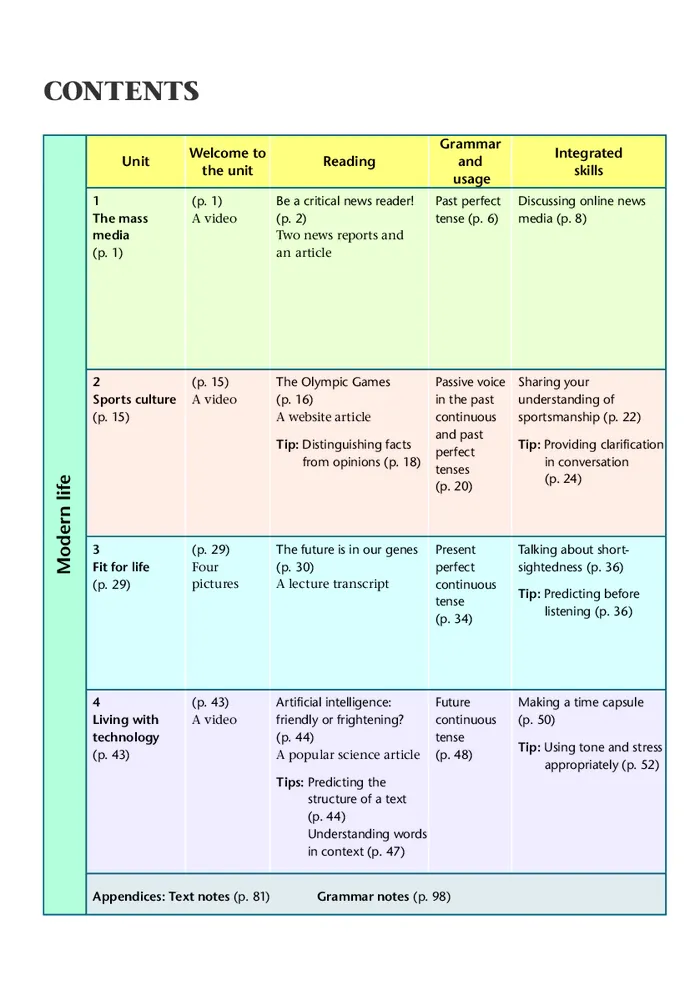
Unit
Welcome to
the unit
Reading
Grammar
and
usage
Integrated
skills
1
The mass
media
(p. 1)
(p. 1)
A video
Be a critical news reader!
(p. 2)
Two news reports and
an article
Past perfect
tense (p. 6)
Discussing online news
media (p. 8)
2
Sports culture
(p. 15)
(p. 15)
A video
The Olympic Games
(p. 16)
A website article
Tip: Distinguishing facts
from opinions (p. 18)
Passive voice
in the past
continuous
and past
perfect
tenses
(p. 20)
Sharing your
understanding of
sportsmanship (p. 22)
Tip: Providing clarification
in conversation
(p. 24)
3
Fit for life
(p. 29)
(p. 29)
Four
pictures
The future is in our genes
(p. 30)
A lecture transcript
Present
perfect
continuous
tense
(p. 34)
Talking about short-
sightedness (p. 36)
Tip: Predicting before
listening (p. 36)
4
Living with
technology
(p. 43)
(p. 43)
A video
Artificial intelligence:
friendly or frightening?
(p. 44)
A popular science article
Tips: Predicting the
structure of a text
(p. 44)
Understanding words
in context (p. 47)
Future
continuous
tense
(p. 48)
Making a time capsule
(p. 50)
Tip: Using tone and stress
appropriately (p. 52)
Appendices: Text notes (p. 81) Grammar notes (p. 98)
Modern life
CONTENTS
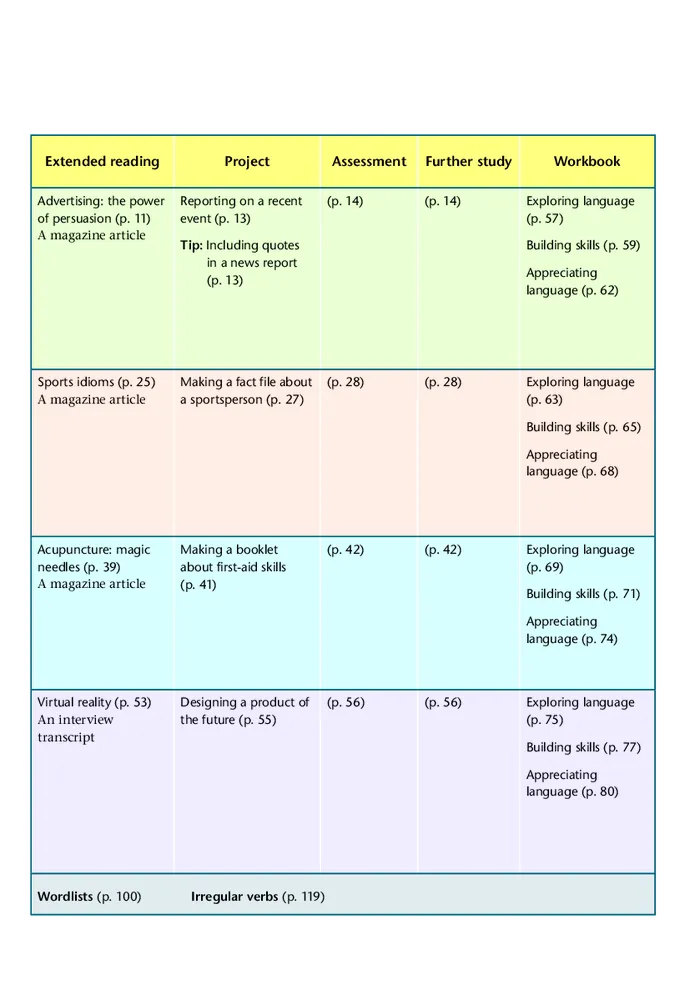
Extended reading
Project
Assessment
Further study
Workbook
Advertising: the power
of persuasion (p. 11)
A magazine article
Reporting on a recent
event (p. 13)
Tip: Including quotes
in a news report
(p. 13)
(p. 14)
(p. 14)
Exploring language
(p. 57)
Building skills (p. 59)
Appreciating
language (p. 62)
Sports idioms (p. 25)
A magazine article
Making a fact file about
a sportsperson (p. 27)
(p. 28)
(p. 28)
Exploring language
(p. 63)
Building skills (p. 65)
Appreciating
language (p. 68)
Acupuncture: magic
needles (p. 39)
A magazine article
Making a booklet
about first-aid skills
(p. 41)
(p. 42)
(p. 42)
Exploring language
(p. 69)
Building skills (p. 71)
Appreciating
language (p. 74)
Virtual reality (p. 53)
An interview
transcript
Designing a product of
the future (p. 55)
(p. 56)
(p. 56)
Exploring language
(p. 75)
Building skills (p. 77)
Appreciating
language (p. 80)
Wordlists (p. 100) Irregular verbs (p. 119)
The mass media
1
UNIT
1
The mass media
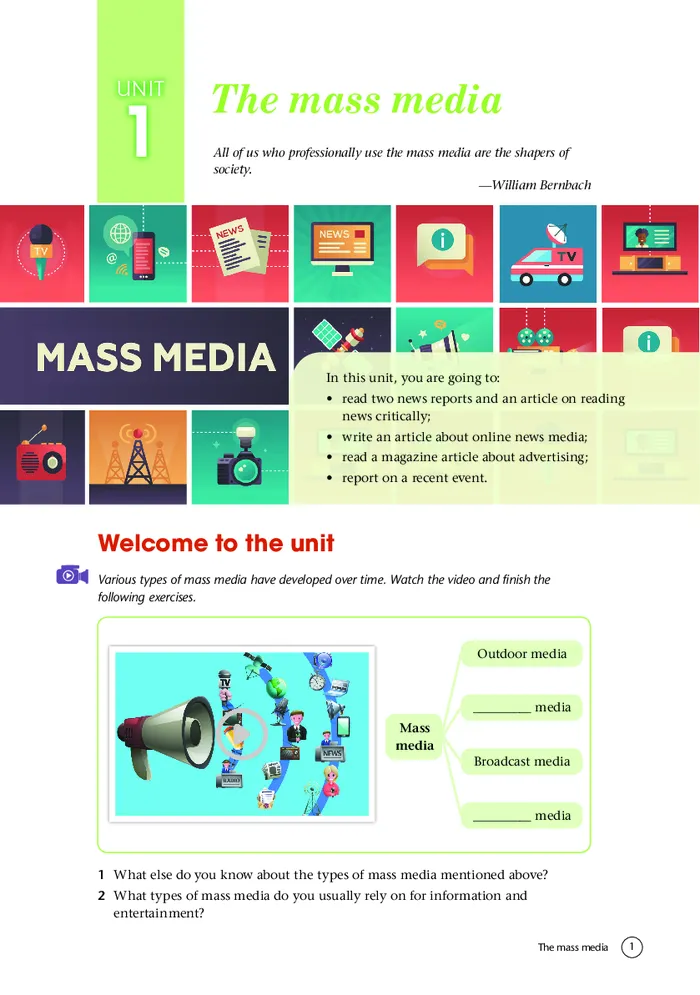
Welcome to the unit
In this unit, you are going to:
• read two news reports and an article on reading
news critically;
• write an article about online news media;
• read a magazine article about advertising;
• report on a recent event.
1 What else do you know about the types of mass media mentioned above?
2 What types of mass media do you usually rely on for information and
entertainment?
Various types of mass media have developed over time. Watch the video and finish the
following exercises.
All of us who professionally use the mass media are the shapers of
society.
—William Bernbach
Mass
media
__________ media
Broadcast media
__________ media
Outdoor media
5
10
5
10
Be a critical news reader!
Unit 1
2
Most of us learn about news through the mass media, but can we just believe news as it is
presented? The two news reports and the article below encourage you to be a critical news
reader. Before you read the news reports and the article, think about the following questions:
• Do you believe everything you read in a news report? Why or why not?
• What do you think makes a critical news reader?
Reading
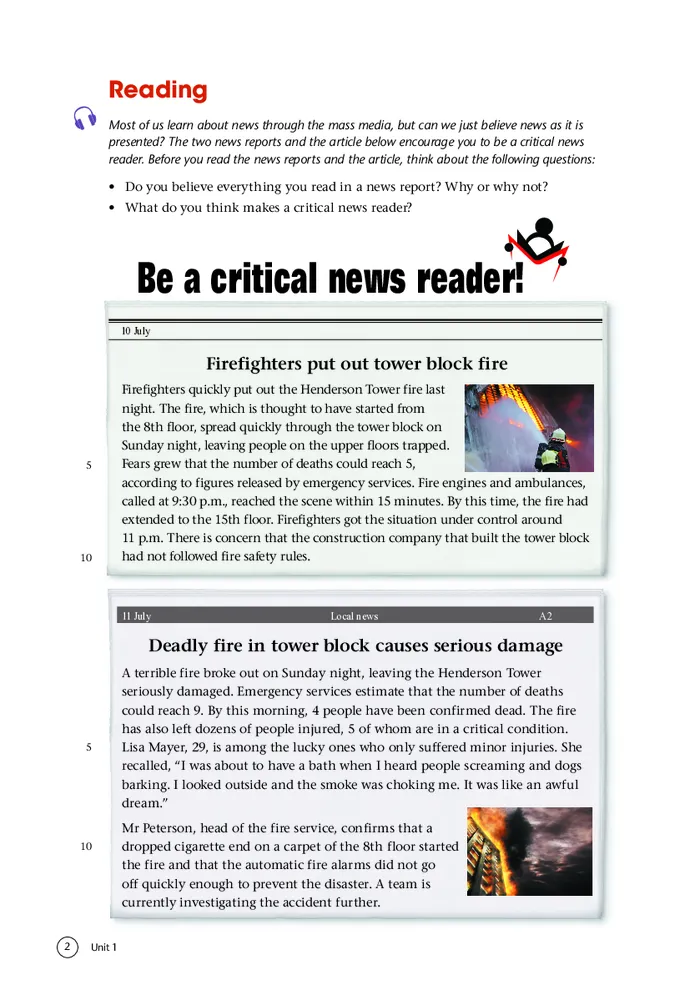
Firefighters quickly put out the Henderson Tower fire last
night. The fire, which is thought to have started from
the 8th floor, spread quickly through the tower block on
Sunday night, leaving people on the upper floors trapped.
Fears grew that the number of deaths could reach 5,
according to figures released by emergency services. Fire engines and ambulances,
called at 9:30 p.m., reached the scene within 15 minutes. By this time, the fire had
extended to the 15th floor. Firefighters got the situation under control around
11 p.m. There is concern that the construction company that built the tower block
had not followed fire safety rules.
Firefighters put out tower block fire
10 July
11 July
Local news
A2
Deadly fire in tower block causes serious damage
A terrible fire broke out on Sunday night, leaving the Henderson Tower
seriously damaged. Emergency services estimate that the number of deaths
could reach 9. By this morning, 4 people have been confirmed dead. The fire
has also left dozens of people injured, 5 of whom are in a critical condition.
Lisa Mayer, 29, is among the lucky ones who only suffered minor injuries. She
recalled, “I was about to have a bath when I heard people screaming and dogs
barking. I looked outside and the smoke was choking me. It was like an awful
dream.”
Mr Peterson, head of the fire service, confirms that a
dropped cigarette end on a carpet of the 8th floor started
the fire and that the automatic fire alarms did not go
off quickly enough to prevent the disaster. A team is
currently investigating the accident further.
The mass media
3
We rely on news to learn about what is happening in the world around us.
However, we usually find that reports on the same events contain different or even
contradictory information. How do these differences come about?
It is advisable to remember that journalists may have different priorities, which
would influence how they report an event. Let’s take the two news reports on the
Henderson Tower fire as an example. We can see that the first news report pays
more attention to the rescue efforts, while the second talks more about deaths and
injuries. When we read more than one report, we come to understand an event in
a more comprehensive way.
Even if news reports are written from basically the same perspective, they may
contradict each other in terms of factual details, as events in the real world are
usually complicated and constantly changing. For instance, the numbers of deaths
differ in the two news reports on the Henderson Tower fire. When we come
across such factual differences, we should not rush to the conclusion that one of
the news reports gives false information. Instead, check when the reports were
written. News reports written at different stages of an event could contain different
information as new facts are brought to light. Another aspect worthy of mention
is that journalists may approach information they get from research or interviews
differently. Suppose emergency services’ estimates of the number of deaths vary
between 5 and 9. Journalists may choose to present the minimum, the maximum
or something in between in their news reports. Therefore, checking different
sources enables us to draw a more informed conclusion.
To sum up, it is wise to read news reports written from various perspectives and
at different stages, which brings us a more accurate understanding of a situation.
We also need to be critical about the information we receive and remember not to
blindly trust what we have read. Though journalists are committed to presenting
the truth, it is better to use our own judgement than rely entirely on news reports.
With great discrimination, every one of us has the potential to be a critical news
reader.
5
10
15
20
25
Reading news reports critically
Unit 1
4
A Understanding the text
A1 Read the two news reports and the article and complete the tables below.
1 How long did it take the firefighters to get the situation under control according
to the first news report?
__________________________________________________________________________________
2 How did Lisa feel about the fire according to the second news report?
__________________________________________________________________________________
3 What should we not do when we come across factual differences in different
news reports?
__________________________________________________________________________________
4 What may different journalists do when an estimate of a number is given?
__________________________________________________________________________________
A3 In pairs, discuss the following questions.
1 Three texts are presented to encourage the reader to read news critically. Why
is the information organized this way? If you were to write on the same topic,
what information would you choose to present and how would you organize the
information?
2 A British writer and journalist once said, “A community needs news, for the
same reason that a man needs eyes. It has to see where it is going.” How do you
understand it?
3 What else can we do to be critical news readers?
A2 Read the two news reports and the article again carefully and answer the following
questions.
Time
Place
Deaths and
injuries
Rescue efforts
Cause
News
report 1
Sunday
night
Henderson
Tower
(1) _____________
________________
(2) _____________
________________
News
report 2
4 confirmed
dead and dozens
of people injured
(3) _____________
________________
Reading news reports critically
Why do news
reports differ from
or even contradict
each other?
• (4) ______________________________________________________.
• News reports may be written at different stages of an
event.
• (5) ______________________________________________________.
How can we be
critical news
readers?
• Read different news reports on the same event written
from various perspectives and at different stages.
• (6) ______________________________________________________.
The mass media
5
B2 The news reports and the article use the same words as different parts of speech. Find
more words used this way in the news reports and the article, and make sentences using each
of them.
B Building your language
B1 The blog post below is about how to be a good journalist. Complete the blog post with
the correct forms of the words and phrases in the box below.
accurate
investigate
be committed to
sum up
minor
priority
dozens of
come about
So, you are interested in becoming a good journalist but don’t know where to start?
Well, there are a couple of things you should put on your list of (1) _________________.
Firstly, you need to be skilled at writing. The information involved in a complex
story may come from (2) _________________ sources. Good journalists need to
organize all this information clearly to give a(n) (3) _________________ account of
what is happening.
Secondly, you must have a natural curiosity about things that are happening, even
though they may appear to be (4) _________________ matters. When something
newsworthy (5) _________________, it may escape the attention of ordinary people;
however, good journalists are sensitive enough to notice the event and draw public
attention to it.
Finally, good journalists (6) _________________ revealing the truth. According
to Noam Chomsky, “The duty of journalists is to tell the truth. Journalism
means you go back to the actual facts, you look at the documents, you discover
what the record is, and you report it that way.” To do this, journalists need to
(7) _________________ an event thoroughly.
To (8) _________________, being a good journalist requires writing skills, curiosity
and commitment to finding the truth. Good luck!
Emergency services estimate that the number of deaths could reach 9.
Suppose emergency services’ estimates of the number of deaths vary between 5 and 9.
B3 The two news reports present information in a factual and formal way. Find the
expressions in the two news reports that help present information this way and revise the
short paragraph below in a similar way.
Learn this To present information in a factual and formal way, you can use the
following expressions: according to, be thought to do/have done, there is concern that …,
be confirmed …, be reported to do/have done, etc.
The traffic accident on Sunday morning killed five people. It was probably caused
by a car driver speaking on his mobile phone. More and more people worry that
speaking on the mobile phone when driving has been a big killer in recent years.
Unit 1
6
Grammar and usage
Past perfect tense
A Exploring the rules
Below is the short life story of Joseph Pulitzer. Find the sentences that use the past perfect
tense and fill in the box below. The first one has been done for you.
• We often use the past perfect tense to talk about something that happened
(1) _________________ (before/after) a past time.
• The verb form of the past perfect tense is “(2) _________________ (have/had)
done”.
Grammar notes page 98
Joseph Pulitzer was born on April 10, 1847, in Hungary. He moved to America and
became an American citizen in the 1860s. He had a number of different jobs after
he moved to America. He regularly visited the library and studied English and
law—by then he had learned very little English. While in the library one day, he
began chatting to two editors of a German-language newspaper. They offered him
a job.
Pulitzer quickly became a successful journalist and by the age of 25, he had become
a publisher. In 1878, he founded the newspaper the St Louis Post-Dispatch. Pulitzer
worked tirelessly, from early in the morning until midnight. His paper published
articles about politics and social issues, accusing government officials of dishonesty
and wealthy people of not paying their taxes. Sales of the newspaper shot up. In
1883, Pulitzer bought the New York World. He used the same business strategy he
had employed at the St Louis Post-Dispatch and sales of the newspaper mounted up
until it was the bestselling newspaper in the country.
Pulitzer was the first to advocate the training of journalists at university level.
In 1892, he offered Columbia University money to start a school of journalism.
Of this decision he said, “I am deeply interested in the progress and elevation of
journalism ... regarding it as a noble profession and one of unequaled importance
for its influence upon the minds and morals of the people.” Pulitzer died in 1911.
One year after his death, the Columbia School of Journalism was established. Six
years after his death, the first Pulitzer Prizes were awarded.
… by then he had learned very little English.
Working out the rules
The mass media
7
B Applying the rules
B1 Circle the mistakes and correct them in the blanks below.
B2 Below is a passage about the Pulitzer Prizes. Complete it with the correct forms of the
verbs in the box below.
win build intend award allow
The Pulitzer Prizes are a set of awards honoring excellence in journalism and
the arts. The prizes were established largely due to the efforts of Joseph Pulitzer,
who (1) _________________ his reputation as a newspaper publisher. He left money
in his 1904 will to fund the establishment of the prizes, stating that he wanted
four awards in journalism, four in letters and drama, one for education, and five
traveling scholarships. Since the first prizes (2) _________________ in 1917, there have
been many winners and some people have won more than once. Past winners
include such famous names as Eugene O’Neill. When O’Neill received the Pulitzer
Prize in Drama in 1957, it was the fourth time he (3) _________________ it.
There have been a number of changes to the Pulitzer Prizes over time. Some
of these resulted from advances in technology. For example, online content
from newspaper websites (4) _________________ in all of the journalism categories
since 2006. The Pulitzer Prizes have also expanded to include such categories as
photography and music. Nevertheless, journalism is still what the Pulitzer Prizes are
best known for. Today, winning the Pulitzer Prizes is considered by many to be the
highest achievement possible in journalism—just as Pulitzer (5) _________________.
B3 Zou Taofen was a famous Chinese journalist and publisher. Read the timeline below and
describe his life story using the past perfect tense. Use the example below to help you.
1 Pulitzer knew that he had learned very little English, so he had started to work
hard at the language.
__________________________________________________________________________________
2 Pulitzer was very hard-working. Quite often, when he arrived home at midnight,
he was working for over 10 hours.
__________________________________________________________________________________
3 For the time he was 25, Pulitzer had become a journalist and publisher.
__________________________________________________________________________________
4 Many of the best reporters have worked for his paper before its failure in 1931.
__________________________________________________________________________________
Born in
Fujian
Becomes the
chief editor
of Life Weekly
Starts a new
journal called Life
of the Masses
Graduates from
university
Starts campaigning
against the
Japanese invasion
Dies in
Shanghai
1895
1926
1921
1931
1935
1944
Example
By the time he was 31, Zou Taofen had become the chief editor of Life Weekly.
1922
Becomes
an editor
Unit 1
8
Integrated skills
Discussing online news media
A Simon has found an article about the history of online news media. Read the article
below and answer the following questions.
The rise of online news media
The past decades have witnessed the rapid development of online news media. In
the mid-1990s, due to the popularity of personal computers and increased Internet
access, some newspapers began to publish their own digital editions on the
Internet. People can read the same content online as is printed in the newspapers
every day. By the end of 1999, about 1,000 newspapers in China had set up their
own online news platforms. At almost the same time, news websites with no print
editions sprang up. They made a hit immediately because of a wider range of stories
and almost instant updates of news events. Interaction was also encouraged as
readers could post their own comments.
Then we entered the smartphone era. Nowadays there are hundreds of thousands
of news apps and official news media accounts on social media, with a total
membership of over 700 million in China. Smartphone owners are finding it easier
to read news on their mobile devices. They can check the latest news any time at
any place.
As the chart shows, technology
has transformed the way people
get news during the past years.
From print media to broadcast
media to online media, reading
news has become a more
personal and comprehensive
experience than ever before.
The variety and accessibility
of online news means that the
rapid rise of online news media is unlikely to stop.
1 How has online news media developed over time?
__________________________________________________________________________________
2 What information can you get from the chart?
__________________________________________________________________________________
Where people get news: then and now
100%
90%
80%
70%
60%
50%
40%
30%
20%
10%
0%
15 years ago
10 years ago
5 years ago
Now
Print media
Broadcast media
Online media
Percentage of people
The mass media
9
B
Simon is interviewing a mass media expert about online news media. Listen and finish
the exercises below.
B1 Listen to the interview and fill in the blanks.
Miss Smith’s opinion on online news media
Reasons for the popularity of online news media
• People have (1) _________________ to news.
Readers can get the (2) _________________ whenever and
wherever they want.
With (3) _________________, people can simply type in their
search words and click “Search” to get the news they want.
• Online news media makes it easy for people to interact with
others and talk about news.
The future of online news media
It will develop (4) _________________ with print news media.
• Print news media is still viewed by many people as more
trustworthy than online news media.
• It is hard to change people’s (5) _________________. Some people
just enjoy the feeling of (6) _________________ when reading
news.
B2 Listen to the interview again and complete the notes below.
1 To learn about a specific topic from print newspapers or TV broadcasts, people
would have to carefully ______________________ or wait until a certain time of
day, and by then the stories may have already ______________________.
2 According to one study, ______________________ of online news readers regularly
comment on articles.
3 If people find an interesting online news article, they can quickly let their
friends know by sending them ______________________ to the story or sharing it
on ______________________.
4 A recent survey of ______________________ found that ______________________ trust
print news more than online news.
Unit 1
10
C In pairs, talk about online news media. Use the following questions and expressions to
help you.
• What is the current situation of online news media?
• What are the advantages and disadvantages of online news media?
• How will online news media change in the future? Why?
D Write an article about online news media. Use your ideas from part C and the
information in parts A and B to help you.
Expressions
Discussing advantages and disadvantages
One of the strengths/problems … is that …
Another positive/negative aspect is that …
On the one hand, … On the other hand, …
There are more advantages than disadvantages when it comes to …
… has more advantages over …
Planning your writing
• Learning about the structure
To write an article about online news media, you can follow the structure below:
Introduction: give information on the current situation of online news media.
Main body: state the advantages and disadvantages of online news media.
Conclusion: predict the future of online news media.
• Learning about writing techniques
You can use different expressions to avoid repetition in your writing. For example,
to talk about the popularity of online news media, you can use the sentence
patterns below:
It is clear that online news media is becoming increasingly popular among …
As we can see, online news media enjoys great popularity among …
Nowadays an increasing number of people turn to online news media for …
Checking your writing
Remember to check your writing after you finish and exchange drafts between you
and your partner. Pay attention to the following aspects:
Punctuation
Spelling
Grammar
Choice of words
Style (formal/informal)
Structure
Self-review
• What expressions do you use to avoid
repetition?
• How can you improve your writing?
Peer review
• What does your partner think of the
structure of your writing?
• What suggestions does your partner give
to improve your writing?
The mass media
11
Extended reading
Read the magazine article about advertising.
5
10
15
20
Advertising:
the power of persuasion
In just one day, a person can see hundreds of marketing messages. Advertising has
become part of modern life. But what is advertising exactly? In short, it refers to
the activity of promoting a product or service. In other words, it tries to persuade
people to buy a product or service.
The history of advertising has always been closely linked with that of the mass
media. From the ancient simple advertisements painted on outdoor signs to the
colourful, interactive ones in smartphone apps, advertising and the mass media
have developed hand in hand. As media channels have grown in number and
type, so have advertisements.
Because the mass media reaches so many people, it is a perfect vehicle for
advertisers. If an advertisement is placed on a popular website or on TV at peak
times, a huge number of people will know about the product or service it is
advertising. In addition to making people aware of a product or service, a successful
advertisement will also create a desire to buy, thus boosting business. That is why
when a company wants to promote a product or service, it often launches a mass
media advertising campaign.
Based on the psychology behind creating a desire to buy, advertisers have developed
ways of persuading people into purchasing their products or services. A common
technique to make an impact is to create a memorable slogan. Slogans use simple
but impressive language to make us remember the product or service being
advertised. Some of these slogans may also appeal to our emotions. For example,
a slogan may connect a fine china teapot it aims to promote with our pride in
having good taste. You will hear a variety of slogans any time you watch TV. Think
about your favourite one. What makes it special? And what message does it try to
Unit 1
12
get across? A slogan which communicates an idea effectively can boost sales and
even become part of popular culture. That is the power of memorable slogans.
Another technique advertisers often employ is to link their company or product to
a “brand ambassador”—a famous actor, a sports star, or even a fictional character.
Think of a popular fast-food restaurant. Does it have a brand ambassador? Is the
brand ambassador popular among potential customers? The more we like the brand
ambassador, the more we will be attracted to buy the product.
Of course, some advertisements are not so obvious: product placement is typically
used in films with huge box-office success and TV shows with high ratings. Some
films are now sponsored by leading brands, so that only their products appear in
the films, like the watches worn by the title character in the James Bond films.
Other types of mass media use product placement too, including video games. It is
not uncommon for sports video game series to feature different in-game equipment
with real brand names. We absorb these marketing messages without thinking
about them too much, yet they will probably have an effect on us the next time we
go shopping.
In the past, advertising was all about reaching as many people as possible with the
same message. Now, advertising is becoming more digital and more personalized.
Already we may see online advertisements for products or services we have previously
searched for on the Internet, and we are very likely to receive special discounts and
promotions targeted specifically at us. In the future, advertising will be even more
about understanding individual customers and sending them advertisements that
are tailored to specific needs. Not only will this make them feel more valued and
enable them to see what they are most interested in, but it will also help companies
target their customers more efficiently to have a positive effect on sales.
A Write a summary of the magazine article. Use the following questions to help you.
• What is advertising?
• What is the relationship between advertising and the mass media?
• What are the functions of advertising?
• How does advertising work?
• What is the future of advertising?
B
What is your favourite advertisement? What techniques does it use to promote the
product or service?
C What is your attitude towards advertising tailored to individual customers’ needs? Give
reasons for your answer.
25
30
35
40
45
The mass media
13
8 November
Local news
Using quotes adds authority and accuracy to a news report. When
using a quote, always introduce who you are quoting. In direct speech,
use the exact words that they said. In reported speech, remain faithful
to what was said though you do not need to use the exact wording,
and remember to use reporting verbs like say, tell or ask.
Tip
Including quotes in a news report
Students of a Nanjing senior high school brought joy to the elderly and
brightened up their day by volunteering at a local nursing home last
weekend. The nursing home, located on a housing estate, has more than
150 senior citizens, some of whom are over 90 years old.
Though it was the first time many of the students had taken part in a
volunteer programme like this, they were eager to share various interesting
topics with the residents, such as how to use mobile phones and go online
on the computer. After lunch the residents and the young volunteers
amused themselves with art activities which included Chinese painting and
calligraphy. They enjoyed each other’s company so much that Su Ming, 16,
said he hoped to return to the nursing home regularly to spend time with
the seniors that he made friends with.
Wang Hong, the programme organizer, said, “I was concerned that the
students and the senior residents wouldn’t get along easily, but it turned
out to be the exact opposite. I can say that today’s activities have made a
big difference to the lives of the residents as well as the students.”
Youth volunteers make a difference
Projectchure about your new school
Reporting on a recent event
A As a class, discuss what areas of news you are interested in. You can use the ideas below
or think of other ideas. Then in groups, choose one area of news and pick an event in this
area to report on.
community
education
entertainment
environment
medicine
sport
technology
transport
C As a group, write your news report. Use the example below to help you. Then present
your news report to the rest of the class.
B
As a group, research your chosen event. You can interview someone or turn to different
kinds of media for related information.
Unit 1
14
“Can You Spot the Problem with These Headlines?” is a short
video about whether headlines present information accurately.
The video provides examples of headlines and analyses typical
problems to help the viewer read news more critically. Watch the
video to learn how to become a critical news reader, and then
apply this knowledge the next time you read a news report.
China Daily is China’s bestselling English-language newspaper. It
was founded in Beijing in 1981 and now serves more than 350
million readers all over the world. Try reading it to get news and
practise your English at the same time.
Further study
Assessment
Answer the following questions to assess your performance. Then work in groups and
exchange your answers with your partners.
1 What questions can you ask to decide whether a news report is trustworthy?
2 What do you think of your writing about online news media? List 2 or 3
sentences that you are the most satisfied with.
3 What advertising techniques does an effective advertisement use? Which
works best for you? Why?
4 Did you have any difficulty doing the project of this unit? If yes, what was it?
5 What new words have you learnt from this unit? List some of them. *
6 What grammar have you learnt from this unit? Make a sentence with the
grammar. *
7 What tip have you learnt from this unit? Explain it briefly.
8 How are you going to improve your overall performance? Make an action
plan.
* Assess your learning of vocabulary and grammar by doing language practice on pages 57–58.
Sports culture
15
UNIT
2
Sports culture
Welcome to the unit
Many different sporting events enjoy great popularity among people across the world. Watch
the video and finish the following exercises.
In this unit, you are going to:
• read a website article about the Olympic Games;
• write an essay on sportsmanship;
• read a magazine article about sports idioms;
• make a fact file about a sportsperson.
1 Which sporting event in the video do you like best? Why?
2 What other sporting events do you know about?
Sport teaches you character, it teaches you to play by the rules, it teaches
you to know what it feels like to win and lose—it teaches you about life.
—Billie Jean King
• _________ is commonly held
during the last two weeks
of January. It was started in
_________.
• Formula 1 is the world’s fastest
motor race. The Chinese
Grand Prix is held in _________
in Shanghai.
• The Tour de France, held in
summer, is a team competition
that lasts for over _________
weeks with _________ stages.
5
10
15
20
Unit 2
16
The Olympic Games are an important event in the sports calendar. The website article below
is about this extraordinary sporting event. Before you read the website article, think about the
following questions:
• What do you know about the Olympic Games?
• Have you ever watched the Olympics? How did you feel?
Reading
Every four years, thousands of highly trained and talented athletes gather together
in the spirit of friendship, solidarity and fair play, ready to test their abilities
against each other in the hope of being recognized as the best of the best. This is
the Olympics—an extraordinary sporting event that was first celebrated about 3,000
years ago.
[Subheading 1] ____________________________
The ancient Olympic Games began in the year 776 BCE. During the early Games,
only Greek men were allowed to participate. They competed in such events as
boxing, running and the long jump. The ancient Olympic Games were held at
Olympia in Greece every four years for almost 12 centuries, until they eventually
died out around the year 393.
More than 1,500 years later, however, the Games rose again. The modern Olympics
were first held in 1896, in Athens. It was a Frenchman, Pierre de Coubertin, who
brought the Olympics back to life. His dream was that the Olympics would help
people of different racial origins and from different cultures live side by side in
peace. For over a century, people from diverse backgrounds have made joint efforts
to help realize Coubertin’s dream.
[Subheading 2] ____________________________
Motivated by the original Olympic motto “Faster, Higher, Stronger”, many well-
known athletes, both male and female, have devoted themselves to achieving
sporting excellence and pushing the boundaries of human achievement. One such
Olympian was the boxer Cassius Clay. He came to public attention during the
1960 Rome Olympics, when he won the light heavyweight gold medal for the USA,
25
30
35
40
45
50
17
Sports culture
demonstrating great talent and personality in the process. Afterwards, this young
man proceeded to become the world heavyweight champion in 1964, and later
changed his name to the one we all know—Muhammad Ali. He returned to the
1996 Atlanta Olympic Games to light the Olympic flame at the opening ceremony.
By the time he died in 2016, Ali had been recognized as one of the greatest boxers
of all time.
Another sportsperson that should be applauded is Jessica Ennis-Hill. Her story
is a remarkable example of how hard work and devotion can lead to sporting
excellence. A former track and field athlete from the UK, she won an Olympic gold
medal in her home country in 2012. As if that were not enough, she returned to
the Olympics and won a silver medal in 2016, just two years after giving birth to
her first child. In an interview she revealed that the secret of her consistent good
performance was the training that she never missed.
[Subheading 3] ____________________________
The 2008 Beijing Olympics called on the whole world to join in the Olympic spirit
and build a better future for humanity with the slogan “One World, One Dream”.
In addition to hosting the Olympics for the first time, China also ranked first in
the medal table. This success is truly remarkable if you consider that just 24 years
before, at the 1984 Los Angeles Olympics, Xu Haifeng won our country’s first-ever
gold medal. Since then the upward trend for Chinese sport has been unstoppable.
At the 2004 Athens Olympic Games, Liu Xiang became the first Asian to win the
gold medal in the men’s 110-metre hurdles, while at the 2016 Rio Olympic Games,
the Chinese women’s volleyball team won a hard-fought victory in the final.
Another historic moment for China came when Beijing successfully hosted the
2022 Winter Olympics after winning the election in 2015.
The Olympic Games bring joy and excitement to people across the world. As
Coubertin believed, “With the Olympic Games, each generation celebrates its
advent, its joy of living, its faith in the future, its ambition and its will to ascend.”
A2 Read the website article again carefully and decide whether the following statements are
facts (F) or opinions (O). If the statement is an opinion, find the evidence the author gives to
support it.
A3 In pairs, discuss the following questions.
1 What is the author’s attitude to the Olympic Games? Use details in the article to
support your opinion.
2 Do you think the Olympic Games can help people of different racial origins and
from different cultures live side by side in peace? Why or why not?
3 How do you understand Coubertin’s words at the end of the website article?
1 The ancient Olympic Games were held at Olympia in Greece
every four years until around the year 393.
F / O
_____________________________________________________________
2 Many Olympic athletes have devoted themselves to
achieving sporting excellence.
F / O
_____________________________________________________________
3 Since the 1984 Los Angeles Olympics, the upward trend for
Chinese sport has been unstoppable.
F / O
_____________________________________________________________
Unit 2
18
A Understanding the text
A1 Read the website article and write down the subheadings of the article.
Tip
A fact is a piece of information
that is known to be true and
can be proved. An opinion is a
statement that reflects an
author’s points of view,
beliefs, personal feelings and
values. In order for an opinion
to be accepted by the reader,
the author often supports it
with evidence. A critical reader
needs to distinguish facts
from opinions, and evaluate
the evidence on which the
opinions are based to decide
whether they are convincing.
Distinguishing facts from
opinions
Subheading 1: History of the Olympic Games
Subheading 2: _________________________________________________________
Subheading 3: _________________________________________________________
B2 Sports can be divided into different categories. Think of as many sports as you can and
fill in the table below. You can also add your own categories.
Sports culture
19
B Building your language
B1 The passage below gives an introduction to the Youth Olympic Games (YOG). Complete
the passage with the correct forms of the words and phrases in the box below.
The Youth Olympic Games are the youth version of the Olympic Games. Young
athletes aged between 15 and 18 (1) _________________ in a wide range of sports. The
majority of these sports are identical to those at the Olympics but other sports,
such as wushu, have been added too. The Youth Olympic Games give talented
teenagers a chance to connect with fellow athletes from (2) _________________
backgrounds. The focus is on building bridges between different cultures, so there
are competitions featuring mixed teams, such as mixed swimming relays. In these
competitions, both male and female athletes, sometimes of different nationalities,
play (3) _________________.
The first Youth Olympic Games were held in Singapore in 2010, and China
(4) _________________ first in the medal table with 30 gold medals. In 2014, Nanjing
had the honour of hosting the second Summer Youth Olympic Games. This was
another great success and China topped the medal table again.
People across the world (5) _________________ athletes who try hard to achieve
sporting excellence. However, it is not only the athletes who deserve applause.
The Youth Olympic Games (6) _________________ young people to learn and share
beyond the field of play. Official non-sporting roles include Young Reporters, YOG
Ambassadors and Athlete Role Models.
For many athletes, the Youth Olympic Games help them (7) _________________
that they are ready for the Olympic Games. Many of these talented athletes will
(8) _________________ to participate in the Olympic Games in the future.
B3 The website article gives a lot of specific information. Find the sentences using numbers
or years and revise the short paragraph below in a similar way.
Learn this When writing articles, we often use numbers and dates, such as years,
to give specific information. This way, our writing will be more convincing.
The first ancient Olympics were held a very long time ago. After that, the Greeks
continued holding the event for many years. Then the ancient Olympics stopped.
There were not any Olympic Games for a long time. Then a Frenchman named
Pierre de Coubertin restarted the Olympic Games. The first modern Olympic
Games were held in Athens.
diverse
compete
rank
call on
demonstrate
applaud
proceed
side by side
Categories
Sports
Ball games
basketball, football
Water sports
swimming, diving
Track and field
the 110-metre hurdles, the long jump
Grammar and usage
Passive voice in the past continuous and past perfect tenses
A Exploring the rules
Nicole wrote a blog post about the city half-marathon she took part in. Find the sentences
that use the passive voice in the past continuous and past perfect tenses and fill in the table
below. The first one has been done for you.
Unit 2
20
Grammar notes page 98
• The passive voice in the past continuous tense is used to refer to an
action being done at a specific time in the past. The verb form is
“(1) _________________”.
• The passive voice in the past perfect tense is used to express an action
completed before a past time. The verb form is “(2) _________________”.
My heart was beating rapidly in my chest as I found a shady place to rest my tired
body. My cheeks were red, and I could hear myself breathing heavily as I looked up
at the blue sky. When my breathing returned to normal, I reflected on what had
just been achieved. Six weeks ago, my friends told me that a city half-marathon for
amateurs was being organized to help raise money for charity, and encouraged me
to take part. Despite my lack of running experience, I agreed. In order not to hurt
my knees or ankles, I started my training very gently by running just one kilometre
on the first day. Over the next six weeks, I gradually increased the distance I ran
in each training session and also made sure to allow my body enough time to
rest and recover after each run. Soon I was running distances I had never thought
possible. The day of the half-marathon finally arrived and I felt well prepared. I ate
a hearty breakfast so I knew I could get through to the end. I ran my race relaxed
and confident, even though my limits were being tested like never before. I was
happy to learn that a lot of money had been raised for charity. I felt really proud of
myself, and my friends and I agreed to run in the next city marathon!
Passive voice
in the past
continuous
tense
Passive voice
in the past
perfect tense
..., I reflected on what had just been achieved.
Working out the rules
B2 Jessica gave an account of her experience as a volunteer for the city half-marathon.
Complete the passage with the correct forms of the verbs in the box below.
Sports culture
21
B Applying the rules
B1 Complete the sentences with the correct forms of the verbs in the brackets.
make train blow place carry cheer
B3 Think about a sporting event you took part in or watched. Describe the experience using
the passive voice in the past continuous and past perfect tenses.
1 It was an amazing achievement for a player who _________________ (injure)
so recently.
2 The swimming pool _________________ (clean) thoroughly the day before the
competition began.
3 He felt that his talents _________________ (waste) as a basketball player and was
eager for a change.
4 Tom was told that his teammate won the race while he _________________ (treat)
by the team doctor.
5 Photos of the riders _________________ (take) before they got on their horses.
By the time Cathy and I, together with other volunteers for the city half-marathon,
arrived at 4:30 a.m., tables (1) _________________ on both sides of the road. Bottles
of water and paper cups (2) _________________ to different tables, so Cathy and I
immediately went to help. Then, we took our place at the table and quickly
started to arrange the bottles and cups so that they looked like an army of soldiers
standing in line for inspection. I took a step back, and looked at the scene with
satisfaction. For the previous couple of weeks, I (3) _________________ on how to
be a volunteer for the half-marathon. I decided to volunteer for this year’s half-
marathon after the chairman of the organizing committee visited my school. We
were told that the competitors would be raising money for charity, and while I
didn’t feel that I had a strong constitution to run that far, I thought the next best
thing would be to help those who could.
After all the preparations (4) _________________, the exciting half-marathon began.
Cathy and I waited patiently until word spread that the first runners would be
arriving soon. As the tired, thirsty runners ran along, they (5) _________________
by the crowds. Cathy and I quickly poured water into the cups for them. After the
last runner passed, I found paper cups and plastic bottles everywhere. The litter
(6) _________________ around by the wind as I bent over to pick up a plastic bottle.
Cathy and I started clearing up. We were tired and wet with sweat but it felt really
good to know that we had been able to help others.
Unit 2
22
Integrated skills
Sharing your understanding of sportsmanship
A Daniel is listening to an introduction to Sir Bobby Charlton. Listen and finish the exercises
below.
A1 Listen to the introduction and decide whether the following statements are true (T) or
false (F). Circle the incorrect information in the false statements and correct it in the blanks.
1 The air crash happened when Bobby was 22 years old.
T / F
__________________________________________________________________________________
2 Together with his best friend, Bobby helped rebuild the team over the
next few years.
T / F
__________________________________________________________________________________
3 Instead of attending the celebrations after winning the European Cup,
Bobby stayed alone to remember his former teammates.
T / F
__________________________________________________________________________________
4 It can be seen in Bobby’s case that champions are not made in the gym or
on the field but in the heart.
T / F
__________________________________________________________________________________
A2 Listen to the introduction again and complete the notes below.
Personal information
• Was born in England on 11 October (1) _________________
• began playing football as a young child
Career and achievements
• returned to the game less than (2) _________________ after an air crash
• won the European Cup (3) _________________ after the crash
• made 758 appearances for Manchester United, scoring
(4) _________________ goals; scored 49 goals for England
• earned many honours including some of Europe’s highest athletic
awards, as well as (5) _________________ awards
• is known as one of England’s greatest football players and one of the
leading players in the history of football
Qualities
• Ability to control the midfield and to deliver striking blows and
(6) _________________ with either foot
• Determination, strong willpower, fitness and hard work
Sir Bobby Charlton
Sports culture
23
Winning isn’t everything
B
Daniel has found a website article about fair play. Read the article below and answer the
following questions.
We all know what it is like to want to win and most of us know what it is like
to lose. More often than not, winning has the victor walking on air, lost in
the glory of the moment, while the loser is left with a bitter taste and a feeling
of failure. Almost nobody likes to come second, and sometimes it is difficult
to keep everything in perspective. Modern society honours winners and
successful sportspeople quickly become celebrities, admired by all. However,
there are ways to win and ways to lose. Whether you come first or last, it is
important to remember that at any sporting event, you face two opponents:
your fellow competitors and yourself. At the finish, your competitors will
walk away but you will have to live with your decisions. A true sportsperson
will make the right decisions for the right reasons and not worry about
failure. There is an old and very wise saying, repeated many times, “Win with
humility, lose with grace, and do both with dignity.”
In praise of such acts of sportsmanship, the International Fair Play Committee
decided to award the Pierre de Coubertin Fair Play Trophy, in 1964. The
first athlete to receive the award was an Italian bobsleigh competitor named
Eugenio Monti. During the two-man bobsleigh final at the 1964 Winter
Olympic Games, he produced an excellent time for his downhill run. One of
the British competitors, Tony Nash, had broken a part of his bobsleigh and
was unable to compete. Monti became aware of this, and without hesitation,
he removed the same part of his own bobsleigh and lent it to his opponent.
Nash and his partner went on to achieve a record time and won the gold
medal. Monti’s remarkable, unselfish decision to help a fellow competitor, in
the final stage of an Olympic event, is an example to us all. He did not come
first but he walked away a true hero.
1 Why does the author say “at any sporting event, you face two opponents”?
__________________________________________________________________________________
2 Why was Monti awarded the Pierre de Coubertin Fair Play Trophy?
__________________________________________________________________________________
3 Would you do the same if you were Monti? Why or why not?
__________________________________________________________________________________
Unit 2
24
C In pairs, discuss different aspects of sportsmanship. Use the ideas in the mind map
below to help you and think of examples to support your ideas.
D Write an essay about sportsmanship. Use your ideas from part C and the information in
parts A and B to help you.
Tip
When you try to explain an
idea, the person you are
speaking to may fail to
understand you. In this case,
try to repeat or paraphrase
what you have said, or give
examples, e.g. When I say …,
I actually mean … Take … as
an example.
Providing clarification in
conversation
Sportsmanship
Playing fair
...
Working
hard
Showing respect
to other players
Planning your writing
• Learning about the structure
When writing an essay about sportsmanship, you can follow the structure below:
introduce the topic of sportsmanship and state the main idea of your essay.
Remember to take a clear stand on sportsmanship.
develop the body of your essay by giving your understanding of sportsmanship
in detail. Use examples to support your opinion where necessary. You can also
include an opposing opinion and state why you disagree.
sum up your opinion by reminding the reader of what you have written.
Rather than repeating the exact words, express your main idea in a different
way.
• Learning about writing techniques
Use transitional statements to conclude what you have written and introduce
what you will write next, which will make your essay flow more smoothly. For
example, after arguing that some people believe winning is all that matters,
you can move on to an opposing idea: Though winning is very important in sport,
I believe that …
Checking your writing
Remember to check your writing after you finish and exchange drafts between you
and your partner. Pay attention to the following aspects:
Punctuation
Spelling
Grammar
Choice of words
Style (formal/informal)
Structure
Self-review
• Do you use transitional statements in
your writing?
• How can you improve your writing?
Peer review
• What does your partner think of your
opinion on sportsmanship?
• Which sentences does your partner think
are most persuasive?
Sports culture
25
5
10
15
20
25
Every language has its idioms, which are groups of words with meanings different
from the meanings of the individual words. Idioms make language more colourful
and expressive. Since sport is an inseparable part of day-to-day life, there are lots of
sports idioms that have found their way into everyday language. Let’s take a look at
some of them!
Football
Football (or soccer, as it is called in the USA) is
one of the most popular sports in the world and
many countries have their own football leagues.
The English language is full of idioms which are
thought to have come from football.
As you know, in a football match, players try to
kick or head the ball into the opposing team’s
goal, which is the net between two big goalposts fixed to the ground. Can you
imagine that every time you have a chance to score, the goalposts are moved? That
would be not only difficult, but also upsetting. If someone “moves the goalposts”
in everyday life, it means they unfairly change the rules or requirements for
something. An insurance salesman who is about to reach his annual sales target,
only for the company to make the target higher, could rightly complain about the
company moving the goalposts.
Thankfully, goalposts do not really move—but when a player scores an own
goal, he or she might wish they did. “Scoring an own goal” in football means
accidentally kicking or heading the ball into one’s own net, and it is one of the
worst things that can happen to a football player. If someone makes a bad mistake
which unintentionally harms their own interests, they are said to have scored an
Extended reading
Read the magazine article about sports idioms.
Unit 2
26
A Find the idioms in the magazine article, explain them in your own words and make
sentences using these idioms.
30
35
40
45
50
55
60
B
Do you know any Chinese sports idioms? Make a list of them and explain how they are
different from or similar to English sports idioms.
own goal. You might see this expression in the newspapers when the local council
makes a decision which backfires terribly!
Baseball
Baseball is an old and popular sport that has given
the English language many different idioms. You
might have heard expressions like “in the ballpark”
or “a ballpark estimate”. The venue where a baseball
game is played is called a ballpark. So, even if we
do not know exactly where the ball is during the
game, we can assume that it is somewhere in the
ballpark. For this reason, people use the expression
“in the ballpark” or “a ballpark estimate” to talk about rough estimates.
Another common baseball expression is “throwing someone a curveball”.
Curveballs are balls that suddenly turn in the air, and these are of course difficult
for the other team to handle. We use this expression to describe things that are
unexpected and difficult to respond to. “Three strikes and you are out” is another
idiom that comes from baseball. As it suggests, in baseball this means that a
batter (the person with the baseball bat in his or her hands) is out after making
three unsuccessful attempts to hit the ball. This idiom is often used to talk about
situations where people fail after wasting three chances.
Boxing
English also has a large number of idioms
connected with boxing, which has been a popular
sport for thousands of years. A boxer is not
allowed to use his or her fists to hit the opponent
below the waist. Hence comes the idiom “below
the belt”. In day-to-day life, if someone makes
an unfair and cruel remark, we can describe it as
“below the belt”.
“Throwing in the towel” is another common idiom that comes from boxing. When
a boxer is losing badly and is too tired or confused to give up on his or her own,
the coach will literally throw a towel into the ring to end the fight. In everyday
life, this idiom simply means admitting defeat and giving up.
Sport is challenging and so is life. However, when you are thrown a curveball, do
not throw in the towel—work hard, be careful not to score an own goal, and you
are sure to make it!
Sports culture
27
Project
Making a fact file about a sportsperson
A As a class, discuss different sportspeople you are interested in. Then in groups, choose one
sportsperson to research.
B
As a group, research your chosen sportsperson. Use the ideas below to help you.
C As a group, put together your information to make your fact file. Use the example below
to help you. Then present your fact file to the rest of the class.
• Basic information
• professional career
• achievements
• Additional facts
Basic information
Date of birth: 10 December 1960
Place of birth: Tianjin, China
Additional facts
• Known as the “Iron Hammer”, Lang Ping is the first person in volleyball
to win Olympic gold medals both as a player and as a coach.
• During the 2015 FIVB Volleyball Women’s World Cup, she stayed up
late preparing for the next games by watching videos of the day’s
matches, and slept about six hours every night.
As a player
• joined the Chinese women’s
volleyball team, and won the silver
medal at the Asian Games in 1978
• won the gold medal at the FIVB
Volleyball Women’s World Cup in
1981 and 1985
• won the gold medal at the
FIVB Volleyball Women’s World
Championship and the Asian
Games in 1982
• won the gold medal at the Los
Angeles Olympic Games in 1984
• retired as a player in 1986
As a coach
• became head coach of the Chinese
women’s volleyball team in 2013
• coached the Chinese women’s
volleyball team to win the gold
medal at the FIVB Volleyball
Women’s World Cup in 2015 and
2019
• �coached the Chinese women’s
volleyball team to win the gold
medal at the Rio Olympic Games
in 2016
Professional career & achievements
Lang Ping
Unit 2
28
Further study
The film Cool Runnings is about a team of Jamaican athletes
who enter the bobsleigh competition at the Winter Olympics.
Watch the film to learn more about their inspiring story.
The Olympic Games allow us to experience humanity’s greatest
achievements in sport and many books have been written
about them. Choose a book about the history of the ancient
and modern Olympic Games, as well as the famous and
outstanding athletes, and read it to get inspired.
Assessment
Answer the following questions to assess your performance. Then work in groups and
exchange your answers with your partners.
1 How can the Olympic motto motivate you at senior high school?
2 Did you have any difficulty writing the essay about sportsmanship? If yes,
what was it?
3 Have you been in situations where you can apply some of the sports idioms?
Briefly explain the situation(s).
4 While doing the project of this unit, what contribution did you make to your
group?
5 What new words have you learnt from this unit? List some of them. *
6 What grammar have you learnt from this unit? Make a sentence with the
grammar. *
7 What tips have you learnt from this unit? Make a list of them.
8 How are you going to improve your overall performance? Make an action
plan.
* Assess your learning of vocabulary and grammar by doing language practice on pages 63–64.
Fit for life
29
UNIT
3
Fit for life
The practice of medicine is an art, not a trade; a calling, not a
business; a calling in which your heart will be exercised equally with
your head.
—William Osler
In this unit, you are going to:
• read a lecture transcript about genome editing;
• write an article on short-sightedness;
• read a health magazine article about acupuncture;
• make a booklet about first-aid skills.
Welcome to the unit
Medical professionals work hard to keep us healthy. Look at the pictures below and discuss the
following questions in pairs.
1 What jobs are shown in the pictures? Write the letters in the boxes above.
2 Would you like to be a medical professional? Why or why not?
3 Can you describe an experience you had with a medical professional? What was
it like?
a A surgeon performs
operations.
b A physician is
trained in general
medicine.
c A chemist prepares
and sells medicines
in a shop.
d A dentist
specializes in the
care of people’s
teeth.
The future
is in our genes
Unit 3
30
Good afternoon, ladies and gentlemen. Thank you all for coming to this lecture.
Over the course of my career, I have seen many wonderful scientific developments,
but none are as game-changing as genome editing. I am full of excitement about
the possibilities this scientific advance can bring and I hope to share my excitement
with you today.
As many of you may already know, genes play a critical role in shaping our lives.
Everything from the colour of our eyes to our talent for maths depends on genes.
The complete set of genes inside a cell or a living being is called a genome. Our
own personal genome carries all the information needed to make us grow and
develop. It also contains information that helps determine our lifespan and affects
our chances of contracting certain diseases. Some people, for example, carry a gene
that makes them more likely to catch a certain virus or develop a particular form
of cancer.
Geneticists have been trying to identify which genes relate to which diseases,
as they believe genome editing is an effective means of disease treatment and
prevention. It allows geneticists to make changes to the genome by correcting,
adding, deleting or replacing specific parts of the genetic material. In the near
Advances in medical science are happening quickly these days. The lecture below is given by a
biologist about the new possibilities that gene research can bring. Before you read the lecture
transcript, think about the following questions:
• What advances in medical science have you heard about?
• What do you know about genes?
Reading
5
10
15
Fit for life
31
future, geneticists hope to apply this technology to treat a wide range of health
problems. Soon we may be able to use such treatments to restore a blind person’s
vision or give someone who was born deaf an excellent sense of hearing.
Ultimately, this new technology might even make it possible to prevent diseases
from ever developing by correcting abnormal genes early on. Genome editing,
serving as a new weapon in the fight against diseases, will lead to a fundamental
change in our approach to health care.
As the technology continues to develop at a fast pace, however, questions arise
about how to use it appropriately. Should we restrict our use of this technology
to the treatment and prevention of diseases? Should we prohibit geneticists from
using it to enhance healthy bodies? One day soon we will be able to use genome
editing to increase the human resistance to colds and flu, to make people taller, to
help their muscles develop faster, to sharpen all of their senses or to make them
more intelligent. We will also be able to select specific characteristics for children
before they are born, creating what some have called “designer babies”. However, is
this a good thing? What consequences might it have? Philosophers, geneticists and
government officials have all started to wrestle with such moral issues. We have
to figure out how to keep the technology from running wild. This means putting
appropriate controls in place to make sure that genome editing will work to our
advantage. Without them, genome editing could be as dangerous as a car out of
control.
There is still much to be explored and debated on the subject of genome editing.
Despite the public argument over this technology, its possibilities have been
creating much excitement throughout the entire medical community and beyond.
Without doubt, genome editing is one of the greatest inventions in the history of
science. Thank you for listening.
20
25
30
35
40
A2 Read the lecture transcript again carefully and answer the following questions.
A3 In pairs, discuss the following questions.
1 How does the lecturer feel about genome editing? Find evidence from the lecture
transcript to support your opinion.
2 The lecturer mentions that one day we will be able to create “designer babies”.
What do you think of “designer babies”?
3 What controls can we put in place to make sure that genome editing will work
to our advantage?
1 What information does our personal genome carry?
__________________________________________________________________________________
2 How can geneticists make changes to the genome?
__________________________________________________________________________________
3 How might genome editing make it possible to prevent diseases from developing?
__________________________________________________________________________________
4 What is a “designer baby”?
__________________________________________________________________________________
5 What does the lecturer compare uncontrolled genome editing to?
__________________________________________________________________________________
Para. 1: Genome editing brings many exciting possibilities.
Para. 2: ___________________________________________________
Para. 3: ___________________________________________________
Para. 4: ___________________________________________________
Para. 5: ___________________________________________________
Introduction
Main body
Conclusion
Unit 3
32
A Understanding the text
A1 Read the lecture transcript and complete the chart below with the main idea of each
paragraph.
Fit for life
33
Suffixes
Meanings
Words
-(t)ics/-(o)logy the study of a subject
genetics
-(t)ic/-al
related to
genetic
-ist/-ian
a person who studies a subject
geneticist
B Building your language
B1 The news report below is about the discovery of genetic markers that are tied to lifespans.
Complete the news report with the correct forms of the words and phrases in the box below.
pace
means
identify
wrestle with
cell
fundamental
affect
without doubt
This week, a team of scientists based in Switzerland announced the discovery of
sixteen genetic markers that relate to human lifespans. (1) _________________, the
discovery is an important finding in the field of genetics. For years, scientists have
been working to (2) _________________ specific genetic markers that are connected
with a long lifespan. Until recently, only two such markers were known to the
scientific community.
Genes play a critical role in overall health. Every (3) _________________ in the human
body contains genetic information. Everything from the ageing process to the
development of deadly diseases, such as cancer, is tied to an individual’s genetic
make-up. However, scientists have long been (4) _________________ the question
about which genetic markers indicate a short or long lifespan. The discovery by
the research team may quicken the (5) _________________ of the study on genes and
human lifespans, and eventually help answer this question.
Scientists say that locating these sixteen genetic markers will greatly improve
their understanding of how genes (6) _________________ lifespans. These genetic
markers may eventually function as a (7) _________________ of targeting the
specific genes connected with lifespans. This could significantly enhance people’s
chances of living to a ripe old age. According to some scientists, it could make a
(8) _________________ change to the future of human life.
B3 The lecture transcript uses different structures with “as”. Find the sentences in the lecture
transcript and use different structures with “as” to join the sentences below.
B2 The lecture transcript uses a number of words related to “gene”. Look at the examples,
think of more word families with a similar pattern and fill in the table below.
Learn this “As” can be used in different structures to express different meanings,
such as time and reason. As a linking word, it can make your information better
organized.
1 You might have heard this before. Some genes make you more likely to
develop certain diseases.
2 We need to have appropriate controls on genome editing. It can be dangerous.
3 New discoveries are being made. Geneticists gain a better understanding of
our genes.
Grammar and usage
Present perfect continuous tense
A Exploring the rules
Below is a personal account given by a girl who is equipped with a robotic hand. Find the
sentences that use the present perfect continuous tense and fill in the box below. The first one
has been done for you.
Unit 3
34
• We use the present perfect continuous tense to talk about an action that
started in the past and is still continuing now, or an action that has just
finished but is still connected with (1) _________________ (the past/the
present/the future) in some way.
• The verb form of the present perfect continuous tense is
“(2) _________________”.
After I lost my right hand in a car accident two years ago, I began to withdraw into
myself, believing I would never be able to lead a normal life again. I was equipped
with an artificial hand, but it did not feel like part of me. Even simple things like
getting dressed were unbelievably difficult. Three months ago, however, all that
changed when I was given the chance to test a new robotic hand.
Scientists have been making great progress in robotic technology in recent years,
and their work on robotic limbs has really changed my life. With my new hand,
I can move my individual fingers and hold on to small things like pens and
pencils. More amazingly, my robotic hand is capable of feeling varying degrees of
pressure, just like a real hand. In addition, it looks very lifelike with special rubber
used on the outside.
Over the past three months I have been testing out the limits of what I can do with
my new hand, and it constantly surprises me. I have rediscovered hobbies I had
enjoyed before my accident. For example, I have been cooking for my family again
since I got my new hand. Not only can I do more, but I have also become more
confident and outgoing. I’m so grateful for all the new possibilities my robotic
hand has opened up.
Scientists have been making great progress in robotic technology in recent years, ...
Grammar notes page 99
Working out the rules
B2 Below is an article about robotic limbs. Circle the correct expressions to complete it.
Fit for life
35
B Applying the rules
B1 Complete the sentences with the correct forms of the verbs in the brackets.
B3 A student is interviewing David Jones about the research his team has been doing. In
pairs, role-play the interview using the present perfect continuous tense. The beginning has
been given.
1 I _________________ (reflect) on the article I read about ancient medicine all day.
2 I _________________ (wait) for two hours to see the doctor but it is still not my
turn yet.
3 My mother _________________ (write) a report on the new treatment all morning.
She hopes to finish it tonight.
4 The company _________________ (make) herbal medicines for more than 100 years.
5 Scientists _________________ (do) research on the disease since it was first
discovered in the early 20th century.
It (1) is being estimated/has been estimated that over 30 million people
worldwide have lost arms or legs, and many of them fail to get the help that they
need. For some time, they (2) are hoping for/have been hoping for better-quality
artificial limbs. Fortunately, one exciting new advance could help these physically
disabled people lead a normal life again: robotic limbs.
Over the last few years, scientists (3) have been developing/will be developing
new kinds of artificial limbs to help people overcome their disabilities. Robotic limbs
can do much more than conventional artificial limbs. Some of the earliest artificial
limbs were made of wood and leather, and until recently, artificial limbs (4) have
only served/have only been serving basic functions. With the advancement in
robotic technology, artificial limbs can now perform much more complex tasks and
come closer to real human limbs. Not only can they make a much wider range of
movements, but they can also be controlled directly by the brain and feed sensory
information back into it.
David Jones is one of a team of scientists devoted to making even better robotic
limbs. “We (5) have done/have been doing everything we can to advance this
technology and we will not take out a patent on it,” said David. “Hopefully, more
and more people in need of robotic limbs will be equipped with them and enjoy a
higher quality of life.”
Student:
What have you been doing, Dr Jones?
David Jones: We have been developing …
Unit 3
36
A2 Listen to the report again and complete the notes below.
Integrated skills
Talking about short-sightedness
A Jenny is listening to a report about short-sightedness. Listen and finish the exercises below.
A1 Listen to the report and answer the following questions.
Definition of short-sightedness
The inability to see objects at a distance clearly
Percentages of students who suffer from short-sightedness
Short-sightedness
1 What is special about the increasing number of Chinese students who are
affected by short-sightedness?
__________________________________________________________________________________
2 What sports can short-sightedness make it inconvenient for students to play?
__________________________________________________________________________________
3 What may short-sightedness give rise to in some cases?
__________________________________________________________________________________
4 What may be a key factor in developing short-sightedness?
__________________________________________________________________________________
Causes of short-sightedness
• Getting affected because one’s parents are short-sighted
• spending a large amount of time reading, (3) _________________, focusing on
a smartphone screen or doing other close work
• Having (4) _________________ or bad reading habits like reading in bed
• spending too little time (5) _________________
Signs of short-sightedness
• looking at things with eyes (6) _________________
• moving closer to objects
• Complaining of (7) _________________ and headaches
0%
10%
20%
30%
40%
50%
60%
70%
80%
100%
Primary school
students
Junior high school
students
Senior high school
students
90%
(1) ___________%
(2) ___________%
36%
Tip
It is helpful to identify
keywords before you
listen to a report. For
example, from the
notes, you might
identify “percentages”,
“causes” and “signs” as
keywords. Then you can
predict what the
speaker will talk about,
and look out for these
words as you listen.
Predicting before
listening
Fit for life
37
B Jenny has found a feature article about the measures taken by a high school to protect
students’ eyes. Read the feature article below and make a list of the measures.
A recent national survey has revealed that roughly three out of four high
school students wear glasses, fuelling concerns about eyesight problems among
China’s youth. The figures disturb the school authorities, who have decided
to tackle this problem head-on. No. 9 High School is one of those that have
gone to great lengths to protect students’ eyes, coming up with many effective
solutions.
It is important for eyes to get regular breaks throughout the day, so students at
No. 9 High School are advised to stop for a few minutes in the middle of their
study and look at distant objects. Instead of studying for long hours, students
are actively encouraged to go outdoors and enjoy themselves in the sun.
School facilities have also been improved to provide students with an eye-
friendly environment. The school has adjusted all the lights to make sure the
classrooms are well lit. In the computer room, computers are placed at least 50
centimetres away from students. In the library, new chairs can be adjusted to
ensure that students read in the best sitting position.
The school has also taken action to make everyone aware of the ways to
improve eye health. They have sent out information advising all parents on
how to protect their children’s eyes. At the same time, students have been
trained to recognize signs of eyesight problems themselves.
All of these measures are helping reduce eyesight problems. No. 9 High School
is leading the way for other schools with its impressive forward thinking on
eye health.
Effective ways to protect eyes
Measures taken by No. 9 High School to protect students’ eyes
1
2
3
D Write an article on short-sightedness among Chinese students. Use your ideas from part C
and the information in parts A and B to help you.
Expressions
Talking about cause and effect
Due to/Because of/As a result of …, short-sightedness has become a serious problem.
As a result/Consequently, more and more students …
Because …, students …
Such problems arise out of/arise from …
… is caused by …
Planning your writing
• Learning about the structure
When writing about short-sightedness, you can follow the structure below:
start by introducing the current situation of short-sightedness among Chinese
students.
analyse the causes of short-sightedness.
conclude with suggestions to improve the situation.
• Learning about the language
To put forward your suggestions, you can use expressions like:
The situation could be improved if …
An effective way to … is …
You can also write about the improvement you would like to see using
expressions like:
It is my belief that …
I am looking forward to …
Checking your writing
Remember to check your writing after you finish and exchange drafts between you
and your partner. Pay attention to the following aspects:
Punctuation
Spelling
Grammar
Choice of words
Style (formal/informal)
Structure
Self-review
• Does your writing cover all the main
points in your writing plan?
• How can you improve your writing?
Peer review
• What does your partner think of your
writing on short-sightedness?
• What improvements does your partner
advise you to make?
Unit 3
38
C In pairs, discuss the problem of short-sightedness among Chinese students. Use the
following questions and expressions to help you.
What is the present situation of short-sightedness among Chinese students?
What are the causes of short-sightedness?
What can we do to protect our eyes?
Acupuncture:
magic needles
Fit for life
39
Read the health magazine article about a traditional Chinese medical treatment.
One of the most famous Chinese medical treatments is the art of “magic needles”,
or Chinese acupuncture. It was developed long ago, perhaps as early as 2000 BCE.
There is evidence that acupuncture dates back to the Stone Age, when stone tools
called bian were used to press areas of the body.
As acupuncture developed, the simple bian stones were replaced by stone needles.
Eventually, metal needles began to appear and took the place of stone needles.
These solid needles are made of different metals, such as gold and silver. Some
acupuncturists today still use gold and silver needles, but the majority have now
switched to stainless steel ones. In addition to the changes in material, the shapes
of the needles have also changed over time. Originally, there were nine different
kinds of needles, with variations in shape. Nowadays, the fine sharp needles that
measure usually between 15 and 75 millimetres in length are still used, while most
of the others have been replaced by more complex medical instruments.
So what happens during a visit to the acupuncture clinic? First, the acupuncturist
examines the patient, looking at the patient’s skin and tongue, listening to the
sound of his or her voice and breathing, and smelling his or her breath. Then the
acupuncturist asks some questions about the patient’s condition and feels his or her
pulse. This is a particularly important step according to the energy theory behind
acupuncture. The acupuncturist can check the pulse in three positions on each
wrist, and every one of them is connected with a major body organ. By checking
all the positions, the acupuncturist can find out which energy channel does not
have enough energy.
According to the results of the check-up, the acupuncturist then selects certain
points on the body called acupuncture points. Needles are pushed into the skin at
these points so that a health problem can be treated. Up to now, more than 360
5
10
15
20
25
Extended reading
acupuncture points have been identified, each linked to a different part of the
body. Sometimes the needles are pushed into points near the body part affected by
a disease, and sometimes into points that are not so close to it.
Over the years, acupuncture has been used to treat a wide variety of health
problems, including severe pains, blood pressure issues, stomach discomfort, sports
injuries and weight problems. And it has been used to treat more than just physical
problems—acupuncturists have discovered that the treatment helps with mental
problems like depression and anxiety too. Acupuncture has also been applied to
treat people who abuse alcohol, tobacco or drugs.
How acupuncture actually works is not clearly understood. For example, there
are different theories trying to explain how it eases pain, but no agreement has
been reached. One theory explaining this phenomenon suggests that acupuncture
blocks pain signals from reaching the brain. Another theory relates acupuncture to
the production of a substance in the body which can reduce pain.
Despite the uncertainty about its medical basis, acupuncture has become a popular
form of treatment. As a unique contribution of traditional Chinese medicine,
acupuncture spread to many other Asian countries, such as Japan, as early as the
6th century. It was introduced to the West around the 16th century. In 2010,
acupuncture was included in the UNESCO Intangible Cultural Heritage List. Today,
acupuncture is recognized as a symbol of traditional Chinese culture and has come
into widespread use around the world. The World Health Organization recommends
acupuncture as a good treatment for over 100 medical problems. While doubts
about its safety have gradually disappeared, interest continues to grow.
Unit 3
40
30
35
40
45
A Write a short passage summarizing the use of acupuncture as a medical treatment. Use
the following questions to help you.
• What is the history of acupuncture?
• How does the acupuncturist treat the patient?
• What health problems can it treat?
• How does acupuncture work?
• What is its influence worldwide?
B
Would you be interested in getting an acupuncture treatment if you had a health
problem? Give at least two reasons.
Fit for life
41
Project
Making a booklet about first-aid skills
A As a class, discuss what first-aid skills you are interested in. You can use the ideas below
or think of other ideas. Then in groups, choose one health problem and research the related
first-aid skills.
B
As a group, research your chosen first-aid skills. Use the following ideas to help you.
C As a group, put together your information to make your part of the booklet. Use the
example below to help you. Present your part to the rest of the class. Then as a class, put all
the parts together to make the booklet.
animal bites
bleeding
burns
cuts
heart attacks
shock
• What health problem they treat
• When to use them
• Dos and don’ts
• How they help
1
Cool
• Hold burnt skin
under cool running
water for several
minutes, until the
pain eases.
• Do not break bubbles
on the skin, which
form to help protect
the skin.
Cover
Apply some medicine
to the burnt area. Then
cover the burnt area
loosely with a clean
bandage, so that it
does not stick to or put
pressure on the burn.
Call for
emergency help
Burns damage skin,
which can lead to
infection and other
health problems. If
the burn is severe, call
for emergency help or
go to the emergency
department.
First aid for minor burns
2
3
Unit 3
42
Further study
“How CRISPR Lets Us Edit Our DNA” is a video talk given by
geneticist Jennifer Doudna. She reveals interesting information
about CRISPR, the latest genome editing technique that
scientists can use to make changes to our DNA. Watch the
video talk to find out more about the applications of CRISPR,
future possibilities it may offer and measures we could take to
prevent potential problems with this technique.
Since its discovery, DNA has fascinated scientists and
encouraged constant research to understand its nature. DNA
studies have revealed some amazing secrets and led to many
useful applications. Read a book on DNA to discover more
about its secrets and the potential applications of genetics.
Assessment
Answer the following questions to assess your performance. Then work in groups and
exchange your answers with your partners.
1 Are you excited about the new possibilities that genome editing can bring?
Why or why not?
2 How well can you explain cause and effect relationships when writing the
article on short-sightedness? List 2 or 3 sentences that you are the most
satisfied with.
3 What do you think is the value of acupuncture?
4 What is the best part in your booklet about first-aid skills? Why?
5 What new words have you learnt from this unit? List some of them. *
6 What grammar have you learnt from this unit? Make a sentence with the
grammar. *
7 What tip have you learnt from this unit? Provide an example to show how it
helps you learn better.
8 How are you going to improve your overall performance? Make an action plan.
* Assess your learning of vocabulary and grammar by doing language practice on pages 69–70.
Living with technology
43
UNIT
4
Living with technology
The advance of technology is based on making it fit in so that you don’t
really even notice it, so it’s part of everyday life.
—Bill Gates
In this unit, you are going to:
• read a popular science article about artificial
intelligence;
• write a letter to people in the future;
• read an interview transcript about virtual reality;
• design a product of the future.
1 What other descriptions in science fiction have turned into reality?
2 Jules Verne believes that anything people can imagine can be made real. Do you
agree? Why or why not?
3 What technology do you imagine will be possible in the future and how do you
think it will change our lives?
Welcome to the unit
Science fiction becomes a reality with the development of science and technology. Watch the
video and finish the following exercises.
• Twenty Thousand Leagues
Under the Sea: travelling deep
under the ocean
• 2001: A Space Odyssey:
travelling to __________
• The Matrix: connecting the
human brain with __________
and entering the virtual world
Unit 4
44
Artificial intelligence is developing at a very rapid pace. Many people worry about the effects
that artificial intelligence might have. Below is a popular science article about artificial
intelligence. Before you read the article, think about the following questions:
Imagine waking up one morning with the option of staying in bed and pressing
a button to send a robot to do all the work for you. How cool that would be! It
may seem like building castles in the air, but given the rate at which artificial
intelligence, or AI, is being developed, in the future such dreams may actually
come true.
At the basic level, artificial intelligence is a branch of computer science that aims to
create intelligent machines. One of the essential aims of AI is to develop computer
intelligence capable of learning from experience, adjusting to new inputs and
performing tasks like humans. To achieve this aim, many approaches to creating
true AI have been put forward, including “deep learning”, which enables a machine
to improve its own performance by learning from the results of its previous actions.
Deep-learning AI has the capacity to analyse massive amounts of data through
multiple layers, imitating the complex networks of the human brain.
The dream of AI has been around for centuries, and the development of computers
since the 1940s has finally made it a reality. Years before the term “artificial
intelligence” was coined in the mid-1950s, the theory had been explored by
Reading
5
10
15
Tip
Predicting the structure of a text
Sometimes the title of an article can tell not
only what the text is about, but also how
the text is likely to be organized. So can the
pictures in the article.
• What do you know about artificial intelligence?
• How is the author likely to organize the
information on artificial intelligence?
Living with technology
45
Alan Turing, one of the pioneers in the field of computer science.
However, for a long time, AI technology developed very slowly. A
major breakthrough in AI came in 1997, when Deep Blue, a chess-
playing computer, beat the world chess champion Garry Kasparov.
Then in 2017, a computer program named AlphaGo defeated Ke
Jie, arguably the best human Go player, which demonstrated a
significant advance in deep-learning AI systems.
Nowadays, AI is already being applied in many fields: finance,
health care, machine translation and art, to name but a few. From
autonomous vehicles to domestic robots, from recommendation
systems to computers writing novels, AI has an unlimited number
of applications. Ordinary people are now using AI to get instant
translations of text in foreign languages, and machines can
recognize fingerprints and even faces.
In short, this technology is transforming the way we live. It is
clear that we are at a turning point in history. With machines
like AlphaGo now capable of thinking and learning from their
mistakes, we are getting closer to the dividing line between
humans and machines. The question is, where will all this lead?
While AI enthusiasts promise us a bright future where intelligent
robots will be working to our advantage, these undoubted benefits
also bring concerns and fears. Could machines really develop
human-like intelligence? And what would happen if they did?
Would thinking machines work alongside humans or threaten
the existence of humans? How would they be punished if they
committed crimes or even murdered humans? As we become more
and more dependent on computers, some scientists are urging us
to think about the dangers posed by the advances in AI. Stephen
Hawking, for example, warned, “The development of full artificial
intelligence could spell the end of the human race.”
Apparently, such warnings demand our attention. We need to make
sure that we will not fall victim to AI. We may still think it would
be fantastic to relax all day and allow autonomous machines to do
all the work for us—but perhaps we should not be too greedy and
rather be careful what we wish for!
20
25
30
35
40
45
50
Unit 4
46
A Understanding the text
A1 Read the popular science article and complete the chart below with the main idea of
each paragraph.
A2 Read the popular science article again carefully and answer the following questions.
1 How can a deep-learning machine improve its own performance?
__________________________________________________________________________________
2 What events were considered as major breakthroughs in AI?
__________________________________________________________________________________
3 What are ordinary people using AI to do?
__________________________________________________________________________________
4 What are we getting closer to according to the author?
__________________________________________________________________________________
A3 In pairs, discuss the following questions.
1 What is the author’s attitude to artificial intelligence? Use details from the
article to support your opinion.
2 In lines 44–46, Stephen Hawking is quoted as saying, “The development of full
artificial intelligence could spell the end of the human race.” Do you agree with
him? Why or why not?
3 What do you think intelligent machines will be capable of doing in the future?
Para. 1
AI can make your dreams come true.
Para. 6
_______________
_______________
Para. 2
_______________
_______________
Para. 5
_______________
_______________
Para. 4
_______________
_______________
Para. 3
_______________
_______________
Living with technology
47
B Building your language
B1 The passage below is about facial recognition technology. Complete the passage with the
correct forms of the words and phrases in the box below.
B2 The popular science article uses “coin” and “spell” differently from how they are
commonly used. Translate the sentences below into Chinese, pay attention to the underlined
words and think of more similar words.
B3 The popular science article uses a quote to show scientists’ concerns. Find the quote, write
down your opinion about the future of AI and support it with a quote.
Learn this Using quotes from famous people in your writing is an effective way to
support your ideas.
Technology is changing the face of the world, and now faces are changing
technology too. Facial recognition technology, with its capacity to
(1) _________________ a huge amount of data, has come into widespread use. It works
by comparing the facial features of given images with those in a database. It offers
a quick and cool alternative to traditional passwords, and you cannot forget your
own face! In theory, (2) _________________ which use our own body as passwords
should also be safer from hackers and better protect us from identity theft than
those that use traditional passwords, mainly because every individual is unique.
This technology is especially useful in public places: banks, airports and railway
stations, (3) _________________.
However, facial recognition technology has also started to (4) _________________
some difficult questions. Experts have been giving (5) _________________ about this
technology, saying it may not be as good as we think. Facial expressions often vary,
which makes facial recognition less effective. Moreover, there is growing concern
that we might (6) _________________ this technology, as there are cases in which
hackers have broken into facial recognition systems by using people’s social media
photos to build models of their faces.
Scientists and engineers (7) _________________ to improve existing technology and
make it fail-safe. (8) _________________, this will be a tough task. Whatever happens,
we need to make sure that facial recognition technology can be trusted—or we will
have to face the consequences.
apparently
urge
warning
fall victim to
analyse
pose
network
to name but a few
Tip
A word may have many meanings.
What it means heavily depends on
the context. Looking for contextual
clues in sentences will help you
better understand what a word
means and how it is used.
Understanding words in context
1 a She took a handful of coins out of her bag.
b Opportunity and risk are just two sides of the same coin.
c �The term “Silk Road” was coined by a German traveller
and geographer.
2 a Would you please spell your family name?
b �Some people are worried that artificial intelligence
would spell disaster for mankind.
Unit 4
48
Grammar and usage
Future continuous tense
A Exploring the rules
Working out the rules
• We use the future continuous tense to talk about an action that will be in
progress at a particular moment in the future or a future action that is the
result of a routine or an arrangement.
• We also use the future continuous tense to express (1) _________________
(predictions/warnings).
• The verb form of the future continuous tense is “(2) _________________ doing”.
Grammar notes page 99
Today I’ll be speaking to you about drones, ...
At the school science exhibition, Jessica is giving a talk to her classmates on how drones may
develop in the future. Find the sentences that use the future continuous tense and fill in the
box below. The first one has been done for you.
Good morning! Today I’ll be speaking to you about drones, also known as UAVs.
Flying around on their own, drones have already been used for photography,
scientific research and military operations. They will come into wider use in
various fields in the near future.
Delivery drones, as the name suggests, are used to deliver goods. At the moment,
delivery drones are mainly used for military action and disaster relief, like the
distribution of medicines during emergencies, especially to places that are hard
to reach by other means of transport. It can be predicted that before long many
people will be using drones to deliver daily supplies like food and drink.
Some companies are also developing passenger drones, which carry people in
crowded cities. Just enter a destination, and the drones will fly the passengers
where they want to go. This could not only save time, but also greatly decrease
road traffic. We can assume that with improved technology in passenger drones,
we will be entering the age of personal flying vehicles.
There are also many other exciting new ways to use this technology. Whatever
happens, we’ll all be interacting with drones on a daily basis. There can be no
denying that the technology will have a huge impact on everyday life.
B Applying the rules
B1 Complete the conversations with the correct expressions in the brackets.
1 Celine: �Lisa is a smart engineer. I feel proud to see the contributions she
(a) _________________ (has made/will be making) to the company.
Jack:
�So do I. I also believe we (b) _________________ (are seeing/will be seeing)
more of them in the next few years.
2 Sam: �(a) _________________ (Will you be visiting/Have you visited) the science
exhibition next month?
Amy: �Yes. You know I’m a technology enthusiast and I (b) _________________ (am
looking forward to/will be looking forward to) it.
3 Alice: �I (a) _________________ (have been giving/will be giving) a talk on
artificial intelligence from 2 to 3 p.m. tomorrow. I really feel nervous.
Simon: �Take it easy. You (b) _________________ (have been making/will be
making) preparations and your audience will be impressed.
B3 Write down your prediction about technological development using the future continuous
tense.
I predict that _______________________________________________________________________
_____________________________________________________________________________________
B2 Below is a passage about the problems that might be caused by the widespread use of
drones. Complete the passage with the present continuous or future continuous form of the
verbs or phrase in the box below.
For better or for worse, the widespread use of drones will affect our lives in
different ways. It is certain that as the technology gets more advanced, more drones
(1) _________________ in the sky. Despite all the wonderful functions that drones
perform, they may also cause trouble.
Take air traffic for example. When passenger drones are flying above our cities in
large quantities, the sky (2) _________________ more and more crowded. As a result,
they are more likely to crash into each other. In addition, drones cause much
trouble for airlines as some of them fly near airports, posing a threat to planes that
(3) _________________ or landing.
Another risk is that people might take advantage of drones to harm others. For
instance, as more people (4) _________________ drones for photography in the future,
some might spy on and take photographs of others without their knowledge. Illegal
hunters might also use drones to track and kill animals.
Such issues must be addressed. The government needs to make laws to monitor
the production and use of drones. For example, in some countries, a remote pilot
licence is required in order to fly a drone for business purposes. At the moment,
different countries (5) _________________ air traffic control systems that can manage
large numbers of drones. Police forces around the world are also looking at ways of
stopping drones from flying near airports and stadiums.
Living with technology
49
develop fly get use take off
Integrated skills
Making a time capsule
A Anna is listening to Professor Chen’s talk on a radio programme about time capsules.
Listen and finish the exercises below.
A1 Listen to the talk and decide whether the following statements are true (T) or false (F).
Circle the incorrect information in the false statements and correct it in the blanks.
A2 Listen to the talk again and complete the notes below.
Time capsules
Purpose of a time capsule
To provide a picture of (1) _________________ at the time it was created
Things to be put in a time capsule
• Almost anything
• A “letter to the future”
Famous time capsules
• In 1983, Steve Jobs donated (2) _________________ from his computer to
be put in a time capsule, which was opened in (3) _________________.
• A time capsule was launched to (4) _________________ in 2008. It
contains a list of humanity’s most important achievements and
personal messages, as well as copies of the (5) _________________ of
famous people like Stephen Hawking.
1 In a “letter to the future”, the writer might describe his or her hopes and
worries for future generations.
T / F
__________________________________________________________________________________
2 The time capsule associated with Steve Jobs was 15 feet long.
T / F
__________________________________________________________________________________
3 The 1983 time capsule was intended to be buried for 30 years.
T / F
__________________________________________________________________________________
4 The maker of the 2008 time capsule was worried that the Earth might
suffer a terrible disaster.
T / F
__________________________________________________________________________________
Unit 4
50
B
Anna is reading an introduction to the time capsule at the 1939 World’s Fair. Read the
introduction below and answer the following questions.
Living with technology
51
1 What were the purpose and contents of the 1939 time capsule?
__________________________________________________________________________________
2 What was Einstein’s message to future generations about? Why do you think he
wrote the message with mixed feelings?
__________________________________________________________________________________
The 1939 World’s Fair opened in New York on April
30. The theme of the fair was “Building the World
of Tomorrow”. One highlight of the fair was a time
capsule with Albert Einstein’s message to people
5,000 years in the future.
The time capsule, buried 50 feet below the ground
in a park, was designed to be opened in the year
6939. It was filled with various objects that were
intended to show what life was like in America at
the time the capsule was created: a toothbrush, a
fountain pen, a baseball, a toy car, a small camera,
microfilm rolls recording modern literature, contemporary art and news events
of the 1930s, a variety of seeds including wheat, and many more.
Albert Einstein wrote a message to future generations, which was put in the
capsule. In his message, he wrote about the technological progress man had
made:
Our time is rich in inventive minds, the inventions of which could make
our lives considerably easier. We are crossing the seas by power and use
power also in order to relieve humanity from all tiring muscular work. We
have learned to fly and we are able to send messages and news without
any difficulty over the entire world through electric waves.
However, his message was also colored by the dark times he lived in. He
mentioned a few social problems before concluding that he believed future
generations would read his message with “a feeling of proud and justified
superiority”.
C In pairs, discuss ideas for your time capsule that will be opened in 2050. Use the
following questions to help you.
• What would you like to tell people in the future?
• Imagine that you need to put a technological
product in the time capsule. What would you
choose? Why?
• What hopes and wishes do you have for the future?
D Write a letter to people in 2050. Use your ideas from part C and the information in parts
A and B to help you.
Tip
In conversation, your tone and stress on
certain words help express your ideas and
emotions better. For example, you can use a
rising tone to check or confirm something
with your partner, even when what you say
is not a question. If you stress “wonderful”
when saying “It is a wonderful invention.”, it
shows you think highly of the invention.
Using tone and stress appropriately
Unit 4
52
Planning your writing
• Learning about the structure
When writing a letter to people in the future, you can follow the structure below:
Describe what life is like in your time.
Focus on one technological product and explain how it is changing people’s
lives.
Conclude your letter with your hopes and wishes for the future.
• Learning about writing techniques
It is a good idea to give specific statements rather than general ones, which makes
it easier to get your ideas across. For example:
We are living in a great age. (general)
We are living in an age when the Internet makes it possible for us to stay connected
wherever we are. (specific)
Checking your writing
Remember to check your writing after you finish and exchange drafts between you
and your partner. Pay attention to the following aspects:
Punctuation
Spelling
Grammar
Choice of words
Style (formal/informal)
Structure
Self-review
• Are your descriptions specific or general?
• How can you improve your writing?
Peer review
• What does your partner think of your
descriptions?
• What suggestions does your partner give
for further improvement?
Extended reading
Susan, an industry-leading tech magazine editor, is interviewing Frank, an expert in virtual
reality (VR). Read the interview transcript below.
Living with technology
53
Susan: Frank, you’ve been working at the forefront of developments in virtual
reality for many years. Can you tell us what virtual reality is and how it
works?
Frank: Of course. The basic definition of VR lies in the name itself, which means
“reality that is not real”. When you wear a VR headset equipped with
sensors and a screen, you are surrounded by three-D images, sounds and
other sensory information, which creates a super-realistic effect called
“presence”. Though you know the sensory information surrounding you
is not real, part of your brain believes it is—and acts accordingly.
Susan: Thanks, Frank. Can you give some examples of the practical applications
VR has?
Frank: I’d love to. There are a host of educational applications. Academic VR
enables students to interact with others in a three-D environment. There
are endless possibilities for the subject matter that can be created in a VR
system. Imagine studying the solar system or the human body in a fully
immersive environment. By delivering the content in a meaningful way,
this new approach to learning manages to engage students’ interest and
enhance learning efficiency. The applications can be expanded to make it
easier to visualize data such as engineering projects and a variety of other
design developments. It’s pretty exciting!
Susan: This sounds like it has a lot of constructive applications. What about its
uses for highly developed technical industries such as medicine?
Frank: Surgeons are already using robotic technology with VR to perform
complex surgery. What if I told you that doctors could create a virtual
“twin” in order to practise delicate surgery before attempting it on the
patient? This technology can be applied to train new surgeons; it also
enables experts to test new techniques safely before trying them on
human subjects. Treatments of anxiety and drug addiction are other
valuable and cost-effective applications of VR.
Susan: That is amazing! It sounds like VR will be a life-changing technology as
well as a life-saving one. How will it affect the different aspects of our
everyday lives, such as entertainment, shopping and travelling?
5
10
15
20
25
30
A Fill in the table with the information from the interview transcript.
B
What other applications of VR do you know about?
C What future development do you think VR will have?
Frank: The entertainment industry is one of the most enthusiastic advocates
of VR. Current game systems come with headsets so that players can
enter virtual environments and play against either real or virtual
opponents. It won’t be long before virtual museums and interactive
three-D exhibitions become common. When shopping online, you can
look forward to being able to have your own virtual reality clone try on
clothes and to see products with 360-degree views. Also, people who
want to go on holiday will have the opportunity to take a virtual tour of
several destinations before deciding where to go. In both of these cases,
this technology will help people make more informed choices.
Susan: I can’t wait! However, as with any technology, there must be some barriers
to the development of VR, I guess?
Frank: It really boils down to three things—time, cost and technical limitations.
We will need time to develop and fine-tune the hardware and software.
The initial cost will discourage most people in the beginning but that
should be fixed over time. The last issue is our own technical limitations.
Just trying to figure out how to do what we want in terms of technology
will prove challenging in some areas.
Susan: Considering there are so many challenges to deal with, are you still
optimistic about the future of VR?
Frank: Sure. When talking about VR, we should keep in mind its quick rate of
evolution. The possibilities seem endless. For example, 5G technology,
with its potential to serve up more stable mobile connectivity at faster
speed, will make it possible for people to enjoy a more immersive
VR experience wherever they are. Indeed we are only limited by our
imagination. What excites me the most is that young people today
are digital citizens who are comfortable with technology. They’re well
equipped to become part of a technological generation that will develop
and use VR to do things we might think impossible today.
Susan: Thank you, Frank. It all sounds wonderful.
What VR is
How it works
Applications
Barriers
Future
Unit 4
54
35
40
45
50
55
60
Living with technology
55
Project
Designing a product of the future
A As a class, discuss high-tech products that you think will be available in the future. Then
in groups, choose one product that you would like to design.
C As a group, put together your information to make an introduction to your product. Use
the example below to help you. Then present your product description to the rest of the class.
B
As a group, discuss how you will design the product. Use the ideas below to help you.
Think of an attractive name for your product.
• Who the target users are
• How it looks
• What functions/applications it has
Does it annoy you to see cars blocking the road like
weeds when you are travelling? Our new InstaTrip
watch makes travel stress a thing of the past. You
could be away from your busy life and travel to a
far distant land instantly—all you need to do is
touch a few buttons.
Featuring a state-of-the-art touchscreen and a virtual three-D globe which
is constantly updated by our satellites above the Earth, the InstaTrip watch
makes it easy to pick exactly where you want to go. Once you choose
your destination, built-in sensors map your body and the latest transport
technology takes you there in an instant! We guarantee that you will never
have an unpleasant trip.
All this technology does not come at the
expense of fashion. We have designs for
different ages, genders and occasions, so you
will be the envy of all your friends wherever
you go—from pubs to offices. Whether
you need a break from your busy life, have
to go home for something or just want an
adventure, the InstaTrip watch makes
travelling easy.
InstaTrip watch:
travel in no time!
Further study
Science fiction films often give us a glimpse into the future.
Many important inventions, such as the mobile phone, first
appeared as unbelievable machines in sci-fi stories. Watch a
science fiction film and explore whether its ideas have—or
could—become a reality.
Artificial intelligence (AI) plays an important role in our
current lives. Its capabilities seem to be endless, and it is
predicted to become an even bigger part of our future lives.
Read a book on AI to learn about its history and current
applications, as well as how the technology is likely to develop
in the future.
Assessment
Answer the following questions to assess your performance. Then work in groups and
exchange your answers with your partners.
1 What impresses you most when you read the popular science article about
artificial intelligence?
2 Are you interested in the writing topic of this unit? Why or why not?
3 Do you agree that VR will be a life-changing technology? Why or why not?
4 How do you like your experience of designing a product of the future?
5 What new words have you learnt from this unit? List some of them. *
6 What grammar have you learnt from this unit? Make a sentence with the
grammar. *
7 Of all the tips provided in this unit, which one do you think is the most
useful? Why?
8 How are you going to improve your overall performance? Make an action plan.
* Assess your learning of vocabulary and grammar by doing language practice on pages 75–76.
Unit 4
56
Unit 1 The mass media
Workbook
A Replace the underlined parts in the following sentences with the correct forms of the
words and phrases in the box below.
1 The forecast says that the storm will reach all parts of the province
tonight.
_________________
2 This company was established more than a century ago.
_________________
3 The police are looking into the accident right now.
_________________
4 People’s abilities may not be the same, but they should have equal
rights and opportunities.
_________________
5 It was years before these facts became known.
_________________
6 Recent years have seen the rapid development of China’s
high-speed railway.
_________________
7 Is it true that most people need to read something more than
once to take in all the ideas?
_________________
8 What he said at the meeting was not true.
_________________
B
Fill in the blanks with the correct forms of the phrases in the box below.
1 They collected ______________________ shells on the beach, which could be used
to create a unique picture.
2 When the fire alarm ______________________, leave the room as quickly as possible.
3 A plane that was stolen from the East Bay Airport crashed in the end. How did it
______________________?
4 There are many ways to get to the town centre. ______________________, you can
take a water taxi.
5 It is important not to ______________________. Instead, double-check the facts
and figures.
6 ______________________, you must stop smoking immediately, take regular
exercise and eat more fresh fruit and vegetables.
7 I believe that hundreds of small companies ______________________ in our
province soon.
8 Don’t let others ______________________ buying things you don’t need.
come about
dozens of
for instance
go off
persuade sb into
rush to conclusions
spring up
sum up
absorb
differ
false
extend to
investigate
witness
found
bring ... to light
57
The mass media
Exploring language
C Fill in the blanks with the correct forms of the verbs in the brackets.
1 By the time I got home, my son ______________________ (finish) his homework
and was watching TV.
2 Tim looked around the surroundings and felt that he ______________________ (be)
there before.
3 One of my friends went abroad two years ago and we ______________________ (be)
out of touch since.
4 Before I went on the trip, I ______________________ (study) the map carefully and
marked the places on it.
5 Mike ______________________ (want) to come to the lecture, but he changed his
mind at the last minute.
6 Sorry for being late. I was about to leave when a friend ______________________
(call).
7 —How many books did you read during the holidays?
—All the books that our teacher ______________________ (recommend).
8 When I got out into the street, I realized I ______________________ (leave) my key
at home.
D Translate the following sentences into English. Use the words and phrases in the brackets.
1 来自世界各地的救援人员正在全力解救困在山洞里的孩子。(trap)
2 九月的进口贸易数据将在下个周末公布。(release)
3 孩子对周围的世界有天然的好奇心。(curiosity)
4 被指责说谎时,他感到很生气。(accuse)
5 你应该按照轻重缓急把任务列出来。(priority)
6 我们学校致力于每个学生的全面发展。(be committed to)
7 在黄金时段的电视上投放广告是非常昂贵的。(advertise; peak)
8 他花了两个小时才把自己的想法表达清楚。(get across)
58
Unit 1
1 What does the underlined phrase “raise red flags” in the second paragraph
mean?
2 What tips are given on how to identify fake news?
We read news every day. Having an accurate account of newsworthy events
allows us to be more knowledgeable about current affairs and avoid potentially
damaging misinformation. But how would we know if what we are reading is
fact or fiction? Follow the tips below to prevent you from becoming a victim
of fake news.
If you look at the headline and content of a news report and it seems like fake
news, it probably is. Some news reports that focus on exciting stories rather
than facts attract readers with bold headlines, shocking exaggerations of events
or just plain gossip. While this may indicate an untrustworthy news article, the
writing itself can also raise red flags. If there are errors in spelling or grammar,
it can also point to false news as reputable news outlets hold their writing to a
higher standard.
If you want to determine whether a piece of news is valid, it is also necessary
to make sure that it is reported by a source that is trustworthy. A quick Internet
search can determine whether the reporter or publisher can be trusted. Visit
the publisher’s official website to find out more information about it. The
“About Us” section, in particular, can reveal a lot about the publisher. You can
also check other resources to determine whether your source is reliable.
Last but not least, reporting the news faithfully usually involves presenting
information from various sources. If there is no data that a news report is
referencing, then it is more likely that it is not reliable. So looking at where
the author gets his or her information can help you determine whether a
news event is real. Like any academic writing, a good news article should cite
its sources such as personal eyewitness accounts, interviews, videos, or other
published articles. A lack of such sources is a good indicator of falsehood.
It may take a few extra minutes to confirm if a news story is true, but these
tips will not only enable you to separate fact from fiction, but also help you
develop into a critical reader.
59
The mass media
Building skills
A Reading and speaking
A1 In the information age, we have easy access to lots of news; however, fake news has
become a big issue. Read the guide below and answer the following questions.
A2 In pairs, role-play an interview between a student and a media expert on how to identify
fake news and prevent it from circulating. Use the example below to help you and pay
attention to the expressions in bold. Switch roles after you finish.
A: Would you say that fake news is a big problem?
B: It is a very big problem. In fact, some fake news stories may receive more
attention on social media than those from trustworthy news outlets.
A: Are there any reliable ways to identify fake news?
B: Yes. You could start by looking at the quality of the story. Are there spelling
or grammatical mistakes? If so, it’s highly likely that the news story is not
reliable.
A: What if it looks like a real news story?
B: Well, it’s always a good idea to check whether the source is reliable or not.
Look at the other articles on the site and ask: do they look sensible? Plus it
would be wise to do a quick online search to see whether any other news
outlets have reported on the same event.
A: What should I do if I come across a fake news story?
B: Well, resist the urge to share it, even if it’s funny or shocking. You should also
report it immediately. Most websites and social media apps have systems for
readers to report fake news.
B Listening and writing
B1 Ron McCartney, CEO of Candy Corporation, is being interviewed about the sales of the
company’s ChocoLoco chocolate bar. Listen to the interview and decide whether the following
statements are true (T) or false (F). Circle the incorrect information in the false statements
and correct it in the blanks.
1 The ChocoLoco chocolate bar was first introduced in 2000.
T / F
__________________________________________________________________________________
2 In the first year, sales of the ChocoLoco bar were higher than expected.
T / F
__________________________________________________________________________________
3 After the packaging was changed, the percentage of people buying the
ChocoLoco bar fell to 12.5%.
T / F
__________________________________________________________________________________
4 In 2015 a famous actress starred in the advertisements.
T / F
__________________________________________________________________________________
5 Currently, 25% of people buying chocolate bars choose the ChocoLoco
bar.
T / F
__________________________________________________________________________________
6 A brand new advertising campaign will be launched next week.
T / F
__________________________________________________________________________________
60
Unit 1
B2 Ron McCartney is giving a presentation about how to build a successful ad campaign.
Listen to the presentation and complete the notes below.
______________________________________________________________________
______________________________________________________________________
______________________________________________________________________
______________________________________________________________________
______________________________________________________________________
______________________________________________________________________
______________________________________________________________________
______________________________________________________________________
______________________________________________________________________
______________________________________________________________________
______________________________________________________________________
______________________________________________________________________
______________________________________________________________________
B3 Suppose you work in a publishing house. Plan an ad campaign for a classic literature
series. You may invent details about the literature series.
How do you build a successful ad campaign?
Your target audience
• You need to know your audience to (1) ______________________ for the right
people.
• In order to identify your target audience, you need to research and
consider many factors such as age, gender, location, income and
(2) ______________________.
Your message
• Your message works best when it appeals to (3) ______________________.
• You need to figure out the answers to several questions. For example:
What aspects of the product would your target audience care about or
take an interest in?
How do you want them to (4) ______________________ your product?
Ways to get your message across
• You can use (5) ______________________, or ads in newspapers or magazines,
as well as on radio, television, websites or social media apps. It mainly
depends on your audience and their (6) ______________________.
Title: __________________________
Your
message
Ways to
reach your
target
audience
Your target
audience
61
The mass media
Appreciating language
There are rules for news writing that result in a clear and good presentation of an event.
Read aloud the excerpt below about one of the important rules of news writing.
A first essential of good news writing is accuracy. The word should be
given top priority in the mind of every reporter and every editor.
If a story is accurate, if it is written with a nice attention to detail, it is
likely to be fair. If a story is not accurate, it is not news in the best sense.
Accuracy implies more than mere grammatical correctness. It means
more even than the stating of every fact with precision. A story may be
taken to pieces, fact by fact, and every sentence found to be correct; yet
the whole may give a false impression. Accuracy means the spirit as well
as the letter of the truth.
Truthful, precise writing is the fruit of accurate observation. If one would
write news, he must learn first to see news clearly and without prejudice.
Therein the trained reporter excels the casual observer. The one has
learned to observe keenly; the other, well equipped though he may be in
the rules of rhetoric, has not schooled himself in the business of seeing
things with an eye single to getting the facts in right proportion. Learn
to observe and you will have gone far toward mastering the art of news
getting and news writing. Casual observation is nearly always faulty.
Take for example the conflicting statements of persons on the witness
stand. One man, telling his version of an automobile accident, swears
the car was going fully thirty miles an hour, while another is certain the
speed was only eight miles; one heard the driver sound a warning “honk”,
while another is equally positive no warning was given. Each witness is a
reputable citizen and each thinks his version is the truth. The difference
in their accounts is due, not to any effort to deceive, but to the common
failure to observe carefully.
It is the business of the newspaper man, whose eyes must serve
thousands of readers each day, to see rightly what others see imperfectly
or not at all. He is subject to the same human limitations as the others,
but he must make it his duty, by training his mind and his eye, to reduce
those limitations to the minimum. Then, and then only, can he gather
and write news with the maximum of efficiency.
(Adapted from The Writing of News, by Charles G. Ross)
62
Unit 1
Unit 2 Sports culture
Exploring language
Exploring language
A Fill in the blanks with the correct forms of the words in the box below.
1 —Congratulations on your gold medal!
—Thanks. The honour also belongs to my _________________ members.
2 His great _________________ is to become a scientist.
3 We may have to _________________ with robots for jobs in the future.
4 His presentation at the graduation ceremony was so impressive that it was
warmly _________________ by all present.
5 —What has _________________ her to be a volunteer?
—A desire to help others.
6 After the chairman outlined his plan, he _________________ to explain it in detail.
7 —Can you explain how we can use the equipment?
—Sure. Let me _________________ how to use it step by step.
8 A(n) _________________ is a group of words with a special meaning that is
different from the meanings of the individual words.
B
Fill in the blanks with the correct forms of the phrases in the box below.
1 After the accident occurred, they ______________________ the police department
to thoroughly investigate it.
2 Lisa ______________________ when she got the new job.
3 You need to ___________ everything ___________ to draw a logical conclusion.
4 I know she really wants the promotion, but she hit ______________________ when
she told the boss about my personal problems.
5 To his satisfaction, his invention eventually ______________________ the shops.
6 Workers cannot help but ______________________ the poor working conditions.
7 What will you do if someone ______________________?
8 —Is Jane active in your class?
—Yes, she is. She is always ready to ______________________ group discussions.
idiom
fellow
demonstrate
proceed
ambition
motivate
applaud
compete
below the belt
call on
complain about
find one’s way into
keep … in perspective
walk on air
participate in
throw sb a curveball
63
Sports culture
D Translate the following sentences into English. Use the words and phrase in the brackets.
1 这本书很受欢迎,后来被翻译成英语。(afterwards)
2 我的家乡是中国最美丽的城市之一。(rank)
3 无论发生什么,我们都应该对自己有信心。(faith)
4 随着时间的推移,他逐渐意识到他必须对自己的决定负责。(gradually)
5 我们是否有必要对花多少钱买新年礼物设定额度?(limit)
6 实话实说,应付愤怒的顾客是件难事。这需要特殊的培训。(handle)
7 这家公司的员工有时会抱怨老板的行为前后不一致。(complain; consistent)
8 当你在学习上有困难时,不要放弃努力。(throw in the towel)
C Fill in the blanks with the correct forms of the verbs in the brackets.
1 This interview was a follow-up to the one that ______________________ (conduct)
two weeks previously.
2 It was so noisy that I couldn’t hear what ______________________ (say) on the
phone.
3 I was still waiting at noon because no message of any kind ______________________
(receive).
4 —You took a taxi to the office yesterday. Why didn’t you drive your car?
—Oh, it ______________________ (repair) because of a flat tyre.
5 Charles Dickens’s novels ______________________ (make) into many films over the
past decades.
6 Despite the efforts made by both sides, the differences were too great and no
agreement ______________________ (reach) by the end of the talks.
7 Local residents were relocated to temporary accommodation while the
construction work ______________________ (do).
8 The price of the products went down partly because a new technique
______________________ (introduce) to increase production.
64
Unit 2
Building skills
A Listening and speaking
A1 The host of a radio programme is talking about the Marathon des Sables. Listen to the
radio programme and answer the following questions.
1 What is the distance the Marathon des Sables covers?
__________________________________________________________________________________
2 What is the purpose of the sixth stage of the Marathon des Sables?
__________________________________________________________________________________
3 When will runners receive the course maps?
__________________________________________________________________________________
4 How long can the supplies that athletes carry last?
__________________________________________________________________________________
5 What must runners wear to protect themselves against the sun?
__________________________________________________________________________________
Marathon des Sables
Participants
• About 70% of the runners are men.
• The oldest competitor to date was (1) ______________________ years old, and
the youngest was 16.
• Some runners have participated more than (2) ______________________ times.
Challenges
• The weather is a big challenge. Participants have to deal with unbearable
desert heat and extreme (3) ______________________.
• (4) ______________________ and sandstorms can occur at any time.
Safety measures
• Because of what happened to an Italian participant, runners are now tracked
with (5) ______________________.
• There are 60 doctors, nurses and (6) ______________________ at the race.
• Two helicopters and eight planes are also ready to fly anyone who becomes
seriously ill to hospital.
A2 In the second half of the radio programme, the host is interviewing a participant who
has run the Marathon des Sables. Listen to the interview and complete the notes below.
65
Sports culture
A3 In pairs, discuss why people participate in very challenging sporting events. Use the
example below to help you and pay attention to the expressions in bold.
A: Nowadays challenging sporting events seem to be increasingly popular
among people.
B: Yes. Not only are such events popular among young people, but more and
more older people are also drawn to them.
A: But I can’t understand why people would enjoy them. Take the marathon in
the Sahara Desert for example. Think of the long distance, the desert heat, the
emergencies that could occur at any time … It is so dangerous!
B: I agree, but completing such a race is definitely an amazing achievement.
Besides, challenges like that can also be character-building.
A: I’m not sure what you mean by “character-building”.
B: Participants have to spend a lot of time training for such sporting events.
During this long tiring process, they need to overcome difficulties, which in
turn makes them not only physically strong but also mentally tough.
Entering a sport into the Olympics can be a long process. There are many
requirements that must be met before a sport can be considered by the
International Olympic Committee (IOC). First, a sport must have its own
international association. Next, it must be practised by men in at least 75
countries on four continents, or practised by women in at least 40 countries
on three continents.
Which ones are out?
Some sports that were part of the Olympics in the past have been removed
from the Games. These include familiar sports such as polo, as well as more
unusual sports such as motor boating. Some of them are not well known and
you may never have heard of them. Do you know what “Basque pelota” is, for
example? Or “roque”? These sports were judged to have become less popular
and had to make way for new sports which are more popular.
Which ones are in?
Some sports have been added, such as tae kwon do, which was first included
in the Olympics in 2000. In 2016, rugby and golf, which had previously been
played at the Olympics and then dropped, were included again. Similarly,
B Reading and writing
B1 There have been changes in the sports played at the Olympic Games. Read the magazine
article and answer the following questions.
66
Unit 2
B2 What sport do you think should be included in the Olympics? Write a blog post arguing
in favour of your chosen sport. Give reasons for your choice.
baseball, which was left out of the 2012 Olympics, was approved for inclusion
again at the 2020 Olympics. This happens because they are now very popular
and are played all around the world. Other sports which are thought to appeal
to a younger audience have also been added, such as skateboarding, surfing
and sport climbing.
Which ones are still trying?
Squash is still waiting to get into the Olympics. The proposal has been under
consideration for several years, but the IOC has not approved it because they
prefer sports that appeal to the youth and do not require new facilities to be
built in order to keep the cost down. Other sports that some people would like
to see included are wushu, competitive dancing and bowling.
______________________________________________________________________
______________________________________________________________________
______________________________________________________________________
______________________________________________________________________
______________________________________________________________________
______________________________________________________________________
______________________________________________________________________
______________________________________________________________________
______________________________________________________________________
______________________________________________________________________
______________________________________________________________________
______________________________________________________________________
______________________________________________________________________
______________________________________________________________________
______________________________________________________________________
______________________________________________________________________
1 What are the requirements that a sport must meet to be considered by the IOC?
2 What seems to be the most important factor in determining whether a sport can
enter the Olympic Games? Find details in the article to support your answer.
Title: __________________________
Giving
reasons for
your choice
Concluding
with a
positive
outcome you
hope to see
Stating
what sport
should be
included
67
Sports culture
Appreciating language
Mr President of the People’s Republic of China,
Mr Liu Qi,
Members of the Organising Committee,
Dear Chinese friends,
Dear athletes,
For a long time, China has dreamed of opening its doors and inviting the
world’s athletes to Beijing for the Olympic Games. Tonight that dream
comes true. Congratulations, Beijing!
You have chosen as the theme of these Games “One World, One Dream”.
That is what we are tonight. As one world, we grieved with you over
the tragic earthquake in Sichuan Province. We were moved by the great
courage and solidarity of the Chinese people. As one dream, may these
Olympic Games bring you joy, hope and pride.
Athletes, the Games were created for you by our founder, Pierre de
Coubertin. These Games belong to you. Let them be the athletes’ Games.
Remember that they are about much more than performance alone. They
are about the peaceful gathering of 204 National Olympic Committees—
regardless of ethnic origin, gender, religion or political system. Please
compete in the spirit of Olympic values: excellence, friendship and respect.
Dear athletes, remember that you are role models for the Youth of the
World. Reject doping and cheating. Make us proud of your achievements
and your conduct.
As we bring the Olympic dream to life, our warm thanks go to the Beijing
Organising Committee for their tireless work. Our special thanks also go to
the thousands of gracious volunteers, without whom none of this would
be possible.
Beijing, you are a host to the present and a gateway to the future. Thank
you!
In 2008, Beijing successfully hosted the 29th Summer Olympic Games. Read aloud the
speech below given by Jacques Rogge at the opening ceremony.
68
Unit 2
Unit 3 Fit for life
Exploring language
Exploring language
A Fill in the blanks with the correct forms of the words in the box below.
1 Please have faith in this treatment. It will gradually _________________ your sight.
2 I _________________ the file by accident. I’m terribly sorry about that.
3 I am confident that new opportunities will _________________ and that you will
ultimately achieve your ambition.
4 The train was delayed due to _________________ weather conditions.
5 It seems to me that these changes are happening at too fast a _________________.
I really can’t keep up.
6 The new guidelines have _________________ further development in the city
centre as it has already been overdeveloped.
7 Teachers need to _________________ their teaching methods to meet the needs of
each individual student.
8 The nurse quickly pulled the curtains around the bed so that the doctor could
_________________ the patient in private.
B
Fill in the blanks with the correct forms of the phrases in the box below.
1 My aunt is a nurse who ______________________ looking after babies.
2 He ______________________ this problem right now.
3 It is clear that an effective control system should be ______________________ at
the very beginning.
4 ______________________, he is the most hard-working student I have ever met.
5 I ______________________ all your love and support during my stay at your home.
6 Nowadays, our classrooms ______________________ different kinds of modern
teaching aids.
7 My fear of dentists ______________________ my childhood.
8 He started to study History in college, but ______________________ Mass Media in
his second year.
pace
delete
arise
examine
abnormal
adjust
restore
restrict
be equipped with
be grateful for
date back to
put ... in place
specialize in
switch to
without doubt
wrestle with
69
Fit for life
C Fill in the blanks with the correct forms of the verbs in the brackets.
1 I ______________________ (read) books about positive thinking recently and I will
write about it in my article.
2 —Will you apply to a university in Beijing?
—I haven’t decided yet. I ______________________ (think) about it, though.
3 Mick took some music lessons during the holidays and now he
______________________ (learn) to play the guitar.
4 I think this is the best short story you ______________________ (write). Why not
have it published?
5 —Has Alice found a new job yet?
—Not yet, but she ______________________ (take) job interviews for weeks.
6 I’m confident that our team will win the competition because we
______________________ (work) hard for almost a year.
7 It ______________________ (rain) heavily all day. I wish it would stop soon.
8 —�Sorry I’m late. ___________ you ___________ (wait) long?
—No, I’ve just arrived.
D Translate the following sentences into English. Use the words and phrases in the brackets.
1 还没有证据表明这一治疗手段是有效的。(evidence)
2 气候变化正对我们的环境造成根本性的影响。(fundamental)
3 毫无疑问,人们会持续讨论这个问题。(without doubt; debate)
4 我们坚信这个决定会影响所有人。(affect)
5 你们竭尽全力来帮助我,我非常感激。(grateful; go to great lengths)
6 众所周知,酗酒会带来很多健康问题。(abuse)
7 艺术通常被视为表达情感的一种方式。(means)
8 出乎所有人的意料,她在最后一刻退出了比赛。(withdraw)
70
Unit 3
Building skills
A Listening and speaking
A1 Dr Jameson is giving a lecture about the importance of blood donation. Listen to the
lecture and answer the following questions.
1 How many blood donations take place every year worldwide?
__________________________________________________________________________________
2 What do blood services need to ensure, apart from making sufficient blood
available?
__________________________________________________________________________________
3 How many people’s lives could one single blood donation potentially save?
__________________________________________________________________________________
4 What needs to be done before donated blood is prepared for use?
__________________________________________________________________________________
5 When is World Blood Donor Day celebrated every year?
__________________________________________________________________________________
Blood donation
Dos
• Get (1) ______________________ and drink plenty of water the day before you
donate blood.
• Eat something sweet and drink (2) ______________________ after your
donation.
• (3) ______________________ for a while if you feel dizzy afterwards.
• Make sure your next meal is (4) ______________________.
Don’ts
• Don’t donate more than (5) ______________________ blood each time.
• Don’t carry anything heavy the same day you’ve donated blood.
• Don’t donate blood again within (6) ______________________.
• Don’t donate blood if you are under 18 or above (7) ______________________.
• Don’t donate blood if your (8) ______________________ is too low.
A2 After the lecture, Dr Jameson is answering a student’s questions about blood donation.
Listen to the conversation and complete the notes below.
71
Fit for life
A glimpse of cancer
The human body contains trillions of cells. Most of the time, they function
normally. When cells get damaged, the body can usually deal with the
problem. However, in some cases, damaged cells run out of control and start
multiplying rapidly. This condition is known as cancer.
General statements
• Cancer is one of the most common causes of death in the world. In 2020,
nearly 10 million people died from cancer.
• The World Health Organization believes 30% to 50% of cancers could be
prevented.
Types of cancer*
• Lung (1.80 million deaths)
• Colorectal (935,000 deaths)
• Liver (830,000 deaths)
• Stomach (769,000 deaths)
• Breast (685,000 deaths)
Risk factors
• Tobacco use
• Alcohol use
• High body mass index
• An unhealthy diet including a low intake of fruit and vegetables
• Physical inactivity
• Radiation exposure
Hello, everyone! I’m here today to talk to you about blood donation. Blood
donation is so important that it can make the difference between life and death.
Let me tell you why.
My uncle was in a car accident a couple of years ago, and he needed emergency
surgery. He lost a lot of blood on the way to the hospital, but thanks to blood
donation, the surgeon managed to save him. After that, my uncle started
donating blood regularly.
With this example, I want to show that blood donors save lives. We also have
responsibility to help those who are less fortunate survive and live healthy
and productive lives. Thank you!
A3 In turns, make a speech giving reasons why people should donate blood. Use the
example below to help you and pay attention to the expressions in bold.
B Reading and writing
B1 Cancer has been a leading cause of death in today’s society. Read the leaflet about
cancer and answer the following questions.
72
Unit 3
_____________________
• Surgery: operations to remove solid tumours
• Chemotherapy: powerful cancer-killing medication
• Radiotherapy: the controlled use of intense energy, usually X-rays
Advances in cancer treatment
• New tools have been developed in the battle against acute myeloid
leukaemia.
• Anti-cancer gene therapies are regarded as an effective means of fighting cancer.
• The outlook for liver cancer treatment is improving.
* Statistics in this section refer to deaths worldwide in 2020, given by the World Health
Organization.
B2 Once a year, your school organizes an event to raise money for people who are suffering
from cancer. Suppose you are the chairperson of the Students’ Union. Write a letter to your
principal explaining your plan for the event.
1 What facts does the leaflet give to show that cancer is one of the most common
causes of death?
2 What might be an appropriate subheading for the last but one section? Write it
in the blank.
Dear _________________,
____________________________________________________________________________
____________________________________________________________________________
____________________________________________________________________________
____________________________________________________________________________
____________________________________________________________________________
____________________________________________________________________________
____________________________________________________________________________
____________________________________________________________________________
____________________________________________________________________________
____________________________________________________________________________
____________________________________________________________________________
____________________________________________________________________________
____________________________________________________________________________
Yours faithfully,
The Students’ Union
Aim of the
event and
specific
activities
Positive
outcome you
hope to see
Purpose of
the letter
73
Fit for life
Appreciating language
Medical science has been closely related to the advancement of mankind. In 1901, the award
ceremony speech was given for the first-ever Nobel Prize in Physiology or Medicine. Read
aloud the adaptation of the first part of the speech transcript below.
The interest in medical science which was expressed in Alfred Nobel’s will
must have sprung from two roots.
His heart was warmly inclined towards everything which could be of use and
benefit to humanity; he gave plenty of evidence of this both in his lifetime
and in the clauses of his will.
Closely connected with this, and also as an independent feeling, was his love
for scientific research. He brought this interest not only to those questions
which belonged to his immediate sphere of activity, but also to those that lay
beyond it. I know from experience that Dr Nobel occupied himself with the
solution of medical problems and that he spared neither trouble nor expense
to obtain an explanation of the question raised. A long time ago his love of
medical research was already expressed through a large donation which he
made to the Caroline Institute.
But it is hardly surprising that medical research had a fascination for a man
of Dr Nobel’s nature and attitude to life. He rated medical science highly and
placed great hopes on its successful development.
In this he was justified.
During the last century, medical science has developed in a manner never
before paralleled. Already in the first half of the century fresh ground was
broken and the foundations for further development were laid. The second
half of the century has been even richer in important work and brilliant
achievements.
74
Unit 3
Unit 4 Living with technology
Exploring language
Exploring language
A Fill in the blanks with the correct forms of the words in the box below.
1 The headmaster always _________________ parents to make sure that their children
finish their homework independently.
2 This is the third time that you have been late. I _________________ an explanation,
not an excuse.
3 The hot weather could _________________ trouble for people working outdoors.
4 In spite of the language _________________, the two boys soon became friends.
5 Finally, we _________________ from the evidence that the man lied.
6 If a book doesn’t _________________ your interest in the very beginning, what will
you do?
7 I think what we need to gain at the moment is _________________ experience.
8 Do you think that he has the _________________ to meet the deadline?
B
Fill in the blanks with the correct forms of the phrases in the box below.
1 This robot can understand a wide variety of languages: Chinese, English,
German and French, _______________________.
2 The United Nations Climate Change Conference was held in Morocco, which
marked a _______________________ in fighting climate change.
3 It is important that we should not _______________________ modern technology.
4 Please make sure that the alarm will go off when someone tries to
_______________________ the museum.
5 With such a big market, we always need to grow beans, wheat and corn
_______________________.
6 The company has been _______________________ science and technology for over
two decades.
7 Now it _______________________ a question of how we can get there: by plane or
by train?
8 There are _______________________ reasons why we should get students involved
in artificial intelligence as early as possible.
barrier
capacity
conclude
demand
engage
practical
spell
urge
a host of
at the forefront of
boil down to
break into
fall victim to
in large quantities
to name but a few
turning point
75
Living with technology
C Fill in the blanks with the correct forms of the verbs in the brackets.
1 —Can I see you at three this afternoon, Mr Smith?
—�Sorry, I ____________________________ (give) a lecture at that time. How about
tomorrow morning?
2 —�This time tomorrow I ____________________________ (see) the new members of
the club. Can you come along?
—Sure. I would be happy to meet them.
3 —�Jack, can I stay in your room when the workers ____________________________
(repair) my house?
—�Yes. Actually, I ____________________________ (think) of inviting you over.
4 —______________ it still ______________ (rain) when we get there?
—�I’m afraid so. It usually ____________________________ (rain) for days during this
season.
5 —Do you have any plans for the summer vacation?
—I ____________________________ (travel) in Beijing from 20 July to 2 August.
6 —�Let’s talk about the project next Friday. ______________ you ______________ (be)
available then?
—�I ____________________________ (work) the night shift next Friday, so I shall have
plenty of time during the day.
D Fill in the blanks with proper words or the correct forms of the words in the brackets.
5G, as the name indicates, refers to fifth-generation mobile networks or wireless
systems. (1) _________________ (compare) with previous generations of technology,
5G technology has several distinct characteristics. It can transmit data at much
greater speed than 4G technology and connect a host of devices at the same time.
It also has low latency, which means a decrease (2) _________________ the response
time between a device and the network it is connected to.
These characteristics enable 5G to have various (3) _________________ (practice)
applications, such as in smart cities, self-driving vehicles and health care. The
Internet of Things (IoT), (4) _________________ brings together billions of connected
smart devices, will get a major boost from 5G. As a result, civil management, like
that of power and water, will operate much more efficiently, (5) _________________
(save) more energy. Self-driving vehicles will find it easy to monitor and respond
(6) _________________ traffic situations more quickly and efficiently as they are
connected with each other and with roadside infrastructure, thus ensuring safe
driving. Also, using 5G technology, health care providers will be able to monitor
patients and gather (7) _________________ (mass) amounts of data more easily,
changing the focus from disease treatment to disease prevention.
(8) _________________ (apparent), this new generation of wireless technology
will transform people’s lives. In the hope of realizing (9) _________________ (it)
full potential, countries from around the world are conducting research on 5G
technology. And China is one of the (10) _________________ (lead) countries in this
field.
76
Unit 4
A Listening and speaking
A1 Jake and his Science teacher are talking about a lecture on nanotechnology. Listen to the
conversation and decide whether the following statements are true (T) or false (F). Circle the
incorrect information in the false statements and correct it in the blanks.
Building skills
1 With the development of nanotechnology, it may be possible to take
an elevator up into space.
T / F
__________________________________________________________________________________
2 Miss Wang gives an example of how nanotechnology may help reduce
water pollution.
T / F
__________________________________________________________________________________
3 A nanometre equals a billionth of a metre.
T / F
__________________________________________________________________________________
4 A human hair is about 100,000 nanometres wide.
T / F
__________________________________________________________________________________
5 Nanotechnology deals with structures that are less than 1,000 nanometres
long.
T / F
__________________________________________________________________________________
A2 A university professor is explaining potential applications of nanotechnology. Listen to the
lecture and complete the notes below.
Potential applications of nanotechnology
Supermaterials
• killing bacteria
• getting rid of (1) ______________________
• detecting (2) ______________________
• identifying spoiled food
Nanofactories
• building (3) ______________________ inside the body
• producing (4) ______________________ for self-powering devices
• Making things from food to fuel at any place inexpensively
Nanorobots
• entering the bloodstream and (5) ______________________ to specific
locations in the body
• detecting disease
• repairing broken parts of the body
• (6) ______________________ of our insides
77
Living with technology
A3 In pairs, discuss potential applications of nanotechnology. Use the example below to help
you and pay attention to the expressions in bold.
A: I attended a lecture about nanotechnology the other day. It was really
informative—a lot of interesting things are happening in this field.
B: I see. What are the latest developments?
A: The lecturer mentioned a new nanomaterial being developed. It’s a kind of
coating with some unusual properties: it makes ordinary materials like glass
or plastic as smooth as a liquid.
B: That’s interesting, but what practical applications are there for such a
product?
A: One application is food packaging—for instance, ketchup bottles. Thick
liquids like ketchup tend to get stuck inside the bottle. The new material
could be used on the inside of the bottles to make the liquid flow out more
smoothly.
B: Cool, that’s really something!
B Reading and writing
B1 What is it like having a robot driver? Read the short story below and answer the
following questions.
Derek and Shirley walked out of the airport building and into the bright
sunshine. Looking up at the brilliant blue sky and then at the faraway
mountains rising above the swaying palm trees, they couldn’t wait to start
their holiday.
A taxi pulled up swiftly and silently. Derek dropped their suitcases into the
boot and joined Shirley in the back seat. “Palm Trees Hotel, please,” Derek
said excitedly. “Certainly, sir,” replied the driver, as he turned around with
a flashing white smile. Derek and Shirley gave each other a puzzled look as
the taxi eased smoothly into the traffic. “Excuse me, er, your face seems very
familiar—in fact, you remind us of that famous film star, Rocky Overton …
but of course, you can’t be.”
Derek and Shirley sat in silent disbelief as the driver explained that he was not
a real person, but a robot made to look like a famous actor. “Rocky” explained
that the taxi company had purchased the latest model of robot drivers since
they were programmed to be safer and more reliable than human drivers. “So,
here I am,” “Rocky” continued, “your first robot taxi driver!”
78
Unit 4
B2 What might happen to Derek and Shirley next? Write an ending for the short story in B1.
_________________________________________________________________________________
_________________________________________________________________________________
_________________________________________________________________________________
_________________________________________________________________________________
_________________________________________________________________________________
_________________________________________________________________________________
_________________________________________________________________________________
_________________________________________________________________________________
_________________________________________________________________________________
_________________________________________________________________________________
_________________________________________________________________________________
_________________________________________________________________________________
_________________________________________________________________________________
_________________________________________________________________________________
_________________________________________________________________________________
_________________________________________________________________________________
Derek and Shirley held each other’s hands more tightly. “Relax,” “Rocky”
reassured them, “there is nothing for you to worry about. I can assure you that
my driving skills are excellent. I’m equipped with perfect vision and superior
reactions, and I know every street in the city. I am instantly updated with the
latest traffic information so that I can avoid traffic jams and get you to your
destination in the quickest and least stressful manner. Please sit back, relax and
enjoy the journey.”
Derek and Shirley, feeling a little better, leaned back in their seats and closed
their eyes. “And another thing,” “Rocky” added, “my line of robots represents
the ultimate in computer technology. I am beautifully designed, made from
only the best materials and subject to the strictest quality checks. Therefore,
you are entirely safe with me. Nothing could possibly go wrong … could
possibly go wrong … go wrong … go wrong …”
1 What features made the robot driver in the story special?
2 How did Derek and Shirley’s feelings change in the story?
79
Living with technology
Alan Turing is widely recognized as the father of theoretical computer science. Read aloud the
excerpt below to learn more about his idea of what machines can do.
Appreciating language
Arguments from various disabilities
These arguments take the form, “I grant you that you can make machines do
all the things you have mentioned but you will never be able to make one do
X.” Numerous features X are suggested in this connection. I offer a selection:
Be kind, resourceful, beautiful, friendly, have initiative, have a sense of
humour, tell right from wrong, make mistakes, fall in love, enjoy strawberries
and cream, make someone fall in love with it, learn from experience, use
words properly, be the subject of its own thought, have as much diversity of
behaviour as a man, do something really new.
No support is usually offered for these statements. I believe they are mostly
founded on the principle of scientific induction. A man has seen thousands
of machines in his lifetime. From what he sees of them he draws a number
of general conclusions. They are ugly, each is designed for a very limited
purpose, when required for a minutely different purpose they are useless, the
variety of behaviour of any one of them is very small, etc., etc. Naturally he
concludes that these are necessary properties of machines in general. Many
of these limitations are associated with the very small storage capacity of
most machines. A few years ago, when very little had been heard of digital
computers, it was possible that people were doubtful about them, if one
mentioned their properties without describing their construction. That was
presumably due to a similar application of the principle of scientific induction.
These applications of the principle are of course largely unconscious. When a
burnt child fears the fire and shows that he fears it by avoiding it, I should say
that he was applying scientific induction. The works and customs of mankind
do not seem to be very suitable material to which scientific induction can be
applied. A very large part of space-time must be investigated, if reliable results
are to be obtained. Otherwise we may (as most English children do) decide
that everybody speaks English.
(Adapted from “Computing Machinery and Intelligence”, by Alan Turing)
80
Unit 4
Unit 1
1
All of us who professionally use the mass media are the shapers of society.
—William Bernbach (page 1)
我们所有专业使用大众传媒的人都是社会的塑造者。——威廉·伯恩巴克
该句出自美国某著名广告公司创始人、广告创意总监威廉·伯恩巴克,意在提醒人们
关注大众传媒对社会的重要影响。
2
The fire, which is thought to have started from the 8th floor, spread quickly through
the tower block on Sunday night, leaving people on the upper floors trapped.
(page 2, news report 1, lines 2–4)
周日晚上的大火被认为是从九楼开始的,很快蔓延到整座公寓大楼,把高楼层的人们
困在里面。
(1) 该句主语为the fire,谓语为spread,which 引导的定语从句修饰主语the fire,
动词-ing 形式短语leaving people ... 在句中充当结果状语。
(2) 句中be thought to have done ... 意为“被认为做了……”,强调事情已经发生。
该结构也可使用be thought to do/be ... 的形式,意为“被认为做/ 是……”。如:
Classical music is often thought to be difficult and inaccessible.
人们常常认为古典音乐曲高和寡。
(3) 句中the 8th floor 指“九楼”。英式英语和美式英语中楼层的表达方法不同,具
体如下:
英式英语:一楼 the ground floor
二楼 the first floor
美式英语:一楼 the first floor
二楼 the second floor
3
By this time, the fire had extended to the 15th floor. (page 2, news report 1,
lines 7–8)
截至此时,火势已蔓延到十六楼。
句中extend 为不及物动词,意为“涉及(范围),延伸(距离),延续(时间)”,此时
extend 也可以用作及物动词;extend 作及物动词还可以表示“扩大”。如:
Her teaching career extended over a period of 50 years.
她的教学生涯超过了五十年。
The company extended its operations in Europe.
该公司扩大了其欧洲业务。
81
Appendices
Text notes
4
A team is currently investigating the accident further. (page 2, news report 2,
lines 12–13)
一个小组现正在对事故进行进一步调查。
句中investigate 意为“侦查,调查”。如:
The police are investigating the cause of the fire.
警察正在调查起火原因。
5
When we come across such factual differences, we should not rush to the
conclusion that one of the news reports gives false information. (page 3, lines 13–15)
当我们发现这样的事实性差异时,不应该急于下结论,认为其中一篇新闻报道提供了
错误的信息。
句中conclusion 意为“结论”,常与rush to、draw、reach、arrive at 等动词(短语)连用。
在说明结论的具体内容时,conclusion 后面常接that 引导的同位语从句。如:
We finally drew the conclusion that she was lying.
我们最终得出了她在说谎的结论。
6
News reports written at different stages of an event could contain different
information as new facts are brought to light. (page 3, lines 16–17)
随着新的事实被披露,在一个事件的不同阶段撰写的新闻报道可能包含不同的信息。
句中bring ... to light 意为“揭露,披露,暴露,揭发”。如:
These figures have just been brought to light.
这些数据刚刚被披露出来。
7
Though journalists are committed to presenting the truth, it is better to use our own
judgement than rely entirely on news reports. (page 3, lines 26–27)
尽管记者致力于呈现真相,我们最好还是运用自己的判断力,而非完全依赖新闻
报道。
句中committed 为形容词,意为“尽心尽力的”,常用结构be committed to 意为“致
力于”,其中to 是介词。如:
The club has many committed members.
这个俱乐部有许多尽心尽职的成员。
The government is committed to reducing poverty and has made remarkable
progress.
政府致力于消除贫困,并已取得显著进步。
8
His paper published articles about politics and social issues, accusing government
officials of dishonesty and wealthy people of not paying their taxes. (page 6)
他的报纸刊登关于政治和社会问题的文章,谴责政府官员满口谎言和富人逃税。
句中accuse 意为“谴责,控诉”,常用结构为accuse sb of (doing) sth。如:
He was accused of stealing other people’s ideas.
他被控剽窃他人的观点。
82
9
Sales of the newspaper shot up. (page 6)
报纸销量陡增。
句中shoot up 意为“陡增,猛涨,迅速上升”;而文中本段最后一句话中的mount up
意为“(尺寸和数量上)增加,上升”,尤指逐渐增长。如:
The ticket price has shot up to 80 dollars.
票价已经飙升到八十美元。
It worried him that his bills were mounting up.
让他忧心的是,他的账单越积越多。
10 The Pulitzer Prizes are a set of awards honoring excellence in journalism and the
arts. (page 7)
普利策奖是一系列奖项,奖励新闻和艺术领域的杰出表现。
普利策奖包括新闻奖和创作奖两大类。其中新闻奖有十五种,包括公众服务奖、突发
新闻报道奖、调查性报道奖、解释性报道奖、特稿写作奖等;创作奖有七种,包括小说
奖、戏剧奖、历史奖、传记奖、诗歌奖、非虚构图书奖和音乐奖。
11
The past decades have witnessed the rapid development of online news media.
(page 8)
过去数十年见证了网络新闻媒体的快速发展。
句中witness 用作动词,意为“见证,是发生……的时间(或地点)”,主语常为表示时
间、地点的名词(短语);witness 作动词还可以表示“目击,当场看到”;witness 还可
以用作名词,意为“目击者,见证人”。如:
Several passers-by witnessed this accident.
几位路人目击了该事故。
The police were looking for witnesses to the traffic accident.
警方正在寻找该起交通事故的目击者。
12
In other words, it tries to persuade people to buy a product or service. (page 11,
lines 3–4)
换言之,它(广告)试图说服人们去购买一种产品或服务。
句中persuade 意为“说服,劝说”,常用结构为persuade sb to do sth 或persuade sb
into doing sth。如:
I finally persuaded him to enter the competition.
= I finally persuaded him into entering the competition.
我最终说服了他去参加比赛。
13 If an advertisement is placed on a popular website or on TV at peak times, a huge
number of people will know about the product or service it is advertising. (page 11,
lines 11–13)
如果一则广告被投放在一个热门网站或黄金时段的电视上,许多人都会知晓它所宣
传的产品或服务。
83
句中peak 为形容词,意为“最高度的,高峰时期的,巅峰状态的”,只用于名词前;
peak 还可以用作名词,意为“高峰,顶峰”。如:
I might need some helping hands during the peak season.
在旺季我可能需要一些帮手。
He is past his peak as a boxer.
身为一名拳击手,他已经过了巅峰期。
14 In addition to making people aware of a product or service, a successful
advertisement will also create a desire to buy, thus boosting business. (page 11,
lines 13–14)
除了让人们知晓产品或服务,一则成功的广告也会激发购买欲,从而促进业务增长。
句中boost 意为“使增长,使兴旺”。如:
Winning the prize boosted his confidence.
获奖使他信心倍增。
15
Based on the psychology behind creating a desire to buy, advertisers have
developed ways of persuading people into purchasing their products or services.
(page 11, lines 17–18)
基于激发购买欲背后的心理特征,广告商开发了多种说服人们购买其产品或服务的
方式。
句中purchase 用作动词,意为“买,购买,采购”;purchase 还可以用作名词,意为“购
买,采购”。如:
This device can be purchased online.
这一设备可在网上购买。
The company has just declared its purchase of a large department store.
该公司刚刚宣布收购了一家大型百货商场。
16 We absorb these marketing messages without thinking about them too much, yet
they will probably have an effect on us the next time we go shopping. (page 12,
lines 38–40)
我们没有多加考虑就记住了这些促销信息,而它们有可能会在我们下次购物时对我
们产生影响。
句中absorb 意为“理解,掌握”;absorb 还可以表示“吸引全部注意力,使全神贯注”,
常用结构为be absorbed in。如:
I keep the lesson simple because little kids can’t absorb that much at a time.
我把课上得很简单,因为小孩子无法一下掌握那么多内容。
We were totally absorbed in our work.
我们完全沉浸在自己的工作中了。
84
Unit 2
1
Sport teaches you character, it teaches you to play by the rules, it teaches you to
know what it feels like to win and lose—it teaches you about life.
—Billie Jean King (page 15)
运动教你坚强品格,它教你遵守规则,它教你感悟输赢——它教你生活的真谛。
——比利·琼·金
该句出自美国著名女子网球运动员比利·琼·金,表明了体育运动对人的积极作用。
2
It was a Frenchman, Pierre de Coubertin, who brought the Olympics back to life.
(page 16, lines 13–14)
是一位叫皮埃尔·德·顾拜旦的法国人使奥运会重现生机。
(1) 皮埃尔·德·顾拜旦(1863—1937),现代奥林匹克运动的发起人,1896 年至
1925 年任国际奥林匹克委员会主席,被誉为“现代奥林匹克之父”。
(2) 该句是强调句,句式为it was ... who ...,用来强调主语a Frenchman, Pierre de
Coubertin。强调句的结构为it is/was ... that/who ...,可以对句子中除谓语外的
某个成分进行强调,被强调部分放在it is/was 和that/who 之间。如:
It was yesterday that he met his middle school teacher.
他是昨天碰到他的中学老师的。
Was it Sam who lent you this book?
是萨姆借这本书给你的吗?
3
For over a century, people from diverse backgrounds have made joint efforts to
help realize Coubertin’s dream. (page 16, lines 16–17)
一个多世纪以来,来自不同背景的人们共同努力,帮助实现顾拜旦的梦想。
(1) 句中diverse 意为“不同的,多种多样的”。如:
New York is one of the most culturally diverse cities in America.
纽约是美国最具文化多样性的城市之一。
(2) 句中joint 意为“共同的,联合的”。如:
The couple have a joint account.
这对夫妇有一个联名账户。
4
Motivated by the original Olympic motto “Faster, Higher, Stronger”, many well-
known athletes, both male and female, have devoted themselves to achieving sporting
excellence and pushing the boundaries of human achievement. (page 16, lines 19–21)
在原先的奥运口号“更快、更高、更强”的激励下,许多著名的男女运动员致力于在体
育运动方面追求卓越,突破人类成就的极限。
(1) 奥运口号“更快、更高、更强”首次用于1924 年巴黎奥运会,激励着无数奥运健儿
奋力拼搏,突破自我。2021 年,该口号变更为“更快、更高、更强——更团结(Faster,
Higher, Stronger—Together)”,呼吁全人类在新的时代背景下团结一致,携手共进。
85
(2) 句中motivate 意为“激励”,常用于motivate sb to do sth 的结构中。如:
The new policy aims to motivate employees to work more efficiently.
这一新政策旨在激励员工更高效地工作。
(3) 句中boundary 意为“界限,边界”,可以指实际存在或想象的界限。如:
The fence serves as the boundary between my garden and hers.
那道篱笆是我和她的花园之间的分界线。
5
He came to public attention during the 1960 Rome Olympics, when he won
the light heavyweight gold medal for the USA, demonstrating great talent and
personality in the process. (pages 16–17, lines 22–24)
他在1960 年罗马奥运会上引起了公众的关注,当时他为美国赢得了轻重量级拳击金
牌,在比赛过程中展现了过人的天赋与优秀的品性。
(1) 穆罕默德·阿里(1942—2016)原名卡修斯·克莱,出生于美国肯塔基州路易
斯维尔,是美国著名拳击运动员。阿里从12 岁开始练习拳击。1964 年,22 岁
的他首次赢得“重量级拳王”的称号。阿里在职业生涯中取得了56 胜5 负的成
绩,被誉为史上最伟大的拳击运动员之一。1984 年,42 岁的阿里被诊断出患有
帕金森综合征,此后一直饱受这一病症的折磨,直至去世。
(2) 句中demonstrate 意为“表现(才能、品质等),表露(情感)”。如:
Employees should demonstrate an ability to communicate effectively with others.
员工应该展示与他人有效沟通的能力。
6
Another sportsperson that should be applauded is Jessica Ennis-Hill. (page 17, line 30)
另一位值得称赞的运动员是杰西卡·恩尼斯—希尔。
(1) 杰西卡·恩尼斯—希尔出生于1986 年,是英国著名田径运动员,在七项全能比赛
中成绩突出。她在2012 年伦敦奥运会上获得七项全能冠军,曾是英国七项全能
的纪录保持者。
(2) 句中applaud 意为“称赞,赞许”;applaud 还可以表示“鼓掌”。如:
Not everyone applauded her decision.
并非所有人都称赞她的决定。
The crowd started to applaud loudly.
人群开始热烈地鼓掌。
7
I ran my race relaxed and confident, even though my limits were being tested like
never before. (page 20)
我轻松自信地跑着比赛,尽管自己的极限正受到前所未有的考验。
(1) 句中relaxed and confident 为形容词短语,用来补充说明主语I 在跑步时的状
态。如:
I stepped onto the stage anxious and excited.
我走上舞台,既紧张又激动。
(2) 句中limit 为名词,意为“限制,限度”;limit 还可以作动词,意为“限制,限定”。如:
86
There is no limit to what you can achieve if you try hard enough.
要是够努力,你就能取得无限成就。
We must take measures to limit carbon dioxide emissions.
我们必须采取措施限制二氧化碳的排放。
8
More often than not, winning has the victor walking on air, lost in the glory of the
moment, while the loser is left with a bitter taste and a feeling of failure. (page 23)
胜利往往让成功者得意扬扬,沉浸在当下的荣耀中,而留给失败者的只有苦涩的滋味和
挫败感。
句中walk on air 意为“得意扬扬,欢天喜地”。如:
Knowing that I would be promoted to be director of marketing, I felt like walking
on air.
我得知自己将升任市场总监,高兴坏了。
9
Almost nobody likes to come second, and sometimes it is difficult to keep
everything in perspective. (page 23)
几乎没有人喜欢屈居第二,而且有时候很难正确客观地看待这一切。
句中keep ... in perspective 意为“正确客观地看待……”。如:
When asked why the experiment failed, he kept the issue in perspective.
当被问及试验为何失败时,他客观地回答了这个问题。
10 Whether you come first or last, it is important to remember that at any sporting
event, you face two opponents: your fellow competitors and yourself. (page 23)
无论你是第一名还是最后一名,重要的是要记住,在任何体育赛事中,你都面临着两
个对手:与你同场竞技的人和你自己。
句中opponent 意为“对手,竞争者”;opponent 还可以表示“反对者”,后面常跟介词
of。如:
Winning the last game gave them a mental advantage over their opponents.
上次比赛胜利让他们比对手多了心理上的优势。
Opponents of the plan are worried that it might have a negative effect on their
work.
该计划的反对者担心它可能会对他们的工作产生负面影响。
11 In praise of such acts of sportsmanship, the International Fair Play Committee
decided to award the Pierre de Coubertin Fair Play Trophy, in 1964. (page 23)
为表彰这些彰显体育精神的行为,国际公平竞赛委员会在1964 年决定颁发皮埃尔·
德·顾拜旦公平竞赛奖。
句中in praise of 意为“表彰,表扬”,类似的结构还有in honour of、in defence of、in
favour of、in celebration of、in memory of 等。如:
87
The majority of the council members are in favour of the plan.
大部分政务委员会委员支持该计划。
12 move the goalposts、score an own goal (page 25)
(1) move the goalposts 意为“改变规则,改变条件”,指在过程中改变原定的标准,
故意让别人为难,含有贬义。如:
It sure makes it difficult to get the job done when someone keeps moving the
goalposts.
总是有人改变规则,这当然使得工作很难完成。
(2) score an own goal 意为“进乌龙球,摆乌龙”,指球员把球踢进自己队的球门,也
可指无意中做出让自己吃亏的事。
13 in the ballpark、a ballpark estimate、throw someone a curveball、three strikes and
you are out (page 26)
(1) in the ballpark 意为“大致正确,差不多”,a ballpark estimate 意为“大致相近的
估计”,这里ballpark 指棒球场。类似的习语还有a ballpark figure(大致数字)、
out of the ballpark (相差甚远)。如:
Your estimate is not in the ballpark. Please try again.
你的估计还差得多,请再试试。
What I can do now is give you a ballpark estimate.
我现在能做的是给你一个大致相近的估计。
I don’t need an exact number. A ballpark figure will do.
我不需要准确数字,有个大概就够了。
I can’t believe that your estimate is completely out of the ballpark.
我无法相信,你的估计太离谱了。
(2) throw someone a curveball 意为“给某人出难题”。棒球赛中,一名出色的投手不只
是投掷快,投曲线球也是拿手好戏。曲线球会急速下坠,使得击球员扑个空。throw
someone a curveball 被借用到日常生活中,意为“出其不意地刁难某人”。如:
The workers complained that their boss threw them a curveball.
工人们抱怨他们的老板有意刁难他们。
(3) three strikes and you are out 意为“三振出局”。在棒球运动中,strike 指“击球
未中”。根据棒球比赛的规则,如果投手投出三个好球而击球手却一个都没击中,
击球手就要出局。three strikes and you are out 被借用到日常生活中,指三次均
失利而被淘汰出局。
14 below the belt、throw in the towel (page 26)
(1) below the belt 原指拳击手腰以下的部位,在拳击中打击对手腰以下的部位是违规
的,因此这个习语含有“不公正的,伤人的”之意,常与be 动词或动词hit 连用。如:
Mentioning his family problems is (hitting) below the belt.
提及他的家庭问题这一做法并不公平。
88
(2) throw in the towel 意为“认输,承认失败,放弃努力”。在拳击比赛中,拳击手惨
败但是自己已没有能力承认失败时,教练会将毛巾扔进拳击场内,表示认输。现
在这个习语用于表示放弃或承认失败的情况。如:
Isn’t it too soon to throw in the towel?
现在放弃是不是太早了?
Unit 3
1
The practice of medicine is an art, not a trade; a calling, not a business; a calling in
which your heart will be exercised equally with your head. —William Osler (page 29)
行医是艺术而非交易,是使命而非生意。在这个使命中,你要如用脑般用心。
——威廉·奥斯勒
该句出自加拿大医学家、医学教育家威廉·奥斯勒。奥斯勒被誉为“现代医学之父”,
对医学及医学教育做出了重大贡献。这句话告诫行医者要具备良好的人文精神,在
治病救人的同时,还需要有一颗仁慈之心。
2
It also contains information that helps determine our lifespan and affects our
chances of contracting certain diseases. (page 30, lines 10–11)
它(基因组)还包含了有助于决定我们寿命长短和影响我们患某些疾病概率的信息。
(1) 句中affect 意为“影响”。如:
An unhappy home environment can affect a child’s growth.
不幸的家庭环境可能会影响孩子的成长。
(2) 句中contract 意为“感染,患(病)”,用在比较正式的语境中。如:
Unfortunately he contracted cancer at a very young age.
不幸的是,他年纪轻轻就得了癌症。
3
Geneticists have been trying to identify which genes relate to which diseases,
as they believe genome editing is an effective means of disease treatment and
prevention. (page 30, lines 14–16)
遗传学家一直试图找出哪些基因与哪些疾病有关,因为他们认为基因组编辑是治疗
和预防疾病的一种有效手段。
(1) 句中identify 意为“找到,发现”。如:
Scientists are trying to identify the relationship between genes and personality.
科学家正在试图找到基因与个性之间的联系。
(2) 句中means 意为“方式,方法”,单数和复数形式均为means;常用短语by
means of 意为“借助,依靠”。如:
He came first in the writing competition by means of hard work.
通过勤奋努力,他获得了写作比赛的第一名。
89
4
Soon we may be able to use such treatments to restore a blind person’s vision or
give someone who was born deaf an excellent sense of hearing. (page 31,
lines 19–20)
也许我们很快就能利用这些疗法来恢复盲人的视力,或者让先天性耳聋的人拥有敏
锐的听力。
句中restore 意为“恢复(某种情况或感受)”,后面的宾语常为order、confidence、
faith、peace 等名词。如:
Her friend’s kindness has restored her faith in friendship.
朋友的善良让她对友谊重拾了信心。
5
As the technology continues to develop at a fast pace, however, questions arise
about how to use it appropriately. (page 31, lines 25–26)
然而,随着这一技术不断迅速发展,出现了如何合理使用它的问题。
(1) 句中at a fast pace 意为“快速”,pace 在此处表示“发生的速度,节奏”;pace 还
可以表示“(移动的)速度,步速”。如:
The runner quickened his pace and won the race.
那名赛跑选手加快步伐,赢得了比赛。
(2) 句中arise 意为“出现,发生”;arise 还可以表示“(由……)引起”,常用短语
arise from、arise out of 意为“由……引起”。如:
Mental problems can arise from/out of a physical cause.
精神问题可能是由生理原因引起的。
6
Should we prohibit geneticists from using it to enhance healthy bodies? (page 31,
lines 27–28)
我们是否应该禁止遗传学家使用它(基因组编辑技术)来使健康的身体更加强健?
句中prohibit 意为“(尤指以法令)禁止”,常用结构为prohibit sb from doing sth。如:
The law prohibits people from hunting animals in this area.
法律禁止人们在该地区狩猎。
7
Philosophers, geneticists and government officials have all started to wrestle with
such moral issues. (page 31, lines 33–34)
哲学家、遗传学家和政府官员都已开始全力解决这样的道德问题。
句中wrestle with 意为“奋力对付,努力处理,全力解决”。如:
She helped me solve the problem I had been wrestling with for weeks.
她帮我解决了这个我好几个星期都在努力解决的问题。
8
This means putting appropriate controls in place to make sure that genome editing
will work to our advantage. (page 31, lines 35–37)
这意味着适当的管制要准备到位,以确保基因组编辑会对我们有利。
(1) 句中put ... in place 意为“准备就绪”,其被动式be put in place 与be in place
含义相近。如:
90
All the arrangements are now in place for the meeting.
会议的一切事宜现在都安排妥当了。
(2) 句中work to one’s advantage 意为“对某人有利”,也可以说be to one’s
advantage。如:
It might be to your advantage to minor in Engineering.
辅修工程学可能对你有利。
9
After I lost my right hand in a car accident two years ago, I began to withdraw into
myself, believing I would never be able to lead a normal life again. (page 34)
当我两年前在一起车祸中失去右手之后,我开始变得不爱与人交往,觉得自己再也不
能过正常的生活了。
句中withdraw (into oneself) 意为“脱离(社会),不与人交往”;withdraw 还可以表
示“(使)撤回,撤离;(使)退出”。如:
Three days later, both countries started to withdraw their armies.
三天后,两个国家都开始撤离军队。
It shocked all of us that she decided to withdraw from the competition.
让我们所有人都感到震惊的是,她决定退出比赛。
10
A recent national survey has revealed that roughly three out of four high school
students wear glasses, fuelling concerns about eyesight problems among China’s
youth. (page 37)
最近的一项全国性调查显示,约四分之三的中学生佩戴眼镜,引发了人们对中国青年
视力问题的担忧。
句中fuel 用作动词,意为“增加,刺激”,后面常接concern、fear、anger 等名词作宾语;
fuel 还可以用作名词,意为“燃料”。如:
What he said fuelled our anger.
他所说的话使我们勃然大怒。
This new type of car uses fuel more efficiently.
这种新型汽车更高效地使用燃料。
11 The figures disturb the school authorities, who have decided to tackle this problem
head-on. (page 37)
这些数字使校方感到不安,他们已决定积极处理这个问题。
(1) 句中disturb 意为“使烦恼,使不安”;disturb 还可以表示“打扰,妨碍”。如:
Sorry to disturb you, but can you spare me a few minutes?
不好意思打扰您了,但您能不能抽出几分钟时间给我?
(2) 句中head-on 作副词,意为“(解决问题)积极地,果断地”;head-on 还可以表示
“正面相撞地”。如:
91
It was already too late for the drivers to do anything and the two cars crashed
head-on.
司机已经来不及做任何反应,两辆汽车迎面撞了上去。
12 No. 9 High School is one of those that have gone to great lengths to protect
students’ eyes, coming up with many effective solutions. (page 37)
第九中学是那些竭尽全力保护学生眼睛的学校之一,提出了许多行之有效的解决
办法。
句中go to great lengths 意为“竭尽全力,不遗余力”,后面常跟动词不定式,great 可
以换成any、some 等。如:
They will go to any lengths to help the children who lost their parents in the
earthquake.
他们将不遗余力帮助那些在地震中失去父母的孩子。
13 There is evidence that acupuncture dates back to the Stone Age, when stone tools
called bian were used to press areas of the body. (page 39, lines 3–4)
有证据表明针刺疗法可追溯到石器时代,当时一种叫做“砭”的石器被用来按压身体
部位。
(1) 句中evidence 意为“证据,证明”。如:
The evidence is against him.
证据对他不利。
(2) 句中date back to 意为“始于,追溯到”。如:
This temple dates back to the 5th century.
这座寺庙始建于五世纪。
14
Up to now, more than 360 acupuncture points have been identified, each linked to
a different part of the body. (pages 39–40, lines 25–27)
到目前为止,已有360 多个针刺穴位被确认,每个穴位对应身体的一个不同部位。
句中each linked to ... 是独立主格结构,linked to ... 是过去分词短语,其逻辑主语
each 指代each acupuncture point。如:
Simon was sitting on the sofa, his arms folded across his chest.
西蒙坐在沙发上,双臂交叉在胸前。
15
Acupuncture has also been applied to treat people who abuse alcohol, tobacco or
drugs. (page 40, lines 33–34)
针刺疗法也被用于治疗酗酒、嗜烟、嗜毒的人群。
句中abuse 用作动词,意为“滥用”;abuse 还可以表示“虐待”。如:
Anyone who abuses children will be severely punished.
任何虐童者都将受到严惩。
92
Unit 4
1
The advance of technology is based on making it fit in so that you don’t really even
notice it, so it’s part of everyday life. —Bill Gates (page 43)
技术的进步是基于让它融入你的生活,这样你甚至不会真正注意到它,如此一来它就
成为了日常生活的一部分。——比尔·盖茨
该句出自美国企业家比尔·盖茨,说明技术会深入千家万户,成为人们生活中不可或
缺的一部分。
2
It may seem like building castles in the air, but given the rate at which artificial
intelligence, or AI, is being developed, in the future such dreams may actually
come true. (page 44, lines 2–5)
也许这看上去像建造空中楼阁一样不切实际,但是考虑到目前人工智能(AI)的发展
速度,将来这样的梦想真的很可能会实现。
(1) 句中build castles in the air 本意为“建造空中楼阁”,可引申为“幻想,空想”,也
可单独使用名词短语castles in the air。如:
Many of his ideas, which were believed to be castles in the air, have turned into reality.
他的许多想法曾被认为是空想,如今已成为现实。
(2)
句中given 用作介词,意为“考虑到”,相当于considering 或in view of。如:
Given her age, she has done quite well.
考虑到她的年纪,她已经做得相当不错了。
3
Years before the term “artificial intelligence” was coined in the mid-1950s, the
theory had been explored by Alan Turing, one of the pioneers in the field of
computer science. (pages 44–45, lines 15–17)
“人工智能”这个词在20 世纪50 年代中期被创造出来的许多年前,计算机科学领域
的先驱之一艾伦·图灵就已探索了这一理论。
(1) 艾伦·图灵 (1912—1954),英国计算机科学家、数学家和逻辑学家,被称为“计
算机科学之父” “人工智能之父”,是计算机逻辑的奠基者。他提出了著名的“图
灵测试”,认为如果测试者无法辨别人类与人工智能机器反应的差别,则说明该
机器具备人工智能。计算机界的最高奖项被定名为“图灵奖”,以此纪念他的杰
出贡献。
(2) 句中coin 作动词,意为“创造(新词语)”。如:
The word “robotics” was coined by Isaac Asimov, a science fiction writer, in a
short story.
“机器人科学”这个词是科幻作家艾萨克·阿西莫夫在一个短篇小说中创
造的。
93
4
Then in 2017, a computer program named AlphaGo defeated Ke Jie, arguably the
best human Go player, which demonstrated a significant advance in deep-learning
AI systems. (page 45, lines 21–23)
之后在2017 年,一个叫做阿尔法围棋的计算机程序打败了可以说是人类最强的围棋
棋手柯洁,这体现了深度学习人工智能系统的一大显著进展。
阿尔法围棋是一个计算机程序,其主要工作原理是深度学习。2017 年5 月,在中国
乌镇围棋峰会上,阿尔法围棋与当时的世界围棋冠军柯洁对战,以3 比0 的总比分获
胜,标志着人工智能进入了新时代。比赛之后阿尔法围棋宣布退役,但人们的研究脚
步不会停止。
5
As we become more and more dependent on computers, some scientists are urging
us to think about the dangers posed by the advances in AI. (page 45, lines 42–44)
随着我们变得越来越依赖于电脑,一些科学家正敦促我们思考人工智能发展带来的危险。
(1) 句中urge 意为“敦促,力劝”,常用于urge sb to do sth 的结构。urge 在后接宾
语从句时,宾语从句通常要使用虚拟语气,即(should) do 的结构。如:
The report urged that further investigation into the accident (should) be
conducted.
这份报告呼吁进一步调查该事故。
(2) 句中pose 意为“造成(威胁、问题等),引起,产生”,后面常接的名词有risk、
problem、danger、threat、challenge 等。如:
This event posed a challenge to his leadership.
这一事件对他的领导地位构成了挑战。
6
Stephen Hawking, for example, warned, “The development of full artificial
intelligence could spell the end of the human race.” (page 45, lines 44–46)
例如,斯蒂芬·霍金曾警告说:“完全人工智能的发展可能意味着人类的终结。”
句中spell 作动词,意为“招致,意味着(通常指坏事)”,后面常跟的名词有danger、
disaster、trouble 等。如:
The snowstorm would spell a lot of trouble for the tourists.
暴风雪将给游客带来很多麻烦。
7
Moreover, there is growing concern that we might fall victim to this technology,
as there are cases in which hackers have broken into facial recognition systems by
using people’s social media photos to build models of their faces. (page 47)
而且,我们越来越担心自己可能会成为这一技术的受害者,因为已有黑客利用人们社
交媒体上的照片来制作脸部模型以侵入脸部识别系统的案例发生。
(1) 该句结构较为复杂,concern 后接that 引导的同位语从句we might fall victim
to this technology ;as 引导状语从句,状语从句中,cases 后接 in which 引导
的定语从句hackers have broken into facial recognition systems by using
people’s social media photos to build models of their faces。
94
(2) 句中break into 意为“强行闯入”,后面须接宾语;后面没有宾语时用break in。如:
A thief broke into our house last week.
上周有小偷闯进了我们家里。
Someone broke in and stole the camera.
有人闯进来偷走了相机。
8
There can be no denying that the technology will have a huge impact on everyday
life. (page 48)
无可否认,这种技术将对日常生活产生重大影响。
句中deny 意为“否认,否定”,后面能接名词、代词、动词-ing 形式或that 引导的从句,
不能接动词不定式;there can be no denying that ... 意为“不可否认的是”,相当于
there is no denying that ... 或者it can’t be denied that ...。如:
He strongly denied breaking the window.
他坚决否认打破了窗户。
There is no denying that the accident could have been prevented.
不可否认的是,这起事故本可以避免。
9
In addition, drones cause much trouble for airlines as some of them fly near
airports, posing a threat to planes that are taking off or landing. (page 49)
此外,无人机给航空公司带来诸多麻烦,因为有些无人机在机场附近飞行,对正在起
飞或降落的飞机构成了威胁。
句中threat 作名词,意为“形成威胁的事物,构成威胁的人”,后面常接介词to ;threat
还可以表示“威胁,恐吓”,后面常接介词of 或from。如:
She is viewed as a threat to the British player in the competition.
在比赛中她被视为对那名英国运动员构成威胁。
He received phone threats from his opponent, but he was not scared at all.
他收到了对手的电话恐吓,但他毫无怯意。
10
For instance, as more people will be using drones for photography in the future, some
might spy on and take photographs of others without their knowledge. (page 49)
例如,由于将来会有更多的人使用无人机来摄影,有人可能会在他人不知情的情况下
监视他们并拍下他们的照片。
句中spy on 意为“暗中监视,窥探”。如:
She felt that she was being spied on.
她感觉到自己正在被监视。
11 One highlight of the fair was a time capsule with Albert Einstein’s message to
people 5,000 years in the future. (page 51)
本次博览会的一个亮点是一个时间胶囊,里面有阿尔伯特·爱因斯坦给五千年后的
人们的信息。
95
句中highlight 用作名词,意为“最好(或最精彩、最激动人心)的部分”;highlight 还
可以用作动词,意为“突出,强调”。如:
The highlight of the performance was a short play performed by the Drama Club.
这次演出最精彩的部分是戏剧俱乐部表演的一部短剧。
The report highlights the differences between the two education systems.
该报告强调了两种教育制度的不同。
12 Frank, you’ve been working at the forefront of developments in virtual reality for
many years. (page 53, lines 1–2)
弗兰克,你已经在虚拟现实技术开发的最前沿工作了很多年。
句中at the forefront of 意为“处于最前列,进入重要地位(或主要地位)”。如:
Our company has always been at the forefront of science and technology.
我们公司在科学技术方面一直处于领先地位。
13 There are a host of educational applications. (page 53, line 12)
(虚拟现实)有大量教育方面的应用。
句中a host of 意为“许多,大量”。如:
Life is a journey with a host of possibilities.
生活是一场充满多种可能的旅行。
14
By delivering the content in a meaningful way, this new approach to learning
manages to engage students’ interest and enhance learning efficiency. (page 53,
lines 16–18)
通过用一种富有意义的方式来呈现内容,这种新的学习方式能够吸引学生兴趣,提高
学习效率。
句中engage意为“吸引住(注意力、兴趣)”;常用短语engage in表示“参加,从事”。如:
The new toy didn’t engage her interest for long.
这个新玩具没有引起她太长时间的兴趣。
According to the survey, only 20% of the senior high school students engage in
regular exercise.
根据这项调查,只有20% 的高中生定期锻炼。
15 It really boils down to three things—time, cost and technical limitations. (page 54,
line 45)
实际上就归结为三件事:时间、成本和技术局限。
句中boil down to 意为“归结为,基本问题是”,不用于进行时。如:
It boils down to the question of who should have the final say.
说到底还是谁应该有决定权的问题。
16
Does it annoy you to see cars blocking the road like weeds when you are
travelling? (page 55)
旅游时,你看到大量的汽车堵塞公路是否会感到烦躁?
96
(1)
句中annoy 意为“使恼怒,使生气”,其常用的形容词为annoyed (感到烦恼的)
和annoying (令人烦恼的)。如:
It often annoys me when he plays practical jokes on people around him.
= I am often annoyed when he plays practical jokes on people around him.
= It is often annoying to me when he plays practical jokes on people around him.
当他捉弄身边的人时,我常感到生气。
(2)
句中like weeds 意为“大量”,weed 本意为“杂草,野草”。如:
The garden is overgrown with weeds.
花园内杂草丛生。
17
All this technology does not come at the expense of fashion. (page 55)
整个这项技术没有影响产品的时尚性。
句中at the expense of 意为“在牺牲(或损害)……的情况下”。如:
Although he has achieved great success, it is at the expense of his health.
尽管他取得了巨大成功,但这是以他的健康为代价换来的。
97
98
Grammar notes
Unit 1
过去完成时
1
过去完成时用来描述过去某一时间之前发生的动作或存在的状态。如:
He had tried his best although he failed.
It surprised me that she had been out of work for a year.
2
过去完成时有时用来表示没有实现的愿望,主要用于want、hope、intend 等词。如:
I had wanted to help you, but I was too busy then.
3
过去完成时可以用于hardly ... when ... 或no sooner ... than ... 等结构,表示“一……
就……”。如:
I had hardly entered the classroom when the bell rang.
No sooner had he got to the station than the bus arrived.
4
过去完成时常有by、when 等引导的时间状语作为标志。如:
I had finished reading the novel by the end of last week.
He had learnt English for ten years when he graduated from high school.
5
如果before 引导时间状语从句,主句可用一般过去时代替过去完成时;如果after 引
导时间状语从句,从句可用一般过去时代替过去完成时。如:
John (had) left before I came home.
He began to write a review after he (had) watched the film twice.
Unit 2
过去进行时与过去完成时的被动语态
1
过去进行时的被动语态
(1) 过去进行时的被动语态表示过去某一特定时间某事正在被做。如:
The road was being repaired when I got there.
(2) 过去进行时的被动语态构成形式为was/were being done。如:
The house was being cleaned.
The flowers were being watered.
2
过去完成时的被动语态
(1) 过去完成时的被动语态表示过去某一时间之前已经被完成的动作。如:
He told me that the injured man had been sent to hospital.
(2) 过去完成时的被动语态构成形式为had been done。如:
I found the meal had been prepared.
99
Unit 3
现在完成进行时
1
现在完成进行时表示一直持续到现在的动作,该动作可能刚停止,也可能仍在进行。如:
—Where have you been?
—I’ve been watering flowers in the yard.
I have been working on the computer for hours.
2
现在完成进行时的动作往往与现在的状态有联系。如:
You don’t look well. Have you been working too hard?
3
现在完成进行时的构成形式为has/have been doing。如:
You have been standing here for an hour.
Unit 4
将来进行时
1
将来进行时表示将来某一时间正在进行的动作。如:
We will be travelling in August.
2
将来进行时表示安排要做或预计会发生的事情。如:
We will be taking an examination next week.
It will be raining when we arrive in London.
3
将来进行时的构成形式为will be doing,主语为第一人称时也可用shall be doing 的
形式。如:
I will/shall be seeing a friend tomorrow.
Unit 1
critical /ˈkrɪtɪkl/ adj. 批评的,批判性的;
关键的;危急的
(2)
trap /træp/ vt. 使落入险境;卡住,绊住
n. 陷阱,罗网;圈套;困境,牢笼 (2)
release /rɪˈliːs/ vt. 发布;释放;松开;发泄
n. 释放;发行;排放,泄漏 (2)
ambulance /ˈæmbjələns/ n. 救护车
(2)
extend /ɪkˈstend/ vi. & vt. 延伸(距离);
扩大;延长;伸展
(2)
construction /kənˈstrʌkʃn/ n. 建筑,建造;
建造物
(2)
dozen /ˈdʌzn/ n. 许多;(一)打;十来个
(2)
dozens of 很多,许多
(2)
minor /ˈmaɪnə(r)/ adj. 轻微的,次要的
(2)
bath /bɑːθ/ n. 洗澡,洗浴;浴缸,浴盆
(2)
scream /skriːm/ vi. & vt. 尖叫;高声喊;发出
大而尖的声音
n. 尖叫,尖锐刺耳的声音
(2)
bark /bɑːk/ vi. (狗)吠叫
vt. 厉声发令
n. (狗)吠声;短促响亮的人声;树皮 (2)
choke /tʃəʊk/ vt. & vi. (使)窒息;
(使)哽咽,
(尤指感情激动而)说不出话来
(2)
cigarette /ˌsɪɡəˈret/ n. 香烟
(2)
carpet /ˈkɑːpɪt/ n. 地毯;覆盖地面的一层厚
东西
(2)
automatic /ˌɔːtəˈmætɪk/ adj. 自动的;无意识
的,不假思索的
(2)
investigate /ɪnˈvestɪɡeɪt/ vt. & vi. 侦查,
调查;研究
(2)
come about 发生
(3)
journalist /ˈdʒɜːnəlɪst/ n. 新闻记者,新闻
工作者
(3)
priority /praɪˈɒrəti/ n. 优先事项,首要事情;
优先权,重点
(3)
contradict /ˌkɒntrəˈdɪkt/ vt. 相矛盾,相反;
反驳,驳斥
(3)
factual /ˈfæktʃuəl/ adj. 事实的,真实的
(3)
instance /ˈɪnstəns/ n. 例子,事例
(3)
for instance 例如,比如
(3)
differ /ˈdɪfə(r)/ vi. 相异;意见相左
(3)
conclusion /kənˈkluːʒn/ n. 结论,推论;
结束,结果;签订,达成
(3)
false /fɔːls/ adj.错误的,不真实的;非天生的;
假的,伪造的;不真诚的
(3)
bring sth to light 揭露,披露
(3)
minimum /ˈmɪnɪməm/ n. 最小值,最少量
adj. 最低的,最小的 (3)
maximum /ˈmæksɪməm/ n. 最大量,最大限度
adj. 最高的,最多的 (3)
sum /sʌm/ up 总结,概括
(3)
sum /sʌm/ n. 金额,款项;总和,总数;全部 (3)
accurate /ˈækjərət/ adj. 正确无误的;精确的 (3)
committed /kəˈmɪtɪd/ adj. 尽心尽力的
(3)
be committed to 致力于
(3)
discrimination /dɪˌskrɪmɪˈneɪʃn/ n. 辨别力,
识别力;歧视,区别对待
(3)
curiosity /ˌkjʊəriˈɒsəti/ n. 好奇心,求知欲;
奇物,珍品
(5)
journalism /ˈdʒɜːnəlɪzəm/ n. 新闻业,新闻
说明:本表收录各单元阅读文章和语篇练习中所包含的生词和短语,不收录指示语和讲解
文字中所包含的生词和短语。带* 的词条为《普通高中英语课程标准( 2017 年版2020 年
修订 )》规定之外的词汇。
100
Wordlist 1
(by unit)
工作
(5)
commitment /kəˈmɪtmənt/ n. 献身,投入;
承诺,许诺;花费
(5)
citizen /ˈsɪtɪzn/ n. 公民;市民,居民
(6)
found /faʊnd/ vt. 创建,创办;建立,兴建 (6)
politics /ˈpɒlətɪks/ n. 政治,政治事务;
(个人的)政治观点,政见
(6)
accuse /əˈkjuːz/ vt. 谴责,控诉
(6)
tax /tæks/ n. 税,税款
vt. 对…征税,使纳税
(6)
mount /maʊnt/ vi. 逐步增加
vt. 攀登,爬上
n. 山
(6)
mount up (尺寸和数量上)增加,上升 (6)
*elevation /ˌelɪˈveɪʃn/ n. 提高;提升;海拔 (6)
profession /prəˈfeʃn/ n. 行业,职业;同行;
宣称,声明
(6)
drama /ˈdrɑːmə/ n. 戏剧;戏剧性事件
(7)
scholarship /ˈskɒləʃɪp/ n. 奖学金;学术
(7)
category /ˈkætəɡəri/ n. 类别,种类
(7)
nevertheless /ˌnevəðəˈles/ adv. 尽管如此 (7)
witness /ˈwɪtnəs/ vt. & vi. 是发生…的时间
(或地点),见证;目击;作证;是…的迹象
n. 目击者,见证人;证人 (8)
edition /ɪˈdɪʃn/ n. 版本;一份,一期;版次 (8)
platform /ˈplætfɔːm/ n. 计算机平台;站台,
月台;讲台,舞台
(8)
spring up 迅速出现,突然兴起
(8)
interaction /ˌɪntərˈækʃn/ n. 互动;互相作用 (8)
membership /ˈmembəʃɪp/ n. (统称)会员,
会员人数;会员资格
(8)
chart /tʃɑːt/ n. 图表;海图;(the charts)排
行榜
vt. 记录;制订计划;绘制区域地图
(8)
broadcast /ˈbrɔːdkɑːst/ n. 广播节目,电视节目
vi. & vt. (broadcast, broadcast) 播送,
广播;散布,传播
(8)
advertising /ˈædvətaɪzɪŋ/ n. 广告活动,
广告业
(11)
persuasion /pəˈsweɪʒn/ n. 说服,劝说;信仰 (11)
persuade /pəˈsweɪd/ vt. 说服;使信服
(11)
advertisement /ədˈvɜːtɪsmənt/ n. (informal
ad) 广告,启事;广告活动,广告宣传 (11)
channel /ˈtʃænl/ n. 途径,渠道;电视台;
频道;方法;水渠
(11)
peak /piːk/ adj. 高峰时期的,最高度的
n. 顶峰,高峰;山峰;尖端
vi. 达到高峰,达到最高值
(11)
advertise /ˈædvətaɪz/ vt. & vi. 做广告,
登广告;公布,征聘;展现,宣传
(11)
boost /buːst/ vt. 使增长,使兴旺
n. 增长,提高;帮助,激励
(11)
psychology /saɪˈkɒlədʒi/ n. 心理,心理特征;
心理学
(11)
purchase /ˈpɜːtʃəs/ vt. 买,购买
n. 购买,采购;购买的东西,购买项目 (11)
memorable /ˈmemərəbl/ adj. 难忘的,值得
纪念的
(11)
*slogan /ˈsləʊɡən/ n. 标语,口号
(11)
teapot /ˈtiːpɒt/ n. 茶壶
(11)
get across 被传达,被理解,把…讲清楚 (12)
*brand /brænd/ n. 品牌;类型;烙印
(12)
*ambassador /æmˈbæsədə(r)/ n. 大使,代表 (12)
placement /ˈpleɪsmənt/ n. 放置;安置
(12)
rating /ˈreɪtɪŋ/ n. 收视率;等级,级别
(12)
sponsor /ˈspɒnsə(r)/ vt. 赞助;主办;为慈善
活动捐款;资助
n. 赞助商;为慈善活动捐款的人
(12)
absorb /əbˈzɔːb/ vt. 理解,掌握;吸收;
吸引全部注意力
(12)
discount /ˈdɪskaʊnt/ n. 折扣
vt. 打折出售
(12)
tailor /ˈteɪlə(r)/ vt. 专门制作,定做
n. 裁缝
(12)
brighten up (使)增添乐趣;使更艳丽
(13)
housing /ˈhaʊzɪŋ/ n. 住房,住宅
(13)
estate /ɪˈsteɪt/ n. 住宅区;(通常指农村的)
大片私有土地;个人财产,
(尤指)遗产 (13)
housing estate 住宅区,住宅群
(13)
amuse /əˈmjuːz/ vt. (提供)消遣;逗笑
(13)
101
Unit 2
solidarity /ˌsɒlɪˈdærəti/ n. 团结,齐心协力 (16)
*BCE /ˌbiː siː ˈiː/ abbr. 公元前
(16)
participate /pɑːˈtɪsɪpeɪt/ vi. 参加,参与 (16)
compete /kəmˈpiːt/ vi. 参加比赛;竞争
(16)
racial /ˈreɪʃl/ adj. 种族的;种族间的
(16)
diverse /daɪˈvɜːs/ adj. 多种多样的,不同的 (16)
joint /dʒɔɪnt/ adj. 联合的,共同的
n. 关节;接合处
(16)
motivate /ˈməʊtɪveɪt/ vt. 激励,激发;
成为…的动机,是…的原因
(16)
*motto /ˈmɒtəʊ/ n. (pl. mottoes, mottos)
格言,座右铭
(16)
boundary /ˈbaʊndri/ n. 边界,分界线
(16)
demonstrate /ˈdemənstreɪt/ vt. 表现,表露;
证实,证明;示范,演示
vi. 游行示威
(17)
afterwards /ˈɑːftəwədz/ (also afterward)
adv. 以后,后来
(17)
proceed /prəˈsiːd/ vi. 接着做,继而做;继续
从事(或进行);行进,前往
(17)
*flame /fleɪm/ n. 火焰,火舌
(17)
applaud /əˈplɔːd/ vt. & vi. 称赞,赞许;鼓掌 (17)
track and field 田径运动
(17)
consistent /kənˈsɪstənt/ adj. 一致的,始终
如一的;连续的
(17)
call on sb to do sth 正式邀请某人做某事;
请求某人做某事
(17)
humanity /hjuːˈmænəti/ n. (统称)人,
人类;人性;人道,仁慈
(17)
rank /ræŋk/ vi. & vt. 属于某等级,把…分
等级;排列,使排成行
n. 地位,级别;等级;排,列;军衔
(17)
trend /trend/ n. 趋势,趋向
(17)
*hurdle /ˈhɜːdl/ n. (hurdles) 跨栏赛;栏架;
障碍
(17)
election /ɪˈlekʃn/ n. 选举,推选;当选
(17)
*advent /ˈædvent/ n. (重要事件、人物等的)
到来,出现
(17)
faith /feɪθ/ n. 信心;宗教信仰
(17)
ambition /æmˈbɪʃn/ n. 追求的目标,夙愿;
野心,雄心,壮志
(17)
*ascend /əˈsend/ vi. & vt. 上升,升高,登高 (17)
identical /aɪˈdentɪkl/ adj. 完全同样的
(19)
fellow /ˈfeləʊ/ adj. 同伴的,同情况的,同类的
n. 同辈,同类;男人,家伙
(19)
relay /ˈriːleɪ/ n. 接力赛
/ˈriːleɪ; rɪˈleɪ/ vt. 转发(信息、消息等);
播放,转播
(19)
chest /tʃest/ n. 胸部;大箱子
(20)
cheek /tʃiːk/ n. 面颊,脸颊
(20)
half-marathon /ˌhɑːf ˈmærəθən/ n. 半程
马拉松赛跑
(20)
amateur /ˈæmətə(r)/ n. 业余运动员,
业余爱好者;生手,外行
adj. 业余的
(20)
ankle /ˈæŋkl/ n. 踝,踝关节
(20)
gradually /ˈɡrædʒuəli/ adv. 逐渐地,逐步地 (20)
session /ˈseʃn/ n. 一段时间,一场;会议,
开庭;学年
(20)
limit /ˈlɪmɪt/ n. 限度,限制;限量,限额;界限
vt. 限制,限定;限量,减量
(20)
marathon /ˈmærəθən/ n. 马拉松赛跑;马拉
松式的活动(或工作)
(20)
chairman /ˈtʃeəmən/ n. (委员会的)委员长,
主席;(会议的)主席,主持人
(21)
constitution /ˌkɒnstɪˈtjuːʃn/ n. 体质,身体
素质;宪法,章程
(21)
pour /pɔː(r)/ vt. & vi. 倒,斟;倾倒,倒出;
涌流,倾泻;下大雨
(21)
walk on air 欢天喜地,得意扬扬
(23)
keep sth in perspective 正确客观地看待 (23)
celebrity /səˈlebrəti/ n. 名人;名望
(23)
opponent /əˈpəʊnənt/ n. 对手,竞争者;
反对者
(23)
*humility /hjuːˈmɪləti/ n. 谦逊,谦虚
(23)
*grace /ɡreɪs/ n. 高雅,文雅;优美;风度,体面 (23)
dignity /ˈdɪɡnəti/ n. 尊严;自尊;高贵
(23)
*bobsleigh /ˈbɒbsleɪ/ n. 大雪橇(供两人或
两人以上比赛用)
(23)
unselfish /ʌnˈselfɪʃ/ adj. 无私的,忘我的 (23)
102
idiom /ˈɪdiəm/ n. 习语,成语
(25)
find one’s way into 偶然来到,无意中处于 (25)
league /liːɡ/ n. 联赛;等级,级别
(25)
opposing /əˈpəʊzɪŋ/ adj. 对抗的;相反的 (25)
net /net/ n. (the net) 球门网;网,网状物 (25)
move the goalposts 改变条件(或规则) (25)
insurance /ɪnˈʃʊərəns; ɪnˈʃɔːrəns/ n. 保险业;
保险;保险费
(25)
salesman /ˈseɪlzmən/ n. 售货员,推销员 (25)
complain /kəmˈpleɪn/ vi. & vt. 抱怨,投诉 (25)
score an own goal 进乌龙球;无意中做让
自己吃亏的事
(25)
unintentionally /ˌʌnɪnˈtenʃənəli/ adv. 无意
地,非故意地
(25)
council /ˈkaʊnsl/ n. 政务委员会,地方议会;
市政服务机构;委员会
(26)
backfire /ˌbækˈfaɪə(r)/ vi. 产生事与愿违
的不良(或危险)后果
(26)
ballpark /ˈbɔːlpɑːk/ n. 棒球场;变动范围 (26)
in the ballpark 差不多
(26)
a ballpark estimate 大致相近的估计 (26)
venue /ˈvenjuː/ n. 活动场地
(26)
*curveball /ˈkɜːvbɔːl/ n. 曲线球
(26)
throw sb a curveball 给某人出难题 (26)
handle /ˈhændl/ vt. 处理,应付;控制,操纵
n. 把手,拉手;柄
(26)
three strikes and you are out 三振出局 (26)
fist /fɪst/ n. 拳,拳头
(26)
waist /weɪst/ n. 腰,腰部;(衣服的)腰部 (26)
below the belt 不公正的,伤人的
(26)
cruel /ˈkruːəl/ adj. 刻毒伤人的,残酷的 (26)
remark /rɪˈmɑːk/ n. 谈论,言论
vi. & vt. 说起,评论
(26)
towel /ˈtaʊəl/ n. 毛巾,抹布,纸巾
(26)
throw in the towel 认输,承认失败 (26)
literally /ˈlɪtərəli/ adv. 真正地,确实地;
按字面,字面上
(26)
iron /ˈaɪən/ n. 铁;熨斗
vt. & vi.(用熨斗)熨,烫平 (27)
Unit 3
surgeon /ˈsɜːdʒən/ n. 外科医生
(29)
physician /fɪˈzɪʃn/ n. 医师,内科医生
(29)
chemist /ˈkemɪst/ n. 药剂师,药商;化学家 (29)
dentist /ˈdentɪst/ n. 牙科医生
(29)
specialize /ˈspeʃəlaɪz/ (also specialise)
vi. 专门研究(或从事),专攻
(29)
*gene /dʒiːn/ n. 基因
(30)
game-changing /ˈɡeɪm tʃeɪndʒɪŋ/ adj. 改变
游戏规则的(指彻底改变事态发展的) (30)
*genome /ˈdʒiːnəʊm/ n. 基因组,染色体组 (30)
cell /sel/ n. 细胞
(30)
being /ˈbiːɪŋ/ n. 生物;存在;身心
(30)
*lifespan /ˈlaɪfspæn/ n. 寿命,有效期
(30)
affect /əˈfekt/ vt. 影响;侵袭,使感染;
深深打动
(30)
contract /kənˈtrækt/ vt. 感染(疾病);与…
订立合同(或契约)
/ˈkɒntrækt/ n. 合同,合约
(30)
virus /ˈvaɪrəs/ n. 病毒;(计算机程序中的)
病毒
(30)
cancer /ˈkænsə(r)/ n. 癌症;邪恶,毒瘤
(30)
identify /aɪˈdentɪfaɪ/ vt. 找到,发现;确认,
认出;显示,说明身份
(30)
relate /rɪˈleɪt/ vi. & vt. 联系,使有联系;
叙述,讲述
(30)
relate to 涉及,与…相关
(30)
means /miːnz/ n. (pl. means) 方法,方式;
财富,钱财
(30)
delete /dɪˈliːt/ vt. 删去,删除
(30)
restore /rɪˈstɔː(r)/ vt. 恢复;修复;使复原,
使复位
(31)
ultimately /ˈʌltɪmətli/ adv. 最终;根本上 (31)
abnormal /æbˈnɔːml/ adj. 反常的,畸形的 (31)
weapon /ˈwepən/ n. 武器,手段;兵器
(31)
fundamental /ˌfʌndəˈmentl/ adj. 十分重大
的,根本的;基础的,基本的
n. 基本规律,根本法则,基础
(31)
pace /peɪs/ n. 发生的速度,节奏;步速;快节奏
vi. & vt. 来回踱步,走来走去;
103
确定速度,调整节奏
(31)
arise /əˈraɪz/ vi. (arose, arisen) 发生,
出现;(由…)引起,
(因…)产生
(31)
restrict /rɪˈstrɪkt/ vt. 限制,限定;束缚,
妨碍;约束,管束
(31)
prohibit /prəˈhɪbɪt/ vt. (尤指以法令)禁止;
使不可能
(31)
prohibit sb from doing sth 禁止某人
做某事
(31)
resistance /rɪˈzɪstəns/ n. 抵抗力;抵制,反对;
抵抗,反抗
(31)
flu /fluː/ n. 流行性感冒,流感
(31)
characteristic /ˌkærəktəˈrɪstɪk/ n. 特征,特点
adj. 典型的,独特的
(31)
wrestle /ˈresl/ vi. & vt. 奋力对付,努力
处理;摔跤
(31)
wrestle with 努力处理,全力解决
(31)
put sth in place 准备就绪
(31)
debate /dɪˈbeɪt/ vt. & vi. 讨论,辩论;仔细
考虑,思考
n. 讨论,争论;辩论
(31)
without doubt 毫无疑问,的确
(31)
finding /ˈfaɪndɪŋ/ n. 调查发现,调研结果 (33)
ripe /raɪp/ adj. 成熟的;时机成熟的
(33)
a ripe old age 高龄
(33)
withdraw /wɪðˈdrɔː/ vi. & vt. (withdrew,
withdrawn) 脱离(社会),不与人交往;
(使)撤回;(使)退出;停止提供
(34)
equip /ɪˈkwɪp/ vt. 配备;使有能力
(34)
artificial /ˌɑːtɪˈfɪʃl/ adj. 人工的,人造的;
人为的;虚假的
(34)
*limb /lɪm/ n. 肢,臂,腿
(34)
rubber /ˈrʌbə(r)/ n. 橡胶;橡皮
(34)
outgoing /ˌaʊtˈɡəʊɪŋ/ adj. 外向的
(34)
grateful /ˈɡreɪtfl/ adj. 感激的,表示感谢的 (34)
disabled /dɪsˈeɪbld/ adj. 有残疾的,丧失
能力的
(35)
disability /ˌdɪsəˈbɪləti/ n. 缺陷,障碍
(35)
conventional /kənˈvenʃənl/ adj. 传统的,
习惯的;依照惯例的,遵循习俗的
(35)
leather /ˈleðə(r)/ n. 皮革
(35)
sensory /ˈsensəri/ adj. 感觉的,感官的
(35)
patent /ˈpætnt; ˈpeɪtnt/ n. 专利,专利证书
/ˈpeɪtnt/ adj. 有专利的,受专利保护的 (35)
fuel /ˈfjuːəl/ vt. 增加,刺激;给…提供燃料
n. 燃料
(37)
disturb /dɪˈstɜːb/ vt. 使不安;打扰;搅乱 (37)
tackle /ˈtækl/ vt. 应付,处理,解决
(37)
head-on /ˌhed ˈɒn/ adv. 积极地,果断地;
正面相撞地
adj. 迎头相撞的;正面反对的
(37)
go to great lengths to do sth 竭尽全力
做某事,不遗余力做某事
(37)
adjust /əˈdʒʌst/ vt. & vi. 调整,调节;适应,
习惯;整理
(37)
centimetre /ˈsentɪmiːtə(r)/ (AmE
centimeter) n. 厘米
(37)
*acupuncture /ˈækjupʌŋktʃə(r)/ n. 针刺
疗法
(39)
needle /ˈniːdl/ n. 针;注射针;指针
(39)
evidence /ˈevɪdəns/ n. 证据,证明;物证,人证
vt. 证明,表明
(39)
date back to 追溯到,始于,自…至今
(39)
solid /ˈsɒlɪd/ adj. 实心的;固体的;结实的;
纯色的
(39)
switch /swɪtʃ/ vi. & vt. 转变;交换;调班
n. 开关,闸;转变,改变
(39)
*stainless /ˈsteɪnləs/ adj. 不生锈的
(39)
steel /stiːl/ n. 钢;钢铁工业
(39)
millimetre /ˈmɪlimiːtə(r)/ (AmE millimeter)
n. 毫米
(39)
clinic /ˈklɪnɪk/ n. 私人诊所;门诊部;
门诊时间
(39)
examine /ɪɡˈzæmɪn/ vt. 检查,检验;审查,
调查;考,测试;审问
(39)
*tongue /tʌŋ/ n. 舌头;语言
(39)
*pulse /pʌls/ n. 脉搏
vi. 搏动,跳动;洋溢着
(39)
wrist /rɪst/ n. 手腕,腕关节
(39)
organ /ˈɔːɡən/ n. 器官;风琴;机构,机关 (39)
severe /sɪˈvɪə(r)/ adj. 十分严重的,极为
恶劣的;严厉的;艰难的
(40)
104
anxiety /æŋˈzaɪəti/ n. 焦虑;担心;渴望 (40)
abuse /əˈbjuːz/ vt. 滥用;虐待;辱骂
/əˈbjuːs/ n. 滥用;虐待;辱骂
(40)
alcohol /ˈælkəhɒl/ n. 酒精,酒
(40)
tobacco /təˈbækəʊ/ n. 烟草
(40)
drug /drʌɡ/ n. 毒品;药物
(40)
phenomenon /fəˈnɒmɪnən/ n. (pl.
phenomena /fəˈnɒmɪnə/) 现象
(40)
substance /ˈsʌbstəns/ n. 物质;要点
(40)
symbol /ˈsɪmbl/ n. 象征;符号,代号
(40)
widespread /ˈwaɪdspred/ adj. 分布广的,
普遍的,广泛的
(40)
*bandage /ˈbændɪdʒ/ n. 绷带
(41)
infection /ɪnˈfekʃn/ n. 传染,感染
(41)
department /dɪˈpɑːtmənt/ n. (医院的)科,
部门,局,系
(41)
Unit 4
castle /ˈkɑːsl/ n. 城堡
(44)
(build) castles in the air (建)空中楼阁,
幻想,空想
(44)
input /ˈɪnpʊt/ n. 输入的信息;投入
vt. (input, input) 输入(信息)
(44)
capacity /kəˈpæsəti/ n. 领悟(或理解、办事)
能力;容量,容积;职位,职责;生产量 (44)
analyse /ˈænəlaɪz/ (AmE analyze) vt. 分析 (44)
massive /ˈmæsɪv/ adj. 巨大的,大而重的;
非常严重的
(44)
network /ˈnetwɜːk/ n. 网络,网状系统;
关系网,人际网;(互联)网络
(44)
coin /kɔɪn/ vt. 创造(新词语)
(44)
breakthrough /ˈbreɪkθruː/ n. 重大进展,突破
adj. 突破性的
(45)
finance /ˈfaɪnæns; faɪˈnæns/ n. 财政,金融;
资金;财力,财务管理
vt. 提供资金
(45)
to name but a few 略举几例
(45)
autonomous /ɔːˈtɒnəməs/ adj. 自主的,
有自主权的;自治的
(45)
domestic /dəˈmestɪk/ adj. 家庭的,家用的;
本国的,国内的
(45)
threaten /ˈθretn/ vt. 危及,对…构成威胁;
威胁,恐吓
(45)
commit /kəˈmɪt/ vt. 犯(罪);承诺,保证;
花(钱或时间)
vi. 全心全意投入,忠于 (45)
crime /kraɪm/ n. 罪,罪行;犯罪活动
(45)
murder /ˈmɜːdə(r)/ vt. & n. 谋杀,凶杀 (45)
urge /ɜːdʒ/ vt. 敦促,催促;大力推荐,竭力
主张;驱赶,鞭策
n. 冲动,强烈的欲望
(45)
pose /pəʊz/ vt. 造成,产生;提问,质询
vi. 摆好姿势
n. 姿势
(45)
apparently /əˈpærəntli/ adv. 显然,可见 (45)
warning /ˈwɔːnɪŋ/ n. 警告,先兆;警戒
(45)
demand /dɪˈmɑːnd/ vt. 需要;强烈要求
n. 要求,所需之物;需求,需要
(45)
victim /ˈvɪktɪm/ n. 受害者,牺牲品;受骗者;
祭品
(45)
fall victim to 受伤,受损,被害
(45)
greedy /ˈɡriːdi/ adj. 贪心的,贪婪的
(45)
recognition /ˌrekəɡˈnɪʃn/ n. 识别,认出;
承认,认可;赞誉,赏识
(47)
database /ˈdeɪtəbeɪs/ n. 数据库
(47)
alternative /ɔːlˈtɜːnətɪv/ n. 可供选择的事物
adj. 可供替代的;非传统的
(47)
*hacker /ˈhækə(r)/ n. 黑客
(47)
theft /θeft/ n. 偷窃,偷窃罪
(47)
break into 强行闯入,撬开;突然开始(笑、
唱等);顺利打入
(47)
fail-safe /ˈfeɪl seɪf/ adj. 有自动保险装置的,
具有自动防止故障性能的
(47)
*drone /drəʊn/ n. 无人驾驶飞机
(48)
distribution /ˌdɪstrɪˈbjuːʃn/ n. 分发,分送;
分配,分布
(48)
predict /prɪˈdɪkt/ vt. 预言,预告
(48)
decrease /dɪˈkriːs/ vt. & vi. 减少,降低
/ˈdiːkriːs/ n. 减少,降低
(48)
deny /dɪˈnaɪ/ vt. 否认,否定;拒绝承认,
拒绝接受
(48)
105
quantity /ˈkwɒntəti/ n. 数量;大量
(49)
in large quantities 大量,大批
(49)
airline /ˈeəlaɪn/ n. 航空公司
(49)
threat /θret/ n. 构成威胁的人(或事物);
威胁,恐吓;凶兆
(49)
spy /spaɪ/ vi. 从事间谍活动
vt. 突然看见
n. 间谍
(49)
spy on 暗中监视,窥探
(49)
illegal /ɪˈliːɡl/ adj. 不合法的,非法的
(49)
monitor /ˈmɒnɪtə(r)/ vt. 监视,跟踪调查;监听
n. 显示屏;监测器;班长
(49)
licence /ˈlaɪsns/ (AmE license) n. 许可证,
执照
(49)
stadium /ˈsteɪdiəm/ n. 体育场,运动场 (49)
highlight /ˈhaɪlaɪt/ n. 最好(或最精彩)的部分
vt. 突出,强调;使醒目
(51)
capsule /ˈkæpsjuːl/ n. 小塑料容器;(装药的)
胶囊;太空舱
(51)
bury /ˈberi/ vt. 埋藏;埋葬,安葬;覆盖;
遮盖;使陷入
(51)
fountain /ˈfaʊntən/ n. 喷射,涌流;喷水池;
源泉,丰富来源
(51)
fountain pen 自来水笔
(51)
contemporary /kənˈtemprəri/ adj. 当代的,
现代的;属同时期的,同一时代的
n. 同代人,同辈人
(51)
seed /siːd/ n. 种子;起源,起因
(51)
wheat /wiːt/ n. 小麦,小麦粒
(51)
muscular /ˈmʌskjələ(r)/ adj. 肌肉的;强壮的 (51)
conclude /kənˈkluːd/ vt. & vi. 断定,推断出;
达成,订立;(使)结束,终止
(51)
justified /ˈdʒʌstɪfaɪd/ adj. 合乎情理的,
事出有因的;有正当理由的
(51)
superiority /suːˌpɪəriˈɒrəti/ n. 优越感;
优越性,优势
(51)
virtual /ˈvɜːtʃuəl/ adj. 虚拟的,模拟的;
很接近的,事实上的
(53)
at the forefront /ˈfɔːfrʌnt/ of 处于最前列,
进入重要地位
(53)
definition /ˌdefɪˈnɪʃn/ n. 定义;释义,解释 (53)
headset /ˈhedset/ n. 耳机
(53)
sensor /ˈsensə(r)/ n. 传感器,敏感元件 (53)
practical /ˈpræktɪkl/ adj. 实际的,真实的;
切实可行的;有用的;实事求是的
(53)
a host of 许多,大量
(53)
academic /ˌækəˈdemɪk/ adj. 教学的,学术的;
学习良好的;纯理论的
(53)
*immersive /ɪˈmɜːsɪv/ adj.(计算机系统或
图像)沉浸式虚拟现实的
(53)
engage /ɪnˈɡeɪdʒ/ vt. & vi. 吸引住(注意力、兴
趣);雇用,聘用;与…建立密切关系 (53)
twin /twɪn/ n. 双胞胎之一;一对相像的
事物之一
adj. 双胞胎之一的;成对的,成双的 (53)
clone /kləʊn/ n. 好像一模一样的人,复制品;
克隆动物(或植物)
vt. 克隆,以无性繁殖技术复制 (54)
barrier /ˈbæriə(r)/ n. 障碍,阻力;屏障,
障碍物;分界线,隔阂
(54)
boil down to 归结为,基本问题是
(54)
fine-tune /ˌfaɪn ˈtjuːn/ vt. 对…微调
(54)
initial /ɪˈnɪʃl/ adj. 最初的,开始的
n. 首字母
(54)
optimistic /ˌɒptɪˈmɪstɪk/ adj. 乐观的,抱
乐观看法的
(54)
annoy /əˈnɔɪ/ vt. 使恼怒,使生气;打扰,骚扰 (55)
weed /wiːd/ n. 杂草,野草
(55)
like weeds 大量
(55)
state-of-the-art /ˌsteɪt əv ði ˈɑːt/ adj. 使用
最先进技术(或方法)的,最先进的 (55)
globe /ɡləʊb/ n. 球体,球状物;地球仪;地球,
世界
(55)
satellite /ˈsætəlaɪt/ n. 人造卫星;卫星
(55)
expense /ɪkˈspens/ n. 费用;开销;开支
(55)
at the expense of 在牺牲(或损害)…的
情况下
(55)
gender /ˈdʒendə(r)/ n. 性别
(55)
envy /ˈenvi/ n. & vt. 羡慕,忌妒
(55)
pub /pʌb/ n. 酒吧,酒馆
(55)
106
A
a host of 许多,大量
(53)
abnormal /æbˈnɔːml/ adj. 反常的,畸形的 (31)
absorb /əbˈzɔːb/ vt. 理解,掌握;吸收;
吸引全部注意力
(12)
abuse /əˈbjuːz/ vt. 滥用;虐待;辱骂
/əˈbjuːs/ n. 滥用;虐待;辱骂
(40)
academic /ˌækəˈdemɪk/ adj. 教学的,学术的;
学习良好的;纯理论的
(53)
accurate /ˈækjərət/ adj. 正确无误的;精确的 (3)
accuse /əˈkjuːz/ vt. 谴责,控诉
(6)
*acupuncture /ˈækjupʌŋktʃə(r)/ n. 针刺
疗法
(39)
adjust /əˈdʒʌst/ vt. & vi. 调整,调节;适应,
习惯;整理
(37)
*advent /ˈædvent/ n. (重要事件、人物等的)
到来,出现
(17)
advertise /ˈædvətaɪz/ vt. & vi. 做广告,
登广告;公布,征聘;展现,宣传
(11)
advertisement /ədˈvɜːtɪsmənt/ n. (informal
ad) 广告,启事;广告活动,广告宣传 (11)
advertising /ˈædvətaɪzɪŋ/ n. 广告活动,
广告业
(11)
affect /əˈfekt/ vt. 影响;侵袭,使感染;
深深打动
(30)
afterwards /ˈɑːftəwədz/ (also afterward)
adv. 以后,后来
(17)
airline /ˈeəlaɪn/ n. 航空公司
(49)
alcohol /ˈælkəhɒl/ n. 酒精,酒
(40)
alternative /ɔːlˈtɜːnətɪv/ n. 可供选择的事物
说明:本表收录各单元阅读文章和语篇练习中所包含的生词和短语,不收录指示语和讲解
文字中所包含的生词和短语。带* 的词条为《普通高中英语课程标准( 2017 年版 2020 年
修订)》规定之外的词汇。
adj. 可供替代的;非传统的
(47)
amateur /ˈæmətə(r)/ n. 业余运动员,
业余爱好者;生手,外行
adj. 业余的
(20)
*ambassador /æmˈbæsədə(r)/ n. 大使,代表 (12)
ambition /æmˈbɪʃn/ n. 追求的目标,夙愿;
野心,雄心,壮志
(17)
ambulance /ˈæmbjələns/ n. 救护车
(2)
amuse /əˈmjuːz/ vt. (提供)消遣;逗笑
(13)
analyse /ˈænəlaɪz/ (AmE analyze) vt. 分析 (44)
ankle /ˈæŋkl/ n. 踝,踝关节
(20)
annoy /əˈnɔɪ/ vt. 使恼怒,使生气;打扰,骚扰 (55)
anxiety /æŋˈzaɪəti/ n. 焦虑;担心;渴望 (40)
apparently /əˈpærəntli/ adv. 显然,可见 (45)
applaud /əˈplɔːd/ vt. & vi. 称赞,赞许;鼓掌 (17)
arise /əˈraɪz/ vi. (arose, arisen) 发生,
出现;(由…)引起,
(因…)产生
(31)
artificial /ˌɑːtɪˈfɪʃl/ adj. 人工的,人造的;
人为的;虚假的
(34)
*ascend /əˈsend/ vi. & vt. 上升,升高,登高 (17)
at the forefront /ˈfɔːfrʌnt/ of 处于最前列,
进入重要地位
(53)
automatic /ˌɔːtəˈmætɪk/ adj. 自动的;无意识
的,不假思索的
(2)
autonomous /ɔːˈtɒnəməs/ adj. 自主的,
有自主权的;自治的
(45)
B
backfire /ˌbækˈfaɪə(r)/ vi. 产生事与愿违
107
Wordlist 2
(in alphabetical order)
的不良(或危险)后果
(26)
ballpark /ˈbɔːlpɑːk/ n. 棒球场;变动范围 (26)
in the ballpark 差不多
(26)
a ballpark estimate 大致相近的估计 (26)
*bandage /ˈbændɪdʒ/ n. 绷带
(41)
bark /bɑːk/ vi. (狗)吠叫
vt. 厉声发令
n. (狗)吠声;短促响亮的人声;树皮 (2)
barrier /ˈbæriə(r)/ n. 障碍,阻力;屏障,
障碍物;分界线,隔阂
(54)
bath /bɑːθ/ n. 洗澡,洗浴;浴缸,浴盆
(2)
*BCE /ˌbiː siː ˈiː/ abbr. 公元前
(16)
being /ˈbiːɪŋ/ n. 生物;存在;身心
(30)
below the belt 不公正的,伤人的
(26)
*bobsleigh /ˈbɒbsleɪ/ n. 大雪橇(供两人或
两人以上比赛用)
(23)
boil down to 归结为,基本问题是
(54)
boost /buːst/ vt. 使增长,使兴旺
n. 增长,提高;帮助,激励
(11)
boundary /ˈbaʊndri/ n. 边界,分界线
(16)
*brand /brænd/ n. 品牌;类型;烙印
(12)
break into 强行闯入,撬开;突然开始(笑、
唱等);顺利打入
(47)
breakthrough /ˈbreɪkθruː/ n. 重大进展,突破
adj. 突破性的
(45)
brighten up (使)增添乐趣;使更艳丽
(13)
bring sth to light 揭露,披露
(3)
broadcast /ˈbrɔːdkɑːst/ n. 广播节目,电视节目
vi. & vt. (broadcast, broadcast) 播送,
广播;散布,传播
(8)
bury /ˈberi/ vt. 埋藏;埋葬,安葬;覆盖;
遮盖;使陷入
(51)
C
call on sb to do sth 正式邀请某人做某事;
请求某人做某事
(17)
cancer /ˈkænsə(r)/ n. 癌症;邪恶,毒瘤
(30)
capacity /kəˈpæsəti/ n. 领悟(或理解、办事)
能力;容量,容积;职位,职责;生产量 (44)
capsule /ˈkæpsjuːl/ n. 小塑料容器;(装药的)
胶囊;太空舱
(51)
carpet /ˈkɑːpɪt/ n. 地毯;覆盖地面的一层厚
东西
(2)
castle /ˈkɑːsl/ n. 城堡
(44)
(build) castles in the air (建)空中楼阁,
幻想,空想
(44)
category /ˈkætəɡəri/ n. 类别,种类
(7)
celebrity /səˈlebrəti/ n. 名人;名望
(23)
cell /sel/ n. 细胞
(30)
centimetre /ˈsentɪmiːtə(r)/ (AmE
centimeter) n. 厘米
(37)
chairman /ˈtʃeəmən/ n. (委员会的)委员长,
主席;(会议的)主席,主持人
(21)
channel /ˈtʃænl/ n. 途径,渠道;电视台;
频道;方法;水渠
(11)
characteristic /ˌkærəktəˈrɪstɪk/ n. 特征,特点
adj. 典型的,独特的
(31)
chart /tʃɑːt/ n. 图表;海图;(the charts)排
行榜
vt. 记录;制订计划;绘制区域地图
(8)
cheek /tʃiːk/ n. 面颊,脸颊
(20)
chemist /ˈkemɪst/ n. 药剂师,药商;化学家 (29)
chest /tʃest/ n. 胸部;大箱子
(20)
choke /tʃəʊk/ vt. & vi. (使)窒息;
(使)哽咽,
(尤指感情激动而)说不出话来
(2)
cigarette /ˌsɪɡəˈret/ n. 香烟
(2)
citizen /ˈsɪtɪzn/ n. 公民;市民,居民
(6)
clinic /ˈklɪnɪk/ n. 私人诊所;门诊部;
门诊时间
(39)
clone /kləʊn/ n. 好像一模一样的人,复制品;
克隆动物(或植物)
vt. 克隆,以无性繁殖技术复制 (54)
coin /kɔɪn/ vt. 创造(新词语)
(44)
come about 发生
(3)
commit /kəˈmɪt/ vt. 犯(罪);承诺,保证;
花(钱或时间)
vi. 全心全意投入,忠于 (45)
commitment /kəˈmɪtmənt/ n. 献身,投入;
承诺,许诺;花费
(5)
committed /kəˈmɪtɪd/ adj. 尽心尽力的
(3)
108
be committed to 致力于
(3)
compete /kəmˈpiːt/ vi. 参加比赛;竞争
(16)
complain /kəmˈpleɪn/ vi. & vt. 抱怨,投诉 (25)
conclude /kənˈkluːd/ vt. & vi. 断定,推断出;
达成,订立;(使)结束,终止
(51)
conclusion /kənˈkluːʒn/ n. 结论,推论;
结束,结果;签订,达成
(3)
consistent /kənˈsɪstənt/ adj. 一致的,始终
如一的;连续的
(17)
constitution /ˌkɒnstɪˈtjuːʃn/ n. 体质,身体
素质;宪法,章程
(21)
construction /kənˈstrʌkʃn/ n. 建筑,建造;
建造物
(2)
contemporary /kənˈtemprəri/ adj. 当代的,
现代的;属同时期的,同一时代的
n. 同代人,同辈人
(51)
contract /kənˈtrækt/ vt. 感染(疾病);与…
订立合同(或契约)
/ˈkɒntrækt/ n. 合同,合约
(30)
contradict /ˌkɒntrəˈdɪkt/ vt. 相矛盾,相反;
反驳,驳斥
(3)
conventional /kənˈvenʃənl/ adj. 传统的,
习惯的;依照惯例的,遵循习俗的
(35)
council /ˈkaʊnsl/ n. 政务委员会,地方议会;
市政服务机构;委员会
(26)
crime /kraɪm/ n. 罪,罪行;犯罪活动
(45)
critical /ˈkrɪtɪkl/ adj. 批评的,批判性的;
关键的;危急的
(2)
cruel /ˈkruːəl/ adj. 刻毒伤人的,残酷的 (26)
curiosity /ˌkjʊəriˈɒsəti/ n. 好奇心,求知欲;
奇物,珍品
(5)
*curveball /ˈkɜːvbɔːl/ n. 曲线球
(26)
throw sb a curveball 给某人出难题 (26)
D
database /ˈdeɪtəbeɪs/ n. 数据库
(47)
date back to 追溯到,始于,自…至今
(39)
debate /dɪˈbeɪt/ vt. & vi. 讨论,辩论;仔细
考虑,思考
n. 讨论,争论;辩论
(31)
decrease /dɪˈkriːs/ vt. & vi. 减少,降低
/ˈdiːkriːs/ n. 减少,降低
(48)
definition /ˌdefɪˈnɪʃn/ n. 定义;释义,解释 (53)
delete /dɪˈliːt/ vt. 删去,删除
(30)
demand /dɪˈmɑːnd/ vt. 需要;强烈要求
n. 要求,所需之物;需求,需要
(45)
demonstrate /ˈdemənstreɪt/ vt. 表现,表露;
证实,证明;示范,演示
vi. 游行示威
(17)
dentist /ˈdentɪst/ n. 牙科医生
(29)
deny /dɪˈnaɪ/ vt. 否认,否定;拒绝承认,
拒绝接受
(48)
department /dɪˈpɑːtmənt/ n. (医院的)科,
部门,局,系
(41)
differ /ˈdɪfə(r)/ vi. 相异;意见相左
(3)
dignity /ˈdɪɡnəti/ n. 尊严;自尊;高贵
(23)
disability /ˌdɪsəˈbɪləti/ n. 缺陷,障碍
(35)
disabled /dɪsˈeɪbld/ adj. 有残疾的,丧失
能力的
(35)
discount /ˈdɪskaʊnt/ n. 折扣
vt. 打折出售
(12)
discrimination /dɪˌskrɪmɪˈneɪʃn/ n. 辨别力,
识别力;歧视,区别对待
(3)
distribution /ˌdɪstrɪˈbjuːʃn/ n. 分发,分送;
分配,分布
(48)
disturb /dɪˈstɜːb/ vt. 使不安;打扰;搅乱 (37)
diverse /daɪˈvɜːs/ adj. 多种多样的,不同的 (16)
domestic /dəˈmestɪk/ adj. 家庭的,家用的;
本国的,国内的
(45)
dozen /ˈdʌzn/ n. 许多;(一)打;十来个
(2)
dozens of 很多,许多
(2)
drama /ˈdrɑːmə/ n. 戏剧;戏剧性事件
(7)
*drone /drəʊn/ n. 无人驾驶飞机
(48)
drug /drʌɡ/ n. 毒品;药物
(40)
E
edition /ɪˈdɪʃn/ n. 版本;一份,一期;版次 (8)
election /ɪˈlekʃn/ n. 选举,推选;当选
(17)
109
*elevation /ˌelɪˈveɪʃn/ n. 提高;提升;海拔 (6)
engage /ɪnˈɡeɪdʒ/ vt. & vi. 吸引住(注意力、兴
趣);雇用,聘用;与…建立密切关系 (53)
envy /ˈenvi/ n. & vt. 羡慕,忌妒
(55)
equip /ɪˈkwɪp/ vt. 配备;使有能力
(34)
estate /ɪˈsteɪt/ n. 住宅区;(通常指农村的)
大片私有土地;个人财产,
(尤指)遗产 (13)
housing estate 住宅区,住宅群
(13)
evidence /ˈevɪdəns/ n. 证据,证明;物证,人证
vt. 证明,表明
(39)
examine /ɪɡˈzæmɪn/ vt. 检查,检验;审查,
调查;考,测试;审问
(39)
expense /ɪkˈspens/ n. 费用;开销;开支
(55)
at the expense of 在牺牲(或损害)…的
情况下
(55)
extend /ɪkˈstend/ vi. & vt. 延伸(距离);
扩大;延长;伸展
(2)
F
factual /ˈfæktʃuəl/ adj. 事实的,真实的
(3)
fail-safe /ˈfeɪl seɪf/ adj. 有自动保险装置的,
具有自动防止故障性能的
(47)
faith /feɪθ/ n. 信心;宗教信仰
(17)
false /fɔːls/ adj.错误的,不真实的;非天生的;
假的,伪造的;不真诚的
(3)
fellow /ˈfeləʊ/ adj. 同伴的,同情况的,同类的
n. 同辈,同类;男人,家伙
(19)
finance /ˈfaɪnæns; faɪˈnæns/ n. 财政,金融;
资金;财力,财务管理
vt. 提供资金
(45)
find one’s way into 偶然来到,无意中处于 (25)
finding /ˈfaɪndɪŋ/ n. 调查发现,调研结果 (33)
fine-tune /ˌfaɪn ˈtjuːn/ vt. 对…微调
(54)
fist /fɪst/ n. 拳,拳头
(26)
*flame /fleɪm/ n. 火焰,火舌
(17)
flu /fluː/ n. 流行性感冒,流感
(31)
found /faʊnd/ vt. 创建,创办;建立,兴建 (6)
fountain /ˈfaʊntən/ n. 喷射,涌流;喷水池;
源泉,丰富来源
(51)
fountain pen 自来水笔
(51)
fuel /ˈfjuːəl/ vt. 增加,刺激;给…提供燃料
n. 燃料
(37)
fundamental /ˌfʌndəˈmentl/ adj. 十分重大
的,根本的;基础的,基本的
n. 基本规律,根本法则,基础
(31)
G
game-changing /ˈɡeɪm tʃeɪndʒɪŋ/ adj. 改变
游戏规则的(指彻底改变事态发展的) (30)
gender /ˈdʒendə(r)/ n. 性别
(55)
*gene /dʒiːn/ n. 基因
(30)
*genome /ˈdʒiːnəʊm/ n. 基因组,染色体组 (30)
get across 被传达,被理解,把…讲清楚 (12)
globe /ɡləʊb/ n. 球体,球状物;地球仪;地球,
世界
(55)
go to great lengths to do sth 竭尽全力
做某事,不遗余力做某事
(37)
*grace /ɡreɪs/ n. 高雅,文雅;优美;风度,体面 (23)
gradually /ˈɡrædʒuəli/ adv. 逐渐地,逐步地 (20)
grateful /ˈɡreɪtfl/ adj. 感激的,表示感谢的 (34)
greedy /ˈɡriːdi/ adj. 贪心的,贪婪的
(45)
H
*hacker /ˈhækə(r)/ n. 黑客
(47)
half-marathon /ˌhɑːf ˈmærəθən/ n. 半程
马拉松赛跑
(20)
handle /ˈhændl/ vt. 处理,应付;控制,操纵
n. 把手,拉手;柄
(26)
head-on /ˌhed ˈɒn/ adv. 积极地,果断地;
正面相撞地
adj. 迎头相撞的;正面反对的
(37)
headset /ˈhedset/ n. 耳机
(53)
highlight /ˈhaɪlaɪt/ n. 最好(或最精彩)的部分
vt. 突出,强调;使醒目
(51)
housing /ˈhaʊzɪŋ/ n. 住房,住宅
(13)
humanity /hjuːˈmænəti/ n. (统称)人,
110
人类;人性;人道,仁慈
(17)
*humility /hjuːˈmɪləti/ n. 谦逊,谦虚
(23)
*hurdle /ˈhɜːdl/ n. (hurdles) 跨栏赛;栏架;
障碍
(17)
I
identical /aɪˈdentɪkl/ adj. 完全同样的
(19)
identify /aɪˈdentɪfaɪ/ vt. 找到,发现;确认,
认出;显示,说明身份
(30)
idiom /ˈɪdiəm/ n. 习语,成语
(25)
illegal /ɪˈliːɡl/ adj. 不合法的,非法的
(49)
*immersive /ɪˈmɜːsɪv/ adj.(计算机系统或
图像)沉浸式虚拟现实的
(53)
infection /ɪnˈfekʃn/ n. 传染,感染
(41)
initial /ɪˈnɪʃl/ adj. 最初的,开始的
n. 首字母
(54)
input /ˈɪnpʊt/ n. 输入的信息;投入
vt. (input, input) 输入(信息)
(44)
instance /ˈɪnstəns/ n. 例子,事例
(3)
for instance 例如,比如
(3)
insurance /ɪnˈʃʊərəns; ɪnˈʃɔːrəns/ n. 保险业;
保险;保险费
(25)
interaction /ˌɪntərˈækʃn/ n. 互动;互相作用 (8)
investigate /ɪnˈvestɪɡeɪt/ vt. & vi. 侦查,
调查;研究
(2)
iron /ˈaɪən/ n. 铁;熨斗
vt. & vi.(用熨斗)熨,烫平 (27)
J
joint /dʒɔɪnt/ adj. 联合的,共同的
n. 关节;接合处
(16)
journalism /ˈdʒɜːnəlɪzəm/ n. 新闻业,新闻
工作
(5)
journalist /ˈdʒɜːnəlɪst/ n. 新闻记者,新闻
工作者
(3)
justified /ˈdʒʌstɪfaɪd/ adj. 合乎情理的,
事出有因的;有正当理由的
(51)
K
keep sth in perspective 正确客观地看待 (23)
L
league /liːɡ/ n. 联赛;等级,级别
(25)
leather /ˈleðə(r)/ n. 皮革
(35)
licence /ˈlaɪsns/ (AmE license) n. 许可证,
执照
(49)
*lifespan /ˈlaɪfspæn/ n. 寿命,有效期
(30)
*limb /lɪm/ n. 肢,臂,腿
(34)
limit /ˈlɪmɪt/ n. 限度,限制;限量,限额;界限
vt. 限制,限定;限量,减量
(20)
literally /ˈlɪtərəli/ adv. 真正地,确实地;
按字面,字面上
(26)
M
marathon /ˈmærəθən/ n. 马拉松赛跑;马拉
松式的活动(或工作)
(20)
massive /ˈmæsɪv/ adj. 巨大的,大而重的;
非常严重的
(44)
maximum /ˈmæksɪməm/ n. 最大量,最大限度
adj. 最高的,最多的 (3)
means /miːnz/ n. (pl. means) 方法,方式;
财富,钱财
(30)
membership /ˈmembəʃɪp/ n. (统称)会员,
会员人数;会员资格
(8)
memorable /ˈmemərəbl/ adj. 难忘的,值得
纪念的
(11)
millimetre /ˈmɪlimiːtə(r)/ (AmE millimeter)
n. 毫米
(39)
minimum /ˈmɪnɪməm/ n. 最小值,最少量
adj. 最低的,最小的 (3)
minor /ˈmaɪnə(r)/ adj. 轻微的,次要的
(2)
monitor /ˈmɒnɪtə(r)/ vt. 监视,跟踪调查;监听
n. 显示屏;监测器;班长
(49)
motivate /ˈməʊtɪveɪt/ vt. 激励,激发;
111
成为…的动机,是…的原因
(16)
*motto /ˈmɒtəʊ/ n. (pl. mottoes, mottos)
格言,座右铭
(16)
mount /maʊnt/ vi. 逐步增加
vt. 攀登,爬上
n. 山
(6)
mount up (尺寸和数量上)增加,上升 (6)
move the goalposts 改变条件(或规则) (25)
murder /ˈmɜːdə(r)/ vt. & n. 谋杀,凶杀 (45)
muscular /ˈmʌskjələ(r)/ adj. 肌肉的;强壮的 (51)
N
needle /ˈniːdl/ n. 针;注射针;指针
(39)
net /net/ n. (the net) 球门网;网,网状物 (25)
network /ˈnetwɜːk/ n. 网络,网状系统;
关系网,人际网;(互联)网络
(44)
nevertheless /ˌnevəðəˈles/ adv. 尽管如此 (7)
O
opponent /əˈpəʊnənt/ n. 对手,竞争者;
反对者
(23)
opposing /əˈpəʊzɪŋ/ adj. 对抗的;相反的 (25)
optimistic /ˌɒptɪˈmɪstɪk/ adj. 乐观的,抱
乐观看法的
(54)
organ /ˈɔːɡən/ n. 器官;风琴;机构,机关 (39)
outgoing /ˌaʊtˈɡəʊɪŋ/ adj. 外向的
(34)
P
pace /peɪs/ n. 发生的速度,节奏;步速;快节奏
vi. & vt. 来回踱步,走来走去;
确定速度,调整节奏
(31)
participate /pɑːˈtɪsɪpeɪt/ vi. 参加,参与 (16)
patent /ˈpætnt; ˈpeɪtnt/ n. 专利,专利证书
/ˈpeɪtnt/ adj. 有专利的,受专利保护的 (35)
peak /piːk/ adj. 高峰时期的,最高度的
n. 顶峰,高峰;山峰;尖端
vi. 达到高峰,达到最高值
(11)
persuade /pəˈsweɪd/ vt. 说服;使信服
(11)
persuasion /pəˈsweɪʒn/ n. 说服,劝说;信仰 (11)
phenomenon /fəˈnɒmɪnən/ n. (pl.
phenomena /fəˈnɒmɪnə/) 现象
(40)
physician /fɪˈzɪʃn/ n. 医师,内科医生
(29)
placement /ˈpleɪsmənt/ n. 放置;安置
(12)
platform /ˈplætfɔːm/ n. 计算机平台;站台,
月台;讲台,舞台
(8)
politics /ˈpɒlətɪks/ n. 政治,政治事务;
(个人的)政治观点,政见
(6)
pose /pəʊz/ vt. 造成,产生;提问,质询
vi. 摆好姿势
n. 姿势
(45)
pour /pɔː(r)/ vt. & vi. 倒,斟;倾倒,倒出;
涌流,倾泻;下大雨
(21)
practical /ˈpræktɪkl/ adj. 实际的,真实的;
切实可行的;有用的;实事求是的
(53)
predict /prɪˈdɪkt/ vt. 预言,预告
(48)
priority /praɪˈɒrəti/ n. 优先事项,首要事情;
优先权,重点
(3)
proceed /prəˈsiːd/ vi. 接着做,继而做;继续
从事(或进行);行进,前往
(17)
profession /prəˈfeʃn/ n. 行业,职业;同行;
宣称,声明
(6)
prohibit /prəˈhɪbɪt/ vt. (尤指以法令)禁止;
使不可能
(31)
prohibit sb from doing sth 禁止某人
做某事
(31)
psychology /saɪˈkɒlədʒi/ n. 心理,心理特征;
心理学
(11)
pub /pʌb/ n. 酒吧,酒馆
(55)
*pulse /pʌls/ n. 脉搏
vi. 搏动,跳动;洋溢着
(39)
purchase /ˈpɜːtʃəs/ vt. 买,购买
n. 购买,采购;购买的东西,购买项目 (11)
put sth in place 准备就绪
(31)
112
Q
quantity /ˈkwɒntəti/ n. 数量;大量
(49)
in large quantities 大量,大批
(49)
R
racial /ˈreɪʃl/ adj. 种族的;种族间的
(16)
rank /ræŋk/ vi. & vt. 属于某等级,把…分
等级;排列,使排成行
n. 地位,级别;等级;排,列;军衔
(17)
rating /ˈreɪtɪŋ/ n. 收视率;等级,级别
(12)
recognition /ˌrekəɡˈnɪʃn/ n. 识别,认出;
承认,认可;赞誉,赏识
(47)
relate /rɪˈleɪt/ vi. & vt. 联系,使有联系;
叙述,讲述
(30)
relate to 涉及,与…相关
(30)
relay /ˈriːleɪ/ n. 接力赛
/ˈriːleɪ; rɪˈleɪ/ vt. 转发(信息、消息等);
播放,转播
(19)
release /rɪˈliːs/ vt. 发布;释放;松开;发泄
n. 释放;发行;排放,泄漏 (2)
remark /rɪˈmɑːk/ n. 谈论,言论
vi. & vt. 说起,评论
(26)
resistance /rɪˈzɪstəns/ n. 抵抗力;抵制,反对;
抵抗,反抗
(31)
restore /rɪˈstɔː(r)/ vt. 恢复;修复;使复原,
使复位
(31)
restrict /rɪˈstrɪkt/ vt. 限制,限定;束缚,
妨碍;约束,管束
(31)
ripe /raɪp/ adj. 成熟的;时机成熟的
(33)
a ripe old age 高龄
(33)
rubber /ˈrʌbə(r)/ n. 橡胶;橡皮
(34)
S
salesman /ˈseɪlzmən/ n. 售货员,推销员 (25)
satellite /ˈsætəlaɪt/ n. 人造卫星;卫星
(55)
scholarship /ˈskɒləʃɪp/ n. 奖学金;学术
(7)
score an own goal 进乌龙球;无意中做让
自己吃亏的事
(25)
scream /skriːm/ vi. & vt. 尖叫;高声喊;发出
大而尖的声音
n. 尖叫,尖锐刺耳的声音
(2)
seed /siːd/ n. 种子;起源,起因
(51)
sensor /ˈsensə(r)/ n. 传感器,敏感元件 (53)
sensory /ˈsensəri/ adj. 感觉的,感官的
(35)
session /ˈseʃn/ n. 一段时间,一场;会议,
开庭;学年
(20)
severe /sɪˈvɪə(r)/ adj. 十分严重的,极为
恶劣的;严厉的;艰难的
(40)
*slogan /ˈsləʊɡən/ n. 标语,口号
(11)
solid /ˈsɒlɪd/ adj. 实心的;固体的;结实的;
纯色的
(39)
solidarity /ˌsɒlɪˈdærəti/ n. 团结,齐心协力 (16)
specialize /ˈspeʃəlaɪz/ (also specialise)
vi. 专门研究(或从事),专攻
(29)
sponsor /ˈspɒnsə(r)/ vt. 赞助;主办;为慈善
活动捐款;资助
n. 赞助商;为慈善活动捐款的人
(12)
spring up 迅速出现,突然兴起
(8)
spy /spaɪ/ vi. 从事间谍活动
vt. 突然看见
n. 间谍
(49)
spy on 暗中监视,窥探
(49)
stadium /ˈsteɪdiəm/ n. 体育场,运动场 (49)
*stainless /ˈsteɪnləs/ adj. 不生锈的
(39)
state-of-the-art /ˌsteɪt əv ði ˈɑːt/ adj. 使用
最先进技术(或方法)的,最先进的 (55)
steel /stiːl/ n. 钢;钢铁工业
(39)
substance /ˈsʌbstəns/ n. 物质;要点
(40)
sum /sʌm/ n. 金额,款项;总和,总数;全部 (3)
sum /sʌm/ up 总结,概括
(3)
superiority /suːˌpɪəriˈɒrəti/ n. 优越感;
优越性,优势
(51)
surgeon /ˈsɜːdʒən/ n. 外科医生
(29)
switch /swɪtʃ/ vi. & vt. 转变;交换;调班
n. 开关,闸;转变,改变
(39)
symbol /ˈsɪmbl/ n. 象征;符号,代号
(40)
113
T
tackle /ˈtækl/ vt. 应付,处理,解决
(37)
tailor /ˈteɪlə(r)/ vt. 专门制作,定做
n. 裁缝
(12)
tax /tæks/ n. 税,税款
vt. 对…征税,使纳税
(6)
teapot /ˈtiːpɒt/ n. 茶壶
(11)
theft /θeft/ n. 偷窃,偷窃罪
(47)
threat /θret/ n. 构成威胁的人(或事物);
威胁,恐吓;凶兆
(49)
threaten /ˈθretn/ vt. 危及,对…构成威胁;
威胁,恐吓
(45)
three strikes and you are out 三振出局 (26)
to name but a few 略举几例
(45)
tobacco /təˈbækəʊ/ n. 烟草
(40)
*tongue /tʌŋ/ n. 舌头;语言
(39)
towel /ˈtaʊəl/ n. 毛巾,抹布,纸巾
(26)
throw in the towel 认输,承认失败 (26)
track and field 田径运动
(17)
trap /træp/ vt. 使落入险境;卡住,绊住
n. 陷阱,罗网;圈套;困境,牢笼 (2)
trend /trend/ n. 趋势,趋向
(17)
twin /twɪn/ n. 双胞胎之一;一对相像的
事物之一
adj. 双胞胎之一的;成对的,成双的 (53)
U
ultimately /ˈʌltɪmətli/ adv. 最终;根本上 (31)
unintentionally /ˌʌnɪnˈtenʃənəli/ adv. 无意
地,非故意地
(25)
unselfish /ʌnˈselfɪʃ/ adj. 无私的,忘我的 (23)
urge /ɜːdʒ/ vt. 敦促,催促;大力推荐,竭力
主张;驱赶,鞭策
n. 冲动,强烈的欲望
(45)
V
venue /ˈvenjuː/ n. 活动场地
(26)
victim /ˈvɪktɪm/ n. 受害者,牺牲品;受骗者;
祭品
(45)
fall victim to 受伤,受损,被害
(45)
virtual /ˈvɜːtʃuəl/ adj. 虚拟的,模拟的;
很接近的,事实上的
(53)
virus /ˈvaɪrəs/ n. 病毒;(计算机程序中的)
病毒
(30)
W
waist /weɪst/ n. 腰,腰部;(衣服的)腰部 (26)
walk on air 欢天喜地,得意扬扬
(23)
warning /ˈwɔːnɪŋ/ n. 警告,先兆;警戒
(45)
weapon /ˈwepən/ n. 武器,手段;兵器
(31)
weed /wiːd/ n. 杂草,野草
(55)
like weeds 大量
(55)
wheat /wiːt/ n. 小麦,小麦粒
(51)
widespread /ˈwaɪdspred/ adj. 分布广的,
普遍的,广泛的
(40)
withdraw /wɪðˈdrɔː/ vi. & vt. (withdrew,
withdrawn) 脱离(社会),不与人交往;
(使)撤回;(使)退出;停止提供
(34)
without doubt 毫无疑问,的确
(31)
witness /ˈwɪtnəs/ vt. & vi. 是发生…的时间
(或地点),见证;目击;作证;是…的迹象
n. 目击者,见证人;证人 (8)
wrestle /ˈresl/ vi. & vt. 奋力对付,努力
处理;摔跤
(31)
wrestle with 努力处理,全力解决
(31)
wrist /rɪst/ n. 手腕,腕关节
(39)
114
说明:本表收录教科书中出现的人名、国名、地名、节日名称等专有名词。本表按页码排序。
William Bernbach /ˌwɪljəm ˈbɜːnbɑːk/
威廉·伯恩巴克(美国某著名广告公司创始人) (1)
Henderson /ˈhendəsən/ Tower
亨德森楼(虚构大楼名)
(2)
Lisa Mayer /ˌliːsə ˈmeɪə(r)/
莉萨·迈耶(女子名)
(2)
Peterson /ˈpiːtəsən/
彼得森(姓)
(2)
Noam Chomsky /ˌnəʊəm ˈtʃɒmski/
诺姆·乔姆斯基(美国语言学家)
(5)
Joseph Pulitzer /ˌdʒəʊzəf ˈpʊlɪtzə(r)/
约瑟夫·普利策(美国新闻工作者、出版家)
(6)
Hungary /ˈhʌŋɡəri/
匈牙利
(6)
America /əˈmerɪkə/
美国
(6)
St Louis /snt ˈluːɪs/ Post-Dispatch
《圣路易斯邮报》
(6)
/ˌpəʊst dɪˈspætʃ/
New York /ˌnjuː ˈjɔːk/ World
《纽约世界报》
(6)
Columbia /kəˈlʌmbiə/ University
哥伦比亚大学
(6)
the Columbia School of Journalism
哥伦比亚大学新闻学院
(6)
the Pulitzer Prizes
普利策奖
(6)
Eugene O’Neill /ˌjuːdʒiːn əʊˈniːl/
尤金·奥尼尔(美国剧作家)
(7)
the Pulitzer Prize in Drama
普利策戏剧奖
(7)
Zou Taofen
邹韬奋(中国新闻工作者、出版家)
(7)
Life Weekly
《生活周刊》(杂志名)
(7)
Life of the Masses
《大众生活》(杂志名)
(7)
Simon /ˈsaɪmən/
西蒙(男子名)
(8)
Smith /smɪθ/
史密斯(姓)
(9)
James Bond /ˌdʒeɪmz ˈbɒnd/
詹姆斯·邦德(“007”系列电影的主人公)
(12)
“Can You Spot the Problem with These 《你能发现这些新闻标题的问题吗?》(短视频名) (14)
Headlines?”
China Daily
《中国日报》
(14)
Billie Jean King /ˌbɪli ˌdʒiːn ˈkɪŋ/
比利·琼·金(美国网球运动员)
(15)
the Olympic /əˈlɪmpɪk/ Games
奥林匹克运动会(也被称为the Olympics)
(15)
Formula /ˈfɔːmjələ/ 1
一级方程式锦标赛
(15)
the Chinese Grand Prix /ˌɡrɒn ˈpriː/
中国大奖赛
(15)
the Tour de France
环法自行车赛
(15)
Olympia /əˈlɪmpiə/
奥林匹亚(古代奥林匹克运动会遗址)
(16)
115
Wordlist 3
(proper nouns)
116
Greece /ɡriːs/
希腊
(16)
Athens /ˈæθənz/
雅典(希腊首都)
(16)
Pierre de Coubertin /piˈeə də ˌkʊbe(r)ˈten/
皮埃尔·德·顾拜旦(法国体育活动家,被誉为
“现代奥林匹克之父”)
(16)
Cassius Clay /ˌkæsiəs ˈkleɪ/
卡修斯·克莱(拳王阿里的原名)
(16)
the Rome /rəʊm/ Olympics
罗马奥运会
(16)
the USA
美国(the United States of America 的缩写) (16)
Muhammad Ali /məˈhæmɪd æˈliː/
穆罕默德·阿里(美国拳击运动员)
(17)
the Atlanta /ətˈlæntə/ Olympic Games
亚特兰大奥运会
(17)
Jessica Ennis-Hill /ˌdʒesɪkə ˌenɪs ˈhɪl/
杰西卡·恩尼斯—希尔(英国田径运动员)
(17)
the UK
英国(the United Kingdom 的缩写)
(17)
the Beijing Olympics
北京奥运会
(17)
Xu Haifeng
许海峰(中国射击运动员)
(17)
Liu Xiang
刘翔(中国田径运动员)
(17)
the Rio /ˈriːəʊ/ Olympic Games
里约奥运会
(17)
the Winter Olympics
冬季奥林匹克运动会(简称冬奥会)
(17)
the Youth Olympic Games (YOG)
青年奥林匹克运动会(简称青奥会)
(19)
Singapore /ˌsɪŋəˈpɔː(r)/
新加坡
(19)
the Summer Youth Olympic Games
夏季青年奥林匹克运动会(简称夏季青奥会)
(19)
Nicole /nɪˈkəʊl/
妮科尔(女子名)
(20)
Tom /tɒm/
汤姆(男子名)
(21)
Cathy /ˈkæθi/
卡西(女子名)
(21)
Daniel /ˈdænjəl/
丹尼尔(男子名)
(22)
Sir Bobby Charlton /ˌbɒbi ˈtʃɑːltən/
博比·查尔顿爵士(英格兰足球运动员)
(22)
the European Cup
欧洲杯足球赛
(22)
England /ˈɪŋɡlənd/
英格兰
(22)
Manchester /ˈmæntʃɪstə(r)/ United
曼彻斯特联队(英格兰足球俱乐部)
(22)
the International Fair Play Committee
国际公平竞赛委员会
(23)
the Pierre de Coubertin Fair Play
皮埃尔·德·顾拜旦公平竞赛奖
(23)
Trophy /ˈtrəʊfi/
Eugenio Monti /juːˌdʒiːnɪəʊ ˈmɒnti/
欧金尼奥·蒙蒂(意大利雪橇运动员)
(23)
Tony Nash /ˌtəʊni ˈnæʃ/
托尼·纳什(英国雪橇运动员)
(23)
Lang Ping
郎平(中国女排运动员、教练)
(27)
the Asian Games
亚洲运动会
(27)
the FIVB Volleyball Women’s World Cup 国际排联女子排球世界杯
(27)
the FIVB Volleyball Women’s World
国际排联世界女子排球锦标赛
(27)
Championship
117
Iron Hammer /ˈhæmə(r)/
铁榔头(郎平的外号)
(27)
Cool Runnings
《冰上轻驰》(电影名)
(28)
William Osler /ˈɒzlə(r)/
威廉·奥斯勒(加拿大医学家,被誉为“现代医
学之父”)
(29)
Switzerland /ˈswɪtsələnd/
瑞士
(33)
David Jones /ˌdeɪvɪd ˈdʒəʊnz/
戴维·琼斯(男子名)
(35)
Jenny /ˈdʒeni/
珍妮(女子名)
(36)
the Stone Age
石器时代
(39)
Japan /dʒəˈpæn/
日本
(40)
the UNESCO Intangible /ɪnˈtændʒəbl/
联合国教科文组织非物质文化遗产名录
(40)
Cultural Heritage /ˈherɪtɪdʒ/ List
the World Health Organization
世界卫生组织
(40)
“How CRISPR /ˈkrɪspə(r)/ Lets Us Edit
Our DNA”
《CRISPR 技术如何让我们编辑DNA》
(演讲名)(42)
Jennifer Doudna /ˌdʒenɪfə ˈdaʊdnə/
珍妮弗·道德纳(美国生物化学家)
(42)
Bill Gates /ˌbɪl ˈɡeɪts/
比尔·盖茨(美国企业家)
(43)
Twenty Thousand Leagues Under the Sea 《海底两万里》(儒勒·凡尔纳的作品)
(43)
2001: A Space Odyssey /ˈɒdəsi/
《2001 太空漫游》(科幻小说名)
(43)
The Matrix /ˈmeɪtrɪks/
《黑客帝国》(电影名)
(43)
AI
人工智能(artificial intelligence 的缩写)
(44)
Alan Turing /ˌælən ˈtjʊərɪŋ/
艾伦·图灵(英国计算机科学家、数学家,被誉 (45)
为“人工智能之父”)
Deep Blue
深蓝(超级国际象棋电脑)
(45)
Garry Kasparov /ˌɡæri ˈkæspərɒf/
加里·卡斯帕罗夫(俄罗斯国际象棋棋手)
(45)
AlphaGo /ˈælfəɡəʊ/
阿尔法围棋(计算机程序)
(45)
Ke Jie
柯洁(中国围棋棋手)
(45)
Stephen Hawking /ˌstiːvn ˈhɔːkɪŋ/
斯蒂芬·霍金(英国物理学家)
(45)
UAV
无人驾驶飞机(Unmanned Aerial /ˈeəriəl/
Vehicle 的缩写)
(48)
Celine /seɪˈliːn/
塞琳(女子名)
(49)
Jack /dʒæk/
杰克(男子名)
(49)
Sam /sæm/
萨姆(男子名)
(49)
Amy /ˈeɪmi/
埃米(女子名)
(49)
Alice /ˈælɪs/
艾丽斯(女子名)
(49)
Anna /ˈænə/
安娜(女子名)
(50)
Steve Jobs /ˌstiːv ˈdʒɒbz/
史蒂夫·乔布斯(美国企业家)
(50)
the World’s Fair
世界博览会
(51)
118
New York
纽约(美国城市)
(51)
Albert Einstein /ˌælbət ˈaɪnstaɪn/
阿尔伯特·爱因斯坦(美籍德裔物理学家)
(51)
Susan /ˈsuːzn/
苏珊(女子名)
(53)
Frank /ˈfræŋk/
弗兰克(男子名)
(53)
VR
虚拟现实(virtual reality 的缩写)
(53)
InstaTrip
即刻旅行(虚构产品名)
(55)
119
Irregular verbs
Base form
Simple past
Past participle
Base form
Simple past
Past participle
eat
ate
eaten
fall
fell
fallen
feed
fed
fed
feel
felt
felt
fight
fought
fought
find
found
found
fly
flew
flown
forecast
forecast/
forecast/
forecasted
forecasted
forget
forgot
forgotten
forgive
forgave
forgiven
freeze
froze
frozen
get
got
got
give
gave
given
go
went
gone
grow
grew
grown
hang
hung/hanged
hung/hanged
have
had
had
hear
heard
heard
hide
hid
hidden
hit
hit
hit
hold
held
held
hurt
hurt
hurt
keep
kept
kept
know
knew
known
lay
laid
laid
lead
led
led
learn
learnt/learned
learnt/learned
leave
left
left
lend
lent
lent
let
let
let
arise
arose
arisen
awake
awoke
awoken
be
was/were
been
bear
bore
borne
beat
beat
beaten
become
became
become
begin
began
begun
bend
bent
bent
bet
bet
bet
bite
bit
bitten
bleed
bled
bled
blow
blew
blown
break
broke
broken
bring
brought
brought
broadcast
broadcast
broadcast
build
built
built
burn
burnt/burned
burnt/burned
buy
bought
bought
cast
cast
cast
catch
caught
caught
choose
chose
chosen
come
came
come
cost
cost
cost
cut
cut
cut
deal
dealt
dealt
dig
dug
dug
do
did
done
draw
drew
drawn
dream
dreamt/dreamed dreamt/dreamed
drink
drank
drunk
drive
drove
driven
120
Base form
Simple past
Past participle
Base form
Simple past
Past participle
lie
lied/lay
lied/lain
light
lit/lighted
lit/lighted
lose
lost
lost
make
made
made
mean
meant
meant
meet
met
met
mistake
mistook
mistaken
misunderstand
misunderstood
misunderstood
overcome
overcame
overcome
panic
panicked
panicked
pay
paid
paid
prove
proved
proved/proven
put
put
put
quit
quit/quitted
quit/quitted
read
read
read
ride
rode
ridden
ring
rang
rung
rise
rose
risen
run
ran
run
say
said
said
see
saw
seen
seek
sought
sought
sell
sold
sold
send
sent
sent
set
set
set
sew
sewed
sewn/sewed
shake
shook
shaken
shine
shone
shone
shoot
shot
shot
show
showed
shown
shut
shut
shut
sing
sang
sung
sink
sank
sunk
sit
sat
sat
sleep
slept
slept
slide
slid
slid
smell
smelt/smelled
smelt/smelled
sow
sowed
sown/sowed
speak
spoke
spoken
speed
sped/speeded
sped/speeded
spell
spelt/spelled
spelt/spelled
spend
spent
spent
spread
spread
spread
spring
sprang
sprung
stand
stood
stood
steal
stole
stolen
stick
stuck
stuck
strike
struck
struck/stricken
string
strung
strung
sweep
swept
swept
swim
swam
swum
swing
swung
swung
take
took
taken
teach
taught
taught
tell
told
told
think
thought
thought
throw
threw
thrown
understand
understood
understood
upset
upset
upset
wake
woke
woken
wear
wore
worn
weep
wept
wept
wet
wet/wetted
wet/wetted
win
won
won
wind
wound
wound
withdraw
withdrew
withdrawn
write
wrote
written
《普通高中教科书·英语》是集体智慧的结晶,感谢所有参与教材设计和编写
的人员,感谢使用教材的师生。
特别鸣谢:
牛津大学出版社(中国)有限公司戴思泉、张群、陈峤琦、Johan Uusitalo、
Carmen Bodrick 参与编辑、审读本册教材。
周宁之、李文娟、章全、陈燕玲、伍杰、杨行胜、季钰、石小刚、Ruth Johnson 审读
本册教材。
Cricket Media
授权部分语篇在本册教材中使用。
国际奥林匹克委员会授权Jacques Rogge 2008 北京奥运会开幕式致辞在本册
教材中使用。
我们竭尽所能取得作品权利人的授权许可。如无意中侵犯作品权利人的权益,
相关权利人可随时与我们联系。
如果您在使用教材过程中有任何问题、意见、建议,欢迎与我们联系。
教材邮箱:jiaocai@yilin.com
教材热线:025—83658349, 83672889
通信地址: 南京市湖南路1 号A 楼
译林出版社《普通高中教科书·英语》编写组
210009
《普通高中教科书·英语》编写组
2021 年6 月
后 记
定价: 9.74 元
审批号:苏费核(2024 年)0173 号 举报电话:12315