定价:9.40元
物 流 码
批准文号:渝发改价格〔2024〕778号 举报电话:12315
副主编 黄学军 郑加明
编 者 张 翼 熊紫薇 张云建
普通高中教科书
英 语
(必修第三册)
主编 杨晓钰
责任编辑:罗 亚 版式设计:罗 亚
责任校对:谢 芳 责任印制:赵 晟
*
重庆大学出版社出版发行
出版人:饶帮华
社址:重庆市沙坪坝区大学城西路21号
邮编:401331
电话:(023)88617190 88617185(中小学)
传真:(023)88617186 88617166
网址:http://www.cqup.com.cn
邮箱:fxk@cqup.com.cn(营销中心)
全国新华书店经销
重庆俊蒲印务有限公司印刷
*
开本:890mm×1240mm 1/16 印张:8.5 字数:367千
2021年1月第1版 2021年12月第2次印刷
ISBN 978-7-5689-2114-5 定价:9.40元
本书如有印刷、装订等质量问题,本社负责调换
版权所有,请勿擅自翻印和用本书
制作各类出版物及配套用书,违者必究
To the student
To the student
亲爱的同学,欢迎你随本书一起继续高中阶段的英语学习。我们希望充
满求知欲的你,能喜欢书中所提供的学习材料,喜欢各种鼓励探究和发展思
维、注重学习能力和学习习惯培养的教学设计。
高中英语学习是初中英语学习的延伸,同时也是新的英语学习生活的开
始。在这一阶段,提高基本语言运用能力极其重要,但提高用英语获取信
息、处理信息、分析和解决问题的能力,用英语进行思考和表达的能力,以
及跨文化交际的意识和基本的跨文化交际能力也必不可少;而掌握有效的英
语学习策略,提高自主学习能力,会帮助你更有效地学习,形成具有个性的
学习方法和风格,为将来进一步学习英语和终身发展打下良好基础。
关于本教材的使用,我们有以下建议:
1. 请仔细阅读每个主题前的学习导页,它会帮助你熟悉该部分的主要学
习内容,激发你思考与之相关的问题,为本主题的学习做好必要的准备。
2. 只有充分了解了学习目标,你才能在学习中处于主动地位,发挥主体
作用,才能使自己的“学”与教师的“教”形成协调发展的合力,从而取得
最佳的学习效果。因此,各单元的学习从研读 Looking Ahead 开始,并在每
个单元学习后根据 Self-assessing 帮助自己反思学习效果,调整自己的学习目
标、学习方式和学习进程。
3. Activating and Predicting 旨在最大限度地激活你与所学内容相关的背景
知识,激发你学习的兴趣和动机,为进入下一步学习做好准备。在本板块的
学习中一定要勤于思考,积极参与,勇于表达。
4.“学而不思则罔,思而不学则殆”,没有思考、缺乏创造性的学习收
获甚少。建议你在进行Reading,Thinking and Analysing部分课文的学习时,
不要忽略了页边注释和TIP,一定要边学边思,学思结合,掌握策略,举一反
三,这样你才能真正提高阅读能力,逐渐成长为高效的英语阅读者。
5. Exploring and Using 将为你轻松化解阅读课文中的语言知识,引导你通
过观察和分析,了解语法形式,理解语法意义,发现语法规则。这将帮助你
1
在真实语境中运用所学语言知识来理解和表达意义,加强准确、得体地使用语言的
意识,深化对语言的理解。
6. 在进行了大量的听说和阅读后,你一定记住了许多优美的词句、漂亮的段
落,一定发现了英语文章与汉语文章在风格和组织结构上的异同,也一定跃跃欲试
地想用英语表达自己的所感所想。这的确是一件值得高兴的事!那么,请一定经常
读一读、听一听、说一说、记一记一些好的句子和美文,并认真完成每课的写作任
务,这样,你的英语写作就会不断进步,逐步达到“行文如流水,落笔如有神”的
境界。
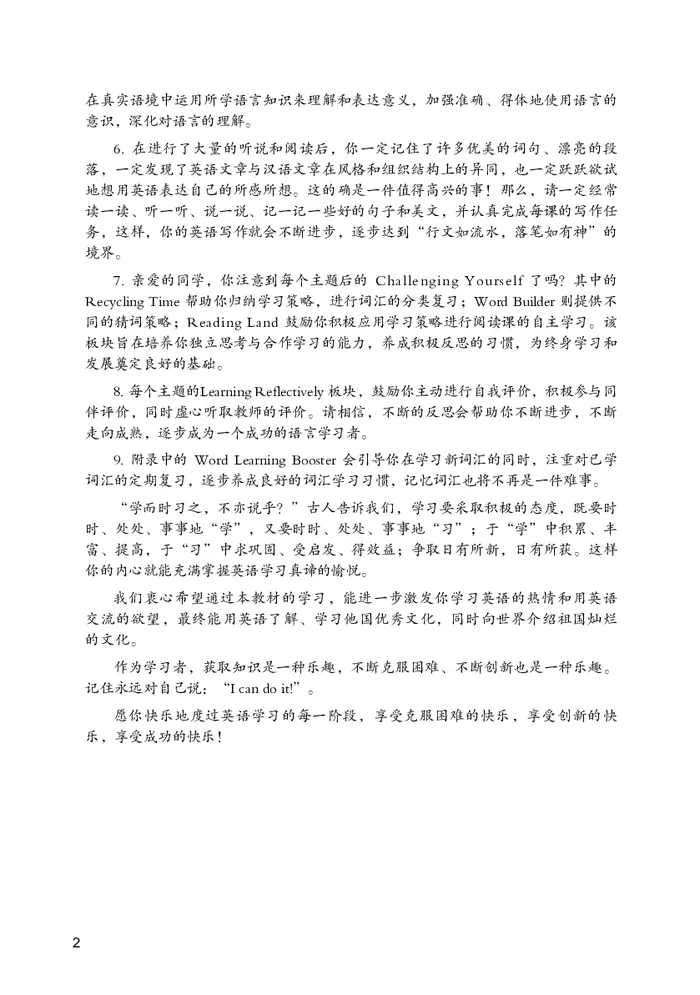
7. 亲爱的同学,你注意到每个主题后的 Challenging Yourself 了吗?其中的
Recycling Time 帮助你归纳学习策略,进行词汇的分类复习;Word Builder 则提供不
同的猜词策略;Reading Land 鼓励你积极应用学习策略进行阅读课的自主学习。该
板块旨在培养你独立思考与合作学习的能力,养成积极反思的习惯,为终身学习和
发展奠定良好的基础。
8. 每个主题的Learning Reflectively 板块,鼓励你主动进行自我评价,积极参与同
伴评价,同时虚心听取教师的评价。请相信,不断的反思会帮助你不断进步,不断
走向成熟,逐步成为一个成功的语言学习者。
9. 附录中的 Word Learning Booster 会引导你在学习新词汇的同时,注重对已学
词汇的定期复习,逐步养成良好的词汇学习习惯,记忆词汇也将不再是一件难事。
“学而时习之,不亦说乎?”古人告诉我们,学习要采取积极的态度,既要时
时、处处、事事地“学”,又要时时、处处、事事地“习”;于“学”中积累、丰
富、提高,于“习”中求巩固、受启发、得效益;争取日有所新,日有所获。这样
你的内心就能充满掌握英语学习真谛的愉悦。
我们衷心希望通过本教材的学习,能进一步激发你学习英语的热情和用英语
交流的欲望,最终能用英语了解、学习他国优秀文化,同时向世界介绍祖国灿烂
的文化。
作为学习者,获取知识是一种乐趣,不断克服困难、不断创新也是一种乐趣。
记住永远对自己说:“I can do it!”。
愿你快乐地度过英语学习的每一阶段,享受克服困难的快乐,享受创新的快
乐,享受成功的快乐!
2
Theme
Unit/Title
Reading Actively
Reading Further
Exploring & Using
Listening, Understanding
& Communicating
Reading/Listening/Viewing,
Speaking & Writing
Learning Strategies
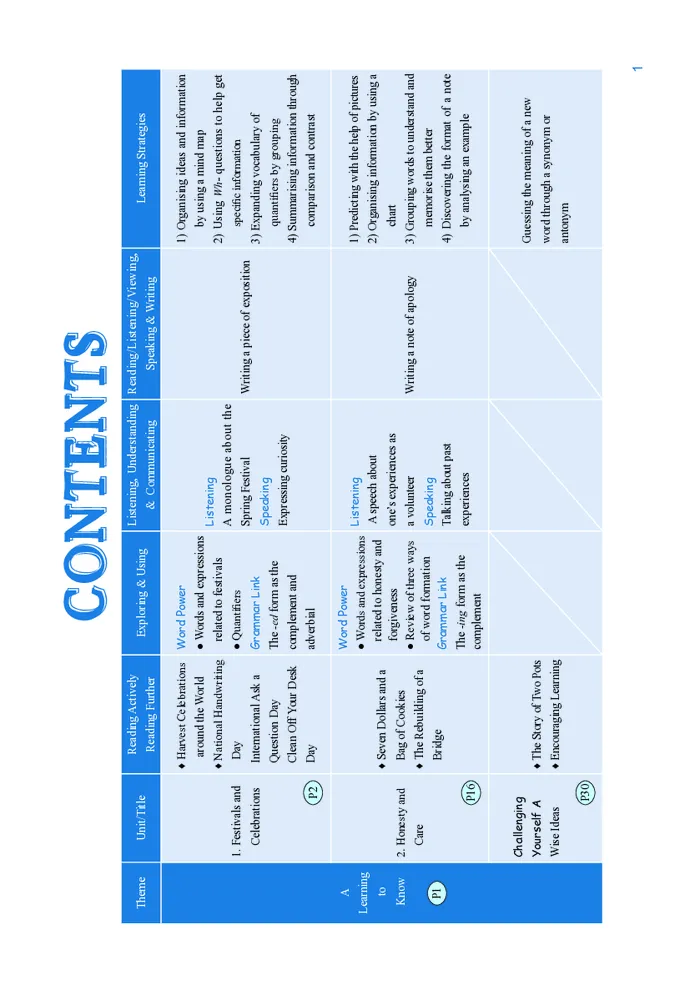
A
Learning
to
Know
P1
1. Festivals and
Celebrations
♦ Harvest Celebrations
around the World
♦ National Handwriting
Day
International Ask a
Question Day
Clean Off Your Desk
Day
Word Power
● Words and expressions
related to festivals
● Quantifiers
Grammar Link
The -ed form as the
complement and
adverbial
Listening
A monologue about the
Spring Festival
Speaking
Expressing curiosity
Writing a piece of exposition
1) Organising ideas and information
by using a mind map
2) Using Wh- questions to help get
specific information
3) Expanding vocabulary of
quantifiers by grouping
4) Summarising information through
comparison and contrast
2. Honesty and
Care
♦ Seven Dollars and a
Bag of Cookies
♦ The Rebuilding of a
Bridge
Word Power
● Words and expressions
related to honesty and
forgiveness
● Review of three ways
of word formation
Grammar Link
The -ing form as the
complement
Listening
A speech about
one’s experiences as
a volunteer
Speaking
Talking about past
experiences
Writing a note of apology
1) Predicting with the help of pictures
2) Organising information by using a
chart
3) Grouping words to understand and
memorise them better
4) Discovering the format of a note
by analysing an example
Challenging
Yourself A
Wise Ideas
♦ The Story of Two Pots
♦ Encouraging Learning
Guessing the meaning of a new
word through a synonym or
antonym
CONTENTS
P30
P16
P1
P2
1
Theme
Unit/Title
Reading Actively
Reading Further
Exploring & Using
Listening, Understanding &
Communicating
Reading/Listening/Viewing,
Speaking & Writing
Learning Strategies
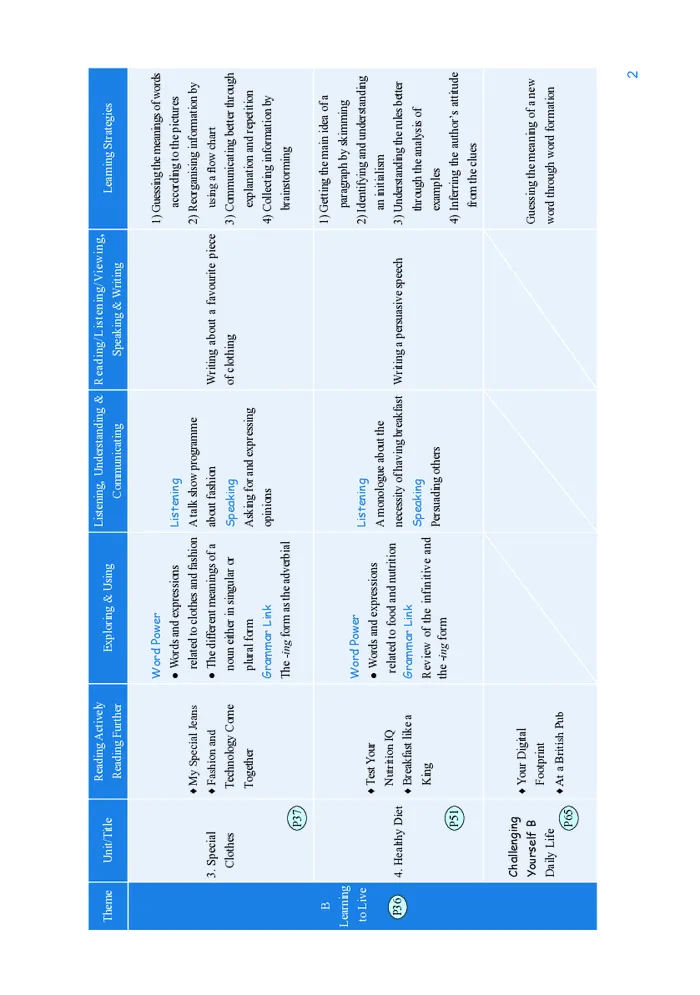
B
Learning
to Live
P35
3. Special
Clothes
♦ My Special Jeans
♦ Fashion and
Technology Come
Together
Word Power
● �Words and expressions
related to clothes and fashion
● The different meanings of a
noun either in singular or
plural form
Grammar Link
The -ing form as the adverbial
Listening
A talk show programme
about fashion
Speaking
Asking for and expressing
opinions
Writing about a favourite piece
of clothing
1) Guessing the meanings of words
according to the pictures
2) Reorganising information by
using a flow chart
3) Communicating better through
explanation and repetition
4) Collecting information by
brainstorming
4. Healthy Diet
♦ Test Your
Nutrition IQ
♦ Breakfast like a
King
Word Power
● Words and expressions
related to food and nutrition
Grammar Link
Review of the infinitive and
the -ing form
Listening
A monologue about the
necessity of having breakfast
Speaking
Persuading others
Writing a persuasive speech
1) Getting the main idea of a
paragraph by skimming
2) Identifying and understanding
an initialism
3) Understanding the rules better
through the analysis of
examples
4) Inferring the author’s attitude
from the clues
Challenging
Yourself B
Daily Life
♦ Your Digital
Footprint
♦ At a British Pub
Guessing the meaning of a new
word through word formation
P37
P51
P36
P65
2
Theme
Unit/Title
Reading Actively
Reading Further
Exploring & Using
Listening, Understanding &
Communicating
Reading/Listening/Viewing,
Speaking & Writing
Learning Strategies
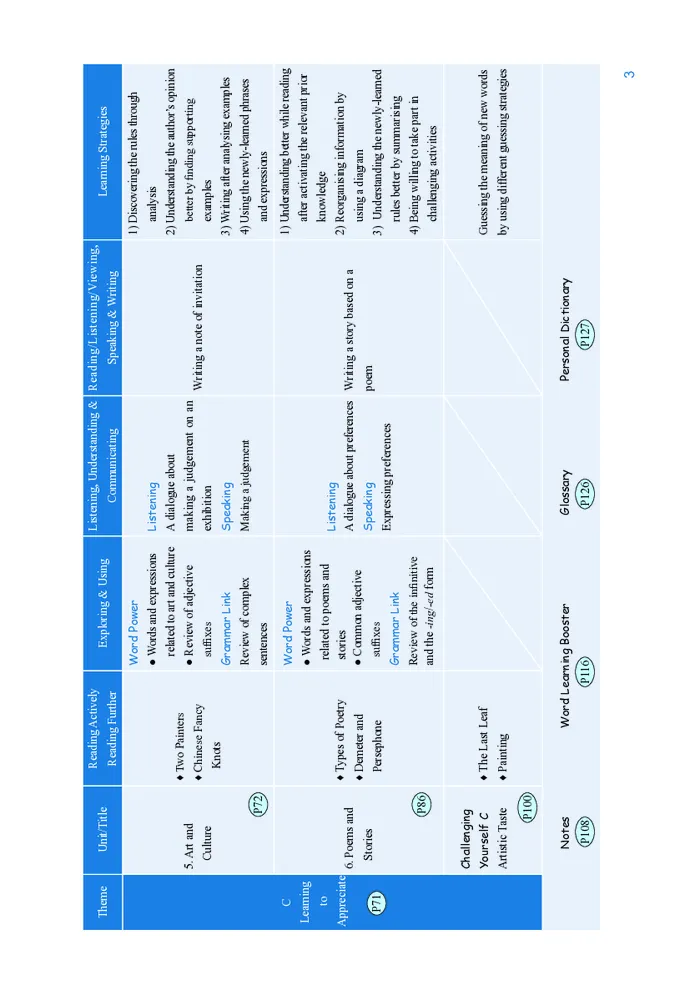
C
Learning
to
Appreciate
P69
5. Art and
Culture
♦ Two Painters
♦ Chinese Fancy
Knots
Word Power
● �Words and expressions
related to art and culture
● Review of adjective
suffixes
Grammar Link
Review of complex
sentences
Listening
A dialogue about
making a judgement on an
exhibition
Speaking
Making a judgement
Writing a note of invitation
1) Discovering the rules through
analysis
2) Understanding the author’s opinion
better by finding supporting
examples
3) Writing after analysing examples
4) Using the newly-learned phrases
and expressions
6. Poems and
Stories
♦ Types of Poetry
♦ Demeter and
Persephone
Word Power
● Words and expressions
related to poems and
stories
● Common adjective
suffixes
Grammar Link
Review of the infinitive
and the -ing/-ed form
Listening
A dialogue about preferences
Speaking
Expressing preferences
Writing a story based on a
poem
1) Understanding better while reading
after activating the relevant prior
knowledge
2) Reorganising information by
using a diagram
3) Understanding the newly-learned
rules better by summarising
4) Being willing to take part in
challenging activities
Challenging
Yourself C
Artistic Taste
♦ The Last Leaf
♦ Painting
Guessing the meaning of new words
by using different guessing strategies
Notes Word Learning Booster Glossary Personal Dictionary
P72
P86
P71
P108
P100
P116
P126
P127
3
Theme A
Learning to Know
What is your favourite
festival? Who have you forgiven
before and why? What are your
own strengths and weaknesses?
Marie Curie once said, “Nothing in life is to be feared; it is only
to be understood. Now is the time to understand more, so that we
may fear less.” In this theme we will learn to understand: festivals
and cultures, people who forgive others, and your own strengths and
weaknesses.
Unit 1
◊ read about how the
harvest is celebrated
worldwide;
◊ know more about some
special days;
◊ talk about festivals and
customs in different
cultures.
Unit 1
◊ appreciate a story about
honesty and forgiveness;
◊ read a story about the
rebuilding of a bridge;
◊ take part in club activities
and give help.
Unit 2
Unit 2
◊ understand
and respect
the differences
between people.
Challenging
Yourself A
In this theme, you will:
Theme A Learning to Know
2
Loɼʘʖnɒ Aȱeaɍ
By the end of this unit, you will be able to:
compare and contrast festivals in different cultures;
enrich vocabulary about quantifi ers and festivals;
introduce festivals by using the -ed form as the complement and adverbial;
express curiosity about festivals;
write a piece of exposition about a festival by arranging information logically;
create and introduce a special day for a special purpose.
Harvest festivals are the seasons for enjoying the fullness of life.
Harvest festivals are the seasons for enjoying the fullness of life.
—Anonymous
—Anonymous
Unit 1
Unit 1
Festivals and Celebrations
Festivals and Celebrations
Reading Actively
► Activating and Predicting
Complete the mind map by writing down the reasons why people around the world
celebrate festivals. Then share your ideas in groups and add more reasons.
More reasons:
Why
For a harvest
2
Unit 1 Festivals and Celebrations
3
pumpkins, ears of corn, bunches
of grapes, turkeys
lanterns, lantern riddles,
moon cakes, reunion dinners
rice, milk, cattle
What is the festival for? Who celebrates
it? When and where…? How…?
► Reading, Thinking and Analysing
Harvest Celebrations around the World
A harvest festival is an annual celebration that occurs around
the time of the main harvest in a given region. People from different
cultures throughout the world celebrate the gathering of the harvest
with different names and unique customs.
In the United States, the celebration is held on the fourth
Thursday of November with a feast tradition, while people in Canada
(the country of maple leaves) have the same national holiday on
the second Monday in October. Turkeys, pumpkins, ears of corn,
bunches of grapes and other kinds of food are displayed to symbolise
Thanksgiving Day.
In the United Kingdom, Harvest Thanksgiving is observed by
churches and schools in late September or early October with singing,
prayers, the decoration of school or church halls with baskets of food
and fruit and the collection of money for charity.
Harvest festivals in Asia include the Chinese Mid-Autumn
Festival, one of the most widely celebrated harvest festivals in the
world. The festival falls on the 15th day of the 8th month of the lunar
calendar with a full moon at night. It is the second most important
festival in China. For the Chinese, the festival indicates family reunion
and peace. Chinese people celebrate the Mid-Autumn Festival with
many traditional activities, such as hanging lanterns, guessing lantern
feast (n.): a large meal
Guess the meaning of
ear from the context
and the picture.
a maple leaf
Look at the following pictures about three harvest festivals around the world. Ask yourself
questions and try to answer them. Then read the text to check your answers.
Asking questions can help
develop your thinking skills.
TIP
Theme A Learning to Know
4
riddles, appreciating the moon, chatting with family members and
having a reunion dinner, along with delicious moon cakes.
People in other places also celebrate festivals at the time of
harvest. In West Africa, people celebrate the New Yam Festival. This
is a significant annual festival practised throughout West Africa,
especially in Ghana and Nigeria, at the end of the rainy season in early
August. In that region, yams are an important crop and the fi rst crop
to be harvested. On the evening before the day of the festival, all old
yams are consumed or thrown away. This is because it is believed that
a new year must begin with tasty fresh yams, instead of the old dried-
up ones of the previous year.
The people of South India celebrate a festival called Pongal. It
lasts four days in the month of Thai (January-February) to mark the
harvest of crops and to offer a special thanksgiving to the sun, the
earth and the cattle. Rice is boiled in milk and offered fi rst to the gods,
then to the cattle, and then to family members.
As long as they farm the land, people in these and other places
will probably maintain this tradition of harvest celebration. Although
the forms the festivals take may differ from culture to culture, the
celebration of suffi cient food and of freedom from work in the fi elds
are two central features of harvest festivals.
yam (n.):
a sweet potato
pre-: before
Previous means ____
in Chinese.
► Comprehending, Integrating and Creating
Read the text again and tick (√) the statements that you think are true.
□ The purpose of the author is to provide information.
□ The structure of the text is: Introduction, Body and Conclusion.
□ The style of the language is informal.
□ The text type is a piece of argumentation.
□ The main writing method the author uses is illustration and comparison.
□ The text most probably appears in a newspaper.
Scan Paragraphs 2-6 and complete the following cards, using the given example as a
guide. Then work in pairs to ask and answer questions about the various festivals.
Festival Facts
● Name: Thanksgiving Day
● Time and place: on the fourth Thursday of November in the United States or
on the second Monday of October in Canada
● Celebrations: displaying turkeys, pumpkins, ears of corn, bunches of grapes
and other kinds of food
Unit 1 Festivals and Celebrations
5
Read the text again and try to summarise the similarities and differences between the fi ve
harvest festivals. Examples are given below.
Work in groups to discuss the following questions.
1) Among the harvest festivals mentioned in the text, which impresses you most? Why?
2) Do you know any customs in China that are somewhat similar to the one of throwing
the old yams away? What do these customs suggest?
3) Do you enjoy Chinese traditional festivals? Why or why not?
4) Should we celebrate Western festivals? Why or why not?
Match each of the following traditional Chinese festivals with its meaning. Then work in
groups to select one and introduce it to the class.
1) the Qingming Festival
A. to celebrate the beginning of the Chinese New Year
2) the Dragon Boat Festival
B. to show respect for the elderly
● Name:
● Time and place:
● Celebrations:
● Name:
● Time and place:
● Celebrations:
● Name:
● Time and place:
● Celebrations:
● Name:
● Time and place:
● Celebrations:
Similarities Differences
① annual celebration
① different kinds of food
Theme A Learning to Know
6
3) the Spring Festival
C. to remember and honour our ancestors
4) the Mid-Autumn Festival
D. to give thanks for the harvest
5) the Chongyang Festival
E. to remember the great person, Qu Yuan
Exploring and Using
► Word Power
Reread the text to fi nd the corresponding words and write them on the lines below. Then
use their proper forms to complete the following paragraph.
A. occurring once every year
B. to point out; to show
C. having happened or existed before
D. having an important effect or infl uence
E. to continue; to keep
F. enough; adequate
G. to talk in a friendly and informal way
H. a typical aspect of something
The Spring Festival, a/an festival, is the most festival
for the Chinese, and also one of the world’s most celebrated festivals. During the Spring
Festival, every family cleans up the house. The custom that all the bad
luck in the year will be swept away in order to make way for the
incoming good luck. People also prepare foods for the coming festival,
especially for the dinner on the eve of the Chinese Lunar New Year. While having the
reunion dinner, Chinese people watch performances on TV and with family
members. Some people, however, complain that the of the Spring Festival
are becoming less and less distinct, though many customs are still . For
example, setting off fi recrackers is now banned in a lot of cities in the country for the
sake of environmental protection.
Study the examples from the text to know what a quantifi er is. Then complete the phrases
on Page 7 with the quantifi ers in the box.
Look for information about a festival from different sources such as books
and the Internet. Check whether you have covered the following things:
name, time, place, nationality, origin, celebrations, customs, interesting
stories and similar festivals in other countries.
TIP
Unit 1 Festivals and Celebrations
7
·Example·
● ears of corn ● bunches of grapes
1) a of chocolate
2) a of bread
3) a of blood
4) a of keys
5) a of clothes
6) a of cigarettes
7) a of directors
8) a of players
9) a of rice
10) a of chalk
11) a of musicians
12) a of stamps
Analyse the words in the box by following the example. Then give more examples of your own.
·Example·
collection (n.) = collect (v.) + -ion My example: communication, …
► Grammar Link
The -ed Form as the Complement and Adverbial
Understanding the meaning
Read the riddles below and guess what festivals are being described, paying special
attention to the coloured parts.
I see the streets decorated with colourful lights.
I hear cheerful songs repeated everywhere.
I notice the Chinese character “Fu” put on almost every door.
I fi nd the trees hung with red lanterns.
Which festival is it?
Given a day off, people are happy.
Put on the centre of the table, it smells good.
Displayed everywhere, food and stuff make the day bright.
Held on Thursday, it celebrates the harvest.
Which festival is it?
fourth
national
symbolise
decoration
widely
reunion
traditional activity
tasty
probably
freedom
festival
A quantifier is a word or phrase that is used before a noun to indicate the
amount or quantity. The most common quantifiers are “some”, “many”, “a
large number of”, etc.
TIP
bar
piece
drop
stick
bunch
bundle
packet
band
board
series
team
bowl
Theme A Learning to Know
8
Discovering the rule
Study the following two examples and tick the correct choices in the box.
·Example·
Underline the -ed forms in the examples in the left column and then match them with their
functions in the right column.
Applying the rule
Rewrite each of the following sentences from the text by using the -ed form as object
complement or adverbial.
1) In the United States, the celebration is held on the fourth Thursday of November with
a feast tradition.
2) Turkeys, pumpkins, ears of corn, bunches of grapes and other kinds of food are
displayed to symbolise Thanksgiving Day.
3) In the United Kingdom, Harvest Thanksgiving is observed by churches and schools
in late September or early October with singing, prayers, the decoration of school or
church halls with baskets of food and fruit and the collection of money for charity.
4) On the evening before the day of the festival, all old yams are consumed or thrown
Example
The adverbial of
1) Held on Thursday, it celebrates harvest.
2) The train seems to be a hundred years old, pulled by a steam
engine.
3) The girl had an accident, wounded in the head.
4) United, we stand. Divided, we fall.
5) Tired after the busy holiday, I still enjoyed it.
6) Seated at the table, my father and I were talking about my job.
condition
cause
manner
concession
result
time
The -ed form
Form: vt./vi. + -ed
Meaning:
1) a/an (completed/ongoing) action
2) a/an (active/passive) sense
People are given a day off.
Given a day off, people are happy.
adverbial
↑
The streets have been decorated with lights.
↑
I see the streets decorated with colourful lights.
object complement
1)
2)
Unit 1 Festivals and Celebrations
9
away.
5) Rice is boiled in milk and offered fi rst to the gods.
Combine the following pairs of sentences by using the -ed form as adverbial. Then use
some of the sentences you have made to make up a story, and share your story in groups.
1) The baby was frightened by the loud noise. She burst into tears.
2) Tony was laughed at by many people. He continued his performance.
3) The children were given many candies. They smiled a big smile.
4) The school was decorated with flags and lighting. The school celebrated its 100th
birthday.
5) She was surprised by the big bunch of fl owers. She kissed her sweet daughter.
6) The old man was surrounded by his family members. He felt happy.
Describe one of the following festivals, using the -ed form as adverbial or object
complement. Then read it aloud to let your group members guess which festival it is.
Listening, Understanding and Communicating
Expressing Curiosity
Work in pairs to tell each other how much you know about the monster, Nian, with the
help of the picture and the given expressions.
the Chinese Lunar New Year
keep off the monster
stay deep in the mountains
a strong bull
a bright fl ame
stay up all night
beat on things
crackling bamboo
set off fi recrackers
establish a tradition
Theme A Learning to Know
10
Listen to a monologue about the Spring Festival and check your ideas.
Listen to the monologue again to complete the answers.
1) What does the Spring Festival mark?
It marks the of the Chinese Lunar New Year.
2) What does Guonian mean?
It means the monster, Nian.
3) What did Nian look like?
Nian looked like a strong with a/an like that of a lion.
4) Why did Nian enter the villages during the winter?
It entered the villages to whatever it could .
5) Which three things was Nian afraid of?
The colour red, bright , and loud noises.
6) What did people do to prevent Nian from entering the village?
They their doors red, burned a f ire in front of their and
stayed up all night beating on things to make a loud .
Read the following sentences and underline the structures used to express curiosity.
1) Do you happen to know how Americans celebrate their Thanksgiving Day?
2) I wonder if you could tell me what a harvest festival is.
3) It would be very interesting to know how people around the world celebrate their
harvest festivals.
4) What I’d really like to fi nd out is why Chinese people have moon cakes when they are
celebrating the Mid-Autumn Festival.
5) I’m rather curious/keen to know about the festival called Pongal.
6) I wish someone would tell me something about the New Yam Festival in West Africa.
Work in pairs to make up a dialogue by using some of the sentence structures you have
underlined.
Situation: A is a Chinese student in a senior high school. B, A’s classmate, is an exchange
student from Canada. B is very curious about why the Spring Festival is called
Guonian in China.
Viewing, Speaking and Writing
Writing a Piece of Exposition
Read the given example and tick (√) the elements it covers.
Unit 1 Festivals and Celebrations
11
Put the following basic steps for writing a piece of exposition in the right order.
A. Decide on the elements you will cover.
B. Select a topic that interests you.
C. Collect detailed information about these elements.
D. Choose the type of exposition you want to use: description, introduction, comparison,
cause and effect, problem and solution or sequence.
E. Recall your theme and main points in the conclusion.
F. Include specifi c examples.
G. Write and keep your readers’ interest from the very beginning.
The correct order is:
Match each of the following traditional Chinese festivals with its corresponding picture.
Choose the festival that you are most interested in. Then follow the above given steps in
Activity 2 and the instructions on Page 12 to write a composition about it.
The Chongyang Festival, also called the Double
Ninth Festival, is celebrated on the ninth day of the ninth
lunar month. It is a special day on which people pay their
respects to the elderly. So it is also known as Seniors’
Day. On this day, people customarily climb mountains,
enjoy the chrysanthemums, drink chrysanthemum wine,
and eat double-ninth cakes.
□ name
□ date
□ meaning
□ origin
□ development
□ celebration
□ customs
□ infl uence
A
the Spring Festival
B
the Lantern Festival
C
the Qingming Festival
D
the Dragon Boat Festival
E
the Mid-Autumn Festival
F the Chongyang Festival
1
2
3
4
5
6
·Example·
Theme A Learning to Know
12
Work in groups to mark your compositions and complete the following table.
Name
Organisation
(3 points)
Content
(3 points)
Language
(3 points)
Handwriting
(1 point)
Total
score
Comments
Reading Further
► Getting Ready
How much do you know about the following festivals? Guess what each festival is for
based on its name, and what people might do to celebrate it. Then share your ideas with
your partner.
Skim the following three passages to check your ideas. Then write a proper heading on
the line for each passage.
► Reading
A.
The aim of National Handwriting Day is to highlight the
importance of the skill of handwriting. It is an important day
in today’s world where people use a computer keyboard more
than a pen or pencil. Some people are even worried that, in the
future, handwriting might become a lost art.
International Ask a Question Day National Handwriting Day
Clean Off Your Desk Day
International Day of Happiness
Part I Introduction
Part III Conclusion
Part II Body
Idea 1
Idea 2
Idea 3
Write one or two sentences that introduce
your topic.
In the end you can add one or two sentences
that will sum up your main ideas and
emphasise what is important about the topic.
List the main ideas about the topic that you
will include. These can be important facts
you’d like to describe, points you’d like to
explain, or elements you’d like to defi ne.
Unit 1 Festivals and Celebrations
13
National Handwriting Day is on January 23rd because this day is the birthday of John
Hancock, who was the fi rst person to sign the American Declaration of Independence—one of
the most important documents in the history of the United States of America.
Handwriting is like an art. We can use it to express ourselves and be creative. Everyone’s
handwriting is unique. Experts can even analyse our handwriting and tell what kind of
personality we have. Some handwriting can be almost impossible to read, however. Doctors are
said to be famous for writing prescriptions that look like ancient hieroglyphics.
What does your handwriting say about you?
B.
International Ask a Question Day is on March 13th. Its
goal is to improve our knowledge and lives by asking more
and better questions. Researchers tell us that “A question not
asked is a door not opened.” The best question askers know
how to open many doors, even locked ones!
We can build our “curiosity muscle” to make us more
successful in life by asking the right questions. Researchers
have a list of the top twelve questions that will bring you success. Besides asking yourself
exactly what you want, such questions as “What else can I think about this?” and “What is the
other person thinking, feeling and wanting?” can make you look at a situation from a different
angle and give you new and better ideas. The fi nal question on their list is: “What is possible?”
This is a great question to ask. Ask it today.
C.
Are you a messy person? Is your desk a mountain of books
and paper? If yes, January 14th, Clean Off Your Desk Day
is for you. This is also a day for you to clean your computer
desktop too. A neat desk means you are organised. You won’t
have to spend hours looking for things under piles of paper. For
many people, a tidy desk makes them feel good. They can sit
down and get to work straight away. A well-organised computer desktop is the same. They can
quickly fi nd any document they want.
It only takes two minutes at the end of the day to tidy up and put things in the right place.
Make use of your wastepaper basket (that’s trash can for Americans). Do that, and life will be
simpler.
► Comprehending
Decide whether each of the following statements is true (T) or false (F) based on your
understanding of the passages.
1) National Handwriting Day is on January 23rd because the American Declaration
of Independence was signed on this day.
Theme A Learning to Know
14
2) Everyone has unique handwriting and it can reveal his or her personality.
3) The aim of International Ask a Question Day is to encourage us to become good
question askers.
4) A metaphor is used in the sentence “A question not asked is a door not opened”.
5) The aim of Clean Off Your Desk Day is to remind us to keep our desk and computer
desktop clean.
6) A tidy desk and a well-organised computer desktop will help us to work more
effi ciently.
Read to understand the following sentences from the passages and select the better choice
to replace the underlined parts in each sentence.
1) The aim of National Handwriting Day is to highlight the importance of the skill of
handwriting.
A. intention; make more visible
B. purpose; emphasise
2) Doctors are famous for writing prescriptions that look like ancient hieroglyphics.
A. instructions written by doctors; writing consisting of pictures to represent words
B. medicine prescribed by doctors; a writing system from ancient times
3) We can build our “curiosity muscle” to make us more successful in life by asking the
right questions.
A. build up our strength to awaken our curiosity
B. develop our ability to arouse our curiosity
4) Such questions can make you look at a situation from a different angle and give you
new and better ideas.
A. the space between two crossing lines
B. a position from which something is viewed
5) Are you a messy person?
A. an untidy
B. an unpleasant
Complete the following passage about the International Day of Happiness according to
your own understanding.
The International Day of Happiness
What is the International Day of Happiness? It’s a day ,
of course! Since 2013, it has been celebrated annually on the 20th of March as a way to
happiness in the lives of people around the world.
Research fi ndings show that people who are happier tend to
in work and relationships when compared to those who are less happy.
The day then becomes a great opportunity to explore what we generally consider
happiness to be and how to .
Individually, we all have different defi nitions of happiness. For many, that might
mean video games, sports, reading books, art, family, friends, fi ne foods, a nice house,
Unit 1 Festivals and Celebrations
15
lots of money, etc.
For me, happiness means , and I will
to become happier.
Work in groups to create a speical day of your own. Then complete the table and write a
passage based on it. Introduce your speical day to your class.
Name
Celebration
Why
When
How
Signif icance
Logo
Sɰlɑ-aʽ esʣʖnɒ
Refl ect on your learning process in this unit. Tick (√) the following statements to assess
your own progress and decide what you still need to work on.
◊ appreciate festivals around the world by
summarising their similarities and differences;
◊ enrich vocabulary about quantifiers and use
them correctly;
◊ understand the -ed form as complement and
adverbial and use it to describe pictures and
festivals;
◊ express curiosity about festivals in other
cultures and get information about them by
asking proper questions;
◊ write a piece of exposition to introduce a
Chinese festival and assess classmates’ work;
◊ create and introduce a special day for a special
purpose.
Agree Somewhat Need more
agree work
□
□
□
□
□
□
□
□
□
□
□
□
□
□
□
□
□
□
◊
i t
f
ti
You are able to:
Loɼʘʖnɒ Aȱeaɍ
By the end of this unit, you will be able to:
appreciate a story by locating its plot and analysing the personalities of its characters;
classify words according to their formation and use them to complete the summary of the text;
use the -ing form as the complement through role-play and passage completion;
talk about past experiences by using proper tenses;
write a note of apology with an appropriate format and proper expressions;
retell a story about the rebuilding of a bridge and value the good quality of helping others.
Honesty is the best policy.
Honesty is the best policy.
—Anonymous
—Anonymous
Unit 2
Unit 2
Honesty and Care
Honesty and Care
Reading Actively
► Activating and Predicting
What is “honesty”? What is “forgiveness”? Give some examples in the following circles.
Were you forgiven when you did something wrong? If yes, share your experience with a
partner.
Honesty
• To tell the truth
•
•
•
Forgiveness
• To understand others
•
•
•
16
Unit 2 Honesty and Care
17
► Reading, Thinking and Analysing
Seven Dollars and a Bag of Cookies
Forty years seems like a long time to remember the name of an
acquaintance. I have forgotten the name of an old lady who was a
customer on my paper route when I was a twelve-year-old boy, back
in 1959. Yet it seems like just yesterday that she gave me a lesson in
forgiveness that I can only hope to pass on to someone else someday.
On a Saturday afternoon, a friend and I were throwing rocks onto
the roof of the old lady’s house from a hidden place in her backyard.
The object of our play was to observe how the rocks changed to
missiles as they rolled to the roof’s edge and shot out into the yard like
comets falling from the sky.
I found myself a perfectly smooth rock and sent it for a ride.
However, the stone was too smooth. It slipped from my hand as I let it
go and headed straight for a small window in the old lady’s house. At
the sound of broken glass, we took off from the old lady’s yard faster
than any of our missiles that had flown off her roof. I was too scared of
getting caught that first night to be concerned about the old lady with
the broken window. A few days later, however, when I was sure that I
hadn’t been discovered, I started to feel guilty for her misfortune. She
still greeted me with a smile each day when I gave her the paper, but I
was no longer able to feel comfortable in her presence.
I made up my mind that I would save my paper delivery money,
and three weeks later I had the
seven dollars that I calculated would
cover the cost of her window. I put
the money in an envelope with a
note explaining that I was sorry for
breaking her window and hoped that
the seven dollars would cover the cost
A
B
C
D
E
acquaintance (n.):
someone you know
slightly
comet []
n. 彗星
Take off here means
_____.
A. stop
B. rush away
missile []
n. 导弹, 飞弹
Object here means
___.
A. thing B. purpose
fortunate (adj.) →
fortune (n.)
Misfortune here means
_____ in Chinese.
Look at the following fi ve pictures and predict what the coming story is like by putting
them in order. Then read the text to check your prediction.
The proper order: □→□→□→□→□
18
Theme A Learning to Know
of repairing it. I waited until dark, went to the old lady’s house, and put
the envelope through the letter slot in her door. Then, I couldn’t wait
for the freedom of, once again, looking straight into the old lady’s eyes.
The next day, I handed the old lady her paper and was able to
return the warm smile that I was receiving from her. She thanked me
for the paper and said, “Here, I have something for you.” It was a bag of
cookies. I thanked her and ate the cookies as I continued on my route.
After several cookies, I felt an envelope and pulled it out of the
bag. When I opened the envelope, I was surprised. Inside was the
seven dollars and a short note that said, “I’m proud of you.”
► Comprehending, Integrating and Creating
Complete the following mind map by noting down some key words.
Put the letters for the pictures in Activity 2 on Page 17 on the corresponding lines and
then complete the part headed “Main events” below.
Plot
Picture
Main events
Feeling
Beginning
Rising
action
Climax
Falling
action
Ending
The boy and his friend were
in an old lady’s garden by
the roof of her house.
A smooth rock and they
immediately .
The boy dared not the
lady’s eyes when she .
The boy three weeks later,
and put the envelope with the money
and a note through the letter slot in the
lady’s door.
The next day, the boy from
the old lady and found .
The story about seven dollars and a bag of cookies
characters
when
where
point of view
theme
A slot is in a wall or
door, through which
mail is delivered.
Unit 2 Honesty and Care
19
Work in pairs to complete the “Feeling” column in the diagram in Activity 2 by writing
down some adjectives. Then analyse the personality of the boy and the old lady based on
the evidence from the story.
Character Personality Evidence
Work in pairs to play the roles of the boy and his classmate. Ask and answer the following
questions.
1) What made you make up your mind to save money to cover the cost of the window?
2) Why do you think the lady was proud of you?
3) If the lady didn’t forgive you, what would you do?
4) Do you think you will forget about the accident? Why or why not?
5) Do you think you are an honest boy? Why do you think so?
Work in groups to discuss what mutual understanding suggests based on the behaviour of
the characters in the story. Then work out how to increase mutual understanding between
you and people around you.
How to increase mutual understanding between you and your
The boy’s behaviour
Mutual understanding
suggests
.
The old lady’s behaviour
friends
teachers
parents
20
Theme A Learning to Know
Exploring and Using
► Word Power
Find the following words in the text and work out their meanings. Then use their proper
forms to replace the underlined parts in the following sentences.
1) William is the sort of man who is easy to excuse and forget.
2) I was late getting to the train station but, luckily for me, the train was late too.
3) One advantage of shopping online is that the things you buy will be sent direct to your
door.
4) I can’t work out when we’ll arrive at our destination because of the traffi c jam.
5) The teacher’s sudden question frightened the little girl into not being able to say anything.
6) If you don’t have enough cash to pay the cost, you can pay by credit card.
Read the text carefully and tick the language features of a child that can be found in it.
Then fi nd more examples from the text.
( ) 1) Using phrasal verbs like “take off” instead of single verbs.
( ) 2) Using child’s vocabulary like “Mamma”.
( ) 3) Emphasising by using adverbs like “perfectly” in “perfectly smooth”.
( ) 4) Using very short sentences.
( ) 5) Using similes as in the sentence “... shot out into the yard like comets falling from
the sky.”
Classify the following words from the text and use ten of them to complete the summary of
the text. Change the forms if necessary.
A. Adding affi xes
B. Putting words together
C. Using it as a different part of speech
The main character of the story was a/an boy who newspapers
in the neighbourhood. One day, he with a friend in the of an old lady
by throwing rocks onto the roof of her house. Because one rock was smooth, it
scared
misfortune
cover
delivery
forgiveness
calculate
twelve-year-old
forgiveness
someday
hidden
backyard
play
perfectly
ride
head
scared
guilty
misfortune
comfortable
presence
delivery
deliver
cost
cover
freedom
smile
Unit 2 Honesty and Care
21
slipped from his hand and broke a window in the house. He escaped because he was too
. Several days later, however, he started to feel . He decided to make
up for his mistake. After three weeks, he saved up seven dollars which, he thought, might
the of the window and then secretly put the money into the old
lady’s home. The next day, the old lady gave him a bag of cookies, with the money in it.
The old lady gave the boy a good lesson in .
► Grammar Link
The -ing Form as the Complement
Understanding the meaning
Read to understand the following note, paying special attention to the coloured parts.
May 6
Dear Mrs. Bush,
I’m writing to apologise for breaking a window of your house.
One day three weeks ago, Jerry and I were playing in your backyard. We threw rocks
on the roof because we wanted to see them changing into missiles as they fell down from
the roof. One of the rocks was too smooth and I let it go by accident. Then the rock was
seen heading for a small window… It made me feel so scared that I took off immediately.
In the following days, I saw you still smiling at me when I delivered the paper to your
door. You know, your smile made me feel so guilty. So I made up my mind to save up
money to cover the cost of your window.
I am so sorry for breaking your window and hope that seven dollars will cover the
cost of repairing it. Please forgive me.
Yours sincerely,
Bob
Discovering the rule
Compare the blue parts and the red parts in the above note and work out their basic
forms.
The blue parts: verb + object +
The red parts: + +
Study the following examples and then work in groups to share the rules you have found
out.
·Example·
causative verb
It made me feel so scared that I took off immediately.
I felt so scared at that moment.
object
1)
22
Theme A Learning to Know
sense verb
subject
Then the rock was seen heading for a small window…
The rock was heading for the window at that moment.
You may start to share your fi ndings in this way:
A: I think there are two kinds of complements: complements of subjects and complements
of objects.
B: I have found that when the -ing form is used as the complement of the subject, the
sentence is usually in the passive voice.
C: ...
Applying the rule
Work in pairs to have a dialogue by playing the roles of the boy (Bob) and his classmate
(Cathy). Use the -ing form as the complement.
Cathy: Bob, I heard that you had broken one of the windows of
Mrs. Bush’s house.
Bob: Yes. I was so sorry for that.
Cathy: How did it happen?
Bob: Jerry and I were playing in her backyard and we were throwing
rocks onto the roof to...
...
Complete the following short story by using the proper forms of the given words. Each
word may be used more than once.
Sometimes, it is not so easy to understand others and also make others you.
One day, Mr. Black, an American businessman, went to India. He had his assistant
a car for him. When the car arrived, he told the driver him to his
offi ce. But he saw the driver his head at once. The driver was a somewhat old
guy, so Mr. Black thought the driver hadn’t heard what he had said. He raised his voice to
repeat his order in order to make himself . The driver still shook his head with a
smile. The smile of the driver, somehow, made Mr. Black angry.
“How dare you refuse my order?” Mr. Black shouted. “I let you me to my
offi ce immediately!”
Then he heard the driver in a very loud voice, “Yes, sir.”
But to Mr. Black’s surprise, he saw the driver his head at the same time.
At last, the driver got the car , and Mr. Black became totally . He
thought about it for a while and then said to himself, “No means Yes here!”
answer
hire
confuse
send
drive
hear
understand
shake
get
start
2)
Unit 2 Honesty and Care
23
Describe what was happening when you walked into the classroom this morning, using
the -ing form as the complement. Then share your writing with your group members.
Listening, Understanding and Communicating
Talking about Past Experiences
Read the following sentences from a monologue you will listen to, and guess the meanings
of the words in bold. Then predict what “something both meaningful and fun” is.
Some people think what you do in your spare time is your own affair. Some argue
that we must do something profi table. For me, I really recommend that we do something
both meaningful and fun.
Listen to the monologue and check your prediction. Then choose the best answers.
1) The main topic of the monologue is .
A. meaningful and fun volunteer work
B. the speaker’s experiences as a volunteer
C. the speaker’s attitude towards volunteer work
2) This monologue is .
A. a story
B. a report
C. a speech
3) The nationality of the speaker is most probably .
A. French
B. British
C. unclear
4) The speaker is most probably a .
A. university student
B. high school student
C. farmer
Listen to the monologue again and complete the table with the missing information.
Experiences as a Volunteer
What she did
What she got
organised a/an for charity at
the university
raised for a cause she believed in
volunteered at a charity
got cupcakes from a/an London bakery from
the organisers for her
volunteered in a/an shop
found many nice clothes to her wardrobe
worked on a farm in France to
look after horses
had a/an holiday with food and accommodation
provided, made some great and her
French
24
Theme A Learning to Know
Listen for a third time and complete the following sentences.
1) I organised a concert for charity with my friends at our university.
2) fi nding bands and raising funds for a cause we believed in.
3) , I volunteered in a charity shop so I found loads of nice cheap clothes
to update my wardrobe.
4) as a volunteer, however, was working on a farm in France.
5) I had to admit that experience for me.
6) though, since I had to look after fi fteen horses and sleep at the top
of a tower in an odd castle!
Study the above sentences to fi nd out the structures that can be used to talk about past
experiences. Then work in pairs to talk about your unforgettable experiences by using
some of them.
Reading, Speaking and Writing
Writing a Note of Apology
What elements should a note of apology contain? Tick (√) the ideas listed below that you
agree with.
□ expression of regret
□ explanation of what went wrong
□ acknowledgement of responsibility
□ an offer of a solution
□ request for forgiveness
Read the following note of apology to fi nd which elements listed above have been included
and then match each part of the note with its explanation by putting the letter on the
corresponding line.
May 15
Dear Frank,
I’m writing to apologise for having lost the book you were so kind to
lend me last week.
You know, I liked the book so much that I brought it along with me
every day. Whenever I had free time I took it out to read. I had finished
four chapters
chapters, but when I came back home last night, it wasn’t found
anywhere in my backpack.
A
B
C
D
While you are talking about your past experiences, the past tense should be
the basic tense.
TIP
Unit 2 Honesty and Care
25
Date Greeting
Closing Signature
Saying sorry at the very beginning to tell the purpose of writing the note
Explaining why you are apologising
Offering a solution
Expressing your apology again and hoping for forgiveness
Read the following sentence structures and classify them.
C
D
E
F
1) I am writing to express my apology for...
2) I hope you will pardon me.
3) I’m extremely/terribly sorry for...
4) Here’s my deepest apology for...
5) Unfortunately, I didn’t realise that...
6) In order to make up for my fault...
7) Please forgive me. I really didn’t mean that.
8) Please accept my apology. I hope...
9) I am afraid what I have done has caused much inconvenience for you.
10) I promise I will...
Is there anything that you want to apologise for? To whom? Write a note of apology to the
person(s) by following the steps below.
Step 1 Choose some sentence structures in
Activity 3 to finish the four main
parts of C, D, E and F.
Step 2 Add the other parts of A, B, G and H.
Step 3 Link all the parts together and add
more details.
Step 4 Check and correct the errors.
Step 5 Write down the complete note here and
share it with a partner.
I know old books are like your old friends; they can never be replaced
replaced.
I will try my best to get it back. Otherwise
Otherwise, I will get a new copy for you.
Many apologies again. Do please forgive me.
Yours truly,
Zhang Fei
E
F
G
H
26
Theme A Learning to Know
Reading Further
► Getting Ready
Brainstorm and complete the following diagram. Then share your ideas in your group.
Look at the title of the passage below and predict what it is mainly about with the help of
the following questions. Share your ideas with a partner. Then read the passage to check
your prediction.
● What happened to the bridge?
● What was needed to rebuild the bridge?
● How was the bridge rebuilt?
● What might be the theme of the story?
► Reading
The Rebuilding of a Bridge
David and Roy decided to go for a bicycle ride with three other students: Robert, Helen
and Betty. Since Robert’s father couldn’t afford to buy a bike for him, they borrowed one for
him.
The students had planned to meet at 8 o’clock, but Robert, Helen and Betty were half an
hour late, since they had to come a long way once they discovered that the bridge over the
stream had been washed away.
When they told the bad news to David and Roy,
David said nothing and kept silent for a moment.
After a while, an idea came into his mind. “Do you
think we could rebuild it?”
All of them agreed and started to consider this
idea seriously. They decided to rebuild the bridge
before they went for the bicycle ride. Betty said she
could ask her brother to make a plan for them.
The biggest problem was how to get enough
helping others
Understanding
Others
Unit 2 Honesty and Care
27
wood. The next day they visited nearly every house in the village. Mr. Robinson agreed to
supply the wood so long as they did the work. Several people promised to give money if the
students could build a new bridge because it was a short cut for the villagers.
The students worked for nearly a week under Mr. Robinson’s guidance. At the end of a
week’s hard work, the bridge was completed. They all agreed to ask Mr. Robinson to offi cially
open the bridge. “He has helped us the most,” David said.
“And tomorrow morning we can go around to all the houses,” added Roy, “and tell the
people that the bridge will be offi cially opened at six o’clock. Then we can remind them of
their promises about money,” Roy added.
“But we don’t really want that, do we?” said Robert.
“Yes,” said Helen. “We need it and I think we should collect it.” She glanced quickly at the
others, who nodded.
The next day, the students visited all the houses again. They were surprised when they
saw how pleased the people were with them. By two o’clock they had collected over a hundred
dollars. By fi ve o’clock, unknown to Robert, they had spent it.
At six the students gathered at the bridge. Mr. Robinson appeared with nearly forty of the
people of their district. In a short speech he praised the students for their efforts.
“And now I announce that the new bridge is open,” he said, “and I have a small surprise
for you.” He turned to his son and received a small metal sign from him. Climbing down the
bank, he nailed it on the side of the bridge. “Students’ Bridge”, it said. The neighbours clapped,
and the students felt even more pleased with their work.
David turned to Robert. “And now,” he said, “we have a surprise for you. Look!” Helen
pushed a new bike through the crowd and gave it to the astonished Robert. “Now you see why
we wanted the money,” she said.
► Comprehending
Put the following statements in the correct order according to the story.
1) The students worked for nearly a week under the guidance of Mr. Robinson.
2) The students decided to rebuild the bridge before going for the bicycle ride.
3) Mr. Robinson praised the students for their efforts in his speech.
4) Five students decided to go for a bicycle ride.
5) The students decided to ask Mr. Robinson to officially open the bridge after it was
completed.
6) Three students were late for their appointment because the bridge, a short cut for them,
was broken.
7) Mr. Robinson supplied the wood for building the bridge.
8) The bridge was named “Students’ Bridge”.
The correct order: □→□→□→□→□→□→□→□
28
Theme A Learning to Know
Read the passage carefully and complete “The students’ decision” column. Then write
down your ideas about what you would do in this situation.
Situations
The students’ decision
Your ideas
Robert had no bicycle for the ride.
They for him.
They found that the bridge had been
washed away before they began their
ride.
They decided to rebuild the
bridge before .
How can they rebuild the bridge?
They sought help .
The new bridge was completed one
week later.
They invited Mr. Robinson
to .
They went around to all the villagers’
houses to tell them about the opening of
the bridge.
They the villagers
of their promises to collect
money.
They collected over a hundred dollars.
They for Robert
with the money.
Work in groups to answer the following questions.
1) Who contributed to the rebuilding of the bridge and how?
2) What did the following people get respectively after the event?
Robert:
The students:
Mr. Robinson and the villagers:
Everyone:
The rebuilding
of the bridge
Betty’s brother:
make the plan
Unit 2 Honesty and Care
29
3) Who helped whom in the story? Draw a mind map to illustrate it.
4) What can you learn from the story?
We think that the story is not only about rebuilding a bridge, but also
.
5) Can you give another creative name for the bridge based on your understanding of the
story?
Our name for the bridge:
Sɰlɑ-aʽ esʣʖnɒ
Refl ect on your learning process in this unit. Tick (√) the following statements to assess
your own progress and decide what you still need to work on.
◊ appreciate a story about honesty and forgiveness
by locating its main plot and analysing the
personalities of the characters;
◊ classify words according to their formation and
use them to complete the summary of the text;
◊ use the -ing form as the complement through
role-playing and passage completion;
◊ talk about past experiences by using proper
tenses;
◊ write a note of apology with an appropriate
format and proper expressions;
◊ retell the story about the rebuilding of a bridge
and value the good quality of helping others.
Agree Somewhat Need more
agree work
□
□
□
□
□
□
□
□
□
□
□
□
□
□
□
□
□
□
You are able to:
Theme A Learning to Know
Loɼʘʖnɒ Aȱeaɍ
We learned to understand cultures behind festivals in Unit 1 and understand other people
in Unit 2. Now let‛s try to understand ourselves and complete this self-directed learning
project. In this project, you should be able to:
sum up the learning strategies learned in Unit 1 and Unit 2;
guess the meaning of a word by its synonym or antonym;
fi nd out the moral of a fable by exploring the facts and opinions in it;
propose your own opinions appropriately;
assess your own weaknesses in learning and try to turn your weaknesses into strengths;
monitor your own learning by referring to the learning objectives in Looking Ahead.
He who has confi dence in himself will gain the confi dence of others.
—Leib Lazarow
—Leib Lazarow
Learning Individually
► Recycling Time
Note down the words about festivals you have learned before, and the strategies you have
learned in the previous two units.
He who has confidence in
He who has confidence in
Self-directed
Learning Project
Challenging Yourself A
Challenging Yourself A
Wise Ideas
Wise Ideas
Vocabulary about
Festivals
Learning Strategies
30
Challenging Yourself A Wise Ideas
31
water bearer
perfect pot
path
leak
cracked pot
stream
pole
► Word Builder
Learn to guess the meaning of a new word based on contextual clues by studying the
example.
·Example·
Of course, the perfect pot was proud of itself. But the poor cracked pot was ashamed of
its imperfection.
► Reading Land
Study the picture below and fi nd out the differences between the two sides of the path.
Then fi ll in the blanks.
On the left side:
On the right side:
Predict what the story is about based on the picture and then read the article to check
your prediction.
The Story of Two Pots
A water bearer had two large pots, hung on either end of a pole
which he carried across his neck. One pot had a crack in it while the
other was perfect. The perfect pot was always full of water at the end
of a long walk from the stream to the house; the cracked pot only
arrived half full.
For two years the bearer had only been able to take one and a half
pots of water to his house at a time.
Of course, the perfect pot was proud of itself. But the poor cracked
pot was ashamed of its own imperfection. It spoke to the water bearer
imperfection (n.) =
+ perfect (adj.) +
Expressions like “instead of”, “rather than”, “but” and “however” in context
may help you find a synonym or antonym of a new word. Then make use of the
synonym or antonym to guess the meaning of the word you don’t understand.
TIP
Guessing through synonym or antonym
the perfect pot
the cracked pot
antonym
proud
ashamed
but
ashamed (adj.):
feeling shame
ashamed?
32
Theme A Learning to Know
Choose the best answers after reading the article.
1) The reading passage is a .
A. short story
B. fable
C. novel
2) The passage suggests that .
A. we shouldn’t be ashamed of ourselves in spite of our weaknesses
B. we should know ourselves well and make good use of our weaknesses
C. we should be proud of both our strengths and weaknesses
3) The author uses in the conversations between the cracked pot and the water
bearer.
A. exaggeration
B. metaphor
C. personifi cation
Complete the following mind map with facts from the article and the ideas of your own.
one day by the stream, “I am ashamed of myself, and I want to apologise
to you.” “Why?” asked the bearer, “What are you ashamed of ?”
“I have been able to take only half of my load because this crack
in my side causes water to leak out all the way back to your house.
Because of my fl aw, you don’t get the full value of your efforts.” The
pot said.
The water bearer felt sorry for the cracked pot and said, “As we
return to the house, I want you to pay attention to all of the beautiful
fl owers along the path.”
Indeed, as they went up the hill, the old cracked pot took notice of
the sun warming the beautiful wild fl owers on the side of the path, and
this cheered it up a little. But at the end of the walk, the cracked pot
still felt bad because half of its load had leaked out, and so again the
pot apologised to the bearer for its failure.
The bearer said to the pot, “Did you notice that there were fl owers
only on your side of the path, but not on the other pot’s side? That’s
because I have always known about your fl aw, and I took advantage
of it. I planted fl ower seeds on your side of the path, and every day as
we walked back from the stream you watered them. For two years, I
have been able to pick these beautiful flowers to decorate my table.
Without you being just the way you are, I would not have the beautiful
fl owers.”
Everyone has flaws. We’re all cracked pots in some aspect. But
if we allow ourselves to take advantage of our fl aws, nothing goes to
waste. Don’t be afraid of your fl aws. Get to know your fl aws and you
too can be successful. In our weaknesses we fi nd our strengths.
Decorate means
in English.
Why is aspect in
singular form?
load (n.): something
that is being carried
Do you think flaw and
imperfection mean the
same?
Challenging Yourself A Wise Ideas
33
Read the following conversation between the water bearer and the cracked pot, and put
them in the right order.
A. As we return to the house, pay attention to all of the beautiful fl owers along the path.
B. Because of my fl aw, you don’t get the full value of your efforts.
C. Did you notice that the fl owers were only on your side of the path? I planted fl ower
seeds along the path, and as we walked back you watered them every day.
D. I am ashamed of myself, and I want to apologise to you.
E. I still feel bad and want to apologise to you since half of my water leaked out.
F. Why? And what are you ashamed of?
G. So don’t be afraid of your fl aws.
► Question Corner
Read the article closely and note down anything that you are still confused about for group
discussion.
features of this pot:
features of this pot:
How did the water bearer use this pot?
What do you think the pot would
feel after noticing the flowers? What
caused the change of its feelings?
If you were the water bearer, what would you do with the cracked pot?
Do you think this pot was really “perfect”?
Why or why not?
How did the water bearer use this pot?
While an author is creating characters in a story or novel, he/she may
describe their appearances and actions. But sometimes their dialogues also
help a lot.
TIP
1)
3)
5)
2)
4)
6)
7)
34
Theme A Learning to Know
Learning Cooperatively
Discuss with your group members the questions you have prepared in Question Corner.
Ask your teacher for help if necessary.
Work in groups to discuss the following questions. Take notes and write down the main
points. Then report to the class.
1) Do you think the water bearer is a wise man? Give your reasons.
2) Which pot do you like better, the perfect one or the cracked one? Why?
3) What do you understand by the moral “In our weaknesses we fi nd our strengths”?
Work in groups to share one of your typical weaknesses and discuss how you can turn it
into strength.
Learning Creatively
Brainstorm what you know about Xun Zi and his main ideas about learning. Then read
the following article to check your ideas.
Encouraging Learning
The gentleman says: Learning should never cease. Blue comes from the indigo plant but is
bluer than the plant itself. Ice is made of water but is colder than water ever is… If the gentleman
studies widely and each day examines himself, his wisdom will become clear and his conduct be
without fault.
If you do not climb a high mountain, you will not comprehend the highness of the heavens;
if you do not look down into a deep valley, you will not know the depth of the earth; and if you
do not hear the words handed down from the ancient kings, you will
not understand the greatness of learning. Children born among the
Han or Yüeh people of the south and among the Mo barbarians of
the north cry with the same voice at birth, but as they grow older
they follow different customs. Education causes them to differ. The
Odes says: Oh, you gentlemen, do not be constantly at ease and
rest! Quietly respectful in your posts, love those who are correct and
upright. And the gods will hearken to you and aid you with great
blessing. There is no greater godliness than to transform yourself
with the way, no greater blessing than to escape misfortune.
Xun Zi
313 B.C.E.—238 B.C.E.
Challenging Yourself A Wise Ideas
35
I once tried to spend the whole day in thinking, but I found it of less value than a moment of
study. I once tried standing on tiptoes and gazing into the distance, but I found I could see much
farther by climbing to a high place. If you climb to a high place and wave to someone, it is not as
though your arm were any longer than usual, and yet people can see you from much farther away.
If you shout down the wind, it is not as though your voice were any stronger than usual, and yet
people can hear you much more clearly. Those who make use of carriages or horses may not be
any faster walkers than anyone else, and yet they are able to travel a thousand li. Those who make
use of boats may not know how to swim, and yet they manage to get across rivers. The gentleman
is by birth no different from any other man; it is just that he is good at making use of things.
Do the following activities.
1) Discuss in groups what Xun Zi’s purpose is in writing this article. List your ideas and compare
yours with those of your classmates.
2) Search for other famous sayings by Xun Zi and share your understanding of them with your
classmates.
Learning Reflectively
► Self-reflecting
Refer back to Guiding Page and Looking Ahead in this theme to refl ect on your learning.
The targets I have achieved in this theme are:…
I am confi dent in… because I can…
I need further efforts on… because…
My next moves include… because I want to be able to…
► Peer-sharing
Work with a partner and fi nish the peer assessment. Then listen to and learn from each
other.
You really worked hard at… for example…
Perhaps you could make more progress if you…
Next time you should pay more attention to…
► Teacher-responding
Now listen to your teacher for his/her comments and suggestions.
Utilising Resources
Read the article entitled “How to Turn Your Weaknesses into Strengths” in Reading Box.
Theme B
Learning to Live
What do you regard as the best way to live? Dressing fashionably?
Eating expensively? Or surfing online freely? A good life should be
guided by knowledge. Learn to live as you learn to dress, to eat, and to
surf online wisely in this theme.
How do you understand
fashion? What do you consider
as a healthy diet? How can you
keep yourself safe online?
Unit 3
◊ read about the story of a
girl and her jeans;
◊ know more about the
development of fashion
with technology;
◊ share your understanding
of fashion.
Unit 3
◊ test your knowledge about
food and nutrition;
◊know more about how
to eat healthily;
◊ discuss the importance
of developing a healthy
diet.
Unit 4
Unit 4
Challenging
Yourself B
◊ know about digital
footprint and take
action to avoid
danger online.
Challenging
Yourself B
In this theme, you will:
Loɼʘʖnɒ Aȱeaɍ
By the end of this unit, you will be able to:
analyse the narrator’s personality and feelings for her jeans;
recognise a noun’s different meanings in its singular and plural forms;
use the -ing form as the adverbial properly;
ask for and express opinions on fashion;
write a story about your favourite clothing;
explain some applications of technology in fashion.
We can learn about ourselves by examining how we think and feel about clothing.
We can learn about ourselves by examining how we think and feel about clothing.
—Anonymous
—Anonymous
Unit 3
Unit 3
Special Clothes
Special Clothes
Reading Actively
► Activating and Predicting
Tick the items which may make a piece of clothing special to you. Then share your ideas
with a partner and add more items.
□ a high price
□ your favourite colour
□ a famous brand
□ a popular style
□ comfortable material
□ the time you shared together
More items:
Look at the picture and the given words and predict why the author thinks her jeans are
special. Then read the text to check your prediction.
patch
slightly faded
a bit expensive
over-wear
wear through
accident
get Mum’s money’s worth
37
Theme B Learning to Live
38
► Reading, Thinking and Analysing
My Special Jeans
We shared the best of times together—my old jeans and I. I
remember the day I got them. It was sometime in the April of 2007.
My mum took me shopping for jeans, and I picked out fi ve or six pairs
to try on. I tried on a couple of pairs that fi tted okay, but they were
nothing special. Then I tried on a pair of blue jeans which were slightly
faded. I, however, fell in love with them the moment I put them on. I
didn’t even bother to try on the other three pairs I had picked out. I just
got that pair. They were a bit more expensive than the other jeans, but
I assured my mum that I would get her money’s worth. And that was
no lie!
If there was one thing in my wardrobe that I “over-wore”, it
would have to be those jeans. Each time I took them out of the washer,
I noticed that they looked more and more faded and had worn thin,
especially in the left knee and on the back pockets. However, that
didn’t matter to me and I still wore them. Sun or rain, wind or snow—
it didn’t matter—they were still my favourite!
By that time the next year they were wearing through right under
the right back pocket, so I had mum repair them, because I couldn’t
wear them like that. Mum did a really good job on the patch, and I
wore them for another six months or so. One day, I decided to invite
a few friends to my garden for a bonfi re until midnight. There was an
old shed out there and it was easy to climb up onto it, but it was a bit
harder to get down. You had to jump. I was the only girl who dared
to jump—I felt confident because I had done it before when I was
younger. I sat right on the edge and then I jumped. But a nail which I
hadn’t seen caught the patch under the right back pocket of my jeans.
So when I jumped all I heard was a sharp r-i-p. Then I felt a bit of air
as I hit the ground despite the fact that I didn’t
feel an ache. Not only did the accident leave me
feeling awkward in front of my merry friends, but
it also killed my favourite jeans.
When I told my mum what had happened, she
said they were beyond repair. I was sad because
they had been my special jeans. But at least I
could tell my mum that I had got her money’s
worth!
nail [] n.
wardrobe
[] (n.)
It means in
Chinese.
bonfire [ɒ] n.
How do you understand
over-wore? Why is it in
quotation marks?
Guess the meaning
of times. Why is it in
plural form?
Guess the meaning of
the word r-i-p from
the context. Why is it
spelled in this way?
Unit 3 Special Clothes
39
► Comprehending, Integrating and Creating
Match each paragraph of the text with its main idea.
Read the text again and complete the following diagram. Then retell the story with a
partner.
My jeans My feelings
Paragraph 1
A. How I killed my favourite jeans.
Paragraph 2
B. They are still my favourite jeans, although old and faded.
Paragraph 3
C. I kept my promise to get my mum’s money’s worth.
Paragraph 4
D. How I bought my favourite jeans.
The new jeans: slightly
, a little
I them as soon as
I put them on.
The more faded jeans: more
and more and worn
, especially in the
and on the
They were still my .
The broken jeans:
right under the right back pocket,
repaired well with a/an
I kept wearing them for
.
The killed jeans:
repair
I was , but proud for
I had .
over-wearing
a sharp
Theme B Learning to Live
40
Work in groups to analyse the personality of the narrator “I” in the story based on the
facts from the text. Then state whether you like her or not and give your reasons.
Everyone has something precious in his/her process of growing up. Note down the key
words about your most precious thing and then tell your partner about it.
Hold a class debate on “Should we buy famous-brand clothes?” based on the given
information.
Now work in groups to design a questionnaire about the attitudes of middle school
students towards buying clothing. Do a survey in your school, write a survey report and
report to the class.
What it is:
Why it is precious to you:
What happened between you and it:
How it infl uences you:
Some students think that they should buy clothes of famous brands, even though
they are expensive. Others think they should buy inexpensive but comfortable
clothes that are not of famous brands. Which opinion do you agree with?
Personality
Your opinion
Like or dislike?
Facts
Reasons
independent,
Unit 3 Special Clothes
41
Exploring and Using
► Word Power
Read the explanations and fi nd out the corresponding words in the text. Then write the
words down on the lines.
A. at a time that you do not know exactly (Para. 1)
B. not ordinary or usual (Para. 1)
C. to lose or cause something to lose colour or brightness (Para. 1)
D. to take the trouble to do something (Para. 1)
E. feeling sure about one’s own ability to do things (Para. 3)
F. exactly; directly (Para. 3)
G. the outside limit of an object, area or surface (Para. 3)
H. passing a certain point or degree (Para. 4)
Now use the proper forms of the words you have written down to replace the underlined
parts in the sentences below.
1) Jimmy has become a particularly valued friend of mine since that accident.
2) Your white short-sleeved blouse is just under the yellow sweater.
3) I am not doubtful about the result that I can win in the f inal match.
4) The china vase is too badly damaged to repair.
5) I told mum that she needn’t trouble herself by coming upstairs to wake me up tomorrow
morning since I had set my alarm clock.
6) He attended his former English teacher’s wedding ceremony on a certain day last
month.
7) Don’t put the glass so near to the outside limit of the table.
8) The sunlight has made the colour of the curtains lighter and lighter.
Study the examples from the text to understand the meanings of the word “time” and then
complete the table by referring to your dictionary. Then add more.
·Example·
1) We shared the best of times together—my old jeans and I. (days)
2) By that time the next year they were wearing through right under the right back
While writing a survey report, you should include the purpose, the subjects,
the questions, the results and the implications of the survey. You can also
draw some charts and tables to help illustrate your fi ndings.
TIP
Theme B Learning to Live
42
pocket, so I had mum repair them. (a certain time)
Singular form
Plural form
Word
Meaning
Word
Meaning
sand
iron
good
air
force
arm
cloth
...
a substance
sands
a broad area along a shore
Now make sentences with some of the words and let your partner decide whether you
have used them correctly.
Study the example and read the tip about “hyphen”. Then use the words in the two boxes to
form compound words with hyphens.
·Example·
1) adj. + n.:
2) n. + -ing/-ed:
3) n.+ adj.:
4) adv. + -ing/-ed:
5) adj. + adj.:
6) adj. + -ing/-ed:
peace
hand
dark
old
hard
snow
highly
funny
clear
style
looking
developed
working
loving
cut
made
white
green
hyphen
over + wear over-wear ( a compound word)
TIP
A hyphen is the punctuation sign used to join words together to make a
compound which has a combined meaning.
Unit 3 Special Clothes
43
Now write down more words formed by using hyphens and work together with a partner
to use them to make sentences.
► Grammar Link
The -ing Form as the Adverbial
Understanding the meaning
Read the following passage about the birth of jeans, paying special attention to the
coloured parts.
How Were Jeans Born?
Jeans are a type of pants. They are often called “blue jeans”, made from a kind of
blue hard-wearing cloth.
Jeans were invented by Jacob Davis and Levi Strauss in 1873. Levi Strauss came
from Germany to New York in 1851, wanting to join his elder brother who had a dry
goods store. In 1853, when he heard about the Gold Rush in the West, he decided to move
to San Francisco. After arriving there, he established the western branch of the family
dry goods business. Because he sold, among other things, cotton cloth, Jacob W. Davis, a
tailor, became his regular customer. Having ordered a pair of pants that could withstand
hard work, Davis made them from denim that he bought from Levi Strauss & Co. When
he later wanted to obtain the government authority giving a right to them, he wrote to
Levi Strauss, and they became partners. They opened a bigger factory, and that is how
jeans were born.
Discovering the rule
Study the following example and then fi ll in the blanks below.
·Example·
• The red part functions as .
• The basic form is .
Study more examples and find out the meanings of the -ing form as adverbial. Put the
corresponding letters in brackets.
because he wanted to join his elder brother who had a dry goods store
Levi Strauss came from Germany to New York in 1851, wanting to join his elder brother
who had a dry goods store.
A. accompanying
B. cause
C. result
D. time
E. manner
F. concession
G. condition
Theme B Learning to Live
44
( ) 1) Hearing the news, Jimmy jumped with joy.
( ) 2) Being ill, Jimmy didn’t go to school.
( ) 3) Working hard, Jimmy will become more successful.
( ) 4) Having tried his best, Jimmy couldn’t work out the math problem.
( ) 5) Jimmy sat in the classroom, (as though) waiting for someone.
( ) 6) Jimmy fell, striking his head against the door.
( ) 7) Jimmy walked into the classroom, waving his hands to his classmates.
Now share your ideas in groups and fi nd out when the -ing form comes before or after the
clauses.
Applying the rule
Rewrite the sentences with blue parts in Understanding the meaning by using the -ing
form, and the sentences with red parts by using adverbial clauses.
Complete the following paragraph about the author’s special jeans by using the proper
forms of the given words.
In 2007, (take) by my mum to go shopping, I decided to buy a pair
of jeans. (try) a couple of pairs, I still found they were nothing special.
However, (try) on a pair of blue jeans, I fell in love with them immediately.
(be) more expensive than the other jeans, I assured my mum I would get her
money’s worth. (buy) them, I “over-wore” them. One day, I invited a few friends
to my garden for a bonfi re. There was an old shed out there and it was easy to climb
up onto it, but it was a bit harder to get down. (be) the only girl who dared
to jump, I felt pretty confi dent. I jumped, (hear) a big r-i-p under the right
back pocket. Thus, I killed my special jeans. However, (spend) the best time
together with them, I will never forget them.
Read the following short story and then write as many sentences as possible by using the
-ing or -ed form as adverbial.
Second-hand Clothes
One day, Tom went shopping. When he saw a sign which said “Second-hand clothes
bought and sold”, he walked into the shop. He was carrying an old pair of trousers and
asked the owner of the shop, “How much will you give me for these?” After the man
looked at them carefully, he said, “Two dollars.”
“What?” Tom said, “I had guessed they cost at least fi ve.”
“No,” said the man, “Although they don’t look so old and worn, they aren’t worth a
cent more than two dollars.”
Unit 3 Special Clothes
45
“Well,” said Tom, and took two dollars out of his pocket, “here’s your money. These
trousers were hanging outside your shop and the price was six dollars. Because I thought
that was too much money, I wanted to fi nd out how much they are really worth.”
Then Tom took the pair of trousers, walked out of the shop and disappeared. The
shop owner stood there and could think of nothing to say.
Listening, Understanding and Communicating
Asking for and Expressing Opinions
Read the following statements about fashion and decide which you agree (A) or disagree
with (D). Then share your ideas with a partner.
( ) Fashion is a means of self-expression that allows people to try many roles in life.
( ) Fashion is your own style that no one else has.
( ) Fashion is a language that tells a story about the person who wears it.
( ) Fashion is a style in clothes, make-up and behaviour.
( ) Fashion is something that refl ects the way we are and the times in which we live.
( ) Fashion is an endless popularity contest.
( ) Fashion can mean the latest or most admirable style.
( ) Fashion is something in fashion today that may be out of fashion tomorrow.
Listen to an interview about fashion and complete its summary.
You are listening to a programme called “School Talk”. The topic of this week is
. The host is
and three guests have been invited. They are
Cathy from Class
, Grade
, Della from Class
,
Grade
and Eric from Class
, Grade
. They are
talking about their
on fashion.
thinks fashion is one’s own
style and is also
. Della thinks
always reveal what groups
people are in.
thinks fashion is a language that tells a story about the person
who wears it.
Listen again and fi ll in the blanks with the specifi c information.
Name
Like/Dislike
Reason
Cathy
Cathy
wearing the
school uniform.
The school uniform is not
at all.
There’s no
in it.
Della
Della
wearing the
school uniform.
The school uniform is
than those
fashionable clothes, and
.
Theme B Learning to Live
46
Name
Like/Dislike
Reason
Eric
Eric
fashionable
clothes.
Wearing
and
is not
appropriate for a high school student.
Listen for a third time and complete the following sentences.
Asking for opinions:
1)
your opinion about it, Cathy?
2) So,
think of fashion, Eric?
Expressing opinions:
1)
, I think fashion is your own style that no one else has.
2)
a high school student,
we should keep to the school
uniform.
3)
, I don’t like fashionable clothes.
4)
, fashion is also big business.
Look at the following items of clothing and talk in pairs about whether they are
fashionable or not in your opinion. You may also talk about your own clothes.
Asking for opinions
Expressing opinions
1) What do you think of...
2) How do you like...
3) What’s your view on...
4) What about...
1) If you ask me, I think...
2) As far as I am concerned, ...
3) From my point of view, ...
4) I’d just like to say...
a pair of golden
high heels
a fl owered scarf
an orange down coat
a blue T-shirt
a grey sweater
a white silk dress
a pair of dark
purple trousers
Unit 3 Special Clothes
47
Viewing, Speaking and Writing
Writing about a Favourite Piece of Clothing
Choose your favourite item of clothing and stick its picture or draw it here.
Work in pairs to talk about your favourite clothing based on the picture or the drawing.
You may begin like this:
A: Look at this scarf. It is my favourite. What do you think of it?
B: It’s beautiful. ...
Complete the following table with the information about your favourite clothing. Then
share yours with a partner.
Language used
Content
covered
Word and expression
Sentence structure
What it looks like
fashionable, comfortable...
It looks..., but...
How you got it
...
It was a gift from...
When you wear it
...
I usually wear it when...
Why you like it best
...
Each time I wear it, I
feel...
What special stories about it
...
...
Write a story about your favourite item of clothing. Then share your story with your group
members and let them draw a picture of it.
Theme B Learning to Live
48
Reading Further
►Getting Ready
Write down the words related to “fashion” and “technology”. Find the connection
between them and then read the passage to check.
The connection between “fashion” and “technology” is .
►Reading
Fashion and Technology Come Together
Fashion is moving into the twenty-f irst
century. A coat can change its colour with the
weather; the stripes on a shirt can disappear
while you are wearing it; a blouse can be
worn for days and days without a bad smell…
These are not dreams of scientists, but the
most recent developments in the fashion
world, made possible by advances in f ibre
technology.
A jacket by Stone Island changes its colour in warm weather and costs between $40 and
$5,000. Peter White, a customer, says, “There’s not much more that designers can do with the
old cloth. They need to make new cloth to keep fashion interesting.”
Massimo Osti is the man who has brought this unusual cloth to the shops. Another of
Osti’s inventions is a sweatshirt with the company’s trademark on the chest, which disappears
when you breathe on it. Now there is a special kind of leisure wear for golfers who like to
practise in all weathers. As golfers leave the warm club house, their sweaters will change from
TIP
1) Brainstorming is helpful for you to collect information about a particular subject.
2) A network makes vocabulary learning more effective.
Fashion
Technology
Unit 3 Special Clothes
49
white to a rainbow of colours.
Unika, a Japanese f irm, has developed a man-made f ibre which changes sunlight into
thermal energy and keeps the wearer up to 10℃ warmer than ordinary f ibres. A kind of new
cloth for ski-wear can turn black to absorb sunlight when the temperature drops below zero,
and change to white at above 5℃ to refl ect the sun.
Producers of tights in the Far East and Europe have sold many tights which have a pleasing
smell. A department store in Britain reports good sales for this kind of tights. The sweet smell
lasts up to three hand-washes.
► Comprehending
Read the passage and fill in the table with the missing information.
Items
Features
A jacket by Stone Island
A sweatshirt by Osti
Leisure wear for golfers
Ski-wear
Tights
Work in groups to look for information about Qipao on the Internet and report your
fi ndings to the class.
These features suggest that .
TIP
You may describe it, and report on its
development, its culture, its influence,
etc.
Theme B Learning to Live
50
◊ make an analysis of the narrator’s personality
and feelings for her jeans;
◊ recognise different meanings of some nouns
in their singular and plural forms;
◊ use the -ing form as the adverbial properly;
◊ ask for and express opinions on fashion;
◊ write a short passage about your favourite
clothing;
◊ explain some applications of technology in
fashion.
Agree Somewhat Need more
agree work
□
□
□
□
□
□
□
□
□
□
□
□
□
□
□
□
□
□
Before designing, think about the following aspects:
1) its appearance;
2) its unique features;
3) what has been improved;
4) what needs to be improved;
5) its potential infl uence;
...
Work in groups to design a new kind of Qipao with high-tech features and select a
reporter to introduce your design to the class. Or you can select any type of clothing with
traditional Chinese features and improve it with technology.
Sɰlɑ-aʽ esʣʖnɒ
Refl ect on your learning process in this unit. Tick (√) the following statements to assess
your own progress and decide what you still need to work on.
◊
k
l
i
f
You are able to:
Loɼʘʖnɒ Aȱeaɍ
By the end of this unit, you will be able to:
fi nd out your Nutrition IQ and judge whether you have a healthy diet or not;
identify and understand some common initialisms;
distinguish the differences between the -ing form and the infi nitive, and use them correctly;
persuade people to give up the wrong ideas or take up the right ones in discussion;
write a persuasive speech;
talk about daily eating habits in some countries.
Tell me what you eat, and I’ll tell you who you are.
Tell me what you eat, and I’ll tell you who you are.
—Jean Anthelme Brillat-Savarin
—Jean Anthelme Brillat-Savarin
Unit 4
Unit 4
Healthy Diet
Healthy Diet
Reading Actively
► Activating and Predicting
Tick (√) the ones you like and cross (×) the ones you dislike among the following foods.
You may add more.
A. lemon
B. potato
C. beer
D. yoghurt
E. wine
F. cabbage
G. sugar
H. mushroom
I. corn
J. pancake
K. chicken
L. butter
M. grape
N. milk
O. carrot
P. snack
Q. bean curd
R. honey
S. bread
T. pudding
U. hotdog
V. beef
W. ice cream
X. sandwich
Y. noodle
Z. salad
Others: cookie, nut, onion, toast...
51
Theme B Learning to Live
52
More foods I like:
Reasons:
More foods I dislike:
Reasons:
Work in groups to put the letters standing for the foods listed in Activity 1 into the proper
baskets.
How much do you know about nutrition? Are the following statements true (T) or false (F)?
Share your ideas with your partner.
( ) 1) You’ll get proper nutrition if you eat a variety of foods.
( ) 2) Food eaten between meals can be just as good for health as food eaten at regular
meals.
( ) 3) If you weigh what you should, you’re getting proper nutrition.
( ) 4) When dieting, avoid starchy foods such as bread or potatoes.
( ) 5) Taking extra vitamins won’t give you more energy.
( ) 6) People who don’t eat meat or fi sh can’t get proteins or keep healthy.
► Reading, Thinking and Analysing
Test Your Nutrition IQ
1.
Variety is not a guarantee of good nutrition, but in order to keep
healthy, adults can get a balanced diet by including several meals daily
from the following main groups: proteins, carbohydrates, fats, minerals
and vitamins. Proteins are very important for building our bodies; they
help us to build new cells as old ones die. Meat, f ish, nuts and cheese
are the main sources of protein, but not the only ones—we can also get
protein from eggs and beans. Carbohydrates are important to enable
us to store energy—they provide fuel for the body. Carbohydrates are
found in sugar, rice, corn and wheat. Fats give us energy, too. Some
foods high in fat are ice cream, sausage, butter and potato chips. We
also need minerals and vitamins to help our body work properly. Fish,
IQ = intelligence
quotient
It means in
Chinese.
Why are these words in
plural forms?
en- +able→ enable (vt.)
It means
in English.
proteins
蛋白质
carbohydrates
碳水化合物
fats
脂肪
minerals & vitamins
矿物质和维生素
Unit 4 Healthy Diet
53
vegetables and milk contain most of the minerals we need. Vitamins
are found in fresh vegetables and fruits.
2.
As long as people eat enough dairy foods, eggs and meat, they
can get basic proteins.
3.
Nutritional value depends on what types of food you eat, not
when you eat them. Eating a hard-boiled egg or an orange as a snack
can contribute to a well-balanced diet.
4.
It is widely believed that extra vitamins provide more energy. But
taking more than what the body needs does not make it function better,
just as overf illing your gas tank will not make your car run better.
5.
An appropriate weight alone
does not show whether a diet is
lacking in vitamins and minerals.
The scales make no difference
between the similar numbers of
calories provided by a can of soda
and two eggs.
6.
If you cut out starchy foods, such as peas, potatoes, bread
and rice, you cut out very good sources of several vitamins, such
as Vitamin B and Vitamin C, as well as other nutritional benefits.
Furthermore, there is nothing magical about protein. The simple truth
is that you have to either eat fewer calories or use up more in order to
lose weight.
Now you can say you know something about food and nutrition
by today’s standards. But remember that nutrition is a complex and
growing science and that today’s beliefs may be changed as new
information becomes available.
► Comprehending, Integrating and Creating
Read the text as quickly as you can and decide which paragraph gives the information
about each statement in Activity 3 of Activating and Predicting. Correct the false one(s)
fi rst and then write the proper statement on the line before each paragraph.
Read Paragraph 1 again and complete the following table.
nutritional (adj.) =
nutrition (n.) + -al
It means in
Chinese.
Guess the meaning of
starchy according to
the examples followed.
calorie [] n.
Pronounce the word
and guess its meaning
according to its sound.
scale
a can of soda
Theme B Learning to Live
54
Nutrient group
Function
Source food
Proteins
Carbohydrates
sugar, rice, corn, wheat
Fats
Minerals
helping our body work properly
Vitamins
Read to understand the following sentences from the text. Rewrite them in your own words
and then check them with a partner.
1) Variety is not a guarantee of good nutrition.
2) Meat, fi sh, nuts and cheese are main sources of protein, but not the only ones—we can
also get protein from eggs and beans.
3) Some foods high in fat are ice cream, sausage, butter and potato chips.
4) Eating a hard-boiled egg or an orange as a snack can contribute to a well-balanced diet.
5) It is widely believed that extra vitamins provide more energy.
6) But remember that nutrition is a complex and growing science and that today’s beliefs
may be changed as new information becomes available.
List what you ate yesterday, and then work together with a partner to decide whether your
diet is healthy or not and why you think so. Give each other suggestions if necessary.
1) My diet yesterday
Breakfast:
Lunch:
Supper:
Snacks:
Unit 4 Healthy Diet
55
2) My diet is .
A. a healthy one
B. an unhealthy one
3) Reasons:
4) My partner’s suggestions:
Do a survey in your class about the nutrition IQ of your classmates. Then draw a pie chart
and report your fi ndings in groups.
Exploring and Using
► Word Power
Read the explanations and fi nd out the corresponding words in the text. Then write them
down on the lines.
A. the process of obtaining the food necessary for health and growth (Para. 1)
B. to keep somebody or something in a steady position without falling (Para. 1)
C. to hold or have something within itself (Para. 1)
D. to cook food in boiling water (Para. 3)
E. a small amount of food eaten between meals (Para. 3)
F. to work or operate in a proper or particular way (Para. 4)
G. additional; beyond what is expected (Para. 4)
H. to have none or not enough of something (Para. 5)
Now complete the following sentences according to the given Chinese meanings, using
the proper forms of the above words.
Draw your pie chart
here.
Your report should include:
1) what the purpose of your survey is;
2) how many classmates you have interviewed;
3) what questions you have asked;
4) how you have collected the data;
5) which tool you have used to analyse the data;
6) illustration of your fi ndings and analysis of the possible
reasons;
7) what implications your fi ndings have.
Theme B Learning to Live
56
Test Your Nutrition IQ (intelligence quotient)
[]
initialism
1) I (无法用言语) to express my thanks.
2) Secondly, (把土豆放在水中煮) until well done.
3) The machine will not (顺利地运转) if it is not kept well-oiled.
4) When you learn to ride a bicycle, it is very important for you to
(学会保持平衡).
5) Could you please lend me the newly-published edition of the book because it
(里面有我需要的资料).
6) It’s healthier to have fruit rather than chocolate (当零食).
7) Many children at the remote village schools were found to be suffering from
(营养不良).
8) The boss promised his employees that they will (加班有加班费).
Complete each of the following sentences by using the proper forms of the given
expressions.
People once had some incorrect ideas about food. They thought that food
ginger roots, eggs, tomatoes and fi sh had magical powers. They thought that they
have much ginger roots improve their memory. Eggs were thought to
people have a pretty voice. Tomatoes were believed to the person
who had the tomatoes fall in love. And if someone wanted to , he
should have more fi sh starchy food like potatoes and
bread.
Study the following example to understand what an initialism is and how it is formed.
Then guess the meanings of the following initialisms and write down their full forms.
·Example·
VIP:
BBC:
EQ:
NBA:
WTO:
UN:
UFO:
IOC:
IT:
Now add more initialisms by searching different resources.
More initialisms:
TIP
An initialism is formed
from the initial letters
of several words. It is
pronounced letter by
letter.
cut out
such as
have to
either... or...
lose weight
help sb. to do sth.
in order to
enable sb. to do sth.
Unit 4 Healthy Diet
57
► Grammar Link
Review of the Infi nitive and the -ing Form
Understanding the meaning
Read the following dialogue, paying attention to the use of the infinitive and the -ing
form.
A: What’s up, Brian? Just now I saw Dick running out
of the classroom in a hurry.
B: Oh! He must be hurrying to the playground. Having
fi nished his assignment, Dick usually plays soccer
together with his friends. In the past two months, I
have seen him play soccer in the playground almost
every Saturday afternoon.
A: Yes. Dick is so crazy about it. It seems that the most interesting thing in the world is
playing soccer.
B: Yes. Last Saturday, Dick got me to join them. I learned a lot of soccer techniques from
him. It made me feel so awesome.
A: Really?
B: Sure. It also got me thinking a lot about myself and I have decided to play soccer
every day so as to make myself healthier and more energetic.
A: That’s a good idea. But for me, I prefer to have a balanced diet in order to keep healthy.
That’s a better way for me.
Discovering the rule
Underline the infi nitive and the -ing form used in the above dialogue. Then decide which
sentence elements they are by labelling them with the corresponding letters.
Study the following examples and then fi ll in the blanks to complete the similarities and
differences.
·Example·
A. object
B. object complement
C. adverbial
D. attribute
sense verb
Dick was running out of the classroom when I saw him.
Just now I saw Dick running out of the classroom in a hurry.
Dick played soccer almost every Saturday
afternoon in the past two months. I saw it.
In the past two months, I have seen him play soccer in the playground almost every
Saturday afternoon.
1)
Theme B Learning to Live
58
Similarities:
♦ The verbs are usually sense verbs such as “see”, and
causative verbs such as “get”, .
♦ The infi nitives and -ing forms both function as in the sentences.
Differences:
♦ When functioning as object complements after sense verbs, the -ing forms usually
suggest that the action , but the infi nitives usually suggest
that the action .
♦ When functioning as object complements after causative verbs, the -ing forms usually
suggest that the action , but the infi nitives usually suggest
that the action .
Applying the rule
Complete the following passage by using the infi nitive and the -ing form based on the text.
As we know, a balanced diet may make us . For example, proteins make
our bodies as old ones die. Carbohydrates get our bodies . Fats
may make us be . However, don’t forget minerals and vitamins. They help our
bodies . Sometimes, you may hear someone that extra vitamins
provide more energy. Don’t believe it. Extra vitamins will not make our bodies .
Complete the following sentences by using the proper forms of the given words.
1) When I caught the café owner (cheat), I decided to stop going there.
2) At last, they found the lost child (play) by the river.
3) I’ll try my best to get Daisy (see) a doctor. She must have caught the fl u.
4) I seldom hear Jean (sing), but I heard her (sing) an English
song yesterday when I walked into the classroom.
5) At that moment, I felt the little girl (touch) my hand.
6) Yesterday, Paul’s father made him (paint) the house.
Look at the given picture and make up a story. You should use the infi nitive and the -ing
form as the object complement of a causative verb or a sense verb.
causative verb
Last Saturday, Dick got me to join them.
It also got me thinking a lot about myself.
I joined them because Dick asked me to join them.
I was thinking a lot about myself because of it.
2)
Unit 4 Healthy Diet
59
Listening, Understanding and Communicating
Persuading Others
Listen to a mini-dialogue and complete the sentences in the speech bubbles. Discuss
whether the girl or the boy has a good eating habit for breakfast. Then predict what the
coming monologue is probably about.
Listen to the monologue to check your prediction and then tick its main idea.
A. It is important to have different kinds of food for breakfast.
B. It is necessary to have a good breakfast.
C. It is helpful for those who want to lose weight to have no breakfast.
D. It is good to have more than one breakfast each day.
Listen to the monologue again and complete the table with the missing information.
A Test on the Necessity of Having Breakfast
Time
Place
Subjects
people of different ages, from to
Purpose
How well people’s bodies worked when they had eaten for
breakfast.
Angela, do you
usually have
breakfast?
What about you,
Thomas?
No, I have
breakfast, because it will
make me .
I often have ,
eggs, bread and for
breakfast because it can make
me
all day.
Theme B Learning to Live
60
Results
If a person has a good breakfast, he will .
If a student has a good breakfast, he will and in
class.
If a person has no breakfast, it will not help him .
Instead, he will .
Write out your own conclusion according to the results of the test, and then share your
ideas with a partner.
My conclusion:
Read to understand the following sentence structures in blue. Suppose Angela in Activity
1 is one of your classmates. Try to persuade her to give up her wrong ideas about having
breakfast.
1) Are you really sure that having no breakfast will help you to lose weight?
2) Please let me tell you the reasons.
3) To be honest, you will gain weight if you don’t have breakfast.
4) But everybody knows that it’s harmful not to have breakfast.
5) I really don’t think so, because you will have more at lunch if you don’t have breakfast.
You may begin your dialogue like this:
A: Angela, I’ve heard that you seldom have breakfast, right?
B: No. Because it may make me gain weight.
A: Are you really sure about that?
...
Reading, Speaking and Writing
Writing a Persuasive Speech
Skim the following speech and answer the questions below it.
Good evening, everyone.
My name’s Jimmy Tang from Class 4, Grade 1. I feel very
honoured to have this chance to speak to you. Recently, we have
done a survey in our school. Of the 200 students surveyed, 45 %
don’t care much about whether they have breakfast and what they
have for it. And as many as 17% of them seldom have breakfast.
The percentages show that students don’t consider having
Greeting
Opening
Unit 4 Healthy Diet
61
1) Who is the speaker?
2) Who are the audience?
3) What’s the purpose of the speaker?
4) How many key points are covered in the speech?
Read the speech again and match the following explanations with its different parts to
know the format of a persuasive speech.
A. Introducing the speaker and the topic of the speech
B. Thanking the audience for listening
C. Persuading by giving reasons
D. Addressing and welcoming the audience
E. Summarising the topic and often calling for action
Match the examples from the sample speech with the language features of a persuasive
speech. Then work in pairs to fi nd more examples in the speech.
( ) 1) My name’s Jimmy Tang from Class 4, Grade 1.
( ) 2) I feel very honoured to have this chance to speak to you.
( ) 3) And as many as 17% of them seldom have breakfast.
( ) 4) Next, a large number of studies show that a good meal in the morning can help
your body prepare for the day to come...
Body
Conclusion
Closing
breakfast important and necessary. Breakfast does matter a lot to
secondary school students, however.
First, scientists have found that our bodies work differently,
depending upon whether we have breakfast or not. The body of a
person who eats a good breakfast works better than one who has
no breakfast. If a student eats such food as eggs, milk, bread and
fruit for breakfast before going to school, he or she will learn more
quickly and listen more carefully in class.
Next, a large number of studies show that a good meal in the
morning can help your body prepare for the day to come and lower
your risk of getting such diseases like heart disease and obesity.
Finally, contrary to what you have expected, having no breakfast
won’t help you lose weight. This is because you may become so
hungry at noon that you eat too much for lunch.
To sum up, having breakfast is very important and necessary for us
middle school students. Let’s not skip any breakfast from now on.
Thank you for listening.
Theme B Learning to Live
62
A. Using a style that is more formal than ordinary conversation
B. Using contractions which are common in spoken language
C. Using connectives of sequence to list the main reasons
D. Using fi gures to be more precise
E. Using data, quotations and the results from other studies to support the speaker’s
opinions
( ) 5) First, scientists have found that our bodies work differently, depending upon
whether we have breakfast or not.
Now suppose you are holding a class meeting to talk about the importance of “having
a balanced diet”. Write a speech fi rst, improve it after rehearsal and give the speech in
class.
Reading Further
► Getting Ready
Discuss with a partner what the word “breakfast” means to you and how we should have
our breakfast. Then read the fi rst two paragraphs of the following passage to check your
ideas.
breakfast = break + fast
In my opinion, it means .
We should have our breakfast like/as if .
► Reading
There is a saying: Breakfast like a king, lunch like
a prince, and dinner like a pauper—a very poor person.
This means that breakfast should be the largest meal of
your day. In many countries, the biggest meal of the day
is dinner. So why does this saying advise us to eat a large
breakfast instead?
The answer is in the word “breakfast” itself, which
means the “breaking” of a “fast”, or a long period without
eating. The gap between dinner and breakfast can be up to
twelve hours, so the meal that breaks your fast should be healthy and wholesome. Also, unlike
your evening meal, the food you consume for breakfast will give you energy to use while
Unit 4 Healthy Diet
63
you are active during the day. There is evidence that eating a big breakfast, particularly one
containing whole grains and fruit, can improve your concentration and mood.
Although health experts stress the importance of eating a good breakfast and having one’s
main meal earlier in the day, not many people are changing their daily eating habits. In the U.S.,
for example, about two-thirds of the population still has its main meal in the evening. Many
of the most popular types of American food, such as steak and potatoes, are full of fat and
carbohydrates, which make them slow to digest.
In Mexico, the most important meal for many families is usually eaten at 2:00 p.m. The
meal normally includes an appetiser, soup, pasta, fi sh, meat with a salad, dessert, and fi nally
tea or coffee. In Switzerland, the main meal is also eaten in the middle of the day, and usually
contains a lot of fresh vegetables and fruits.
Many nutritionists suggest that people eat small, low-fat meals fi ve or six times a day.
Most agree, however, that good nutrition and what you eat are more important than when you
eat it. Keeping to a balanced diet of nutritious, low-calorie foods like vegetables, whole grains,
fi sh and fresh fruits is the best way to enjoy a healthy life.
► Comprehending
Write a proper title for the passage. Then share it in groups, explaining your reasons.
Read the passage again and decide whether each of the following statements is true (T)
or false (F). Correct the false one(s).
1) According to the author, the biggest meal of the day should be breakfast.
2) The word “breakfast” means a long period without eating.
3) According to the passage, both breakfast and supper will give you energy to use
during the day.
4) A small number of people are following the experts’ advice and changing their
eating habits.
5) The most popular types of American food are full of fat and carbohydrates.
6) In Mexico, the most important meal normally includes seven parts.
7) According to the passage, the best way to enjoy a healthy life is to have meals
fi ve or six times a day.
Guess the meanings of the coloured words in the following sentences and then decide
which guessing methods you have used by putting the corresponding letters in brackets.
( ) 1) There is a saying: Breakfast like a king, lunch like a prince, and dinner like a
pauper—a very poor person.
( ) 2) The answer is in the word “breakfast” itself, which means the “breaking” of a “fast”,
or a long period without eating.
( ) 3) The gap between dinner and breakfast can be up to twelve hours, so the meal that
breaks your fast should be healthy and wholesome.
Theme B Learning to Live
64
◊ identify your Nutrition IQ and judge whether
you have a healthy diet;
◊ identify and understand some common
initialisms;
◊ use the -ing form and the infinitive to express
oneself correctly;
◊ persuade people to give up the wrong ideas
or take up the right ones in discussion;
◊ find out the format and language features of
a persuasive speech;
◊ introduce daily eating habits in your own
and other countries.
Agree Somewhat Need more
agree work
□
□
□
□
□
□
□
□
□
□
□
□
□
□
□
□
□
□
( ) 4) There is evidence that eating a big breakfast, particularly one containing whole
grains and fruit, can improve your concentration and mood.
( ) 5) Many nutritionists suggest that people eat small, low-fat meals fi ve or six times a
day.
Tick the statements that are opinions stated in the passage, and then discuss in groups
whether you agree with them or not.
1) Breakfast like a king, lunch like a prince, and dinner like a pauper.
2) Breakfast should be the largest meal of your day.
3) Eating a big breakfast can improve your concentration and mood.
4) One should have one’s main meal earlier in the day.
5) Many of the most popular types of American food are full of fats and carbohydrates.
6) People should eat small and low-fat meals fi ve or six times a day.
7) What you eat is more important than when you eat it.
Sɰlɑ-aʽ esʣʖnɒ
Refl ect on your learning process in this unit. Tick (√) the following statements to assess
your own progress and decide what you still need to work on.
A. Analysing the formation of a word
B. Using a word with a similar meaning shown by such words as “and” and “or”
C. Using punctuation like a dash to give information
D. Giving example(s)
E. Using another way to explain
F. Using the context
◊id
if
N
i i
You are able to:
Loɼʘʖnɒ Aȱeaɍ
After you have learned some strategies in the previous two units, it is time to challenge
yourself. With the help of these strategies, you can learn by yourself more effectively. In
this self-directed learning project, you should be able to:
sum up the strategies learned in Unit 3 and Unit 4;
guess the meaning of compound words with the knowledge of their separate parts;
be aware of your digital footprint and know how to protect your privacy online;
identify the headings of paragraphs by summarising;
hold a talk show about web safety;
share your understanding of digital safety with personal experience.
Through the Internet, people are discovering and inventing new ways to
share things.
—Anonymous
—Anonymous
Learning Individually
► Recycling Time
List the words and expressions related to the Internet and the learning strategies that you
have learned in the previous two units.
Through the Internet, pe
Through the Internet, pe
Self-directed
Learning Project
Challenging Yourself B
Challenging Yourself B
Daily Life
Daily Life
e previous two units.
Vocabulary Related to the Internet:
Learning Strategies:
65
Theme B Learning to Live
66
► Word Builder
Learn to guess the meaning of a compound word based on its formation.
·Example·
Don’t tell anyone your passwords and don’t write them down in an obvious place.
► Reading Land
Tick (√) the things you have ever done online. Then you may add more.
List what you should do to avoid danger while you are doing the above things online.
Then read the article to check your ideas.
□ surf websites
□ download music
□ watch movies □ send emails
□ read novels
□ do online shopping □ chat on QQ
□ keep a web blog
□ play online games □ upload photos
□ share with friends on Wechat
More:
Your Digital Footprint
Every time you go online you leave a digital
footprint. It reveals where you’ve been, how long
you stayed and what you’ve been doing there. Every
time you surf the Internet, send an email, play games,
download a video or upload a photo, the information can
be accessed. This shouldn’t necessarily be worrying, but
it is advisable to be aware of your digital footprint and to be careful to
avoid danger when you are online.
Here are some top tips for taking care of your digital footprint.
Remember to log off when you leave a
website, especially if you are using a shared computer. If you don’t,
someone else can easily pretend to be you! When using Wi-Fi hotspots in
coffee shops, libraries and other public places, avoid logging in apps
digital (adj.) = digit (n.)
+ -al
Digit (n.) refers to any
of the numerals from 0
to 9.
Guess the meaning of
digital.
advisable (adj.)=
(v.) + -able
TIP
If a new word is formed on the basis of other words which you are familiar
with, you can guess its meaning by combining the meanings of those words.
Guessing through word formation
password?
pass + word
password (n.):
a secret word used to
gain admission
Challenging Yourself B Daily Life
67
that require personal or fi nancial information.
Don’t tell anyone your passwords and
don’t write them down in an obvious place. Make them more
complex by using a combination of letters, numbers and
punctuation marks.
Make sure that your blogs or posts are seen
only within your circle of friends. Just a click on your apps and
software can make your fi les private and safe. Remember to do
this, especially after updating them.
Think twice before sharing details like your
email, home address, WeChat ID, school or phone number with
someone. If you want to post comments online, don’t use your real
name. Instead, you can invent a nickname. You can also use a picture
instead of a real photo.
As teenagers, if you come across anything
online that makes you upset, anxious or concerned, don’t keep
it to yourself. Tell an adult you trust. There are also ways to report
inappropriate or abusive content online.
Think about the future.
Remember your favourite websites by using
the history button and the bookmark function on your computer
or mobile devices. This is a way that your digital footprint can work in
your favour, but remember to clear your browser history regularly.
All kinds of people are interested in
your digital footprint. It’s now quite common for colleges,
universities and employers to check out the online profi les of possible
candidates. There are cases of people having missed out on jobs and
places in college because their digital footprint didn’t impress people.
So, remember: take good care of your digital footprint with the
future in your mind!
Abusive here means
_____.
A. extremely offensive
B. involving injustice
Browse means read or
survey data or fi les via a
network.
Guess the meaning of
browser.
Scan the fi rst paragraph and complete the following diagram.
Your activities
the Internet;
send a/an ;
;
;
.
Your information
where ;
how long ;
.
refers to the information that
when we are surfi ng the Internet.
should be paid special attention to in
order to .
cause
→
→
Your digital footprint
to reveal
Guess the meaning of
post from the sentence
structure.
combination (n.) =
(v.) +
It means _______ here.
Theme B Learning to Live
68
Read the rest of the article and match the following headings to each point. Then think
about it and add more points.
Tips for taking care of your digital footprint
Thinking about the future
Others:
Others:
Read the whole article again and answer the following questions.
1) Think about how your digital footprint matters. Give an example of your own
experience to support your view.
2) Do you think the given tips in the article are really useful? Why or why not?
3) According to the article, how can your digital footprint infl uence your future?
4) Do you think network security issues are very serious nowadays? Why or why not?
5) Should everybody in our society do his/her duty to help to create a secure network
environment? How?
Check your behaviour while surfi ng online with the given tips in the article and then fi ll in
the boxes and the blanks.
1) My behaviour online:
Password
Identity
Privacy
2) My web life is .
A. a safe one B. an unsafe one
3) Reasons:
► Question Corner
Write down any questions you have in learning the article. They may be about the theme,
the structure, the language, etc.
A. Protect your identity online
B. Find help
C. Remember to log off
D. Make use of your footprint
E. Keep your passwords safe
F. Get opportunities from what you share
G. Check your privacy settings on your mobile phone and laptop
TIP
You can fi nd the corresponding paragraphs by underlining the topic sentence and
key words of each paragraph.
Challenging Yourself B Daily Life
69
Learning Cooperatively
Discuss in groups to solve the problems in Question Corner. Ask your teacher for help if
necessary.
Hold a talk show in class by following the steps below.
Step 1 Assign the roles of a host/hostess, net-users and experts among group members.
Step 2 Search more information about digital footprints on the Internet and prepare for
the talk show.
Step 3 Work in groups to practise the talk show, focusing on how to become aware of
your digital footprints and avoid danger online.
Step 4 Present your talk show in class.
Learning Creatively
Think what a menu may include, and then read the following menu to check your ideas.
At a British Pub
Li Hua, a Chinese student, and his parents are travelling in Britain. They walk into a traditional
English pub. A waitress comes up to them and offers service.
Waitress: Good evening. Welcome to our pub.
Li Hua: Do you have a table free?
Waitress: Yes. Follow me, please.
Li Hua: Can I have the menu?
Waitress: Here it is.
Li Hua: Would you please recommend the
most typical food here?
Waitress: Sure. You may try Fish and Chips.
They are fi sh fi llets coated with batter
and deep-fried, eaten with French
fries. The dish is one of our national
dishes.
Li Hua: Hmm… It sounds like a good idea.
Three portions, please.
Theme B Learning to Live
70
Do the following activities.
1) Study the above menu and discuss in groups how the dishes refl ect the English culture. Give
examples to illustrate your opinion.
2) Suppose you are opening a Chinese restaurant in Britain. Work in groups to create your own
menu and then share it in class.
Learning Reflectively
► Self-reflecting
Refer back to Guiding Page and Looking Ahead in this theme to refl ect on your learning.
I am confi dent in… because I can…
I need more time and practice to improve… so that I can…
My learning targets are… because they could enable myself to…
My further efforts are to… so that I am able to…
► Peer-sharing
Work with a partner and fi nish the peer assessment. Then listen to and learn from each
other.
I would like to give you a thumbs-up in…
If I were you, I would…
The next steps you could work on are…
► Teacher-responding
Now listen to your teacher for his/her comments and suggestions.
Utilising Resources
Read more about how to be safe online. You can refer to the article “How to Be Safe on
the Internet” in Reading Box.
Theme C
Learning to Appreciate
Why is it important for
us to appreciate works of art
and literature in our life?
Have you ever been touched, inspired or awakened by a piece
of art or literature? The key to understanding paintings, poems and
stories, as well as other works of art and literature is to appreciate
their signifi cance, because they never just refl ect the appearance of
things.
◊ read about the story of
two painters;
◊ know more about
Chinese fancy knots and
other cultural symbols;
◊ talk about how to
appreciate different
styles of art.
◊ know more about poem
types;
◊ read the Greek myth of
Demeter and Persephone;
◊ explain the reasons why
you like a certain type of
literature.
◊ enjoy and get
inspired by the
short story: The
Last Leaf.
Challenging
Yourself C
In this theme, you will:
Unit 6
Unit 5
Theme C Learning to Appreciate
72
Loɼʘʖnɒ Aȱeaɍ
By the end of this unit, you will be able to:
share your understanding of what art is;
change nouns into adjectives by adding suffi xes;
analyse and use different types of complex sentences;
make a judgement on works of art;
write a note of invitation;
introduce Chinese folk art like Chinese fancy knots.
Painting is silent poetry, and poetry is painting that speaks.
Painting is silent poetry, and poetry is painting that speaks.
—Plutarch
—Plutarch
Unit 5
Unit 5
Art and Culture
Art and Culture
Reading Actively
► Activating and Predicting
Read the following statements and tick (√) the ones that you agree with. Then share your
ideas with a partner and note down his/her opinion.
You
Your partner
A. The colours used in a painting should make each
other stronger.
B. The object(s) in a painting should be the focus of our
attention.
C. A painting should only represent the object itself.
Any deep meaning should not be included.
D. A painter can make a good painting by copying the
works of others.
E. The objects or fi gures in a painting should look like
the real ones in our life.
72
Unit 5 Art and Culture
73
Greece (n.): a country
in southeast Europe. Its
capital is Athens.
Does the first decide
have the same meaning
as the second one?
Set the painters a task
means _______.
A. give somebody a
job to do
B. succeed in doing
something
Cheer here means .
A. shout for joy or in
praise
B. make sb. become
happy
Imagine and guess the
meanings of swoop and
peck from the context.
► Reading, Thinking and Analysing
Two Painters
The people of Greece loved beauty in all its forms and tried to
fi nd the best in all things. They held the Olympic Games to fi nd out
who was the best in every sport, and they held competitions in poetry,
music, painting and sculpture. Many years ago in Greece, they held
a competition to fi nd out the best painter. This is a story about that
competition.
Nobody could decide which of the two top painters was the better
artist. Some people preferred one artist; some preferred the other. So
they decided to ask an old man who had once been the best painter of
his day to judge between them. The old man set the painters a task—
each was to paint a picture that was to be as true to life as they could
make it. In three months they were to return, and show their paintings.
The old man would then judge which was the better.
The two artists went away, and after three months passed they
returned, each bringing with him a finished picture. The crowd
gathered in the market place, eager to see which painter would be the
winner. The old man who was to judge stood there in front of the two
paintings. Each painting was covered with a curtain. When a signal
was given, the fi rst painter came forward and pulled down the curtain
which covered his picture. The crowd cheered since the painting was
beautiful and very lifelike. It showed a bowl of grapes which looked
so ripe and juicy that people could hardly believe that they were not
real. Suddenly some birds that had been fl ying nearby swooped down
and began pecking at the picture. They were trying to eat the grapes!
The crowd clapped and cheered. If the painting was good enough to
fool the birds, it must surely be
the winner.
Now it was the turn of the
other painter. The old man gave
the signal for the curtain to be
pulled down so that all might see
for themselves what picture the
Read the text quickly and tick (√) the statements in Activity 1 which the author agrees with.
Theme C Learning to Appreciate
74
Deceive here means
.
A. fool and cheat
B. attract
artist had painted. The young painter smiled but did not move.
“It’s your turn,” said the judge. “Let us see your painting so that
we can judge which is better.” But still the painter did not move.
What was the meaning of this? The old man was getting impatient. He
stepped forward to pull the curtain down for himself. His hand went to
the curtain, but he did not seem able to get a grip on it.
“There is no curtain here,” he said to the crowd. “The curtain is
the painting. It is a painting of a curtain. It looks just like a real one!”
The crowd gasped with surprise.
When he recovered, the old man knew he must choose a winner.
Who would he choose? He turned to the fi rst painter and said, “Your
painting was good enough to deceive the birds.” Then to the second
he said, “But your picture is better, for it deceived the eyes of humans!
You are therefore the winner.” The crowd cheered and the second
painter went forward to collect his prize as winner of the competition.
They had found out who the best painter was. Or had they?
► Comprehending, Integrating and Creating
Read the text and put the following statements in the correct order.
1) An old artist was asked to choose the best painter in the world.
2) People held a competition to fi nd out the best painter.
3) The two painters returned with their fi nished works.
4) The old artist asked the two painters to make a picture as true to life as possible.
5) The old artist judged who was the better painter.
6) The painter who won the competition went to collect his prize.
7) The old artist tried to pull the curtain down and then found out the truth.
8) Some birds began pecking at the picture.
The correct order is: .
Read the following statements and decide whether each of them is true (T) or false (F).
Correct the false one(s).
1) The people of Greece held various competitions because they wanted to fi nd the
most beautiful things.
2) The old man was selected as the judge because he was once the best painter.
3) The crowd gathered in the market place because they were eager to see the fi nished
pictures.
Act out gasp with
surprise.
Unit 5 Art and Culture
75
4) When the curtain covering the fi rst picture was pulled down, the crowd cheered
since the painting was so lifelike.
5) Some birds came to eat the grapes in the bowl because they mistook them for
the real ones.
6) The old man stepped forward to pull down the curtain of the second picture because
the painter himself refused to do it.
7) The old man chose the second painter as the winner of the competition because
he himself was deceived.
Find out four sentences from the text which illustrate the following phenomena. Then
work in groups to check your answers.
Common phenomenon
Example from the text
1) We always tend to pick out the best one
or the one at the top.
2) Human beings are always cleverer than
animals.
3) It’s easy for us to jump to conclusions.
4) We like to blindly worship someone who
is considered an expert.
Now work in groups to select one phenomenon that you are most interested in. Illustrate
it and give your comments.
The phenomenon: .
Comments: .
Read to understand the following quotations and defi ne “art”. Then share your ideas in
groups.
♦All art is but imitation of nature.
♦Art is long and time is fl eeting.
♦Art is the daughter of freedom.
♦Art is the lie that enables us to realise the truth.
♦Art is not a handicraft; it is the transmission of feelings the artist has experienced.
In my opinion:
In our opinion:
Match the types of art to the corresponding pictures. Select one type you like best and fi nd out
more information about it. Then illustrate how to appreciate it to the class.
Theme C Learning to Appreciate
76
The type I choose:
Why I am interested in it:
The features of this type:
How to appreciate it:
Exploring and Using
► Word Power
Find the following words in the text and work out their meanings. Then use their proper
forms to complete the sentences below.
1) The teacher to attract the children’s attention.
2) The BBC has decided to bring the down on this old television programme.
3) It is well-known that a red light is usually a/an of danger.
4) Brian hasn’t whether to postpone the appointment with Susan or not.
5) To some extent, we can people according to their taste in clothes.
6) Every passenger was by the news that the delayed fl ight would take off soon.
7) You won’t feel the tension in your shoulders soon and will be fully before
you know it.
Match the descriptions in the box with the sentences taken from the text, paying special
attention to the coloured parts. Then write your own sentences by using the blue parts.
1) Some people preferred one artist; some preferred the other.
decide
clap
judge
signal
recover
curtain
cheer
A. papercutting
B. calligraphy
C. photography
D. sculpture
E. oil painting
F. Chinese ink painting
Unit 5 Art and Culture
77
2) The crowd gathered in the market place, eager to see which painter would be the
winner.
3) The crowd cheered since the painting was beautiful and very lifelike.
4) It showed a bowl of grapes which looked so ripe and juicy that people could hardly
believe that they were not real.
5) If the painting was good enough to fool the birds, it must surely be the winner.
Write down the adjective forms of the following nouns by adding suffi xes. Then use their
proper forms to complete the paragraph below.
For me, the of a painting does not have
anything to do with looking “ ”. The value
of a good painting is not about beauty in the normal sense
of the word. For example, a/an apple doesn’t look
like an apple any more. Look at this picture by Picasso.
Some people think it’s disturbing while some people like
its colour. I think it’s a great example of a great . It is meant to make the
of viewers in front of the painting think. Good art is about the message, or what
the artist is trying to communicate or to convey.
► Grammar Link
Review of Complex Sentences
Understanding the meaning
Read an excerpt from the text and underline each of the subordinate clauses, and then
decide which kind of subordinate clause it is.
A. Object clause
B. Attributive clause
C. Adverbial clause
juice
beauty
poetry
competition
artist
crowd
cheer
impatience
A. Using an adjective phrase at the end of a sentence to reveal more information
about the subject
B. Comparing people’s attitude towards two things or persons
C. Expressing an opinion about something that is very likely
D. Expressing affi rmative meaning by using the double negative structure
E. Expressing causes in a complex sentence
Theme C Learning to Appreciate
78
Nobody could decide which of the two top painters was the better artist. Some
people preferred one artist; some preferred the other. So they decided to ask an old man
who had once been the best painter of his day to judge between them. The old man set
the painters a task—each was to paint a picture that was to be as true to life as they could
make it. Three months later, they were to return, and show their paintings. The old man
would then judge which was the better.
The two artists went away, and after three months passed they returned, each
bringing with him a fi nished picture. The crowds gathered in the market place, eager to
see which painter would be the winner. The old man who was to judge stood there in
front of the two paintings. Each painting was covered with a curtain.
Discovering the rule
Study the above excerpt and tick (√) the correct choices to complete the following
statements.
1) There are (two/three) kinds of subordinate clauses in it.
2) You can fi nd (object/attributive/adverbial) clauses.
3) The word order in these clauses is like the order of a (statement/question).
Work in pairs to answer the following questions.
1) What words are usually used to introduce object clauses? Which of them can be
omitted and when? List them here.
2) How many kinds of attributive clauses are there according to the different relative
words? What are they respectively? Does a relative word function as an element of the
clause?
3) How many kinds of adverbial clauses have you learned? What are they? List them
here.
Applying the rule
Underline the mistake in each sentence and then correct it.
( ) 1) The foolish man sold the painting which value is one million plus for only one
hundred dollars.
( ) 2) The only word which had been deleted from your composition was “my”.
( ) 3) I’ll never forget the hours when we spent together.
( ) 4) No sooner I had entered my room than the telephone rang.
( ) 5) Do you know the way how he peacefully settled the confl ict?
( ) 6) They began to talk about the people and the village which they remembered.
Unit 5 Art and Culture
79
( ) 7) Try although he might, he is likely to fail a second time.
( ) 8) He is the only student who has been praised by the headmaster.
( ) 9) This is the school in that I studied for three years.
( ) 10) He said he was very angry with the decision and he would make a protest against it.
Combine each pair of simple sentences together by using object, attributive or adverbial
clauses.
1) I don’t know. These cars are made for export.
2) I had finished my work. The electricity was cut off.
3) There are a few books in this book store. You can read them.
4) The Great Wall is the first place. I visited it in Beijing.
5) We can learn English well. We are certain about it.
6) Jane understood me. Only she understood me.
7) She asked about the schools and teachers. She once visited them.
Look at the following paintings and describe or introduce them by using some complex
sentences with object, attributive and adverbial clauses.
Listening, Understanding and Communicating
Making a Judgement
Match the following expressions to the pictures on Page 80 and talk about the pictures in
pairs. Then predict what the dialogue you will listen to is mainly about.
Starry Night
by Vincent van Gogh, a Dutch Post-
Impressionist painter, one of the most
famous pieces of art in the world, painted in
1889 from the painter’s memory
A Sunday Afternoon on the Island of La
Grande Jatte
by French painter Georges Seurat, noted
for inventing a unique technique creating a
complete image by using tiny dots of various
pure colours
A. a portrait
B. a still life
C. an abstract painting
D. a landscape
Theme C Learning to Appreciate
80
Listen to the dialogue to check your prediction and then choose the best answers.
1) What is the most probable relationship between the two speakers?
A. Teacher and student.
B. Two friends.
C. Two painters.
2) Where are they now?
A. At the entrance of an exhibition hall.
B. At the exit of an exhibition hall.
C. In an exhibition hall.
3) What are they mainly talking about?
A. Which painting is the best one.
B. How to appreciate a painting.
C. Judging the paintings on exhibition.
Listen again and judge whether each of the following statements is true (T) or false (F).
Correct the false one(s).
( ) 1) Shirley likes traditional paintings better than modern ones.
( ) 2) The second painting they are talking about was painted by Picasso.
( ) 3) In Shirley’s opinion, Picasso’s painting is too abstract to understand.
( ) 4) Shirley thinks a still life painting is so boring because there is only a bowl of fruit
or an individual apple on a table in it.
( ) 5) Both Shirley and Bob assume it would be more interesting to watch the process
of painting.
( ) 6) There is another art exhibition on the next fl oor.
Listen for a third time and complete the following sentences about making a judgement.
1) belong to modern art.
Unit 5 Art and Culture
81
2) To be frank, judge it.
3) I you’re right.
4) To judge , this painting
be a typical example of a traditional painting.
5) I I can appreciate art like this.
6) You fi nd it more interesting
you can watch how the painting has been applied in careful and regular strokes.
7)
interesting.
8)
something more striking.
Work in pairs to practise making a
judgement on the following two pictures,
using some of the above sentence
structures.
Reading, Speaking and Writing
Writing a Note of Invitation
Read the note of invitation on the left, paying special attention to the underlined parts.
Then complete the format on the right.
Oct. 15th
Dear Helen,
I am so glad to tell you that
there will be a 1) party at 2) my home
at 3) seven o’clock this Saturday
evening. My cousin 4) Jane just
came back from the United States
and we decided to have a party so as
to let her share with us what she had
experienced. We would appreciate it
if you could come and join us.
5) Looking forward to seeing
you.
Yours,
Richard
(The of writing)
(Salutation),
1) The chief reason for invitation
2) The
3) The
4) People who are to be present (if
necessary)
5) (The wish to meet the receiver)
(Complimentary closing)
(The )
Theme C Learning to Appreciate
82
Look at the picture and talk about it with a partner.
A: Look at the painting. Do you know it?
B: Sure. It’s The Mona Lisa by da Vinci.
A: But I don’t know why this painting is so famous. Do you think
the woman in the painting is really that beautiful?
B: ...
Suppose you are going to invite your friends to appreciate the
painting. How will you introduce it? Fill in the blanks with the
information you have got by noting down some key words.
Write a note of invitation based on the following poster, stating why you’d like to invite
him/her.
Reading Further
► Getting Ready
Look at the picture and decide whether each of the following statements about the knots is
true (T) or false (F), guessing the meanings of the coloured words. Then read the passage
quickly to check your ideas.
Leonardo da Vinci Exhibition
Highlight:
The Mona Lisa
Place:
National Art Gallery
Time:
Oct. 20th—30th
Fee:
$15 per person
Tickets available at the Box Offi ce
The painter’s achievements:
The painting’s popularity:
Anything special about the painting:
The secrets behind the painting:
You may improve your writing by
1) checking whether the format is correct;
2) confi rming that the basic elements of an invitation have been included;
3) avoiding any mistake in spelling, punctuation, vocabulary and grammar.
TIP
Unit 5 Art and Culture
83
1) They are a very popular form of folk art in China.
2) Each knot is made up of a single piece of string by hand.
3) They are mainly used to decorate our clothes, homes and so on.
4) They are associated with a wide range of cultural concepts.
5) They come in varied sizes, patterns and colours.
6) They symbolise that life on earth will continue and multiply forever.
► Reading
Chinese Fancy Knots
Chinese fancy knots, also called Chinese knots, refer to the
traditional decorative knots in Chinese culture. They began as a form of
folk art in the Tang and Song Dynasties in China, and became popular
in the Ming Dynasty. Long ago, they found their way to Japan and other
Southeast Asian countries, and were well received there. Now they are
taken as one of the most representative symbols of Chinese culture.
As for the name itself, it is definitely meaningful. The Chinese
character for “knot”, jie, means “connection” or “combination”. It is
associated with a wide range of cultural concepts—marriage, brotherhood, friendship, unity,
reunion, etc. Meanwhile, the pronunciation of the Chinese character jie is very close to that of
ji, “good luck”. As a result, Chinese knots perfectly serve as a way to express people’s strong
wishes for good things like joy, love and good luck.
Besides, the knots, widely existing in the everyday life of the Chinese, come in various
sizes. Small ones are attached to jewellery, clothes, gift-wrapping and furniture in order to
attract people’s attention, while large ones are applied like fi ne paintings or photographs to
decorate a living room or study. Whether large or small, there are over a dozen basic knot
patterns, named according to their typical shapes, usages
or origins. For example, Double Coin Knots are called
Shuangqian Jie because they are in the shape of two ancient
Chinese coins, meaning “good things coming in pairs”.
However, almost all the main styles of Chinese fancy knots
are made up of two exactly similar parts, and the patterns on
the front and the back sides are also similar in every detail.
Theme C Learning to Appreciate
84
In addition to their varied sizes and patterns, Chinese knots are famous for their bright
colours. Each of the Chinese knots is made of a single string of cotton, silk, gold or silver.
But the colours of the strings are rich and have various traditional cultural meanings. Among
the most commonly used base colours, red symbolises good luck and happiness, green means
health and harmony, and yellow, which was once known as the emperor’s colour, may represent
wealth and honour.
In brief, the famous Chinese fancy knots fully refl ect the depth of Chinese culture. These
brightly coloured knots of various patterns, with their endless chains of knots, symbolise that
life on earth will continue and multiply forever.
► Comprehending
Read the passage again and complete the diagram about its structure.
Chinese Fancy Knots
Read the passage carefully and fi ll in each blank with no more than three words.
1) The name is associated with various .
2) People use Chinese knots to express their strong wishes for because
the of the Chinese character jie is very much like the sound of another
Chinese character ji which means .
3) Both small Chinese knots and large ones are used for purposes.
4) The patterns of Chinese knots are according to their typical shapes,
usages or origins. However, the basic patterns consist of two exactly , the
front and the back sides looking in their details.
5) The colours of the strings also have various meanings.
6) Chinese people think that red symbolises good luck and , green means
, and yellow may represent .
Work in pairs to role-play based on the following situation.
Situation: A (an international student from the UK) is very interested in Chinese fancy
knots. A asks as many questions as possible about them.
B (a Chinese student) tries to answer the questions with the help of the
expressions provided and the information he/she has got from the passage.
A brief
of the name
: They fully refl ect the depth of Chinese culture.
Unit 5 Art and Culture
85
Sample questions:
What are Chinese fancy knots made up of?
What do they symbolise?
...
Search for other forms of Chinese folk art and write a passage to introduce it to the class.
·Example·
Sɰlɑ-aʽ esʣʖnɒ
Refl ect on your learning process in this unit. Tick (√) the following statements to assess
your own progress and decide what you still need to work on.
◊ talk about how to appreciate different styles
of art;
◊ guess the meaning of words from their
context;
◊ learn new words by adding adjective suffixes;
◊ make judgements on works of art;
◊ write a note of invitation;
◊ introduce Chinese folk art such as fancy
knots.
Agree Somewhat Need more
agree work
□
□
□
□
□
□
□
□
□
□
□
□
□
□
□
□
□
□
Sugar fi gures Weifang kites Chinese papercutting
refer to
begin as
take... as...
be associated with
apply as
be made up of
in addition to
in brief
◊
lk b
h
You are able to:
Try your best to use the phrases and
expressions which you have just learned.
TIP
Loɼʘʖnɒ Aȱeaɍ
By the end of this unit, you will be able to:
identify the features of different types of poems;
enlarge your vocabulary by adding adjective suffi xes: -ed, -ful, -ive, -y and -ic;
use the infi nitive and the -ing/-ed form comprehensively;
express preferences with reasons in a dialogue;
complete a poem and write a story based on it;
tell a myth based on a mind map.
Poems are images in your mind. They let you go beyond the surface and discover
Poems are images in your mind. They let you go beyond the surface and discover
your deepest feelings.
your deepest feelings.
—Anonymous
—Anonymous
Unit 6
Unit 6
Poems and Stories
Poems and Stories
Reading Actively
► Activating and Predicting
Read the following defi nitions of poetry, and then give your own defi nition.
1) Poetry is an art form that expresses one’s feelings in many different forms of writing.
2) Poetry is you. It’s your experiences, your memories, your thoughts and your emotions.
3) Poetry is the music of the soul, and, above all, of the great and feeling souls.
4) Poetry is the natural overfl ow of powerful feelings.
5) Poetry is the opening and closing of a door, leaving those who look through to guess
about what is seen during a moment.
Your defi nition:
Work in groups to share the various kinds of poems you have read. Then skim the text to
check whether you know the mentioned types.
86
Unit 6 Poems and Stories
87
87
► Reading, Thinking and Analysing
Types of Poetry
Being one of the most loved forms of literature, poetry is often
used to express thoughts, ideas, emotions or experiences.
We often read a poem but do not know what particular kind it
belongs to. In fact, the appearance of the poem is often a clue to its type,
meanwhile the type is usually determined by the number and the length
of the lines, the rhythmic pattern, and/or the rhyming arrangement.
Let’s have a look at some simple types. You may fi nd them quite
interesting.
A shape poem is a type of poetry that describes an object and is
shaped the same as the object which the
poem is describing. You could write your
shape poem on anything, such as a circle-
shaped poem describing a cookie, or a poem
about love shaped like a heart. Here are
examples of shape poems.
An acrostic poem is a kind of poem
where the fi rst or the last letters of the lines,
or certain other letters, taken in order, form a
name, word, phrase, or motto.
Haiku is a Japanese poetry form which can be written on many
themes, ranging from love to nature. A Haiku uses just a few words
to create a picture in the reader’s mind. It is like a tiny window into a
scene much larger than itself.
Poetry forms in different languages can influence one another.
For example, Cinquain is inspired by Japanese Haiku. Cinquains are
rhythmic (adj.) =
rhythm (n.) + -ic
It means having regular
repeated patterns of
sounds.
rhyming (adj.) = rhyme
(v.) + -ing
It means having the
similar sounds at the
ends of the lines in a
poem.
motto (n.): a short
sentence or phrase that
expresses a belief or
purpose
It means in
Chinese.
A
Lightning is
dangerous
destructive
explosive
blinding
deadly
a killer
bright
scary
as it
hits
t
h
e
g
r
o
u
n
d
A
volcano.
A huge rock,
shooting lava up into
the air! Everyone runs for
cover. Lots of thick, black smoke
pours out of the top, giving you a warning
before the explosions start. Nothing can stand in its
way. Sometimes they don’t blow up for hundreds of years.
Still thousands in the world but they don’t all work, some are even underwater
B
Theme C Learning to Appreciate
88
particularly rich in their imagery and are meant to express a certain mood
or emotion.
Some poems, like limericks, follow a strict rhyming arrangement.
A limerick is a short, humourous and almost musical poem with a
strong beat. The fi rst line usually begins with “There was a...” and ends
with a name, person or place. The last line is normally a little unusual.
Besides the types mentioned above, there are many more types
of poetry, and poetry is also developing, just as any other form of
literature is. No matter how poetry has been developing, however, “A
poet is”, as W. H. Auden said, “before anything else, passionately in
love with language”. Time permitting, read more and try one! With a
bit of practice, before long, you’ll be addicted to coming up with these
witty rhymes. It’ll be fun!
Summer
The sky is so blue.
The sun is so warm up high.
I love the summer.
Toast
I really like toast.
It is yummy when it’s hot.
I like it best cold.
E
F
My mum
Is so caring
She is always helpful
She is so beautiful and kind
Love you.
G
There was an old man with a beard
Who said, it is just as I feared,
Two owls and a hen
A lark and a wren
Have all built their nests in my beard!
H
Beat is used as a .
A. verb B. noun
It means in
Chinese.
► Comprehending, Integrating and Creating
Read the text again and complete the following diagram.
KATIE
Kind
Amazing
Talented
Intelligent
Energetic
C
D
Fancy Writing
Pi
You can w
Let y
Choo
Writing your
Nothing is
Be
A
C
R
O
S
T
I
C
poem?
k a topic of your choice
ite about anything
ur imagination run wild
e the right words
houghts on paper
mpossible
reative!
imagery (n.)=image
(n.) + - (e) ry
Unit 6 Poems and Stories
89
89
Complete the following table. Then share your ideas with your partner.
Type
Example
(A-H)
Writing purpose
Decisive factor
Shape
to describe a/an
♦the and the of
the lines
♦the pattern
♦the arrangement
Acrostic
to illustrate a/an
Haiku
to create a/an
Cinquain
to express
Limerick
to describe in a
humorous way
Read the Haiku poems again and study the following example. Then analyse the example
of Cinquain poems in the text.
·Example·
Haiku: 3 lines, 17 syllables.
Line 1: 5 syllables Line 2: 7 syllables Line 3: 5 syllables
Now mark out the stressed syllables of the two poems and then read aloud, paying
attention to the rhythm and rhyme.
Types of Poems
Cinquain
Acrostic
a/an , word, phrase or formed
by the letters or other certain letters
♦ a/an poetry
♦ ranging from to in
themes
♦ creating a picture with words
♦ by Haiku
♦ being rich in their
♦ expressing a certain
or
♦ following a/an
rhyming arrangement
♦ being short,
and
♦ with “There
was a/an...” and
with a name, person
or place
♦ describing a/an
♦ shaped the object
Cinquain: lines, syllables
Line 1: syllables
Line 2: syllables Line 3: syllables
Line 4: syllables Line 5: syllables
Theme C Learning to Appreciate
90
Answer the following questions and note down the key words. Then introduce the poem to
your partner in your own words.
1) Which poem in the text do you like best?
2) What is its type?
3) What is its theme and purpose?
4) What impresses you most while you are reading it?
5) How do you feel when and after reading it?
Do the activity by following the steps below.
Step 1 Read the following poems and decide their types.
1) 2)
Type: Type:
3) 4)
Type:
5)
Type: Type:
Step 2 Choose a poetic form from them: I will write a/an .
Step 3 Pick a specifi c theme or idea: I want to write about .
Step 4 Write the draft.
Step 5 Read your poem out aloud, paying attention to the rhythm and rhyme.
Step 6 Read your poem to your classmates and get feedback from them to revise it.
Step 7 Improve your poem.
Penguins
Black, white
Swimming, jumping, fi shing
All the penguins jump down
Into the water.
There was an old man called Greg
Who tried to break open an egg.
He kicked it around,
But fell on the ground,
And found that he’d broken a leg.
Fun Times
Returning hopefully again
Important to one another
Enjoying each other
New friends forever
Doing fun things together.
Stay in touch!
It would melt
in my hand—
the autumn frost.
Trees
are old friends.
They have so many jobs.
Homes for animals, shelters
from the cold and the rain,
oxygen producers, and are
providers of shade.
So big, so alive.
Roots Roots
Soil, soil, soil, soil, soil, soil, soil, soil
Roots, bark, branches
TIP
When you are writing a poem, use language that produces pictures in your
mind, and details related to the senses—be a painter in words.
Unit 6 Poems and Stories
91
91
Introducing something as a typical case
Exploring and Using
► Word Power
Find the following words in the text and work out their meanings. Then match them with
their explanations.
Now use the proper forms of the above words to complete the sentences below.
1) Jane Eyre is one of the classics of English .
2) Shirley is very fond of reading poems—Chinese traditional ones in .
3) This research might provide some about why the committee has dismissed
him.
4) Many people are having a battle against their smartphones because they are so
to the games on them.
5) To tell you the truth, I don’t believe in or love at fi rst sight.
6) In a sonnet poem, fourteen lines are carefully .
7) Do you think we should follow a set while we are writing a composition?
8) David is to adapt himself to the new environment as soon as possible.
Study the example below. Then reread the text to underline the other four expressions
about giving examples. Write the typical indicators on the lines and add more.
·Example·
Poetry forms in different languages can infl uence one another. For example, Cinquain
is inspired by Japanese Haiku.
1) For example
2)
3)
4)
5)
More indicators to give examples:
Now illustrate the following statements by using some of the indicators to give examples.
Then share your writing in groups.
1) literature
2) particular
3) clue
4) determine
5) pattern
6) passion
7) addicted
8) arrangement
A. to fi rmly decide
B. a regular form or order
C. putting in order
D. written works, especially those with lasting artistic value
E. enthusiastically devoted to a particular thing or activity
F. a fact or idea that serves as a guide
G. special; this and not any other
H. strong and almost uncontrollable emotion
Theme C Learning to Appreciate
92
• Poetry is one of the most loved forms in literature.
• There are different kinds of poems.
• The shape of some poems is very interesting.
Study the formation of the following adjectives from the text and group them. Then
complete the passage below with some of them.
-ed:
-ful:
-ive:
-y:
-ic:
There is a common view that poetry is somehow difficult for students to read.
Many people, even intelligent and cultured people, fear poetry. It’s , reading
something without understanding it. In fact, reading words is much like going
to the gym. You need continuous training to make yourself a more person
in your mind. The more you read, the more you become. The more talented
you are, the more capable you will be. The lines that once seemed to be to
your enjoyment in reading will become a/an cake. And one day, you may also
enjoy the process of writing some beautiful poems.
► Grammar Link
Review of the Infinitive and the -ing/-ed Form
Understanding the meaning
Read the following passage, paying special attention to the use of the infi nitive and the
-ing/-ed form.
If a storyteller wants to gain the attention of the audience, he usually arranges
the events skillfully to let the characters be life-like. In order to keep the audience
interested, the arranged action of a story is often presented around meeting some human
needs. While feeling loved, being in control of one’s life and fate, or discovering and
understanding the meaning and purpose of life, the audience may fi nd it interesting to
go on with the story. Through experiencing a story’s arrangement of its events, a story’s
audience, through their own similar experiences, will find that the “life” in the story
is more powerful and “truer” than real life. Reading the story, the audience may find
themselves entering a life with meaning and purpose, where people get what they want if
they really believe.
Discovering the rule
Underline each of the infi nitives and the -ing/-ed forms in the above passage. Then decide
which sentence element it is by labelling it with a corresponding letter given below.
destructive
scary
yummy
beautiful
talented
creative
determined
rhythmic
helpful
explosive
poetic
energetic
Unit 6 Poems and Stories
93
93
Study the following sentences, paying special attention to the coloured parts. Then
complete the table below and check your ideas with a partner.
1) They fi nally decided not to use any military force.
2) It’s not easy for them to decide the site for the new factory.
3) Not interested in the speech, he left earlier than others.
4) Do you mind him smoking in the car?
5) The victims are said to have been sent to hospital.
6) He could not bear being made fun of like that.
Examples
The infi nitive
The -ing/-ed form
The basic form
Example
The basic form
Example
The negative form
not + to-v.
1)
The passive voice
The logic subject
Applying the rule
Use the infi nitive or the -ing/-ed form to paraphrase the following sentences from the text.
1) We often read a poem but do not know what particular kind it belongs to.
→ We often read a poem, what particular kind it belongs to.
2) Haiku is a Japanese poetry form which can be written on many themes, ranging from
love to nature.
→ on many themes, Haiku, a Japanese poetry, can range from love to
nature.
3) A Haiku uses just a few words to create a picture in the reader’s mind.
→ a few words, it is easy create a picture in the
reader’s mind.
4) Poetry forms in different languages can infl uence one another.
→ Though , poetry forms can infl uence one another.
5) Cinquain is inspired by Japanese Haiku. Cinquains are particularly rich in their
imagery and are meant to express a certain mood or emotion.
→ by Japanese Haiku, Cinquains are particularly rich in their imagery
and are meant to express a certain mood or emotion.
The infi nitive as
A1= Attribute
A2= Adverbial A3= Complement A4= Object
The -ing or -ed form as
B1= Attribute
B2= Adverbial B3= Complement B4= Object
Theme C Learning to Appreciate
94
Complete the following sentences by using the proper forms of the given words.
1) I think there is nothing we can do but (wait) now.
2) I am sorry. I don’t mean (hurt) your feelings.
3) Faced with diffi culties, we must try (overcome) them.
4) I will never forget (meet) you this time in such a beautiful town.
5) The little rabbit was lucky that it just missed (catch).
6) I hoped (see) you yesterday, but I didn’t have time.
7) (fi nish) her homework, the little girl didn’t dare (go)
to school.
Complete the following passage by using the proper forms of the given words.
O. Henry
O. Henry was a pen name 1) (use) by an American writer of short
stories. His real name was William Sydney Porter. He was born in North Carolina in
1862. As a young boy, he lived an 2) (excite) life. Because he did not go to
school for very long, he did his best 3) (teach) himself everything he needed
4) (know).
When he was about twenty years old, he went to Texas 5) (seek) his
fortune. It was not so easy for him 6) (fi nd) a 7) (satisfy) job. He
tried 8) (fi nd) different jobs. He fi rst worked on a newspaper, and then he
had a job in a bank. When some money went 9) (miss) from the bank, he was
believed 10) (steal) it. Because of that, he was sent to prison. While he stayed
in prison for three years, he learned 11) (write) short stories.
After he came out of prison, he went to New York and continued 12) (write).
He wrote mostly about New York and the life of the poor there. People liked 13)
(read) his stories. Though the plots were simple, these stories would fi nish with a sudden
change at the end in order to 14) (let) readers 15) (enjoy) a
16) (surprise) ending.
Listening, Understanding and Communicating
Expressing Preferences
Predict what the two speakers Rebecca and Lisa in the coming dialogue would like to do
on a snowy evening based on the given words. Then share your ideas with a partner.
favourite
walk
comfortable
poem
preference
Langston Hughes
dream
dorm
campus
Unit 6 Poems and Stories
95
95
Listen to the dialogue to check your prediction and then complete the following sentences.
1) The dialogue is mainly about .
2) The dialogue most probably took place .
3) The relationship between Lisa and Rebecca is probably .
Listen again and judge whether each of the following statements is true (T) or false (F).
Correct the false one(s).
( ) 1) Rebecca and Lisa are having a dialogue on the phone.
( ) 2) Rebecca thinks this is a beautiful snowy evening.
( ) 3) Rebecca doesn’t want to go for a walk because it is snowy outside.
( ) 4) Rebecca and Lisa have the same favourite lines in the poem—“Dreams”.
( ) 5) Rebecca’s last choice is reading a poem in the dorm.
( ) 6) In the end, Jerry will go for a walk together with Lisa.
Listen for a third time and complete the following sentences. Then fi nd out the sentence
structures for expressing preference.
1) You know, for me, to stay in the dorm.
2) stay in the dorm and read my favourite poetry.
3) I it very much.
4) spending time reading poems, take a walk on
campus.
5) But as far as I’m concerned, reading a poem inside is than going for
a walk outside.
6) But I must say, you have a strong poetry.
Choose some of the following topics and talk about your preferences with a partner, using
some of the sentence structures in Activity 4.
Topic 1 Reading poems or novels.
Topic 2 Appreciating oil paintings or traditional Chinese watercolours.
Topic 3 Listening to pop songs or classical music.
Topic 4 Playing sports such as jogging or running.
Topic 5 Travelling by public transport like the subway or using private cars.
Listening, Speaking and Writing
Writing a Story Based on a Poem
Listen to a part of a poem and fill in the blanks. Then ask and answer the following
questions in pairs.
Theme C Learning to Appreciate
96
1) What is the author’s purpose in writing this poem?
2) Who is the main character in the poem?
3) Can you guess what may have happened?
4) How do you feel when you are listening to the poem?
Read the paragraph written based on the fi rst section of the above poem. Then tick (√)
the differences between a poem and a story and add more.
□ punctuation □ diction □ word order □ details
More:
Add two more stanzas to the poem in Activity 1 and read them aloud to your group
members. Then improve them by asking your group members for advice.
Mum, I am a little
And a little hungry
It is so dark here
I am
But I don’t cry
I cannot move
I cannot breathe
It is so painful
So painful all over
But I don’t cry
I hear your call
I am a/an child
Mum, I Don’t Cry
—in memory of the child victims
Mum, I want to go home
But I have lost my way
Not because I am playing
Just that I cannot fi nd the way home
No
No lights
And no familiar kitchen smoke
All my friends are here
In class we
just laughed together
But now it is so
I wonder if we can play tomorrow or not
(to be continued)
Poem
Mum, I am a little cold
And a little hungry
It is so dark here
I am fearful
But I don’t cry
Story
The boy has been buried under the ruins for 10
hours now, and he feels both cold and hungry. It is
so dark down there and he cannot see anything. The
darkness makes him feel quite fearful. But he doesn’t
cry when he thinks about his dear mum.
Unit 6 Poems and Stories
97
97
Write a whole story based on the completed poem. Share it in groups.
Surf the Internet to fi nd out the original poem of “Mum, I Don’t Cry” and compare it with
yours. Then write another story based on it.
Reading Further
► Getting Ready
Pronounce the names by yourself and then look them up in a dictionary to check. Match
them with their explanations.
Now predict which Greek myth they may come from and what the story is mainly about.
Then read the passage quickly and check.
► Reading
Demeter and Persephone
Do you know why the earth is cold in winter and warm in the rest of the year? Here is a
story from a Greek myth.
Demeter was known as the Goddess of harvest and agriculture. People loved Demeter
because she was kind and generous and gave them plenty of food.
Demeter had a daughter named Persephone. After she grew
up and became a young woman, Persephone’s beauty caught the eye
of Hades, the ruler of the Underworld. Hades fell in love at the very
fi rst sight of her. He asked her to marry him and be the queen in the
Underworld. Persephone didn’t want to go with him because she
loved her mother and the beautiful earth she lived on. Hades didn’t
care and carried her down into the Underworld.
When Persephone was taken away, Demeter began to search
for her everywhere, but she failed. Demeter loved her daughter
1) Demeter
2) Persephone
3) Hades
4) Apollo
5) Zeus
6) Hermes
A. the god of the sun
B. the messenger of the gods
C. Demeter’s beautiful and beloved daughter
D. the ruler of the dead
E. the Goddess of harvest and agriculture
F. the ruler of all the gods
Theme C Learning to Appreciate
98
more than anything else in the world, and she couldn’t bear to be without her. She asked other
gods if they had seen her daughter. Apollo, the god of the sun, told her that Hades had carried
Persephone off to the Underworld.
Demeter became very sad because of the loss of her daughter. She no longer cared for her
beautiful earth or the bright yellow grains that were her treasure. Soon the earth became cold and
fruitless. The people everywhere became hungry, because they had no grain or fruit to eat.
Zeus, the ruler of all the gods, told Demeter that he could help to get Persephone back
from the Underworld. He also requested that Hades let Persephone go, so that the earth could
be warm and fruitful again.
Zeus sent Hermes, the offi cial messenger, down to Hades to ask him to send Persephone
back to the earth. Seeing Hermes, Hades knew that he had no choice but to obey Zeus and
let Persephone go home to her mother. But before she left, Hades gave Persephone four
pomegranate seeds to eat because he knew that if she ate anything from the Underworld, she
would have to return to his kingdom someday.
Having eaten the seeds, Persephone rode happily out of the Underworld with Hermes.
The mother and the daughter reunited happily. But due to the four seeds she had eaten, Zeus
ordered that Persephone live in the Underworld for four months out of the year, one month for
each pomegranate seed.
From that time on, the mother and the daughter spent two-thirds of the year together.
During their time together, spring came and fl owers bloomed. But when Persephone went each
year to spend four months with Hades in the Underworld, the earth got cold, and the winter
came.
► Comprehending
Put the following statements in order according to the myth.
1) Demeter looked for her daughter everywhere but she couldn’t fi nd her.
2) People on the earth loved Demeter since she gave them plenty of food.
3) Demeter and Persephone reunited happily and lived together for two-thirds of the year.
4) Hades carried Persephone down into the Underworld because he fell in love with her at
fi rst sight.
5) Hades gave Persephone four pomegranate seeds to eat before letting her go.
6) Demeter no longer cared for her beautiful earth after she knew the truth about her
daughter from Apollo.
7) Persephone had to return each year to stay together with Hades in the Underworld for
four months.
8) Demeter had a beautiful grown-up daughter, Persephone.
9) Zeus, the ruler of all the gods, decided to help Demeter to get Persephone back.
10) Zeus sent Hermes down to the Underworld to ask Hades to send Persephone back to
the earth.
The correct order:
Unit 6 Poems and Stories
99
99
Discuss the following questions in groups.
1) What is the signifi cance of the four seeds?
2) What compromise did Zeus make for Demeter and Persephone, and why did he make it?
3) How does this myth help to explain the seasons?
4) What do you think about the motherly love of Demeter to Persephone?
5) What is the theme of this myth?
6) Do you think myths have infl uenced us a lot? If yes, how?
Draw a mind map to show the relationship between the important facts and characters
from the passage, and then retell the Greek myth based on it.
Then tell the Chinese myth “Lotus Lantern” after watching the movie and drawing a
similar mind map.
Sɰlɑ-aʽ esʣʖnɒ
Refl ect on your learning process in this unit. Tick (√) the following statements to assess
your own progress and decide what you still need to work on.
Main characters
Lotus Lantern
Chen Xiang
Goddess of Mt. Hua
Liu Yanchang
Monkey King
God Er-lang
◊ identify the features of different types of poems;
◊ enlarge your vocabulary by adding adjective
suffi xes: -ed, -ful, -ive, -y and -ic;
◊ review and use the infinitive and the -ing/-ed
form comprehensively;
◊ express preferences with reasons in a dialogue;
◊ complete a poem and write a story based on it;
◊ tell a myth based on a mind map.
Agree Somewhat Need more
agree work
□
□
□
□
□
□
□
□
□
□
□
□
□
□
□
□
□
□
◊id
if
h f
You are able to:
Loɼʘʖnɒ Aȱeaɍ
In Units 5 and 6, you learned some useful strategies. Now, it is high time to use them to
complete this self-directed learning project. In this project, you should be able to:
sum up the learning strategies learned in Unit 5 and Unit 6;
identify contextual clues to guess the meaning of a word;
summarise the plot and the theme of a story;
use examples to support your opinions;
role-play the story in groups.
Learning Individually
► Recycling Time
Summarise the vocabulary about
stories and learning strategies you
have learned in Unit 5 and Unit 6.
► Word Builder
Guess the meaning of each of the
underlined words and then decide
which technique(s) you have used
by putting the corresponding
letter(s) in the “Context clues”
column.
Great hopes make great men.
—Thomas Fuller
—Thomas Fuller
G
h
k
G
h
k
Self-directed
Learning Project
Challenging Yourself C
Challenging Yourself C
Artistic Taste
Artistic Taste
Learning Strategies
Vocabulary about
Stories
100
Challenging Yourself C Artistic Taste
101
Word in context
Word meaning
(in English or Chinese)
Context clue
1) It was so silly of you to give up such a
good chance.
2) —Has she recovered from the lung disease?
—No, she’s getting worse.
3) Where there is a will, there is a way. In
other words, if you are determined to
do something, you will always find the
method to do it.
4) You will find a lot in the woods: trees,
bridges, lakes, plants, animals, insects,
etc.
5) No matter how it grows, to my thinking
the vine is a lovely thing.
► Reading Land
If someone is facing death because of serious illness, what do you think matters most to
him or her? Write your ideas in the mind map.
Read the article and compare your ideas with the author’s.
A. cause and effect
B. explanation
C. collocation
D. examples
E. word formation
F. common sense
G. contrast or comparison
What matters
most?
treatment
The Last Leaf
Many artists live in a certain part of New York City. Most of the
buildings in this area are very old and cheap and it is easy for poor
artists to fi nd rooms that they like.
TIP
Guessing the meaning of a new word in context is a useful vocabulary learning
strategy. There are some guidelines for using this strategy: 1) not every word’s
meaning can be guessed in context; 2) just get the general meaning; 3) different types
of clues may be combined to help you get the meaning of a word.
Theme C Learning to Appreciate
102
What does decide mean
here?
Try to say something in
a faint voice.
vine
pneumonia
[] (n.):
a kind of lung disease
masterpiece (n.) =
master (n.) + piece (n.)
It means an artist’s best
piece of work.
Sue was a young woman who was studying art. One day in May,
she met another young woman artist named Johnsy at a restaurant.
They found that they liked the same kind of art, the same kind of
food, and the same kind of clothes. So they started to live and work
together. They loved each other just like two sisters.
In November, pneumonia came to that part of the city. Many
people caught it, and Johnsy was among them. She lay in her bed all
day, and looked from time to time through the window at the wall of
the next house.
One morning, the doctor spoke to Sue when they were alone in
the hall. He told her that Johnsy had a very poor chance of recovering.
“She will have a chance only if she has a strong will to live,” said
the doctor. “But she has decided that she isn’t going to get well.”
The doctor said to Sue, “I’ll do all I can. But you will also have
to do your best to give her a strong will to live. Talk to her about
new winter clothes, or picnics in the woods next spring. If she gets
interested in the future, her chances will be better.”
The doctor left. Then Sue went into Johnsy’s room and began
drawing a picture.
While Sue was drawing, Johnsy said something in a faint voice.
Sue went quickly to the side of her bed. Johnsy’s eyes were wide open.
She was looking out of the window and was counting something.
“Twelve,” said Johnsy. A little later she said, “Eleven, ... ten, ...
nine, ... eight, ... seven.”
Sue looked out. There was a wall covered with an old vine
growing half way up it.
“Six,” said Johnsy after a little while. “They are falling faster
now. During the past three days almost a hundred have fallen. And
now there are only six. There goes another. Only fi ve are left now.”
“Five what, dear? Tell me, Johnsy.”
“Five leaves,” said Johnsy. “When the last leaf falls, I must go,
too. The doctor told you that I would die soon, didn’t he?”
“Don’t be silly!” said Sue. “He said that you would soon get
well.”
“There goes another,” said Johnsy. “I know the last leaf will fall
before dark. I want to see it when it falls.”
“Johnsy,” said Sue, “shut your eyes and go to sleep. I’ll go and
ask Behrman to come up and sit here as my model.”
Behrman was a poor artist who was over sixty years old. He
always said that some day he would paint a great masterpiece. When
Sue went into his room, he was alone, drinking. She told him about
Johnsy and the leaves on the vine.
“What!” shouted the old man. “Do people die because leaves fall
Challenging Yourself C Artistic Taste
103
What does it refer to?
from a tree? I’ve never heard such a silly thing. Just take me to her
room.”
Johnsy was sleeping when they went in. A cold rain was falling,
mixed in the rain was snow.
The next morning Johnsy wanted Sue to pull up the shade.
“It’s the last leaf,” said Johnsy. “It will fall today, and I’ll go with it.”
When the night came, the rain began to fall again with a strong wind.
Another morning came. Sue pulled up the shade. The lonely leaf
was still there! Johnsy looked at it for a long time. Then she said to
Sue, “I’ve been a bad girl, Sue. I’ve learned from that leaf that it’s
wrong to decide to die. Now I want to get well and paint again.”
The doctor came to see Johnsy in the afternoon. Sue followed him
into the hall and asked him, “Does Johnsy have any chance?”
“Yes, she does. She’ll get well before long if you give her good
care,” said the doctor. “And now I must see another case downstairs.
His name is Behrman. He’s an artist. Pneumonia, too. He’s very ill.
There’s little hope for him. We’re going to take him to the hospital.”
When Sue met the doctor the next morning, he said to her, “Your
friend is safe now. All she needs is food and care. You’ve done it!”
In the evening Sue came to Johnsy’s bed.
“I’ve something to tell you,” said Sue. “Mr. Behrman died of
pneumonia in the hospital today. He was ill for only two days.
When someone went into his room on the morning of the first
day, Behrman was lying there with his shoes on. His shoes and
clothes were all wet and as cold as ice.
Nobody knew why.”
“Oh, poor Behrman!” cried
Johnsy.
“Look out of the window at the
last leaf on the wall,” said Sue. “It
looks like a real leaf, doesn’t it?”
“A real leaf?”
“It’s Behrman’s great masterpiece.
When the last leaf fell that night, he
painted another one there in its place.”
shade
Fill in the blanks based on the story.
Background:
Rising action:
Climax:
Falling action:
Ending:
Theme C Learning to Appreciate
104
Read the story again and complete the following table.
Character
Personality
Example from the story
Johnsy
Sue
Behrman
Complete the table and answer the question about “the last leaf”.
The time when “the leaf”
appears
The plot of the story
The fi rst time
Johnsy thought that she would die when the last leaf fell.
...
…
What may “the last leaf” symbolise?
Work in groups to discuss the following questions.
1) If you were Sue, what would you do to help Johnsy to recover?
2) What do you think of Behrman’s masterpiece?
3) In your opinion, what is the theme of the story?
► Question Corner
Write down any questions you have in learning the article. They may be about the theme,
the structure, the language, etc.
TIP
What someone has said and done may suggest what kind of person he/she is.
Challenging Yourself C Artistic Taste
105
Learning Cooperatively
Share your learning of new words and sentences and discuss with your group members
the questions you have prepared. Ask your teacher for help if necessary.
Now work in groups of fi ve to act out the story, with one being the narrator and the other
four being the doctor, Johnsy, Sue and Behrman.
Suppose you are Johnsy and you will attend the funeral of Behrman who has sacrifi ced
his life to save yours. Write down a few words to say at his funeral.
Learning Creatively
Look at the Chinese paintings inserted in the article written by Lin Yutang and share your
general impression of them with a partner. Then talk about the techniques of Chinese
painting and read the article to check your ideas.
Painting
Chinese painting, the flower of Chinese culture, is
distinguished by a spirit and an atmosphere all of its own, entirely
different from Western painting. It is as different from Western
painting as Chinese poetry is different from Western poetry. That
difference is hard to grasp and express. It has a certain tone and
atmosphere, visible in Western painting, but essentially different
and achieved by different means. It shows a certain economy of
material, marked by the many blank spaces, an idea of composition
determined by its own harmony and marked by a certain “rhythmic
vitality” and a boldness and freedom of the brush which impresses
the onlooker in an unforgettable manner.
Somehow the picture before us has undergone an inner process of transformation in
the artist’s mind, shorn of its irrelevancies, its disharmonies, and giving us only a completely
satisfying whole, so true to life and yet so different from it. The design is more obvious. The
artist has interfered with the material reality and presented it to us only as it appears to him,
without losing its essential likeness or intelligibility to others. It does not try to paint all before
one’s eyes, and it leaves a great deal to the onlooker’s imagination, without developing into
TIP
When role-playing with classmates, you should focus on the key points to
ensure a smooth performance.
Theme C Learning to Appreciate
106
a geometric puzzle. Sometimes the concentration on the immediate object is so intensive that
only the tip of a plum branch is given in the whole picture and left there as perfect.
This artistic tradition did not come by chance or by an accidental discovery. Its
characteristics may be most conveniently summed up, I think, in the word lyricism, and this
lyricism came from a certain type of human spirit and culture. For we must remember that
Chinese painting is closely related, in spirit and technique, to Chinese calligraphy and Chinese
poetry. Calligraphy gave it its technique, and Chinese poetry lent it its spirit. Poetry, painting
and calligraphy are closely related arts in China.
It was Wang Wei, born in 699, a first-class landscape painter
himself, who fi rst introduced into painting the spirit and technique of
Chinese poetry, with its impressionism, its lyricism, and its emphasis
on atmosphere. Thus the “father of the southern school,” which makes
Chinese painting deservedly famous, was a man nurtured in the
Chinese poetic spirit.
Later on, in the eleventh century, under the influence of Song
scholars like Su Dongpo (1035-1101), Chinese painting reached still
greater simplicity and subjectivity. Su Dongpo even painted a bamboo
tree without its joints, and when someone protested, he replied by
asking, “Did the bamboo grow by adding one joint to another?” Su,
who was a great writer and poet, specialised in painting bamboos, and
he was so fond of them that he once said, “I would rather go without
meat in my meals than go without bamboos in my house.” His bamboo
was like his “running script,” a splash of ink without colours.
The best way of understanding Chinese painting is to study these
infl uences which went into the building of that peculiar tradition.
Do the following activities.
1) Discuss in groups what the peculiar tradition of Chinese painting is and what the basic
differences between Western and Chinese painting are.
2) Look at the following paintings and find out their peculiar features. Then search more
information about them and share your understanding about them with your classmates.
Guernica (Picasso)
Challenging Yourself C Artistic Taste
107
Learning Reflectively
► Self-reflecting
Refer back to Guiding Page and Looking Ahead in this theme to refl ect on your learning.
The improvements I have made in Theme C are… because I…
I would grade myself (A, B, C, D or E) because I…
My further learning targets are… so that I can…
My next steps in learning are… to achieve… because I want to be able to…
► Peer-sharing
Work with a partner and fi nish the peer assessment. Then listen to and learn from each
other.
You did good jobs in these particular aspects:…
You could have…
Next time you need to try hard on…
► Teacher-responding
Now listen to your teacher for his/her comments and suggestions.
Utilising Resources
Read the short story “The Gift of the Magi” by O. Henry in Reading Box.
Lotuses in Five Colours (Zhang Daqian)
The Yellow Mountain (Li Keran)
108
Unit 1 Festivals and Celebrations
Reading Actively
1. Thanksgiving Day: 感恩节是美国人民独创的一个古老节日,也是美国人合家欢聚的节日。初时
感恩节没有固定日期。1941年,美国国会正式将每年11月第四个星期四定为“感恩节”。1957
年1月31日,加拿大议会宣布每年十月的第二个星期一为感恩节。除了美国、加拿大,世界上还
有埃及、希腊等国家有自己独特的感恩节。
2. The festival falls on the 15th day of the 8th month of the lunar calendar with a full moon at
night. 节日定在农历的八月十五月圆之夜。
lunar calendar 指农历或者阴历。
full moon 满月
3. In West Africa, people celebrate the New Yam Festival.
在西非,人们在收获之季庆祝番薯节。
New Yam Festival: 番薯节,是西非,特别是加纳(Ghana)和尼日利亚(Nigeria)人民生活中
最重要的节日之一,标志着季节的交替。一般在八月初雨季结束的时候,而节日则因这时是新的
番薯收获时节而得名。
4. The people of South India celebrate a festival called Pongal.
南印度的人们会庆祝叫Pongal的丰收节。
Pongal:泰米尔语,又称之为彭歌节。有如当地人的新年,通常举行祭典的时间在元月中旬,主
要的意义是庆祝丰收,每年节庆期间约是4天。第一天要祭拜雷雨神因帝拉(Indra),因为没有
足够的雨量,农作物就不能有好的收成。这一天家中必须大扫除,象征除旧布新,门口地面上也
会加上吉祥画,并在图案上撒入新收成的米粒。第二天要祭拜的是太阳神。没有日照,作物也不
会丰收。要在盛满水的金属圆盘中观看太阳的反影;另外,这一天妇女会烹煮特制的甜八宝饭,
这是一种加入牛奶、红糖、印度奶油的香浓米饭,并且缀饰当地原产的腰果与香料。第三天祭拜
的是牛神,感谢辛苦犁田的牛。牛儿会被沐浴,画上彩绘,其牛角也要上色。印度绝无仅有的斗
牛赛是节庆的压轴戏。彩绘过的牛只,颈部缠上钱包。牛群被放置于特定的公开场合,任何参赛
者只要能够驯服牛儿、骑到牛儿身上,就可以把钱包带回家。第四天是休息日。
Reading Further
1. National Handwriting Day is on January 23rd because this day is the birthday of John
Hancock, who was the first person to sign The American Declaration of Independence—one of
Notes
Notes
Notes
109
the most important documents in the history of the United States of America. 1月23日是美国
书法日,因为这一天是第一位在美国历史上最重要的文件之一的《独立宣言》上签字的约翰·汉
考克的生日。
《独立宣言》:1776年7月4日,大陆会议通过了《独立宣言》,代表北美13州殖民地宣告脱离英
国,独立了。7月4日成为美国的国庆日。《独立宣言》在历史上第一次用宣言的形式,提出了资
产阶级的革命原则。北美地区的56位代表在《独立宣言》上签了字。
John Hancock是当时56名代表中第一个签字的人。现在 John Hancock 被用来指“亲笔签名”的
意思。
2. Doctors are said to be famous for writing prescriptions that look like ancient hieroglyphics.
医生以其开出的处方像古代的象形文字而出名。
象形文字由图画文字演化而来,是一种最原始的字体。世界上主要的象形文字有中国甲骨文、古埃
及象形文字、苏美尔文等。中国所采用的汉字是世界上现存为数不多的仍在使用的象形文字系统。
Unit 2 Honesty and Care
Reading Actively
1. route 划定的递送线路或地区。paper route就是“划定的送报线路或地区”。
2. I found myself a perfectly smooth rock and sent it for a ride.
我给自己挑了块特别光滑的石块,把它投射了出去。
3. ... we took off from the old lady’s yard faster than any of our missiles that had flown off her roof.
我们以比屋顶上飞下的任何一颗石块都要快的速度逃离了老太太家的院子。
4. I was too scared of getting caught that first night to be concerned about the old lady with the
broken window.
那天晚上我太害怕自己会被抓住,都顾不上担心那位窗户被砸破了的可怜的老太太了。
be concerned about 为……感到不安; 担心。例如:
We are all concerned about her safety. 我们都为她的安全担忧。
5. ... but I was no longer able to feel comfortable in her presence.
在她面前我再也不能表现得很自在了。
comfortable在此句中是主语补足语,补充说明主语,因此不用副词形式。
in one’s presence 在某人面前;有某人在场。例如:
He admitted his mistakes in the presence of his parents. 当着父母的面,他承认了自己的错误。
6. paper delivery money 送报纸所挣的钱
7. Then, I couldn’t wait for the freedom of, once again, looking straight into the old lady’s eyes.
我迫切地期望能够再一次毫无愧意地直视老太太的眼睛。
Reading Further
1. The biggest problem was how to get enough wood. 最大的问题是如何获得足够的木材。
how to get enough wood 是特殊疑问词加不定式做表语。
2. Mr. Robinson agreed to supply the wood so long as they did the work.
罗宾逊先生答应只要他们愿意做这件事,他就提供木材。
so long as 意为“只要”,用来引导条件状语从句。例如:
You will pass the exam so long as you study hard. 只要努力学习,你就能通过考试。
Notes
110
Challenging Yourself A Wise Ideas
1. One pot had a crack in it while the other was perfect.
一只罐子有裂缝,而另一只罐子则完好无损。
while在此句中表示对比或相反的情况。例如:
I have no money to spend, while you have nothing to spend money on.
我无钱可花,而你的钱却无处可花。
2. ... you don’t get full value of your efforts. 你的劳作没有得到充分的回报。
3. Without you being just the way you are, I would not have the beautiful flowers.
如果你不是现在这个样子,我就不会有这些美丽的鲜花。
第一个you是动词-ing形式being just the way you are的动作施行者,也可用your being just the
way you are。
4. In our weaknesses we find our strengths. 我们从我们的弱点中发现我们的长处。
Unit 3 Special Clothes
Reading Actively
1. Then I tried on a pair of blue jeans which were slightly faded. I, however, fell in love with
them the moment I put them on. 然后我试穿了一条有些泛白的蓝色牛仔裤。然而,我在穿上的
那一刻就喜欢上了它。
the moment I put them on是由名词the moment引导的时间状语从句,表示“刚一……,就
……”。例如:
The moment I stepped into the room, the telephone rang. 我刚一进屋,电话铃就响了。
2. If there was one thing in my wardrobe that I “over-wore” , it would have to be those jeans.
如果说在我的衣柜里有哪件衣物穿得过于频繁的话,当属那条牛仔裤了。
that I “over-wore”是定语从句,被in the wardrobe分隔开了,它的先行词是one thing。
3. Each time I took them out of the washer, I noticed that they looked more and more faded and
had worn thin, especially in the left knee and on the back pockets. 每次从洗衣机里拿出这条
牛仔裤,我都会发现它的颜色越来越浅,而且变得越来越薄,特别是左膝和后口袋。
4. Sun or rain, wind or snow—it didn’t matter—they were still my favourite!
无论阳光灿烂还是阴雨绵绵,无论刮风还是下雪 ,它始终都是我的至爱!
5. By that time the next year they were wearing through right under the right back pocket, ...
第二年那个时候,裤子的右后袋正下方破了个洞……
6. There was an old shed out there and it was easy to climb up onto it, but it was a bit harder to
get down. 花园里有间旧棚屋,爬到屋顶很容易,但下来就没那么容易了。
Reading Further
1. A coat can change its colour with the weather; the stripes on a shirt can disappear while you
are wearing it; a blouse can be worn for days and days without a bad smell... 外套的颜色会随
天气变化而变化;衬衫的条纹会在你穿上时消失;衬衣可以穿很多天而没有怪味……
stripe [strap] n. 条纹;线条
Notes
111
2. These are not dreams of scientists, but the most recent developments in the fashion world,
made possible by advances in f ibre technology.
这些不是科学家的梦想,而是时装界的最新成果。这些都是由于纤维技术的进步才成为可能。
made possible by advances in fibre technology是-ed分词短语作定语,修饰的是developments.
相当于一个定语从句which are made possible by advances in fibre technology。
3. There’s not much more that designers can do with the old cloth. They need to make new cloth
to keep fashion interesting.
设计师们对传统布料已无计可施。他们需要生产新型的布料来使时装更具吸引力。
4. Another of Osti’s inventions is a sweatshirt with the company’s trademark on the chest, which
disappears when you breathe on it.
奥斯提的另一项发明是胸口处有公司商标的圆领长袖运动衫。你一对着商标吹气,它就消失了。
5. thermal [] adj. 热的
6. A kind of new cloth for ski-wear can turn black to absorb sunlight when the temperature drops
below zero, and change to white at above 5℃ to reflect the sun.
一种新型的用来做滑雪服的布料可以在温度降到零下时变成黑色以吸收太阳光,然后当温度达到
5℃ 以上时,又变成白色以反射太阳光。
7. The sweet smell lasts up to three hand-washes. 这种清香的味道,手洗三次之后还能闻到。
Unit 4 Healthy Diet
Reading Actively
1. IQ: intelligence quotient,表示“智商,智力商数”。Test Your Nutrition IQ意为“测测你的营养
知识”。
2. Proteins are very important for building our bodies; they help us to build new cells as old ones
die. 蛋白质对于我们身体的生长是非常重要的,它们有助于在老细胞死亡的同时造出新细胞。
3. Nutritional value depends on what types of food you eat, not when you eat them.
营养价值取决于你吃什么类型的食物,而不是取决于你什么时候吃。
4. Eating a hard-boiled egg or an orange as a snack can contribute to a well-balanced diet.
作为零食,吃一个煮鸡蛋或橘子都有利于均衡饮食。
5. It is widely believed that extra vitamins provide more energy.
人们普遍相信额外的维生素会提供更多能量。
6. But taking more than what the body needs does not make it function better, just as overf illing
your gas tank will not make your car run better. 但如果摄入超过身体所需,并不会使身体更健
康,就像给汽车油箱超额加油并不会使你的车行驶得更好一样。
7. An appropriate weight alone does not show whether a diet is lacking in vitamins and minerals.
The scales make no difference between the similar numbers of calories provided by a can of
soda and two eggs. 仅凭适当的体重并不能说明饮食中是否缺乏维生素和矿物质。磅秤显示不出
热量相近的一罐汽水和两个鸡蛋间的差别。
Reading Further
1. There is a saying: Breakfast like a king, lunch like a prince, and dinner like a pauper...
俗话说:“早吃好;午吃饱;晚吃少。”……此处也可以说:Eat breakfast like a king, lunch like a
Notes
112
prince, and dinner like a beggar.
pauper [pp] n. 穷人 beggar [be] n. 乞丐
2. The answer is in the word “breakfast” itself, which means the “breaking” of a “fast”, or a
long period without eating.
答案就在breakfast这个词本身。这个词本意是指解除斋戒或长期禁食。
3. There is evidence that eating a big breakfast, particularly one containing whole grains and
fruit, can improve your concentration and mood.
事实表明,吃一顿丰盛的早餐,尤其是含有谷物、水果的早餐,有助于改善你的注意力和情绪。
4. Many of the most popular types of American food, such as steak and potatoes, are full of fat
and carbohydrates, which make them slow to digest. 许多美国人最喜欢吃的食物,如牛排、
土豆,都含有大量的脂肪和碳水化合物,使得这些食物不易消化。
5. fast [f] n. 斋戒;禁食(期)
6. appetizer [ptaz] n. 开胃之食物
7. pasta [st] n. 意大利面食
Challenging Yourself B Daily Life
1. Every time you surf the Internet, send an email, play games, download a video or upload a
photo, the information can be accessed. 每一次你上网、发邮件、玩游戏、下载视频或者上传
照片的时候,这些信息都能被(别人)获取。
Every time引导时间状语,类似的用法还有each time, the moment/second/minute, by the time
等,起连词作用。例如:
I hope her health will have improved greatly by the time we come back next year.
The old man’s face brightened the moment he saw his son who hadn’t come home for two
months.
2. This shouldn’t necessarily be worrying, but it is advisable to be aware of your digital footprint
and to be careful to avoid danger when you are online.
这并不需要特别担心,但是仍然建议你在上网的时候关注自己的数字足迹并注意避免危险。
worrying adj. 指某事是令人担忧的,与之对应的worried指某人很担忧。
It is advisable to... and to... 中两个动词不定式的to do结构才是真正的主语,it是形式主语。
3. Remember to log off when you leave a website, especially if you are using a shared computer.
当你离开网站的时候记得要退出(你的账户),特别是在使用公共电脑时。
log off 退出,反义短语log in/on 登录。
a shared computer 公共电脑 a private computer 个人电脑
4. Make them more complex by using a combination of letters, numbers and punctuation marks.
通过使用字母、数字和标点符号的组合使密码更复杂。
combination n. 联合;组合
combine v.(使)结合;组合
punctuation marks
标点符号
5. Think twice before sharing details like your email, home address, WeChat ID, school or phone
number with someone.
在你告诉别人你的邮箱、家庭住址、微信号、学校名字或电话号码等详细信息之前一定要三思。
think twice 慎重考虑。例如:
Think twice before you leap. 三思而后行。
6. Remember your favourite websites by using the history button and the bookmark function on
Notes
113
your computer or mobile devices.
通过电脑或移动设备上的历史记录或书签功能来记住你最喜欢的网站。
Unit 5 Art and Culture
Reading Actively
1. They held the Olympic Games to find out who was the best in every sport, and they held
competition in poetry, music, painting and sculpture. 他们举行奥运会的目的在于找出每项运
动的佼佼者。同时,他们也举行诗歌、音乐、绘画和雕刻比赛。
who引导的是宾语从句, who was the best in every sport 作动词短语find out的宾语。例如:
Do you know who has won the talent show? 你知道谁赢得了才艺展示吗?
2. The old man set the painters a task—each was to paint a picture that was to be as true to life as
they could make it. 这位老人给两位画家设定了一项任务,即每人都要画一幅最为真实的画。
该句中each was... it是对task的补充说明。that引导定语从句修饰先行项a picture。定语从句中包
含as... as结构,意为“与……一样”。
1) be to do表示事先安排或准备要做某事
The students are to meet at the school gate tomorrow. 明天学生们将在学校大门口集合。
2) be true to life 逼真;栩栩如生
The picture is true to life. 这幅画栩栩如生。
3. The two artists went away, and after three months they returned, each bringing with him a
finished picture. 两位艺术家离开了。三个月后,他们分别带着自己完成的作品回到比赛地点。
... each bringing with him a finished picture为独立主格结构。bring与each是逻辑上的主谓关
系,故bring用动词的-ing形式。改为完整的句子则为:and each brought with him a finished
picture。finished 为-ed分词修饰picture,-ed分词作定语表示完成或被动。
4. The old man who was to judge stood there in front of the two paintings. Each painting was
covered with a curtain. 即将做出评判的老人站在两幅画前面。两幅画都被幕布遮盖住了。
who was to judge为定语从句修饰先行词man,此处的关系代词who可以用that代替;因为关系代
词在从句中作主语,故不能省略。
Reading Further
Long ago, they found their way to... 它们(中国结)很早就被传到了……
long: 副词。长时间地;长久地;长期地
fi nd one’s way (to... ): 发现(到某处的)途径
Unit 6 Poems and Stories
Reading Actively
1. ... meanwhile the type is usually determined by the number and the length of the lines, the
rhythmic pattern, and/or the rhyming arrangement.
同时,(诗歌的)类型也由诗句的行数和长短、节奏类型以及/或者韵律的分布所决定。
rhythm:(音乐或词语的)节奏,一句诗中长短音的安排。
Notes
114
rhyme:韵, (尤指)韵脚(如day和away, visit和is it, puff和rough)。
2. An acrostic poem is a kind of poem where the first or the last letters of the lines, or certain
other letters, taken in order, form a name, word, phrase, or motto.
离合诗是指诗句的首字母或者尾字母,也可能是其他字母,按照顺序排列组成某个名字、单词、
短语或者格言。
3. Haiku is a Japanese poetry form which can be written on many themes, ranging from love to
nature. 俳句,是日本的一种诗歌,其主题多样,可以是爱情,也可以是自然。
Haiku:日本古典短诗,由17字音组成。原称俳谐(也写为诽谐)。同中国近体诗联句相仿。它
的第1句为5、7、5句式的17音,称为发句(起句),胁句(配句)为7、7句式,第3、第4句以
后为前两种句式轮流反复,最后一句以7、7句式结束,称为结句。俳句,即取其发句(起句),
加上“季题”(表现写作俳句季节的词语)和“切字”(一定的断句助词或助动词),使之成为
独立的17字音的短诗。
4. Cinquains are particularly rich in their imagery and are meant to express a certain mood or
emotion. 五行诗的意象特别强烈,常用来表达某种情绪或者感情。
Cinquain:五行诗(来自法文的五cinq),是指每段由五个诗行组成的诗歌。美国诗人Adelaide
Crapsey(1878–1914)受俳句等日本诗歌的启发,创造了一种无韵的简单五行诗体,每行分别
有2-4-6-8-2个音节,一共22个音节。此称为传统五行诗,后来通过卡尔·桑德堡等其他美国诗人
的作品而得到推广。例如Crapsey的五行诗“Triad”:
These be
Three silent things:
The falling snow... the hour
Before the dawn... the mouth of one
Just dead.
后来又有人发展出一种更简单的五行诗体,称为现代五行诗:
1个名词 = 诗的题目
2个与题目有关的形容词
3个与题目有关的动词
4个词组成的短句
进一步阐述题目1个词,回归题目
如:
Brother
Beautiful, athletic
Teasing, shouting, laughing
Friend and enemy too
Mine
5. Some poems, like limericks, follow a strict rhyming arrangement.
有些诗歌,比如五行幽默诗,遵循严格的韵式。
limerick:五行打油诗是一种通俗幽默短诗,有五行组成,韵式为aabba。
Reading Further
1. Demeter was known as the Goddess of harvest and agriculture.
德墨忒尔是丰收与农业之神。
Demeter:德墨忒尔,希腊神话中主管农业、婚姻、社会秩序的女神,为奥林匹斯十二主神之
Notes
115
一; 相当于罗马神话中的塞丽斯(Ceres)。她是第二代众神之王克洛诺斯与众神之王后瑞亚的女
儿,赫拉、哈迪斯、波塞冬和宙斯的姐姐。德墨忒尔通常表现为一个高贵的女性,高挑、庄重、
威严。一头漂亮的金发,像波浪一样落在肩膀上,金黄的发绺象征着成熟的玉米穗。
2. Demeter had a daughter named Persephone. 德墨忒尔有个女儿叫珀尔塞福涅。
Persephone:珀尔塞福涅,也译作贝瑟芬妮,是希腊神话中冥界的王后,她是众神之王宙斯和农
业女神德墨忒尔的女儿,被哈迪斯(Hades)绑架到冥界与其结婚,成为冥后。相当于罗马神话
中的普萝塞比娜(Proserpina)。
3. ..., Persephone’s beauty caught the eye of Hades, the ruler of the Underworld.
珀尔塞福涅的美貌吸引了哈迪斯,他是冥界的统治者。
Hades:哈迪斯,又译作哈得斯、哈帝斯、哈德斯等,是希腊神话中统治冥界的冥帝,在部分
十二神版本中也算是十二神之一。他通常是坐在四匹黑马拉的战车里,手持双叉戟,无论前面有
任何障碍他都将铲除。
4. He also requested that Hades let Persephone go, so that the earth could be warm and fruitful
again. 他同时要求哈迪斯放了珀尔塞福涅,这样大地才能再次温暖,充满生机。
request, order, command等表示命令、要求的谓语动词其宾语从句中的谓语部分要用“should +动
词原形”的结构,should可以省略。
so that 此处引导结果状语从句。
5. Seeing Hermes, Hades knew that he had no choice but to obey Zeus and let Persephone go
home to her mother.
看到赫耳墨斯,哈迪斯知道他别无选择,必须遵从宙斯的指令,让珀尔塞福涅回到她母亲身边。
Hermes:赫耳墨斯,是神界与人界之间的信使,还是亡灵的接引神,他帮助死去的灵魂到达冥
界。在许多希腊神话故事里,赫耳墨斯是除了哈迪斯和珀尔塞福涅之外唯一可以在冥界自由出入
的神。
Challenging Yourself C Artistic Taste
1. Many artists live in a certain part of New York City. 许多艺术家居住在纽约市的某个地区。
certain adj. “某个/些”(不指明的或不说出的),用作定语,限定 part。
2. He told her that Johnsy had a very poor chance of recovering.
他告诉她琼西恢复的可能性很小。
chance 这里指“可能性”。
3. Talk to her about new winter clothes, or picnics in the woods next spring.
给她讲讲新的冬装,或者说说明年春天去林中野餐。
医生的意思是要苏通过给琼西讲述新衣服或野餐一类的事情以激发琼西生的希望。
4. The next morning Johnsy wanted Sue to pull up the shade. 第二天早上,琼西要苏拉起遮阳窗帘。
shade 指“遮挡光线的东西”,可以理解为“百叶窗”。
116
Word Learning Booster
Word Learning Booster
WordsforProduction中的词汇为课标要求掌握的词汇;WordsforRecognition中及带有∗的词汇为只需要理解的词
汇;蓝色的词汇为根据构词法复习初中所学词汇。
Unit1
ReadingActively
ⅠWordsforProduction
thinking[ˈIkI]n.思想;思维
(3)
throughout[ruːˈaʊt]prep.遍及
(3)
gathering[ˈæðərI]n.聚会
(3)
turkey[ˈtɜːki]n.火鸡
(3)
observe[əbˈzɜːv]vt.庆祝
(3)
prayer[preə]n.祈祷
(3)
pray[preI]vt.祈祷
collection[kəˈlekʃn]n.收集;采集
(3)
charity[ˈtʃærəti]n.慈善
(3)
lunar[ˈluːnə]adj.阴历的;月球的
(3)
indicate[ˈIndIkeIt]vt.表明;象征
(3)
lantern[ˈlæntən]n.灯笼
(3)
riddle[ˈrIdl]n.谜语
(4)
chat[tʃæt]vi.闲谈;聊天
(4)
significant[sIˈnIfIkənt]adj.重要的;意义
重大的
(4)
crop[krɒp]n.农作物;庄稼
(4)
tasty[ˈteIsti]adj.美味的
(4)
taste[teIst]vt./vi.尝(起来)
previous[ˈpriːviəs]adj.以前的;先前的(4)
mark[mːk]vt.庆贺;纪念
(4)
cattle[ˈkætl]n.牛
(4)
farm[fːm]vt.耕种
(4)
maintain[meInˈteIn]vt.维持;保持
(4)
differ[ˈdIfə]vi.相异;不同于
(4)
sufficient[səˈfIʃnt]adj.足够的;充分的
(4)
feature[ˈfiːtʃə]n.特色;特征
(4)
newspaper[ˈnjuːzpeIpə]n.报纸
(4)
ⅡWordsforRecognition
feast[fiːst]n.宴会;节日
(3)
pumpkin[ˈpʌmpkIn]n.南瓜
(3)
reunion[ˌriːˈjuːniən]n.重聚
(3)
yam[jæm]n.番薯;山药
(4)
ⅢPhrasesandExpressions
lookahead
规划未来
(2)
atnight
在夜里
(3)
suchas
比如
(3)
alongwith
与……一起;连同
(4)
atthetimeof
在……的时候
(4)
attheendof
在……结束时
(4)
throwaway
扔掉;丢弃
(4)
itisbelieved(that)
据说
(4)
beginwith
以……开始
(4)
insteadof
代替;而不是
(4)
aslongas
只要
(4)
differfrom
与……不同
(4)
Exploring&Using
series[ˈsIəriːz]n.系列;连续
(7)
amount[əˈmaʊnt]n.量;数量
(7)
stuff[stʌf]n.材料;东西
(7)
harvest[ˈhːvIst]n.收获
(7)
engine[ˈendʒIn]n.发动机;机车
(8)
accident[ˈæksIdənt]n.事故
(8)
unite[juˈnaIt]vt./vi.联合;团结
(8)
Word Learning Booster
117
Listening,Understanding&Communicating
keepoff
躲开;避开;不让……接近
(9)
∗monster[ˈmɒnstə]n.怪物;妖怪
(9)
∗bull[bʊl]n.公牛
(9)
staydeepinthemountains
躲在深山
(9)
∗beast[biːst]n.兽;畜生
(9)
frightened[ˈfraItnd]adj.害怕的;受惊的
(9)
frighten[ˈfraItn]vt.使吃惊
∗flame[fleIm]n.火焰;火舌
(9)
figureout
想出;算出;了解
(9)
prevent[prIˈvent]vt./vi.阻止
(9)
stayupallnight
一夜不眠;守夜;熬夜(9)
beaton
打击;敲打
(9)
bereplacedwith
被……代替
(9)
∗firecracker[ˈfaIəkrækə]n.爆竹;鞭炮
(9)
setofffirecrackers
燃放鞭炮
∗firework[ˈfaIəwɜːk]n.烟花;烟火
curious[ˈkjʊəriəs]adj.好奇的
(10)
Viewing,Speaking&Writing
elderly[ˈeldəli]adj.上了年纪的
(11)
comparison[kəmˈpærIsn]n.比较;对照(11)
ReadingFurther
ⅠWordsforProduction
highlight[ˈhaIlaIt]vt.突出;强调
(12)
handwriting[ˈhændraItI]n.书写;书法(12)
sign[saIn]vt.签署
(13)
personality[ˌpɜːsəˈnæləti]n.个性;性格(13)
lock[lɒk]vt.锁上;锁住
(13)
muscle[ˈmʌsl]n.肌肉
(13)
researcher[rIˈsɜːtʃə]n.研究人员
(13)
research[rIˈsɜːtʃ;ˈriːsɜːtʃ]n./vi.研究;调查
angle[ˈæl]n.角度
(13)
messy[ˈmesi]adj.凌乱的
(13)
mess[mes]vt.弄脏;弄乱n.凌乱
neat[niːt]adj.整洁的;干净的
(13)
organised[ˈɔːənaIzd](AmEalso⁃ized)adj.
做事有条理的
(13)
well⁃organised[welˈɔːənaIzd]adj.有序的;
很有条理的
(13)
individually[ˌIndIˈvIdʒuəli]adv.单独地;
个别地
(14)
individual[ˌIndIˈvIdʒuəl]adj.个人的;个
别的
ⅡWordsforRecognition
prescription[prIˈskrIpʃn]n.处方
(13)
hieroglyphics[ˌhaIərəˈlIfIks]n.象形文字
(13)
curiosity[ˌkjʊəriˈɒsəti]n.好奇心
(13)
desktop[ˈdesktɒp]n.桌面;台式电脑(13)
ⅢPhrasesandExpressions
theAmericanDeclarationofIndependence
美国独立宣言
(13)
cleanoff
把……弄干净
(13)
pilesof
成堆的
(13)
gettoworkstraightaway
立刻开始工作(13)
tidyup
收拾;整理
(13)
wastepaperbasket
废纸篓
(13)
trashcan
垃圾桶
(13)
Unit2
ReadingActively
ⅠWordsforProduction
forgiveness[fəˈIvnəs]n.原谅;宽恕;饶恕
(17)
forgive[fəˈIv](forgave,forgiven)vt.原谅;
宽恕;饶恕
someday[ˈsʌmdeI]adv.有一天;有朝一日
(17)
roof[ruːf]n.屋顶;顶部
(17)
hidden[ˈhIdn]adj.隐藏的
(17)
missile[ˈmIsaIl]n.投射物;导弹
(17)
shoot[ʃuːt](shot,shot)vi.射击
(17)
perfectly[ˈpɜːfIktli]adv.完美地;完全地
(17)
slip[slIp](⁃pp⁃)vi.滑;滑动;轻快地移动
(17)
head[hed]vi.朝……方向行进(for)
(17)
scared[skeəd]adj.害怕的
(17)
scare[skeə]vt.惊吓
misfortune[ˌmIsˈfɔːtʃuːn]n.不幸;厄运;
逆境;不幸的事;灾难;灾祸
(17)
Word Learning Booster
118
fortune[ˈfɔːtʃuːn]n.运气;命运
fortunate[ˈfɔːtʃənət]adj.幸运的
fortunately[ˈfɔːtʃənətli]adv.幸运地
presence[ˈprezns]n.出席;到场;存在(17)
present[ˈpreznt]adj.现在的;出席的n.礼物
delivery[dIˈlIvəri]n.投递;送交
(17)
deliver[dIˈlIvə]vt.投递;递送
calculate[ˈkælkjuleIt]vt.计算;估计;核算
(17)
mail[meIl]n.邮件
(18)
ⅡWordsforRecognition
acquaintance[əˈkweIntəns]n.认识的人;
泛泛之交
(17)
backyard[ˌbækˈjːd]n.后院;后花园(17)
slot[slɒt]n.(投放或插入东西的)窄缝;扁口
(18)
ⅢPhrasesandExpressions
givesb.alesson
给某人一次教训
(17)
passonto
传递给
(17)
shootout
射出
(17)
fallfrom
从……落下
(17)
letsth./sb.go
放开某物/某人
(17)
head(straight)for
(径直)朝……而去
(17)
atthesoundof
一听到……的声音就……
(17)
takeofffrom
从……起飞;快速离开
(17)
flyoff
飞出;飞跑;飞离
(17)
bescaredof
担心;害怕
(17)
getcaught
被抓住;被逮住
(17)
beconcernedabout
关心;挂念
(17)
feelguiltyfor
对……感到内疚;对……感到
羞愧
(17)
greetsb.withasmile
微笑着问候
(17)
inone’spresence
在某人面前
(17)
makeupone’smind
下决心;打定主意(17)
coverthecostof
支付……的开销
(17)
lookstraightintoone’seyes
直视某人
(18)
pulloutof
把……从……中取出
(18)
beproudof
因……而自豪
(18)
Exploring&Using
column[ˈkɒləm]n.列;纵队
(19)
credit[ˈkredIt]n.信用
(20)
apologise[əˈpɒlədʒaIz]vi.道歉
(21)
assistant[əˈsIstənt]n.助手;助理
(22)
somehow[ˈsʌmhaʊ]adv.以某种方法(22)
Listening,Understanding&Communicating
campus[ˈkæmpəs]n.校园;校区
(23)
argue[ˈːjuː]vt./vi.主张;争论
(23)
profitable[ˈprɒfItəbl]adj.有益的
(23)
profit[ˈprɒfIt]n.利润
recommend[ˌrekəˈmend]vt.推荐
(23)
accommodation[əˌkɒməˈdeIʃn]n.住处(23)
fund[fʌnd]n.基金
(24)
odd[ɒd]adj.古怪的
(24)
Reading,Speaking&Writing
chapter[ˈtʃæptə]n.章;回
(24)
replace[rIˈpleIs]vt.取代;替换
(25)
otherwise[ˈʌðəwaIz]adv.否则;另外(25)
inconvenience[ˌInkənˈviːniəns]n.麻烦;
不方便
(25)
error[ˈerə]n.错误
(25)
ReadingFurther
ⅠWordsforProduction
rebuild[ˌriːˈbIld]vt.再建;重建
(26)
build[bIld]vt.建立;建筑
supply[səˈplaI]vt.供给;提供;补充
(27)
guidance[ˈaIdns]n.向导;指导;导航(27)
officially[əˈfIʃəli]adv.官方地;法定地(27)
official[əˈfIʃl]adj.官方的n.官员
pleased[pliːzd]adj.对……高兴的;对……
满意的
(27)
district[ˈdIstrIkt]n.区;地区;区域
(27)
effort[ˈefət]n.努力;尝试
(27)
nail[neIl]vt.钉牢;钉住
(27)
clap[klæp]vt.鼓掌;拍(手);轻拍
(27)
ⅡWordsforRecognition
glance[lːns]vi.扫视;匆匆一看n.一瞥
(27)
Word Learning Booster
119
ⅢPhrasesandExpressions
goforabicycleride
骑自行车兜风
(26)
halfanhourlate
迟到半小时
(26)
comealongway
从远处来;走了相当长的路
(26)
washaway
冲走;冲垮
(26)
keepsilent
保持安静
(26)
foramoment
一会儿
(26)
afterawhile
一会儿;稍后
(26)
comeintoone’smind
想到(某事)
(26)
makeaplanfor
为……制定计划
(26)
solongas
只要
(27)
ashortcut
捷径;小路
(27)
underone’sguidance
在某人的指导下
(27)
remindsb.ofsth./sb.
提醒某人某事/某人
(27)
glanceat
看;瞥
(27)
gatherat
在……集合
(27)
be/feelpleasedwith
对……感到高兴/愉悦
(27)
turntosb.
转向某人;向某人寻求帮助(27)
ChallengingYourselfA
ⅠWordsforProduction
pot[pɒt]n.罐;锅;壶
(31)
pole[pəʊl]n.柱;杆
(31)
stream[striːm]n.小溪
(31)
ashamed[əˈʃeImd]adj.惭愧的;难为情的
(31)
shame[ʃeIm]vt.使羞愧/丢脸
imperfection[ˌImpəˈfekʃn]n.不完美;缺点
(31)
perfection[pəˈfekʃn]n.完善;完美
perfect[ˈpɜːfIkt]adj.完美的;完好无损的
load[ləʊd]n.负荷;负担
(32)
leak[liːk]vt./vi.漏;渗;泄露出去
(32)
warm[wɔːm]vt./vi.(使)变暖;加热
(32)
seed[siːd]n.种子
(32)
author[ˈɔːə]n.作者
(33)
ⅡWordsforRecognition
bearer[ˈbeərə]n.搬运者
(31)
crack[kræk]n.裂缝;缝隙
(31)
cracked[krækt]adj.有裂缝的
(31)
flaw[flɔː]n.缺陷;裂痕;瑕疵
(32)
ⅢPhrasesandExpressions
fullof
充满
(31)
oneandahalf(pots)
一(桶……)半(31)
beashamedof
感到羞愧;惭愧
(31)
leakout
漏出;渗出;泄露
(32)
alltheway
一路上;一直;完全
(32)
feelsorryforsb.
为某人难过;替某人感到
惋惜;对某人感到抱歉
(32)
takenoticeof
注意;注意到
(32)
onthesideof
在……的边上;站在……一边
(32)
knowabout
知道;了解
(32)
takeadvantageof
利用;占……的便宜(32)
insomeaspect
在某方面
(32)
gotowaste
(被)浪费掉
(32)
beafraidof
害怕;担忧
(32)
Unit3
ReadingActively
ⅠWordsforProduction
application[ˌæplIˈkeIʃn]n.应用
(37)
jeans[dʒiːnz]n.牛仔裤
(38)
sometime[ˈsʌmtaIm]adv.在某时
(38)
bother[ˈbɒðə]vi.费心;麻烦
(38)
midnight[ˈmIdnaIt]n.午夜
(38)
onto[ˈɒntə]prep.在……之上
(38)
dare[deə]vi.敢;敢于
(38)
nail[neIl]n.钉子
(38)
sharp[ʃːp]adj.刺耳的;强烈的
(38)
despite[dIˈspaIt]prep.尽管
(38)
ache[eIk]n.疼痛
(38)
awkward[ˈɔːkwəd]adj.尴尬的
(38)
merry[ˈmeri]adj.愉快的
(38)
beyond[bIˈjɒnd]prep.超过
(38)
vase[vːz]n.花瓶
(41)
Word Learning Booster
120
wedding[ˈwedI]n.婚礼
(41)
broad[brɔːd]adj.宽阔的
(42)
ⅡWordsforRecognition
fade[feId]vt./vi.褪色;凋谢
(38)
assure[əˈʃʊə]vt.使确信
(38)
wardrobe[ˈwɔːdrəʊb]n.衣橱
(38)
over⁃wear[ˌəʊvəˈweə]vt.使过度磨损(38)
washer[ˈwɒʃə]n.洗衣机
(38)
patch[pætʃ]n.补丁
(38)
bonfire[ˈbɒnfaIə]n.篝火;营火
(38)
shed[ʃed]n.棚;小屋
(38)
rip[rIp]n.撕裂(处)
(38)
ⅢPhrasesandExpressions
pickout
挑选出
(38)
tryon
试穿……
(38)
acoupleof
一对……;三两条……
(38)
fallinlovewith
爱上……;喜欢上……(38)
orso
大约;左右
(38)
climbuponto
爬到……上
(38)
abit
有点儿
(38)
getdown
从……下来
(38)
abitof
少量的;一点
(38)
beyondrepair
无法再缝补
(38)
atleast
至少
(38)
Exploring&Using
∗pants[pænts]n.裤子
(43)
branch[brːntʃ]n.分支
(43)
tailor[ˈteIlə]n.裁缝
(43)
∗withstand[wIðˈstænd]vt.承受;抵御(43)
partner[ˈpːtnə]n.伙伴;合伙人
(43)
owner[ˈəʊnə]n.物主;主人
(44)
Listening,Understanding&Communicating
fashion[ˈfæʃn]n.时髦;流行式样
(45)
fashionable[ˈfæʃnəbl]adj.时髦的;流行的
What’syouropinionabout?
你对……有
何看法?
(45)
uniform[ˈjuːnIfɔːm]n.制服;统一的服装
(45)
keepto
遵守;坚持
(45)
leather[ˈleðə]n.皮;皮革
(45)
highheels
高跟鞋
(45)
∗wig[wI]n.假发
(45)
beappropriatefor
适合……
(45)
inmyopinion
依我看来
(45)
studio[ˈstjuːdiəʊ]n.演播室
(45)
ReadingFurther
ⅠWordsforProduction
fibre[ˈfaIbə]n.纤维
(48)
cloth[klɒ]n.布;衣料
(48)
company[ˈkʌmpəni]n.公司
(48)
chest[tʃest]n.胸膛;胸腔
(48)
leisure[ˈleʒə]n.空闲;业余时间
(48)
golfer[ˈɒlfə]n.打高尔夫球的人
(48)
golf[ɒlf]n.高尔夫球
rainbow[ˈreInbəʊ]n.虹;彩虹
(49)
firm[fɜːm]n.商行;公司
(49)
sunlight[ˈsʌnlaIt]n.阳光
(49)
ski[skiː]vi.滑雪
(49)
ski⁃wear
滑雪衣
(49)
absorb[əbˈsɔːb]vt.吸收(水、热、光等)
(49)
tights[taIts]n.紧身衣;内衣
(49)
tight[taIt]adj.紧的
pleasing[ˈpliːzI]adj.令人愉快的;讨人
喜欢的
(49)
department[dIˈpːtmənt]n.部分
(49)
hand⁃wash[ˈhændwɒʃ]n.手洗
(49)
ⅡWordsforRecognition
stripe[straIp]n.条纹;线条
(48)
blouse[blaʊz]n.短上衣
(48)
sweatshirt[ˈswetʃɜːt]n.无领长袖运动衫
(48)
trademark[ˈtreIdmːk]n.商标
(48)
thermal[ˈɜːml]adj.热的
(49)
wearer[ˈweərə]n.穿戴者
(49)
centigrade[ˈsentIreId]n.摄氏度(℃)
adj.分为百度的;摄氏的
(49)
ⅢPhrasesandExpressions
keepupto
保持……达到……
(49)
departmentstore
百货商店
(49)
upto
(数量上)多达
(49)
Word Learning Booster
121
Unit4
ReadingActively
ⅠWordsforProduction
beer[bIə]n.啤酒
(51)
yoghurt[ˈjɒət]n.酸奶
(51)
wine[waIn]n.红酒
(51)
cabbage[ˈkæbIdʒ]n.甘蓝;卷心菜
(51)
mushroom[ˈmʌʃrʊm]n.蘑菇
(51)
beancurd[biːnkɜːd]n.豆腐
(51)
honey[ˈhʌni]n.蜂蜜
(51)
pudding[ˈpʊdI]n.甜点;布丁
(51)
cream[kriːm]n.奶油
(51)
nut[nʌt]n.坚果
(51)
onion[ˈʌnjən]n.洋葱
(51)
toast[təʊst]n.吐司
(51)
nutrition[njuˈtrIʃn]n.营养
(52)
nutritional[njuˈtrIʃənl]adj.营养的
variety[vəˈraIəti]n.多样(性)
(52)
guarantee[ˌærənˈtiː]n.保证(人/物)(52)
mineral[ˈmInərəl]n.矿物质
(52)
cell[sel]n.细胞
(52)
cheese[tʃiːz]n.奶酪
(52)
source[sɔːs]n.来源;原始资料
(52)
enable[IˈneIbl]vt.使能够
(52)
wheat[wiːt]n.小麦
(52)
sausage[ˈsɒsIdʒ]n.香肠;腊肠
(52)
butter[ˈbʌtə]n.黄油;奶油
(52)
hard⁃boiled[ˌhːdˈbɔIld]adj.煮得老的
(53)
boil[bɔIl]vi.煮沸;烧开
contribute[kənˈtrIbjuːt]vi.贡献;出力
(53)
contribution[ˌkɒntrIˈbjuːʃn]n.贡献
function[ˈfʌkʃn]vi.起作用
(53)
gas[æs]n.汽油;气体
(53)
tank[tæk]n.(储存气体或液体的)箱;
坦克
(53)
appropriate[əˈprəʊpriət]adj.适当的(53)
lacking[ˈlækI]adj.缺乏的;不足的
(53)
lack[læk]vt.缺乏;不足
complex[ˈkɒmpleks]adj.复杂的
(53)
available[əˈveIləbl]adj.可利用的;可得到的
(53)
ⅡWordsforRecognition
IQ(intelligencequotient)n.智商
(52)
carbohydrate[ˌkːbəʊˈhaIdreIt]n.碳水化
合物
(52)
vitamin[ˈvItəmIn;ˈvaIt⁃]n.维生素;维他命
(52)
potatochip 炸土豆片
(52)
dairy[ˈdeəri]adj.牛奶的;奶制的
(53)
overfill[ˌəʊvəˈfIl]vt.过量加注;过满(53)
starchy[ˈstːtʃi]adj.含有淀粉的
(53)
furthermore[ˌfɜːðəˈmɔː]adv.此外;而且
(53)
ⅢPhrasesandExpressions
getfrom
从……获得……
(52)
enablesb.todosth. 使某人能做某事(52)
providefor
为……提供……
(52)
dependon
取决于……;依赖……
(53)
contributeto
有助于……
(53)
It’s(widely)believedthat
人们(普
遍)认为……
(53)
belackinginsth.
不足;不够
(53)
acanofsoda
一听汽水
(53)
cutout
剪掉;删掉;放弃
(53)
Exploring&Using
publish[ˈpʌblIʃ]vt./vi.出版;发行
(56)
assignment[əˈsaInmənt]n.作业;功课
(57)
assign[əˈsaIn]vt.分配;指派
soccer[ˈsɒkə]n.<美>足球
(57)
awesome[ˈɔːsəm]adj.极好的
(57)
café [ˈkæfeI]n.咖啡馆
(58)
Listening,Understanding&Communicating
allkindsof
各种类型的
(59)
differentkindsof
不同种类的
(59)
havenobreakfast
不吃早饭
(59)
loseweight
体重减轻
(59)
atnoon
在中午
(59)
gainweight
体重增加
(59)
Word Learning Booster
122
Reading,Speaking&Writing
honour[ˈɒnə]vt./n.尊敬;尊重
(60)
percentage[pəˈsentIdʒ]n.百分比
(60)
secondary[ˈsekəndri]adj.中等的
(61)
disease[dIˈziːz]n.疾病
(61)
skip[skIp]vt.跳过;遗漏
(61)
ReadingFurther
ⅠWordsforProduction
gap[æp]n.间歇
(62)
consume[kənˈsjuːm]vt.吃;喝
(62)
evidence[ˈevIdəns]n.证据
(63)
grain[reIn]n.谷物;谷粒
(63)
concentration[ˌkɒnsnˈtreIʃn]n.集中;专心
(63)
concentrate[ˈkɒnsntreIt]vt./vi.专心(于);
集中注意力
mood[muːd]n.心情;情绪
(63)
stress[stres]vt./n.强调;着重
(63)
importance[Imˈpɔːtns]n.重要(性)
(63)
important[Imˈpɔːtnt]adj.重要的
steak[steIk]n.牛排
(63)
digest[daIˈdʒest]vt./vi.消化
(63)
Mexico[ˈmeksIkəʊ]n.墨西哥
(63)
Mexican[ˈmeksIkən]n.墨西哥人
p.m.abbr.下午
(63)
dessert[dIˈzɜːt]n.(餐后)甜食;甜点(63)
Switzerland[ˈswItsələnd]n.瑞士
(63)
ⅡWordsforRecognition
pauper[ˈpɔːpə]n.穷人
(62)
fast[fːst]n.斋戒;禁食(期)
(62)
wholesome[ˈhəʊlsəm]adj.有益的;健全的
(62)
appetizer[ˈæpItaIzə]n.开胃之食物
(63)
pasta[ˈpæstə]n.意大利面食
(63)
nutritionist[njuːˈtrIʃənIst]n.营养学家(63)
nutritious[njuːˈtrIʃəs]adj.有营养的(63)
ⅢPhrasesandExpressions
advisesb.todosth.
建议某人做某事(62)
alargebreakfast
一顿丰盛的早餐
(62)
beupto
长达……
(62)
Thereisevidencethat
有证据表明(63)
stresstheimportanceof
强调……的重
要性
(63)
forexample
例如
(63)
ChallengingYourselfB
ⅠWordsforProduction
digital[ˈdIdʒItl]adj.数字的
(66)
reveal[rIˈviːl]vt.显示
(66)
surf[sɜːf]vt.(互联网上)冲浪;漫游
(66)
download[ˌdaʊnˈləʊd]vt.下载
(66)
upload[ˌʌpˈləʊd]vt.上传
access[ˈækses]vt.使用
(66)
advisable[ədˈvaIzəbl]adj.明智的;可取的
(66)
advise[ədˈvaIz]vt.建议;劝告
advice[ədˈvaIs]n.建议;忠告
pretend[prIˈtend]vi.假装;伪装
(66)
Wi⁃Fiabbr.无线局域网
(66)
laptop[ˈlæptɒp]n.便携式电脑
(67)
lap[læp]n.(坐着时的)大腿部分;(跑道等
的)一圈
blog[blɒ]n.博客;网络日志
(67)
within[wIˈðIn]prep.在……之内
(67)
click[klIk]n.单击;滴答声vt.点击
(67)
app[æp]n.应用程序
(67)
software[ˈsɒftweə]n.软件
(67)
file[faIl]n.文件;档案
(67)
update[ˌʌpˈdeIt]vt.更新
(67)
identity[aIˈdentəti]n.身份
(67)
detail[ˈdiːteIl]n.细节
(67)
teenager[ˈtiːneIdʒə]n.青少年
(67)
upset[ˌʌpˈset]adj.难过的;失望的
(67)
concerned[kənˈsɜːnd]adj.担心的;忧虑的
(67)
inappropriate[ˌInəˈprəʊpriət]adj.不适当
的;不相称的
(67)
abusive[əˈbjuːsIv]adj.辱骂的;恶语的
(67)
abuse[əˈbjuːs]vt.滥用
button[ˈbʌtn]n.按钮;纽扣
(67)
device[dIˈvaIs]n.装置
(67)
Word Learning Booster
123
clear[klIə]vt.清除
(67)
employer[ImˈplɔIə]n.雇主;老板
(67)
employ[ImˈplɔI]vt.雇佣;使用
profile[ˈprəʊfaIl]n.简介;侧面
(67)
candidate[ˈkændIdət]n.应试者;候选人(67)
duty[ˈdjuːti]n.义务;职责;责任
(68)
ⅡWordsforRecognition
footprint[ˈfʊtprInt]n.足迹;脚印
(66)
asharedcomputer
共享电脑
(66)
password[ˈpːswɜːd]n.密码;口令
(67)
punctuationmark
标点符号
(67)
privacysettings
隐私设置
(67)
nickname[ˈnIkneIm]n.绰号;昵称
(67)
bookmark[ˈbʊkmːk]n.书签
(67)
browser[ˈbraʊzə]n.浏览器
(67)
ⅢPhrasesandExpressions
beawareof
意识到;明白
(66)
takecareof
照顾;抚养
(66)
logoff
注销;退出系统
(66)
thinktwicebeforedoingsth.
三思而行(67)
comeacrosssb./sth.
偶遇
(67)
keepsth.toyourself
保密
(67)
makeuseof
使用;利用
(67)
insb.’sfavour
对某人有益
(67)
checkout
核实;了解清楚
(67)
missout(onsth.)
错过机会
(67)
Unit5
ReadingActively
ⅠWordsforProduction
painter[ˈpeIntə]n.画家
(73)
painting[ˈpeIntI]n.绘画;油画
paint[peInt]vt.(用颜料)画;在……上刷
油漆
poetry[ˈpəʊətri]n.诗;诗意;诗情
(73)
poem[ˈpəʊIm]n.诗
poet[ˈpəʊIt]n.诗人
poetic[pəʊˈetIk]adj.诗歌的
sculpture[ˈskʌlptʃə]n.雕塑;雕塑品(73)
finished[ˈfInIʃt]adj.完成了的
(73)
curtain[ˈkɜːtn]n.窗帘
(73)
signal[ˈsInəl]n.信号;暗号
(73)
lifelike[ˈlaIflaIk]adj.栩栩如生的
(73)
ripe[raIp]adj.成熟的
(73)
juicy[ˈdʒuːsi]adj.多汁的;汁液丰富的
(73)
surely[ˈʃʊəli]adv.当然;无疑
(73)
impatient[ImˈpeIʃnt]adj.不耐烦的;着急的
(74)
recover[rIˈkʌvə]vi.恢复;复原
(74)
ⅡWordsforRecognition
grip[rIp]n.握紧;抓牢
(74)
gasp[ːsp]vi.倒抽气;喘气
(74)
deceive[dIˈsiːv]vt.欺骗;蒙骗
(74)
ⅢPhrasesandExpressions
holdacompetition(inpoetry)
举行一场
(诗歌)比赛
(73)
eagertodosth.
急切地想要做某事
(73)
infrontof
在……前面
(73)
becoveredwith(acurtain)
被(幕布)
盖住
(73)
comeforward
自告奋勇;主动提供
(73)
pulldown
拉下来;拆毁
(73)
swoopdown
突然飞下来
(73)
peckat
啄
(73)
stepforwardto
往前走
(74)
getagripon
抓住
(74)
gaspwithsurprise
惊叹
(74)
Exploring&Using
postpone[pəˈspəʊn]vt.把……延期
(76)
extent[Ikˈstent]n.程度
(76)
flight[flaIt]n.航班
(76)
tension[ˈtenʃn]n.紧张;不安
(76)
disturbing[dIˈstɜːbI]adj.令人不安的;
烦扰的
(77)
plus[plʌs]adj.(数量)多的
(78)
settle[ˈsetl]vt.解决;安排
(78)
protest[ˈprəʊtest]n.抗议
(79)
export[ˈekspɔːt;(v.)Iksˈpɔːt]n./vt.出口
(79)
import[ˈImpɔːt;(v.)Imˈpɔːt]n./vt.进口
Word Learning Booster
124
Listening,Understanding&Communicating
abstract[ˈæbstrækt]adj.抽象的;深奥的(79)
∗portrait[ˈpɔːtreIt]n.肖像
(79)
∗stroke[strəʊk]n.一笔;笔画
(79)
exhibition[ˌeksIˈbIʃn]n.展览
(79)
entrance[ˈentrəns]n.入口
(80)
exit[ˈeksIt]n.出口vi.退出
(80)
assume[əˈsjuːm]vt./vi.假定;认为
(80)
Reading,Speaking&Writing
format[ˈfɔːmæt]n.形式;格式
(81)
chief[tʃiːf]adj.主要的
(81)
confirm[kənˈfɜːm]vt.确认;批准
(82)
ReadingFurther
ⅠWordsforProduction
fancy[ˈfænsi]adj.有装饰的;精美的
(83)
decorative[ˈdekərətIv]adj.装饰性的(83)
folk[fəʊk]adj.民间的
(83)
representative[ˌreprIˈzentətIv]adj.代表性
的;典型的
(83)
connection[kəˈnekʃn]n.连接;联系
(83)
connect[kəˈnekt]vt.连接
concept[ˈkɒnsept]n.观念;概念
(83)
brotherhood[ˈbrʌðəhʊd]n.手足情谊(83)
exist[IˈzIst]vi.存在;生存
(83)
attach[əˈtætʃ]vt.把……固定
(83)
decorate[ˈdekəreIt]vt.装饰;布置
(83)
decoration[ˌdekəˈreIʃn]n.装饰;装潢;装
饰品
living[ˈlIvI]adj.活着的;活的
(83)
typical[ˈtIpIkl]adj.典型的;特有的
(83)
varied[ˈveərid]adj.各式各样的
(84)
vary[ˈveəri]vt.使多样化
cotton[ˈkɒtn]n.棉线;棉布;棉花
(84)
base[beIs]n.底部;基础
(84)
brief[briːf]adj.简洁的
(84)
chain[tʃeIn]n.链子;链条
(84)
ⅡWordsforRecognition
knot[nɒt]n.结;疙瘩
(83)
unity[ˈjuːnəti]n.团结;一致
(83)
jewellery[ˈdʒuːəlri]n.珠宝
(83)
ⅢPhrasesandExpressions
longago
很久以前
(83)
findone’swayto
发现……的路/方法
(83)
beassociatedwith
与……有关
(83)
asaresult
结果;因此
(83)
serveas
充当
(83)
beattachedto
固定在;喜爱;附属于
(83)
bemadeupof
由……组成
(83)
Unit6
ReadingActively
ⅠWordsforProduction
literature[ˈlItrətʃə]n.文学
(87)
clue[kluː]n.线索
(87)
determine[dIˈtɜːmIn]vt.决定
(87)
rhythmic[ˈrIðmIk]adj.有节奏的
(87)
rhyme[raIm]n.韵律vt.使押韵
scary[ˈskeəri]adj.可怕的
(87)
imagery[ˈImIdʒəri]n.形象的描述
(88)
image[ˈImIdʒ]n.形象
beat[biːt]n.节奏
(88)
passionately[ˈpæʃənətli]adv.激情地(88)
passion[ˈpæʃn]n.激情
addicted[əˈdIktId]adj.上瘾的;入迷的(88)
addict[ˈædIkt]n.上瘾
addiction[əˈdIkʃn]n.瘾;嗜好
oxygen[ˈɒksIdʒən]n.氧气
(90)
ⅡWordsforRecognition
ashapepoem
形状诗
(87)
circle⁃shaped
圆形的
(87)
cookie[ˈkʊki]n.饼干
(87)
acrostic[əˈkrɒstIk]n.离合诗
(87)
haiku[ˈhaIkuː]n.俳句;日本三行诗
(87)
cinquain[sIˈkeIn]n.五行诗
(87)
limerick[ˈlImərIk]n.五行幽默诗
(88)
witty[ˈwIti]adj.聪明的
(88)
ⅢPhrasesandExpressions
belongto
属于
(87)
infact
事实上
(87)
Word Learning Booster
125
bedeterminedby
由……决定
(87)
thesameas
与……相同
(87)
(stand)inone’sway
阻碍
(87)
berichin
在……方面很充分
(88)
meantodo
意图/打算做……
(88)
endwith
以……结束
(88)
beinlovewith
爱上……
(88)
beforelong
不久;很快
(88)
beaddicted(tosth.)
对……上瘾
(88)
comeupwith
想出
(88)
Exploring&Using
dismiss[dIsˈmIs]vi.解雇;开除
(91)
battle[ˈbætl]n.战争
(91)
adapt[əˈdæpt]vt.适应
(91)
gym[dʒIm]n.体操
(92)
character[ˈkærəktə]n.角色
(92)
military[ˈmIlətri]adj.军事的;军用的
n.军队;军人;武装力量
(93)
site[saIt]n.遗址;地点
(93)
prison[ˈprIzn]n.监狱
(94)
Listening,Understanding&Communicating
dormitory[ˈdɔːmətri]n.(informaldorm)宿舍
(95)
broken⁃winged
折断翅膀的
(95)
holdfastto
坚守;紧紧抓住
(95)
∗abarrenfield
不毛之地
(95)
muchmore
更加;多得多
(95)
subway[ˈsʌbweI]n.地铁
(95)
Listening,Speaking&Writing
bury[ˈberi]vt.埋葬
(96)
ReadingFurther
ⅠWordsforProduction
agriculture[ˈærIkʌltʃə]n.农业
(97)
generous[ˈdʒenərəs]adj.慷慨的;大方的
(97)
loss[lɒs]n.损失;减少
(98)
request[rIˈkwest]vt.要求;请求
(98)
reunite[ˌriːjuːˈnaIt]vi.重聚
(98)
ⅡWordsforRecognition
myth[mI]n.神话
(97)
goddess[ˈɒdes]n.女神
(97)
god[ɒd]n.神
messenger[ˈmesIndʒə]n.送信者
(98)
pomegranate[ˈpɒmIrænIt]n.石榴
(98)
ⅢPhrasesandExpressions
plentyof
大量;许多
(97)
growup
成长
(97)
catchtheeyeof
引起……的注意
(97)
fallinloveattheveryfirstsightof
对……
一见钟情
(97)
nolonger
不再
(98)
carefor
照料;关心
(98)
fromthattimeon
从那时起
(98)
ChallengingYourselfC
ⅠWordsforProduction
guideline[ˈaIdlaIn]n.指导方针
(101)
catch[kætʃ]vt.感染上/传染上(疾病)(102)
will[wIl]n.强烈的愿望;决心
(102)
woods[wʊdz]n.林地;树林
(102)
masterpiece[ˈmːstəpiːs]n.杰作
(102)
case[keIs]n.患者;病例;案件
(103)
ⅡWordsforRecognition
pneumonia[njuːˈməʊniə]n.肺炎
(102)
faint[feInt]vi.昏迷;失去知觉
(102)
vine[vaIn]n.葡萄藤
(102)
ⅢPhrasesandExpressions
haveaverypoorchanceofdoing
做……
没多大希望
(102)
onlyif
只要;只有
(102)
getinterestedin
对……感兴趣
(102)
lookout
往外望
(102)
lookoutof
往……外望
(102)
(be)coveredwith
覆盖
(102)
pullup
向上拉;拉起
(103)
126
Glossary
Glossary
The following list of special words from the tips, directions and Grammar Link are helpful
for your learning. They are arranged in alphabetic order and their Chinese meanings are given
for your reference.
address
向……致辞
mutual
相互的
adverbial clause
状语从句
object clause
宾语从句
affi x
词缀
organisation
结构
causative verb
使役动词
paraphrase
改述;释义
climax
(故事的)高潮
plural
复数;复数的
closing
结尾辞
quantifi er
量词
comprehensively
全面地
questionnaire
调查问卷
concession
让步
quotation
引文;语录
connective
连接词
rehearsal
排演;练习
content
内容
replace
替换
contents
目录
rhyme
韵律
contraction
缩略语
rhythm
节奏
dash
破折号
sense verb
感官动词
debate
辩论
sequence
顺序;排序
diction
措辞
signature
签名;署名
excerpt
节选
simile
比喻;明喻
fl ow chart
流程图
singular
单数;单数的
hyphen
连字符
stylistic
文体的
ilitialism
首字母缩略词
suppose
假设
indicator
标志词
tone
语气;语调
manner
方式
127
Personal Dictionary
Personal Dictionary
根据教育部制订的《普通高中英语课程标准》(2017版)、由重庆大学出版
社组织编写的普通高中教科书《英语》,得到了教育界诸多前辈、专家和学
者的热情帮助和大力支持。在高中英语教科书出版之际,我们衷心感谢从教
材修订工作伊始就一直支持我们的各位前辈、专家和学者,感谢各省市的高
中英语教研员及一线教师,感谢所有对本套教材提出修改意见、提供帮助和
支持的朋友们。
希望教师和同学们在使用本套教材的过程中与我们保持联系,及时反馈
在使用中发现的问题,提出宝贵的意见和建议,以利我们更好地完善教材。
让我们携手同行,为我国高中英语教材建设做出积极的贡献。
联系方式:
电话: 023-88617136
023-88617133
版权所有。未经许可,本书的任何部分
不得以任何方式在世界任何地区以任何
文字翻印、拷贝、仿制或转载。
后 记