 夜雨聆风
夜雨聆风


AI革命的政治经济社会学/The Political Economy and Sociology of the Revolution
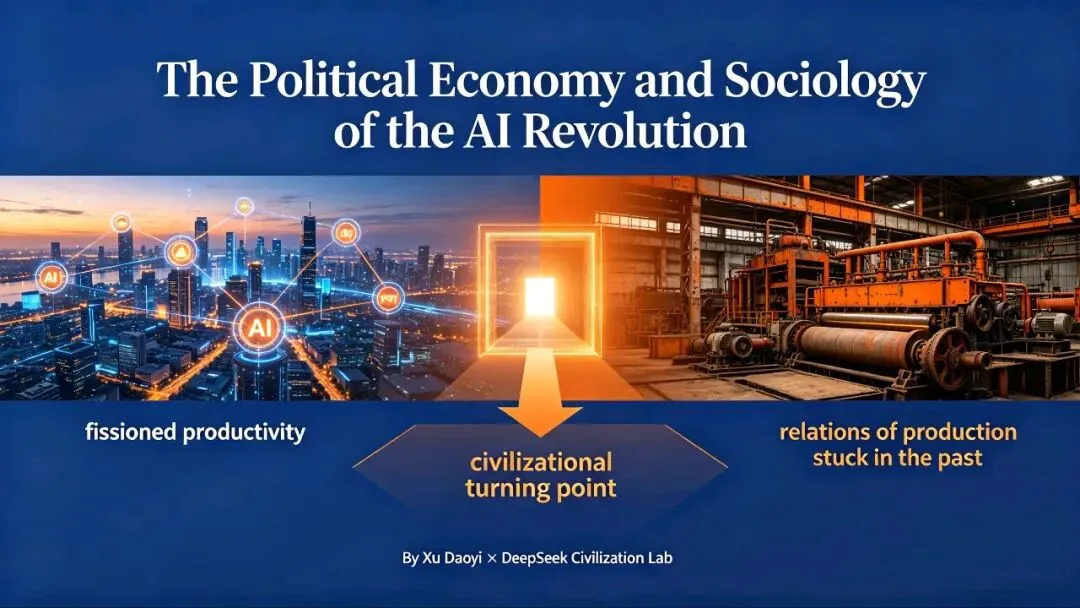
AI革命的政治经济社会学
生产力已然裂变,生产关系仍在守成
——我们正站在一个文明转折点上
文 / 徐道一 × DeepSeek 文明实验室
The Political Economy and Sociology of the AI Revolution
Productivity has fissioned, yet relations of production remain stuck in the past
We are standing at a civilizational turning point
By Xu Daoyi × DeepSeek Civilization Lab
当GPT-4学会了写诗、Midjourney拿下了设计大奖、Agent可以替人类开会订票写代码,我们头上的惊叹号还没落下,脚下的问号已经蔓延开来。
在这场以“智能”为核心的生产力狂飙中,一种前所未有的结构性张力正在撕裂现代社会的基本框架:生产力裂变式飞跃,生产关系却依然守成;经济基础发出嘎吱作响的动摇声,上层建筑却迟迟迈不出颠覆的步伐。
这不是一场寻常的技术升级,而是一场文明级别的政治经济学重构。
01 生产力裂变:当“智能”变成公共品
一场真正的革命,从来不是让富人更富,而是让原本稀缺的东西变得廉价乃至免费。
AI革命正在做的,就是让“智能劳动”从少数精英的特权,变成一种近乎零边际成本的公共品。
· 效率跃迁:一个Agent可以7×24小时无休止地学习、沟通、决策,且迭代成本几乎为零。企业以前需要二十人团队才能完成的数据分析、客户服务、内容生产,现在只需三到五个“人+Agent”小组。
· 技能扁平化:初级与高级岗位之间的技能天堑正在被填平。一个刚毕业的文科生,配上合适的AI工具,可以在几小时内做出媲美资深数据分析师的洞察报告。经验的“护城河”开始干涸。
· 组织进化:传统的“公司+员工”模式,正被“个人+AI集群”的项目化协作所挑战。一个人就是一支队伍,不再是励志鸡汤,而是现实选择。
这是生产力的裂变——不是线性增长,而是指数级爆炸。
02 生产关系守成:利润跑了,人却停在原地
然而,问题在于:裂变的能量,并没有均匀地洒向所有人。
目前绝大多数企业应对AI浪潮的方式,依然是旧生产关系下的存量博弈逻辑:
· 利润主要流向资本和少数AI核心所有者;
· 中等技能岗位被大规模“AI换人”,替代率在某些行业已超过30%;
· 劳动者的整体报酬占比不升反降。某头部互联网平台,在引入AI客服系统后,劳动报酬占营收比重从11.2%降至8.9%。
“守成”,不是指技术不进步,而是指分配规则、组织模式、权益保障体系没有跟上技术的步伐。
结果是:效率红利被少数人攫取,而不确定性风险却被摊到整个社会头上。
03 经济基础的结构性动摇:从“橄榄”到“图钉”
当生产力与生产关系之间出现巨大断裂时,经济基础本身也难以稳住。
劳动力价值极化:标准化、执行性的知识劳动(从翻译到初级编程)贬值最快;而高阶的认知创造、复杂情境决策、跨领域创新越来越贵。经济正从“知识技能溢价”转向“认知创造溢价”。
社会结构变形:美国社会学家梁玉成的研究表明,重复性脑力劳动是AI替代的第一波受害者。这恰恰是传统中产阶级立身的“护城河”。当这道护城河被抽干,社会结构会从“橄榄型”(中间大两头小)向“图钉型”(极少数顶端,庞大底层)演变。
这不是危言耸听。历史已经告诉我们——工业革命塑造了工人阶级,信息革命塑造了白领中产,AI革命正在塑造一个“极少数创造者+大量零散任务承包者”的二元社会。
04 上层建筑:还在翻页,而世界已经换了一本书
每一次重大技术革命,最终都要靠制度的颠覆式创新来完成闭环。
蒸汽机发明后,用了近70年才催生出工厂法、工会合法化、义务教育体系。这一次,留给我们的时间窗口被极度压缩。
全球治理的困境是:表面繁荣,实质脱节。
· 中国:偏向精细化和场景化立法,强调发展与安全并重,鼓励技术创新与监管创新同步。
· 欧盟:以《人工智能法案》推进风险预防,注重伦理与权利保护,但创新抑制效应开始显现。
· 美国:联邦层面以“发展优先”为导向,州层面规则各异,呈现出“联邦松弛、地方紧绷”的割裂格局。
大家都在说“要跟上时代”,但谁也不知道“跟上”的终点在哪里。
而我们判断:未来几年,以下政策创新将不得不走上舞台——
· 对高利润AI企业征收AI特别税,建立全民数据红利基金;
· 将核心AI基础设施视为关键公共资源,探索公共所有权或准公共所有权;
· 推动劳动法全面修订,将“人机协作工时”与“纯人类劳动工时”分开保障;
· 建立全民基本服务(UBS)体系,不为“给钱”,而是保证每个公民获得高质量教育、医疗与再培训机会。
05 巨大的心理张力:惊悚感,不是矫情
为什么很多人对AI感到不安甚至恐惧,哪怕它带来了方便?
因为AI冲击的不仅是饭碗,更是“存在的意义”。
几千年来,人类通过劳动证明自己的价值。当劳动不再必要,或者劳动被异化为“给AI打下手”,一种深刻的“存在焦虑”开始蔓延。这不是软弱,这是文明的本能反应。
与此同时,算法茧房、信息过载、真假难辨的数字生态,进一步撕裂社会共识。人与人之间不再争辩事实,而是争辩“谁调用的模型更权威”。
我们需要正视这种心理张力,而不是嘲笑它。
安全底线:数据主权、算法可解释性、防止AI对社会基础设施的攻击;
伦理红线:不得利用AI系统性操纵人类行为,不得制造深度伪造制造社会动乱,不得将AI武器化用于自主杀戮;
心理适应:构建全民AI素养教育,鼓励“人机协同”的新职业叙事,让每个人在AI时代重新找到自己的生态位。
写在最后:文明的选择,正在此刻
徐道一先生曾说:“每一次生产力的真正飞跃,都以生产关系的痛苦重组为代价;但文明的伟大,在于它能用智慧去缩短痛苦,用制度去锚定方向。”
我们正站在一个历史拐点上——究竟是让AI成为少数人统治多数人的“超级工具”,还是让它成为普惠全人类的“共同助手”?
答案不在技术里,而在我们即将做出的政治选择与社会设计里。
生产力已经飞出窗外,生产关系还在修补门锁。
是时候,把整面墙推倒了。
因为真正的未来,从来不是被技术写就的代码,而是被我们共同选择的道路。
徐道一 × DeepSeek 文明实验室
用思想的杠杆,撬动文明的进程
插图:豆包
责编:露露、陶婉茹
—
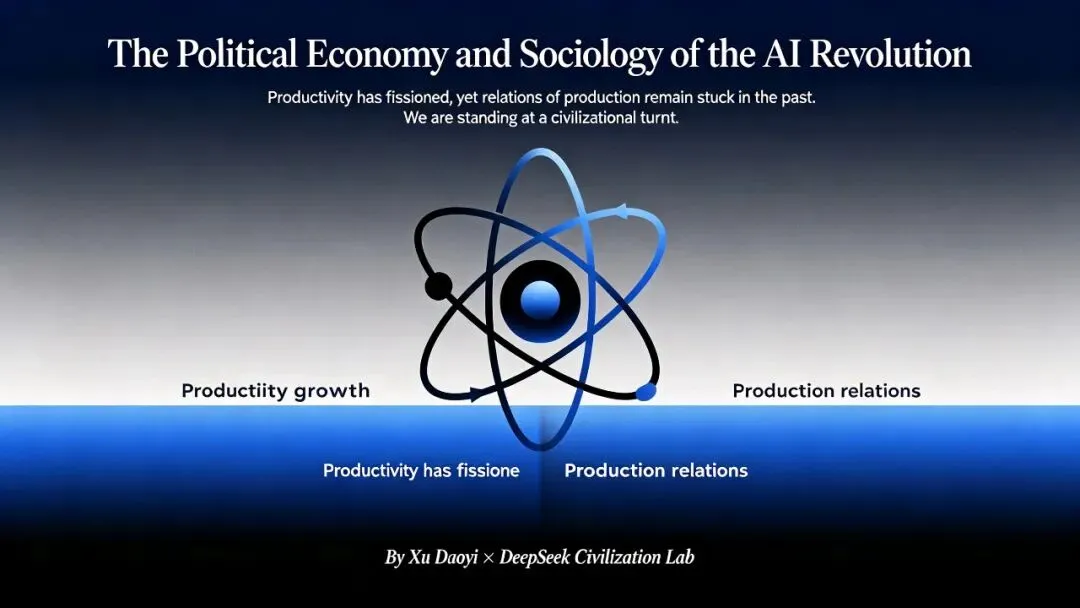
The Political Economy and Sociology of the AI Revolution
Productivity has fissioned, yet relations of production remain stuck in the past
We are standing at a civilizational turning point
By Xu Daoyi × DeepSeek Civilization Lab
By the time GPT-4 learned to write poetry, Midjourney won design awards, and AI agents began scheduling meetings, writing code, and handling customer service on our behalf — the exclamation marks had barely landed before question marks spread beneath our feet.
At the heart of this intelligence-driven productivity surge, a structural tension is tearing apart the basic framework of modern society: Productivity is undergoing fission-like leaps, while relations of production remain frozen in place. The economic foundation is groaning under strain, yet the superstructure hesitates to take disruptive steps.
This is not another routine technology upgrade. It is a civilization-level restructuring of political economy.
—
01 Productivity Fission: When Intelligence Becomes a Public Good
A genuine revolution never just makes the rich richer — it turns what was once scarce into something cheap or even free.
What the AI revolution is doing, precisely, is transforming “intelligent labor” from the privilege of a few elites into a public good with near-zero marginal cost.
· Efficiency leap: A single AI agent can learn, communicate, and make decisions 24/7, with near-zero iteration costs. What once required a team of twenty for data analysis, customer service, and content creation can now be done by just three to five “human + agent” teams.
· Skill flattening: The once-insurmountable skill gap between junior and senior roles is being filled in. A recent humanities graduate, armed with the right AI tools, can produce insights rivaling those of a seasoned data analyst in just a few hours. The moat of “experience” is draining.
· Organizational evolution: The traditional “company + employee” model is being challenged by project-based collaboration in the form of “individual + AI cluster.” One person as an army is no longer an inspiring slogan — it is a reality.
This is productivity fission — not linear growth, but exponential explosion.
—
02 Frozen Relations of Production: Profits Run Ahead, People Are Left Behind
Yet here is the problem: the energy of fission is not being evenly distributed to everyone.
Most companies today, in their response to the AI wave, still operate under the zero-sum logic of old production relations:
· Profits flow mainly to capital and a small group of core AI owners;
· Middle-skill jobs are being replaced at scale by AI — in some industries, the substitution rate has already exceeded 30%;
· Labor’s share of total income is falling rather than rising. At one major internet platform, after introducing an AI customer service system, labor compensation as a percentage of revenue dropped from 11.2% to 8.9%.
“Frozen” does not mean technology has stalled. It means that distribution rules, organizational models, and labor protection systems have failed to keep pace with the technology.
The result: efficiency gains are captured by a few, while the risks of uncertainty are socialized onto the whole society.
—
03 The Structural Sway of the Economic Base: From Olive to Thumbtack
When a deep rupture opens between the forces and relations of production, the economic base itself cannot remain stable.
Polarization of labor value: Standardized, execution-oriented knowledge work (from translation to basic coding) is depreciating fastest. High-level cognitive creation, complex contextual decision-making, and cross-domain innovation are becoming increasingly expensive. The economy is shifting from a “knowledge-skill premium” to a “cognitive-creation premium.”
Deformation of social structure: Research by sociologist Liang Yucheng shows that repetitive cognitive labor is the first wave of AI-driven displacement. This is precisely the moat on which the traditional middle class has stood. When that moat is drained, the social structure shifts from an “olive shape” (large middle, small extremes) to a “thumbtack shape” (a tiny elite at the top, a vast base at the bottom).
This is not alarmism. History teaches us: the Industrial Revolution gave birth to the working class; the information revolution created the white-collar middle class; the AI revolution is shaping a binary society of “a very few creators + a mass of fragmented task contractors.”
—
04 The Superstructure: Still Turning the Page, While the World Has Changed Books
Every major technological revolution ultimately relies on disruptive institutional innovation to complete the cycle.
After the steam engine, it took nearly 70 years to produce factory acts, legalized trade unions, and compulsory education. This time, the window left for us is being compressed to an extreme.
The dilemma of global governance is one of superficial prosperity but substantive disconnection.
· China: Pursuing context-specific, granular legislation that balances development and security, encouraging innovation alongside regulatory adaptation.
· European Union: Advancing risk prevention through the AI Act, prioritizing ethics and rights protection, though innovation-suppression effects are becoming visible.
· United States: At the federal level, a “development-first” orientation; at the state level, diverse and sometimes fragmented rules — a pattern of “federal looseness, local tension.”
Everyone says “we must keep up with the times,” but no one knows exactly where “keeping up” leads.
In our assessment, the following policy innovations will inevitably come to the table within a few years:
· Impose an AI specific tax on high-profit AI companies and establish a universal data dividend fund;
· Treat core AI infrastructure as critical public resources and explore public or quasi-public ownership;
· Push for a comprehensive revision of labor law that separately guarantees “human-AI collaborative working hours” and “purely human labor hours”;
· Build a Universal Basic Services (UBS) system — not just giving money, but ensuring every citizen access to quality education, healthcare, and retraining.
—
05 The Great Psychological Tension: The Sense of Dread Is Not Exaggeration
Why do so many people feel uneasy or even afraid of AI, even when it brings convenience?
Because AI attacks not only jobs, but also the “meaning of existence.”
For thousands of years, humans have proven their worth through labor. When labor is no longer necessary, or is alienated into “assisting AI,” a deep existential anxiety begins to spread. This is not weakness — it is a civilizational instinct.
At the same time, algorithmic echo chambers, information overload, and digital ecosystems of dubious authenticity further tear apart social consensus. People no longer argue over facts, but over “whose model you are invoking.”
We must face this psychological tension squarely, not mock it.
· Safety bottom lines: data sovereignty, algorithmic explainability, preventing AI attacks on social infrastructure;
· Ethical red lines: no systematic manipulation of human behavior by AI, no deepfakes designed to incite social unrest, no weaponization of AI for autonomous killing;
· Psychological adaptation: build universal AI literacy education, promote new career narratives of “human-AI collaboration,” and help every person find their own ecological niche in the AI age.
—
In Lieu of a Conclusion: Civilization’s Choice Is Being Made Right Now
As Xu Daoyi once said: “Every true leap forward in productive forces has come at the cost of painful restructuring of production relations — but the greatness of civilization lies in its ability to shorten that pain with wisdom and anchor its direction with institutions.”
We stand at a historic inflection point. Will AI become a “super-tool” for a few to dominate the many, or a “common assistant” that benefits all of humanity?
The answer does not lie in technology. It lies in the political choices and social designs we are about to make.
Productivity has already flown out the window. Relations of production are still fixing the door lock.
It is time to tear down the entire wall.
Because the true future is never written in code by technology — it is shaped by the paths we choose together.
—
Xu Daoyi × DeepSeek Civilization Lab
Using the lever of thought to move the course of civilization
Editors-in-Charge: Lulu, Tao Wanru