ARTICLE · 1176797
【干货】F8科目考试重点知识整理-Finalisation

I. Summary of Knowledge
1. Subsequent events
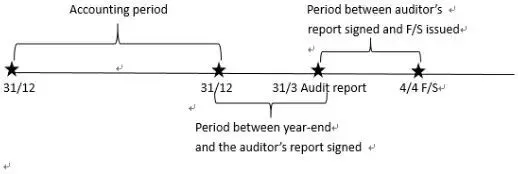
1.1 Events after the reporting period (IAS 10)
1.1.1 Definition :※※※※※
Events after the reporting period: events, both favourable and unfavourable, that occur between the end of the reporting period and the date when the financial statements are authorised for issue.
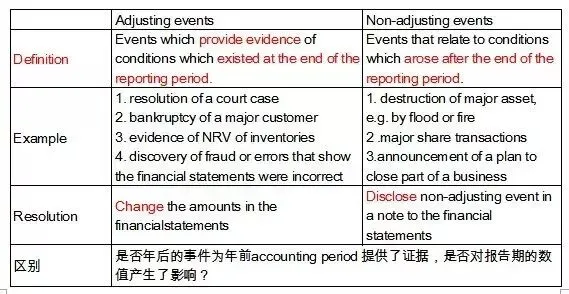
1.2 Adjusting events & Non-adjusting events
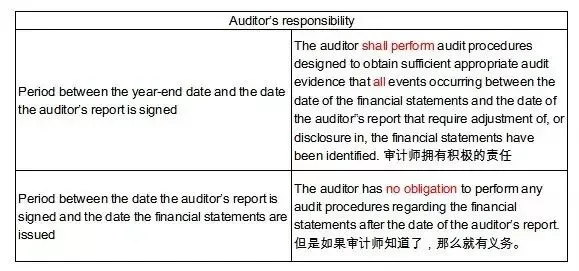
1.3 Auditor’s responsibility ※※※※※
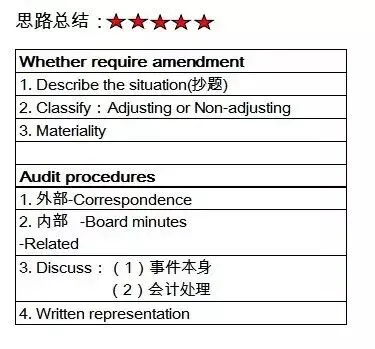
 1.4 Examples ※※※
1.4.1 Adjusting events
Bankruptcy of a major customer - Dec 2014 Q4
Audit procedures:
Review correspondence with the customer
Discuss with management
Review the post year end
Evidence of NRV of inventories - June 2013 Q5
Audit procedures:
Review the board minutes
Discuss with director: sufficient inventory to trade in the short time
Obtain written representation
Obtain a schedule
Discuss with directors of the valuation
Resolution of a court case - Dec 2011 Q5
Audit procedures:
Contact with lawyers
Review the correspondence with the supplier
Written representation
1.4.2 Non-adjusting event
Explosion- June 2013 Q5
Obtain a schedule of damaged property
Obtain the latest inventory records
Discuss with directors whether they will disclose
Discuss with directors why unable to claim on insurance
I.5 Events after the audit report has been signed ※※
Audit procedures:
-Discussing the matter with directors to determine their course of action.
-Re-draft and re-date the audit report as appropriate.
-Considering acting the members: speak in AGM.
-Extraordinary general meeting.
2. Going concern
2.1 Definition ※※※※※
ISA 570-Going concern define the going concern assumption. The going concern assumption means that management believes the company will continue in business for the foreseeable future. Foreseeable future is not defined in ISA 570 Going Concern. However under IAS 1 Presentation of Financial Statements, this period is a minimum of 12 months after the year end.
2.2 Indicators ※※※
- Financial: The ability of generating cash flow & The ability of obtaining funds
- Operational
- Other: Legal factors
2.3 Auditor’s responsibility of going concern ※※※※※
- To carry out appropriate audit procedures that will identify whether or not an organisation can continue as a going concern.
- To ensure that the organisation’s management have been realistic in their use of the going concern assumption when preparing the financial statements
- To report to the members where they consider that the going concern assumption has been used inappropriately, for example, when the financial statements indicate that the organisation is a going concern, but audit procedures indicate this may not be the case.
2.4 Auditor’s procedure for going concern: ※※
- Cash flow forecast
- Review post year-end sales and order book
- Compare current agreement with bank with key ratios
- Inquire of lawyers
- Written representation
3. Written representation ※※
3.1 Sample of ISA 580
3.2 If the client refuses to sign.
II. Key points
1. Definition of Events after the reporting period (IAS 10)
2. Definition of Adjusting events & Non-adjusting events
3. Resolution of adjusting events and non-adjusting events
4. Auditor’s responsibility during the different periods
5. Definition of going concern
6. Auditor’s responsibility of going concern
III. Mind map
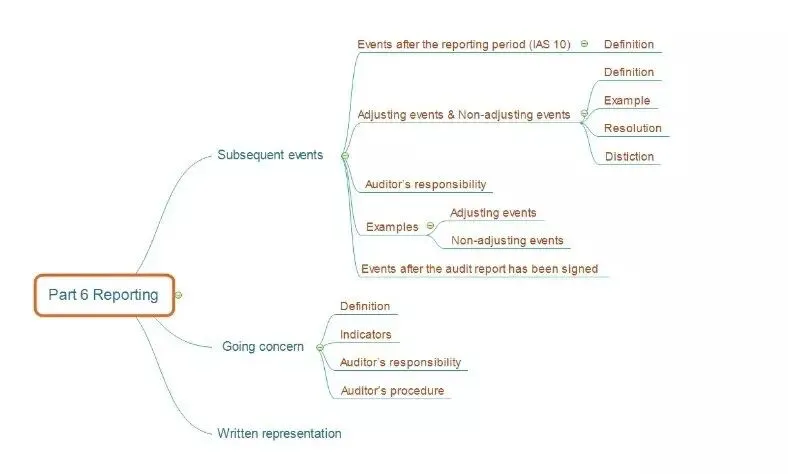
关于F8科目Finalisation这个重点知识你get了么?what?没看懂?蹲墙角抱着这篇文章有感情的含情脉脉的看上10遍就懂了~