文档文本内容
2026 人教版英语四下单元重点知识
单元重点知识
Unit 4 Going shopping
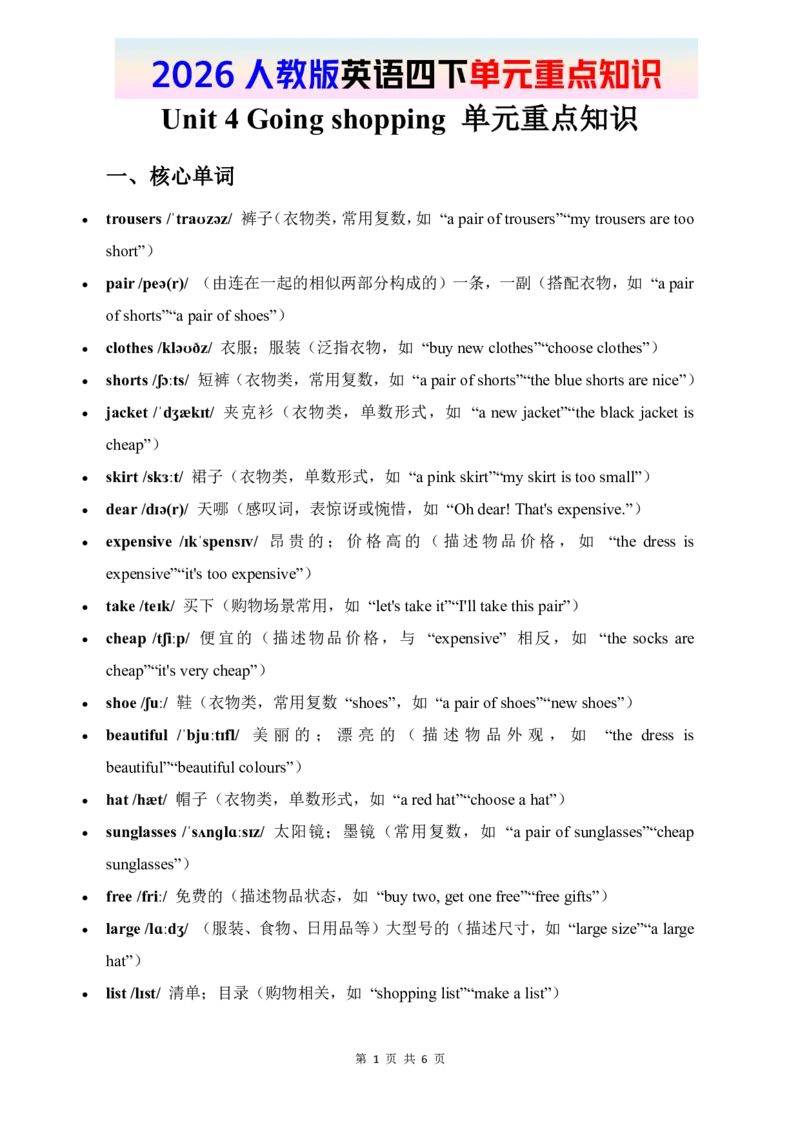
一、核心单词
trousers /ˈtraʊzəz/ 裤子(衣物类,常用复数,如 “apair oftrousers”“mytrousers are too
short”)
pair/peə(r)/ (由连在一起的相似两部分构成的)一条,一副(搭配衣物,如 “apair
ofshorts”“a pairofshoes”)
clothes /kləʊðz/ 衣服;服装(泛指衣物,如 “buynewclothes”“choose clothes”)
shorts/ʃɔːts/ 短裤(衣物类,常用复数,如 “apair ofshorts”“the blueshorts are nice”)
jacket /ˈdʒækɪt/ 夹克衫(衣物类,单数形式,如 “a new jacket”“the black jacket is
cheap”)
skirt /skɜːt/ 裙子(衣物类,单数形式,如 “apink skirt”“my skirt is toosmall”)
dear/dɪə(r)/ 天哪(感叹词,表惊讶或惋惜,如 “Oh dear!That's expensive.”)
expensive /ɪkˈspensɪv/ 昂贵的;价格高的(描述物品价格,如 “the dress is
expensive”“it's too expensive”)
take/teɪk/ 买下(购物场景常用,如 “let's takeit”“I'll take thispair”)
cheap /tʃiːp/ 便宜的(描述物品价格,与 “expensive” 相反,如 “the socks are
cheap”“it's very cheap”)
shoe/ʃuː/ 鞋(衣物类,常用复数 “shoes”,如 “apair ofshoes”“new shoes”)
beautiful /ˈbjuːtɪfl/ 美 丽 的 ; 漂 亮 的 ( 描 述 物 品 外 观 , 如 “the dress is
beautiful”“beautiful colours”)
hat/hæt/ 帽子(衣物类,单数形式,如 “aredhat”“choosea hat”)
sunglasses /ˈsʌnɡlɑːsɪz/ 太阳镜;墨镜(常用复数,如 “a pair of sunglasses”“cheap
sunglasses”)
free/friː/ 免费的(描述物品状态,如 “buytwo, get onefree”“free gifts”)
large/lɑːdʒ/ (服装、食物、日用品等)大型号的(描述尺寸,如 “large size”“alarge
hat”)
list/lɪst/ 清单;目录(购物相关,如 “shopping list”“makea list”)
第 1 页 共 6 页2026 人教版英语四下单元重点知识
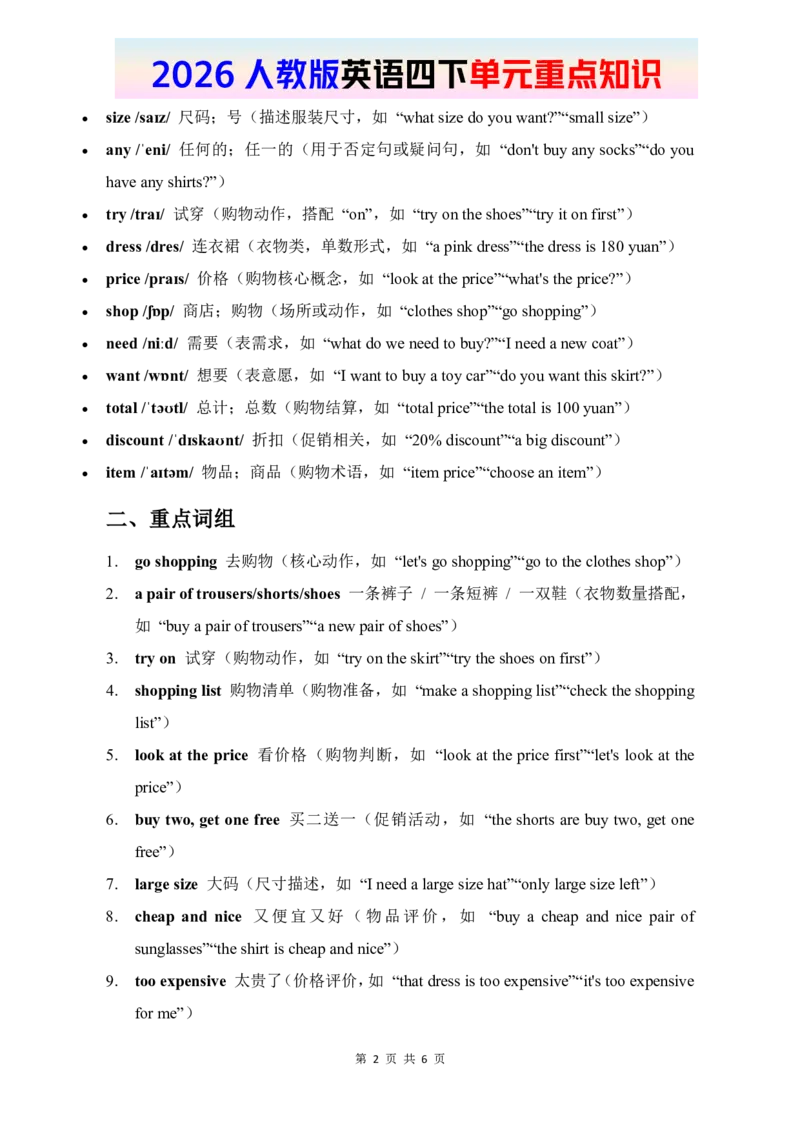
size/saɪz/ 尺码;号(描述服装尺寸,如 “what sizedoyou want?”“small size”)
any /ˈeni/ 任何的;任一的(用于否定句或疑问句,如 “don't buy any socks”“do you
haveany shirts?”)
try /traɪ/ 试穿(购物动作,搭配 “on”,如 “try ontheshoes”“try itonfirst”)
dress/dres/ 连衣裙(衣物类,单数形式,如 “apink dress”“thedress is 180yuan”)
price/praɪs/ 价格(购物核心概念,如 “lookat the price”“what's the price?”)
shop/ʃɒp/ 商店;购物(场所或动作,如 “clothes shop”“go shopping”)
need /niːd/ 需要(表需求,如 “what dowe need to buy?”“Ineed anew coat”)
want/wɒnt/ 想要(表意愿,如 “I want to buyatoy car”“doyou want thisskirt?”)
total /ˈtəʊtl/ 总计;总数(购物结算,如 “totalprice”“thetotal is100yuan”)
discount/ˈdɪskaʊnt/ 折扣(促销相关,如 “20% discount”“a big discount”)
item/ˈaɪtəm/ 物品;商品(购物术语,如 “item price”“choosean item”)
二、重点词组
1. goshopping 去购物(核心动作,如 “let's go shopping”“go tothe clothesshop”)
2. apairoftrousers/shorts/shoes 一条裤子 / 一条短裤 / 一双鞋(衣物数量搭配,
如 “buyapair oftrousers”“a newpair ofshoes”)
3. try on 试穿(购物动作,如 “try onthe skirt”“try theshoes onfirst”)
4. shoppinglist 购物清单(购物准备,如 “make ashopping list”“check theshopping
list”)
5. look at the price 看价格(购物判断,如 “look at the price first”“let's look at the
price”)
6. buy two, get one free 买二送一(促销活动,如 “the shorts are buy two, get one
free”)
7. largesize 大码(尺寸描述,如 “Ineed alarge sizehat”“only large sizeleft”)
8. cheap and nice 又便宜又好(物品评价,如 “buy a cheap and nice pair of
sunglasses”“theshirt ischeap and nice”)
9. too expensive 太贵了(价格评价,如 “that dress istoo expensive”“it's too expensive
forme”)
第 2 页 共 6 页2026 人教版英语四下单元重点知识
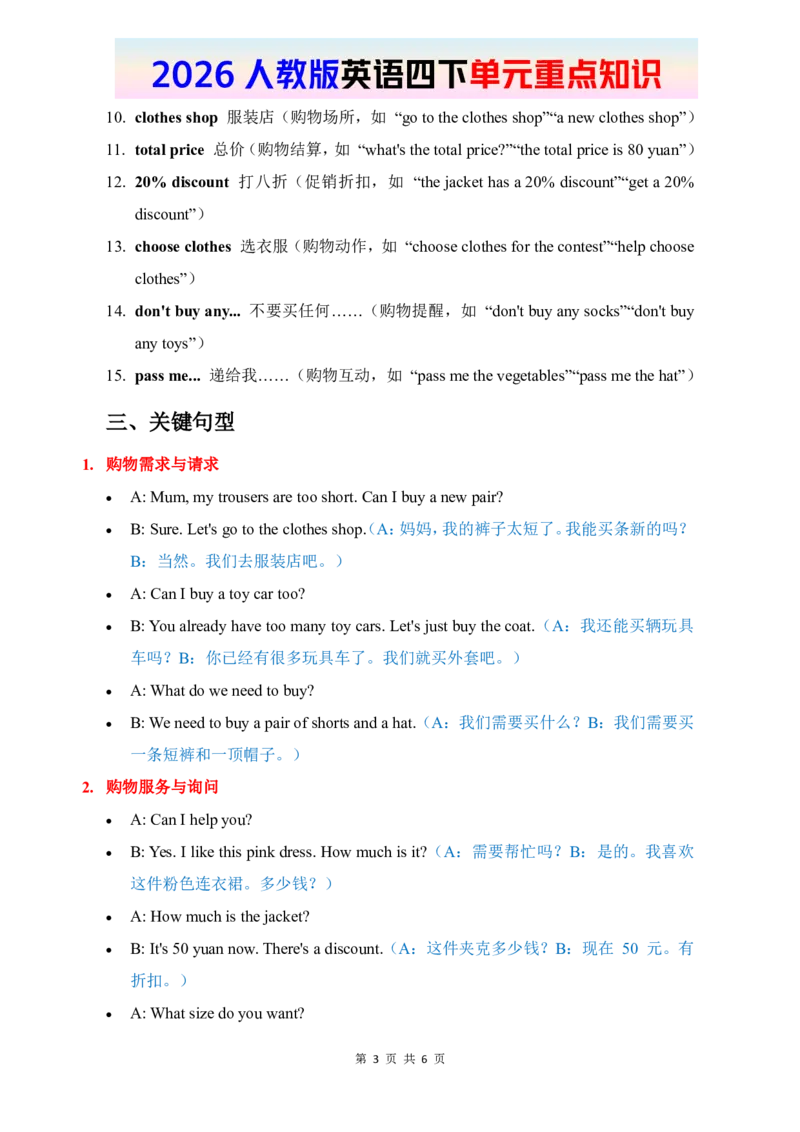
10. clothes shop 服装店(购物场所,如 “go totheclothes shop”“a newclothes shop”)
11. total price 总价(购物结算,如 “what's thetotal price?”“thetotal priceis 80yuan”)
12. 20% discount 打八折(促销折扣,如 “the jacket has a 20% discount”“get a 20%
discount”)
13. chooseclothes 选衣服(购物动作,如 “choose clothes for thecontest”“help choose
clothes”)
14. don't buy any... 不要买任何……(购物提醒,如 “don't buy any socks”“don't buy
anytoys”)
15. passme... 递给我……(购物互动,如 “pass methevegetables”“pass methehat”)
三、关键句型
1. 购物需求与请求
A: Mum,my trousers are tooshort. CanI buyanew pair?
B: Sure. Let's go tothe clothesshop(. A:妈妈,我的裤子太短了。我能买条新的吗?
B:当然。我们去服装店吧。)
A: CanI buyatoycar too?
B:You already have too many toy cars. Let's just buy the coat.(A:我还能买辆玩具
车吗?B:你已经有很多玩具车了。我们就买外套吧。)
A:What dowe need tobuy?
B:Weneed tobuya pairof shortsand ahat.(A:我们需要买什么?B:我们需要买
一条短裤和一顶帽子。)
2. 购物服务与询问
A: CanI helpyou?
B:Yes. I like this pink dress. How much is it?(A:需要帮忙吗?B:是的。我喜欢
这件粉色连衣裙。多少钱?)
A: Howmuchis thejacket?
B: It's 50yuan now.There's a discount.(A:这件夹克多少钱?B:现在 50 元。有
折扣。)
A:What sizedoyou want?
第 3 页 共 6 页2026 人教版英语四下单元重点知识
B: Iwant alarge size.(A:你想要什么尺码?B:我想要大码。)
3. 价格评价与决定
A: It's 180yuan.
B: I'm sorry,dear.That's expensive.(A:180 元。B:抱歉,宝贝。太贵了。)
A:Theblueshorts are 20yuan.
B:That's cheap! Let's takethem.(A:这条蓝色短裤 20 元。B:真便宜!我们买下
吧。)
A: Look!The sunglasses are sixtyyuan now.
B:They're cheap and nice. Let's buy a pair.(A:看!太阳镜现在 60 元。B:又便
宜又好。我们买一副吧。)
4. 试穿与提醒
A:Theshorts look nice.Trythem onfirst.
B: OK.They fit well.(A:这条短裤看起来不错。先试穿一下。B:好的。很合身。)
A: Don't buyany socks!Youhave alot ofsocks!
B: OK, Mum.(A:别买袜子了!你已经有很多袜子了!B:好的,妈妈。)
A: Buytwo pairs of shorts. Buy two, get onefree.
B: Great!I'll buytwo.(A:买两条短裤。买二送一。B:太好了!我买两条。)
5. 购物总结与计划
A: Let's makeashopping list.What dowe need?
B:Weneed sunglasses, shorts and a hat.(A:我们列个购物清单吧。需要什么?B:
我们需要太阳镜、短裤和帽子。)
A: Here's your shoppinglist. Don't forget totry ontheshorts.
B: Iwon't.(A:这是你的购物清单。别忘了试穿短裤。B:我不会忘的。)
A:Thetotal price is 90yuan.
B:That's OK. Here's themoney.(A:总价 90 元。B:好的。给你钱。)
四、语法要点
1. “Howmuch...” 的用法
第 4 页 共 6 页2026 人教版英语四下单元重点知识
询问物品价格:How much +be 动词 + 物品?,如 “How much is thedress?”“How
much are theshorts?”(注意单复数:单数用 “is”,复数用 “are”)
回答:It's + 金额 +yuan.(单数物品)/They're + 金额 +yuan.(复数物品),如
“It's 180yuan.”“They're 20yuan.”
2. 情态动词 can 表请求许可的应用
结构:CanI + 动词原形?(请求允许做某事),如 “Can Ibuyanew pair?”“CanI
tryit on?”
肯定回答:Sure. / Yes, you can.;否定回答:No, you can't. / You already have too
many...,如 “CanI buyatoycar?”“Youalready havetoo manytoy cars.”
3. “too” 的用法
表 “太……”,修饰形容词或副词,如 “too short”(太短)、“too expensive”(太
贵)、“too many”(太多,后接可数名词复数),如 “my trousers are tooshort”“too
many toycars”
区别 “too” 与 “very”:“too” 含否定意味,表 “超出合适程度”,“very” 表 “非
常”,无否定意味,如 “very cheap”(非常便宜)、“too cheap”(太便宜,可能隐
含质量问题)
4. “let's” 与 “let's just” 的用法
“let's + 动词原形”:表提议 “让我们做某事”,如 “Let's go to the clothes
shop.”“Let's take it.”
“let's just+ 动词原形”:表 “我们就做某事(不做其他事)”,强调 “只做这一件”,
如 “Let's justbuythecoat.”“Let's justlook at the price.”
5. 名词单复数的特殊情况
常用复数的衣物名词:trousers, shorts, sunglasses, shoes(这类名词通常由两部分
构成,需用复数),搭配 “a pairof” 表单数数量,如 “a pairoftrousers”“apair of
sunglasses”
单数衣物名词:dress, skirt, jacket, hat(这类名词为整体单一物品,直接用单数,
复数加 “s”),如 “a pink dress”“two jackets”
五、语音拓展
第 5 页 共 6 页2026 人教版英语四下单元重点知识
1. 字母组合 “ir” 的发音 /ɜː/
对应单词:skirt(/skɜːt/,如 “anew skirt”)、bird(/bɜːd/,拓展,如 “a smallbird”)、
girl(/ɡɜːl/,拓展,如 “alittlegirl”)、shirt(/ʃɜːt/,如 “a whiteshirt”)
发音技巧:舌身中部抬起,口型较小,双唇略收圆,发长音 “呃”,声音清晰且拉
长,如 “skirt” 中 “ir” 的发音,与 “sir”“third” 相近。
2. 字母组合 “ur” 的发音 /ɜː/
对应单词:turn(/tɜːn/,拓展,如 “turn around”)、hurt(/hɜːt/,拓展,如 “hurt my
hand”)、nurse(/nɜːs/,拓展,如 “anurse”)、fur(/fɜː/,拓展,如 “animal fur”)
发音技巧:与 “ir” 发音相同,舌身中部抬起,口型紧凑,发长音 “呃”,如 “turn”
中 “ur” 的发音,注意与 “or”(/ɔː/)区分,避免混淆 “turn”(/tɜːn/)和 “torn”
(/tɔːn/)。
3. 字母组合 “ea” 的发音 /iː/
对应单词:cheap(/tʃiːp/,如 “cheap shorts”)、dear(/dɪə(r)/,如 “Oh dear!”)、
beautiful(/ˈbjuːtɪfl/,中 “eau” 发 /juː/,拓展 “tea”/tiː/)、need(/niːd/,如 “need
acoat”)
发音技巧:舌尖抵下齿龈,口型扁平,发长音 “衣”,声音饱满,如 “cheap” 中 “ea”
的发音,与 “see”“meat” 相近。
4. 单词重音规律(购物与衣物相关词汇)
双 音 节 衣 物 类 词 汇 : 重 音 多 在 第 一 个 音 节 , 如
“ˈtrousers”“ˈjacket”“ˈskirt”“ˈdress”“ˈsunglasses”(重音在第一个音节 “sun”)
双音节描述性词汇:重音多在第一个音节,如 “ˈcheap”“ˈexpensive”“ˈbeautiful”(重
音在第一个音节 “beau”)
多音节词汇:重音常在倒数第三个音节,如 “ˌexˈpensive”(重音在第二个音节)、
“ˈbeauˈtiful”(双重音,主重音在第一个音节)、“ˈshopˈping”(重音在第一个音节)
第 6 页 共 6 页