文档文本内容
2026
人教版英语四下单元重点知识
Unit 3 Time for school 单元重点知识
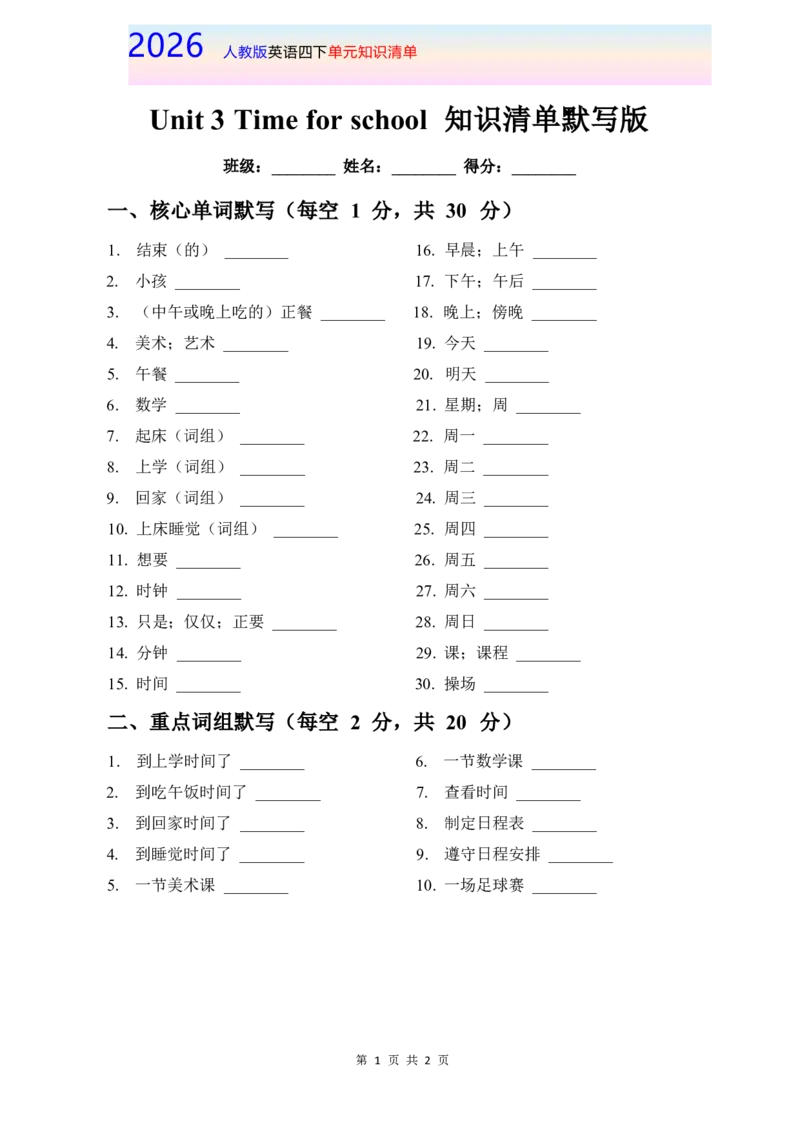
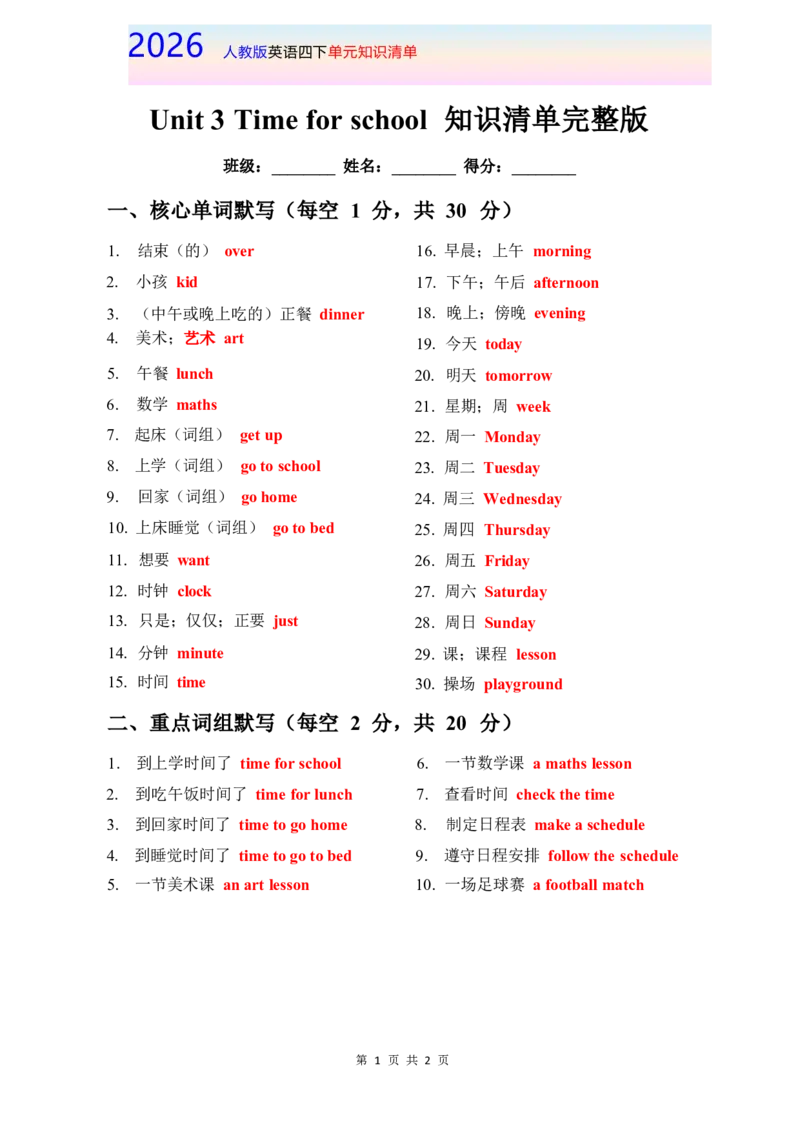
一、核心单词
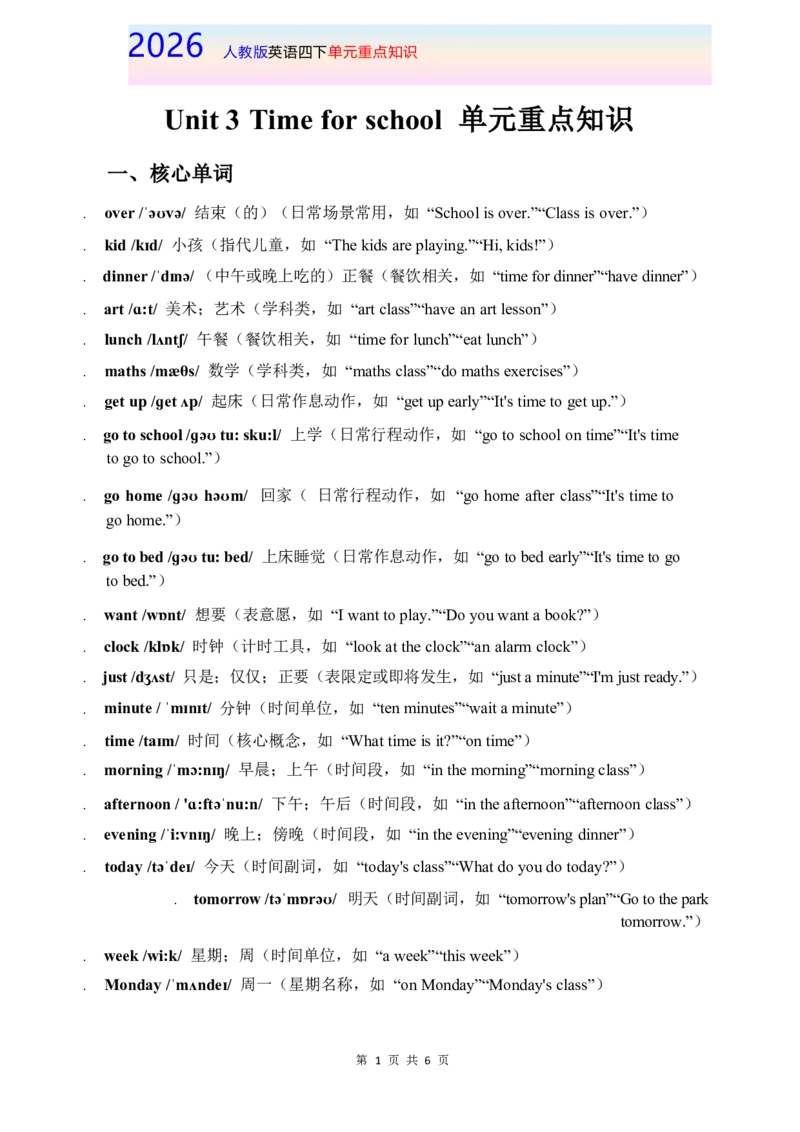
. over /ˈəʊvə/ 结束(的)(日常场景常用,如 “School is over.”“Class is over.”)
. kid /kɪd/ 小孩(指代儿童,如 “The kids are playing.”“Hi, kids!”)
. dinner /ˈdɪnə/ (中午或晚上吃的)正餐(餐饮相关,如 “time for dinner”“have dinner”)
. art /ɑ:t/ 美术;艺术(学科类,如 “art class”“have an art lesson”)
. lunch /lʌntʃ/ 午餐(餐饮相关,如 “time for lunch”“eat lunch”)
. maths /mæθs/ 数学(学科类,如 “maths class”“do maths exercises”)
. get up /ɡet ʌp/ 起床(日常作息动作,如 “get up early”“It's time to get up.”)
. go to school /ɡəʊ tu: sku:l/ 上学(日常行程动作,如 “go to school on time”“It's time
to go to school.”)
. go home /ɡəʊ həʊm/ 回家( 日常行程动作,如 “go home after class”“It's time to
go home.”)
. go to bed /ɡəʊ tu: bed/ 上床睡觉(日常作息动作,如 “go to bed early”“It's time to go
to bed.”)
. want /wɒnt/ 想要(表意愿,如 “I want to play.”“Do you want a book?”)
. clock /klɒk/ 时钟(计时工具,如 “look at the clock”“an alarm clock”)
. just /dʒʌst/ 只是;仅仅;正要(表限定或即将发生,如 “just a minute”“I'm just ready.”)
. minute / ˈmɪnɪt/ 分钟(时间单位,如 “ten minutes”“wait a minute”)
. time /taɪm/ 时间(核心概念,如 “What time is it?”“on time”)
. morning /ˈmɔ:nɪŋ/ 早晨;上午(时间段,如 “in the morning”“morning class”)
. afternoon / 'ɑ:ftəˈnu:n/ 下午;午后(时间段,如 “in the afternoon”“afternoon class”)
. evening /ˈi:vnɪŋ/ 晚上;傍晚(时间段,如 “in the evening”“evening dinner”)
. today /təˈdeɪ/ 今天(时间副词,如 “today's class”“What do you do today?”)
. tomorrow /təˈmɒrəʊ/ 明天(时间副词,如 “tomorrow's plan”“Go to the park
tomorrow.”)
. week /wi:k/ 星期;周(时间单位,如 “a week”“this week”)
. Monday /ˈmʌndeɪ/ 周一(星期名称,如 “on Monday”“Monday's class”)
第 1 页 共 6 页2026
人教版英语四下单元重点知识
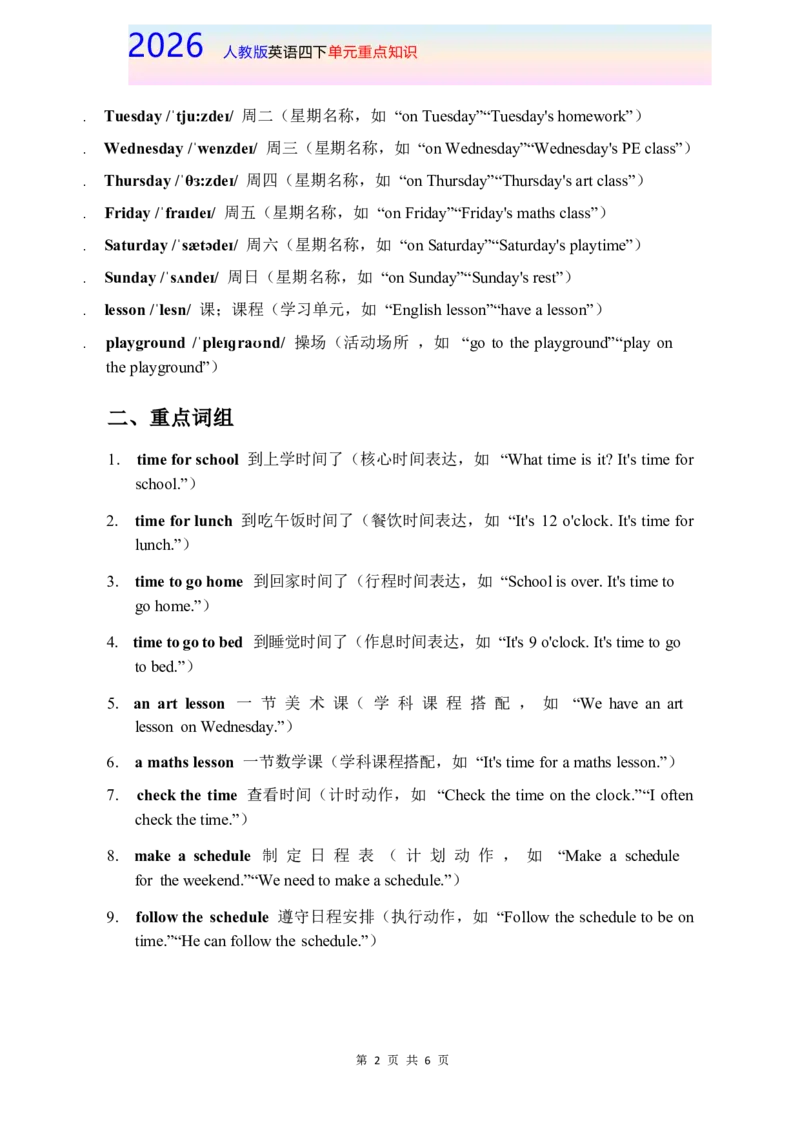
. Tuesday /ˈtju:zdeɪ/ 周二(星期名称,如 “on Tuesday”“Tuesday's homework”)
. Wednesday /ˈwenzdeɪ/ 周三(星期名称,如 “on Wednesday”“Wednesday's PE class”)
. Thursday /ˈθɜ:zdeɪ/ 周四(星期名称,如 “on Thursday”“Thursday's art class”)
. Friday /ˈfraɪdeɪ/ 周五(星期名称,如 “on Friday”“Friday's maths class”)
. Saturday /ˈsætədeɪ/ 周六(星期名称,如 “on Saturday”“Saturday's playtime”)
. Sunday /ˈsʌndeɪ/ 周日(星期名称,如 “on Sunday”“Sunday's rest”)
. lesson /ˈlesn/ 课;课程(学习单元,如 “English lesson”“have a lesson”)
. playground /ˈpleɪɡraʊnd/ 操场(活动场所 ,如 “go to the playground”“play on
the playground”)
二、重点词组
1. time for school 到上学时间了(核心时间表达,如 “What time is it? It's time for
school.”)
2. time for lunch 到吃午饭时间了(餐饮时间表达,如 “It's 12 o'clock. It's time for
lunch.”)
3. time to go home 到回家时间了(行程时间表达,如 “School is over. It's time to
go home.”)
4. time to go to bed 到睡觉时间了(作息时间表达,如 “It's 9 o'clock. It's time to go
to bed.”)
5. an art lesson 一 节 美 术 课( 学 科 课 程 搭 配 , 如 “We have an art
lesson on Wednesday.”)
6. a maths lesson 一节数学课(学科课程搭配,如 “It's time for a maths lesson.”)
7. check the time 查看时间(计时动作,如 “Check the time on the clock.”“I often
check the time.”)
8. make a schedule 制 定 日 程 表 ( 计 划 动 作 , 如 “Make a schedule
for the weekend.”“We need to make a schedule.”)
9. follow the schedule 遵守日程安排(执行动作,如 “Follow the schedule to be on
time.”“He can follow the schedule.”)
第 2 页 共 6 页2026
人教版英语四下单元重点知识
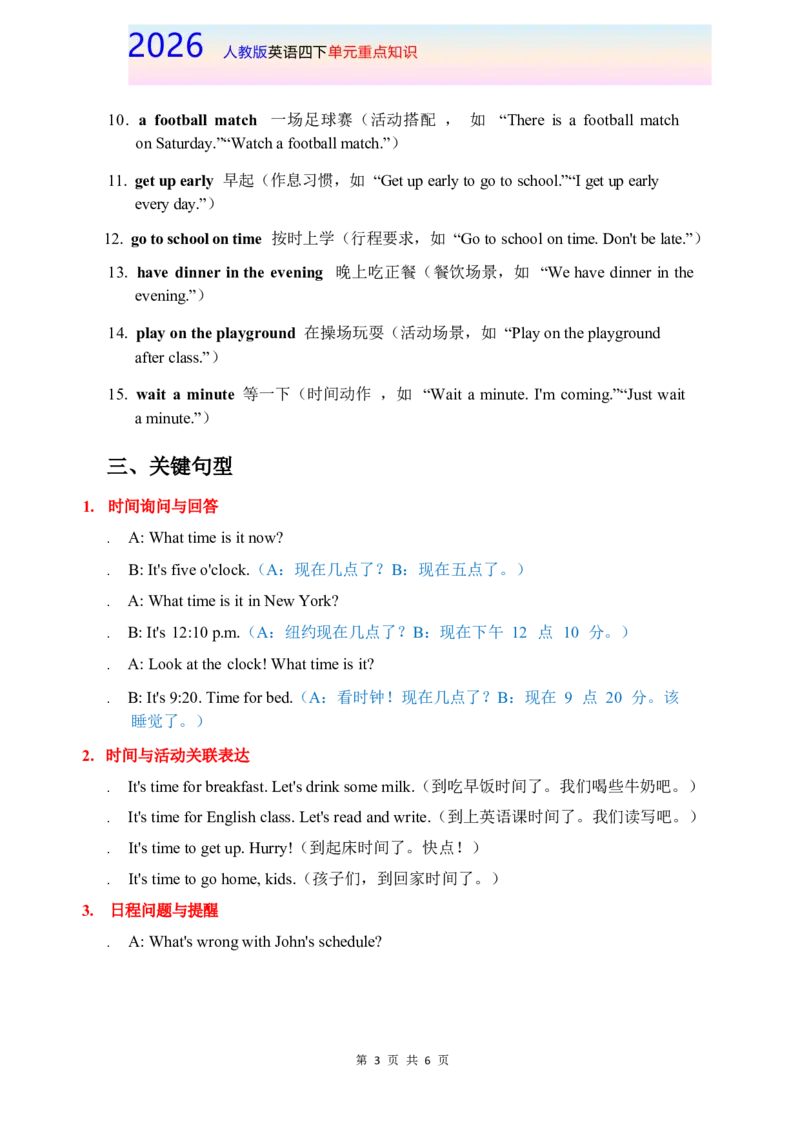
10. a football match 一场足球赛(活动搭配 , 如 “There is a football match
on Saturday.”“Watch a football match.”)
11. get up early 早起(作息习惯,如 “Get up early to go to school.”“I get up early
every day.”)
12. go to school on time 按时上学(行程要求,如 “Go to school on time. Don't be late.”)
13. have dinner in the evening 晚上吃正餐(餐饮场景,如 “We have dinner in the
evening.”)
14. play on the playground 在操场玩耍(活动场景,如 “Play on the playground
after class.”)
15. wait a minute 等一下(时间动作 ,如 “Wait a minute. I'm coming.”“Just wait
a minute.”)
三、关键句型
1. 时间询问与回答
. A: What time is it now?
. B: It's five o'clock.(A:现在几点了?B:现在五点了。)
. A: What time is it in New York?
. B: It's 12:10 p.m.(A:纽约现在几点了?B:现在下午 12 点 10 分。)
. A: Look at the clock! What time is it?
. B: It's 9:20. Time for bed.(A:看时钟!现在几点了?B:现在 9 点 20 分。该
睡觉了。)
2. 时间与活动关联表达
. It's time for breakfast. Let's drink some milk.(到吃早饭时间了。我们喝些牛奶吧。)
. It's time for English class. Let's read and write.(到上英语课时间了。我们读写吧。)
. It's time to get up. Hurry!(到起床时间了。快点!)
. It's time to go home, kids.(孩子们,到回家时间了。)
3. 日程问题与提醒
. A: What's wrong with John's schedule?
第 3 页 共 6 页2026
人教版英语四下单元重点知识
. B: It's 8 o'clock. He's late. It's time to go to school.(A:约翰的日程出什么问题了?
B:现在 8 点了。他迟到了。该上学了。)
. Mike! It's 7:40. It's time to get up.(迈克!现在 7 点 40 分了。该起床了。)
. Hurry, Mike! It's 8:30. You're late for class.(快点,迈克!现在 8 点 30 分了。你
上课迟到了。)
4. 日常意愿与回应
. A: Oh no! I want to play more!
. B: It's time to go home.(A:哦不!我还想多玩一会儿!B:该回家了。)
. A: Can I go to bed late tonight?
. B: OK, but not too late.(A:今晚我能晚点睡觉吗?B:可以,但别太晚。)
. A: Let's go to the playground.
. B: OK.(A:我们去操场吧。B:好的。)
5. 日程意义表达
. A good schedule makes us organized. We can plan our day and use our time well.(
一个好的日程表让我们有条理。我们可以规划一天,合理利用时间。)
. We often check the schedule to keep to it.(我们经常查看日程表以遵守它。)
. Have a nice day!(祝你一天愉快!)
四、语法要点
1. 时间表达法(整点与非整点)
. 整点:It's + 数字 + o'clock ,如 “It's five o'clock.”“It's 8 o'clock.”
. 非整点:
. 分钟≤30:It's + 分钟 + past + 小时,如 “It's 10 past 7.”(7 点 10 分)(本
单元侧重基础表达,如 “It's 7:10.”)
. 直接读数:It's + 小时:分钟,如 “It's 7:20.”“It's 9:20.”(课文主要采用此形
式,简洁易懂)
2. “It's time for...” 与 “It's time to...” 的用法
. It's time for + 名词 / 名词短语:表 “到 … …(事物)的时间了”,如 “It's time
for school.”“It's time for lunch.”“It's time for English class.”
第 4 页 共 6 页2026
人教版英语四下单元重点知识
. It's time to + 动词原形:表 “到做 … …(动作)的时间了” ,如 “It's time to
get
up.”“It's time to go home.”“It's time to sleep.”
. 转换关系:部分场景可互换,如 “It's time for class.” = “It's time to have class.”
3. 星期表达与介词搭配
. 星期名称首字母大写,如 “Monday”“Sunday”,常用 “on + 星期” 表 “在星期
几”,如 “on Monday”“on Saturday”(本单元涉及周末计划,如 “on the
weekend”)
. 询问星期:What day is it today?(今天星期几?),回答:It's Monday.(今天星
期一。)(课文虽未直接出现,但为相关拓展内容)
4. 一般现在时表日常习惯
. 结构:主语 + 动词原形 / 动词第三人称单数形式,表 “经常性、习惯性动作”,
如 “I get up at 7:00 every day.”“He goes to school at 7:30.”(课文通过日程表隐含
此语法,如 “7:00 a.m. get up” 表日常作息)
. 频率副词:可搭配 “often”“every day”“usually” 等,如 “I often check the
time.”“She usually goes to bed at 9:00.”
5. 情态动词 can 表能力的延续应用
. 结构:主语 + can + 动词原形 ,如 “I can make a schedule.”“We can follow
the schedule.”“He can check the time.”(相较于前两单元,本单元侧重与日程相关
的能力表达)
五、语音拓展
1. 字母组合 “or” 的发音 /ɔ:/
. 对应单词:for(/fɔː/,如 “It's time for...”)、floor(/flɔː/,如 “The floor is
clean.”)、 door(/dɔː/ ,如 “close the door”)、sport(/spɔːt/ ,如 “PE sport”)、
short(/ʃɔːt/,拓展,如 “short time”)
. 发音技巧:舌后部抬起,口半开,双唇略收圆,发长音 “哦”,声音饱满,如
“for”中 “or” 的发音需拉长,与 “horse”“north” 相近。
2. 字母组合 “ur” 的发音 /ɜ:/
. 对应单词:Thursday(/ˈθɜːzdeɪ/,如 “on Thursday”)、turn(/tɜːn/,拓展,如
“turn round”)、hurt(/hɜːt/ ,拓展,如 “hurt your hand”)
第 5 页 共 6 页2026
人教版英语四下单元重点知识
. 发音技巧:舌身中部抬起,口型较小,双唇收圆,发长音 “呃” ,比 “or” 的发
音更紧凑,如 “Thursday” 中 “ur” 的发音需清晰,与 “bird”“girl” 相近。
3. 字母组合 “ow” 的发音 /aʊ/
. 对应单词:now(/naʊ/,如 “What time is it now?”)、how(/haʊ/,拓展,如
“How are you?”)、down(/daʊn/ ,拓展,如 “sit down”)
. 发音技巧:由 “/a/” 向 “/ʊ/” 滑动,口型由大变小,如 “now” 中 “ow” 的发
音,类似中文 “奥” 的尾音收圆,与 “cow”“brown” 相近。
4. 单词重音规律(时间与学科相关词汇)
. 双 音 节 时 间 类 词 汇 : 重 音 多 在 第 一 个 音 节 ,
如“ˈmorning”“ˈafternoon”“ˈevening”“ˈminute”“ˈMonday”“ˈSunday”
. 双音节学科类词汇:重音多在第一个音节,如 “ˈmaths”“ˈart”(单音节)、“ˈlesson”
. 多音节词汇:重音常在倒数第三个音节,如 “ ˌafterˈnoon”(部分发音可灵活,
也可重音在第一个音节)、“ˌThursˈday”(重音在第二个音节)
第 6 页 共 6 页