文档文本内容
2026
人教版英语四下单元重点知识
Unit 1 Class rules 单元重点知识
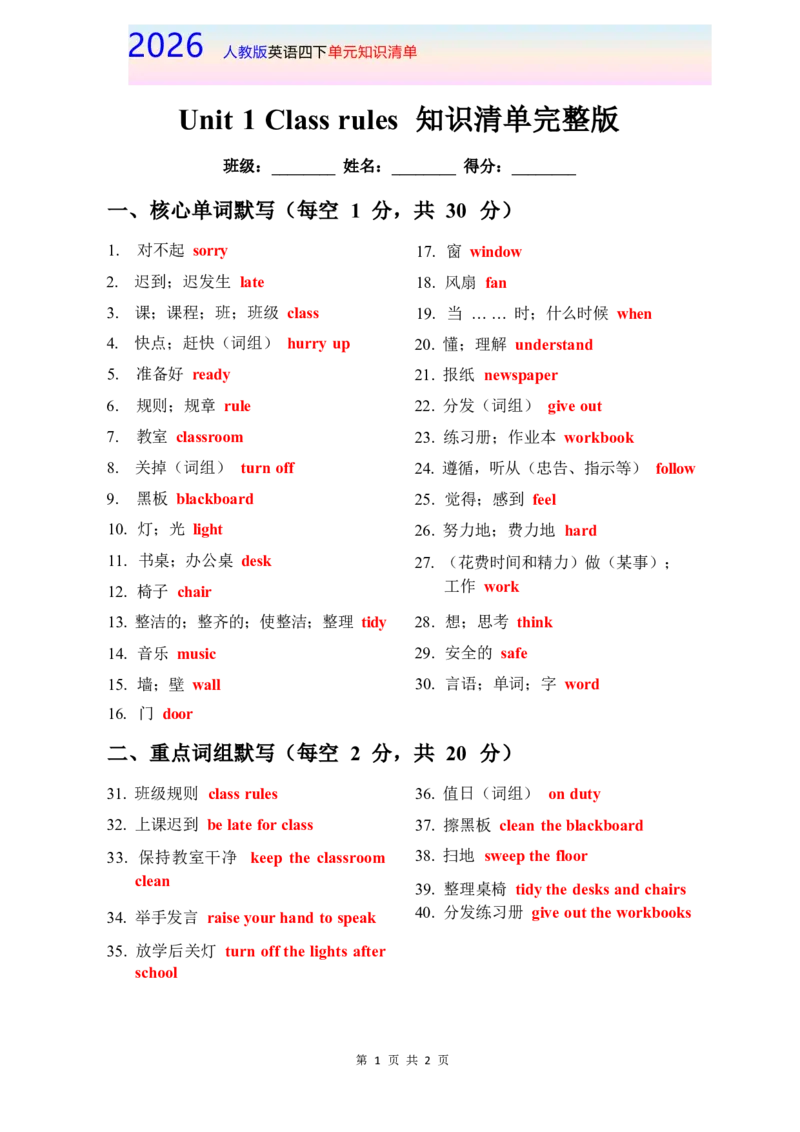
一、核心单词
. sorry /ˈsɒri/ 对不起(日常道歉场景常用,如 “Sorry. Can I eat this apple?”)
. late /leɪt/ 迟到;迟发生(搭配 “be late for” ,如 “Don't be late for class!”)
. class /klɑ:s/ 课;课程;班;班级(可指 “课堂” 或 “班级”,如 “in class”“our
class”)
. hurry up /ˈhʌri ʌp/ 快点;赶快(祈使句常用,如 “Hurry up! Don't be late for
class!”)
. ready /ˈredi/ 准备好(搭配 “be ready” ,如 “I'm ready. Let's go!”)
. rule /ru:l/ 规则;规章(单元核心词,如 “class rules”“follow rules”)
. classroom /ˈklɑ:sru:m/ 教室(指学习场所,如 “keep the classroom clean”)
. turn off /tɜ:n ɒf/ 关掉(后接电器类名词,如 “turn off the lights/fans”)
. blackboard /ˈblækbɔ:d/ 黑板(教室物品,搭配 “clean the blackboard”)
. light /laɪt/ 灯;光(指 “电灯” ,如 “turn off the lights after school”)
. desk /desk/ 书桌;办公桌(教室物品,如 “put back the desks”“clean the desk”)
. chair /tʃeə/ 椅子(教室物品,搭配 “put back the chairs”)
. tidy /ˈtaɪdi/ 整洁的;使整洁(可作形容词或动词,如 “keep tidy”“tidy the classroom”)
. music /ˈmju:zɪk/ 音乐(指 “音乐课” 或 “音乐” ,如 “music class”“the music room”)
. wall /wɔ:l/ 墙;壁(教室部位,如 “put signs on the wall”“blue walls”)
. door /dɔ:/ 门(教室物品,搭配 “close the door”)
. window /ˈwɪndəʊ/ 窗(教室物品,搭配 “close the window”)
. fan /fæn/ 风扇(电器类,如 “turn off the fans”)
. when /wen/ 当 … … 时;什么时候(引导时间状语从句,如 “When we don't
understand, we say 'Excuse me?'”)
. understand /ˌʌndəˈstænd/ 懂;理解(指 “明白含义” ,如 “I don't understand.”)
. newspaper /ˈnju:zpeɪpə/ 报纸(可指 “墙报” ,如 “make wall newspapers”)
. hand out /hænd aʊt/ 分发(搭配 “hand out workbooks” ,如 “Some hand out the
workbooks.”)
. workbook /ˈwɜ:kbʊk/ 练习册;作业本(学习用品,如 “hand out the workbooks”)
第 1 页 共 5 页2026
人教版英语四下单元重点知识
. follow / ,fɒləʊ/ 遵循,听从(搭配 “follow rules”,如 “We follow rules to help us learn.”)
. feel /fi:l/ 觉得;感到(表感受,如 “I feel good.”)
. hard /hɑ:d/ 努力地;费力地(修饰动词,如 “work hard”)
. floor /flɔ:/ 地板(教室部位,搭配 “clean the floor”“sweep the floor”)
. clean /kli:n/ 打扫;干净的(可作动词或形容词,如 “clean the floor”“keep clean”)
. duty / ,dju:ti/ 职责;值班(搭配 “on duty” ,如 “Who's on duty today?”)
. quiet / ,kwaɪət/ 安静的(表状态,如 “be quiet in class”“Don't talk loudly. Keep quiet.”)
二、重点词组
1. be late for class 上课迟到(祈使句否定式常用,如 “Don't be late for class!”)
2. hurry up 快点;赶快(催促场景,如 “Hurry up! It's time for class!”)
3. be ready 准备好(表状态,如 “I'm ready. Let's go to school!”)
4. class rules 班级规则(单元核心词组,如 “talk about class rules”“follow class rules”)
5. turn off the lights/fans 关灯 / 关风扇(课后整理场景,如 “Turn off the lights
after school.”)
6. keep the classroom clean and tidy 保持教室干净整洁(值日职责,如 “Some of
us keep the classroom clean and tidy.”)
7. put back the desks and chairs 把桌椅放回原位(值日任务,如 “I can put back
the desks and chairs.”)
8. clean the blackboard/floor 擦 黑板 / 扫地(值 日分工 ,如 “I can clean
the blackboard. He can clean the floor.”)
9. be on duty 值日(表职责,如 “Who's on duty today? We are on duty.”)
10. hand out the workbooks 分 发 练 习册(班 级 任 务 , 如 “Some hand
out the workbooks.”)
11. make wall newspapers 制 作 墙 报( 班 级 活 动 , 如 “Some of us
make wall newspapers.”)
12. put up signs 张贴标识(项目任务,如 “We can put our signs on the classroom wall.”)
13. close the windows/door 关窗 / 关门(课后整理,如 “We close the windows and
doors.”)
第 2 页 共 5 页2026
人教版英语四下单元重点知识
14. use kind words 用友好的语言(课文迁移,贴合规则主题,如 “Use kind words
in class.”)
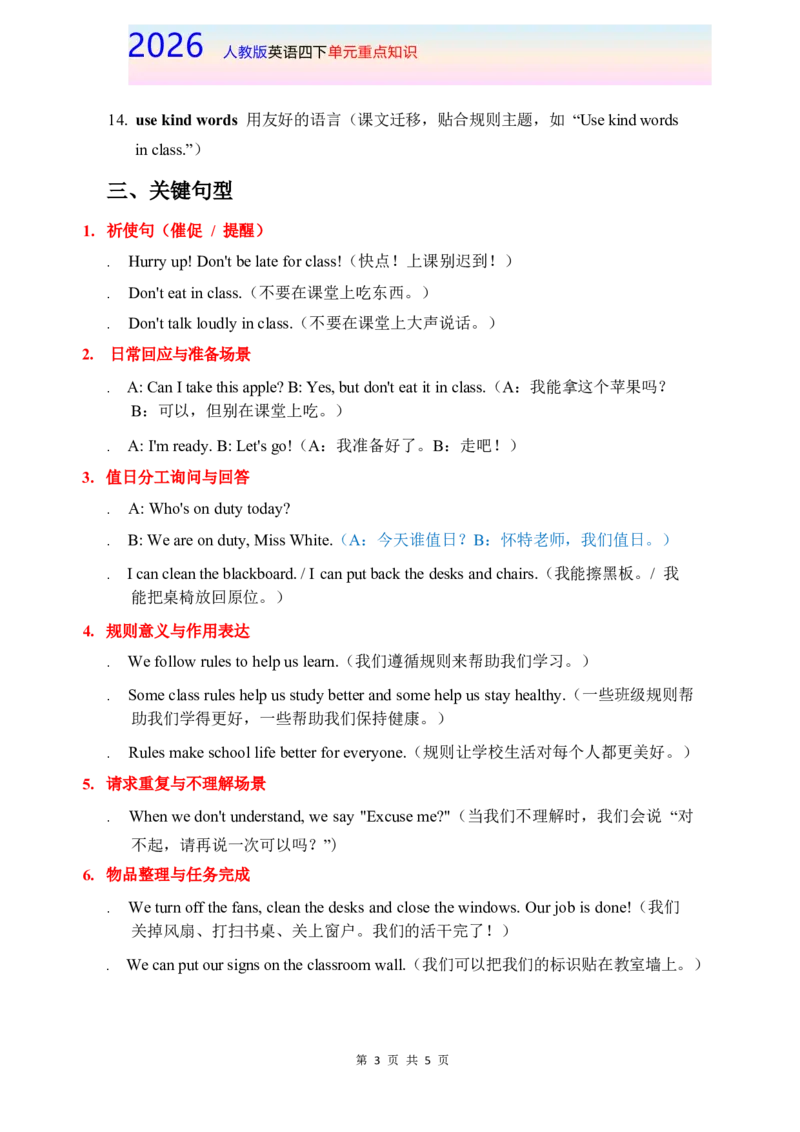
三、关键句型
1. 祈使句(催促 / 提醒)
. Hurry up! Don't be late for class!(快点!上课别迟到!)
. Don't eat in class.(不要在课堂上吃东西。)
. Don't talk loudly in class.(不要在课堂上大声说话。)
2. 日常回应与准备场景
. A: Can I take this apple? B: Yes, but don't eat it in class.(A:我能拿这个苹果吗?
B:可以,但别在课堂上吃。)
. A: I'm ready. B: Let's go!(A:我准备好了。B:走吧!)
3. 值日分工询问与回答
. A: Who's on duty today?
. B: We are on duty, Miss White.(A:今天谁值日?B:怀特老师,我们值日。)
. I can clean the blackboard. / I can put back the desks and chairs.(我能擦黑板。/ 我
能把桌椅放回原位。)
4. 规则意义与作用表达
. We follow rules to help us learn.(我们遵循规则来帮助我们学习。)
. Some class rules help us study better and some help us stay healthy.(一些班级规则帮
助我们学得更好,一些帮助我们保持健康。)
. Rules make school life better for everyone.(规则让学校生活对每个人都更美好。)
5. 请求重复与不理解场景
. When we don't understand, we say "Excuse me?"(当我们不理解时,我们会说 “对
不起,请再说一次可以吗?”)
6. 物品整理与任务完成
. We turn off the fans, clean the desks and close the windows. Our job is done!(我们
关掉风扇、打扫书桌、关上窗户。我们的活干完了!)
. We can put our signs on the classroom wall.(我们可以把我们的标识贴在教室墙上。)
第 3 页 共 5 页2026
人教版英语四下单元重点知识
四、语法要点
1. 祈使句的用法
. 否定式: 以 “Don't + 动词原形” 开头,表禁止或提醒,如 “Don't be late
for class.”“Don't eat in class.”
. 肯定式:以动词原形开头,表建议或指令,如 “Hurry up!”“Follow rules!”“Put your
hand up to speak.”
. 特殊形式:“Let's + 动词原形” 表提议,如 “Let's go to the playground.”“Let's
make wall newspapers.”
2. 情态动词 can 的用法
. 表 “能力” :主语 + can + 动词原形,如 “I can clean the floor.”“I can put back
the desks.”
. 表 “请求许可”:Can I + 动词原形?,如 “Can I take this apple?”“Can I watch
TV?” (后者为 Unit2 迁移,本单元侧重能力)
. 否定式:can't(= cannot),如 “You can't take toys to school.”
3. 介词的搭配(表地点 / 时间)
. in + 封闭空间:in the classroom(在教室里)、in the music room(在音乐教室
里)、 in class(在课堂上)
. on + 表面:on the wall(在墙上)、on the desk(在书桌上)
. after + 时间点:after school(放学后)、after class(课后),如 “Turn off the
lights after school.”
4. when 引导的时间状语从句
. 结构:When + 主语 + 谓语(一般现在时),主句(一般现在时),如 “When
we don't understand, we say 'Excuse me?'”(当我们不理解时,我们会说 “对不
起,请再说一次可以吗?”)
. 注意:从句用一般现在时表习惯或常态,主句根据场景用相应时态(本单元以一
般现在时为主)。
五、语音拓展
1. 字母组合 “ar” 的发音 /ɑ:/
第 4 页 共 5 页2026
人教版英语四下单元重点知识
. 对应单词:class(/klɑːs/)、blackboard(/ˈblækbɔːd/)、wall(/wɔːl/)、hard(/hɑːd/)
. 发音技巧:舌尖抵下齿龈,口张大,舌身放平,发长音 “啊” ,如 “class” 中
“ar”的发音与 “car”“far” 相近。
2. 字母组合 “or” 的发音 /ɔ:/
. 对应单词:for(/fɔː/ ,如 “for everyone”)、floor(/flɔː/)、door(/dɔː/)
. 发音技巧:舌后部抬起, 口半开,发长音 “哦” ,如 “floor” 中 “or” 的发音
与“horse”“short” 相近(参考 Unit3 语音迁移)。
3. 字母组合 “er” 的发音 /ə/(弱读)
. 对应单词:teacher(/ˈtiːtʃə/ ,课文未直接出现,可拓展)、worker(/ˈwɜːkə/ ,
拓展)、under(/ˈʌndə/ ,拓展)
. 发音技巧:舌身放平,口微开,发轻短的 “呃” 音,常出现在单词末尾,如
“teacher”中 “er” 表 “人” ,发音弱读。
4. 单词重音规律
. 双音节词:一般重音在第一个音节,如 “ˈsorry”“ˈready”“ˈclassroom”“ˈblackboard”
. 多音节词:重音常在倒数第三个音节,如 “ˌunderˈstand”“ˌnewspaper”,注意
“under-”前缀重音在第二音节。
第 5 页 共 5 页