文档文本内容
2026
人教版英语四下单元重点知识
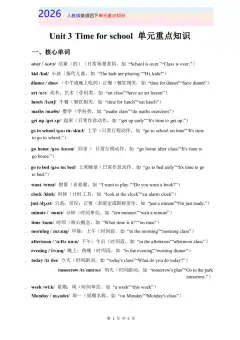
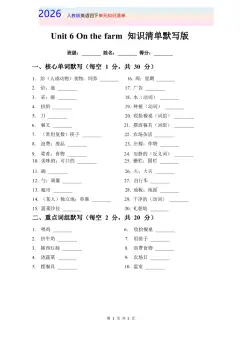
Unit 6 On the farm 单元重点知识
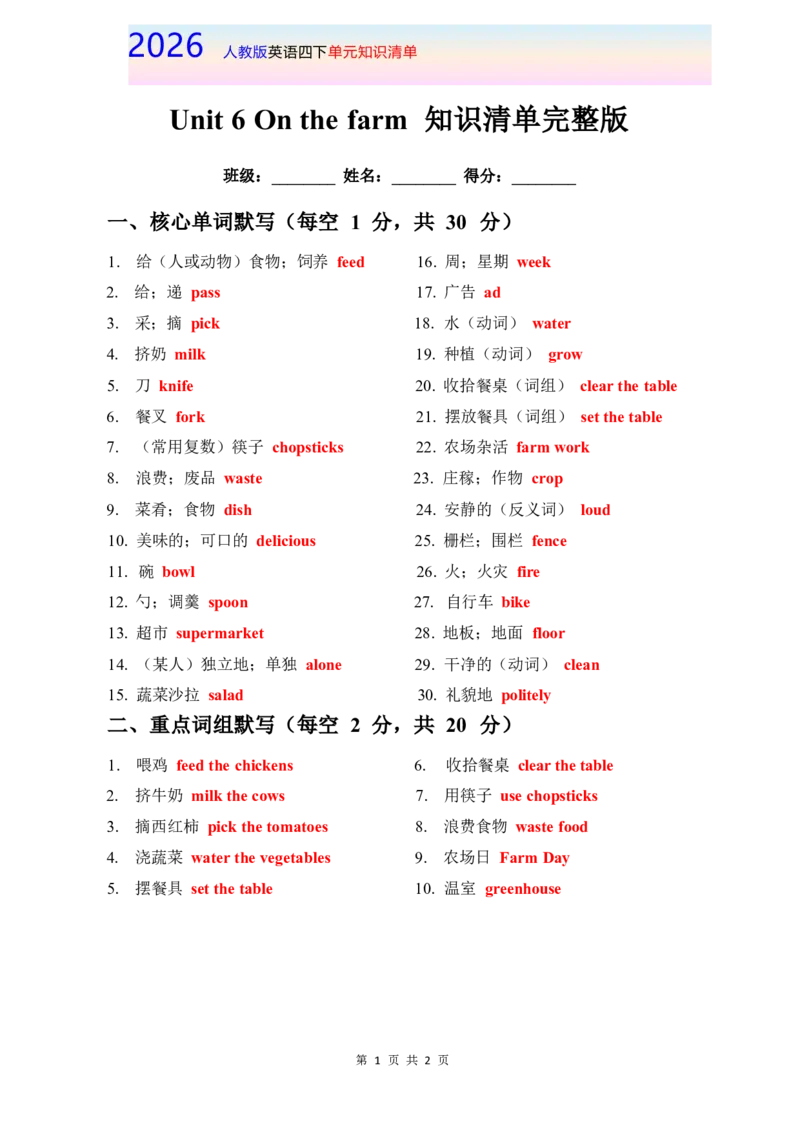
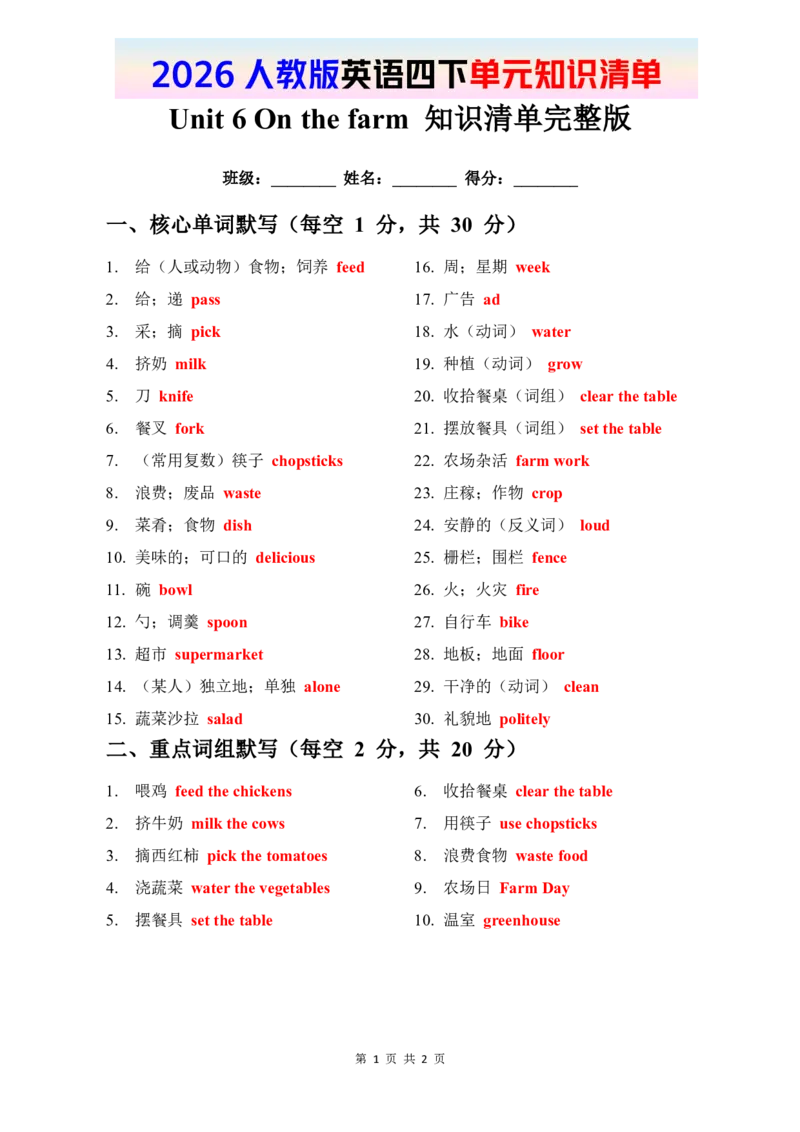
一、核心单词
. feed /fi:d/ 给(人或动物)食物;饲养(农场动作,搭配 “feed + 动物 + 食物” ,
如“feed chickens”“feed pigs vegetables”“feed the cow grass”)
. pass /pɑ:s/ 给;递(互动动作,搭配 “pass sb. sth.” 或 “pass sth. to sb.”,如 “pass
me the vegetables”“pass the fork to him”)
. pick /pɪk/ 采;摘(收获农作物动作,如 “pick tomatoes”“pick carrots”“pick fruit”)
. milk /mɪlk/ 挤奶(照顾奶牛动作,如 “milk cows”“help milk the cow”“milk the cow in
the morning”)
. knife /naɪf/ 刀(餐具类,复数为 “knives”,如 “a sharp knife”“use a knife”“a knife
and fork”)
. fork /fɔ:k/ 餐叉(餐具类,如 “a metal fork”“use a fork”“a fork and knife”)
. chopstick / ,tʃɒpstɪk/ 筷 子 ( 餐 具 类 , 常 用 复 数 “chopsticks” , 如 “a
pair of chopsticks”“use chopsticks”“hold chopsticks”)
. waste /weɪst/ 浪费;废品(行为类,如 “waste food”“don't waste water”“it's a waste”)
. food /fu:d/ 菜肴;食物(饮食核心,如 “delicious food”“farm food”“don't waste
food”)
. delicious /dɪ ,lɪʃəs/ 美味的;可口的(描述食物味道,如 “delicious tomatoes”“the
food is delicious”“delicious salad”)
. clear the table 收拾餐桌(餐后动作 ,如 “help clear the table”“clear the table
after dinner”)
. bowl /bəʊl/ 碗(餐具类,如 “a big bowl”“a bowl of rice”“use a bowl”)
. spoon /spu:n/ 勺;调羹(餐具类,如 “a small spoon”“a soup spoon”“use a spoon to
eat soup”)
. set the table 摆放餐具(餐前动作,如 “set the table for dinner”“help set the table”)
. supermarket / ,su:pəmɑ:kɪt/ 超市(购物场所,如 “buy food in the supermarket”“go
to the supermarket”)
第 1 页 共 7 页2026
人教版英语四下单元重点知识
. by oneself(某人)独立地;单独(表方式,如 “grow tomatoes by herself”“do
homework by myself”“feed chickens by himself”)
. salad / ,sæləd/ 蔬菜沙拉(食物类,如 “make a salad”“tomato salad”“eat a salad”)
. week /wi:k/ 周;星期(时间单位,如 “a busy week”“every week”“this week on the
farm”)
. ad /æd/ 广告(宣传形式,如 “a farm ad”“design an ad”“read the ad”)
. water / ,wɔ:tə/ 浇水(照顾植物动作,如 “water vegetables”“water tomatoes”“water
the plants every day”)
. plant /plɑ:nt/ 种植(农场动作,如 “plant potatoes”“plant carrots”“plant tomato seeds”)
. winter / ,wɪntə/ 冬天;冬季(季节,如 “farm work in winter”“cold winter”“from
winter to fall”)
. fall /fɔ:l/ 秋天;秋季(季节,如 “harvest in fall”“cool fall”“work from winter to fall”)
. greenhouse / ,ɡri:nhaʊs/ 温室(种植场所,如 “pick tomatoes in the
greenhouse”“grow vegetables in the greenhouse”)
. barn /bɑ:n/ 谷仓;畜棚(农场建筑,如 “a farm barn”“store food in the barn”“animals
in the barn”)
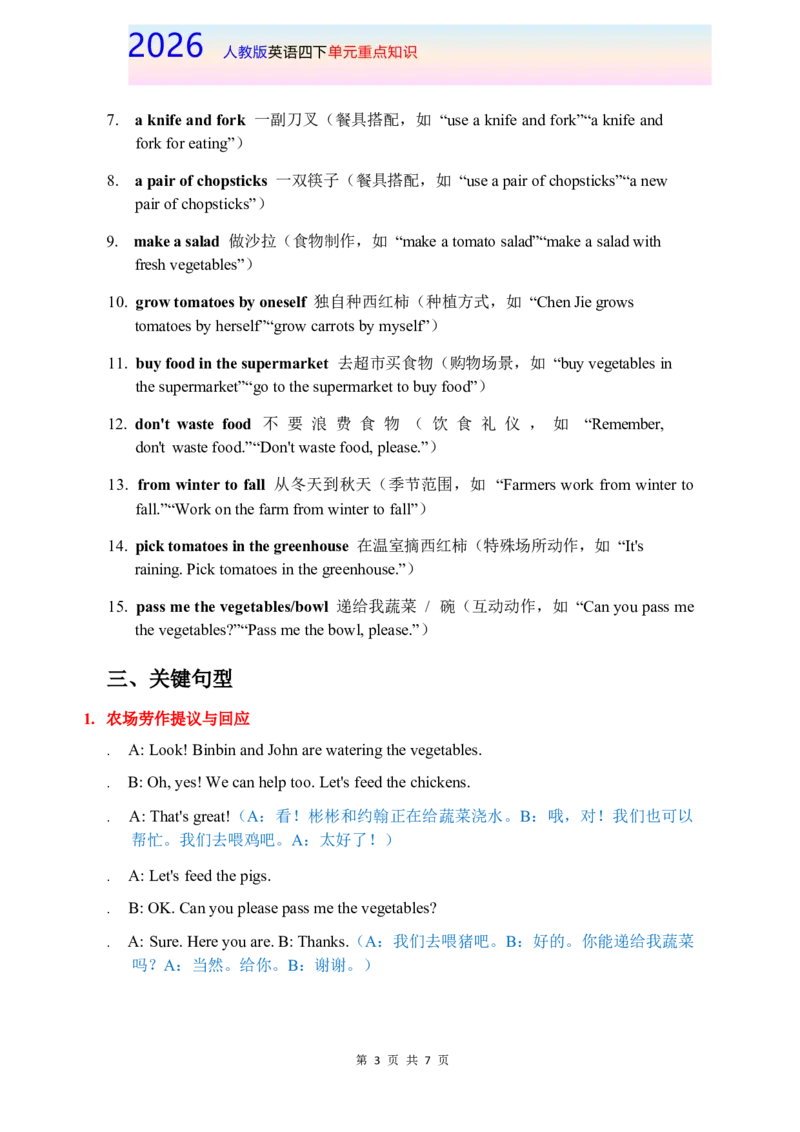
二、重点词组
1. feed the chickens/pigs 喂 鸡 / 喂 猪 ( 农 场 喂 养 动 作 , 如 “Let's
feed the chickens.”“feed pigs with vegetables”)
2. milk the cows 挤牛奶(农场劳作动作,如 “help milk the cows”“milk the cows in
the morning”)
3. water the vegetables/plants 给蔬菜 / 植物浇水(农场照料动作,如 “water the
vegetables every day”“help water the plants”)
4. pick the tomatoes/carrots 摘西红柿 / 胡萝 卜(农场收获动作 ,如 “pick
the tomatoes in summer”“pick carrots in the field”)
5. set the table 摆放餐具(餐前准备,如 “set the table for dinner”“help set the table
with bowls and chopsticks”)
6. clear the table 收拾餐桌(餐后整理,如 “clear the table after lunch”“help clear
the table”)
第 2 页 共 7 页2026
人教版英语四下单元重点知识
7. a knife and fork 一副刀叉(餐具搭配,如 “use a knife and fork”“a knife and
fork for eating”)
8. a pair of chopsticks 一双筷子(餐具搭配,如 “use a pair of chopsticks”“a new
pair of chopsticks”)
9. make a salad 做沙拉(食物制作,如 “make a tomato salad”“make a salad with
fresh vegetables”)
10. grow tomatoes by oneself 独自种西红柿(种植方式,如 “Chen Jie grows
tomatoes by herself”“grow carrots by myself”)
11. buy food in the supermarket 去超市买食物(购物场景,如 “buy vegetables in
the supermarket”“go to the supermarket to buy food”)
12. don't waste food 不 要 浪 费 食 物 ( 饮 食 礼 仪 , 如 “Remember,
don't waste food.”“Don't waste food, please.”)
13. from winter to fall 从冬天到秋天(季节范围,如 “Farmers work from winter to
fall.”“Work on the farm from winter to fall”)
14. pick tomatoes in the greenhouse 在温室摘西红柿(特殊场所动作,如 “It's
raining. Pick tomatoes in the greenhouse.”)
15. pass me the vegetables/bowl 递给我蔬菜 / 碗(互动动作,如 “Can you pass me
the vegetables?”“Pass me the bowl, please.”)
三、关键句型
1. 农场劳作提议与回应
. A: Look! Binbin and John are watering the vegetables.
. B: Oh, yes! We can help too. Let's feed the chickens.
. A: That's great!(A:看!彬彬和约翰正在给蔬菜浇水。B:哦,对!我们也可以
帮忙。我们去喂鸡吧。A:太好了!)
. A: Let's feed the pigs.
. B: OK. Can you please pass me the vegetables?
. A: Sure. Here you are. B: Thanks.(A:我们去喂猪吧。B:好的。你能递给我蔬菜
吗?A:当然。给你。B:谢谢。)
第 3 页 共 7 页2026
人教版英语四下单元重点知识
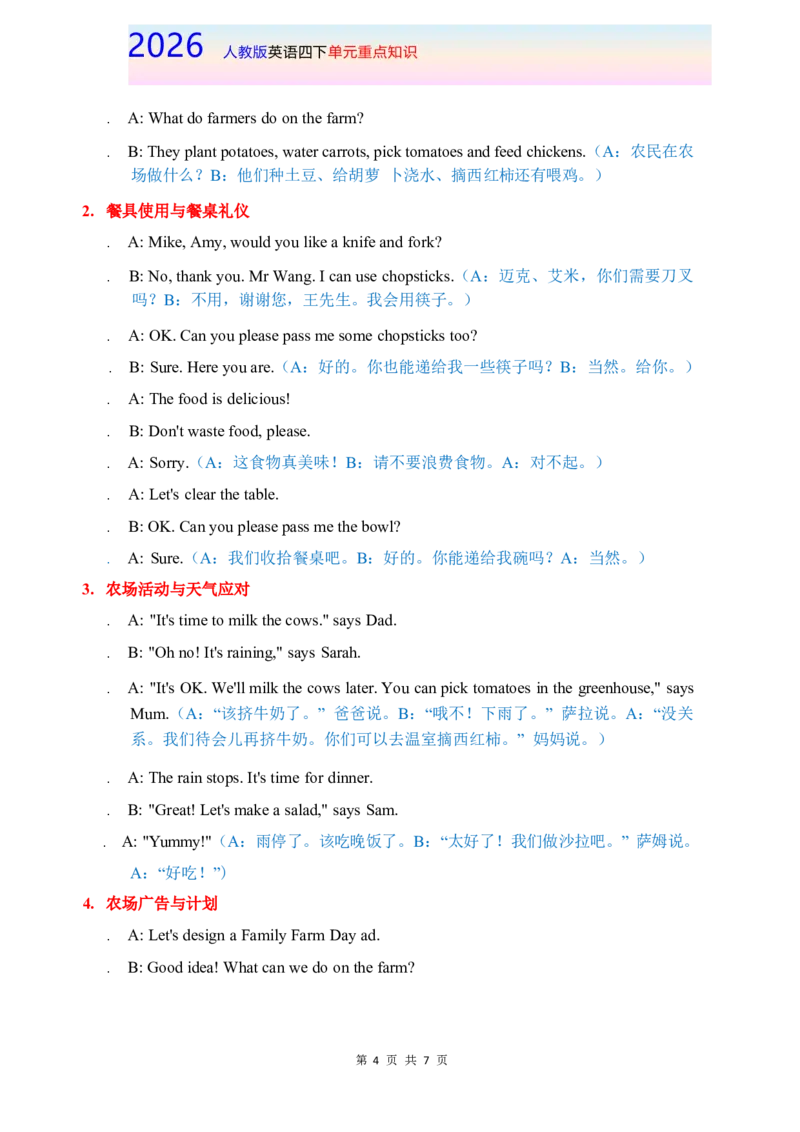
. A: What do farmers do on the farm?
. B: They plant potatoes, water carrots, pick tomatoes and feed chickens.(A:农民在农
场做什么?B:他们种土豆、给胡萝 卜浇水、摘西红柿还有喂鸡。)
2. 餐具使用与餐桌礼仪
. A: Mike, Amy, would you like a knife and fork?
. B: No, thank you. Mr Wang. I can use chopsticks.(A:迈克、艾米,你们需要刀叉
吗?B:不用,谢谢您,王先生。我会用筷子。)
. A: OK. Can you please pass me some chopsticks too?
. B: Sure. Here you are.(A:好的。你也能递给我一些筷子吗?B:当然。给你。)
. A: The food is delicious!
. B: Don't waste food, please.
. A: Sorry.(A:这食物真美味!B:请不要浪费食物。A:对不起。)
. A: Let's clear the table.
. B: OK. Can you please pass me the bowl?
. A: Sure.(A:我们收拾餐桌吧。B:好的。你能递给我碗吗?A:当然。)
3. 农场活动与天气应对
. A: "It's time to milk the cows." says Dad.
. B: "Oh no! It's raining," says Sarah.
. A: "It's OK. We'll milk the cows later. You can pick tomatoes in the greenhouse," says
Mum.(A:“该挤牛奶了。” 爸爸说。B:“哦不!下雨了。” 萨拉说。A:“没关
系。我们待会儿再挤牛奶。你们可以去温室摘西红柿。” 妈妈说。)
. A: The rain stops. It's time for dinner.
. B: "Great! Let's make a salad," says Sam.
. A: "Yummy!"(A:雨停了。该吃晚饭了。B:“太好了!我们做沙拉吧。” 萨姆说。
A:“好吃!”)
4. 农场广告与计划
. A: Let's design a Family Farm Day ad.
. B: Good idea! What can we do on the farm?
第 4 页 共 7 页2026
人教版英语四下单元重点知识
. A: We can plant carrots, water vegetables, pick fruit and feed farm animals.(A:我们
设计一个家庭农场日广告吧。B:好主意!我们在农场能做什么?A:我们可以
种胡萝 卜、给蔬菜浇水、摘水果还有喂农场动物。)
. A: Bring your family and have fun! Every Saturday is a great time for the whole
family on the farm.(A:带上家人来享受乐趣吧!每周六都是全家在农场欢聚的好
时光。)
5. 食物来源与节约意识
. A: Where do we get food?
. B: Some from farms, some from supermarkets. But many foods come from farms first.
(A:我们从哪里获取食物?B:有些来自超市,有些来自农场。但很多食物最
初都来自农场。)
. A: Remember, plants take months to grow and animals take years. So don't waste food!
. B: I won't.(A:记住,植物要几个月才能长大,动物要几年才能长成。所以不要
浪费食物!B:我不会的。)
四、语法要点
1. “Let's...” 的用法
. 结构:Let's + 动词原形,表 “提议一起做某事”,语气委婉且积极,如 “Let's
feed the chickens.”“Let's set the table.”“Let's make a salad.”
. 否定形式: Let's not + 动词原形 ,表 “提议不做某事 ” ,如 “Let's not
waste food.”“Let's not be late.”(课文未直接出现,为拓展内容,贴合礼仪主题)
. 回应:肯定用 “Great!”“That's a good idea!”“OK.” ;否定用 “Sorry, I can't. I
have to...” ,如 “Sorry, I can't. I have to water the vegetables.”
2. “Can you please...” 的用法
. 结构:Can you please + 动词原形?,表 “礼貌请求对方做某事”,比 “Can
you...?”更委婉,如 “Can you please pass me the vegetables?”“Can you please set the
table?”
. 肯定回答:Sure. / Of course. / No problem. + 动作回应(如 “Here you are.”);否
定回答:Sorry, I can't. Because...,如 “Sorry, I can't. Because I have to feed the
pigs.”
3. 餐具类名词的单复数
第 5 页 共 7 页2026
人教版英语四下单元重点知识
. 常用复数 :chopsticks (筷子 , 由两根组成 ,通常用复数) ,如 “a pair
of chopsticks”“use chopsticks”
. 不规则复数:knife → knives(刀),如 “a knife”“two knives”;
. 规则复数:fork → forks,bowl → bowls,spoon → spoons,如 “a fork”“three
forks”“a bowl”“five bowls”
4. 现在进行时的场景应用
. 结构:主语 + am/is/are + 动词 - ing 形式,表 “此时此刻正在做某事”,如
“Binbin and John are watering the vegetables.”“Mr Wang is putting the
tomatoes in the boxes.”“She is making a salad.”
. 标志词:look(看)、listen(听)、now(现在),如 “Look! They are feeding
the chickens.”“Listen! The pigs are oinking.”
5. “by oneself” 的用法
. 结构:by + 反身代词(myself/yourself/herself/himself/ourselves/themselves),表
“独自;独立地” ,如 “Chen Jie grows tomatoes by herself.”(陈杰独自种西红
柿。)“I do homework by myself.”(我独自做作业。)
. 同义表达:alone ,如 “She works alone.” = “She works by herself.”(课文用 “by
oneself” ,更侧重 “独立完成” 的意味)
五、语音拓展
1. 字母组合 “ear” 的发音 /ɪə/
. 对应单词:dear(/dɪə/ ,如 “My dear bear”)、hear(/hɪə/ ,如 “do you
hear?”)、 clear(/klɪə/ ,如 “It's so clear!”)、year(/jɪə/ ,拓展,如 “this
year”)
. 发音技巧:由 “/ɪ/” 向 “/ə/” 滑动,口型先小后略开,声音轻柔且连贯,如
“dear”中 “ear” 的发音,与 “near”“fear” 相近。
2. 字母组合 “ear” 的发音 /eə/
. 对应单词:bear(/beə/ ,如 “My dear bear”)、pear(/peə/ ,如 “there is a
pear”)、 wear(/weə/ ,拓展,如 “wear clothes”)、care(/keə/ ,拓展,如
“take care”)
第 6 页 共 7 页2026
人教版英语四下单元重点知识
. 发音技巧:由 “/e/” 向 “/ə/” 滑动,口型先张大后变小,声音自然过渡,如
“bear”中 “ear” 的发音,与 “air”“chair” 相近,注意与 “ear” 发 /ɪə/ 的单词区
分(如“dear” 和 “bear” 发音不同)。
3. 字母组合 “or” 的发音 /ɔ:/
. 对应单词:fork(/fɔ:k/ ,如 “a knife and fork”)、horse(/hɔ:s/ ,如 “farm
horse”)、 born(/bɔ:n/,拓展,如 “born on the farm”)、corn(/kɔ:n/,如 “corn
on the farm”)
. 发音技巧:舌后部抬起,口半开,双唇略收圆,发长音 “哦”,声音饱满,如
“fork”中 “or” 的发音,与 “floor”“door” 相近,延续前单元语音规律,强化记
忆。
4. 单词重音规律(农场劳作与餐具相关词汇)
. 双 音 节 农 场 劳 作 类 词 汇 : 重 音 多 在 第 一 个 音 节 ,
如“ˈfeed”“ˈpass”“ˈpick”“ˈmilk”“ˈwater”“ˈplant”
. 双 音 节 餐 具 类 词 汇 : 重 音 多 在 第 一 个 音 节 ,
如“ˈknife”“ˈfork”“ˈbowl”“ˈspoon”“ˈsalad”
. 多音节词汇:重音常在倒数第三个音节,如 “ˈsu:pəmɑ:kɪt”(重音在第一个音
节)、 “ˈɡri:nhaʊs”(重音在第一个音节)、“ˈdelicious”(重音在第二个音节
“li”)、“by ourˈselves”(重音在第二个音节 “selves”)
第 7 页 共 7 页