文档文本内容
2026
人教版英语四下单元重点知识
Unit 5 Farms and us 单元重点知识
一、核心单词
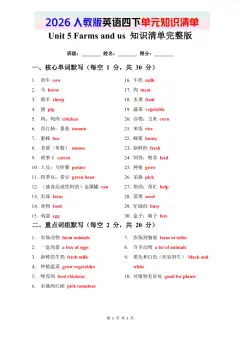
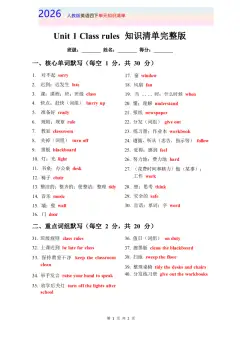
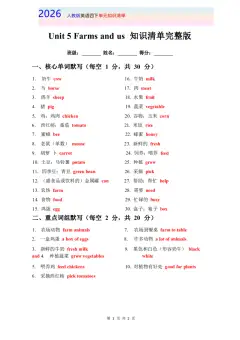
. cow /kaʊ/ 奶牛(农场动物类,如 “a black and white cow”“cows give us milk”)
. horse /hɔ:s/ 马(农场动物类,如 “a strong horse”“ride a horse”“horses run fast”)
. sheep /ʃi:p/ 绵羊(农场动物类,单复数同形,如 “a small sheep”“many sheep”“sheep
give us wool”)
. pig /pɪɡ/ 猪(农场动物类,如 “a fat pig”“pigs like mud”“pigs give us meat”)
. chicken /ˈtʃɪkɪn/ 鸡;鸡肉(农场动物类,表 “鸡” 时复数为 “chickens”,如 “a
small chicken”“chickens lay eggs” ;表 “鸡肉” 时为不可数名词,如 “eat chicken”)
. tomato /təˈmɑ:təʊ/ 西红柿(农作物类,复数为 “tomatoes” ,如 “red
tomatoes”“pick tomatoes”)
. bee /bi:/ 蜜蜂(农场相关生物 ,如 “busy bees”“bees help plants grow”“bees
make honey”)
. mouse /maʊs/ 老鼠(农场常见动物,复数为 “mice” ,如 “a small mouse”“mice like
rice”)
. carrot /ˈkærət/ 胡萝 卜(农作物类,如 “long carrots”“orange carrots”“pull carrots”)
. potato /pəˈteɪtəʊ/ 土豆(农作物类 ,复数为 “potatoes” ,如 “round
potatoes”“dig potatoes”“cook potatoes”)
. green bean /ɡri:n bi:n/ 四季豆(农作物类,常用复数 “green beans” ,如 “long
green beans”“pick green beans”)
. can /kæn/ (盛食品或饮料的)金属罐(农场产物储存容器,如 “a can of
milk”“cans for tomatoes”)
. farm /fɑ:m/ 农场(核心场所类,如 “a big farm”“work on a farm”“visit a farm”)
. farmer /ˈfɑ:mə/ 农民(职业类,如 “a hard-working farmer”“farmers grow food”)
. food /fu:d/ 食物(农场产物核心,如 “farm food”“fresh food”“food from farms”)
. milk /mɪlk/ 牛奶(农场动物产物,如 “fresh milk”“milk from cows”“drink milk”)
第 1 页 共 7 页2026
人教版英语四下单元重点知识
. egg /eɡ/ 鸡蛋(农场动物产物,复数为 “eggs” ,如 “white eggs”“a box of
eggs”“eat eggs”)
. meat /mi:t/ 肉(农场动物产物,不可数名词,如 “pork meat”“beef meat”“cook
meat”)
. vegetable / ,vedʒtəbl/ 蔬菜(农作物统称,如 “fresh vegetables”“grow
vegetables”“eat vegetables”)
. fruit /fru:t/ 水果(农场产物,泛指时不可数,如 “farm fruit”“pick fruit”“eat fruit”;
表具体种类时可数,如 “different fruits”)
. wool /wʊl/ 羊毛(绵羊产物,不可数名词,如 “white wool”“wool from sheep”“make
clothes with wool”)
. honey / ,hʌni/ 蜂蜜(蜜蜂产物,不可数名词,如 “sweet honey”“honey from
bees”“eat honey”)
. mud /mʌd/ 泥(农场环境相关,如 “wet mud”“pigs like mud”“play in mud”)
. fresh /freʃ/ 新鲜的(描述农场产物,如 “fresh milk”“fresh tomatoes”“fresh eggs”)
. grow /ɡrəʊ/ 种植;生长(农场动作,如 “grow tomatoes”“plants grow”“farmers grow
food”)
. pick /pɪk/ 采摘(收获农作物动作,如 “pick tomatoes”“pick carrots”“pick fruit”)
. feed /fi:d/ 喂养(照顾农场动物动作,如 “feed chickens”“feed pigs”“feed the cow”)
. help /help/ 帮助(农场协作动作 , 如 “help farmers”“bees help plants”“help
pick vegetables”)
二、重点词组
1. farm animals 农 场 动 物( 核 心 类 别 , 如 “name farm animals”“look
at farm animals”“feed farm animals”)
2. farm vegetables 农场蔬菜(农作物类别,如 “grow farm vegetables”“pick farm
vegetables”“eat farm vegetables”)
3. a box of eggs 一盒鸡蛋(产物数量搭配,如 “buy a box of eggs”“carry a box of
eggs”“a box of fresh eggs”)
4. a can of milk 一罐牛奶(产物数量搭配,如 “store a can of milk”“drink a can
of milk”“a can of fresh milk”)
第 2 页 共 7 页2026
人教版英语四下单元重点知识
5. grow tomatoes/carrots 种 西 红柿 / 胡 萝 卜(种植动 作 , 如 “farmers
grow tomatoes”“grow carrots in the field”)
6. pick potatoes/green beans 摘土豆 / 四季豆(收获动作,如 “pick potatoes in
autumn”“help pick green beans”)
7. feed chickens/pigs 喂鸡 / 喂猪(喂养动作,如 “feed chickens with corn”“feed
pigs with vegetables”)
8. fresh milk/eggs 新鲜牛奶 / 鸡蛋(产物描述 ,如 “drink fresh milk”“eat
fresh eggs”“buy fresh milk”)
9. ride a horse 骑马(农场活动,如 “ride a horse on the farm”“learn to ride a horse”)
10. work on a farm 在农场工作(职业动作,如 “farmers work on a farm”“help work
on a farm”)
11. visit a farm 参观农场(活动场景,如 “visit a big farm”“visit a farm with family”)
12. bees help plants 蜜蜂帮助植物(生物关联,如 “bees help plants grow”“bees help
plants make fruit”)
13. farm-to-table 从 农 场 到 餐 桌 ( 产 物 流 程 , 如 “a farm-to-table
flow chart”“farm-to-table food”)
14. different farm foods 不 同 的 农 场 食 物( 产 物 类 别 , 如 “eat
different farm foods”“know different farm foods”)
15. pigs like mud 猪喜欢泥巴(动物习性,如 “pigs like to play in mud”“pigs like wet
mud”)
三、关键句型
1. 农场动物询问与回答
. A: What animals do you have on the farm?
. B: I have a lot of animals. Cows, horses, sheep, pigs and chickens.(A:你农场里有
什么动物?B:我有很多动物。奶牛、马、绵羊、猪和鸡。)
. A: How many cows do you have?
. B: I have 20.(A:你有多少头奶牛?B:我有 20 头。)
. A: What do cows give us?
第 3 页 共 7 页2026
人教版英语四下单元重点知识
. B: Cows give us fresh milk.(A:奶牛能给我们什么?B:奶牛能给我们新鲜的牛
奶。)
2. 农作物认知与描述
. A: What are these?
. B: They're tomatoes.
. A lot of tomatoes are big and red, but these are small and yellow.(A:这些是什么?
B:是西红柿。很多西红柿又大又红,但这些又小又黄。)
. A: What are those?
. B: They're carrots. They're long and orange.(A:那些是什么?B:是胡萝 卜。它
们又长又橙。)
. A: Look at the potatoes. They're round and brown.(A:看这些土豆。它们又圆又棕。)
3. 农场生物作用表达
. A: What do bees do?
. B: Bees are good for plants. They help plants grow fruit.(A:蜜蜂能做什么?B:蜜
蜂对植物有好处。它们帮助植物结出果实。)
. A: What do sheep give us?
. B: Sheep give us wool. We can make warm clothes with wool.(A:绵羊能给我们什
么?B:绵羊能给我们羊毛。我们可以用羊毛做暖和的衣服。)
. A: What do chickens give us?
. B: Chickens give us eggs and meat.(A:鸡能给我们什么?B:鸡能给我们鸡蛋和
鸡肉。)
4. 农场活动与体验
. A: Let's visit Mr Wang's farm.
. B: Great! What can we do there?
. A: We can pick tomatoes and feed chickens.(A:我们去参观王叔叔的农场吧。B:
太好了!我们在那儿能做什么?A:我们可以摘西红柿、喂鸡。)
. A: Can you ride a horse?
. B: No, but I can help pick carrots.(A:你会骑马吗?B:不会,但我可以帮忙摘胡
萝 卜 。)
第 4 页 共 7 页2026
人教版英语四下单元重点知识
. A: This is a busy day on the farm. Mr Wang is putting the tomatoes in the boxes.
(A:今天农场很忙。王叔叔正在把西红柿装进箱子里。)
5. 农场重要性表达
. A: Why do we need farms?
. B: Because farms give us food. Milk, eggs, meat, vegetables and fruit all come from
farms.(A:我们为什么需要农场?B:因为农场能给我们食物。牛奶、鸡蛋、肉
类、蔬菜和水果都来自农场。)
. A: Farms are really helpful. We all need farms to eat!(A:农场真的很有用。我们都
需要农场来获取食物!)
. A: Remember, plants take months to grow and animals take years. So don't waste food!
(A:记住,植物要几个月才能长大,动物要几年才能长成。所以不要浪费食
物!)
四、语法要点
1. 指示代词 “this/that/these/those” 的用法
. 近处单数:this(这个),如 “What's this? It's a tomato.”
. 远处单数:that(那个),如 “What's that? It's a horse.”
. 近处复数:these(这些),如 “What are these? They're carrots.”
. 远处复数:those(那些),如 “What are those? They're sheep.”
. 关键区别:单复数对应 “is/are” ,回答时单数用 “It's...” ,复数用 “They're...”
2. “How many...” 的用法
. 询问可数名词数量:How many + 复数名词 + 一般疑问句?,如 “How many
cows do you have?”“How many tomatoes are there?”
. 回答:直接用数字,或 “数字 + 复数名词” ,如 “I have 20 (cows).”“There are
15 (tomatoes).”
. 注意:“sheep”“deer” 等单复数同形的名词,提问时仍用 “How many sheep...”,
无需变复数形式。
3. 名词单复数的特殊变化
. 不规则变化:
. sheep(绵羊):单复数同形,如 “a sheep”“ten sheep”
第 5 页 共 7 页2026
人教版英语四下单元重点知识
. mouse(老鼠):复数为 “mice” ,如 “a mouse”“two mice”
. tomato(西红柿)/potato(土豆):复数加 “es”,如 “a tomato”“five
tomatoes”“a potato”“three potatoes”
. 规则变化:大部分农场名词直接加 “s”,如 “cow → cows”“horse → horses”“carrot
→ carrots”
4. 一般现在时表客观事实与习性
. 结构:主语 + 动词原形 / 动词第三人称单数形式,表 “客观存在的事实” 或
“动物 / 人的习惯性动作”
. 客观事实:Cows give us milk.(奶牛给我们牛奶。)Bees help plants grow.(蜜蜂
帮助植物生长。)
. 习惯性动作:Farmers work hard every day.(农民每天努力工作。)Sheep eat
grass. (绵羊吃草。)
5. “be good for...” 的用法
. 表 “对 … … 有好处”,后接名词或代词,如 “Bees are good for plants.”“Milk is
good for children.”
. 否定形式:“be bad for...”(对 … … 有害),如 “Mice are bad for crops.”(老鼠
对庄稼有害。)(拓展内容,贴合农场场景)
五、语音拓展
1. 字母组合 “air” 的发音 /eə/
. 对应单词:air(/eə/,如 “fresh air”)、chair(/tʃeə/,拓展,如 “a wooden
chair”)、 fair(/feə/,如 “fair hair”)、hair(/heə/,如 “long hair”)、pair
(/peə/,如 “a pair of shoes”)
. 发音技巧:由 “/e/” 向 “/ə/” 滑动,口型先张大后变小,声音自然过渡,如
“air”的发音类似中文 “爱尔” ,与 “bear”“pear” 中 “ear”“ear” 的发音相近(注意
区分“ear” 的其他发音)。
2. 字母组合 “ee” 的发音 /i:/
第 6 页 共 7 页2026
人教版英语四下单元重点知识
. 对应单词:bee(/bi:/,如 “busy bees”)、sheep(/ʃi:p/,如 “white sheep”)、green
(/ɡri:n/ ,如 “green beans”)、see(/si:/ ,拓展,如 “see animals”)、feed
(/fi:d/,如 “feed chickens”)
. 发音技巧:舌尖抵下齿龈,口型扁平,发长音 “衣” ,声音清晰且持续,如
“bee”中 “ee” 的发音与 “meet”“tree” 相近,注意与 “ea”(/i:/)发音一致,可归
为同类长元音。
3. 字母组合 “or” 的发音 /ɔ:/
. 对应单词:horse(/hɔ:s/,如 “a strong horse”)、fork(/fɔ:k/,拓展,如 “a farm
fork”)、 pork(/pɔ:k/ ,如 “pork meat”)、short(/ʃɔ:t/ ,拓展,如 “short
grass”)
. 发音技巧:舌后部抬起,口半开,双唇略收圆,发长音 “哦”,如 “horse” 中
“or”的发音与 “floor”“door” 相近,延续前单元语音规律,强化记忆。
4. 单词重音规律(农场与生物相关词汇)
. 双 音 节 农 场 动 物 类 词 汇 : 重 音 多 在 第 一 个 音 节 ,
如“ˈcow”“ˈhorse”“ˈsheep”“ˈpig”“ˈchicken”(“chicken” 重音在第一个音节
“chick”)
. 双音节农作物类词汇:重音多在第一个音节,如 “ ˈtomato”(部分发音可重音
在第二个音节 “ma” ,但小学阶段侧重第一个音节)、“ˈcarrot”“ ˈpotato”(重音
在第一个音节 “po”)
. 多音节词汇:重音常在倒数第三个音节,如 “ˈvegeˈtable”(双重音,主重音在第
一个音节)、“ˈfarmer”(重音在第一个音节)、“ˈanimal”(重音在第一个音节)
第 7 页 共 7 页