ARTICLE · 1300193
朝阳2026年初一年级英语学科试卷上期中
初一年级英语学科试卷
满分100分考试时间120分钟
学校:__________班级:__________姓名:__________准考证号:__________
考 生 须 知 | 1.本试卷共8页,满分100分,考试时间120分钟。 2.在试卷和答题卡上准确填写学校、班级、姓名、座位号。 3.试题答案一律填涂或书写在答题卡上,在试卷上作答无效。 4.在答题卡上,选择题用2B铅笔作答,其他试题用黑色字迹签字笔作答。 5.考试结束,请将本试卷和答题卡一并交回。 |
第一部分听力部分
本部分共19题,共40分。根据题目要求,完成相应任务。
一、听后选择(每题1.5分,共18分)
听下面6段对话或独白。每段对话或独白后有两个小题,从每题所给的A、B、C三个选项中选出最佳选项。每段对话或独白你将听两遍。
请听一段对话,完成问题。
1. What’s Jack’s favourite subject?
A. Maths. B. English. C. History.
2. What’s Jack good at?
A. Swimming.B. Playing football. C. Playing basketball.
请听一段对话,完成问题。
3. Which class is Tom in?
A. Class 1. B. Class 2. C. Class 3.
4. What does Ms. Chen tell the students?
A. To write faster. B. To think more. C. To listen carefully.
请听一段对话,完成问题。
5. What does the girl’s mother look like?
A. Tall with long hair.
B. Tall with short hair.
C. Short with short hair.
6. What is the girl’s mother like?
A. Kind and clever. B. Kind and strict. C. Kind and friendly.
请听一段对话,完成问题。
7. How many books are there in the reading corner?
A. About 30. B. About 40. C. About 50.
8. What kind of books does the girl love?
A. Science books. B. History books. C. Storybooks.
请听一段独白,完成问题。
9. What can we learn from the talk?
A. The speaker goes to school by bus.
B. The speaker is good at swimming.
C. The speaker likes using the computer for fun.
10. Why does the speaker give this talk?
A. To tell about her school.
B. To introduce ways to relax.
C. To talk about her everyday life.
请听一段独白,完成问题。
11. What do we learn from the talk?
A. Sally’s mum loves making cookies.
B. Sally’s brother wants to be a businessman.
C. Sally’s sister is sweet and clever.
12. Why does the speaker write the email?
A. To make more new friends.
B. To ask for help from her friend.
C. To introduce her family to her friend.
二、听后回答(每题2分,共12分)
听对话,根据对话内容笔头回答问题。每段对话你将听两遍。
请听一段对话,完成问题。
13. What does Mike’s uncle do?
__________________________________________________________________
请听一段对话,完成问题。
14. What was the boy’s first class?
__________________________________________________________________
请听一段对话,完成问题。
15. Where are the boy and the girl going?
__________________________________________________________________
请听一段对话,完成问题。
16. How does the boy feel about junior high life?
__________________________________________________________________
请听一段对话,完成问题。
17. Where does Li Ming’s mother often play theerhu?
__________________________________________________________________
18. What can Li Ming play?
__________________________________________________________________
三、听后转写(10分)
听短文,请根据所听到的内容和提示信息写出短文的主要内容。短文的开头已给出。请注意语法正确,语意连贯。短文将连续播放三遍。
19.I’ve got some information about____________________________________________________________________________________________________________________________________________________________________________________
第二部分
本部分共33题,共40分。在每题列出的选项中,选出最符合题目要求的选项。
四、单项填空(每题0.5分,共6分)
从下面各题所给的A、B、C三个选项中,选择可以填入空白处的最佳选项。
1. My brother is good at playing the piano. ________ wants to join the “BA Talent Stage”.
A.IB.SheC.He
2. — When does your first class begin?
— It begins ________ 8 o’clock.
A. atB. inC. on
3. There ________ two basketballs on the ground. They are mine.
A. isB. areC. isn’t
4. Bob ________ football three times a week.
A. playsB. is playingC. play
5. My grandpa loves Beijing Opera, ________ he listens to it on the radio every evening.
A. orB. butC. so
6. The leaves are wonderful in Xiangshan Park. Many visitors go there ________ autumn.
A. atB. inC. on
7. Lucy is my best friend. I always chat with ________ after school.
A. herB. himC. you
8. —Are there two erasers in your bag?
—No, ________.
A. there isn’tB. there areC. there aren’t
9. Lei Feng never refused ________ a hand to people in need.
A. lendB. to lendC. lending
10. — Do you ________ milk every day, Tina?
— Yes, because it can keep me healthy.
A. drinkingB. drankC. drink
11. Look! They ________ volleyball on the beach.
A. are playingB. playC. plays
12. We go to school from Monday to Friday and we ________ to school at the weekend.
A. doesn’t goB. don’t goC. didn’t go
五、完形填空(每题1分,共8分)
阅读下面的短文,掌握其大意,然后从短文后各题所给的A、B、C四个选项中,选择最佳选项。
This autumn, children and their parents in Barcelona ride their bikes together to school in large groups. The program (项目) is called “bike bus”. A group of five children begin____13____ to school with their parents on Fridays. Soon the group grows to about 150.
The bike bus starts at around 8:25 every____14____ morning. The route (路线) is always shown ahead of time (提前公布). So every child and parent knows where to____15____. At first, the bike bus starts off with just a few students and____16____. As it travels along the road, more and more people join in the program.
Most kids ride their ____17____, but others ride scooters (滑板车) or use skates. The bike bus takes over the whole street. With music playing and bike bells ringing, the bike bus feels like a party.
Riding with a group of kids makes the trip____18____. 9-year-old Maria says, “I love picking up my friends and riding together.”
The bike bus goes to a few schools. When students arrive at their school, they leave the bike bus and park their bikes. Some parents use the bike bus as their way to____19____ on Fridays.
Parents hope that the program will help change ideas about how people can get around in the city. They want the city to make wider bike lanes (车道) and make bike riding____20____ for kids so they can keep away from cars. They point out that the program can also help cut down on pollution (污染).
13. A. walkingB. drivingC. riding
14. A. MondayB. WednesdayC. Friday
15. A. joinB. stopC. study
16. A. teachersB. parentsC. classmates
17. A. horsesB. bikesC. taxis
18. A. funB. shortC. hard
19. A. workB. travelC. shop
20. A. difficultB. badC. safe
六、阅读理解(每题2分,共26分)
(一)
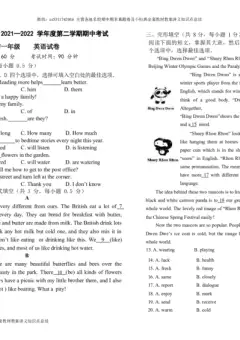
A
请根据三位学生的介绍,从A、B、C、D选项中选出与之相匹配的活动。其中有一个选项是多余的。
____21____
____22____
____23____
(二)阅读下列短文,根据短文内容,从短文后各题所给的A、B、C、D四个选项中,选择最佳选项。
B
Anna is a 9-year-old girl from a small village. She finishes Grade 4 at her village school. For Grade 5, she knows she will get into a famous city school nearby. So she is very happy.
On her first school day, Anna arrives at the classroom. Some classmates see her simple clothes and know she is from a village. They begin to laugh at her. Soon the teacher comes in. She introduces Anna to the whole class and says Anna will study with them from that day on.
In class, the teacher tells students to take a surprise test. She asks students to write down the Seven Wonders of the World (世界七大奇迹). All the other students write quickly, but Anna writes slowly.
Everyone hands in their paper, but Anna doesn’t. The teacher talks to her kindly. Anna says there are too many wonderful things and she does not know which seven to choose. Then she gives her paper to the teacher.
Most students write the famous buildings, like the Great Wall. The teacher is glad they remember what she teaches. Then she reads Anna’s answer: “The Seven Wonders—To see, To hear, To feel, To laugh, To think, To be kind, To love!”
The teacher is surprised, and the whole class says nothing. The village girl tells us our own gifts are the real wonders. We should value and make good use of what we have.
24. How does Anna feel when she knows she gets into a famous city school?
A. Nervous.B. Surprised.C. Happy.D. Excited.
25. What does the teacher ask students to do in class?
A. Draw a picture.B. Have a good rest.
C. Take a test.D. Give a speech.
26. Why does the teacher feel surprised at last?
A. Anna doesn’t know the answers.
B. All students’ answers are right.
C. Students remember what they learn.
D. Anna’s answer tells us our gifts are true wonders.
C
According to the Global Times, two short online videos are popular in China. In the videos, kids say “I love you” to their parents. But parents give very different answers. One parent asks, “Are you crazy?” Another father answers in a hurry, “I am busy. I have to go.” He just wants to end the conversation fast.
Why do Chinese families seldom say “I love you?” Some experts say this has to do with Confucian (儒家的,孔子的) culture. Xia Xueluan, a sociologist (社会学家) from Peking University, says Chinese parents often point out their children’s mistakes to show love. They do not often use warm and positive (积极的) words.
China Daily did a survey (调查) before. A 56-year-old man said he never said “I love you” to his family. He would not say it later, either. He thought it was really uncomfortable to say these words out loud.
But this does not mean Chinese people cannot show love. Sometimes actions speak louder than words. Zhao Mengmeng is 35 years old. She never says “I love you” to her father face to face. In 2022, she made a photo album for her dad. There were photos of them together. The photos were taken on almost every birthday of hers. This photo album became famous online. People shared it hundreds of thousands of times on Weibo. Her father was so touched that he could not sleep that night.
Love does not always need to be said. We can also show love through small and warm acts.
27. What do we know about Chinese parents from their answers in the two online videos?
A. They are good at showing their warm feelings.
B. They do not usually answer positively to “I love you”.
C. They feel very excited when their children say “I love you”.
D. They are always ready to talk about love with their children.
28. What is one reason for Chinese people seldom saying “I love you” according to the passage?
A. They have no time to talk with family.
B. They don’t have true love for their family members.
C. They think it’s not important to show love to children.
D. Confucian culture has something to do with how they show their feelings.
29. What lesson can we learn from Zhao Mengmeng’s story?
A. We can do small and warm actions to show our love.
B. We should say “I love you” to our parents face to face.
C. Chinese parents should be warmer to their children.
D. Chinese parents seldom talk about the love to their children.
D
Hobbies help us remember things better and keep our brains healthy. Hobbies make us happy and keep our brains working well. A study from Canada tells us that if we keep a hobby for a long time, our brain will become better.
Scientists studied 58 people who love watching birds. Half of them know a lot about birds. The others are new learners. These people are of different ages (20 to 70 years old). They have similar school learning experience.
In the brain test, people saw a bird photo for less than four seconds. Then they had to pick the same bird from four pictures. They did this test 72 times, with photos of 18 kinds of birds. The bird experts (专家) got 83% right for birds near their homes and 61% right for birds from other places. New learners only got 44% right for both. Brain scans (扫描) found a big difference: the brain parts used for paying attention and short-time memory worked more closely together for bird-watching experts, young or old. These brain partslit up when the experts tried to find out what kind of bird they were looking at. This did not happen to new learners.
Fun hobbies like music and dancing are also good for our brains. One study found dancers’ brains looked more than seven years younger than their real age. AI studies show even short creative learning time (30 hours) can make our brains younger. Scientists said, “Creativity changes not only our culture, but also our bodies.”
30. For birds from other places, what percentage of answers did experts get right?
A. 44%.B. 61%.C. 83%.D. 100%.
31. The underlined phrase “lit up” in the passage probably means “________”.
A. fell into sleepB. turned darkC. got hurtD. began to work
32. What can you learn from the passage?
A. The test used photos of 18 kinds of birds.
B. People in the study are all of the same age.
C. New learners can get 83% right for birds near their homes.
D. Dancers’ brains are seven months younger than their real age.
33. What is the main idea of the passage?
A. People have different kinds of hobbies.
B. Bird-watching is the best hobby for all students.
C. Good hobbies can help our brains stay in good condition.
D. Music and dancing are more popular than bird-watching.
第三部分
本部分共6题,共20分。根据题目要求,完成相应任务。
七、阅读表达(每题2分,共10分)
阅读短文,根据短文内容回答问题。
September is a big month for students in China because a new term begins at that time. In ancient China, the school entrance ceremony (入学典礼) was very important.
In ancient (古代的) China, children began school at the age of 4 to 7. Parents could choose a lucky day for the children to begin school. Parents got school things ready, like desks, chairs and the four treasures of the study.
Back then, teachers were often very knowledgeable (有学问的) people. Parents gave them gifts and wrote letters to ask them to teach their children.
On the first school day, children went to The First Writing Ceremony. Before it, they kowtowed to the statue of Confucius 9 times and to their teacher 3 times to show they were polite. During the ceremony, the teacher put a red point on the children’s forehead (额头) because it meant opening their mind. Children rang a bell to start the new term. Then they could sit down and begin to study.
Today, some schools have the same ceremony. Students wear traditional clothes and kowtow to Confucius and their teachers. Having such a ceremony means that from this moment, they take a step in the lifelong journey of learning.
34. At what age did children begin school in ancient China?
______________________________
35. What school things did parents get ready for children to begin school in ancient China?
______________________________
36. Why would children kowtow to the statue of Confucius and their teacher before the First Writing Ceremony?
______________________________
37. Why did the teacher put a red point on the children’s forehead during the First Writing Ceremony?
______________________________
38. What does having a school entrance ceremony mean to the students?
______________________________
八、文段表达(10分)
从下面两个题目中任选一题,根据中文和英文提示,完成一篇不少于50词的文段写作。文中已给出内容不计入总词数。所给提示词语仅供选用。请不要写出你的校名和姓名。
题目①
39.假设你是李华,升入初中已经一个多月了。你的美国笔友Paul想了解你的初中新生活。请你用英语给他写一封邮件,介绍你的初中生活。可以谈谈新学校的样子、谈谈你最喜欢初中新生活的哪一个方面(如课程、老师、或者新朋友等)、以及你对初中生活的感受。
提示词语:library,teacher,helpful,subject,happy
提示问题:
● What is your new school like?
● What do you like best about your new school life? Why?
● How do you feel about your junior high life?
注意:根据中文和英文提示,完成一篇不少于50词的文段写作。文中已给出内容不计入总词数。所给提示词语仅供选用。请不要写出你的校名和姓名。
Dear Paul,
I’m glad to tell you about my new start in junior high. ________________________________________________________________________________________________________________________________________________________________________________________________________________________________________________________________________________________________________________________________________________________________________________________________________________________________________________________________________________________________________________________________________________________________________________________________________________________________________________________________
Please write to me soon!
Yours,
Li Hua
题目②
40.假设你是李华,你校英语校刊正在开展以“My Family and Me”为主题的征文活动,请同学们分享和家人在一起的难忘时光。请你用英语写一篇短文,介绍你和家人喜欢一起做的一件开心的事(如一起做饭、打球、听音乐等),说说你们通常是怎么做的,以及这段时光给你带来的感受和意义。
提示词语:together, cook, share, happy, close
提示问题:
● What activity do you enjoy doing with your family?
● What do you usually do during the activity?
● How do you feel about the time with your family? Why?
注意:根据中文和英文提示,完成一篇不少于50词的文段写作。文中已给出内容不计入总词数。所给提示词语仅供选用。请不要写出你的校名和姓名。
Everyone comes from a family. I love the happy time with my family. ________________________________________________________________________________________________________________________________________________________________________________________________________________________________________________________________________________________________________________________________________________________________________________________________________________________________________________________________________________________________________________________________________________________________________