文档文本内容
2 0 2 5 年 全 国 教 师 资 格
主讲老师 李婉君
粉笔教师教育 粉笔教师温 故知 新
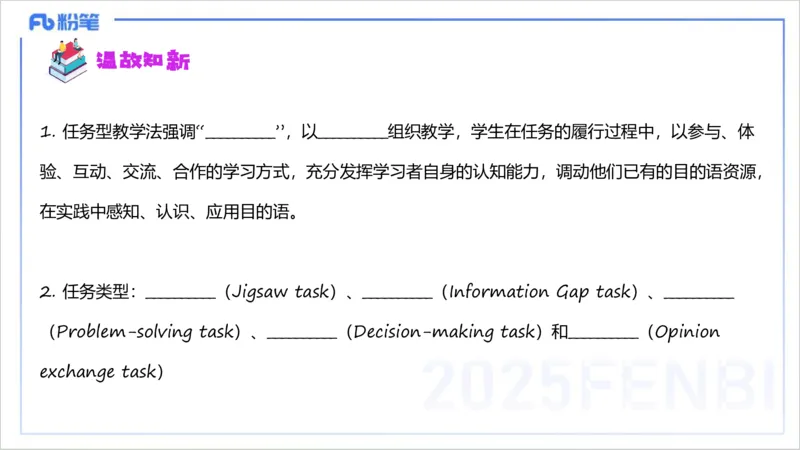
任务型教学法强调 ,以 组织教学,学生在任务的履行过程中,以参与、体
1. “__________” __________
验、互动、交流、合作的学习方式,充分发挥学习者自身的认知能力,调动他们已有的目的语资源,
在实践中感知、认识、应用目的语。
任务类型: ( )、 ( )、
2. __________ Jigsaw task __________ Information Gap task __________
( )、 ( )和 (
Problem-solving task __________ Decision-making task __________ Opinion
)
exchange task温 故知 新
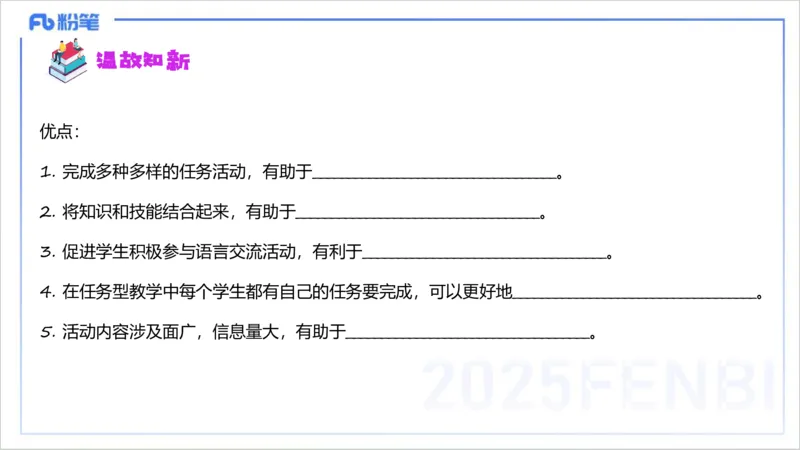
优点:
完成多种多样的任务活动,有助于 。
1. ___________________________________
将知识和技能结合起来,有助于 。
2. ___________________________________
促进学生积极参与语言交流活动,有利于 。
3. ___________________________________
在任务型教学中每个学生都有自己的任务要完成,可以更好地 。
4. ___________________________________
活动内容涉及面广,信息量大,有助于 。
5. ___________________________________温 故知 新温 故知 新
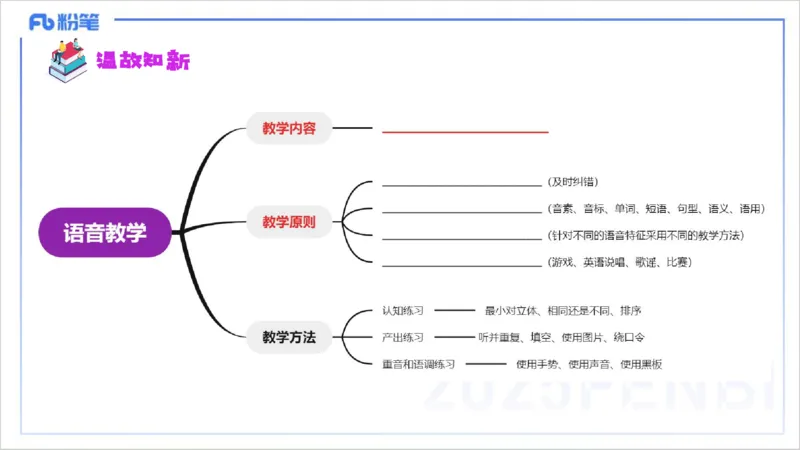
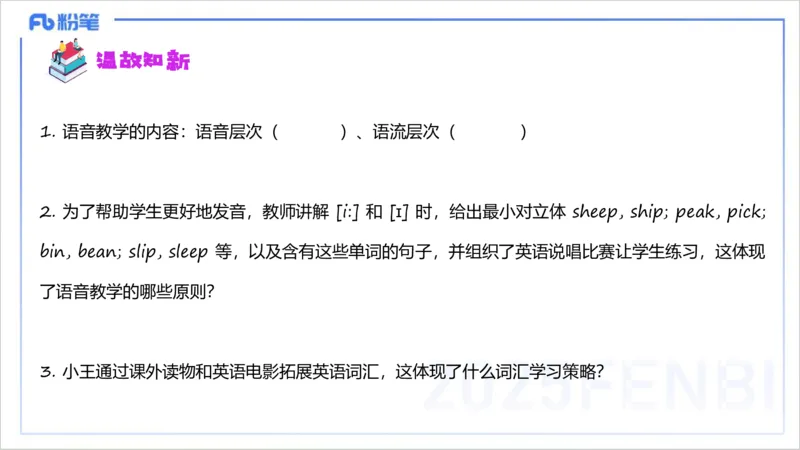
语音教学的内容:语音层次( )、语流层次( )
1.
为了帮助学生更好地发音,教师讲解 和 ɪ 时,给出最小对立体
2. [i:] [ ] sheep, ship; peak, pick;
等,以及含有这些单词的句子,并组织了英语说唱比赛让学生练习,这体现
bin, bean; slip, sleep
了语音教学的哪些原则?
小王通过课外读物和英语电影拓展英语词汇,这体现了什么词汇学习策略?
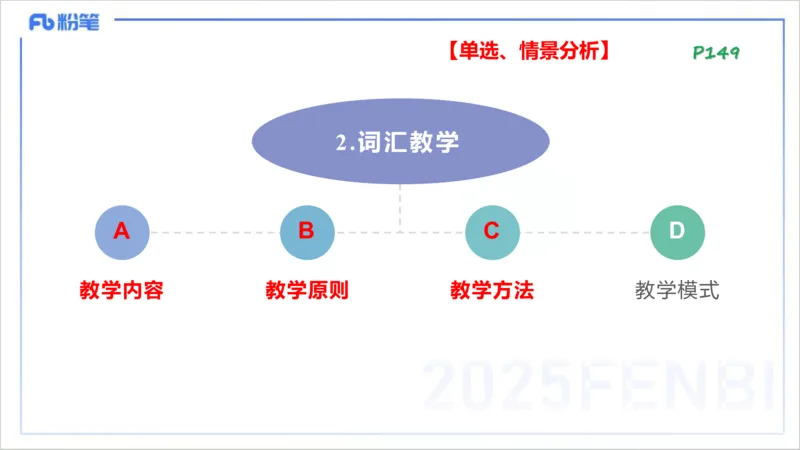
3.【单选、情景分析】
2 . 词 汇 教 学
A B C D
教学内容 教学原则 教学方法 教学模式【单选】
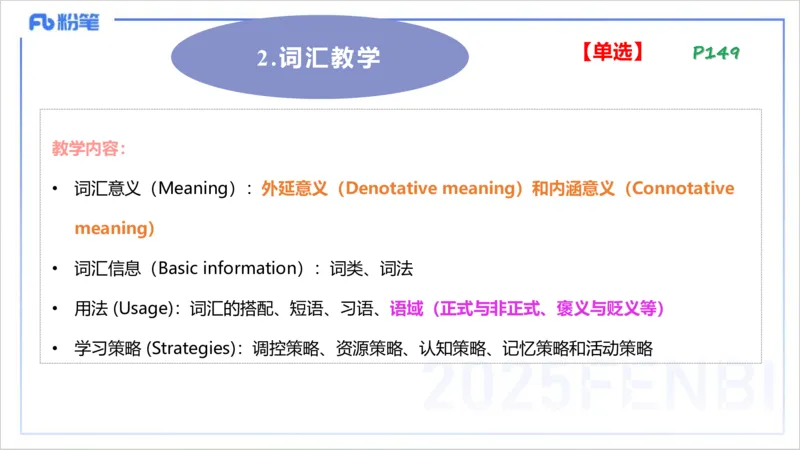
2 . 词 汇 教 学
教学内容:
• 词汇意义(Meaning):外延意义(Denotative meaning)和内涵意义(Connotative
meaning)
• 词汇信息(Basic information):词类、词法
• 用法 (Usage):词汇的搭配、短语、习语、语域(正式与非正式、褒义与贬义等)
• 学习策略 (Strategies):调控策略、资源策略、认知策略、记忆策略和活动策略【情景分析】
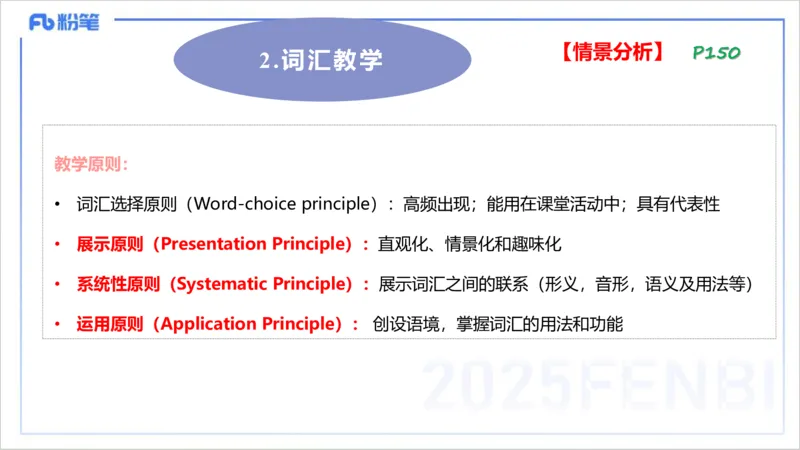
2 . 词 汇 教 学
教学原则:
• 词汇选择原则(Word-choice principle):高频出现;能用在课堂活动中;具有代表性
• 展示原则(Presentation Principle):直观化、情景化和趣味化
• 系统性原则(Systematic Principle):展示词汇之间的联系(形义,音形,语义及用法等)
• 运用原则(Application Principle): 创设语境,掌握词汇的用法和功能【情景分析】
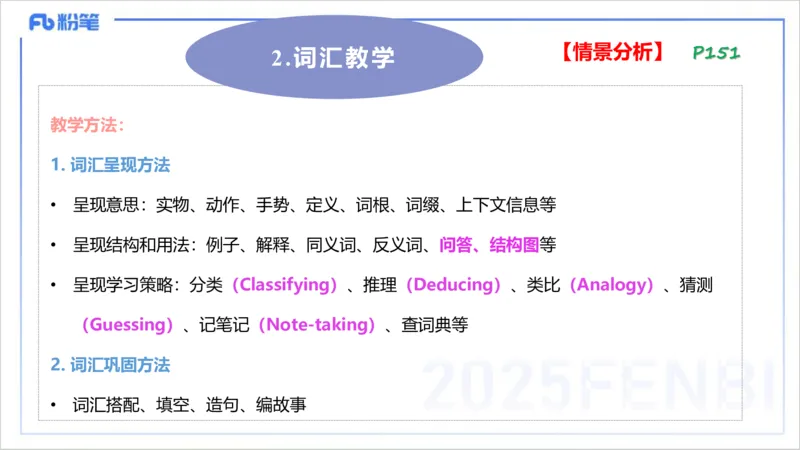
2 . 词 汇 教 学
教学方法:
1. 词汇呈现方法
• 呈现意思:实物、动作、手势、定义、词根、词缀、上下文信息等
• 呈现结构和用法:例子、解释、同义词、反义词、问答、结构图等
• 呈现学习策略:分类(Classifying)、推理(Deducing)、类比(Analogy)、猜测
(Guessing)、记笔记(Note-taking)、查词典等
2. 词汇巩固方法
• 词汇搭配、填空、造句、编故事2 . 词 汇 教 学
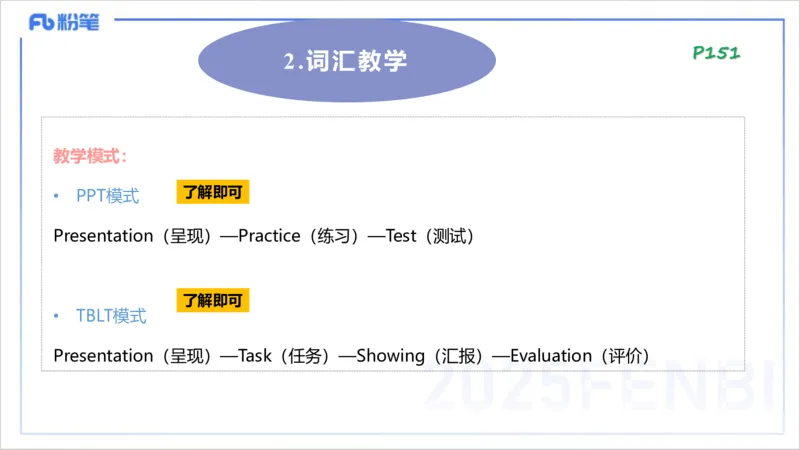
教学模式:
了解即可
• PPT模式
Presentation(呈现)—Practice(练习)—Test(测试)
了解即可
• TBLT模式
Presentation(呈现)—Task(任务)—Showing(汇报)—Evaluation(评价)【2017下·高中·教学情景分析】
下面是一位高中英语教师进行词汇教学时的课堂板书。
(1)图一和图二体现了词汇教学的哪两种方式?(10 分)【参考答案】
图一体现了词语搭配法。学生通过将左栏的冠词和形容词与右栏的名词组成词块进行记忆。在材
料中,学生将 a rainy 与 day 进行搭配,组成词块 a rainy day,更有利于学生记忆单词的用法。
图二体现了词语联想法。教师通过给出关键词或者某一主题,激发学生对相关主题词汇的联想和
提取,以达到记忆词汇的目的。在材料中,学生根据给出的关键词decision进行联想,有利于学生发
散思维。【2021下初中/高中】Which of the following activities best promotes the development of students’
communicative skills?
A. Doing multiple-choice questions.
B. Sharing information with partners.
C. Completing a summary of the text.
D. Copying sentences from the dictionary.【巩固提升】
1. If someone says “I know the word”, he should not only understand its meaning but also
be able to pronounce, spell and ________ it.
A. explain B. recognize C. memorize D. use
2. What skill does he/she use when a student uses language knowledge and contextual
clues to figure out the meaning of a new word? 【2020年下】
A. Contrasting. B. Summarizing. C. Deducing. D. Predicting【巩固提升】
3. Which of the following fails to describe the nature of vocabulary or vocabulary learning?
A. Words are best learned in a context.
B. A lexical item can be more than a word.
C. All words in a language have equivalents in other languages.
D. Learning a word includes learning its form, meaning and use.【单选、简答、情景分析】
3 . 语 法 教 学
A B C D
教学内容 教学原则 教学方法 练习方法【单选】
3 . 语 法 教 学
教学内容:
• 语言形式 / 结构(Language form/ structure)
• 语言意义(Language meaning)
• 语言功用(Language use/function)—语境
p She has taught English for 5 years.3 . 语 法 教 学
教学原则:
• 系统性原则:根据教材的内容编排学习节奏
• 交际性原则:创设情境,在交际中使用语法
• 整体性原则:将方法、应用、内容和能力等整合在一起
(1)归纳法与演绎法相结合。
(2)隐性教学与显性教学相结合。
(3)听说读写与语法教学相结合。
• 多样性原则:在活动组织、话题选择、语法展示手段等方面多样化3 . 语 法 教 学
【单选、简答、情景分析】
教学方法:
• 演绎法(The deductive method)(教师:规则—例子)
优点:讲解清楚,易于理解,适合成年学生 缺点:依赖性强、易遗忘、被动学习
• 归纳法(The inductive method)(学生:例子—规则)
优点:增加接触,培养分析能力注意力 缺点:师生要求高,学生需主动学习【单选】
3 . 语 法 教 学
练习方法:
1. 机械式练习(Mechanical practice):
• 替换操练(Substitution drills),转换操练(Transformation drills),填空
2. 意义性练习(Meaningful practice):看图片编对话、根据提示翻译句子等。
3. 交际性练习(Communicative practice):讲故事、情景对话、小组讨论、角色扮演等【巩固提升】
1. Teacher Taylor taught that attributive clause had two types, one is restrictive one, and the other is
non-restrictive one. What grammar content is the teacher teaching?
A. Language form. B. Language meaning.
C. Language use. D. Language function.
2. If a teacher wants to use “Communicative principle” to teach the grammar of past tense, what will
you suggest?
A. Ask students to repeat a model sentence many times.
B. Ask students to transcribe the text.
C. Ask students “What did you do yesterday?” and let them answer.
D. Show the calendar and ask students to say which dates are past.【2021年下】If a teacher asks the students in class “When do we use passive voice in our
daily life?”, he/she is trying to draw students’ attention to the ______ in grammar teaching.
A. meaning B. function C. form D. sound
【2020年下】What is the focus when a teacher says to the class “Rewrite each of the
following sentences using the passive voice.”?
A. Skill. B. Meaning. C. Structure. D. Function.【2018年下·高中·简答】
简述英语语法教学中归纳法(Inductive Method)的含义(4分),用英语写出两句体现该方法特点
的教师指令语(8分),并从两个方面简述教师在运用该方法时的注意事项(8分)。
教师指令语:【例】Let’s play a game together! Here is the rule. When I say the word in a
high voice, you should say it in a low voice..... Are you clear? Let’s begin!【参 考 答 案 】
(1)归纳法指的是教师让学生首先接触含有语法规则的语境,然后根据上下文的信息归纳出语
法规则。
(2)两句体现该方法特点的教师指令语:
① Now, let’s summarize the grammatical rules.
② Please work in groups to discuss the rules of this grammar according to the
given sentences.【参 考 答 案 】
(3)教师在运用该方法时的两个注意事项:
①要有一定数量的积累。首先,呈现具体的事例;其次,经过观察、分析、思考,对这些具体
的事例进行归纳总结。
②要体现教师的引导作用。在使用归纳法总结语法规则时,教师需要使用恰当的方式引导学生
探究新知,针对较难的知识点或语言基础较薄弱的学生,教师可通过启发提问的方式引起学生
思考。真 题演 练
(2021 年上 · 高中 · 教学情境分析)
32. 下面内容是某教师讲解 remember doing sth. 和 remember to do sth. 语言点时的课堂实录。
Teacher: Li Hua, what did you do last Sunday morning?
Li Hua: I played badminton with my friends.
Teacher (to the class): Did Li Hua remember playing badminton with her friends?
Students: Yes, she did.
Teacher: Liu Ying, what did you do last Sunday morning?
Liu Ying: I visited my grandparents.真 题演 练
Teacher (to the class): Did Liu Ying remember visiting her grandparents?
Students: Yes, she did.
Teacher: What will you do this Sunday morning then, Liu Ying?
Liu Ying: I will see a film with my sister.
Teacher: Please remember to take the tickets with you and be there on time.
Liu Ying: Sure. I will remember to do that. Thank you.
Teacher: Now, class, can you tell the difference between “remember doing sth.” and
“remember to do sth.”? Look at the following diagrams.真 题演 练
请根据此教学情景回答下列问题:
(1)该教师在讲解知识点时运用了哪两种方法?(8 分)
(2)这些方法各自有何特点?(8 分)能发挥什么作用?(8 分)
【参考答案】
(1)该教师在讲解知识点时使用了归纳法和交际法两种教学方法。真 题演 练
【参考答案】
(2)①特点:
归纳法的特点:学生首先接触的是包含语法规则的语境,然后根据上下文信息归纳出语法规则。
交际法的特点:交际法以培养学生的交际能力为宗旨,主张让教学过程交际化;以话语作为教学的基本单位;在
一定程度上允许学习者在学习过程中存在语言错误。
②作用:
归纳法的作用:归纳法可以增加学生和语言的接触,有助于激发学生的参与意识,培养学生的分析能力和注意力,
使学生理解语法所适用的语境、所表达的含义以及所承载的功能。通过分析归纳总结语言使用规律,可以深化学
生对其用法的理解。
交际法的作用:交际法可以培养学生的交际能力;从学生的实际需要出发,帮助学生确定学习目标;教学过程交
际化,有助于锻炼学生的口语表达能力和反应能力。【单选】
4 . 语 篇 教 学
A B C D
概念 分类 功能及特点 教学方法【单选】
4 . 语 篇 教 学
概念:语篇(Discourse)由一个以上的句子或段落组成,各句子或段落之间在形式上是衔接的
(cohesive),语义上是连贯的(coherent)。
分类:会话语篇(多见于口语和听力);段落语篇(多见于语法和阅读)4 . 语 篇 教 学
了解即可
功能及特点:
• 整体性效能:英语语篇分析必须遵循“整体大于局部之和”的原则
• 预测性特点:可预测事件情节的发展、文本的结果等
• 图式化构建:通过具体语篇所提供的意义文本与信息渠道来检测学生知识与经验储备的质量水
平,密切新旧知识的关系,形成新的知识链4 . 语 篇 教 学
了解即可
篇章模式:
(一)问题—解决模式(Problem-solution pattern)
(二)主张—反主张模式(Claim-counterclaim pattern)
(三)概括—具体模式(General-specific pattern)
(四)匹配——比较模式(Matching pattern)
(五)叙事模式(Narrative pattern)4 . 语 篇 教 学
了解即可
教学方法:
1. 整体分析法:利用小标题、主题句等,从整体上纵观全文结构和内容
2. 线索教学法:(记叙文)抓住关键要素:“5W+H”
3. 背景知识介绍法4 . 语 篇 教 学
了解即可
教学方法:
4. 段落提问教学法
• 关于主旨:The main idea of this text may be…/This article is mainly about…
• 关于文章细节:Who/ Where/ When/ What/ Why/ How…
• 推断型:The author implies that…/ Implied but not stated…
• 作者的观点:The author believes/ thinks that…
• 归类型:We can summarize the main meaning…/ The conclusion of the text is…
5. 讨论教学法:设疑+正确引导;分组讨论:创设交际情境,充分调动学生的参与性、主动性、创造性【2023年下初中/高中】What does a teacher intend to do when asking students to put jumbled
paragraphs into a meaningful passage?
A. To enhance students’ability to guess word meaning in context.
B. To develop students’awareness of reading for the main idea.
C. To enhance students’ability to read for specific information.
D. To develop students’awareness of cohesion and coherence.【2021年下初中/高中】When using such sentences as “A long time ago…/ Then…/ Afterwards… /In
the end…” in a reading class, a teacher is probably teaching language at the ______.
A. lexical level B. discoursal level C. grammatical level D. phonological level
【2021年上初中/高中】Which of the following activities is NOT appropriate for developing students’
awareness of discourse coherence?
A. Writing a conclusion for a passage.
B. Underlining the topic sentence of each paragraph.
C. Changing sentences from active forms into passive ones.
D. Arranging all the sentences to produce a meaningful passage.【巩固提升】
1. Which the following is wrong about discourse teaching?
A. Discourse is the language unit of expressing meaning.
B. The elements of a discourse are independent of each other.
C. Learning discourse knowledge is the basis of developing language competence.
D. Discourse includes oral discourse and written discourse
2. When you focus on “utterance function” and “expected response” by using examples like
“Here you are” “Thanks”, you are probably teaching language at the _________.
A. lexical level B. sentence level
C. grammatical level D. discourse level【巩固提升】
3. What textual pattern can be found between the two sentences “Clare loves potatoes.
She was born in Ireland.”?
A. Problem-solution pattern.
B. Cause-effect pattern.
C. Phenomenon-example pattern.
D. Instrument-achievement pattern.