学位英语汉译英翻译真题解析
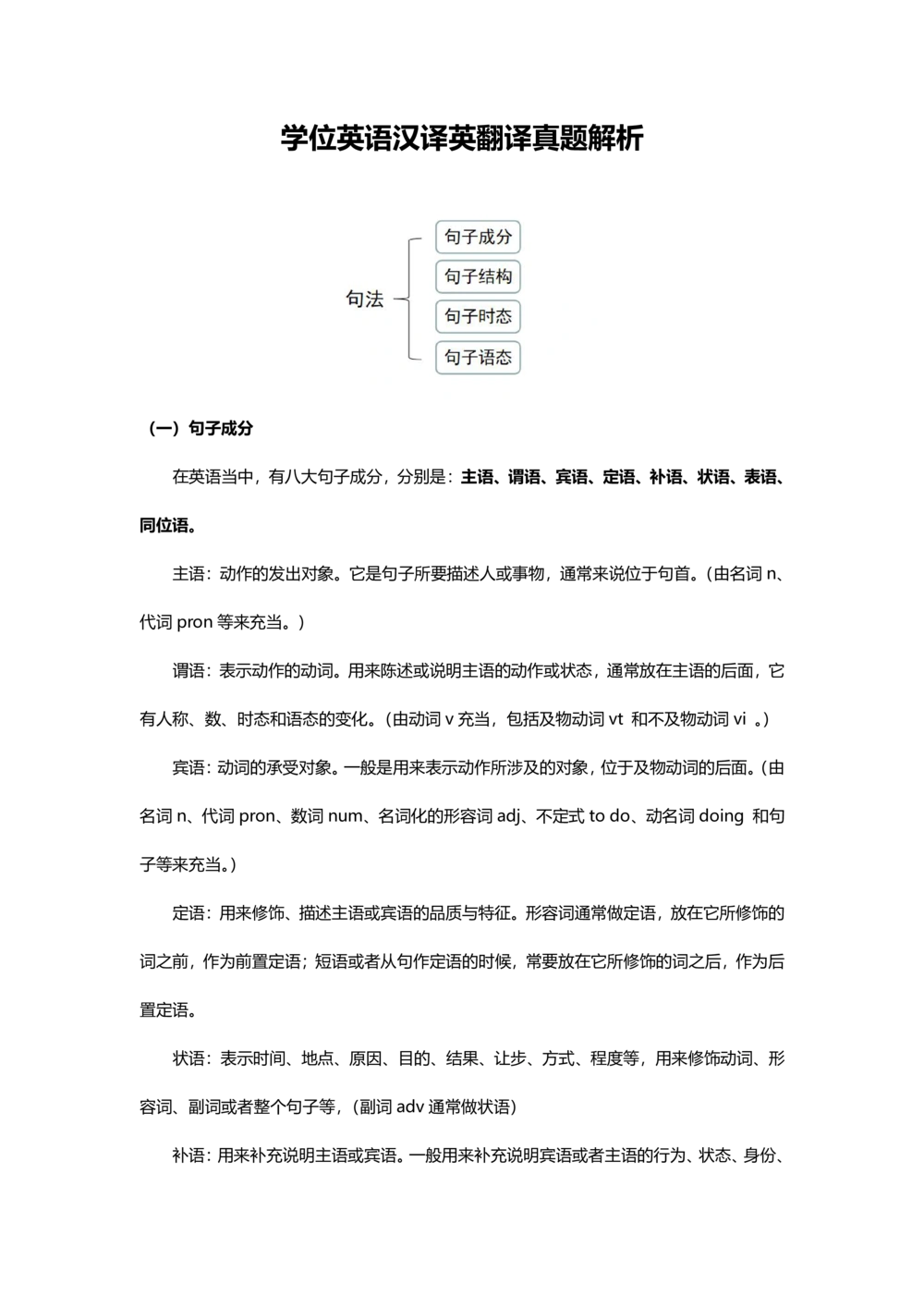
(一)句子成分
在英语当中,有八大句子成分,分别是:主语、谓语、宾语、定语、补语、状语、表语、
同位语。
主语:动作的发出对象。它是句子所要描述人或事物,通常来说位于句首。(由名词n、
代词pron等来充当。)
谓语:表示动作的动词。用来陈述或说明主语的动作或状态,通常放在主语的后面,它
有人称、数、时态和语态的变化。(由动词v充当,包括及物动词vt 和不及物动词vi 。)
宾语:动词的承受对象。一般是用来表示动作所涉及的对象,位于及物动词的后面。(由
名词n、代词pron、数词num、名词化的形容词adj、不定式todo、动名词doing 和句
子等来充当。)
定语:用来修饰、描述主语或宾语的品质与特征。形容词通常做定语,放在它所修饰的
词之前,作为前置定语;短语或者从句作定语的时候,常要放在它所修饰的词之后,作为后
置定语。
状语:表示时间、地点、原因、目的、结果、让步、方式、程度等,用来修饰动词、形
容词、副词或者整个句子等,(副词adv通常做状语)
补语:用来补充说明主语或宾语。一般用来补充说明宾语或者主语的行为、状态、身份、特征等。补语可以分为宾语补足语和主语补足语。(由名词n、形容词adj、副词adv、介词
短语prep、非谓语动词等来充当。)
表语:说明主语的品质、性质、身份、特征和状态,通常由名词n、代词pron、形容
词adj等来充当,放在在系动词后面。常见的系动词有:be,become,appear,seem,look,
sound, feel, get, smell等。
同位语:即“同等位置”,以一个名词来解释说明另外一个名词或代词。
例如:1. My sister Susan sings very well. 我的妹妹苏珊唱歌很棒。
My—定语
sister—主语
Susan—同位语
sings—谓语
very well—状语
2. She is Chinese. 她是中国人。
She—主语
is— be动词
Chinese—表语
3. I painted the wall white. 我把墙漆成白色的。
I—主语
painted—谓语
the wall—宾语
white—补语主谓一致
主谓一致的原则是指,主语和谓语从语法形式上取得一致: 主语是第三人称单数形式
(简称“三单”),谓语动词采用单数形式;主语是复数形式,谓语必须采用复数形式。
例如: 1. A grammar book helps you learn something about the rules of a
language. 语法书帮助你学习语言的某些规则。
(主语是单数形式,谓语也采取单数形式)
2. Grammar books help you learn something about the rules of a language.
语法书帮助你学习语言的某些规则。
(主语是复数形式,谓语也采取复数形式)
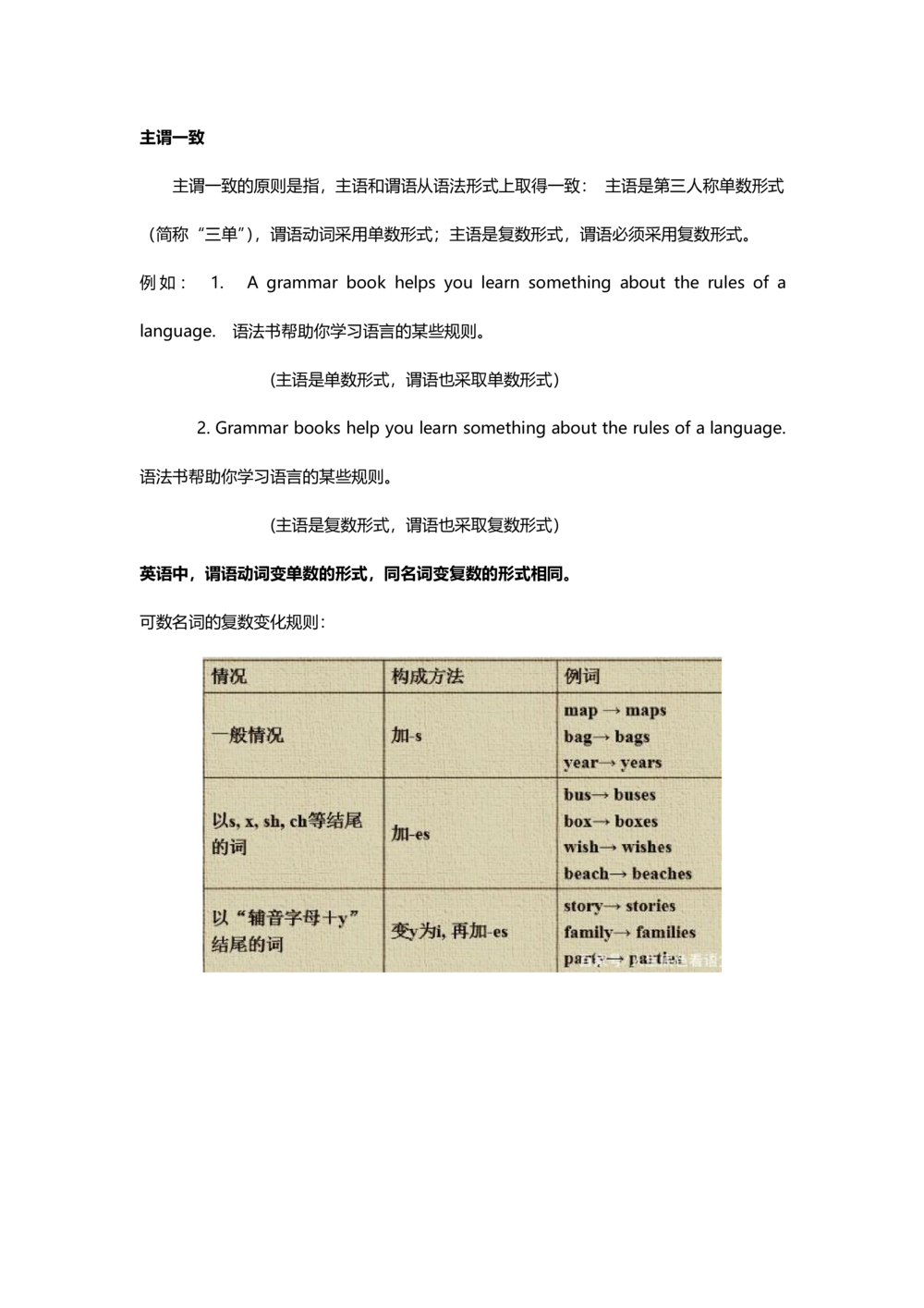
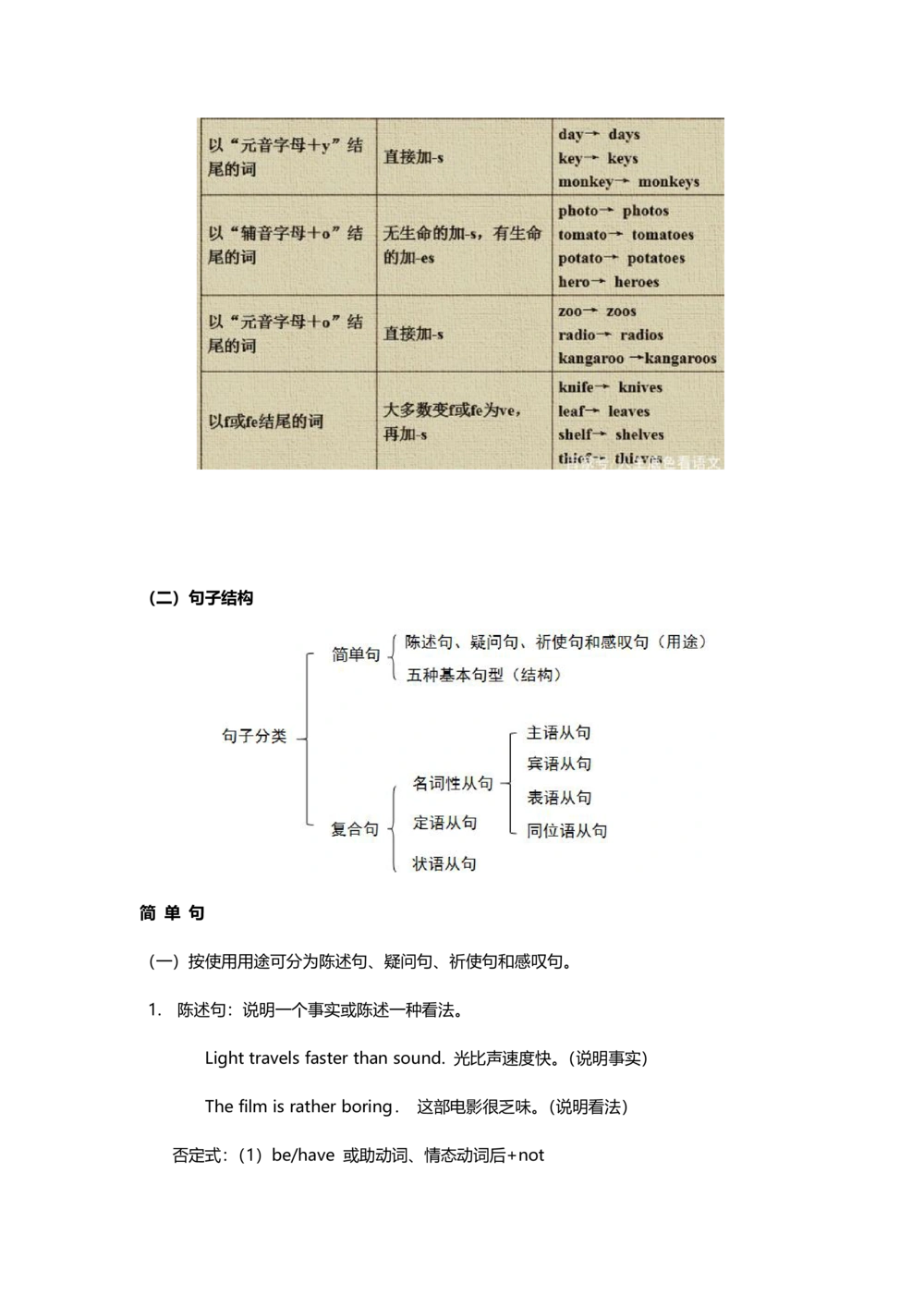
英语中,谓语动词变单数的形式,同名词变复数的形式相同。
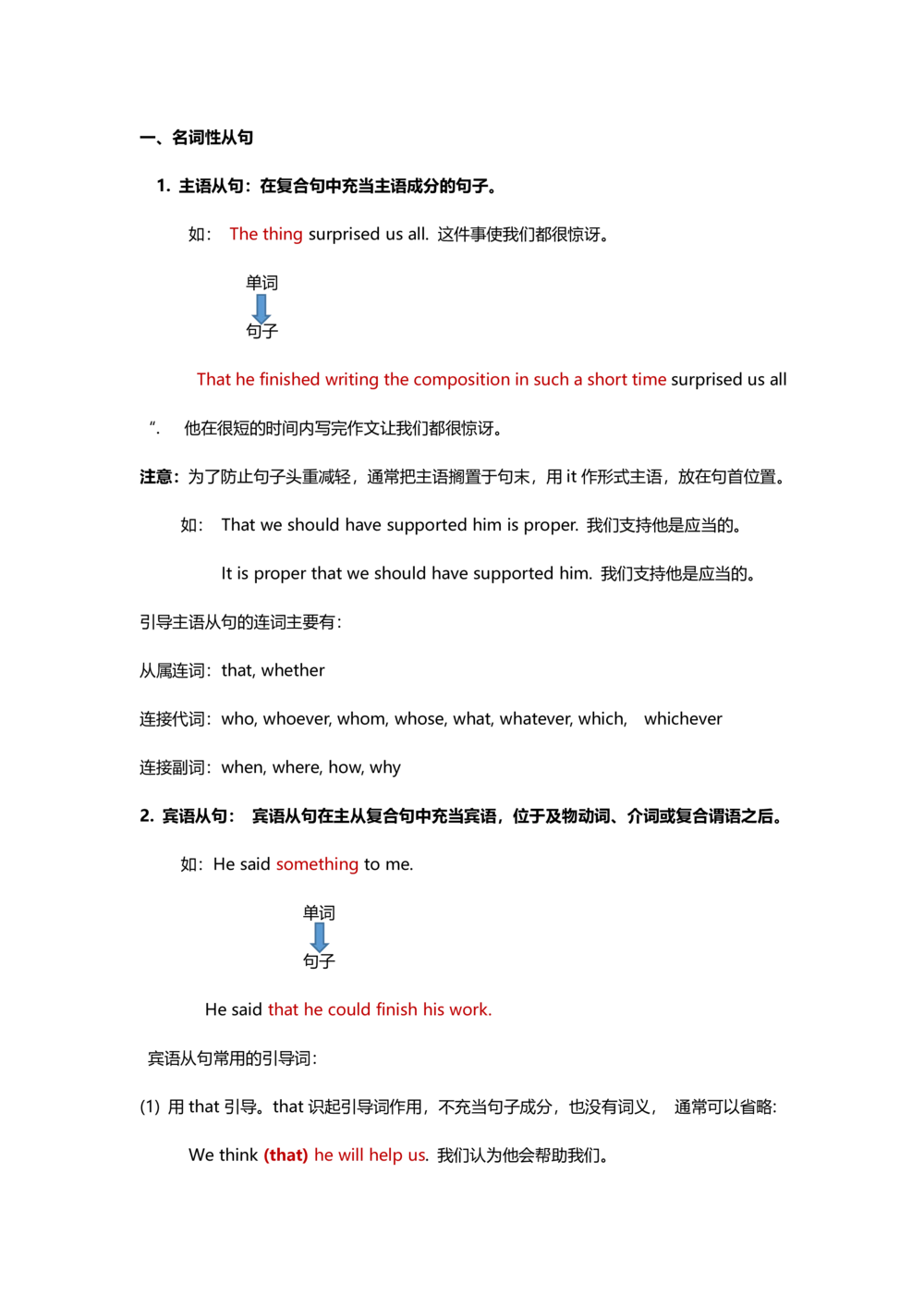
可数名词的复数变化规则:(二)句子结构
简 单 句
(一)按使用用途可分为陈述句、疑问句、祈使句和感叹句。
1. 陈述句:说明一个事实或陈述一种看法。
Light travels faster than sound. 光比声速度快。(说明事实)
The film is rather boring. 这部电影很乏味。(说明看法)
否定式:(1)be/have 或助动词、情态动词后+notHe has not made his meaning clear. 他还没有把自己的意思说清楚。
(2)其他实意动词原形前+do not(don’t)
He didn’t makehis meaning clear. 他没有把自己的意思说清楚。
2. 疑问句:
(1)一般疑问句:
Can you finish the work in time? 你能按时完成工作吗?
Do you change your address? 你改地址了吗?
否定式:在助动词或情态动词后+not
Aren’t you coming to the meeting? 你不来参加会议吗?
(2)特殊疑问句:
以疑问词what 、who 、whose 、which 、when 、 where 、how 、why等开
头的问句。
疑问代词:what(什么) what time(什么时候)
who(谁)
which(哪个,在一定范围内选择)
whose(谁的)
whom(谁)
疑问副词:when(询问时间)
where(询问地点)
why(询问原因)
how(询问怎么样) how much(多少)、how long(多长)
如: Whatdoes she like? 她喜欢什么?/ How do you know that?你怎么知道那件事?(3)选择疑问句
Do you want tea or coffee?你是要茶还是要咖啡?
(4) 反意疑问句
You are a student, aren’t you? 你是学生,不是吗?
You didn't go, did you? 你没去,是吗?
They work hard, don’t they? 他们努力工作,不是吗?
3. 祈使句: 表示命令、请求或建议。
Sit down, please. 请坐。
Don‘t let him go out. 不要让他出去。
Let’s go out together. 我们一块出去吧。
4. 感叹句:表示说话人惊奇、喜悦、愤怒等情绪。
What good news it is! 多好的消息啊!
How funny ! 多么有趣啊 !
(二)按结构划分
简单句: 只包含一个主谓结构,各个句子成分都是单词或短语。
I like flowers.
英语中的基本简单句型可归纳为五种:
1. 主+谓(不及物动词) (SV)
例句: It rained this morning.
2. 主+谓(及物动词vt)+宾 (SVO)
例句: My father loves my mother.
3. 主+谓(vt)+宾(直)+宾 (间) (SVOO)例句: My mother bought me a skirt.
4. 主+谓(vt)+宾+补 (SVOC)
例句: Money makes us happy.
5. 主+谓(系动词+感官动词)+表(SVP)
例句: I am a excellent students.
简单句中的并列句及其常用连词
并列句由两个或两个以上并列而又相对独立的简单句构成,结构如下:简单句+并列连
词+简单句。
1. 结合连接词:and, so, therefore, not only…butalso, neither…nor等。
如:The owner and editor of the newspaper is a friend of mine.
该报纸的发行人和总编辑是我的一个朋友。
2. 选择连接词:or,either… or,otherwise, or else等。
如:Let’s hurry up or we’ll be late. 快点儿,否则我们会迟到的。
3. 转折关系连接词:but, yet, while, nevertheless, however, whereas等。
如:Heneverdidanything butreadnewspapers. 他除了看报纸,从不做任何事情。
4. 因果连接词:for, so, therefore, then等。
如:There was nobody at the office, so I went home again. 办公室里没人,所以我又
回家了。
复 合 句
复合句:由一个主句和一个或一个以上的从句构成。主句为句子的主体, 从句只作句子的
一个成分,不能独立。从句的结构是:关联词+主语+谓语一、名词性从句
1. 主语从句:在复合句中充当主语成分的句子。
如: The thing surprised us all. 这件事使我们都很惊讶。
单词
句子
Thathefinishedwritingthecompositioninsuchashort timesurprisedusall
“. 他在很短的时间内写完作文让我们都很惊讶。
注意:为了防止句子头重减轻,通常把主语搁置于句末,用it作形式主语,放在句首位置。
如: That we should have supported him is proper. 我们支持他是应当的。
It is proper that we should have supported him. 我们支持他是应当的。
引导主语从句的连词主要有:
从属连词:that, whether
连接代词:who, whoever,whom, whose, what, whatever, which, whichever
连接副词:when, where, how, why
2. 宾语从句: 宾语从句在主从复合句中充当宾语,位于及物动词、介词或复合谓语之后。
如:He said something to me.
单词
句子
He said that he could finish his work.
宾语从句常用的引导词:
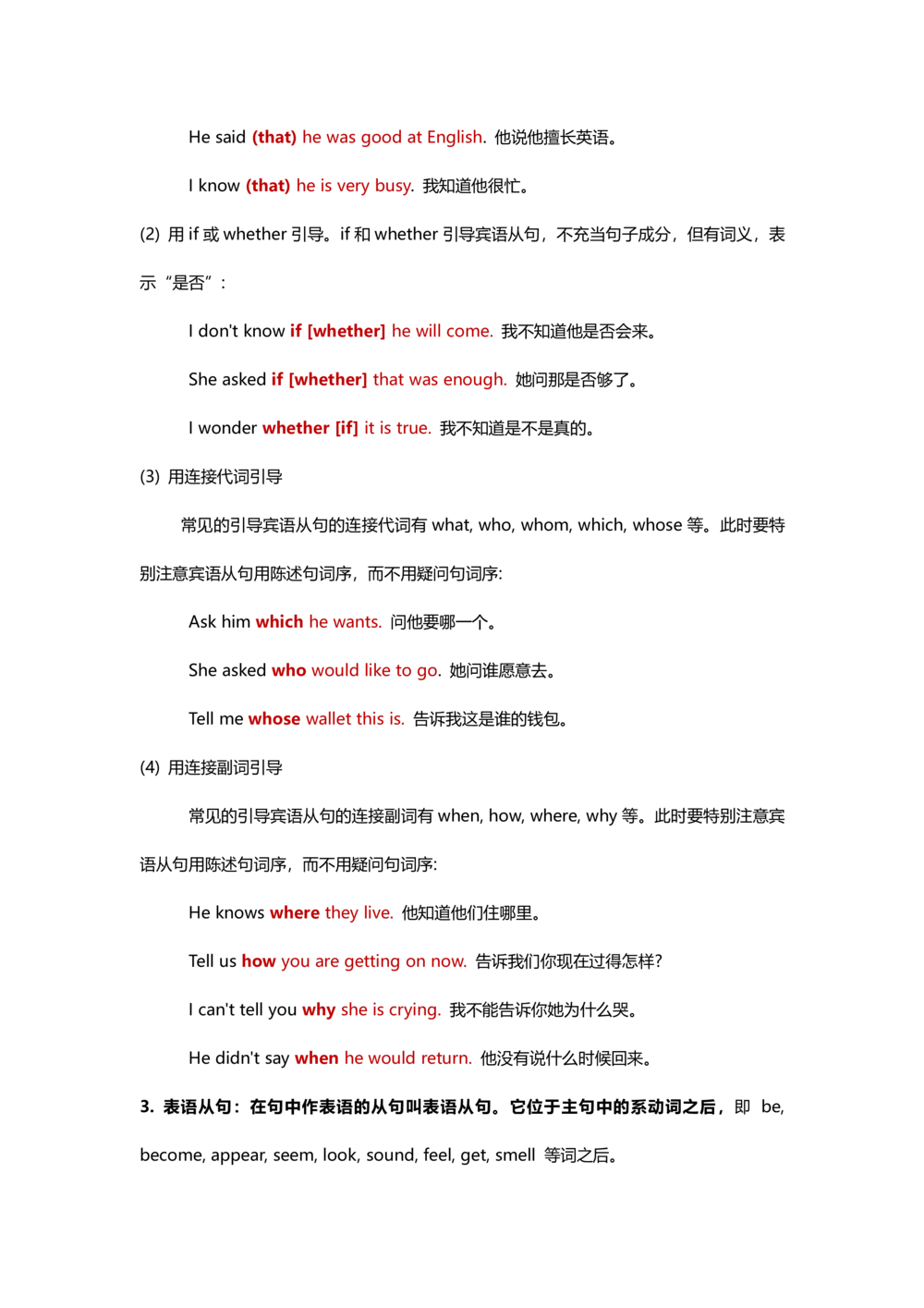
(1) 用that引导。that识起引导词作用,不充当句子成分,也没有词义, 通常可以省略:
We think (that) he will help us. 我们认为他会帮助我们。He said (that) he was good at English. 他说他擅长英语。
I know (that) he is very busy. 我知道他很忙。
(2) 用if或whether引导。if和whether引导宾语从句,不充当句子成分,但有词义,表
示“是否”:
I don't know if [whether] he will come. 我不知道他是否会来。
She asked if [whether] that was enough. 她问那是否够了。
I wonder whether [if] it is true. 我不知道是不是真的。
(3) 用连接代词引导
常见的引导宾语从句的连接代词有what, who, whom, which, whose等。此时要特
别注意宾语从句用陈述句词序,而不用疑问句词序:
Ask him which he wants. 问他要哪一个。
She asked who would like to go. 她问谁愿意去。
Tell me whose wallet this is. 告诉我这是谁的钱包。
(4) 用连接副词引导
常见的引导宾语从句的连接副词有when, how, where, why等。此时要特别注意宾
语从句用陈述句词序,而不用疑问句词序:
He knows where they live. 他知道他们住哪里。
Tell us how you are getting on now. 告诉我们你现在过得怎样?
I can't tell you why she is crying. 我不能告诉你她为什么哭。
He didn't say when he would return. 他没有说什么时候回来。
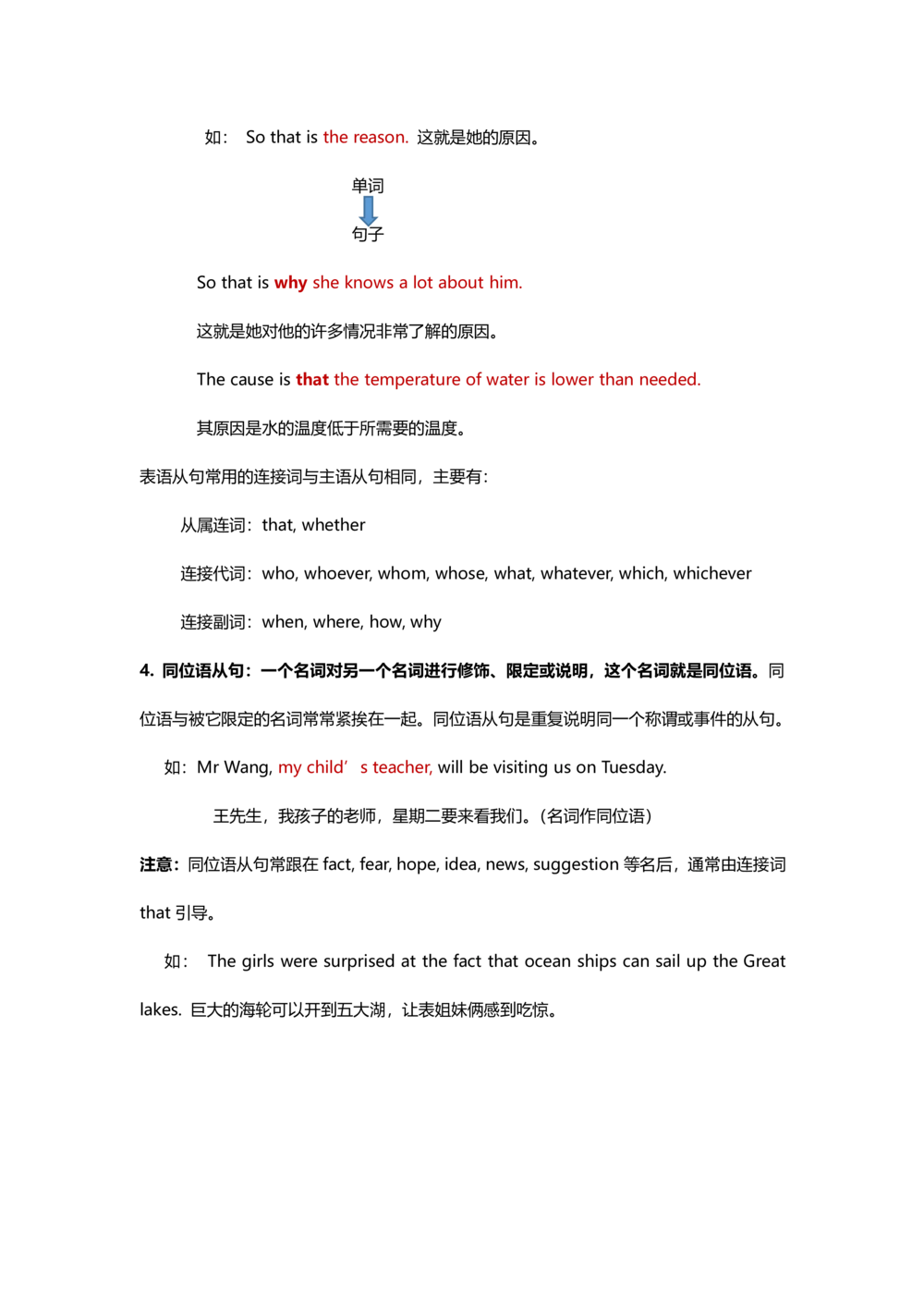
3. 表语从句:在句中作表语的从句叫表语从句。它位于主句中的系动词之后,即 be,
become, appear, seem, look, sound, feel, get, smell 等词之后。如: So that is the reason. 这就是她的原因。
单词
句子
So that is why she knows a lot about him.
这就是她对他的许多情况非常了解的原因。
The cause is that the temperature of water is lower than needed.
其原因是水的温度低于所需要的温度。
表语从句常用的连接词与主语从句相同,主要有:
从属连词:that, whether
连接代词:who, whoever,whom, whose, what, whatever, which, whichever
连接副词:when, where, how,why
4. 同位语从句:一个名词对另一个名词进行修饰、限定或说明,这个名词就是同位语。同
位语与被它限定的名词常常紧挨在一起。同位语从句是重复说明同一个称谓或事件的从句。
如:Mr Wang, my child’s teacher,will be visiting us on Tuesday.
王先生,我孩子的老师,星期二要来看我们。(名词作同位语)
注意:同位语从句常跟在fact,fear,hope,idea,news,suggestion等名后,通常由连接词
that引导。
如: The girls were surprised at the fact that ocean ships can sail up the Great
lakes. 巨大的海轮可以开到五大湖,让表姐妹俩感到吃惊。二、定语从句
一个从句在整个句子中做定语,那么这个从句就叫做定语从句。
如:He has a story book. 他有一本故事书。
He has an interesting (单词)story book. 他有一本非常有趣的故事书。
He has a story book which is very interesting(句子).
先行词 引导词
注意:引导词要和关系词对应。
指人:who, whom, that,whose
在从句中所起作用如下:
Is he the man who/that wants to see you?(who/that在从句中作主语)
他就是想见你的人吗?
He is the man whom/ that I saw yesterday.(whom/that在从句中作宾语)
他就是我昨天见的那个人。
They rushed over tohelp the man whose carhad broken down.(whose在从句中
作定语) 那人车坏了,大家都跑过去帮忙。指物:which, that,在从句中可作主语、宾语等。
例如:A prosperity which / that had never been seen before appears in the
countryside. (which / that在从句中作主语)
农村出现了前所未 有的繁荣。
The package which / that you are carrying is about to come unwrapped.
你拿的包快散了。(which / that 在从句中作宾语)
关系副词: when, where, why
关系副词可代替的先行词是时间、地点或理由的名词,在从句中作状语。
如: Thereareoccasions when (on which) one must yield. 任何人都有不得不屈服的
时候。
Beijing is the place where (in which) I was born. 北京是我的出生地。
Thisisthereasonwhy(forwhich)hedoesn'tcome. 这就是他为什么不来的原因。
定语从句与宾语从句的判定:
1. 定语从句:主谓宾结构完整,去掉从句后,句子结构和意思完整。 宾语从句:只有主谓
结构,缺少宾语,去掉从句后,句子结构和意思不完整。
如:This is the book that I bought last week. 这是我上周买的书。
I told him that we must go at once. 我告诉他我们必须马上走了。
2. 定语从句:引导词前是名词。 宾语从句: 引导词前是动词。
如:This is the place where Luxun once lived. 这是鲁迅曾经住过的地方。
He knows where they live. 他知道他们住哪里。
三、状语从句
指句子用作状语时,起副词作用的句子。根据其作用可分为时间、地点、原因、条件、目的、结果、让步、方式和比较等状语从句。
注意:从句位于句首或句中时通常用逗号与主句隔开,位于句尾时可以不用逗号隔开。
1. 时间状语从句
常用引导词:when(在…时),as(当…时),while(在…期间),assoonas(一……就……),
before(在…之前),afte(r 在...之后),since(自从...以来),not...unti(l 直到…才)until/till(直
到…时)等。
如:When I lived in the countryside, I used to carry some water for him.
当我住在农村时,我常常为他担水。
2. 地点状语从句:表示地点、方位, 这类从句通常由where, wherever引导。
如:Where there is a will, there is a way. 有志者, 事竟成。
They will go where they are happy. 他们想到他们觉得快乐的地方去。
地点状语从句与定语从句的区别 :
定语从句:where引导定语从句时,从句前必须有一个表示地点的名词作先行词。
状语从句:where 引导状语从句时,状语从句前无先行词。
如:Go back where you came from. (where引导地点状语从句)
你从何处来到何处去。
Go back to the village where you came. (where引导定语从句,修饰village)
回到你来的那个村子里去。
3. 条件状语从句:由引导词if或unless引导的状语从句叫做条件状语从句,指在某种条件
下才能进行的行为,通常译作“假如”。
常用引导词:if, unless,whether(whether...or not)
如:We’llstartourprojectifthepresidentagrees. 如果总统同意,我们将开始我们的项目。
You will certainly succeed so long as you keep on trying. 只要你继续努力,你一
定会成功的。
4. 原因状语从句:引导原因状语从句的从属连词有because(因为), as(由于), since
(既然),nowthat(既然),seeingthat (由于,鉴于),considering(that)(考虑到),
for(为了)等。
如:I can’t get to sleep because of the noise outside. 由于外面声音嘈杂我睡不着。
Now that you are here, you’d better stay. 你既然来了,最好还是留下吧。(既来
之,则安之。)
5. 让步状语从句: 一般翻译为“尽管……”或“即使……”,就是我们日常生活中用的“退
一步说…”的意思。
常用引导词:though, although, even if,even though,as等。
如:Much as I respect him, I can’t agree to his proposal.
尽管我很尊敬他, 但是我却不同意他的建议。
No matter how hard he tried, she could not change her mind.
不论他如何努力,她都不会改变她的主意。
6. 方式状语从句
通常由as, (just) as…so…, as if, as though, by, with引导,多用来谈论某人的行为
或者做某事的方式。
如: When in Rome, do as the Romans do. 入乡随俗。
You must try to hold the tool as I do. 你必须像我这样拿工具。
7. 目的状语从句:用以补充说明主句中谓语动词发生的目的,通常意为“以便”。常用引导词:so that, in order that
特殊引导词:lest, in case, for fear that, in the hope that, for the purpose of
如:Say it louder(so)that everyone can hear you.大声说,以便大家都能听到你。
I get up early in order that I can catch the early bus.
8. 结果状语从句
常用引导词:so … that(如此…以致于),such … that(如此的…以致),sothat...
(因而)
如: He got up so early that he caught the first bus. 他很早起床以便赶上第一班公
共汽车。
Thisnewsisexciting,sothathejumpedup. 这个消息太令人激动了,以至于他跳了
起来。
注意:在结果状语从句中不可用情态动词may,might,否则就成了目的状语从句。
9. 比较状语从句:主要运用于形容词和副词的原级、比较级及最高级的句子之中。
原级:as…as(和……一样),not so(as)…as …(和....不一样);
比较级:more…than(更);
最高级:The most…in/of, the + 形容词+est…of/in。
常用引导词:as(同级比较),than(不同程度的比较)
特殊引导词:the more … the more … ; no … more than
如:She is as bad-tempered as her mother. 她和她妈妈一样脾气很坏。
The more you exercise, the healthier you will be. 你运动的越多,你就越健康。句子时态
英语中常用的有八种基本时态,即:一般现在时、一般过去时、一般将来时、过去将来
时、现在进行时、过去进行时、现在完成时、过去完成时。
一、一般现在时
概念: ①指经常、反复发生的动作或行为及现在的某种状况。
②表示主语的特征、性格、能力等。
③表示客观事实或普遍真理。
2. 时间状语:always, usually, often, sometimes, seldom,every week (day, year,
month…), once a week, on Sundays,
3. 基本结构:主语+ 动词原形 (如果主语为第三人称单数,动词要用单数形式.)
如:It seldom snows here.
Action speaks louder than words.
二、一般过去时
1. 概念:过去某个时间里发生的动作或状态;过去习惯性、经常性的 动作、行为。
2. 时间状语:ago, yesterday, the day before yesterday,last week(year,
night, month…), in 1989, just now, at the age of 5, one day, long long ago.
3. 基本结构:
含有Be动词:主语+was/were+形容词或者名词......
不含有be动词:主语+动词过去式+......
4.否定句:
带be: 主语+was/were not+形容词或者名词+......
不带be:主语+didn't+动词原形+......如: I didn't know you were so busy.
She sang a song of Wang Feng yesterday.
三、现在进行时
1. 概念:表示现阶段或说话时正在进行的动作及行为。
2. 时间状语:now, at this time, these days, etc.
3. 基本结构:Be动词(am/is/are)+doing(动词的现在分词形式)
4. 否定形式:Be动词(am/is/are)+not+doing.
5. 一般疑问句:把be动词放于疑问词的后面。
如:How are you feeling today?
He is doing well in his lessons.
注意:一般表示位移的词如leave,fly,arrive,go,come. 等用现在进行时表将来。
如: I am flying Beijing next week .我下周即将飞往北京。
He is leaving for Beijing tomorrow. 他明天即将去北京。
四、过去进行时
1. 概念:表示过去某段时间或某一时刻正在发生或进行的行为或动作。
2. 时间状语:at this time yesterday, at that time等
3. 基本结构:was/were + doing
4.否定形式:was/were + not + doing.
5.一般疑问句:把was或were放于句首。
如: When he came in, I was reading a newspaper.
五、现在完成时
1.概念:过去发生或已经完成的动作对现在造成的影响或结果,或从过去已经开始,持续到现在的动作或状态。
2. 时间状语:already,recently, lately,since…for…,in the past few years, etc.
3. 基本结构:have/has + done
4. 否定形式:have/has + not + done.
5. 一般疑问句:have或has提前。
如:I have already finished my homework.
六、过去完成时
1. 概念:以过去某个时间为标准,在此以前发生的动作或行为,或在过去某动作之前完
成的行为,即“过去的过去”。
2. 时间状语:before, by the end of last year(term, month…),by the time...,etc.
3.基本结构:had + done.
4.否定形式:had + not + done.
5.一般疑问句:had放于句首。
如:As soon as we got to the station, the train had left.
By the end of last month,we had reviewed four books.
七、一般将来时
1. 概念:表示将要发生的动作或存在的状态及打算、计划或准备做某事。
2. 时间状语:tomorrow, next day(week, month, year…),soon etc.
3. 基本结构:will/shall + do;am/is/are + going to + do.
如:He will be back soon. / It is going to rain.
八、过去将来时
1. 概念:立足于过去某一时刻,从过去看将来,常用于宾语从句中。2. 时间状语:the next day(morning, year…),the following month(week…)
3. 基本结构:would/should + do; was/were + going to + do.
4. 否定形式:would/should + not + do; was/were + not + going to + do.
5. 一般疑问句:would/should 提到句首;was或were放于句首。
如:He said he would go to Beijing the next day.
句子语态
英语的语态共有两种:主动语态和被动语态。
主动语态:表示主语是动作的执行者;
被动语态:表示主语是动作的承受者。
注意:被动语态是动词的一种特殊形式,只有及物动词才有被动语态,不及物动词或动词短
语、系动词都无被动语态。
如: Many people speak English.(主动语态)
English is spoken by many people.(被动语态)
被动语态
1. 形式:“be+done(过去分词)”,(be 随着时态人称和数的变化而变化。)
2. 一般疑问句:将主语后的第一个助动词提到句首
3. 否定句时:将not加在第一个助动词后。
如:This work was finished.
This work wasn’t finished.
Was this work finished?句子语气
动词的语气表示讲话者对所述内容的看法、心情或态度等。英语中有三种语气:陈述语
气、祈使语气和虚拟语气。
一、陈述语气
陈述一个事实或提出一个想法的语气,一般以句号结尾。
如:Our country is a great socialist country. (陈述事实)
二、祈使语气
表示向对方提出请求、邀请,给予忠告、指示或发出命令等语气, 通常动词原形放句
首,构成祈使句。
如:Hurry up!(催促)/ Put down your gun!(命令)
三、虚拟语气
指在非真实或不可能的情况下进行的假设。其中,“非真实”是说与过去和现在的情
况不符合,“不可能”是指未来发生的概率极低。
如:If I were you, I would go to the docctor right away.
如:1. If I knew the fact now,I would tell you. (对现在情况的假设)
假如我现在知道事情真相,我就告诉你了。2. If you had studied hard before, you would have passed the examination.
(对过去情况的假设)
如果你以前好好学习,你会通过考试的。
3. If you were to see Jane, what would you tell her? (对将来情况的假设)
假如你去看望珍妮,你会告诉她什么?
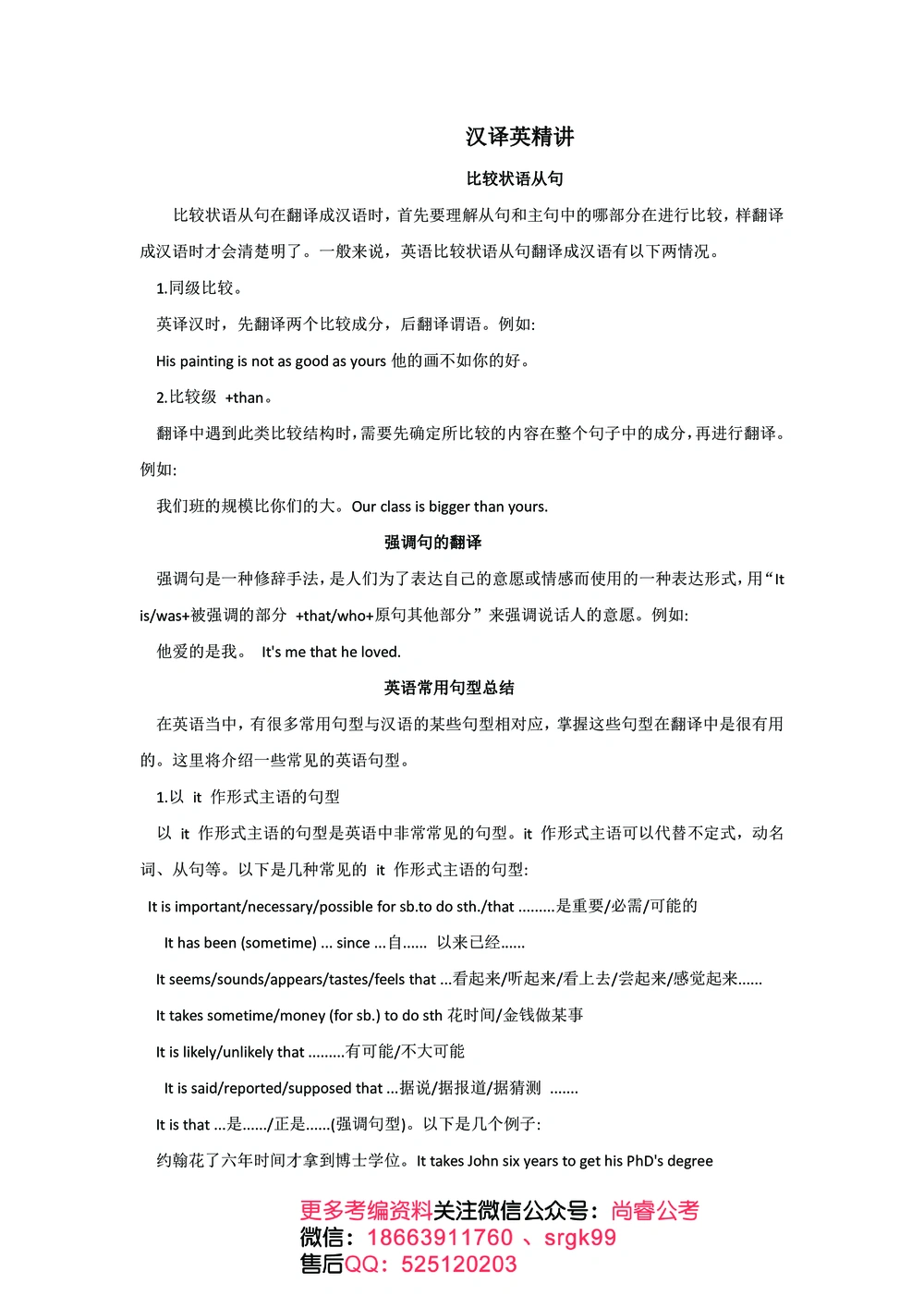
汉译英翻译技巧:
第一步:找句子主干,即句子的主谓宾结构。
第二步:找从句。
第三步:将时间、地点等状语插入句尾。
汉语:次要信息放前,主要信息放后;
英语:主要信息放前,次要信息放后。
句子汉译英翻译
1.去年暑假我们班去露营了。
Our class went camping last summer vacation.
2.上周五我去图书馆借了本书。
I borrowed a book from the library last Friday.
3.你觉得这首诗怎么样?
What do you think of this poem?
4.你经常去听音乐会吗?
Do you often go to concerts?
5.放学后,这些孩子们一直在操场上踢足球。
The children have been playing football on the playground after school.
6.她激动得说不出话来。
She was so excited that she couldnt speak.
7.买这部手机你花了多少钱?
How much did you spend on this mobile phone?
8.一有消息我就告诉你。I’ll let you know as soon as I have any news.
9.今天他要参加一个重要的面试。
He has an important interview today.
10.他喜欢玩电脑游戏。
He likes playing computer games.
11.这部电影值得看。
The film is worth seeing.
12.他每天坐公共汽车上班。
He goes to work by bus every day.
13.整个早晨我都在打篮球。
I’ve been playing basketball all the morning.
14.飞机马上就要起飞了。
The plane is going to take off.
15.今天比昨天热得多。
Its much hotter today than yesterday.
16.由于下大雨,到处都出现了交通拥堵。
Because of the heavy rain, there are traffic jams everywhere.
17.如果不能来开会,请告诉我。
If you cant come to the meeting, please let me know.
18.我们刚才去超市了。
Wewent to the supermarket just now.
19.早餐我通常吃面包和鸡蛋。I usually have bread and eggs for breakfast.
20.外面太嘈杂了,我无法集中精力。
It’s too noisy outside. I cant concentrate.
21.学生们正在打扫教室。
The students are cleaning the classroom.
22.你离开教室的时候,请把灯关上。
Please turn off the light when you leave the classroom.
23.我每天六点起床
I get up at six every day.
24.法国以葡萄酒而闻名。
France is famous for its wine.
25.我们刚刚吃过午饭。
Wejust had lunch.
26.我们认识有十年了。
Wehave known each other for ten years.
27.他每天必须处理许多问题。
He has to deal with many problems every day.
28.你昨天早上几点起床的?
When did you get up yesterday morning?
29.这部电影让她想起了她的童年。
This movie reminded her of her childhood.
30.经理不在时,这个商店由他负责。When the manager is out, he will be in charge of the store.
31.不要放弃希望
Dont give up hope.
32.我会去火车站接你。
I will pick you up at the railway station.
33.我不能去聚会,因为要准备考试。
I can’t attend the party,for I have to prepare for the examination.
34.我们刚才去散步了。
Wetook a walk just now.
35.你喜欢流行音乐吗?
Do you like pop music?
36.他在这所大学任教多久了?
How long has he been teaching in this school?
37.我希望我们的演出成功。
I hope our performance will be a success.
38.春天是游览这个城市的最佳季节。
Spring is the best season to tour this city.
39.他们正在打篮球。
They are playing basketball.
40.他十年前搬到这儿的。
He moved here 10 years ago.
41.今天早上我没赶上公共汽车。I missed the bus this morning.
42.你找到上周丢的那本书了吗?
Have you found the book you lost last week?
43.李明正在看报纸。
Li Ming is reading a newspaper.
44.那个博物馆是五年前建造的。
That museum was built five years ago.
45.互联网在我们的生活中变得越来越重要了。
The Internet is becoming more and more important in our life.
46.请带把雨伞以防下雨。
Please bring an umbrella in case it rains.
47.你应该听老师的话。
You should listen to the teacher.
48.汤姆每天下午打篮球。
Tom plays basketball every afternoon.
49.足球是一项培养孩子与别人合作的运动。
Football is a sport that develops the cooperation between children and others.
50.同学们都在忙着准备考试。
The students are busy preparing for the exam.
51.这个国家以其美丽的湖泊而闻名于世。
This country is famous for its beautiful lakes.
52.周末,我宁愿待在家里看看书。I would rather stay at home to read books during the weekends.
53.他们理解汉语还有些难度。
They have difficulty in understanding Chinese.
54.在业余时间里你通常做些什么?
What do you usually do in your spare time?
55.你最好穿上夹克,外面冷。
Youd better put on a jacket and it is cold outside.
56.这些人急需食物和水。
These people are in great need of food and water.
57.我相信你是班上最棒的。
I believe that you are the best in the class.
81.玛丽一回来,我就会把信给她的。
As soon as Mary comes back, I will give the letter to her.
58.众所周知,吸烟有害健康。
As is well-known, smoking does harm to health.
59.在你考虑之后,请告诉我你的决定。
Please tell me your decision after you consider it well.
60.你应该多运动。
You should exercise more.
61.去年春天,我们又见面了。
Wesaw each other again last spring.
62.我们必须保护自然资源不被浪费。Wemust prevent our natural resources from being wasted.
63.杰克正在写的报告星期五必须完成。
The report Jack is writing now has to be finished before Friday.
64.那个电影我已经看了很多次。
I have seen the film many times.
65.在暑假期间,孩子们参观了一个农场。
He kids visited a farm during the summer vacation.
66.我们正急忙赶往机场去接史密斯先生。
Weare hurrying to the airport to pick up Mr.Smith
67.他们不知道如何应对压力。
They don’t know how to deal with pressure.
68.我昨天看的那部电影是一个真实的故事。
The film I saw yesterday was adapted from a real story.
69.像往常一样,他们又迟到了。
They are late again as usual.
70.昨天我花了两个小时阅读和回复电子邮件。
I spent about two hours in reading and replying emails yesterday.
71.你认识昨天做报告的那个人吗?
Do you know the man who gave a lecture yesterday?
72.她已经邀请我们去她的生日聚会。
She has already invited us to her birthday party.
73.我一到那儿,就给你打电话。I will call you the moment I get there.
74.去年,她被提升为经理。
She was promoted to the position of manager last year.
75.他是第一个在月球上行走的人。
He was the first man to walk on the moon.
1.随着人们年龄的增长,他们变得更加感恩于他们所拥有的一切。
Aspeoplegrowold,theybecomemoreandmoregratefulforeverythingtheyhave.
2.这家公司成立于1970年。
This company was set up (established) in 1970.
3.能把你昨天讨论的那本书借给我吗?
Can you lend me the book that you discussed yesterday?
4.她使我想起她的姐姐。
When I see her,I think of her sister.
80.昨天,我坐在办公室写报告时,小明从英国打电话过来了。
Yesterday Xiaoming called me from Britain while I was writing my report in the
office.
81.想去图书馆的人必须在这里签名。
Anyone who wants to go to the library must sign his name here.
82.他专心致志地看书,所以没有听到电话响。
He is so devoted to reading that he didn’t hear the phone call.
83.去年,我在伦敦过的暑假。
I spent my summer vacation in London last year.84.我学习英语大概有十年了。
I have been learning English for about 10 years.
85.闪闪发光的不一定是金子
All that glitters is not gold.
86.如果可能,约翰是出色的画家
If possible, John is an excellent painter.
87.事实证明,中国的缺电问题解决了
ThefactprovesthattheproblemsofthelackofelectricityinChinahasbeensolved.
88.孩子们受父母的影响很深。
Children are deeply influenced by their parents.
89.下一次你可以早点儿来吗?
Next time you should come here earlier.
90.对于年轻人来说,教育很重要。
It'simportant for young people to receive education.
91.比起电子通讯,我更喜欢面对面的交谈。
I prefer face-to-face conversation to electronic communication.
92.动画片给人带开了欢乐。
Cartoons bring joy to people.
93.就我们所知,地球是人类唯一可以居住的星球。
As far as we know, the earth is the only planet on which human beings can live.
94.我们对他的所作所为甚感惊奇
Wewere amazed at what he did.95.我昨天逛街的时候突然遇到了我的同学。
I met my classmate suddenly when I was shopping yesterday.
96.令他们感到惊奇的是那座城市的变化。
What surprised them was the change of the city.
97.自从中国加入世贸,大量外国公司涌入中国。
A large number of foreign companies have poured into China since Since China's
accession to the WTO.
98.我们的粮食快用完了,我感觉很无助。
The supply of our food almost ran out and we felt helpless.
99.这个小熊是巧克力做的。
This bear is made of chocolate.
100.虽然生活艰难,但他从未屈服。
Though life was hard, he never gave in.
101.他的话是否真实让人怀疑。
It is doubtful whether what he said is true.
102.使我们惊讶的是,他什么话也没说就走了。
Toour surprise, he left without saying anything.
103.他为他的粗鲁无礼向我道歉并希望我能原谅他。
He apologized to me for his rudeness and hoped I could forgive him.
104.你尽管努力,即使失败了将来也不会有人责备你。
Try as you may, no one will blame you in the future even if you fail.
105.他要是不听你的话,肯定会犯错误。If he doesn't listen to you, he will make a mistake.
106.我给你买了件新衣服,你试一试。
I bought you a new dress. You can have a try.
107.他昨晚很早就睡觉了。
He went to bed early last night.
108.越来越严重的污染使我们的环境变暖。
More and more serious pollution makes our environment warm.
109.这里离最近的医院差不多十公里。
It'sabout ten kilometres from the nearest hospital.
110.成功在于勤奋,这句话没错。
It is true that success lies in diligence.
111.他给我们讲了有趣的故事,我们哈哈大笑。
The funny storys he told made us laugh.
112.运动会推迟到下个周一了。
The sports meeting has been put off until next Monday.
113.等他回来,我再离开。
I won't leave until he comes back.
114.他经常在操场上踢足球。
He often plays football on the playground.
115.现代科学家发现:物质能够改变能量,能量能够改变物质。
Modern scientists have found that matter can change energy, and energy can
change matter.116.他迟到不是因为生病,而是因为懒惰。
He was late not because he was ill but because he was lazy.
117.今年所建的新房子和去年数量差不多。
The houses that they have built this year is as many as last year.
118.登记完成方可入住酒店。
You aren't allowed to stay at the hotmail until the form is filled in.
119.报告中有两点值的注意。
There are two points worth noting in the report.
120.过渡看电视对眼睛有害。
Watching too much TV is bad for your eyes.
121.政府的大部分收入来自税收。
The government gets most of its revenue from taxes.
122.父母的影响贯穿孩子一生。
The influence of parents continues throughout a child's life.
123.因为交通拥堵,他们上学迟到了。
They were late for school because of the traffic jam.
124.从此以后他不再是学生了。
From then on he was no longer a student.
125.他说他在中央公园拍了很多照片。
He said he took a lot of photos in Central Park.
126.除了你要的苹果,我还买了橘子。
In addition to the apples that you ask for,I have bought you some oranges.127.你能帮我拿我的行李吗?
Can you help me with my luggage?
128.从前这里是一个公园。
Once upon a time, it was a park./ There used to be a park here.
129.他花了三年时间把这本书翻译成了英语。
It took him three years to translate the book into English.
130.他提出的改善环境的提议,被委员会一致接受。
His proposal to improve the environment was unanimously accepted by the
Committee.