北京十二中 2020-2021 学年第二学期 3 月检测试题
初一英语
班级: 姓名: 学号: 考场号: 座位号:
(满分100分,时间90分钟)
听力理解 (共25分)
一、听对话,从下面各题所给的A、B、C三个选项中选择与对话内容相符的图片。每段对话
你将听两遍。(共5分,每小题1分)
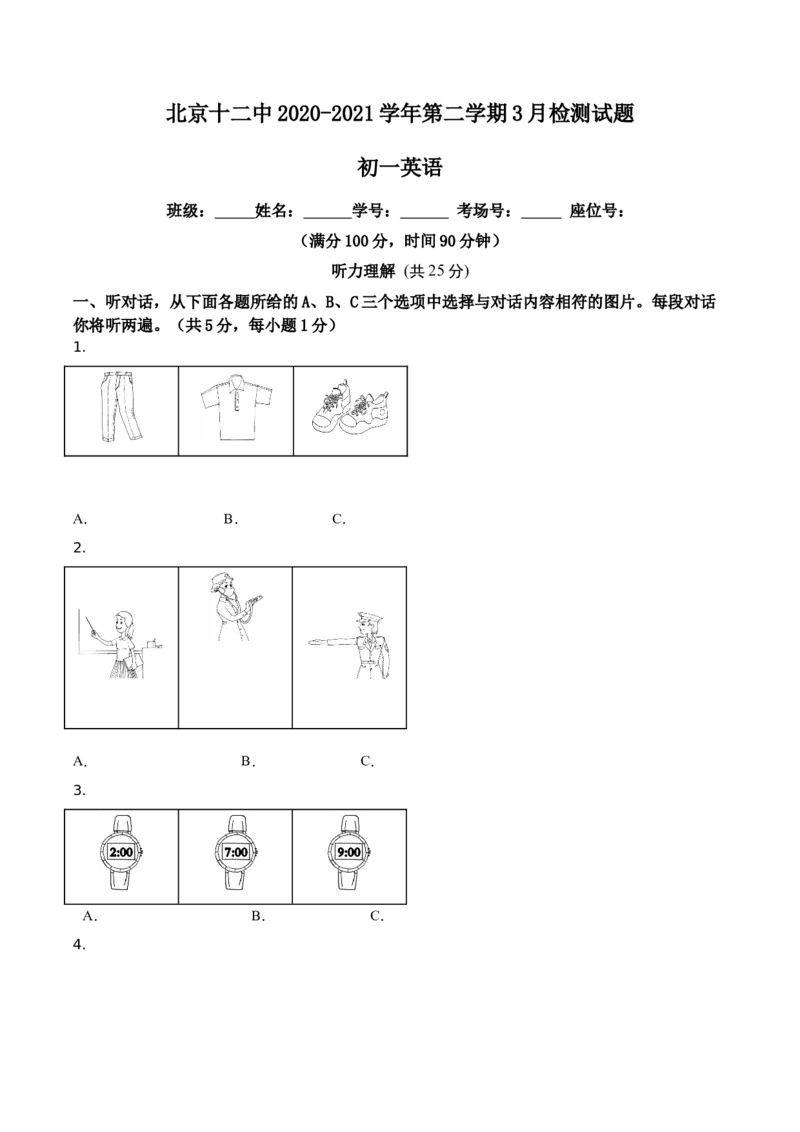
1.
A. B. C.
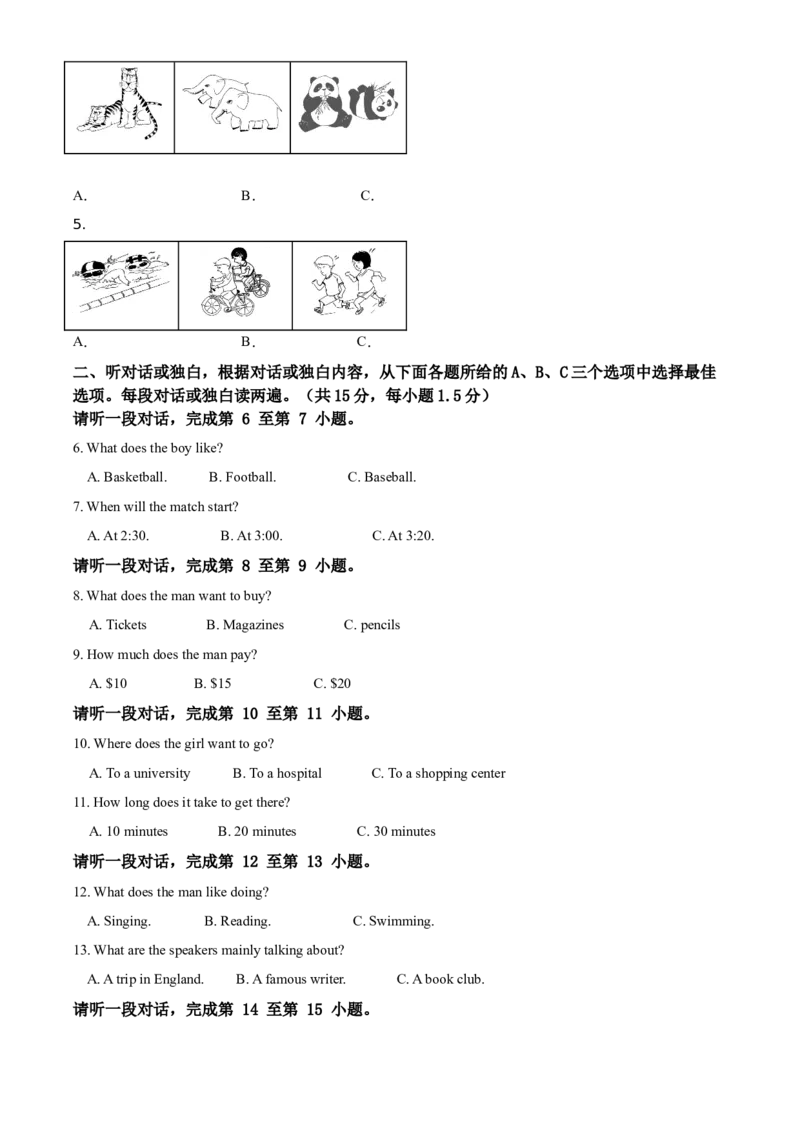
2.
A. B. C.
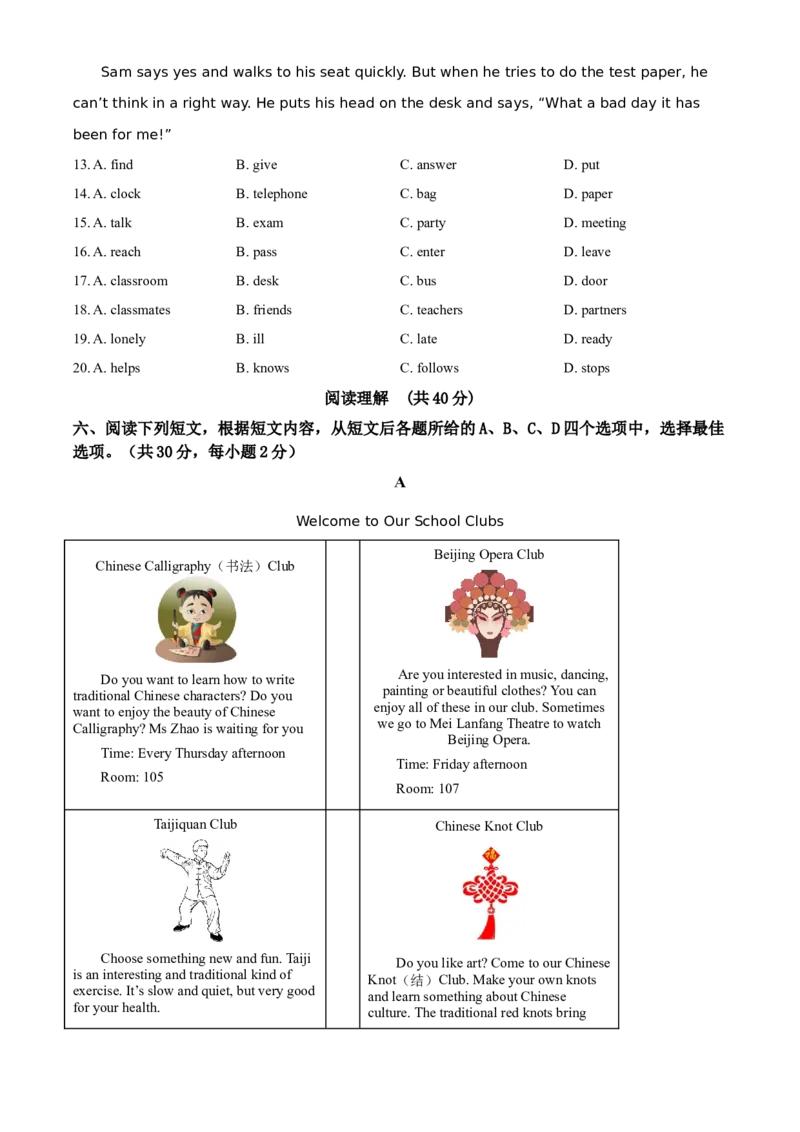
3.
A. B. C.
4.A. B. C.
5.
A. B. C.
二、听对话或独白,根据对话或独白内容,从下面各题所给的A、B、C三个选项中选择最佳
选项。每段对话或独白读两遍。(共15分,每小题1.5分)
请听一段对话,完成第 6 至第 7 小题。
6. What does the boy like?
A. Basketball. B. Football. C. Baseball.
7. When will the match start?
A. At 2:30. B. At 3:00. C. At 3:20.
请听一段对话,完成第 8 至第 9 小题。
8. What does the man want to buy?
A. Tickets B. Magazines C. pencils
9. How much does the man pay?
A. $10 B. $15 C. $20
请听一段对话,完成第 10 至第 11 小题。
10. Where does the girl want to go?
A. To a university B. To a hospital C. To a shopping center
11. How long does it take to get there?
A. 10 minutes B. 20 minutes C. 30 minutes
请听一段对话,完成第 12 至第 13 小题。
12. What does the man like doing?
A. Singing. B. Reading. C. Swimming.
13. What are the speakers mainly talking about?
A. A trip in England. B. A famous writer. C. A book club.
请听一段对话,完成第 14 至第 15 小题。14. How many problems does the boy have in learning English?
A. 2. B. 3. C. 4.
15. What do we know about the boy?
A. He has a funny pen friend.
B. He studies words at home.
C. He goes to school by train
三、听对话,记录关键信息。本段对话你将听两遍。(共5分,每小题1分)
请根据所听到的对话内容和提示词语,将所缺的关键信息填写在答题卡的相应位置上。
Lost Thing a 16
Type Nikon DF Super
Colour 17
Value £380
Place outside MacDonald’s on 18 Street
Time about 2:30
age: around 19
Thief
clothes: a green 20
知识运用(共 2 0 分)
四、单项填空(共12分,每小题1分)
从下面各题所给的A、B、C、D四个选项中,选择可以填入空白处的最佳选项。
1. —Kate, can you see my eraser?
—Look! There’s one under your desk. Is it________?
A. your B. yours C. mine
2. I sometimes help my mom with her housework____________ Saturdays.
A. at B. in C. on D. to
3. —_________ glasses are these?
—I think they are our teacher’s.
A. Who B. What C. Whom D. Whose
4. We don’t play basketball on the playground _________ it rains outside.
A. so B. because C. and D. but
5. — Lily, _____ you finish the letter in ten minutes?
— Yes, I can.
A. must B. should C. need D. can
6. They _________ play basketball next weekend.A. go to B. goes to C. is going to D. are going to
7. Tony is very kind. He often _________ me English when he is free.
A. teaches B. teaching C. teach D. to teach
8. — Where is Bob?
— He ______ in the library.
A. reads B. is reading
C. read D. was reading
9. What _________ Tom and his friend going to do tomorrow?
A. is B. be C. am D. are
10. My mother promises _________ toys for me, but she forgets it soon.
A. buy B. buys C. to buy D. buying
11. I’m good at singing so I’d like _________ the Music Club.
A. to join B. joining C. join D. joins
12. My father and I often go _________ at weekends so I can _________ very well.
A. swimming; swim B. swims; swim
C. swim; swimming D. swimming; swimming
五、完形填空(共8分,每小题1分)
阅读下面的短文,掌握其大意,然后从短文后各题所给的A、B、C、D四个选项中,选择最佳
选项。
“Ring…Ring…” the telephone suddenly rings. Sam gets up to ___13___ the call. It is his
aunt.
“Sam, why are you still at home?” she asks surprisingly. Sam looks at the ___14___ . It is
already 7:30 a.m.
“Oh, my goodness! There’s an important ___15___ today.” Sam shouts out. He hurries to
wash his face and get dressed. When he plans to ___16___ the house, he remembers that he
has not put away his books. He runs quickly to the ___17___ and put them into the bag.
He then goes to the bus stop to go to school as fast as he can. When he gets into the
classroom, his ___18___ are busy writing on their papers.
“Why are you so ___19___ ?” asks the teacher.
“I’m sorry, sir,” Sam answers, afraid of looking up. “It is my clock. It fails to wake me up
this morning and…”
“Don’t say anything about it!” his teacher ___20___ him. “Don’t try to come late next
time!”Sam says yes and walks to his seat quickly. But when he tries to do the test paper, he
can’t think in a right way. He puts his head on the desk and says, “What a bad day it has
been for me!”
13. A. find B. give C. answer D. put
14. A. clock B. telephone C. bag D. paper
15. A. talk B. exam C. party D. meeting
16. A. reach B. pass C. enter D. leave
17. A. classroom B. desk C. bus D. door
18. A. classmates B. friends C. teachers D. partners
19. A. lonely B. ill C. late D. ready
20. A. helps B. knows C. follows D. stops
阅读理解 (共40分)
六、阅读下列短文,根据短文内容,从短文后各题所给的A、B、C、D四个选项中,选择最佳
选项。(共30分,每小题2分)
A
Welcome to Our School Clubs
Beijing Opera Club
Chinese Calligraphy(书法)Club
Are you interested in music, dancing,
Do you want to learn how to write
painting or beautiful clothes? You can
traditional Chinese characters? Do you
want to enjoy the beauty of Chinese . enjoy all of these in our club. Sometimes
we go to Mei Lanfang Theatre to watch
Calligraphy? Ms Zhao is waiting for you
Beijing Opera.
Time: Every Thursday afternoon
Time: Friday afternoon
Room: 105
Room: 107
Taijiquan Club Chinese Knot Club
Choose something new and fun. Taiji
Do you like art? Come to our Chinese
is an interesting and traditional kind of
Knot(结)Club. Make your own knots
exercise. It’s slow and quiet, but very good
and learn something about Chinese
for your health.
culture. The traditional red knots bringTime: 5:30 pm- 6:30 pm (from you good luck.
Monday to Friday)
Time: Tuesday afternoon
Room: 201
Room: 308
21. Beijing Opera Club is in ______.
A. Room 105 B. Room 201 C. Room 107 D. Room 308
22. When can you go to the Taijiquan Club?
A. At 5:00 pm on Sunday.
B. At 5:30 pm on Saturday.
.
C At 5:00 pm on Tuesday.
D. At 6:00 pm on Wednesday.
23. In Chinese culture, the red knots can bring us ______.
A. good characters B. good luck
C. beautiful clothes D. healthy life
B
It was a sunny day. Everyone in the station was waiting for the train to arrive.
A group of friends made loud noise to welcome the train as it entered the station. They ran to get their seats
before anyone could get into the train. An old man with a young boy aged around 15 years came running to catch
the train. They entered the train and the train started to move. They had their seats just next to the friends’ group.
The young boy was so surprised to see everything. He acclaimed (欢呼) at his father, “Dad, the train is
moving and the things are moving backwards.” His father smiled and nodded his head.
As the train started moving fast, the young boy again screamed, “Dad, the trees are green in colour and run
backward very fast.” His father said, “Yes, dear” and smiled.
Just like a kid, he was watching everything with great excitement and happiness.
A fruit seller passed selling apples and oranges. The young boy said to his dad, “I want to eat apples.” His
father bought him apples. He said, “Oh, apple looks so sweet and I love this colour.”
The group was watching all the activities of this boy and asked the boy’s father, “Is your son having any
problems? Why is he behaving so differently?”
A friend from the group made fun of him and shouted, “His son is mad, I think.”
The father of the young boy, with patience, replied to the friend-group. “My son was born blind. Only a few
days ago, he was operated and got the vision. He is seeing so many different things in his life for the first time.”
The young friends became very quiet and said sorry to the father and son.
24. According to the second paragraph, which of the following is TRUE?A. People were angry because of the slow train.
B. The group of friends got on the train first.
C. The old man with a young boy were late for the train.
D. The young boy and the friends were in different cars (车厢) .
25. The boy was so interested in everything he saw because ________.
A. he was mad
B. he had never taken a train
C. there was something wrong with him
.
D he saw the things for the first time in his life
26. The young group ______ the boy after they knew his story.
A. made fun of
B. shouted angrily at
C. said sorry to
D. became impatient with
27. The best title of this passage is most probably ________.
A. Don’t behave differently
B. Don’t play a joke
C. Enjoy our trip
D. Think before you speak
C
Winning Color
You are getting ready to play a football match and you want to win. What color should you
wear to help you win? You are getting ready to go to an interview and you want to succeed.
What color should you wear to help you succeed? Strange questions, perhaps, but color could
be the key to your success. Read on and find out how.
The most popular color in Britain is black. Wearing black makes people feel more confident,
but can often make you look unemotional. This may be why people sometimes think that British
people don’t want to make a strong impression (印象). Although black is common in Britain,
most people agree that in fact blue is the world’s favorite color. The students in school
and the people who work in business often wear blue. Wearing blue will show that you are an
effective and hard-working person.
Sometimes people mistakenly think that red makes you look strong and successful. However,
you will be seen aggressive (好攻击的) if you choose red clothes. New information now saysthat yellow, not red, is the color of winning. Australia and Brazil are both very successful
in the sporting world, and the sports things of both countries are yellow. Strangely enough,
athletes who wear yellow glasses during a race can improve their time by up to half a
second. Tests show that the yellow color makes them feel positive and energetic and could be
the difference between a medal and no medal.
So, next time you have an important event in your life—a race, a match, an exam or an
interview—think about you clothes. The color of your clothes can change your life!
28. According to the passage, wearing black in Britain makes people feel ______.
A. energetic B. Positive C. Successful D. confident
29. What is Paragraph 3 mainly about?
A. Sport — red or yellow?
B. Race — winning or losing?
C. Athletes — success or failure?
D. Work and school — black or blue?
30. From the passage, we can learn that ______.
A. blue is the winning color
B. red makes you look strong
C. British people like wearing black
D. a hard-working person likes wearing yellow.
31. If you have an important match and you want to win, you'd better ______.
A. change your favorite color
B. choose the color of winning
C. wear the most popular color
D. know other players' favorite color
D
Many people complain about their bad memory, especially when they are older. How can we improve our
memory?
Many people think that repeating things is the best way to remember them. While this undoubtedly helps
short-term memory(remembering a telephone number for a few seconds, for example), psychologists(心理学
家)doubt whether it can help you remember things for very long. The British psychologist E. C. Stanford seemed
to prove this point when he tested himself on five prayers(祈祷文)that he had read aloud every morning for over
25 years. He found that he could remember no more than three words of some of them! More helpful, especially forremembering numbers, is grouping the information. The following numbers would be impossible for most of us to
remember: 1492178919931848. But look at them in chunks, and it becomes much easier: 1492 1789 1993 1848.
According to experts, there are many ways of training your memory. Many of them involve forming a mental
picture of the things to be memorized. One method, which may be useful in learning foreign languages, is to create
a picture in your mind connected to a word you want to remember.
Another method is to invent a story that includes all the things you want to remember. In experiments, people
were asked to remember up to 120 words using this skill; when tested afterwards, on average, they were able to
recall 90% of them!
However, not all of us are interested in learning long lists of names and numbers just for fun. For those
studying a large amount of information, psychologists suggest that the best way to form meaningful connections is
to ask yourself lots of questions as you go along. So, for example, if you were reading about a particular disease,
you would ask yourself questions like: "Do people get it from water?", "What parts of the body does it influence?"
and so on. This is said to be far more effective than time spent "passively" reading and re-reading notes.
32. Which of the following is TRUE about repeating things according to the passage?
A. It helps short-term memory for sure.
B. It makes remembering things interesting.
C. It helps to remember things for long.
D. It makes remembering prayers effortless.
33. The underlined word "chunks" in Paragraph 2 probably means “________”.
A. details B. turns C. groups D. lines
34. What can we infer from the passage?
.
A Creating a picture is useful in learning Maths.
B. Inventing a prayer trains our memory quickly.
C. Remembering long numbers is easy for people.
D. Asking yourself questions activates the memory.
35. What's the writer's main purpose in writing this passage?
A. To complain that his memory is bad.
B. To recognize some memory problems.
C. To explain some memory experiments.
D. To share some ways of improving memory.
七、阅读短文,根据短文内容回答问题。(共10分,每小题2分)As the development of modern technology, smartphones have become quite popular all over the world with
their various functions (功能). However, some people have an addiction (瘾) to smartphones. It already has bad
effects on their normal life.
Some people, especially teenagers, are crazy about smartphones for these reasons. First of all, nowadays,
people are under great pressure (压力), while smartphones provide a chance for people to relax themselves. By
playing games, talking with friends, watching movies and listening to music, people can easily forget their
problems for a while. Second, there is always something new on smartphones. So people are eager to turn on their
smartphones. But when people spend too much time on smartphones, they don’t have enough chance to
communicate with their friends or parents. They don’t have much time to take part in social activities or do
exercise. Their attention has been drawn away by the virtual (虚拟的) world. If they don’t have good self-control
(自控能力), they will have an addiction to smartphones. In fact, they should spend more time on their study and
work.
People should give up smartphone addiction. It needs time and patience. They should turn off their
smartphones, go outside and communicate with others face to face. Do more exercise and form a good attitude
towards life!
36. Are smartphones popular today?
37. How do people relax themselves by using smartphones?
38. Why are people eager to turn on their smartphones?
39. What will happen if people don’t have good self-control?
40. What does the writer mainly tell us?
词汇与表达 (共15分)
八、补全单词(共 10 分,每小题 1 分)
根据图片或首字母,将完整的单词填写在答题卡的相应位置,使句子意思通顺。
41. The teacher told us to be c______ with our things and not to leave them anywhere.
42. There are some new subjects in this t______.
43. I can’t f_______ my crayons. Have you seen them in the lost and found box?
44. I often do the housework at home and I like a clean and t______ house.
45. I r______ a bike to school every day.46. Where is my w______ ? There is a lot of money in it!
47. Lucy has a p______ lesson in the morning.
48. She has a picnic on the b______ with her friends.
49. They c______ the players in the football match.
50. My parents and I like flying a k______ in the park at weekends.
九、完成句子。根据中文提示,用单词的正确形式填空。(共5分,每小题1分)
51. 她正在四处找她的手套。
.
She is ______ ______ her gloves everywhere
52. 我想和同学们做朋友并且互相帮助。
I want to ______ ______ with classmates and help each other.
53. 他们放学后经常复习功课。
They often ______ ______ lessons after school.
54. 她不想让她的父母担心她。
She doesn’t want her parents to ______ ______ her.
55. 我与同学们相处得很好。
I ______ ______ well with my classmates.本试卷的题干、答案和解析均由组卷网(http://zujuan.xkw.com)专业教师团队编校出品。
登录组卷网可对本试卷进行单题组卷、细目表分析、布置作业、举一反三等操作。
试卷地址:在组卷网浏览本卷
组卷网是学科网旗下的在线题库平台,覆盖小初高全学段全学科、超过900万精品解析试题。
关注组卷网服务号,可使用移动教学助手功能(布置作业、线上考试、加入错题本、错题训练)。
学科网长期征集全国最新统考试卷、名校试卷、原创题,赢取丰厚稿酬,欢迎合作。
钱老师 QQ:537008204 曹老师 QQ:713000635