用负责任态度,做更好的教育
目录
第一章 小学英语教案模板..................................................1
第二章 真题精选(题本+教案+逐字稿)......................................2
真题1 At the shop......................................................2
真题2 My family......................................................7
真题3 I like noodles...................................................14
真题4 Look, Sam. Here’s a dog..........................................20
真题5 My Day.......................................................26
真题6 National Day holiday.............................................31
真题7 She is reading a book.............................................37
真题8 Pronunciation of “er”.............................................43
真题9 Ms Guo’s journey to work.........................................48
第三章 真题演练.........................................................54
第四章 答辩.............................................................71
1用负责任态度,做更好的教育
第一章 小学英语教案模板
×××(Title)
Teaching objectives/aims(教学目标):
1.
2.
3.
4.
Teaching key/difficult(教学重难点):
1.Teaching key point:
2.Teaching difficult point:
Teaching procedures(教学过程):
1.Warming up+lead-in(寒暄+导入):建议情境导入法
(2-4 步骤分别对应技能型和知识型课型)
2.Pre-task(任务前)/Presentation(呈现):
为任务中环节做准备;
讲解对应知识点。
3.While-task(任务中)/Practice(练习):
核心内容讲解分析/口语练习;
通过机械练习和意义练习等方式进行练习。
4.Post-reading(任务后)/Production(运用):
巩固运用/修改展示评价;
通过角色扮演,编故事,对话等方式进行灵活运用巩固。
5.Summary(总结):
总结本文主要内容和本节课重难点。
6.Homework(作业布置):素质性作业
Blackboard Design (板书设计):简略地画一个板书
体现教学意图,突出教学重点,揭示教材思路,条理清晰、
设计美观。小学学段可以图文并茂。
1用负责任态度,做更好的教育
第二章 真题精选
真题 1 At the shop
中小学教师资格证面试备课纸
准考证号: 姓名: 所在考场:第 考场
报考科目:小学英语 抽题时间:
1.题目:At the shop
2.内容:
potato, fish, tomato, carrot, meat, rice
A: What would you like….?
B: I’d like some...
3.基本要求:
(1)配合教学内容适当板书;
(2)让学生掌握词汇和重点句型;
(3)体现师生互动;
(4)用英文试讲,试讲时间10分钟。
2用负责任态度,做更好的教育
At the shop 教案
Teaching aims
1. Students will master words, such as “meat”, “rice”, “fish”, “carrot”, “tomato” and
“potato”.
2. Students will master the sentence structure “What would you like? I’d like some...”.
3. Students will improve their interest in English by realizing the practical use.
4. Students can master scientific learning methods and form good lifelong learning habits.
Teaching key and difficult points
1. Key points
Students know the words about food and master the sentence structure.
2. Difficult point
Students can apply the structure into daily communication.
Teaching procedures
Step 1: Warming-up and Lead-in
l. Greetings.
2. Sing a song named Once I Caught A Fish Alive. The song goes like this:
One two three four five
Once I caught a fish alive
Six seven eight nine ten
Then I let it go again
Why did you let it go
Because it bit my finger so
Which finger did it bite
This little finger on my right
3用负责任态度,做更好的教育
Ask them where they can see fish. Then tell them we can see fish at the shop in daily life and
lead in the topic.
Step 2: Presentation
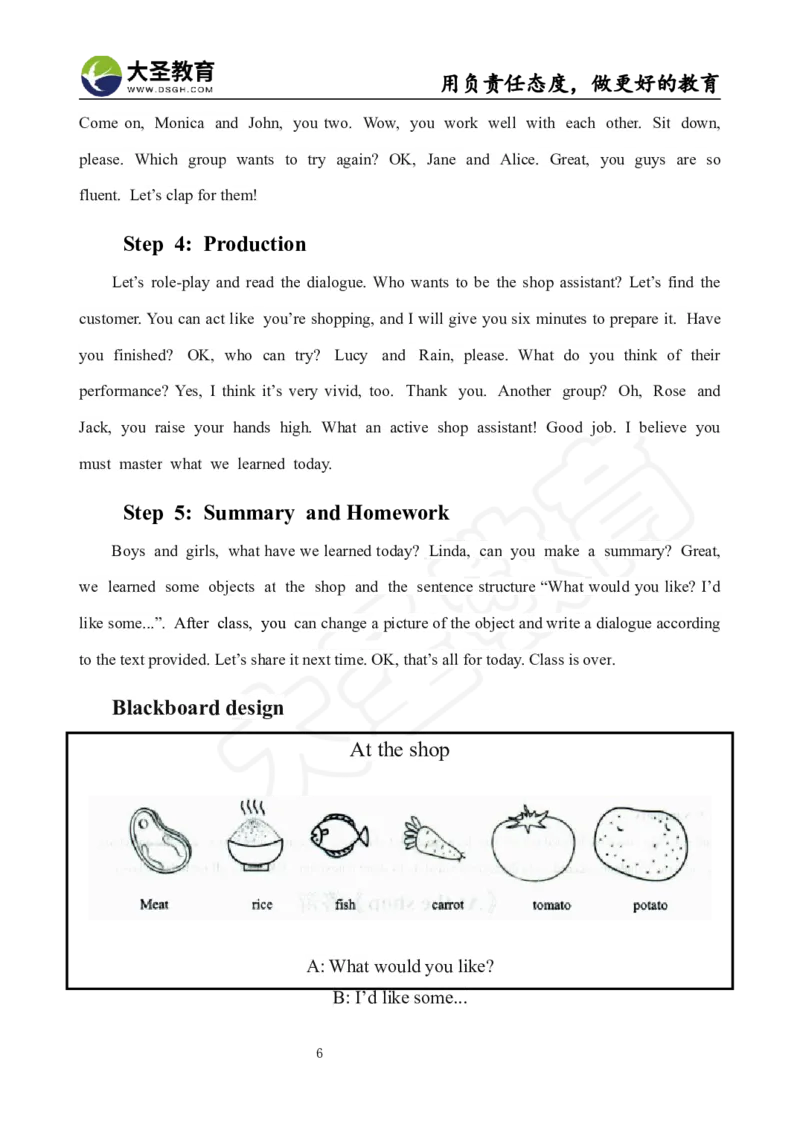
l. Draw six pictures on the blackboard, then write the related names in English.
2. Play a game called Playing On the Seesaw. And then read pictures.
3. Read a dialogue for students, and ask what they are talking about.
4. Write the main sentence pattern.
Step 3: Practice
Make dialogues with the given words and sentence structure as many as possible.
Step 4: Production
Role-play
Students work in pairs to make performance. One student is a shop assistant, and another one
is a customer. They should act as if they were shopping or selling while they are talking to group
members. The teacher will give them 6 minutes to discuss and prepare for it.
Step 5: Summary and homework
Summarize what we have learned today.
Students draw a picture of food and write down a dialogue according to the text.
Blackboard design
At the shop
A: What would you like?
B: I’d like some...
4用负责任态度,做更好的教育
At the shop 逐字稿
Step 1: Warming up+ Lead-in
1. Warming up:
Class begins! Good morning/afternoon, boys and girls. Welcome to my class. /I’m
glad to see you. How are you today? Wow, you all look so good. I feel good, too.
2. Lead-in:
Boys and girls, let’s sing the song Once I Caught A Fish Alive. Let’s see who sings better.
Do you know where we can see fish? Oh, in the river, in the sea, at the shop. Interesting! Today,
let’s find out in this lesson!
Step 2: Presentation
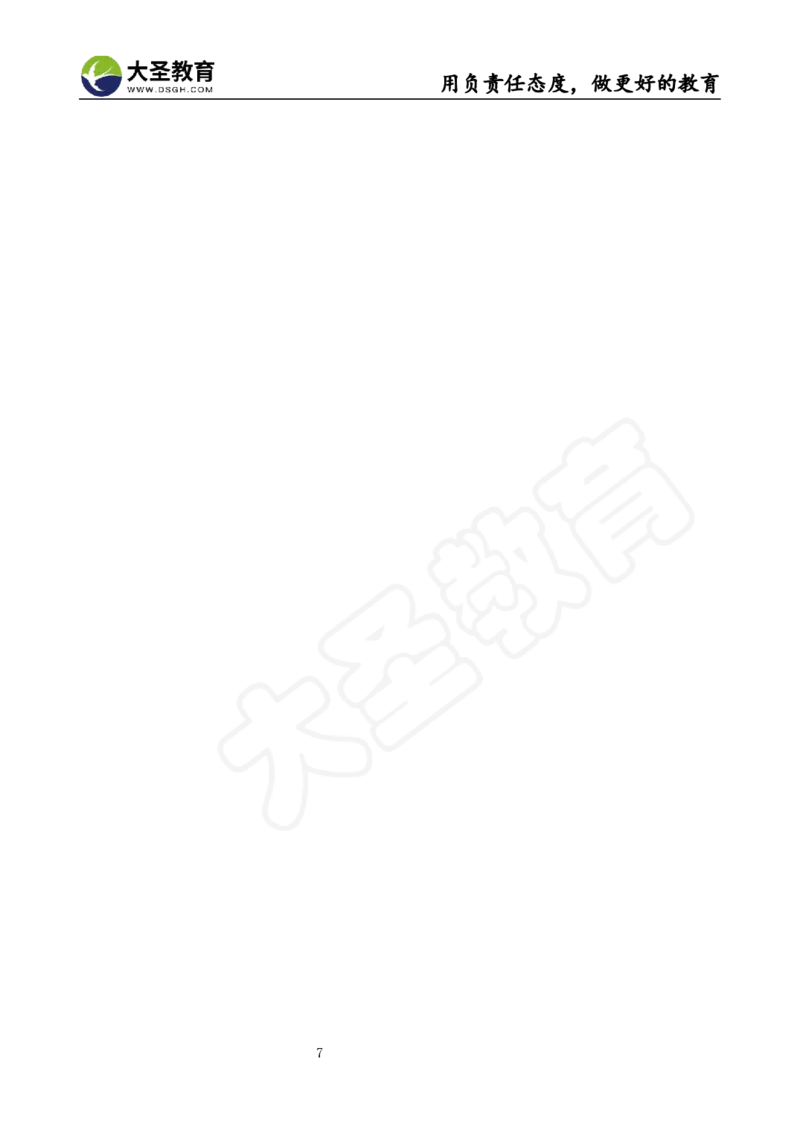
Now please look at the six pictures on the blackboard. Who knows them? Lily, please. Yes,
meat and rice! You did a good job! Some say tomatoes and potatoes. You are very nice! Let’s
play a new game called Playing on the Seesaw and read the other pictures. Who can try? The girl
in the corner. Well-done! Fish and carrot. Then I will read a dialogue for you, listen
carefully. “Aria asks ‘What would you like?’ Lee answers ‘I’d like some tomatoes
and carrots’.” So, boys and girls, can you tell me what are they talking about? Brandy,
you please. Very nice, they are talking about something they like. What kind of sentence
pattern they use? Now, look at the blackboard, this is the main sentence pattern.
Everyone, read after me, “What would you like? I’d like some...”.
Step 3: Practice
In addition to learning words, we have a dialogue today. Let’s read it together. “What would
you like?” “I’d like…” Well-done. Who wants to read it for us? Lisa, you are so active. I like your
pronunciation. Who can use the words and sentences to make a conversation? Any volunteers?
5用负责任态度,做更好的教育
Come on, Monica and John, you two. Wow, you work well with each other. Sit down,
please. Which group wants to try again? OK, Jane and Alice. Great, you guys are so
fluent. Let’s clap for them!
Step 4: Production
Let’s role-play and read the dialogue. Who wants to be the shop assistant? Let’s find the
customer. You can act like you’re shopping, and I will give you six minutes to prepare it. Have
you finished? OK, who can try? Lucy and Rain, please. What do you think of their
performance? Yes, I think it’s very vivid, too. Thank you. Another group? Oh, Rose and
Jack, you raise your hands high. What an active shop assistant! Good job. I believe you
must master what we learned today.
Step 5: Summary and Homework
Boys and girls, what have we learned today? Linda, can you make a summary? Great,
we learned some objects at the shop and the sentence structure “What would you like? I’d
like some...”. After class, you can change a picture of the object and write a dialogue according
to the text provided. Let’s share it next time. OK, that’s all for today. Class is over.
Blackboard design
At the shop
A: What would you like?
B: I’d like some...
6用负责任态度,做更好的教育
7用负责任态度,做更好的教育
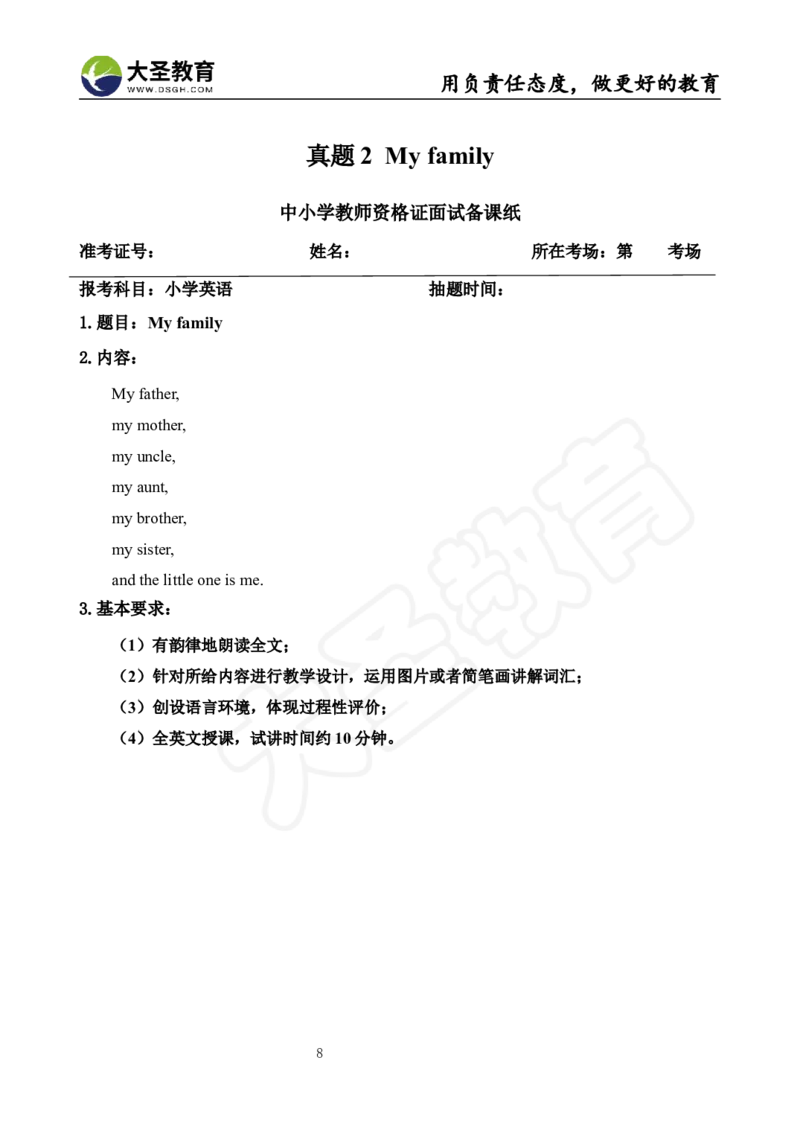
真题 2 My family
中小学教师资格证面试备课纸
准考证号: 姓名: 所在考场:第 考场
报考科目:小学英语 抽题时间:
1.题目:My family
2.内容:
My father,
my mother,
my uncle,
my aunt,
my brother,
my sister,
and the little one is me.
3.基本要求:
(1)有韵律地朗读全文;
(2)针对所给内容进行教学设计,运用图片或者简笔画讲解词汇;
(3)创设语言环境,体现过程性评价;
(4)全英文授课,试讲时间约10分钟。
8用负责任态度,做更好的教育
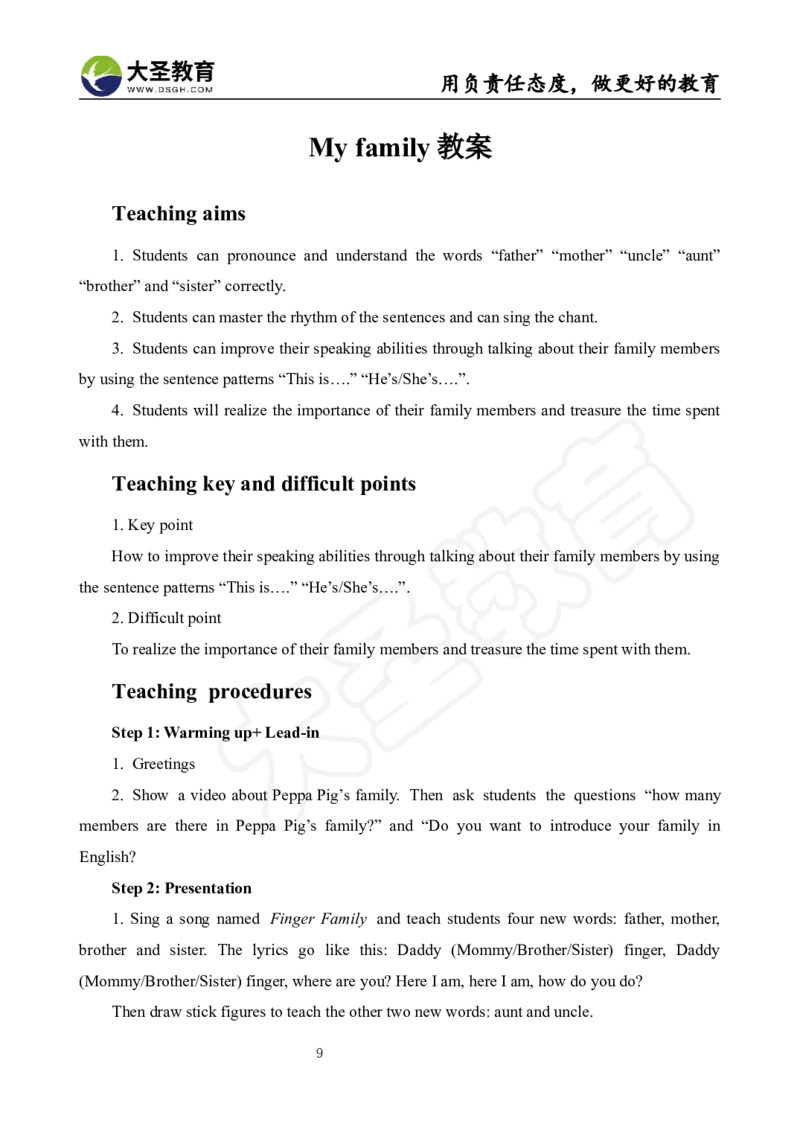
My family 教案
Teaching aims
1. Students can pronounce and understand the words “father” “mother” “uncle” “aunt”
“brother” and “sister” correctly.
2. Students can master the rhythm of the sentences and can sing the chant.
3. Students can improve their speaking abilities through talking about their family members
by using the sentence patterns “This is….” “He’s/She’s….”.
4. Students will realize the importance of their family members and treasure the time spent
with them.
Teaching key and difficult points
1. Key point
How to improve their speaking abilities through talking about their family members by using
the sentence patterns “This is….” “He’s/She’s….”.
2. Difficult point
To realize the importance of their family members and treasure the time spent with them.
Teaching procedures
Step 1: Warming up+ Lead-in
1. Greetings
2. Show a video about Peppa Pig’s family. Then ask students the questions “how many
members are there in Peppa Pig’s family?” and “Do you want to introduce your family in
English?
Step 2: Presentation
1. Sing a song named Finger Family and teach students four new words: father, mother,
brother and sister. The lyrics go like this: Daddy (Mommy/Brother/Sister) finger, Daddy
(Mommy/Brother/Sister) finger, where are you? Here I am, here I am, how do you do?
Then draw stick figures to teach the other two new words: aunt and uncle.
9用负责任态度,做更好的教育
2. Ask students whether they know how to describe their family members. Then teach them
the sentence patterns “This is….” “He’s/She’s….”.
3. Lead students to read the chant with a proper rhythm and pay attention to the intonation:
We should use the rising tone in every sentence but use the falling tone in the last sentence.
Step 3: Practice
1. Match Game
Have students match the words with pictures and check the answers together.
2. Hot Potato
Students pass the music box one by one and the teacher plays the music at the same time.
When the music stops, the student who holds the music box needs to stand up and lead others to
sing the chant together. While singing, they should point at the words respectively. Meanwhile,
remind them to pay attention to the rising and falling tone in each line.
Step 4: Production
Create a situation: The Spring Festival is coming. We’re going to hold a family party and we
need to count our family members.
Divide the students into eight groups. Let them make a survey about the family members of
their group members and fill in the chart. After five minutes, invite one group to make a report.
Name How Many People Family Members
Anna
Bob
Cindy
David
Step 5: Summary and homework
Summary: Invite one student to review what he/she has learned in this class. Then make a
supplement—We should love our family members and treasure the time spent with them.
Homework: Ask students to draw family photos and write down some words and sentences
to introduce them.
10用负责任态度,做更好的教育
Blackboard design
My family
New words:
father, mother, brother, sister
uncle aunt
Sentences:
简笔画两个家人
This is ...
He is …; She is ...
My family 逐字稿
Step 1: Warming up+ Lead-in
1. Warming up:
Class begins! Good morning/afternoon, boys and girls. Welcome to my class. /I’m
glad to see you. How are you today? Wow, you all look so good. I feel good, too.(通用
模板)
2. Lead-in:
Before our class, I’d like to introduce a lovely friend to you and believe all of you know her.
Please look at the screen. Wow, all of you tell me her name: Peppa Pig. Now, we are going to
watch a video about Peppa Pig’s family. After watching it, please tell me how many members
there are in Peppa’s family. Here we go. Time is up. So how many members? Yes, there are four
members in her family. Pupils, do you want to introduce your family in English? Yes, and today,
our topic is about family.
Step 2: Presentation
Pupils, do you like singing songs? I want to share a song Finger Family with you.
11用负责任态度,做更好的教育
Let’s sing it:(跟随歌词手指演示)
Daddy finger, Daddy finger where are you?
Here I am, here I am, how do you do?
…
Stop here. What a beautiful song. So pupils, sometimes we can call our Daddy as father, and
Mommy as mother. How about brother? Great, the boy who is also your father’s son, maybe a
little older or younger than you is your brother. Meanwhile, the girl who is also your father’s
daughter, maybe a little older or younger than you is your sister. (板书单词) So do you
have any brothers or sisters? Lily, you please. Wow you have a brother and a sister. You
must love them so much. James, how about you? Oh, you don’t have any brothers or
sisters. You feel lonely sometimes. I’m sorry to hear that. But you can make more
friends at school and play with them. OK. Pupils, now please look at the stick figures on
the blackboard. (画简笔画) The man is my father’s brother. What should I call him? I
should call him “uncle”. And the woman next to him is my father’s sister, and I can call her
“aunt”. Now, please read after me all these new words: father, mother, uncle, aunt, brother, sister.
Pupils, I have one more question for you: If I want to introduce my family
members, what should I say? Actually, we can use the sentence patterns “This is….”
“He’s….” or “She’s….” (板书句型) For example, this is my father. He is my father.
Well, pupils, please read the chant after me. Remember to focus on the rhythm and the
intonation. We should use the rising tone in every sentence but use the falling tone in the last
sentence. Let’s start! “My father, my mother, my uncle, my aunt, my brother, my sister and the
little one is me”(配合手势) Stop here. You read it fluently. And remember to practice it
more after class.
Step 3: Practice
It’s game time now. Firstly, I will divide you into the boys’ team and the girls’ team. Next I
12用负责任态度,做更好的教育
will show you some photos you need to match them to the right family names and read the words
aloud. The team which answers quickly and correctly will get one point. Are you clear? Here we
go. Photo one: brother. The boys get one point. Photo two: mother. The girls get one point. The
last photo: sister. Well, the girls’ team is the winner. But all of you are so smart and active.
Do you want to play another game? It’s Hot potato. Here I have a music box. You will pass
the music box one by one and I will play the music at the same time. When the music stops, one
of you who holds the music box should stand up and lead others to sing the chant together. While
singing, please point at the words respectively and pay attention to the rising and falling tone in
each line. Are you ready? Here we go! Stop! Let me see who is the lucky dog? Wow it’s Betty.
Betty, could you please lead us to read the chant? You are so nice, let’s start. Betty, you did a great
job. But you can pay more attention to the rising and falling tone next time. Sit down please.
Step 4: Production
Pupils, the Spring Festival is coming. We’re going to hold a family party and we need to
count our family members. Now, I divide you into eight groups, and you need to make a survey
about the family members of your group members. What’s more, please fill in the chart. After five
minutes, I will invite a student to share it with us. Here we go. Time’s up. Now, who wants to
share your chart? Tony, you’re the first one to raise your hand. Excellent, you reported your
survey results very clearly. Sit down, please. Remember, we should cherish the love from our
family members and be grateful.
Step 5: Summary and homework
It’s time to review what we have learned today. Who wants to be a little teacher? Jerry, you
please. Yes, today we learned the words about family members. We should love our family
members and treasure the time spent with them. At last, please draw a picture of your family
members and write some words and sentences to introduce them. And we will share it together in
the next class. Class is over. See you next time.
13用负责任态度,做更好的教育
Blackboard Design
My family
New words:
father, mother, brother, sister
uncle aunt
简笔画两个家人
Sentences:
This is ...
He is …; She is ...
14用负责任态度,做更好的教育
真题 3 I like noodles
中小学教师资格证面试备课纸
准考证号: 姓名: 所在考场:第 考场
报考科目:小学英语 抽题时间:
1.题目:I like noodles
2.内容:
3.基本要求:
(1)试讲时间约10分钟,釆用英语授课;
(2)根据教学内容设计导入环节;
(3)突出教学重点和难点,呈现对话教学的主要环节;
(4)配合教学过程适当板书。
15用负责任态度,做更好的教育
I like noodles 教案
Teaching aims
1. Students can read, understand and use the sentences “Do you like…?” “Yes, I do.” or “No,
I don’t.”.
2. Students’ speaking ability will be also improved by some activities. Through group work,
students can learn how to cooperate with others.
3. Students’ interests of learning English will be improved.
4. Students can master scientific learning methods and form good lifelong learning habits.
Teaching key and difficult points
1. Key points
Students understand the sentences “Do you like…?” “Yes, I do.” or “No, I don’t.”. Students
can use these certain expressions to communicate with others.
2. Difficult point
Students can use the key sentences flexibly in different situations.
Teaching procedures
Step 1: Warming up+Lead-in
1. Greetings.
2. Show some pictures of different food on the screen and ask students the names of the
food. Talk more about the food such as shape, color and taste.
Step 2: Presentation
1. Play the tape for students and ask them what the dialogue is about.
2. Students listen to the tape again and answer the following questions:
(1) Suppose you are Amy, do you like meat?
(2) Suppose you are Ling ling, what do you like?
16用负责任态度,做更好的教育
(3) Suppose you are the boy, what do you like?
(4) Who likes milk?
3.The teacher shows students the picture of the dialogue and plays the tape for the third time.
Students try to follow the tape with the help of the picture and imitate the pronunciation.
Step 3: Practice
Activity 1: Ask and Answer
Show some pictures of different food on the screen again. Point at some food and
ask students “Do you like…?”. Guide students to answer with “Yes, I do/ No, I don’t.
But I like…”.
Activity 2: Pair Work
Students work in pairs to ask each other about their food preferences. Then the teacher
invited several pairs to show their conversations.
Step 4: Production
Activity 1: Group Work
The New Year is coming. Four students in a group, talk about their plans on the New Year’s
Eve and their preparation for the New Year’s Eve dinner and explain the reasons.
Step 5: Summary and homework
Students summarize what they have learnt in this lesson and the teacher gives supplement if
necessary. Enlarge students’ knowledge about food and familiar with the traditional Chinese
festivals.
Students ask their friends about their likes and dislikes after class.
Blackboard design
17用负责任态度,做更好的教育
I like noodles 逐字稿
Step 1: Warming up+ Lead-in
1. Warming up:
Class begins! Good morning/afternoon, boys and girls. Welcome to my class. /I’m
glad to see you. How are you today? Wow, you all look so good. I feel good, too.
2. Lead-in:
Before our class, please look at the screen. There are some pictures, please tell me “What’s
this?”. Oh, Jack, please. Yes, you are right. This is an apple, and the apple is red, round and sweet.
Any other students want to have a try? Anna, please. Wonderful! This is a pear, and the pear is
yellow, and sweet. Today, we will learn about conversation of some food. The title is “I like
noodles”.
Step 2: Presentation
Now, I will play the tape and please listen to the tape carefully. After listening, please tell me
what the dialogue is about. Are you ready? Let’s go! OK, the tape is over. Who can answer my
question? Lisa, please! Well done! It talks about what they like to eat. And now, please listen to
the tape again and answer the following questions on the power point:
(1) Suppose you are Amy, do you like meat?
(2) Suppose you are Ling ling, what do you like?
(3) Suppose you are the boy, what do you like?
(4) Who likes milk?
Are you clear? OK! Let’s go! The tape is over, who can tell me the answer? Lily, please!
Wonderful! Amy likes meat. What about the second one? Mike, you, please! Ling ling likes
meat. Great! What about the third one? Our monitor, please! The boy likes noodles. Good job!
What about the last one? Tom, please! The baby likes milk. Exactly! OK! Now, I will show you
the picture of the dialogue and plays the tape for the third time. You should try to follow the tape
18用负责任态度,做更好的教育
with the help of the picture and imitate the pronunciation. I believe everyone has mastered the
dialogue.
Step 3: Practice
Now, please look at the screen. There are some pictures of different food on the screen. I will
point at some food and ask you “Do you like...?”. Then, you should answer with “Yes, I do/No, I
don’t. But I like…”. Are you clear? OK! Let’s go! Do you like meat? Yes, I do. Wonderful!
OK, next one! Do you like milk? No, I don’t. But I like meat. Excellent! Next, you have to work
in pairs to ask each other about your food preferences. Then I will invite several pairs to show
your conversations. Clear? OK, stop here. Who wants to share with us? Sam and Monica, you
two, please! Wow, your pronunciation is great! Thanks for your sharing.
Step 4: Production
OK, let’s do the next task! It’s a group work. Four students in a group. As we know, the New
Year is coming. Please talk about your plan on the New Year’s Eve and what you are going to
prepare for the New Year’s Eve dinner. Are you clear? OK, let’s go! Time is up! Which group
wants to have a try? Wow, Group two, you are so brave! It is your show time! Wow, your
performance is so creative! Anyone else? Ok, group three, please. Good job!
Step 5: Summary and Homework
How time flies! Before finishing the class, who can tell me what we have learned in this
class? David, can you? Yes, you are careful! We learned the sentence pattern “do you like...? Yes,
I do/No, I don’t”, and we know more about the traditional Chinese festivals. Today’s homework is
to ask your friends about their likes and dislikes after class. Class is over, bye!
Blackboard design
19用负责任态度,做更好的教育
20用负责任态度,做更好的教育
真题 4 Look, Sam. Here’s a dog
中小学教师资格证面试备课纸
准考证号: 姓名: 所在考场:第 考场
报考科目:小学英语 抽题时间:
1.题目:Look, Sam. Here’s a dog
2.内容:
3.基本要求:
(1)试讲时间约10分钟,采用英语授课;
(2)突出教学重点和难点,呈现对话教学的主要环节;
(3)运用地理位置示意图辅助教学,配合教学过程适当板书;
(4)创设情境,引导学生在相关情境中谈论各个场所的地理位置。
21用负责任态度,做更好的教育
Look, Sam. Here’s a dog 教案
Teaching aims:
1. Students can read, understand and use the sentences “Where is...?” “Turn left.”
or “Go straight on”.
2. Students’ speaking ability will be also improved by some activities. Through group
work, students can learn how to cooperate with others.
3. Students will know the importance of asking for ways and helping others.
4. Students can master scientific learning methods and form good lifelong learning
habits.
Teaching key and difficult points
1. Key point
Students are able to understand the sentences “Where is...?” “Turn left.” or “Go straight
on”. Students can use these certain expressions to communicate with others.
2. Difficult point
Students can use the key sentences flexibly in different situations.
Teaching procedures
Step 1: Warming-up and Lead-in
l. Greetings.
2. The teacher shares his/her own experience of getting lost with students and asks
students “What will you do if you get lost?”.
Step 2: Presentation
1. Listen to the tape and get the main idea of the dialogue.
Q1: How many people are there in the dialogue?
Q2: What are they talking about?
22用负责任态度,做更好的教育
3. Listen to the tape again and answer some questions.
Q1: Who is lost?
Q2: Who helped the lost one?
Q3: What is the right way?
Step 3: Practice
Activity 1: Listen and imitate
Students listen to the tape together and imitate it, paying attention to the
pronunciation and intonation.
Activity 2: Role play
Students read the dialogue in pairs. Then exchange roles.
Step 4: Production
Group work
1. Students share their own experience of getting lost with others.
2. The teacher shows students four maps and divides students into four groups. Each
group chooses one map and makes a new dialogue according to the way on the map,
using the important sentence structures. Ten minutes later, each group shows their
performances in the front of the class.
Step 5: Summary and Homework
Students summarize what they have learned in this lesson and the teacher
complements if necessary, and reminds them the importance of asking the way and
helping others.
Draw a picture about the way from their home to the school and make a report for
the class next time.
Blackboard design
Look, Sam. Here’s a dog
23用负责任态度,做更好的教育
Look, Sam. Here’s a dog 逐字稿
Step 1: Warming up+ Lead-in
1. Warming up:
Class begins! Good morning/afternoon, boys and girls. Welcome to my class. /I’m
glad to see you. How are you today? Wow, you all look so good. I feel good, too.
2. Lead-in:
Before the class, I will share you a sad story of me. Last weekend, I got lost! I was afraid at
that time. So, do you have any experience about getting lost? And what will you do if you get
lost? Lily, you please. She thinks she will ask the policeman for help! Good answer. Anyone
else? Jack, what about you? Oh, Jack has never got lost because he goes out with his
family. Very safe!
Step 2: Presentation:
Now please listen to the tape and get the main idea of the dialogue. What’s more, please
answer the two questions.
Q1: How many people are there in the dialogue?
Q2: What are they talking about?
Time is up! Any volunteers? Mike, you please! There are three people in the dialogue. Good
answer! Do you agree with her? Yes! How about the second question? Do you have any idea?
OK! Let’s check it! What about Lily? They are talking about how to help the dog find home.
Nice! Next, listen to the tape again and answer some questions.
Q1: Who is lost?
Q2: Who helped the lost one?
Q3: What is the right way?
24用负责任态度,做更好的教育
Do you have any idea? Our monitor, Andy please! The dog is lost. Nice! How about the
second question? Do you have any idea? Cassie, you please! Two students help the dog. Yes!
How about the third question? Do you have any idea? Wow, you are so active! Mandy, you
please. The right way is turn left first. Then go straight on. Next turn right. And it’s next to a
supermarket. Finally, it’s beside the cinema. Very Good!
Step 3: Practice:
Activity 1: Listen and imitate
Now we have known the main idea of the dialogue. Next, please listen to the tape together
and imitate it. Please pay attention to the pronunciation and intonation, Clear? OK, Great, let’s
go! Wow, your pronunciation is great, I am so proud of you!
Activity 2: Role play
Then, two students in a group, play the roles of the dialogue in pairs. Do you understand?
OK! I will give you several minutes to prepare. Some of you will come to the front and show your
dialogue. Let’s begin! OK, time is up, Which group wants to try? Great! Betty and David, you
two please. Come here. It’s your show time! Please exchange your roles! You did a good job!
Let’s clap your hands for them.
Step 4: Production:
Group work
Now, let’s play a game! Please work in groups and share their own experience of getting lost
with others. Are you clear? Let’s go! Your sharing is great! So next, I will show you four maps
on the PPT and divides you into four groups. Each group chooses one map and makes a new
dialogue according to the way on the map, using the important sentence structures. Ten minutes
later, I will invite two groups show your performance in the front of the class. Time is up!
Group one please! Fine, thanks for your sharing. OK! Group three, it’s your turn! Splendid! I
believe you all master the key structure.
25用负责任态度,做更好的教育
Step 5: Summary and Homework
Who can tell me what we have learned in this class? We learned some new words. Yes,
what’s more we should know the importance of asking the way and helping others. Today’s
homework is to draw a picture about the way from your home to the school and make a report to
the class next time. Class is over, bye!
Blackboard design
Look, Sam. Here’s a dog
26用负责任态度,做更好的教育
真题 5 My Day
中小学教师资格证面试备课纸
准考证号: 姓名: 所在考场:第 考场
报考科目:小学英语 抽题时间:
1.题目:My Day
2.内容:
3.基本要求:
(1)试讲时间10分钟,全英授课;
(2)试讲时需示范朗读教学内容,组织互动教学游戏操练主要句型;
(3)创设语言情境辅助学生感知和理解对话进行听力教学,并适当替换词组;
(4)结合教学内容借助简笔画适当进行板书。
27用负责任态度,做更好的教育
My Day 教案
Teaching aims
1. Students can know these phrases “have lunch” “play basketball” “watch TV” and
“go to sleep” and master the sentence pattern “I/They do something at X o’clock.”
2. Students can improve their listening ability through listening activities between Lisa
and Mary.
3. Students can share their day with each other and consolidate the sentence patterns
through making small stories.
4. Students can realize time is life.
Teaching key and difficult points
1. Key point
To improve their listening ability through learning daily activities between Mary and
Lisa.
2. Difficult point
To use “I/They do something at X o’clock.” to talk about their activities in a day.
Teaching procedures
Step 1: Warming up+ Lead-in
1. Greetings.
2. Play a guessing game with students.
What has hands but no feet, a face but no eyes, tells but not talk? It’s a clock.
Then ask students what do they do at 7 o’clock, 8 o’clock and 12 o’clock and give
them 3 minutes to talk in a group. Lead in the topic——My Day.
Step 2: Pre-listening
1. Show students some pictures about “have lunch” “play basketball” “watch TV”
28用负责任态度,做更好的教育
and “go to sleep” and ask students what these pictures mean.
2. Ask students to read these phrases after teacher and choose some students to read.
Step 3: While-listening
1. Play the tape for the first time for students. They need to find out what the people in the
dialogue talk about and answer two questions:
Question one: When do Mary play basketball?
Question two: When do they go home?
Then invite some students to answer and give them encouragement.
2. Play the tape for the second time. They need to pay attention to the pronunciation of the
sentences “I play basketball at 4 o’clock.” “They go home at 5 o’clock.”.
Then invite some students to read and give them encouragement.
Step 4: Post-listening
Play a game
Show some activities on the screen and let students rank them according to their own
time line. They should make a small story using sentence pattern they learned with group
members. Five minutes will be given. Then invite some students to show and give them
positive feedback.
Step 5: Summary and homework
Summary: Ask a volunteer to summarize what he/she has learned today. And encourage all
students to express their day by using the key words and sentences pattern.
Homework: Ask students to tell the story they made in class to their parents.
Blackboard Design
My Day
简笔画部分
have lunch/play basketball/watch TV/go to sleep
I play basketball at 4 o’clock.
They go home at 5 o’clock.
29用负责任态度,做更好的教育
My Day 逐字稿
Step 1: Warming up+ Lead-in
1. Warming up:
Class begins! Good morning/afternoon, boys and girls. Welcome to my class. /I’m glad to see
you. How are you today? Wow, you all look so good. I feel good, too.
2. Lead-in:
Before our class, let’s play a guessing game. What has hands but no feet, a face but
no eyes, tells but not talk? Boys and girls, can you guess? Ok, Mary, please. Trumpet?
Are you sure? Ok, sit down, please. Mary has a large vocabulary. Very good, but the
answer is not true. Anyone else? Give you a tip. It wakes you up every morning. Ok,
Jack, you try it. Yes, you are right, it’s a clock.(黑板上画一个表)Well, what do you
do at 7 o’clock, 8 o’clock and 12 o’clock? Alice, please. Oh, you get up at 7 o’clock,
go to school at 8 o’clock, and have lunch at 12 o’clock. Wow, your pronunciation is
wonderful. I am proud of you. Now you can have a free talk with your group members
about the question. Give you 3 min, here we go.(板书标题My day,画出吃午饭,打篮
球,看电视,睡觉的简笔画)
Step 2: Pre-listening
Boys and girls, I know many students maybe use Chinese to express your day, well, how to
use English to express it? Look at the blackboard, the first picture means have lunch, the second
picture means play basketball. Well, who know the third picture mean? Lily, please. Yes,
exactly, watch TV. Sit down, please. The fourth picture means? Who want to try? Amy,
please. Good, we can see: go to sleep. Sit down, please.(分别在学生回答完板书 have
lunch, play basketball, watch TV, go to sleep)
Boys and girls, let’s read the phrases, read after me. Three times. Ok, good job. Now, I will
choose three students to read these phrases. Monica first, Jimmy, second, Tom finally, ok? You all
read them fluently. I believe everyone has mastered the phrases.
30用负责任态度,做更好的教育
Step 3: While-listening
Now, there are two students Mary and Lisa in the classroom, they are talking about
their daily activities. Let’s listen to their conversations(读试题材料), and answer two
questions:
1. When do Mary play basketball?
2. When do they go home?
Ok, have you some idea? Who want to try to answer these questions? The first: when do
Mary play basketball? Bob, please. Are you sure? Pay attention, it’s Mary not Lisa. Claudia, can
you help him? Yes, you are right. At 4 o’clock, you listen carefully. Next question: when do
they go home? Oh, David, please. Yes, they all go home at 5 o’clock.(板书这两个问题
的答案)
Now, listen the tape again and pay attention to the pronunciation of the sentences. After
listening, I will choose two students to read these sentences on the blackboard. Jack and Sam, you
two please. Your pronunciation is good. I think everyone can read them correctly.
Step 4: Post-listening
Now, let’s play a game. I will show many activities on the screen and you can rank them
according to your own time line. Then you should make a small story using our sentence pattern
with your group members, and let’s see whose story is the most interesting one. Give you 5
mins to finish it. Ok, time’s up. Which group want to try? Group1, please. Good idea.
Group3, please. Wow, it’s interesting. The final group, please. Wonderful!What do you
think which group’s story is the most interesting? Oh, everyone said group 3. I think so.
But other groups are still worth learning.
Step 5: Summary and Homework
Before finishing the class, who can tell me what we learned this class? John, can
you? Good, sit down, please. We learned how to express my day. I believe everyone
have mastered the key words and sentences pattern. After class, you have a task, tell the
story you made just now to your parents, ok? Can you finish it? I believe you all can
do it. Boys and girls, you are all active, I am proud of you. I hope you can keep it up.
Ok, class is over, see you next class.
31用负责任态度,做更好的教育
Blackboard Design
My Day
简笔画部分
have lunch/play basketball/watch TV/go to sleep
I play basketball at 4 o’clock.
They go home at 5 o’clock.
32用负责任态度,做更好的教育
真题 6 National Day holiday
中小学教师资格证面试备课纸
准考证号: 姓名: 所在考场:第 考场
报考科目:小学英语 抽题时间:
1.题目:National Day holiday
2.内容:
3.基本要求:
(1)试讲时间约10分钟,用英文授课;
(2)注重语言情境的创设以辅助学生听懂文本,并预测听力文本的发展;
(3)示范并指导学生朗读教学内容,设计角色扮演,引导学生分享和交流假期活动;
(4)配合教学内容适当板书,以利于学生学习。
33用负责任态度,做更好的教育
National Day holiday 教案
Teaching aims
1. Students can know these places “the Bund” “the Great Wall” and “the Palace Museum”
and master the sentence patterns “Where did you go for the holiday?” and “What did you do?”.
2. Students can improve their listening ability through learning Liu Tao’s National Day
holiday.
3. Students can share their holiday experiences with each other and consolidate the sentence
patterns through the role-play.
4. Students can get familiar with some places of interest in China and love to travel.
Teaching key and difficult points
1. Key point
To improve their listening ability through learning Liu Tao’s National Day holiday.
2. Difficult point
To talk about their holiday experiences freely with target expressions.
Teaching procedures
Step 1: Warming-up and Lead-in
1. Greet students.
2. Sing a song named London Bridge, then show students some pictures of London the
teacher took during the National Day holiday five years ago. Lead in the topic— holiday
experiences.
Step 2: Pre-listening
1. Show students some pictures to introduce “the Bund” “the Great Wall” and “the Palace
Museum”.
2. Ask students to look at the pictures in the textbook and predict what they are talking about.
34用负责任态度,做更好的教育
Step 3: While-listening
1. Play the tape for the first time for students. They need to find out what the people in the
dialogue talk about—Liu Tao’s National Day holiday. And introduce the sentence patterns
“Where did you go for the holiday?” and “What did you do?”.
2. Play the tape for the second time. They need to answer two questions.
Question one: Where did Liu Tao go?
Question two: What did Liu Tao do for the holiday?
Then invite some students to answer and give them encouragement.
3. Read the dialogue for students and ask them to follow. Remind students to pay attention to
the intonation and pronunciation of special questions.
Step 4: Post-listening
Role-play
Ask students to work in pairs. One is a reporter, while the other is an interviewee. They
should do a role-play about where they went and what they did last International Labor Day by
using the new sentence patterns. Five minutes will be given. Then invite some students to perform
and give them positive feedback.
Step 5: Summary and homework
Summary: Ask a volunteer to summarize what he/she has learned today. And tell all the
students that they should go and see the wonderful world.
Homework: Ask students to make a survey about their friends’ travel experiences of last
winter holiday.
Blackboard design
National Day holiday
Place of interest: Liu Tao’s National Day holiday
the Bund Where:went to Shanghai
What:aunt;the Bund;the Shanghai Museum
the Great Wall
— W here did you go for the holiday? —I went to Beijing.
the Palace Museum
— W hat did you do?—I visited the Palace Museum.
35用负责任态度,做更好的教育
National Day holiday 逐字稿
Step 1: Warming up+ Lead-in
1. Warming up:
Class begins! Good morning/afternoon, boys and girls. Welcome to my class. /I’m
glad to see you. How are you today? Wow, you all look so good. I feel good, too.
2. Lead-in:
Before our class, I’d like to share a song with you. Please look at the screen. You can try to
sing with me. Now, please stand up. Are you ready? Three two one, go!
London Bridge is falling down, falling down, falling down,
London Bridge is falling down, my fair lady
…
OK, stop here. Wow, all of you have a beautiful voice. So, which place did you hear from the
song? I heard you say “London”. And I went to London during the National Day holiday five
years ago. Here are some photos I took there. Today, we are going to talk about our holiday
experiences.
Step 2: Pre-listening
Now, pupils, I’d like to show you some pictures. Please look at the screen and tell me: Where
are they?(展示上海外滩、长城、故宫博物院的图片)Great, all of you know them in Chinese.
And for picture one, we call it the Bund in English; the second one is the Great Wall; the last one
is the Palace Museum.(板书单词) Now, read after me, the Bund, the Great Wall, the Palace
Museum. Wonderful, you read it correctly.
And pupils, now please look at the pictures in the book and think about what the dialogue is
about. OK, now who wants to share your idea? Susan, you please Maybe they are talking about
36用负责任态度,做更好的教育
travelling. How about other answers? Beautiful places? Maybe. So, now let’s listen to the
dialogue and find out the answer.
Step 3: While-listening
We need to listen to the tape for the first time. This time, you need to check you predictions
and find out what they are talking about. Here we go. Stop here. So who wants to share your
answer? Lucy, you please. What are they talking about? Yes, they’re talking about Liu Tao’s
National Day holiday(板书主旨) Do you agree with Lucy? Yes, you are smart, sit down, please.
Pupils, now please think about how can we ask others’ holiday experiences? Can you find out in
the dialogue? Please look at the blackboard.(板书句子) We can use “Where did you go for the
holiday? What did you do?” to ask about the holiday. And for the answer, we also need to use the
past form, for example, “I went to Beijing. I visited the Palace Museum.”
Now, you need to listen to the tape for the second time. For this time, you need to listen and
find out “Where did Liu Tao go for the holiday?” and “What did Liu Tao do?” and we will check
the answers later. Stop here. Any volunteer wants to share your idea? Wow, Max, you’re the first
one to raise your hand. So where did he go? Yes, he went to Shanghai. And what did Liu Tao do
or the holiday? Excellent, he visited his aunt and went to the Bund. Anymore? It doesn’t matter,
Max, you’re so clever. Please sit down. And who wants to offer more answers? Betty, great. Yes,
he also visited the Shanghai Museum. (板书答案) I believe you listened very carefully.
Pupils, I will read the dialogue for you. Please read after me and pay attention to the
intonation and pronunciation of special questions. (配合手势)
Step 4: Post-listening
Pair work for you now. Let’s role-play. Between you and your deskmate, one is a reporter
and the other is an interviewee. You should talk about where you went and what you did last
International Labor Day by using the sentence patterns. Five minutes will be given. Start now.
Time’s up. Who wants to share your ideas? Well, all of you are so active. Lily and Kate, please
37用负责任态度,做更好的教育
come here. Wow, you two did a great job. Lily went to Yunnan and saw many flowers there and
Kate went to Beijing and visited the Summer Palace. How wonderful!
Step 5: Summary and homework
Now, who wants to be a little teacher and help us recap what we have learned today? Linda,
you please. Well, today we learned some sentences to talk about our holidays in the past. At last, I
want to give you a task. You need to do a survey about your friends’ last winter holiday, and
remember to use the sentences we just learned to ask and answer. So much for today. See you
tomorrow.
Blackboard design
National Day holiday
Place of interest:
the Bund Liu Tao’s National Day holiday
the Great Wall Where:went to Shanghai
What:aunt;the Bund;the Shanghai Museum
the Palace Museum
— W here did you go for the holiday? —I went to Beijing.
— W hat did you do?—I visited the Palace Museum.
38用负责任态度,做更好的教育
真题 7 She is reading a book
中小学教师资格证面试备课纸
准考证号: 姓名: 所在考场:第 考场
报考科目:小学英语 抽题时间:
1.题目:She is reading a book
2.内容:
3.基本要求:
(1)试讲时间约10分钟,全英文试讲;
(2)重点讲解现在进行时课堂导入、呈现新知、操练方法、拓展运用等教学环节;
(3)设置游戏活动,体现课堂师生互动,注重过程性评价;
(4)综合教学内容进行板书设计,板书设计有利于学生学习。
39用负责任态度,做更好的教育
She is reading a book 教案
Teaching aims
1. Students can understand the present continuous tense in real situations through various
activities.
2. Students can improve their grammar and speaking ability through using “be doing” to talk
about activities happening at present and retell it in their own word.
3. Students can understand the text and retell it in their own words.
4. Students can develop their self-study ability in grammar learning.
Teaching key and difficult points
1. Key point
To understand the text and perceive the usage of the present continuous tense.
2. Difficult point
To use “be doing” to talk about pictures or activities they see at present.
Teaching procedures
Step 1: Warming up+ Lead-in
1. Greetings
2. Listen to a song named I am sailing. After that the teacher will invite students to share
their feelings? Then tell students there is some grammar knowledge in it that they will learn
today and lead to the topic “She is reading a book”.
Step 2: Presentation
Act as Sam to introduce his friends, sister and little brother with these pictures in the text.
Lead students to learn the present continuous tense “be doing”: it can be used to describe pictures
and the activities at present.
Step 3: Practice
40用负责任态度,做更好的教育
1. Have students listen to the tape and match the names with the activities. Check answers
with questions.
2. Have students work in pairs to retell the text according to the pictures in the textbook.
Step 4: Production
Divide students into groups of four to share the pictures they bring today, and introduce these
pictures just like Sam. Invite some volunteers to present.
Step 5: Summary and homework
Summary: Lead students to review the present continuous tense.
Homework: Ask students to make a poster about their friends or family members and share it
in the next class.
Blackboard design
She is reading a book
Maomao reading a book.
Xiaowei taking pictures.
is
Amy watching TV
Tom playing with a toy train
be + doing
She is reading a book 逐字稿
Step 1: Warming up+ Lead-in
1. Warming up:
Class begins! Good morning/afternoon, boys and girls. Welcome to my class. /I’m
glad to see you. How are you today? Wow, you all look so good. I feel good, too.(通用
模板)
41用负责任态度,做更好的教育
2. Lead-in:
Before our class, please listen to a song named I am sailing. After that I will invite
you to share your feelings? Clear? Stop here. Who can tell me your feelings about this
song? Lisa, please. Oh, you like it. And it’s beautiful. Very good. Sit down, please. Well,
I want to know which sentence do you remember in the song? Tom, please. Oh, I am
sailing. You have a good memory. Sit down, please. Actually, there is some grammar
knowledge in it that we will learn today. So, now let’s learn some grammar knowledge
like this sentence “I am sailing”. This lesson’s topic is “She is reading a book”. (板书
标题)
Step 2: Presentation
Pupils, now I am your friend Sam. I want to show you some pictures. Look, the
first pictures. This is my friend Maomao. She is reading a book. The second picture, this
is my friend Xiaowei. He is taking pictures. The third picture, this is my sister Amy. She
is watching TV. The last picture, this is my little brother Tom. He is playing with a toy
train. (板书句型) Now, look at the blackboard. Are there any same parts? Two minutes to
think about it. Who wants to share your ideas? Tammy, you please. Yes, you found it.
They have the structure “is doing” (板书语法结构) You’re clever. Sit down, please.
“Is” sometimes can be changed into “am” or “are” according to the subject. And this
structure “be doing” is called the present continuous tense.
There is a new question for you: When should we use the present continuous tense?
I’ll give you three minutes to think and discuss with your deskmates. You can read the
passage again. Time’s up. Do you have any findings? Jerry, I see you raise your hand.
Yeah. Maybe we can describe what we see with the present continuous tense. Do you
agree with him, class? You are right. Or we can be more accurate. When we describe
pictures or activities happening now, we can describe them using the present continuous
42用负责任态度,做更好的教育
tense. For example, you are having an English class.
Step 3: Practice
Pupils, now let’s play a competition game. I would divide you into the boys’ team
and the girls’ team. You need to listen to the tape and match the names with the
activities on the screen The team that matches more correct answers will get one point.
Let’s start. Stop here. The boys’ team? Xiaowei is taking pictures. Great. Anymore?
Nope? OK, how about the girls’ team? Amy is watching TV and Tom is playing with a
toy train. Wonderful, so this time our girls get one point.
Now, you need to work with your deskmates to retell the text according to the
pictures in the textbook. I will give you three minutes. Stop here! I believe you have
been more familiar with this structure through these activities.
Step 4: Production
Pupils, have you brought some photos today? That’s the homework I gave you
yesterday Yes. Now, take out your photos, and four of you form a group to introduce
your photos. Remember to use the present continuous tense. I will give you eight
minutes. Star now. Time’s up. So who wants to share your photos? Lily, you first, please.
Great. Your sister Ada is playing with a doll. Your mother is cooking. And your father is
reading. What a lovely family! But remember, we should use “is” but not “are” when
referring to the third person. For example, my father is reading. Sit down, please. Mike,
have a try. OK, they are your friends. Betty is watching a movie. Sandy is doing her
homework. And Kate is eating. Very good. And there aren’t any grammatical mistakes.
Step 5: Summary and homework
It’s time to review what we have learned today. We have mastered the new grammar
point: the present continuous tense. We can use it to describe the activities happening at
43用负责任态度,做更好的教育
the moment. As for homework, you need to make a poster about your friends or family
members. You will share it in the next class. So much for today, see you next time.
Blackboard Design
She is reading a book
Maomao reading a book.
Xiaowei taking pictures.
is
Amy watching TV
Tom playing with a toy train
be + doing
44用负责任态度,做更好的教育
真题 8 Pronunciation of “er”
中小学教师资格证面试备课纸
准考证号: 姓名: 所在考场:第 考场
报考科目:小学英语 抽题时间:
1.题目:Pronunciation of “er”
2.内容:
water,tiger,mother
3.基本要求:
(1)讲解er的发音;
(2)全英授课,试讲时间10分钟。
45用负责任态度,做更好的教育
Pronunciation of “er”教案
Teaching aims
1. Students can know the pronunciation of the group of letter “er”.
2. Students can improve their pronunciation and speaking abilities through class activities.
3. Students can read words with “er” when they learn vocabulary.
4. Students can arouse their interest in learning English.
Teaching key and difficult points
1. Key point:
How to pronounce the group of letter “er”.
2. Difficult point:
How to improve students’ pronunciation and speaking abilities through class activities, and
how to arouse their interest in learning English.
Teaching procedures
Step 1: Warming up+ Lead-in
1. Greetings
2. Show a picture about the little match girl on the screen.
Step 2: Presentation
1. Tell the story of Little Match Girl by using pictures. Then show the word such as dinner,
water, father, mother, brother, grandmother on the blackboard.
2. Teach the pronunciation of “er”.
Step 3: Practice
1. Let students find out more words with the group of letter “er”.
2. Play a game with group members: use words we learn today to make sentence according
to pictures. Such as: a tiger is drinking water from the river.
46用负责任态度,做更好的教育
Step 4: Production
Do a chant. My mother is a teacher, my father is a cooker, my brother is a driver and my
sister is a dancer. My families all love each other!
Step 5: Summary and Homework
Summary: Students summarize the content we learn today.
Homework: Show the chant to students’ parents.
Blackboard Design
Pronunciation of “er”
dinner water father mother grandmother /ə/
tiger computer river ruler /ə/
A tiger is drinking water from the river.
Pronunciation of “er”逐字稿
Step 1: Warming up+ Lead-in
Warming up:
Class begins! Good morning/afternoon, boys and girls. Welcome to my class. /I’m
glad to see you. How are you today? Wow, you all look so good. I feel good, too.
Lead-in:
Before our class, look at the picture on the screen, do you know the girl? Who is
she? Ok, together. Yes, she is the little match girl. Do you know this fairy tale of Little
Match Girl? Now, give you 5 mins to discuss the story with your group members. After
that, we talk about it. Here we go. Boys and girls, time’s up. Have you finished? Ok,
which group wants to share this story? Group 1, please. Good, you are brave. I think
everyone has known the story.
47用负责任态度,做更好的教育
Step 2: Presentation
Now, I will tell the story of Little Match Girl by using pictures. Please listen carefully and
look at the pictures on the screen, ok? Long long ago, there was a little poor girl selling match, but
nobody bought. She felt cold and lit a match to get warm. Ok, boys and girls, I want to know
what did she see in the light of the flame? Bob, please. Exactly! Sit down, please. A big
dinner and a glass of water. (黑板上写出dinner和water 两个词)Let’s continue. Soon the
light went out, and the girl only saw cold wall. So she lit the second match. Well, what
did she see from the flame this time? Oh, Rose, please. Yes, good job. Sit down please.
she saw her family. There was her father, mother, brother and grandmother. (黑板上写出
father, mother, brother, and grandmother 这些词)And the little girl threw herself into
grandmother’s arms and went to paradise with her. Ok, the story is finished. Look at these words
on the blackboard: dinner, water, mother, father, grandmother. Please, find out the similarity
among these words. Who wants to try? Ok, Monica, please. Yes, you are careful. Sit down,
please. We see all these words have “er” at the end of the word. Now let’s learn how
to pronounce the group letter of “er”.(在黑板上写出标题 pronunciation of “er”) Please,
listen carefully, I will read these words. Find out how to pronounce the group letter of “er”.
Ok, do you have any idea? Maybe it’s difficult for you, right? I will tell you, the group letter of
“er” pronounces as /ə/(板书写音标).Are you clear? Ok.
Step 3: Practice
Now, let’s find out more words with the group of letter “er”. Who wants to try?
Tom, please. Yes, tiger is true. Anything else? Alice, please. Exactly! Computer. Oh, Jack,
please. River, ruler. Wow, your vocabulary is rich.(写上这几个词)
Now, let’s play a game: use words we learn today to make sentence according to
pictures. Such as: a tiger is drinking water from the river. (写在黑板上) You can discuss
with your group members. Give you 5 mins. Let’s see who can use most words in a
48用负责任态度,做更好的教育
sentence. Boys and girls, which group wants to try? Group 3, please. Wow, the sentence you
made is interesting. Anyone else? Group 2, please. The sentence you made is creative. I think you
are all clever. But time is limited. Let’s do next part.
Step 4: Production
Now, let’s do a chant. My mother is a teacher, my father is a cooker, my brother is a driver
and my sister is a dancer. My families all love each other! Let’s do it, together, ok? You are all
wonderful. Give yourself a round of applause.
Step 5: Summary and Homework
How time flies! Before finishing the class, who can tell me what we learned this
class? David, can you? Good, sit down, please. We learned the pronunciation of the
group of letter “er”. I believe everyone has understood them. After class, you have a
task, show the chant to your parents. Are you clear?
Ok, boys and girls, you are all active, I am proud of you. I hope you can keep it up. Ok, class
is over, see you next class.
Blackboard Design
Pronunciation of “er”
dinner water father mother grandmother /ə/
tiger computer river ruler /ə/
A tiger is drinking water from the river.
49用负责任态度,做更好的教育
真题 9 Ms Guo’s journey to work
中小学教师资格证面试备课纸
准考证号: 姓名: 所在考场:第 考场
报考科目:小学英语 抽题时间:
1.题目:Ms Guo’s journey to work
2.内容:
3.基本要求:
(1)示范朗读文本,提示学生注意语音语调;
(2)设计阅读理解教学活动,讲解重点单词并渗透语法点;
(3)组织小组活动;
(4)板书宜配合教学内容;
(5)试讲时间约10分钟。
50用负责任态度,做更好的教育
Ms Guo’s journey to work 教案
Teaching aims
1. Students will learn new phrases such as “take the bus” “take the train” and the basic rule
of the third person singular.
2. Students can develop their reading abilities such as making predictions and catching
detailed information.
3. Students will be able to discuss the ways of transportation with peers in their daily life.
4. Students can heighten their awareness of environmental protection and take action
voluntarily.
Teaching key and difficult points
1. Key point
How to improve their reading abilities such as making predictions and catching detailed
information.
2. Difficult point
How to raise the awareness of environmental protection and take action in daily life.
Teaching procedures
Step 1: Warming up+ Lead-in
1. Greetings.
2. Invite students to do some actions or imitate the sounds that show the ways they get to
school. Let other students guess what kind of transportation they take and introduce the topic.
Step 2: Pre-reading
1. Display some transportation on the screen and introduce the key words “take” “walk”,
meanwhile, lead students to pair the words up.
2. Ask students to look at the pictures and the title in the textbook and guess how Ms Guo
51用负责任态度,做更好的教育
goes to work.
Step 3: While-reading
1. Ask students to read the text quickly to check their predictions and find out the job, the
living and the working places of Ms Guo. Then, invite one student to answer.
2. Encourage students to draw a route map when they read the passage and ask them “How
does Ms Guo get to school?”
Then collect answers and expressions. In this part, enlighten students to observe the verbs,
and then, emphasize the “s” added at the end of the verbs. Explain the rules and underline them
on the blackboard.
3. Read the text for students and ask them to read after aloud to imitate the intonation and
pronunciation.
Step 4: Post-reading
Create a situation where a new student, Lisa, is coming next week and she would appreciate
it if we could design a route for her to come to the school.
Provide students with Lisa’s address and divide them into different groups. Ten minutes will
be given. Then, invite several groups to share and give reasons.
Inspire students with the question “Why don’t Ms Guo and Lisa come to school by car?”
and lead them to think from the environmentally-friendly perspective.
Step 5: Summary and homework
Summary: Invite a “little teacher” to summarize the content and explain the importance of
protecting “Mother Earth”.
Homework: Encourage students to do a handy thing that can protect the environment and try
to keep doing it for 21 days.
Blackboard design
Ms Guo’s journey to work
小女孩简笔画 Takes the train→ Takes Bus No.12→ Walks to school 学校简笔画
Green Street Happy Primary School
Ms Guo walks to5 2the station and takes the train用负责任态度,做更好的教育
Ms Guo’s journey to work 逐字稿
Step 1: Warming up+ Lead-in
1. Warming up:
Class begins! Good morning/afternoon, boys and girls. Welcome to my class. /I’m
glad to see you. How are you today? Wow, you all look so good. I feel good, too.
2. Lead-in:
Before the class, let’s play a guessing game. I will invite one of you to come to the
front to do some actions or to imitate the sounds, and others need to guess the way
he/she goes to school. Who wants to come to the front? Tom. OK. Tom will do some
actions or imitate the sounds, and you will guess the transportation. Now let’s start. How
does Tom go to school? Great. Tom rides a bicycle to school. You all react so quickly.
Does anyone want to try again? Linda, please. We can guess Linda is running. It’s also a
useful way. We have different kinds of transportation. Of course, Ms Guo has her means
to the school. Now, please open your textbook and start this topic—Ms Guo’s journey to
work. (板书课题)
Step 2: Pre-reading
Now I would like to show you some pictures. Please look at the screen. There are
many kinds of transportation. What’s the first one? It’s so easy for you, right. Yes, it’s a
bus. What about the second one? It’s a train. If we want to express the way of
transportation we use, which verb can we use? We can use “take”. For example, we
take the bus. We take the train. We take the subway. If we don’t use any tool of
transportation, we can say we walk some place. For example, we walk to school.
Now pupils, open your book and look at the four pictures please. What can you see?
53用负责任态度,做更好的教育
Jessica, do you want to have a try? She said she saw a woman on the street near the
station. So can you make a prediction about how Ms Guo goes to work according to the
pictures and title? She maybe takes a train to work. Great.
Step 3: While-reading
We have different predictions. Now read the passage quickly to check your
predictions and you need to find out the job, the living and the working place of Ms
Guo, and how many kinds of transportation she uses to work. OK, time is up. Any
volunteer? Peter, you raise your hand so high. Please come to the front and write your
answer on the blackboard. Let’s check it together. Perfect! Ms Guo lives on Green Street
and she is a teacher in Happy Primary School. (补充简笔画) I am so proud of you. And
guys, how about the transportation? Mia, please. Ms Guo takes the train and the bus, and
then walks to school. Well done.
Let’s find more detailed information by reading the text again. Try to draw a route
map about how Ms Guo gets to school. I give you ten minutes. Time’s over. Any
volunteer? Emma, please show it to us. She walks to the station and takes the train.
Then she takes Bus No. 12. Finally, she walks to school. (板书交通方式)Well done. Let’s
pay attention to this sentence. Ms Guo walks to the station and takes the train. (板书句
子)Please observe the verbs. Can you find some common rules? Linda. Great. The subject
is Ms Guo. It refers to the third person. The verbs “walks” and “takes” are added an
“s” (画下划线) Now, pupils, actually this is the rule of the third person singular: When
the subject is the third person singular like “she” “he” or “it”, the verb should be in
the third person singular form. The basic form is to add an “s” at the end of the verb
usually.
Now I will read the text for you and please read after me to imitate the intonation
and pronunciation.
54用负责任态度,做更好的教育
Step 4: Post-reading
Pupils, let’s do something interesting. We will have a new friend. Her name is Lisa,
who is coming next week. She lives on Green Street, too, but she doesn’t know how to
come to our school. Let’s work in groups of five to design a route for her to come to
school, OK? Ten minutes will be given. Time’s up. Anyone? John, your group Great.
John’s group thinks she can take the bus and then walk to school for only three minutes.
This is the route that she can transfer the least transportation. Now I want to ask you
“Why don’t Ms Guo and Lisa come to school by car?” Sam, you please. You say
taking a car will emit a lot of gases that are not good for the environment. They protect
our environment. It’s of great help to our Earth. Excellent! You really get the point!
Step 5: Summary and Homework
How time flies. Our class is going to end. Let’s make a summary of today’s lesson.
Who wants to be the assistant teacher? David. Great! Thank you. Today we learned some
new words and a passage about transportation, and learned about the basic rule of the
third person singular. Learning is for using. We should not only use it in class. More
importantly, we should know the importance of protecting “Mother Earth”. After class,
please do a handy thing that can protect the environment and keep doing it for 21 days.
So much for today’s lesson Goodbye!
Blackboard Design
Ms Guo’s journey to work
Takes the train→ Takes Bus No.12→ Walks to school
小女孩简笔画 学校简笔画
Green Street Ms Guo walks to the station and takes the train Happy Primary School
55用负责任态度,做更好的教育
56用负责任态度,做更好的教育
第三章 真题演练
中小学教师资格证面试备课纸
准考证号: 姓名: 所在考场:第 考场
报考科目:小学英语 抽题时间:
1.题目:Shapes
2.内容:
Square and circle
Say hello.
Square and circle
Here we go.
Triangle, rectangle
Say hello.
Triangle, rectangle
Here we go.
3.基本要求:
(1)试讲时间10分钟授课;
(2)对读音较难的词汇作重点指导;
(3)结合教学内容组织教学游戏;
(4)配合教学内容适当板书。
57用负责任态度,做更好的教育
中小学教师资格证面试备课纸
准考证号: 姓名: 所在考场:第 考场
报考科目:小学英语 抽题时间:
1.题目:Grammar time
2.内容:
-What do you/they like doing?
-I/they like playing basketball/ swimming.
-What does he/she like doing?
-He/she likes drawing/reading stories.
3.基本要求:
(1)多种形式进行操练;
(2)注意与学生的互动;
(3)有相应的板书设计;
(4)用英文试讲;
(5)试讲时间:10分钟。
58用负责任态度,做更好的教育
中小学教师资格证面试备课纸
准考证号: 姓名: 所在考场:第 考场
报考科目:小学英语 抽题时间:
1.题目:口语教学试讲
2.内容:
3.基本要求:
(1)全英文试讲10分钟;
(2)根据所给材料设计一堂口语课;
(3)创设相关生活情境,进行句型操练;
(4)适当结合板书。
59用负责任态度,做更好的教育
中小学教师资格证面试备课纸
准考证号: 姓名: 所在考场:第 考场
报考科目:小学英语 抽题时间:
1.题目:The four seasons
2.内容:
3.基本要求:
(1)试讲需在10分钟之内;
(2)试讲过程中有提问,设计练习环节;
(3)引导并帮助学生学会表达对秋季的喜爱;
(4)全英文授课。
60用负责任态度,做更好的教育
中小学教师资格证面试备课纸
准考证号: 姓名: 所在考场:第 考场
报考科目:小学英语 抽题时间:
1.题目:At the fruit shop
2.内容:
3.基本要求:
(1)试讲需在10分钟之内;
(2)试讲过程中有提问,设计练习环节;
(3)引导并帮助学生理解水果名词的复数形式;
(4)全英文授课。
61用负责任态度,做更好的教育
中小学教师资格证面试备课纸
准考证号: 姓名: 所在考场:第 考场
报考科目:小学英语 抽题时间:
1.题目:词汇教学试讲
2.内容:
3.基本要求:
(1)全英文试讲10分钟;
(2)根据所给材料设计一堂词汇教学课;
(3)创设相关生活情境,进行词汇和句型教学和操练活动;
(4)适当结合板书。
62用负责任态度,做更好的教育
中小学教师资格证面试备课纸
准考证号: 姓名: 所在考场:第 考场
报考科目:小学英语 抽题时间:
1.题目:语音教学试讲
2.内容:
Try to say “ear” (ear, near, hear)
Put your ear,
Near my ear.
Put your ear,
Near my ear.
And you will hear,
And you will hear,
And you will hear,
NOTHING!!
3.基本要求:
(1)试讲时间约10分钟,用英语授课;
(2)试讲时需示范朗读教学内容,关注学生语音语调的训练;
(3)创设语言教学情境,组织互动教学游戏来呈现和操练所学词汇。
63用负责任态度,做更好的教育
中小学教师资格证面试备课纸
准考证号: 姓名: 所在考场:第 考场
报考科目:小学英语 抽题时间:
1.题目:He’s a doctor
2.内容:
3.基本要求:
(1)请设计一节词汇课;
(2)全英文授课;
(3)授课时间约10分钟。
64用负责任态度,做更好的教育
中小学教师资格证面试备课纸
准考证号: 姓名: 所在考场:第 考场
报考科目:小学英语 抽题时间:
1.题目:Clothes
2.内容:
3.基本要求:
(1)试讲过程中要有板书设计;
(2)全英文授课;
(3)教学过程中要体现师生互动;
(4)授课时间约10分钟。
65用负责任态度,做更好的教育
中小学教师资格证面试备课纸
准考证号: 姓名: 所在考场:第 考场
报考科目:小学英语 抽题时间:
1.题目:词汇操练教学
2.内容:
Find numbers in life.
One, two, three, four, five.
Numbers in life.
Six, seven, eight. nine.
Numbers are fine.
Ten, eleven, twelve for me.
Numbers I see.
3.基本要求:
(1)试讲时间约10分钟,采用英语授课;
(2)创设相关的生活情境,帮助学生进行数字操练;
(3)注意对读音较难的词汇作重点指导;
(4)配合教学内容适当板书。
66用负责任态度,做更好的教育
中小学教师资格证面试备课纸
准考证号: 姓名: 所在考场:第 考场
报考科目:小学英语 抽题时间:
1.题目:会话教学
2.内容:
Amy: Mum can I have a drink. Please?
Mum: Yes. Here you are.
Amy: Can I watch TV, please?
Mum: Yes, you can.
Amy: Can I have an ice cream, please?
Mum: No, you can’t. Look! No ice-cream.
Any: I can go to the shop for an ice-cream!
Mum: No, you can’t go out! You’re ill. But you can have these biscuits!
Amy: Thanks. Mum.
3.基本要求:
(1)试讲时间约10分钟,采用英语授课;
(2)帮助学生梳理对话的主要信息;
(3)训练学生的表演能力和口语表达能力;
(4)配合教学内容适当板书。
67用负责任态度,做更好的教育
中小学教师资格证面试备课纸
准考证号: 姓名: 所在考场:第 考场
报考科目:小学英语 抽题时间:
1.题目:小学阅读课
2.内容:
Its ears are long.
Its eyes are small.
Its mouth is small.
Its tail is short.
What is it?
It is a rabbit.
3.基本要求:
(1)全英试讲;
(2)设计游戏环节;
(3)试讲时间: 10分钟。
68用负责任态度,做更好的教育
中小学教师资格证面试备课纸
准考证号: 姓名: 所在考场:第 考场
报考科目:小学英语 抽题时间:
1.题目:I can ...I can’t...
2.内容:
3.基本要求:
(1)创设生活情境,让学生熟练运用句子;
(2)设计角色扮演等多种游戏类型的活动;
(3)注意过程性评价;
(4)全英试讲,试讲时间10分钟。
69用负责任态度,做更好的教育
中小学教师资格证面试备课纸
准考证号: 姓名: 所在考场:第 考场
报考科目:小学英语 抽题时间:
1.题目:What does he do?
2.内容:
factory, worker, postman, business, man, police, officer
Zhang Peng: Is your father a postman?
Oliver: No. he isn’t.
Zhang Peng: What does he do?
Oliver: He is a businessman.
3.基本要求:
(1)英文试讲10分钟;
(2)读一遍;
(3)讲解单词时注意互动。
70用负责任态度,做更好的教育
中小学教师资格证面试备课纸
准考证号: 姓名: 所在考场:第 考场
报考科目:小学英语 抽题时间:
1.题目:Height and Weight
2.内容:
Ann: Hi, Cathy. How tall are you?
Cathy: I’m 137 centimeters toll.
Ann: You are taller than me. I’m 135 centimeters tall.
Cathy: How much do you weigh?
Ann: I weigh 31 kilograms. I think you are heavier than me, too.
Cathy: No, I weigh 30 kilograms. You are heavier!
3.基本要求:
(1)试讲时间10分钟,全英授课;
(2)突出重难点内容教学,注意关注学生口语交际能力表达。
71用负责任态度,做更好的教育
中小学教师资格证面试备课纸
准考证号: 姓名: 所在考场:第 考场
报考科目:小学英语 抽题时间:
1.题目:In My Room
2.内容:
chair desk pen
pencil ruler schoolbag
Play a game
S1: Is this a ...? S1: Are these ...?
S2: Yes, it is. S2: Yes, they are.
No, it isn’t. No, they aren’t.
3.基本要求:
(1)试讲时间约10分钟,用英语授课;
(2)根据教学内容进行教学设计,体现课堂导入、呈现新知、操练方法、拓展运用
等教学环节;
(3)突出重点词汇的教学,组织教学游戏,活跃课堂气氛,体现过程性评价;
(4)结合教学内容进行板书设计,板书设计有利于学生学习。
72用负责任态度,做更好的教育
中小学教师资格证面试备课纸
准考证号: 姓名: 所在考场:第 考场
报考科目:小学英语 抽题时间:
1.题目:词汇教学
2.内容:
bathroom
living room
dining room
kitchen
bedroom
balcony
garage
study
3.基本要求:
(1)试讲时间约10分钟,用英语授课;
(2)根据教学内容进行教学设计,体现课堂导入、呈现新知、操练方法,拓展应用
等环节;
(3)创设情景讲解单词,渗透文化比较意识;
(4)综合教学内容进行板书,板书有利于学生学习。
73用负责任态度,做更好的教育
第四章 答辩
答辩是面试考试的最后一个环节,规范的答辩题目为2题,考官的提问时间和考生的
作答时间合计为5分钟,以一问一答的形式展开。
(一)答辩问题的类型
教师资格面试中的答辩没有既定的模式、框架和程序,考官可以围绕考生的试讲(演
示)内容和测试项目,随意向考生提出问题,题目数量与作答形式不定,但常见的问题类
型包括如下:
环节设置
(二)答辩题目展示(根据考官提问情况,中文问中文答,英文问英文
答)
1.请问你有哪些记忆单词的好方法?
【参考答案】
单词的记忆是学习英语的基础,记忆单词的方式有很多种,其中,我认为有效的方法
有联想记忆、谐音记忆和利用卡片进行记忆。
首先,联想记忆。因为小学生对形象直观的事物比较感兴趣,把单词联想成生活中常
见的一些事物能帮助学生记忆。例如,在记忆单词“eye”时,可以把两个“e”想象成两只
眼睛,把“y”想象成鼻子。
其次,谐音记忆。例如,单词“pest”,我们一想到害虫都想“拍死他”,相似的读音
可加深学生对单词的印象。
74用负责任态度,做更好的教育
最后,卡片记忆。利用卡片进行记忆就是将单词整理或写在卡片上,学生随时翻阅并
加以记忆。这种方法的特点是简单、实用,卡片易于携带,不受时间和空间的限俐。这样
可以大大提高学生对课余时间的利用效率。
当然,记忆单词还有许多其他方法,教师也需要根据学生的年龄、性格等,给学生提
供合理建议。
2.除了游戏,上课时我们如何提高学生学习英语的兴趣?
【参考答案】
俗话说“兴趣是最好的老师”,提高学生学习英语的热情和兴趣在教学过程中非常重
要。我认为我们可以从以下几个方面来提高学生学习英语的兴趣。
首先,多种教学方法配合使用,比如全身反应法、情景教学法等。
其次,在导入环节,充分利用各种教学工具调动学生的积极性,为新授课做好准备。
比如使用动画片、图片、歌曲等。
最后,充分尊重学生的主体地位,多让学生们展示,让他们享受学习英语的乐趣。
如果做好上述工作,我相信一定可以调动学生学习英语的积极性,提高他们的兴趣。
3.If you are an English teacher, what do you want to do to improve yourself?
【Suggested version】
As a new English teacher without much teaching experience, I have a lot to be improved.
Firstly, I need to learn methods of dealing with various problems that may arise during my
teaching career. Secondly, the teacher should not only teach students knowledge but also broaden
their horizons. For this reason, I need to enrich my knowledge. Thirdly, I need to be more cautious
about my words and deeds so as to set a good example for students.
I will humbly consult other experienced teachers, and strive to improve myself all round in
the future.
(三)答辩问题的作答策略
答辩时,对于考官的提问一定要诚实坦诚、旗帜鲜明、内容简洁。避免在最后一个环
节留给考官不良印象。因此,在与考官交流时切记:
认真聆听,及时追问,想好再答
态度端正,实事求是,有理有据
逻辑清晰,描述准确,语言简洁
75用负责任态度,做更好的教育
76