专题 04 现在完成时的用法
一、基本用法
(一)现在完成时的用法
1. 表示过去发生或已经完成的动作对现在造成的影响或结果,常和just(刚刚),already(已
经),yet(已经),never(从不),ever(曾经),before(以前),so far(到目前为止)
等时间状语连用。
—Have you had breakfast yet?你吃过早饭了吗?
—Yes, have. I've just had it. 是的,我吃过了。我刚吃过。(现在我不饿了)
2. 表示从过去某一时刻开始一直持续到现在的动作或状态,还有可能继续下去,常和时间状
语“for+段时间”或“since+表示过去的时间点或从句”连用。
He has taught French for five years. 他教法语五年了。
He has taught French since he came to this school. 他自从来到这个学校就一直教法语了。
(二)现在完成时的构成
现在完成时由“助动词have/has+动词的过去分词”构成。
(三)现在完成时的句式结构
1. 肯定句:主语+have/has+过去分词+其他。
I have seen the film. 我看过那部电影。
2. 否定句:主语+have/ has not (haven't/hasn't)+过去分词+其他.
Tom hasn't finished his homework. 汤姆还没有完成他的家庭作业。
I haven't met him since last week. 从上周到现在我一直没有见过他。
3. 一般疑问句:Have/Has+主语+过去分词+其他?
肯定回答:Yes, 主语have/has.
否定回答:No, 主语+haven't/hasn't.
—Have you ever climbed that mountain? 你爬过那座山吗?
—Yes, I have. /No, I haven't. 是的,我爬过。/不,我没有。
4. 特殊疑问句:特殊疑问词+have/has+主语+过去分词+其他?
How long have you worked in Japan? 你在日本工作多长时间了?(四)动词过去分词的变化规则
动词过去分词的变化分为规则变化和不规则变化。
1. 规则变化
(1)一般情况加-ed finish—finished
(2)以-e结尾的,加-d。live—lived
(3)以“辅音字母+y”结尾的,变y为i加-ed。carry—carried
(4)重读闭音节单词,并且末尾只有一个辅音字母,先双写该辅音字母,再加-ed。stop—
stopped
2. 不规则变化
不规则变化见《不规则动词表》。
3.现在完成时的几个标志词
(1)just 意为“刚刚”,表示动作刚刚结束,常放在助动词与过去分词之间。
☞He has just come back from Beijing.他刚从北京回来。
(2)ever意为“曾经”,放在助动词与过去分词之间。
☞Have you ever been to Shanghai?你曾去过上海吗?
(3)never意为“从来没有”,常与before 连用,多放在助动词与过去分词之间。
☞I have never traveled by plane before.我以前从来没有乘飞机旅行过。
(4)before 意为“以前”,指过去不确定的某个时间,总是放在句末,不受句型的限制。
☞I think we’ve met before.我觉得我们以前见过面。
(5)since+时间点,for+时间段。
☞I have been in Beijing for two years.我在北京两年了。
(6)already意为“已经”通常用于完成时的肯定句中,放在助动词 have/has后,过去分词前或
句尾。
☞We have already read the book. 我们已经读过这本书了。
(7)yet用于完成时的疑问句和否定句中,意为“已经”,通常放于句末。
Have you found your wallet yet? 你已经找到你钱包了吗?
I haven't found my wallet yet. 我还没找到我的钱包。
4.延续性动词与非延续性动词的用法
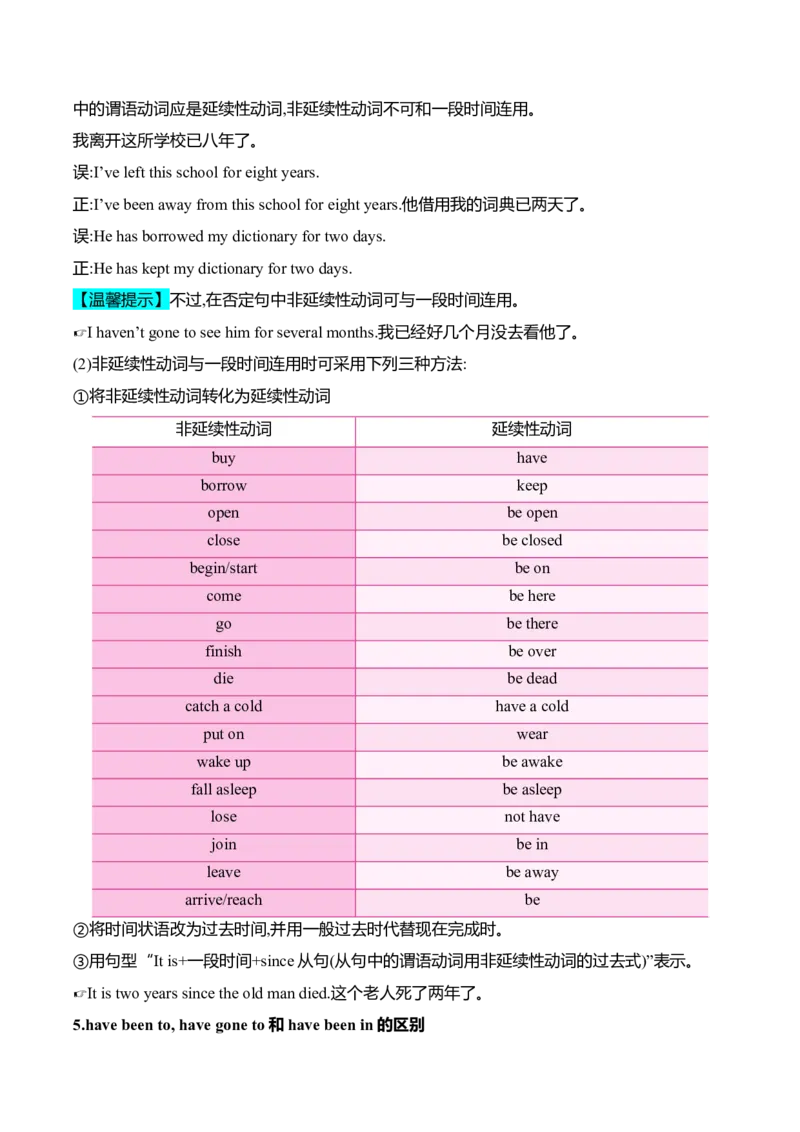
(1)现在完成时表示动作从过去某个时候开始一直持续到现在,与一段时间连用时应注意肯定句中的谓语动词应是延续性动词,非延续性动词不可和一段时间连用。
我离开这所学校已八年了。
误:I’ve left this school for eight years.
正:I’ve been away from this school for eight years.他借用我的词典已两天了。
误:He has borrowed my dictionary for two days.
正:He has kept my dictionary for two days.
【温馨提示】不过,在否定句中非延续性动词可与一段时间连用。
☞I haven’t gone to see him for several months.我已经好几个月没去看他了。
(2)非延续性动词与一段时间连用时可采用下列三种方法:
①将非延续性动词转化为延续性动词
非延续性动词 延续性动词
buy have
borrow keep
open be open
close be closed
begin/start be on
come be here
go be there
finish be over
die be dead
catch a cold have a cold
put on wear
wake up be awake
fall asleep be asleep
lose not have
join be in
leave be away
arrive/reach be
②将时间状语改为过去时间,并用一般过去时代替现在完成时。
③用句型“It is+一段时间+since从句(从句中的谓语动词用非延续性动词的过去式)”表示。
☞It is two years since the old man died.这个老人死了两年了。
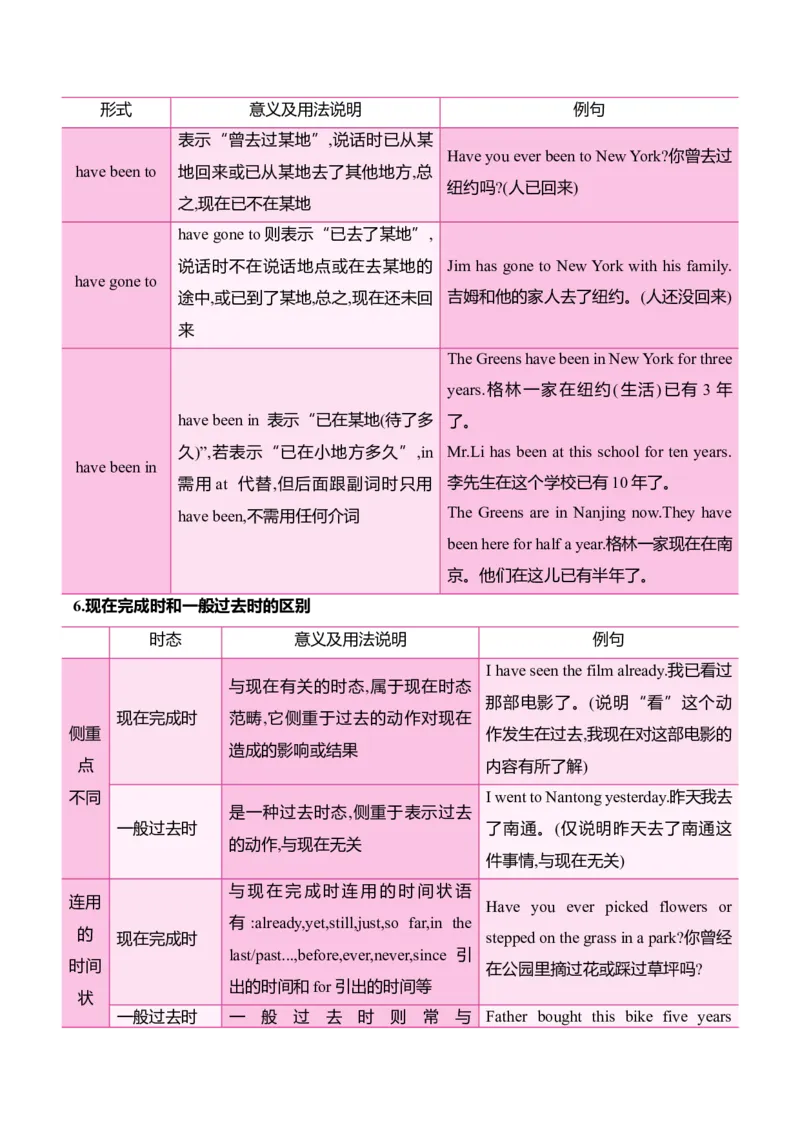
5.have been to, have gone to和have been in的区别形式 意义及用法说明 例句
表示“曾去过某地”,说话时已从某
Have you ever been to New York?你曾去过
have been to 地回来或已从某地去了其他地方,总
纽约吗?(人已回来)
之,现在已不在某地
have gone to则表示“已去了某地”,
说话时不在说话地点或在去某地的 Jim has gone to New York with his family.
have gone to
途中,或已到了某地,总之,现在还未回 吉姆和他的家人去了纽约。(人还没回来)
来
The Greens have been in New York for three
years.格林一家在纽约(生活)已有 3 年
have been in 表示“已在某地(待了多 了。
久)”,若表示“已在小地方多久”,in Mr.Li has been at this school for ten years.
have been in
需用 at 代替,但后面跟副词时只用 李先生在这个学校已有10年了。
have been,不需用任何介词 The Greens are in Nanjing now.They have
been here for half a year.格林一家现在在南
京。他们在这儿已有半年了。
6.现在完成时和一般过去时的区别
时态 意义及用法说明 例句
I have seen the film already.我已看过
与现在有关的时态,属于现在时态
那部电影了。(说明“看”这个动
现在完成时 范畴,它侧重于过去的动作对现在
侧重 作发生在过去,我现在对这部电影的
造成的影响或结果
点 内容有所了解)
不同 I went to Nantong yesterday.昨天我去
是一种过去时态,侧重于表示过去
一般过去时 了南通。(仅说明昨天去了南通这
的动作,与现在无关
件事情,与现在无关)
与现在完成时连用的时间状语
连用 Have you ever picked flowers or
有 :already,yet,still,just,so far,in the
的 现在完成时 stepped on the grass in a park?你曾经
last/past...,before,ever,never,since 引
时间 在公园里摘过花或踩过草坪吗?
出的时间和for引出的时间等
状
一般过去时 一 般 过 去 时 则 常 与 Father bought this bike five yearsago,yesterday,last...,in 1990,just now
ago.父亲5年前买了这辆自行车。
语不 等连用
同
基础训练
1.—Why won’t you go to see the film with me, Betty?
—Because I ________ it twice.
A.see B.saw C.have seen D.will see
2.—________ you ________ of the International Museum of Toilets in India yet?
— No, not yet.
A.Has; heard B.Have ; heard C.Did; hear D.Do; hear
3.—__________ you ever __________ the book, Journey to the West?
—Yes, I have. It’s fantastic.
A.Do; read B.Are; reading
C.Will; read D.Have; read
4.—Where is your sister, Cathy?
—She ______ to the Snow County in Heilongjiang. She will be back this Sunday.
A.has been B.has gone C.went D.will go
5.—Have you watched Tom and Jerry?
—Yes. I ______ it three times.
A.watch B.watched C.has watched D.have watched
6.Mary ______ reading the book last week and she ______ 50 pages so far.
A.has started; finished B.has started; has finished
C.started; has finished D.started; finished
7.I ________ the piano club last week and I ________ two classes already.
A.join; take B.joined; took C.joined; have taken D.have joined; took
8.—How do you like Mount Huang, Lucy?
—Oh, I ________ such a beautiful place before.
A.don’t visit B.didn’t visit C.haven’t visited D.can’t visit
9.I’m surprised at the new look of Jingdezhen City. It ________ a lot over the past few years.
A.changes B.has changed C.will change D.is changing
10.I ________ the book Oliver Twist yet, so I know nothing about it now.
A.have read B.haven’t read C.read D.didn’t read11.—Hurry up! The movie ________.
—Don’t hurry! Safety comes first. It only started a few minutes ago.
A.has begun B.would begin C.will begin D.had begun
12.Hurry up! The film ________ for 10 minutes.
A.begins B.has begun C.is on D.has been on
13.—How long have you had the bike?
—I ________ it since I was six years old.
A.bought B.have bought C.have had D.has bought
14.I have ________ the magazine for two weeks. I’ll return it this afternoon.
A.looked B.lent C.bought D.kept
15.—How long has your uncle ________ this personal computer?
—Since ten years ago. He wants to buy a new one.
A.has B.bought C.kept D.have
16.The old man ________ for five years.
A.died B.has died C.has dead D.has been dead
17.She has ________ from her hometown for nearly ten years.
A.left B.gone away C.to leave D.been away
18.Please hurry up! The TV play for ten minutes.
A.started B.has started C.was on D.has been on
19.—Where is your father?
—He ________ Australia and ________ Sydney for two weeks.
A.has gone to; has been in B.has been in; has been to
C.has gone to; has been to D.has been to; has been in
20.The boy ________ the train and railway set since he was five.
A.has bought B.has owned C.bought D.had
二、用所给词的适当形式填空
1.She (finish) her homework already.
2.The famous writer has (die) for ten years.
3.—Have you ever (be) to the city park?
—Yes. I (go) there last weekend.
4.—Where is Mary?
—She (go) to the library.
5.I like collecting stamps. So far I (collect) five hundred stamps.
6.Tina and Helen (know) each other since 2010.
7.Mom, I (finish) my homework already. Let’s go for a walk.8.—Do you know when we will hold the sports meeting?
—No, I don’t. The teachers (not decide) yet.
9.25 years (pass) since Hong Kong returned to China.
10.Our school (change) a lot recently.
提升训练
1.(23-24八年级下·北京顺义·期末)—Lucy, is your aunt a teacher?
—Yes, she is. She ________ English in this school for nearly 20 years.
A.teaches B.is teaching C.has taught D.will teach
2.(22-23八年级下·江苏淮安·期末)—Where is Miss Smith, Jenny?
—She ________ her company for an important meeting. She left half an hour ago.
A.has gone to B.has been to C.is going to D.goes to
3.(19-20八年级下·吉林长春·单元测试)—Where is your father?
—He_______ Australia and he _______ Sydney for two weeks.
A.has been to; has been in B.has gone to; has been in
C.has been in; has been to D.has gone to; has been to
4.(23-24八年级下·云南玉溪·期末)Mr. Johnson moved to Beijing at the age of 20 and ________ there ever
since then.
A.has lived B.is living C.was living D.lived
5.(23-24八年级下·安徽宿州·期末)—Mr.Liu, have you ever ________ abroad?
—Yes, I ________ Singapore last week.
A.been; been to B.gone; been in C.been; gone to D.been; went to
6.(23-24八年级下·江苏扬州·期末)—Let’s turn on the TV and enjoy watching the football match.
—It’s too late. It ________ for half an hour. And the result is 1-0, China won.
A.has finished B.has begun C.has been on D.has been over
7.(23-24八年级下·江西萍乡·期末)—Amy __________ for two hours. Do you know where she is?
—In the art room. She __________ an art lesson every Friday.
A.has been away; had B.has been away; has C.has gone; has D.has gone; had
8.(23-24八年级下·广东江门·期末)—How long have you known your best friend?
—I’ve known him ________ six years. I ________ to know him in 2018.
A.since; had begunB.for; began C.at; begin D.since; began
9.(23-24八年级下·甘肃武威·期末)—How long ________ you ________ your bread maker?
—For about three months.
A.did; buy B.have; bought C.have; had D.have; buy
10.(23-24八年级下·江苏淮安·期末)— Hello! May I speak to Jack?
—Sorry. He ________ to the library.A.goes B.went C.has gone D.has been
11.(23-24八年级下·陕西西安·期末)—Amy, I remember you ________ several years ago.
—Yes. I ________ for five years.
A.get married; have been married B.have married; got married
C.got married; have been married D.have married; have been married
12.(23-24八年级下·江苏镇江·期末)Jenny can tell every street in Zhenjiang because she ________ this city
for 22 years.
A.was B.has been in C.has been to D.has gone to
13.(23-24八年级下·四川达州·期末)She ________ this book ________ nearly three weeks ago.
A.has borrowed; since B.has borrowed; for C.has kept; for D.has kept; since
14.(23-24八年级下·山东青岛·期末)—Jenny, Would you like to see the movie with me?
—It’s an interesting film, but I ________ it.
A.will see B.have seen C.see D.saw
15.(23-24八年级下·北京东城·期末)—May I speak to Tom?
—Sorry, he ________ America. But he ________ in two days.
A.has been to; will come back B.has gone to; will come back
C.has gone to; came back D.has been to; came back
16.(23-24八年级下·江西赣州·期末)—Everybody is playing on the playground. Can I join them, Mr. Smith?
—Why not? You ________ all your homework.
A.is finishing B.have finished C.will finish D.finish
17.(23-24八年级下·吉林长春·期末)—_________ have you learned Chinese, Tina?
—Since 2021. It’s been 3 years.
A.How soon B.How old C.How long D.How far
18.(23-24八年级下·江西南昌·期末)—Where is Kate?
—She ________ America. She ________ that country for a week.
A.has been to; has been in B.has been in; has gone to
C.has gone to; has been to D.has gone to; has been in
19.(22-23八年级下·辽宁铁岭·期末)—Tom, could you lend me your Harry Potter?
—Sorry, I ________ reading it yet.
A.don’t finish B.didn’t finish C.won’t finish D.haven’t finished
20.(22-23八年级下·云南临沧·期末)—Have you decided which book to write about yet?
—______. I’ve already finished reading it. It was really good.
A.No, I haven’t B.Yes, I have C.No, I don’t D.Yes, I do