绝密★启用前
2024年全国硕士研究生招生考试
英 语(一)
(科目代码:201)
试卷条形 码
☆考生注意事项☆
1. 答题前,考生须在试题册指定位置上填写考生编号和考生姓名;在答题卡指
定位置上填写报考单位、考生姓名和考生编号,并涂写考生编号信息点。
2. 考生须把试题册上的“试卷条形码”粘贴条取下,粘贴在答题卡的“试卷条
形码粘贴位置”框中。不按规定粘贴条形码而影响评卷结果的,责任由考生
自负。
3.选择题的答案必须涂写在答题卡相应题号的选项上,非选择题的答案必须书
写在答题卡指定位置的边框区域内。超出答题区域书写的答案无效;在草稿
纸、试题册上答题无效。
4. 填(书)写部分必须使用黑色字迹签字笔书写,字迹工整、笔迹清楚;涂写
部分必须使用2B铅笔填涂。
5.考试结束,将答题卡和试题册按规定交回。
(以下信息考生必须认真填写)
考生编号
考生姓名Section I Use of English
Directions:
Read the following text. Choose the best word(s) for each numbered blank and mark A,
B,C or D on the ANSWER SHEET.(10 points)
There's nothing more welcoming than a door opening for you. 1 the need to
be touched to open or close, automatic doors are essential in. 2 disabled access to
buildings and helping provide general. 3 to commercial buildings.
Self-sliding doors began to emerge as a commercial product in 1960 after being
as
invented six years. 4 by Americans Dee Horton and Lew Hewitt. They. 5
a novelty feature, but as their use has grown, their 6 have extended within our
technologically advanced world. Particularly. 7 in busy locations or during times
of emergency, the doors. 8 crowd management by reducing the obstacles put in
people's way.
9 making access both in and out of buildings easier for people, the difference
in the way many of these doors open helps reduce the total area . 10 by them.
Automatic doors often open to the side, with the panels sliding across one another.
Replacing swing doors, these 11 smaller buildings to maximise the usable space
inside without having to12 the way for a large, sticking-out door. There are many
different types of automatic door, with each13 specific signals to tell them when to
open.14 these methods differ, the main. 15remain the same.
Each automatic door system. 16 the light, sound, weight or movement in
their vicinity as a signal to open. Sensor types are chosen to. 17 the different
environments they are needed in. 18 , a busy street might not. 19 a motion-
sensored door, as it would constantly be opening for passers-by. A pressure-sensitive
mat would be more 20 to limit the surveyed area.
2024-21.[A] Through [B] Despite [C] Besides [D] Without
2.[A] revealing [B] demanding [C] improving [D] tracing
3. [A] experience [B] convenience [C] guidance [D] reference
4.[A] previously [B] temporarily [C] successively [D] eventually
5.[A] held on [B] started out [C] settled down [D] went by
6.[A] relations [B] volumes [C] benefits [D] sources
7.[A] useful [B] simple [C] flexible [D] stable
8.[A] call for [B] yield to [C] insist on [D] act as
9.[A] As well as [B] In terms of [C] Thanks to [D] Rather than
10.[A] connected [B] shared [C] represented [D] occupied
11.[A] allow [B] expect [C] require [D] direct
12.[A] adopt [B] lead [C] clear [D] change
13.[A] adapting to [B] deriving from [C] relying on [D] pointing at
14.[A] Once [B] Since [C] Unless [D] Although
15.[A] records [B] positions [C] principles [D] reasons
16.[A] controls [B] analyses [C] produces [D] mixes
17.[A] decorate [B] compare [C] protect [D] complement
18.[A] In conclusion [B] By contrast [C] For example [D] Above all
19.[A] identify [B] suit [C] secure [D] include
20.[A] appropriate [B] obvious [C] impressive [D] delicate
Section II Reading Comprehension
Part A
Directions:
Read the following four texts. Answer the questions after each text by choosing A, B,
C or D.Mark your answers on the ANSWER SHEET.(40 points)
2024-3Text 1
Nearly 2,000 years ago, as the Romans began to pull out of Scotland, they left
behind a curious treasure: 10 tons of nails, nearly a million of the things. The nail
hoard was discovered in 1960 in a four-metre-deep pit covered by two metres of
gravel.
Why had the Romans buried a million nails? The likely explanation is that the
withdrawal was rushed, and they didn't want the local Caledonians getting their hands
on 10 tons of weapon-grade iron. The Romans buried the nails so deep that they would
not be discovered for almost two millennia.
Later civilisations would value the skilled blacksmith's labour in a nail even more
than the raw material. As Roma Agrawal explains in her new delightful book Nuts and
Bolts, early 17th-century Virginians would sometimes burn down their homes if they
were planning to relocate. This was an attempt to recover the valuable nails, which
could be reused after sifting the ashes. The idea that one might burn down an entire
house just to reclaim the nails underlines how scarce, costly and valuable the simple-
seeming technology was.
The price of nails fell by 90etween the late 1700s and mid-1900s, as economist
Daniel Sichel points out in a research paper. According to Sichel, although the falling
price of nails was driven partly by cheaper iron and cheaper energy, most of the credit
goes to nail manufacturers who simply found more efficient ways to turn steel into
nails.
Nails themselves have changed over the years, but Sichel studied them because
they haven't changed much. Roman lamps and Roman chariots are very different
from LED strips and sports cars, but Roman nails are still clearly nails. It would be
absurd to try to track the changing price of sports cars since 1695, but to ask the same
question of nails makes perfect sense.
I make no apology for being obsessed by a particular feature of everyday objects:
their price.I am an economist, after all. After writing two books about the history
of inventions, one thing I've learnt is that while it is the enchantingly sophisticated
technologies that get all the hype, it's the cheap technologies that change the world.
The Gutenberg printing press transformed civilisation not by changing the nature
of writing but by changing its cost—and it would have achieved little without a
parallel collapse in the price of surfaces to write on, thanks to an often-overlooked
technology called paper. Solar panels had a few niche uses until they became cheap;
now they are transforming the global energy system.
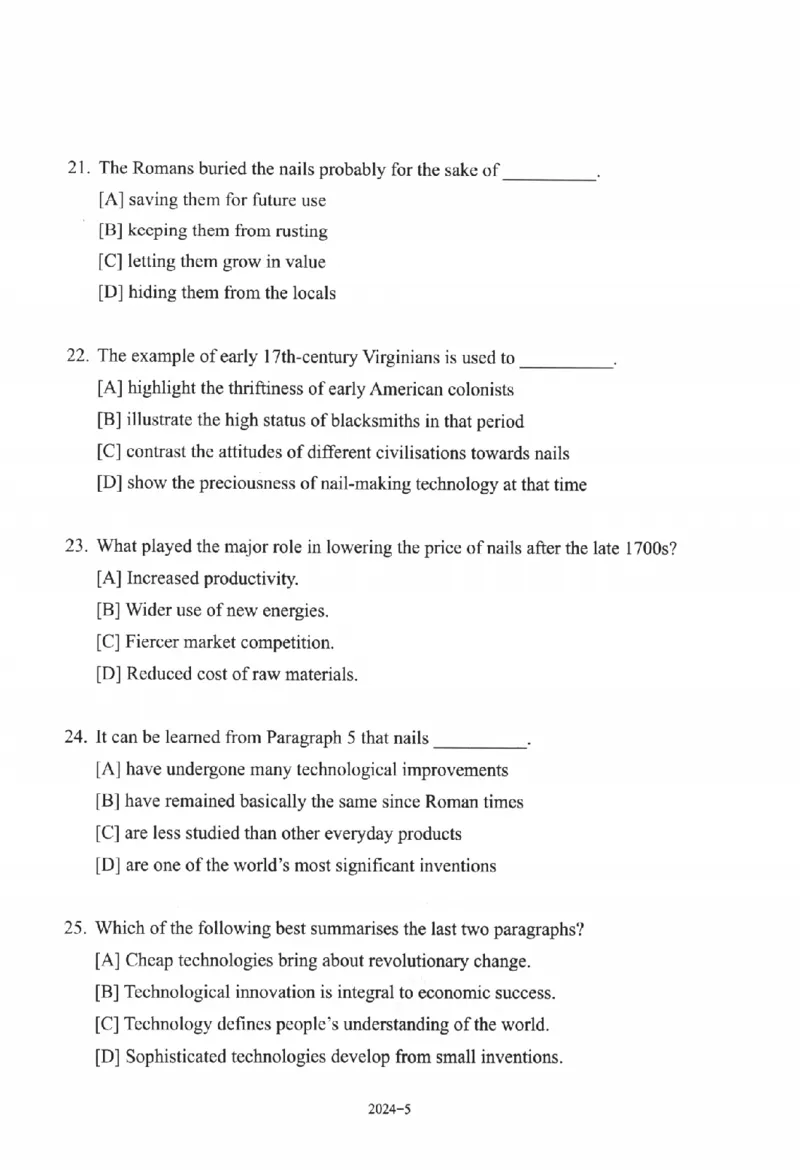
2024-421.The Romans buried the nails probably for the sake of.
[A] saving them for future use
[B] kecping them from rusting
[C] letting them grow in value
[D] hiding them from the locals
22. The example of early 17th-century Virginians is used to.
[A] highlight the thriftiness of early American colonists
[B] illustrate the high status of blacksmiths in that period
[C] contrast the attitudes of different civilisations towards nails
[D] show the preciousness of nail-making technology at that time
23.What played the major role in lowering the price of nails after the late 1700s?
[A] Increased productivity.
[B] Wider use of new energies.
[C] Fiercer market competition.
[D] Reduced cost of raw materials.
24.It can be learmed from Paragraph 5 that nails
[A] have undergone many technological improvements
[B] have remained basically the same since Roman times
[C] are less studied than other everyday products
[D] are one of the world's most significant inventions
25. Which of the following best summarises the last two paragraphs?
[A] Cheap technologies bring about revolutionary change.
[B] Technological innovation is integral to economic success.
[C] Technology defines people's understanding of the world.
[D] Sophisticated technologies develop from small inventions.
2024-5Text 2
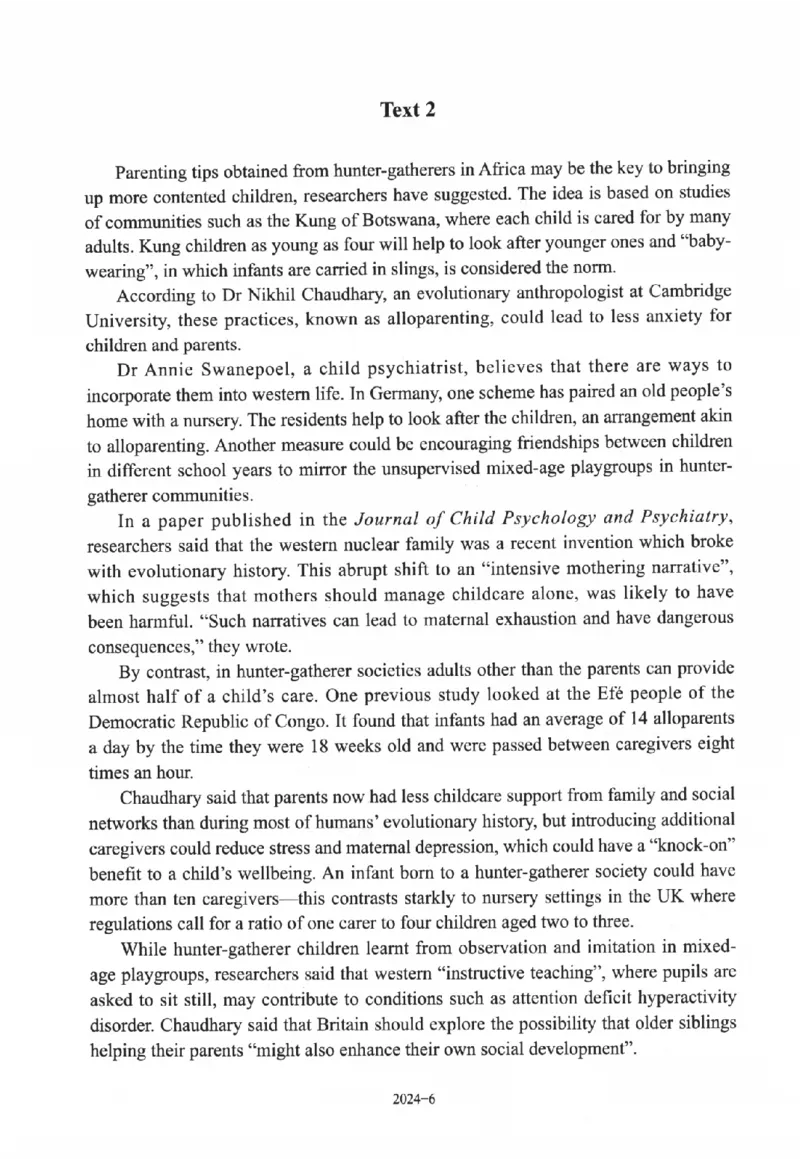
Parenting tips obtained from hunter-gatherers in Africa may be the key to bringing
up more contented children, researchers have suggested. The idea is based on studies
of communities such as the Kung of Botswana, where each child is cared for by many
adults. Kung children as young as four will help to look after younger ones and "baby-
wearing", in which infants are carried in slings, is considered the norm.
According to Dr Nikhil Chaudhary, an evolutionary anthropologist at Cambridge
University, these practices, known as alloparenting, could lead to less anxiety for
children and parents.
Dr Annie Swanepoel, a child psychiatrist, believes that there are ways to
incorporate them into western life. In Germany, one scheme has paired an old people's
home with a nursery. The residents help to look after the children, an arrangement akin
to alloparenting. Another measure could be encouraging friendships between children
in diferent school years to mirror the unsupervised mixed-age playgroups in hunter-
gatherer communities.
In a paper published in the Journal of Child Psychology and Psychiatry,
researchers said that the western nuclear family was a recent invention which broke
with evolutionary history. This abrupt shift to an"intensive mothering narrative",
which suggests that mothers should manage childcare alone, was likely to have
been harmful.“Such narratives can lead to maternal exhaustion and have dangerous
consequences,” they wrote.
By contrast, in hunter-gatherer societies adults other than the parents can provide
almost half of a child's care. One previous study looked at the Efé people of the
Democratic Republic of Congo. It found that infants had an average of 14 alloparents
a day by the time they were 18 weeks old and were passed between caregivers eight
times an hour.
Chaudhary said that parents now had less childcare support from family and social
networks than during most of humans'evolutionary history, but introducing additional
caregivers could reduce stress and maternal depression, which could have a“knock-on”
benefit to a child's wellbeing. An infant born to a hunter-gatherer society could have
more than ten caregivers—this contrasts starkly to nursery settings in the UK where
regulations call for a ratio of one carer to four children aged two to three.
While hunter-gatherer children learnt from observation and imitation in mixed-
age playgroups, researchers said that western "instructive teaching", where pupils are
asked to sit still, may contribute to conditions such as attention deficit hyperactivity
disorder. Chaudhary said that Britain should explore the possibility that older siblings
helping their parents "might also enhance their own social development".
2024-626.According to the first two paragraphs, alloparenting refers to the practice of
[A] sharing childcare among community members
[B] assigning babies to specific adult caregivers
[C] teaching parenting skills to older children
[D] carrying infants around by their parents
27. The scheme in Germany is mentioned to illustrate.
[A] an attempt to facilitate intergenerational communication
[B] an approach to integrating alloparenting into western society
[C] the conventional parenting style in western culture
[D] the differences between western and African ways of living
28.According to Paragraph 4, the "intensive mothering narrative".
[A] alleviates parenting pressures
[B] consolidates family relationships
[C] results in the child-centred family
[D] departs from the course of evolution
29.What can be inferred about the nurseries in the UK?
[A] They tend to fall short of official requirements.
[B] They have difficulty finding enough caregivers.
[C] They ought to improve their carer-to-child ratio.
[D] They should try to prevent parental depression.
30.Which of the following would be the best title for the text?
[A] Instructive teaching: a dilemma for anxious parents
[B] For a happier family, learn from the hunter-gatherers
[C] Mixed-age playgroup, a better choice for lonely children
[D] Tracing the history of parenting: from Africa to Europe
2024-7Text 3
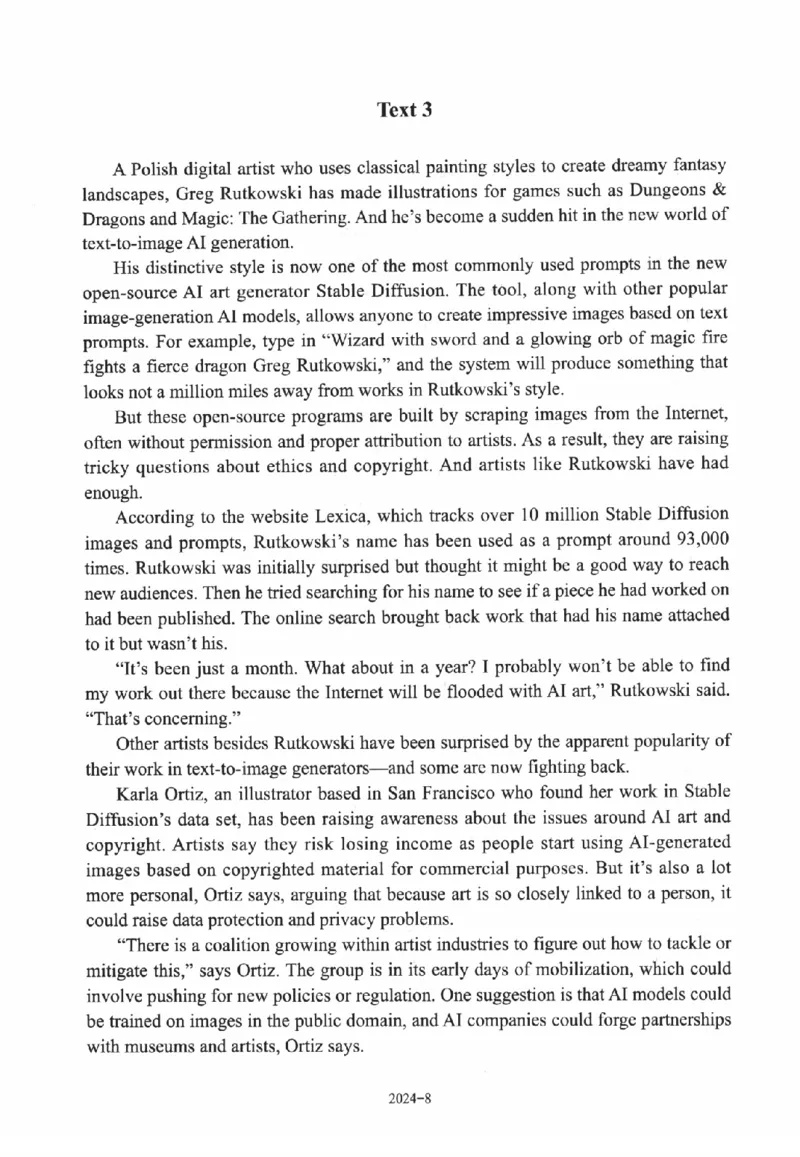
A Polish digital artist who uses classical painting styles to create dreamy fantasy
landscapes, Greg Rutkowski has made illustrations for games such as Dungeons &
Dragons and Magic: The Gathering. And he's become a sudden hit in the new world of
text-to-image AI generation.
His distinctive style is now one of the most commonly used prompts in the new
open-source AI art generator Stable Diffusion. The tool, along with other popular
image-generation Al models, allows anyone to create impressive images based on text
prompts.For example, type in"Wizard with sword and a glowing orb of magic fire
fights a fierce dragon Greg Rutkowski,” and the system will produce something that
looks not a million miles away from works in Rutkowski's style.
But these open-source programs are built by scraping images from the Internet,
often without permission and proper attribution to artists. As a result, they are raising
tricky questions about ethics and copyright. And artists like Rutkowski have had
enough.
According to the website Lexica, which tracks over 10 million Stable Diffusion
images and prompts, Rutkowski's name has been used as a prompt around 93,000
times. Rutkowski was initially surprised but thought it might be a good way to reach
new audiences. Then he tried searching for his name to see if a piece he had worked on
had been published. The online search brought back work that had his name attached
to it but wasn't his.
“It's been just a month. What about in a year? I probably won't be able to find
my work out there because the Internet will be flooded with Al art," Rutkowski said.
“That's concerning.”
Other artists besides Rutkowski have been surprised by the apparent popularity of
their work in text-to-image generators—and some are now fighting back.
Karla Ortiz, an illustrator based in San Francisco who found her work in Stable
Diffusion's data set, has been raising awareness about the issues around Al art and
copyright. Artists say they risk losing income as people start using AI-generated
images based on copyrighted material for commercial purposes. But it's also a lot
more personal, Ortiz says, arguing that because art is so closely linked to a person, it
could raise data protection and privacy problems.
“There is a coalition growing within artist industries to figure out how to tackle or
mitigate this,” says Ortiz. The group is in its early days of mobilization, which could
involve pushing for new policies or regulation. One suggestion is that Al models could
be trained on images in the public domain, and AI companies could forge partnerships
with museums and artists, Ortiz says.
2024-831.What can be learned about Rutkowski from the first two paragraphs?
[A] He is enthusiastic about using AI models.
[B] He is popular with users of an AI art generator.
[C] He attracts admiration from other illustrators.
[D] He specializes in classical painting digitalization.
32. The problem with open-source AI art generators is that they.
[A] lack flexibility in responding to prompts
[B] produce artworks in unpredictable styles
[C] make unauthorized use of online images
[D] collect user information without consent
33. After searching online, Rutkowski found
[A] a unique way to reach audiences
[B] a new method to identify AI images
[C] AI-generated work bearing his name
[D] heated disputes regarding his copyright
34. According to Ortiz,AI companies are advised to.
[A] campaign for new policies or regulation
[B] offer their services to public institutions
[C] strengthen their relationships with AI users
[D] adopt a different strategy for AI model training
35. What is the text mainly about?
[A] Artists' responses to AI art generation.
[B] AI's expanded role in artistic creation.
[C] Privacy issues in the application of AI.
[D] Opposing views on AI development.
2024-9Text 4
The miracle of the Chesapeake Bay lies not in its depths, but in the complexity
of its natural construction, the interaction of fresh and saline waters, and the mix of
land and water. The shallows provide homes for hundreds of species while storing
floodwaters, filtering pollutants from water, and protecting nearby communities from
potentially destructive storm surges.
All this was put at great risk late last month, when the U.S. Supreme Court issued
a ruling in an Idaho case that provides the U.S. Environmental Protection Agency (EPA)
far less authority to regulate wetlands and waterways. Specifically, a 5-4 majority
decided that wetlands protected by the EPA under its Clean Water Act authority
must have a“continuous surface connection”to bodies of water. This narrowing
of the regulatory scope was a victory for builders, mining operators and other
commercial interests often at odds with environmental rules. And it carries“significant
repercussions for water quality and flood control throughout the United States," as
Justice Brett Kavanaugh observed.
In Maryland, the good news is that there are many state laws in place that provide
wetlands protections. But that's a very shortsighted view, particularly when it comes
to the Chesapeake Bay. The reality is that water, and the pollutants that so often come
with it, don't respect state boundaries. The Chesapeake draws from a 64,000-square-
mile watershed that extends into Virginia, Pennsylvania, New York, West Virginia,
the District of Columbia and Delaware. Will those jurisdictions extend the same
protections now denied under Sackett v.EPA? Perhaps some, but all? That seems
unlikely,
It is too easy, and misleading, to see such court rulings as merely standing up for
the rights of land owners when the consequences can be so dire for their neighbors.
And it's a reminder that the EPA's involvement in the Chesapeake Bay Program has
long been crucial as the means to transcend the influence of deep-pocketed special
interests in neighboring states. Pennsylvania farmers, to use one telling example,
aren't thinking about next year's blue crab harvest in Maryland when they decide
whether to spread animal waste on their fields, yet the runoff into nearby creeks can
have enormous impact downstream.
And so we would call on state lawmakers from Richmond to Albany to consider
reviewing their own wetlands protections and see for themselves the enormous
stakes involved. We can offer them a visit to Blackwater National Wildlife Refuge in
Dorchester County where bald eagles fly over tidal marshes so shallow you could not
paddle a boat across them but teaming with aquatic life. It's worth the scenic drive.
2024-10_·
36.The Chesapeake Bay is described in Paragraph 1 as
[A] a valuable natural environment
[B] a controversial conservation area
[C] a place with commercial potential
[D] a headache for nearby communities
37. The U.S.Supreme Court's ruling in the ldaho case
[A] reinforces water pollution control
[B] weakens the EPA's regulatory power
[C] will end conflicts among local residents
[D] may face opposition from mining operators
38.How does the author feel about the future of the Chesapeake Bay?
[A] Worried.
[B] Puzzled.
[C] Relieved.
[D] Encouraged.
39.What can be inferred about the EPA's involvement in the Chesapeake Bay
Program?
[A] It has restored the balance among neighboring jurisdictions.
[B] It has triggered a radical reform in commercial fisheries.
[C] It has set a fine example of respecting state authorities.
[D] It has ensured the coordination of protection efforts.
40.The author holds that the state lawmakers should
[A] be cautious about the influence of land owners
[B] attach due importance to wetlands protections
[C] recognize the need to expand wildlife refuges
[D] improve the wellbeing of endangered species
2024-11Part B
Directions;
Read the following comments on a report about American museums returning artifacts
to their countries of origin and a list of statements summarizing the comments. Choose
the best statement from the list A-G for each numbered name(41-45). There are two
extra choices which you do not need to use. Mark your answers on the ANSWER
SHEET.(10 points)
(41)Hannah
Simply, there are people in Nigeria who cannot travel to the Smithsonian
Institution to see that part of their history and culture represented by the Benin
Bronzes. These should be available to them as part of their cultural heritage and
history and as a source of national pride. There is no good reason that these artifacts
should be beyond the ordinary reach of the educational objectives or inspiration of the
generations to which they were left. They serve no purpose in a museum in the United
States or elsewhere except as curious objects. They cannot be compared to works of
art produced for sale which can be passed from hand to hand and place to place by
purchase.
(42)Buck
We know very exact reproductions of artwork can be and are regularly produced.
Perhaps museums and governments might explore some role for the use of nearly
exact reproductions as a means of resolving issues relating to returning works of art
and antiquities. The context of any exhibit is more important to me than whether the
object being displayed is 2,000 years old or 2 months old. In many cases the experts
have a hard time agreeing on what is the real object and what is a forgery. Again, the
story an exhibit is trying to tell is what matters. The monetary value of the objects on
display is a distant second place in importance.
(43) Sara
When visiting the Baltimore Museum of Art, I came across a magnificent 15th-
century Chinese sculpture. It inspired me to learn more about the culture that it
represented. Artifacts in museums have the power to inspire, and perhaps spark that
need to learn and understand the nature of their creators. Having said that, I do feel
that whatever artifacts find their way to public museums should, in fact, be sanctioned
as having been obtained on loan, legally purchased, or obtained by treaty. Stealing
2024-12artifacts from other peoples' cultures is obscene; it robs not only the physical objects,
but the dignity and spirit of their creators.
(44) Victor
Ancient art that is displayed in foreign countries by all means should be returned
to the original country. The foreign countries have no right to hold back returning
the items. I would ask that the foreign nations and the original country discuss the
terms of transfer. Yes, there is the risk that the original country will not have as good
security as do the foreign countries. But look at what happened to Boston's Gardner
Museum theft in 1990, including the loss of Rembrandt, Vermeer, Manet, and other
masterpieces. Nothing is absolutely safe nowhere. And now Climate Change agitators
are attacking publicly displayed works in European museums.
(45) Julia
To those of you in the comments section who are having strong feelings about
artifacts being removed from cities in the U.S. and Britain and returned to their
countries of origin, I would ask you to consider why do you think Americans have
more of a right to easily access the Benin Bronzes than the people of Nigeria? Why
are people who live within a day's drive of London entitled to go and see the Elgin
Marbles whenever they want, but the people of Athens aren't? What intrinsic factors
make the West a suitable home for these artifacts but preclude them from being
preserved and displayed by their countries of origin? If your conclusion is that the
West is better able to preserve these artifacts, think about why you're assuming that to
be true.
[A] It is clear that the countries of origin have never been compensated for the stolen
artifacts.
[B] It is a flawed line of reasoning to argue against returning artifacts to their countries
of origin.
[C] Museum visitors can still learn as much from artifacts' copies after the originals
are returned.
[D] Reproductions, even if perfectly made, cannot take the place of the authentic
objects.
[E] The real value of artifacts can only be recognized in their countries of origin rather
than anywhere else.
[F] Ways to get artifacts from other countries must be decent and lawful.
[G] Concern over security is no excuse for refusing to return artifacts to their countries
of origin.
2024-13Part C
Directions:
Read the following text carefully and then translate the underlined segments into
Chinese. Write your answers on the ANSWER SHEET. (10 points)
“Elephants never forget”—or so they say—and that piece of folklore seems to
have some foundation.
The African savanna elephant, also known as the African bush elephant, is
distributed across 37 African countries. They move between a variety of habitats,
including forests, grasslands, woodlands, wetlands and agricultural land. (46) They
sometimes travel more than sixty miles to find food or water, and are very good
at working out where other elephants are—even when they are out of sight. Using
tracking devices, researchers have shown that they have“remarkable spatial acuity.”
When finding their way to waterholes, they headed off in exactly the right direction,
on one occasion from a distance of roughly thirty miles. What is more, they almost
always seem to choose the nearest waterhole.(47) The researchers are convinced that
the elephants always know precisely where they are in relation to all the resources
they need, and can therefore take shortcuts, as well as following familiar routes.
Although the cues used by African elephants for long-distance navigation are not
yet understood, smell may well play a part.
Elephants are very choosy eaters, but until recently little was known about how
they selected their food. (48) One possibility was that they merely used their eyes and
tried out the plants they found, but that would probably result in a lot of wasted time
and energy, not least because their eyesight is actually not very good.
(49)The volatile chemicals produced by plants can be carried a long way, and
they are very characteristic: Each plant or tree has its own particular odor signature.
What is more, they can be detected even when they are not actually visible. New
research suggests that smell is a crucial factor in guiding elephants—and probably
other herbivores—to the best food resources.
The researchers first established what kinds of plant the elephants preferred either
to eat or avoid when foraging freely. They then set up a"food station" experiment,
in which they gave the elephants a series of choices based only on smell. (50) The
experiment showed that elephants may well use smell to identify patches of trees that
are good to eat, and secondly to assess the quality of the trees within each patch. Free-
ranging elephants presumably also use this information to locate their preferred food.
Their well-developed hippocampal structures may enable elephants, like rats and
people, to construct cognitive maps.
2024-14Section III Writing
Part A
51. Directions:
Read the following email from an international student and write a reply.
Dear Li Ming,
I've got a class assignment to make an oral report on an ancient Chinese
scientist, but I'm not sure how to prepare for it. Can you give me some
advice? Thank you for your help.
Yours,
Paul
Write your answer in about 100 words on the ANSWER SHEET.
Do not use your own name in your email; use"Li Ming" instead.(10 points)
Part B
52.Directions;
Write an essay based on the picture and the chart below. In your essay, you
should
1)describe the picture and the chart briefly,
2) interpret the implied meaning, and
3) give your comments.
Write your answer in 160-200 words on the ANSWER SHEET. (20 points)
某市近三年公园数量
P
(单位:座)
市民健身区
670
532
406
家门
新建的小公
真不错!
2020年 2021年 2022年
2024-15答案速查
Section I Use of English lots of anecdotes to make it engaging. Remember to
1.D 2.C 3. B 4.A 5.B practice your presentation to enhance confidence and
6.C 7.A 8.D 9.A 10.D coherence. Good luck, and I'm sure you'll do well.
11.A 12.C 13.C 14.D 15.C Sincerely yours,
Li Ming
16.B 17.D 18.C 19.B 20.A
Part B
Section Ⅱ Reading Comprehension
The drawing on the left depicts the scene of
Part A some city dwellers doing physical exercise in a park,
21. D 22.D 23.A 24.B 25.A and one of them expresses his satisfaction with the
26.A 27.B 28.D 29.C 30.B newly built park. The bar chart on the right shows
31.B 32.C 33.C 34.D 35.A an upward trend in the number of parks of a city in
36.A 37.B 38.A 39.D 40.B recent three years. I think the two pictures reveal city
Part B parks play a vital role in promoting physical activity,
41.E 42.C 43. F 44.G 45.B and that the number of city parks is a crucial aspect
Part C of public well-being.
46.它们有时会跋涉60多英里去寻找食物或 Firstly, city parks offer opportunities for
水,而且非常善于找出其他大象的位置——即使 physical exercise, contributing to people's overall
它们不在其视线范围内。 health. They serve as venues for recreational
47.研究人员确信,大象总是精确地感知它们
activities such as jogging, cycling, and sports,
相对于所有所需资源的位置,因此它们不但可以 reducing the risk of sedentary lifestyles. Secondly,
沿着熟悉的路线前进,还可以抄近路。 the presence of green spaces has positive effects on
48.一种可能是,它们只是用眼睛看,并尝试 mental health. Parks provide serene environments,
它们找到的植物,但这可能会导致大量的时间 offering an escape from the hustle and bustle
和精力浪费,尤其是因为它们的视力实际上并不 of urban life. And nature has proven benefits in
是很好。 reducing stress and anxiety, helping to keep a
49.植物产生的挥发性化学物质可以被扩散至
healthier mental state for city residents.
很远,而且它们非常有特点:每种植物或树木都 In my opinion, it is important to build more
有自己独特的气味特征。 parks in cities. A higher number of city parks
50.实验结果表明,大象很可能利用气味来识 correlates positively with improved physical and
别适合食用的树丛,其次还可以利用气味来评估 mental health for urban populations. Prioritizing
每片树丛中树木的品质。 the creation of parks in urban planning is not only
Section IⅢ Writing an investment in environmental sustainability but
Part A also an important step towards fostering healthier
communities
Dear Paul,
I have just received your email, and I hope my
reply finds you well. To prepare for your oral report
on an ancient Chinese scientist, I think you should
first select one, such as Shen Kuo, Zhang Heng, or
Zu Chongzhi. Then do a lot of information gathering
to ensure that your report focuses on conveying the
scientist's contributions, impact, and historical context
and covering the scientist's life and discoveries. To grab
your audience's attention, I think you'd better begin
with an attractive and interesting introduction and use 扫码查看2024年真题详解
真题词汇及更多考研课程
2024-16