New English Curriculum for Chinese Primary Schools
and Junior/Senior Middle Schools
Experimental Version drafted by the Education Ministry of the PRC
Note on this translation
This English version of China’s new curriculum for English is intended for VSO volunteers who
would like to feel better informed about a document that is central to our work. However, it
should in no way be regarded as an official translation. In fact, it is neither a word for word
translation nor a summary. The appendix to the original, which includes lists of specific
language items to be mastered, has been omitted, as have some level descriptors and sample
learning activities. Despite trying to make it more readable, this version reflects the repetitive
nature of the original, with the same key words cropping up over and over again. Volunteers
should also refer to the more official (but still not completely official!) translation of the new
English curriculum specifically for senior middle schools available from the Programme Office.
Any feedback on this version would be welcome.
Tim Martin
Shaanxi Institute of Education, October 2005
Part 1: Introduction
With the advent of the information age and the global economy, English has become increasingly
important. English is the dominant carrier of information and the most widely spoken language
in the world. Many countries have made English a cornerstone of quality education when
developing strategies for basic education.
Since China’s reform and opening, the scale of its English education has continually grown,
attended by significant achievements in teaching and learning. However, English education in its
current form is failing to meet the needs of contemporary social and economic development.
The current round of reforms to the English curriculum aim to end the following practices:
Over-emphasizing the transmission and explanation of knowledge about grammar and
vocabulary
Neglecting to develop students’ ability to use language for real
In their place, the reforms aim to establish a curriculum that:
Develops students’ comprehensive language competence
Motivates students, is relevant to their life experiences and cognitive level
Promotes task-based teaching methods
Involves students in experiential, practical, participatory and cooperative learning
1 Develops students’ positive attitudes, thinking skills, practical abilities, cultural awareness and
autonomy through the language learning process
1. The Nature of the New Curriculum
The new English curriculum strives to accomplish far more than just help students learn English.
At one level learning English should involve helping students to:
Develop a certain level of comprehensive language competence and the ability to use
language for real communication
Master certain basic language knowledge
Master listening, speaking, reading and writing skills
However, at another level the curriculum should also serve students’ all-round development,
providing them with opportunities to:
Strengthen their interest in studying English
Grow in self-discipline, perseverance and self-confidence
Improve their cooperative, investigative and thinking abilities
Develop their memory, imagination and creativity
Adopt good study habits and effective learning strategies
Develop as autonomous and lifelong learners
Build moral integrity and a healthy outlook on life
Establish both national spirit and an awareness of and respect for cultural differences
Broaden their horizons and enrich their life experience
Take part in cultural life
Develop as individuals
2. Basic Principles of the New Curriculum
The curriculum promotes quality education (as opposed to exam-orientated education) and
the all-round developmen t of the students
To promote quality education particular attention must be paid to:
Valuing each student’s feelings
Stimulating students’ interest in studying English
Helping students gain a sense of achievement and self-confidence
The curriculum must go beyond developing students’ comprehensive language competence to
include areas such as:
Improving students’ ability to contribute to cultural and social life
Developing students’ practical abilities
Fostering students’ creativity
The curriculum objectives are holistic and flexible.
The fundamental aim of the new English curriculum is to develop students’ comprehensive
language competence. This aim is broken down into five general objectives. These objectives are
then divided into nine ability levels with descriptors provided for each level. The five general
2objectives are:
1. Language Skills
2. Language Knowledge
3. Attitudes to Learning
4. Learning Strategies
5. Cultural Awareness
This design allows students to progress systematically through each level whilst meeting the full
range of the curriculum’s demands.
Students are put at the centre of the curriculum and individual differences are respected
Students’ must be at the heart of the new curriculum. For example, their developmental needs
must be the central consideration when developing:
Curriculum objectives
The teaching and learning process
The assessment process
Teaching and learning resources
When implementing the curriculum each student must be allowed to develop individually under
the guidance of the teacher:
The curriculum promotes activity-based methods, experiential and participatory learning
The curriculum promotes task-based learning whereby, under the guidance of the teacher, the
students gain a sense of achievement by reaching the goals of the task. Task completion will
involve the following types of learning:
Sensory
Experiential
‘Hands on’/practical
Participatory
Cooperative
In order to improve their ability to use language for real communication, students should also be
able to:
Adjust their learning strategies and control their emotions
Form positive attitudes towards learning
The curriculum recognizes the important role of formative assessment in promoting student’
development
The assessment system should combine formative with summative assessment. The purposes of
assessment should be to:
Promote students’ comprehensive language competence
Encourage and motivate students
Help students become more autonomous learners
Benefit students’ healthy personal development
Give teachers useful feedback from which to develop teaching and learning
Inform the ongoing development and perfection of the English curriculum
Formative assessment should be an important part of the English teaching and learning process
3with a particular emphasis on:
Encouraging students’ active participation in learning
Improving students’ self-confidence
Summative assessment should focus on:
Testing students’ integrated language skills
Testing students’ ability to use language
The curriculum expands the range of learning resources and opportunities available
The curriculum should strive to use and develop resources whose content is:
Realistic
Close to the students’ lives
Contemporary
Healthy
Rich and varied
Active use should be made of:
Audio visual material
Print media
The Internet
Students should be encouraged to take responsibility for finding, using and developing learning
resources themselves.
3. The Curriculum Design
The curriculum follows the international practice of dividing the general objectives into different
ability levels. When designing these nine levels consideration was given to the following:
The nature of language development
The different needs of different age groups
The needs of different ethnic groups and areas
The economic imbalances that exist in China
The aim is to have designed a system that is holistic and flexible.
The correspondence between the level system and the grade system is shown in the following
diagram:
Primary School Work towards: Notes
Grade 3 Level 1 Students should start studying English in Grade 3
Grade 4 Level 1
Grade 5 Level 2
Grade 6 Level 2 The required standard for the end of primary school
Junior Middle School Work towards: Notes
Grade 7 (= Junior 1) Level 3
Grade 8 (= Junior 2) Level 4
Grade 9 (= Junior 3) Level 5 The required standard for the end of junior middle
school
Senior Middle School Work towards: Notes
Senior 1 Level 6
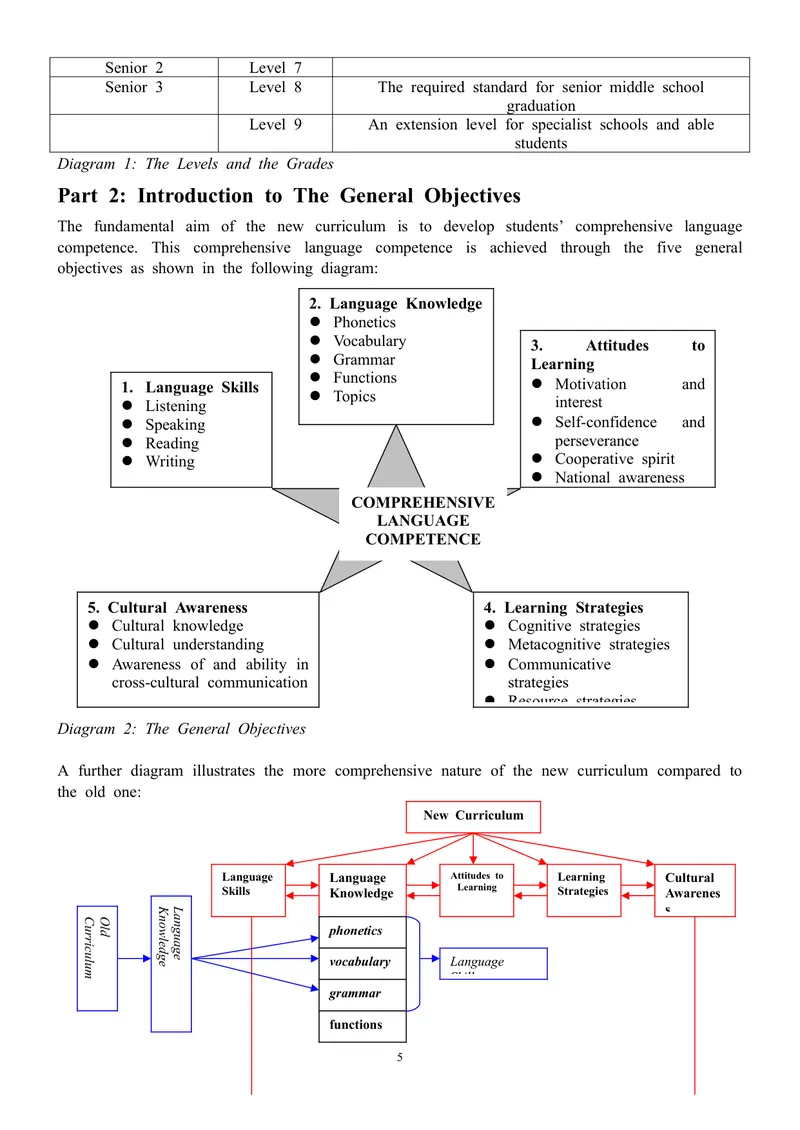
4Senior 2 Level 7
Senior 3 Level 8 The required standard for senior middle school
graduation
Level 9 An extension level for specialist schools and able
students
Diagram 1: The Levels and the Grades
Part 2: Introduction to The General Objectives
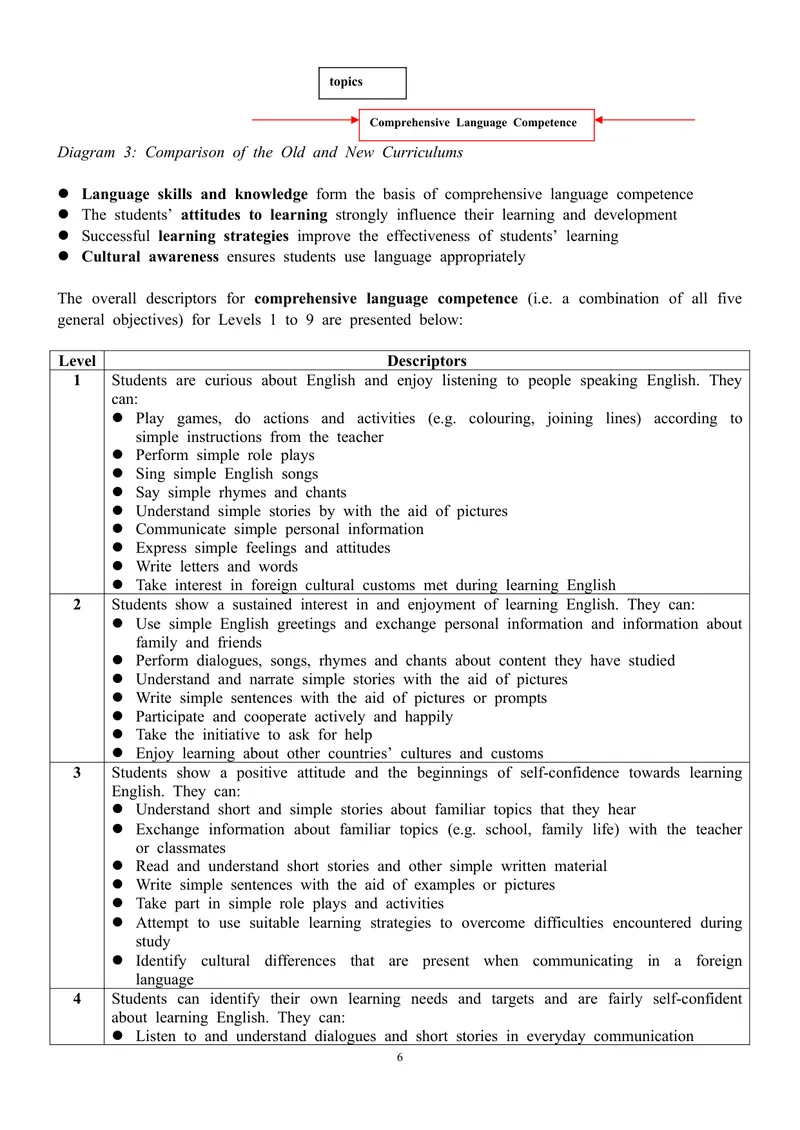
The fundamental aim of the new curriculum is to develop students’ comprehensive language
competence. This comprehensive language competence is achieved through the five general
objectives as shown in the following diagram:
2. Language Knowledge
Phonetics
Vocabulary
3. Attitudes to
Grammar
Learning
Functions
1. Language Skills Motivation and
Topics
Listening interest
Speaking Self-confidence and
Reading perseverance
Writing Cooperative spirit
National awareness
COMPREHENSIVE
LANGUAGE
COMPETENCE
5. Cultural Awareness 4. Learning Strategies
Cultural knowledge Cognitive strategies
Cultural understanding Metacognitive strategies
Awareness of and ability in Communicative
cross-cultural communication strategies
Resource strategies
Diagram 2: The General Objectives
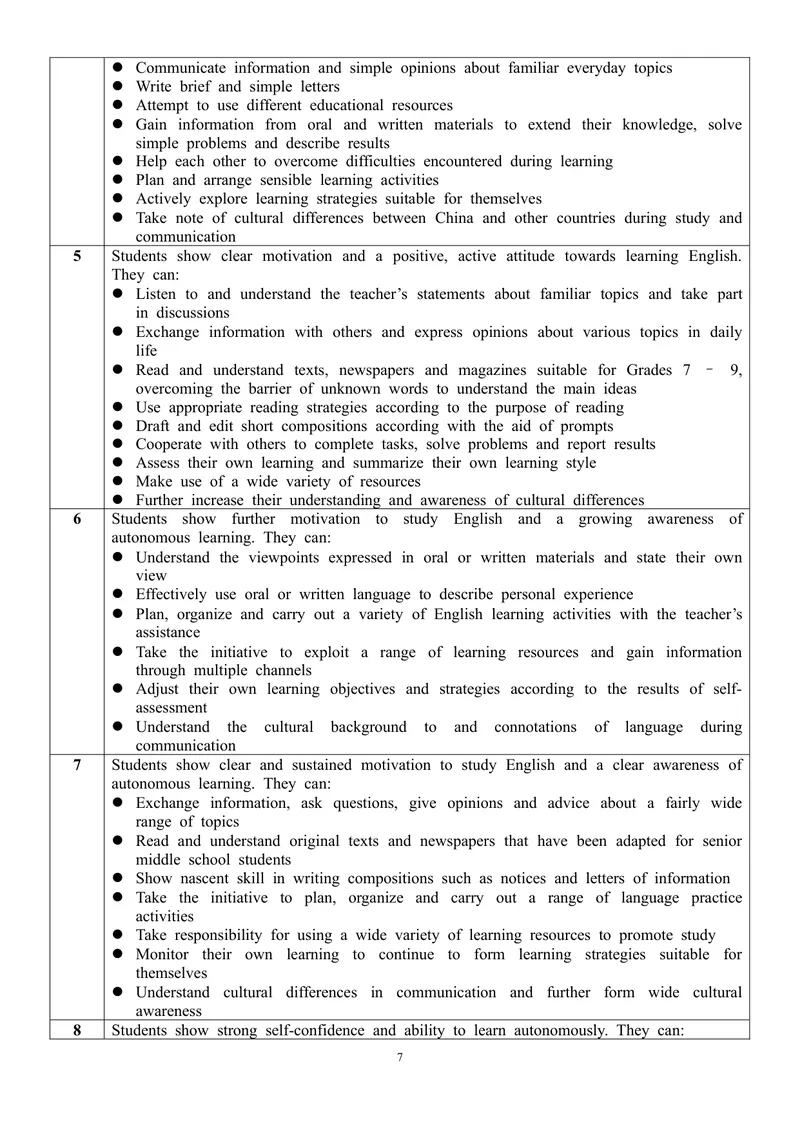
A further diagram illustrates the more comprehensive nature of the new curriculum compared to
the old one:
New Curriculum
Language Language Attitudes to Learning Cultural
Skills Knowledge Learning Strategies Awarenes
s
phonetics
vocabulary
grammar
functions
5
Curriculum Old
Knowledge Language
Language
Skillstopics
Comprehensive Language Competence
Diagram 3: Comparison of the Old and New Curriculums
Language skills and knowledge form the basis of comprehensive language competence
The students’ attitudes to learning strongly influence their learning and development
Successful learning strategies improve the effectiveness of students’ learning
Cultural awareness ensures students use language appropriately
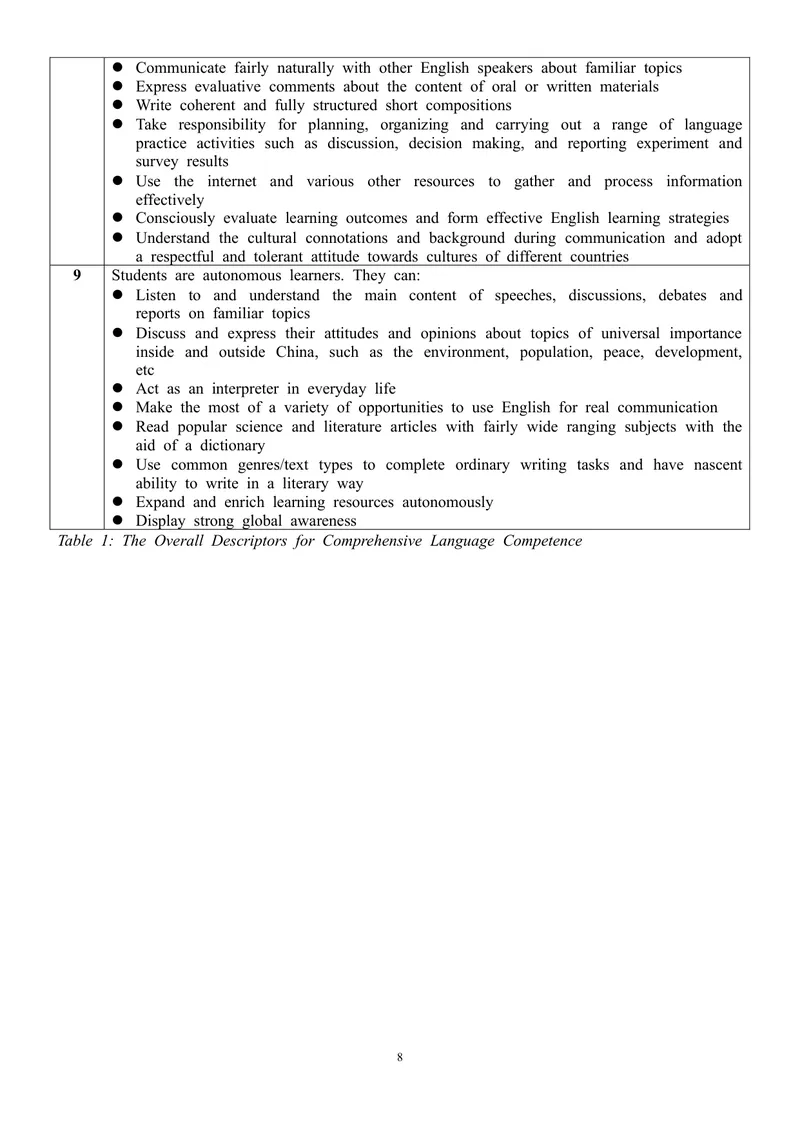
The overall descriptors for comprehensive language competence (i.e. a combination of all five
general objectives) for Levels 1 to 9 are presented below:
Level Descriptors
1 Students are curious about English and enjoy listening to people speaking English. They
can:
Play games, do actions and activities (e.g. colouring, joining lines) according to
simple instructions from the teacher
Perform simple role plays
Sing simple English songs
Say simple rhymes and chants
Understand simple stories by with the aid of pictures
Communicate simple personal information
Express simple feelings and attitudes
Write letters and words
Take interest in foreign cultural customs met during learning English
2 Students show a sustained interest in and enjoyment of learning English. They can:
Use simple English greetings and exchange personal information and information about
family and friends
Perform dialogues, songs, rhymes and chants about content they have studied
Understand and narrate simple stories with the aid of pictures
Write simple sentences with the aid of pictures or prompts
Participate and cooperate actively and happily
Take the initiative to ask for help
Enjoy learning about other countries’ cultures and customs
3 Students show a positive attitude and the beginnings of self-confidence towards learning
English. They can:
Understand short and simple stories about familiar topics that they hear
Exchange information about familiar topics (e.g. school, family life) with the teacher
or classmates
Read and understand short stories and other simple written material
Write simple sentences with the aid of examples or pictures
Take part in simple role plays and activities
Attempt to use suitable learning strategies to overcome difficulties encountered during
study
Identify cultural differences that are present when communicating in a foreign
language
4 Students can identify their own learning needs and targets and are fairly self-confident
about learning English. They can:
Listen to and understand dialogues and short stories in everyday communication
6 Communicate information and simple opinions about familiar everyday topics
Write brief and simple letters
Attempt to use different educational resources
Gain information from oral and written materials to extend their knowledge, solve
simple problems and describe results
Help each other to overcome difficulties encountered during learning
Plan and arrange sensible learning activities
Actively explore learning strategies suitable for themselves
Take note of cultural differences between China and other countries during study and
communication
5 Students show clear motivation and a positive, active attitude towards learning English.
They can:
Listen to and understand the teacher’s statements about familiar topics and take part
in discussions
Exchange information with others and express opinions about various topics in daily
life
Read and understand texts, newspapers and magazines suitable for Grades 7 – 9,
overcoming the barrier of unknown words to understand the main ideas
Use appropriate reading strategies according to the purpose of reading
Draft and edit short compositions according with the aid of prompts
Cooperate with others to complete tasks, solve problems and report results
Assess their own learning and summarize their own learning style
Make use of a wide variety of resources
Further increase their understanding and awareness of cultural differences
6 Students show further motivation to study English and a growing awareness of
autonomous learning. They can:
Understand the viewpoints expressed in oral or written materials and state their own
view
Effectively use oral or written language to describe personal experience
Plan, organize and carry out a variety of English learning activities with the teacher’s
assistance
Take the initiative to exploit a range of learning resources and gain information
through multiple channels
Adjust their own learning objectives and strategies according to the results of self-
assessment
Understand the cultural background to and connotations of language during
communication
7 Students show clear and sustained motivation to study English and a clear awareness of
autonomous learning. They can:
Exchange information, ask questions, give opinions and advice about a fairly wide
range of topics
Read and understand original texts and newspapers that have been adapted for senior
middle school students
Show nascent skill in writing compositions such as notices and letters of information
Take the initiative to plan, organize and carry out a range of language practice
activities
Take responsibility for using a wide variety of learning resources to promote study
Monitor their own learning to continue to form learning strategies suitable for
themselves
Understand cultural differences in communication and further form wide cultural
awareness
8 Students show strong self-confidence and ability to learn autonomously. They can:
7 Communicate fairly naturally with other English speakers about familiar topics
Express evaluative comments about the content of oral or written materials
Write coherent and fully structured short compositions
Take responsibility for planning, organizing and carrying out a range of language
practice activities such as discussion, decision making, and reporting experiment and
survey results
Use the internet and various other resources to gather and process information
effectively
Consciously evaluate learning outcomes and form effective English learning strategies
Understand the cultural connotations and background during communication and adopt
a respectful and tolerant attitude towards cultures of different countries
9 Students are autonomous learners. They can:
Listen to and understand the main content of speeches, discussions, debates and
reports on familiar topics
Discuss and express their attitudes and opinions about topics of universal importance
inside and outside China, such as the environment, population, peace, development,
etc
Act as an interpreter in everyday life
Make the most of a variety of opportunities to use English for real communication
Read popular science and literature articles with fairly wide ranging subjects with the
aid of a dictionary
Use common genres/text types to complete ordinary writing tasks and have nascent
ability to write in a literary way
Expand and enrich learning resources autonomously
Display strong global awareness
Table 1: The Overall Descriptors for Comprehensive Language Competence
8Part 3: The General Objectives in Detail
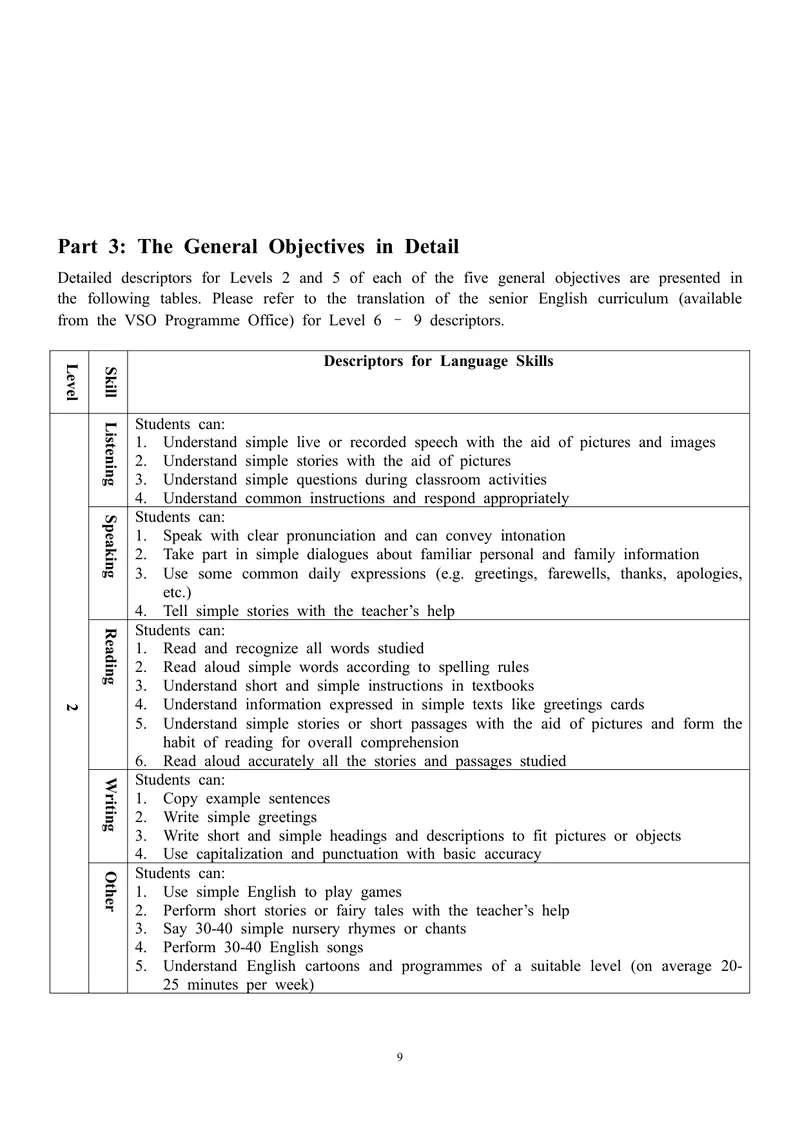
Detailed descriptors for Levels 2 and 5 of each of the five general objectives are presented in
the following tables. Please refer to the translation of the senior English curriculum (available
from the VSO Programme Office) for Level 6 – 9 descriptors.
Level Skill
Descriptors for Language Skills
2
Listening
Students can:
1. Understand simple live or recorded speech with the aid of pictures and images
2. Understand simple stories with the aid of pictures
3. Understand simple questions during classroom activities
4. Understand common instructions and respond appropriately
Speaking
Students can:
1. Speak with clear pronunciation and can convey intonation
2. Take part in simple dialogues about familiar personal and family information
3. Use some common daily expressions (e.g. greetings, farewells, thanks, apologies,
etc.)
4. Tell simple stories with the teacher’s help
Reading
Students can:
1. Read and recognize all words studied
2. Read aloud simple words according to spelling rules
3. Understand short and simple instructions in textbooks
4. Understand information expressed in simple texts like greetings cards
5. Understand simple stories or short passages with the aid of pictures and form the
habit of reading for overall comprehension
6. Read aloud accurately all the stories and passages studied
Writing
Students can:
1. Copy example sentences
2. Write simple greetings
3. Write short and simple headings and descriptions to fit pictures or objects
4. Use capitalization and punctuation with basic accuracy
Other
Students can:
1. Use simple English to play games
2. Perform short stories or fairy tales with the teacher’s help
3. Say 30-40 simple nursery rhymes or chants
4. Perform 30-40 English songs
5. Understand English cartoons and programmes of a suitable level (on average 20-
25 minutes per week)
95
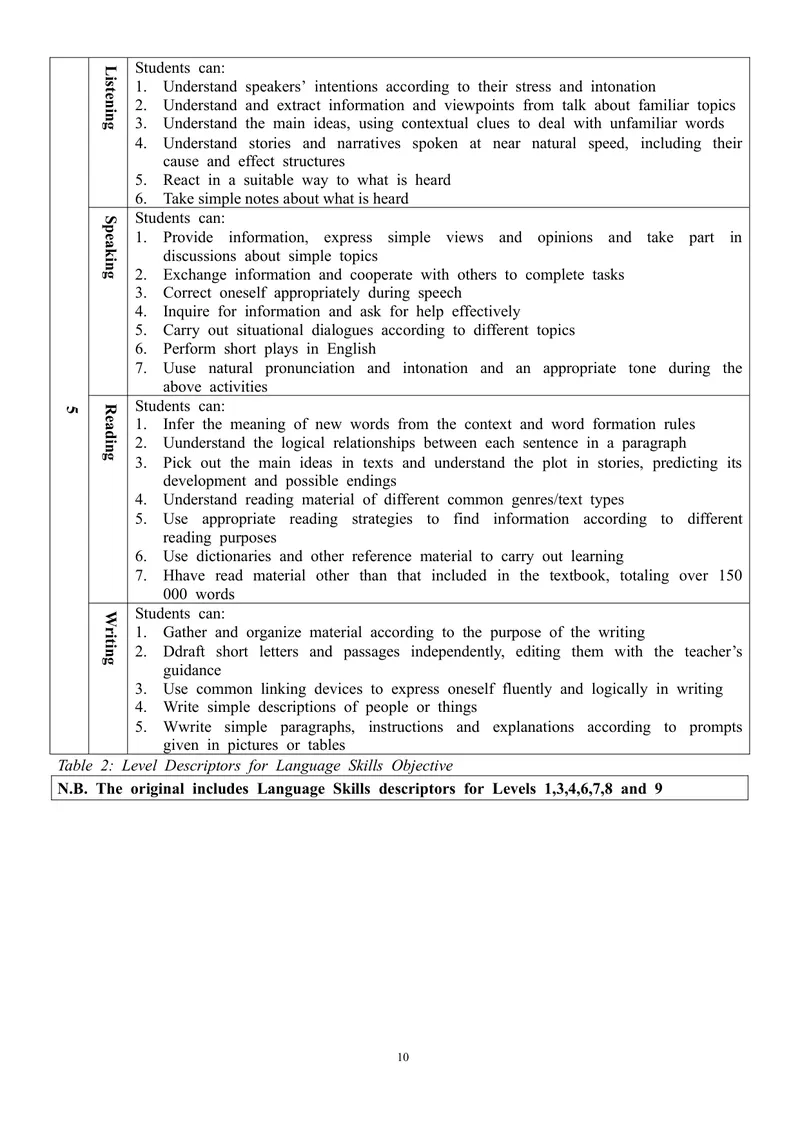
Listening
Students can:
1. Understand speakers’ intentions according to their stress and intonation
2. Understand and extract information and viewpoints from talk about familiar topics
3. Understand the main ideas, using contextual clues to deal with unfamiliar words
4. Understand stories and narratives spoken at near natural speed, including their
cause and effect structures
5. React in a suitable way to what is heard
6. Take simple notes about what is heard
Speaking
Students can:
1. Provide information, express simple views and opinions and take part in
discussions about simple topics
2. Exchange information and cooperate with others to complete tasks
3. Correct oneself appropriately during speech
4. Inquire for information and ask for help effectively
5. Carry out situational dialogues according to different topics
6. Perform short plays in English
7. Uuse natural pronunciation and intonation and an appropriate tone during the
above activities
Reading
Students can:
1. Infer the meaning of new words from the context and word formation rules
2. Uunderstand the logical relationships between each sentence in a paragraph
3. Pick out the main ideas in texts and understand the plot in stories, predicting its
development and possible endings
4. Understand reading material of different common genres/text types
5. Use appropriate reading strategies to find information according to different
reading purposes
6. Use dictionaries and other reference material to carry out learning
7. Hhave read material other than that included in the textbook, totaling over 150
000 words
Writing
Students can:
1. Gather and organize material according to the purpose of the writing
2. Ddraft short letters and passages independently, editing them with the teacher’s
guidance
3. Use common linking devices to express oneself fluently and logically in writing
4. Write simple descriptions of people or things
5. Wwrite simple paragraphs, instructions and explanations according to prompts
given in pictures or tables
Table 2: Level Descriptors for Language Skills Objective
N.B. The original includes Language Skills descriptors for Levels 1,3,4,6,7,8 and 9
10Level Knowledge
Descriptors for Language Knowledge
2
n Pronunciatio
Students can
1. Know incorrect pronunciation can affect communication
2. Know how to say the alphabet
3. Understand simple spelling rules
4. Understand words have stress patterns
5. Pronounce clearly with natural intonation
y Vocabular
Students can:
1. Learn the 600-700 words and 50 or so common expressions associated with the
topics for this unit
2. Uunderstand words are formed from letters
Grammar
Students can:
1. Know nouns have singular and plural forms
2. Know the difference between the main pronouns
3. Know verbs can change forms in different situations
4. Understand prepositions to express time, place and position
5. Understand the basic forms and functions of simple English sentences
Functions
Students can understand the basic forms for expressing simple communicative
functions such as greetings, farewells, thanks, accepting apologies, introductions,
requests, etc.
Topics
Students can understand and express simple information about the following topics:
numbers, colours, time, weather, food, clothes, toys, plants and animals, the body,
personal and family circumstances, school, friends, hobbies and sports, festivals, etc.
5
Phonetics
Students can:
1. Understand the significance of phonetics within language learning
2. Uunderstand English phonetics includes pronunciation, stress, linking, intonation
and rhythm
3. Speak with basically accurate, natural and fluent pronunciation and intonation in
daily communication
4. Understand and express different intentions by altering stress and intonation
appropriately
5. Spell words and phrases according to their pronunciation
Vocabulary
Students can:
1. Understand English vocabulary includes such items as words, phrases, expressions
and collocations
2. Understand and distinguish between the basic meanings of words and their
meanings in special situations
3. Use vocabulary to describe things, behaviour and characteristics, explain
principles, etc.
4. Learn and use 1500-1600 words and 200-300 expressions and collocations
11Grammar
Students can:
1. Understand common forms and structures and their functions
2. Llearn and distinguish between the functions of different forms and structures
during real language use
3. Understand and master how to describe of people and things
4. Understand and master how to describe specific factual and behavioural
phenomena and develop the ability to describe processes
5. Begin to master how to describe time, place and position
6. Understand and master how to compare people, objects and things
Functions
Students can:
1. Understand and suitably express everyday communicative functions such as
greetings, farewells, thanks, introductions and so on
2. Effectively express themselves in everyday communication with others
Topics
Students are:
1. Familiar with topics closely related to themselves, their families and school life
2. Ffamiliar with topics related to everyday life, hobbies and interests, social
customs, science and culture, etc.
Table 3: Level Descriptors for Language Knowledge Objective
Level
Descriptors for Attitudes to Learning
2
1. Students listen to and speak English, recite rhymes, sing songs, tell stories and play
games with interest.
2. Students imitate happily, open their mouths bravely, participate actively and ask for help
autonomously.
5
1. Students have clear learning objectives that can be met through communication.
2. Students have an interest in and desire to learn English, happily taking part in a variety
of language practice activities.
3. Students have the self-confidence to learn English well and the courage to use English
to express themselves.
4. Students can actively cooperate with and help others in small groups to complete
learning tasks.
5. Students can experience the pleasure of learning English through contact with English
songs, reading material, etc.
6. Students pay attention to and understand other people’s feelings during communication.
7. When students encounter problems they can take the initiative to ask for help from the
teacher or their classmates.
8. When encountering English during daily life, students happily investigate its meaning
and try to copy it.
9. Students have a deepened understanding of their own culture.
10. Students happily get in touch with and understand the cultures of different countries.
Table 4: Level Descriptors for Affective Attitudes Objective
12Level Type
Strategy
Descriptors for Learning Strategies
2
Basic
Learning
Strategies
Students can:
1. Actively cooperate with others to complete learning tasks
2. Take initiative to ask the teacher or classmates for help
3. Establish a simple study plan
4. Independently practice what has been learnt
5. Build connections between words and what they represent
6. Learn with concentration and focus
7. Try to read English stories and other kinds of non-curricular reading material
8. Actively use the English they have learnt to express themselves and
communicate
9. Take note of simple English found in daily life and the media
10. Begin to use simple students’ English/Chinese dictionaries
5
Cognitive
Strategies
Students can:
1. Preview material as necessary
2. Learn with concentration and focus
3. Actively think when learning
4. Note key points well during learning
5. Uuse pictures and other non-linguistic clues well to understand main ideas
6. Uuse association to help learn and remember words
7. Take the initiative to review, sort and summarize what they have learnt
8. Try to discover language rules and infer general rules from single cases
9. Realize they have made mistakes when using English and correct themselves
appropriately
10. Use knowledge of Chinese when necessary to help them understand English
more effectively
11. Try to read English stories and other non-curricular reading material
Strategies
Metacognitive
Students can:
1. Know their own English learning objectives clearly
2. Know their own learning needs clearly
3. Establish simple study plans
4. Grasp the main content of what they learn
5. Pay attention to understanding and reflecting on their own progress and
shortcomings
6. Actively explore learning styles that are suitable for themselves
7. Often share studying experiences with teachers and classmates
8. Actively participate in classroom and extracurricular English learning activities
Strategies
Communication
Students can:
1. Communicate with others in English during classroom and extracurricular
learning activities
2. Make good use of opportunities to communicate in English
3. Concentrate on expressing their meaning when communicating
4. Use gestures, facial expressions and so on to help communicate when necessary
5. Ask for help effectively when they experience communication problems
6. Recognize cultural differences in Chinese and foreign modes of communication
13Strategies Resource
Students can:
1. Enrich their learning through the use of audio visual materials
2. Use dictionaries and simple reference books to find information
3. Take note of all the English used in real life and the media
4. Begin to use learning resources available in libraries or on the Internet
Table 5: Level Descriptors for Learning Strategies Objective
Level
Descriptors for Cultural Awareness
2
Students can:
1. Know the simple forms of address, greetings and farewells in English
2. Rrespond appropriately to ordinary compliments, requests, etc.
3. Know the main international sports and entertainments
4. Know the names of the most popular foods and drinks in English speaking countries
5. Know the capitals and flags of the major English speaking countries
6. Know the important symbols of major countries, such as the UK’s Big Ben
7. Know the main festivals of English speaking countries
5
Students can:
1. Understand common body language, gestures and facial expressions used in English
communication
2. Use different forms of address, greetings and farewells appropriately in English
3. Know the difference between male and female names and common affectionate forms of
address
4. Know the names commonly used by family members to refer to each other in English
speaking countries
5. Understand dress codes for formal and informal occasions in English speaking countries
6. Understand eating and drinking customs in English speaking countries
7. Respond appropriately to other people’s compliments, requests, etc.
8. Use appropriate forms to give compliments, make requests, etc.
9. Begin to understand the geographical position, climate, history and so on of English
speaking countries
10. Understand the cultural significance of common plants and animals in English speaking
countries
11. Understand that natural phenomena possibly have cultural significance in the English
language
12. Understand the traditional leisure and sporting activities of English speaking countries
13. Understand the main holidays and festivals of English speaking countries and how they
are celebrated
14. Deepen their knowledge of Chinese culture
Table 6: Level Descriptors for Cultural Awareness
Part 4: Guidelines for Implementation
1. Suggestions for Teaching and Learning
141.1Lay the groundwork for students’ all-round and lifelong development
Teaching and learning should meet the diverse needs of all students, ensuring the healthy
development of their mind and body. In particular the teacher should pay attention to the
following:
Encourage students to use English bravely, taking a lenient attitude towards mistakes they
make during the learning process.
Provide students with ample opportunities to collaborate with others and to become
autonomous learners.
Give students plenty of space for self-development.
Encourage students to develop their language skills in an integrated way through experiential,
practical, cooperative and inquiry-based learning.
Create conditions that allow students to explore questions they are personally interested in and
solve problems by themselves.
1.2Create a relaxed, democratic and harmonious learning environment
Positive attitudes are an essential condition for effective learning. Negative attitudes can not only
reduce the effectiveness of study but also adversely affect students’ long-term development. In
particular, teachers should heed the following:
Respect each individual student, actively encouraging everyone to try and safeguarding their
self-esteem and enthusiasm.
Integrate students’ English education with their emotional education. Develop cooperative spirit
by organizing learning activities that let students work together, help each other and experience
group recognition and achievement.
Pay particular attention to introverted students or weak learners, trying to give them as many
language practice opportunities as possible.
Establish a friendly and democratic channel of communication between students and teacher,
frequently reflecting on the learning process and results together, and offering mutual help and
support.
1.3Use task-based learning methods to promote students comprehensive language competence
Teachers should try to adopt task-based learning methods as much as possible. Teachers should
creatively design learning activities that are relevant to the students’ real lives, according to the
overall curriculum objectives and content. Teachers should engage students’ interest in the activity
and organize them effectively so that they participate actively and complete the tasks, learning
and using English through thinking, carrying out surveys, discussing, communicating and
cooperating. Attention should be paid to the following points when designing tasks:
Activities must have clear and achievable aims and objectives.
Activities must be relevant to students’ life experiences and interests; the content and style
should be as true to life as possible.
Activities must benefit the development of students’ language knowledge, language skills and
ability to use language for real communication.
Activities should be of a cross-curricular nature, promoting the integrated development of
students’ thinking and imagination, aesthetic and artistic sense, cooperative and creative spirit.
15 Activities should make students gather, process and use information, using English to
communicate with others in order to develop their ability to use English to solve real
problems.
Activities should not purely be limited to the classroom but also extend to out of school
learning.
N.B. In July 2005 VSO’s curriculum advisor, Professor Zhang Lianzhong, mentioned that this
section of the curriculum will be revised such that “we will take the TBL (Task-Based
Learning) approach as one of the useful tools within the big box of Communicative Language
Learning.”
1.4. Provide increased guidance about learning strategies
Helping students to adopt good study habits and effective learning strategies is one of the
important tasks of the new curriculum. Teachers should consciously give students guidance about
learning strategies so that, through learning and using English, they are learning how to learn. To
this end the teacher should observe the following:
Give students chances to establish their own study targets and the means of fulfilling these.
Help students to use inference, research and inquiry style methods to carry out their learning.
Develop students’ practical abilities and creative thinking by designing inquiry based activities.
Encourage students to use observation, discovery and induction to acquire language knowledge
and grasp language functions.
Help students to carry out self-assessment during the learning process and adjust their own
learning objectives and strategies appropriately according to the results.
1.4Develop students’ awareness of and ability in cross-cultural communication
Language and culture are closely related, language being the main transmitter and carrier of
culture. Teachers should work hard to help students achieve the following during the English
learning process:
Understand foreign cultures, especially those of English speaking countries
Use English appropriately
Constantly broaden their cultural horizons
Deepen their understanding of their own culture
Develop an awareness of and ability in cross-cultural communication
1.5Use modern teaching technology and expand learning opportunities
In order to increase the effectiveness of teaching and learning, teachers should make good use of
modern technology, expand the range resources and opportunities through which students can
learn, thereby modernizing learning ways. Conditions permitting, teachers should try to:
Use audiovisual material and the Internet to enrich the learning content and form and
improve outcomes.
Use computer and multi-media software to explore new teaching and learning methods and
promote more individualized study.
Create conditions for students to study more independently through sensible use of a variety
of learning resources, such as broadcasts, print media, libraries and the Internet.
161.6Organize lively and active extracurricular activities to promote students’ English learning
Teachers should arrange a variety of extracurricular activities according to the students’ age and
interests to help them expand their knowledge, broaden their horizons, strengthen their intellect and
individuality and use their talents. The content and form of these carefully planned activities
should be rich and varied. Suggestions include:
Recitals
Songs
Story telling
Speeches
Performances
English corner
English wall displays
Cclass discussions
Exhibitions
The teacher should be good at leading these activities to maintain students’ interest and foster
their creativity and initiative.
1.7Continue to develop professionally
Teachers should aim to:
Familiarize themselves with the principles, objectives, content, teaching and learning methods,
psychological theories and language learning research findings of this curriculum
Select and adjust English teaching and learning strategies according to their students’
psychological characteristics
Develop their ability to organize and monitor activities
Use a variety of teaching skills and methods flexibly
Master the use of modern educational technology, using it increasingly in their own
continuing study and real classroom practice
Consciously deepen their knowledge of Chinese and foreign cultures
Actively and creatively explore which teaching and learning methods best suit their students’
needs, local conditions and the objectives
Continuously reflect on their own practice, endeavouring to become a creative and research
driven teacher
1.8Follow high frequency principles to ensure effective teaching and learning
In Grades 3-6 there should be a minimum of four teaching and learning periods per week, with
shorter periods for the younger years. For Grades 5 and 6 classes should not exceed two periods in
length. In order to ensure the effectiveness of teaching and learning, class sizes should not
exceed 40 at primary level. Grades 7 –9 and senior school students should have a minimum of
four lessons a week.
N.B. The original provides five sample learning activities here that have not been translated.
172. Suggestions for Assessment and Evaluation
Assessment and evaluation is an important component of the new curriculum. Assessment should
be carried out according to the requirements of the curriculum standards, focusing not only on
the results but also the process of learning. The primary purposes of assessment are to:
Let students continuously experience progress and success during the learning process
Let students know their own progress and build confidence
Promote all aspects of students’ comprehensive language competence
Provide the teacher with feedback on the teaching and learning process
Help the teacher reflect on their own teaching practice and adjust it accordingly
Help the teacher continuously improve the quality of their teaching
Provide the school with prompt feedback on the implementation of the curriculum
Help improve educational management
Inform the ongoing development and perfection of the new English curriculum
The assessment system should diversify both the subjects and forms of assessment. Assessment
should focus on students’ comprehensive language competence, combining both formative
assessment (concentrating on the study process) and summative assessment (concentrating on the
learning outcomes).
Ensure that students are the subjects (not objects) of assessment
Students are at the centre of learning. The development of their comprehensive language
competence should be the starting point for both teaching and learning and assessment.
Assessment should help students know their own progress, develop self-confidence, reflect on
and adjust their own study process, thereby ensuring the continuous development of their
language ability.
Teachers should help students carry out self-assessment.
Students should be active participants and collaborators in a variety of assessment activities.
Assessment should be an organic part of teaching and learning activities.
Assessment should help students to analyse their own successes and shortcomings, clarifying
the direction in which they need to work.
Make sure formative assessment plays a role in student development
Formative assessment is an important component and driving element of teaching and learning.
Formative assessment should check the students’ learning outcomes, attitudes and strategies during
the everyday learning process. The purpose of formative assessment is to encourage students,
help students adjust the learning process effectively, help students gain a sense of achievement,
strengthen their self-confidence, and improve their cooperative spirit. Formative assessment helps
students develop from passive objects of assessment to active participants in the assessment
process. In order to let formative assessment become an organic part of the study process its
important to:
Establish an open and relaxed atmosphere for assessment
Use both tests and other methods
18 Use a combination of individual and small group assessment
Encourage students, classmates, teachers and parents to collectively participate in assessment,
thereby diversifying the subjects of assessment
Formative assessment can take many forms, such as:
Comparison and assessment of classroom learning activities
Self assessment of learning outcomes
A learning portfolio
Questionnaires
Interviews
Feedback from parents
Everyday quizzes and tests
Formative assessment can be recorded in the form of descriptions, levels or marks. No matter
what method is used, the role of assessment in encouraging learners must not be forgotten.
According to the assessment results, teachers should give students individual feedback, ensuring
their steady progress and encouraging them to reflect on and better themselves.
Make sure assessment methods are varied and flexible
Teachers must select assessment methods suitable for the age of the students and the learning
conditions. During formal assessment teachers should permit students to select assessment
methods that suit their characteristics or strengths. If students get unsatisfactory results during a
certain test they should be allowed to negotiate with the teacher to retake the test after sufficient
preparation.
Make sure assessment feedback is used to increase the effectiveness of teaching and learning
The teacher should ask themselves the following questions:
Does the assessment help promote autonomous learning and self-confidence?
Does the assessment reflect the students’ achievements?
Does the assessment reflect the teachers’ strengths and weaknesses?
Does the assessment reflect problems in the students’ learning process?
Teachers should promptly adjust their teaching methods and plans according to assessment
feedback.
Summative assessment should focus on checking students’ comprehensive language
competence
Summative assessment (such as end of term exams and graduation exams) is the main means of
measuring the level of students’ comprehensive language competence. It also reflects the
effectiveness of the teaching and learning process and is a major indicator of the schools’ quality
in managing teaching and learning. Summative assessment must have the target of assessing
students’ comprehensive language competence, striving to scientifically and comprehensively check
students’ language level at the end of a particular stage of learning. The following should be
observed:
Exams should include oral, listening and writing amongst other components in assessing
students’ comprehensive language competence.
Listening tests must account for a minimum of twenty percent of termly, yearly and
19graduation exams.
Listening tests should check students’ understanding and ability to gain information rather
than asking them to distinguish between different pronunciations.
Writing exams should avoid testing knowledge of phonetics or grammar in isolation.
There should be an increase in questions that require students to use English in a specific
language context.
Objective questions with a single correct answer should be reduced in favour of more
subjective questions with several correct answers.
Exam results should not be publicly displayed nor students ranked in order of their results.
Recognize the special characteristics of assessment for Grades 3 – 6
The main purpose of assessment at primary level should be to encourage students’ interest and
active participation in learning English. Assessment methods should be varied and choice should
be offered. Formative assessment should be the main type, focusing mainly on students’
performance and ability to cooperate during a variety of everyday teaching and learning activities.
In Grades 3 and 4 end of term or end of year assessment should use assessment activities
similar to normal teaching and learning activities. Through observing students’ behaviour and
discussing with them teachers should assess their ability to use English to do things.
For end of term or year assessment in Grades 5 and 6 a combination of oral and written
tests can be used. Oral tests should check students’ ability to use language to communicate
about content close to their real lives. Written tests should focus on checking their listening
and reading skills, using methods that are as active and lively as possible.
Pay attention to the relationship between assessment and teaching and learning
Pay attention to the proportion of teaching and learning time spent on assessment. Only carry
out assessment that has useful results. Avoid over-elaborate and time-consuming assessment
processes. Don’t let assessment become the sole end of teaching and learning.
The assessment of each level should be founded on the general objectives
The general objectives should be the basis for all assessment. Since the assessment of Level 2
will be organized by individual places and schools, formative assessment should be the main
means. The same applies to all other levels apart from Levels 5 and 8, whose assessment is
organized by national and provincial education bodies. Selection exams should unite the
requirements of this curriculum with those of local conditions to establish suitable levels and test
demands.
N.B. Six examples of assessment documents are provide in the original. They are just listed
here.
Example 1: Self assessment questionnaire for Grade 7-9 students about learning strategies
Includes statements such as:
I can concentrate during study.
During communication I use gestures and facial expressions to help express myself.
20 I often use associations to help study and remember new words
Students choose between ‘never’, ‘rarely’, ‘sometimes’, ‘often’ and ‘always’.
Example 2: Assessment reference sheet for Grade 3-6 for English ‘playing, performing,
watching, speaking and listening’
Example 3: Formative assessment scheme for Grade 3-6 listening at Level 2
Example 4: Guidelines for using student portfolios
Portfolios might include:
Some kind of baseline assessment
A record of the students’ classroom performance – e.g. participation in role-plays,
volunteering to read something aloud, etc.
Examples of the students’ best written homework, as selected by themselves
Teachers’ and parents’ observations on the students’ study situation
Results of tests and quizzes marked by the teacher, student or students’ classmates, either as
grades or written comments
Students’ self-assessments and reflections on their own attitude, methods and outcomes
Example 5: Guidelines for oral tests
End of term or end of year oral tests should test students’ real ability to express themselves orally.
Students can be tested in groups of two, three or four. According to a situation or topic (that
might be presented through words or pictures), students discuss and communicate. Teachers
should assess their oral expression, communicative ability and effectiveness. The following
questions may be useful:
Is information coherent and easily expressed? (Students may make grammar and vocabulary
mistakes that affect the accuracy but the basic information is still transmitted effectively.)
Are the pronunciation, intonation and rhythm natural? Can the speaker be understood?
Does the speaker use appropriate communication strategies, such as repetition, clarification,
using expressions and gestures, to complete the activity successfully?
Example 6: Reference sheet for the assessment of writing for Levels 3 – 8.
3. Exploitation and Use of Curricular Resources
4. The compilation of teaching materials and guidelines for their use
N.B. A full translation of these final two sections is incorporated in the translation of the
senior English curriculum available from the Programme Office.
21Source of this translation:
英语课程标准教师读本 (修订本),华中师范大学出版社, 2003, 武汉,
ISBN 7-5622-2557-5/G.1317
22