2024-2025 学年九年级上学期期中模拟卷(云南专用)
英  语
(本试卷共三个部分,满分70 分,时间120 分钟)
注意事项:
1. 答卷前,考生务必在答题卡上用黑色字迹的钢笔或签字笔填写自己的考生号、姓名、试室号、座位号,
再用2B 铅笔把对应这两个号码的标号涂黑。
2. 选择题每小题选出答案后,用2B 铅笔把答题卡上对应题目的答案标号涂黑。如需要改动,用橡皮擦干
净后,再选涂其他答案。不能答在试卷上。
3. 非选择题必须用黑色字迹的钢笔或签字笔作答,答案必须写在答题卡各题目指定区域的相应位置上;如
需要改动,先划掉原来的答案,然后再写上新的答案,改动的答案也不能超出指定的区域;不准使用铅
笔、圆珠笔和涂改液。不按以上要求作答的答案无效。
4. 难度系数:0.65。
5. 考生务必保持答题卡的整洁,考试结束时,将答题卡交回。
第一部分  英语知识运用(共两节,满分20 分)
第一节  单项填空(共10 小题;每小题1 分,满分10 分)
从题中所给的 A、B、C、D 四个选项中选出能填入空白处的最佳选项,并将所选答案涂到答题卡的相应位
置上。
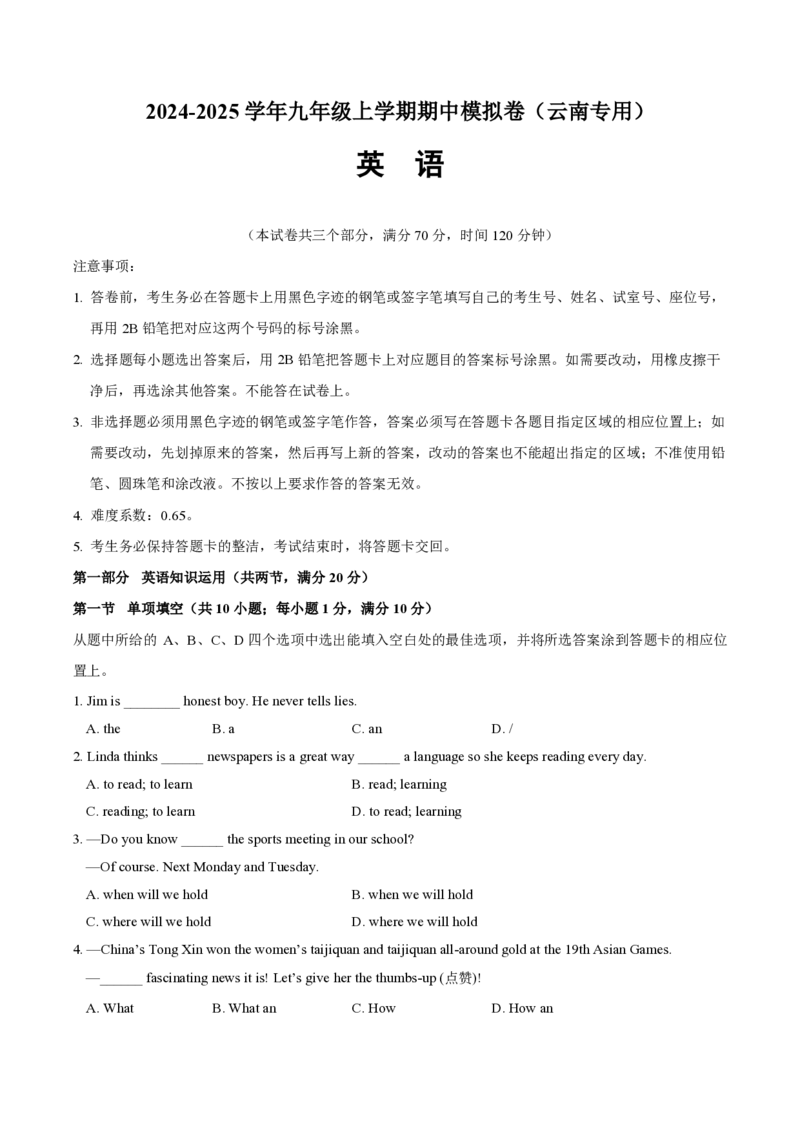
1. Jim is ________ honest boy. He never tells lies.
A. the
B. a
C. an
D. /
2. Linda thinks ______ newspapers is a great way ______ a language so she keeps reading every day.
A. to read; to learn
B. read; learning
C. reading; to learn
D. to read; learning
3. —Do you know ______ the sports meeting in our school?
—Of course. Next Monday and Tuesday.
A. when will we hold
B. when we will hold
C. where will we hold
D. where we will hold
4. —China’s Tong Xin won the women’s taijiquan and taijiquan all-around gold at the 19th Asian Games.
—______ fascinating news it is! Let’s give her the thumbs-up (点赞)!
A. What
B. What an
C. How
D. How an
公众号:初中英语助手
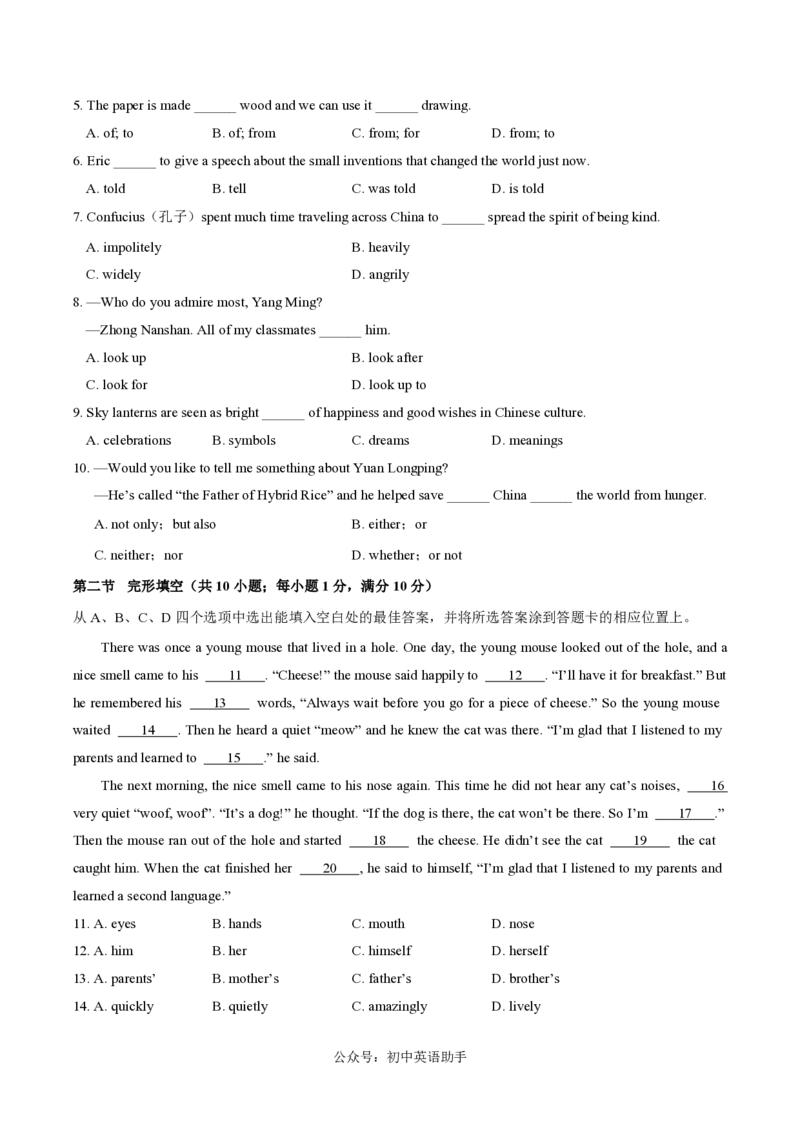
5. The paper is made ______ wood and we can use it ______ drawing.
A. of; to
B. of; from
C. from; for
D. from; to
6. Eric ______ to give a speech about the small inventions that changed the world just now.
A. told
B. tell
C. was told
D. is told
7. Confucius(孔子)spent much time traveling across China to ______ spread the spirit of being kind.
A. impolitely
B. heavily
C. widely
D. angrily
8. —Who do you admire most, Yang Ming?
—Zhong Nanshan. All of my classmates ______ him.
A. look up
B. look after
C. look for
D. look up to
9. Sky lanterns are seen as bright ______ of happiness and good wishes in Chinese culture.
A. celebrations
B. symbols
C. dreams
D. meanings
10. —Would you like to tell me something about Yuan Longping?
—He’s called “the Father of Hybrid Rice” and he helped save ______ China ______ the world from hunger.
A. not only;but also
B. either;or
C. neither;nor
D. whether;or not
第二节  完形填空(共10 小题;每小题1 分,满分10 分)
从A、B、C、D 四个选项中选出能填入空白处的最佳答案,并将所选答案涂到答题卡的相应位置上。
There was once a young mouse that lived in a hole. One day, the young mouse looked out of the hole, and a
nice smell came to his     11    . “Cheese!” the mouse said happily to     12    . “I’ll have it for breakfast.” But
he remembered his     13     words, “Always wait before you go for a piece of cheese.” So the young mouse
waited     14    . Then he heard a quiet “meow” and he knew the cat was there. “I’m glad that I listened to my
parents and learned to     15    .” he said.
The next morning, the nice smell came to his nose again. This time he did not hear any cat’s noises,     16
very quiet “woof, woof”. “It’s a dog!” he thought. “If the dog is there, the cat won’t be there. So I’m     17    .”
Then the mouse ran out of the hole and started     18     the cheese. He didn’t see the cat     19     the cat
caught him. When the cat finished her     20    , he said to himself, “I’m glad that I listened to my parents and
learned a second language.”
11. A. eyes
B. hands
C. mouth
D. nose
12. A. him
B. her
C. himself
D. herself
13. A. parents’
B. mother’s
C. father’s
D. brother’s
14. A. quickly
B. quietly
C. amazingly
D. lively
15. A. wait
B. say
C. hear
D. smell
16. A. and
B. so
C. instead
D. or
17. A. special
B. active
C. safe
D. blind
18. A. making
B. eating
C. heating
D. frying
19. A. when
B. after
C. unless
D. until
20. A. work
B. meal
C. cheese
D. class
第二部分  阅读理解(共三节,满分30 分)
第一节(共5 小题;每小题1. 5 分,满分7. 5 分)
根据短文内容,判断正误(正确“T”,错误“F”)。
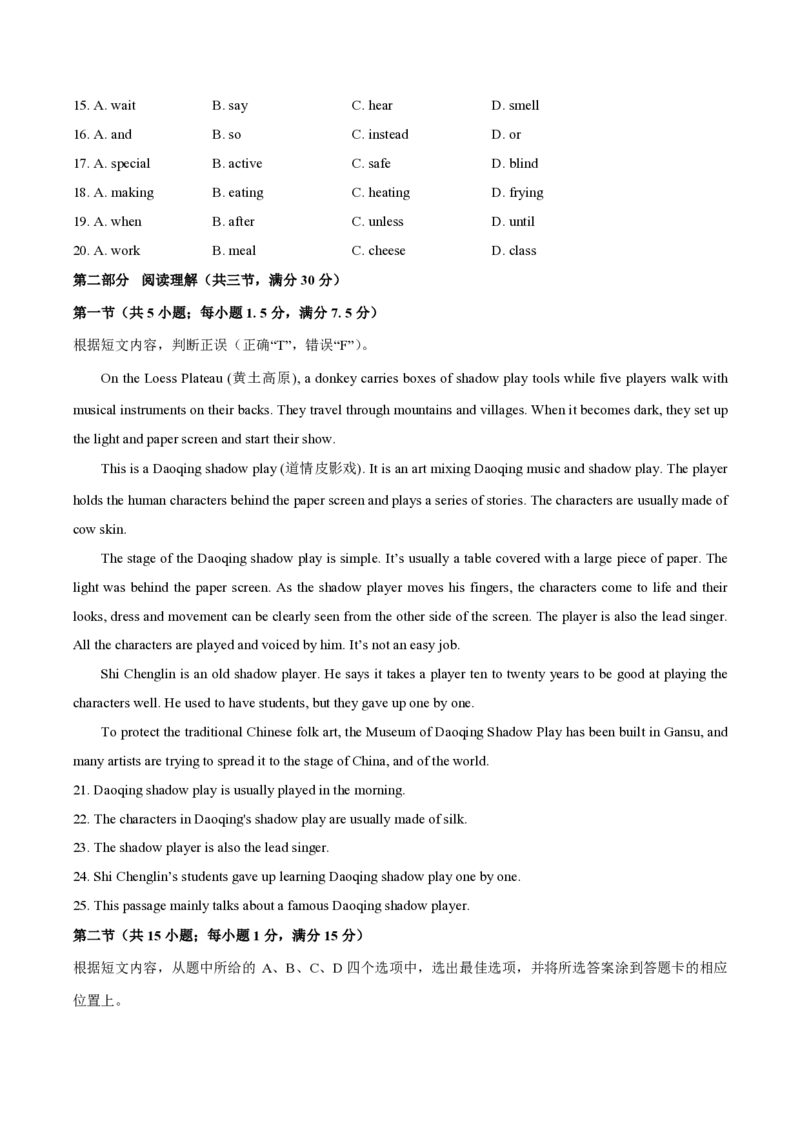
On the Loess Plateau (黄土高原), a donkey carries boxes of shadow play tools while five players walk with
musical instruments on their backs. They travel through mountains and villages. When it becomes dark, they set up
the light and paper screen and start their show.
This is a Daoqing shadow play (道情皮影戏). It is an art mixing Daoqing music and shadow play. The player
holds the human characters behind the paper screen and plays a series of stories. The characters are usually made of
cow skin.
The stage of the Daoqing shadow play is simple. It’s usually a table covered with a large piece of paper. The
light was behind the paper screen. As the shadow player moves his fingers, the characters come to life and their
looks, dress and movement can be clearly seen from the other side of the screen. The player is also the lead singer.
All the characters are played and voiced by him. It’s not an easy job.
Shi Chenglin is an old shadow player. He says it takes a player ten to twenty years to be good at playing the
characters well. He used to have students, but they gave up one by one.
To protect the traditional Chinese folk art, the Museum of Daoqing Shadow Play has been built in Gansu, and
many artists are trying to spread it to the stage of China, and of the world.
21. Daoqing shadow play is usually played in the morning.
22. The characters in Daoqing's shadow play are usually made of silk.
23. The shadow player is also the lead singer.
24. Shi Chenglin’s students gave up learning Daoqing shadow play one by one.
25. This passage mainly talks about a famous Daoqing shadow player.
第二节(共15 小题;每小题1 分,满分15 分)
根据短文内容,从题中所给的 A、B、C、D 四个选项中,选出最佳选项,并将所选答案涂到答题卡的相应
位置上。
公众号:初中英语助手
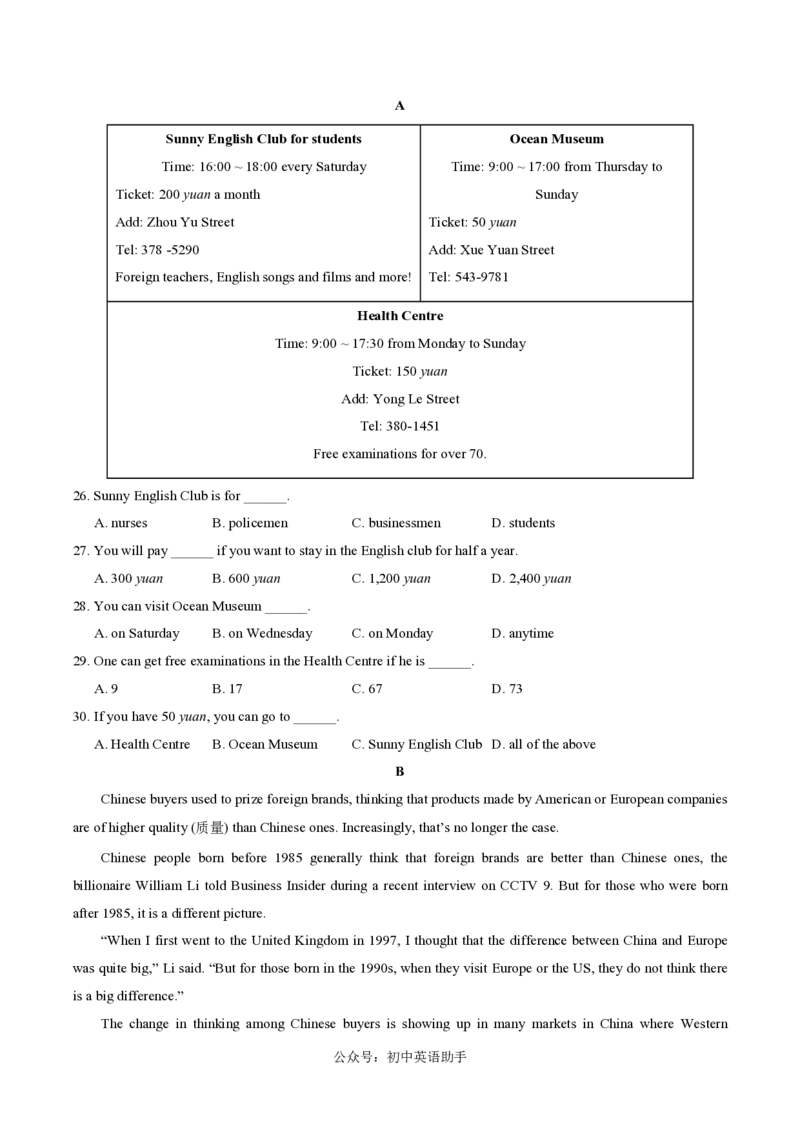
A
Sunny English Club for students
Time: 16:00 ~ 18:00 every Saturday
Ticket: 200 yuan a month
Add: Zhou Yu Street
Tel: 378 -5290
Foreign teachers, English songs and films and more!
Ocean Museum
Time: 9:00 ~ 17:00 from Thursday to
Sunday
Ticket: 50 yuan
Add: Xue Yuan Street
Tel: 543-9781
Health Centre
Time: 9:00 ~ 17:30 from Monday to Sunday
Ticket: 150 yuan
Add: Yong Le Street
Tel: 380-1451
Free examinations for over 70.
26. Sunny English Club is for ______.
A. nurses
B. policemen
C. businessmen
D. students
27. You will pay ______ if you want to stay in the English club for half a year.
A. 300 yuan
B. 600 yuan
C. 1,200 yuan
D. 2,400 yuan
28. You can visit Ocean Museum ______.
A. on Saturday
B. on Wednesday
C. on Monday
D. anytime
29. One can get free examinations in the Health Centre if he is ______.
A. 9
B. 17
C. 67
D. 73
30. If you have 50 yuan, you can go to ______.
A. Health Centre
B. Ocean Museum
C. Sunny English Club D. all of the above
B
Chinese buyers used to prize foreign brands, thinking that products made by American or European companies
are of higher quality (质量) than Chinese ones. Increasingly, that’s no longer the case.
Chinese people born before 1985 generally think that foreign brands are better than Chinese ones, the
billionaire William Li told Business Insider during a recent interview on CCTV 9. But for those who were born
after 1985, it is a different picture.
“When I first went to the United Kingdom in 1997, I thought that the difference between China and Europe
was quite big,” Li said. “But for those born in the 1990s, when they visit Europe or the US, they do not think there
is a big difference.”
The change in thinking among Chinese buyers is showing up in many markets in China where Western
companies used to control. A study by Credit Suisse published in March found that young Chinese buyers are
increasingly showing a “home brand bias”.
More than 90% of young Chinese buyers would prefer to buy home appliance brands, according to the study.
Meanwhile, home companies producing food, drinks, or personal care products increased their share of the market
by 3. 3% over the last ten years to nearly 70%.
“Chinese buyers, especially the younger ones, don’t just believe that foreign brands are better.
Right now, Chinese buyers think China is good and ‘Made in China’ is not bad at all,” Charlie Chen, head of
China buyer research at Credit Suisse, told South China Morning Post in March.
The Chinese smartphone market is controlled by home companies—Huawei, Oppo, Vivo, and Xiaomi. Apple
is the only foreign brand in the top five, but it has lost large ground to the home brands in recent years. Its market
share is believed to be down to 37% from a 2015 high of 54%.
31. What is this passage mainly about?
A. The quality of “Made in China”.
B. The change in Chinese buyers’ thinking.
C. Chinese products in the eye of foreigners.
D. Difference between older and younger Chinese buyers.
32. Which of the following is true according to the text?
A. More and more foreigners go to buy Chinese products.
B. Foreign products are more expensive than Chinese ones.
C. More and more Chinese buyers prefer Chinese products.
D. Older Chinese people don’t like foreign products anymore.
33. Which fact best explains “home brand bias”?
A. Apple had a market share of 54% in 2015.
B. More than 90% of young Chinese buyers prefer home brands.
C. Chinese people born before 1985 think that foreign brands are better.
D. William Li found a big difference between China and Europe in 1997.
34. Who did most of the research for this report?
A. Credit Suisse.
B. CCTV 9.
C. South China Morning Post.
D. Business Insider.
35. What’s the best title for this passage?
A. Chinese products get more popular at home
B. Young Chinese are crazy about foreign brands
C. “Made in China” is welcomed all over the world
D. Apple has lost large ground to Huawei in China
C
公众号:初中英语助手
In the 13th century, Marco Polo saw many wonderful things in China. One of the things he discovered was
money made of paper. People in the West did not have such kind of money until the 15th century. However, the
Chinese began to use it in the 7th century.
Paper was invented by a Chinese man called Cai Lun almost 2,000 years ago. But it was not made in Europe
until the year 1100. Four hundred years later, a German discovered that he could make the best paper from trees.
After that countries rich in forests, such as Canada, Sweden, America, and Finland became the most important ones
in paper making.
Paper can be used in many ways. The common uses include newspapers, magazines and books. But do you
know that paper can be used for keeping warm? In Finland, the farmers wear paper boots to keep their feet warm in
the snow. And even houses can be insulated (使绝缘) from heat or cold with paper.
However, we have to understand that paper still comes from trees now. If we keep on wasting so much paper,
there will not be any trees left on the earth someday in the near future. Every day people throw away about 2,800
tons of paper in our city. It takes 17 trees to make one ton of paper. This means that we are cutting down nearly
48,000 trees every day. The fact is that it takes more than 10 years for a tree to grow.
So we must start saving paper right now. We can use both sides of every piece of paper. We can make useful
things out of used paper. We can use china cups instead of paper ones. When shopping, we can use fewer paper
bags and reuse them if we have some.
In short, we should keep a balance between using paper and protecting trees, and do it now before it is too late.
36. When did people in the West have paper money?
A. In the 5th century.
B. In the 13th century.
C. In the 7th century.
D. In the 15th century.
37. Why did America become an important country in paper making?
A. Because it had a large population.
B. Because it was a large country.
C. Because it had lots of forests.
D. Because it was a rich country.
38. What is paper used for in Finland?
A. Keeping warm.
B. Making newspaper.
C. Reducing waste.
D. Making books.
39. Which of the following is TRUE?
A. Seventy trees are needed to make one ton of paper.
B. Marco Polo found money made of paper in China.
C. Used paper can not be used again.
D. It takes five years for a tree to grow.
40. What’s the best title of this passage?
A. Save Paper
B. History of Making Paper
C. Information of Paper
D. The Use of Paper
第三节(共5 小题;每小题1.5 分,满分7.5 分)
根据短文内容,从短文后所给的选项中,选出能填入空白处的最佳选项。选项中有两项为多余选项,并将
所选答案涂到答题卡的相应位置上。
What did the teacher say about your English subject? Here are some ways.     41
Speak without fear
The biggest problem in learning a new language is fear.     42     The fastest way to learn anything is to do
it again and again until you get it right.
    43
Even if you study English at a language school, it doesn’t mean you can’t learn outside of class. Using as
many different sources, methods and tools as possible will allow you to learn faster. There are many different ways
you can improve your English, so don’t limit yourself to only one or two.
Surround yourself with English
    44     Take notes in English, put English books around your room, listen to English radios and watch
English news and movies. Speak English with your friends whenever you can. The more English material you have
around you, the faster you will learn.
Listen to English songs
Listening to English songs can be a very effective method of learning English. In fact, it is often used as a way
of improving comprehension(理解力). Thus, you can understand what you want. The best way to learn is to get
the words to the songs you are listening to and try to read them as the singers sing.     45
With these methods, you can learn English better.
A. Use all of your resources
B. This way you can practise your listening and reading at the same time.
C. They may help you to master the English subject.
D. Reading aloud is helpful.
E. The best way to learn English is to surround yourself with it.
F. Making word cards is a good way to remember new words.
G. They worry they won’t say things correctly or that they will look fool, so they don’t talk at all.
第三部分  写作(共三节,满分20 分)
第一节(共5 小题;每小题1 分,满分5 分)
根据句意,用括号中所给词的适当形式填空,并将答案写在答题卡的相应位置上。
46. The
 at the meeting are all excellent, so we like all of their speeches.(speak)
公众号:初中英语助手
47. This novel is about stories of Halloween and there is a ghost haunted house on
 cover. (it)
48. I am
 in class. I always put up my hands when the teachers ask someone to answer questions. (act)
49. As students, we should learn to speak
 wherever we are.(impolite)
50. People celebrated the Dragon Boat Festival on June the
 this year.(twenty-two)
第二节(共5 小题;每小题1 分,满分5 分)
将下列句子中汉语部分译成英语,注意使用适当的形式,并将答案写在答题卡的相应位置上。
51. Learn from your mistakes, or you will
 making the same mistakes again. (最终处于)
52. Diana always
 the weather condition before travelling.(注意)
53. Only by doing this task
 can we truly understand the value and meaning of labor. (亲自)
54. Nobody knew why Sam and Jim
 the party.(缺席)
55. Hangzhou has successfully hosted the 19th
 from September 23rd to October 8th.(亚运会)
第三节  书面表达(满分10 分)
56. 初中生活中,你有些什么改变?你是怎样改变的?请以“How I’ve changed”为题写一篇英语小短文,描
述你发生的变化。
(1)以“How I’ve changed”为题;
(2)选取至少两个方面;
(3)结合自身亲身经历谈一谈过去与现在的改变;
(4)书写工整,语句通顺,连贯。
注意:文中不得出现真实人名、校名、地名及其他相关信息。
参考词汇:used to do/be…, try one’s best to do…, make progress in (doing…)
____________________________________________________________________________________________
____________________________________________________________________________________________
____________________________________________________________________________________________
____________________________________________________________________________________________
____________________________________________________________________________________________
____________________________________________________________________________________________
____________________________________________________________________________________________
____________________________________________________________________________________________
____________________________________________________________________________________________
____________________________________________________________________________________________
____________________________________________________________________________________________