1
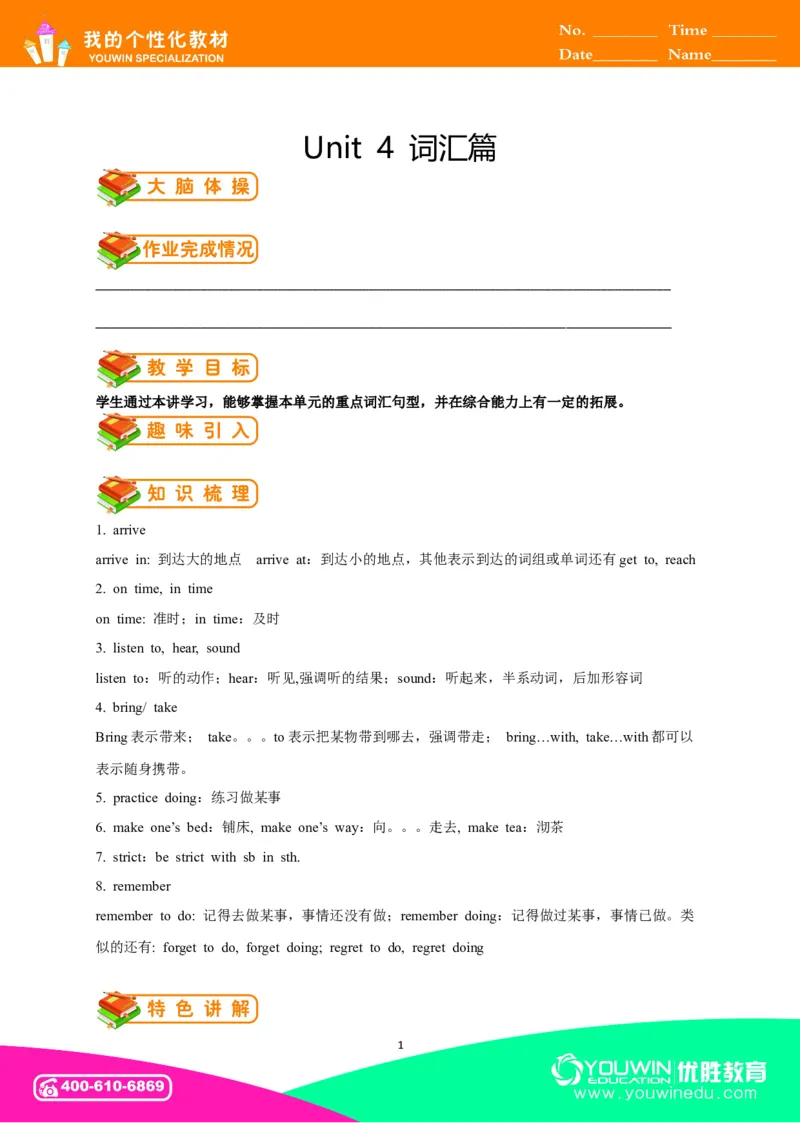
Unit 4 词汇篇
__________________________________________________________________________________
__________________________________________________________________________________
学生通过本讲学习,能够掌握本单元的重点词汇句型,并在综合能力上有一定的拓展。
1. arrive
arrive in: 到达大的地点  arrive at:到达小的地点,其他表示到达的词组或单词还有get to, reach
2. on time, in time
on time: 准时;in time:及时
3. listen to, hear, sound
listen to:听的动作;hear:听见,强调听的结果;sound:听起来,半系动词,后加形容词
4. bring/ take
Bring 表示带来; take。。。to 表示把某物带到哪去,强调带走; bring…with, take…with 都可以
表示随身携带。
5. practice doing:练习做某事
6. make one’s bed:铺床, make one’s way:向。。。走去, make tea:沏茶
7. strict:be strict with sb in sth.
8. remember
remember to do: 记得去做某事,事情还没有做;remember doing:记得做过某事,事情已做。类
似的还有: forget to do, forget doing; regret to do, regret doing
2
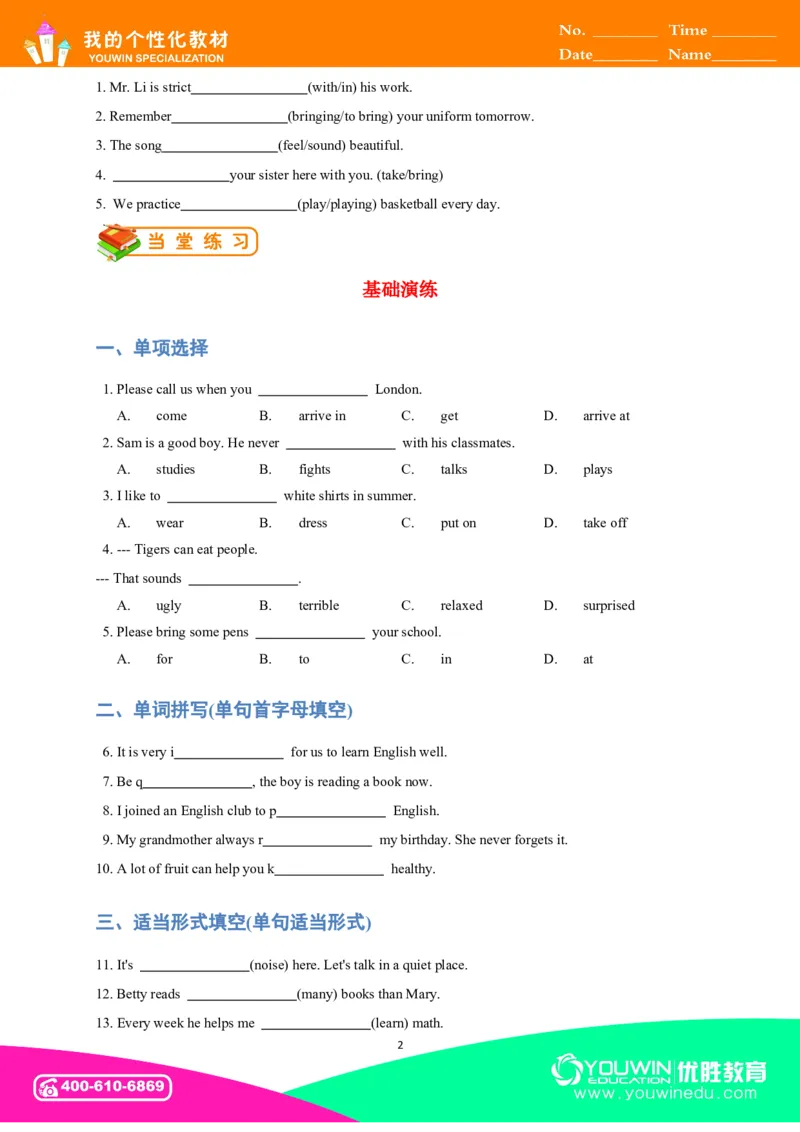
1. Mr. Li is strict

   (with/in) his work.
2. Remember

   (bringing/to bring) your uniform tomorrow.
3. The song

   (feel/sound) beautiful.
4.

     your sister here with you. (take/bring)
5. We practice

   (play/playing) basketball every day.
基础演练
一、单项选择
 1. Please call us when you

    London.
A.
 come
B.
 arrive in
C.
 get
D.
 arrive at
 2. Sam is a good boy. He never

    with his classmates.
A.
 studies
B.
 fights
C.
 talks
D.
 plays
 3. I like to

    white shirts in summer.
A.
 wear
B.
 dress
C.
 put on
D.
 take off
 4. --- Tigers can eat people.
--- That sounds

   .
A.
 ugly
B.
 terrible
C.
 relaxed
D.
 surprised
 5. Please bring some pens

    your school.
A.
 for
B.
 to
C.
 in
D.
 at
二、单词拼写(单句首字母填空)
 6. It is very i

    for us to learn English well.
 7. Be q

   , the boy is reading a book now.
 8. I joined an English club to p

    English.
 9. My grandmother always r

    my birthday. She never forgets it.
10. A lot of fruit can help you k

    healthy.
三、适当形式填空(单句适当形式)
11. It's

   (noise) here. Let's talk in a quiet place.
12. Betty reads

   (many) books than Mary.
13. Every week he helps me

   (learn) math.
3
14. I have to do the

   (dish) every day.
15. That old man often

   (relax) under the tree.
四、翻译(根据中文提示完成句子)
16. 父母不应该对青少年要求过严。
Parents should not

    too


    teenagers.
17. 玛丽太小还不会整理床铺。
Mary is too young to


   .
18. 医生嘱咐他按时吃药。
The doctor asked him to take the medicine


   .
19. 在图书馆,我们必须遵守规则。
We have to


    in the library.
20. --- 你喜欢听音乐吗?
--- 不。
---

    you like


    music?
--- No,


   .
巩固提高
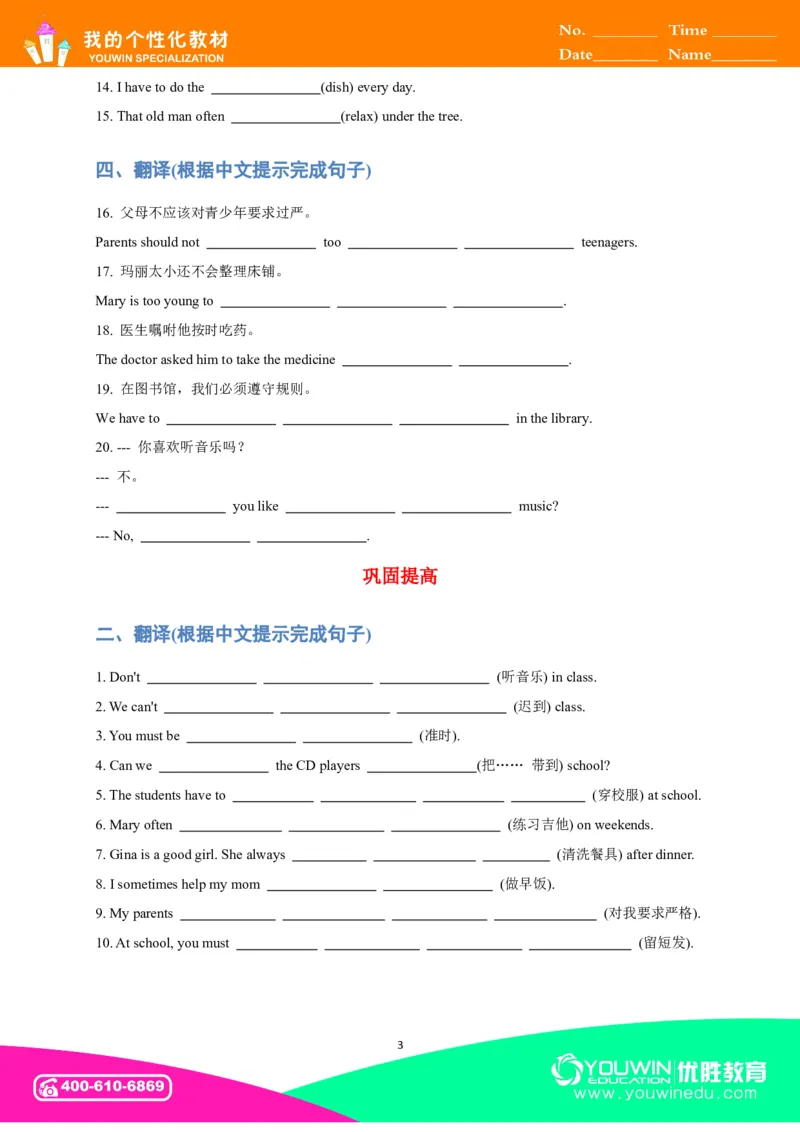
二、翻译(根据中文提示完成句子)
1. Don't


    (听音乐) in class.
2. We can't


    (迟到) class.
3. You must be


    (准时).
4. Can we

    the CD players

   (把…… 带到) school?
5. The students have to


    (穿校服) at school.
6. Mary often


    (练习吉他) on weekends.
7. Gina is a good girl. She always


    (清洗餐具) after dinner.
8. I sometimes help my mom


    (做早饭).
9. My parents


    (对我要求严格).
10. At school, you must


    (留短发).
4
1. He has

    work to do.
A.
 much too
B.
 too many
C.
 too  much
D.
 many too
2. Tom often helps me

    my English.
A.
 learning
B.
 with
C.
 in
D.
 learns
3. My father is strict

    me.
A.
 in
B.
 with
C.
 at
D.
 on
4. He often

    after dinner.
A.
 do the dishes
B.
 do the dish
C.
 does the dish
D.
 does the dishes
5. We can't watch TV

    school nights.
A.
 in
B.
 on
C.
 during
D.
 at
6. --- Please be

   ! It's a reading room.
--- Sorry.
A.
 quite
B.
 shy
C.
 quietly
D.
 quiet
7. Linda has to

    home before 6:00 p.m.
A.
 gets to
B.
 reach to
C.
 arrive
D.
 arrive at
8. Let's meet

    the school gate.
A.
 on
B.
 out
C.
 outside
D.
 next
9. I

    carefully, but I can't

    anything.
A.
 listen to; hear
B.
 listen; hear
C.
 listen to; listen
D.
 hear; hear
10. We students should

    school uniforms every day.
A.
 wear
B.
 put on
C.
 dress
D.
 in
B(101 中学初一下期中考试)
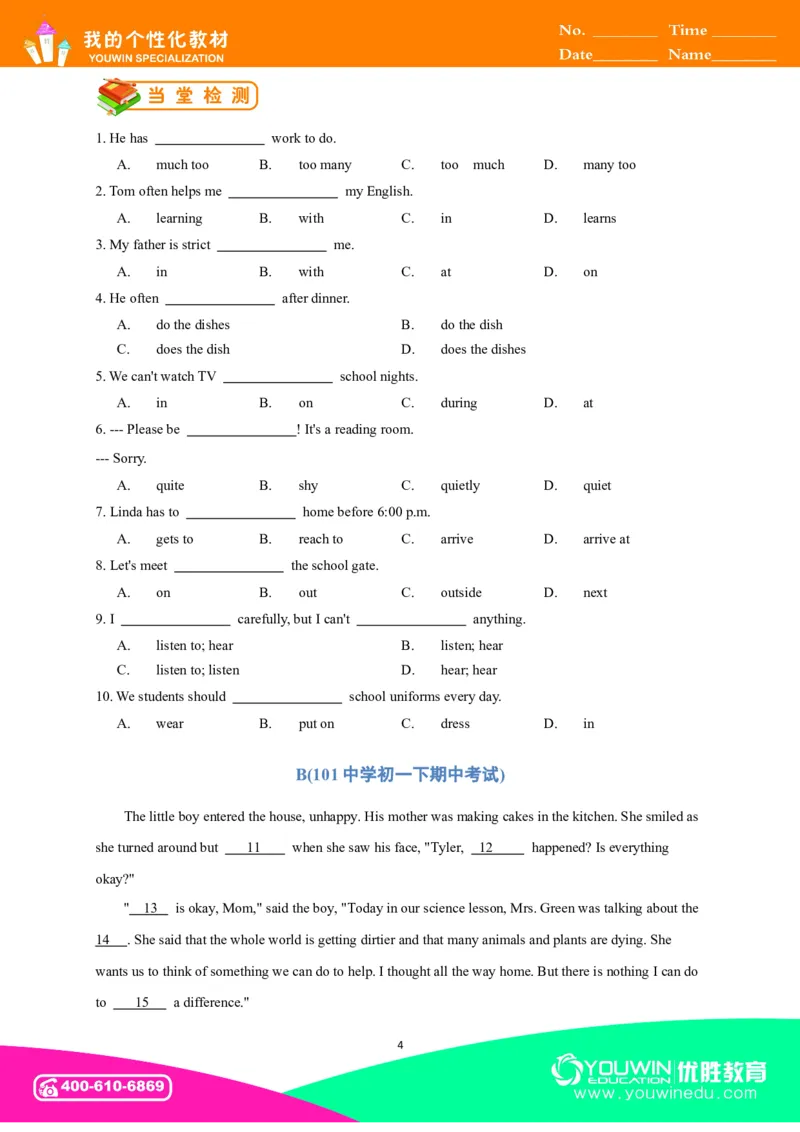
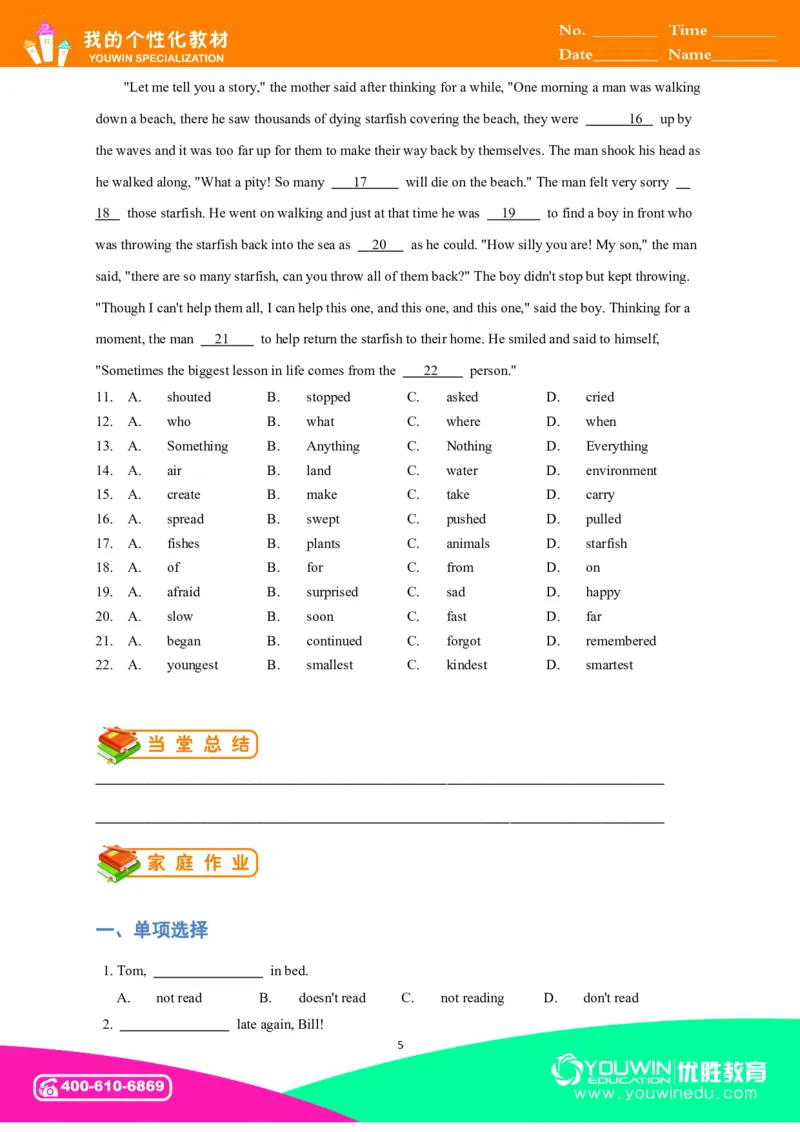
    The little boy entered the house, unhappy. His mother was making cakes in the kitchen. She smiled as
she turned around but

 11


    when she saw his face, "Tyler,   12


    happened? Is everything
okay?"
    "    13
       is okay, Mom," said the boy, "Today in our science lesson, Mrs. Green was talking about the
14
        . She said that the whole world is getting dirtier and that many animals and plants are dying. She
wants us to think of something we can do to help. I thought all the way home. But there is nothing I can do
to

 15
         a difference."
5
    "Let me tell you a story," the mother said after thinking for a while, "One morning a man was walking
down a beach, there he saw thousands of dying starfish covering the beach, they were

 16
       up by
the waves and it was too far up for them to make their way back by themselves. The man shook his head as
he walked along, "What a pity! So many

 17


    will die on the beach." The man felt very sorry

18
       those starfish. He went on walking and just at that time he was     19


    to find a boy in front who
was throwing the starfish back into the sea as     20
         as he could. "How silly you are! My son," the man
said, "there are so many starfish, can you throw all of them back?" The boy didn't stop but kept throwing.
"Though I can't help them all, I can help this one, and this one, and this one," said the boy. Thinking for a
moment, the man     21


    to help return the starfish to their home. He smiled and said to himself,
"Sometimes the biggest lesson in life comes from the

 22


    person."
11.
A.
 shouted
B.
 stopped
C.
 asked
D.
 cried
12.
A.
 who
B.
 what
C.
 where
D.
 when
13.
A.
 Something
B.
 Anything
C.
 Nothing
D.
 Everything
14.
A.
 air
B.
 land
C.
 water
D.
 environment
15.
A.
 create
B.
 make
C.
 take
D.
 carry
16.
A.
 spread
B.
 swept
C.
 pushed
D.
 pulled
17.
A.
 fishes
B.
 plants
C.
 animals
D.
 starfish
18.
A.
 of
B.
 for
C.
 from
D.
 on
19.
A.
 afraid
B.
 surprised
C.
 sad
D.
 happy
20.
A.
 slow
B.
 soon
C.
 fast
D.
 far
21.
A.
 began
B.
 continued
C.
 forgot
D.
 remembered
22.
A.
 youngest
B.
 smallest
C.
 kindest
D.
 smartest
_________________________________________________________________________________
_________________________________________________________________________________
一、单项选择
 1. Tom,

    in bed.
A.
 not read
B.
 doesn't read
C.
 not reading
D.
 don't read
 2.

    late again, Bill!
6
A.
 Don't to be
B.
 Don't be
C.
 Not be
D.
 Be not
 3. It's raining all day, so I

    stay at home.
A.
 must
B.
 have to
C.
 must  to
D.
 can
 4. --- Mum, may I go to the cinema?
--- No, you can't. You

    finish your homework first.
A.
 can
B.
 may
C.
 must
D.
 can't
 5. When the light is red, you

    cross the road. You

    wait for the
green light.
A.
 can; must
B.
 can; must not
C.
 can't; must
D.
 can't; must not
 6. --- Could I use your ruler?
--- Of course, you

   .
A.
 can
B.
 could
C.
 will
D.
 need
 7. When will you

    that village?
A.
 arrive
B.
 get
C.
 reach to
D.
 arrive at
 8. First of all, teacher must be strict

    their students.
A.
 at
B.
 in
C.
 for
D.
 with
 9. Miss Jones

    a ring every day.
A.
 puts on
B.
 wears
C.
 in
D.
 dresses
10. --- Don't be late again, Tom.
---

   .
A.
 No, I don't
B.
 Don't worry
C.
 Sorry, I won't
D.
 I don't know
二、单词拼写(根据中文提示拼写单词)
11. Do you

   (记得) his telephone number?
12. My father often listens to light music to

   (放松) after work.
13. How

   (可怕的) the car accident is!
14. It's

   (重要的) to have a good study habit(习惯).
15. Don't

   (打架) with your friends.
三、适当形式填空(单句适当形式)
16. We must keep

   (quiet) in the library.
17. He is a

   (luck) boy.
7
18. The radio is too

   (noise). Would you mind turning it down?
19. My father likes

   (read) newspapers at night.
20. I want

   (learn) English from you.
四、完形填空
Dear Sally,
    How are you? I'm happy that you can do the things you         21

    at home. I never have
fun, because there are         22

    rules(规定) in my family. My parents are strict(严格的) with
me. I have to         23

    at six o'clock every morning and make my bedroom         24

before breakfast and then go to school. I can't play with my friends after school. I have to do         25
homework. After dinner I have to take the dog for         26

    walk in the park. I can't watch
TV on school nights. I have to         27

    the violin(小提琴). I can't go to bed late. I have to be
in bed         28

    nine o'clock. At weekends I have to help my mother do the housework and
29

    the dishes. I also have to go to learn the violin on Sundays. I'm         30

    tired.
Can you help me?

Yours,

Lisa
21.
A.
 play
B.
 like
C.
 learn
D.
 have
22.
A.
 many
B.
 much
C.
 little
D.
 any
23.
A.
 have breakfast
B.
 go home
C.
 get up
D.
 go to school
24.
A.
 small
B.
 big
C.
 clean
D.
 dirty
25.
A.
 me
B.
 my
C.
 us
D.
 our
26.
A.
 a
B.
 an
C.
 the
D.
 不填
27.
A.
 practise
B.
 watch
C.
 draw
D.
 sing
28.
A.
 on
B.
 at
C.
 with
D.
 to
29.
A.
 eat
B.
 buy
C.
 make
D.
 do
30.
A.
 only
B.
 really
C.
 also
D.
 seldom
五、阅读理解
A
Rule(规则) One
Rule Two
8
    ● You can come into the room only with your
teacher.
    ● Don't eat or drink in the room.
    ● Don't listen to music.
    ● Be quiet. Don't talk with each other.
    ● Turn off (关掉) all the computers and close
windows after class.
    Here are the rules for Emily.
    ● You must get up before 6:30 am.
    ● Don't listen to music.
    ● Don't talk loudly on the phone.
    ● Go to bed by 10:00 p.m.
    ● You can't meet friends if you don't finish
your homework.
    ● Clean your bedroom yourself.
31. In the two rules,

    isn't allowed(被允许).
A.
 eating or drinking
B.
 listening to music
C.
 meeting friends
D.
 coming into the room
32. When does Emily have to go to bed?
A.
 After 10:00 p.m.
B.
 Before 6:30 p.m.
C.
 By 10:00 p.m.
D.
 By 9:00 p.m.
33. Rule One may be for a

   .
A.
 computer room
B.
 classroom
C.
 bedroom
D.
 dining room
34. The underlined word "finish" means "

   " in Chinese.
A.
 阅读
B.
 拿走
C.
 开始
D.
 完成
35. Which of the following is NOT true?
A.
 You have to be quiet when you have a computer class.
B.
 Emily's parents clean her bedroom.
C.
 Students can't go into the room if there is no teacher.
D.
 Rule Two is a family rule.
B
    In most schools, all students must wear school uniforms when they are at school. But not every student
likes the school uniform.
    Li Jia, a 13-year-old girl from No.9 Middle School, said, "I don't like my school uniform at all. It is
too ugly. I think young girls should wear some colorful clothes. But, I have to wear it every day."
    However, Su Yang, also a middle school student, has different opinions. He said, "I like my school
uniform. It is very beautiful. It is a symbol(象征) of my school and I like my school very much."
    Mr. Chen, a teacher, told the reporter, "It's good for the students to wear uniforms. It saves a lot of
time and money. In the past, my daughter spent much time on her clothes. But now, she seldom(很少) asks
me to buy clothes for her because she has to wear the school uniform."
    Do you like your school uniform? Welcome to write to us.
36. Most middle school students must wear the school uniform because

   .
9
A.
 their parents ask them to do so
B.
 the uniforms are beautiful
C.
 they don't have money to buy other clothes
D.
 it's the school rule
37. What do you know about Li Jia?
A.
 She doesn't like the uniform because it is expensive.
B.
 She is an ugly girl.
C.
 She doesn't like her school uniform at all.
D.
 She never wears her uniform.
38. What does Su Yang think of his school uniform?
A.
 He thinks it is very beautiful.
B.
 He thinks it is very ugly.
C.
 He doesn't like it.
D.
 He likes a symbol.
39. The word "opinion" probably means

    in Chinese.
A.
 校服
B.
 看法
C.
 情况
D.
 成绩
40. From the passage, we know that

   .
A.
 most students like their uniforms
B.
 most students don't like their uniforms
C.
 different people have different opinions about their uniforms
D.
 uniforms are very popular in China
C
      What do children need?
    Nowadays, students cannot enjoy their life happily, because they have to work very hard to
satisfy(使…满意) their parents and teachers. They are always under high pressure(压力).
    Most schools have strict rules on many things, from students' hair to clothes and things in their school
bags. This may hurt the feelings of the students. Most parents want to help their children, but they don't
know what to do. They even send their children to some evening classes or weekend classes. This makes
things worse. As it is reported(据报道), some students kill themselves, and some join troublemakers, etc.
they try to escape(逃避) troubles in such ways. About 40% of the students say that no one teaches them
how to get on with others, how to tell right from wrong(分辨是非), how to show respect(尊重) to others,
even to their parents, etc.
    What do children need? Textbooks, high marks or good jobs? More than these. And we can find the
very answer from the words above.
10
41. According to the passage, who make the children be under high pressure?
A.
 Themselves
B.
 Their parents
C.
 Schools
D.
 Both B and C
42. Many schools have rules on everything except(除了)

    according to the passage.
A.
 food
B.
 clothes
C.
 hair
D.
 things in school bags
43. In school's view(角度), students need

   .
A.
 textbooks
B.
 marks
C.
 good jobs
D.
 A, B and C
44. What do most students' parents do?
A.
 Scold(批评) the schools
B.
 Ask their children to stay away from school
C.
 Send their children to more classes
D.
 Do nothing
45.

    of the students think nobody tells them how to behave(表现) well.
A.
 30%
B.
 40%
C.
 50%
D.
 70%
课程顾问签字:                        教学主管签字: