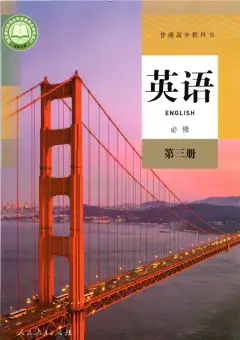
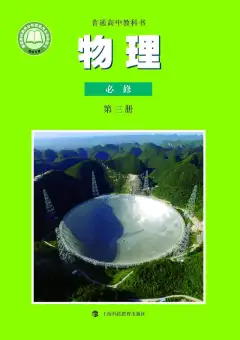
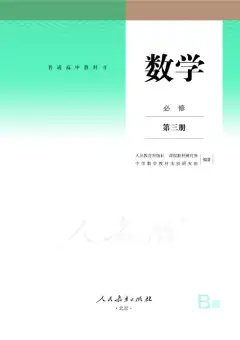
普通高中教科书
第三册
必修
普通高中教科书
第三册
必修
主
编:陈
琳
北京
主 编:陈 琳
副 主 编:张连仲
编 者:刘 晓 李陆桂 张京生 钱建源 徐 浩 雷传利
(按照姓氏笔画排序)
项目策划:王 芳 王 勇
项目负责:张黎新 郎 崧 张 涛
基础教育出版分社:
地 址:北京市西三环北路19 号 外研社大厦 基础教育出版分社(100089)
咨询电话:(010)88819117/88819688
传 真:(010)88819423
本教材是外语教学与研究出版社根据教育部制定的《普通高中英语课程标准(2017 年版)》,在充分
调研和科学论证的基础上推出的中小学“一条龙”英语教材——《英语》(新标准)的高中部分。
本教材的主编为北京外国语大学陈琳教授,副主编为张连仲教授,编写团队包括国内高校的知名专家
学者、教研人员和一线教师。陈琳教授秉承周恩来总理提出的“一条龙”外语教学理念,总结自己从事
外语教育工作70 年的经验,提出了符合中国外语教育实践的教育理论——辩证实践外语教育途径,并在
《英语》(新标准)教材中贯彻实施。
根据教育部2017 年新课程标准的精神,我们启动了《英语》(新标准)高中教材的修订工作。本次
修订全面依托新课程标准要求,坚持陈琳教授的特色理论,由陈琳教授、张连仲教授指导编写团队,在充
分考虑我国英语教育实际学情和教情的前提下,进行了全面的框架重建和内容设计,保证了理论与实践的
紧密结合。
《英语》(新标准)高中教材共分10 册:1—3 册为必修课程教材,4—7 册为选择性必修课程教材,
8—10 册为选修课程中的提高类教材。
必修课程教材具备良好的体系性、延伸性和接续性,能够帮助学生根据自己的需求不断提升个性化的
语言能力,确保学生达到高中毕业基本要求,为日后进入选择性必修课程打下坚实的基础。《英语》(新标
准)必修课程教材的主要特色如下:
一、坚持立德树人根本任务。在教材的选材、内容、语言等各个方面突出学科的育人本质,帮助学生更好
地培育中国情怀,坚定文化自信,拓展国际视野,形成正确的世界观、人生观和价值观。
二、突出学科核心素养的重要性,全面培养学生的语言能力、文化意识、思维品质和学习能力,帮助学生
逐步形成正确的价值观念、必备品格和关键能力。
三、坚持理论与实践的辩证关系。从语言实践的角度设计教材的主题架构、内容结构直至每一项具体活
动,确保有实践、可实践,并通过实践促进提升,帮助学生形成素养,发展素养。
四、遵循“理解—发展—实践”的原则,以“主题”为纲设计单元任务,重要题材在各册教材中均得到体
现,且内容逐步扩展加深、螺旋式上升,符合语言教学规律。
五、语篇题材多样、体裁丰富,语言地道鲜活、难度适中,符合学生的兴趣特点,同时能够提升学生的语
篇意识,丰富语言感知与学习体验,有利于学生通过与主题语篇互动,培养在获取信息、处理信息、
重构信息过程中的逻辑思维、多元思维和批判性思维。
六、活动设计紧密围绕主题语境,注重整合语言技能和学习技能,充分体现了英语学习活动观;同时强调
交际情境的真实性和丰富性,帮助学生掌握语言技能、建构完善的知识基础,在实践中逐步形成交际
能力。
七、强调学习策略的培养,鼓励学生通过体验、实践、讨论、合作、探究等方式,利用各种学习资源完成
学习任务,解决学习中的困难,从而形成自主学习能力。
八、突出文化意识(尤其是跨文化意识)的建构与发展。通过介绍及比较中外文化,帮助学生更好地理解
文化异同,学会理解和包容不同文化,提升道路自信、文化自信,将文化知识内化为正确的文化价值
观和有利于国家和个人发展的跨文化态度与意识。
九、为教师编写了流程清晰、内容丰富的教师用书,帮助教师快速理解教材内容和相关背景知识,明确教
学目标,掌握教学节奏;同时开发了配套的网络教材和其他多媒体配套资源,丰富课程资源,拓展教
学模式。
我们希望,《英语》(新标准)高中必修课程教材能够初步培养学生的语言能力、文化意识、思维品质
和学习能力等英语学科核心素养,为他们继续学习英语和终身发展打下坚实的基础。
《英语》(新标准)系列教材
高中阶段编委会
前 言
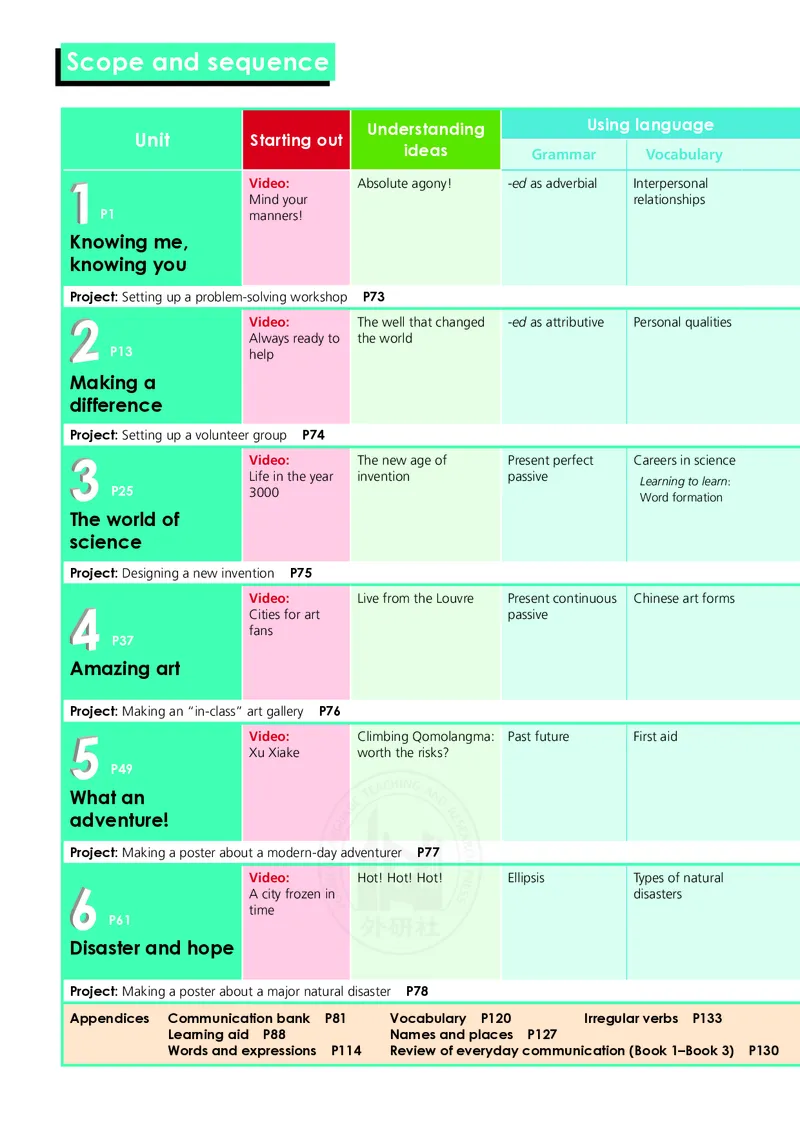
Scope and sequence
Unit
Starting out
Understanding
ideas
Using language
Grammar
Vocabulary
P1
Knowing me,
knowing you
Video:
Mind your
manners!
Absolute agony!
-ed as adverbial
Interpersonal
relationships
Project: Setting up a problem-solving workshop P73
P13
Making a
difference
Video:
Always ready to
help
The well that changed
the world
-ed as attributive
Personal qualities
Project: Setting up a volunteer group P74
P25
The world of
science
Video:
Life in the year
3000
The new age of
invention
Present perfect
passive
Careers in science
Learning to learn:
Word formation
Project: Designing a new invention P75
P37
Amazing art
Video:
Cities for art
fans
Live from the Louvre
Present continuous
passive
Chinese art forms
Project: Making an “in-class” art gallery P76
P49
What an
adventure!
Video:
Xu Xiake
Climbing Qomolangma:
worth the risks?
Past future
First aid
Project: Making a poster about a modern-day adventurer P77
P61
Disaster and hope
Video:
A city frozen in
time
Hot! Hot! Hot!
Ellipsis
Types of natural
disasters
Project: Making a poster about a major natural disaster P78
Appendices Communication bank P81
Vocabulary P120
Irregular verbs P133
Learning aid P88
Names and places P127
Words and expressions P114
Review of everyday communication (Book 1–Book 3) P130
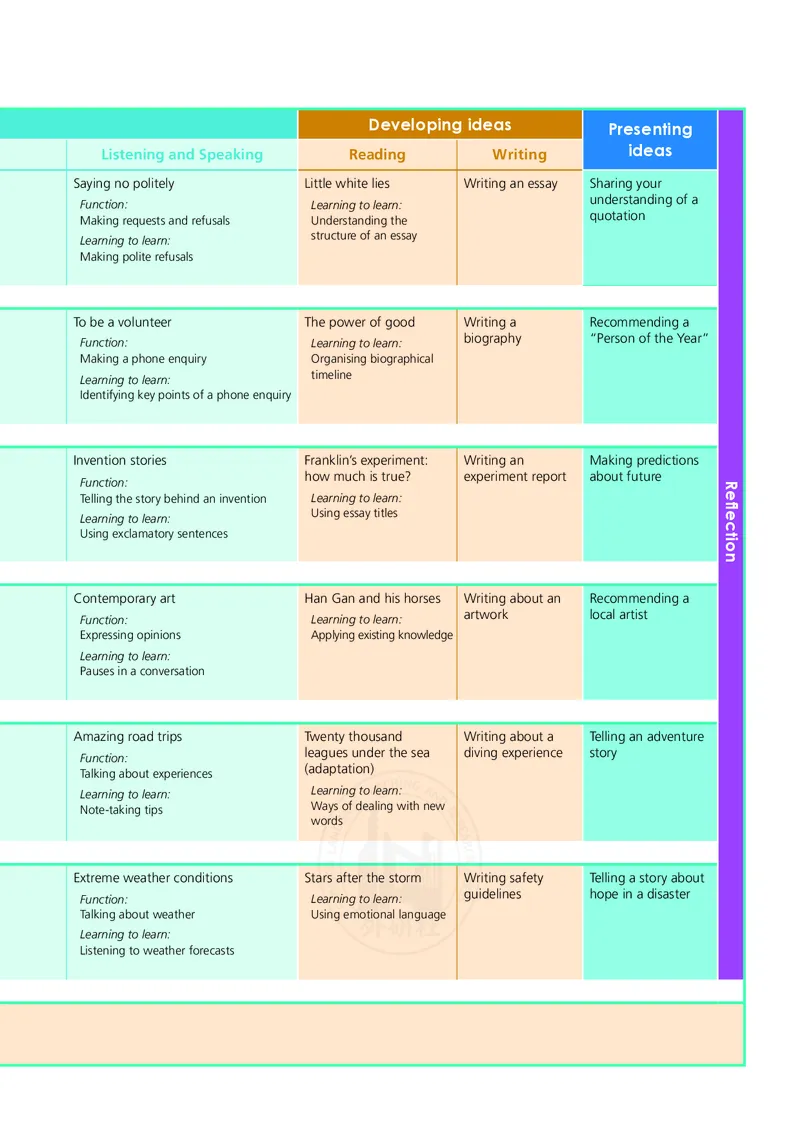
Developing ideas
Presenting
ideas
Listening and Speaking
Reading
Writing
Saying no politely
Function:
Making requests and refusals
Learning to learn:
Making polite refusals
Little white lies
Learning to learn:
Understanding the
structure of an essay
Writing an essay
Sharing your
understanding of a
quotation
To be a volunteer
Function:
Making a phone enquiry
Learning to learn:
Identifying key points of a phone enquiry
The power of good
Learning to learn:
Organising biographical
timeline
Writing a
biography
Recommending a
“Person of the Year”
Invention stories
Function:
Telling the story behind an invention
Learning to learn:
Using exclamatory sentences
Franklin’s experiment:
how much is true?
Learning to learn:
Using essay titles
Writing an
experiment report
Making predictions
about future
Contemporary art
Function:
Expressing opinions
Learning to learn:
Pauses in a conversation
Han Gan and his horses
Learning to learn:
Applying existing knowledge
Writing about an
artwork
Recommending a
local artist
Amazing road trips
Function:
Talking about experiences
Learning to learn:
Note-taking tips
Twenty thousand
leagues under the sea
(adaptation)
Learning to learn:
Ways of dealing with new
words
Writing about a
diving experience
Telling an adventure
story
Extreme weather conditions
Function:
Talking about weather
Learning to learn:
Listening to weather forecasts
Stars after the storm
Learning to learn:
Using emotional language
Writing safety
guidelines
Telling a story about
hope in a disaster
Reflection
同学们,欢迎大家继续学习《英语》(新标准)高中教材!
由教育部制定并颁布的《普通高中英语课程标准(2017 年版)》明确规定:普通高中英语课程
作为一门学习及运用英语语言的课程,与义务教育阶段的课程相衔接,旨在为学生继续学习英语和
终身发展打下良好基础。普通高中英语课程强调对学生语言能力、文化意识、思维品质和学习能力
的综合培养。也就是说,发展学科素养是同学们高中阶段英语学习的方向和目标。时光飞逝,必修
课程的学习已进入尾声,相信大家对必修阶段的学习要求已有了充分的认识,并为进一步发展英语
学科核心素养打下了坚实的基础。
《英语》(新标准)高中必修课程教材遵循“为用而学,在用中学,在学中用,学而能用”的原
则,为同学们提供了语言地道、优美的阅读文章和灵活多样的学习活动,力图使大家逐步获得独立
学习和自主学习的能力。
必修课程教材第三册进一步拓展话题,从自我认知、社会责任,到科技发展、艺术欣赏,再到
探索及认识自然,帮助大家提升对人与自我、人与社会、人与自然三大主题语境的认识,为选择性
必修阶段的学习做好准备。本册共六个单元,单元结构如下:
(1) 背景激活(Starting out)
该板块旨在激活同学们已有的背景知识和语言知识。我们把“看”(viewing)的活动作为
预热和导入,通过视频、文字、图片、表格等多模态语篇,帮助同学们更好地了解本单元
主题。
(2) 主题理解(Understanding ideas)
该板块通过语篇和阅读活动聚焦核心语言、结构,帮助大家在达成主题理解、实现语言形
式与意义深度加工的同时培养文化意识和思维品质。
(3) 功能运用(Using language)
该板块是对语言技能的综合学习和运用。通过语法、词汇及听说三个部分的大量语言实践
活动,发展大家的语言技能,为真实生活中的语言交际做好铺垫。
(4) 思维拓展(Developing ideas)
该板块为大家提供新的阅读语篇,从不同角度进一步呈现单元话题,调动大家的逻辑思维、
批判性思维和创造思维,并以一项读写结合的活动来检验大家前述学习活动的成果。
(5) 观点表达(Presenting ideas)
该板块主要以讨论、评选、演讲、辩论等口头表达形式进一步促进同学们对所学内容的复
习与掌握。开放或半开放性的活动有利于大家彼此合作,展示个性,充分表达自己对主题
思想的理解和认识。
(6) 自我反思(Reflection)
该板块列出了本单元话题下可以实现的学习目标,通过自我评价和总结的方式,帮助大家
反思自己的学习成果,进而认识到自己的进步与不足,逐步培养自主学习的能力。
(7) 项目实践(Project)
该板块提供真实的语境和任务,每个项目活动均由小组合作完成,力求培养大家获取信息、
相互合作、学以致用的能力。
我们希望同学们通过使用本教材,全面提高综合语言运用能力,发展英语学科的核心素养,成
为具有中国情怀、国际视野和跨文化沟通能力的社会主义建设者和接班人。
致 同 学
Knowing me, knowing you
U
N
I
T
1
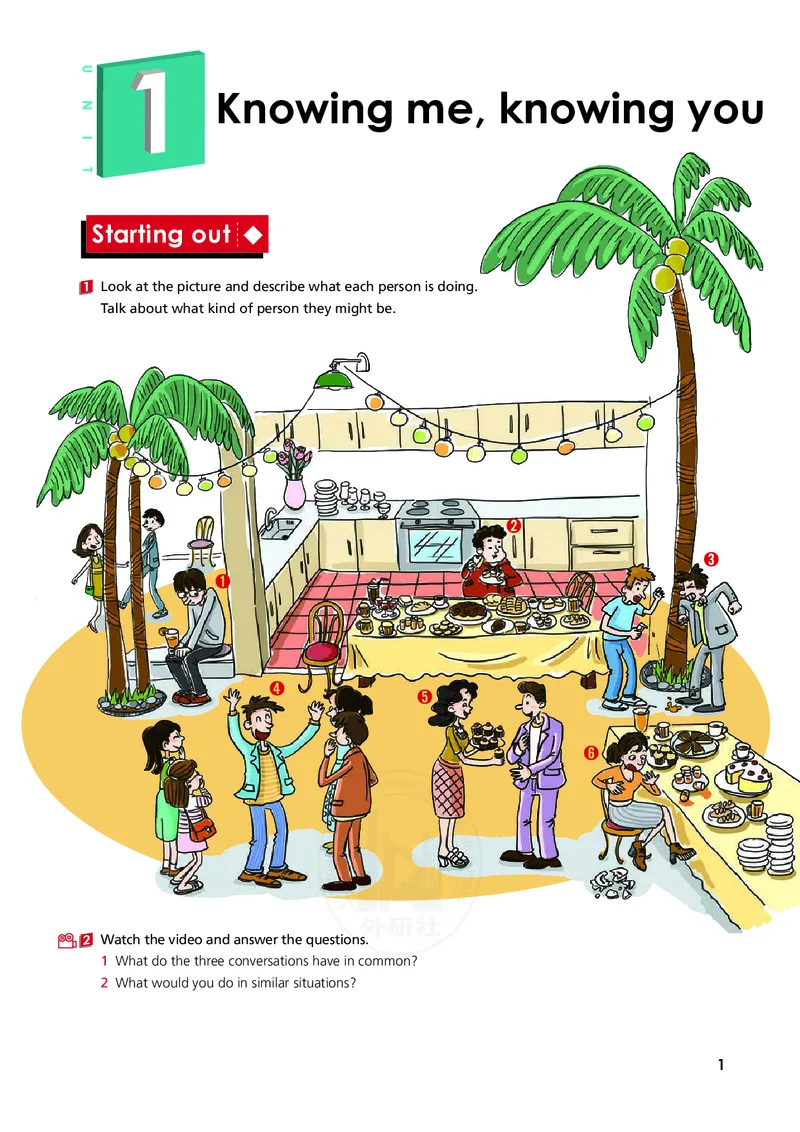
Look at the picture and describe what each person is doing.
Talk about what kind of person they might be.
2
Watch the video and answer the questions.
1 What do the three conversations have in common?
2 What would you do in similar situations?
➊
➋
➌
➍
➎
➏
Starting out
1
1
Look at the problems you may face
at school. Discuss which you think
is the most difficult to overcome
and why.
• bad performance in a subject
• pressure to look good
• conflict with classmates
• difficulties fitting in with others
Now think about who you turn to
for help when you face a problem.
• friends
• parents
• teachers
• online forums
• no one – you prefer to keep things
to yourself
• other
2
Read the letters and find out what
kind of problems Ben has and who
he turns to for help.
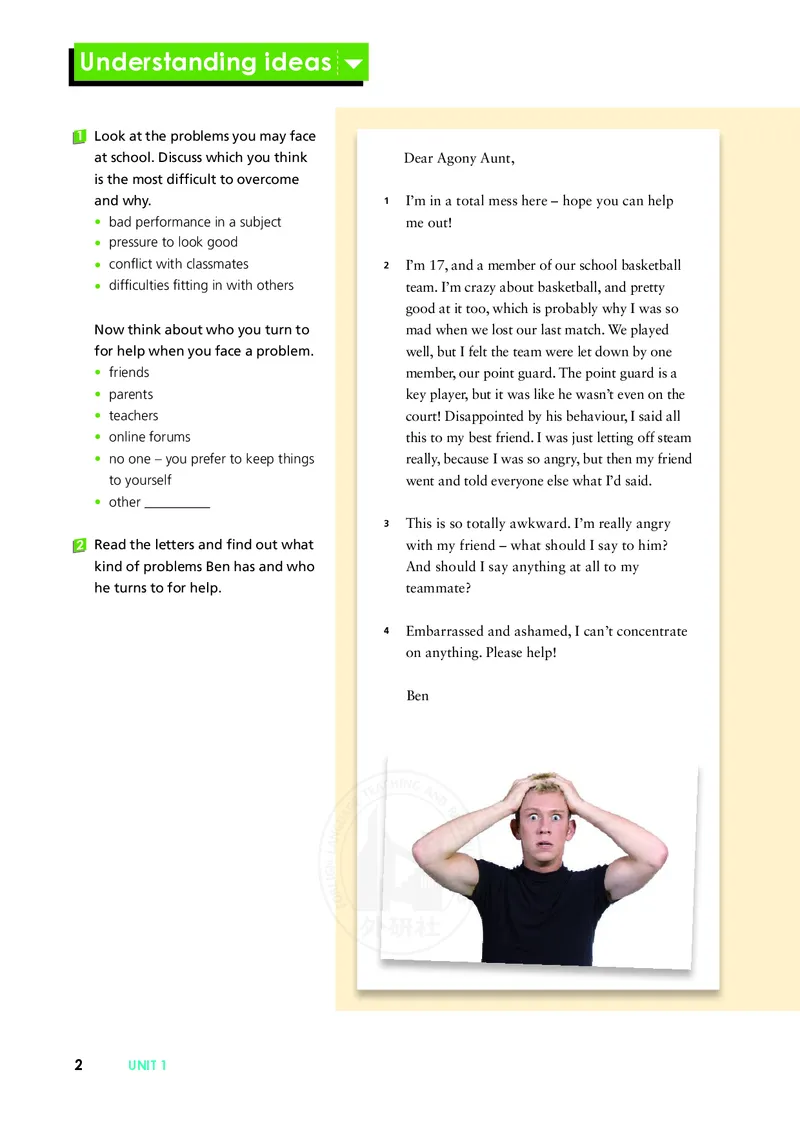
Dear Agony Aunt,
1
I’m in a total mess here – hope you can help
me out!
2
I’m 17, and a member of our school basketball
team. I’m crazy about basketball, and pretty
good at it too, which is probably why I was so
mad when we lost our last match. We played
well, but I felt the team were let down by one
member, our point guard. The point guard is a
key player, but it was like he wasn’t even on the
court! Disappointed by his behaviour, I said all
this to my best friend. I was just letting off steam
really, because I was so angry, but then my friend
went and told everyone else what I’d said.
3
This is so totally awkward. I’m really angry
with my friend – what should I say to him?
And should I say anything at all to my
teammate?
4
Embarrassed and ashamed, I can’t concentrate
on anything. Please help!
Ben
Understanding ideas
2
UNIT 1
Dear Ben,
1
There is an old American saying, “Loose lips sink ships.”
This means that if you speak too much about something,
especially to people who you don’t know so well, it’ll cause
all kinds of trouble.
2
The situation here is so much worse because the “loose lips”
were your best friend’s. Treated this way, you’re sure to feel
hurt – we should always be able to trust those closest to us,
and it hurts even more when we find we can’t.
3
But I have to say that it’s partly your fault, isn’t it?
You admit that you were “letting off steam”. It is
understandable in that situation, but we should always
think before we speak.
4
Here’s what you need to do. First, apologise to your
teammate. If you ever want to win any more basketball
games (and I’m sure you do!), you need to work together,
and that means communicating with each other clearly and resolving conflicts. So have a chat
with your teammate. Tell him directly and honestly that you were talking without thinking.
5
Then, talk to your friend. Friendship should be one of the greatest things in the world, but
sometimes it can be difficult. Again, your strategy is clear communication. Tell your friend
you’re angry with him for repeating what you said and making the situation worse, but that
you want to move on. Approached in this way, your friendship will soon be repaired.
6
Thirdly, and perhaps most importantly, think about your own behaviour. Don’t say too much
when you’re angry! Filled with anger, you tend to say whatever comes to your mind. This
gives people the wrong signal. Take a deep breath, calm down, and always remember: think
first, speak later. If you feel one of your teammates isn’t pulling their weight, then raise your
concerns in a professional way with your team coach.
7
If you think about other people’s feelings as well as your own, you’ll soon find everything
works out.
8
Good luck!
Our Agony Aunt answers
your questions.
Absolute
agony!
Agony Aunt
Knowing me, knowing you
3
3
Choose the best summary of the letters.
1 Ben said something bad about his best friend, and Agony Aunt told him to
apologise to his friend.
2 Ben was angry that his team was let down by some members, and Agony Aunt told
him to take it easy.
3 Ben didn’t play well in the match, and Agony Aunt advised him to apologise to his
teammate.
4 Ben was in an awkward situation, and Agony Aunt gave him suggestions as to how
to deal with his problems.
4
Complete the sentences with expressions from the passage.
Agony Aunt’s
suggestions
Think Share
&
1 What do you think of Agony Aunt’s advice? What other advice
would you give to Ben?
2 What is your understanding of the saying “Loose lips sink ships”? Do you know
any similar sayings in Chinese?
Now match the suggestions to Ben’s problems.
• I was disappointed with my teammate
because I felt
1 by him.
• My best friend
3 .
I don’t know what to do.
• I told my best friend that my teammate
was to blame, just
2 .
• Don’t
9 when you’re angry.
Always remember:
10 .
• Tell your best friend you’re angry with him for
7 and
8 ,
but that you want to move on.
• You should
4 . You need to
work together, and that means
5 and
6 .
Ben’s problems
4
UNIT 1
-ed as adverbial
1
Look at the sentences from the reading passage and
answer the questions.
2
Rewrite the underlined sentences with the -ed form.
3
Read the plot summary and choose
the correct form of the words.
Inside Out is an animated
film about the five emotions
of a girl called Riley: Joy,
Sadness, Fear, Disgust
and Anger. Influencing /
Influenced mainly by Joy,
most of Riley’s memories
are happy ones.
Believing / Believed that she is Riley’s
most important emotion, Joy always
tries to take the lead.
Preventing /
Prevented from playing her role in Riley’s
emotional development, Sadness feels
annoyed. When Riley moves to a new
city, she has a hard time adjusting to her
new surroundings. Sadness wants to do
her duty but by accident causes the loss
of Riley’s happy core memories with Joy.
Now separating / separated from her
friends and her beloved hockey team,
Riley starts to feel lost and helpless, and
wants to run away from her parents and
new school. Worried about her, Joy and
Sadness try to work together to ensure
she gets her core memories back.
Eventually, realising / realised that every
emotion has a role, Joy understands it
is okay for Riley to feel sad sometimes.
Accepting sadness as part of life helps
Riley deal with the emotional complexity
of growing up, and settle down in her
new life.
a Disappointed by his behaviour, I said all this to my
best friend.
b Approached in this way, your friendship will soon
be repaired.
c Because I was disappointed by his behaviour, I
said all this to my best friend.
d If it is approached in this way, your friendship will
soon be repaired.
1 Who was disappointed in sentence (a)? What is
approached in sentence (b)?
2 Why does the author use -ed instead of -ing here?
Compare them with the following sentences and
answer the questions.
3 What is the difference between the two groups of
sentences?
4 Why does the author choose to use -ed instead of an
adverbial clause in the reading passage?
Now look for more sentences with -ed as adverbial
in the reading passage.
Last week, Anne was attracted by a particular article
in a magazine, so she bought it. Three days ago, to
complete her homework quickly, she grabbed the
magazine from her desk drawer and copied part of
the article without thinking. Her teacher was very
satisfied with her homework. Anne was praised in
class, and she felt happy as well as ashamed. Then, the
teacher wanted to enter her homework into a writing
competition. Anne was shocked by the decision and did
not know what to do. If she told the truth, the whole
class would find out and accuse her of cheating. They
would look down on her. If she kept silent, maybe no
one would ever find out…?
What should Anne do?
Using language
Knowing me, knowing you
5
Interpersonal relationships
5
Describe the situations with the words you
underlined in Activity 4.
1 I’m really sorry. I didn’t mean it. ____________
2 You’re so selfish! ____________
3 I know you’re sorry. It’s OK. Don’t worry about
it. ____________
4 I can tell he is not easy to get along with.
____________
5 I don’t want to wait for him all the time.
____________
6 My pet parrot flew away with my homework.
____________
4
Read the tips and underline the words that describe behaviour towards others.
for happy and healthy
relationships
6
Work in pairs. Discuss what you should do
in the following situations and explain
your reasons.
Try to forgive someone when they apologise.
It’s not easy for anyone to say sorry.
It’s important to tell the truth. Don’t lie.
Don’t judge someone too quickly. It
takes time to understand a person.
Don’t always complain about people. Try
to look on the bright side.
It’s not a good idea to criticise someone in
front of others. This can cause embarrassment.
Tips
2
3
4
5
1
1 You forgot your best friend’s birthday, and you
feel bad about it.
2 Your neighbour always makes a lot of noise late
at night. You cannot stand it.
3 I slipped at art class and spilt some paint on my
classmate’s favourite jeans.
4 Your friends have asked you to watch a boxing
match with them, but you don’t like boxing.
5 Your colleague says that a person’s sex matters
a lot in the workplace, but you don’t agree.
6
UNIT 1
?
Did You Know
Saying no politely
Emotional quotient (EQ), or emotional
intelligence quotient, is a measurement
of the ability to recognise one’s own and
other people’s emotions. It is believed that
EQ plays an even more important role
than IQ (intelligence quotient) in people’s
lives. Being able to say no
politely is one of the features
of emotional intelligence.
7
Listen to three conversations and
match them to the pictures.
8
Listen again and complete the table.
Request
Refusal
1
Tina has to leave her
flat
1 .
She wants to stay at
Kerry’s place.
Kerry thinks that
2 is
too long. Tina is
welcome to stay for
3 .
2
Mike invites Ryan to
4 on
5 .
Ryan cannot come,
because he has to
6 to
New York at the
weekend.
3
Jane would like to see
Becky’s
7
for some ideas.
Becky refuses because
she thinks it is better for
Jane to
8 .
9
Work in pairs. Act out the conversation about asking
for a favour and refusing politely.
Student A: Turn to Page 81.
Student B: Turn to Page 84.
10
Work in pairs. Think of another situation and have a
similar conversation.
a
b
c
If you have to say no to a request, your refusal will sound
more polite if you begin with a statement of regret, such
as I’m sorry…, I’d really like to, but… Then explain why your
answer is no, eg I’m really busy right now. If possible, suggest an
alternative – How about next week?
Learning to learn
Now talk about how the speakers make requests and
refusals. Listen again if necessary.
Knowing me, knowing you
7
1
Written more than two hundred years ago,
these lines by Walter Scott remain one of the
most well-known excerpts of Scottish poetry:
Oh, what a tangled web we weave,
When first we practise to deceive!
2
We all know that honesty is an important
value and that lying is wrong, but who
can honestly say that they’ve never told a
lie? Perhaps we comfort ourselves with the
knowledge that most of the lies we tell are
“white lies”: little lies that we tell to protect
others from the truth.
3
We’ve all surely had the experience of
someone cooking a meal for us that we don’t
like. The majority of us of course don’t tell
the truth – we lie and say that the food is
“delicious”.
4
Or if a friend asks us what we think of their
new haircut, we say “It’s great!”, even if we
Little
White
Lies
1
Look at the pictures. What would you say if
you were student B?
2
Read the passage and find out the meaning
of “white lies”.
A
B
I didn't do very well in
the exam. I only scored
60. What about you?
Developing ideas
8
UNIT 1
think it’s awful. But to what extent can we
justify telling white lies like these?
5
One of the main reasons for telling a
white lie is to try to make others feel
better. However, when we lie and say that
someone’s haircut looks good, or when we
say that we love a meal that we secretly
hate, are we really hoping to improve the
situation for someone else? Perhaps we are
in fact lying to protect ourselves from the
disappointment and anger of others.
6
Another reason for telling a white lie is
to give encouragement. Say for example
that your friend asks you what you think
of his singing. You of course say that
it’s wonderful, despite secretly thinking
that your cat can sing better. Stop for a
moment and consider that perhaps your
friend wants some frank comments from
you so that they can improve. Or perhaps,
they need to know that they should look
for a different hobby.
7
Finally, we may also tell a white lie when
we want to protect others from bad news.
If you’ve had a bad day, do you tell your
parents about it, or do you hide your tears
and lie that your day was “fine”? If the
latter, don’t you think your parents would
want to listen to you and understand
your feelings? Wouldn’t it be better to
respect their concern for you and ask for
their advice?
8
Going back to Walter Scott’s lines, we
may find even white lies have results we
cannot know in advance. Perhaps the
meal you said was “delicious” will be
served every time you visit. Would your
friend trust your opinion again if he found
out you had lied about his “wonderful”
singing? How would you expect others
to truly understand your emotions if you
only shared good news instead of bad?
Moreover, how would you feel if you
discovered that the people closest to you
had been hiding the truth from you?
Knowing me, knowing you
9
4
Work in groups. Give a talk on the importance of honesty following the steps below.
• Explain what honesty is.
• Give reasons for the importance of being honest.
• Support your reasons with examples.
• End with your conclusion.
3
Complete the diagram with information from the passage.
Introduction
We know lying is wrong, so why do we tell white lies?
Conclusion
Even white lies may have results we cannot predict.
So ____________________________________________.
Think Share
&
1 What does the “web” in the
poem represent?
2 What would you do in the situations described in
the passage?
3 What do you think is the difference between a lie
and a white lie?
4 How would you feel if you were told a white lie?
Share your experience with the class if this has
happened to you.
Reason1
To make others
.
Example(s)
Someone’s cooking
.
Someone’s haircut
.
Analysis
Perhaps we lie to protect
ourselves
.
Reason 2
Example(s)
Analysis
Perhaps your friend wants
.
Perhaps they need to know
.
Reason 3
Example(s)
Analysis
Perhaps your parents
.
Main body
An essay usually consists of three parts:
introduction, main body and conclusion.
Start with an introduction that contains the
aims and an overview of the essay. The main
body of an essay is a series of paragraphs
that explore and develop your argument.
The conclusion contains a summary of your
ideas – do not introduce any new material
here! End your essay by linking your
conclusion back to the essay title.
Learning to learn
10
UNIT 1
Original author:
Summary of the fable:
Viewpoint:
Supporting examples in your real life:
5
Read the fable and choose the message you
think it conveys.
1 Porcupines are not sociable animals.
2 The more independent you are, the better your
life will be.
3 There should be boundaries in interpersonal
relationships.
Writing an essay
One cold winter night, a group of
porcupines gathered together to keep
warm. As soon as they started to get closer,
they hurt each other with their quills, so
they had to move apart. After a short time,
they started to feel cold again, so they
moved closer together. But again they had
to move away because of the pain caused
by the other porcupines’ quills. After
repeating this process a few times, they
eventually found the ideal distance where
they could feel warm while managing not
to hurt each other.
6
Make notes based on the passage in Activity 5
with your own opinions.
7
Share your essay with the class.
Now write an essay. Use the expressions in
the box to help you.
Introduction
Main body
Conclusion
• This fable describes…
• The fable teaches us that…
• One example of this from real life is…
• In conclusion, …
Useful expressions
The Porcupine Dilemma
Adapted from a work by Schopenhauer
Knowing me, knowing you
11
1
Work in groups. Read the quotations
and discuss their meanings.
2
Choose one quotation and discuss the following
points:
• its main message
• how it applies to everyday life, giving examples
• what we can learn from the quotation
3
Present your ideas to the class. Use the expressions in
the box to help you.
Good fences make good neighbours.
�
Proverb
Do not do to others what you do not
want others to do to you.
�
Confucius
The most basic of all human needs
is the need to understand and be
understood.
�
Ralph G. Nichols
1
After completing this unit, I can rate my
performance 1 (excellent), 2 (good) or
3 (in need of improvement).
interpret interpersonal behaviour
make requests and refusals
write an essay
give suggestions to resolve interpersonal conflicts
improve interpersonal skills and relationships
2
I’ve learnt to make use of the following
words and expressions:
3
I still need to improve:
• We have chosen to talk about the quotation…
• The main message of this quotation is…
• In daily life, …
• Another example is…
• In conclusion, this quotation teaches us that…
Useful expressions
Presenting ideas
Reflection
12
UNIT 1
U
N
I
T
Making a difference
1
Watch the video and answer the questions.
1 What kinds of good deeds are shown in
the video?
2 What idea does the video convey?
2
Look at the pictures of the three people and
read the quotations. Talk about the following
points:
• the contribution these people made to society
• the qualities you admire in each of them
• other people who have similar qualities
Florence Nightingale,
founder of modern nursing
The amount of relief and comfort
experienced by the sick after the
skin has been carefully washed and
dried, is one of the commonest
observations made at a sick bed.
Red Adair, oil well firefighter
It scares you: all the noise, the
rattling, the shaking. But the look on
everybody’s face when you’re finished
and packing, it’s the best smile in the
world; and there’s nobody hurt, and
the well’s under control.
Bai Fangli, tricycle driver
I’m old. All I can do is ride a
tricycle and make money for the
students... Knowing that the kids
now have money for school is
what keeps me going and gives
me more energy.
Starting out
13
1
Look at the map and talk about water
problems in Africa.
Now tick the solutions that you think
are most effective to supply Africa with
fresh water.
collect and purify rainwater
fund water projects
build wells and pumps
recycle waste water
set up facilities to purify water
develop new water conservation technologies
2
Read the passage and find out what Ryan did
to help solve the problem of water shortage
in Africa.
Freshwater stress (1,000 to 1,700 m
3/capita/year)
Globally, renewable internal freshwater resource
per
capita was around 6,000 m
3 in 2014.
*
Freshwater shortage (less than 1,000 m
3/capita/year)
1
As a six-year-old Canadian schoolboy, Ryan
had trouble believing the words spoken by
his teacher that many people in developing
African countries couldn’t get enough clean
water. He looked across the classroom at the
drinking fountain. It was very close – only
ten steps away. So, Ryan asked himself, “Why
do some African children have to walk ten
kilometres to get water every day? And why
is the water so dirty that it makes them
sick?” Young Ryan thought, “Life is easy for
me, but hard for those people. Why don’t
I help?”
2
At first, his plan was to earn money to
build a single well somewhere in Africa. He
cleaned windows and did gardening for his
family and neighbours. He soon reached
his first target of $70, but when he gave
the money to a charity, he was told that it
actually cost $2,000 to build a well. Seventy
dollars was only enough for a hand pump.
Understanding ideas
FRESHWATER
PROBLEMS
in Africa by 2025
14
UNIT 2
Ryan understood that a hand pump wouldn’t
help the children. What they needed was a well
dug near their homes.
3
Two thousand dollars was a lot of money,
but Ryan didn’t give up. He was determined
to help other children have clean water. He
started to ask for help from his classmates and
neighbours and persuaded them to donate
money. At the same time, a friend of Ryan’s
mother helped make his story go public. After
several months, Ryan had raised the $2,000,
with which a well was built near a primary
school in Uganda. The children at the school
no longer needed to walk for hours to get
water. They were grateful to him and invited
him to visit.
4
In Uganda, Ryan at last saw the finished well
with his own eyes. But that was not all. He
also saw hundreds of delighted students who
had turned out to welcome him. They sang and
That Changed
The Well
the World
danced happily. Some even offered him food
and gifts. At first Ryan was nervous, but soon
a great warmth filled him. He really had made
a difference for these children. He broke into a
joyful smile.
5
Later, Ryan’s experience led him to set up a
foundation to encourage more people to help.
Many inspired people gave him their support.
Ryan’s foundation continues to attract support
from more and more people, so the work of
building more wells can go on. Today, over
800,000 people in 16 countries across Africa
have benefited from the life-changing gift of
clean, safe water.
6
Now, as an adult, Ryan says that the question
to ask is not “Why don’t I help?”, but “How
can I help today?”. This insight grew from the
determined attitude of a six-year-old boy who
had the courage and perseverance to make his
dream a reality.
Making a difference
15
3
Choose the best explanation of the title and give your reasons.
1 The well built by Ryan solved the problem of worldwide water shortage.
2 The more wells you dig, the better the world will be.
3 The well built by Ryan encouraged more people to help make the world a better place.
4
Complete Ryan’s story with expressions from the passage.
Think Share
&
1 What kind of person do you think Ryan is? Which of his qualities
do you admire most? Why?
2 As a senior high school student, what can you do to help people in need?
Ryan’s story
1 Ryan could get clean drinking water within ten steps, but some African children had to
1 . So Ryan decided to help.
2 Ryan cleaned windows and did gardening, and reached 2 . But
when he 3 , he was told it cost $2,000 to build a well.
3 Ryan persuaded his classmates and neighbours to 4 . His mother’s
friend also helped him. After several months, he raised enough money and a well was
built in Uganda.
4 Ryan visited Uganda. He saw 5 . He also saw 6
who had turned out to welcome him.
5 Later, Ryan’s experience led him to 7 to encourage more people
to help.
6 Today, the life-changing gift of clean water 8 .
16
UNIT 2
-ed as attributive
a … Ryan had trouble believing the words spoken
by his teacher…
b In Uganda, Ryan at last saw the finished well with
his own eyes.
c ... Ryan had trouble believing the words which
were spoken by his teacher...
d In Uganda, Ryan at last saw the well, which was
finished, with his own eyes.
2
Read the discussion between two
students about Ryan’s foundation.
Rewrite the underlined sentences
using the -ed form.
1
Look at the sentences from the reading passage and
answer the questions.
3
Read the passage and choose the correct form of the words.
The United Nations Children’s Fund, also knowing / known as UNICEF, is a United
Nations (UN) organisation basing / based in New York. It offers help needing /
needed by children all over the world.
UNICEF was founded on 11 December 1946, to provide food and healthcare to children
in countries damaging / damaged in World War II. Since 1953, UNICEF has taken up an extended
mission to help children in the developing / developed world, including those living / lived with
diseases or disabilities, and those affecting / affected by rapid modernisation and environmental
problems. Now, UNICEF has been working to improve the lives of children and their families across
190 countries and territories.
Ryan is a young man who is
admired by a lot of people. The money
which is raised by his foundation
supports schools and communities in
Africa. I think digging wells for
drinking water is a good way to solve
the problem of water shortage.
1 What was spoken in sentence (a)? What was finished
in sentence (b)?
2 Why does the author use -ed instead of -ing?
Compare them with the following sentences and
answer the questions.
I absolutely agree with you. Digging
wells is a good way, but not the only
way, to solve the problem of water
shortage in Africa. As in the words
which were spoken by Ryan, we need to
not only donate money but also get new
ideas. I think the support which is needed
includes new technology for recycling
water and education on how to use and
save water.
3 What is the difference between the two groups of
sentences?
4 Why does the author choose to use -ed instead of an
attributive clause in the reading passage?
Now look for more sentences with -ed as attributive
in the reading passage.
Using language
Making a difference
17
She’s usually very
shy, but she’s
generous and
never hesitates to
help. She’s also
the most honest
person I know.
I can always trust
her with my secrets.
Anna
She’s easygoing
with a sense of
humour. She’ll try
to cheer you up if
you have a problem,
but she’s somewhat
lazy. Her desk is
extremely messy!
Tim
He’s always
confident about
everything. He’s
a good public
speaker and I have
never seen him
get nervous. And
he’s creative. He
often comes up
with good ideas.
He’s sensitive and
rather serious, which
sometimes makes
him appear to be
a little bookish.
But he’s also an
independent thinker.
He always knows
how to make
wise decisions.
Li Mei
Personal qualities
4
Read the descriptions and underline the words that describe personal qualities.
5
Put the words you underlined in Activity 4 into the table. Add any more you can think of.
Positive
Neutral
Negative
6
Work in pairs. Talk about people’s personal qualities using the words you have learnt.
A: I think my cousin is very brave.
B: Why do you think so?
…
Anna
Tim
Liu Tao
18
UNIT 2
To be a volunteer
Now talk about how Sarah makes a phone
enquiry on becoming a volunteer. Listen
again if necessary.
9
Work in pairs. Act out a telephone enquiry.
Student A: Turn to Page 81.
Student B: Turn to Page 84.
10
Work in pairs. Think about other voluntary
work you would like to be involved in, and
have a similar conversation.
7
Listen to the phone enquiry and complete
the sentences with the correct ending.
1 Sarah likes _____.
2 The man suggests _____.
3 Erica Marshall needs to know _____.
a teaching children with disabilities
b when Sarah can start work
c if Sarah is suitable for the work
d horses and being with children
e helping out three times a week
f taking care of old people
Before making a phone enquiry, take a moment to
prepare your questions. Take notes if necessary. Also,
remember that it’s okay to ask again when you think
it’s not clear enough!
Learning to learn
Registration Form
Winchester Volunteer Centre
8
Listen again and complete the form.
Ryan’s charity work is not unusual. Many people
donate money and others volunteer to help run
charities. On most UK high streets, for example,
you will often come across people raising money
and looking for volunteers for Cancer Research
UK, the British Heart Foundation, the Royal
National Lifeboat Institution and many more. In
China, volunteers are also playing an increasingly
important role in environmental protection,
disability assistance and many other fields.
Personal information
Name: Sarah White
Telephone: 077 8665 3048
Preferred field:
1
Voluntary work description
• Intended voluntary work: teaching children
with disabilities 2 at
Peter’s Stables
• Aim: for the children to 3
and realise that they can 4
in spite of their disabilities
• Role: working 5 with the
same children in order to 6
Additional information needed
• Your previous experience
7
• A
8 for confirmation
• Available working hours
?
Did You Know
Making a difference
19
1
Look at the word cloud and predict
what the man in the pictures might
have done.
I
t is August 1939, and a group of frightened
children are boarding a train at Prague’s Wilson
Station. Their heartbroken parents do not join
them. Indeed, they fear they may never see their
children again. But they know that their children will
live. These are among the 669 children, most of them
Jewish, that Nicholas Winton will go on to save from
death at the hands of the Nazis.
2
Nicholas Winton was born on 19 May 1909 in
London, to German-Jewish parents. The family later
took British nationality. On leaving school, Winton
worked in banks in Germany and France. He returned
to Britain in 1931, where he worked in business.
3
In December 1938, a friend asked Winton to come
to Prague to aid people who were escaping from
the Nazis. In Prague, Winton saw people living in
terrible conditions and whose lives were in danger.
He decided to help transport children to safety in
Britain. He established an office to keep records of
the children, and then returned to Britain to find
temporary homes for them. He used donated funds
and his own money to pay the 50 pounds per child
that the British government required. By August
1939, Winton had saved 669 children.
4
During World War II, Winton served as an officer
in Britain’s Royal Air Force. He left the military in
1954. He then worked for international charities and
for various companies. For the most part, he did not
2
Read the biography of Nicholas Winton
and check your prediction in Activity 1.
1
frightened children
heartbroken parents
Nazis
Jewish
business Britain
saved
during World War II
forgotten journal
public attention
various honours
Most biographies are organised in the order
in which events happened. Whilst reading
a biography, it’s a good idea to make a
timeline to record and track important
information, such as dates, places and key
events. This can be a useful way of displaying
the kind of life the person led and even,
sometimes, what he / she was really like.
Learning to learn
Developing ideas
20
UNIT 2
THE POWER of GOOD
“The British Schindler”: the life of Nicholas Winton
mention the children he saved, and his actions
soon disappeared from people’s memories.
5
That all changed in 1988 when his wife
Grete found a forgotten journal at home. The
journal contained photographs and names
of the children and addresses of the families
that took them in. She sent the journal to a
newspaper, and that year Winton was seen
on the British television programme That’s
Life. At one point, the host asked people in
the audience to stand up if Nicholas Winton
had saved their lives. A shocked Winton
watched as the majority of people rose
to their feet. The programme brought
his actions to public attention,
and Winton became a respected
figure around the world.
6
Later, Winton received various honours for his
achievement, including a knighthood in 2003,
and the Czech government’s highest honour,
the Order of the White Lion, in 2014.
7
Nicholas Winton passed away on 1 July 2015,
at the age of 106. As the Chinese saying goes,
“A kind-hearted person lives a long life.”
Making a difference
21
3
Match the events to the years in which they happened.
a Winton left the military.
b He was awarded the Order of the White Lion.
c He went to Prague to help refugees escape from the Nazis.
d He was invited onto the British television programme That’s Life.
e He became a businessman.
1931
1938
1954
1988
2014
4
Work in groups. Give a talk in honour of Nicholas Winton.
1 Use the table to help plan your talk.
Key actions
Personal qualities
2 Organise your talk following the steps below.
• Say who you are going to talk about.
• Talk about his key actions.
• Talk about his personal qualities.
• End with the main reasons why he inspires you.
3 Give your talk to the class.
Think Share
&
1 Why did the parents fear that they would never see
their children again?
2 Why do you think it took such a long time for Winton’s actions to
become known?
3 Which three words would you use to describe Winton’s personal qualities?
4 Do you know of any Chinese who have acted in a similar way to
Winton? Share their stories with the class.
22
UNIT 2
5
Read Tu Youyou’s CV and fill in the boxes with the corresponding information.
Introduction
Name of the person:
Her biggest achievement:
Name of the person:
Her biggest achievement:
Main body
Conclusion
Major events (in time order):
Major events (in time order):
Your opinion on her contribution:
Your opinion on her contribution:
Writing a biography
PERSONAL INFORMATION
Date of birth:
30 December 1930
Place of birth:
Ningbo, Zhejiang, China
Tu Youyou
Education
1951–1955:
Beijing Medical College (now Peking University
Health Science Centre)
Work Experience
1955–present:
China Academy of Chinese Medical Sciences
Title: Tenured & Chief Researcher
Major Achievements and Awards
1969:
Worked as the leader of a research team aiming to
discover a treatment for malaria
1972:
Managed to extract qinghaosu from a Chinese herb,
which is very effective in fighting malaria
1986:
Obtained a New Drug Certificate for qinghaosu, issued
by the Ministry of Health of China
2015:
Won the Nobel Prize in Physiology or Medicine for
discovering a novel therapy against malaria
2019:
Nominated for “The Greatest Person of the 20th Century”
• In (year), …
• On (day / date), …
• Later, …
• Finally, …
• At the age of…
• At one point, …
• By (year / day /
date), …
Useful expressions
Now write a biography of Tu Youyou. Use the
expressions in the box to help you. Do further
research if necessary.
6
Share your biography with the class.
Making a difference
23
2
I’ve learnt to make use of the following
words and expressions:
3
I still need to improve:
1
Think of someone you want to recommend as “Person of the Year”. You can choose
a well-known person or someone you know. Complete the form about the person.
Reasons for
recommendation
2
Work in groups. Talk about your “Person of the
Year” and choose the best one in your group. Use the
information in Activity 1 and the expressions in the box
to help you.
3
Present your “Person of the Year” to the class.
Name
Personal qualities
Achievements
PERSON
OF THE YEAR
1
After completing this unit, I can rate my
performance 1 (excellent), 2 (good) or
3 (in need of improvement).
describe personal qualities
make a phone enquiry
write a short biography
comment on people’s moral values
develop a sense of social responsibility
• I recommend… because…
• I think… is the best choice, because…
• I agree with him / her.
• Really? I don’t think so. I think…
Useful expressions
Presenting ideas
Reflection
24
UNIT 2
U
N
I
T
The world of science
1
Read about the inventions from
famous novels and choose those
that have become a reality.
2
Watch the video and answer the
questions.
1 Which of the inventions in the
video interests you most? Why?
2 Which of the inventions in the
video do you think will become
a reality?
3 Of all the inventions in the world,
which do you think is the most
useful? Why?
Harry threw the cloak around his
shoulders… Harry looked down at his
feet, but they were gone.
Harry Potter and the Philosopher’s Stone
A faint blue light shot across it,
darkening to purple, and presently she
could see the image of her son, who
lived on the other side of the earth, and
he could see her.
The Machine Stops
Presently I am going to press the lever,
and off the machine will go. It will
vanish, pass into future time, and
disappear.
The Time Machine
Instead of being printed, the Earth
Chronicle is every morning spoken
to subscribers, who, in interesting
conversations with reporters, statesmen,
and scientists, learn the news of the day.
In the Year 2889
Starting out
25
1
Look at the pictures and talk about
how the way we live has changed
over time. Discuss the reasons
behind these changes.
2
Read the interview and find out
what inventions are mentioned.
The New Age of
Interviewer: Good evening, and welcome to Between the
Pages. This evening, I’ll be talking to Dr Richard Fairhurst,
whose new book The New Age of Invention has just been
published. Welcome, Richard!
Richard: Thank you. It’s a pleasure to be here.
Interviewer: I guess you have been asked about the title of
your book before. It suggests that the present day is a new
age for inventions, but many people might think that the
great age of invention is over.
Richard: Well, that’s an interesting point. There have been
golden ages of invention throughout history. Think of
the four great inventions in Ancient China: gunpowder,
papermaking, printing and the compass. These things
changed the world forever. Then there were the great
Western inventions: the steam engine, the telephone and
the radio. And now, we find ourselves
in the great new age of technology.
Interviewer: So are most of the new
great inventions tech-based?
Richard: A lot, yes. For example,
advances in virtual reality and
wearable tech, as well as the
Invention
BETWEEN
THE PAGES
BTP
Understanding ideas
26
UNIT 3
a problem that needs a solution. This was no
doubt the reason behind the invention of
the wheel in ancient times, which much later
developed into the car. Now, reduced energy
supplies and environmental pollution have led to
more advances in the technology of new energy
vehicles. But what remains important is that we
have an incredible desire to think and create, and
that’s the real spirit of invention.
Interviewer: One last question. This is the one
everyone really wants to know: will anybody
ever invent a time machine?
Richard: I think you’ve been watching too many
movies! Nothing like this has been invented yet
and I’d say we’re a long way from an invention
like that at the moment! But, as they say, “Never
say never!”
flexible battery, mean we should soon be seeing
further developments. In addition, important
advances have been made in medicine and
environmental science thanks to increasing
computer power.
Interviewer: Can you give us some examples?
Richard: Sure. New inventions like 3D printers
have been used to make replacement hearts and
bone parts. In terms of the environment, it is now
possible to create an intelligent walking house.
It is capable of using GPS technology to travel
to different places, with computing technology
controlling its “legs”. What’s more, huge advances
in solar technology mean it can be eco-friendly,
too.
Interviewer: Impressive stuff! I’ve also been told
that you’re an inventor yourself. Is that correct?
Richard: Yes, I am, but I’m only one member of a
big team – most inventors now work as part of big
international teams.
Interviewer: I see. So what is it that inspires us to
invent things?
Richard: Most inventions start with recognising
The world of science
27
3
Choose the sentences that describe Dr Fairhurst’s opinions.
1 Inventions in Ancient China were better than those in the West.
2 A lot of today’s great inventions are tech-based.
3 Today, most inventors prefer working by themselves.
4 The desire to solve problems inspires invention.
5 A time machine will definitely be invented in the future.
4
Complete the mind map with information from the passage.
8
virtual reality
Ancient China –
1
the West –
2
wearable tech
3
replacement
4
made by 3D printers
5
using GPS, computing
technology and
6
recognising
7
Think Share
&
1 If you were the interviewer, what other questions would you ask
Dr Richard Fairhurst?
2 In your opinion, what else inspires people to invent things?
I
n
s
p
i
r
a
t
i
o
n
f
o
r
i
n
v
e
n
ti
o
n
s
t
o
d
a
y
I
n
v
e
n
t
i
o
n
s
o
f
INVENTIONS
I
n
v
e
n
t
i
o
n
s
o
f
t
h
e
p
a
s
t
28
UNIT 3
Present perfect passive
1
Look at the sentences from the reading passage and
answer the questions.
2
Rewrite the underlined parts using the present
perfect passive.
3
Imagine you are Dr Moore. Look at
the pictures and tell the police about
the damage and loss to your lab. Use
the present perfect passive where
appropriate.
Dr Moore
My lab has been broken
into! My...
a I guess you have been asked about the title of your
book before.
b New inventions like 3D printers have been used to
make replacement hearts and bone parts.
c I guess someone has asked you about the title of
your book before.
d People have used new inventions like 3D printers to
make replacement hearts and bone parts.
1 What has happened to “you” in sentence (a)?
2 Who has used new inventions to make replacement
hearts and bone parts in sentence (b)?
Compare them with the following sentences and
answer the questions.
3 What is the difference between the two groups of
sentences?
4 Why does the author choose to use the passive form
instead of the active form in the reading passage?
Now look for more sentences with the present
perfect passive in the reading passage.
Within the next 80 years, our lives may be changed
beyond recognition by 3D printing. It has already
affected many things in our lives, right down to the
food we eat. For instance, some restaurants in London
have served 3D-printed hamburgers to customers.
But perhaps the most significant success that people
have achieved to date is in medicine. They have made
human body parts, including a beating heart, with 3D
printing technology. And it is not just humans who
are benefiting – in Brazil, people have given a new
3D-printed shell to a turtle injured in a forest fire!
Using language
The world of science
29
Careers in science
5
Complete the introductions about different scientists
with the words in Activity 4. Pay attention to the
language that describes their careers.
4
Look at the pictures and answer
the questions.
Words about different careers in science
can be formed by adding -er, -ist or -ian
at the end of the words about subjects,
eg biology – biologist.
Learning to learn
1 What do you know about these
careers?
2 What famous scientists can you
name in these fields?
physicist
mathematician
chemist
astronomer
geographer
biologist
6
Work in pairs. Think about other careers in science and
discuss what interests you most.
I’m interested in the work of a(n)… because…
Guo Shoujing (1231–1316) was a famous Chinese
1____________ of the Yuan Dynasty. He invented twelve
new instruments to study stars and planets. He also
developed a calendar which is as accurate as the Gregorian
calendar. A mountain on the Moon and a minor planet are
named after him.
British
2____________ Charles Darwin (1809–1882) is best
known for his work On the Origin of Species, in which he
explains changes in species due to natural selection. His
ideas deeply influence our understanding of the relationship
between humans and nature.
Li Daoyuan (ca 466–527) was a famous writer and
3____________ of the Northern Wei Dynasty. He did field
research across China and studied more than a thousand
rivers and streams, along with the landscape, history and
culture of the surrounding areas.
Marie Curie (1867–1934) was a world-famous
4___________,
and was first awarded the Nobel Prize in 1903 for her
extraordinary work on radioactivity. She was also regarded as
a brilliant
5____________, and was again awarded the Nobel
Prize in 1911 for the isolation of pure radium.
Chen Jingrun (1933–1996) was one of the world’s leading
6____________. His work on Chen’s Theorem made an
important advance towards proving Goldbach’s Conjecture,
the greatest unsolved problem in number theory.
30
UNIT 3
?
Did You Know
8
Listen again and complete the notes.
Invention stories
Alzheimer’s disease is a brain disorder that causes
problems with memory, thinking and behaviour.
The majority of people with Alzheimer’s are 65
and above. It is recognised as the most common
mental disease among older people, and the
number of sufferers is growing. Currently, there’s
no cure for Alzheimer’s, but
scientists are researching
ways to improve the
quality of life for people
living with the disease.
Exclamatory sentences express strong emotions, such
as surprise, shock, joy, emphasis and excitement. These
are usually formed with what or how, and in written
form usually end with an exclamation mark.
Learning to learn
9
Work in pairs. Act out the conversation about
the invention of the telephone.
Student A: Turn to Page 82.
Student B: Turn to Page 85.
10
Work in pairs. Choose another story of an
invention you know and have a similar
conversation.
Now talk about how the speakers describe
the story behind an invention. Listen again
if necessary.
7
Listen to the conversation and number the
pictures in the correct order.
What is it?
It’s
1___________________.
Who was it invented by?
It was invented by
2___________________
called Kenneth.
Who inspired the invention?
3___________________, who has Alzheimer’s.
How does it work?
4___________________ is sent to a mobile
phone like an alarm when the person with it
5___________________.
a
b
c
d
e
The world of science
31
1
Read the short introduction to
Benjamin Franklin and share any
other information you know
about him.
2
Read the passage and find out what
Franklin’s experiment aimed to prove.
FRANKLIN’S
EXPERIMENT:
How Much Is True?
Benjamin Franklin (1706–1790)
was one of the Founding
Fathers of the United States and
helped draft the Declaration
of Independence and the US
Constitution. Apart from being
a successful statesman, he was
also well known as a leading
American author, printer and
publisher, successful diplomat,
creative scientist and inventor.
1
Benjamin Franklin’s famous experiment with
lightning has introduced generations of children to
science. However, new research suggests that the
story may be fiction instead of fact.
2
The well-known story is that the American
Founding Father and scientist flew a kite during
a storm in 1752. At that time, there was much
interest in electricity. People wanted to know if
lightning was really produced by electricity or
something else. Franklin was one of them. He
raised the kite with a piece of string tied to it. A
metal key was attached to the string. A flash of
lightning hit the kite, and electricity was conducted
through the string to the key. Franklin then
touched the key with his finger and got an electric
shock. This, he said, proved that lightning was a
form of electricity.
3
For many years, schools have taught the story of
Franklin’s lightning experiment. More than one
generation of schoolchildren has been amazed
by his bravery and his scientific approach to
looking for the truth. Franklin, along with many
other scientists, has inspired us and taught us that
scientific experiments are important in order to
establish the truth and to contribute towards later
scientific discoveries and inventions.
An essay title often contains an explicit or
implicit question which your essay should
focus on answering. For example, the
title “Franklin’s Experiment: How Much Is
True?” makes it clear what question is being
answered within the essay.
Learning to learn
Developing ideas
32
UNIT 3
4
However, neither the story nor the details of the
experiment are entirely true. Although it has
been proved that Franklin’s experiment took
place, more than one scientist has questioned
what really happened. The detail about the string
and the key is true. But scientists all agree that if
Franklin had actually touched the key, he would
certainly have died from the electric shock.
5
Scientists often question accepted ideas because
they want to establish the facts. Some have
even questioned the story about the apple that
fell on Newton’s head and led him to come up
with his theory of gravity. In fact, more than
one account suggests that while Newton was
certainly inspired by a falling apple, there is no
proof that it hit him on the head.
6
Admittedly, fiction is often more interesting
than the truth. People have been more inspired
by Franklin’s spirit of scientific exploration
than by the facts themselves. But in science,
facts should be proved by experiments and
research, and we should not always believe
everything we read or hear – even if it is a
great story.
The world of science
33
3
Number the statements to show how people’s attitudes towards Franklin’s
experiment have changed.
Franklin’s spirit of scientific exploration is still considered an inspiration.
People are amazed at and inspired by Franklin’s experiment.
Scientists question what really happened in Franklin’s experiment.
4
Work in groups. Explain your understanding of the saying “Seeing is believing”, and
then give a talk about it. You may use information in the passage as examples.
1 Make notes about your understanding of the saying and list supporting details.
2 Organise your talk following the steps below.
Your understanding
Supporting details
Think Share
&
1 Do you think it matters that Franklin’s experiment might not be
true? Why?
2 What is your opinion about the statement “... we should not always believe
everything we read or hear – even if it is a great story”?
3 What qualities do you think a great scientist should have?
4 In what ways do scientists contribute to society?
• Start your talk by explaining how you understand this saying.
• Explain why you think this way. Use the notes you have made to support your ideas.
• End your talk by summarising your points.
3 Give your talk to the class.
34
UNIT 3
Writing an experiment report
6
Complete the boxes with the information in
Activity 5. Do further research if necessary.
Materials
・ A boiled egg
・ A glass bottle (bottleneck a bit
smaller than the egg)
・ Hot water
Procedure
1. Remove the shell of the egg.
2. Carefully pour some hot water
into the bottle.
3. Shake the bottle gently.
4. Pour out the hot water.
5. Quickly put the egg on top of
the bottle.
Results
…
Note:
Do the experiment under the instructions
of a teacher.
Now write a report of the experiment.
Magic bottle
28 March
Introduction Introduce the aim of the
experiment.
Conclusion Report the results and what
you have learnt.
This experiment is designed to
.
This experiment is designed to
.
I prepared
to do this experiment.
Procedure:
I prepared
to do this experiment.
Procedure:
After the experiment, I can draw the
conclusion that
.
After the experiment, I can draw the
conclusion that
.
7
Share your report with the class.
5
Read the instructions for the experiment and
answer the questions.
1 What do you think the results of this
experiment will be?
2 What can you learn from this experiment?
Main body Describe the materials used
in the experiment and explain the procedure.
The world of science
35
1
Work in groups. Look at the pictures and
discuss how these objects have changed over
the years.
2
Choose one of the objects in Activity 1 or an
object that you use every day. Predict how it
will further change over the next 50 years.
Make notes about your ideas.
3
Present your ideas to the class. Use the notes
in Activity 2 and the expressions in the box to
help you.
My object:
How it will change:
Why it will change:
1
After completing this unit, I can rate my
performance 1 (excellent), 2 (good) or
3 (in need of improvement).
talk about careers in science
tell the story behind an invention
write an experiment report
think critically about what I’ve read and heard
cultivate a spirit of innovation
• It will become…
• People will use… instead of…
• It will be… for people to…
• There will be no… because…
Useful expressions
Presenting ideas
2
I’ve learnt to make use of the following
words and expressions:
3
I still need to improve:
Reflection
36
UNIT 3
U
N
I
T
1
Watch the video and answer the questions.
1 What cities are introduced in the video?
2 What is each city famous for in the world of art?
2
Look at the pictures and answer the questions.
1 What forms of art are these works?
2 How do you feel about these works?
3 What is the most impressive artwork, building
or performance you’ve ever seen? Why did it
make such an impression on you? Share your
answer with the class.
Amazing art
The Peacock by Yang Liping
The Persistence of Memory by Salvador Dalí
Turandot by Giacomo Puccini
The Thinker by Auguste Rodin
Starting out
37
1
Hi, it’s Zack! Greetings from Paris, everyone! This
broadcast is being brought to you from one of the
largest museums on Earth – the Louvre! Today we’re
going to find out about some of the Louvre’s most
amazing treasures. Here we go!
2
Now, at the top of these stone stairs… get a load of
that! That huge sculpture you can see is the Winged
Victory of Samothrace, or Nike of Samothrace! I can’t
even begin to tell you how amazing this is! It looks
like she has just flown down out of the sky and is
standing on a ship. Her head and arms are missing,
but you can imagine her holding her arms up high,
celebrating the result of an ancient battle. And just
look at how her dress is being folded by the wind!
I really can’t believe she’s made of stone. The skill of
the sculptor is just incredible.
1
Work in pairs and complete the
quiz. Try to guess if you are not sure
of the answers.
2
Read the passage and find out
what Zack is doing in the Louvre.
1 Where is the Louvre Museum?
a In London.
b In Paris.
c In Berlin.
2 When was the original castle of
the Louvre built?
a The 12th century.
b The 15th century.
c The 18th century.
3 How many works of art are there
in its collection?
a Around 180,000.
b Around 400,000.
c Around 480,000.
4 Which work of art is among
the “Big Three” attractions of
the Louvre?
a The Code of Hammurabi.
b Liberty Leading the People.
c Venus de Milo.
live
716
Understanding ideas
LOUVRE FUN QUIZ
38
UNIT 4
3
Okay, I’d better move on. You can see there
are so many people here. I’m being pushed
around quite a bit, in fact. And you’re really
going to love what’s coming up next. It’s the
one and only Mona Lisa! The painting is a
lot smaller than you would expect, and is
protected by glass. But from here I can get a
good view to show you. When I look into her
eyes it seems she has a mind of her own! One
moment she seems to be laughing at me, but
then again I catch a sense of sadness in her
smile. I guess that’s why she attracts so many
visitors every day.
4
And now, it’s time to get up close and
personal with one of history’s greatest artists –
Rembrandt! He painted this self-portrait about
400 years ago. Throughout his life, he made over
Live from the Louvre
live
845
90 self-portraits! No
one really knows
why. Perhaps it was
his way of taking a
17th-century selfie?
Or was it simply
cheaper to paint
himself than to pay
for a model?
5
About 35,000 works are currently being
displayed in over 300 rooms in the Louvre,
and it would take a lifetime to see everything!
I’ll say bye for now, and hope you can all visit
this fantastic place one day to feel the power
of these great works of art for yourselves. They
really do reach out to us across the centuries as
if time itself were nothing. By the way, if you
have enjoyed this live broadcast, subscribe to
find out where I’m visiting next!
live
1120
Amazing art
39
3
Choose three tags that best describe the main idea of the passage and give reasons for
your choices.
Think Share
&
1 Which of the three artworks makes the greatest impression on
you? Why?
2 Which galleries and museums have you visited? Share your experience with the class.
4
Complete the route with expressions from the passage.
Louvre
selfie
art
Mona Lisa
exhibition
museum
history
live broadcast
fantastic
tour guide
➡ ➡
➡ ➡ ➡ ➡ ➡ ➡ ➡ ➡ ➡ ➡
Mona Lisa
This is perhaps the most famous
painting here, protected by glass. It’s
smaller than
4 . The
lady in the painting seems to have
5
, which makes her so interesting!
Winged Victory of
Samothrace
Here at the top of the stairs
is this
1 .
Although
2 , you can
still imagine her posture. The folded
dress shows incredible
3 .
Rembrandt’s self-portrait
This is one of the 90 or more self-
portraits Rembrandt made in his
lifetime. We don’t know why he
made so many – perhaps it was his way of
6 ! Or maybe it was just
7 ?
40
UNIT 4
Present continuous passive
2
Rewrite the underlined parts using
the passive.
3
Look at the picture. Describe what is happening using the passive form of the
words and expressions in the box.
arrange carry hang paint put up sweep write
1
Look at the sentences from the reading passage and
answer the questions.
a And just look at how her dress is being folded by
the wind!
b I’m being pushed around quite a bit, in fact.
c And just look at how the wind is folding her dress!
d People are pushing me around quite a bit, in fact.
1 What causes the action in sentence (a)? The dress or
the wind?
2 What is happening to “me” in sentence (b)?
Compare them with the following sentences and
answer the questions.
3 What is the difference between the two groups of
sentences?
4 Why does the author choose to use the passive form
instead of the active form in the reading passage?
Now look for more sentences with the present
continuous passive in the reading passage.
Do you think going to a museum
is the only way to see art? Actually,
art is everywhere around us! For
example, on the walls of my local
pub, young people are painting
beautiful pictures. Some people find
graffiti too random and don’t like it,
but I like its colours. Even trees can
be art – some people are trimming
trees into interesting shapes, like
animals or clouds. And look up –
construction workers are building
impressive, original buildings in every
neighbourhood. Anyhow, it’s easy
to see great art nowadays, because
people are creating it everywhere
you look.
Using language
Amazing art
41
Chinese art forms
5
Complete the passage with the words and expressions in Activity 4.
4
Look at the pictures and answer the questions.
6
Work in pairs. Talk about a Chinese art form that your home town is famous for.
My home town is famous for the traditional art of… People use… to…
paper cutting
seal cutting
embroidery
calligraphy
porcelain
Chinese painting
1 What do you know about these art forms?
2 Have you tried any of these art forms? Share your experience with the class.
Yesterday, I went to an amazing Chinese art festival. There were different stands where artists could
demonstrate their skills and teach the visitors! It was definitely an exciting experience for a foreign
student like me.
What caught my attention first was a 15th-century qinghua bowl in a breathtaking exhibition of
Chinese
1______________. It vividly illustrated a dragon playing with a ball.
Then I tried some
2______________, that is, making images out of paper. It was difficult, but a lot of fun!
With help from the artist, I managed to make one in the shape of a fish. Meanwhile, a woman at the
next stand was using a needle and some thread to do some
3______________. It looked so pretty!
Then I went into a section decorated like a traditional Chinese study, with two beautiful
4______________
of a pine tree and some bamboo hung on the walls.
There was also an old man writing Chinese
5______________: his writing was so free and elegant!
Another man sitting next to him showed me how
6______________ works. Chinese characters are
carved into small squares of stone and stamped onto paper with ink. He made one for me with my
name in Chinese – pretty awesome!
I also came away with a beautifully embroidered handkerchief made of soft cotton fabric, and a
porcelain cup and saucer painted in wonderful shades of blue.
42
UNIT 4
?
Did You Know
Contemporary art
8
Listen again and complete the table.
Jill’s opinions
Andrew’s opinions
Empty
It was boring and
there was
1_______________.
It had
2_______________
for me.
It was really clever
and the viewer can
3_______________.
Living room
It was rather
lazy because the
artist didn’t
4_______________.
Everyday objects
can also be
art.
I could
5_______________
when looking at the
details.
Future
It was just
6_______________
anyone can make,
and my cat would
love to play in them.
That was my
favourite piece
and it really
7_______________.
9
Work in pairs. Act out the conversation to share your
opinions about the artwork.
Student A: Turn to Page 82.
Student B: Turn to Page 85.
10
Work in pairs. Think of another artwork and have a
similar conversation.
7
Listen to the conversation and
choose the main idea.
1 Everyone can create art,
whatever their background.
2 We can use art to learn about
the world.
3 Art means different things to
different people.
4 Everyone should try to include
art in their lives.
Pauses give the listener extra time to understand what is being
said. Pausing also allows the speaker to emphasise certain words
within a sentence. Try to be aware of where and when to pause
during a conversation.
Learning to learn
Since it began in the late 20th century,
the Contemporary Art Movement
has raised questions and doubts, with
people asking, “Is it really art?” This
was the case in 1999 with British artist
Tracey Emin’s work, My bed – which
was, quite literally, her unmade bed.
Then, in 2015, cleaners in an Italian
gallery threw away an art piece after
mistaking the pile of empty bottles,
cigarette ends and pieces of coloured
paper for rubbish! While some say
contemporary art lacks skill, meaning
and artistic value, others argue that
its worth lies in its ability to stimulate
new discussions and understanding of
everyday objects, such as water pipes
and iron wires.
Now talk about how Jill and Andrew express their opinions
towards contemporary artworks. Listen again if necessary.
Amazing art
43
1
Tick the words that you would use to
describe horses. Add any more you
can think of.
Now compare your choices with the
rest of the class and share what you
know about horses.
2
Read the passage and find out what
it is about.
a An introduction to the Metropolitan
Museum of Art.
b The story behind Night-Shining White.
c The famous artist Han Gan.
1
What a magnificent horse! Even after more than
a thousand years have passed, we can still feel
the power within its burning eyes, bared teeth
and kicking hooves. Night-Shining White, now
kept in New York’s Metropolitan Museum of Art,
is regarded as one of the most significant horse
paintings in the history of Chinese art. Its artist,
Han Gan, is known for his skill in capturing not
only the physical features of the animal, but also its
inner spirit and strength.
Han Gan
and
His Horses
calm
cute
fast
wild
brave
clever
loyal
strong
Before reading a passage, think of what you
already know about the topic. For example,
you may already know some facts about
the Chinese horse painter, Han Gan and
his paintings. Make connections between
your background knowledge about this
Chinese historical figure and the new
information you read in the passage. This
will improve your understanding of new
concepts and information.
Learning to learn
韩
干
Developing ideas
44
UNIT 4
2
Born into a poor family in the early Tang
Dynasty, the young Han Gan had to help
support his family by working in a local wine
shop. His artistic talent was discovered by
accident when he was sent to the poet Wang
Wei’s house to collect payment for some wine.
While waiting at the gate, Han Gan used a
stick to draw pictures in the dirt and was seen
by the poet himself. Wang Wei decided to
sponsor the young man to study painting and
recommended him to a master. Due to Han
Gan’s natural talent and years of hard work,
he was eventually chosen to serve Emperor
Xuanzong in the royal palace.
3
The Tang emperors were very fond of horses.
This meant that the animal was a frequent
subject for artists. At that time, the most
common way to study horse painting was by
copying the works of previous painters. Han
Gan’s method, however, was different – he
observed the animal itself. He was a frequent
visitor to the royal stables and even moved in
to live with the stable workers for quite some
time. The horses, whether resting or on the
move, offered him plenty of inspiration. The
more time he spent observing these animals,
the more his understanding of them grew. Day
after day, Han Gan painted the horses, his
brush presenting every detail that he saw with
his own eyes.
4
It is said that when the Emperor asked Han
Gan to take a master of horse painting as his
teacher, the artist replied, “I have my own
teachers, Your Majesty. All the horses in your
stables are my very teachers.”
5
Those who saw Han Gan’s horse paintings all
sang high praises for his unique skill, saying
that his horses “could gallop off the paper”.
Even Su Shi, the famous poet of the Song
Dynasty, expressed his admiration for Han
Gan as a master of horse painting with the
words, “The horses painted by Han Gan are
real horses.”
Amazing art
45
Name of the artist
Name of the painting
Description of the painting
3
Complete the diagram with information from the passage.
4
Work in groups. Imagine you are a tour guide
in the Metropolitan Museum of Art. Use the
information in Activity 3 to talk about the life
and work of Han Gan.
1 Think about what information to include.
2 Decide in what order you will introduce.
3 Introduce Han Gan and his painting to your
group members.
Think Share
&
1 What made Han Gan a
successful painter?
2 What does Su Shi’s comment mean to you?
3 What can you learn from Han Gan’s way
of painting?
4 Do you know of any other artists famous for
painting animals? Introduce one to the class.
Su Shi
Other viewers
Personal information
(birth, dynasty, etc)
How he became a painter
What he did as a court painter
The artist and
his masterpiece
The life of the artist
Comments on
his work
46
UNIT 4
5
Read the museum introduction to the painting and
answer the questions.
Writing about an artwork
Now write an article about the
painting Sunflowers.
7
Share your article with the class.
6
Complete the boxes with the
information in Activity 5. Do further
research if necessary.
Introduction give basic information
about the artist and the artwork
Main body describe the artwork
Conclusion give your own comments
Sunflowers
Arles, January 1889, Vincent van Gogh (1853–1890)
oil on canvas, 95 cm x 73 cm
Van Gogh’s sunflower paintings are among his most
famous, and this one was completed in Arles in 1889.
It shows sunflowers in a vase, mostly in three shades
of yellow. The colours of the flowers range from bright
yellows to brownish yellows, showing that the flowers
are at different stages of life.
The sunflower paintings held special meaning for Van
Gogh. When his friend Paul Gauguin, who was also a
famous painter, came to live with him for a while, he
hung the first two in his guest’s room to welcome him.
1 What else do you know about Van Gogh’s sunflower
paintings?
2 What do you think of this one?
• This sunflower painting was an
1 by
2 .
• It is among his
3 .
• It was completed 4
.
• It shows
5 .
• It is painted mostly in
6
.
• The colours range from
7
.
•
8
_____________________________
_____________________________
_____________________________
_____________________________
_____________________________
Amazing art
47
1
Recommend a local artist and complete the form with information
about him / her.
Name
Speciality
Representative works
Key features
Reasons for recommendation
• I recommend… because…
• I think… is the best choice, because…
• He / She specialises in…
• His / Her work shows…
• I agree with him / her.
• I’m afraid that I have to disagree. I think…
Useful expressions
1
After completing this unit, I can rate my
performance 1 (excellent), 2 (good) or
3 (in need of improvement).
introduce Chinese art forms
express opinions about artworks
write about an artwork
compare and contrast different forms of art
develop an ability to appreciate art
3
Present your chosen artist to the class. Vote for the best
“Neighbourhood Artist”.
2
Work in groups. Talk about your recommended artist and vote
for the most interesting. Use the information in Activity 1 and
the expressions in the box to help you.
Presenting ideas
2
I’ve learnt to make use of the following
words and expressions:
3
I still need to improve:
Reflection
48
UNIT 4
U
N
I
T
What an adventure!
Starting out
1
Look at the map, and read the
information about the three explorers.
Match the routes to the explorers.
1 Ferdinand Magellan (1480–1521)
was a Portuguese explorer who
sailed west from Spain across
the Atlantic and Pacific oceans
in search of a westward route
to the Spice Islands (now part of
Indonesia).
2 Vasco da Gama (1460–1524) was
a Portuguese explorer and the first
European to reach India by sea. His
initial journey to India opened up
the sea route from Western Europe
to the east by way of the Cape of
Good Hope.
3 Christopher Columbus (1451–
1506) was an Italian explorer who
completed journeys between Spain
and the Americas, thus marking the
beginning of European exploration
of the Americas. He brought native
plants such as tomatoes and tobacco
back to Spain.
2
Watch the video and answer the
questions.
1 What kind of difficulties did
Xu Xiake meet?
2 Do you know any other great
explorers? Share their stories with
the class.
b
a
c
49
1
Look at the map and answer the questions.
1
Last year, hundreds of people spent
good money on an experience that
they knew would include crowds,
discomfort and danger. Many would
become sick, due to the extreme cold
and low air pressure, and a few would
even lose their lives. Yet, despite all
this, by the end of the trip many were
already planning to return. For these
people, climbing Qomolangma is an
experience like no other, making some
feel weak and others, powerful.
2
British mountain climber George
Mallory wrote of climbing
Qomolangma, “What we get from this
adventure is just sheer joy... We do not
live to eat and make money. We eat
CLIMBING
QOMOLANGMA:
WORTH THE
RISKS?
1 Who were the first people confirmed to have reached
the top of the mountain? When did this happen?
2 Why do you think the climbers need so many camps
along the route?
3 What else do you know about Qomolangma? Share
the information with the class.
2
Read the passage and find out what “Type T”
personalities are.
Facts about Qomolangma
• Qomolangma lies on the border of Nepal and the
Tibet Autonomous Region of China.
• The best time to climb Qomolangma is in April
and May.
• The temperature on the mountain can get as low
as −60℃.
• The first people confirmed to have reached the top
were Edmund Hillary and Tenzing Norgay in 1953.
The South-east Ridge Route
on Qomolangma
8,000 m above sea level
Only 30% as much oxygen
as available at sea level. The
human body can only stand
this height for a few days.
DEATH
ZONE
SUMMIT: 8,844 m
CAMP 4:
8,016 m
CAMP 3:
7,163 m
CAMP 2:
6,400 m
CAMP 1:
5,944 m
BASE CAMP:
5,334 m
Understanding ideas
50
UNIT 5
4
With the majority of attempts to climb
Qomolangma resulting either in total success
or failure, is there also a scientific reason
behind this risk-taking? Recent studies indicate
that risk-taking may be part of human nature,
with some of us more likely to take risks than
others. Psychologist Frank Farley has spent
years studying people who jump out of planes
and drive fast cars, as well as those who climb
Qomolangma. He refers to the personalities
of these people as “Type T”, with the “T”
standing for “thrill”.
5
Speaking to the LA Times about the “Type T”
personalities, Farley said, “They’ll say, ‘I’m not
taking risks, I’m an expert…’ They don’t want
to die and they don’t expect to die.”
6
Research also suggests that our desire to seek
risks can be connected to how much we expect
to benefit from the result.
7
With this in mind, are the benefits of climbing
Qomolangma worth the risks? It’s totally up
to you.
and make money to be able to enjoy life. That
is what life means and what life is for.” Sadly,
Mallory would die on the mountain in 1924,
although his body would not be found until
many years later. It is still not known if he
succeeded in reaching the top of Qomolangma
before it took his life.
3
In 2011, words similar to those of Mallory
were spoken by American mountain climber
Alan Arnette, who climbed Qomolangma in
that year and was going to climb other high
mountains around the world. “It brings into
focus what’s important to you.” He added,
“There are a thousand reasons to turn around
and only one to keep going. You really have to
focus on the one reason that’s most important
and unique to you. It forces you to look deep
inside yourself and figure out if you really have
the physical, as well as mental, toughness to
push when you want to stop.”
What an adventure!
51
3
Choose the author’s purpose in writing the passage.
1 To encourage people to climb Qomolangma if fully prepared, as risks bring many benefits.
2 To remind people to balance the benefits and risks before deciding to climb Qomolangma.
3 To suggest that people stop taking risks and climbing Qomolangma, as the risks outweigh
the benefits.
4
Complete the paragraphs with expressions from the passage.
Think Share
&
1 Do you agree with Mallory’s and Arnette’s opinions? Why?
2 If you were given the chance, would you like to climb Qomolangma? Why or why not?
Why Do People Climb
Qomolangma?
Alan Arnette
Each person has a(n)
3 reason for
climbing a mountain. It forces people to
4 themselves. To succeed, people
must have the physical as well as
5 .
George Mallory
What people get from this adventure is just
1 . People eat and make money to be
able to
2 , not the other way round.
Scientific reasons
Risk-taking may be part of
6 . People
who are more likely to
7 have “Type T”
personalities. Research also suggests
that our desire to seek risks can be
connected to how much we expect
to
8 .
52
UNIT 5
Past future
3
Imagine you were one of the sailors in Activity 2.
Answer the captain’s questions using I was going
to…, but…
Did you collect any water?
Did you put up the tent?
Did you find logs to
build a fire?
Did you hunt for food?
1
Compare the two groups of sentences
and answer the questions. Sentences (a)
and (b) are from the reading passage.
Now look for more sentences with
the past future tense in the reading
passage.
2
Write the clauses in the correct order.
a which / for three full days / the storm / would last
b remain / there / we would / for many months to come
c wouldn’t / for a very long time / be back / we
d from port / we / sailing / were
Now complete the captain’s memoir with the clauses.
B
A
Using language
It was spring, and 1 . We were excited – none
of us knew that these would be our final days
together. At first, the waters of the strait were
calm and we spent our days working, fishing and
playing cards, happily unaware that 2 . At that
point, 3 was just a few dark clouds on the
horizon. Hours later, the waves rose up over our
ship, breaking it into two and throwing us overboard.
Choking with water, we swam to the nearest island.
4 , hatching plans to escape.
a Last year, hundreds of people spent
good money on an experience that
they knew would include crowds,
discomfort and danger.
b … Alan Arnette, who climbed
Qomolangma in that year and
was going to climb other high
mountains around the world.
c This year, hundreds of people will
spend good money on an experience
that they know will include crowds,
discomfort and danger.
d … Alan Arnette, who has climbed
Qomolangma and is going to
climb other high mountains
around the world.
1 What is the difference between the
two groups of sentences?
2 What clues in the sentences help you
decide which tense to use?
3 Match each group of sentences to the
correct timeline.
Past
Present
Future
Past
Present
Future
What an adventure!
53
First aid
6
Work in pairs. Offer first aid advice for injuries or illness in Activity 5. Add any more you can
think of.
A: Are you OK? What’s the matter?
B: I think I’ve broken my arm / wrist / finger. What should I do?
…
4
Look at the items in the first aid kit and talk about what they are used for. Add anything else that
you think would be useful.
Insect bite
Wash the area with liquid
medicine. If the bite becomes hot,
red and itchy, try to cool it down.
If the bite is painful, give the person one or two
5____________. Go to hospital if necessary.
Broken arm
To reduce the pain, place a(n)
1____________ on the arm. If it
is too cold, cover it with cloth
beforehand. It is important to keep the arm
still and rigid, so make a sling out of a(n)
2____________.
Cut
Put pressure on the cut with a
clean cloth. Once the bleeding has
stopped, clean the area out with
fresh water or
3____________. Once the wound
is cleaned and dry, cover it with a bandage.
Heatstroke
Take the person to a cool place
and give him / her lots of water
to drink. Take the person’s
temperature by putting a(n)
4____________
under his / her tongue. If it is 40°C or higher,
take the person to hospital as soon as possible.
FIRST AID GUIDELINES
bandage
ice pack
plasters
alcohol
painkillers
scissors
thermometer
rubber gloves
cotton wool balls
5
Complete the first aid guidelines with the words and expressions in Activity 4.
Learning first aid is helpful before you go
on an adventure!
54
UNIT 5
?
Did You Know
Amazing road trips
7
Listen to the interview and choose
the words that best describe the
speakers’ experiences.
1 Expensive but fun.
2 Difficult and unpleasant.
3 Challenging but rewarding.
Now talk about how the speakers describe their
experiences. Listen again if necessary.
9
Work in pairs. Act out the conversation to talk about
the road trips across China.
Student A: Turn to Page 83.
Student B: Turn to Page 86.
10
Work in pairs. Think about a trip you have taken and
have a similar conversation.
8
Listen again and complete the blog.
Why did you do it?
We did it to
1_____________________.
How did you prepare?
We really practised a lot! If we weren’t studying,
we were
2_____________________.
China’s National Highway 318,
stretching over 5,000 kilometres,
runs from Shanghai to Zhangmu,
Tibet. It is the longest highway in
China. Although regarded as the
most dangerous road in the country,
it is also known as the “heavenly
road” for its amazing views and the
raw beauty of the landscape.
HIGHWAY
318
A TRIP
ALONG
How did you feel after the trip?
It was the best feeling in the world! We had an adventure,
raised some money and
7_____________________ to some
children’s lives.
What did you see?
The views were fantastic! The most impressive ones were
those of
6_____________________.
When we came back, we were asked a lot
of questions about our adventure. Here
we’ll try to answer the most frequently
asked questions.
What difficulties did you encounter?
We had to
3______________________ day after day. We also
had to face
4_____________________ and dangerous falling
rocks.
5_____________________ started from Chengdu, but
three friends got injured.
∵
While listening and taking notes, you
don’t need to write down every word
in full. Using symbols and abbreviations
can allow you to take notes more
quickly. Next time you need to take
notes, try using some of these: ∵ /
because, ∴ / therefore, 5 / five,↑/ up,
C20 / 20th century, 20 K / twenty
thousand, diff. / difference.
Learning to learn
What an adventure!
55
1
Read the short introduction to Jules
Verne and answer the questions.
2
Read the passage and underline the
key sentences of each paragraph. Find
out what the author intends to tell us.
Unde
r
The
S
ea
Jules Verne (1828–1905) was a French
writer best known for his adventure
stories. Often called the “Father of
Science Fiction”, Verne described in
his stories technology and inventions
years before they became realities.
Verne’s most famous books are
Journey to the Centre of the Earth
(1864), Twenty Thousand Leagues
Under the Sea (1870) and Around the
World in Eighty Days (1873).
Lea
gu
es
Tho
usa
nd
Twe
nty
1 Have you read any stories written by Jules
Verne? What are they about?
2 What amazing things do you think you
might find in Twenty Thousand Leagues
Under the Sea?
Developing ideas
56
UNIT 5
I
n 1866, a terrible sea creature is seen by several ships. Biologist Professor
Pierre Aronnax and his servant, Conseil, join a ship to find and kill the
creature. After a long journey into the Pacific Ocean, the creature is finally
seen. While attacking from the ship, Aronnax and Conseil, along with the whale
hunter Ned Land, fall into the sea, and discover that the “creature” is actually a
submarine. They are captured and taken inside the submarine, where they meet
the man in charge, Captain Nemo. Ahead of its time, the submarine is also a secret
from the rest of the world. In order to keep this secret, Captain Nemo tells his
three newest passengers that they are not permitted to leave the submarine. While
Ned Land can think only of escaping, Aronnax and Conseil are fascinated by their
adventures in the new underwater world. In this part adapted from a chapter of the
book, Aronnax describes the experience of walking on the sea bed…
1
And now, how can I look back upon the impression left upon me by that walk
under the waters? Words are not enough to relate such wonders! Captain
Nemo walked in front, one of his men following some steps behind. Conseil
and I remained near each other, as if an exchange of words had been possible
through our metal cases. I no longer felt the weight of my clothes, or of my
shoes, of my air supply, or my thick helmet, inside which my head shook like a
nut in its shell.
2
The light, which lit the soil thirty feet below the surface of the ocean,
astonished me by its power. The solar rays shone through the watery mass
easily, and consumed all colour, and I clearly distinguished objects at a distance
of a hundred and fifty yards. Beyond that the colours darkened into fine shades
of deep blue, and gradually disappeared. Truly this water which surrounded
me was but another air heavier than the Earth’s atmosphere, but almost as
clear. Above me was the calm surface of the sea. We were walking on fine, even
sand, not wrinkled, as on a flat shore, which keeps the impression of the waves.
This dazzling carpet, really a reflector, drove away the rays of the sun with
wonderful intensity, which accounted for the vibration which passed through
every atom of liquid. Shall I be believed when I say that, at the depth of thirty
feet, I could see as if I was in broad daylight?
(Adaptation from Twenty Thousand Leagues Under the Sea by Jules Verne)
What an adventure!
57
4
Work in pairs. Imagine you are the marine biologist from the story walking on the
sea bed. Talk about your experiences.
1 Plan your conversation by answering the questions.
• What did you wear and how did you breathe?
• Who did you go with?
• What did you see?
• How did you feel?
2 Have the conversation with your partner. Take turns asking each other questions and
respond to your partner’s comments.
3 Give your talk to the class.
3
Complete the table with expressions from the passage.
Adventures under the sea
Actions
Feelings
Views
walked under the waters
no longer felt the weight
solar rays shone through
the watery mass easily
When reading an unfamiliar word, first try to use the context of the sentence or passage to infer
its meaning. Then think about what other words would make sense in the sentence. Parts of the
word, such as prefixes, word roots and suffixes, can also be used to try and work out its meaning.
Learning to learn
Think Share
&
1 What does the author mean by “Words are not enough to relate
such wonders”?
2 What do you think will happen next in the story? Share your ideas with the class.
3 What do you know about the world beneath the surface of the oceans?
4 Why do you think people want to explore this underwater world?
58
UNIT 5
5
Read the poster and answer the questions.
Writing about a diving experience
WRECK DIVING:
Let our instructors take you on
a circuit through the 6,810-ton
steamer Somali, which sank in
1941 during the Second World
War. The ship rests upright on the sea bed, about 30
metres below the waves. She almost looks as though
she is about to set sail once again!
1 Where are the divers going on this adventure?
2 What are they going to do and see during the trip?
3 Which of the experiences appeals to you most and why?
6
Imagine you have been on this adventure. Make notes about your experience.
What did you do?
What did you see?
How did you feel?
SCENIC DIVING:
Swim with Farne’s most lovely
residents: the thousands of grey
seals that live on the island all
year. Although the 300 kg adult
males can look a bit scary – don’t worry, they’re
harmless! – the young seals will delight you with
their curiosity, as they follow you among the seaweed
forests and schools of unusual fish.
UNDERSEA ADVENTURE
DISCOVER A HIDDEN ENGLAND
Come and explore the magical waters around the Farne Islands, one of
England’s premier dive sites. With both shallow and deep-water diving,
there’s something for divers of all skill levels, from shipwrecks waiting
for you to discover their secrets to the islands’ lovely baby seals!
One-day
tour to the
Farne Islands
Two
dives and
buffet lunch
included
Available
every day
from 1 June to
31 July
12 divers
and 6 dive
instructors per
tour
Now write a diary entry about your adventure.
7
Share your diary entry with the class.
What an adventure!
59
1
Think of an adventure story you have read or heard and make notes.
Look at the pictures for ideas.
Main character(s)
Time
Place
What happened?
What do you think about
the story?
• The hero / heroine of my story is…
• This is how it all began…
• He / She was to… when suddenly…
• To make a long story short, …
• It was a(n) exciting / scary / memorable / impressive experience!
• It made me feel…
Useful expressions
3
Choose one story as your group story and present it to the class.
2
Work in groups. Tell your story to other group members. Use the
notes in Activity 1 and the expressions in the box to help you.
Presenting ideas
2
I’ve learnt to make use of the following
words and expressions:
3
I still need to improve:
1
After completing this unit, I can rate my
performance 1 (excellent), 2 (good) or
3 (in need of improvement).
describe items in first aid kit and their uses
talk about adventure experiences
write about a diving experience
evaluate the benefits and risks of adventurous
activities
cultivate a spirit of exploration
Reflection
60
UNIT 5
U
N
I
T
Disaster and hope
1
Watch the video and answer the questions.
1 Where is the city? What happened there?
2 How did people there react to the disaster? What
was the result?
2
Look at the film posters and answer the questions.
1 Have you seen the films? What are they about?
2 What do you think the main characters do in the
face of these disasters?
3 What other stories do you know about natural
disasters? Share an example with the class.
Starting out
61
1
Look at the thermometer and answer the
questions.
2
Look at the picture and predict what the
passage is about. Then read the passage and
check your prediction.
1 What happens when the temperature goes
very high or very low? How do people deal
with extreme temperatures?
2 What were the highest and lowest
temperatures recorded where you live? How
do you feel in extreme temperatures?
1
Picking up a free newspaper at the Tube
station, I see the title “Hot! Hot! Hot!”.
Today, the temperature in London is
expected to reach 30 plus degrees! The
average high temperature in July is only 22
degrees, so over 30 is not usual for London.
It’s going to be awful on the Central Line,
with no air conditioning. Why did they have
to invent the Tube before air conditioning?
It’s just typical that my journey is on one of
the oldest lines, as well as one of the deepest.
It’s the hottest on the whole Tube system.
2
Sure enough, going down the stairs and onto
the platform is like jumping into a volcano
that’s erupting. This, however, is nothing
compared to the train. Because there’s no air
conditioning, the temperature inside the train
can reach 35 degrees! It’s lovely at the beach,
but not so when you’re wearing a suit and in
a crowd of passengers! I’m sure the passenger
next to me and I are melting and becoming
one! I had bacon and eggs for breakfast, and
now I’m feeling a bit sick – I hope I can make
it to Bank station… I’ll avoid the feeling by
0
20
−20
40
60
80
100
℃
The lowest temperature
recorded on Earth
(Antarctica, 2010)
The highest temperature
recorded on Earth
(California, 1913)
−93.2℃
−40
−60
−80
−100
56.7℃
Understanding ideas
62
UNIT 6
thinking about work. I work in a tall, glass building. One very
hot summer, the sun reflected off it and melted cars parked
below! Will this happen again today?
3
Yes, each summer in London definitely seems hotter than the
last. I suddenly feel a bit scared. Perhaps now is the time to start
planning for the future? I should probably put my flat on the
market and buy a boat. That way, when the Thames rises and
there is a flood in London, I’ll still be able to get to work. But
wait! Would I still have a workplace to go to? My office is only
on the third floor of the building, so quite low. I’ll speak with
my manager about moving to the top floor. Most importantly,
I will need to learn to swim! I’ll join a beginner’s swimming
class immediately. Then I’ll be able to survive even when the tall
buildings are flooded.
4
Looking through my newspaper, I’m shocked by photos showing that a hurricane in
Asia has destroyed a town. What’s more, heavy rain in Eastern Europe has caused
landslides, and the heat across Southern Europe has caused forest fires. Experts
say this bad weather has occurred due to climate change. News like this makes me
feel nervous. Now that it’s hard to avoid a disaster on Earth, perhaps I should start
thinking about moving to space…
5
“The next station is Bank!” comes the announcement. That’s my destination. Stepping
out of the station with a heavy heart, I suddenly feel a fresh wind on my face. Well,
maybe I have been worrying too much. After all, it’s only 30 degrees outside!
Disaster and hope
63
The author is travelling on the London Tube.
It is very hot and the temperature outside will
be
1 . He feels awful.
3
Choose the author’s purpose in writing the passage.
1 To explain why summers in London are getting hotter and hotter.
2 To complain about the London Tube.
3 To warn people about the danger of London being flooded.
4 To express his worries about the dangers of extreme weather conditions.
4
Complete the flow chart with words and expressions from the passage.
Thinking that London will probably get hotter, the author feels
3 . To prepare for the future, he thinks he should:
•
4
•
5
•
6
In the newspaper, there are reports of
natural disasters around the world caused
by
7 , which makes the
author feel
8 .
Going outside, the author feels
refreshed and realises he has been
9 .
It is even hotter inside the train than outside, and
the author thinks he is
2 with
the passenger next to him.
Think Share
&
1 Do you share the author’s concerns about extreme weather
conditions? Why?
2 Do you think climate change will affect your life in the future? How would
you adapt?
64
UNIT 6
Ellipsis
3
Remove words from the news report to
make it more concise.
The 8.1-magnitude earthquake
that hit Nepal on 25 April 2015,
was one of the worst earthquakes
in history. On hearing the news,
China was quick to start organising
emergency aid.
International rescue teams soon
began to arrive in the country.
Amongst all the international
heavy rescue teams, the China
International Search and Rescue
Team (CISAR) was the first
international heavy rescue team
to arrive. Consisting of 62 people,
it not only included rescuers and
medical staff, but also included
earthquake experts. By early May,
emergency aid worth 9.7 million US
dollars had been donated by China,
with a further round of emergency
aid to follow.
2
Read the paragraph and find out what words have
been removed before or after the underlined words.
Technology isn’t the only way to forecast the weather.
Nature has its ways, too. Unusual animal behaviour, for
example, can indicate whether it’s cold, wet weather
that’s on the way or a hot, dry period. If fish are
jumping higher than usual or frogs are croaking more
loudly, it may rain. And next time you look up at the
sky, don’t just look for rain clouds, but also for birds.
If they are flying low, grab your umbrella. It is also said
that mice and snakes head for safer ground several days
before an earthquake, while dogs avoiding the beach
may be a sign that a tsunami is approaching. Of course,
although these things may suggest something bad is
going to happen, they won’t tell us when and where.
So, for accurate and reliable predictions, it’s best to
check an official, scientific report.
CHINA’S RESCUE
EFFORTS IN NEPAL
1
Look at the sentences from the reading passage.
a It’s just typical that my journey is on one of the
oldest lines, as well as one of the deepest.
b My office is only on the third floor of the building,
so quite low.
c It’s just typical that my journey is on one of the
oldest lines, as well as one of the deepest lines.
d My office is only on the third floor of the building,
so it is quite low.
Compare them with the following sentences and
answer the questions.
1 What has been left out in sentences (a) and (b)?
2 Why does the author leave them out?
Now look for more sentences with ellipsis in the
reading passage.
Using language
Disaster and hope
65
Types of natural disasters
6
Work in pairs. Talk about a recent natural disaster you have
heard about or seen on the news.
4
Look at the pictures and
answer the questions.
5
Complete the reports with the words in Activity 4. Pay
attention to the words describing natural disasters.
tsunami
drought
wildfire
typhoon
avalanche
blizzard
earthquake
1 Which one do you think is
the most dangerous?
2 Can you name some big
natural disasters in history?
In 1881, a(n)
1____________ struck the small Vietnamese city of
Haiphong, bringing terrible strong winds. When it hit the coast, huge
tidal waves caused severe flood, costing the lives of up to 300,000
citizens.
A(n)
6____________ hit Iran in February 1972, causing a week of
extremely low temperatures. Winter storms brought as much as 7.9
metres of snow in the south of the country, resulting in the deaths of
about 4,000 people.
In 1960, Chile suffered the strongest
4____________ to be recorded
in the 20th century. The shock is generally agreed to have had a
magnitude of 9.5. It caused a(n)
5____________ with waves of up to 25
metres affecting places as far away as Hawaii and Japan.
In July 2011, a(n)
7____________ struck East Africa. It was said to be
the worst in 60 years, and not a single drop of rain fell for almost a
whole year. It led to a severe food crisis and threatened the livelihoods
of more than 9.5 million people.
The winter of 1950 to 1951 came to be known as the Winter of
Terror when over 600
3____________ struck towns and villages in the
mountains of the Swiss-Austrian Alps. Caused by exceptionally heavy
snowfall within a short period of time, they destroyed buildings and
forests, and claimed over 256 lives.
In August 1949, the Landes region of South-west France faced a major
2____________ that lasted almost a week. Some 500 km
2 of forested
land was burnt and 82 people killed. Even today, it is considered one
of Europe’s most deadly forest fires.
66
UNIT 6
?
Did You Know
Extreme weather conditions
7
Listen to the weather forecast and match the
weather symbols to the locations on the map.
9
Work in pairs. Act out the conversation to
talk about an extreme weather condition.
Student A: Turn to Page 83.
Student B: Turn to Page 86.
10
Choose another extreme weather condition
and have a similar conversation.
For thousands of years, people have been trying
to predict the weather. In China during the Shang
Dynasty, people recorded weather forecasts
on animal bones and tortoise shells. Centuries
later, in Greece, the philosopher, Aristotle wrote
his theories about how weather conditions
formed. Weather forecasting advanced over time,
with more and more instruments to measure
temperature, humidity and air pressure. Today,
satellite data and computer technology help
scientists predict the weather more precisely and
comprehensively.
8
Listen again and complete the form.
Anchorage
• You will need
1___________.
• Temperatures will stay around
2___________℃.
Phoenix
• Temperatures are really high and it’s probably
hot enough to
3__________.
• Be sure to
4___________ if you or others have
symptoms of heatstroke.
Houston
• It’s
5___________ season and there will be a
big one across the Atlantic.
• Stay
6___________ and listen out for the
latest forecasts.
Washington, DC
• Temperatures are going to stay around
7___________℃.
• Don’t drive
8___________!
San Francisco
• Temperatures are going to be around
9___________℃.
• People are suffering from
10___________,
which are causing damage and loss.
a
b
e
c
d
When listening to a weather forecast, pay attention
to the following information:
• temperature levels
• descriptions of forthcoming weather conditions
• weather warnings
Learning to learn
Now talk about how the speaker describes the
weather. Listen again if necessary.
Disaster and hope
67
1
Look at the map and answer the questions.
2
Read the passage and talk about your understanding
of the title.
1 Where did Hurricane Katrina form?
2 Where did it hit?
3 How long did it last?
4 How many people lost their lives in the hurricane?
5 What was the cost of the damage Hurricane
Katrina caused?
HURRICANE KATRINA
AUGUST 23–31, 2005
Hurricane
EDT: Eastern Daylight Time
Tropical storm
mph: miles per hour
Mississippi
Alabama
Gulf of Mexico
Atlantic Ocean
Louisiana
It is one of the costliest natural disasters
in US history, causing USD 108 billion in
damage. It claimed more than 1,800 lives.
Florida
People often use emotional words and imagery to describe
an important event or memorable experience. These words
and phrases help us identify and interpret the thoughts and
feelings of the author of the passage.
Learning to learn
1
It’s strange, but I don’t really remember
much about the hurricane itself. It all
happened so quickly. I was sitting in
my room with my cat, Smartie, on my
lap, when the roof just flew off. All of
a sudden, there was sky where the roof
had been. I was so frightened that I
just froze.
2
Mom cried to get out quickly, but it
was already too late by then. The rain
was coming down so hard and so
fast. Our street turned into a river in
seconds. We were going nowhere.
3
At first, I was pleased we could stay
at home, but soon it got really tough.
Without a roof, staying inside was
too dangerous. There was water
everywhere, but we couldn’t drink any
of it otherwise we’d get really sick.
We just had drinking water that was
sent to us by helicopter, but it was
never enough. It was August, so it
was really, really hot and it smelled so
bad everywhere! I just spent the days
watching the boats going up and down
Developing ideas
Aug 29, 08:00 EDT
Category 3, 125-mph winds
Aug 28, 20:00 EDT
Category 5, 160-mph winds
Aug 23, 14:00 EDT
tropical depression forms
Aug 24, 20:00 EDT
tropical storm, 50-mph winds
Bahamas
New Orleans
68
UNIT 6
Stars
the street and looking out for Smartie. He had
disappeared the moment the storm hit.
4
Living in the open air, we became breakfast,
lunch and dinner for the mosquitos. But
Mom said that whatever happens, we should
always try to see the good side of things. It
was difficult to stay positive, though. We had
lost our home and everything in it, including
Smartie. All we had left were the clothes on
our backs. But as Mom kept on reminding us,
we were all together and safe. Mom’s words
made us feel better. I remember us all lying
under the midnight sky and looking up at the
stars. Because there were no lights, we could
see the Big Dipper, the Little Dipper and the
Milky Way. It was amazing! Even though we
had lost a lot, moments like those gave us
hope for the future.
5
Although it was only a few days before we
were rescued, it felt like months. We were
taken to another town in a faraway county.
Thankfully, Smartie came home just in
time. We were so happy to take him with
us, although then, none of us knew that we
wouldn’t be back for quite a while.
6
Now, one year has passed and I’m back home
in New Orleans. Some families have yet to
return, but many others have come back.
Although we are surrounded by reminders
of the disaster, we are working together to
rebuild our homes and our lives. Now we have
another chance to look up at the stars of New
Orleans, their beauty inspiring us and giving us
confidence to move on.
after the storm
Disaster and hope
69
3
Complete the diagram with words and expressions from the passage.
4
Work in pairs. Act out an interview with the author about their experience of
Hurricane Katrina.
1 Read the passage again and underline the important information.
2 Prepare questions for the interview using the information you underlined.
Think Share
&
1 Why does the author say “Although it was only a few days
before we were rescued, it felt like months”?
2 What sort of attitude to life is reflected in the author’s experience of looking at
the night sky?
3 If you were in the same situation as the author, what would you think and do?
4 What do you think could be done to help the local people rebuild their homes?
HURRICANE
KATRINA
Feelings
Causes
• The roof
2 .
• The street turned into a river and we
were going nowhere.
Right after
the hurricane
A few days
later
One year later
• We didn’t have enough drinking water.
• It was hot and
3 .
• Mom told us to
4 .
• The amazing stars at night gave us
hope for the future.
• We were rescued.
• Smartie
6 .
Many families have come back to New
Orleans and are working together to
7 .
1
5
optimistic
worried
hopeful
During the
hurricane
3 Decide the roles of interviewer and interviewee. Act out the interview.
• How did you feel when you realised that Smartie had disappeared?
70
UNIT 6
5
Read the hurricane safety guidelines and
answer the questions.
Writing safety guidelines
• The first thing to do is…
• Do not…
• Never…
• Remember (not) to…
• Try to…
• It’s important (not) to…
Useful expressions
Many people have no idea what to do when
a disaster strikes. Being prepared is the best
way to increase your chances of survival. Read
these tips on hurricane safety so that you and
your family can survive this common threat to
coastal cities.
Flood Safety Guidelines
Things to do before a flood:
Things to do during a flood:
Things not to do during a flood:
6
Make notes for flood safety guidelines based
on the hurricane safety guidelines in Activity 5.
Do further research if necessary.
Now write flood safety guidelines. Use the
expressions in the box to help you.
Hurricane Safety Guidelines
Things to do before a hurricane
• Protect your property: close windows and tape
them up, and bring indoors anything that could
blow away.
• Make sure you have sufficient food, water,
medicine and batteries for electrical appliances.
• If you cannot get home in time, find other shelter
as soon as you can.
Things to do during a hurricane
• Stay in the shelter.
• Stay away from windows.
• Listen to weather warnings.
Things not to do during a hurricane
• Do not go outside.
• Do not go near any glass structures.
• Do not assume the storm has passed even if the
wind stops. Dangerous winds may return.
7
Share your guidelines with the class.
1 What is the purpose of safety guidelines?
2 What type of language is used in safety
guidelines?
Disaster and hope
71
1
Do some research online and find a story about
hope in the face of disaster. Complete the notes with
information about your story.
• This story took place in… on…
• We follow our main character(s)…,
as he / she / they…
• Unwilling to abandon his / her /
their…, he / she / they…
• He / She / They finally made it to
safety by…
• I think this story is touching because…
• From the story, I realise that…
Useful expressions
2
Work in groups. Tell your story to
other group members. Use the notes
in Activity 1 and the expressions in the
box to help you.
3
Choose one story as your group story
and present it to the class.
Date:
Place:
Main character(s):
What happened?
Do you think it’s a touching story? Why?
What did you learn from the story?
Presenting ideas
2
I’ve learnt to make use of the following
words and expressions:
3
I still need to improve:
1
After completing this unit, I can rate my
performance 1 (excellent), 2 (good) or
3 (in need of improvement).
describe natural disasters
talk about the weather
write safety guidelines
find out more about weather and climate
develop environmental awareness and make
efforts to protect Earth
Reflection
72
UNIT 6
Investigate
Plan
Create
Present
Setting up a problem-solving workshop
It is both common and normal for teenagers to come across personal problems
that are difficult to solve. Besides getting advice from parents and teachers, it
can also be helpful to ask friends and classmates to suggest ways to solve these
problems. Set up a problem-solving workshop in class and become an Agony
Aunt or Uncle yourself!
Tell the rest of the class about your problem-solving workshop. You may include
the following information:
• how many letters you received
• what difficulties you encountered when working out possible solutions
• how you overcame these difficulties
1 Work in groups. Research advice columns for teenagers in newspapers,
magazines or online and find out:
• what problems teenagers commonly face
• what sort of advice is given to them
1 Run your problem-solving workshop. Let your class know how to use your
workshop and encourage them to take part.
2 As a group, review the letters you have received. Discuss the problems and
work out possible solutions. Write your replies.
UNIT 1
Project
Choose one category for your group and set up a problem-solving workshop.
You need to:
• think of a name for your workshop
• set up a mailbox either in the classroom or online to collect letters asking for help
• decide how and when you will reply to the letters
2 Organise these problems into the following categories. Add more if necessary.
• issues with friends
• conflicts with parents
• problems with studies
Project
73
Investigate
Plan
Create
Present
Tell the rest of the class about your volunteering experience. Explain how you
overcame the challenges and how helping others made you feel.
1 Work in groups. Research volunteer groups that already exist in your
neighbourhood and find out:
• what they focus on (eg environmental protection, animal welfare)
• what sort of work they do
• how much time they devote to this work
2 Think about other people and places in your neighbourhood that would
benefit from the support of a volunteer group. Make a list of ideas. You may:
• search online
• consult existing volunteer groups and organisations
1 Decide which of the people or places on your list you would most like to help.
2 Discuss possible ways to help.
3 Organise your ideas and make a detailed plan. Make sure you include all the
information in the table.
1 Set up your group and think of a name for it.
2 Start volunteering! Remember to:
• get permission
• respect others and their privacy
• ask for help if you need it
Time
Location
Team members
Aim(s)
Action(s)
Setting up a volunteer group
Volunteering is a great way to help others. From picking up litter, to organising a
charity concert, planting flowers or helping out at your local hospital, there are
many things you can do to help make where you live a better place.
UNIT 2
Project
74
Investigate
Plan
Create
Present
1 Work in groups. Think of some practical problems that you face in daily life and
make a list.
2 Choose the problem you would most like to solve and discuss:
• What has caused the problem?
• How could you solve the problem?
1 Decide what invention you will design to solve the problem and discuss its
working principles.
2 Make notes about the key features of your invention.
3 Decide what skills and materials you will need to create it.
1 Draw a picture of your invention.
2 Label the key features and list the materials needed to make it.
3 Write a general introduction explaining the working principles of the invention.
1 Show your picture and present your invention to the rest of the class.
Remember:
• state the problem you want to solve
• explain how the invention works in solving the problem
• describe how you would create the invention
2 Share what you have learnt through the process of designing the invention
and ask the class for advice about how to further improve it.
3 If possible, try making the invention after class.
Designing a new invention
Invention is a creative process, and it often begins with an everyday problem that
needs to be solved. Inspiration is all around you, so keep an open and curious mind,
identify a problem and solve it!
UNIT 3
Project
Project
75
Investigate
Plan
Create
Present
1 Find out where these works of art are on display.
1 Work in groups. Discuss and decide on a theme for an exhibition in your
gallery. You could consider:
• a famous artist (eg Picasso, Wu Guanzhong)
• a particular genre (eg landscape painting, pop art)
2 Decide which works of art you would like to include in the exhibition.
3 Design the layout of the exhibition.
1 Print out pictures of your selected works of art.
2 Write a brief introduction to each work.
3 Display the pictures according to the design and layout of the exhibition.
1 Welcome the class to your gallery. Find out what they think of it and of the
artworks you have included in the exhibition.
2 If possible, make a web page for your gallery after class.
Making an “in-class” art gallery
Art is a powerful way to represent life and express feelings. Understanding and
appreciating art not only brings us joy, but also opens doors to better expressing
ourselves and understanding the world. Visiting an art gallery is a way to see and
experience the power of art. Bring that power to your classmates by creating your
own gallery in class.
UNIT 4
Project
Campbell’s Soup Cans
Andy Warhol
Galloping Horse
Xu Beihong
Water Lilies and Japanese Bridge
Claude Monet
2 Visit the websites of these museums or galleries and find information about
these works of art. Make sure to make notes of the following:
• the size and positioning of the work
• the content and layout of related text
3 Visit the websites of other major art galleries and museums to find out what
famous works of art they have on display. You could visit the websites of:
• the Palace Museum, Beijing
• the National Portrait Gallery, London
• the Uffizi Gallery, Florence
76
1 Present your poster to the class. Find out what they think of your modern-
day adventurer.
2 Vote as a class for the adventurer who most inspires you.
Investigate
Plan
Create
Present
1 Find out the most famous modern-day adventurers. Make notes about:
• their names, ages and nationalities
• where they went and what they did there
1 Decide what information you will include in your poster.
2 Draft the layout of your poster. Include photos and maps to bring the
adventurer’s story to life.
Making a poster about a modern-day adventurer
From the first explorers to today’s travellers, humans have always had a desire to
discover new places and experiences. This adventurous spirit is part of what drives
understanding, learning and progress. Even today, there are still many adventurers
constantly pushing human limits. Make a poster about a modern-day adventurer
and find out more about this big, exciting world.
UNIT 5
Project
1 Make your poster according to your draft layout.
2 Prepare a short commentary explaining why you chose this adventurer and
what you think we can learn from him / her.
2 Work in groups. Choose one of the adventurers and research him / her in
more detail. You may want to find out about:
• his / her experiences
• his / her motivation
• the risks and dangers he / she faced
• what skills and knowledge he / she had beforehand
Project
77
Investigate
Plan
Create
Present
1 Work in groups. Discuss some natural disasters and choose the one that
most interests you.
2 Go online or search the library to find out:
• what caused the natural disaster and how or why it occurred
• the worst-hit country or region
• its impact on the surrounding environment and the people living there
• what happened to the people caught up in it
• what actions these people took or could have taken to protect themselves
and others
1 Decide what information to include in your poster.
2 Collect pictures, diagrams and maps.
3 On a large piece of paper, sketch the layout of your poster, deciding how
best to position the text and pictures.
1 Organise the information you have collected and make your poster according
to your chosen layout.
2 Review your design to make it more effective.
Present your poster to the class.
Making a poster about a major natural disaster
Every year, tens of millions of people around the world are affected by natural
disasters. A disaster can destroy a community and the after-effects can lead to
drought, disease and even death. Quick and appropriate action in the face of a
disaster can limit its effects on you as well as others.
UNIT 6
Project
78
Appendices
• Communication bank
• Learning aid
• Words and expressions
• Vocabulary
• Names and places
• Review of everyday communication
(Book 1–Book 3)
• Irregular verbs
80
Communication bank
80
81
Communication bank
81
Communication bank
UNIT
Saying no politely
9
Work in pairs. Act out the conversation about asking
for a favour and refusing politely.
Student A
You will go on a trip with your family for two weeks and you
would like to ask Student B to take care of your pet cat. Explain
to him / her:
• You’d like to send your pet cat to his / her flat to stay for
two weeks.
• Your cat is well-behaved and won’t make any trouble.
• You will treat him / her to dinner when you come back.
UNIT
To be a volunteer
9
Work in pairs. Act out a telephone enquiry.
Student A
You’re interested in taking up voluntary work about
environmental protection, and you’re going to make a
telephone enquiry about it. Information you’d like to know:
• what kind of work is available
• the responsibilities of the work
• the requirements on you
• the person to contact
• Have you got a minute?
• Hello…! Just the person I wanted
to see.
• Well, the thing is…
• I was just wondering if you could…
• I promise…
• Oh, come on, please…
Useful expressions
• I’m interested in…
• Could you tell me how to become
a volunteer?
• I enjoy…
• Can you tell me a bit more?
• What should I do to get the work?
• Is there anything else I need to
know?
Useful expressions
Communication bank
82
Communication bank
82
UNIT
Contemporary art
9
Work in pairs. Act out the conversation to share your
opinions about the artwork.
Student A
You like this painting very much. Share what you think of it,
based on the following opinions:
• It has a wonderful sense of movement and energy.
• It is vivid and original.
• It expresses the artist’s emotions and imagination.
• Some art critics have described the painting as a form of
dance or music.
Jackson Pollock
Summertime: Number 9A 1948
Student A
You are going to give a presentation about the invention of
the telephone. As part of your research, you speak to Student B
who has just read a book about it. Ask him / her questions to
find out more information. Information you’d like to know:
• the inventor
• year of invention
• the inventing process
• the first phone call
• other interesting things about the invention
UNIT
Invention stories
9
Work in pairs. Act out the conversation about the
invention of the telephone.
• What do you think of…?
• I think it is…
• I especially like…
• I have to disagree because…
• There’s a great deal of meaning in
the work. For example, …
• I think the artist is saying…
Useful expressions
• Who invented…?
• When was… invented?
• How was… invented?
• What was the first phone call
about?
• What other interesting things…?
Useful expressions
83
Communication bank
83
Communication bank
UNIT
Amazing road trips
9
Work in pairs. Act out the conversation to talk about
the road trips across China.
Student A
You and Student B have just come back from two
different trips north-to-south across China. You took the
following route, visited some scenic spots and tasted
some local food:
Cities he / she went to
Places of interest he /
she visited
Food he / she tasted
• Qingdao / Zhanqiao Pier / seafood
• Hangzhou / West Lake and gardens / Dongpo Pork
• Xiamen / Gulangyu Island / fish ball soup
Ask Student B about his / her trip and complete the table. Then answer his / her questions
about your trip.
UNIT
Extreme weather conditions
9
Work in pairs. Act out the conversation to talk about an
extreme weather condition.
Student A
You learn from a TV report that Student B’s city has been
suffering from rainstorms and floods. Call Student B to check
if he / she is safe and ask about the weather. Information
you’d like to know:
• how long the rainstorms have lasted
• the effect of the rainstorms on his / her city
• how to cope during rainstorms and floods
• I’m calling to check that…
• How long have… lasted?
• What’s the effect of…?
• How do you cope with…?
• Is there anything I can do to…?
• How has the weather changed…?
Useful expressions
• Which city did you…?
• Did you go to…?
• Which places of interest did
you…?
• Did you enjoy any…?
• What about…?
• The first city I…
• Then…
• In…, I visited…
• The most delicious…
Useful expressions
• what you can do to help
• how the weather has changed over recent years
84
Communication bank
84
• First of all, you need to…
• Well, they do…
• The most important thing is…
• You can contact…
• Well, once you’ve contacted…
• And then, you should think
about…
Useful expressions
UNIT
Saying no politely
9
Work in pairs. Act out the conversation about asking
for a favour and refusing politely.
Student B
Student A would like you to do him / her a favour. You have to
refuse politely. Explain to him / her:
• You don’t want your room to be messy.
• Your parents won’t allow it.
• You know another classmate who likes cats and maybe
he / she would like to help.
UNIT
To be a volunteer
9
Work in pairs. Act out a telephone enquiry.
Student B
You work at a volunteer centre. Your job is to answer enquiries
about voluntary work and give practical step-by-step advice
on how to get started. The voluntary work you recommend is
coastal clean-up at North Beach.
Responsibilities:
• collect waste from the beach
• stop people from littering the beach and the ocean
• record the waste and write reports
Requirements:
• fill in the registration form
• provide a letter of recommendation
• think about the time you want to help out
Contact:
• Mr Brown, Tel. 012 3481 2177
• What’s up?
• Oh, you mean…?
• I’m afraid…
• I’m sorry, but…
• I think it would be better to…
• But maybe…
Useful expressions
85
Communication bank
85
Communication bank
UNIT
Invention stories
9
Work in pairs. Act out the conversation about the
invention of the telephone.
Student B
You’ve just read a book about the invention of the telephone.
Student A, who is going to give a presentation on the same
topic, asks you for information.
• Inventor: Alexander Graham Bell
• Invention created in: 1876
• Background: Bell was a teacher at a school for the deaf.
He tried to invent a machine to send messages over
an electronic wire. This eventually led to the idea of a
telephone. Later, with his assistant, he created a device to
produce and receive sound waves using electrical signals.
• The telephone was invented by…
in…
• When…, he…
• He later…, and finally…
• The first phone call was about…
• It is interesting that…
Useful expressions
• First phone call: On 10 March 1876,
Bell made the first clear and complete
phone call to his assistant, saying, “Mr
Watson – come here – I want to see
you.”
• Other information: Bell never had
a telephone in his study, where he
wanted to be alone with his thoughts
and work.
UNIT
Contemporary art
9
Work in pairs. Act out the conversation to share your
opinions about the artwork.
Student B
You think this painting is boring and meaningless. Share what
you think of it, based on the following opinions:
• It’s just paint poured in random lines and shapes.
• There is no recognisable form within the painting, so it is
difficult to understand.
• It didn’t require much artistic skill to create.
• It doesn’t hold as much meaning as more traditional paintings
of recognisable subjects.
Jackson Pollock
Summertime: Number 9A 1948
• What do you think of…?
• I think it is…
• I have to disagree because…
• There’s no meaning in the work.
For example, …
• I can’t see… in the work, but I can
see…
• To be honest, I prefer…
Useful expressions
86
Communication bank
86
UNIT
Extreme weather conditions
9
Work in pairs. Act out the conversation to talk about an
extreme weather condition.
Student B
Your city has been suffering from rainstorms and floods.
Student A calls you to check you are safe and ask about the
weather. Give him / her the information.
UNIT
Amazing road trips
9
Work in pairs. Act out the conversation to talk about
the road trips across China.
Student B
You and Student A have just come back from two
different trips north-to-south across China. You took the
following route, visited some scenic spots and tasted
some local food:
• Jiaozuo / Yuntaishan Geopark / youcha
• Changsha / Yuelu Mountain / preserved meat
• Guilin / Lijiang River / rice noodles
• Thank you for…
• The… have lasted…
• The most serious effect is…
• Be sure to…
• I’d really appreciate it if you
would…
• There have been more…
Useful expressions
• The first city I…
• Then…
• In…, I visited…
• The most delicious…
• Which city did you…?
• Did you go to…?
• Which places of interest did
you…?
• Did you enjoy any…?
• What about…?
Useful expressions
Answer Student A’s questions about your trip. Then ask Student A about his / her trip
and complete the table.
Cities he / she went to
Places of interest he /
she visited
Food he / she tasted
• Duration: about five days
• Effect: no electricity; shortage of food and drinking water;
damage to property
87
Communication bank
87
Communication bank
• Points for attention: stay away from fallen power lines, particularly in or near water; move
to higher ground, away from the flow of water
• Things to help: make a donation; volunteer to help people in need; share knowledge on
how to prevent disease
• Changes to the weather: more frequent extreme weather conditions; more severe
rainstorms and floods
Learning aid
88
We could also say
Although we played well, I personally thought the
team didn’t get the best result because our point
guard didn’t do a great job.
let… down: to not do something that someone
trusts or expects you to do
eg She’s a great player and never lets her fans down.
point guard: the guard who leads the offense by
directing or setting up the plays
eg He kept his eyes fixed on the television as the
point guard hit a three-point shot from the corner.
1 We played well, but I felt the team were let down by one
member, our point guard.
2 Disappointed by his behaviour, I said all this to my best
friend. I was just letting off steam really, because I was
so angry, but then my friend went and told everyone else
what I’d said.
disappointed by his behaviour → because I was
disappointed by his behaviour
disappointed by his behaviour 是一个过去分词短语,在
句中作状语,表示原因。
Q: 过去分词的作用是什么?
A: 过去分词表达被动语义或动作的完成,可在句
中构成谓语,以及用作表语、定语、状语和复
合宾语。其引导的短语作状语修饰谓语动词或
整个句子时,可表示原因、伴随、时间等意义,
说明谓语动作发生的背景或情况。
Q: 使用过去分词时应注意哪些问题?
A: 过去分词在句中作状语时一般情况下其逻
辑主语与主句的主语一致。比如,本句中
disappointed 的逻辑主语为主句主语I,即“我
对他的行为感到失望”。
Key expressions
in a mess
let… down
point guard
let off steam
be angry with
be sure to do
apologise to
communicate with
move on
pull one’s weight
white lies
tell a lie
protect… from
tell the truth
to what extent
even if
hide… from
89
Learning aid
We could also say
I can’t focus on anything because I feel embarrassed and ashamed.
4 Loose lips sink ships.
Q: 本句中过去分词的用法和第2 条注释里的用法有什么不同?
A: 此处的过去分词是单独的过去分词在句中作状语,不表示动作,而是表示状态。
Q: 这种情况下过去分词只能放在句首吗?
A: 不是的,也可放在句中或句后。例如:1) He turned away disappointed.
2) Shelley, astonished, urged her to explain.
let off steam: to get rid of your anger, excitement, or energy in a way that does
not harm anyone by doing something active
eg When Jackie was frustrated, she let off steam by going for a run.
We could also say
Don’t speak carelessly because you never know who is listening and how they
will react to what they hear.
Background information
This phrase was coined as a slogan during World War II when the US Office
of War Information attempted to limit the possibility of people unintentionally
giving useful information to the enemy. It was one of several similar slogans
which all came under the campaign’s basic message – “Careless talk costs lives”.
3 Embarrassed and ashamed, I can’t concentrate on anything.
5 Treated this way, you’re sure to feel hurt – we should always be able to trust those
closest to us, and it hurts even more when we find we can’t.
Learning aid
90
6 If you feel one of your teammates isn’t pulling their weight, then raise your concerns
in a professional way with your team coach.
7 Written more than two hundred years ago, these lines by Walter Scott remain one of
the most well-known excerpts of Scottish poetry…
be sure to do: to be certain to happen, succeed, or have a particular result
eg If you practise a lot, you’re sure to pass the exam.
pull one’s weight: to do one’s full share of work
eg Everyone has to pull their weight during a match.
We could also say
If you feel one of your teammates isn’t playing well as they should, you should
talk to your team coach about your concerns in a professional way.
We could also say
Although Walter Scott wrote these lines more than two hundred years
ago, they are still known by a lot of people as famous excerpts of
Scottish poetry…
Background information
Sir Walter Scott (1771–1832) was a Scottish novelist, poet, historian, and
biographer who is often considered both the inventor and the greatest
practitioner of the historical novel. The lines quoted in the passage are from his
long epic poem Marmion: A Tale of Flodden Field, which is a historical romance
in verse of 16th-century Britain, ending with the Battle of Flodden Field (1513).
What we can learn from the lines “Oh, what a tangled web we weave, / When
first we practise to deceive!” is that lying often snowballs into a bigger problem.
If a person starts out by telling one lie, then they have to follow it up with
another and another.
91
Learning aid
8 But to what extent can we justify telling white lies like these?
to what extent: to the degree or limit of something
eg To what extent does concern for others influence the choices you make?
Learning aid
92
1 As a six-year-old Canadian schoolboy, Ryan had trouble
believing the words spoken by his teacher that many
people in developing African countries couldn’t get
enough clean water. He looked across the classroom at
the drinking fountain.
Q: 本句中过去分词结构的用法与上一单元所学的
用法有什么不同?
A: 此处的过去分词结构作定语,放在所修饰名词
的后面,相当于一个定语从句,使语言更加简洁。
Q: look across 与look over,look through 有什么
区别?
A: look across 强调从一边看到另一边。look over
强调迅速地检查。例如:look over the proposal
before the meeting 意为“会前迅速检查提案”。
look through 可以表示翻查、翻找,也可以
表示(假装)没有注意到。例如:She looked
through me. 意为“她假装没看到我”。
drinking fountain: a piece of equipment in a public
place that produces a stream of water for you to
drink from
the words spoken by his teacher → the words which
were spoken by his teacher
spoken by his teacher 是一个过去分词短语,修饰the
words,补充更多信息,表示words 是老师说出的。
look across: to look from one side to the other
eg After helping clean the window, he looked
across the room to see if there was anything
else he could do.
Key expressions
look across
drinking fountain
earn money
turn out
make a difference
set up
benefit from
make one’s dream a reality
transport… to safety
keep records of
temporary home
at one point
rise to one’s feet
bring… to public attention
pass away
93
Learning aid
3 Ryan’s foundation continues to attract support from more and more people, so the
work of building more wells can go on. Today, over 800,000 people in 16 countries
across Africa have benefited from the life-changing gift of clean, safe water.
Q: 本句中过去分词结构有什么特别之处?
A: 此处的过去分词是单个词作定语,一般放在所修饰名词或代词的前面。
Q: 在词典上可以查到finished 词条,释义为“完成的,结束的”,也就是说-ed
结构可以充当形容词?
A: 是的,这种单个词的-ed 结构常常也可以看作是形容词。这段话中的delighted
也是这种用法。
the finished well → the well which was finished
finished 也是-ed 结构,修饰 well,表示井已经建好了。
turn out: to go somewhere in order to be present at an event or take part in
an activity
eg Crowds of people turned out to watch the charity performance.
Background information
Uganda is a landlocked country in East Africa. Its official languages are
English and Swahili. Poverty is widespread and many local people have limited
access to clean water. However, the water situation is improving, partly due to
international aid.
2 In Uganda, Ryan at last saw the finished well with his own eyes. But that was not all.
He also saw hundreds of delighted students who had turned out to welcome him.
We could also say
Ryan’s foundation is still running and more and more people are offering their
support. Because of this, more wells are being built and clean, safe water is now
available to more than 800,000 people in 16 countries across Africa. The water
is a gift that has changed these people’s lives.
Learning aid
94
We could also say
These children are among the 669 children, and most of them are Jewish. Their
lives will be saved by Nicholas Winton from the hands of the Nazis.
We could also say
Now, Ryan has grown up. He no longer asks the question “Why don’t I help?”,
but “How can I help today?”. This understanding began when he was six years
old. Even as a little boy, he was determined to help and kept working to make
his dream come true.
the life-changing gift → the gift that has changed people’s lives
Q: life-changing 是什么用法,该如何理解?
A: life-changing为合成形容词,由名词life和动词change的现在分词构成,意为“能
改变人的一生的”。这种类型的合成形容词比较常见。例如:English-speaking
意为“说英语的”;life-threatening 意为“危及生命的”;troublemaking 意为“捣
乱的”;heartbreaking 意为“令人心碎的”。两个词之间有时加“-”,有时
不加“-”,平时要多注意积累。
Q: heartbreaking 和heartbroken 这两个词的用法有什么不同?
A: 在heartbreaking 和heartbroken 中,heart 都是break 的施动对象,但
heartbreaking 意为“使人心碎的”,主语可以是人也可以是物、事,而
heartbroken 意为“心碎的”,主语一般是人。
4 Now, as an adult, Ryan says that the question to ask is not “Why don’t I help?”, but
“How can I help today?”. This insight grew from the determined attitude of a six-
year-old boy who had the courage and perseverance to make his dream a reality.
5 These are among the 669 children, most of them Jewish, that Nicholas Winton will
go on to save from death at the hands of the Nazis.
95
Learning aid
We could also say
He set up an office to record information about the children, and then he
returned to Britain to find homes for them to live in temporarily. The British
government demanded 50 pounds for each child, and he used the money that
was collected and his own money to pay it.
We could also say
At one moment, the host asked people in the audience to stand up if Nicholas
Winton had saved their lives. Winton was shocked as he saw most of the people
standing up.
keep records of: to keep information about something that has happened
eg They kept records of every book they had sold.
at one point: at one moment
eg At one point, someone in the crowd started cheering and, after that,
everyone joined in.
rise to one’s feet: to stand up
eg When he had finished his meal, he rose to his feet and left the restaurant.
temporary home: a home that you intend to live in for a limited time
eg During World War II, many children were sent out of the city to live in
temporary homes in the countryside, where it was safer.
6 He established an office to keep records of the children, and then returned to Britain
to find temporary homes for them. He used donated funds and his own money to
pay the 50 pounds per child that the British government required.
7 At one point, the host asked people in the audience to stand up if Nicholas Winton
had saved their lives. A shocked Winton watched as the majority of people rose to
their feet.
Learning aid
96
Background information
• A knighthood is a title in the British honours system, and is often granted to
those who have made a significant contribution to the country.
• The Order of the White Lion was first created in 1922 by Czechoslovakia
as an award for foreign citizens. After World War II, it became an award for
those who had helped liberate the country from Nazi occupation. In the 1990s,
it was re-established as the highest order of the Czech Republic. Unlike in the
past, it is now awarded to Czech citizens and foreigners alike for outstanding
services to the Czech Republic.
8 Later, Winton received various honours for his achievement, including a knighthood
in 2003, and the Czech government’s highest honour, the Order of the White Lion,
in 2014.
97
Learning aid
1 I guess you have been asked about the title of your book
before. It suggests that the present day is a new age for
inventions, but many people might think that the great
age of invention is over.
2 So are most of the new great inventions tech-based?
Q: 现在完成时的被动语态的基本结构是什么?
A: 现在完成时的被动语态的基本结构为“主语+
have / has been + 过去分词”。使用时需注意:
主语是行为动作的承受者;动作或状态在说话
之前已经结束或持续到现在并对现在产生影响
或造成结果。
Q: 一般在什么情况下使用现在完成时的被动语
态呢?
A: 可根据主语与谓语之间的关系以及动作或状态
与现在有无联系进行判断。一般情况下,在学
术语体和新闻报道中使用比较频繁,旨在体现
论述的客观性和公正性。
you have been asked about → someone has asked
you about
you have been asked about 是现在完成时的被动语态,
突出动作承受者you,而非动作实施者someone,侧重
体现人们对事件本身的关注。
tech-based: using or involving technology
eg Investors were accused of not giving new tech-
based companies enough support.
Key expressions
virtual reality
wearable tech
in addition
in terms of
fly a kite
tie… to
along with
establish the truth
take place
die from
come up with
Learning aid
98
Q: be used to do 与be used to doing, used to do 有什么区别?
A: be used to do 表示被动,意为“被用来做某事”。be used to doing 意为“习
惯于做某事”。例如:be used to sleeping early 意为“习惯早睡”。used to
do 意为“过去常常做某事”,特别强调现在不那样了。例如:used to enjoy
gardening 意为“过去喜爱园艺”。
We could also say
For example, we can expect further developments very soon, as great progress
has been made in virtual reality, wearable tech and the flexible battery.
wearable tech: wearable technology, consisting of things that can be worn (such
as clothing or glasses) and contain computer technology
eg Wearable tech such as “smart clothes” can be used to monitor heart rate.
Background information
Virtual reality is the term used to describe a three-dimensional, computer-
generated environment that a person can interact with and explore.
People are immersed in the environment of this virtual world and, while there,
are able to manipulate objects and perform actions. Virtual reality is usually
implemented using technology such as special headsets and gloves that stimulate
the wearer’s senses and create the illusion of reality.
3 For example, advances in virtual reality and wearable tech, as well as the flexible
battery, mean we should soon be seeing further developments.
4 New inventions like 3D printers have been used to make replacement hearts and
bone parts.
Background information
A 3D printer can create a solid, three-dimensional object. It does this by printing
multiple layers of material that build up to form the object.
99
Learning aid
5 It is capable of using GPS technology to travel to different places, with computing
technology controlling its “legs”. What’s more, huge advances in solar technology
mean it can be eco-friendly, too.
6 Most inventions start with recognising a problem that needs a solution. This was no
doubt the reason behind the invention of the wheel in ancient times, which much
later developed into the car.
We could also say
The intelligent walking house can move around using GPS technology.
Computing technology controls its “legs”. Moreover, the use of advanced solar
technology ensures that it is harmless to the environment.
We could also say
The ideas behind most inventions come from people trying to solve a problem.
This is certainly why the wheel was invented long ago. Many years after the
invention, the wheel developed into the car.
eco-friendly: not harmful to the environment
Q: eco-friendly 中eco 是哪个单词的缩写?
A: eco 是ecology 的缩写,ecology 意为“生态”。以eco 为前缀的词大多与生态
相关,如ecotourism 意为“生态旅游”, ecosystem 意为“生态系统”。
7 More than one generation of schoolchildren has been amazed by his bravery and his
scientific approach to looking for the truth. Franklin, along with many other scientists,
has inspired us and taught us that scientific experiments are important in order to
establish the truth and to contribute towards later scientific discoveries and inventions.
We could also say
Many generations of children have been impressed by Franklin’s brave
behaviour and his use of scientific methods to look for the truth. We can
learn from Franklin and many other scientists that scientific experiments
Learning aid
100
Background information
In 2010, to celebrate its 350th anniversary, Britain’s Royal Society released a
digital version of a manuscript containing an early account of the apple story.
The manuscript would become a biography of Newton, entitled Memoirs
of Sir Isaac Newton’s Life, written by William Stukeley, one of Newton’s
contemporaries and first biographers. In his 1752 book on Newton, Stukeley
writes: “After dinner, the weather being warm, we went into the garden and
drank tea, under the shade of some apple trees, only he and myself. Amidst
other discourse, he told me, he was just in the same situation, as when formerly,
the notion of gravitation came into his mind. It was occasion’d by the fall of
an apple, as he sat in a contemplative mood. Why should that apple always
descend perpendicularly to the ground, thought he to himself. Why should it
not go sideways or upwards, but constantly to the earth’s centre? Assuredly the
reason is, that the earth draws it.”
8 Some have even questioned the story about the apple that fell on Newton’s head
and led him to come up with his theory of gravity. In fact, more than one account
suggests that while Newton was certainly inspired by a falling apple, there is no
proof that it hit him on the head.
We could also say
Some scientists have doubts about the story of an apple falling on Newton’s head,
which inspired him to discover the law of gravity. However, many reports mention
that although the falling apple certainly provided inspiration, there is nothing to
prove that the apple actually hit him on the head.
along with: accompanying; together with
eg Positive thinking, along with a little action, will help you turn your ideas
into reality.
establish the truth: to find out facts that will prove that something is true
eg Efforts are being made to establish the truth behind the mysterious paintings.
come up with: to suggest or think of an idea or a plan
eg He’s come up with a new way to test his ideas.
are important for discovering and proving the truth. In addition, scientific
experiments help with the success of later scientific discoveries and inventions.
101
Learning aid
We could also say
We are agreeing unwillingly that fiction is often more interesting than the truth.
People have been more encouraged by Franklin’s spirit of scientific exploration
than by the actual facts.
9 Admittedly, fiction is often more interesting than the truth. People have been more
inspired by Franklin’s spirit of scientific exploration than by the facts themselves.
Learning aid
102
1 This broadcast is being brought to you from one of the
largest museums on Earth – the Louvre! Today we’re
going to find out about some of the Louvre’s most
amazing treasures.
Background information
The Louvre Museum in Paris, France, is one of the
oldest, largest and most famous art galleries and
museums in the world. The Louvre was originally
a royal palace, until Louis XIV moved his court to
Versailles in 1682. It became a public museum in
the late 18th century, and has since built one of the
greatest collections of art in the world, including da
Vinci’s Mona Lisa, Delacroix’s Liberty Leading the
People and Alexandros’s Venus de Milo.
This broadcast is being brought to you… → I’m
bringing the broadcast to you…
be being done 是现在进行时被动语态的基本结构,表示
说话时或现阶段正在进行或发生的被动动作,强调主语
是动作的承受者。
Q: 现在进行时的主动语态变为被动语态需注意哪
些问题?
A: 现在进行时的主动语态变为被动语态的关键是
把be doing 变为be being done。此外,一般情
况下可以省略原来充当主语的名词或代词,如
果有必要强调时可以用“by + 施动者”表示,
常放在句子后面。比如课文第二段中的And
just look at how her dress is being folded by
the wind! 。
Q: 现在进行时的主动语态有时可以表示将来意义,
现在进行时的被动语态也可以吗?
A: 是的,现在进行时的被动语态也可以表示将来
意义。例如:A party is being held tonight. 但是
要注意,此种用法仅限于少数及物动词。
Key expressions
get a load of
have a mind of one’s own
but then again
reach out to
by the way
by accident
be fond of
on the move
day after day
sing high praises for
103
Learning aid
2 Now, at the top of these stone stairs… get a load of that! That huge sculpture you can
see is the Winged Victory of Samothrace, or Nike of Samothrace!
3 Her head and arms are missing, but you can imagine her holding her arms up high,
celebrating the result of an ancient battle. And just look at how her dress is being
folded by the wind! I really can’t believe she’s made of stone.
We could also say
Now, at the top of these stone stairs, take a look and you can see the huge
scuplture of the Winged Victory of Samothrace, also known as Nike of
Samothrace!
Background information
Winged Victory of Samothrace is a marble sculpture of Nike, the Greek
goddess of victory. Created around the 2nd century BC, it shows the winged
goddess standing on the prow of a ship. As one of the most celebrated
sculptures in the world, it was most likely commissioned in commemoration
of a naval victory. It was discovered in 1863 by a French diplomat, Charles
Champoiseau, on Samothrace, Greece, and since 1884 has been prominently
on display at the Louvre.
get a load of: used to tell someone to look at or listen to someone or something
that you think is funny or interesting
eg Get a load of that view!
Q: 现在进行时被动语态中的被动动作一定是说话时正在发生的吗?
A: 不一定,现在进行时的被动语态也可以用来表示现阶段正在进行的被动动作或
经常性的一些行为。例如:A new station is being built. 和He is always being
praised by the teacher.
Q: 哪些动词一般不用于现在进行时的被动语态呢?
A: 一些表示状态、心理活动、拥有、存在等的动词, 一般不用现在进行时的被动
语态,而是常用一般现在时的被动语态来表示此时此刻或目前主语正承受的动
作。例如:Mary, come here. You are wanted on the phone.
Learning aid
104
4 When I look into her eyes it seems she has a mind of her own! One moment she
seems to be laughing at me, but then again I catch a sense of sadness in her smile.
I guess that’s why she attracts so many visitors every day.
5 I’ll say bye for now, and hope you can all visit this fantastic place one day to feel
the power of these great works of art for yourselves. They really do reach out to us
across the centuries as if time itself were nothing.
We could also say
When I look into her eyes, it seems she has her own thoughts and opinions! At
one point she seems to be laughing at me, yet I also get a feeling of sadness in
her smile. I guess that’s what makes her such an attraction to visitors every day.
have a mind of one’s own: to have strong opinions and the ability to make one’s
own decisions
eg Olivia certainly has a mind of her own!
but then again: used for introducing a statement that makes what you have just
said seem less true, or that is the opposite of what you have just said
eg I suppose Elaine might help; but then again, she might not.
We could also say
I’ll say bye for the moment, and I hope all of you can visit this wonderful and
impressive museum one day, and feel the power of these great works of art for
yourselves. Although several centuries have passed since their creation, they
really do interest us and touch us as if no time at all has gone by.
6 Night-Shining White, now kept in New York’s Metropolitan Museum of Art, is
regarded as one of the most significant horse paintings in the history of Chinese art.
We could also say
Night-Shining White is now housed in the Metropolitan Museum of Art in New
York. It is considered one of the most important horse paintings in the history
of Chinese art.
105
Learning aid
7 Those who saw Han Gan’s horse paintings all sang high praises for his unique skill,
saying that his horses “could gallop off the paper”.
Background information
Night-Shining White is a portrait, and the name, of a favourite horse of Emperor
Xuanzong (r. 712–756). The painting is 34 cm wide by 30.8 cm high. Delicate
and precise, it is an example of “baihua” (or “white painting”), a term used in
Tang texts to describe monochrome painting with ink shading, as opposed to
full colour painting.
Over the years, many seals and inscriptions have been added to the painting
and its borders by its owners. Being a distinctive mark of Chinese art collecting,
these serve as a record of the work’s journey through history and the impression
it has left upon each generation.
We could also say
People who saw Han Gan’s horse paintings praised highly for his skill, and said
that his images were so lifelike that it seemed as if the horses were going to
come out of the paper and run away.
sing high praises for: to speak very highly of something or someone
eg People sing high praises for poetry of Li Bai and Du Fu.
Learning aid
106
1 Last year, hundreds of people spent good money on
an experience that they knew would include crowds,
discomfort and danger.
2 For these people, climbing Qomolangma is an experience
like no other, making some feel weak and others, powerful.
Q: 这句话中knew 表示过去,would 表示将来,
应该如何理解?
A: 这里使用的是过去将来时态,表示过去某个时
间点对未来的看法。
an experience that they knew would include → (比
较)an experience that they know will include
We could also say
Climbing Qomolangma is a unique experience
for people seeking adventure. It is an adventure
that can make some feel powerless and others
feel powerful.
good money: an amount of money that you think
is large
eg His father paid good money for the once-in-a-
lifetime experience of walking the Inca Trail.
3 Sadly, Mallory would die on the mountain in 1924,
although his body would not be found until many years
later. It is still not known if he succeeded in reaching the
top of Qomolangma before it took his life.
Key expressions
good money
make money
succeed in
take one’s life
bring… into focus
figure out
human nature
refer to
leave an impression
upon somebody
account for
107
Learning aid
take one’s life: to kill someone
eg The Himalayas have taken the lives of countless mountain climbers.
bring… into focus: if you bring something into focus, people start to talk about it
and pay attention to it
eg People have recently brought these issues into focus.
Q: 这句话中有两处用到了过去将来时,这两处应该如何理解?
A: 第一处Mallory would die on… 是过去将来时最基本的用法,表示从过去看将
要发生的情况或动作。第二处 although his body would not be found… 是过去
将来时的否定用法,并且使用了被动语态。
Q: 过去将来时也分主动语态和被动语态吗?
A: 是的,过去将来时被动语态的基本形式为:would be done; was / were going to
be done。如果掌握了一般将来时的被动语态,那么过去将来时的被动语态也
可以轻松拿下。
Background information
George Mallory (1886–1924) was a British explorer and mountaineer who was
a leading member of early expeditions to Mount Qomolangma. He disappeared
in 1924 while attempting to reach the summit. In 1999, Mallory’s body was
found at 8,155 metres, and it was determined that he had died after a bad fall.
It is hoped that his camera will one day be found and reveal whether he made it
to the top. Nonetheless, he will always be remembered for his famous reply
to a reporter’s question about why he wanted to climb Mount Qomolangma:
“Because it’s there!”
5 There are a thousand reasons to turn around and only one to keep going. You really
have to focus on the one reason that’s most important and unique to you. It forces
you to look deep inside yourself and figure out if you really have the physical, as well
as mental, toughness to push when you want to stop.
4 It brings into focus what’s important to you.
Learning aid
108
We could also say
During the climb, you may find many excuses to stop and turn back. You must
think about the most significant reason why you want to continue. It makes you
look deep inside yourself and decide whether you’re strong and determined
enough in both body and mind to keep going.
figure out: to understand or to find the answer to something by thinking
carefully about it
eg We had to figure out the connection between the two events.
6 With the majority of attempts to climb Qomolangma resulting either in total success
or failure, is there also a scientific reason behind this risk-taking?
7 And now, how can I look back upon the impression left upon me by that walk under
the waters? Words are not enough to relate such wonders!
We could also say
Many people try to climb Qomolangma and they either make it or they don’t.
Why is it that they risk their lives in this way? Is there a scientific reason for
doing so?
We could also say
And now, what can I say about the way it felt to walk underwater? Words are
not enough to describe the beauty and uniqueness of the experience!
8 We were walking on fine, even sand, not wrinkled, as on a flat shore, which keeps
the impression of the waves. This dazzling carpet, really a reflector, drove away the
rays of the sun with wonderful intensity, which accounted for the vibration which
passed through every atom of liquid. Shall I be believed when I say that, at the depth
of thirty feet, I could see as if I was in broad daylight?
109
Learning aid
We could also say
We were walking on flat and smooth sand. It was different to the sand on
a beach, which still bears the marks of the tide. Like a bright carpet, the sand
reflected the sunlight shining through the water, which shook with small, quick
movements. Will anyone believe me when I say that, even thirty feet beneath the
surface, I could see as clearly as in the light of day?
account for: to be the reason why something exists or happens
eg Recent pressures at work may account for Steve’s odd behavior.
Learning aid
110
1 It’s just typical that my journey is on one of the oldest
lines, as well as one of the deepest. It’s the hottest on the
whole Tube system.
2 Sure enough, going down the stairs and onto the
platform is like jumping into a volcano that’s erupting.
This, however, is nothing compared to the train.
Q: 本句中as well as one of the deepest 后的lines
为什么可以省略?
A: 此处as well as 连接的是两个平行的名词短语,
因为这两个平行名词短语的中心词同为lines,
所以可以省略。在省略名词中心词时,我们既
可以省略前一个名词短语的中心词,也可以省
略后一个名词短语的中心词,因此我们也可以
说:It’s just typical that my journey is on one of
the oldest as well as one of the deepest lines. 不
过这种省略现象主要见于书面语体。
Q: 英语中的并列句也可以进行省略吗?
A: 是的,并列句的省略是最常见的。一般说来,
在后句中与上文相同的成分通常会被省略。但
需要注意,省略并不是随意而为的,只有当省
略的词义已经出现在句中,并且在不影响句意
的情况下才可以省略。
We could also say
As expected, when I go down the stairs and walk
onto the platform, I feel very hot. It is just like
jumping into an erupting volcano. However, it is
much hotter inside the train.
Key expressions
air conditioning
go down the stairs
look through
move to space
fly off
all of a sudden
keep on
have yet to do
111
Learning aid
Q: 本句中的省略应该如何理解?
A: 第一句的后半部分省略了主语和谓语,即:my office is,因为它们与前半部分
的主语和谓语相同,如果不省略的话就会显得很啰唆。当然,我们也可以说:
On the third floor of the building, my office is quite low.
Q: 英语中省略句的作用是什么?
A: 英语中,为了使语言简洁明了、重点突出或上下文紧密相连,可以省去某些句
子成分而保持句子原意不变。了解和掌握这一现象,在阅读上有助于理解,在
写作上有助于用词简练、行文自然流畅。
We could also say
I read the newspaper and am shocked by the photos, which show that a
hurricane in Asia has destroyed a town.
We could also say
I was sitting in my room and my cat Smartie was on my lap. Just then, the roof
of my room was blown away. Suddenly, there was no roof, but the sky. I was
very scared and didn’t know what to do.
3 My office is only on the third floor of the building, so quite low. I’ll speak with my
manager about moving to the top floor.
4 Looking through my newspaper, I’m shocked by photos showing that a hurricane in
Asia has destroyed a town.
5 I was sitting in my room with my cat, Smartie, on my lap, when the roof just flew off. All
of a sudden, there was sky where the roof had been. I was so frightened that I just froze.
look through: to read quickly
eg I looked through the database and found the information I needed.
so quite low → so it is quite low
Learning aid
112
fly off: to go away or separate quickly and suddenly
eg The car crashed when the wheel flew off.
all of a sudden: quickly and without warning
eg All of a sudden we heard a loud noise.
6 Our street turned into a river in seconds. We were going nowhere.
7 I remember us all lying under the midnight sky and looking up at the stars. Because
there were no lights, we could see the Big Dipper, the Little Dipper and the Milky Way.
Background information
The Big Dipper is a pattern of stars that looks like the outline of a large ladle,
or dipper. It consists of the seven brightest stars of the constellation Ursa Major,
also known as the Great Bear.
The seven stars of the Little Dipper belong to the constellation Ursa Minor, or
the Little Bear. Some of them are rather dim and can only be seen without the
influence of light pollution.
The Milky Way is the galaxy that contains our solar system. “Milky” describes
its appearance seen from Earth – a dim glowing band arching across the night
sky, in which the naked eye cannot distinguish individual stars.
We could also say
Our street became a river very quickly. We couldn’t go anywhere.
We could also say
Although some families have not returned yet, many others have. The
surroundings remind us of the hurricane, but we are working together to build
our homes and our lives again after the disaster.
8 Some families have yet to return, but many others have come back. Although we
are surrounded by reminders of the disaster, we are working together to rebuild our
homes and our lives.
113
Learning aid
have yet to do: if you have yet to do something, you have not done it
eg The group has yet to find a replacement for the director who left
in September.
reminder: someone or something that makes you remember a particular person,
event or situation
eg The cold served as a reminder that winter wasn’t quite over.
Words and expressions
114
UNIT 1
* agony /ˈæɡəni/ n. 痛楚,苦难�
2
agony aunt 知心阿姨�
2
help out 帮一把�
2
let down 使失望,辜负�
2
▫steam /stiːm/ n. 蒸汽,水蒸气�
2
let off steam 发泄怒火,宣泄情绪�
2
▫loose /luːs/ adj. 控制不严的�
3
* lip /lɪp/ n. (嘴)唇�
3
▫sink /sɪŋk/ v. 使(船)沉没�
3
loose lips sink ships 祸从口出�
3
▫fault /fɔːlt/ n. 责任,过错�
3
▫resolve /rɪˈzɒlv/ v. 解决(问题、困难)�
3
strategy /ˈstrætədʒi/ n. 计谋,策略;行动计划�
3
signal /ˈsɪɡn(ə)l/ n. 信号;暗号�
3
▫breath /breθ/ n. 一口气�
3
take a breath 吸一口气�
3
pull one’s weight 做好分内事,尽责�
3
concern /kənˈsɜːn/ n. 忧虑,担心�
3
▫annoyed /əˈnɔɪd/ adj. 恼怒的,烦恼的�
5
▫adjust /əˈdʒʌst/ v. 适应,(使)习惯�
5
duty /ˈdjuːti/ n. 职责,义务;责任�
5
accident /ˈæksɪd(ə)nt/ n. 意外事件,偶然因素�
5
by accident 偶然,意外地�
5
▫core /kɔː/ adj. 核心的(课程、团体等)�
5
ensure /ɪnˈʃʊə/ v. 确保,保证�
5
▫complexity /kəmˈpleksɪti/ n. 复杂性,错综复杂� 5
▫forgive /fəˈɡɪv/ v. 原谅,宽恕�
6
▫criticise /ˈkrɪtɪsaɪz/ v. 批评,指责�
6
▫embarrassment /ɪmˈbærəsmənt/ n. 尴尬,难为情� 6
boxing /ˈbɒksɪŋ/ n. 拳击(运动)�
6
* tangled /ˈtæŋɡ(ə)ld/ adj. 纠结的;复杂的�
8
* web /web/ n. 蜘蛛网;错综复杂的事物�
8
* weave /wiːv/ v. 编,织�
8
* deceive /dɪˈsiːv/ v. 欺骗�
8
▫justify /ˈdʒʌstɪfaɪ/ v. 证明(别人认为不合理的事)
有道理;为……辩护�
9
frank /fræŋk/ adj. 坦率的,坦诚的,直言不讳的� 9
tear /tɪə/ n. 眼泪,泪水�
9
* latter /ˈlætə/ n. 后者�
9
moreover /mɔːrˈəʊvə/ adv. 此外,而且�
9
independent /ˌɪndɪˈpendənt/ adj. 独立的�
11
▫apart /əˈpɑːt/ adv. 分离,分开�
11
▫fence /fens/ n. 栅栏,围栏,篱笆�
12
UNIT 2
contribution /ˌkɒntrɪˈbjuːʃ(ə)n/ n. 贡献�
13
relief /rɪˈliːf/ n. 减轻,缓解�
13
▫shortage /ˈʃɔːtɪdʒ/ n. 短缺,不足,缺乏�
14
▫internal /ɪnˈtɜːnl/ adj. 内部的�
14
effective /ɪˈfektɪv/ adj. 有效的,产生预期效果的�14
fund /fʌnd/ v. 为……提供资金,资助�
14
注:词汇表中,未加符号的单词为必修单词;加▫的为选择性必修单词;加* 的为未做要求的单词。
115
Words and expressions
▫recycle /ˌriːˈsaɪk(ə)l/ v. 再利用,回收利用�
14
▫fountain /ˈfaʊntɪn/ n. 喷水池�
14
earn /ɜːn/ v. 挣(钱)�
14
donate /dəʊˈneɪt/ v. 捐赠,捐献�
15
break into a smile 突然笑起来�
15
▫foundation /faʊnˈdeɪʃ(ə)n/ n. 基金会�
15
▫insight /ˈɪnsaɪt/ n. 顿悟,猛醒�
15
* perseverance /ˌpɜːsɪˈvɪərəns/ n. 不屈不挠,
坚持不懈�
15
▫reality /riˈælɪti/ n. 真实,现实�
15
▫extend /ɪkˈstend/ v. 持续;延伸�
17
▫mission /ˈmɪʃ(ə)n/ n. 职责;使命�
17
disease /dɪˈziːz/ n. 疾病,病�
17
▫disability /ˌdɪsəˈbɪlɪti/ n. 残疾,残障�
17
▫territory /ˈterɪt(ə)ri/ n. 地区,地方�
17
▫sensitive /ˈsensɪtɪv/ adj. 敏感的,容易生气的�
18
generous /ˈdʒen(ə)rəs/ adj. 慷慨的,大方的�
18
hesitate /ˈhezɪteɪt/ v. 迟疑,犹豫�
18
▫cancer /ˈkænsə/ n. 癌症�
19
▫royal /ˈrɔɪəl/ adj. 王室的,皇家的�
19
▫institution /ˌɪnstɪˈtjuːʃ(ə)n/ n. 机构,团体�
19
▫assistance /əˈsɪst(ə)ns/ n. 帮助,援助�
19
▫registration /ˌredʒɪˈstreɪʃ(ə)n/ n. 登记,注册�
19
confirmation /ˌkɒnfəˈmeɪʃ(ə)n/ n. 证实,证明� 19
* Nazi /ˈnɑːtsi/ n. 纳粹党员,纳粹分子�
20
* Jewish /ˈdʒuːɪʃ/ adj. 犹太人的,犹太教的�
20
aid /eɪd/ v. 帮助,援助�
20
▫temporary /ˈtemp(ə)rəri/ adj. 短期的,短暂的;
临时的�
20
military /ˈmɪlɪt(ə)ri/ n. 军队�
20
rise to one’s feet 站起身来�
21
achievement /əˈtʃiːvmənt/ n. 成绩,成就�
21
* knighthood /ˈnaɪthʊd/ n. (英国的)爵士封号或
头衔�
21
chief /tʃiːf/ adj. 最高级别的,首席的�
23
major /ˈmeɪdʒə/ adj. 重要的,主要的�
23
treatment /ˈtriːtmənt/ n. 治疗;疗法�
23
▫obtain /əbˈteɪn/ v. 获得,得到�
23
▫drug /drʌɡ/ n. 药物,药材�
23
▫certificate /səˈtɪfɪkət/ n. 证明书,证书�
23
▫ministry /ˈmɪnɪstri/ n. (政府的)部�
23
further /ˈfɜːðə/ adj. 更多的,附加的�
23
UNIT 3
press /pres/ v. 按�
25
shoot /ʃuːt/ v. 射出(光线等),放射�
25
* gunpowder /ˈɡʌnˌpaʊdə/ n. 火药�
26
* compass /ˈkʌmpəs/ n. 指南针,罗盘�
26
▫virtual /ˈvɜːtʃuəl/ adj. 虚拟的,模拟的�
26
virtual reality 虚拟现实�
26
wearable tech 可穿戴技术�
26
flexible /ˈfleksɪb(ə)l/ adj. 易弯曲的,柔韧的�
27
battery /ˈbæt(ə)ri/ n. 电池�
27
in addition 除此之外,另外�
27
Words and expressions
116
* compute /kəmˈpjuːt/ v. 计算�
27
capable /ˈkeɪpəb(ə)l/ adj. 有能力的�
27
stuff /stʌf/ n. 东西,物品�
27
desire /dɪˈzaɪə/ n. 渴望,欲望�
27
never say never 别轻易说决不�
27
passive /ˈpæsɪv/ adj. 被动的�
29
beyond /bɪˈjɒnd/ prep. 无法……�
29
▫instance /ˈɪnstəns/ n. 例子,实例�
29
significant /sɪɡˈnɪfɪkənt/ adj. 重要的,影响
深远的�
29
▫injure /ˈɪndʒə/ v. 使受伤,弄伤�
29
▫chemist /ˈkemɪst/ n. 化学家�
30
▫astronomer /əˈstrɒnəmə/ n. 天文学家�
30
▫biologist /baɪˈɒlədʒɪst/ n. 生物学家�
30
▫accurate /ˈækjʊrət/ adj. 精确的�
30
Gregorian calendar 公历,阳历(自1582 年
起在西方使用的历法)�
30
▫minor /ˈmaɪnə/ adj. 小的�
30
▫origin /ˈɒrɪdʒɪn/ n. 起源,起因�
30
▫species /ˈspiːʃiːz/ n. 物种�
30
natural selection 自然选择�
30
field research 实地研究,实地调研�
30
▫stream /striːm/ n. 小河,小溪�
30
▫extraordinary /ɪkˈstrɔːd(ə)n(ə)ri/ adj. 非凡的,
出色的�
30
▫brilliant /ˈbrɪljənt/ adj. 聪颖的,才华横溢的�
30
▫radium /ˈreɪdiəm/ n. 镭(一种化学元素)�
30
Goldbach’s Conjecture 哥德巴赫猜想�
30
▫theory /ˈθɪəri/ n. 学说,理论�
30
mental /ˈmentl/ adj. 精神的;精神健康的�
31
cure /kjʊə/ n. 药剂;疗法�
31
▫draft /drɑːft/ v. 起草,草拟�
32
declaration /ˌdekləˈreɪʃ(ə)n/ n. 声明,宣告�
32
experiment /ɪkˈsperɪmənt/ n. (科学)实验�
32
* lightning /ˈlaɪtnɪŋ/ n. 闪电�
32
▫fiction /ˈfɪkʃ(ə)n/ n. 虚构的事,想象的事�
32
metal /ˈmetl/ n. 金属�
32
attach /əˈtætʃ/ v. 系,绑;贴�
32
flash /flæʃ/ n. 闪光�
32
conduct /kənˈdʌkt/ v. 传导(热、电)�
32
▫scientific /ˌsaɪənˈtɪfɪk/ adj. 科学(上)的�
32
entirely /ɪnˈtaɪəli/ adv. 完全地,彻底地�
33
▫gravity /ˈɡrævɪti/ n. 重力,引力�
33
account /əˈkaʊnt/ n. 记述,描述�
33
▫proof /pruːf/ n. 证明,证据�
33
procedure /prəˈsiːdʒə/ n. 程序,步骤,手续�
35
UNIT 4
▫greet /ɡriːt/ v. 问候,迎接,招呼�
38
▫broadcast /ˈbrɔːdkɑːst/ n. 广播节目,电视节目� 38
stair /steə/ n. 楼梯�
38
▫load /ləʊd/ n. 某物的量�
38
get a load of… 注意,仔细看(常用于表示
惊讶或羡慕)�
38
117
Words and expressions
battle /ˈbætl/ n. 战斗,战役�
38
▫fold /fəʊld/ v. 折起�
38
▫sculptor /ˈskʌlptə/ n. 雕刻家,雕塑家�
38
* portrait /ˈpɔːtrɪt/ n. 人物照片;肖像�
39
* selfie /ˈselfi/ n. 自拍照�
39
▫exhibition /ˌeksɪˈbɪʃ(ə)n/ n. 展出,展览�
40
▫neighbourhood /ˈneɪbəhʊd/ n. 社区,街坊�
41
* embroidery /ɪmˈbrɔɪd(ə)ri/ n. 刺绣图案,
刺绣品�
42
* seal /siːl/ n. 印章,图章�
42
seal cutting 篆刻�
42
▫calligraphy /kəˈlɪɡrəfi/ n. 书法�
42
* porcelain /ˈpɔːslɪn/ n. 瓷器�
42
▫demonstrate /ˈdemənstreɪt/ v. 示范,演示�
42
▫vividly /ˈvɪvɪdli/ adv. 生动地�
42
▫needle /ˈniːdl/ n. 缝衣针�
42
▫elegant /ˈelɪɡənt/ adj. 高雅的,优美的�
42
▫carve /kɑːv/ v. 刻(图形或字母)�
42
▫contemporary /kənˈtemp(ə)rəri/ adj. 当代的�
43
▫cigarette /ˌsɪɡəˈret/ n. 香烟�
43
▫lack /læk/ v. 没有,缺乏�
43
▫stimulate /ˈstɪmjʊleɪt/ v. 刺激,促使,促进�
43
* magnificent /mæɡˈnɪfɪs(ə)nt/ adj. 宏伟的,
壮丽的�
44
* bare /beə/ v. 使暴露,露出�
44
* hoof /huːf/ n. 蹄�
44
wine /waɪn/ n. 葡萄酒�
45
* dirt /dɜːt/ n. 灰尘,尘土�
45
▫sponsor /ˈspɒnsə/ v. 资助�
45
▫emperor /ˈemp(ə)rə/ n. 皇帝�
45
▫fond /fɒnd/ adj. 喜爱的�
45
be fond of… 喜欢……�
45
frequent /ˈfriːkwənt/ adj. 经常发生的,频繁的� 45
* majesty /ˈmædʒɪsti/ n. 陛下�
45
* gallop /ˈɡæləp/ v. (马)飞奔,疾驰�
45
▫vase /vɑːz/ n. 花瓶�
47
▫mostly /ˈməʊstli/ adv. 大部分;主要地�
47
▫shade /ʃeɪd/ n. (色彩的)浓淡,深浅,色度�
47
UNIT 5
▫initial /ɪˈnɪʃ(ə)l/ adj. 开始的,最初的�
49
thus /ðʌs/ adv. 因此,从而�
49
▫zone /zəʊn/ n. 地区,地带�
50
oxygen /ˈɒksɪdʒ(ə)n/ n. 氧气�
50
▫border /ˈbɔːdə/ n. 国界,边界�
50
confirm /kənˈfɜːm/ v. 证实,证明�
50
crowd /kraʊd/ n. 人群�
50
* sheer /ʃɪə/ adj. 纯粹的,十足的�
50
bring… into focus 使……成为焦点�
51
attempt /əˈtempt/ n. 努力,尝试�
51
failure /ˈfeɪljə/ n. 失败�
51
▫psychologist /saɪˈkɒlədʒɪst/ n. 心理学家�
51
* thrill /θrɪl/ n. 惊险,刺激�
51
port /pɔːt/ n. 港,港口�
53
Words and expressions
118
unaware /ˌʌnəˈweə/ adj. 未觉察到的,
未意识到的�
53
▫alcohol /ˈælkəhɒl/ n. 酒精�
54
* bandage /ˈbændɪdʒ/ n. 绷带�
54
* plaster /ˈplɑːstə/ n. 创可贴�
54
* thermometer /θəˈmɒmɪtə/ n. 体温计�
54
▫rubber /ˈrʌbə/ n. 橡胶,合成橡胶�
54
▫cotton /ˈkɒtn/ n. 棉布,棉纱�
54
▫wool /wʊl/ n. 羊毛,毛织物�
54
cotton wool 药棉,脱脂棉�
54
guideline /ˈɡaɪdlaɪn/ n. 指导方针,指导原则�
54
▫cloth /klɒθ/ n. 布�
54
▫bleeding /ˈbliːdɪŋ/ n. 流血,失血�
54
▫liquid /ˈlɪkwɪd/ n. 液体,液态物�
54
▫injury /ˈɪndʒəri/ n. 伤,损害�
54
▫stretch /stretʃ/ v. 延伸,绵延�
55
▫league /liːɡ/ n. 里格(旧时长度单位,相当于
3 英里或3 海里)�
56
▫servant /ˈsɜːv(ə)nt/ n. 仆人,佣人�
57
* submarine /ˈsʌbməriːn/ n. 潜(水)艇�
57
charge /tʃɑːdʒ/ n. 主管,负责�
57
▫captain /ˈkæptɪn/ n. 船长�
57
ahead /əˈhed/ adv. 在前面�
57
permit /pəˈmɪt/ v. 允许,准许,许可�
57
* fascinated /ˈfæsɪneɪtɪd/ adj. 被迷住的,
被吸引住的�
57
chapter /ˈtʃæptə/ n. 章节�
57
▫relate /rɪˈleɪt/ v. 相联系,有关联;讲述�
57
* helmet /ˈhelmɪt/ n. 头盔,钢盔�
57
nut /nʌt/ n. 坚果(仁)�
57
▫astonish /əˈstɒnɪʃ/ v. 使吃惊,使惊讶�
57
▫ray /reɪ/ n. 光线,光束�
57
▫consume /kənˈsjuːm/ v. 消耗�
57
▫distinguish /dɪˈstɪŋɡwɪʃ/ v. 看清;认出�
57
▫gradually /ˈɡrædʒuəli/ adv. 逐渐地,逐步地�
57
surround /səˈraʊnd/ v. 环绕,围绕�
57
▫wrinkled /ˈrɪŋk(ə)ld/ adj. 有皱褶的�
57
▫shore /ʃɔː/ n. 岸,滨�
57
▫carpet /ˈkɑːpɪt/ n. 地毯�
57
▫intensity /ɪnˈtensɪti/ n. (光、声等的)强度�
57
* vibration /vaɪˈbreɪʃ(ə)n/ n. 震颤,震动�
57
* atom /ˈætəm/ n. 原子�
57
▫depth /depθ/ n. 深,深度�
57
broad /brɔːd/ adj. 宽的,阔的�
57
in broad daylight 在大白天�
57
beneath /bɪˈniːθ/ prep. 在……之下,
在……正下方�
58
▫resident /ˈrezɪd(ə)nt/ n. 居民,住户�
59
male /meɪl/ n. 雄性动物�
59
UNIT 6
disaster /dɪˈzɑːstə/ n. 灾难,灾祸�
61
tube /tjuːb/ n. 管子�
62
the Tube (伦敦的)地下铁道,地铁�
62
119
Words and expressions
plus /plʌs/ adj. (用于数字后面表示)多,余�
62
erupt /ɪˈrʌpt/ v. (火山)爆发,喷发�
62
immediately /ɪˈmiːdiətli/ adv. 即刻,马上�
63
hurricane /ˈhʌrɪkən/ n. 飓风�
63
* landslide /ˈlændslaɪd/ n. 山崩,滑坡�
63
occur /əˈkɜː/ v. 发生�
63
announcement /əˈnaʊnsmənt/ n. 通告,公告�
63
▫forecast /ˈfɔːkɑːst/ v. 预测,预报�
65
▫grab /ɡræb/ v. 攫取,抓住�
65
* tsunami /tsʊˈnɑːmi/ n. 海啸�
65
▫reliable /rɪˈlaɪəb(ə)l/ adj. 可信赖的,可靠的�
65
▫rescue /ˈreskjuː/ n. 营救,解救�
65
▫emergency /ɪˈmɜːdʒ(ə)nsi/ n. 紧急情况,
不测事件�
65
▫typhoon /ˌtaɪˈfuːn/ n. 台风�
66
* blizzard /ˈblɪzəd/ n. 暴风雪�
66
* avalanche /ˈævəlɑːntʃ/ n. 雪崩�
66
▫exceptionally /ɪkˈsepʃ(ə)nəli/ adv. 极其,非常� 66
▫claim /kleɪm/ v. (战争、事故等)夺去(生命)� 66
▫crisis /ˈkraɪsɪs/ n. 危机�
66
▫threaten /ˈθretn/ v. 威胁到,危及�
66
▫satellite /ˈsætɪlaɪt/ n. 人造卫星�
67
▫precisely /prɪˈsaɪsli/ adv. 精确地,准确地�
67
▫billion /ˈbɪljən/ num. 十亿�
68
lap /læp/ n. (坐着时的)大腿部�
68
nowhere /ˈnəʊweə/ adv. 什么地方都不,无处�
68
otherwise /ˈʌðəwaɪz/ adv. 否则,要不然�
68
* helicopter /ˈhelɪkɒptə/ n. 直升机�
68
▫mosquito /məˈskiːtəʊ/ n. 蚊子�
69
midnight /ˈmɪdnaɪt/ n. 子夜,午夜�
69
the Big Dipper 北斗七星�
69
the Little Dipper 小北斗七星�
69
the Milky Way 银河�
69
county /ˈkaʊnti/ n. (美国等国家的)县;
(英国的)郡�
69
have yet to 还没有�
69
▫threat /θret/ n. 威胁,可能会带来危险的
人(事)�
71
▫property /ˈprɒpəti/ n. 所有物,资产,财产�
71
sufficient /səˈfɪʃ(ə)nt/ adj. 足够的,充足的�
71
▫shelter /ˈʃeltə/ n. 庇护,掩蔽�
71
Vocabulary
120
A
accident /ˈæksɪd(ə)nt/ n. 意外事件,偶然因素�
5
account /əˈkaʊnt/ n. 记述,描述�
33
▫accurate /ˈækjʊrət/ adj. 精确的�
30
achievement /əˈtʃiːvmənt/ n. 成绩,成就�
21
▫adjust /əˈdʒʌst/ v. 适应,(使)习惯�
5
* agony /ˈæɡəni/ n. 痛楚,苦难�
2
agony aunt 知心阿姨�
2
ahead /əˈhed/ adv. 在前面�
57
aid /eɪd/ v. 帮助,援助�
20
▫alcohol /ˈælkəhɒl/ n. 酒精�
54
announcement /əˈnaʊnsmənt/ n. 通告,公告�
63
▫annoyed /əˈnɔɪd/ adj. 恼怒的,烦恼的�
5
▫apart /əˈpɑːt/ adv. 分离,分开�
11
▫assistance /əˈsɪst(ə)ns/ n. 帮助,援助�
19
▫astonish /əˈstɒnɪʃ/ v. 使吃惊,使惊讶�
57
▫astronomer /əˈstrɒnəmə/ n. 天文学家�
30
* atom /ˈætəm/ n. 原子�
57
attach /əˈtætʃ/ v. 系,绑;贴�
32
attempt /əˈtempt/ n. 努力,尝试�
51
* avalanche /ˈævəlɑːntʃ/ n. 雪崩�
66
B
* bandage /ˈbændɪdʒ/ n. 绷带�
54
* bare /beə/ v. 使暴露,露出�
44
battery /ˈbæt(ə)ri/ n. 电池�
27
battle /ˈbætl/ n. 战斗,战役�
38
be fond of… 喜欢……�
45
beneath /bɪˈniːθ/ prep. 在……之下,
在……正下方�
58
beyond /bɪˈjɒnd/ prep. 无法……�
29
▫billion /ˈbɪljən/ num. 十亿�
68
▫biologist /baɪˈɒlədʒɪst/ n. 生物学家�
30
▫bleeding /ˈbliːdɪŋ/ n. 流血,失血�
54
* blizzard /ˈblɪzəd/ n. 暴风雪�
66
▫border /ˈbɔːdə/ n. 国界,边界�
50
boxing /ˈbɒksɪŋ/ n. 拳击(运动)�
6
break into a smile 突然笑起来�
15
▫breath /breθ/ n. 一口气�
3
▫brilliant /ˈbrɪljənt/ adj. 聪颖的,才华横溢的�
30
bring… into focus 使……成为焦点�
51
broad /brɔːd/ adj. 宽的,阔的�
57
▫broadcast /ˈbrɔːdkɑːst/ n. 广播节目,电视节目� 38
by accident 偶然,意外地�
5
C
▫calligraphy /kəˈlɪɡrəfi/ n. 书法�
42
▫cancer /ˈkænsə/ n. 癌症�
19
capable /ˈkeɪpəb(ə)l/ adj. 有能力的�
27
▫captain /ˈkæptɪn/ n. 船长�
57
▫carpet /ˈkɑːpɪt/ n. 地毯�
57
▫carve /kɑːv/ v. 刻(图形或字母)�
42
▫certificate /səˈtɪfɪkət/ n. 证明书,证书�
23
chapter /ˈtʃæptə/ n. 章节�
57
121
Vocabulary
charge /tʃɑːdʒ/ n. 主管,负责�
57
▫chemist /ˈkemɪst/ n. 化学家�
30
chief /tʃiːf/ adj. 最高级别的,首席的�
23
▫cigarette /ˌsɪɡəˈret/ n. 香烟�
43
▫claim /kleɪm/ v. (战争、事故等)夺去(生命)� 66
▫cloth /klɒθ/ n. 布�
54
* compass /ˈkʌmpəs/ n. 指南针,罗盘�
26
▫complexity /kəmˈpleksɪti/ n. 复杂性,错综复杂� 5
* compute /kəmˈpjuːt/ v. 计算�
27
concern /kənˈsɜːn/ n. 忧虑,担心�
3
conduct /kənˈdʌkt/ v. 传导(热、电)�
32
confirm /kənˈfɜːm/ v. 证实,证明�
50
confirmation /ˌkɒnfəˈmeɪʃ(ə)n/ n. 证实,证明� 19
▫consume /kənˈsjuːm/ v. 消耗�
57
▫contemporary /kənˈtemp(ə)rəri/ adj. 当代的�
43
contribution /ˌkɒntrɪˈbjuːʃ(ə)n/ n. 贡献�
13
▫core /kɔː/ adj. 核心的(课程、团体等)�
5
▫cotton /ˈkɒtn/ n. 棉布,棉纱�
54
cotton wool 药棉,脱脂棉�
54
county /ˈkaʊnti/ n. (美国等国家的)县;
(英国的)郡�
69
▫crisis /ˈkraɪsɪs/ n. 危机�
66
▫criticise /ˈkrɪtɪsaɪz/ v. 批评,指责�
6
crowd /kraʊd/ n. 人群�
50
cure /kjʊə/ n. 药剂;疗法�
31
D
* deceive /dɪˈsiːv/ v. 欺骗�
8
declaration /ˌdekləˈreɪʃ(ə)n/ n. 声明,宣告�
32
▫demonstrate /ˈdemənstreɪt/ v. 示范,演示�
42
▫depth /depθ/ n. 深,深度�
57
desire /dɪˈzaɪə/ n. 渴望,欲望�
27
* dirt /dɜːt/ n. 灰尘,尘土�
45
▫disability /ˌdɪsəˈbɪlɪti/ n. 残疾,残障�
17
disaster /dɪˈzɑːstə/ n. 灾难,灾祸�
61
disease /dɪˈziːz/ n. 疾病,病�
17
▫distinguish /dɪˈstɪŋɡwɪʃ/ v. 看清;认出�
57
donate /dəʊˈneɪt/ v. 捐赠,捐献�
15
▫draft /drɑːft/ v. 起草,草拟�
32
▫drug /drʌɡ/ n. 药物,药材�
23
duty /ˈdjuːti/ n. 职责,义务;责任�
5
E
earn /ɜːn/ v. 挣(钱)�
14
effective /ɪˈfektɪv/ adj. 有效的,产生预期效果的�14
▫elegant /ˈelɪɡənt/ adj. 高雅的,优美的�
42
▫embarrassment /ɪmˈbærəsmənt/ n. 尴尬,难为情� 6
* embroidery /ɪmˈbrɔɪd(ə)ri/ n. 刺绣图案,
刺绣品�
42
▫emergency /ɪˈmɜːdʒ(ə)nsi/ n. 紧急情况,
不测事件�
65
▫emperor /ˈemp(ə)rə/ n. 皇帝�
45
ensure /ɪnˈʃʊə/ v. 确保,保证�
5
Vocabulary
122
entirely /ɪnˈtaɪəli/ adv. 完全地,彻底地�
33
erupt /ɪˈrʌpt/ v. (火山)爆发,喷发�
62
▫exceptionally /ɪkˈsepʃ(ə)nəli/ adv. 极其,非常� 66
▫exhibition /ˌeksɪˈbɪʃ(ə)n/ n. 展出,展览�
40
experiment /ɪkˈsperɪmənt/ n. (科学)实验�
32
▫extend /ɪkˈstend/ v. 持续;延伸�
17
▫extraordinary /ɪkˈstrɔːd(ə)n(ə)ri/ adj. 非凡的,
出色的�
30
F
failure /ˈfeɪljə/ n. 失败�
51
* fascinated /ˈfæsɪneɪtɪd/ adj. 被迷住的,
被吸引住的�
57
▫fault /fɔːlt/ n. 责任,过错�
3
▫fence /fens/ n. 栅栏,围栏,篱笆�
12
▫fiction /ˈfɪkʃ(ə)n/ n. 虚构的事,想象的事�
32
field research 实地研究,实地调研�
30
flash /flæʃ/ n. 闪光�
32
flexible /ˈfleksɪb(ə)l/ adj. 易弯曲的,柔韧的�
27
▫fold /fəʊld/ v. 折起�
38
▫fond /fɒnd/ adj. 喜爱的�
45
▫forecast /ˈfɔːkɑːst/ v. 预测,预报�
65
▫forgive /fəˈɡɪv/ v. 原谅,宽恕�
6
▫foundation /faʊnˈdeɪʃ(ə)n/ n. 基金会�
15
▫fountain /ˈfaʊntɪn/ n. 喷水池�
14
frank /fræŋk/ adj. 坦率的,坦诚的,直言不讳的� 9
frequent /ˈfriːkwənt/ adj. 经常发生的,频繁的� 45
fund /fʌnd/ v. 为……提供资金,资助�
14
further /ˈfɜːðə/ adj. 更多的,附加的�
23
G
* gallop /ˈɡæləp/ v. (马)飞奔,疾驰�
45
generous /ˈdʒen(ə)rəs/ adj. 慷慨的,大方的�
18
get a load of… 注意,仔细看(常用于表示
惊讶或羡慕)�
38
Goldbach’s Conjecture 哥德巴赫猜想�
30
▫grab /ɡræb/ v. 攫取,抓住�
65
▫gradually /ˈɡrædʒuəli/ adv. 逐渐地,逐步地�
57
▫gravity /ˈɡrævɪti/ n. 重力,引力�
33
▫greet /ɡriːt/ v. 问候,迎接,招呼�
38
Gregorian calendar 公历,阳历(自1582 年
起在西方使用的历法)�
30
guideline /ˈɡaɪdlaɪn/ n. 指导方针,指导原则�
54
* gunpowder /ˈɡʌnˌpaʊdə/ n. 火药�
26
H
have yet to 还没有�
69
* helicopter /ˈhelɪkɒptə/ n. 直升机�
68
* helmet /ˈhelmɪt/ n. 头盔,钢盔�
57
help out 帮一把�
2
hesitate /ˈhezɪteɪt/ v. 迟疑,犹豫�
18
* hoof /huːf/ n. 蹄�
44
hurricane /ˈhʌrɪkən/ n. 飓风�
63
123
Vocabulary
I
immediately /ɪˈmiːdiətli/ adv. 即刻,马上�
63
in addition 除此之外,另外�
27
in broad daylight 在大白天�
57
independent /ˌɪndɪˈpendənt/ adj. 独立的�
11
▫initial /ɪˈnɪʃ(ə)l/ adj. 开始的,最初的�
49
▫injure /ˈɪndʒə/ v. 使受伤,弄伤�
29
▫injury /ˈɪndʒəri/ n. 伤,损害�
54
▫insight /ˈɪnsaɪt/ n. 顿悟,猛醒�
15
▫instance /ˈɪnstəns/ n. 例子,实例�
29
▫institution /ˌɪnstɪˈtjuːʃ(ə)n/ n. 机构,团体�
19
▫intensity /ɪnˈtensɪti/ n. (光、声等的)强度�
57
▫internal /ɪnˈtɜːnl/ adj. 内部的�
14
J
* Jewish /ˈdʒuːɪʃ/ adj. 犹太人的,犹太教的�
20
▫justify /ˈdʒʌstɪfaɪ/ v. 证明(别人认为不合理的事)
有道理;为……辩护�
9
K
* knighthood /ˈnaɪthʊd/ n. (英国的)爵士封号或
头衔�
21
L
▫lack /læk/ v. 没有,缺乏�
43
* landslide /ˈlændslaɪd/ n. 山崩,滑坡�
63
lap /læp/ n. (坐着时的)大腿部�
68
* latter /ˈlætə/ n. 后者�
9
▫league /liːɡ/ n. 里格(旧时长度单位,相当于
3 英里或3 海里)�
56
let down 使失望,辜负�
2
let off steam 发泄怒火,宣泄情绪�
2
* lightning /ˈlaɪtnɪŋ/ n. 闪电�
32
* lip /lɪp/ n. (嘴)唇�
3
▫liquid /ˈlɪkwɪd/ n. 液体,液态物�
54
▫load /ləʊd/ n. 某物的量�
38
▫loose /luːs/ adj. 控制不严的�
3
loose lips sink ships 祸从口出�
3
M
* magnificent /mæɡˈnɪfɪs(ə)nt/ adj. 宏伟的,
壮丽的�
44
* majesty /ˈmædʒɪsti/ n. 陛下�
45
major /ˈmeɪdʒə/ adj. 重要的,主要的�
23
male /meɪl/ n. 雄性动物�
59
mental /ˈmentl/ adj. 精神的;精神健康的�
31
metal /ˈmetl/ n. 金属�
32
midnight /ˈmɪdnaɪt/ n. 子夜,午夜�
69
military /ˈmɪlɪt(ə)ri/ n. 军队�
20
▫ministry /ˈmɪnɪstri/ n. (政府的)部�
23
▫minor /ˈmaɪnə/ adj. 小的�
30
▫mission /ˈmɪʃ(ə)n/ n. 职责;使命�
17
moreover /mɔːrˈəʊvə/ adv. 此外,而且�
9
Vocabulary
124
▫mosquito /məˈskiːtəʊ/ n. 蚊子�
69
▫mostly /ˈməʊstli/ adv. 大部分;主要地�
47
N
natural selection 自然选择�
30
* Nazi /ˈnɑːtsi/ n. 纳粹党员,纳粹分子�
20
▫needle /ˈniːdl/ n. 缝衣针�
42
▫neighbourhood /ˈneɪbəhʊd/ n. 社区,街坊�
41
never say never 别轻易说决不�
27
nowhere /ˈnəʊweə/ adv. 什么地方都不,无处�
68
nut /nʌt/ n. 坚果(仁)�
57
O
▫obtain /əbˈteɪn/ v. 获得,得到�
23
occur /əˈkɜː/ v. 发生�
63
▫origin /ˈɒrɪdʒɪn/ n. 起源,起因�
30
otherwise /ˈʌðəwaɪz/ adv. 否则,要不然�
68
oxygen /ˈɒksɪdʒ(ə)n/ n. 氧气�
50
P
passive /ˈpæsɪv/ adj. 被动的�
29
permit /pəˈmɪt/ v. 允许,准许,许可�
57
* perseverance /ˌpɜːsɪˈvɪərəns/ n. 不屈不挠,
坚持不懈�
15
* plaster /ˈplɑːstə/ n. 创可贴�
54
plus /plʌs/ adj. (用于数字后面表示)多,余�
62
* porcelain /ˈpɔːslɪn/ n. 瓷器�
42
port /pɔːt/ n. 港,港口�
53
* portrait /ˈpɔːtrɪt/ n. 人物照片;肖像�
39
▫precisely /prɪˈsaɪsli/ adv. 精确地,准确地�
67
press /pres/ v. 按�
25
procedure /prəˈsiːdʒə/ n. 程序,步骤,手续�
35
▫proof /pruːf/ n. 证明,证据�
33
▫property /ˈprɒpəti/ n. 所有物,资产,财产�
71
▫psychologist /saɪˈkɒlədʒɪst/ n. 心理学家�
51
pull one’s weight 做好分内事,尽责�
3
R
▫radium /ˈreɪdiəm/ n. 镭(一种化学元素)�
30
▫ray /reɪ/ n. 光线,光束�
57
▫reality /riˈælɪti/ n. 真实,现实�
15
▫recycle /ˌriːˈsaɪk(ə)l/ v. 再利用,回收利用�
14
▫registration /ˌredʒɪˈstreɪʃ(ə)n/ n. 登记,注册�
19
▫relate /rɪˈleɪt/ v. 相联系,有关联;讲述�
57
▫reliable /rɪˈlaɪəb(ə)l/ adj. 可信赖的,可靠的�
65
relief /rɪˈliːf/ n. 减轻,缓解�
13
▫rescue /ˈreskjuː/ n. 营救,解救�
65
▫resident /ˈrezɪd(ə)nt/ n. 居民,住户�
59
▫resolve /rɪˈzɒlv/ v. 解决(问题、困难)�
3
rise to one’s feet 站起身来�
21
▫royal /ˈrɔɪəl/ adj. 王室的,皇家的�
19
▫rubber /ˈrʌbə/ n. 橡胶,合成橡胶�
54
125
Vocabulary
S
▫satellite /ˈsætɪlaɪt/ n. 人造卫星�
67
▫scientific /ˌsaɪənˈtɪfɪk/ adj. 科学(上)的�
32
▫sculptor /ˈskʌlptə/ n. 雕刻家,雕塑家�
38
* seal /siːl/ n. 印章,图章�
42
seal cutting 篆刻�
42
* selfie /ˈselfi/ n. 自拍照�
39
▫sensitive /ˈsensɪtɪv/ adj. 敏感的,容易生气的�
18
▫servant /ˈsɜːv(ə)nt/ n. 仆人,佣人�
57
▫shade /ʃeɪd/ n. (色彩的)浓淡,深浅,色度�
47
* sheer /ʃɪə/ adj. 纯粹的,十足的�
50
▫shelter /ˈʃeltə/ n. 庇护,掩蔽�
71
shoot /ʃuːt/ v. 射出(光线等),放射�
25
▫shore /ʃɔː/ n. 岸,滨�
57
▫shortage /ˈʃɔːtɪdʒ/ n. 短缺,不足,缺乏�
14
signal /ˈsɪɡn(ə)l/ n. 信号;暗号�
3
significant /sɪɡˈnɪfɪkənt/ adj. 重要的,影响
深远的�
29
▫sink /sɪŋk/ v. 使(船)沉没�
3
▫species /ˈspiːʃiːz/ n. 物种�
30
▫sponsor /ˈspɒnsə/ v. 资助�
45
stair /steə/ n. 楼梯�
38
▫steam /stiːm/ n. 蒸汽,水蒸气�
2
▫stimulate /ˈstɪmjʊleɪt/ v. 刺激,促使,促进�
43
strategy /ˈstrætədʒi/ n. 计谋,策略;行动计划�
3
▫stream /striːm/ n. 小河,小溪�
30
▫stretch /stretʃ/ v. 延伸,绵延�
55
stuff /stʌf/ n. 东西,物品�
27
* submarine /ˈsʌbməriːn/ n. 潜(水)艇�
57
sufficient /səˈfɪʃ(ə)nt/ adj. 足够的,充足的�
71
surround /səˈraʊnd/ v. 环绕,围绕�
57
T
take a breath 吸一口气�
3
* tangled /ˈtæŋɡ(ə)ld/ adj. 纠结的;复杂的�
8
tear /tɪə/ n. 眼泪,泪水�
9
▫temporary /ˈtemp(ə)rəri/ adj. 短期的,短暂的;
临时的�
20
▫territory /ˈterɪt(ə)ri/ n. 地区,地方�
17
the Big Dipper 北斗七星�
69
the Little Dipper 小北斗七星�
69
the Milky Way 银河�
69
the Tube (伦敦的)地下铁道,地铁�
62
▫theory /ˈθɪəri/ n. 学说,理论�
30
* thermometer /θəˈmɒmɪtə/ n. 体温计�
54
▫threat /θret/ n. 威胁,可能会带来危险的
人(事)�
71
▫threaten /ˈθretn/ v. 威胁到,危及�
66
* thrill /θrɪl/ n. 惊险,刺激�
51
thus /ðʌs/ adv. 因此,从而�
49
treatment /ˈtriːtmənt/ n. 治疗;疗法�
23
* tsunami /tsʊˈnɑːmi/ n. 海啸�
65
tube /tjuːb/ n. 管子�
62
▫typhoon /ˌtaɪˈfuːn/ n. 台风�
66
Vocabulary
126
U
unaware /ˌʌnəˈweə/ adj. 未觉察到的,
未意识到的�
53
V
▫vase /vɑːz/ n. 花瓶�
47
* vibration /vaɪˈbreɪʃ(ə)n/ n. 震颤,震动�
57
▫virtual /ˈvɜːtʃuəl/ adj. 虚拟的,模拟的�
26
virtual reality 虚拟现实�
26
▫vividly /ˈvɪvɪdli/ adv. 生动地�
42
W
wearable tech 可穿戴技术�
26
* weave /wiːv/ v. 编,织�
8
* web /web/ n. 蜘蛛网;错综复杂的事物�
8
wine /waɪn/ n. 葡萄酒�
45
▫wool /wʊl/ n. 羊毛,毛织物�
54
▫wrinkled /ˈrɪŋk(ə)ld/ adj. 有皱褶的�
57
Z
▫zone /zəʊn/ n. 地区,地带�
50
127
Names and places
NAMES
Ben /ben/ 本�
2
Riley /ˈraɪli/ 莱莉�
5
Tina /ˈtiːnə/ 蒂娜�
7
Kerry /ˈkeri/ 克丽�
7
Ryan /ˈraɪən/ 瑞安�
7
Becky /ˈbeki/ 贝姬�
7
Walter Scott /ˈwɔːltə skɒt/ 沃尔特·司各特�
8
Schopenhauer /ˈʃəʊpənˌhaʊə(r)/ 叔本华�
11
Confucius /kənˈfjuːʃəs/ 孔子�
12
Ralph G. Nichols /rælf dʒiː ˈnɪkəlz/ 拉尔夫·
G. 尼科尔斯�
12
Florence Nightingale /ˈflɒr(ə)ns ˈnaɪtɪŋɡeɪl/
弗洛伦丝·南丁格尔�
13
Adair /əˈdeə(r)/ 阿代尔�
13
Tim /tɪm/ 蒂姆�
18
Erica Marshall /ˈerɪkə ˈmɑːʃ(ə)l/ 埃丽卡·
马歇尔�
19
Schindler /ˈʃɪndlə(r)/ 辛德勒�
21
Nicholas Winton /ˈnɪkələs ˈwɪntən/ 尼古拉斯·
温顿�
21
Richard Fairhurst /ˈrɪtʃəd ˈfeəhɜːst/ 理查德·
费尔赫斯特�
26
Moore /mʊə(r)/ 穆尔�
29
Charles Darwin /tʃɑːlz ˈdɑːwɪn/ 查尔斯·
达尔文�
30
Marie Curie /ˈmɑːri ˈkjʊəri/ 玛丽·居里�
30
Benjamin Franklin /ˈbendʒəmɪn ˈfræŋklɪn/
本杰明·富兰克林�
32
Newton /ˈnjuːt(ə)n/ 牛顿�
33
Salvador Dalí /ˈsælvədɔː ˈdɑːli/ 萨尔瓦多·达利�37
Giacomo Puccini /ˈdʒɑːkəʊməʊ pʊˈtʃiːni/
贾科莫·普契尼�
37
Auguste Rodin /ɒˈɡjuːst ˈrəʊdæn/ 奥古斯特·
罗丹�
37
Zack /zæk/ 扎克�
38
Rembrandt /ˈrembrænt/ 伦勃朗�
39
Tracey Emin /ˈtreɪsi ˈemɪn/ 特蕾西·艾敏�
43
Jill /dʒɪl/ 吉尔�
43
Vincent van Gogh /ˈvɪnsənt vænˈɡɒf/ 文森特·
梵高�
47
Paul Gauguin /pɔːl ˈɡəʊɡæn/ 保罗·高庚�
47
Ferdinand Magellan /ˈfɜːdɪnənd məˈɡelən/
费迪南德·麦哲伦�
49
Christopher Columbus /ˈkrɪstəfə kəˈlʌmbəs/
克里斯托弗·哥伦布�
49
Vasco da Gama /ˈvæskəʊ dəˈɡɑːmə/ 瓦斯科·
达·伽马�
49
Edmund Hillary /ˈedmənd ˈhɪləri/ 埃德蒙·
希拉里�
50
Tenzing Norgay /ˈtenzɪŋ ˈnɔːɡeɪ/ 丹增·诺尔盖�50
George Mallory /dʒɔːdʒ ˈmæləri/ 乔治·马洛里�50
Alan Arnette /ˈælən ɑːˈnet/ 艾伦·阿内特�
51
Frank Farley /fræŋk ˈfɑːli/ 弗兰克·法利�
51
Names and places
Names and places
128
Jules Verne /dʒjuːlz vɜːn/ 儒勒·凡尔纳�
56
Pierre Aronnax /piˈeə(r) ˈærənæks/ 皮埃尔·
阿龙纳斯�
57
Conseil /kɒnˈseɪ/ 康塞尔�
57
Ned Land /ned lænd/ 内德·兰德�
57
Nemo /ˈniːməʊ/ 尼摩�
57
Smartie /ˈsmɑːti/ 斯玛蒂�
68
Andy Warhol /ˈwɔːhəʊl/ 安迪·沃霍尔�
76
Claude Monet /klɔːd mɒˈneɪ/ 克劳德·莫奈�
76
Picasso /pɪˈkɑːsəʊ/ 毕加索�
76
Jackson Pollock /ˈdʒæks(ə)n ˈpɒlək/ 杰克逊·
波洛克�
82
Alexander Graham Bell /ˌælɪɡˈzɑːndə ˈɡreɪəm bel/
亚历山大·格雷厄姆·贝尔�
85
Watson /ˈwɒts(ə)n/ 沃森�
85
PLACES
Uganda /juːˈɡændə/ 乌干达(国家)�
15
Winchester /ˈwɪntʃɪstə(r)/ 温切斯特(英国城市)� 19
Prague /prɑːɡ/ 布拉格(捷克首都)�
20
Wilson /ˈwɪls(ə)n/ Station 威尔逊车站�
20
Brazil /brəˈzɪl/ 巴西(国家)�
29
Louvre /ˈluːvr(ə)/ 卢浮宫�
38
Berlin /bɜːˈlɪn/ 柏林(德国首都)�
38
Metropolitan Museum of Art 大都会艺术
博物馆�
44
Arles /ɑːlz/ 阿尔勒(法国城市)�
47
Pacific /pəˈsɪfɪk/ Ocean 太平洋�
49
Spice /spaɪs/ Islands 香料群岛�
49
Indonesia /ˌɪndəʊˈniːziə/ 印度尼西亚(国家)�
49
Spain /speɪn/ 西班牙(国家)�
49
Cape of Good Hope 好望角�
49
Nepal /nɪˈpɔːl/ 尼泊尔(国家)�
50
Mount Qomolangma /ˈtʃəʊməʊˌlɑːŋmə/
珠穆朗玛峰�
50
Tibet /tɪˈbet/ Autonomous Region 西藏自治区
(中国自治区名)�
50
Farne /fɑː(r)n/ Islands 法恩群岛�
59
Antarctica /æntˈɑːktɪkə/ 南极洲�
62
Thames /temz/ 泰晤士河�
63
Haiphong /ˌhaɪˈfɒŋ/ 海防(越南城市)�
66
Chile /ˈtʃɪli/ 智利(国家)�
66
Alps /ælps/ 阿尔卑斯山脉�
66
Iran /ɪˈrɑːn/ 伊朗(国家)�
66
Anchorage /ˈæŋkərɪdʒ/ 安克雷奇(美国城市)�
67
Houston /ˈhjuːstən/ 休斯敦(美国城市)�
67
Phoenix /ˈfiːnɪks/ 菲尼克斯(美国城市)�
67
San Francisco /ˌsænfrænˈsɪskəʊ/ 旧金山(美国
城市)�
67
Washington /ˈwɒʃɪŋt(ə)n/, DC 华盛顿(美国
首都)�
67
Mississippi /ˌmɪsɪˈsɪpi/ 密西西比(美国州名)�
68
Alabama /ˌæləˈbæmə/ 亚拉巴马(美国州名)�
68
Louisiana /luːˌiːziˈænə/ 路易斯安那(美国州名)� 68
129
Names and places
Florida /ˈflɒrɪdə/ 佛罗里达(美国州名)�
68
Bahamas /bəˈhɑːməz/ 巴哈马(国家)�
68
New Orleans /njuː ˈɔːliənz/ 新奥尔良(美国
城市)�
69
Uffizi /uːˈfɪtsi/ Gallery 乌菲齐美术馆�
76
Florence /ˈflɒr(ə)ns/ 佛罗伦萨(意大利城市)�
76
130
Review of everyday communication (Book 1–Book 3)
Book 1
Exchanging ideas
What do you think?
How about…?
What’s your opinion?
It would be a good idea to…
I’ve got an idea.
Asking for and giving clarification
I beg your pardon?
What does… mean?
What’s that for?
When you say… you mean…, right?
It means…
It’s a shorter way of saying…
You use it to…
Making apologies and offering forgiveness
I’m so sorry!
I’m really sorry that…
Can you forgive me?
Please forgive me for…
Please don’t be angry with me…
I didn’t mean to…
It’s OK.
It’s all right.
I understand that…
Let’s forget about it.
Don’t worry about it.
Making suggestions
You should…
How about…?
Perhaps you could…
It might be a good / bad idea to…
Why don’t you…?
Agreeing and disagreeing
Exactly!
I agree.
That is true.
I see your point.
No doubt about it.
I suppose so.
I don’t agree.
That’s just not true.
I’m afraid I totally disagree.
I’m not so sure about that.
I don’t think so.
That’s not always the same.
Talking about advantages and disadvantages
This can only be a good / bad thing.
The upside / downside to this is…
The advantage / disadvantage is…
There are pros and cons to this.
Another good / negative aspect is…
Best / Worst of all, …
Book 2
Persuading others
Did you know that…?
It’s made from…
It’s rich in…
Absolutely. It’s good for…
There’s… off the total price.
Extending and accepting an invitation
Are you free…?
Would you like to…?
It’s celebrated for… on…
You can wear…
You can… if you like.
Yes, I’d love to…
When does…?
131
Review of everyday communication (Book 1–Book 3)
What’s the origin of…?
Do I need to…?
Should I bring… with me?
Giving explanations
The main reason was…
The best / worst thing is…
My biggest challenge was…
What keeps me going is…
I hope that…
It’s been a pleasure.
Making arrangements
I’ve got tickets…
It’s close to…
It starts at…
We can…
I think…
Let’s meet at… at…
I suggest…
Did you manage to get tickets for…?
Where is…?
When does it start?
How can we get there?
How about…?
Where / When shall we meet?
Should I bring…?
Asking for and giving information
I was wondering where the… is.
Could you please tell me how I can get to…?
When does… open / close?
Could you recommend any…?
What else do you recommend?
Do you happen to know…?
I’d like to know…
It’s on… Street / Road.
Take the first / second turning on your right / left.
Go straight on.
It opens / closes at…
There’s a… called… It’s…
I’d recommend…
You can…
Interrupting politely
Sorry to interrupt, but…
Excuse me, but can I just ask…?
Could I just stop you again to check…?
Do you mind if I ask another question?
Sorry, but I was wondering whether…
Is it OK if I jump in for a second?
Book 3
Making requests and refusals
Have you got a minute?
Hello…! Just the person I wanted to see.
Well, the thing is…
I was just wondering if you could…
I promise…
Oh, come on, please…
What’s up?
Oh, you mean…?
I’m afraid…
I’m sorry, but…
I think it would be better to…
But maybe…
Making a phone enquiry
I’m interested in…
Could you tell me how to become a volunteer?
I enjoy…
Can you tell me a bit more?
What should I do to get the work?
Is there anything else I need to know?
Telling the story behind an invention
The telephone was invented by… in…
When…, he…
He later…, and finally…
132
Review of everyday communication (Book 1–Book 3)
The first phone call was about…
It is interesting that…
Expressing opinions
What do you think of…?
I think it is…
I especially like…
I have to disagree because…
There’s a great deal of meaning in the work. For
example, …
I think the artist is saying…
There’s no meaning in the work. For example, …
I can’t see… in the work, but I can see…
To be honest, I prefer…
Talking about experiences
Which city did you…?
Did you go to…?
Which places of interest did you…?
Did you enjoy any…?
What about…?
The first city I…
Then…
In…, I visited…
The most delicious…
Talking about weather
I’m calling to check that…
How long have… lasted?
What’s the effect of…?
How do you cope with…?
Is there anything I can do to…?
How has the weather changed…?
Thank you for…
The… have lasted…
The most serious effect is…
Be sure to…
I’d really appreciate it if you would…
There have been more…
133
Irregular verbs
Infinitive
Past tense
Past participle
am / is
was
been
are
were
been
beat
beat
beaten
become
became
become
begin
began
begun
bet
bet
bet
break
broke
broken
bring
brought
brought
build
built
built
burn
burnt, burned
burnt, burned
buy
bought
bought
can
could
—
catch
caught
caught
choose
chose
chosen
come
came
come
cost
cost
cost
dig
dug
dug
do
did
done
draw
drew
drawn
dream
dreamt, dreamed
dreamt, dreamed
drink
drank
drunk
drive
drove
driven
eat
ate
eaten
fall
fell
fallen
feed
fed
fed
feel
felt
felt
Irregular verbs
134
Irregular verbs
Infinitive
Past tense
Past participle
fight
fought
fought
find
found
found
fly
flew
flown
forget
forgot
forgotten
forgive
forgave
forgiven
freeze
froze
frozen
get
got
got
give
gave
given
go
went
gone
grow
grew
grown
hang ( 悬挂)
hung
hung
have / has
had
had
hear
heard
heard
hide
hid
hidden
hit
hit
hit
hold
held
held
hurt
hurt
hurt
keep
kept
kept
know
knew
known
lay
laid
laid
lead
led
led
learn
learnt, learned
learnt, learned
leave
left
left
lend
lent
lent
let
let
let
lie ( 躺)
lay
lain
135
Irregular verbs
Infinitive
Past tense
Past participle
lose
lost
lost
make
made
made
may
might
—
mean
meant
meant
meet
met
met
pay
paid
paid
put
put
put
read
read
read
rebuild
rebuilt
rebuilt
ride
rode
ridden
ring
rang
rung
rise
rose
risen
run
ran
run
say
said
said
see
saw
seen
seek
sought
sought
sell
sold
sold
send
sent
sent
set
set
set
shake
shook
shaken
shall
should
—
shine
shone, shined
shone, shined
shoot
shot
shot
shut
shut
shut
sing
sang
sung
sink
sank
sunk
136
Irregular verbs
Infinitive
Past tense
Past participle
sit
sat
sat
smell
smelt, smelled
smelt, smelled
speak
spoke
spoken
spell
spelt, spelled
spelt, spelled
spend
spent
spent
spread
spread
spread
stand
stood
stood
stick
stuck
stuck
strike
struck
struck
sweep
swept
swept
swim
swam
swum
swing
swung
swung
take
took
taken
teach
taught
taught
tell
told
told
think
thought
thought
throw
threw
thrown
understand
understood
understood
wake
woke
woken
wear
wore
worn
weave
wove
woven
will
would
—
win
won
won
wind
wound
wound
write
wrote
written
后 记
为了在高中英语学科教育中全面贯彻党的教育方针,落实立德树人根
本任务,外语教学与研究出版社以党的十九大精神为指引,组织专业团队,
在深入领会《普通高中英语课程标准(2017 年版)》精神的基础上,对
《英语》(新标准)高中教材进行了全面修订。
在主编陈琳教授的指导下,副主编张连仲教授带领作者团队、编辑团
队和设计团队精心设计、反复打磨,确保全面落实党的教育方针,实现从
学科角度培养学生的核心素养,提升高中学生的英语应用能力和学习能力。
我们对整个团队的艰辛努力表示由衷的感谢。
此次修订得到了广大教研员和一线教师的无私帮助。他们丰富细致的
意见和建议,确保修订后的教材具有更为合理的内容和结构设计,更加贴
合一线教学需求。我们向各位可敬的教研员和老师致以诚挚的谢意。
此次修订也得到了英方编审专家和中外社会各界人士及组织的大力
支持。本册的英方编审专家是:Simon Greenall,Ingrid Wisniewska,
Carmel Reilly,Chris Rose,Robert Gott,Sharon Dalgleish,Melanie
Guile,Paul Mason,James Styring。本册第二单元“主题理解”部分
的非洲淡水资源紧缺图片由Philippe Rekacewicz,Delphine Digout,
UNEP/GRID-Arendal 提供,Ryan 和非洲儿童的照片由Ryan’s Well 基金
会授权使用。“思维拓展”部分的Nicholas Winton 爵士的部分照片由他
的女儿Barbara Winton 女士授权使用。第四单元“背景激活”部分的《图
兰朵》剧照由国家大剧院提供,“思维拓展”部分的韩干画像由画家苏文
授权使用。他们的支持保证了教材的语言真实地道、内容鲜活多样。在此,
我们一并向他们表示真诚的感谢。
教材是学生学习与教师教学的重要内容和手段,是落实学科课程标准
的重要介质。时代在前进,教材的建设也将持续发展,教材编写工作是永
无止境的。我们热切期待修订后的《英语》(新标准)高中教材得到业内
专家持续指正,在未来的实践中亦将广泛征求使用者的意见,使之更加完
善,适应我国高中英语教育的不断发展,为学生继续学习英语和终身发展
打下良好基础,为培养具有中国情怀、国际视野和跨文化沟通能力的社会
主义建设者和接班人做出应有的贡献。
外语教学与研究出版社
2019 年3 月
N
e
w
S
t
a
n
d
a
r
d