第1 页共4 页
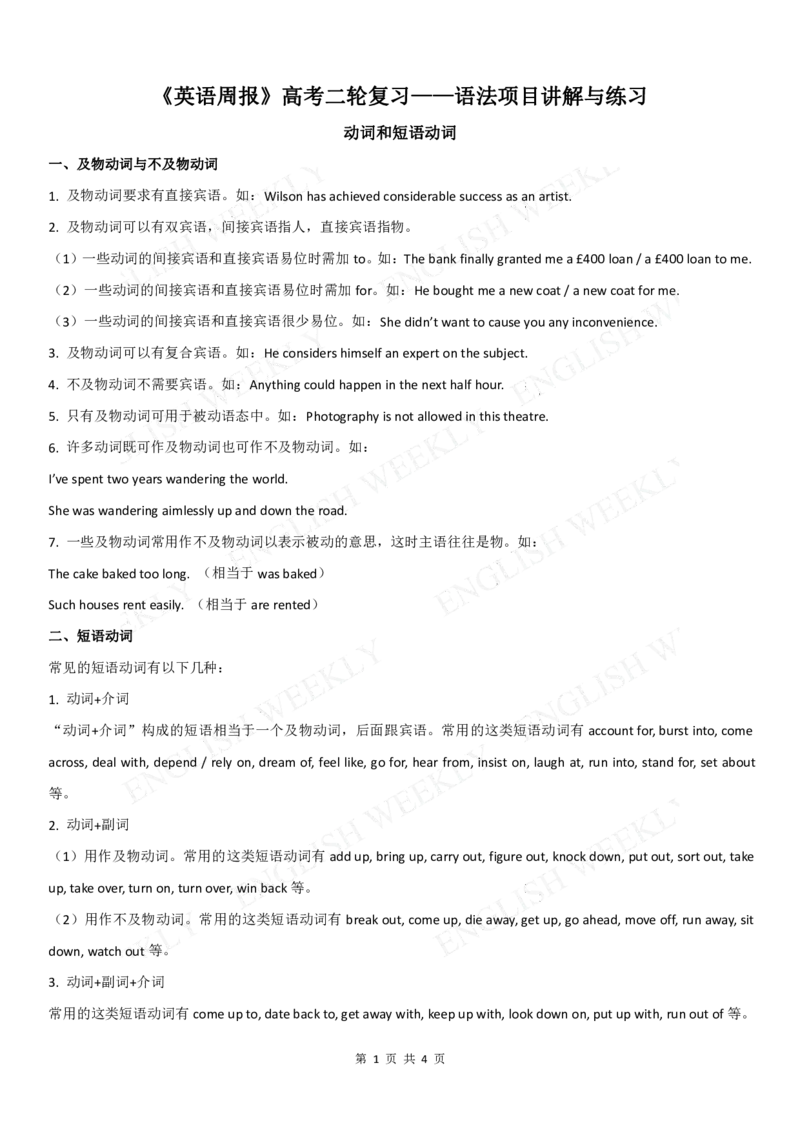
《英语周报》高考二轮复习——语法项目讲解与练习
动词和短语动词
一、及物动词与不及物动词
1. 及物动词要求有直接宾语。如:Wilson has achieved considerable success as an artist.
2. 及物动词可以有双宾语,间接宾语指人,直接宾语指物。
(1)一些动词的间接宾语和直接宾语易位时需加to。如:The bank finally granted me a £400 loan / a £400 loan to me.
(2)一些动词的间接宾语和直接宾语易位时需加for。如:He bought me a new coat / a new coat for me.
(3)一些动词的间接宾语和直接宾语很少易位。如:She didn’t want to cause you any inconvenience.
3. 及物动词可以有复合宾语。如:He considers himself an expert on the subject.
4. 不及物动词不需要宾语。如:Anything could happen in the next half hour.
5. 只有及物动词可用于被动语态中。如:Photography is not allowed in this theatre.
6. 许多动词既可作及物动词也可作不及物动词。如:
I’ve spent two years wandering the world.
She was wandering aimlessly up and down the road.
7. 一些及物动词常用作不及物动词以表示被动的意思,这时主语往往是物。如:
The cake baked too long. (相当于was baked)
Such houses rent easily. (相当于are rented)
二、短语动词
常见的短语动词有以下几种:
1. 动词+介词
“动词+介词”构成的短语相当于一个及物动词,后面跟宾语。常用的这类短语动词有account for, burst into, come
across, deal with, depend / rely on, dream of, feel like, go for, hear from, insist on, laugh at, run into, stand for, set about
等。
2. 动词+副词
(1)用作及物动词。常用的这类短语动词有add up, bring up, carry out, figure out, knock down, put out, sort out, take
up, take over, turn on, turn over, win back 等。
(2)用作不及物动词。常用的这类短语动词有break out, come up, die away, get up, go ahead, move off, run away, sit
down, watch out 等。
3. 动词+副词+介词
常用的这类短语动词有come up to, date back to, get away with, keep up with, look down on, put up with, run out of 等。
第2 页共4 页
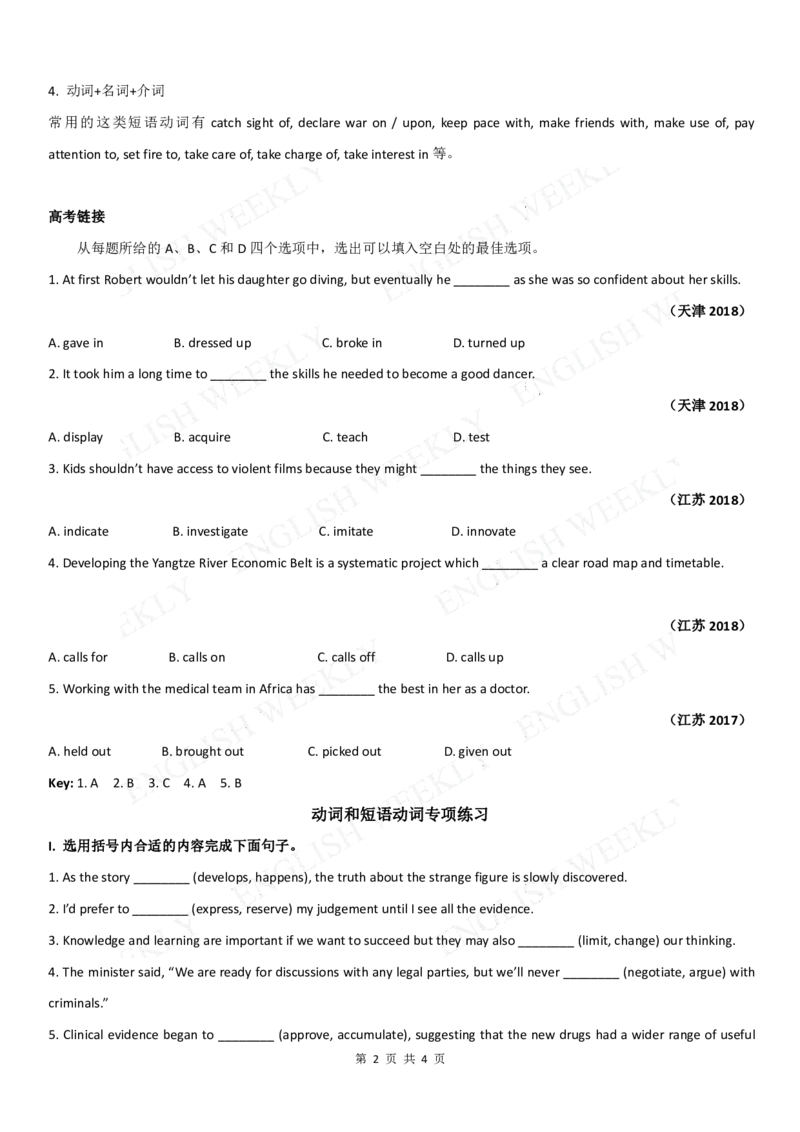
4. 动词+名词+介词
常用的这类短语动词有catch sight of, declare war on / upon, keep pace with, make friends with, make use of, pay
attention to, set fire to, take care of, take charge of, take interest in 等。
高考链接
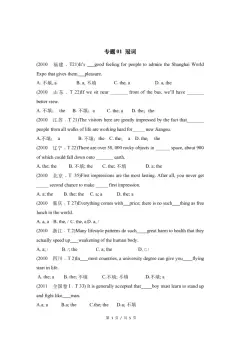
从每题所给的A、B、C 和D 四个选项中,选出可以填入空白处的最佳选项。
1. At first Robert wouldn’t let his daughter go diving, but eventually he ________ as she was so confident about her skills.
(天津2018)
A. gave in
B. dressed up
C. broke in
D. turned up
2. It took him a long time to ________ the skills he needed to become a good dancer.
(天津2018)
A. display
B. acquire
C. teach
D. test
3. Kids shouldn’t have access to violent films because they might ________ the things they see.
(江苏2018)
A. indicate
B. investigate
C. imitate
D. innovate
4. Developing the Yangtze River Economic Belt is a systematic project which ________ a clear road map and timetable.
(江苏2018)
A. calls for
B. calls on
C. calls off
D. calls up
5. Working with the medical team in Africa has ________ the best in her as a doctor.
(江苏2017)
A. held out
B. brought out
C. picked out
D. given out
Key: 1. A
2. B
3. C
4. A
5. B
动词和短语动词专项练习
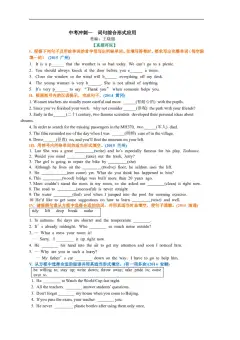
I. 选用括号内合适的内容完成下面句子。
1. As the story ________ (develops, happens), the truth about the strange figure is slowly discovered.
2. I’d prefer to ________ (express, reserve) my judgement until I see all the evidence.
3. Knowledge and learning are important if we want to succeed but they may also ________ (limit, change) our thinking.
4. The minister said, “We are ready for discussions with any legal parties, but we’ll never ________ (negotiate, argue) with
criminals.”
5. Clinical evidence began to ________ (approve, accumulate), suggesting that the new drugs had a wider range of useful
第3 页共4 页
activities than had been predicted from experiments in animals.
6. The loss has not yet been ________ (completed, calculated) accurately, but it is believed to be well beyond a hundred
million dollars.
7. I’d like to know how to ________ (order, open) an account with your bank.
8. The parents only ________ (concerned, contained) themselves with making money and ignored the left-behind
children’s education and life.
9. After days of searching, their patience was ________ (regarded, rewarded) and all the miners were pulled out alive from
the flooded coal mine.
10. Can you tell me how many festivals you ________ (observe, congratulate) a year in your country?
11. While intelligent people can often ________ (simplify, substitute) the complex, a fool is more likely to complicate the
simple.
12. According to the law, all foreigners have to ________ (register, associate) with the local police within two weeks of
arrival.
II. 选用方框内合适的短语动词并用其正确形式填空(每个短语动词限用一次)。
settle down, bring up, pick up, take apart, set out, come about, look into, pay off, keep up
1. We ________________ to paint the whole house but finished only the front part that day.
2. The athlete’s years of hard training ________________
when she finally won the Olympic gold medal.
3. They’d like to see their daughter ________________, get married, and have kids.
4. Walking alone in the dark, the boy whistled to ________________ his courage.
5. Rod loves ________________ clocks. However, he never manages to put them together again.
6. The building around the corner caught fire last night. The police are now ________________ the matter.
7. At the conference, the reporter ________________ a serious matter which was worth thinking about.
8. I just ________________ some French when I visited my uncle in France last year.
9. How did it ________________ that you missed so good a chance, which was very important for your promotion in the
company?
III. 选用方框内合适的动词或短语动词并用其正确形式完成下面短文(每项限用一次)。
A
calm down, discover, break down, wake up, access, ease up, look up, eat up
When Scott 1. ________________ this morning, he 2. ________________ that his toddler (初学走路的孩子) had
thrown up in her bed last night. He cleaned her bedding up before he 3. ________________ a bottle of milk. While he
was having his breakfast, however, his daughter started acting up. She just suddenly 4. ________________ and threw a
第4 页共4 页
tantrum (发脾气) on the kitchen floor. After falling apart for only a few minutes, the tantrum blew over and his daughter 5.
________________. Scott then finished eating and logged onto his computer. But before he could 6. ________________
the Internet, the computer blew up. Scott 7. ________________ the phone number, called for technical help, and told the
IT technician off. He only 8. ________________ when the tech threatened to put him on hold.
B
get into, promise, worry about, show up, knock out, stare at, refuse, depend on, take away, give up
Espen 1. ________________ Julia to pick him up but she had not 2. ________________. He 3. ________________
what might have happened to her. Perhaps she had been 4. ________________ by a bad person. Or, perhaps she had just
forgotten about him. Could she let him down like that? If she had simply failed to remember him, he 5. ________________
that he would ask her when he saw her next. But, then again, what if Julia had been 6. ________________ by bank
robbers? What if she had 7. ________________ to give them her car for a getaway vehicle? What if she had died in her
attempts to get to him? Just then, when Espen had decided not to 8. ________________ on her, Julia finally arrived. She
was just running late. She 9. ________________ Espen, and Espen blushed, thinking about his unfounded (无理由的)
anger. He 10. ________________ the car, but, before he could apologise, she started complaining about how bad the
traffic had been. Espen silently vowed to wait patiently for her tomorrow.
参考答案
动词和短语动词专项练习
I. 1. develops
2. reserve
3. limit
4. negotiate
5. accumulate
6. calculated
7. open
8. concerned
9. rewarded
10. observe
11. simplify
12. register
II. 1. set out
2. paid off
3. settle down
4. keep up
5. taking apart
6. looking into
7. brought up
8. picked up
9. come about
III.
A. 1. woke up
2. discovered
3. ate up
4. broke down
5. calmed down
6. access
7. looked up
8. eased up
B. 1. depended on
2. shown up
3. worried about
4. taken away
5. promised
6. knocked out
7. refused
8. give up
9. stared at
10. got into