专题06
高考阅读理解
七选五
一、考情分析
“七选五”阅读题是高考新题型。新课程标准要求:阅读理解题主要考查学生理解书面语篇的能力,
其中包括对语篇内容、语篇结构的理解和把握,也包括对语篇内容的分析、阐释和评价。高考英语阅读七
选五题型要求考生从整体上把握文章的逻辑结构和内容上的联系,理解句子之间、段落之间的关系,对诸
如连贯性、一致性等语段特征有较强的意识和熟练的把握,并具备运用语法知识分析理解长难句的能力。
可以说,此题型是对语言能力和阅读理解能力的综合测试。
高考英语新题型“七选五”阅读题的具体考试形式,就是将短文中的若干个句子(如五个句子)挑出,
打乱顺序与另外两个句子置于短文之后。学生根据短文内容,从短文后的七个句子中选出能填入空白处的
最佳选项。选项中有两项是多余选项。此题型主要考查学生理解语篇上下文逻辑关系的能力。
句子在段中的位置不同,所起的作用也不同。命题人之所以采用段首、段中和段尾三种挖空方式,正
是利用挖空位置的暗示作用和挖空上下文的提示作用,来考查考生的逻辑思维能力。段首、段中、段尾题
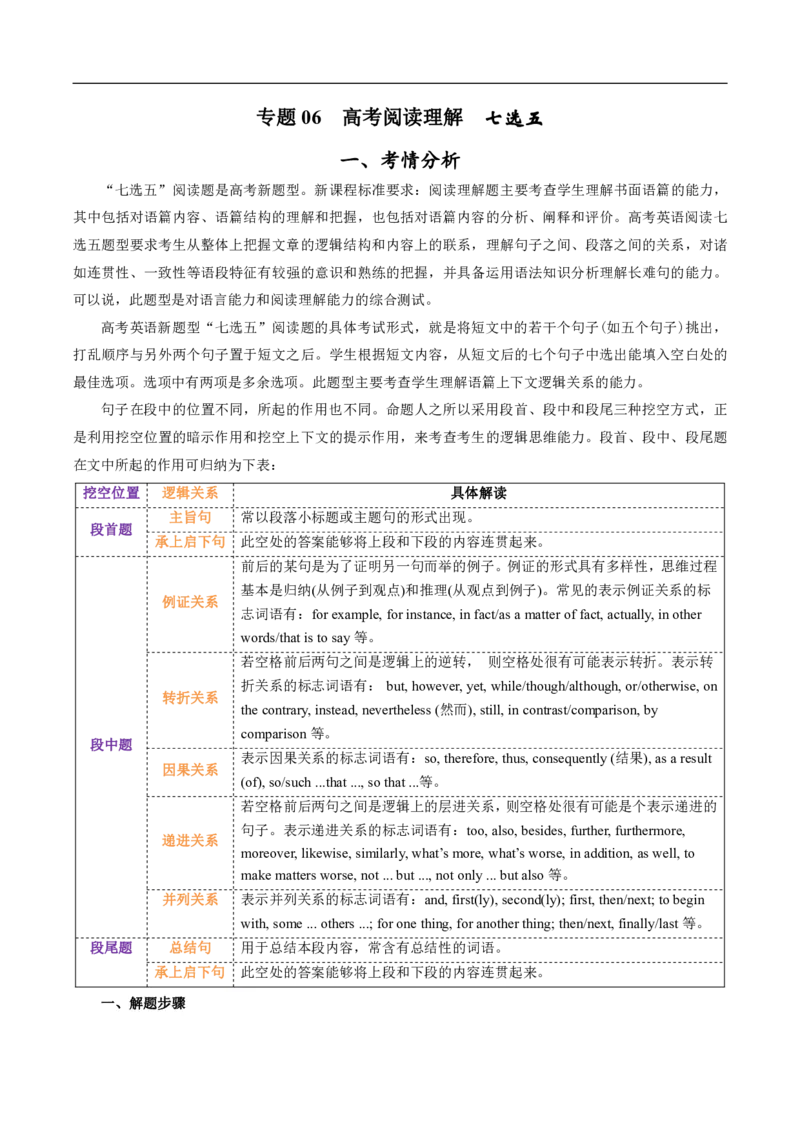
在文中所起的作用可归纳为下表:
挖空位置
逻辑关系
具体解读
段首题
主旨句
常以段落小标题或主题句的形式出现。
承上启下句
此空处的答案能够将上段和下段的内容连贯起来。
段中题
例证关系
前后的某句是为了证明另一句而举的例子。例证的形式具有多样性,思维过程
基本是归纳(从例子到观点)和推理(从观点到例子)。常见的表示例证关系的标
志词语有:for example, for instance, in fact/as a matter of fact, actually, in other
words/that is to say 等。
转折关系
若空格前后两句之间是逻辑上的逆转,则空格处很有可能表示转折。表示转
折关系的标志词语有:but, however, yet, while/though/although, or/otherwise, on
the contrary, instead, nevertheless (然而), still, in contrast/comparison, by
comparison 等。
因果关系
表示因果关系的标志词语有:so, therefore, thus, consequently (结果), as a result
(of), so/such ...that ..., so that ...等。
递进关系
若空格前后两句之间是逻辑上的层进关系,则空格处很有可能是个表示递进的
句子。表示递进关系的标志词语有:too, also, besides, further, furthermore,
moreover, likewise, similarly, what’s more, what’s worse, in addition, as well, to
make matters worse, not ... but ..., not only ... but also 等。
并列关系
表示并列关系的标志词语有:and, first(ly), second(ly); first, then/next; to begin
with, some ... others ...; for one thing, for another thing; then/next, finally/last 等。
段尾题
总结句
用于总结本段内容,常含有总结性的词语。
承上启下句
此空处的答案能够将上段和下段的内容连贯起来。
一、解题步骤
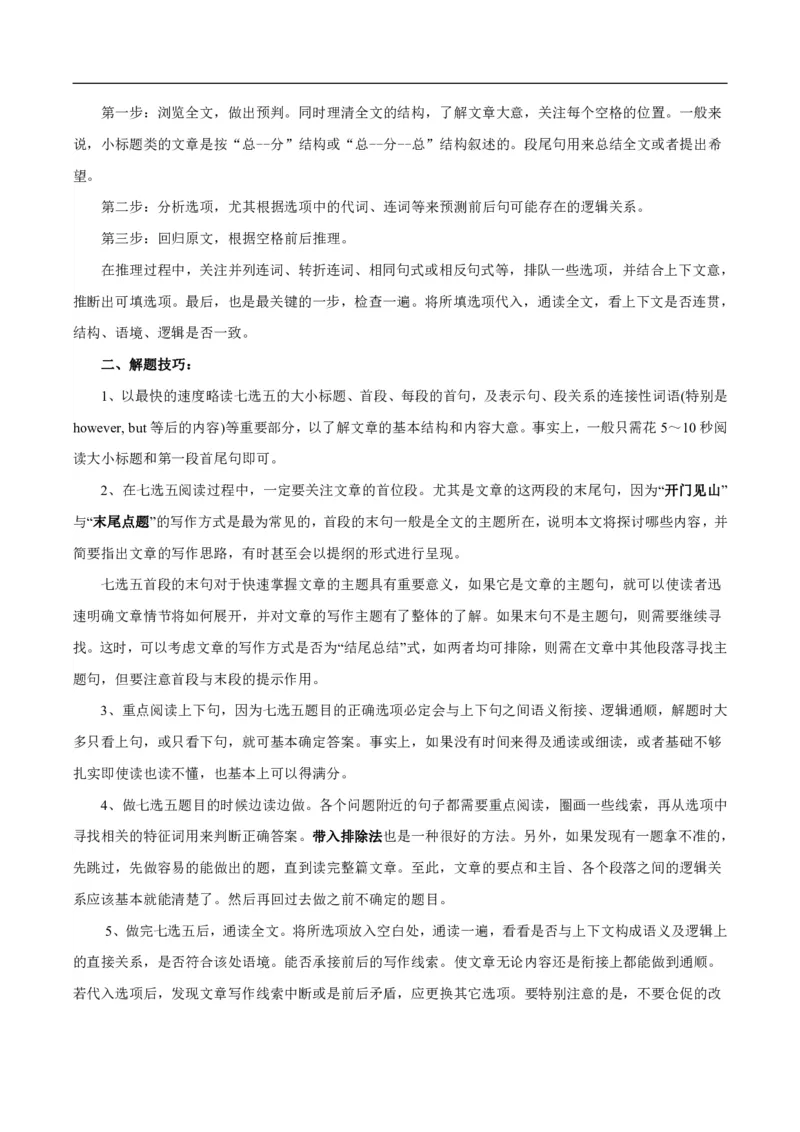
第一步:浏览全文,做出预判。同时理清全文的结构,了解文章大意,关注每个空格的位置。一般来
说,小标题类的文章是按“总--分”结构或“总--分--总”结构叙述的。段尾句用来总结全文或者提出希
望。
第二步:分析选项,尤其根据选项中的代词、连词等来预测前后句可能存在的逻辑关系。
第三步:回归原文,根据空格前后推理。
在推理过程中,关注并列连词、转折连词、相同句式或相反句式等,排队一些选项,并结合上下文意,
推断出可填选项。最后,也是最关键的一步,检查一遍。将所填选项代入,通读全文,看上下文是否连贯,
结构、语境、逻辑是否一致。
二、解题技巧:
1、以最快的速度略读七选五的大小标题、首段、每段的首句,及表示句、段关系的连接性词语(特别是
however, but 等后的内容)等重要部分,以了解文章的基本结构和内容大意。事实上,一般只需花5~10 秒阅
读大小标题和第一段首尾句即可。
2、在七选五阅读过程中,一定要关注文章的首位段。尤其是文章的这两段的末尾句,因为“开门见山”
与“末尾点题”的写作方式是最为常见的,首段的末句一般是全文的主题所在,说明本文将探讨哪些内容,并
简要指出文章的写作思路,有时甚至会以提纲的形式进行呈现。
七选五首段的末句对于快速掌握文章的主题具有重要意义,如果它是文章的主题句,就可以使读者迅
速明确文章情节将如何展开,并对文章的写作主题有了整体的了解。如果末句不是主题句,则需要继续寻
找。这时,可以考虑文章的写作方式是否为“结尾总结”式,如两者均可排除,则需在文章中其他段落寻找主
题句,但要注意首段与末段的提示作用。
3、重点阅读上下句,因为七选五题目的正确选项必定会与上下句之间语义衔接、逻辑通顺,解题时大
多只看上句,或只看下句,就可基本确定答案。事实上,如果没有时间来得及通读或细读,或者基础不够
扎实即使读也读不懂,也基本上可以得满分。
4、做七选五题目的时候边读边做。各个问题附近的句子都需要重点阅读,圈画一些线索,再从选项中
寻找相关的特征词用来判断正确答案。带入排除法也是一种很好的方法。另外,如果发现有一题拿不准的,
先跳过,先做容易的能做出的题,直到读完整篇文章。至此,文章的要点和主旨、各个段落之间的逻辑关
系应该基本就能清楚了。然后再回过去做之前不确定的题目。
5、做完七选五后,通读全文。将所选项放入空白处,通读一遍,看看是否与上下文构成语义及逻辑上
的直接关系,是否符合该处语境。能否承接前后的写作线索。使文章无论内容还是衔接上都能做到通顺。
若代入选项后,发现文章写作线索中断或是前后矛盾,应更换其它选项。要特别注意的是,不要仓促的改
自己的之前选定的答案。做这类的题目时,第一印象的可信度还是很高的,除非你已经常有充分的理由否
定向前的选择。
在做“七选五”阅读题时,还要注意:
1.好好分析阅读材料中的长难句
在阅读过程中,难免会遇到长难句。通常句子较长,一个从句套着另一个从句,环环相扣。但不管句
子有多长、多复杂,它只由两部分组成,即主干和修饰成分。主干是整个句子的骨架,主要是主谓(宾)
结构或主系表结构。
而修饰成分在句中,只起修饰或补充主干的作用,它既可以是单词,也可以是短语,更常见的则是从
句,尤其是定语从句和状语从句。我们应该通过仔细分析,将每个修饰成分划出来,找出句子的主干,这
样整个句子就清晰了。
2.利用思维导图
思维导图完美结合了文字和图形,学生常用于学习笔记中。在教学中,需要引导学生把握篇章结构,
引导学生由词到句、再到段、到篇,关注语篇的结构和层次性,因此,可以借助思维导图增强对语篇的理
解,帮助解题。
3.抓住词汇、句式
除了理解句意,还应该遵循词汇一致性原则、句式一致性原则。对于词汇,应关注词汇复现,包括原
词、同根词、近义词、反义词、同畴词,还有人称代词、指示代词、定冠词等。句式一致性原则,则关注
相同句式和相反句式。
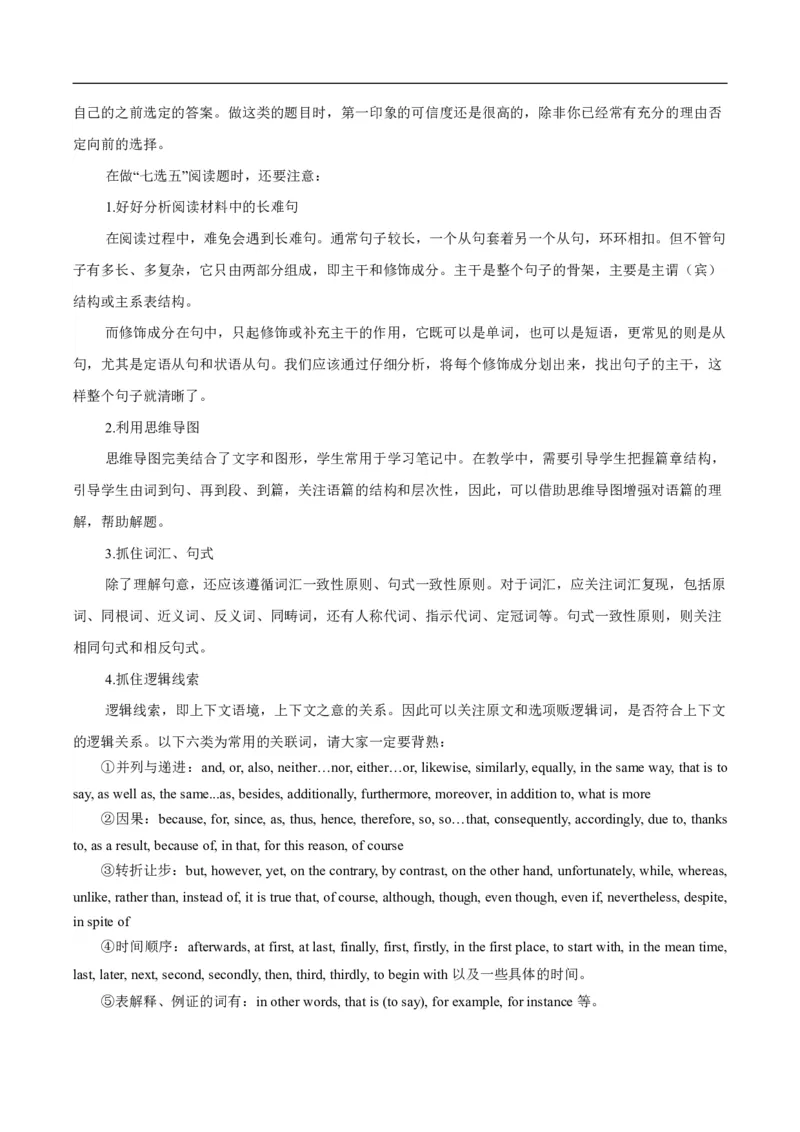
4.抓住逻辑线索
逻辑线索,即上下文语境,上下文之意的关系。因此可以关注原文和选项贩逻辑词,是否符合上下文
的逻辑关系。以下六类为常用的关联词,请大家一定要背熟:
①并列与递进:and, or, also, neither…nor, either…or, likewise, similarly, equally, in the same way, that is to
say, as well as, the same...as, besides, additionally, furthermore, moreover, in addition to, what is more
②因果:because, for, since, as, thus, hence, therefore, so, so…that, consequently, accordingly, due to, thanks
to, as a result, because of, in that, for this reason, of course
③转折让步:but, however, yet, on the contrary, by contrast, on the other hand, unfortunately, while, whereas,
unlike, rather than, instead of, it is true that, of course, although, though, even though, even if, nevertheless, despite,
in spite of
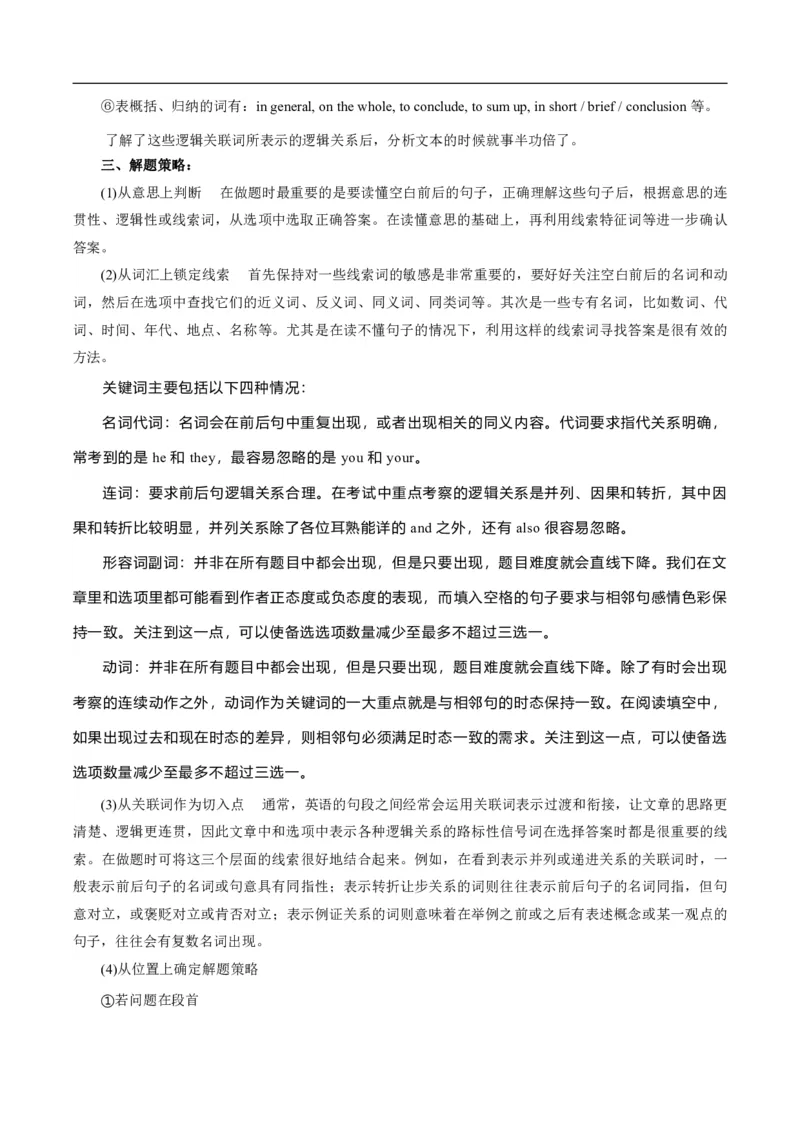
④时间顺序:afterwards, at first, at last, finally, first, firstly, in the first place, to start with, in the mean time,
last, later, next, second, secondly, then, third, thirdly, to begin with 以及一些具体的时间。
⑤表解释、例证的词有:in other words, that is (to say), for example, for instance 等。
⑥表概括、归纳的词有:in general, on the whole, to conclude, to sum up, in short / brief / conclusion 等。
了解了这些逻辑关联词所表示的逻辑关系后,分析文本的时候就事半功倍了。
三、解题策略:
(1)从意思上判断
在做题时最重要的是要读懂空白前后的句子,正确理解这些句子后,根据意思的连
贯性、逻辑性或线索词,从选项中选取正确答案。在读懂意思的基础上,再利用线索特征词等进一步确认
答案。
(2)从词汇上锁定线索
首先保持对一些线索词的敏感是非常重要的,要好好关注空白前后的名词和动
词,然后在选项中查找它们的近义词、反义词、同义词、同类词等。其次是一些专有名词,比如数词、代
词、时间、年代、地点、名称等。尤其是在读不懂句子的情况下,利用这样的线索词寻找答案是很有效的
方法。
关键词主要包括以下四种情况:
名词代词:名词会在前后句中重复出现,或者出现相关的同义内容。代词要求指代关系明确,
常考到的是he 和they,最容易忽略的是you 和your。
连词:要求前后句逻辑关系合理。在考试中重点考察的逻辑关系是并列、因果和转折,其中因
果和转折比较明显,并列关系除了各位耳熟能详的and 之外,还有also 很容易忽略。
形容词副词:并非在所有题目中都会出现,但是只要出现,题目难度就会直线下降。我们在文
章里和选项里都可能看到作者正态度或负态度的表现,而填入空格的句子要求与相邻句感情色彩保
持一致。关注到这一点,可以使备选选项数量减少至最多不超过三选一。
动词:并非在所有题目中都会出现,但是只要出现,题目难度就会直线下降。除了有时会出现
考察的连续动作之外,动词作为关键词的一大重点就是与相邻句的时态保持一致。在阅读填空中,
如果出现过去和现在时态的差异,则相邻句必须满足时态一致的需求。关注到这一点,可以使备选
选项数量减少至最多不超过三选一。
(3)从关联词作为切入点
通常,英语的句段之间经常会运用关联词表示过渡和衔接,让文章的思路更
清楚、逻辑更连贯,因此文章中和选项中表示各种逻辑关系的路标性信号词在选择答案时都是很重要的线
索。在做题时可将这三个层面的线索很好地结合起来。例如,在看到表示并列或递进关系的关联词时,一
般表示前后句子的名词或句意具有同指性;表示转折让步关系的词则往往表示前后句子的名词同指,但句
意对立,或褒贬对立或肯否对立;表示例证关系的词则意味着在举例之前或之后有表述概念或某一观点的
句子,往往会有复数名词出现。
(4)从位置上确定解题策略
①若问题在段首
a. 通常是段落主题句。认真阅读该段落,根据段落一致性原则,查找相关词或者同义词,从而推测出
主题句,找到答案。
b. 与后文是并列、转折、因果关系等。着重阅读后文第一两句,锁定线索信号词,然后在选项中查找
相关特征词。一般来说正确答案与它后面的一句话的在意思上是衔接的,所以通常情况下,这两句话中会
有某种的衔接手段。
c. 段落间的过渡句。这时要前瞻后望找启示,即阅读上一段结尾部分,通常正确答案与上一段结尾有
机地衔接起来,并结合下一段内容,看所选的答案是否将两段内容连贯起来。
②若问题在段尾
a. 空白前的一句或两句是重点语句,重点阅读以锁定关键词。
b. 通常是结论、概括性语句。要注意表示总结的信号词,如therefore, as a result, hence, thus, to sum up, to
conclude, in short, in a word 等词语,选项中也可发现前文的同义词句。
c. 与前文是转折或对比关系。此时要注意在选项中查找表示转折、对比的关联词,同时注意选项中所
讲内容是否与前文在同一主题上形成对立、对比关系。
d. 与前文是并列或排比关系。在这种情况下,通常是该段落要求补全说明本段主题的其他细节,因此
根据段落一致性原则,在原文和选项中找到相关的特征词,通常在选项中会出现表示并列/递进关系的关联
词或与前文类似的句式结构,或出现同义词等其他信号线索。前面的一句与正确答案的第一句是紧密相连
的。要特别注意阅读这样相连的两句,通常会找到关键的线索词句。
e. 所选答案是引出下一段的内容。如果在选项中找不出与前文之间的关联,此时可考虑与下一段开头
是否有一定的衔接。认真阅读下一段开头几句,看是否与选项的最后一句紧密连接起来。
f. 如果第一段的段尾是空白,要认真阅读,看此处是细节还是主题。通常文章第一段要提出文章的主
题,如果在段尾提出主题,会用一些信号词如转折词引出来,正确答案中应有这样的特征词。
③若问题是一整个自然段
a.承上启下是这个段落的主要任务,且自成一体,所以会有一个该段落主旨。考生可以从选项中较长的
选项开始阅读,以此类推直至找到正确答案。
b.着重阅读前一段结尾和后一段开头的一两句查找相关的线索,而且重要线索通常会在后一段开头,因
此后一段开头往往比前一段结尾更为重要。
c.分析段落之间的逻辑关系及内容的连贯性,注意段落间的衔接手段。将选项代入原文,如果前后内容
连贯,符合逻辑,就能得出正确答案。
掌握了解答阅读七选五的关键是理清文章结构和句间逻辑。我们不但要拼解题的准度,还要拼解题的
速度,这里给大家介绍一种快捷的解题技法——一序一忌看四点。
一序:先看七、再读文,快捷准确有针对
关于做题顺序,是先读文段,还是先看七个选项,大多数人倾向于先读文段。但是,笔者还是建议先
看七个选项,再读短文。先确定哪个选项适合放在文章的什么位置。通常有三个位置:段首、段中、段尾。
不同位置的句子有不同的特征,有时有的选项本身表述就是错误的,可以直接从备选项中清除,以降低难
度。
一忌:“选一个、划一个”,这个方法不足取
解答阅读七选五题目最大的风险就是容易出现连环错!假如做题时,我们选一个,划掉一个,美其名
曰:逐步缩小包围圈。方法虽妙,但倘若前面我们错选了一处,那么就会导致多处错选。因此我们做题时
要特别忌讳“选出一个划掉一个”,以避免造成一错再错,产生连环错误,特别是那些句子结构相同、句意相
近的选项更是需要我们三思而定。
看四点:体裁、指代、连贯词,重复信息有价值
1. 看文段体裁,用好鲜明特征
从近年高考所选材料来看,其体裁基本是说明文和记叙文。说明文的特征是主题鲜明、层次清晰,语
篇特征非常明晰。记叙文则以故事发展脉络为主线,为了有趣,常常会出现一些比较特别的记叙手法,因
而会增加理解的难度。
2. 看代词指代,寻根还需溯源
英语是一门非常讲究简洁的语言,所以在篇章中代词的运用很多,用于指代上文已经提到过的人、物
或者整个事件。追根溯源,找到指代与被替代关系,会大大加快我们解题的速度。
3. 看上下连贯,捕捉文段脉络
上下连贯是好的篇章的特点,常常靠“起承转合”来实现。“起”就是开端,或提出主题或吸引读者关注主
题;“承”就是承接上文加以申述;“转”就是转折,指出问题或困难;“合”则是给出解决问题的方法或建议。
这些特征在说明文和议论文中尤为明显。
4. 看重复信息,把握内在联系
篇章是相对完整的一个语义体,自然而然会有很多割裂不开的内在联系。这些联系常常靠同义词、近
义词、反义词或者借助词性的变化来重复体现,而这些重复信息的存在,又为我们提供了良好的解题契机。
二、真题回顾
(2023 年新高考全国I 卷)
第二节
(共5 小题;每小题2.5 分,满分12.5 分)
阅读下面短文,从短文后的选项中选出可以填入空白处的最佳选项。选项中有两项为多余选项。
Personal Forgiveness
Taking responsibility for mistakes is a positive step, but don’t beat yourself up about them. To err (犯错) is
human.
36
You can use the following writing exercise to help you do this.
In a journal or on a piece of paper, put the heading “Personal strengths.”
37
Are you caring? Creative?
Generous? A good listener? Fun to be around? They don’t have to be world-changing, just aspects of your
personality that you’re proud of.
At the top of a second page, put the heading “Acts of kindness.” On this one, list all the positive things you’ve
done for others. It might be the time when you helped a friend with their homework, when you did the ironing
without being asked, or when you baked cookies after the family had had a tiring day.
38
You could ask a friend or family member to help add to your list.
39
That way, you could exchange
thoughts on what makes each of you special and the aspects of your personality that shine through. In fact, don’t
wait until you’ve made a mistake to try this — it’s a great way to boost self-confidence at any time.
It’s something of a cliché (陈词滥调) that most people learn not from their successes but their mistakes. The
thing is, it’s true.
40
We’ re all changing and learning all the time and mistakes are a positive way to develop
and grow.
A. A little self-forgiveness also goes a long way.
B. Now list all the characteristics you like about yourself.
C. They might even like to have a go at doing the exercise.
D. It’s just as important to show yourself some forgiveness.
E. It doesn’t mean you have to ignore what’s happened or forget it.
F. Whatever it is, no matter how small it might seem, write it down.
G. Whatever the mistake, remember it isn’t a fixed aspect of your personality.
【答案】36. D
37. B
38. F
39. C
40. G
【解析】本文为一篇说明文。文章鼓励人们练习自我宽恕,并提供了一个简单的写作练习来增强自信。通
过列出个人的优点和善良的行为,人们可以学会原谅自己的错误,并从中成长。
【36 题】D
根据空前内容“Taking responsibility for mistakes is a positive step, but don’t beat yourself up about
them. To err (犯错) is human. (为错误承担责任是积极的一步,但不要因此而自责。人孰能无过)”可知,作者
认为人都会犯错,勇于承担责任固然重要,但是也不要因此而过于自责。结合空后“You can use the following
writing exercise to help you do this. (你可以使用下面的写作练习来帮助你做到这一点)”中的“do this”以及下文
内容可推断,空处应该内容和“不要太自责”相似。选项D“It’s just as important to show yourself some
forgiveness. (宽恕自己也同样重要)”与“不要太自责”语意相近,起承上启下的作用。故选D。
【37 题】B
根据空前内容“In a journal or on a piece of paper, put the heading “Personal strengths. ” (在日记或
纸上写上“个人优点”)”以及空后内容“Are you caring? Creative? Generous? A good listener? Fun to be around?
They don’t have to be world-changing, just aspects of your personality that you’re proud of. (你有爱心吗?有创造
力吗?你慷慨吗?是一个好的倾听者?与人相处很有趣吗?它们不一定要改变世界,只要你个性中让你感
到自豪的方面就行)”可知,空处指的是列出一些你个性中的优点。选项B“Now list all the characteristics you
like about yourself. (现在列出所有你喜欢的自己身上的特点)”符合上下文内容,下文内容具体解释那些是优
点。故选B。
【38 题】F
根据上文内容“At the top of a second page, put the heading “Acts of kindness.” On this one, list all
the positive things you’ve done for others. It might be the time when you helped a friend with their homework,
when you did the ironing without being asked, or when you baked cookies after the family had had a tiring day. (在
第二页的顶部,写上“善举”的标题。在这张单子上,列出你为别人做过的所有积极的事情。它可能是当你帮
助朋友做作业的时候,当你没有被要求却主动熨衣服的时候,或者当你在家人累了一天之后烤饼干的时候)”
可知,本段主要讲述的是列出一些自己所做的好事。选项F“Whatever it is, no matter how small it might seem,
write it down. (不管是什么,不管它看起来有多小,都要把它写下来)”与上文内容一致,讲述的是不管你所
做的事情不管有多小,只要是好的事情,都记下来。故选F。
【39 题】C
根据空后内容“That way, you could exchange thoughts on what makes each of you special and the
aspects of your personality that shine through. (这样,你们就可以交换意见,谈谈是什么让你们每个人都与众
不同,以及你们个性中闪光的方面)”可知,空处提到了某种方式,这种方式会使得你和朋友们一起交换意见
等。选项C“They might even like to have a go at doing the exercise. (他们甚至可能想试一试做练习)”符合语境,
C 项中的“they”与空前的“You could ask a friend or family member to help add to your list. (你可以让朋友或家
人帮你增加你的列表内容。)”中的“a friend or family member”保持一致,同时选项C 和下文“In fact, don’t wait
until you’ve made a mistake to try this — it’s a great way to boost self-confidence at any time. (事实上,不要等到
你犯了错误才去尝试这个——这是一个在任何时候都能增强自信的好方法)”中的“this”一致。故选C。
【40 题】G
根据空前内容“It’s something of a cliché (陈词滥调) that most people learn not from their successes
but their mistakes. The thing is, it’s true. (大多数人不是从他们的成功中学习,而是从他们的错误中学习,这是
陈词滥调。但事实是,这是真的)”可知,作者认为人是从错误中学习。选项G“Whatever the mistake, remember
it isn’t a fixed aspect of your personality. (不管你犯了什么错误,记住这不是你性格中固定的一面)”符合语境,
G 项中的“isn’t a fixed aspect of your personality”和空后内容“We’ re all changing and learning all the time and
mistakes are a positive way to develop and grow. (我们一直在改变和学习,错误是一种积极的发展和成长的方
式)”保持一致,指的都是犯错并不是性格中固有的一面,我们是通过错误来成长。故选G。
(2022 年新高考全国I 卷)
第一节(共15 小题:每小题2.5 分,满分37.5 分)
阅读下列短文,从每题所给的A、B、C、D 四个选项中选出最佳选项。
Tricks To Becoming A Patient Person
Here’s a riddle: What do traffic jams, long lines and waiting for a vacation to start all have in common?
There’s one answer.
36
.
In the Digital Age, we’re used to having what we need immediately and right ai our fingertips. However,
research suggests that if we practiced patience, we’d be a whole lot better off. Here are several tricks.
●Practice gratitude (感激)
Thankfulness has a lot of benefits: Research shows it makes us happier, less stressed and even more optimistic.
37
. “Showing thankfulness can foster self-control,” said Ye Li, researcher at the University of California.
●Make yourself wait
Instant gratification (满足) may seem like the most “feel good” option at the time, but psychology research
suggests waiting for things actually makes us happier in the long run. And the only way for us to get into the habit
of waiting is to practice.
38
. Put off watching your favorite show until the weekend or wait 10 extra minutes
before going for that cake. You’ll soon find that the more patience you practice, the more you start to apply it to
other, more annoying situations.
●
39
.
So many of us have the belief that being comfortable is the only state we will tolerate, and when we
experience something outside of our comfort zone, we get impatient about the circumstances. You should learn to
say to yourself, “
40
.” You’ll then gradually become more patient.
A. Find your causes
B. Start with small tasks
C. Accept the uncomfortable
D. All this adds up to a state of hurry
E. It can also help us practice more patience
F. This is merely uncomfortable, not intolerable
G. They’re all situations where we could use a little extra patience
【答案】36. G
37. E
38. B
39. C
40. F
【解析】这是一篇说明文。文章主要介绍了变得耐心的一些方法。
【36 题】G
根据上文“Here’s a riddle: What do traffic jams, long lines and waiting for a vacation to start all have
in common? There’s one answer. (这里有一个谜语:交通堵塞、排长队和等待假期开始有什么共同之处?答案
只有一个)”可知,本句说明上文谜语的答案,结合“交通堵塞、排长队和等待假期”这些情况可知都需要耐心。
故G 选项“在这些情况下,我们都需要一点额外的耐心”符合语境,故选G。
【37 题】E
根据上文“Thankfulness has a lot of benefits: Research shows it makes us happier, less stressed and
even more optimistic.(感恩有很多好处:研究表明,感恩让我们更快乐,压力更小,甚至更乐观)”以及后文
““Showing thankfulness can foster self-control,” said Ye Li, researcher at the University of California. (加州大学
的研究员叶丽说:“表达感激可以培养自我控制能力。”)”可知,上文提到了感恩的诸多好处,可知本句继续
说明感恩的好处:它还可以帮助我们练习更多的耐心。E 选项中It 指代上文Thankfulness。故E 选项“它还
可以帮助我们练习更多的耐心”符合语境,故选E。
【38 题】B
根据上文“And the only way for us to get into the habit of waiting is to practice. (我们养成等待习惯
的唯一方法就是练习)”以及后文“Put off watching your favorite show until the weekend or wait 10 extra minutes
before going for that cake. (把你最喜欢的节目推迟到周末再看,或者多等10 分钟再去吃蛋糕)”可知,后文列
举的事情都是日常的小事,说明要从小事开始练习等待,故B 选项“从小任务开始”符合语境,故选B。
【39 题】C
根据本段内容“So many of us have the belief that being comfortable is the only state we will tolerate,
and when we experience something outside of our comfort zone, we get impatient about the circumstances. (我们
中的许多人都认为舒适是我们唯一能容忍的状态,当我们经历舒适区之外的事情时,我们会对环境失去耐
心)”可知,本段提到了舒适是我们唯一能容忍的状态,结合前文的小标题都是祈使句可知,本段的主旨与接
受不舒适相关,C 选项中uncomfortable 对应后文comfortable。故C 选项“接受不舒服”符合语境,故选C。
【40 题】F
根据上文“You should learn to say to yourself (你应该学会对自己说……)”以及后文“You’ll then
gradually become more patient. (然后你会逐渐变得更有耐心)”结合本段主要说明的是不舒服的状态,可知,
本句为对自己所说的话与接受不舒服相关,故F 选项“这仅仅是不舒服,而不是无法忍受”符合语境,故选F。
三、最新模拟试题
(1)
(2023 春·浙江·高三天台中学校联考阶段练习)
Do you ever feel really afraid of failing? Do you think you have to be perfect all the time? Do you get very
upset over small mistakes that you think you made and then imagine that makes the whole thing you are working
on wrong?
1
Perfectionists think that if they don’t act perfectly, they are really bad or worthless.
2
For example, you
imagine other people judge you very harshly for very small mistakes. Perfectionists set really unrealistic goals for
themselves, such as, I will make honor roll every year or never miss a step in that dance sequence.
3
This
kind of thinking means you view situations as all good or all bad—nothing in between.
4
The first step is to help them identify their thoughts about a situation that’s distressing. They are
advised to ask themselves, “What is going through my mind right now?” Then, if their next thought is along the
lines of all-good or all-bad thinking such as “I made a mistake and now my project is ruined,” it is suggested that
they ask themselves something about that thought. They could ask, “Is there a way to see my situation as not all
good or bad, but as something in between?”
Setting realistic goals sounds like a crucial part of trying to avoid perfectionism, while still being motivated to
do well. Yes, contrary to what most people think, you can still become very successful without being a perfectionist!
5
They can fail at a task and more easily bounce back from that failure.
A. If you do, then you are probably a perfectionist.
B. So what can people do to help change the way they think?
C. Perfectionists sometimes avoid challenges for fear of failing.
D. When they don’t meet these goals, they feel it’s a catastrophe.
E. They appreciate success without linking it so rigidly to their self-worth.
F. Positive strivers set realistic goals and enjoy challenging themselves.
G. They usually think others also use the same unreasonably high standards to judge them.
(2)
(2023·浙江杭州·浙江省杭州第二中学校考模拟预测)
Do you have an important or favorite memory from the past? Perhaps it was clapping for goals, or seeing
rainbow picture in the window. Shared memories can connect you to others.
1
How does memory work?
Scientists believe there are two levels of memory. One is short-term or working memory, which stays in our
brain for only 15-30 seconds. The other level is long-term or permanent memory, which can be stored for days, or
even years.
Motor-skill memories help you remember how to ride a bike; factual memories help you to remember faces.
2
Emotional memories recall how you felt about something and can be strong and powerful. Remembering the
sadness of missing your friends during lockdown, and being happy and excited to see them again afterwards, are
emotional memories. They are long term and can sometimes last a lifetime.
Why are memories important?
3
Information such as which school you go to and who your friends are is stored inside your brain, ready
for when you need it. Memories can also help you manage feelings. Heidi, 12, told The Week, “If I miss seeing my
granny and granddad, I remember staying with them in Devon. It makes me feel happy, like when I was there.”
“When people think of shared experience, what usually comes to mind is being with close others, such as
friends or family, and talking with them,” Erica Boothby, a social-psychologist, said. By telling a funny or
embarrassing story we share feelings of joy or recognition of difficulties overcome. By sharing similar experiences,
we empathize (产生共鸣) with and understand one another better.
4
Kim Roberts, a professor who runs the Child Memory Lab in Canada, believes focusing on happy memories
will help you feel more positive.
5
Roberts says it’s also helpful to remember that if you missed out on your
last term at school, or birthday celebrations, then your friends did too. One day you will look back on this year as
an important memory that you all share.
A. When do memories fade?
B. Can memories help well being?
C. Memories tell you the story of yourself.
D. Emotional memories are usually sad ones.
E. These types of memories can be short or long term.
F. If you have difficult memories, though, it is important to talk about them.
G. By sharing our memories, we can feel closer to other people and more positive.
(3)
(2023·湖北·华中师大一附中校考模拟预测)
Photography for me has always been a key. It opens up doors, gives me an excuse to travel with more purpose,
and lets me see behind the scenes.
1
—“Better get back to taking photos. Nice to chat!”
What is my advice to beginners? I didn’t study photography; I’m not formally trained;
2
But that’s not
what photography is about for me. If you want to be a photographer, be constantly asking yourself the question:
“What is the story here?” It doesn’t matter if you are shooting a dish at your favorite restaurant or the food waste
processing plant that deals with wat’s left over —
3
What does that mean? If I’m photographing a dinner
party for Social Supply, it’s important to capture not just the plate of food, but to step back and capture the scene
around it. If I’m taking photos of a mushroom harvest in Yunnan, I make sure to find an angle that shows just how
much they’ve harvested, but also a few close-ups of the weathered hands that are carefully sorting.
4
I’ve taken hundreds of thousands of photos this year alone. The more you shoot the better you will be.
So, start shooting—anything and everything, but specially your fiends’ businesses and projects.
Do I have a good camera? Yes, but some people still think that the photos I post from my phone were taken on
that camera, so don’t confuse a good device with being a good photographer.
5
so start there, and start today.
A. Let the story guide you.
B. I have virtually no art experience.
C. Like anything, photography requires practice.
D. Photography becomes an incredible drive to explore.
E. Some of my favorite photographers just use their phone.
F. It also helps to slip out of awkward small talk at parties.
G. I feel deeply connected with whatever is captured through my camera lens.
(4)
(2023·湖北黄冈·黄冈中学校考二模)
Hilde’s father was a reporter. He often took her to work with him, and she developed a strong interest in news
stories and reporting.
1
She did the writing, her sister Izzy took pictures, and her father helped her organize
and print the newspaper. Hilde wanted to cover big stories in her town. Following the rules her father had taught her,
she researched and reported stories in her monthly newspaper.
The newspaper suddenly became famous when a murder happened in the town, and Hilde was the first person
to report it. Soon, news organizations around the country were doing stories on Hilde.
2
Some people criticized her parents for allowing her to report on something as unpleasant as a murder.
Others criticized Hilde for “pretending to be a reporter’’. Some people even suggested she should be playing
with dolls.
3
She responded with a YouTube video.“I never began my newspaper so that people would think I
was cute,” she said.“I want to be taken seriously.’’
That wasn’t the last time Hilde had trouble getting people to take her seriously. Sometimes, it was because of
her age. Other times, it was because she was a girl.
4
Hilde continued reporting and her activities as a
reporter have made her famous.
Now Hilde has published a book telling her own story and the challenges she has faced. Some of those
challenges came from Hilde herself, struggling to figure out who she was as she grew older.
5
But she is still
just 15, and has plenty of time to decide what she wants to do with her life. Her efforts have already inspired people
around the world.
A. But she never let that stop her.
B. Hilde was upset by the complaints.
C. For now, Hilde says she has given up reporting.
D. When she was 8, Hilde started her own newspaper.
E. Her great success in reporting has changed her life.
F. Not everyone was happy about Hilde’s efforts, though.
G. She was clearly in a dilemma about how to solve the crisis.
(5)
(2023 春·广东珠海·高三珠海市第三中学校考阶段练习)
Establishing healthy boundaries with yourself will help you stay within your range of control and prioritize
what matters most. Here are some tips.
Be honest with yourself
Behind every fancy purchase is a desire for status and recognition. You secretly want to be noticed for wearing
a new watch or carrying a designer purse.
1
So before taking action towards any endeavor, such as making an
expensive purchase or pursuing a job promotion, ask yourself, “Who am I doing this for?”
2
However, if you are pursuing something with the hopes of attracting attention, then you need to say no
to yourself.
Honor your limits
You can’t be everything for everyone. Trying to please everyone makes you vulnerable.
3
It is important
that you are wise with your resources.
The importance of honoring your limits is highlighted by the Greek mythological story. The story is a
reminder that pushing yourself too hard for too long ultimately comes at a cost.
Stop comparing yourself to others
People will engage in behaviors that trigger you. It might be tempting to enter an undeclared competition with
the Joneses. This approach does not work because there is always someone out there who has more of what you
desire.
Stop comparing yourself to others.
4
Focus on living a meaningful life that is consistent with your
values and goals.
Be fair to yourself
You are likely your worst critic. You secretly say things to yourself that you would never have the heart to tell
others.
Remember to have realistic expectations of yourself.
5
If the goal is unrealistic, then you have to say no
and adjust your expectations.
A. You criticize yourself for shortcomings.
B. The truth is you have limited energy and time.
C. The reality is that you are not being recognized.
D. What someone is doing with their life has nothing to do with you.
E. If a pursuit will truly improve the quality of your life, then go for it.
F. The same can be said about other pursuits such as accumulating wealth and status.
G. When you set goals, consider whether you have set the standard at a reasonable level.
(6)
(2023 秋·广东广州·高三执信中学校考开学考试)
How to Be a Good Listener
Whether you’re communicating in person or on the phone, being a good listener is an important part of any
healthy relationship.
1
If you’ve wondered whether you could be a better listener, the answer is almost
certainly “yes”. Making sure the people in your life feel truly heard is something that you can improve upon.
You appear more interested when you invite the speaker to give explanations, by asking them things that need
more than a “yes” or “no” answer. “An open-ended question is an invitation for the other person to say more, and
continue going deeper into their train of thought, versus (与……相对比) a close-ended question that invites a
factual answer,” Dr. Bobby explains.
2
What you’re expressing through your body language is as important as what you say. It’s about looking in
someone’s eyes, smiling and nodding. Showing with your face that you’re following what someone is saying is
really important.
3
Remember that looking into your laptop camera is like making eye contact, while
breaking it to look downward makes it appear that you’re doing something else.
4
“People can be considered as poor listeners when they don’t understand what the conversation is
actually about on a high level.” Dr. Bobby says.
5
Maybe they’re really just wanting to express their bad
feelings, or talk about their day. So don’t try to give suggestions; just listen instead.
A. Listening requires looking at problems from other’s view.
B. In fact, people only want to get to know more about others.
C. This is equally key in virtual conversations on a video chat.
D. Sometimes, people simply want to talk about an unhappy situation.
E. This is something you can do to show that you’re really listening.
F. Being a bad listener can break that person’s trust in your relationship.
G. Listening doesn’t always require offering solutions — quite the opposite, in fact.
(7)
(2023 秋·江苏苏州·高三苏州中学校考阶段练习)
The best way to learn new skills has been widely debated. In 2008, Malcolm Gladwell published Outliers,
which introduced the so-called “10,000 hours rule” that states it takes 10,000 hours to become an expert in a
subject.
1
Let’s break down what this involves.
You’re willing to learn from people you don’t like.
We tend to get annoyed with people who don’t share our view of the world.
2
That’s exactly why they
offer opportunities to learn. You don’t need to buy into someone’s values about the world to learn from them and
they can offer a new perspective.
3
Stick to one comfortable mode of learning is a bad idea. Master learners are willing to learn from lots of
sources, including the following: technical dry books or manuals, YouTube or Instagram, calling or visiting people
they don’t know, searching the internet and through friendships and social relationships.
You can reflect on your work and think outside of the box.
Master learners don’t just become good in their field. They think about what they learn in ways that aren’t
focused on one topic.
4
They allow their minds to move in creative ways and connect seemingly diverse
concepts and tools that other people don’t connect.
You approach learning with your learning objectives in mind.
I love learning about other people’s learning processes. I once watched a video made by a medical student who
stopped going to lectures. She recognized that the lectures weren’t as efficient or effective as reading her own
books.
Master learners don’t follow someone else’s learning plan. For example, they don’t use one learning app for
hundreds of lessons without exploring other options.
5
A. You’re willing to try out different thinking styles.
B. You’re ready to learn through different modes and channels.
C. People who are different from us will tend to approach problems differently.
D. But from a psychological perspective, what makes someone a master learner?
E. They develop their own learning plan based on their specific learning objectives.
F. The smartest, most creative people don’t rely solely on focus for getting things done.
G. To add to our learning, we’ll need to be willing to learn from people who we don’t personally like.
(8)
(2023 秋·江苏盐城·高三江苏省东台中学校考阶段练习)
Conscious (有意识的) living is not just a trend.
1
It is about being intentional with everything you do
—your words, actions, beliefs, habits, and choices. Accepting conscious living takes some effort, but it is
worthwhile. Here are some ways you can achieve this goal.
●Be conscious about your time.
Time is the most precious thing because there is no way to live a moment again. The way you spend your time
determines the course of your life. If you waste your precious hours doing negative things, you will regret it later.
The first step for living consciously is to be wise about your time.
2
●Know yourself better.
You cannot achieve them unless you understand your needs and intentions.
3
Spend time thinking over
and knowing your strengths and weaknesses. Once you know yourself better, you can create a plan to work towards
becoming more patient, honest, and forgiving.
●Learn to be grateful.
Gratitude takes you a long way towards conscious living. It opens you up to a happier and a fulfilled mindset.
Most people are unhappy because they see only the negatives in life. However, everyone has something to be
grateful for. Writing a gratitude journal is a good start for counting your blessings.
4
●Believe in yourself.
It is the key to making the right choices, yet not regretting the wrong ones. The best way to build self-belief is
by reflecting on your own thoughts.
5
Care for it and follow it to make it stronger down the line.
Conscious living is a skill you need to learn as you go, so be willing to make the effort and master it. You will
absorb it soon and be a happier person in the long run.
A. Accept the person you are.
B. Life can be a lot better with the right decisions.
C. It is a healthy choice that enables you to be happy.
D. Pick it as a daily habit, and you will notice the difference.
E. Be selective about things you spend it on, and allocate it for positive activities.
F. It is easier said than done because most people fail to make an effort to know themselves.
G. Spending time alone and thinking deeply are effective measures that enable you to identify the inner voice.
答案与详解
(1)答案1. A
2. G
3. D
4. B
5. F
【导语】本文是一篇说明文。文章主要介绍了完美主义者的特征以及如何改变完美主义者的思维。
1. 根据前文“Do you ever feel really afraid of failing? Do you think you have to be perfect all the time? Do you
get very upset over small mistakes that you think you made and then imagine that makes the whole thing you are
working on wrong?(你曾经真的害怕失败吗?你认为你必须一直保持完美吗?你是否会因为你认为自己犯了
一些小错误而非常沮丧,然后想象这会让你正在做的整个事情都错了?)”可知,如果有以上的现象,你有可
能是一个完美主义者。所以选择项A“If you do, then you are probably a perfectionist.(如果是的,那么你可能是
一个完美主义者。)”符合上下文语境。故选A。
2. 根据前句“Perfectionists think that if they don’t act perfectly, they are really bad or worthless. (完美主义者认
为,如果他们表现得不完美,他们就真的很糟糕或毫无价值。)”和后句“For example, you imagine other people
judge you very harshly for very small mistakes.(例如,你想象其他人会因为你的一个小错误而严厉地批评你。)”
可知,完美主义者认为不但自己要求完美,还会认为别人都以高标准来评判他们。所以选择项G“They usually
think others also use the same unreasonably high standards to judge them. (他们通常认为别人也用同样不合理的
高标准来评判他们。)”符合上下文语境。故选G。
3. 根据前句“Perfectionists set really unrealistic goals for themselves, such as, I will make honor roll every year or
never miss a step in that dance sequence. (完美主义者给自己设定的目标非常不切实际,比如,我每年都要上
荣誉榜,或者在舞蹈中从不错过一步。)”和后句“This kind of thinking means you view situations as all good or
all bad—nothing in between. (这种思维意味着你认为情况不是全好就是全坏——没有介于两者之间。)”可知,
如果完美主义者没有达到给自己设定的目标,就会认为很糟糕。所以选择项D“When they don’t meet these
goals, they feel it’s a catastrophe. (当他们没有达到这些目标时,他们会觉得这是一场灾难。)”符合上下文语境。
故选D。
4. 空处为本段主旨句。根据后文“The first step is to help them identify their thoughts about a situation that’s
distressing. They are advised to ask themselves, “What is going through my mind right now?” Then, if their next
thought is along the lines of all-good or all-bad thinking such as “I made a mistake and now my project is ruined,”
it is suggested that they ask themselves something about that thought. They could ask, “Is there a way to see my
situation as not all good or bad, but as something in between?”(第一步是帮助他们确定自己对令人痛苦的情况
的想法。建议他们问自己:“我现在在想什么?”然后,如果他们的下一个想法是完全好的或完全坏的,比如“我
犯了一个错误,现在我的项目被毁了”,建议他们问问自己关于这个想法的一些事情。他们可能会问:“有没
有一种方法可以让我的处境不完全是?”)”可知,本段主要介绍如何帮助改变完美主义者的思维方式。所以
选择项B“So what can people do to help change the way they think? (那么,人们能做些什么来帮助改变他们的
思维方式呢?)”符合题意。故选B。
5. 根据前文“Setting realistic goals sounds like a crucial part of trying to avoid perfectionism, while still being
motivated to do well. Yes, contrary to what most people think, you can still become very successful without being a
perfectionist! (设定现实的目标听起来像是避免完美主义的一个关键部分,同时仍然有动力做好。是的,与
大多数人的想法相反,你仍然可以变得非常成功,而不是一个完美主义者!)”和后句“They can fail at a task and
more easily bounce back from that failure.(他们可以在任务中失败,并且更容易从失败中恢复过来。)”可知,
这里介绍完美主义者与积极奋斗者对待目标的态度。所以选择项F“Positive strivers set realistic goals and enjoy
challenging themselves. (积极奋斗者设定现实的目标,喜欢挑战自我。)”符合上下文语境。故选F。
(2)答案1. G
2. E
3. C
4. B
5. F
【导语】这是一篇说明文。文章主要说明了分享记忆可以把你和别人联系起来,通过分享我们的记忆,我
们可以感到与他人更亲近,更积极。解释了记忆是如何工作的、为何记忆重要以及记忆对健康的影响。
1. 根据上文“Do you have an important or favorite memory from the past? Perhaps it was clapping for goals, or
seeing rainbow picture in the window. Shared memories can connect you to others.(你是否对过去有过重要或喜
爱的回忆?也许是为进球而鼓掌,或者是看到橱窗里的彩虹画。分享记忆可以把你和别人联系起来)”可知,
本句为本段最后一句,应承接上文说明分享记忆如何让我们和别人联系起来:我们可以感到与他人更亲近,
更积极。故G 选项“通过分享我们的记忆,我们可以感到与他人更亲近,更积极”承接上文。故选G。
2. 根据上文“Motor-skill memories help you remember how to ride a bike; factual memories help you to
remember faces.(机动技能记忆帮助你记住如何骑自行车;事实记忆帮助你记住面孔)”以及后文“Emotional
memories recall how you felt about something and can be strong and powerful. Remembering the sadness of
missing your friends during lockdown, and being happy and excited to see them again afterwards, are emotional
memories. They are long term and can sometimes last a lifetime.(情感记忆能回忆起你对某件事的感觉,它很强
大。想起禁闭期间想念朋友的悲伤,以及之后再次见到他们的高兴和兴奋,都是情感记忆。它们是长期的,
有时可能持续一生)”可知,本句旨在说明上文提到的两种记忆类型的特点,E 选项中long term 对应后文中
long term。故E 选项“这些类型的记忆可以是短期的,也可以是长期的”符合语境。故选E。
3. 根据后文“Information such as which school you go to and who your friends are is stored inside your brain,
ready for when you need it. Memories can also help you manage feelings. Heidi, 12, told The Week, “If I miss
seeing my granny and granddad, I remember staying with them in Devon. It makes me feel happy, like when I was
there.”(你上的是哪所学校,你的朋友是谁,这些信息都储存在你的大脑里,在你需要的时候随时可以使用。
记忆也可以帮助你管理情绪。12 岁的海蒂告诉《The Week》杂志说:“如果我想念我的爷爷奶奶,我会记得
和他们在德文郡的时候。这让我感到快乐,就像我在那里的时候一样。”)”可知,后文具体列举了储存在大
脑里回忆,可知本句是在建议回忆。故C 选项“回忆告诉你自己的故事”符合语境。故选C。
4. 根据后文“Kim Roberts, a professor who runs the Child Memory Lab in Canada, believes focusing on happy
memories will help you feel more positive.(加拿大儿童记忆实验室的负责人金·罗伯茨教授认为,专注于快乐记
忆将帮助你感觉更积极)”可知,后文提到记忆可以帮助感觉更积极,即在说明记忆对健康的影响。故B 选
项“记忆有助于健康吗?”符合语境。故选B。
5. 根据后文“Roberts says it’s also helpful to remember that if you missed out on your last term at school, or
birthday celebrations, then your friends did too. One day you will look back on this year as an important memory
that you all share.(罗伯茨说,如果你在学校错过了最后一个学期或生日庆祝活动,那么你的朋友也会错过,
记住这一点也很有帮助。总有一天,当你们回顾这一年的时候,会觉得这是你们共同拥有的重要回忆)”可知,
后文列举了一些不好的记忆,指出这些不好的记忆也能有帮助,故F 选项“如果你有不好的记忆,那么把它
们说出来是很重要的”符合语境。故选F。
(3)答案1. F
2. B
3. A
4. C
5. E
【导语】这是一篇记叙文。作者结合自身经历给出了一些摄影的建议。
1. 上文“Photography for me has always been a key. It opens up doors, gives me an excuse to travel with more
purpose, and lets me see behind the scenes.(摄影对我来说一直是个关键。它为我打开了一扇门,给了我一个更
有目的旅行的借口,让我看到了幕后。)”提到了摄影对作者的重要性;下文““Better get back to taking photos.
Nice to chat!”(“还是聊回拍照吧。这很好聊!”)”转而提到“回到拍照的话题”,为过渡句,下文第二段开始提出
学习摄影的建议。由此可知,设空处应是承接上文的话题,与摄影的好处相关。F 项“It also helps to slip out of
awkward small talk at parties.(这也有助于在聚会上避免尴尬的闲聊。)”中的it 指代上文的Photography,also
helps 也与上文对应。故选F 项。
2. 上文“I didn’t study photography; I’m not formally trained;(我没有学过摄影;我没有受过正规训练;)”提到
了作者既没学过摄影,也没有受过正规训练;下文“But that’s not what photography is about for me.(但这不是
摄影对我的意义。)”转而提到上文提到的那些都不是摄影对作者的意义。结合设空处前面的分号可知,设空
处与上文两个句子构成排比句式。B 项“I have virtually no art experience.(我几乎没有美术经验。)”与上文对
应。故选B 项。
3. 上文“If you want to be a photographer, be constantly asking yourself the question: “What is the story here?” It
doesn’t matter if you are shooting a dish at your favorite restaurant or the food waste processing plant that deals
with wat’s left over(如果你想成为一名摄影师,就要不断地问自己这个问题:“这里的故事是什么?”无论你
是在你最喜欢的餐馆拍摄一道菜,还是在处理剩饭剩菜的食物垃圾处理厂)”提到了如果相当一名摄影师,就
要不断问自己“这里的故事是什么?”;下文“What does that mean? If I’m photographing a dinner party for Social
Supply, it’s important to capture not just the plate of food, but to step back and capture the scene around it.(这是什
么意思?如果我正在为Social Supply 拍摄晚宴,重要的是不仅要捕捉一盘食物,还要退后一步,捕捉周围
的场景。)”通过举例子进一步解释了问“这里的故事是什么?”的含义。A 项“Let the story guide you.(让故事
引导你。)”与上文的“What is the story here?”对应。故选A 项。
4. 设空处位于段首,为段落主旨句;下文“I’ve taken hundreds of thousands of photos this year alone. The more
you shoot the better you will be. So, start shooting—anything and everything, but specially your fiends’ businesses
and projects.(仅今年一年,我就拍了数十万张照片。你拍得越多,你就会越好。所以,开始拍摄吧,什么都
可以,尤其是你朋友的生意和项目。)”提到了拍得越多,就会越好,说明摄影是需要练习的。C 项“Like anything,
photography requires practice.(像任何事情一样,摄影需要练习。)”最能概括本段内容。故选C 项。
5. 上文“Do I have a good camera? Yes, but some people still think that the photos I post from my phone were
taken on that camera, so don’t confuse a good device with being a good photographer.(我有好的相机吗?是的,但
有些人仍然认为我从手机上发布的照片是用那台相机拍摄的,所以不要把一个好设备和一个好摄影师混为
一谈。)”提到了不要把好设备和好摄影师混为一谈,由此可知,设空处应与摄影设备和摄影师有关。E 项“Some
of my favorite photographers just use their phone.(我最喜欢的一些摄影师只用他们的手机拍。)”与上下文对应。
故选E 项。
(4)答案1. D
2. F
3. B
4. A
5. C
【导语】这是一篇记叙文。讲述了8 岁的女孩Hilde 创办自己的报纸遇到的种种非议,赞扬了Hilde 不怕挑
战,迎难而上的品质。
1. 上文“He often took her to work with him, and she developed a strong interest in news stories and reporting.”(他
经常带她一起去工作,她对新闻故事及报道产生了强烈的兴趣。)说明了Hilde 开始对报纸行业产生兴趣,
结合下文“She did the writing, her sister Izzy took pictures, and her father helped her organize and print the
newspaper.”(她负责撰稿,她的妹妹Izzy 负责拍照,她父亲帮她排版和打印报纸。)可知,Hilde 开始自己
制作报纸,D 项“When she was 8, Hilde started her own newspaper.”(当她八岁时,Hilde 开办了自己的报纸。)
衔接上下文恰当。故选D 项。
2. 上文“Soon, news organizations around the country were doing stories on Hilde.”(很快,全国各地的新闻机构
都在报道Hilde。)可知,Hilde 有了名声,结合下文“Some people criticized her parents for allowing her to report
on something as unpleasant as a murder.”(有些人批评她的父母允许她报道一些像谋杀这样令人不快的事情。)
可知,并不是所有人都欣赏Hilde 的报道行为,F 项“Not everyone was happy about Hilde’s efforts, though.”(但
是,并不是每个人都欣赏Hilde 做出的努力。)衔接上下文恰当。故选F 项。
3. 上文“Others criticized Hilde for “pretending to be a reporter’’. Some people even suggested she should be
playing with dolls.”(有些人批评她说她假装记者。还有一些人甚至建议她应该玩洋娃娃。)描述了人们对Hilde
各种各样的批评,空处应该承接上文,指出Hilde 对此做出的反应,B 项“Hilde was upset by the complaints.”
(Hilde 对这些抱怨感到不安。)中“complaints”照应上文提到的各种批评,衔接恰当。故选B 项。
4. 上文“Sometimes, it was because of her age. Other times, it was because she was a girl.”(有时候,是因为她的
年龄,有时候是因为她的性别。)说明了人们批评Hilde 的其他原因,结合下文“Hilde continued reporting and
her activities as a reporter have made her famous.”(Hilde 继续她的报道,她作为记者的行为使她非常出名。)
可知,Hilde 并没有因为批评而停止报道。A 项“But she never let that stop her”(但她从未因此而停止。)衔接
恰当。故选A 项。
5. 下文“But she is still just 15, and has plenty of time to decide what she wants to do with her life.”(但是她才15
岁,有大量的时间去决定她想从事的工作。)可知,前句与其构成转折,C 项“For now, Hilde says she has given
up reporting.”(现在,Hilde 说她已经不再报道新闻了。)说明她现在不再报道新闻了,衔接后文“虽然如此,
但她年龄还小,有大量的时间去决定日后从事的工作”符合句意。故选C 项。
(5)答案1. C
2. E
3. B
4. D
5. G
【导语】这是一篇说明文。文章介绍了“对自己建立健康的界限将有助于你保持在自己的控制范围内,并优
先考虑最重要的事情”提出了几点建议。
1. 根据上文“You secretly want to be noticed for wearing a new watch or carrying a designer purse. (你偷偷地想
因为戴了一块新手表或带了一个名牌钱包而被人注意)”以及下文“so before taking action towards any endeavor,
such as making an expensive purchase or pursuing a job promotion, ask yourself, “Who am I doing this for?”(因此,
在采取任何行动之前,比如购买昂贵的东西或寻求晋升,问问自己,“我这样做是为了谁?”)”可知,上下文
讲的是你越是想让别人注意,却越是不一定被注意,与C 项“The reality is that you are not being recognized (事
实情况是是你没有被认可)”表达的含义一致,故选C 项。
2. 根据下文“However, if you are pursuing something with the hopes of attracting attention, then you need to say
no to yourself. (然而,如果你带着能引起注意的希望正在追求某件事,那么你需要对自己说不)”可知上下文
说的是有关“pursuing something(追求某件事)”含义的话题,与E 项“If a pursuit will truly improve the quality of
your life, then go for it.(如果追求能真正提高你的生活质量,那就去追求吧)”表达的含义一致,故选E 项。
3. 根据上文“You can’t be everything for everyone. Trying to please everyone makes you vulnerable.”(你不可能
成为所有人的一切。试图取悦所有人只会让你变得脆弱。)根据下文“It is important that you are wise with your
resources. (明智地使用资源是很重要的)”可知,人的精力和时间是有限的,与B 项“The truth is you have limited
energy and time(事实是你的精力和时间有限)”表达的含义一致,故选B 项。
4. 根据上文“Stop comparing yourself to others(别再拿自己和别人比较了)”根据下文“Focus on living a
meaningful life that is consistent with your values and goals.”(专注于过与你的价值观和目标一致的有意义的生
活。)可知此处说的与别人比较是不明智的,因为他们所做的一切与你无关,与D 项“What someone is doing
with their life has nothing to do with you.(别人在他的生活中所做的一切与你无关)”表达的含义一致,故选D
项。
5. 根据上文“Remember to have realistic expectations of yourself(记住对自己来说有现实意义的期望)”以及下
文“If the goal is unrealistic, then you have to say no and adjust your expectations.(如果目标不现实,那么你要去
说不并调整你的期望)”可知此处说的是目标设置要合理,与G 项“When you set goals, consider whether you
have set the standard at a reasonable level.( 当你设定目标时,要考虑你是否将标准设定在了合理的水平上)”
表达的含义一致,故选G 项。
(6)答案1. F
2. E
3. C
4. G
5. D
【导语】这是一篇说明文,文章主要介绍如何成为一个好的倾听者。
1. 上文“Whether you’re communicating in person or on the phone, being a good listener is an important part of
any healthy relationship.(无论你是面对面交流还是通过电话交流,做一个好的倾听者是任何健康关系的重要
组成部分)”描述了成为一个好的倾听者的作用,结合下文“If you’ve wondered whether you could be a better
listener(如果你想知道你是否可以成为一个更好的倾听者)”可知,空处是描述一个不好的倾听者的影响,下
文“a better listener”与之形成比较关系,F 项“做一个糟糕的倾听者会破坏对方对你们关系的信任”符合语境。
故选F。
2. 根据上文“You appear more interested when you invite the speaker to give explanations, by asking them things
that need more than a ‘yes’ or ‘no’ answer. ‘An open-ended question is an invitation for the other person to say
more, and continue going deeper into their train of thought, versus (与……相对比) a close-ended question that
invites a factual answer,’ Dr. Bobby explains.(当你通过问一些不需要“是”或“否”回答的问题来邀请说话者给出
解释时,你会显得更感兴趣。“一个开放式的问题是邀请对方说更多的话,并继续深入他们的思路,而一个
封闭式的问题是邀请一个事实性的答案。”Bobby 博士解释说)”可知,本段是建议在交流时询问一些开放式
的问题,从而邀请对方说更多的话,显得你更感兴趣,E 项“你可以这样做来表明你真的在倾听”总结上文,
说明可以采用这种方法,并说明其好处,故选E。
3. 上文“Showing with your face that you’re following what someone is saying is really important.(用你的面部表
情表明你在听别人说的话是非常重要的)”提到肢体语言在交流中很重要,下文“Remember that looking into
your laptop camera is like making eye contact, while breaking it to look downward makes it appear that you’re
doing something else.(记住,看着你的笔记本电脑摄像头就像在进行眼神交流,反之向下看会让你看起来在
做别的事情)”提到通过摄像头视频交流时的肢体语言,故空处是说肢体语言在视频交流时也同等重要,C 项
“这在视频聊天的虚拟对话中同样重要”符合语境,故选C。
4. 空处是本段的主题句,根据本段末句的总结“So don’t try to give suggestions; just listen instead.(所以不要试
图给出建议;只需倾听)”可知,本段是说有时交流时不需要给出建议,倾听就行了,G 项“倾听并不总是需
要提供解决方案——事实上恰恰相反”符合语境,G 项中的“solutions”与末句中的“suggestions”呼应,故选G。
5. 根据下文“Maybe they’re really just wanting to express their bad feelings, or talk about their day.(可能他们真
的只是想表达他们不好的感觉,或者谈谈他们的一天)”可知,有时人们只是想谈论一下糟糕的感受,D 项“有
时,人们只是想谈谈不愉快的情况”与此处语义一致,下文的“they”指代D 项中的“people”,故选D。
(7)答案1. D
2. C
3. B
4. F
5. E
【导语】本文是一篇说明文,主要介绍了如何成为学习大师。
1. 空前说“In 2008, Malcolm Gladwell published Outliers, which introduced the so-called “10,000 hours rule” that
states it takes 10,000 hours to become an expert in a subject.(2008 年,马尔科姆·格拉德威尔(Malcolm Gladwell)
出版了《异类》(Outliers)一书,介绍了所谓的“10,000 小时规则”,即成为某一学科的专家需要花费10,000
小时。)”,空后说“Let’s break down what this involves.(让我们分解一下这涉及到什么。)”,D 选项“But from a
psychological perspective, what makes someone a master learner?(但从心理学的角度来看,是什么让一个人成为
学习大师?)”引出了后文的一些成为学习大师的方法,因此承上启下,符合语境,故选D。
2. 空前说“We tend to get annoyed with people who don’t share our view of the world.(我们往往会对与我们世界
观不同的人感到恼火。)”,C 选项“People who are different from us will tend to approach problems differently.(与
我们不同的人会倾向于以不同的方式处理问题。)”中的“tend to”和前面的“tend to”是短语复现,且“approach
problems differently(以不同的方式处理问题)”和后文的“That’s exactly why they offer opportunities to learn. You
don’t need to buy into someone’s values about the world to learn from them and they can offer a new
perspective.(这正是他们提供学习机会的原因。你不需要相信别人对世界的价值观就可以从中学习,他们可
以提供一个新的视角。)”相呼应,因此C 选项承上启下,符合语境,故选C。
3. 空格处是本段的小标题,由空格下方的“Stick to one comfortable mode of learning is a bad idea. Master
learners are willing to learn from lots of sources, including the following: technical dry books or manuals, YouTube
or Instagram, calling or visiting people they don’t know, searching the internet and through friendships and social
relationships.(坚持一种舒适的学习模式是一个坏主意。精通学习的人愿意从很多来源学习,包括:技术枯燥
的书籍或手册,YouTube 或Instagram,打电话或拜访他们不认识的人,搜索互联网,通过友谊和社会关系。)”
可知,本段主要讲的是通过不同的渠道学习,B 选项“You’re ready to learn through different modes and
channels.(你已经准备好通过不同的模式和渠道学习了。)”概括了本段内容,可作为小标题,说明了通过不同
渠道学习,故选B。
4. 空前说“They think about what they learn in ways that aren’t focused on one topic.(他们思考他们所学的东西
的方式并不专注于一个主题。)”,空后说“They allow their minds to move in creative ways and connect seemingly
diverse concepts and tools that other people don’t connect.(他们允许自己的思想以创造性的方式移动,并将其他
人无法连接的看似不同的概念和工具连接起来。)”,F 选项“The smartest, most creative people don’t rely solely
on focus for getting things done.(最聪明、最有创造力的人不会仅仅依靠专注来完成任务。)”中的“don’t rely
solely on focus”和前面的“aren’t focused on one topic”相一致,说明最聪明、最有创造力的人不会仅仅依靠专
注来完成任务,因此承上启下,符合语境,故选F。
5. 空前说“Master learners don’t follow someone else’s learning plan. For example, they don’t use one learning
app for hundreds of lessons without exploring other options.(大师不会按照别人的学习计划学习。例如,他们不
会在没有探索其他选择的情况下使用一个学习应用程序来学习数百个课程。)”,空格处应说他们会怎么做,
E 选项“They develop their own learning plan based on their specific learning objectives.(他们会根据自己的学习
目标制定自己的学习计划。)”说明了他们会怎么做,因此承接上文,符合语境,故选E。
(8)答案1. C
2. E
3. F
4. D
5. G
【导语】本文是一篇说明文。清醒的生活不仅仅是一种趋势,它是一个健康的选择,能让你快乐。本文对
如何进入清醒的生活状态给了几个建议。
1. 根据上文“Conscious (有意识的) living is not just a trend.(清醒的生活不仅仅是一种趋势。)”可知上文提出了
“Conscious (有意识的) living(清醒的生活)”这一概念,可推理出下文对这一概念进行解释,与C 项“It is a
healthy choice that enables you to be happy.(这是一个健康的选择,能让你快乐。)”表达的含义一致,故选C
项。
2. 根据上文“The first step for living consciously is to be wise about your time.(有意识地生活的第一步是明智地
把握时间。)”可推理出下文讲的是如何明智地把握时间,与E 项“Be selective about things you spend it on, and
allocate it for positive activities.(对你花在上面的东西要有选择性,并把它分配给积极的活动。)”表达的含义
一致,故选E 项。
3. 根据下文“Spend time thinking over and knowing your strengths and weaknesses.(花时间思考并了解自己的
长处和短处。)”可知此处建议人们花时间思考并了解自己的长处和短处,可推理出上文说的是为什么给这个
建议的原因,与F 项“It is easier said than done because most people fail to make an effort to know themselves.(说
起来容易做起来难,因为大多数人都没有努力了解自己。)”表达的含义一致,故选F 项。
4. 根据上文“Gratitude takes you a long way towards conscious living. It opens you up to a happier and a fulfilled
mindset.(感恩会让你朝向清醒的生活走很长的路。它会让你拥有更快乐、更充实的心态。)”以及“Writing a
gratitude journal is a good start for counting your blessings.(写一本感恩日记是计算你的祝福的一个好的开始。)”
可知,此处上下文说的是从写感恩日记开始,让你拥有更快乐、更充实的心态,可推理出下文