2026 年高考第二次模拟考试(江苏专用)
高三英语
(考试时间:120 分钟  试卷满分:150 分)
注意事项:
1.答卷前,考生务必将自己的姓名、准考证号等填写在答题卡和试卷指定位置上。
2.回答选择题时,选出每小题答案后,用铅笔把答题卡上对应题目的答案标号涂黑。如需改动,用
橡皮擦干净后,再选涂其他答案标号。回答非选择题时,将答案写在答题卡上。写在本试卷上无效。
3.考试结束后,将本试卷和答题卡一并交回。
第一部分 听力(共两节,满分30 分)
1. How much will the man pay?
A. $10.
  B. $15.
 C. $25.
2. Where are the speakers?
A. At the ticket office.
B. At a park.
C. In the car.
3. What is the article about?
A. A lifestyle.
B. A mobile phone.
C. An interesting story.
4. What does the woman want to do?
A. Turn on the TV.
B. Change channels.
C. Check the batteries.
5. What are the speakers talking about?
A. A stadium.
B. A concert hall.
C. A sports event.
第二节(共15 小题;每小题1.5 分,满分22.5 分)
听下面5 段对话或独白。每段对话或独白后有几个小题,从题中所给的A、B、C 三个选项中
选出最佳选项。听每段对话或独白前,你将有时间阅读各个小题,每小题5 秒钟;听完后,各
小题将给出5 秒钟的作答时间。每段对话或独白读两遍。
听第6 段材料,回答第6、7 题。
6. What does the woman think of the bookcase?
A. It is solid.
B. It is a great deal.
C. It is beautifully designed.
7. What will the speakers do next?
A. Find some tools.
B. Sort out the parts.
C. Read the instructions.
听第7 段材料,回答第8 至9 题。
8. What is the relationship between the speakers?
A. Fellow workers.
B. Employer and employee.
C. Interviewer and interviewee.
9.When will the woman leave her present job?
A. In a week.
  B. In two weeks.
 C. In three weeks.
听第8 段材料,回答第10 至12 题。
10.What did the woman do?
A. She attended a lecture.
B. She signed up for a course.
C. She bought a piece of jewelry.
11.What do we know about the course?
A. It allows flexible study time.
B. It offers on-campus classes.
C. It provides all materials needed.
12. What level is the course?
A. Advanced.
  B. Middle.
 C. Introductory.
听第9 段材料,回答第13 至16 题。
13. What did Peter do before going to Antarctica?
A. He learned some skills.
B. He visited his friends.
C. He organized a training course.
14. How did Peter feel when he was leaving for Antarctica?
A. Excited.
  B. Relieved.
C. Depressed.
15. How did Peter keep warm at night?
A. By wearing lots of clothes.
B. By making hot food himself.
C. By doing some exercise.
16. What kind of life does Peter live in Antarctica?
A. Lonely.
  B. Boring.
 C. Stressful.
听第10 段材料,回答第17 至20 题。
17. What can students do at the Adjusting workshop?
A. Learn studying methods.
  B. Tour around the college.
 C. Do leisure activities.
18. What is the key goal of the Getting Organized workshop?
A. To manage time effectively.
B. To adapt to a new academic system.
C. To improve social communication skills.
19. Which workshop is especially recommended to foreign students?
A. The Adjusting workshop.
B. The Communication workshop.
C. The Getting Organized workshop.
20. Who can attend the Motivation workshop?
A. All students.
  B. Newcomers.
 C. Research students.
第二部分  阅读(共两节, 满分50 分)
第一节(共15 小题;每小题2.5 分, 满分37.5 分)
阅读下列短文, 从每题所给的A、B、C 和D 四个选项中选出最佳选项。
A
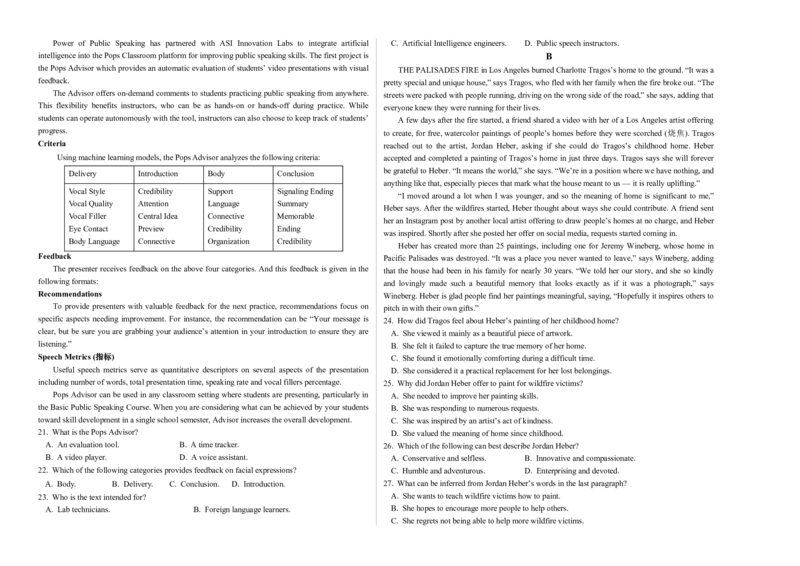
Power of Public Speaking has partnered with ASI Innovation Labs to integrate artificial
intelligence into the Pops Classroom platform for improving public speaking skills. The first project is
the Pops Advisor which provides an automatic evaluation of students’ video presentations with visual
feedback.
The Advisor offers on-demand comments to students practicing public speaking from anywhere.
This flexibility benefits instructors, who can be as hands-on or hands-off during practice. While
students can operate autonomously with the tool, instructors can also choose to keep track of students’
progress.
Criteria
Using machine learning models, the Pops Advisor analyzes the following criteria:
Delivery
Introduction
Body
Conclusion
Vocal Style
Vocal Quality
Vocal Filler
Eye Contact
Body Language
Credibility
Attention
Central Idea
Preview
Connective
Support
Language
Connective
Credibility
Organization
Signaling Ending
Summary
Memorable
Ending
Credibility
Feedback
The presenter receives feedback on the above four categories. And this feedback is given in the
following formats:
Recommendations
To provide presenters with valuable feedback for the next practice, recommendations focus on
specific aspects needing improvement. For instance, the recommendation can be “Your message is
clear, but be sure you are grabbing your audience’s attention in your introduction to ensure they are
listening.”
Speech Metrics (指标)
Useful speech metrics serve as quantitative descriptors on several aspects of the presentation
including number of words, total presentation time, speaking rate and vocal fillers percentage.
Pops Advisor can be used in any classroom setting where students are presenting, particularly in
the Basic Public Speaking Course. When you are considering what can be achieved by your students
toward skill development in a single school semester, Advisor increases the overall development.
21. What is the Pops Advisor?
A. An evaluation tool.
B. A time tracker.
B. A video player.
D. A voice assistant.
22. Which of the following categories provides feedback on facial expressions?
A. Body.
 B. Delivery.    C. Conclusion.   D. Introduction.
23. Who is the text intended for?
A. Lab technicians.
B. Foreign language learners.
C. Artificial Intelligence engineers.
D. Public speech instructors.
B
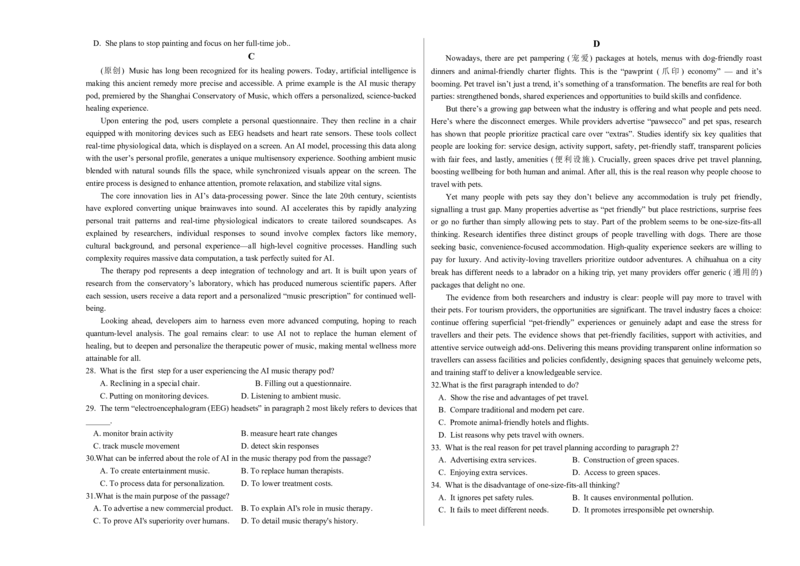
THE PALISADES FIRE in Los Angeles burned Charlotte Tragos’s home to the ground. “It was a
pretty special and unique house,” says Tragos, who fled with her family when the fire broke out. “The
streets were packed with people running, driving on the wrong side of the road,” she says, adding that
everyone knew they were running for their lives.
A few days after the fire started, a friend shared a video with her of a Los Angeles artist offering
to create, for free, watercolor paintings of people’s homes before they were scorched (烧焦). Tragos
reached out to the artist, Jordan Heber, asking if she could do Tragos’s childhood home. Heber
accepted and completed a painting of Tragos’s home in just three days. Tragos says she will forever
be grateful to Heber. “It means the world,” she says. “We’re in a position where we have nothing, and
anything like that, especially pieces that mark what the house meant to us — it is really uplifting.”
“I moved around a lot when I was younger, and so the meaning of home is significant to me,”
Heber says. After the wildfires started, Heber thought about ways she could contribute. A friend sent
her an Instagram post by another local artist offering to draw people’s homes at no charge, and Heber
was inspired. Shortly after she posted her offer on social media, requests started coming in.
Heber has created more than 25 paintings, including one for Jeremy Wineberg, whose home in
Pacific Palisades was destroyed. “It was a place you never wanted to leave,” says Wineberg, adding
that the house had been in his family for nearly 30 years. “We told her our story, and she so kindly
and lovingly made such a beautiful memory that looks exactly as if it was a photograph,” says
Wineberg. Heber is glad people find her paintings meaningful, saying, “Hopefully it inspires others to
pitch in with their own gifts.”
24. How did Tragos feel about Heber’s painting of her childhood home?
A. She viewed it mainly as a beautiful piece of artwork.
B. She felt it failed to capture the true memory of her home.
C. She found it emotionally comforting during a difficult time.
D. She considered it a practical replacement for her lost belongings.
25. Why did Jordan Heber offer to paint for wildfire victims?
A. She needed to improve her painting skills.
B. She was responding to numerous requests.
C. She was inspired by an artist’s act of kindness.
D. She valued the meaning of home since childhood.
26. Which of the following can best describe Jordan Heber?
A. Conservative and selfless.
B. Innovative and compassionate.
C. Humble and adventurous.
D. Enterprising and devoted.
27. What can be inferred from Jordan Heber’s words in the last paragraph?
A. She wants to teach wildfire victims how to paint.
B. She hopes to encourage more people to help others.
C. She regrets not being able to help more wildfire victims.
D. She plans to stop painting and focus on her full-time job..
C
(原创) Music has long been recognized for its healing powers. Today, artificial intelligence is
making this ancient remedy more precise and accessible. A prime example is the AI music therapy
pod, premiered by the Shanghai Conservatory of Music, which offers a personalized, science-backed
healing experience.
Upon entering the pod, users complete a personal questionnaire. They then recline in a chair
equipped with monitoring devices such as EEG headsets and heart rate sensors. These tools collect
real-time physiological data, which is displayed on a screen. An AI model, processing this data along
with the user’s personal profile, generates a unique multisensory experience. Soothing ambient music
blended with natural sounds fills the space, while synchronized visuals appear on the screen. The
entire process is designed to enhance attention, promote relaxation, and stabilize vital signs.
The core innovation lies in AI’s data-processing power. Since the late 20th century, scientists
have explored converting unique brainwaves into sound. AI accelerates this by rapidly analyzing
personal trait patterns and real-time physiological indicators to create tailored soundscapes. As
explained by researchers, individual responses to sound involve complex factors like memory,
cultural background, and personal experience—all high-level cognitive processes. Handling such
complexity requires massive data computation, a task perfectly suited for AI.
The therapy pod represents a deep integration of technology and art. It is built upon years of
research from the conservatory’s laboratory, which has produced numerous scientific papers. After
each session, users receive a data report and a personalized “music prescription” for continued well-
being.
Looking ahead, developers aim to harness even more advanced computing, hoping to reach
quantum-level analysis. The goal remains clear: to use AI not to replace the human element of
healing, but to deepen and personalize the therapeutic power of music, making mental wellness more
attainable for all.
28. What is the first step for a user experiencing the AI music therapy pod?
A. Reclining in a special chair.
B. Filling out a questionnaire.
C. Putting on monitoring devices.
D. Listening to ambient music.
29. The term “electroencephalogram (EEG) headsets” in paragraph 2 most likely refers to devices that
______.
A. monitor brain activity
B. measure heart rate changes
C. track muscle movement
D. detect skin responses
30.What can be inferred about the role of AI in the music therapy pod from the passage?
A. To create entertainment music.
B. To replace human therapists.
C. To process data for personalization.
D. To lower treatment costs.
31.What is the main purpose of the passage?
A. To advertise a new commercial product.
B. To explain AI's role in music therapy.
C. To prove AI's superiority over humans.
D. To detail music therapy's history.
D
Nowadays, there are pet pampering (宠爱) packages at hotels, menus with dog-friendly roast
dinners and animal-friendly charter flights. This is the “pawprint ( 爪印) economy” — and it’s
booming. Pet travel isn’t just a trend, it’s something of a transformation. The benefits are real for both
parties: strengthened bonds, shared experiences and opportunities to build skills and confidence.
But there’s a growing gap between what the industry is offering and what people and pets need.
Here’s where the disconnect emerges. While providers advertise “pawsecco” and pet spas, research
has shown that people prioritize practical care over “extras”. Studies identify six key qualities that
people are looking for: service design, activity support, safety, pet-friendly staff, transparent policies
with fair fees, and lastly, amenities (便利设施). Crucially, green spaces drive pet travel planning,
boosting wellbeing for both human and animal. After all, this is the real reason why people choose to
travel with pets.
Yet many people with pets say they don’t believe any accommodation is truly pet friendly,
signalling a trust gap. Many properties advertise as “pet friendly” but place restrictions, surprise fees
or go no further than simply allowing pets to stay. Part of the problem seems to be one-size-fits-all
thinking. Research identifies three distinct groups of people travelling with dogs. There are those
seeking basic, convenience-focused accommodation. High-quality experience seekers are willing to
pay for luxury. And activity-loving travellers prioritize outdoor adventures. A chihuahua on a city
break has different needs to a labrador on a hiking trip, yet many providers offer generic ( 通用的)
packages that delight no one.
The evidence from both researchers and industry is clear: people will pay more to travel with
their pets. For tourism providers, the opportunities are significant. The travel industry faces a choice:
continue offering superficial “pet-friendly” experiences or genuinely adapt and ease the stress for
travellers and their pets. The evidence shows that pet-friendly facilities, support with activities, and
attentive service outweigh add-ons. Delivering this means providing transparent online information so
travellers can assess facilities and policies confidently, designing spaces that genuinely welcome pets,
and training staff to deliver a knowledgeable service.
32.What is the first paragraph intended to do?
A. Show the rise and advantages of pet travel.
B. Compare traditional and modern pet care.
C. Promote animal-friendly hotels and flights.
D. List reasons why pets travel with owners.
33. What is the real reason for pet travel planning according to paragraph 2?
A. Advertising extra services.
B. Construction of green spaces.
C. Enjoying extra services.
D. Access to green spaces.
34. What is the disadvantage of one-size-fits-all thinking?
A. It ignores pet safety rules.
B. It causes environmental pollution.
C. It fails to meet different needs.
D. It promotes irresponsible pet ownership.
35. How can the travel industry offer genuine pet-friendly experiences according to the evidence?
A. By reducing travel costs.
B. By advertising for good pet trainers.
C. By providing luxury facilities.
D. By offering satisfactory service.
第二节(共5 小题;每小题2. 5 分, 满分12. 5 分)
阅读下面短文, 从短文后的选项中选出可以填入空白处的最佳选项。选项中有两项为多余选
项。
(原创) Young Chinese travelers are discovering a clever way to save money on overseas trips.
36

    For example, one traveler took a high-speed train from Beijing to Datong and then caught a
direct flight to Bangkok. The total cost was much lower than a direct flight from Beijing.
   37

    This new travel style is possible thanks to newly opened international routes from smaller
city airports. This makes the overall journey surprisingly affordable. The airports in these smaller
cities offer another advantage: efficiency. With shorter walking distances and fewer crowds, they
provide a relaxed start to the trip compared to the often busy major hubs.
But for these young people, it’s not just about saving money.    38

    They prefer to spend their
budget on better food and experiences at their destination. An expert points out this reflects an
upgrade in cultural consumption, not simply cheaper travel.
How can these tickets be so cheap?    39

    To encourage local tourism and economic growth,
local governments often provide support for these new flight routes. This reduces airline costs,
allowing them to offer low ticket prices.
This trend is growing across China. More small and medium-sized cities are launching budget
international flights.    40


A. The main reason involves government support and market operations.
B. Therefore, the quality of their travel experience has significantly improved.
C. They combine a short train ride to a nearby city with a flight from its airport.
D. Instead, it represents a smarter choice aimed at gaining greater value.
E. These flights are often 30-50% cheaper than those from big cities.
F. Consequently, this has led to a decrease in international travel overall.
G. As a result, young travelers now have more attractive and cheaper flight options.
第三部分 语言运用(共两节,满分30 分)
第一节(共15 小题,每小题1 分,满分15 分)
阅读下面短文, 从每题所给的A、B、C 和D 四个选项中选出可以填入空白处的最佳选项。
My story in China began with a heartbeat of panic at Chengdu airport.    41

    and knowing no
Chinese, I entered a new world. That night, my    42

    came from a kind senior. He called a car and
opened a gate with his phone app for me. The first    43

    of digital life in China stayed in my mind.
Soon, it became my daily routine. I used apps for bikes and meals. When winter came, I
44

    a jacket on the Internet. It reached me the next day! From then on, I shopped online a lot more,
and really enjoyed the    45

    it brought to me.
But not every day was easy. The language    46

    often felt like a wall. Once, I was looking for
eggs, but didn’t know the word. I    47

    like a chicken, flapping ( 拍打) my arms, but the
shopkeeper didn’t understand. Finally, I    48

    a translation app and it said “dan” then.
After that, the app became my friend. I used it for haircuts and shopping.    49

    , I picked up
simple Chinese words like “nihao” and “zaijian”. Technology was    50

    me to communicate with
locals.
My best moment was my friend Suiti’s wedding. Her husband was abroad, so the ceremony was
held    51

   . When Suiti saw her husband’s face on the screen, tears streamed down her cheeks. I

52

    a love that crossed continents, all enabled by    53

   .
Through it all, China’s digital “    54

    ” was my companion. But it’s the human    55


behind it — the smiles, the patience — that gave it real meaning.
41
A.Alone
B.Awake
C.Alike
D.Alive
42
A.invitation
B.chance
C.patience
D.rescue
43
A.generation
B.description
C.impression
D.innovation
44
A.designed
B.ordered
C.invented
D.returned
45
A.calmness
B.comfort
C.certainty
D.convenience
46
A.barrier
B.point
C.sense
D.diversity
47
A.sang
B.swam
C.acted
D.whispered
48
A.turned to
B.appealed to
C.applied to
D.stuck to
49
A.Suddenly
B.Luckily
C.Gradually
D.Usually
50
A.persuading
B.assisting
C.reminding
D.forcing
51
A.offline
B.secretly
C.online
D.publicly
52
A.expressed
B.missed
C.regretted
D.witnessed
53
A
.
psychology
B.technology
C.imagination
D.transportation
54
A.spirit
B.backbone
C.breath
D.heartbeat
55
A.warmth
B.wisdom
C.curiosity
D.intelligence
第二节(共10 小题;每小题1.5 分 ,满分15 分)
阅读下面短文,在空白处填入1 个适当的单词或括号内单词的正确形式。
(改编) China is widely recognized as   56   noodle paradise. Shanxi Province, in particular, is
known as the home of wheaten food in China. As an American exchange student, my first encounter
with noodles was in Shanxi. Everyone knows that noodles   5

 7
   (be) the king of Shanxi cuisine.
There are about 300 kinds of noodles, among   5

 8
   my favorite is sliced noodles. You can find a
bowl of sliced noodles in almost every part of China.
Once, in a restaurant, I ordered sliced noodles and was lucky enough   5

 9
   (watch) the cook
make them     60
       the kitchen window. I was amazed to see the cook shave the noodles so quickly!
When I tasted them for the first time, I felt extremely happy.
Later, I tried to make sliced noodles
  61

  (I). The more I practiced, the harder it seemed. But
when I got the angle right, it became much
  62

  (easy). In fact, cooking sliced noodles requires
many skills. The first step is the
  63

   (prepare) of the dough. After that, let it rest for 5 to 10
minutes. Then, you cut the noodles by
  64

   (move) the knife up and down. Finally, cook them in
hot water for 5 minutes.
People love sliced noodles not only for their special taste
  65

   also because the making
process is an art form.
第四部分 写作(共两节, 满分40 分)
第一节(满分15 分)
假定你是李华,你校设立了Science Corner。请你为校英文网站写一篇宣传稿,内容包
括:
1.介绍科技角;
2.号召积极参与。
注意:1.写作词数应为80 左右;2.请按如下格式在答题卡的相应位置作答。
Join Our Science Corner!


第二节(满分25 分)
阅读下面材料,根据其内容和所给段落开头语续写两段,使之构成一篇完整的短文。
注意:1.续写词数应为150 个左右;2.请按如下格式在答题纸的相应位置作答。
Batyr was a quiet 17-year-old boy from Kazakhstan who came to America as an exchange
student. His parents had told him many times before he left, “Be polite, be respectful, and never cause
trouble for others.” He was warmly welcomed by his host mother, Allison, who showed him a new
room and said with a big smile, “Make yourself at home, Batyr! This is your room now.” Batyr smiled
back happily but felt a little nervous. He was determined to be a good guest and follow his parents’
advice carefully.
Weeks went by quickly as Batyr started his new school life. But from his very first night,he had a
small problem he didn't know how to solve. He saw a switch by the door, but when he used it, only a
ceiling fan started to turn above his head. “Where is the light switch?” he thought to himself. He felt it
was too silly and embarrassing to ask Allison about such a small thing. Not wanting to bother anyone,
he found his own clever ways to have light in the evening. For seven long weeks, he used the bright
light from his laptop screen to read and do his homework.
One rainy night, Allison came into his room to look for a book she had left there earlier. She was
quite surprised to see the room was lit only by the blue light from his laptop. “Batyr, why are you
sitting in the dark?” she asked with concern. Feeling a little shy and embarrassed, Batyr finally
decided to tell her the truth. “Well, the switch only works for the fan. I didn’t want to trouble you
about the light.” Allison’s eyes opened wide in surprise. Then she laughed kindly and explained, “Oh,
Batyr! The same switch controls the light! You just need to pull this small chain hanging from the
fan!” When she pulled the chain, the room was suddenly filled with warm, bright light. Batyr blinked
in amazement. “I... I really didn’t know that,” he said, feeling both happy and a little foolish. The
whole family thought it was a very kind and funny mistake, and they admired his good nature.
注意:1. 所续写短文的词数应为150 左右;
2.续写部分分为两段,每段的开头语已为你写好。
Paragraph 1:
Amused and touched by his incredible politeness, Allison asked if she could share the story
online.


Paragraph 2:
When Batyr saw so many positive responses, he was astonished.