1 / 19
学科网(北京)股份有限公司
学科网(北京)股份有限公司
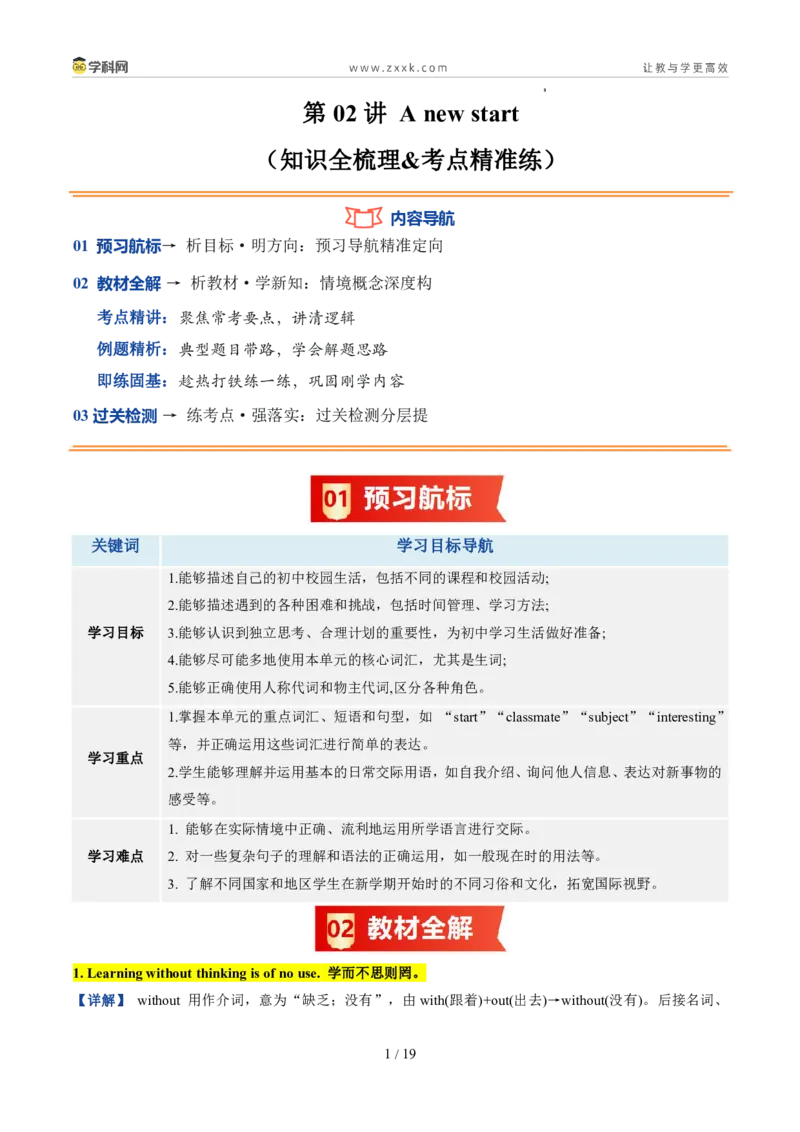
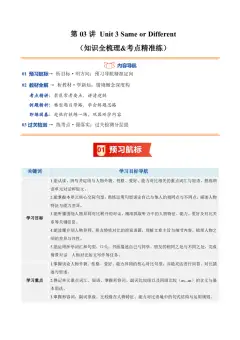
第02 讲A new start
(知识全梳理&考点精准练)
内容导航
01 预习航标→析目标·明方向:预习导航精准定向
02 教材全解→析教材·学新知:情境概念深度构
考点精讲:聚焦常考要点,讲清逻辑
例题精析:典型题目带路,学会解题思路
即练固基:趁热打铁练一练,巩固刚学内容
03 过关检测→练考点·强落实:过关检测分层提
关键词
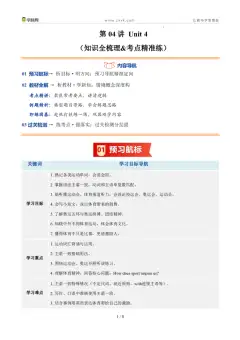
学习目标导航
学习目标
1.能够描述自己的初中校园生活,包括不同的课程和校园活动;
2.能够描述遇到的各种困难和挑战,包括时间管理、学习方法;
3.能够认识到独立思考、合理计划的重要性,为初中学习生活做好准备;
4.能够尽可能多地使用本单元的核心词汇,尤其是生词;
5.能够正确使用人称代词和物主代词,区分各种角色。
学习重点
1.掌握本单元的重点词汇、短语和句型,如“start”“classmate”“subject”“interesting”
等,并正确运用这些词汇进行简单的表达。
2.学生能够理解并运用基本的日常交际用语,如自我介绍、询问他人信息、表达对新事物的
感受等。
学习难点
1. 能够在实际情境中正确、流利地运用所学语言进行交际。
2. 对一些复杂句子的理解和语法的正确运用,如一般现在时的用法等。
3. 了解不同国家和地区学生在新学期开始时的不同习俗和文化,拓宽国际视野。
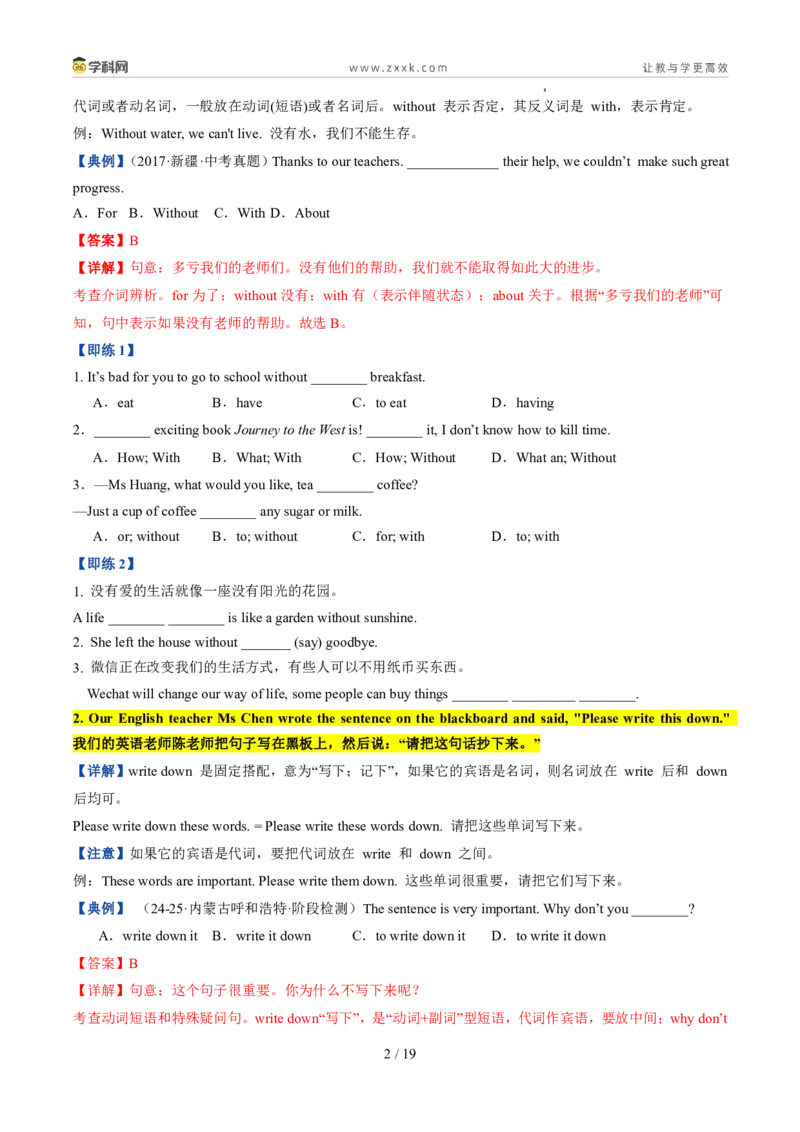
1. Learning without thinking is of no use. 学而不思则罔。
【详解】without 用作介词,意为“缺乏;没有”,由with(跟着)+out(出去)→without(没有)。后接名词、
2 / 19
学科网(北京)股份有限公司
学科网(北京)股份有限公司
代词或者动名词,一般放在动词(短语)或者名词后。without 表示否定,其反义词是with,表示肯定。
例:Without water, we can't live. 没有水,我们不能生存。
【典例】(2017·新疆·中考真题)Thanks to our teachers. _____________ their help, we couldn’t make such great
progress.
A.For
B.Without
C.With D.About
【答案】B
【详解】句意:多亏我们的老师们。没有他们的帮助,我们就不能取得如此大的进步。
考查介词辨析。for 为了;without 没有;with 有(表示伴随状态);about 关于。根据“多亏我们的老师”可
知,句中表示如果没有老师的帮助。故选B。
【即练1】
1. It’s bad for you to go to school without ________ breakfast.
A.eat
B.have
C.to eat
D.having
2.________ exciting book Journey to the West is! ________ it, I don’t know how to kill time.
A.How; With
B.What; With
C.How; Without
D.What an; Without
3.—Ms Huang, what would you like, tea ________ coffee?
—Just a cup of coffee ________ any sugar or milk.
A.or; without
B.to; without
C.for; with
D.to; with
【即练2】
1. 没有爱的生活就像一座没有阳光的花园。
A life ________ ________ is like a garden without sunshine.
2. She left the house without _______ (say) goodbye.
3. 微信正在改变我们的生活方式,有些人可以不用纸币买东西。
Wechat will change our way of life, some people can buy things ________ _________ ________.
2. Our English teacher Ms Chen wrote the sentence on the blackboard and said, "Please write this down."
我们的英语老师陈老师把句子写在黑板上,然后说:“请把这句话抄下来。”
【详解】write down 是固定搭配,意为“写下;记下”,如果它的宾语是名词,则名词放在write 后和down
后均可。
Please write down these words. = Please write these words down. 请把这些单词写下来。
【注意】如果它的宾语是代词,要把代词放在write 和down 之间。
例:These words are important. Please write them down. 这些单词很重要,请把它们写下来。
【典例】(24-25·内蒙古呼和浩特·阶段检测)The sentence is very important. Why don’t you ________?
A.write down it
B.write it down
C.to write down it
D.to write it down
【答案】B
【详解】句意:这个句子很重要。你为什么不写下来呢?
考查动词短语和特殊疑问句。write down“写下”,是“动词+副词”型短语,代词作宾语,要放中间;why don’t
3 / 19
学科网(北京)股份有限公司
学科网(北京)股份有限公司
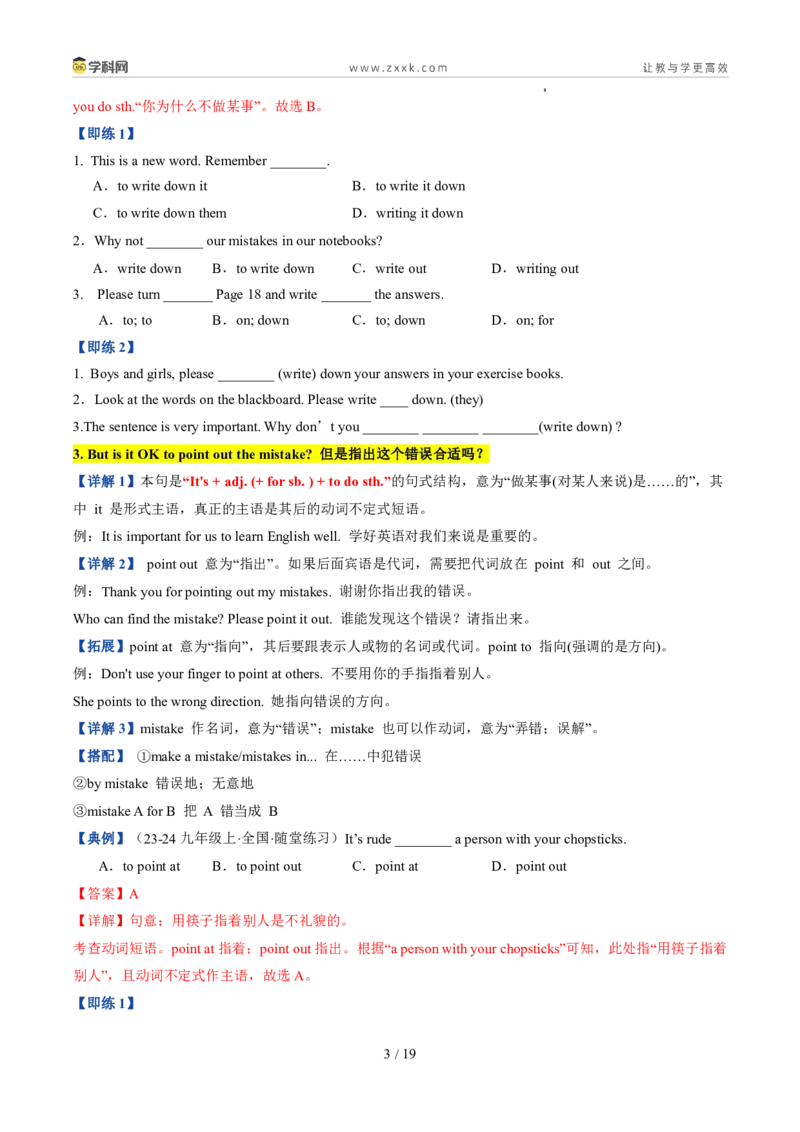
you do sth.“你为什么不做某事”。故选B。
【即练1】
1. This is a new word. Remember ________.
A.to write down it
B.to write it down
C.to write down them
D.writing it down
2.Why not ________ our mistakes in our notebooks?
A.write down
B.to write down
C.write out
D.writing out
3.
Please turn _______ Page 18 and write _______ the answers.
A.to; to
B.on; down
C.to; down
D.on; for
【即练2】
1. Boys and girls, please ________ (write) down your answers in your exercise books.
2.Look at the words on the blackboard. Please write ____ down. (they)
3.The sentence is very important. Why don’t you ________ ________ ________(write down) ?
3. But is it OK to point out the mistake? 但是指出这个错误合适吗?
【详解1】本句是“It's + adj. (+ for sb. ) + to do sth.”的句式结构,意为“做某事(对某人来说)是……的”,其
中it 是形式主语,真正的主语是其后的动词不定式短语。
例:It is important for us to learn English well. 学好英语对我们来说是重要的。
【详解2】point out 意为“指出”。如果后面宾语是代词,需要把代词放在point 和out 之间。
例:Thank you for pointing out my mistakes. 谢谢你指出我的错误。
Who can find the mistake? Please point it out. 谁能发现这个错误?请指出来。
【拓展】point at 意为“指向”,其后要跟表示人或物的名词或代词。point to 指向(强调的是方向)。
例:Don't use your finger to point at others. 不要用你的手指指着别人。
She points to the wrong direction. 她指向错误的方向。
【详解3】mistake 作名词,意为“错误”;mistake 也可以作动词,意为“弄错;误解”。
【搭配】①make a mistake/mistakes in... 在……中犯错误
②by mistake 错误地;无意地
③mistake A for B 把A 错当成B
【典例】(23-24 九年级上·全国·随堂练习)It’s rude ________ a person with your chopsticks.
A.to point at
B.to point out
C.point at
D.point out
【答案】A
【详解】句意:用筷子指着别人是不礼貌的。
考查动词短语。point at 指着;point out 指出。根据“a person with your chopsticks”可知,此处指“用筷子指着
别人”,且动词不定式作主语,故选A。
【即练1】
4 / 19
学科网(北京)股份有限公司
学科网(北京)股份有限公司
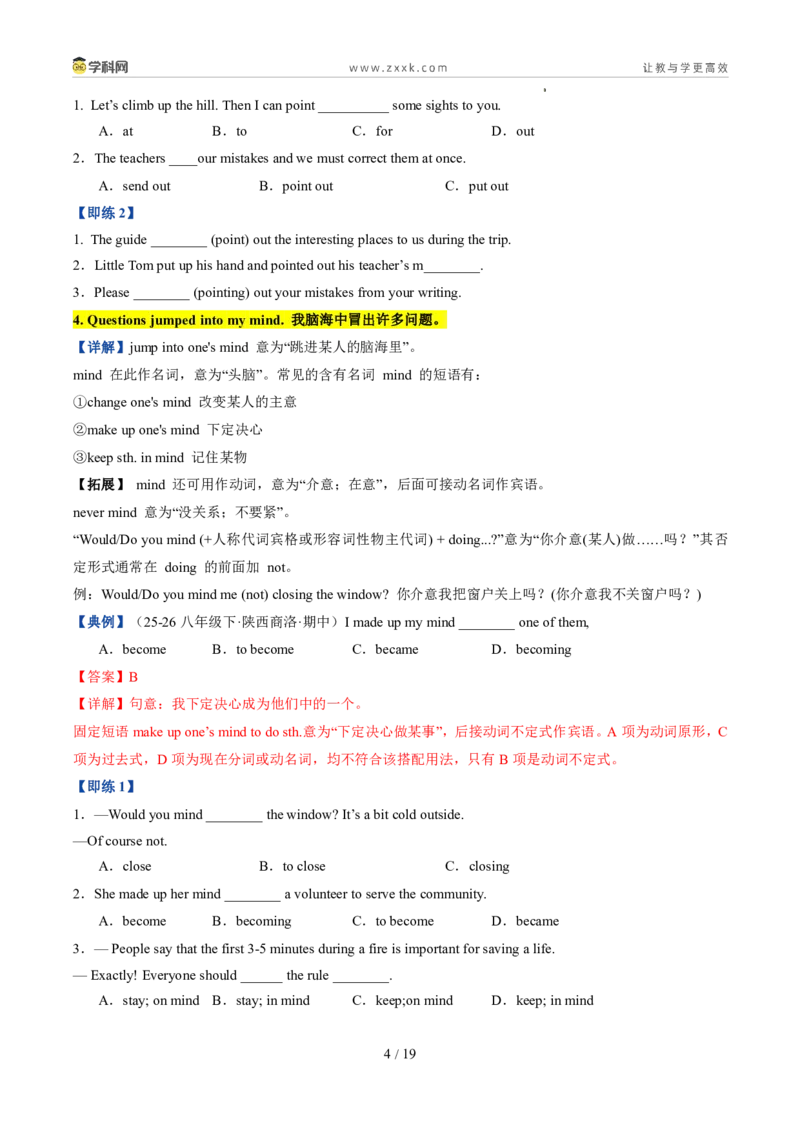
1. Let’s climb up the hill. Then I can point __________ some sights to you.
A.at
B.to
C.for
D.out
2.The teachers ____our mistakes and we must correct them at once.
A.send out
B.point out
C.put out
【即练2】
1. The guide ________ (point) out the interesting places to us during the trip.
2.Little Tom put up his hand and pointed out his teacher’s m________.
3.Please ________ (pointing) out your mistakes from your writing.
4. Questions jumped into my mind. 我脑海中冒出许多问题。
【详解】jump into one's mind 意为“跳进某人的脑海里”。
mind 在此作名词,意为“头脑”。常见的含有名词mind 的短语有:
①change one's mind 改变某人的主意
②make up one's mind 下定决心
③keep sth. in mind 记住某物
【拓展】mind 还可用作动词,意为“介意;在意”,后面可接动名词作宾语。
never mind 意为“没关系;不要紧”。
“Would/Do you mind (+人称代词宾格或形容词性物主代词) + doing...?”意为“你介意(某人)做……吗?”其否
定形式通常在doing 的前面加not。
例:Would/Do you mind me (not) closing the window? 你介意我把窗户关上吗?(你介意我不关窗户吗?)
【典例】(25-26 八年级下·陕西商洛·期中)I made up my mind ________ one of them,
A.become
B.to become
C.became
D.becoming
【答案】B
【详解】句意:我下定决心成为他们中的一个。
固定短语make up one’s mind to do sth.意为“下定决心做某事”,后接动词不定式作宾语。A 项为动词原形,C
项为过去式,D 项为现在分词或动名词,均不符合该搭配用法,只有B 项是动词不定式。
【即练1】
1.—Would you mind ________ the window? It’s a bit cold outside.
—Of course not.
A.close
B.to close
C.closing
2.She made up her mind ________ a volunteer to serve the community.
A.become
B.becoming
C.to become
D.became
3.— People say that the first 3-5 minutes during a fire is important for saving a life.
— Exactly! Everyone should ______ the rule ________.
A.stay; on mind
B.stay; in mind
C.keep;on mind
D.keep; in mind
5 / 19
学科网(北京)股份有限公司
学科网(北京)股份有限公司
【即练2】
1.Would you mind j________ (加入) the English club?
2.In order to pass down traditional Chinese medicine, she ________(make) up her mind to study it in a medical
college from now on.
3.We make up our minds to help the sick children. (改为同义句)
We ________ ________ ________ the sick children.
【答案】
decide
to
help
【详解】句意:我们下定决心帮助生病的孩子。make up one’s mind to do sth.=decide to do sth.,表示“下定决
心做某事、决定做某事”。原句为一般现在时,同义句也为一般现在时,主语是We,动词用原形decide,to
后面跟动词原形help,应填decide;to;help。
5. I looked up at Ms Chen. 我抬头看着陈老师。
【详解】look up at 意为“向上看;抬头看”。
例:Lily looked up at the sky and found something strange. 莉莉抬头看天空,发现了一些奇怪的东西。
【拓展】look up 还有两种含义:①查阅;查找;②向上看。
例:The boy is using a dictionary to look up new words. 这个男孩正在用词典查阅生词。
Look up, and you can see some white clouds. 向上看,你可以看到一些白云。
【典例】(25-26 九年级上·甘肃武威·阶段检测)If you meet some new words. It is a good idea ________ in a
dictionary.
A.make up them B.looking up them
C.to make them up
D.to look them up
【答案】D
【详解】句意:如果你遇到一些生词,在字典里查它们是个好主意。
It is a good idea to do sth.是固定句型,意为“做某事是个好主意”,需用动词不定式,排除B;根据“in a
dictionary”可知动作应为“查阅”,look up 符合语境,make up“编造”,排除A、C;“动词+ 副词”结构接代
词作宾语时,代词需放在动词和副词之间,即look them up。
【即练1】
1. — Could you tell me some information about the hotels in your country?
— Why not ________ on the Internet?
A.look for it
B.to look for it
C.look it up
D.look up it
2.The dictionary on the teacher’s desk is used by students to ________ the new words.
A.look after
B.look up
C.look back
D.look around
3.When you ________ a new word in a dictionary, make sure you ________ the right meaning.
A.look for, look up B.look at, look up
C.look up, look for
D.look for, look after
【即练2】
1. If you ________ (look) up at the sky on a clear night, you can see lots of stars.
2.突然,他们听到了奇怪的声音并抬头看向天空。
6 / 19
学科网(北京)股份有限公司
学科网(北京)股份有限公司
Suddenly, they heard strange noises and _____ ______ ______the sky.
6. I put up my hand. 我举起了手。
【详解】put up 是固定搭配,意为“举起;抬起”。
例:If you want to ask questions, please put up your hand. 你如果想问问问题,请举起手。
【拓展】put up 还有“搭建;建起;张贴”之意。
例:Can you help me put up the tent? 你能帮我把帐篷搭起来吗?
Why not put up the posters? 为什么不把海报张贴起来?
【典例】(25-26 七年级上·吉林长春·期中)Sarah, can you help me ________ the picture on the wall?
A.put up
B.put on
C.come true
D.come on
【答案】A
【详解】句意:Sarah,你能帮我把画挂在墙上吗?
考查动词短语。put up 悬挂;put on 穿上;come true 实现;come on 加油。根据“the picture on the wall”可知,
此处表示在墙上悬挂图画。故选A。
【即练1】
1. —Peter, please come here and help me ________ the tent.
—OK, I’m coming.
A.put on
B.cut up
C.cut down
D.put up
2.Please _______your hand if you have any questions.
A.put up
B.put on
C.put in
D.put down
【即练2】
1. If you know the answer, please ________ (put up) your hand.
2.It took Andy a few minutes ________ (put) up the picture on the wall.
7. What is junior high school life like? 初中生活是什么样子的?
【详解】What's + sth. + like? 某物是什么样子的?用于询问某物的特点、性质等。like 此处用作介词。
—What's your house like? 你们的房子怎么样?
—It's very big. 它非常大。
【拓展】①What's + sb. + like? 常用来询问某人的性格特征。
—What's your father like? 你爸爸是一个怎样的人?
—He's very friendly. 他很友好。
②What + do/does + sb. + look like? 用来询问某人的外貌特征。
—What does your brother look like? 你的哥哥长什么样?
—He is very tall. 他个子很高。
【典例】(25-26 七年级下·全国·随堂练习)What ________ the weather be like in London tomorrow?
A.will
B.do
C.does
D.are
7 / 19
学科网(北京)股份有限公司
学科网(北京)股份有限公司
【答案】A
【详解】句意:明天伦敦的天气将会怎么样?
will 将要;do 做;does 做;are 是。根据时间状语“tomorrow”可知句子时态为一般将来时,结构是“will+动
词原形”。
【即练1】
1. —What does your pet parrot look like?
—It ________ a small head and two colourful wings (翅膀).
A.have
B.has
C.is
D.are
2.—________ does Linda look like?
—She has a small face, two big eyes and yellow hair.
A.When
B.Which
C.Where
D.What
3. —What will you be like in ten years’ time?
—_________.
A.I like coffee without milk
B.I will be tall and slim
C.I will visit Beijing
D.I like playing the piano
【即练2】
1. The cloud in the sky looks like a white rabbit. (对划线部分提问)
________ does the cloud ________ ________?
2.Robots will look like humans in the future. (对划线部分提问)
________ ________ robots look like?
3.What ______ (be) the people in your hometown like?
8. They hold all kinds of activities, such as cultural festivals and sports meets. 他们举行各种活动,比如文化
节和运动会。
【详解1】all kinds of...表示“各种各样的……”,different kinds of...表示“不同种类的……”,都接复数名词。
There are all kinds of toys at the exhibition. 展览会上有各种各样的玩具。
what kind of 什么种类的;a kind of 一种;kind of“有点儿,有几分”,是副词性短语
He feels kind of tired.他觉得有点儿累。
【详解2】activity 名词,意为“活动”,复数形式activities
【拓展】与act 相关的词
act v.“行动;表演”
名词
actor 男演员
actress 女演员
action 行动;行为
activity 活动
8 / 19
学科网(北京)股份有限公司
学科网(北京)股份有限公司
形容词
active 活跃的;积极的
【典例】(25-26 七年级下·湖北襄阳·期中)The old man grows ________ vegetables in the garden, and the green
ones taste ________ delicious.
A.all kinds of; a kind of
B.kind of; all kinds of
C.a kind of; kind of
D.all kinds of; kind of
【答案】D
【详解】句意:这位老人在花园里种了各种各样的蔬菜,这些绿色的蔬菜有点好吃。
all kinds of 各种各样的;kind of 有点;a kind of 一种。第一空后是复数名词vegetables,需要表示“各种各样
的”,故用all kinds of;第二空后是形容词delicious,需要表示“有点”,故用kind of。
【即练1】
1. Our neighbors are very kind, because they often ________ us ________ all kinds of problems.
A.help; /
B.helps; /
C.help; with
D.helps; with
2. —We should take an ________ part in some ________ as long as they are good for us.
—I agree with you.
A.actively; activity
B.active; activities
C.actively; activities
3. I enjoy collecting different ________(kind) of traditional kites from all over China.
【即练2】
1. We stop all kinds of ________ (pollute) to protect our natural outdoor world.
2.This kind of cloth ________ ________ ________ cotton.
3.There are all kinds of ________ in our school. (活动)
9. How many students are there in my class?我班里有多少名学生?
【详解】how many 意为“多少”,对可数名词的数量进行提问。how many 后要跟可数名词的复数形式。
How many books are there? 有多少本书?
How many boys are there in your class? 你们班有多少男孩?
【拓展】how much 可意为“多少(对不可数名词的量进行提问)”或“多少钱(对物品的价格进行提问)”。
How much water do you need? 你需要多少水?
How much is the bag? 这个包多少钱?
【典例】(2026·黑龙江哈尔滨·二模)—________ strawberries do you want to buy?
—Twenty, please. And ________ are they?
A.How much; how many B.How many; how many
C.How many; how much
【答案】C
【详解】句意:——你想买多少草莓?——请给我二十个。它们多少钱?
how much 多少(对价格提问或对不可数名词的数量进行提问);how many 多少(对数量提问)。strawberries
是可数名词复数,询问数量用How many;根据购物情境,第二空询问价格用how much。
【即练1】
9 / 19
学科网(北京)股份有限公司
学科网(北京)股份有限公司
1. —How many times have you visited Paris?
—________. I went there in 2019 and 2022.
A.Once
B.Twice
C.Three times
D.Never
2.—How many floors does the building have?
—It has ________ floors. I live on the ________ floor.
A.twenty;twentieth
B.twenty;twenty
C.twentieth;twenty
D.twentieth;twentieth
【即练2】
1. 你家有几层?
How many ________ are there in your ________?
2.工作日你们每天上午上几节课?
How many lessons ________ you ________ every morning ________ ________?
3.There is only one sheep on the hill. (对划线部分提问)
How many ________ ________ there on the hill?
10. They also help students with their problems.它们还能帮助学生解决遇到的问题。
【详解】help sb. with sth.帮助某人做某事,with 后接名词/动名词(动词-ing 形式),同义结构为help sb.(to)
do sth.
Tom often helps me learn English.=Tom often helps me with my English.
汤姆经常帮我学英语。
【典例】(20-21 七年级下·全国·单元测试)—Can you ________ my English, Jim?
—Sorry, I can't. Why not ask Mike for help? His English is great!
A.help with
B.play with
C.think of
D.care for
【答案】A
【详解】——吉姆,你可以帮助我学习英语吗?——对不起,我不行。为什么不找麦克帮忙呢?他的英语
很好。
考查短语辨析。help with 帮助;play with 和……一起玩;think of 想起;care for 关心。根据“Why not ask Mike
for help?”可知,此处是想找人寻求帮助,故选A。
【即练1】
1. I have problems with my homework.I want ________Lily________ it.
A.to ask; to help. B.ask;help
C.ask; to help with
D.to ask;to help with
2.(24-25 七年级上·广东广州·单元测试)Jim is always ready to ________ me, so he is a ________ friend.
A.help, help
B.help, helpful
C.helpful, helpful
D.helpful, help
【即练2】
1. They keep raising money ________ (help) homeless people.
2.It helps us _________ (communicate) with people from other countries.
3.Using cloth bags is very ________ (help) to protect the earth.
10 / 19
学科网(北京)股份有限公司
学科网(北京)股份有限公司
11. Come and join us!快来加入我们
【详解】join 指“参加、加入(党派、团体等组织)”,join sb.in(doing)sth.意为“加入到某人的某一活动中”
他将和我们一起唱这首歌。He'll join us in singing the song.
【辨析】join,join in,take part in
join
“参加,加入”,指加入某个组织或团体,成为其成员之一,如参军、入团、入党、加入俱乐
部等。
join in
“join in+某活动”,相当于“take part in+某活动”。
take part in
指“参加”会议、考试、竞赛或群众性活动,重在说明句子主语参加该项活动并在其中发挥作
用
He says he's going to join the army.他说他要参军。
Can I join in the game?我可以参加这个游戏吗?
I didn't take part in the meeting.我没有参加会议。
【典例】(25-26 六年级下·黑龙江哈尔滨·期中)—I love doing sports so much, so I ________ a sports club.
—What about ________ our sports meet?
A.join, joining in
B.join in, joining
C.join, join in
【答案】A
【详解】句意:——我非常喜欢做运动,所以我加入一个体育俱乐部。——参加我们的运动会怎么样?
join 指加入组织、团体等;join in 指参加活动。第一空宾语为club“俱乐部”,属于组织,用join;第二空宾
语为sports meet“运动会”,属于活动,用join in,What about 后接动词-ing 形式,后接joining in。
【即练1】
1. why don’t you ________ us to ________ the football game?
A.to join; take part in
B.join; join
C.joins; takes part in
D.join; take part in
2. If he _________ free tomorrow, he ________ us .
A.will be,
joins B.is, join
C.is, will join
D.will be, will join
3. Now more and more volunteers ________ the Helping Hands Club and ________ all kinds of activities to help
the people in need.
A.join in; take part in
B.join; take part in
C.take part in; join
D.take part in; join in
【即练2】
1. 学生们在学校参加许多种课后服务活动。
Students ________ many kinds of after-school clubs at school.
2.如果你加入我们,你可以交到很多新朋友。
If you _______ _______, you can make many friends.
3.I often join in the high jump. (改为同义句)
I often ________ ________ ________ the high jump.
11 / 19
学科网(北京)股份有限公司
学科网(北京)股份有限公司
12. Can you g give me some advice?你能给我一些建议吗?
【详解】advice 不可数名词,意为“劝告;建议”。
Mrs. Green gave us some advice on how to learn English well. 格林夫人给了我们一些怎样学好英语的建议。
【搭配】a piece of advice 一条建议、忠告;
ask for sb.'s advice 征求某人的意见;
give sb. some advice 给某人一些建议。
Let me give you a piece of advice.让我给你一个忠告。
【辨析】advice,suggestion
advice
不可数名词
指带有指教性的“意见”或“劝告”。
suggestion
可数名词
指为改进工作或解决困难等而提出的“意见”或“建议”,语气较为委婉。
I'll ask my teacher for advice when I have difficulty in doing something.
每当我做事遇到困难时,我就向老师征求建议。
Father's suggestions are great valuable for me.爸爸的建议对我来说很有价值。
【拓展】advise v.忠告;建议
advise sb.to do sth.建议某人做某事;advise sb. not to do sth.建议某人不做某事;advise doing sth.建议做某事
He advised me to stop smoking.他建议我戒烟。
I advise waiting till the right time.我建议一直等到适当的时候。
【典例】—You should read more after class for your English study. It can help you make ________ progress.
—Thank you! What ________ useful advice
A.a, /
B./, /
C./, a
D.a, a
【答案】B
【详解】句意:——为了你的英语学习,你应该课后多阅读。它能帮助你取得进步。——谢谢!多么有用
的建议!
progress 是不可数名词,make progress 是固定短语,意为“取得进步”,前面不加冠词;advice 是不可数名词,
在What 引导的感叹句中,结构为“What+形容词+不可数名词”,前面不加冠词。
【即练1】
1. Our teacher always gives us ________ useful advice.
A.a
B.an
C.many
D.some
2.—I failed my writing exam. Can you give me a ________?
—Sure! I’ll ask my teacher to give you some ________ next class.
A.advice; suggestion
B.suggestion; advices
C.suggestion; advice
D.advice; suggestions
3._________ helpful suggestions our teacher has given us!
A.What a
B.What
C.How
D.How a
12 / 19
学科网(北京)股份有限公司
学科网(北京)股份有限公司
【即练2】
1. What do you think of this ________? (suggest)
2. I suggest making a list first. (改为同义句)
My ________ is ________ make a list first.
13. Dad and Mum protected your boat from winds.爸爸妈妈保护你的船免受风力影响。
【详解】protect 为及物动词,意为“保护;防护”,后接名词或代词做宾语。
Protect...against/from...意为“保护……免于……”。强调使不受到伤害或损害。
You should learn to protect yourself. 你应该学会保护自己。
He put on the sunglasses to protect his eyes from the strong sunlight. 他戴上太阳镜以保护眼睛免受日光的强
烈照射。
【拓展】protection 做不可数名词,意为“保护防卫”
【典例】(25-26 六年级下·黑龙江大庆·期中)The ________ of the country helps to ________ the wild animals
from being harmed.
A.protect; protection
B.protection; protect
C.protective; protect
D.protection; protective
【答案】B
【详解】句意:这个国家的保护有助于保护野生动物免受伤害。
protect 保护(动词);protection 保护(名词);protective 保护的(形容词)。第一空位于定冠词The 之后,
需填名词protection 作主语;第二空位于helps to 之后,需填动词原形protect,构成help to do sth.及
protect...from...搭配。
【即练1】
1. —Wearing goggles (护目镜) when you are swimming. It’s a good way to ________ your eyes from being
injured.
—OK. Mom.
A.protect
B.hold
C.save
D.stop
2.It’s important ________ us ________ the animals in danger.
A.of; to protect
B.of; protect
C.for; to protect
D.for; protect
3.We need the ________ of wild animals.
A.protect
B.protection
C.protected
D.to protect
【即练2】
1. Even if you have dark skin, you still need ________ from the sun. (protect)
2.We should protect animals.(改为祈使句)
________ ________ animals.
3.保护野生动物就是保护我们自己。
Protecting wild animals is__________________.
14. But sometimes you have to sail your boat by yourself. Just try your best and work hard.但有时候,你只
13 / 19
学科网(北京)股份有限公司
学科网(北京)股份有限公司
能独自驾驶自己的船。只要尽全力、努力奋斗即可。
【详解1】yourself 是反身代词,反身代词用于强调或表示动作返回到动作执行者本身。
for oneself 为/给某人自己。
I can do it for myself.我自己能做这件事。
【常见搭配】
by oneself 独自;
enjoy oneself 玩得高兴,过得愉快;
【详解2】try doing sth.“(用某一办法)试着去做某事”。
try to do sth.意为“努力或尽力去做某事”,否定形式为try not to do sth.。
They tried making a model plane. 他们试着做一个飞机模型。
He tried to work out the problem. 他努力解出难题。
try/do one's best 尽某人最大努力;try/do one's best to do sth.尽某人最大努力做某事。
I will try my best to help the people in trouble.我会尽最大努力去帮助那些身处困境的人们。
【典例】(24-25 七年级下·甘肃天水·期末)Here are different kinds of delicious foods. Help ________, children.
A.you
B.your
C.yours
D.yourselves
【答案】D
【详解】句意:这里有各种各样的美味食物。孩子们,请你们自便。
you 你/你们;your 你的/你们的;yours 你的/你们的;yourselves 你们自己。固定搭配help oneself 意为“请自
便”,根据称呼语“children”可知对象是复数,反身代词应用yourselves。
【即练1】
1. He can finish his homework by ________.
A.he
B.his
C.himself
2.We enjoyed ________ at the Fuzhou Zoo last weekend.
A.our
B.ourselves
C.us
3.My grandma can use WeChat. She learned it all by ________.
A.she
B.herself
C.her
D.hers
【即练2】
1. When we grow up, we should learn to take care of ________ (we).
2.Mum joined our little group and introduced ________ (她自己) to our new friends.
3.We enjoyed ________ (we) during the school trip last week.
15. 人称代词主格
1.人称代词主格有人称和单复数之分,详见下表:
第一人称
第二人称
单数
复数
单数
复数
I(我)
we(我们)
you(你)
you(你们)
14 / 19
学科网(北京)股份有限公司
学科网(北京)股份有限公司
第三人称
单数
复数
he(他)
she(她)
it(它)
they(他/她它们)
2.人称代词主格在句中做主语。
I am a teacher.我是一名老师。
You are tall 你个子高。
It is a book.它是本书。
3.人称代词排列顺序
巧学妙记单数人称二三一,复数人称一二三
You, he and I are in the same class.你,我和他在同一个班。
We, you and they are new students.我们,你们和他们都是新生。
【典例】(24-25 七年级下·云南红河·期中)— Is the CD on the desk ________?
— No, it’s my brother’s. ________ likes it best.
A.you; He
B.your; His
C.yours; He
D.yours; His
【答案】C
【详解】句意:——桌子上的CD 是你的吗?——不,它是我哥哥的。他最喜欢它。
第一空后无名词,需用名词性物主代词yours 表示“你的CD”;第二空在句中作主语,指代my brother,需
用主格人称代词he。因此用yours; He,符合语境。
【即练1】
1. —Dad, could you please teach ________ English?
—Sure! But it’s more important to learn it by ________.
A.my; you
B.me; you
C.me; yourself
2.Don’t tell others about it. It’s only between ________ .
A.you and I
B.you and me
C.I and our
D.me and your
3.—Whose storybook is this? Is it Teng Fei’s?
—It must belong to ________. He read it yesterday.
A.him
B.himself
C.his
【即练2】
1. Ling Ling is a girl. ________ studies in a primary school. (her)
2.The teacher asks _________ (we) to go to school on time.
3.. We admire ________ (she) for her hard work and courage.
16. 物主代词
(1)形容词性物主代词
一、基本用法
形容词性物主代词具有形容词性质,在句中只能做定语,后接名词表示所属关系。
15 / 19
学科网(北京)股份有限公司
学科网(北京)股份有限公司
Is that his bike? 那是他的自行车吗?
第一人称
第二人称
单数
复数
单数
复数
my(我的)
our(我们的)
your(你的)
your(你们的)
第三人称
单数
复数
his(他的)
her(她的)
its(它的)
their(他/她它们的)
It's a panda. Its name is Huanhuan.它是一只熊猫。它的名字叫欢欢。
二、特殊用法
1.名词前用了形容词性物主代词就不能再用冠词。
It's my key.那是我的钥匙。
2.与形容词一起修饰名词时,形容词性物主代词要放在形容词的前面。
This is my good friend.这是我的好朋友。
(2)名词性物主代词
1.英语中的名词性物主代词
数
人称
类别
单数
复数
第一人称
第二人称
第三人称
第一人称
第二人称
第三人称
名词性
物主代词
mine
yours
his
hers
its
ours
yours
theirs
含义
我的
你的
他的
她的
它的
我们的
你们的
他(她、它)们的
【典例】(25-26 七年级下·福建·阶段检测)I can’t find ________ keys. Can you see ________?
A.my; them
B.mine; they
C.my; their
【答案】A
【详解】句意:我找不到我的钥匙了。你能看见它们吗?
第一空修饰名词keys,表示“我的”,应用形容词性物主代词my;第二空作动词see 的宾语,指代复数名词
keys,应用人称代词宾格them。
【即练1】
1. —Is this dictionary yours?
—No, ________ is in my schoolbag.
A.mine
B.yours
C.her
2.—David, you left your book on the desk.
—It isn’t ________. I think it is ________.
A.my; Nick’s
B.mine; Nick
C.mine; Nick’s
D.my; Nick
3. —Li Lin, do you spend Halloween like Americans?
—No, we don’t. It is ________ festival, not ________.
A.their; our
B.theirs; ours
C.their; ours
D.theirs; our
16 / 19
学科网(北京)股份有限公司
学科网(北京)股份有限公司
【即练2】
1. Grandma takes good care of ________ (we) family and cooks nice food for us.
2.This is not my pen. _________ (my) is in my schoolbag.
3.The shoes on the floor are not my friends’. They’re ________ (they).
一、单词拼写
1. I can’t finish the work w______ your help.
2. Please w______ d______ the new words in your notebook.
3. Can you p______ o______ the mistake in this sentence?
4. She finally m______ u______ her m______ to study abroad.
5. There are a______ k______ of flowers in the garden.
二、单项选择
1.
My sister can dress ______ without help.
A. she
B. her
C. herself
D. hers
2.
—______ is your new teacher like? —She is kind and friendly.
A. What
B. How
C. Who
D. Which
3.
I often help my mother ______ housework on weekends.
A. with
B. for
C. at
D. in
4.
—______ students are there in your class? —Forty.
A. How much
B. How many
C. How old
D. How often
5. This is ______ book. ______ is on the desk.
A. my; Your
B. mine; Yours
C. my; Yours
D. mine; Your
三、用所给词的适当形式填空
1. Please look after ______ (you) when your parents are away.
2. They have made up ______ (they) mind to join the club.
3. The teacher asked us to write down ______ (we) names on the paper.
4. Can you help ______ (I) with my math?
5. He wants to ______ (join) the music club because he loves singing.
四、完成句子
1. 请抬头看天空。
Please ______ ______ ______ at the sky.
2. 你能给我一些关于如何学习英语的建议吗?
Can you give me some ______ on how to learn English?
3. 他决定加入篮球队。
He ______ ______ ______ to join the basketball team.
17 / 19
学科网(北京)股份有限公司
学科网(北京)股份有限公司
4. 他们在墙上贴了一张海报。
They ______ ______ a poster on the wall.
5. 这本书是她的,那本是我们的。
This book is ______, and that one is ______.
五、阅读理解
A
Students Buy Teachers Gifts with Special Tickets
For students at Pine Island in the US, saying thanks to their teachers is part of their daily life. They buy gifts
for their teachers, but they do that in a special way.
Do the students ask their parents for money to buy gifts? No. They get tickets (券) by helping others and
doing well in school. Then, they use these tickets to buy gifts at the school shop.
Every few months, teachers take their classes to the shop. The students have about 20 minutes to spend their
tickets. One popular (受欢迎的) gift is the “99 to be kind“ bag. With 99 tickets, students can get a good bag full of
all gifts for a teacher.
Sometimes, students want to do something more special. For example, TJ Dusendang and classmates,
Hudson VanderHoff and Tenley Welch, choose gifts together for their teacher, Wendy Hawes.” We want to do
something special because it’s our teacher’s birthday and she’s retiring (退休). This is her last year here,” says
fourth-grader TJ Dusendang. The kids want to let her know how much they love her.
These gifts are warm surprises for teachers! How do you say thanks to your teachers? Why do the students
buy gifts for their teachers?
1.How do the students get tickets for gifts?
A.They help at the school shops.
B.They ask their parents for money.
C.They give others a helping hand.
D.They help parents with the housework.
2.What do we know from paragraph 3?
A.The students buy one gift each week.
B.The students can buy a goodie bag with 99 tickets.
C.The students can share gifts with their classmates.
D.The students visit the school shop before school.
3.What makes the gift to Wendy Hawes more special?
A.There is a surprise party.
B.It has her favourite flower.
C.It’s a gift from all the students in Grade 4.
D.It’s a gift to celebrate her birthday and say goodbye.
4.What is the purpose (目的) of the passage?
A.To tell us how to buy gifts.
B.To help us work out a problem.
C.To give us information about a school.
D.To tell us a story about thanking teachers.
B
John Dawkins is a teacher from America. He teaches English at school.
18 / 19
学科网(北京)股份有限公司
学科网(北京)股份有限公司
Before class, Mr Dawkins stands outside the classroom. He greets his students there. He doesn’t just say
hello to his students. There are some pictures outside the classroom. He lets the students choose their favourite way
of greeting from the pictures.
They can choose a hand shake
, a high five
, a fist bump
, a thumbs up
, a
wave
, or a hello
!
Mr Dawkins greets his students every day, He wants to know how his students feel. He wants to be there for
them. He wants them to be happy. He wants them to know they are important to him.
The students like Mr Dawkins’s ways of greeting. They think they’re cool. They feel great to have a teacher
like Mr. Dawkins.
5.There are ________ ways of greeting for the students to choose from.
A.four
B.five
C.six
6.What is a high five?
A.Holding the number of five in the air.
B.Putting your hand up and hitting (击) your friend’s hand as a greeting.
C.Pulling your two hands up and making them like the wings (翅膀) of a bird.
7.What is Paragraph (段) 4 about?
A.Why Mr Dawkins greets his students.
B.How Mr Dawkins greets his students.
C.Where Mr Dawkins greets his students.
8.What do students think of Mr Dawkins?
A.He is a great teacher.
B.He is happy every day.
C.He is important to the students.
9.What’s the best title of this passage?
A.An Interesting Class
B.Greetings from a Teacher
C.A Great School
六、完形填空
Dear Mark,
How are you? I’m at a new
1
in China this term. I was a little nervous at first, but now I love it.
My new school is
2
and nice, with bright buildings and a big playground. There are over 3,500
3
and 195 teachers. Each class has 50 students—we laugh and help each other. Teachers are very
4
to me,
answering my questions patiently (耐心地). My Chinese classmates teach me
5
, and I teach them
English after class. We practice dialogues (对话) during breaks.
There’s a special farm at our school. Here’s a photo of the
6
garden—you can
7
fresh
carrots, tomatoes and potatoes. There are twelve rabbits, fifty hens and five cows too. In labour (劳动) classes, we
feed (喂) rabbits carrots and
8
houses for hens to keep them warm.
We have no
9
on weekends. Sometimes I
10
basketball with classmates. Sometimes I
go shopping with parents—we find snacks (零食) and stationery (文具) there. We all like China.
19 / 19
学科网(北京)股份有限公司
学科网(北京)股份有限公司
Please write to me soon!
1.A.park
B.museum
C.school
D.hospital
2.A.big
B.tidy
C.clean
D.small
3.A.workers
B.students
C.doctors
D.nurses
4.A.bad
B.sad
C.kind
D.angry
5.A.French
B.English
C.Japanese
D.Chinese
6.A.fruit
B.flower
C.grass
D.vegetable
7.A.see
B.eat
C.cook
D.plant
8.A.buy
B.make
C.take
D.draw
9.A.games
B.friends
C.classes
D.teachers
10.A.play
B.find
C.count
D.watch
夸克群
群满加Q
秘塔
QQ群
AI
【温馨提示】本页为广告页,打印前可以把这页删掉
群
满
或
未
通
过
:
请
至
左
侧
资
料
库
文
档
获
取
最
新
二
维
码
防失联渠道二:https://link3.cc/xbjf
防失联渠道一