湖南省华大新高考联盟2025-2026 学年高
三上学期9 月教学质量测评英语试题
(题型二次开发)
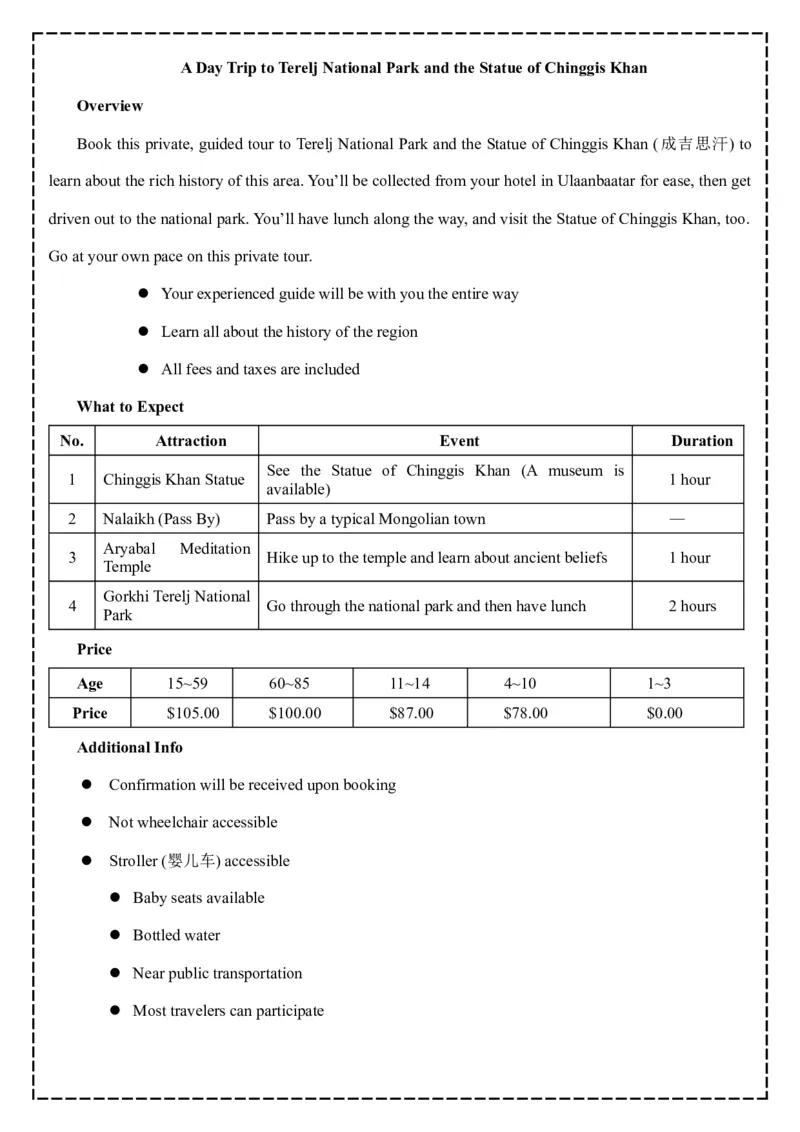
A Day Trip to Terelj National Park and the Statue of Chinggis Khan
Overview
Book this private, guided tour to Terelj National Park and the Statue of Chinggis Khan (成吉思汗) to
learn about the rich history of this area. You’ll be collected from your hotel in Ulaanbaatar for ease, then get
driven out to the national park. You’ll have lunch along the way, and visit the Statue of Chinggis Khan, too.
Go at your own pace on this private tour.
Your experienced guide will be with you the entire way
Learn all about the history of the region
All fees and taxes are included
What to Expect
No.
Attraction
Event
Duration
1
Chinggis Khan Statue
See the Statue of Chinggis Khan (A museum is
available)
1 hour
2
Nalaikh (Pass By)
Pass by a typical Mongolian town
—
3
Aryabal Meditation
Temple
Hike up to the temple and learn about ancient beliefs
1 hour
4
Gorkhi Terelj National
Park
Go through the national park and then have lunch
2 hours
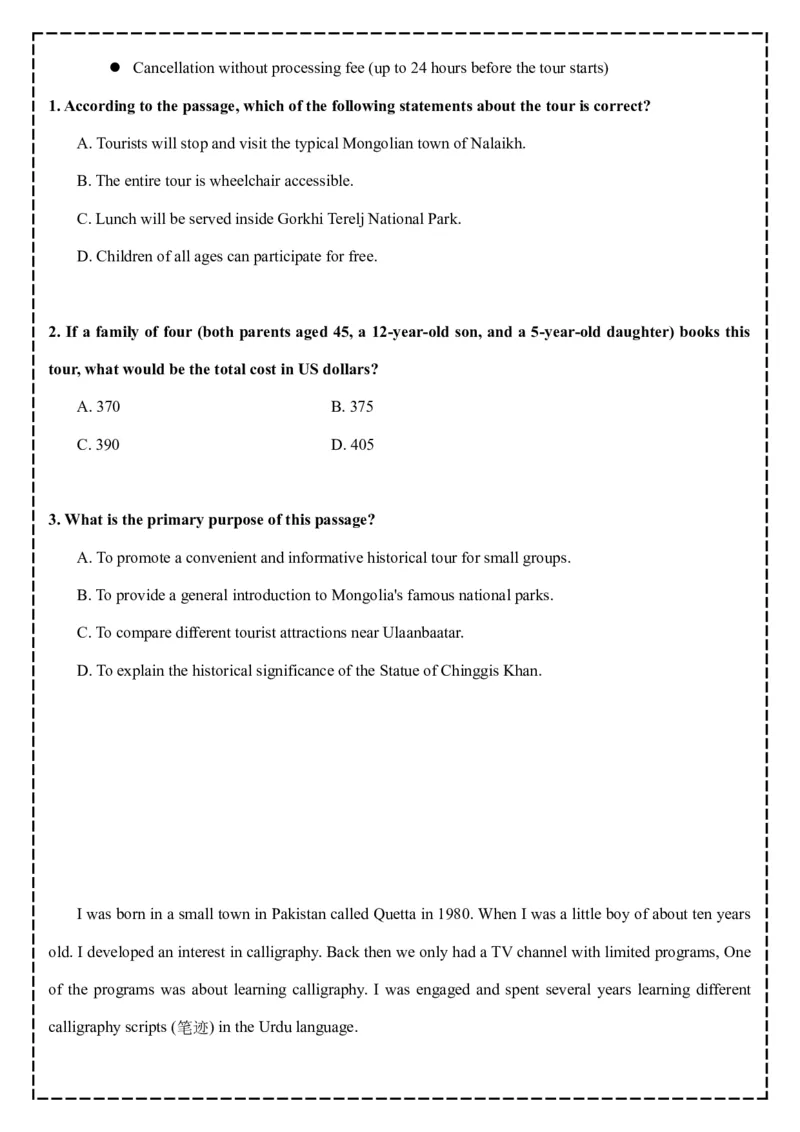
Price
Age
15~59
60~85
11~14
4~10
1~3
Price
$105.00
$100.00
$87.00
$78.00
$0.00
Additional Info
Confirmation will be received upon booking
Not wheelchair accessible
Stroller (婴儿车) accessible
Baby seats available
Bottled water
Near public transportation
Most travelers can participate
Cancellation without processing fee (up to 24 hours before the tour starts)
1. According to the passage, which of the following statements about the tour is correct?
A. Tourists will stop and visit the typical Mongolian town of Nalaikh.
B. The entire tour is wheelchair accessible.
C. Lunch will be served inside Gorkhi Terelj National Park.
D. Children of all ages can participate for free.
2. If a family of four (both parents aged 45, a 12-year-old son, and a 5-year-old daughter) books this
tour, what would be the total cost in US dollars?
A. 370
B. 375
C. 390
D. 405
3. What is the primary purpose of this passage?
A. To promote a convenient and informative historical tour for small groups.
B. To provide a general introduction to Mongolia's famous national parks.
C. To compare different tourist attractions near Ulaanbaatar.
D. To explain the historical significance of the Statue of Chinggis Khan.
I was born in a small town in Pakistan called Quetta in 1980. When I was a little boy of about ten years
old. I developed an interest in calligraphy. Back then we only had a TV channel with limited programs, One
of the programs was about learning calligraphy. I was engaged and spent several years learning different
calligraphy scripts (笔迹) in the Urdu language.
After graduation, I came to Dubai, UAE. Falling in love with the architecture and high-rise buildings, I
wanted to shoot the amazing beauty form different angles. So I bought a camera and learned photography,
joined photography groups and attended workshops. After few years, I got bored of photographing landscapes
and cityscapes.
Seven years ago, while going through the photography blogs and looking through others’ works. I read
the term called “light painting”. a photography technique that allows you to draw in space. I started
experimenting with that and soon it hit me: why not bring back my passion for calligraphy using light painting
technique? Since that day. I’ve been drawing light calligraphy. To achieve the best results. I decided to build
the lights myself. The best part about my work is that they are not photoshopped. I prefer to get the results
straight out of the camera. I don’t even turn over the images. To achieve that, I have to write in reverse (倒置)
and that took a lot of practice to get it right.
Currently, I’m working on the idea of bringing abandoned places back to life, including buildings which
have lost their charm and are hidden in darkness. Through my photography, I try to employ light calligraphy
by writing a word that attaches a deep meaning to those places and telling stories behind them. In this way, I
hope people will revisit these places and appreciate the real reason for their construction.
1. What initially sparked the author's interest in calligraphy as a child?
A. A television program about calligraphy
B. Attending local calligraphy workshops
C. Influence from family members
D. School assignments requiring calligraphy skills
2. Why did the author begin experimenting with light painting photography?
A. He wanted to escape the boredom of traditional photography.
B. He sought to combine his childhood passion with a new technique.
C. He was inspired by photography blogs to try popular trends.
D. He aimed to create photoshopped images for commercial use.
3. What is a distinctive technical challenge the author faces in creating his light calligraphy works?
A. Using multiple cameras simultaneously
B. Working only in complete darkness
C. Writing in reverse without digital editing
D. Requiring a team of assistants
4. What is the primary goal of the author’s current project?
A. To promote tourism in abandoned locations through social media
B. To showcase the technical possibilities of light painting photography
C. To document architectural decay for historical preservation
D. To revive interest in forgotten places by adding meaningful context through art
A major reason why plastic bags and yogurt containers aren’t recycled is that it’s much more frugal to
make these products from the ground up than to recover them. A new recycling technique reported in the
journal Science promises a cost-effective way to transform these common plastic waste items into high-quality
liquid fuels.
What makes plastics useful, namely their strength and resistance to high temperatures, becomes an
annoyance when it comes to recycling the materials. The strong carbon-carbon bonds in these plastics require
very high temperatures to break, making the process energy-consuming. Once the bonds break, the smaller
molecules (分子) that are created quickly form new bonds, giving unwanted chemicals. These byproducts
then have to be broken down again adding time and complexity.
Researchers developed a way to turn these plastics into useful fuels at temperatures below 100℃, without
creating any side products. They conduct the chemical reaction in the presence of a new type of catalyst (催
化剂) in a special acidic solution. In these reaction conditions, as soon as the carbon bonds in the plastic break
apart, new bonds form in a controlled way, giving off the chemicals called alkanes. The alkanes can be used
either as a fuel or as raw material for new plastics. The entire reaction takes place in a single reaction container.
It takes only three hours and occurs at 70℃. By comparison, existing recycling techniques typically require
two stages, take much longer and need temperatures of over 200℃.
The catalyst that the researchers use is already used by some factories. But it will take more research to
know whether the technique can be translated to more occasions. If so, such a one-step, low-cost method to
turn single-use plastics into chemicals, fuels and high-value materials could go a long way in making the
plastic economy sustainable.
1. What is the main advantage of the new recycling method?
A. It requires no catalyst
B. Low temperature with no byproducts
C. Works without energy input
D. Processes all plastics equally
2. How does the author highlight the new method's efficiency?
A. Quoting expert opinions
B. Contrasting with old methods
C. Listing chemical formulas
D. Showing historical data
3. What can be inferred about the technique's future?
A. Needs more research for wider use
B. Will replace all recycling immediately
C. Only suits specific plastic types
D. Too expensive for practical application
4. What is the text mainly about?
A. Criticizing current recycling
B. Advocating plastic reduction
C. Explaining plastic properties
D. Introducing a new recycling method
Telegraphic (电报的) speech, limited to a noun and verb and usually containing little to no grammar,
obtains its name from its brief nature. It is characterized by using only the most essential words to get the
point across, such as “dog running” instead of “the dog is running”.
Some parents use telegraphic speech when communicating with their children in the belief that speaking
this way will enable a child to learn to speak faster because only the key words are employed. Experts disagree,
however. Telegraphic speech may block the child from learning proper grammar and word meaning, according
to Marc Fey, a professor at the University of Kansas Medical Center. For example, when parents use
grammatically correct sentences, a child can learn that words ending in “-ing” are usually verbs, which gives
him or her the ability to make clear distinctions between verbs and nouns.
To encourage a child to leave the telegraphic speech stage, parents want to repeat what their child says in
a complete, grammatically correct sentence. The Hanen Center recommends this rule: use only the sentences
with your child that you use with an adult.
A child’s vocabulary dramatically increases during the post-telegraphic stage. On average, after 24
months, children begin using grammatical constructions of various kinds, such as adding “-ing” to verbs and
using define articles such as “the”. Although it may seem that a child’s vocabulary is on decline after leaving
this stage, it is actually the contrary. Children begin learning new rules for grammar, which they tend to
overgeneralize, thus leading them to make mistakes, such as the use of “-ed” for the past tense of all verbs.
However, parents do not need to worry about these mistakes, as the children are going through a stage
that generally passes after they learn and become more familiar with grammar rules. Repeating your child’s
sentence with a grammatically correct one will enhance his or her linguistic abilities faster than if you do not
correct his or her sentence.
1. What does "telegraphic speech" refer to in the text?
A. Formal language used in telegrams
B. Complete sentences with full grammar
C. Simplified speech using only key words
D. Professional medical terminology
2. What is experts' attitude toward parents using telegraphic speech?
A. Supportive
B. Disapproving
C. Neutral
D. Ambiguous
3. What can be inferred about children's language development after 24 months?
A. They begin to apply grammar rules systematically
B. Their vocabulary size decreases significantly
C. They stop making any grammatical errors
D. They prefer using telegraphic speech permanently
4. What is the text mainly about?
A. Comparing different child language stages
B. Explaining telegraphic speech and its effects
C. Introducing famous child language experts
D. Arguing for early childhood language training
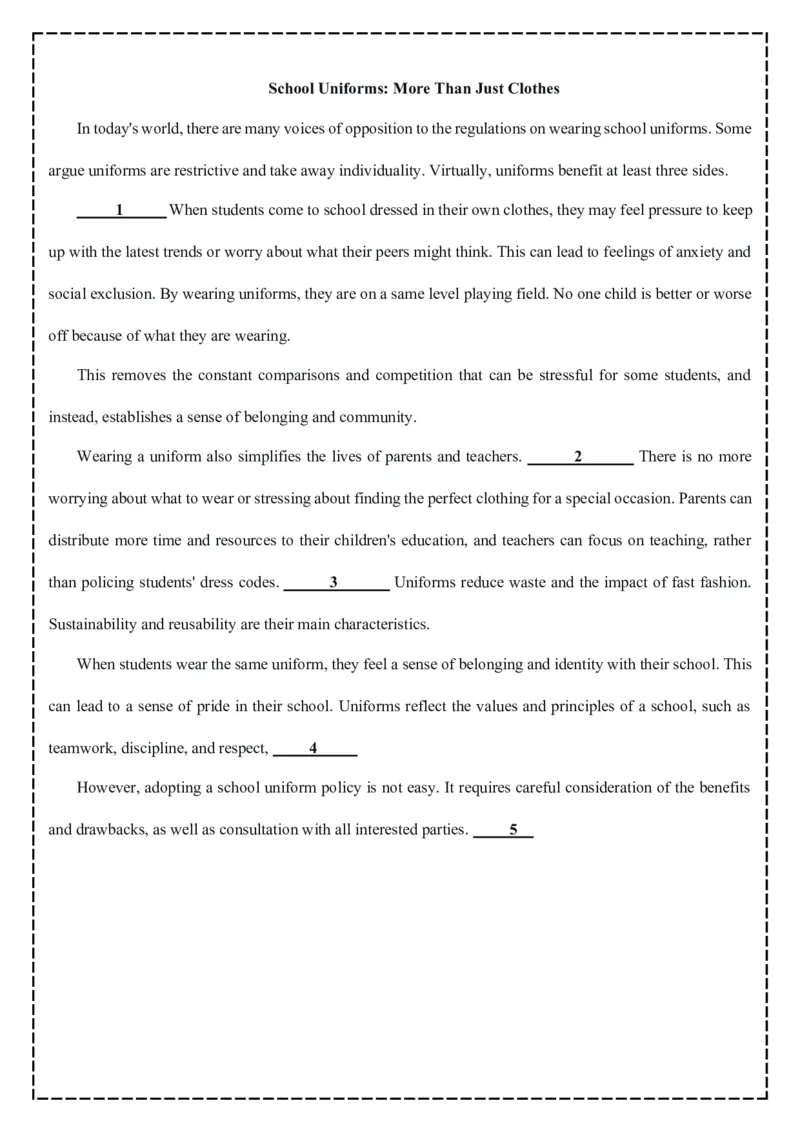
School Uniforms: More Than Just Clothes
In today's world, there are many voices of opposition to the regulations on wearing school uniforms. Some
argue uniforms are restrictive and take away individuality. Virtually, uniforms benefit at least three sides.
1 When students come to school dressed in their own clothes, they may feel pressure to keep
up with the latest trends or worry about what their peers might think. This can lead to feelings of anxiety and
social exclusion. By wearing uniforms, they are on a same level playing field. No one child is better or worse
off because of what they are wearing.
This removes the constant comparisons and competition that can be stressful for some students, and
instead, establishes a sense of belonging and community.
Wearing a uniform also simplifies the lives of parents and teachers. 2 There is no more
worrying about what to wear or stressing about finding the perfect clothing for a special occasion. Parents can
distribute more time and resources to their children's education, and teachers can focus on teaching, rather
than policing students' dress codes. 3 Uniforms reduce waste and the impact of fast fashion.
Sustainability and reusability are their main characteristics.
When students wear the same uniform, they feel a sense of belonging and identity with their school. This
can lead to a sense of pride in their school. Uniforms reflect the values and principles of a school, such as
teamwork, discipline, and respect, 4
However, adopting a school uniform policy is not easy. It requires careful consideration of the benefits
and drawbacks, as well as consultation with all interested parties. 5
A. For one thing, they help create a fair environment for all students.
B. which are essential for a positive and productive learning environment.
C. By weighing the pros and cons, schools can make an informed decision.
D. This is because everyone wears the same clothing regardless of background.
E. As a result, the morning routine becomes much simpler and less stressful.
F. Moreover, uniforms have environmental benefits that are often overlooked.
G. In this way, uniforms serve as a visual representation of school values.
As a child, I was certain that a future in medicine was my calling. I dreamed of developing
revolutionary 1
to help people globally.
But as time went by, my 2
felt increasingly out of reach. It was challenging to imagine myself
in a profession where individuals from my background were rarely 3
, being one of the few Black
students in my science classes. I aspired to become both a 4
and a physician. As a first-generation
college student, I also found it difficult to locate mentors who could guide me toward my career objectives.
However, my academic advisors were 5
and recommended I concentrate on a single field. These
challenges left me 6
my original aspirations.
Everything changed when I discovered rowing. I 7
joined the university's crew team simply to
meet new people. Rowing shares the same problem of insufficient 8
as the medical research field,
with extremely few Black female participants. When I first joined the team, I felt anxious—similar to my
feelings in science classrooms. I expected rowing to be incredibly demanding. Fortunately, my teammates
9 me warmly, offering not just technical advice to enhance my 10
but also making me feel
included. Now, when I doubt my 11
in scientific communities, I 12
how I'm already
accomplishing what once seemed impossible.
Rowing taught me discipline and a fresh strategy for handling difficult challenges. I began applying this
"rowing mindset" to my PhD work: approaching my 13
research projects as series of manageable
objectives. Rather than yielding to anxieties about 15
, I concentrated on making each individual
step effective. Gradually, I discovered a new sense of 15
both in the laboratory and on the river.
1. A. systems
B. therapies
C. facilities
D. cures
2. A. ambition
B. fantasy
C. effort
D. exploration
3. A. present
B. represented
C. rewarded
D. charged
4. A. inventor
B. educator
C. scientist
D. rower
5. A. frustrated
B. resistant
C. refreshed
D. motivated
6. A. canceling
B. ignoring
C. questioning
D. updating
7. A. originally
B. smoothly
C. secretly
D. eagerly
8. A. inspiration
B. respect
C. inclusion
D. diversity
9. A. promoted
B. welcomed
C. forgave
D. persuaded
10. A. adaptability
B. productivity
C. mood
D. form
11. A. belonging
B. meaning
C. suffering
D. training
12. A. reflect on
B. put forward
C. account for
D. look into
13. A. vital
B. innovative
C. challenging
D. permanent
14. A. discontent
B. disharmony
C. failure
D. inflexibility
15. A. peace
B. confidence
C. sympathy
D. balance
答案与解析
【答案】1. C 2. B 3. A
1 题详解:细节理解题。根据“What to Expect”部分第4 项“Gorkhi Terelj National Park”的
说明:“Go through the national park and then have lunch”,明确提到在国家公园内用午餐,故C
项正确。A 项错误,因为行程表中Nalaikh 标注为“Pass By”(路过),并不停留参观;B 项错误,
附加信息中明确说明“Not wheelchair accessible”;D 项错误,价格表显示仅1-3 岁儿童免费,其他
年龄段需付费。
2 题详解:细节理解题。根据价格表计算:
父母(45 岁)属于15-59 年龄段:$105/人 × 2 = $210
儿子(12 岁)属于11-14 年龄段:$87
女儿(5 岁)属于4-10 年龄段:$78
总计:$210 + $87 + $78 = $375,故选B。
3 题详解:主旨大意题。全文围绕“私人导游一日游”产品展开,开篇“ Book this private,
guided tour”直接点明推广目的,后续详细介绍行程安排、价格和服务亮点,旨在推广一个集便利性
与知识性于一体的私人旅游产品,故A 项正确。B、D 项仅涉及文中部分景点,并非主旨;C 项“比
较不同景点”在文中未体现。
【答案】1. A 2. B 3. C 4.D
1 题详解:细节理解题。根据第一段中“One of the programs was about learning calligraphy. I
was engaged and spent several years learning...”可知,作者对书法的兴趣源于一档电视节目。选项
B、C、D 均未在文中提及。故选A。
2 题详解:推理判断题。根据第三段“I read the term called ‘light painting’... I started
experimenting... why not bring back my passion for calligraphy using light painting technique?”可
推断,作者实验光绘的动机是为了融合童年对书法的热爱与新技术。选项A(摆脱传统摄影无聊)
和C (追随流行趋势)虽部分相关,但非根本原因;选项D (商业修图)与文中“ not
photoshopped”矛盾。故选B。
3 题详解:细节理解题。根据第三段“I have to write in reverse and that took a lot of practice
to get it right”及“they are not photoshopped”可知,作者需反向书写且不使用数码编辑,这是技
术挑战的核心。选项A、B、D 均未在文中体现。故选C。
4 题详解:主旨大意题。最后一段明确提到作者通过光书法“ writing a word that attaches a
deep meaning to those places and telling stories behind them”,旨在让人们重新关注这些地点的价
值和建造初衷。选项A(社交媒体推广)、C(记录建筑衰败)、B(展示技术可能性)均未准确概
括当前项目的核心人文目标。故选D。
【答案】1. B 2. B 3. A 4.D
1 题详解:细节理解题。根据第三段首句"Researchers developed a way... at temperatures below
100℃, without creating any side products"明确说明新方法在低温下无副产品产生。A 项与文中"in
the presence of a new type of catalyst"矛盾;C 项错误,因70℃仍需要能量输入;D 项未提及。故
选B。
2 题详解:写作手法题。作者在第三段末尾通过"By comparison"直接对比新旧方法(温度:70℃
vs 200℃;时间:3 小时 vs 更久;步骤:单步 vs 两步),突出新方法优势。A 项专家观点、C 项
化学式、D 项历史数据均未使用。故选B。
3 题详解:推理判断题。末段"But it will take more research to know whether the technique
can be translated to more occasions"表明该技术需要更多研究来验证适用性。B 项"立即取代"过度推
断;C 项"仅适用特定塑料"未证实;D 项与末句"low-cost method"矛盾。故选A。
4 题详解:主旨大意题。全文围绕"new recycling technique"展开,重点介绍其原理、优势及潜力。
A 项批评现有回收方式是为引出新技术;C 项塑料性质是背景介绍;B 项减少塑料使用非文章重点。
故选D。
【答案】1. C 2. B 3. A 4. B
1 题详解:词义猜测题。根据首段"limited to a noun and verb and usually containing little to
no grammar"和"using only the most essential words"可知,telegraphic speech 指的是使用关键词语的
简化语言。A 项电报用语、B 项完整句子、D 项医学术语均不符合文意。故选C。
2 题详解:观点态度题。第二段明确提到"Experts disagree"并引用教授观点"Telegraphic speech
may block the child from learning proper grammar",表明专家不赞同父母使用电报式言语。A 项支
持、C 项中立、D 项模糊均与专家明确反对的态度不符。故选B。
3 题详解:推理判断题。根据第四段"after 24 months, children begin using grammatical
constructions"和"begin learning new rules for grammar"可推断,幼儿开始系统应用语法规则。B 项词
汇量减少与原文"actually the contrary"矛盾;C 项不再犯错与原文"make mistakes"矛盾;D 项永久使
用电报式言语与文意相反。故选A。
4 题详解:主旨大意题。全文围绕电报式言语的定义(首段)、专家评价(二段)、正确引导方
法(三段)和发展阶段(四、五段)展开,核心是解释电报式言语及其影响。A 项不同阶段比较、C
项介绍专家、D 项语言训练均非文章重点。故选B。
【答案】1. A 2. E 3. F 4. B 5. C
1 题详解:段首题。本段主要论述校服如何创造公平环境。空格后具体说明学生穿自己衣服时的
压力,以及穿校服后的平等状态。选项A 中"help create a fair environment"与后文"same level
playing field"形成直接呼应,且"For one thing"与首段"benefit at least three sides"形成逻辑顺序。故
选A。
2 题详解:段中题。本段主要说明校服如何简化生活。空格前是主题句,空格后具体说明不再为
穿着担忧。选项E 中"the morning routine becomes much simpler"完美承接前文"simplifies the lives",
并引出后文的具体例证。故选E。
3 题详解:段中题。此处需要承上启下的过渡句。前文讨论简化生活,后文讨论环保效益。选项
F 中"Moreover"表示递进关系,"environmental benefits"自然引出下文的环保议题。故选F。
4 题详解:段尾题。本段论述校服传递价值观。空格前是具体的价值观列举,需要总结性语句。
选项B 中"which"引导非限制性定语从句,指代前文的价值观,说明其重要性,完美结束本段。故选
B。
5 题详解:段尾题。文章结尾段讨论制定校服政策的注意事项。空格前说明需要权衡利弊,空格
处需要具体说明如何操作。选项C 中"By weighing the pros and cons"与前文"careful consideration of
the benefits and drawbacks"形成同义复现,完成段落收尾。故选C。
【答案】1. B 2. A 3. A 4. C 5. B 6. C 7. A 8. C 9. B 10. D 11. A 12. A 13. C 14. C
15. B
【1 题详解】考查名词词义辨析。句意:我梦想开发革命性的疗法来帮助全球的人们。A.
systems 系统;B. therapies 疗法;C. facilities 设施;D. cures 治愈。根据下文"to help people
globally"及医疗背景可知,此处指治疗方法,"therapies"比"cures"更专业,与"develop"搭配更恰当。
故选B。
【2 题详解】考查名词词义辨析。句意:但随着时间推移,我的抱负感觉越来越遥不可及。A.
ambition 抱负;B. fantasy 幻想;C. effort 努力;D. exploration 探索。上文提到"future in medicine
was my calling"表明这是职业抱负,而非幻想,且与后文"out of reach"形成合理逻辑关系。故选
A。
【3 题详解】考查形容词词义辨析。句意:很难想象自己能够出现在这个专业领域,因为我是科
学课上少数黑人学生之一。A. present 在场的;B. represented 被代表的;C. rewarded 获得奖励的;
D. charged 被指控的。此处强调少数群体在科学领域的可见性和存在感,与下文"few Black
students"形成呼应。故选A。
【4 题详解】考查名词词义辨析。句意:我渴望既成为科学家又成为医生。A. inventor 发明家;
B. educator 教育家;C. scientist 科学家;D. rower 划船者。根据上下文 STEM 背景,且
与"physician"形成学术职业对应,"scientist"比"researcher"更通用。故选C。
【5 题详解】考查形容词词义辨析。句意:然而,我的学术顾问持反对态度,建议我专注于一个
领域。A. frustrated 沮丧的;B. resistant 反对的;C. refreshed 清爽的;D. motivated 有动机的。根据
下文"recommended I concentrate on a single field"可知,顾问不赞同作者的双重计划,即"反对的"。
故选B。
【6 题详解】考查动词词义辨析。句意:这些挑战让我开始质疑自己最初的抱负。A. canceling
取消;B. ignoring 忽略;C. questioning 质疑;D. updating 更新。此处需要表达因困难而产生的怀疑
心理,与后文"doubt"形成呼应,"questioning"比"suspecting"更贴切。故选C。
【7 题详解】考查副词词义辨析。句意:我最开始加入大学划船队只是为了结识新朋友。A.
originally 最初;B. smoothly 平稳地;C. secretly 秘密地;D. eagerly 急切地。根据下文"simply to
meet new people"可知,这是最初的动机,与后文形成的对比关系。故选A。
【8 题详解】考查名词词义辨析。句意:划船运动也存在包容性不足的问题,就像医学研究领域
一样。A. inspiration 灵感;B. respect 尊重;C. inclusion 包容;D. diversity 多样性。此处强调少数群
体的被接纳程度,与后文"few Black female participants"形成直接对应。故选C。
【9 题详解】考查动词词义辨析。句意:幸运的是,我的队友热情地欢迎我。A. promoted 促进;
B. welcomed 欢迎;C. forgave 原谅;D. persuaded 说服。根据下文"warmly"和"making me feel
included"可知,此处需要表达接纳和欢迎的态度。故选B。
【10 题详解】考查名词词义辨析。句意:提供技术建议来提高我的动作姿势。A. adaptability 适
应性;B. productivity 生产力;C. mood 情绪;D. form 姿势。在体育语境中,"form"特指技术动作和
姿势,比"technique"更专业准确。故选D。
【11 题详解】考查名词词义辨析。句意:当我怀疑自己在科学界的归属感时。A. belonging 归属
感;B. meaning 意义;C. suffering 苦难;D. training 训练。此处需要与后文"communities"形成搭配,
表达在科学领域的融入感。故选A。
【12 题详解】考查动词短语辨析。句意:我会思考自己如何已经在实现曾经看似不可能的事情。
A. reflect on 思考;B. put forward 提出;C. account for 解释;D. look into 调查。根据上下文,此
处需要表达回顾和思考的含义,与后文内容逻辑一致。故选A。
【13 题详解】考查形容词词义辨析。句意:应对我具有挑战性的研究项目。A. vital 重要的;B.
innovative 创新的;C. challenging 具有挑战性的;D. permanent 永久的。此处需要与后
文"manageable objectives"形成对比,强调项目的难度。故选C。
【14 题详解】考查名词词义辨析。句意:而不是屈服于对失败的焦虑。A. discontent 不满;B.
disharmony 不和谐;C. failure 失败;D. inflexibility 僵化。根据科研工作特点,此处需要表达最常见
的焦虑来源,即对失败的恐惧。故选C。
【15 题详解】考查名词词义辨析。句意:我发现了新的自信水平。A. peace 和平;B.
confidence 自信;C. sympathy 同情;D. balance 平衡。全文主题为个人成长和突破,且与开
头"ambition felt increasingly out of reach"形成呼应,自信是最合适的收获。故选B。