2024 届名校区域大联考高三英语试题精选集锦(第二期)
专题 03: 阅读理解说明文+议论文
编者按:
遴选全国各地最新区域大联考试题,精心编辑,排版整齐。
目 录
1.【浙江强基联盟2023-2024学年高三上学期10月统测英语试题】
2.【2024届江苏广东福建高三金太阳10月大联考试题】
3.【安徽皖江名校联盟2023-2024学年高三上学期10月阶段考试英语试题】
4.【湖北省腾云联盟2023-2024学年高三上学期10月联考英语试题】
5.【湖南省名校联考联合体2023-2024学年高三上学期第三次联考英语试题】
6.【河南省TOP二十名校2023-2024学年高三上学期调研考试英语试题】
7.【福建省莆田二中、仙游一中2022-2023学年高三上学期第二次联考(期中)英语试题】
8.【江苏省决胜新高考2023-2024学年高三上学期10月大联考英语试题】
9.【重庆市七校2023-2024学年高三上学期第一次月考英语试题】
10.【2024届“皖南八校”高三第一次大联考高三英语试卷.】
11.【浙江省新阵地教育联盟2023-2024学年高三上学期第二次联考英语试题】
12.【广东省2023-2024学年高三上学期10月大联考英语试题】
13.【云南省部分名校2023-2024学年高三上学期10月联考英语试题】
14.【河北省新时代NT教育2023-2024学年高三阶段测试英语试题】
15.【辽宁省重点高中沈阳市郊联体2023-2024学年高三上学期10月月考英语试题】1.【浙江强基联盟2023-2024学年高三上学期10月统测英语试题】
C
Including a joke in the title of a paper could pay off in terms of citations (引用), according to a study.
The finding — which has not been proved by peers — suggests that researchers could gain citations by giving
their papers amusing titles while some say the evidence is too weak to support the conclusion.
Jokes sometimes find their way into academic papers. “One place where we often see humor is in titles,
but there’s a very small amount of literature about whether this is reasonable,” says lead author Stephen
Heard, an evolutionary ecologist.
To investigate whether having a funny title could boost a paper’s readership and citations, Heard and his
colleagues asked volunteers to score the titles of 2,439 papers according to how amusing they were. The
scorers assessed humor on a seven-point scale, from zero (serious titles) to six (extremely funny). The
researchers then looked for a link between papers’ humor scores and the number of citations they had
received, including self-citations by their own authors.
Papers with funny titles were cited slightly less often than those with more serious or straightforward
titles. However, papers with more amusing titles also tended to have fewer self-citations, which led Heard’s
team to infer that scientists might give funnier titles to less important papers. “Our assumption is that authors
don’t cite their own papers subsequently because they don’t think that those are their most important papers,”
Heard says.
After controlling for self-citations as a measure of a paper’s importance, the researchers found that
articles with funny titles are in fact cited more than those with serious titles. For example, papers with titles
that got a score of six had nearly twice as many citations on average as those whose titles got a humor score of
four. But some researchers argued that self-citations might not be a good criterion for a paper’s importance.
8. The finding of the study can be best described as _________ according to the first paragraph.
A. a widely accepted belief. B. something surprising.
C. a wholly resisted opinion. D. something still in debate.
9. How did the researchers carry out the first stage of the study?
A. By enquiring about volunteers’ attitudes toward funny titles.
B. By asking participants to divide those titles into seven ranks.
C. By matching the papers’ scores with the volunteers’ likes.
D. By digitalizing the citations into various scores of humor.
10. Which of the following statements will Heard most probably agree with?
A. Including a joke in an essay is by no means a good attempt.B. Self-citations don’t serve as a good standard for the research.
C. Articles with fewer self-citations tend to be unimportant to the authors.
D. Scientists should stop their self-citations to guarantee academic fairness.
11. Which of the following is the best title of the passage?
A. One Cites Himself: A Rise To Fame B. Funny Or Serious: It Serves Your Choice
C. Are You Joking: Funny Titles Are Good D. Joking Paper Titles: Fewer Citations Or More
D
Expecting the worst to avoid feeling bad later is known as “bracing”. It may help them prepare for
emotionally challenging situations, particularly in the moments before these situations occur. People brace for
the worst while waiting for potentially negative outcomes. Someone might also brace for the worst in
anticipation of stressful events like giving a presentation at work.
Some psychological theories suggest that bracing should help. For example, “decision affect theory”
proposes that how we feel about a situation is determined partly by comparing what actually happened with
what could have happened. Based on this, people should be happy when an event goes beyond their
expectations, and disappointed when an event falls behind. Therefore, by anticipating the worst, one can
safeguard themselves against future disappointment, as any result is likely to surpass their expectations.
But other psychological theories undermine the idea that bracing will be helpful. It has been theorized
and scientifically established – that expectations can powerfully influence reality. There are two key ways that
expectations can shape reality.
First, people may behave in ways that fit with their expectations. If you expect to fail an upcoming test or
interview, then you might not invest efforts in preparation, which in turn reduces your chances of doing well.
Second, people may interpret a situation in line with their expectations. Imagine you believe you are
insufficiently qualified for a job you’ve applied for. During the job interview, you’re likely to interpret blank
expressions from the interviewer in line with this belief, which could negatively affect your performance. In
fact, the interviewer did not want to give anything away.
Drawing together the scientific studies, it seems that expecting the worst is anything but a wise way to
prepare for upcoming news or results. It might be better to hold positive expectations than to brace for the
worst.
12. What is the second paragraph mainly about?
A. The logic of preparing for the worst.
B. The theory of comparing past and future.
C. The conflict between people’s expectation and reality.D. The emotions hidden behind anticipating the worst.
13. What does the underlined word “undermine” in paragraph 3 mean?
A. Strengthen. B. Determine. C. Oppose. D. Justify.
14. How can negative expectations probably affect people’s performance in reality?
A. By resulting in unnecessary time waste.
B. By promoting people’s ambition and motivation.
C. By giving weight to people’s potential of excellence.
D. By causing less preparation and some misinterpretations.
15. What is the author’s attitude toward bracing for the worst?
A. Unclear. B. Objective. C. Negative. D. Approving.
2.【2024届江苏广东福建高三金太阳10月大联考试题】
C
I am a professor of clinical psychology. Some time ago, I got halfway through a day of teaching before a
co-worker pointed out to me I was quite careless ly wearing a different pair of shoes, one red and one black. I
felt so embarrassed and upset but I would have to go teach my course like this. When I noticed how much I
wanted to disappear and avoid this situation, I was determined to face it instead. I walked into class and
announced to the students that I was wearing two shoes from different pairs, and directed their attention to my
feet. Everyone laughed and we went on with class. Years later, a student in that class told me that this was the
moment she first thought that maybe, just maybe, she could be a professor, too.
I shared my mistake because I realized that trying to hide it was interfering with my ability to
concentrate my mind on my teaching—but I had no idea that it would also help shorten the psychological
distance between my students and myself.
Many contexts may punish or shame people for making mistakes. Our efforts to avoid them result from
our desires for success, and how others will respond to our mistakes. We might feel self-criticism and shame if
we do make some.
However, mistake-making is part of learning new things, and it can draw us closer to others. It opens up
the possibility of accepting mistakes gladly, letting us be more open and engaged in what we are doing.
We can say words of kindness and self-compassion to ourselves: Mistakes are natural and human; we
can be kind to ourselves for this error and still try to do better next time; noticing our own imperfections can
help us to be kind to others when we notice they are imperfect, too. When we practice our mistakes in thisway, they can become opportunities to open up to others, learn about ourselves, and connect even more with
what matters to us.
28. How does the author develop paragraph 1?
A. By giving some examples. B. By sharing personal experience.
C. By doing scientific experiments. D. By following time order.
29. Which word best describes the result of the author sharing his mistake?
A. Shameful. B. Unexpected. C. Punishable. D. Unaccepted.
30. What does paragraph 3 mainly tell us?
A. Intentions to avoid mistakes. B. Advantages of making mistakes.
C. Possibilities of making mistakes. D. Efforts to avoid making mistakes.
31. What can we know about mistakes from the last paragraph?
A. They interfere with what we are doing. B. They draw too much attention from us.
C. They make us feel irresponsible and defeated. D. They are big opportunities to get us improved.
D
Clockmaking is a traditional craft which involves the building and repair of clocks. But it is now on the
red list drawn up by the Heritage Crafts Association(HCA), which has warned that more specialists are
retiring than entering the profession.
David Poole, a former master, said,“The shortage of clockmakers is a problem. Whereas there used to be
clockmakers on the high street, a cl ock repair shop is a rare sight today. People will find it extremely difficult
to identify anyone to repair their clocks.”
There are only about 250 makers and repairers left across Britain, according to HCA's research. When
specialists are near retirement, they often cannot afford to take on apprentices (学徒) as happened in the past.
Besides, it is feared that the few training courses that have survived will not fill the gaps.
Howard Walwyn,a leading dealer in Kensington, warned that, if expertise in repairing is lost, clocks will
become inanimate objects rather than living things, adding,“Most clockmakers have fiddled with(捣鼓) clocks
as kids, taking them apart, and trying to get them to work. The problem is that young kids now are spending
all their time in front of screens and show little interest in clockmaking. I've got some younger clockmakers,
but they're few and far between.”
“There are also concerns that too many clockmakers are prepared to use modern mechanical solutions to
make a clock work, even if those solutions are aesthetically(审美地) wrong,” said Jonathan Betts, an adviser
to the National Trust. He added,“Museum collections andmore sensitive private collectors would much rather
not have a clock cleaned so it looks brand new, but an awful lot of restorers reject that.”Mr Poole, whobecame a clockmaker in the 1990s, said,“There are few people coming into the business. Most people who are
in it are edging towards retirement, as am I. If people aren't skilled, all those lovely things won't be looked
after properly.”
32. What does the underlined phrase“on the red list”in paragraph 1 mean?
A. On top of standard. B. At risk of extinction.
C. In response to demand. D. In need of improvement.
33. What belongs to a traditional practice in the clockmaking field?
A. Its pairing each apprentice with a specialist.
B. Its tailoring training programs for apprentices.
C. Its bringing in new blood by employing apprentices.
D. Its postponing experienced specialists' retirement age.
34. What prevents young kids from being clockmakers according to Howard Walwyn?
A. A relatively low salary. B. The tough employment environment.
C. A limited number of training courses. D. The lack of interest in clockmaking.
35. What is Jonathan Betts' concern?
A. Many repairers adopt modern methods in clockmaking.
B. Many restorers are incapable of fixing mechanical clocks.
C. Private collectors show no interest in traditional techniques.
D. Museums refuse to include cleaned clocks in their collections.
3.【安徽皖江名校联盟2023-2024学年高三上学期10月阶段考试英语试题】
C
Body language is an essential part of communication and can be just as important as our spoken language
exchanges. Body language can be both conscious or unconscious actions, so it is important to make sure your
body is sending the same messages as your words to ensure good communication. These actions can
strengthen the verbal (口头的) messages you’re sending or it can lead to mistrust or confusion —
signs of poor communication and misunderstanding.
Body language can make interacting with others and expressing yourself much easier, but it can also
introduce new challenges. Some nonverbal signs unintentionally communicate parts of ourselves that we don’t
want others to know. For example, bad posture or fidgeting (坐立不安) may communicate lack of
confidence, something we may not intend for others to know about us. But body language can strengthen our
verbal messages and solidify what we are telling others. Facing someone with eye contact or taking notes
while someone is speaking can communicate genuine interest. Without these signs, teachers may not be able
to assess a student’s understanding.When you’re speaking sincerely, it’s natural for your body language to respond to your words through
gestures or facial expressions. We also use gestures in conversations to tell stories or describe objects, often
using hand signals to show how big or small something is. These are largely unconscious, naturally occurring
forms of body language.
It can be difficult to communicate confidence in your actions when you may not feel it internally. When
you display confident body language, such as good posture or eye-contact, even if you’re making a conscious
effort, studies have shown that it can lead to feeling more confident. When speaking to others, practice
controlling impulses to fidget and planting your feet confidently to increase self-esteem.
28. What would your body language tell if it can’t go with your speech?
A. A probable disbelief. B. True meaning behind words.
C. An unclear condition. D. A dull speech.
29. Why does the author give some examples in paragraph 2?
A. To show body language can help us all the time.
B. To tell body language can show the true side of us.
C. To explain how challenging it is to read body language.
D. To tell teachers how to assess a student’s understanding.
30. What does the author intend to tell in the last two paragraphs?
A. Hand signals are essential ways to make ourselves understood.
B. Naturally occurring forms of body language makes us confident.
C. Proper body language can help us a lot in gaining confidence.
D. When speaking to others, try your best to hide your body language.
31. What can be a suitable title for the text?
A. Knowing Your Friends with Body Language
B. Understanding Others by Body Language
C. Being Smart in Showing Your Body Language
D. Helping Communicate with Body Language
D
Who first proposed the holiday for workers? It’s not entirely clear, but two workers can make a solid
claim to the Founder of Labor Day title.
Some records show that in 1882, Peter J. McGuire, general secretary of the Brotherhood of Carpenters
and Joiners and a co-founder of the American Federation of Labor, suggested setting aside a day for a “general
holiday for the laboring classes”. But many believe that machinist Matthew Maguire, not Peter McGuire,
founded the holiday.
The first Labor Day holiday was celebrated on Tuesday, September 5, 1882, in New York City, in
accordance with the plans of the Central Labor Union. The Central Labor Union held its second Labor Day
holiday just a year later, on September 5, 1883. By 1894, 23 more states had adopted the holiday, and on June
28, 1894, President Grover Cleveland signed a law making the first Monday in September of each year a
national holiday.
Many Americans celebrate Labor Day with parades (游行), picnics and parties — festivities verysimilar to those outlined by the first proposal for a holiday, which suggested that the day should be observed
with a street parade to exhibit “the strength and spirits of the trade and labor organizations” of the community,
followed by a festival for the recreation and amusement of the workers and their families. This became the
pattern for the celebrations of Labor Day.
Speeches by important official men and women were introduced later, as more emphasis was placed
upon the economic and civil significance of the holiday. Still later, by a resolution of the American Federation
of Labor convention of 1909,the Sunday before Labor Day was adopted as Labor Sunday and
dedicated to (致力于) the spiritual and educational aspects of the labor movement.
American labor has raised the nation’s standard of living and contributed to the greatest production the
world has ever known and the labor movement has brought us closer to the realization of our traditional ideals
of economic and political democracy.
32. What can we know from paragraph 2?
A. People’s views about the founder of Labor Day vary.
B. The author considered Matthew Maguire the founder.
C. Peter J. McGuire wanted to set a few days for a holiday.
D. Labor Day was originally set up for American machinists.
33. What does paragraph 3 mainly tell us?
A. The real meaning of Labor DayB. The development of Labor Day
C. The reason of setting Labor Day D. People’s emphasis on Labor Day
34. What does the underlined word “festivities” in paragraph 4 mean?
A. Manners B. Approaches C. Rewards D. Celebrations
35. Which of the following does the author agree with?
A. It is known that America develops very fast.
B. The original meaning of Labor Day changes
C. It is worthwhile to set a day for the laborer
D. The labor movement makes the life unsteady
4.【湖北省腾云联盟2023-2024学年高三上学期10月联考英语试题】
C
If you’ve ever driven across the United States of America, you have passed beneath the wings of a
courageous songbird — smaller than your palm, light as your change pocket, feathered in bright blue and
yellowish-brown — called the cliff swallow (崖燕). Where other animals flee the human footprint, cliff
swallows don’t. They should properly be called the bridge swallow, for our steel spans have furnished it with
more nesting sites. Once a bird of the western mountains, in the last century cliff swallows have spread onto
the Great Plains and across them, making their mud nests under bridges, works of birds’ engineering no less
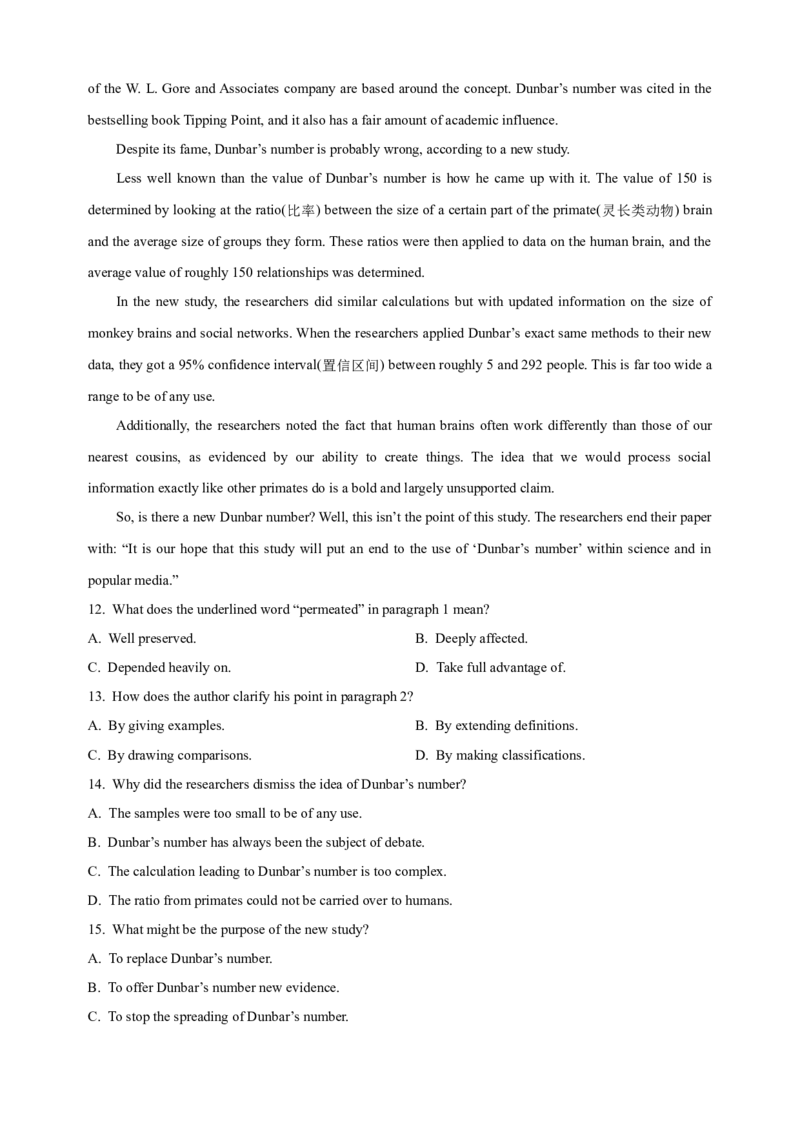
impressive than our own.For the last four decades Brown has paid annual visits to more than two hundred nesting sites in
Nebraska, trying to figure out what makes swallow societies success or fail. “Ninety-eight percent of cliff
swallows in western Nebraska,” Brown said; “are within fifty feet of a road.”
Near a road, of course, is the most dangerous place an animal can live. When Brown began studying
swallows in the 1980s, he often picked up dead swallows on the roads, wings broken and heads crushed (压变
形). However, Brown found swallow roadkill had been decreasing. By 2011 it had dropped to four. Somehow
swallows had become harder to kill.
He found his answer. When he stretched a tape measure from the birds’ shoulders to their outermost
feathers, he found car struck swallows had longer wings than the average bird he caught in his nets. Brown
immediately understood the significance. Traffic was weeding slower long-winged swallows from the
population and favoring the quicker, short-winged ones -Darwinian selection in action.
“Centuries ago ... cliff swallows had existed largely beyond human influence; now they were so involved
in our world that our infrastructure (基础设施) had influenced their DNA,” Brown said. Cliff swallows were
rare winners of concrete and steel. Yet their success had come at a cost — to the long-winged swallows erased
from the population and to the birds’ altered genes themselves. They had been shaped by the road.
8. What is special about cliff swallows?
A. They flee steel and concrete. B. They are good at social engineering.
C. They take on colors of the background. D. They take advantage of human footprint.
9. What leads to cliff swallows’ survival from the roadkill?
A. Human aid. B. Traffic control.
C. Natural selection. D. Infrastructure improvement.
10. What did cliff swallows’ success cost them?
A. Habitat loss. B. Genetic abnormalities.
C. Dramatic declines in population. D. Removal of a genetic characteristic.
11. The text is most likely taken from a book about ________.
A. road ecology B. DNA profiling
C. urban development D. biological diversity
D
Since 1992, people have been talking about “Dunbar’s number,” the supposed upper limit of the number
of people with whom a person can maintain stable social relationships. Named for British scientist Robin
Dunbar, its value, rounded from 148 to 150, has permeated both professional and popular culture.
The Swedish taxation authority keeps offices under 150 people as a result of it, and the standard facilitiesof the W. L. Gore and Associates company are based around the concept. Dunbar’s number was cited in the
bestselling book Tipping Point, and it also has a fair amount of academic influence.
Despite its fame, Dunbar’s number is probably wrong, according to a new study.
Less well known than the value of Dunbar’s number is how he came up with it. The value of 150 is
determined by looking at the ratio(比率) between the size of a certain part of the primate(灵长类动物) brain
and the average size of groups they form. These ratios were then applied to data on the human brain, and the
average value of roughly 150 relationships was determined.
In the new study, the researchers did similar calculations but with updated information on the size of
monkey brains and social networks. When the researchers applied Dunbar’s exact same methods to their new
data, they got a 95% confidence interval(置信区间) between roughly 5 and 292 people. This is far too wide a
range to be of any use.
Additionally, the researchers noted the fact that human brains often work differently than those of our
nearest cousins, as evidenced by our ability to create things. The idea that we would process social
information exactly like other primates do is a bold and largely unsupported claim.
So, is there a new Dunbar number? Well, this isn’t the point of this study. The researchers end their paper
with: “It is our hope that this study will put an end to the use of ‘Dunbar’s number’ within science and in
popular media.”
12. What does the underlined word “permeated” in paragraph 1 mean?
A. Well preserved. B. Deeply affected.
C. Depended heavily on. D. Take full advantage of.
13. How does the author clarify his point in paragraph 2?
A. By giving examples. B. By extending definitions.
C. By drawing comparisons. D. By making classifications.
14. Why did the researchers dismiss the idea of Dunbar’s number?
A. The samples were too small to be of any use.
B. Dunbar’s number has always been the subject of debate.
C. The calculation leading to Dunbar’s number is too complex.
D. The ratio from primates could not be carried over to humans.
15. What might be the purpose of the new study?
A. To replace Dunbar’s number.
B. To offer Dunbar’s number new evidence.
C. To stop the spreading of Dunbar’s number.D. To find new applications of Dunbar’s number.
5.【湖南省名校联考联合体2023-2024学年高三上学期第三次联考英语试题】
C
The Greek historian Herodotus reported over 2,000 years ago on a misguided experiment in which two
children were prevented from hearing human speech so that a king could discover the true, unlearned
language of human beings.
Scientists now know that human language requires social learning and interaction with other people, a
property shared with multiple animal languages. But why should humans and other animals need to learn a
language instead of being born with this knowledge?
Given that the ways honeybees communicate are quite complex, we decided to study how they learn to
communicate to answer this language question.
Bees possess one of the most complicated examples of nonhuman communication. They can tell each
other where to find resources such as food, water, or nest sites with a physical “waggle(摇摆)dance”, by
circling around in a figure eight pattern centered around a waggle run. This dance conveys the direction,
distance and quality of a resource to the bee's nestmates.
Bees begin to dance only as they get older. Could they be learning from practiced teachers?
We thus created isolated experimental colonies of bees(蜂群)that could not observe other waggle
dances before they themselves danced. Like the ancient experiment described by Herodotus, these bees could
not observe the dance language because they were all the same age and had no older, experienced bees to
follow. In contrast, our control colonies contained bees of all ages, so younger bees could follow the older,
experienced dancers.
We recorded the first dances of the bees. The bees that could not follow the dances of experienced bees
produced dances with significantly more directional, distance and disorder crrors than the dances of control
bees.
We then tested the same bees later, when they were experienced dancers. Bees who had lacked teachers
now produced significantly fewer errors, possibly because they had more practice or had learned by
eventually following other dancers. The dances of the control bees remained just as good as their first
dances.
Complex communication is often difficult to produce even when individuals are born with some
knowledge of the correct signals. Bees are born with some knowledge of how to dance, but they have to
learn how to dance even better by following experienced bees.
28. Why does the author say the experiment on the two children is a misguided experiment?
A. Language learning is a social activity. B. Language learning has changed greatly.
C. Children are born with human speech. D. Children develop differently in language.
29. What does the underlined word “isolated” in paragraph 6 indicate?
A. Old bees could not produce waggle dances. B. Old bees could not observe waggle dances.
C. Young bees were separated from older ones. D. Young bees could follow experienced bees.30. What do we know about the bees whose dances remained as good as their first dances?
A. They had little practice in waggle dances.
B. They had learned waggle dances without teachers.
C. They were experienced in teaching waggle dances.
D. They had learned waggle dances before their first dances.
31. What does the last paragraph serve as?
A. A guide to complex communication. B. An answer to why language should be learned.
C. An example of nonhuman communication. D. A proof that bees are born with some knowledge.
D
When I was 15 or 16 years old, I used to enjoy staring out of my bedroom window at night, at the sky
and other houses. After a few minutes of focused attention, I would always reach a point where my vision
shifted. The clouds would suddenly look different, stranger and more real. They weren't “clouds” anymore,
but different magical animal shapes that moved through space. The houses weren't “houses” anymore-they
were strange geometric structures made up of jigsaw(拼图)patterns of bricks.
It's difficult to describe the shift in my vision, but it always felt exciting, as if I was seeing through to
the heart of things, beneath a layer of familiarity.
In most situations, our perception is automatic. We see the familiar world, surrounded by objects and
phenomena that we perceived thousands of times before and don't pay real attention to. In addition, we
perceive the world through filters(过滤器)of concepts. We have a conceptual label (or name) for everything
we see. We label floating shapes in the sky as clouds; we label a masive variety of natural forms with
spreading roots and branches as trees. Through filters of familiarity and concepts, our perception of the world
is like a faded black-and-white image compared to a three-dimensional colour image.
This is why it always makes sense to side-step our normal familiar perception and perceive the world
with fresh vision, free of concepts and expectations, looking at objects as if they had never been seen
before, or as if they were other things.
We can see this in great artists. They go beyond familiarity and find a new way of seeing things.
Familiar everyday objects like fruit and flowers and bottles are filled with freshness and beauty in the great
still-life paintings of artists like Cezanne or Matisse. To look at paintings by Vincent van Gogh, such as
Sunflowers, Irises or Van Gogh's Chair, makes you feel as if an extra dimension of reality has been revealed.
And of course, this is the reason why we love to go to art galleries to see such paintings. To look at them
is like going on vacation to a strange foreign country, a reminder of the raw beauty and wonder of the world,
hidden beneath our normal automatic vision.
32. How did the author look out of the bedroom window?
A. With full attention. B. In a normal way.C. In astonishment.D. With great care.
33. What does the author really mean by saying “our perception is automatic” in paragraph 3?
A. We perceive the world all the time. B. We tend to look at things without thinking.
C. We have the ability to perceive the world.D. We are familiar with the world around us.
34. Why are great artists mentioned in the text?A. To introduce new ways to create art. B. To show how real beauty is created.
C. To support what the author advocates. D. To argue for what the author did as a teenager.
35. What can be the best title for the text?
A. Creating a New World through Art B. Looking at the World with New Eyes
C. Appreciating the Beauty of Every Day D. Experiencing Life in Unfamiliar Environments
6.【河南省TOP二十名校2023-2024学年高三上学期调研考试英语试题】
C
New discoveries and technological breakthroughs are made every year. Yet, as the information industry
moves forward, many people in society are looking back to their roots in terms of the way they eat. A
“locavore” movement has emerged in the United States. The movement supports eating foods grown locally
and sustainably, rather than prepackaged foods shipped from other parts of the world.
Experts hold that eating local has many merits, and is expected to become a trend featuring
sustainability. Erin Barnett is the director of Local Harvest, a company that aims to help connect people to
farms in their area. By eating local, she argues, people have a better and more personal understanding of the
impact their food consumption has on the rest of the world. “There is a way of connecting the point, where
eating locally is an act that raises our awareness of sustainable living,” Barnett says.
The United States’ agricultural output is one of the highest in the world, says Timothy Beach, a professor
of geography and geoscience at the University of Texas in Austin, Texas. “There’s just no other place on Earth
where the amount of input is so productive,” Beach says of American agriculture. “Nobody can cut off the
food we need.”
However, the US food system is not sustainable because of its dependency on fossil(化石) fuels, says
Beach. Equipment used on “extremely productive”, farms is quickly consuming Earth’s natural resources,
particularly oil. Additionally, the production of agricultural supplements(补充剂), such as fertilizer, uses large
amounts of energy.
The world has used close to half of the global oil supply, Beach says, and the second half will be
consumed at an even faster rate because of growing population and economic development. Although many
businesses are experimenting with wind, solar, and biofuel, Beach says there’s nothing that we see on the
horizon that can replace it. “There is no way on Earth we are using fossil fuels sustainably. Then we have to
reconsider the impact of eating local,” he says.
8. What does the underlined word “merits” in Paragraph 2 probably mean?
A. Aspects. B. Advantages. C. Challenges. D. Explanations.9. What’s the weakness of the agriculture in the United States?
A. It consumes too many natural resources.
B. It has a relatively low agricultural output.
C. Large equipment is not widely employed.
D. Agricultural supplements aren’t available.
10. What’s Beach’s view on natural resources?
A. Dependency on oil is and will be a big issue.
B. People will use less and less oil in the future.
C. The use of fossil fuels features sustainability.
D. There are better replacements for fossil fuels.
11. What can be a suitable title for the text?
A. Scientific Ways to Eat Local B. Is Eating Local Sustainable?
C. Efforts to Promote Local Foods D. Are Local Foods Enough?
D
An AI has designed anti-microbial (抗菌的) proteins that were then tested in real life and shown to work.
Proteins are made of chains of amino acids (氨基酸). The sequencest (序列) of those acids determine the
protein’s shape and function. Ali Madani at Profluent, a biotechnology start-up in California, and his
colleagues used an AI to design millions of new proteins, and then created a small sample of those to test
whether they worked.
The AI, called ProGen, works in a similar way to AIs that can generate text. ProGen learned how to
generate new proteins by learning the grammar of how amino acids combine to form 280 million existing
proteins. Instead of choosing a topic for the AI to write about, the researchers could specify a group of similar
proteins for it to focus on. In this case, they chose a group of proteins with anti-microbial activity.
The researchers programmed checks into the AI’s process, and they also tested a sample of the AI-
proposed molecules in real cells. Of the 100 molecules they physically created, 66 participated in chemical
reactions similar to those of natural proteins that destroy bacteria. This suggested that these new proteins
could also kill bacteria.
The researchers then imaged them with X-rays. Even though their amino acid sequences were up to 30
percent different from any existing proteins, their shapes almost matched naturally occurring proteins. James
Fraser at the University of California, San Francisco, who was part of the team, says it was not clear from the
start that the AI could work out how to change the amino acid sequence so much and still produce the correct
shape.“A similar process could be used to create new test molecules for drug development, though they will
still have to be tested in labs, which is time-consuming,” says Madani.
12. How does ProGen produce anti-microbial proteins?
A. By following the way amino acids form proteins.
B. By combining several kinds of existing proteins.
C. By changing some materials from new medicines.
D. By mixing several current proteins with amino acids.
13. How did the researchers know AI-proposed proteins could kill bacteria?
A. They ensured they were produced in real cells.
B. They only analyzed their amino acid sequences.
C. They found they looked the same as natural ones.
D. They tested AI-proposed molecules in real cells.
14. What is James Fraser’s feeling concerning the AI’s final performance?
A. Disappointment. B. Surprise. C. Indifference. D. Guilt.
15. What do Madani’s words suggest?
A. The AI’s process may benefit the medical field.
B. AI-proposed molecules don’t require any lab tests.
C. Hope for the use of the new molecules is very slim.
D. The researchers’ efforts turn out to be a waste of time.
7.【福建省莆田二中、仙游一中2022-2023学年高三上学期第二次联考(期中)英语试题】
C
Have you ever suddenly developed an appetite from a passing glance at a freeway billboard featuring a
brightly colored cheeseburger, or decided to step into a candy or ice cream store displaying a window full of
lively shades and hues (色调)of sweet treats? If so, you are in good company. Unless we are medically
restricted or strictly dieting, we are not likely to resist inviting fare simply because we recognize the lack of
nutritional value.
Devina Wadhera and Elizabeth D.Capaldi-Phillips in A Review of Visual Cues Associated with Food
recognize the impact of sensory cues (信号)on food consumption and enjoyment, and the potential they have
to promote healthy eating behavior. They cite previous research in providing some interesting examples of the
visual impact of different color schemes (方案)on taste and food enjoyment. They note that pink food on a
white plate was considered sweeter and more flavorful than the same food on a black plate. Apparently, weconsume with more of our senses than we realize. So given the rainbow of colors around us when faced with
so many appealing food choices, is there any way to control our appetite? Thankfully, some research says yes.
Oliver Genschow demonstrated that when it comes to eating less colors impact consumption. They
specifically researched the effect of the color red. They found that people ate fewer pretzels when using a red
plate, as opposed to white or blue, and drank less from a red cup than a blue cup. They suggest that the color
red reduces food and drink intake by functioning as a stop signal.
But when it comes to healthy eating, instead of putting on a pair of sunglasses to block the inviting hues
of food cues, consider the value of discipline. Healthy eating involves intentional choices, not mindless
responses to sensory cues. And before you invest in many red tableware to slim down, remember that what
goes onto those plates is much more important.
28. What may be a major reason for us to refuse eye-catching food?
A. The shortage of nutrition. B. The rich color of fine foods.
C. The doctor’s instructions. D. Advertisements everywhere.
29. What might be dealt with in A Review of Visual Cues Associated with Food?
A. Benefits of different color schemes.
B. Interesting examples of food service.
C. Potentials to promote food consumption.
D. Effects of sensory cues on eating behavior.
30. What does the author suggest people do in the last paragraph?
A. Follow the sensory response. B. Make food choices sensibly.
C. Wear sunglasses to block colors. D. Avoid colorful food intentionally.
31. What is the best title for the text?
A. How People can Control Their Appetite.
B. How People are Tricked by Color Schemes.
C. How Colors Impact Food Appeal and Appetite.
D. How Bright Colors Make Food More Appealing.
D
Lisa Gautier receives nearly a dozen parcels of human hair every day. With her San-Francisco-based non-
profit organization Matter of Trust, Gautier turns donated hair into mats used to soak up oil spills on land, and
booms(long tubes)used for spills at sea.
A standard way to clean up oil from land is to use mats made from polypropylene(聚丙烯). But
polypropylene is a non-biodegradable plastic, and producing it ultimately means more drilling for oil. Hair, bycontrast, is an environmentally friendly resource that can soak up around five times its weight in oil,
according to Matter of Trust, and it is abundant.
Oil spills can pollute drinking water, endanger public health, harm plants and wildlife, and damage the
economy. According to Gautier, the spills that hit the headlines only make up 5% of global oil pollution.
Megan Murray, an environmental biologist at the University of Technology Sydney, develops sustainable
technologies to tackle oil spills. Her research indicates that as well as being biodegradable, human hair is
often just as effective as polypropylene, and in some circumstances even better. “The hair mats are very
beneficial to land spills,” says Murray but adds that when raw oil is spilled on beach sand, it is very difficult to
absorb it using any of the materials she has tested. Another advantage of hair is that it costs less than
conventional materials and is “globally available as a recycled material,” she says.
However, Murray cautions that hair mats are not a perfect solution, because they are single-use, and can
only be dealt with by burning or by burying into soil which then isn’t suitable for growing food. She is now
researching methods to extract the oil from a used hair mat, meaning both can be reused.
As the hair mat designs aren’t under patent, other groups have begun producing their own mats and
booms. Gautier is pleased to see the movement growing. “Anyone can make a hair mat,” she says. “It creates
green jobs, it cleans water, it reduces waste in landfill, and it’s promoting renewable resources.”
32. What do we know about polypropylene according to the passage?
A. It is environmentally friendly.
B. People need more oil to produce it.
C. It can soak up around five times its weight in oil.
D. People seldom use mats made from it to clean up oil from land.
33. What does Megan Murray think of the hair mats?
A. Hair mats do no harm to soil after being burnt.
B. People spend more to make hair mats than conventional materials.
C. The effect of hair mats on terrestrial(陆地上的)spills is not very good.
D. Hair mats are not a perfect solution because they can’t be recycled now.
34. What can we infer from the passage?
A. Most oil-spill events have received widespread media coverage.
B. Lisa Gautier donated her hair to soak up oil spills on land and at sea.
C. Megan Murray goes all out to make the hair mats and the oil extracted from them reused.
D. There are many other materials used to treat oil spills on beach sand besides hair.
35. What is the best title for the text?A. Human Hair Is Being Used to Clean Up Oil Spills
B. A Perfect Recycled Material—Human Hair
C. Take Action to Make Hair Mats And Booms
D. How to Tackle Oil Spills
8.【江苏省决胜新高考2023-2024学年高三上学期10月大联考英语试题】
C
Elon Musk has offered a prize of $100m for the best carbon capture proposal. I can save his committee a
lot of time. The money should go to Peter Wohlleben, whose book The Hidden Life of Trees was the most
encouraging blockbuster (一鸣惊人) of 2015.Wohlleben’s idea is this: do nothing about trees. Stop fiddling
(乱作为) with them, thinking that we can deal with climate change better than nature. If we fiddle, our Romes
will burn.
The Hidden Life of Trees argued that trees are social. It shows that they can be our saviours. But it’s
terribly hard to let ourselves be saved. We think we can be the authors of our salvation (拯救). Of course,
there are things we could and should be doing, but in terms of forestry practice, often what’s billed as part of
the solution is part of the problem.
Anyone who has planted a tree in their garden knows that it has a far-reaching effect — it makes your
garden cooler in summer and warmer in winter. Forests cool by transpiring (蒸发). If there’s no water, there’s
no cooling. Drought can kill trees fast, but trees have many ways of dealing with it, and Wohlleben sets them
out. As a species, we have survived many climatic changes by changing our behaviour — and that’s how trees
survive, too. Trees learn from their past harms and produce younger ones programmed with those lessons.
They regulate their growth by changing the rate at which they drip (点滴)-feed them with sugar solution
through root networks.
Deciduous (落叶的) forests in particular remove greenhouse gases effectively as long as they live. Cut
them down and burn them and you’re releasing carbon dioxide not just from the wood, but also from theforest floor. Deciduous trees are not “harvest-ready” at 200 years: they are teenagers. We must interrogate
comforting expressions such as “renewable energy”, and learn the real cost of our toilet paper.
If we don’t learn to do nothing about trees, they will eventually be alone anyway — but without us.
Wohlleben brilliantly and readably shows us how urgent and how hard it is to do nothing.
8. What does Wohlleben suggest for carbon capture?
A. Fight climate change. B. Leave trees alone.
C. Save the earth. D. Change forestry species.
9. How do trees survive the drought?
A. They slow their growth. B. They lose all their leaves.
C. They stop absorbing water. D. They get help from humans.
10. What does the underlined word “interrogate” in paragraph 4 mean?
A. Understand. B. Question.
C. Translate. D. Accept.
11. What is the text?
A. A book review. B. A science report.
C. An introduction to a writer. D. A proposal for a reward
D
The term “beer goggles” is said to have been coined by male North American university students in the
1980s. Yet despite unconfirmed evidence for the phenomenon, the link between alcohol intoxication (醉酒)
and physical attraction has not been systematically studied.
Prof Bowdring of the University of Pittsburgh invited 18 pairs of male friends into the laboratory to rate
the attractiveness of men and women they viewed in photos and videos. On one occasion, both men were
given enough cranberry juice to raise their blood alcohol concentration to about 0.08% - the legal limit for
driving in England — and on the other occasion, they both received a non-alcoholic drink. After providing
attractiveness ratings for the photos, they were asked to select which of these individuals they would most like
to interact with in a future experiment.
The research, published in the Journal of Studies on Alcohol and Drugs, did not find that alcohol
increased people’s perceptions of others’ attractiveness. “But we did find that people were more likely to
select to interact with the people they perceived to be most attractive after consuming alcohol,” Bowdring
said.
Indeed, drunk participants were 1.71 times more likely to select one of their top four attractive candidates
to potentially meet in a future study, compared with when they were sober (清醒的).Given alcohol’s effects on visual processing and cognitive (认知) function, it was also possible that the
results would change as alcohol levels rise in a person’s system, Bowdring said. To move on, the field needs
larger studies to see if they can be replicated (复制).
Assuming alcohol does enhance the likelihood of a person interacting with someone they find attractive.
Bowdring believes her findings could reveal one process supporting the rewarding yet potentially dangerous
nature of alcohol - including its impact on risky behaviour.
“If you’re going to consume alcohol, I think it is worth reflecting on how can you do it in a way that’s
safe and consistent with your goals,” Bowdring said. “People may benefit by recognizing that valued social
motivations and intentions change when drinking, in ways that may be appealing in the short term but
possibly harmful in the long term.”
12. What is paragraph 2 of the text mainly about?
A. The comparison of two experiments.
B. The process of Bowdring’s experiment.
C. The underlying logic of beer goggles effect.
D. The methods of appreciating attractiveness.
13. What did Bowdring’s research find about alcohol intoxication?
A. It increases people’s liquid courage.
B. It makes people better looking.
C. It stops people ignoring attractive faces.
D. It helps understanding others better.
14. What will the follow-up studies focus on?
A. The encounter in real situation.
B. Risky behaviour of intoxication.
C. Drunk people’s visual processing.
D. The result of higher levels of intoxication.
15. What does Bowdring mainly talk about in the last paragraph?
A. The significance of her research.
B. Reflection on her previous research.
C. The negative effects of drinking.
D. Social morality and standards.
9.【重庆市七校2023-2024学年高三上学期第一次月考英语试题】C(改编)
When the company OpenAI developed its new artificial intelligence (AI) program, ChatGPT, in late
2022, educators began to worry. ChatGPT could create text that seemed like a human wrote it. How could
teachers discover whether students were using language created by an AI chatbot to cheat on a writing task?
As a linguist who studies the effects of technology on how people read, write and think, I believe there
are other more pressing concerns besides cheating. These include whether AI, more generally, threatens
student writing skills, the value of writing as a process, and the importance of regarding writing as a tool for
thinking.
As part of my research on the effects of AI on human writing, I surveyed young adults in the U.S. about
some issues related to those effects. One participant said that at some point if you depend on predictive text,
you’re going to lose your spelling abilities. Enter “Was Rom” into a Google search and you’re given a list of
choices like “Was Rome built in a day”. Type “ple” into a text message and you’re offered “please” and
“plenty”. These tools complete our sentences automatically, giving us little chance to think about our spelling,
and continuously asking us to follow their suggestions.
Evan Selinger, a philosopher, worried that predictive texting reduces the power of writing as a form of
mental activity and personal expression. “By encouraging us not to think too deeply about our words,
predictive technology may change how we deal with each other,” Selinger wrote. “We give others more
algorithms (算法) and less of ourselves. Automation can stop us thinking and the resulting text didn’t feel like
mine anymore.”
I asked ChatGPT whether it was a threat to humans’ motivation to write. The bot responded: “There will
always be a demand for creative, original content that requires the unique viewpoint of a human writer.” It
continued: “Writing serves many purposes beyond just the creation of content, such as self-expression,
communication, and personal growth, which can continue to encourage people to write even if certain types of
writing can be automated.”
I was glad to find the program had seemingly admitted its limitations.
28. What is the author’s main concern about ChatGPT?
A. Whether it will lead to students’ cheating.
B. Whether it will shape students’ writing style.
C. How students will make use of it at school.
D. What effects it will have on students’ writing.
29. What will predictive technology do to us according to Evan Selinger?
A. Give us more creative ideas. B. Make us write like a machine.C. Encourage us to think more deeply. D. Make us tend to ignore grammatical mistakes.
30. What can we learn from ChatGPT’s response?
A. Writing will become completely automated. B. Robots will work with humans in writing.
C. Robot writing will become more creative. D. Human writing will still matter a lot.
31. What can be the best title for the text?
A. What impact will AI bring to writing? B. What is the future of modern literature?
C. How to improve writing with AI’s help? D. How to apply AI technology to education?
D (改编)
First impressions can set a lasting tone, but there is often something doubtful. Psychologists have
documented a phenomenon known as the liking gap, whereby two people meeting for the first time routinely
underestimate how much their counterparts (对应方) like them. A new study finds that the liking gap occurs
in group settings too and affects how well groups function.
In one experiment, the researchers divided 159 participants into groups of three and asked them to have a
conversation. They then surveyed the participants individually about how much they liked each of their
partners, how much they thought each partner liked them, and how much they thought their partners liked
each other. On average, people liked their partners more than they believed their partners liked them, and
thought themselves to be the least liked in the group.
In a subsequent experiment, the researchers asked similar questions of engineering students who had
worked together in design competitions for varying lengths of time. Here, too, people tended to underestimate
the degree to which they were liked, regardless of how long they had known their teammates — and their dim
views of their own likability reduced their willingness to ask others for help, give honest feedback, and work
together in the future.
A final experiment involving a broad sample of workers showed that the misperceptions (误解) were
strongest among teammates and that they decreased team effectiveness and job satisfaction. It also found a
possible explanation for the liking gap: People tend to focus on positive thoughts when reflecting on how
much they like someone else “(I’m happy that she got a promotion”) but fall victim to more negative ones
when considering how others view them ( “I got a promotion, so she might be green with envy”).
Managers should think carefully not just about how teammates regard one another but about how team
members think they themselves are regarded, the researchers say; correcting misperceptions could boost team
satisfaction and performance. “If only people knew how positively their teammates actually felt about them,
they might communicate better, feel more included on their teams, and be happier overall with their jobs,”
they write.32. What does the liking gap refer to?
A. A type of social anxiety disorder. B. Love among different age groups.
C. Misjudging others’ opinions of us. D. Holding back others’ evaluations.
33. What did the experiment in paragraph 2 reveal?
A. People did not like to give honest comments.
B. People tended to think little of their partners.
C. People were quite demanding towards others.
D. People were not very confident about themselves.
34. What does the underlined word “dim” in paragraph 3 probably mean?
A. Conflicting. B. Negative. C. Conventional. D. Strong.
35. What do the researchers suggest managers stress?
A. Employees’ viewpoints on themselves.
B. The relationship between team members.
C. Employee promotion and job satisfaction.
D. Communication between leaders and employees.
10.【2024届“皖南八校”高三第一次大联考高三英语试卷.】
C
Re-purposing diapers(尿布) to make building materials would reduce the amount of garbage
that goes to a landfill. It could also make homes more affordable. Maybe giving used diapers a new
use could help tackle both problems.
Building materials-especially those that are used for strengthening structures—are often
expensive. They're often the biggest hurdle to making homes affordable. So researchers have
previously investigated unusual materials that could save costs. These materials included
many that would otherwise pile up as waste, such as fly ash.
"There is a big need in developing countries such as the Southeast Asian nation -
Indonesia. There, demand for low-cost housing outstrips(超过) what's available. The number of
people in Indonesia's cities has climbed by about 4 percent per year in the last 30 years. By 2025,
more than two-thirds of Indonesians are expected to live in urban areas. Indonesia's population
boom is intensifying the demand for housing," says Siswanti Zuraida, an environmental engineer in
Indonesia.
"Despite the need for more affordable housing, there are significant problems that stand in the
way of adopting diapers,”Zuraida says.”Used diapers contain wood pulp, cotton and plastic,which are potentially useful building materials. Diapers plastic components would have to be
separated from the organic fibers, a complicated recycling process currently available only in
developed nations. And Indonesia's building regulations restrict together) - materials to bricks,
wood, steel and concrete (which is used to hold bricks together) - materials that also bear a
high cost in terms of carbon emissions.
But reusing diapers might not be that environmentally friendly, especially on a large
scale. It’s tricky to separate dirty diapers from waste and disinfect them. So it would take a
lot of energy to recycle diapers. It’s maybe worthwhile to start thinking about ways to
replace single-use diapers with something less frequently thrown away,” says Christof
Schrofl, a chemist who works at Technische Universität Dresden in Germany.
28.Which statement describes the idea of re-purposing diapers best?
A. No pains, no gains. B. Waste not, want not.
C. Kill two birds with one stone. D. Great minds think alike.
29.What is the meaning of the underlined word in Paragraph 2?
A.Phase B.Barrier. C.Goal. D. Advantage.
30.What can be inferred from the fourth paragraph?
A.It is illegal to use diapers as building material in Indonesia.
B.Making building materials has little effect on climate warming.
C. The plastic components in diapers can make buildings stronger.
D. Developed countries have difficulty separating organic fibers on diapers.
31.What is Schrofl's attitude towards reusing diapers?
A.Indifferent B.Supportive. C.Admiring. D.Objective.
D
It's mid-afternoon. You're full from lunch. The day is warm. You're starting to feel
sleepy. Should you give ii to the comfort of a nap(打盹)? In point of advantage, it is worth it.
Though there is some disagreement as to whether napping benefits everyone, research suggests
naps can boost at least some people's mental process of understanding in the short term.
Several studies find that a well-timed nap can provide a short-term boost in brainpower. For
example, scientists reviewed past research that focused on healthy participants with regular
sleep cycles. That review, published in 2009 in the Journal of Sleep Research, shows that napping
improves factors ranging from reaction time to alertness( 警 觉 ) to memory performance.
"A brief nap can also inspire people with creativity," a 2021 study in Science Advances
found. In that research, participants were given math problems that could be solved with an
easy short cut that they weren't told about. Some participants were encouraged to take abrief nap before tackling the problems. The researchers found those who napped—and spent
even just 30 seconds in the first, lightest phase of sleep—were 2.7 times more likely to
figure o the short cut than those who stayed awake. But entering a deeper sleep phase had
a negative effect on this creative insight, In other words, there may be a “sweet spot”of
mental relaxation that clears the way for moments of inspiration.
"Timing your naps right can reduce sleep inertia( 睡 眠 惯 性 ),"says Natalie Dautoich, a
psychologist at Virginia Commonwealth University.“A 20-minute nap is recharging and Co, a
90 minutes of sleep can be even more restorative. The nap to avoid is the one lasting to
than 20 minutes and less than 60 minutes, which is most likely to lead to sleep inertia.”
“The short-term benefits of naps are well established, but pinning down the relationship
between naps and any specific health outcomes, long-term effects of napping, is not always simple.
For example, greater daytime sleepiness is symptomatic of many health conditions; and therefore
napping may not necessarily be the cause of these conditions but rather a consequence," says
Victoria Garfield, a professor of University College London.
32. What can we know about napping from the first paragraph?
A. It is favourable to people B.It make people inefficient.
C.It can boost people's night sleep. D. It has little effect on people's ability
33.What would you be if you take a half-an-hour nap?
A.Bored B.Sleepy. C.Enthusiastic. D.Restorative.
34. How does the writer prove arguments in the text mainly?
A.By listing statistics B.By making comparison
C.By criticize wrong opinions D.By presenting study results
35. What will the author probably talk about next?
A. The reasons for unhealthy physical conditions
B. The ways to set the appropriate time of napping
C. The association between nap and health conditions
D.The means to get into the habit of long-term napping
11.【浙江省新阵地教育联盟2023-2024学年高三上学期第二次联考英语试题】
CAfter COVID-19, the Bureau of Labor Statistics predicts that while the number of nurses has
increased in the past three years, the U.S. still experiences a shortage of registered nurses, and
that there will be over one million unfilled nursing jobs. So what’s the solution? Robots.
Japan is ahead of the curve when it comes to this trend. Toyohashi University of
Technology has developed Terapio, a robotic medical cart that can make hospital rounds, deliver
medications and other items, and retrieve records. This type of robot will likely be one of the
first to be implemented in hospital.
Robots capable of social engagement help with loneliness as well as cognitive functioning,
but the robot itself doesn’t have to engage directly—it can serve as a mediator for human
communication.Telepresence robots such as MantaroBot, Vgo, and Giraff can be controlled
through a computer, smartphone, or tablet, allowing family members or doctors to remotely
monitor patients or Skype them. If you cant get to the nursing home to visit grandma, you can
use a telepresence robot to hang out with her.
A robot’s appearance affects its ability to successfully interact with humans, which is why
the Human-Interactive Robot Research decided to develop a robotic nurse that looks like a huge
teddy bear. RIBA, also known as“Robear,”can help patients into and out of wheelchairs and
beds with its strong arms.
On the less cute and more scary side there is Actroid F, which has such resilient skin and
natural hair color that some patients may not know the difference. This conversational robot
companion has cameras in its eyes,which allow it to track patients and use appropriate facial
expressions and body language in its interactions.
It’s important to note that robotic nurses don't decide courses of treatment or make
diagnoses. Instead,they perform routine and laborious tasks, freeing nurses up to attend to
patients with immediate needs. This is one industry where it seems the integration of robots will
lead to cooperation, not replacement.
28. What does the underlined part in paragraph 2 mean?
A. Take the lead. B. Reach the standard. C. Set a record. D. Miss a
turn.29. Telepresence robots may serve their right purposes in hospital when
A. they collect medical records for patients
B. they deliver food to clinical doctors
C. they move the mobility-disabled patients
D. they assist doctors with long-distance diagnoses
30. What is the distinctive attraction of Actroid F?
A. Its scary arm strength. B. Its adorable appearance.
C. Its human-like voice. D. Its proper interactive
response.
31. What is the suitable title for the passage?
A. Robots—the future replacement of nurses
B. Robots—the earth-shaking reform in hospitals
C. Robots—a good supplement to nurses
D. Robots—a new way to treat patients
D
While teenagers who are at risk of depression with risky behaviors—drinking alcohol, smoking
cigarettes and cutting classes often alert parents and teachers that serious problems are brewing, a
new study finds that there’s another group of adolescents who are in nearly as much danger of
experiencing the same mental symptoms.
These teens use tons of media, get insufficient sleep and have a sedentary(不爱活动的) lifestyle.
Of course, that may sound like a description of every teenager on the planet. But the study warns that
it is teenagers who engage in all three of these practices in the extreme that are truly in a dangerous
position. Because their behaviors are not usually seen as a red flag, these young people have been
called the “invisible risk”group by the study's authors.
The study’s authors surveyed 15,395 students and analyzed nine risk behaviors,including
excessive alcohol use, illegal drug use, heavy smoking and high media use. Their aim was to
determine the relationship between these risk behaviors and mental health issues in teenagers. The
group that scored high on all nine of the risk behaviors was most likely to show symptoms of
depression; in all, nearly 15% of this group reported being depressed, compared with just 4% of thelow-risk group. But the invisible group wasn’t far behind the high-risk set, with more than 13% of
them exhibiting depression.
The findings caught Carli off guard. “We didn’t expect that,” he says.“The high-risk group and
low-risk group are obvious, but this third group was not only unexpected. It was so distinct and so
larger—nearly one third of our sample—that it became a key finding of the study.”
Carli says that one of the most significant things about his study is that it provides new early
warning signs for parents, teachers and mental health-care providers. And early identification s,
support and treatment for mental health issues, he says, are the best ways to keep them from turning
into full-blown disorders.
32. Which teenager probably belongs to the “invisible group”?
A. A teenager who drinks frequently. B. A teenager who exercises regularly.
C. A teenager who skips school. D. A teenager who suffers from a lack
of sleep.
33. What can we know about the new study?
A. It was conducted by analyzing and comparing the previous data.
B. It was intended to dig into the reasons for depression.
C. It revealed an alarming rate of the invisible group suffering depression.
D. Its findings were under expectation of the research team.
34. What is Carli’s attitude toward the findings?
A. Unclear. B. Positive. C. Doubtful. D. Indifferent.
35. The author wrote this passage to ______.
A. introduce a new therapy for teens' mental disorder
B. warn about the unobserved signals for teens' mental problems
C. share a novel psychological experiment with teens
D. caution teens against developing unhealthy habits
12.【广东省2023-2024学年高三上学期10月大联考英语试题】
C
Disability is an unavoidable outcome of living. There is no perfect body or mind. And there is no normal body
or mind. In other words, no one is perfectly “able”. Everyone faces limitations, and some might face more severelimitations at different times in life through age, illness, or other unexpected occurrences. Having a disability,
however, should not stop anyone from learning. As a result of several recent international movements, schools in
nations around the world now provide inclusive education, which means that students with disabilities have access
to the common curriculum (课程) in the general education classroom.
English language instructors need to provide equal instruction to all learners in inclusive settings. Online
learning has made it possible for many students with different kinds of disabilities to access classes and learning
materials that were once out of reach or difficult to obtain. However, whenever teachers do not adopt necessary
measures to accommodate as widely as possible in digital spaces, they sometimes unknowingly create barriers for
students with disabilities. It is our responsibility as educators to be aware of that.
While we are acquiring or updating skills for teaching online, we should give equal attention to understanding
how to accommodate students with disabilities in a digital learning environment. When we do not make our classes
accommodating to all students, some students are left behind through no fault of their own. Whenever we work to
create inclusive learning environments, we provide support for all students, with or without disabilities.
The online learning environment provides multiple ways to make learning interesting through media, and
technology tools. It is important not to use technology just for the sake of attracting attention, however, but to use it
because it has a learning purpose that you are clear about. For instance, don’t show a video just because it’s fun, but
because it helps achieve a learning goal.
8. What can be inferred from the first paragraph?
A. Inclusive education has limitations.
B. It is unavoidable to have a disability.
C. The disabled should have equal chances to learn.
D. Those with disabilities have difficulty in learning.
9. What makes learning materials more accessible to the disabled?
A. Online learning. B. Instructors’ help.
C. The digital space. D. The updating skill.
10. What can we know about the author?
A. He is a doctor. B. He is an educator.
C. He teaches English. D. He does research on disabilities.
11. What may be the proper reason for playing a song in class?
A. To provide more media. B. To show new technology.
C. To rid students of barriers. D. To help achieve a learning aim.D
Brynn Schulte nearly died two times when she was a baby. At one point she needed emergency surgery for
bleeding in her brain. No one knew what was wrong. Then, a test that looked at her full genetic details found a rare
bleeding disorder. Catching the disorder early saved her life. “You have this hopeless feeling when you don’t really
know what’s going on,” said her father, Mike Schulte. He noted that the test made a difference in finding the cause
and “getting her the right care that she needed almost immediately”.
Brynn, now 4, got the genetic testing as part of a clinical trial, the results of which were published recently in
The Journal of the American Medical Association. Testing all of the details of a person’s genes is called “whole
genome” testing. Whole genome tests are much better than narrowly targeted tests when it comes to finding genetic
differences, called abnormalities, which can cause disease. The study found 49 percent of these abnormalities,
compared to 27 percent with more commonly used tests targeting only some genetic diseases.
Whole genome tests could solve the problem of doing several narrowly targeted tests on babies, which still
might not find the disorder. Experts warn there are some problems because labs vary in how they understand
results. Also, whole genome tests are more expensive and less likely to be covered by insurance.
But researchers hope that whole genome tests will at some point be used for millions of hospitalized babies
with rare and difficult conditions. The US National Human Genome Research Institute has found that around 350
million people around the world live with rare disorders. And it found that about 80 percent of the more than 7,000
conditions are genetic.
12. How did Mike Schulte feel about the test?
A. Proud. B. Grateful. C. Unclear. D. Hopeless.
13. In finding genetic diseases, .
A. narrowly targeted tests are easier
B. commonly used tests take longer
C. whole genome tests focus on babies
D. whole genome tests are more accurate
14. What disadvantage do whole genome tests have?
A. They cost a lot.
B. The process is complex.
C. The disorder might not be found.
D. Their results are hard to understand.
15. Where is the text most likely found?A. In a blog. B. In a medical record,
C. In a newspaper. D. In a letter.
13.【云南省部分名校2023-2024学年高三上学期10月联考英语试题】
C
Chloe Silvestre feels so fortunate like a winner of a lottery ticket (彩票). As a working mum with two young
children, she is the winner in the “granny game”, allowing her career to develop and saving a fortune along the
way. If Chloe paid for her own childcare in London, it could cost £40,000.
“Both my mother and mother-in-law are available and passionate,” she said. “They have looked after my
children, so they needn’t go to nursery. Sometimes, they even bring an evening meal for us when we get home from
work, or have my children stay so we can go away at weekends.”
Most grandmothers help look after their grandchildren. Yet the exchange is not always good for the grannies’
own careers. “Young grannies in their 50s consider childcare as a burden as they are also trying to deal with their
own jobs. For those in their 70s, it may be too physically demanding. Yet for those in their 60s, it’s usually great,”
said Kanji, professor at Goldsmiths.
Kanji extolled the results and said, “The care the children get is exceptional. It’s one-on-one, loads of books,
no screen time and good fresh food. We often get comments on how confident and polite they are and chatty with
adults. Their social skills are there because they spend much time with someone who listens and responds to them.
The arrangement has bonded all three generations too, over shared meals for example.”
The parents and children have all the benefits of grannies’ involvement. So do grannies themselves. “We saw
that grandparents who stopped looking after their grandchildren suffered mental health impacts from that
withdrawal,” said Kanji.
Chloe’s mum Janet thinks that she has the best side of the childcare bargain. She said, “It can be tiring but they
fill an emotional gap. I’d be very lonely without them. It’s so wonderful to be able to help. If everyone did it, they
would know what a precious thing it is.”
8. Why does Chloe feel so fortunate?
.
A She won a lottery ticket.
B. She has two young children.
C. Her mother paid for the childcare in London.
D. Her mother and mother-in-law help care for her children.9. What can we know from paragraph 3?
A. Grandmothers love their own jobs.
B. Women’s employment is unsatisfactory.
C. Not all grandmothers are suitable for childcare.
D. Looking after children is physically demanding.
10. What does the underlined word “extolled” in paragraph 4 mean?
A. Repeated. B. Praised. C. Abandoned. D. Generated.
11. What is Janet’s attitude to looking after her grandchildren?
A. Uncaring. B. Uncertain. C. Supportive. D. Skeptical.
D
In 2011, organizations in England called on the citizens to reduce the amount of meat eaten on Fridays. 28% of
people adjusted their dietary habits in various ways. Some gave up meat on Fridays, while others reduced it.
A new study from the University of Cambridge aimed to look at the consequences of behavioral change from
people within a society and how these consequences bring in potentially large environmental benefits over time has
,
assessed the impact of this shift estimating that over the past decade, 55,000 tonnes of annual carbon emissions
were saved.
The 28% of people said they changed their habits; of these, 55% reduced meat consumption on Fridays, and
41% stopped eating meat on Fridays. The 72% of people who did not change dietary habits attributed it to
preferring to choose their own foods.
Using further data from the National Diet and Nutrition Survey (NDNS), researchers could tell that people in
the UK eat an average of 100 grams of meat daily, and the average high-protein, non-meat-eater (who eats fish and
cheese) contributes one third of the greenhouse gas emissions per kilogram that a meat-eater does.
,
Thus making a conservative assumption that citizens who adapted their diet switched to high protein non-
meat meals on Fridays, the researchers estimated that this equated to approximately 875,000 fewer meat meals a
week, which saved 1,070 tonnes of carbon, or 55,000 tonnes over a year.
There are some concerns about the implementation(实施) of meatless Fridays leading to further reduction of
fish stocks, as fish is a common substitute for red meat. The researchers say, however, that this need not be a
concern; there was no increase in fish consumption over the past decade, nor did meat consumption go up on other
days to make up for its absence on Fridays. Furthermore, there are many more meat substitutes available now than
in the past, offering more options.
12. Which of the following can best describe the shift?A. Costly. B. Meaningless.
C. Well-known. D. Environmentally friendly.
13. What do the numbers in paragraph 3 show?
A. The experimental process.
B. The changes in people’s lifestyle.
C. The people’s response to the appeal.
D. The people’s care of carbon emissions.
14. Why is NDNS mentioned in the text?
A. To support the findings of the study.
B. To introduce the application of the study.
C. To show a different opinion about the study.
D. To call on more people to participate in the study.
15. How do the researchers feel about the implementation of meatless Fridays?
A. Curious. B. Optimistic. C. Doubtful. D. Shocked.
14.【河北省新时代NT教育2023-2024学年高三阶段测试英语试题】
C
Soccer fan Neale Mahoney’s goal when he subscribed to NBC’s Peacock streaming service last year was to
watch a single season of the Premier League. But he wound up paying for extra time. When I signed up last fall, I
intended to cancel at the end of the season in May, “Mahoney recalls.” But when it came to the summer, I forgot to
cancel and I realized I paid for three extra months.”
It’s a familiar mistake, given the explosion of subscription services in recent years. Americans are increasingly
signing up to buy everything from bottled water to razor blades (剃须刀片) on a pay-by-the-month basis — but
often forgetting to cancel when the subscriptions are no longer needed or wanted.
Mahoney, who’s an economist, wanted to figure out how often people are paying for subscriptions they no
longer want. He and two colleagues at Stanford and Texas A&M University scrolled through millions of
anonymous (匿名的) credit card records, and they discovered a kind of natural experiment.
“The a-ha moment for us,” Mahoney says, “was we realized that when your credit card expires or you lose
your credit card and get a new one in the mail, you’re going to get an email from all the companies where you have
a subscription that says, ‘Can you log in again and update your payment information?’” When that happens, and
people have to make an active decision about whether to renew a subscription, they cancel about four times as oftenas during other months. On average, about 8% of customers cancel during months when they are asked to actively
renew their subscription, compared to about 2% who cancel during other months.
Consumer advocates suggest that businesses are profiting from customers’ forgetfulness and it’s a real cash
cow for companies. Due to thousands of complaints related to the extra subscription, the Federal Trade
Commission is considering a new rule that would require companies to make it as easy to get out of a monthly
subscription as it is to sign up. The so-called click to cancel rule would also require businesses to send customers an
annual reminder.
8. Why is Mahoney’s example mentioned in the first paragraph?
A. To introduce a soccer fan. B. To bring in the topic.
C. To praise a streaming service. D. To stress his forgetfulness.
9. What is the main idea of Paragraph 2?
A. Subscription services are increasingly popular.
B. People are more likely to buy necessities online.
C. Subscription services cause people to buy what they dislike.
D. People often forget to cancel their unnecessary subscriptions.
10. How did Mahoney get the findings?
A. By recording customer’s habits.
B. By comparing previous data of customers.
C. By studying numerous credit card records.
.
D By renewing many customers’ subscriptions.
11. What does the underlined phrase “cash cow” probably mean in the last paragraph?
A. Moneymaker. B. Struggle.
C. Disaster. D. Cashier.
D
As we all know, insects can be remarkably agile (灵活的) in flight. This is really hard to build into flying
robots, but MIT Assistant Professor Kevin Yufeng Chen has developed an insect—sized drone (无人机) that
approaches insects’ agility.
Typically, drones require wide open spaces. “If we look at most drones today, they’re usually quite big,” says
Chen. “Most of their applications involve flying outdoors. The question is: Can you create an insect-sized drone
that can move around in very crowded and complex spaces?”
According to Chen, he overcame many problems when building the drone. The insect-sized drone requires afundamentally different construction from a larger one. The large drone is usually powered by a motor, but the
motor loses efficiency as you shrink it. So, Chen says, “For an insect-sized drone, you need to look for
alternatives.” The principal alternative until now has been employing a small, rigid actuator (执行器) built from
new materials. Chen designed a more agile tiny drone using soft actuators instead of hard ones.
Each actuator can beat nearly 500 times per second and weighs just 0.6 gram, approximately the mass of a
large bee. It gives the drone insect-like agility. “You can hit it when it’s flying, and it can recover,” says Chen. “It
can also turn over in the air.” The drone looks a bit like a tiny cassette tape with wings, though Chen is also
working on a new one shaped like a dragonfly.
Chen says his drone can be useful in industry and agriculture. It can perform machinery inspections to ensure
safety and function. Its potential applications include completing search-and-rescue missions following a disaster.
“All those things can be very difficult for existing large-scale drones,” Chen explains. Sometimes, bigger isn’t
better.
12. What is the disadvantage of the conventional drones?
A. They cost too much. B. They can only fly indoors.
C. Their construction is unstable. D. They are too large to enter narrow spaces.
13. What is the function of the actuator designed by Chen?
A. To power the insect-sized drone.
B. To make the new drone less flexible.
C. To make the new drone easily turn over.
D. To shape the new drone into a dragonfly.
14. What is the last paragraph mainly about?
A. Safety standards of the new drone. B. Possible applications of the new drone.
C. Potential risks of the new drone. D. Design concept of the new drone.
15. Which is the best title for the text?
A. An Insect-like Small Drone
B. The Future of Insect-sized Drones
C. How Drones Will Change the Industry
D. What Problems Drone Development Are Facing
15.【辽宁省重点高中沈阳市郊联体2023-2024学年高三上学期10月月考英语试题】
CArtificial intelligence (AI) has been increasingly good at fooling people. A series of photos showing former
US president Donald Trump being aggressively arrested by police have caught people’s attention. They were fake
but very convincing.
Created by the AI program Midjourney, the photos were highly realistic, from the characters’ movements to
the surroundings. However, many details can give away the fact that they are made by AI. The Washington Post’s
technology writer Shira Ovide shared her tips. The main idea is to spot the problems-anything that would look
strange in a photo.
AI software has a history of generating human hands incorrectly. It sometimes can create hands with more
than five fingers. This is because AI isn’t sure what a “hand” exactly is, according to Popular Science. The data AI
uses to learn often show hands and fingers in various gestures, which can be very confusing for AI.
AI-generated images also usually contain details that are against reality. To spot this, focus on items like
accessories. For example, people in an image may be missing earrings or one part of their sunglasses. If there’s text
in an image, such as a newspaper or poster, it’s usually garbled (篡改), even though the text may look realistic from
a distance.
Another thing AI is terrible at handling is the background. If there’s a crowd in the image, people’s faces in the
background are usually blurry — or they don’t have faces at all!
The development of AI-generated art also raises alarm bells about how these fake images could be used to
spread misinformation. “I think misinformation is going to hit an all-time high,” Jamie Cohen, a digital culture and
AI expert in the US, told New York Post. Generating an AI artwork is to “create reality”, Cohen argued, adding
that, being able to tell whether the work is real or not requires high media literacy (素养) skills. “The world may
not be ready for how realistic the images have become,” Shane Kittelson, a US researcher, told The Washington
Post.
8. Why are Donald Trump’s photos mentioned in the first paragraph?
A. To draw more people’s attention.
B. To make people convinced of the news.
C. To show the AI-generated images were fake.
D. To prove that it’s easy for AI to cheat people.
9. Why does AI generate human hands incorrectly according to the text?
A. It is unable to recognize human hands.
B. The data it uses to learn contain errors.
C. It doesn’t fully understand human hands.D. It has insufficient data about human hands.
10. Which of the following will Jamie Cohen agree with?
A. AI artworks may not be reflective of true creativity.
B. It’s high time to address the risks posed by AI works.
C. AI artworks will replace traditional art forms in the future.
D. Detecting real art demands strong media literacy competence.
11. What is mainly talked about in the text?
A. AI is tricking people with highly realistic photos.
B. AI-generated art make people worried about fake images.
C. AI is terrible at handling the background.
D. The world may not be ready for AI.
D
Millions of us may lose sleep as most states switch to DST, Daylight Saving Time (夏令时) and put the clocks
forward by one hour. The time change brings darker mornings and extends light in the evening.
Some policymakers want to make DST permanent to avoid the disturbance of constant switches. Marco Rubio,
a government officer, says the formality of changing our clocks twice a year makes no sense. He points to the
potential economic benefits DST brings. The key argument is that more light in the evening can stimulate people to
go out and that translates into more people shopping in convenience stores for everything from water to sports
drinks. Thus, there is a boom in spending.
However, the health impacts have been more complicated to figure out. DST increases evening exposure to
light, which can make it harder to fall asleep at night. So in recent years, the time change has been reported to be
linked to an increase in atrial fibrillation, a type of heart disease, perhaps due to the sleep disorder. Besides,
evidences have linked the transition to an increase in attention problems and mood disorders.
“I am very surprised,” says Jay Chudow, a cardiologist. “It’s just a one-hour change, but this shows how
sensitive our bodies maybe to internal clock (生物钟) interruption.” Actually humans’ internal clock is closely
linked to the rising and setting of the sun. He emphasizes that restoring permanent Year-Round Standard Time
(YRST) is the best option for our health and well-being, for the natural daily cycle of light and darkness is really
the most powerful timing reminder that we have to match our body clock with.
So it seems there’s a divide between what’s likely best for our health and what may be good for the economy.
Due to the economic burden and tight budget, it is not hard to guess which one will be given higher priority among
policymakers this year.12. What benefit does DST bring?
A. Boosting consumption. B. Lengthening daytime.
C. Avoiding constant switches. D. Brightening the mornings.
13. What does the underlined word “transition” in Paragraph 3 mean?
A. Impact. B. Exposure. C. Disorder. D. Change.
14. What does Jay think of DST?
A. It helps restore energy. B. It raises health concerns.
C. It is a timing reminder. D. It matches humans’ body clock.
15. What will the policymakers probably do this year?
A. Choose DST. B. Adopt YRST.
C. Tighten the economy. D. Increase funds on healthcare.