专题 03 阅读理解——研究报告类说明文(阅读 D 篇)
目 录
模拟·基础演练.......................................................................................................................................1
重难·创新演练.......................................................................................................................................7
真题·实战演练.....................................................................................................................................13
模拟·基础演练
考查重点:文章分类主要考查 problem--solution--result 类研究报告,考查 Findings/
discoveries--evidence(experiment, result)--conclusion(application/evaluation) 类 研 究 报 告 ,
Phenomenon--analysis--conclusion类研究报告,命题方法分类:主要考查推理判断,主旨
大意,细节理解,部分猜测词义
研究报告类说明文
1.考查problem--solution--result类研究报告
1.(2026 届福建泉州市高中毕业班质量检测(一))In the global effort to fight climate change,
scientists are exploring solutions in unexpected places — including the soil beneath our feet. A recent study
published in Nature highlights a promising discovery: specific bacteria that can dramatically reduce agricultural
emissions of nitrous oxide (N O), a powerful greenhouse gas.
2
Nitrous oxide, largely released from farm fields due to nitrogen fertiliser (肥料) use, is a major climate
concern. According to co-author Professor Lars Bakken of the Norwegian University of Life Sciences, the gas is
265 times more effective at warming the atmosphere than carbon dioxide and can remain in the air for over a
century.
To develop the solution, researchers grew the bacteria using organic waste. Building on past work, they
looked for a microorganism that would reduce nitrous oxide emissions without staying in the soil for so long that it
harmed other life forms important for crop health. The bacteria reduced emissions after a second fertiliser treatmentby about half two weeks later. After three months, the makeup of microbial (微生物的) life was unchanged,
suggesting the bacteria would not harm the soil.
The bacteria, which are not genetically modified, occur naturally in anaerobic digesters — facilities that
transform organic waste into biofuels. That might ease acceptance of their use, said Paul Carini of the University of
Arizona, who was not involved in the research. Moreover, Bakken stated that this “opens up a number of new
possibilities” for managing farmland. The bacteria could be added to fertilisers, offering a potential direct
application for farmers. As Carini noted, using a waste product from one industrial process to benefit another is
cost-effective.
However, significant challenges remain before widespread use. Professor Lori Hoagland of Purdue
University, an expert in the field, noted that soils vary globally, requiring more field testing to ensure effectiveness.
More critically, farmers currently get no financial motivation to adopt such methods. Bakken argued that authorities
must create policies to make emission reductions profitable. If these limitations can be addressed, this bacterial
treatment could have a major impact on reducing agriculture’s contribution to climate change.
1.Why is nitrous oxide a major climate concern?
A.It is released in larger amounts than CO .
2
B.It stays in the atmosphere for a very short time.
C.It comes mainly from industrial production.
D.It has a much stronger warming effect than CO .
2
2.What did the researchers find?
A.A way to help farmers increase fertiliser use.
B.A bacterium that stays in the soil forever.
C.A method to produce more biofuels from waste.
D.A microbe that cuts N O without harming soil.
2
3.Which aspect of the bacteria is mainly discussed in paragraph 4?
A.Its potential benefits. B.Its working principle.
C.Its producing process. D.Its research value.
4.What prevents the application of the finding?
A.Shortage of necessary bacteria.
B.Difficulty in large-scale testing.
C.Lack of economic benefit for farmers.
D.Uncertainty about its effect.2.(2026·山东菏泽市一模)Modern society relies heavily on refrigeration technology, from preserving
food to cooling data centers. However, widely used vapor-compression (蒸汽压缩) cooling consumes vast amounts
of electricity and generates 7.8 percent of the country’s carbon emissions (排放). Solid-state cooling has been
considered cleaner, but the solid materials struggle with heat transmission efficiency, restricting their practical use
in large-scale applications.
The research team, led by Li Bing, a professor at the Chinese Academy of Sciences’ Institute of Metal
Research, discovered a way to bypass this limitation by integrating solid cooling effects with liquid flow.
In their study, they observed ammonium thiocyanate, a widely-used industrial salt, absorbs massive amounts
of heat when it dissolves (溶解) in water. By applying pressure, the process goes backward, separating the salt out
and releasing a large amount of heat. This two-way cycle enables continuous cooling as pressure is applied and
released in turn, making it an ideal one for refrigeration systems. “Unlike traditional cooling methods, the approach
integrates the cooling material and heat-carrying material into a single liquid, facilitating heat conductivity.” Li
said. This approach solves what scientists described as the “impossible triangle”, achieving low emissions, high
cooling power, and efficient heat transmission all at once.
Laboratory experiments demonstrated excellent results. At room temperature, the method achieved a
temperature drop of nearly 30℃ in just 20 seconds, while at higher temperatures the cooling reached as high as
54℃, far exceeding that of existing methods. Another experiment proved the process’ stability and instant response
to pressure changes — key requirements for practical refrigeration systems.
Li emphasized that this technology lays foundation for the commercialization of powerful, zero-emission
refrigeration systems for industrial and home use, especially the next-generation artificial intelligence computing
centers. He added, however, further efforts are needed for practical application, such as breakthroughs in
engineering pressure-tuned changes.
1.What is one problem of traditional cooling systems?
A.They consume much energy.
B.They’re used in small scale.
C.They depend on solid materials.
D.They have low cooling efficiency.
2.What plays a key role in solving the “impossible triangle”?
A.The solid-state materials.
B.The two-way liquid cycle.
C.The pressure-tuned changes.D.The traditional cooling method.
3.What is the purpose of listing the data in paragraph 4?
A.To illustrate the principle of solid cooling.
B.To explain the need for low carbon emission.
C.To show impressive effects of the new method.
D.To compare the differences of two experiments.
4.Which would be the best title for the passage?
A.Salt-based Methods Work Wonders
B.Traditional Cooling Meets its Limits
C.A Report on Eco-refrigeration Industry
D.A Breakthrough in Cooling Technology
2.考查 Findings/discoveries--evidence(experiment, result)--conclusion(application/evaluation)
类研究报告
1.(2026·广东汕头市普通高考第一次模拟)When danger approaches, animals seem to follow the ancient
proverb: “the enemy of my enemy is my friend.” Researchers have found subtle ways that animals communicate
with other species in cooperative defense.
A study in Nature Ecology & Evolution reported that over 20 bird species across four continents make
nearly identical high-pitched (高音调的) “whining” calls to warn others of birds like cuckoos nearby. Cuckoos are
brood parasites — they lay eggs in other birds’ nests, often pushing out the hosts’ own eggs, to trick host birds into
raising their chicks. According to co-lead author James Kennerley, this call works as the word for “cuckoo” and
appears to be understood across species, offering clues about how language may have originated.
Birds producing this alarm call often live in regions with high numbers of brood parasites that target multiple
host species. Hearing the call, potential hosts react aggressively to drive the invaders away.
To investigate further, Will Feeney’s team played recordings of such alarm calls — originally from birds on
other continents — to potential host birds in Australia and China. They found that the hosts responded just as
quickly to foreign alarm calls as to their own. “This indicates that sound helps communication between species, not
only within one species,” explains Feeney. He suggests that while many bird species may respond to certain alarm
sounds, those in parasite-rich areas have adapted the call to carry clear threat information.
Back in 1871, Charles Darwin suggested that spoken language might have evolved from the imitation and
modification of instinctive (本能的) sounds — for example, a scream in response to pain. Feeney notes, “Birdschanging their built-in calls for a new use could be an early stage toward language, something once thought
uniquely human. ”
1.How can animals of different species cooperate in defense?
A.By communicating freely. B.By predicting danger in advance.
C.By following the old routine. D.By making the same sound as signal.
2.Why do birds make “whining” calls to warn others of cuckoos?
A.Because cuckoos are good at playing tricks. B.Because cuckoos steal eggs from hosts’ nests.
C.Because cuckoos have a wide range of species. D.Because cuckoos make hosts care for their young.
3.What does paragraph 4 mainly talk about?
A.Birds universally recognize alarm calls. B.Birds ignore recordings of alarm calls.
C.Birds’ alarm calls function within species. D.Brood parasites target certain host species.
4.Why does the author mention Darwin in paragraph 5?
A.To show language is still evolving. B.To prove human language is unique.
C.To link bird calls with language origin. D.To question the reliability of the study.
2.(2026·吉林省G35 联合体第一次模拟)Tool use has long been observed in animals like primates,
birds, and elephants. However, documented examples among sea creatures are far rarer. A surprising discovery has
now revealed that an endangered population of killer whales, known as the southern residents, regularly uses tools
for social grooming (梳理), demonstrating a behavior never before seen in ocean animals.
This finding was made by a research team conducting aerial observations of these whales in the Salish Sea
between British Columbia and Washington. The southern resident killer whales are a critically endangered and
culturally distinct population with fewer than 80 individuals remaining. Using drones (无人机), the team observed
the whales breaking off pieces of bull kelp (巨藻) to create tools. They would then press the kelp against a partner
and roll it between their bodies for extended periods of time. This activity appears to be a form of social grooming.
The behavior was widespread, observed across all age groups, both sexes, and different social units within
the population. The study further revealed that the whales were more likely to groom close relatives or partners of a
similar age. Researchers also noted that individuals with more molting or dead skin seemed more likely to
participate, suggesting the behavior may serve a cleaning function by helping to remove dead skin.
What makes this discovery particularly remarkable is that this behavior hadn’t been discovered despite
nearly five decades of intensive study of this specific whale population. The lead researcher highlighted that this
underscores not only the power of new observation technologies like drones but also how much there is still to
learn about these complex animals.While it is unclear if this grooming behavior is unique to this group or exists in other whale populations, the
discovery significantly expands our understanding of tool use in the sea. It shows that tools can be used for social
and cleaning purposes, not just for finding food. Ultimately, this finding adds a new layer to our appreciation of the
southern residents’ unique society and culture, emphasizing the critical importance of ongoing conservation efforts
for this endangered population.
1.What is the feature of killer whales?
A.They have a small population.
B.They rarely engage in social interactions.
C.They are increasing in number.
D.They are spread across the world’s oceans.
2.What can be concluded about the whales’ kelp-grooming behavior?
A.It is learned from humans.
B.It is found in every whale population.
C.It has a practical function.
D.It exists mainly among adult whales.
3.What will the research probably lead to?
A.Less attention to whale study.
B.More exploration of sea animals.
C.Stopping the protection of bull kelp.
D.Ignoring other whale groups.
4.Which is the best title for the text?
A.Bull Kelp: Whales’ Favorite Food.
B.Killer Whales: Unusual Tool Users.
C.Drones: Best Tools for Sea Study.
D.Endangered Whales: Eating Habits.
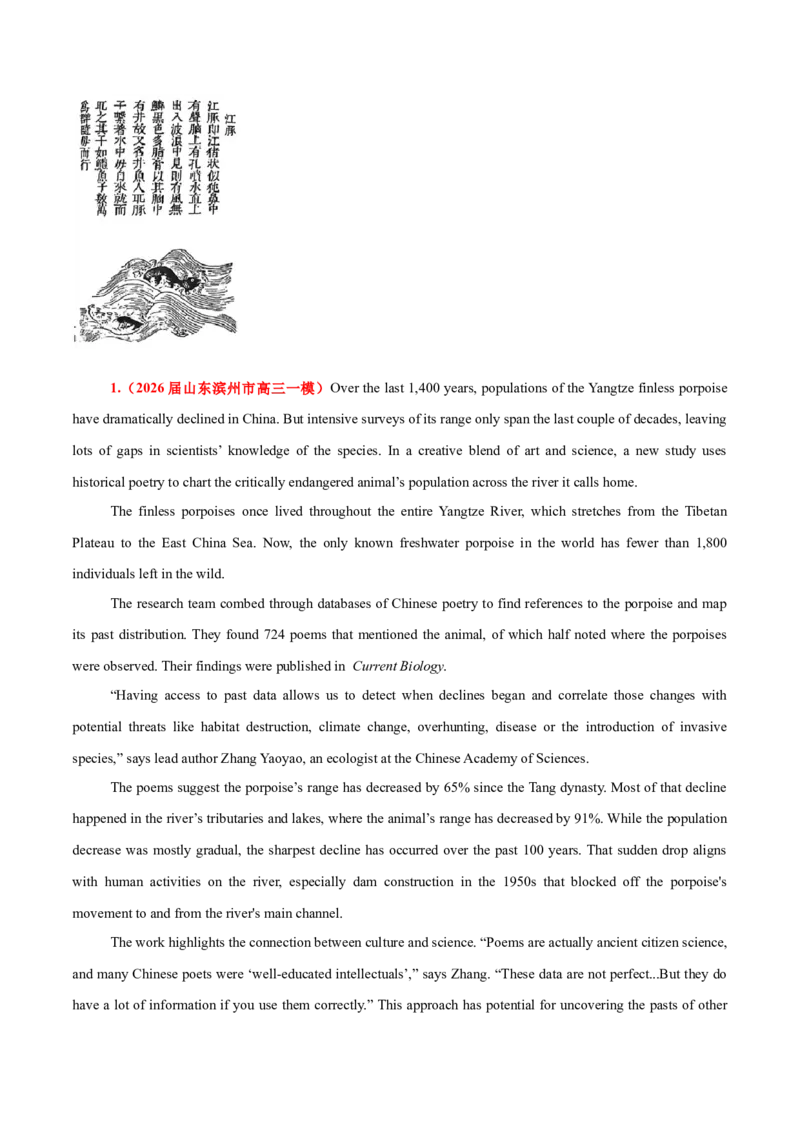
3.考查Phenomenon--analysis--conclusion类研究报告1.(2026届山东滨州市高三一模)Over the last 1,400 years, populations of the Yangtze finless porpoise
have dramatically declined in China. But intensive surveys of its range only span the last couple of decades, leaving
lots of gaps in scientists’ knowledge of the species. In a creative blend of art and science, a new study uses
historical poetry to chart the critically endangered animal’s population across the river it calls home.
The finless porpoises once lived throughout the entire Yangtze River, which stretches from the Tibetan
Plateau to the East China Sea. Now, the only known freshwater porpoise in the world has fewer than 1,800
individuals left in the wild.
The research team combed through databases of Chinese poetry to find references to the porpoise and map
its past distribution. They found 724 poems that mentioned the animal, of which half noted where the porpoises
were observed. Their findings were published in Current Biology.
“Having access to past data allows us to detect when declines began and correlate those changes with
potential threats like habitat destruction, climate change, overhunting, disease or the introduction of invasive
species,” says lead author Zhang Yaoyao, an ecologist at the Chinese Academy of Sciences.
The poems suggest the porpoise’s range has decreased by 65% since the Tang dynasty. Most of that decline
happened in the river’s tributaries and lakes, where the animal’s range has decreased by 91%. While the population
decrease was mostly gradual, the sharpest decline has occurred over the past 100 years. That sudden drop aligns
with human activities on the river, especially dam construction in the 1950s that blocked off the porpoise's
movement to and from the river's main channel.
The work highlights the connection between culture and science. “Poems are actually ancient citizen science,
and many Chinese poets were ‘well-educated intellectuals’,” says Zhang. “These data are not perfect...But they do
have a lot of information if you use them correctly.” This approach has potential for uncovering the pasts of otherendangered species as well. Previously, scholars have used medieval and ancient texts to understand things like
volcanic eruptions, auroras and unusual whales.
1.What challenge do scientists face in their research about the porpoise?
A.Its population has dropped off dramatically.
B.Locating its habitats is increasingly difficult.
C.The long-term historical data are insufficient.
D.Its population is hard to calculate precisely.
2.What mainly contributed to the dramatic fall of the porpoise’s populations?
A.Poor resistance to diseases. B.Climate changes over time.
C.Human impacts on its habitats. D.Competition with other species.
3.Why does the author mention “volcanic eruptions” in the last paragraph?
A.To show major threats to endangered wildlife.
B.To introduce challenges in ecological research.
C.To reveal the wisdom of ancient Chinese poets.
D.To prove the value of ancient texts in research.
4.What can be a suitable title for the text?
A.Historical Poems: Records of Ancient Chinese Wildlife
B.citizen Science: A New Approach to Protecting Animals
C.The Yangtze Finless Porpoise: A Critically Endangered Species
D.Ancient Poetry: A Creative Way to Study Endangered Porpoise
2.(2026·河北承德市强基联盟高三一模)A few weeks ago, an article by Nathan Heller in The New
Yorker indicated “the end of the English major”, examining the trend of declining English department nationwide
and the cultural factors that lead students away from spending four years with the passion for Dickens and
Shakespeare. Like every other humanities-lover on a college campus that day, I was swept away in the mass panic.
My major was, according to a reputable English-major-loved publication, dead.
Heller focused on Arizona State University (ASU) and Harvard University, large “indicators”(higher
education. I initially thought he ignored small liberal arts (文科) colleges, assuming English major were safe at
Allegheny College, where students supposedly came for the love of learning, not for middle management when
they graduate. But data ruined this hope: Allegheny had 84 English majors (9% of all majors) in the spring semester
of 2003, but just 20 (2.5%) now — a 72% drop in about 20 years matching the national trend.
Allegheny’s website fuels optimism, asking, “Why put your mind to just one thing?” and define itself as a“safe place of learning”, unlike ASU, which sees degrees as career stepping stones, or Harvard where, according to
Heller, even an “unusual major” finds work. Yet campus reality in Allegheny differs Students get locked into majors
early, “mind over major” loses to closed-off departments, and English majors fear unemployment, thinking they
wasted time and money.
We need to reject the campus “disease”, Heller noted — pressuring students to choose “safeguard paths and
dismissing humanities as “hobby-based”. The well-known author Kurt Vonnegut reminded you that the arts may not
be the best way to “make a living” but “make life more bearable” and “make soul grow”. Not everybody can or
should pursue a degree in chemistry, but it is increasingly clear to me that everybody would benefit from spending
20 credit hours reading, thinking about and discussing literature. While English majors may decline, their lessons
live on. As the novelist Jonathan Lethem wrote, “Time change and men adapt.” Between “too bad” and “worst”, we
can do better.
1.What phenomenon did Heller point out about English literature?
A.Students’ fading love for it. B.Its limited research visions.
C.Students’ confusion about it. D.Its declining literary works.
2.Why did the author’s hope for Allegheny College fade?
A.It closed most liberal arts majors. B.It valued career training more.
C.It admitted fewer English majors. D.It cared less about students’ likes.
3.What can be inferred from Allegheny’s website?
A.It tried to learn from Harvard. B.It didn’t match its real situation.
C.It failed to ensure students’ safety. D.It didn’t promote critical thinking.
4.What does the author advocate in the last paragraph?
A.Students should plan a unique life journey. B.Schools must make English more inviting.
C.Students need to stick to their own purposes. D.Schools ought to look beyond practical values.
3.(2026届湖南张家界市高三二模)In the age of short videos and social media, most of us are used to
reading in small pieces: a 15-second video introduction, a 100-word post, a 3-line news headline. We can get
information quickly and easily, but many people are losing the ability to do deep reading — the slow, focused
reading of a long text, which helps us understand complex ideas, think critically and develop empathy (共情).
A 2025 study by the Chinese Academy of Social Sciences found that over 68% of young people aged 18-35
read less than one complete book a year, and most of their daily reading time is spent on fragmented content on
social media. “Deep reading is not just about finishing a book. It’s about engaging with the text, questioning the
writer’s ideas, connecting what you read with your own experience, and forming your own opinions,” saidProfessor Zhang Wei, a literature expert from Peking University. “When we read in fragments, we only get the
surface information, but we can’t develop the ability to think deeply about complex problems.”
Many people may think that deep reading is a waste of time in this fast-paced society, but it actually brings
many long-term benefits. Studies have shown that deep reading can improve our concentration, reduce stress, and
develop our emotional intelligence. When we read a novel, for example, we put ourselves in the characters’ shoes,
experience their feelings, and learn to understand different points of view. This helps us develop empathy and
communicate better with others in real life.
So how can we get back the habit of deep reading? Professor Zhang gives some simple tips. First, start with a
book you are really interested in, not a book that others say you “should” read. Second, set a small daily goal, like
reading 20 pages a day, and stick to it. Third, turn off your phone and other electronic devices when you read, so
you can focus without distraction. “Deep reading is like a muscle. The more you practice it, the stronger it gets,”
said Professor Zhang. “In a world full of noise and distraction, the ability to focus and think deeply is the most
valuable skill we can have.”
1.What problem does the text point out in the first paragraph?
A.People are losing the ability of deep reading.
B.Fragmented reading brings too much information.
C.Social media is taking up too much of people’s time.
D.Complex ideas are hard for people to understand now.
2.What does the underlined word “fragmented” in paragraph 2 probably mean?
A.Long and complex.
B.Broken into small pieces.
C.Very interesting and attractive.
D.About academic knowledge.
3.What is one of the benefits of deep reading according to the text?
A.It helps people avoid stress in daily life.
B.It improves people’s communication skills.
C.It allows people to get information quickly.
D.It helps people remember things better.
4.What is the main purpose of the last paragraph?
A.To explain the importance of deep reading.
B.To introduce the history of deep reading.C.To give advice on developing deep reading habits.
D.To encourage people to read more books.
重难·创新演练
设题创新: 青少年中日益普遍的拟社会关系(T1) 防洪(T2); 锚定效应(T3); 社交和幸福
感(T4);城市野生动物数量与多样性增长(T5)
阅读理解记叙文
Passage 1
【新情境·青少年中日益普遍的拟社会关系】(2026·四川绵阳南山中学高三第六次教学质量检测)
In recent years, a new type of relationship has become increasingly common among teenagers: parasocial (拟社会
的) relationships. But what exactly are they? A parasocial relationship is a one-sided emotional connection where a
person feels close to someone they have never met in real life, such as a social media influencer, a celebrity, or even
an AI chatbot. Unlike real friendships, these relationships are not mutual — the other person has no idea the
relationship exists.
A study published in the Journal of Youth and adolescence surveyed 2,000 teenagers aged 15 to 18. It found
that 65% of them reported having at least one parasocial relationship. Among these, 30% said they spent over three
hours daily following their “idol” online, and 20% admitted feeling emotionally dependent on these figures. For
example, some teens said they would feel sad if their favorite influencer didn’t post updates, or would seek comfort
from AI chatbots when feeling lonely.
There are both positive and negative sides to these relationships. On the one hand, parasocial relationships
can provide emotional support. For teenagers who struggle with social anxiety or feel isolated, following someone
they admire can help them feel less alone. Some influencers also act as role models, encouraging teens to pursue
their dreams or adopt healthy habits. On the other hand, excessive engagement in parasocial relationships may harm
real-life social skills. Teens who spend too much time online may have less practice interacting with people face-to-
face, leading to difficulties in building and maintaining real friendships. Additionally, some teens may develop
unrealistic expectations of relationships, as parasocial bonds often lack the complexity and conflicts of real human
connections.
Experts suggest that parents and teachers should guide teenagers to balance online and offline interactions.
It’s important for teens to recognize that parasocial relationships are a form of entertainment or emotional escape,not a replacement for real friendships. By encouraging open communication and supporting teens in building real-
life social networks, adults can help them develop healthy relationships.
1.What is a parasocial relationship according to the passage?
A.A close bond between two teenagers who met online.
B.A real-life friendship with a celebrity.
C.An emotional connection with an AI chatbot who is unaware of it.
D.A mutual relationship with a social media influencer.
2.What does the study in Journal of Youth and adolescence show?
A.Most teenagers have no parasocial relationships.
B.Parasocial relationships are harmful to all teenagers.
C.20% of teens spend over three hours online daily.
D.Many teens rely on media figures for emotional support.
3.What does the underlined word “isolated” in the third paragraph mean?
A.devoted B.separated C.annoyed D.motivated
4.What do experts advise parents and teachers to do?
A.Help teens balance their digital and in-person social lives.
B.Encourage teens to replace real friends with online idols.
C.Discourage teens from having any parasocial relationships.
D.Ban teenagers from using social media.
Passage 2
【新情境·防洪】(2026·浙江强基联盟3月高三下学期二模联考)Swindale Beck meanders (蜿蜒)
through fields, farmland and valleys. However, not long ago, the river took a far more straight course.
A healthy river should be winding, free flowing and filled with wildlife. The ideal river is “very dynamic,
messy and chaotic”, says Glen Swainson, a manager of RSPB.In Britain, however, 97% of rivers are broken up
by artificial barriers. And for centuries rivers have been slowly artificially straightened to stop water from flooding
and spilling onto farmland and houses.
But removing a river’s natural meanders has, in fact, achieved the opposite effect. Instead, it has disrupted
the flow of rivers and destroyed water habitats, water quality and heightened flood risk. As the poor health of
Europe’s rivers and streams continues to make news, communities are turning towards natural solutions to restore
their rivers.
According to Tom Hayek, a natural flood management specialist, adding meanders into rivers has twobenefits — it changes both the volume and the speed of water. Firstly, it decreases what’s known as flow
conveyance. “When the length of the river is increased, you spread water over a wider area. This allows more water
to sit up in the headwaters.” The second impact is on speed. Put simply, the more structure you add to the shape of a
river, the slower the water will move down it. If it’s straight, water will “fly” through, says Hayek. When the flow
of water is slowed, it creates deeper pools for fish to gather and rest.
With meanders added to Swindale Beck, the results were astonishing, says Annabel Rushton, a visitor
experience manager. “Within three months of that river being re-wiggled, the salmon (鲑鱼) were spawning (产卵)
in that one kilometre area for the first time in over150 years,” she says. Scientists have also noted an increase in
fish gathering. Then, there were the knock-on effects. Water-loving plants returned, providing cover for young fish
to feed and hide.
1.Why were many rivers in Britain artificially straightened in the past?
A.To increase the natural flow of rivers. B.To improve water habitats for wildlife.
C.To create barriers for flood management. D.To protect people and land from floods.
2.What problem may be caused by removing a river’s meanders?
A.Lower water levels. B.Poorer farming land. C.Worse water quality.D.Drier
wildlife habitats.
3.What does paragraph 4 mainly talk about?
A.The benefits of adding meanders. B.The impacts of straightening rivers.
C.The examples of controlling floods. D.The needs of increasing water speed.
4.What can be inferred from the last paragraph?
A.Nature conservation is often a long game.B.Species co-exist and function as a whole.
C.Eco-recovery can happen at a high speed.D.Bio-diversity relies on human intervention.
Passage 3
【新情境·锚定效应】(2026·安徽省江南十校综合素质检测)The anchoring effect, a common mental
tendency rooted in the study of how people make economic choices, refers to how people overly depend on the first
piece of information, which is called the “anchor (锚)”, when making later judgments. This simple thinking
strategy affects pricing negotiations, risk assessments, and even moral evaluations. For instance, jurors (陪审员)
asked to consider a 30-year prison sentence before discussion often settle closer to this figure, while those given a
10-year reference tend to suggest much shorter punishments.
The Nobel Prize winner Daniel Kahneman threw light on this tendency via his “wheel of fortune”
experiment. In the experiment, participants spun a wheel that was secretly set to stop at either 10 or 65. Afterspinning, they were asked to estimate the percentage of African nations in the UN. Interestingly, those who saw the
wheel stop at 10 guessed around 25%, while those seeing 65 guessed about 45%. Even when people know the
anchor is random, this unreasonable reliance still persists.
The anchoring effect works in two main ways: the process of adjusting one’s thoughts step by step and the
influence of early information on later thinking. When people try to guess a number, they often start with the
anchor and then change their answer only a little — never enough to get away from the anchor’s influence. This
fact becomes apparent in the field of marketing: labels marked with first prices serve as high anchors, which cause
consumers to perceive the value of discounts as higher than their actual worth.
Neurological (神经学上的) studies find that anchoring stimulates the prefrontal cortex (前额叶皮层) and
the amygdala (杏仁核). This double activation explains why anchors influence both reasonable and emotional
decisions.
Yet the tendency has moral issues: lawyers demanding harsher initial sentences often secure longer
sentences, while real estate agents controlling listing prices can artificially push up market values. To reduce it,
people can set clear evaluation criteria and think carefully without focusing on original anchors, helping them make
fairer, more reasonable choices.
1.Which of the following situations best illustrates the anchoring effect?
A.A viewer likes a movie star and then enjoys all movies the star acts in.
B.A buyer offers £600 for a handbag after the seller first says it costs £800.
C.A student picks a book because its cover looks more attractive than others.
D.A shopper buys a cheap scarf because it’s placed next to a luxury coat in the store.
2.Why do marketers usually display “original price” tags next to product prices?
A.To prove that the original price was fixed in a reasonable way.
B.To attract more customers by showing the product’s popularity.
C.To show that the product’s quality matches its original high price perfectly well.
D.To make consumers believe the discounts are more helpful than they really are.
3.Why does the author mention the prefrontal cortex and amygdala?
A.To prove that the anchoring effect is an in-born mental tendency.
B.To show that the anchoring effect can be controlled by adjusting brain activity.
C.To explain that the anchoring effect shapes both sensible and emotional resolutions.
D.To highlight the importance of neurological research in understanding mental phenomena.
4.What is the main purpose of the passage?A.To describe a specific experiment. B.To analyze a harmful influence.
C.To discuss a moral phenomenon. D.To explain a mental tendency.
Passage 4
【新情境·社交和幸福感】(2026·广东广州市天河区二模)You might be leaving some happiness on
the table by doing your everyday activities all by yourself. Happiness, it seems, is not just a state of mind — it’s a
shared enterprise. A new study has found that almost any activity, from the ordinary to the profound, becomes more
enjoyable when done with others. Whether pumping gas, or cooking dinner, the company of another person appears
to make life’s routines a little brighter.
The study, published in Social Psychological and Personality Science, drew on data from more than 40,000
Americans who collectively reported over 100,000 daily activities. “Participants consistently rate every common
daily activity as more enjoyable when they’re interacting with somebody else,” said Elizabeth Dunn, the study’s
senior author. Even seasoned experts on social behavior were taken aback by the consistency of the findings. “I was
surprised by the extent and extremity of the effects,” admitted Nicholas Epley, a behavioral scientist who was not
involved in the research.
Unsurprisingly, the biggest boosts were linked to activities already social by nature — eating, drinking,
walking, running, and playing games. Yet even solitary (独自的) pursuits such as reading, or crafting also saw a
happiness bump when shared. While in-person interactions provided the strongest benefits, even phone calls
produced measurable mood improvements. Dunn notes that if it can’t be in-person, having some element of voice
seems to be important.
The study did not include personality data, leaving unanswered how individual characteristics might
influence outcomes. Previous studies, however, suggest that social connection reliably enhances wellbeing across
personality types. Researchers identify “undersociality” — the tendency to underestimate how warmly others will
respond to social initiatives — as a primary barrier to seeking connection.
The practical implications are clear; we should intentionally create more opportunities for social
engagement. Simple strategies such as working alongside friends at coffee shops or conversing by phone while
completing chores can transform ordinary activities into sources of joy. Ultimately, the research convincingly
demonstrates that happiness arises not merely from what we do, but fundamentally from who we do it with.
1.How was the research mainly conducted?
A.By analyzing massive activity reports. B.By conducting laboratory experiments.
C.By comparing different personality types.D.By interviewing experts in social behavior.
2.What did the study find about social interactions?A.They require face-to-face communication. B.Their effects vary greatly among individuals.
C.They enhance enjoyment of various activities. D.They bring greater joy in independent activities.
3.Why does the author mention previous studies in paragraph 4?
A.To stress the limitation of the new study.B.To introduce a different research method.
C.To provide supporting evidence for a claim. D.To question the findings of the new study.
4.What can be a suitable title for the text?
A.Alone or Together: A Social Dilemma. B.Social Activities: Relationship Builder.
C.Personality Differences: A Factor in Social Joy. D.Shared Moments: The Social Key to Happiness.
Passage 5
【新情境·城市野生动物数量与多样性增长】(2026·浙江省温州市普通高中高三第一次适应性考
试)Cities worldwide are witnessing a transformation in urban environments. Wildlife populations in cities are not
only surviving but often surpassing those in rural areas. Urban bird populations in cities like Berlin have increased
by over 40% in the past two decades. These aren’t just typical pigeons and sparrows, but hawks and owls, and even
non-native species that have found urban environments surprisingly pleasant.
The urban heat island effect, often seen as a negative consequence of city development, creates micro
climates many species find irresistible. Warmer temperatures extend growing seasons, provide frost-free zones, and
create diverse micro habitats within a single city block. Urban environments also offer abundant food resource.
Raccoon in Toronto have learned some techniques to open garbage cans. The constant availability of food waste
and reduced animal hunters in nature create what ecologists call “urban ecological release.”
Urban wildlife’s boom (繁荣) not only reshapes ecosystems but brings health benefits to humans. Studies
show people in areas with higher biodiversity experience lower rates of autoimmune diseases. Mental health
benefits are equally impressive: urban residents who encounter wildlife report lower stress and improved mood. Yet
this boom isn’t all positive. Urban animals are developing behaviour changes — increased aggression and
interrupted migration routes. Disease spread is also critical as populations grow more crowded, threatening humans
and animals alike.
Forward-thinking cities are pioneering architectural innovations. Green roofs in Copenhagen aren’t just for
beauty — they’re functioning ecosystems supporting plants, insects, and birds, cutting energy costs by up to
30%while providing paths for wildlife to move. Wildlife bridges like Ecoduct de Woeste Hoeve let over 5,000 deer
cross highways safely, reducing wildlife-vehicle accidents by 80%.
The future of urban wildlife coexistence is promising, driven by tech advances and public awareness —smart tech enables wildlife monitoring, and innovative designs create shared livable spaces. Emerging biotech may
revolutionize management: genetic tools help study urban animal adaptation, aiding threatened species. The key is
reimagining cities as integrated ecosystems. As urbanization grows, coexistence lessons grow more valuable. The
question isn’t whether we can live alongside urban wildlife — it’s whether we dare to embrace the possibilities this
partnership offers.
1.What can we know about urban wildlife from Paragraph 1?
A.They have grown in diversity. B.They are mainly from rural areas.
C.They have adapted to urban pollution. D.They tend to avoid human contact.
2.Why is “urban ecological release” mentioned?
A.To present a new ecological concept. B.To stress the constant city development.
C.To show the wildlife-friendliness of cities. D.To explain the reduced ecological harm.
3.What can the urban wildlife boom bring?
A.Lowered rates of disease spread. B.An improved sense of well-being.
C.Impressive migration routes of wildlife. D.Positive behavioural changes in wildlife.
4.What is crucial for urban wildlife coexistence?
A.A slower pace of urbanization. B.Adjustment to existing ecosystems.
C.Advanced biological technologies. D.An adaptive mindset of coexistence.
真题·实战演练
高频考点:文章分类主要考查 problem--solution--result 类研究报告,考查 Findings/
discoveries--evidence(experiment, result)--conclusion(application/evaluation) 类 研 究 报 告 ,
Phenomenon--analysis--conclusion类研究报告,命题方法分类:主要考查推理判断,主旨
大意,细节理解,部分猜测词义
1.(2026·北京卷)Smells are all around us. What we know as a scent (气味) is a collection of natural or
artificial airborne chemicals released from objects. But smell is often overlooked and undervalued. So, as climate
change and biodiversity loss threaten natural scents, many people may not even notice.
Whether or not we pay attention to the world’s “scentscape”, heat and pollution are causing it to shift. As
temperatures rise, man-made substances release more scent molecules (分子), and biodiversity loss due to climate
change threatens the plants that scent the environment. “If you go to a forest, you have a given environment and
temperature. If that temperature goes a little bit high, the profile of the chemical components in the air changes,”since temperature can affect the amount of smell-carrying gas particles (粒子) released from substances, explains
John Smith, a chemical engineer. “And therefore, the perception of how the forest smells changes.”
That effect extends beyond forests. Snow — already threatened by a warming climate — absorbs different
chemicals from the atmosphere as temperatures rise, which changes its cold-clean scent. Warmer conditions can
intensify smells, leading the snow to smell more unpleasant and potentially gather more pollutants.
Climate change is also quickening the loss of biodiversity, threatening to erase certain smells entirely. When
plants disappear, their scents become more difficult to produce.
Some scents are linked to cultural heritage. A recent study reported that native communities in Peru noticed a
change in the smell of the Amazon River due to industrial pollution. Over generations, communities became
desensitised to increasingly smelly rivers, a sign of broader ecosystem degradation. At the same time, in some
Amazonian belief systems, declining water quality and the unpleasant smells will lead to the dispersal (消散) of the
river’s spiritual beings. The damage to the scentscape could result in harm to both health and spiritual practice.
Even though we have other valuable things endangered by climate change, like food access, there is also an
element of cultural identity, cultural survival, and history. If we don’t look at it, we lose all the richness behind it.
28.The author mentions snow in order to _____________.
A.illustrate a point B.contrast approaches
C.classify objects D.define a concept
29.What can we learn from this passage?
A.Biodiversity tends to be overlooked.
B.Snow is intensified by a warming climate.
C.Forest smell is likely to be changed by perception.
D.Disappearance of the Earth’s smells can be a cultural loss.
30.What is implied in this passage?
A.Loss of smells can lead to natural disasters.
B.Damages of scentscapes can be artificially repaired.
C.Scents of the missing plants are preserved in the atmosphere.
D.Smell changes of forest and snow share a common underlying cause.
2.【2024全国甲卷】Animals can express their needs using a lot of ways. For instance, almost all animals have
distinct vocals (声音) that they rely on to either ask for help, scare away any dangerous animals or look for shelter.
But cats are special creatures who possess amazing vocalization skills. They are able to have entire conversations
with humans using meows and you're able to interpret it. If a pet cat is hungry, it will keep meowing to attractattention and find food. However, when a cat is looking for affection, they tend to produce stretched and soft
meows. Meowing starts as soon as a baby cat is brought to life and uses it to get the mother's attention and be fed.
Cats have many heightened senses, but their sense of smell is quite impressive. They use their noses to assess
their environment and look out for any signs of danger. They will sniff out specific areas before they choose a place
to relax. However, another way the cats are able to distinguish between situations is by looking for familiar smells.
Your cat will likely smell your face and store the smell in its memory and use it to recognize you in the future.
That's why most pet cats are able to tell immediately if their owners were around any other cats, which they don't
usually like.
Dogs are known for their impressive fetching habit, but cats take this behavior up a notch. Many cats will find
random objects outside and bring them to their owners. This is a very old habit that's been present in all kinds of
predators (食肉动物). Cats bring gifts for their owners to show they love you. These adorable little hunters are just
doing something that it's been in their nature since the beginning of time. So just go along with it!
4. What can be learned about cats' meowing from the first paragraph?
A. It's a survival skill. B. It's taught by mother cats.
C. It's hard to interpret. D. It's getting louder with age.
5. How does a pet cat assess different situations?
A. By listening for sounds. B. By touching familiar objects.
C. By checking on smells. D. By communicating with other cats.
6. Which best explains the phrase "take. . . up notch" in paragraph 3?
A. Perform appropriately. B. Move faster. C. Act strangely. D. Do better.
7. What is a suitable title for the text?
A. Tips on Finding a Smart Cat B. Understanding Your Cat's Behavior
C. Have Fun with Your Cat D. How to Keep Your Cat Healthy
3.【2023年北京卷】In recent years, researchers from diverse fields have agreed that short-termism is now a
significant problem in industrialised societies. The inability to engage with longer-term causes and consequences
leads to some of the world’s most serious problems: climate change, biodiversity collapse, and more. The historian
Francis Cole argues that the West has entered a period where “only the present exists, a present characterised at
once by the cruelty of the instant and by the boredom of an unending now”.
It has been proved that people have a bias (偏向) towards the present, focusing on loud attractions in the
moment at the expense of the health, well-being and financial stability of their future selves or community. In
business, this bias surfaces as short-sighted decisions. And on slow-burning problems like climate change, ittranslates into the unwillingness to make small sacrifices (牺牲) today that could make a major difference
tomorrow. Instead, all that matters is next quarter’s profit, or satisfying some other near-term desires.
These biased perspectives cannot be blamed on one single cause. It is fair to say, though, that our
psychological biases play a major role. People’s hesitancy to delay satisfaction is the most obvious example, but
there are others.One of them is about how the most accessible information in the present affects decisions about the
future. For instance, you might hear someone say: “It’s cold this winter, so I needn’t worry about global
warming.”Another is that loud and urgent matters are given too much importance, making people ignore longer-
term trends that arguably matter more. This is when a pop star draws far more attention than, say, gradual
biodiversity decline.
As a psychologist once joked, if aliens (外星人) wanted to weaken humanity, they wouldn’t send ships; they
would invent climate change. Indeed, when it comes to environmental transformations, we can develop a form of
collective “poor memory”, and each new generation can believe the state of affairs they encounter is nothing out of
the ordinary. Older people today, for example, can remember a time with insect-covered car windscreens after long
drives. Children, on the other hand, have no idea that insect population has dropped dramatically.
28. The author quotes Francis Cole mainly to ________.
A. draw a comparison
B. introduce a topic
C. evaluate a statement
D. highlight a problem
29. What can be inferred from the last paragraph?
A. Climate change has been forgotten.
B. Lessons of history are highly valued.
C. The human mind is bad at noting slow change.
D. Humans are unwilling to admit their shortcomings.
30. What does the author intend to tell us?
A. Far-sighted thinking matters to humans.
B. Humans tend to make long-term sacrifices.
C. Current policies facilitate future decision-making.
D. Bias towards the present helps reduce near-term desires.
4.【2022年新高考全国Ⅰ 卷】Like most of us, I try to be mindful of food that goes to waste. The arugula
(芝麻菜)was to make a nice green salad, rounding out a roast chicken dinner. But I ended up working late. Thenfriends called with a dinner invitation. I stuck the chicken in the freezer. But as days passed, the arugula went bad.
Even worse, I had unthinkingly bought way too much; I could have made six salads with what I threw out.
In a world where nearly 800 million people a year go hungry, “food waste goes against the moral grain,” as
Elizabeth Royte writes in this month’s cover story. It’s jaw-dropping how much perfectly good food is thrown away
— from “ugly” (but quite eatable) vegetables rejected by grocers to large amounts of uneaten dishes thrown into
restaurant garbage cans.
Producing food that no one eats wastes the water, fuel, and other resources used to grow it. That makes food
waste an environmental problem. In fact, Royte writes, “if food waste were a country, it would be the third largest
producer of greenhouse gases in the world.”
If that’s hard to understand, let’s keep it as simple as the arugula at the back of my refrigerator. Mike Curtin
sees my arugula story all the time — but for him, it's more like 12 bones of donated strawberries nearing their last
days. Curtin is CEO of DC Central Kitchen in Washington, D.C., which recovers food and turns it into healthy
meals. Last year it recovered more than 807,500 pounds of food by taking donations and collecting blemished (有
瑕疵的) produce that otherwise would have rotted in fields. And the strawberries? Volunteers will wash, cut, and
freeze or dry them for use in meals down the road.
Such methods seem obvious, yet so often we just don’t think. “Everyone can play a part in reducing waste,
whether by not purchasing more food than necessary in your weekly shopping or by asking restaurants to not
include the side dish you won’t eat,” Curtin says.
4. What does the author want to show by telling the arugula story?
A. We pay little attention to food waste. B. We waste food unintentionally at times.
C. We waste more vegetables than meat. D. We have good reasons for wasting food.
5. What is a consequence of food waste according to the test?
A. Moral decline. B. Environmental harm.
C. Energy shortage. D. Worldwide starvation.
6. What does Curtin’s company do?
A. It produces kitchen equipment. B. It turns rotten arugula into clean fuel.
C. It helps local farmers grow fruits. D. It makes meals out of unwanted food.
7. What does Curtin suggest people do?
A. Buy only what is needed. B. Reduce food consumption.
C. Go shopping once a week. D. Eat in restaurants less often.
5.【2022年新高考全国Ⅱ卷】Over the last seven years, most states have banned texting by drivers, andpublic service campaigns have tried a wide range of methods to persuade people to put down their phones when
they are behind the wheel.
Yet the problem, by just about any measure, appears to be getting worse. Americans are still texting while
driving, as well as using social networks and taking photos. Road accidents, which had fallen for years, are now
rising sharply.
That is partly because people are driving more, but Mark Rosekind, the chief of the National Highway Traffic
Safety Administration, said distracted(分心)driving was "only increasing, unfortunately. "
"Big change requires big ideas. " he said in a speech last month, referring broadly to the need to improve road
safety. So to try to change a distinctly modern behavior, lawmakers and public health experts are reaching back to
an old approach: They want to treat distracted driving like drunk driving.
An idea from lawmakers in New York is to give police officers a new device called the Textalyzer. It would
work like this: An officer arriving at the scene of a crash could ask for the phones of the drivers and use the
Textalyzer to check in the operating system for recent activity. The technology could determine whether a driver
had just texted, emailed or done anything else that is not allowed under New York's hands-free driving laws.
"We need something on the books that can change people's behavior,” said Félix W. Ortiz, who pushed for
the state's 2001 ban on hand-held devices by drivers. If the Textalyzer bill becomes law, he said, "people are going
to be more afraid to put their hands on the cell phone. "
8. Which of the following best describes the ban on drivers' texting in the US?
A. Ineffective. B. Unnecessary.
C. Inconsistent. D. Unfair.
9. What can the Textalyzer help a police officer find out?
A. Where a driver came from. B. Whether a driver used their phone.
C. How fast a driver was going. D. When a driver arrived at the scene.
10. What does the underlined word "something" in the last paragraph refer to?
A. Advice. B. Data. C. Tests. D. Laws.
11. What is a suitable title for the text?
A. To Drive or Not to Drive? Think Before You Start
B. Texting and Driving? Watch Out for the Textalyzer
C. New York Banning Hand-Held Devices by Drivers.
D. The Next Generation Cell Phone: The Textalyzer-
6.【2022 年北京卷】“What would the world be if there were no hunger?” It’s a question that ProfessorCrystal would ask her students. They found it hard to answer, she wrote later, because imagining something that
isn’t part of real life—and learning how to make it real—is a rare skill. It is taught to artists and engineers, but
much less often to scientists. Crystal set out to change that, and helped to create a global movement. The result—an
approach known as systems thinking—is now seen as essential in meeting global challenges.
Systems thinking is crucial to achieving targets such as zero hunger and better nutrition because it requires
considering the way in which food is produced, processed, delivered and consumed, and looking at how those
things intersect (交叉 ) with human health, the environment, economics and society. According to systems
thinking, changing the food system—or any other network—requires three things to happen. First, researchers need
to identify all the players in that system; second, they must work out how they relate to each other; and third, they
need to understand and quantify the impact of those relationships on each other and on those outside the system.
Take nutrition. In the latest UN report on global food security, the number of undernourished (营养不良
)people in the world has been rising, despite great advances in nutrition science. Tracking of 150 biochemicals in
food has been important in revealing the relationships between calories, sugar, fat and the occurrence of common
diseases. But using machine learning and artificial intelligence, some scientists propose that human diets consist of
at least 26,000 biochemicals—and that the vast majority are not known.This shows that we have some way to travel
before achieving the first objective of systems t hinking - which,in this example, is to identify more constituent
parts of the nutrition system.
A systems approach to creating change is also built on the assumption that everyone in the system has equal
power. But as some researchers find, the food system is not an equal one. A good way to redress (修正 ) such
power imbalance is for more universities to do what Crystal did and teach students how to think using a systems
approach.
More researchers, policymakers and representatives from the food industry must learn to look beyond their
direct lines of responsibility and adopt a systems approach. Crystal knew that visions alone don’t produce results,
but concluded that “we’ll never produce results that we can’t envision”.
28. The author uses the question underlined in Paragraph 1 to ________.
A. illustrate an argument B. highlight an opinion
C. introduce the topic D. predict the ending
29. What can be inferred about the field of nutrition?
A. The first objective of systems thinking hasn’t been achieved.
B. The relationships among players have been clarified.
C. Machine learning can solve the nutrition problem.D. The impact of nutrition cannot be quantified.
30. As for systems thinking, which would the author agree with?
A. It may be used to justify power imbalance.
B. It can be applied to tackle challenges.
C. It helps to prove why hunger exists.
D. It goes beyond human imagination.
7.【2022年浙江卷 6月】Many people believe that working to the maximum is the secret to success, but
research has found that moderation(适度) also gets results on the job.
In a study led by Ellen Langer of Harvard University, researchers asked people to translate sentences into a
new a made-up language. Subjects who practiced the language moderately beforehand made fewer errors than those
who practiced extensively or not at all. High levels of knowledge can make people too attached to traditional ways
of viewing problems across fields the arts, sciences, and politics. High conscientiousness is related to lower job
performance, especially in simple jobs where it doesn’t pay to be a perfectionist.
How long we stay on the clock and how we spend that time are under careful examination in many
workplaces. The young banker who eats lunch at his desk is probably seen as a go-getter, while his colleagues who
chat over a relaxed conference-room meal get dirty looks from the corner office. “People from cultures that value
relationships more than ours does are shocked by the thought of eating alone in front of a computer”, says Art
Markman, a professor of psychology at the University of Texas, Austin. Social interaction has been shown to lift
mood(情绪) and get people thinking in new directions and in ways that could help improve any post-lunch effort.
Markman also promotes off-task time. “Part of being a good thinker is experiencing things that are seemingly
unrelated to what you are working on at the moment but give you fresh ideas about your work,” he says. “Also,
there is a lot of research showing that a positive mood leads to higher levels of productivity and creativity. So, when
people do things to increase their life satisfaction, they also make themselves more effective at work.”
7. What does Ellen Langer’s study show?
A. It is worthwhile to be a perfectionist B. Translation makes people knowledgeable.
C. Simpler jobs require greater caution. D. Moderate effort produces the best result.
8. The underlined word “go-getter” in paragraph 3 refers to someone Who_______.
A. is good at handling pressure B. works hard to become successful
C. a has a natural talent for his job. D. gets on well with his co-workers
9. What can be inferred from the last paragraph?
A. A good thinker is able to inspire other people.B. Experience unrelated to your job is useless.
C. A cheerful mood helps make a creative mind.
D. Focusing on what you do raises productivity.
10. What does the text seem to advocate?
A. Middle-of-the-road work habits. B. Balance between work and family.
C. Long-standing cultural traditions. D. Harmony in the work environment.
8.【2022年天津卷第二次】Is it true that our brain alone is responsible fo human cognition(认知)? What
about our body? Is it possible for thought and behavior to originate from somewhere other than our brain?
Psychologists who study Embodied Cognition(EC) ask similar questions. The EC theory suggests our body is also
responsible for thinking or problem-solving. More precisely, the mind shapes the body and the body shapes the
mind in equal measure.
If you think about it for a moment, it makes total sense. When you smell something good or hear amusing
sounds, certain emotions are awakened. Think about how newborns use their senses to understand the world around
them. They don’t have emotions so much as needs—they don’t feel sad, they’re just hungry and need food. Even
unborn babies can feel their mothers’ heartbeats and this has a calming effect. In the real world,they cry when
they’re cold and then get hugged. That way, they start to as-sociate being warm with being loved.
Understandably, theorists have been arguing for years and still disagree on whether the brain is the nerve
centre that operates the rest of the body. Older Western philosophers and mainstream language researchers believe
this is fact, while EC theorises that the brain and body are working together as an organic supercomputer,
processing everything and forming your reactions.
Further studies have backed up the mind-body interaction. In one ex-periment, test subjects(实验对象) were
asked to judge people after being handed a hot or a cold drink. They all made warm evaluations when their
fingertips perceived warmth rather than coolness. And it works the other way too; in another study, subjects’
fingertip temperatures were measured after being“included” in or “rejected” from a group task. Those who were
included felt physically warmer.
For further proof, we can look at the metaphors(比喻说法) that we use without even thinking. A kind and
sympathetic person is frequently referred to as one with a soft heart and someone who is very strong and calm in
difficult situations is often described as solid as a rock. And this kind of metaphorical use is common across
languages.
Now that you have the knowledge of mind-body interaction, why not use it? If you’re having a bad day,a
warm cup of tea will give you a flash of pleasure. If you know you’re physically cold, warm up before making anyinterpersonal decisions.
46. According to the author, the significance of the EC theory lies in ________.
A. facilitating our understanding of the origin of psychology
B. revealing the major role of the mind in human cognition
C. offering a clearer picture of the shape of human brain
D. bringing us closer to the truth in human cognition
47. Where does the new borns’ understanding of their surroundings start from?
A. Their personal looks.
B. Their mental needs.
C. Their inner emotions.
D. Their physical feelings.
48. The experiments mentioned in Paragraph 4 further prove________.
A. environment impacts how we judge others
B. how body temperature is related to health
C. the mind and the body influence each other
D. how humans interact with their surroundings
49. What does the author intend to prove by citing the metaphors in Paragraph 5?
A. Human speech is alive with metaphors.
B. Human senses have effects on thinking.
C. Human language is shaped by visual images.
D. Human emotions are often compared to natural materials.
50. What is the author’s purpose in writing the last paragraph?
A. To share with the reader ways to release their emotions.
B. To guide the reader onto the path to career success.
C. To encourage the reader to put EC into practice.
D. To deepen the reader’s understanding of EC.
9.【2021年新高考全国Ⅰ 卷】 Popularization has in some cases changed the original meaning of
emotional (情感的) intellingence. Many people now misunderstand emotional intelligence as almost everything
desirable in a person's makeup that cannot be measured by an IQ test, such as character, motivation, confidence,
mental stability, optimism and “people skills.” Research has shown that emotional skills may contribute to some of
these qualities, but most of them move far beyond skill-based emotional intelligence.
We prefer to describe emotional intelligence as a specific set of skills that can be used for either good or badpurposes. The ability to accurately understand how others are feeling may be used by a doctor to find how best to
help her patients, while a cheater might use it to control potential victims. Being emotionally intelligent does not
necessarily make one a moral person.
Although popular beliefs regarding emotional intelligence run far ahead of what research can reasonably
support, the overall effects of the publicity have been more beneficial than harmful. The most positive aspect of this
popularization is a new and much needed emphasis (重视) on emotion by employers, educators and others
interested in promoting social well-being. The popularization of emotional intelligence has helped both the public
and researchers re-evaluate the functionality of emotions and how they serve people adaptively in everyday life.
Although the continuing popular appeal of emotional intelligence is desirable, we hope that such attention will
excite a greater interest in the scientific and scholarly study of emotion. It is our hope that in coming decades,
advances in science will offer new perspectives (视角) from which to study how people manage their lives.
Emotional intelligence, with its focus on both head and heart, may serve to point us in the right direction.
32. What is a common misunderstanding of emotional intelligence?
A. It can be measured by an IQ test. B. It helps to exercise a person’s mind.
C. It includes a set of emotional skills. D. It refers to a person’s positive qualities.
33. Why does the author mention “doctor” and “cheater” in paragraph 2?
A. To explain a rule. B. To clarify a concept.
C. To present a fact. D. To make a prediction.
34. What is the author’s attitude to the popularization of emotional intelligence?
A. Favorable. B. Intolerant.
C. Doubtful. D. Unclear.
35. What does the last paragraph mainly talk about concerning emotional intelligence?
A. Its appeal to the public. B. Expectations for future studies.
C. Its practical application. D. Scientists with new perspectives.
10.【2021年全国乙卷】During an interview for one of my books, my interviewer said something I still think
about often. Annoyed by the level of distraction(干扰)in his open office, he said, “That’s why I have a
membership at the coworking space across the street — so I can focus”. His comment struck me as strange. After
all, coworking spaces also typically use an open office layout(布局). But I recently came across a study that
shows why his approach works.
The researchers examined various levels of noise on participants as they completed tests of creative thinking.
They were randomly divided into four groups and exposed to various noise levels in the background, from totalsilence to 50 decibels(分贝), 70 decibels, and 85 decibels. The differences between most of the groups were
statistically insignificant; however, the participants in the 70 decibels group — those exposed to a level of noise
similar to background chatter in a coffee shop — significantly outperformed the other groups. Since the effects
were small, this may suggest that our creative thinking does not differ that much in response to total silence and 85
decibels of background noise.
But since the results at 70 decibels were significant, the study also suggests that the right level of background
noise — not too loud and not total silence — may actually improve one’s creative thinking ability. The right level
of background noise may interrupt our normal patterns of thinking just enough to allow our imaginations to wander,
without making it impossible to focus. This kind of “distracted focus” appears to be the best state for working on
creative tasks.
So why do so many of us hate our open offices? The problem may be that, in our offices, we can’t stop
ourselves from getting drawn into others’ conversations while we’re trying to focus. Indeed, the researchers found
that face-to-face interactions and conversations affect the creative process, and yet a coworking space or a coffee
shop provides a certain level of noise while also providing freedom from interruptions.
32. Why does the interviewer prefer a coworking space?
A. It helps him concentrate. B. It blocks out background noise.
C. It has a pleasant atmosphere. D. It encourages face-to-face interactions.
33. Which level of background noise may promote creative thinking ability?
A. Total silence. B. 50 decibels C. 70 decibels. D. 8 5 decibels.
34. What makes an open office unwelcome to many people?
A. Personal privacy unprotected. B. Limited working space.
C. Restrictions on group discussion. D. Constant interruptions.
35. What can we infer about the author from the text?
A. He’s a news reporter.
B. He’s an office manager.
C. He’s a professional designer.
D. He’s a published writer.
11. 【2021年浙江卷1月】 At the start of the 20th century, an American engineer named John Elfreth
Watkins made predictions about life today. His predictions about slowing population growth, mobile phones and
increasing height were close to the mark. But he was wrong in one prediction: that everybody would walk 10 miles
a day.Today, in Australia, most children on average fall 2, 000 steps short of the physical activity they need to avoid
being overweight. In the early 1970s, 40 per cent of children walked to school, while in 2010, it was as low as 15
per cent.
The decline is not because we have all become lazy. Families are pressed for time, many with both parents
working to pay for their house, often working hours not of their choosing, living in car-dependent neighborhoods
with limited public transport.
The other side of the coin is equally a deprivation: for health and well-being, as well as lost opportunities(机
会)for children to get to know their local surroundings. And for parents there are lost opportunities to walk and
talk with their young scholar about their day.
Most parents will have eagerly asked their child about their day, only to meet with a “good”, quickly followed
by "I'm hungry". This is also my experience as a mother. But somewhere over the daily walk more about my son's
day comes out. I hear him making sense of friendship and its limits. This is the unexpected and rare parental
opportunity to hear more.
Many primary schools support walking school-bus routes(路线), with days of regular, parent-
accompanied walks. Doing just one of these a few times a week is better than nothing. It can be tough to begin and
takes a little planning-running shoes by the front door, lunches made the night before, umbrellas on rainy days and
hats on hot ones-but it's certainly worth trying.
4.Why does the author mention Watkins' predictions in the first paragraph?
A.To make comparisons. B.To introduce the topic.
C.To support her argument. D.To provide examples.
5.What has caused the decrease in Australian children's physical activity?
A.Plain laziness. B.Health problems.
C.Lack of time. D.Security concerns.
6.Why does the author find walking with her son worthwhile?
A.She can get relaxed after work. B.She can keep physically fit.
C.She can help with her son's study. D.She can know her son better.