【好题汇编】2024 年高考英语三模试题分类汇编
专题 04 议论文
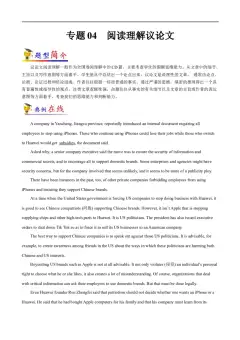
1.(2024届浙江省精诚联盟高三下学期三模英语试题)In 2017, Irish President Michael D.Higgins and
his wife Sabina started the Young Irish Philosopher Awards, the purpose of which is to invite students from
throughout that country to reflect on interesting questions and participate in philosophical thinking and discussion.
In 2023, over 500 young thinkers came together at University College Dublin for the sixth annual gathering. The
grand prize winner was Seán Radeliffe from Cork, for his essay ‘Has Plato’s tale of the cave been warning us of
social media for 2,500years?’And speaking of Plato, in 2022, an award-winning documentary film entitled Young
Plato received international recognition. It focuses on how Kevin McArevey, the headmaster of a primary school in
Belfast’s Ardoyne housing estates, uses critical thinking techniques to empower young children to look beyond the
boundaries of their violence(For more, see YoungPlato. com). As one can see, philosophy is alive and well in both
the Republic of Ireland and the UK constituent country of Northern Ireland.
Ireland has traditionally been known as the Land of Saints and Scholars. In this edition of Philosophy Now,
we’ll cast a cold eye on the state of philosophy past, present and future in the Emerald Isle, with a focus on Thomas
Duddy’s idea, in his book A History of Irish Thought, that such an exploration must be both practical and creative.
This issue is dedicated to my late friend Seán Moran, a Philosophy Now writer and a modern Irish
philosopher whom I met in Waterford many years ago, and whose humor, charm, and friendliness enriched my life.
Like Tom Duddy, Seán died much too young. He demonstrated to me the true meaning of William Butler Yeats’s
closing words from his poem ‘The Municipal Gallery Revisited’:
“Think where man’s glory most begins and ends
And say my glory was I had such friends.”
Prof. Timothy J. Madigan
St John Fisher University
1.What can readers probably get on YoungPlato. com?
A.How critical thinking helps students reflect on their violence.
B.How Plato’s stories influence social media every now and then.
C.How Higgins and his wife started the Young Irish Philosopher Awards.
D.How young thinkers try philosophical thinking and discussion annually.
2.What will be highlighted in this edition of Philosophy Now?
A.Ireland’s Philosophical Evolution. B.Thomas Duddy’s ideas on history.
C.The growing reputation of Ireland. D.The ideal way of exploring philosophy.
3.Why does the author quote Yeats’s poem?
A.To compare Seán’s achievement with Tom Duddy’s.
B.To express the author’s sorrow for Seán’s early death.C.To appreciate the friendship between the author and Seán.
D.To demonstrate the author’s understanding of philosophy.
4.What best shows the author’s view on philosophy?
A.Creative. B.Reflective. C.Skeptical. D.Confused.
2.(2024届浙江省Lambda联盟高三5月模拟试题)Fifty years after Liliana Cavani’s film The Night
Porter was released to widespread critical disgust, how have views of it changed?
“To write a poem after Auschwitz is barbaric,” wrote the German theorist Theodor Adorno, suggesting in his
1949 essay Cultural Criticism and Society that artistic expression had been rendered inadequate as a tool to
understand reality after the Holocaust. In her 1974 film The Night Porter, Italian director Liliana Cavani challenged
this theory, taking it to its logical extreme. She used a concentration camp as the setting to explore a crazed sexual
bond between an adolescent prisoner and an SS commandant, and how, years later, this psychological poison has
pervaded their souls.
Amid the furore after its release — which included intensely negative reviews and an at-tempted ban by the
Italian ratings board—with typical nonchalance, Cavani told The New York Times: “This is nothing compared to
the numberless couples who tear each other apart psychologically.”
Half a century on, however, does The Night Porter still seem like a provocation that plumbs the depths of
bad taste? With the film’s recent restoration and re-releases, as well as renewed conversations around cinematic
depictions of the Holocaust, many have revisited the film and remain unimpressed by its content. Others are
perhaps seeing the film more as Lili-an a Cavani originally intended: as an artistic reflection of how sexual
obsession can be fascistic in its tunnel-visioned ferocity. Cavani herself put it more simply: “love comes always
with a price to pay.”
The Night Porter is set in Vienna in 1957, where a former Nazi commandant, Max (Dirk Bogarde), works in
an upmarket hotel. There, he clashes with former SS colleagues who are determined to purge themselves of any
shame about their roles in the Final Solution and eliminate any surviving witnesses. Max, however, would rather
forget his past and move on, living his life quietly, he says, “as a church mouse.” His careful world is upended
when Lucia (Charlotte Rampling), now married to an American composer, walks into his hotel lobby — the very
woman he sexually abused while she was a prisoner in his camp, and with whom he entered into a sadomasochistic
relationship. Reunited once more, their twisted folie a deux resumes and a fervent debasement begins — now, on
both sides.
5.Which of the following statements best reflects the author’s perspective on the film’s portrayal of the
Holocaust?
A.The film is a disrespectful and exploitative representation of the Holocaust.
B.The film is a complex and abstract exploration of Nazi ideology and sexual taboos.
C.The film is a straightforward historical account of the Holocaust.
D.The film is a romanticized depiction of love during the Holocaust.
6.In the context of the article, which of the following best describes the term “sadomasochistic”?
A.A form of psychological therapy.B.A type of artistic expression.
C.A relationship dynamic characterized by the exchange of pain and pleasure.
D.A historical account of events during World War II.
7.What is the main argument of those who defend the film’s artistic merit?
A.The film provides a realistic portrayal of the Holocaust.
B.The film’s controversial nature generates important discussions.
C.The film is a successful example of the “Nazisploitation” genre.
D.The film’s plot and character development are highly original.
8.What is the most appropriate title for the article?
A.“The Night Porter: A Cinematic Controversy”
B.“Liliana Cavani: The Director Who Challenged Art”
C.“Love and Evil: The Complex Themes of The Night Porter”
D.“The Holocaust on Film: A History of Cinematic Portrayals”
3.(2024届湖北省武汉市华中师范大学第一附属中学高三五月模拟试卷)It is William Shakespeare,
the great coiner, who is given credit for the word. Coriolanus, one of his characters, compares going into exile (流
放) to a “lonely dragon” retiring to his cave. He was talking about a physical state: someone who was lonely was
simply alone. Then, thanks to the Romantic poets, the word took on emotional meanings. Loneliness became a
condition of the soul. For William Wordsworth, who famously “wandered lonely as a cloud”, the natural world
offered an escape from negative feelings of loneliness — a host of flowers could provide “cheerful company”.
Today, loneliness is often seen as a serious public-health problem, creating the feeling of disconnection.
In his book Solitude, Netta Weinstein, a psychology professor wonders the rewards of time spent alone. He
begins with an account of stories of solitude created by figures such as Michel Montaigne, a writer, and Edward
Hopper, a painter. Netta then draw on laboratory work, interviews and surveys to clarify how being alone really
affects the human mind.
It is common to treat loneliness and solitude as synonyms (同义词), but they are not. The author suggests
that what is negatively described as one state can be positively expressed as the other. Loneliness, often perceived
as negative, can potentially be transformed into a positive experience of solitude. To this end he emphasizes how
being alone can help restore people and offers practical advice. In a noisy world, he argues, people should make
time to be alone, away from attention-grabbing motives.
The book’s interviewees mostly regard a lack of company as a contributor to autonomy. But this depends on
whether solitude is desirable or not. Enforced solitude, such as that experienced by prisoners, typically leads to
nothing but suffering. Elective solitude, by contrast, affords space for self-reflection. It can open the door to “peak
experiences” such as wonder, harmony, and happiness. In a highly-connected digital age, however, many readers do
not fancy their chances of ever taking a long enough break to have such experiences.
9.How does paragraph 1 introduce the concept of loneliness?
A.By tracing its development. B.By analyzing causes.C.By making a point to be argued. D.By sharing a romantic story.
10.What does Netta Weinstein’s book Solitude focus on?
A.The various terms of solitude.
B.The societal impact of solitude.
C.The long-standing history of solitude.
D.The psychological benefits of solitude.
11.Netta describes the state of loneliness as __________.
A.stressful B.essential C.changeable D.never beneficial
12.What does Netta most probably agree with according to the last paragraph?
A.Enforced solitude is a matter of choice.
B.Enforced solitude contributes to autonomy.
C.Elective solitude is rare in the digital world.
D.Elective solitude interrupts peak experiences.
4.(2024届河北省秦皇岛市部分示范高中高三下学期三模英语试题)The recent spread of “fake news”
may make it seem like misinformation is a relatively modern invention. But falsehoods (假话) and wild claims
have been part of human culture for about as long as it’s existed. This is because misinformation originates with,
and is spread by, fellow humans.
When you’ve ever had to communicate an important, but complex, issue to a general audience, you may
have a sea of the most reliable data, the most elegant PowerPoint slides and the full backing of every famous expert
in the relevant field. And yet, you can still be less persuasive than someone whose entire argument is: “A guy I met
down the pub told me something different.”
In a perfectly sensible, logical world, someone who is loosely connected with a certain field or industry
wouldn’t have the same influence as actual data, or the leading experts in the field. But humans aren’t perfectly
sensible, logical creatures and neither is the world we live in.
The ability to think rationally and analytically is a relatively recent addition to our mental abilities (in the
evolutionary sense). And it costs our brains a lot of energy and effort, The more established, fundamental systems
in our brain, which shape memory and learning, are heavily reliant on emotion. The more emotionally stimulating
something is, the easier it is to remember. That’s why we can spend months revising the material for a crucial
school exam, but struggle to remember any of it once we’ve passed. Meanwhile, the embarrassing tine we slipped
and landed on our backside in the school canteen. that memory will last until our dying day.
The most determined sceptics (无神论者) will often say, “Facts don’t care about your feelings,” which is
correct. But feelings don’t necessarily care about facts either. And ultimately, feelings have more of a say in what
we think and do. And that’s why your mate down the pub can seem more believable than a pile of published
research.
13.What contributes to the spread of “fake news”?
A.People factor. B.Human culture.C.Modern invention. D.Information accuracy.
14.Why did the general audiences think actual data less persuasive?
A.They prefer making sensible analyses. B.They ae more likely to be emotional.
C.They have more trust in authority. D.They overestimate themselves.
15.How does the author illustrate his idea in paragraph 4?
A.By listing figures. B.By giving examples.
C.By explaining a concept. D.By citing experts’ words.
16.What is the author’s purpose of writing the passage?
A.To reveal secrets. B.To share emotions.
C.To criticize a decision. D.To describe a phenomenon.
5.(2024届河北省邯郸市高三下学期第三次调研考试英语试题)“Individuals of all ages who have
empathy (共情) understand that sometimes telling little white lies can protect other people from getting hurt,” says
Barbara Greenberg, a clinical psychologist in Connecticut. “Most people that I have come across tell these little
white lies because they understand that 100 percent honesty all the time is not beneficial.” A white lie, she explains,
spares people from unnecessary hurt.
At the same time, Dr. Julia Breur, a marriage and family therapist in Florida, emphasizes the importance of
paying attention to the way we respond to someone. The fact is that not telling the truth can result in something
unpleasant on you; it’s not just about the person the white lie is being told to. For example, she says someone who
always tells others that “all is good” when it comes to a sick parent in an effort to avoid discussions about how
serious their health issue really is, can eventually face stressful experiences. When that parent eventually passes
away, the person who always gave an “all is good” response ends up emotionally broken.
Sometimes, telling white lies often depends on the situation, Dr. Breur says. For example, consider a woman
who has not seen her mother for several months. The daughter has gained noticeable weight, yet the mother
responds by excitedly declaring that she looks great. “I emphasize during psychotherapy sessions with my patients
that context helps define meaning,” Dr. Breur says. “So when we look at the context of a mother saying you look
great when she clearly sees that her daughter has gained weight, it can be acceptable. It reflects the intention of the
white lie which is kindness, protection and unconditional love. Otherwise, white lies — especially when told to
avoid personal accountability — can start a cycle of mistrust between people, ultimately compromising integrity,”
she adds.
Therefore, it’s important to ask ourselves when it is and isn’t appropriate to deliver the honest truth, and
when it’s best to step back and offer a more delicate response. More often than not, it’s about finding a balance
between the two.
17.What can be learned about white lies according to Barbara Greenberg?
A.They are short-lived. B.They are unidentifiable.
C.They are trouble-making. D.They are common.
18.What message does Dr. Breur deliver in paragraph 2?A.White lies can harm both the liars and the listeners.
B.We must respond to our family members truthfully.
C.It’s wrong to tell white lies to a seriously ill parent.
D.The “all is good” response is effective in dealing with patients.
19.What is Dr. Breur’s attitude towards the mother’s practice in paragraph 3?
A.Uncaring. B.Critical. C.Supportive. D.Doubtful.
20.Which of the following is the best title for the text?
A.East or West, White Lies Are the Best
B.Think Twice Before You Tell White Lies
C.White Lies Signify Unconditional Love
D.White Lies Are Empathetic People’s Favorable Choice
6.(2024 届江苏省南通市高三下学期高考适应性考试试题)Psychologists have long been in
disagreement as to whether competition is a learned or a genetic component of human behavior. Whatever it is, you
cannot but recognize the effect competition has on academics and many other areas of contemporary life.
Psychologically speaking, competition has been seen as an unavoidable consequence of human drives.
According to Sigmund Freud, humans are born screaming for attention and full of organic drives for fulfillment in
various areas. Initially, we compete for the attention of our parents.
Current work in anthropology (人类学) has suggested, however, that this view of the role of competition in
human behavior may be a fallacy. Thomas Hobbes, one of the great philosophers of the seventeenth century, is
perhaps best remembered for his characterization of the “natural world”, that is, the world before the introduction
of the will of humanity, as being unpleasant and short. This opinion is still widely held, reinforced by Charles
Darwin’s highly influential work, The Origin of Species, which established the doctrine (学说) of natural selection.
Darwin’s theory has even been summarized as “survival of the fittest”-a phrase Darwin himself never used-further
highlighting competition’s role in success. As it has often been pointed out, however, there is nothing in the concept
of natural selection that suggests that competition is the most successful strategy for “survival of the fittest”.
Darwin said in The Origin of Species that the struggles he was describing should be viewed as metaphors and
couldn’t be separated from dependence and cooperation.
Many studies have been conducted to test the importance placed on competition rather than other values,
such as cooperation, and generally conclude that Americans uniquely praise competition as natural, unavoidable,
and desirable. In 1937, the world-renowned anthropologist Margaret Mead published Cooperation and Competition
among Primitive Peoples, based on her studies of several societies that did not prize competition, and, in fact,
seemed at times to place a negative value on it. One such society was the Zuni Indians of Arizona, and they, Mead
found, valued cooperation far more than competition. After studying dozens of such cultures, Mead’s final
conclusion was that competitiveness is a culturally created aspect of human behavior, and that its popularity in a
particular society is relative to how that society values it.
21.What does the author think is commonly seen in many areas of contemporary life?
A.The origin of human drives.B.The influence of competition.
C.The reasons for human behaviour.
D.The disagreement on competition.
22.What does the underlined words “a fallacy” in the second paragraph mean?
A.A false idea.
B.A hard nut.
C.A losing battle.
D.A mixed blessing.
23.What can we learn from Darwin’s words in The Origin of Species?
A.All species depend on others for survival.
B.The strongest species proves to be the fittest.
C.Struggles for survival include support of each other.
D.Competition is looked on as the best survival strategy.
24.What conclusion did Margaret Mead reach?
A.It is characteristic of humans to be competitive.
B.Americans are uniquely opposed to cooperation.
C.Competition is relatively more popular in Western societies.
D.People’s attitude towards competition is actually culture-bound.
7.(2024届安徽省六安第一中学高三下学期三模英语试题)In the record of human history, few subjects
have generated as much excitement, debate, and guess as artificial intelligence (AI). This revolutionary technology,
which enables machines to perform tasks that once required human intelligence, has the potential to transform
every part of our society, from healthcare and finance to transportation and entertainment.
At its heart, AI is all about data. Massive amounts of data are fed into algorithms that learn from this data,
allowing them to make predictions, recognize patterns, and even make decisions. This “machine learning” is the
driving force behind many of the AI applications we see today, from virtual assistants like Siri and Alexa to more
advanced systems like IBM’s Watson, which can analyze vast amounts of information to assist doctors in
diagnosing diseases.
The transformative potential of AI is undeniable. In the medical field, for instance, AI can assist in early
detection of diseases, predict patient outcomes, and even suggest treatment options. In finance, algorithms can
predict stock market trends, and provide personalized financial advice. In transportation, self-driving cars equipped
with AI systems promise to reduce accidents, ease traffic jams, and transform urban landscapes.
However, with great potential comes great responsibility. The rise of AI has caused debates about its ethical
implications (道德含义). The machines are only as good as the data they are fed, and there’s a growing concern
about biases (偏见) being built into AI systems. For instance, facial recognition technologies, used in everything
from unlocking phones to police monitoring cameras, have come under check for misidentifying individuals based
on race or gender.Moreover, the widespread adoption of AI could lead to significant job displacement. While new roles and
industries might emerge as a result of AI, it is not sure that these will pay off the jobs lost. This could increase
income inequalities and causes difficulties to social systems.
Another major concern is the “black box” nature of AI. Many Al systems operate in ways that even their
creators don’t fully understand. This can be problematic, especially in critical applications like healthcare or
criminal justice where understanding the logic behind a decision is important.
Then there’s the potential for Al to be weaponized. In the hands of evil actors, AI could be used to spread
misinformation, control public opinion, or even engage in internet warfare. The global community must come
together to set standards and regulations to prevent such misuse.
On the brighter side, many experts believe that by setting the right frameworks and investing in education
and retraining, we can use the power of AI for the greater good. By fostering (促进) a culture of continuous
learning and staying abreast (并排的,并肩的) of technological advancements, society can benefit from the
promise of AI while avoiding its potential dangers.
In conclusion, artificial intelligence stands as one of the most profound inventions of our time. While it
offers vast opportunities, it also poses significant challenges that we, as a society, must welcome. As we stand at
this technological crossroads, our choices will determine whether AI serves as a benefit or a harm for humanity.
25.In what way does AI acquire the capability to perform tasks that traditionally required human intelligence?
A.By programming predefined rules.
B.Through user interactions every day.
C.By swallowing and processing vast amounts of data.
D.Via regular software updates from developers.
26.In the context of the article, how does the author primarily demonstrate the effect of artificial intelligence?
A.By citing numerous statistical data.
B.By presenting both the positive potential and the challenges of AI.
C.Through personal experiences.
D.By focusing on the negative effects of Al.
27.What can we learn from the passage?
A.Al has already replaced most human jobs and is the leading cause of unemployment.
B.The global community has taken measures to prevent AI misuse.
C.The operation of many AI systems is easily understood by their creators.
D.The solving to the dilemma brought by AI needs co llective efforts of our society.
28.Which of the following is the best title?
A.The Rise of Virtual Assistants: Siri and Alexa
B.Understanding the Mechanisms Behind AI Algorithms
C.Artificial Intelligence: Charting the Course for Tomorrow’s Tech
D.Balancing the Potential and challenges of AI in Modern Society8.(2024届福建省漳州市高三毕业班第三次质量检测试题)The climate crisis may lead the human race to
shrink in size, as mammals with smaller frames appear better able to deal with rising global temperatures, a leading
fossil expert has said.
Professor Steve Brusatte, a palaeontologist at the University of Edinburgh, suggested that the way in which
other mammals have previously responded to periods of climate change could offer an insight into humans’ future.
He compared the potential problem of people as similar to that of early horses, which became smaller in body size
as temperatures rose around 55 million years ago.
Writing in The Rise and Reign of the Mammals, Brusatte notes that animals in warmer parts of the world
today are often smaller than those in colder areas, an ecological principle known as Bergmann’s rule. “The reasons
are not entirely understood, but it is probably, in part, because smaller animals have a higher surface area relative to
their volume than bigger animals and can thus improve the dissipation of the extra heat,” he writes.
Brusatte said that becoming smaller was “a common way that mammals deal with climate change”. He added,
“That’s not to say every species of mammal would get smaller, but it seems to be a common survival trick of
mammals when temperatures rise pretty quickly. That does raise the question: If temperatures do rise really quickly,
might humans get smaller? And I think that’s certainly reasonable.”
However, not all experts agree that rising temperature causes mammals to shrink. Professor Adrian Lister, of
the Natural History Museum in London, said the relationship shown by the recent human remains study is weak.
“We are not really controlled by natural selection,” he said. “If that was going to happen, you’d need to find large
people dying before they could reproduce because of climate warming. That is not happening in today’s world. We
wear clothes, we have got heating, we have got air conditioning if it is too hot.”
29.How do mammals cope with climate change according to Brusatte?
A.Moving to colder regions. B.Reducing their body size.
C.Losing their weight. D.Adapting their diet.
30.What does the underlined word “dissipation” in Paragraph 3 mean?
A.Exchange. B.Formation. C.Absorption. D.Emission.
31.What is Adrian Lister’s attitude towards the recent study?
A.Worried. B.Objective. C.Skeptical. D.Approving.
32.What is the best title of this text?
A.The Threat of Climate Change to Human Survival
B.The Impact of Climate Change on Mammal Body Sizes
C.The Evolutionary Trends in Mammal Body Sizes
D.The Adaptive Strategies of Mammals to Climate Change
9.(四川省绵阳南山中学高三下学期三诊热身考试英语试题)According to most people, after a long
period of studying or working, we need to have a rest to refresh ourselves. However, that may not be the case.
According to a recent report, you don’t need the break as much as you may think that makes you feel less tired.
Scientists have long assumed that willpower is a limited resource, which is why you feel the need to have a
rest, have a snack and come back a task when you’re feeling better. They argued that the only way to restorewillpower was by rest, food or entertainment.
But psychologists have challenged this theory, saying weak willpower is all in your head. They found that
people’s beliefs in willpower determine how long and how well they’ll be able to work on a tough mental exercise.
“If you think of willpower as something that is not easily used up, you can go on and on.” Said Prof. Veronika Job.
The researchers designed four experiments to test students’ beliefs in willpower. After a tiring task, those, who
believed or were led to believe that willpower is a limited resource, performed worse on standard concentration
tests than those who thought of willpower as something they had more control over. They also found that leading
up to final exam week, students who believed the limited resource theory ate junk food 24 percent more often than
those who believed they had more control in resisting temptation.
Mr. Job said. “The theory that willpower is a limited resource is interesting. A belief in willpower as a non-
limited resource makes people stronger in their ability to work through challenges.”
The findings could help people who are battling temptation. Willpower isn’t driven by a biologically based
process as much as we used think. The belief in it is what influences your behavior.
33.The underlined word “restore” in Paragraph 2 probably means______.
A.to make something return to its previous situation or condition
B.to put things in a certain place.
C.to give back to someone something that was lost or taken from them
D.to repair an old building, piece of furniture, or painting and so on.
34.Which of the following best helps the students to prepare better for their exams?
A.Push themselves even if they want to take a break.
B.Tell themselves that willpower is not limited.
C.Don’t eat fast food while studying.
D.Stay in a comfortable and quiet place.
35.What’s the best title for the passage?
A.Willpower doesn’t last long.
B.How to build strong willpower.
C.The great influence of willpower.
D.A new theory about willpower.
36.According to the article, which one is correct?
A.In the experiments, the ones who believe in limited willpower performed better.
B.In the experiments, the ones who believe in unlimited willpower performed better.
C.Leading up to final exam week, students who believed limited willpower ate junk food less than the ones
believed in unlimited willpower.
D.Leading up to final exam week, students who believed limited willpower ate junk food as many as the ones
believed in unlimited willpower.
10.(2024 届重庆市第八中学高三下学期三模试题)Going to a gallery can be really enriching forchildren, but how to get them through the door? According to a psychologist Michael Atar, there’s an art.
With digital distractions everywhere, the thought of taking your kids to an art gallery — and they actually
enjoy it — seems a huge challenge. It’s commonly thought that art galleries are anything but child-friendly places
— they are usually described in popular media as stuffy and serious, demanding intense and extended periods of
concentration for meditation in the backstory and meaning locked within each golden frame.
That common view depressingly makes galleries the least-visited heritage attractions for British families.
Research has found that trips each year to theaters and castles far outnumber those to galleries, with a survey
revealing that 35 percent of families have never been there at all. This is a crying shame as being exposed to art
holds profound significance for the development of young minds, both intellectually and emotionally.
Beyond simply offering aesthetics (美学), art galleries serve as invaluable educational and instructional
resources, fostering creativity, critical thinking and empathy. Here, children have the opportunity to engage in
diverse perspectives, cultures and moods, with each painting, sculpture or photograph telling a story, inviting young
viewers to interpret and connect with the artwork, and offering them different ways of seeing the world. But how
can we get them engaged?
First, dispose of the idea of galleries being old-fashioned, outdated institutions to the dustbin. Similarly, see
engagement with art being far wider than a collection of dry facts about the artist and history. Rather than trying to
make kids “fit in” with fixed labels of a gallery, instead make the art gallery fit in with kids, defining their
encounters on their terms. Besides, what really matters is that children build a connection with art. To encourage
this, you can make it into a game, either with or without a reward, with simple quizzes such as, “Who can guess the
artist?” or, “Who can identify the period it was made?” Also, don’t spend too long in the gallery for children
naturally have shorter attention spans than adults, limiting your visit to 45 minutes in a gallery is perfect for
stopping boredom creeping in.
37.What is the author’s attitude towards the common view on art galleries?
A.Critical. B.Supportive. C.Tolerant. D.Uncertain.
38.Why should a kid be exposed to art galleries?
A.They lift children’s moods. B.They foster educational excellence.
C.They give opportunities to create artworks. D.They offer diverse ways to perceive the world.
39.What does the author recommend parents to do?
A.To define artistic terms. B.To emphasize tradition.
C.To link kids with art by games. D.To make kids fit in with galleries.
40.Which of the following is the best title for the text?
A.Make Art Fun B.Take Kids to Art Galleries
C.Art Galleries Won’t Die Easily D.Kids Say No to Art Galleries
11.(2024届长沙市周南中学高三第三次模拟考试试题)We often hear about schools cutting back on bus
routes to save money, yet plenty of communities have their buses stopping almost as often as the mail truck. The
presence of sidewalks and the safety of area roads play a role in determining who can enjoy door-to-door or off-
street pickup services. But Peter Mannella, head of the New York Association for Pupil Transportation, sayscommunity culture can play an even larger role in traffic conditions.
For example: Several years ago, Bethlehem tried spacing out its stops, says Mannella. The parents were
displeased, expressing as much and, within three days, the routes were back to their original frequency. "You can
say ’We are going to save $100,000 by not stopping at every house,’ but parents don’t want their kids walking,"
Mannella says. As you’d expect, this is especially true in bad weather or during winter.
As a student in the 1980s, we walked to our stops. The neighborhood wait-spot was a good quarter mile
away. Parents didn’t make a fuss (大惊小怪), and no child was injured. In fact, the walking was good - it woke us
up each morning. Not to mention the sense of community we felt each morning waiting for the bus to pick us up
and take us to school.
The thing is, a lot has changed since the 1980s. Too many people are texting and driving, making them as
dangerous on the roads as drunken drivers. And, with fewer employees in many companies, parents often work
longer hours, meaning they aren’t around to guard their kids to and from stops like many parents did when we were
growing up.
So I understand that their kids don’t have to walk a mile to and from school every day. I can’t agree with the
complaints of having kids walk to a community neighborhood stop, though. If you worry they’re going to be cold,
get them a hat. If you fear they may miss the bus, send them out the door five minutes earlier.
41.What do we know about Bethlehem’s plan?
A.It ended up in failure. B.It lasted for a long time.
C.It wasn’t put into practice. D.It saved a lot of money.
42.What can we learn about students in the 1980s from paragraph 3?
A.They woke up early in the morning.
B.They lived just a stone’s throw from the bus stop.
C.They enjoyed socializing with neighbors.
D.They benefited by walking to a neighborhood stop.
43.Why are today’s parents unwilling to let their children walk to a neighborhood stop?
A.Careless drivers bring about safety risks.
B.The weather conditions are terrible in winter.
C.Children might be late for school.
D.The house-to-house pickup is available.
44.What is the author’s attitude towards children walking to bus stops?
A.Doubtful. B.Cautious.
C.Supportive. D.Critical.
12.(2024届黑龙江省哈尔滨市哈师大附中三模试题)Pity the poor traffic policeman. He’s the last guy
you want to see when you’re speeding down the highway. But according to a major research by scientists in Canada
and California, that policeman just might be saving your life or the life of someone else.
The researchers have found that a traffic ticket reduces a driver’s chance of being involved in a disastrousaccident greatly. The effect doesn’t last long, however. Within months, the lead foot is back on the pedal and the
risk of killing yourself or someone else is back up to where it was before that policeman stared you in the eye and
wrote out that expensive ticket. It is back to business as usual for most motorists.
Traffic tickets save thousands of lives every year. Yet traffic laws are applied infrequently, almost as if by
whim (心血来潮), partly because people just don’t like traffic policemen, and there are lots of other things for the
government to spend money on than applying highway safety laws.
Researches looked at the month prior to a disastrous accident, and the number of traffic convictions (定罪),
and then the same month in the year before. They found there were fewer tickets in the month before a disastrous
accident than there were a year before, which suggests there’s a protective effect of having a ticket.
The scientists also turned up some surprising results. “Most of the crashes did not involve alcohol,” they
reported. “The relative risk reduction associated with traffic convictions was remarkably consistent among women
and men, regardless of age, prior driving record, and other personal data. Men, however, were involved in far more
disastrous accidents than women and the most accident-prone (有倾向的) age was between 30 and 50.”
They also pointed out that most crashes could have been prevented by a small difference in driver behavior.
So the next time you see that policeman in your rear-view mirror, give him or her a broad smile.
45.How will the drivers probably behave months after having traffic tickets?
A.Drive more attentively than before. B.Return to where accidents happened.
C.Escape a spot check for alcohol. D.Drive as fast as they did before.
46.Which statement about traffic laws is correct?
A.They have saved thousands of lives so far.
B.They are not favored by traffic policemen.
C.They are carried out consistently and sufficiently.
D.They are not the priority of the government’s budget.
47.What can be learned from paragraph 4?
A.Traffic tickets can guarantee safe driving.
B.It is necessary to reduce traffic convictions.
C.Disastrous accidents will decline with more traffic tickets given.
D.Tickets’ protective effect can be found before disastrous accidents.
48.What can be inferred from the research?
A.Its results applied to both men and women.
B.None of the traffic crashes involved alcohol.
C.Women aged 30 to 50 caused more disastrous accidents.
D.Drivers were used to looking at the mirrors while driving.
13.(2024届江西省联考高考模拟预测试题)If you’re a white-collar worker working at an office, it’s
unlikely that anyone can guess exactly what you do from your clothes. That’s not true for lots of the people you
interact with. The bus driver who gets you to your destination, and the people on reception as you enter the building— they’re likely to be wearing some kind of corporate uniform. A poll of American workers conducted last summer
by Gallup found that although most employees wear casual clothes, almost a quarter wear a uniform.
Some employers require uniforms, since they help ensure a level of professionalism in appearance, project a
brand identity with useful job-specific features, and send a clear signal to customers about whom they should
approach with questions.
Those customers draw different conclusions if staff are in uniform. A study by Robert Smith of Tilburg
University and his colleagues asked people to imagine being on the receiving end of poor service when picking up
a pizza. They were then shown pictures of uniformed or non-uniformed employees. Participants were more likely to
blame the company than the individual for a bad experience when a uniform was involved. If corporate clothing
makes each worker seem more representative of their employers, the authors suggest that it may be a good idea not
to give it to inexperienced workers.
Uniforms can also affect the psychology of employees. In 2012, Hajo Adam and Adam Galinsky coined the
term “unclothed cognition” to describe the effect that specific clothes have on the way people think and feel. In one
study, Emilie Caspar of Ghent University gave participants the option to apply minor electric shocks to other people
in return for money; those dressed in Red Cross uniforms showed more empathy than those in normal outfits.
The effects uniforms have on workers will obviously vary. The obvious objection to uniforms is that they
lack individuality. But employees who don’t have to wear a formal uniform tend to have their own pattern of
dressing, thus forming another informal uniform.
49.What do we know about white-collar office workers?
A.They must follow strict rules about uniforms.
B.Their way of dressing reveals their job duties.
C.Their clothes may not be relevant to their work.
D.They wear uniforms to inspire customers’ interest.
50.What did the participants do in the study in Para. 3?
A.They imagined being served in a shop.
B.They dressed up in employees’ uniform.
C.They were asked to work in a pizza shop.
D.They ordered pizza from uniformed employees.
51.Why are workplace uniforms disliked by some people?
A.They block customers’ en-clothed cognition.
B.They re an expression of being inexperienced.
C.They are inferior to their own pattern of dressing.
D.They lack an express on of wearers’ individuality.
52.Where is the text most probably taken from?
A.An essay on fashion trend.
B.A review of workplace culture
C.A guidebook about making clothes.D.An introduction about social customs.
14.(2024届浙江省Lambda联盟高三5月模拟考试英语试题)In the late nineteenth century, art critics
regarded seventeenth-century Dutch paintings as direct reflections of reality. The paintings were discussed as an
index of the democracy of a society that chose to represent its class, action, and occupations exactly as they were,
wide-ranging realism was seen as the great accomplishment of Dutch art. However, the achievement of more recent
study of Dutch art has been the recovery of the fact that such paintings are to be taken as symbolizing mortality, the
renaissance of earthly life, and the power of God, and as message that range from the mildly moralizing to the
firmly didactic. How explicit and consistent the symbolizing process was intended to be is a much thornier matter,
but anyone who has more familiarity than a passing acquaintance with Dutch literature or with the kinds of images
used in illustrated books (above all emblem books) will know how much less pervasive was the habit of investing
ordinary objects than of investing scenes with meaning that go be-y ond their surface and outward appearance. In
the mid-1960s, Eddy de Jongh published an extraordinary array of material — especially from the emblem books
and vernacular literature — that confirmed the unreliability of taking Dutch pictures at surface value alone.
The major difficulty, however, with the findings of critics such as de Jongh is that it is not easy to assess the
multiplicity of levels in which Dutch viewers interpreted these pictures. De Jongh’s followers typically regard the
pictures as purely symbolic. Not every object within Dutch paintings need be interpreted in terms of the gloss given
to its equivalent representation in the emblem books. Not every foot warmer is to be interpreted in terms of the foot
warmer in Rowmer Visscher’s Sinnepoppen of 1614, not every bridle is an emblem of restraint (though many were
indeed just that).
To maintain as Brown does, that the two children in Netscher’s painting A Lady Teaching a Child to Read
stand for industry and idleness is to fail to understand that the painting has a variety of possible meanings, even
though the picture undoubtedly carriers unmistakable symbolic meanings, too. Modern Art historians may well find
the discovery of parallels be-tween a painting and a specific emblem exciting, they may, like seventeenth-century
viewers, search for the double that lie behind many paintings. But seventeenth-century response can hardly be
reduced to the level of formula. To suggest otherwise is to imply a laboriousness of mental process that may well
characterize modern interpretations of seventeenth-century Dutch Art, but that was, for the most part, not
characteristic in the seventeenth century.
53.The passage is primarily concerned with which of the following?
A.Reconciling two different points of view about how art reflects.
B.Criticizing a traditional method of interpretation.
C.Describing and evaluating a recent critical approach.
D.Describing a long-standing controversy and how it was resolved.
54.The author of the passage mentions bridles in the highlighted portion of the passage most likely in order to
______.
A.Suggest that restraint was only one of the many symbolic meanings attached to bridles
B.Provide an example of an everyday, physical object that was not endowed with symbolic meaning
C.Provide an example of an object that modern critics have endowed with symbolic meaning different fromthe meaning assigned it by seventeenth-century Dutch artists
D.Provide an example of an object with symbolic meaning that was not always used as a symbol
55.Which of the following best describes the function of the last paragraph of the passage?
A.It provides specific applications of the critical approach introduced in the preceding paragraph.
B.It present a caveat about the critical approach discussed in the preceding paragraph.
C.It presents the research on which a theory presented in the preceding paragraph is based.
D.It refutes a theory presented in the preceding paragraph and advocates a return to a more traditional
approach.
56.The passage suggests which of the following about emblem books in seventeenth-century Holland?
A.They confirm that seventeenth century Dutch painting depict some objects and scenes rarely found in daily
life.
B.They are more useful than vernacular literature in providing information about the sym-bolic content of
seventeenth-century Dutch painting.
C.They have been misinterpreted by art critics, such as de Jongh, who claim seventeenth-century Dutch
paintings contain symbolic meaning.
D.They contain material that challenges the assumptions of the nineteenth-century critics about seventeenth-
century Dutch painting.
15.(2024届安徽省安庆市第一中学高三三模试题)Museums have been around for centuries, with the
first known museum founded in the 3rd century BC. For a long time, they were used to showcase traditional
artworks like paintings, sculptures and drawings.
In recent times, however, digital art has started to gain popularity as an art form. This has raised the question
of whether or not museums should accept digital art into their collections.
Digital art can be defined as an artwork created using digital technology and tools like computers, tablets and
smartphones. It includes a variety of mediums such as animation, 3D modelling, virtual reality and video game
design. Digital art is increasingly being used by artists to create unique pieces that are unlike anything else seen
before.
The debate over whether museums should accept digital art into their collections has been ongoing for some
time. On one hand, many believe that digital art is not “real” art and does not deserve to be given the same
recognition as traditional artworks. On the other hand, supporters of digital art hold the view that museums should
embrace this new form of expression and give it the same respect as any other type of artworks.
The truth is that many museums have already begun to accept digital art into their collections. In fact, some
museums have even dedicated entire exhibitions to showcasing digital artworks from around the world. This shows
that there is a growing appreciation for this type of expression and that it is slowly becoming more accepted by
mainstream audiences.
In general, while there may still be some debate over whether or not digital art deserves to be accepted into
museum collections, it is clear that many museums are beginning to welcome this new form of expression. As more
people realize the digital art and its potential as an artistic medium, it will likely become even more popular inyears to come.
57.What do we know about the digital art from the first three paragraphs?
A.It dates back to the 3rd century BC.
B.Its uniqueness leads to its high market value.
C.Its creation cannot be separated from digital technology.
D.It should be placed in museums according to most people.
58.What does the underlined word “embrace” in paragraph 4 mean?
A.increase. B.describe. C.refuse. D.accept.
59.What is the current situation of the digital art?
A.It is getting more and more recognition.
B.It has been accepted by the mainstream audiences.
C.Most museums have accepted it as their collection.
D.This kind of exhibition can be seen all over the world.
60.What is the author’s attitude toward the future of the digital art?
A.Doubtful. B.Optimistic. C.Worried. D.Casual.