专题09 议论文阅读
(一)
(2025 年娄底一模)
D
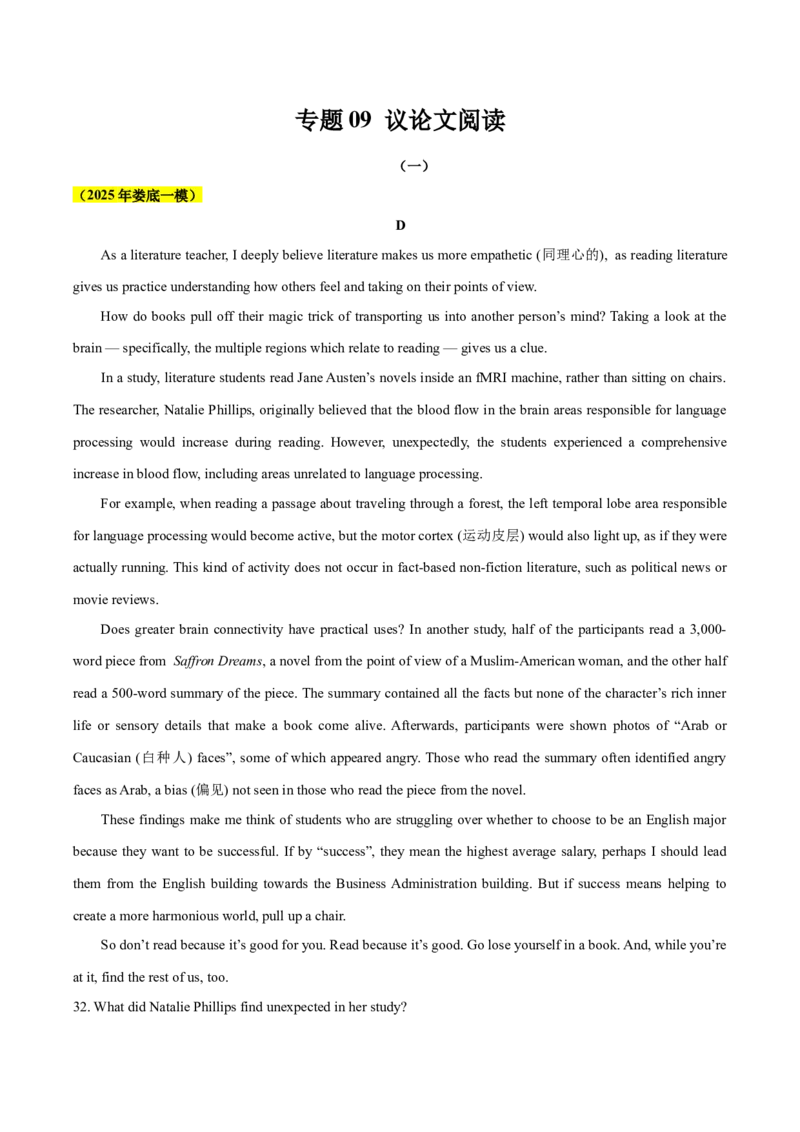
As a literature teacher, I deeply believe literature makes us more empathetic (同理心的), as reading literature
gives us practice understanding how others feel and taking on their points of view.
How do books pull off their magic trick of transporting us into another person’s mind? Taking a look at the
brain — specifically, the multiple regions which relate to reading — gives us a clue.
In a study, literature students read Jane Austen’s novels inside an fMRI machine, rather than sitting on chairs.
The researcher, Natalie Phillips, originally believed that the blood flow in the brain areas responsible for language
processing would increase during reading. However, unexpectedly, the students experienced a comprehensive
increase in blood flow, including areas unrelated to language processing.
For example, when reading a passage about traveling through a forest, the left temporal lobe area responsible
for language processing would become active, but the motor cortex (运动皮层) would also light up, as if they were
actually running. This kind of activity does not occur in fact-based non-fiction literature, such as political news or
movie reviews.
Does greater brain connectivity have practical uses? In another study, half of the participants read a 3,000-
word piece from Saffron Dreams, a novel from the point of view of a Muslim-American woman, and the other half
read a 500-word summary of the piece. The summary contained all the facts but none of the character’s rich inner
life or sensory details that make a book come alive. Afterwards, participants were shown photos of “Arab or
Caucasian (白种人) faces”, some of which appeared angry. Those who read the summary often identified angry
faces as Arab, a bias (偏见) not seen in those who read the piece from the novel.
These findings make me think of students who are struggling over whether to choose to be an English major
because they want to be successful. If by “success”, they mean the highest average salary, perhaps I should lead
them from the English building towards the Business Administration building. But if success means helping to
create a more harmonious world, pull up a chair.
So don’t read because it’s good for you. Read because it’s good. Go lose yourself in a book. And, while you’re
at it, find the rest of us, too.
32. What did Natalie Phillips find unexpected in her study?
A. Changes in the frontal lobe’s motor cortex.
B. Changes in blood flow that took place in an fMRI.
C. An increase of blood flow to the left temporal lobe.
D. Increases of blood flow to multiple parts of the brain.
33. Why does the author talk about running through a forest?
A. To give an explanation of brain activity in running.
B. To draw a conclusion about how blood flow works.
C. To make a comparison between reading and running.
D. To give an example of how the brain works in reading.
34. What do we know about the 500-word summary?
A. It was non-fiction.
B. It was literary fiction.
C. It was a book review. D. It was a guide to reading.
35. What does the last paragraph highlight?
A. Sharing beauty in good books.
B. Sharing good books with others.
C. Sharing others’ views and emotions.
D. Sharing your emotions with others.
(二)
(2025 年常德一模)
C
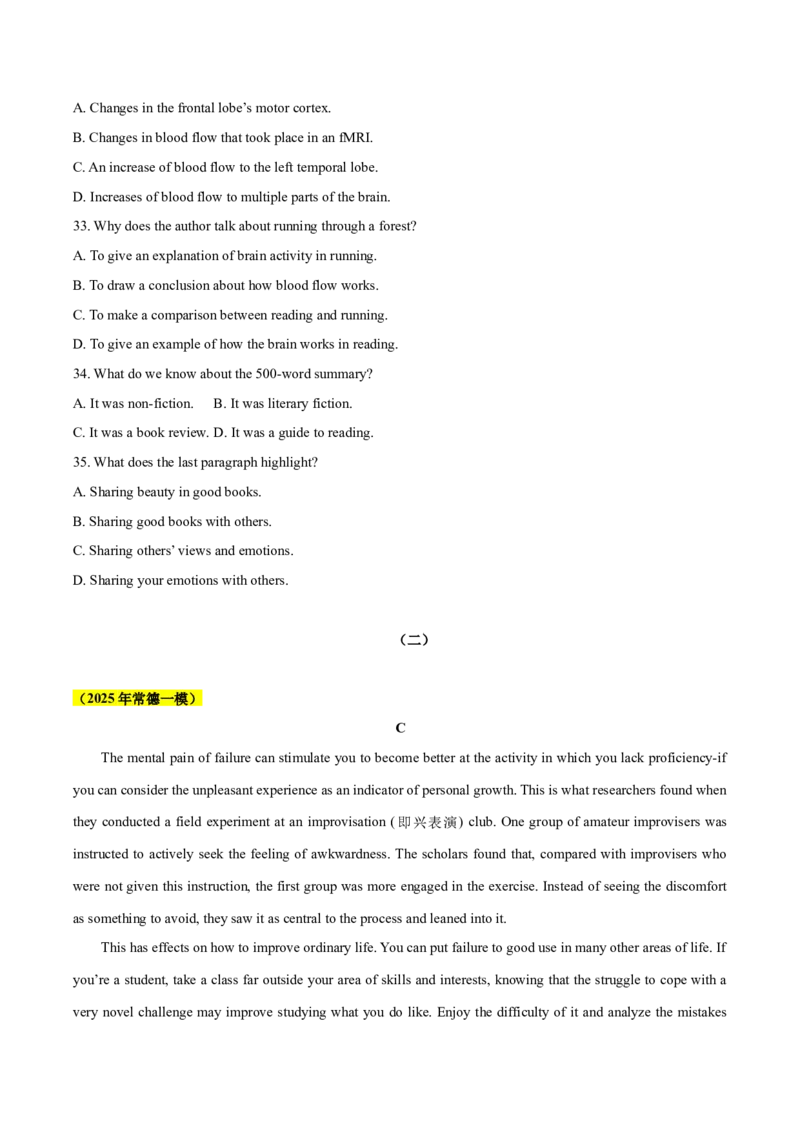
The mental pain of failure can stimulate you to become better at the activity in which you lack proficiency-if
you can consider the unpleasant experience as an indicator of personal growth. This is what researchers found when
they conducted a field experiment at an improvisation (即兴表演) club. One group of amateur improvisers was
instructed to actively seek the feeling of awkwardness. The scholars found that, compared with improvisers who
were not given this instruction, the first group was more engaged in the exercise. Instead of seeing the discomfort
as something to avoid, they saw it as central to the process and leaned into it.
This has effects on how to improve ordinary life. You can put failure to good use in many other areas of life. If
you’re a student, take a class far outside your area of skills and interests, knowing that the struggle to cope with a
very novel challenge may improve studying what you do like. Enjoy the difficulty of it and analyze the mistakes
you make—and you will almost certainly find that you're doing even better at your preferred subject.
Employers can apply these principles as well. I like the “75/25 rule,” according to which employees spend
three-quarters of their time on their assigned task and one quarter helping others outside their area. The short-term
cost of this is friction as people struggle with novelty and difficulty-and bosses should take care not to make this
worse by being punitive or overly critical. But I have seen the long-term benefit of better motivation in the core
assignment, as well as a better flow of information and distribution of new skills across different activities within
an enterprise.
The embrace-failure principle can even be applied to happiness itself. None of us wants to be unhappy. But
inviting sources of unhappiness into life can be extremely beneficial. Resolve not to be afraid of fear, anger, or
sadness. They are normal and natural parts of life, after all. And if you let them, they will help you savor (享受) the
joys of life all the more.
8. What did the experiment at the improvisation club find?
A. Avoiding awkwardness improved improvisers’ creativity.
B. Actively embracing awkwardness increased engagement.
C. Professional improvisers performed better than amateurs.
D. Discomfort negatively impacted participants’ motivation.
9. Why does the author advise students to take unfamiliar classes?
A. To reduce their academic pressure.
B. To increase their studying interests.
C. To avoid errors in their preferred field.
D. To indirectly strengthen their major subjects.
10. What is the long-term effect of the “75/25 rule”?
A. Employees are more motivated and multi-skilled.
B. Competitions among colleagues get more intense.
C. New and difficult assignments become effortless.
D. Conflicts in workplace disappear completely.
11. Which is the best title of the text?
A. The Different Ways to Avoid Failure.
B. The Advice on How to Seek Happiness.
C. The Benefits of Doing Things You’re Bad at.
D. The Reasons Why You’re in Negative Moods.
(三)
(2025 年张家界一模)
D
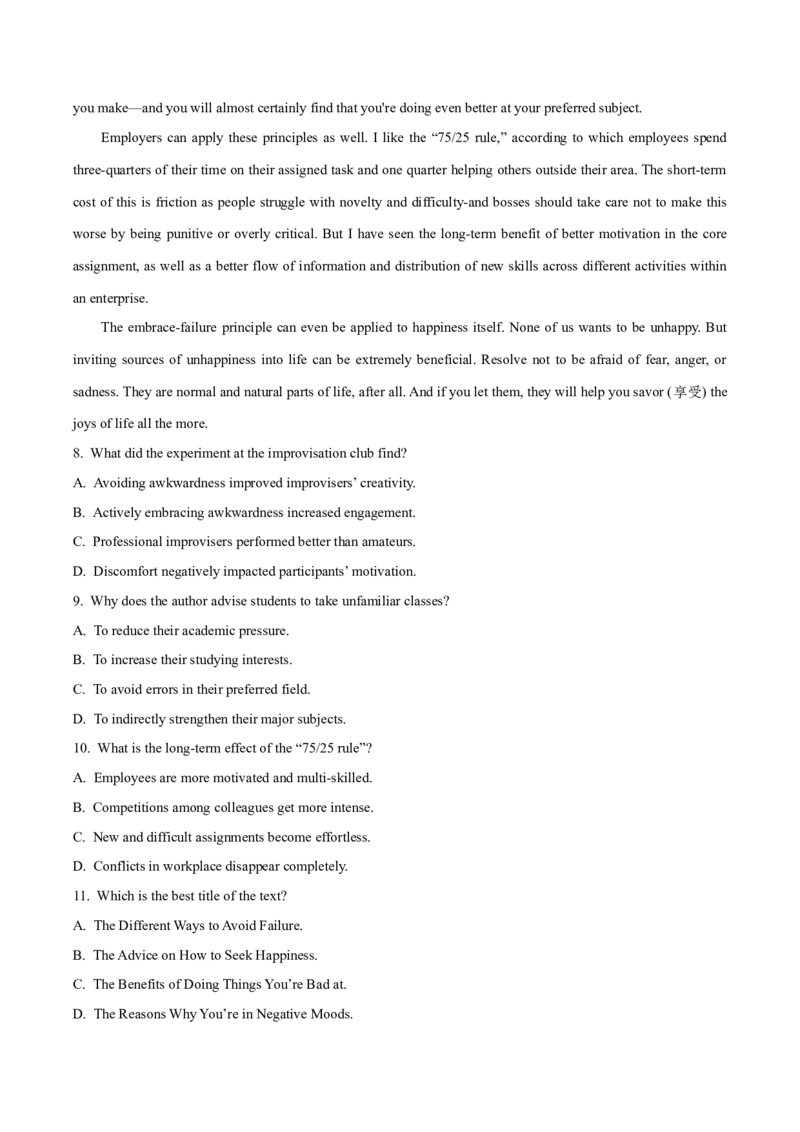
The word paradigm comes from the Greek. It was originally a scientific term, and is more commonly used
today to mean a model or theory. In the more general sense, it’s the way we “see” the world — not in terms of our
visual sense of sight, but in terms of perceiving, understanding, and interpreting.
A simple way to understand paradigms is to see them as maps. We all know that “the map is not the territory.”
A map is simply an explanation of certain aspects of the territory. That’s exactly what a paradigm is. It is a theory,
an explanation, or model of something else. You can never arrive at a specific location in a new city with a wrong
map.
Each of us has many maps in our head, which can be divided into two main categories: maps of the way things
are, or realities, and maps of the way things should be, or values. We interpret everything we experience through
these mental maps. We seldom question their accuracy; we’re usually even unaware that we have them. We simply
assume that the way we see things is the way they really are or the way they should be. And our attitudes and
behaviors grow out of those assumptions. The way we see things is the source of the way we think and the way we
act.
We see the world, not as it is, but as we are or, as we are conditioned to see it. Clearheaded people see things
differently, each looking through the unique lens of experience. But this does not mean that there are no facts.
Instead, each person’s interpretation of these facts represents prior experiences.
The more aware we are of our basic paradigms, maps, or assumptions, and the extent to which we have been
influenced by our experience, the more we can take responsibility for those paradigms, examine them, test them
against reality, listen to others and be open to their perceptions, thereby getting a larger picture and a far more
objective view.
21. How does the author illustrate the concept of “paradigm”?
A.By comparing it to an everyday object. B.By sorting it into different categories.
C.
By presenting personal examples. D .By highlighting a sharp
contrast.
22. What can be concluded about the mental maps mentioned in paragraph 3?
A.They fail to escape our attention.
B.They may be lacking in accuracy.
C.
They prove wrong and unreliable. D.They have little influence
on behavior.
23. Which of the following echoes the main idea of paragraph 4?
A.Great minds think alike.
B.All men have opinions, but few think.
C.Where we stand depends on where we sit.
D.
The fewer the facts, the stronger the opinions.
24. What does the author advocate in the last paragraph?
A.A better understanding of our paradigms.
B.A stronger sense of responsibility for others.
C.A more objective view of others’ perceptions.
D.A more positive attitude toward life experience.
(四)
(2025 年长郡中学一模)
B
I talked with a friend recently who is overwhelmed by her workload. She asked me what tips I might have for
her around time management. That question surprised me. I’ve never thought of myself as someone with great time
management skills, mostly because I tend to avoid rigid productivity systems, believing that they limit creativity.
It wasn’t until we parted that it hit me. I don’t focus on time management, but on energy management.
Somewhere along the way, I learned that the time something takes is secondary to energy. I would argue that you
could work six hours on a task that gives you energy and feel fresh and ready for what’s next. Or, you could spend
three hours on a tiring and unfulfilling task and need to check out for the rest of the day.
I’m a fan of making lists and getting things crossed off the list. But maturity has taught me that satisfaction
comes not from crossing things off the list, but intentionality about what goes on the list. If everything on the list is
an energy waste, how will it feel to get those things done?
Russ Hudson, a teacher, said something recently that blew the doors open for me on this concept. He spoke
about the energy of frustration (懊恼), but it could be applied to any negative emotion. He said that frustration is an
addictive emotion because it causes us to be stressed. Hudson said, “Life force gets trapped in frustration.” So that
extensive energy I spend being frustrated is trapping life force energy that might go to more useful, productive,
creative pursuits.
In a world that often focuses on getting the most out of every hour, it’s about time we should change our focus.
We should pay attention to how our energy changes throughout the day, and learn how to create, use, and save it.
It’s not hard to start thinking this way. We just need to be more aware of ourselves and make careful choices.
24. Why is the author’s friend mentioned in paragraph 1?
A. To lead in the topic.
B. To clarify a definition.
C. To present a common phenomenon.
D. To share a personal experience.
25. What is the author’s core argument about productivity?
A. Completing tasks quickly guarantees satisfaction.
B. Making task lists lays the foundation for achievements.
C. Energy management matters more than time management.
D. Strict time management systems are essential for success.
26. According to Russ Hudson, why is frustration problematic?
A. It wastes time that could be used for work.
B. It makes people ignorant of their limitations.
C. It leaves people trapped in their comfort zone.
D. It stops people pursuing something meaningful in life.
27. What might be talked about following the last paragraph?
A. Ways to reduce negative emotions in work.
B. The relationship between energy and creativity.
C. The disadvantages of focusing on time management.
D. Examples of managing energy through awareness and choices.