专题 06 中国传统文化(原卷版)
【材料来源:BBC July 13,2023】
How ancient “skywells”are keeping
Chinese homes cool
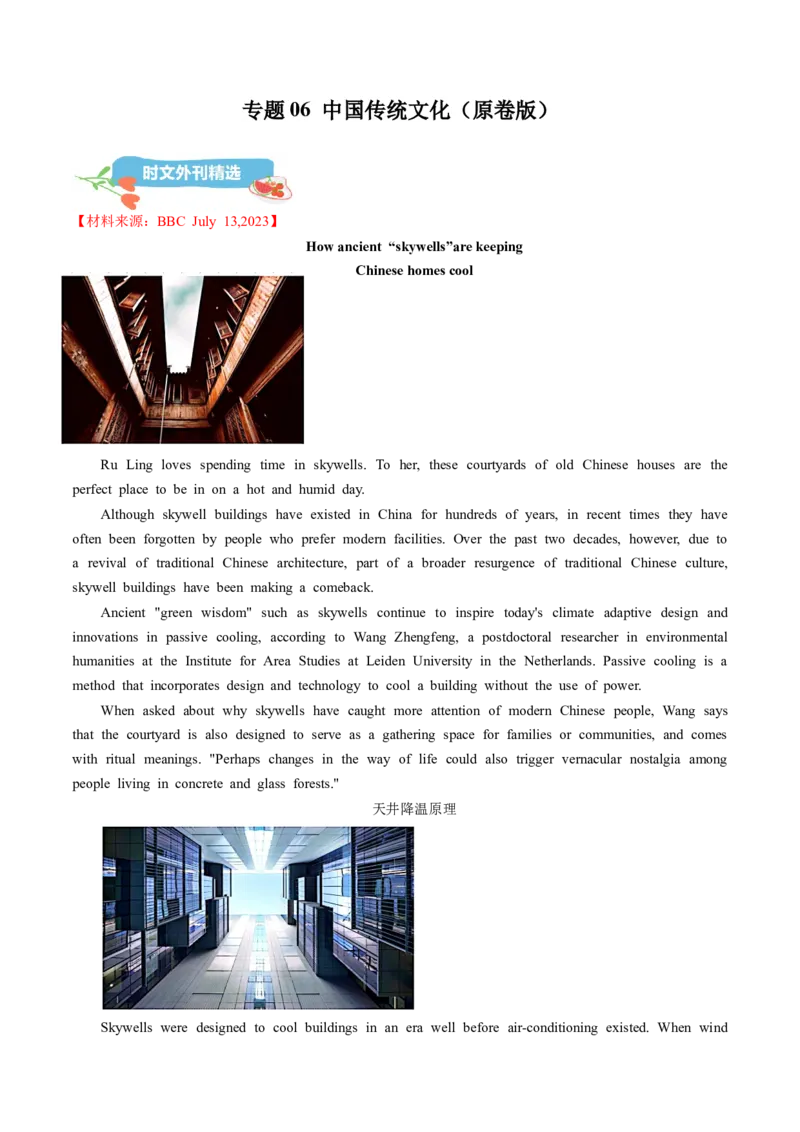
Ru Ling loves spending time in skywells. To her, these courtyards of old Chinese houses are the
perfect place to be in on a hot and humid day.
Although skywell buildings have existed in China for hundreds of years, in recent times they have
often been forgotten by people who prefer modern facilities. Over the past two decades, however, due to
a revival of traditional Chinese architecture, part of a broader resurgence of traditional Chinese culture,
skywell buildings have been making a comeback.
Ancient "green wisdom" such as skywells continue to inspire today's climate adaptive design and
innovations in passive cooling, according to Wang Zhengfeng, a postdoctoral researcher in environmental
humanities at the Institute for Area Studies at Leiden University in the Netherlands. Passive cooling is a
method that incorporates design and technology to cool a building without the use of power.
When asked about why skywells have caught more attention of modern Chinese people, Wang says
that the courtyard is also designed to serve as a gathering space for families or communities, and comes
with ritual meanings. "Perhaps changes in the way of life could also trigger vernacular nostalgia among
people living in concrete and glass forests."
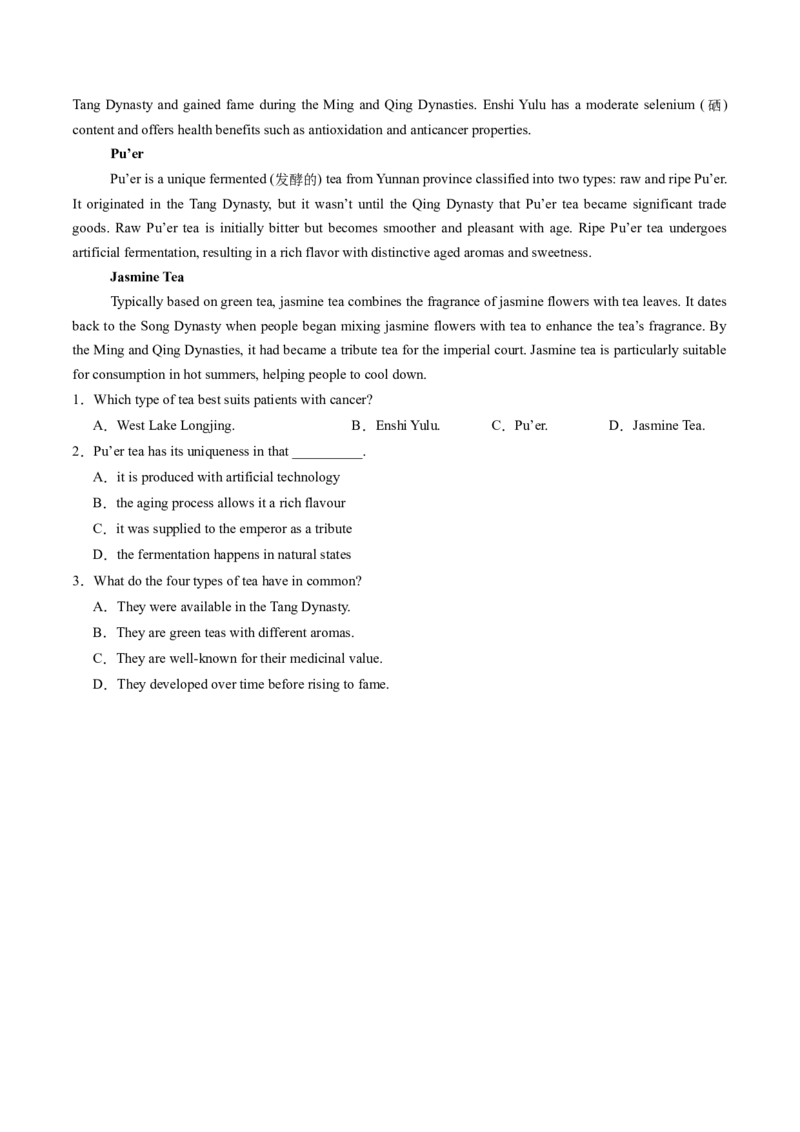
天井降温原理
Skywells were designed to cool buildings in an era well before air-conditioning existed. When windblows above a skywell house, it can enter the indoor space through the opening. Because outdoor air is
often cooler than indoor air, the incoming breeze travels down the walls to the lower stories and create
airflows by replacing warmer indoor air,which rises and leaves through the opening.
In Huizhou,a skywell is small but tall, and the rooms around it can block out sunlight on hot days,
enabling the bottom of the skywell to stay cool, he adds.
Meanwhile, hot air inside the house can rise and escape through the opening above the skywell,which
"works just like a chimney".
【译文欣赏】
古老的“天井”如何让中国住宅保持凉爽
茹玲(音译)喜欢在天井中消磨时光。对她来说,在炎热潮湿的日子里,这些古老的中式庭院是最理
想的去处。
虽然中国的天井建筑已存在了几百年,但近年来,它们往往会被更喜欢现代设施的人们所遗忘。不过,
最近二十年,由于广泛的中国传统文化复苏,中国传统建筑作为其中的一部分也逐渐复兴,天井建筑再度
流行起来。
荷兰莱顿大学区域研究学院环境人文学博士后研究员王争凤(音译)表示,包括“天井”在内的古代
“绿色智慧”持续激发着当代气候适应性设计和被动冷却技术的创新。“被动冷却”是一种无需电力、通
过设计和技术实现建筑物一制冷的方法。
当被问及为什么现代中国人对天井越来越感兴趣时,她说,庭院的设计也承载了家庭或社区的聚会功
能,并颇有仪式感。“对于生活在都市密林中的人们来说,也许生活方式的改变也会引发对于民俗建筑的
怀旧情绪。”
天井降温原理
当有风吹过时,风可以通过天井的开口进入室内空间。由于室外空气通常比室内空气更冷,吹进来的
微风沿着墙壁吹到较低的楼层,取代室内温暖的空气,形成气流,使室内温暖的空气上升并通过开口离开。
影响“天井”降温效果的两种因素。首先,在没有自然风的情况下,由于“烟囱效应”,空气循环仍
然在天井住宅内进行。天井顶部和底部之间的温差使天井内的热空气上升,将房间里的冷空气吸引到天井
底部,从而实现降温的效果。
【词汇积累】
1. skywell /ˈskaɪˌwɛl/ n. 天井
2. courtyard /ˈkɔːrtˌjɑːrd/ n. 院子
3. humid /ˈhjuːmɪd/ adj. 潮湿的
4. facility /fəˈsɪlɪti/ n. 设施
5. revival /rɪˈvaɪvəl/ n. 复兴
6. resurgence /rɪˈsɜːrdʒəns/ n. 复苏
7. architecture /ˈɑːrkɪˌtɛktʃər/ n. 建筑
8. postdoctoral /poʊstˈdɒktərəl/ adj. 博士后的
9. innovation /ˌɪnəˈveɪʃənz/ n. 创新10. passive cooling /ˈpæsɪv ˈkuːlɪŋ/ n. 被动冷却
11. vernacular nostalgia /vərˈnækjələr nɑˈstældʒə/ n. 乡土怀旧
12. gathering space /ˈɡæðərɪŋ speɪs/ n. 聚会空间
13. airflow /ˈɛərfloz/ n. 气流
【长难句分析】
原句
Because outdoor air is often cooler than indoor air, the incoming breeze travels down the walls to the
lower stories and create airflows by replacing warmer indoor air,which rises and leaves through the
opening.
译文
由于室外空气通常比室内空气更冷,吹进来的微风沿着墙壁吹到较低的楼层,取代室内温暖的空气,形成
气流,使室内温暖的空气上升并通过开口离开。
分析
+--[主句: the incoming breeze travels down the walls to the lower stories and create airflows ]
| |
| +--[原因状语从句: Because outdoor air is often cooler than indoor air]
|
+--[并列句: and create airflows by replacing warmer indoor air, which rises and leaves through the
opening]
|
+--[方式状语: by replacing warmer indoor air]
|
+--[定语从句: which rises and leaves through the opening]
(一)
Come to China, enjoying four amazing teas
West Lake Longjing
West Lake Longjing is one of China’s famous green teas, produced in Hangzhou, Zhejiang province. It’s
renowned for its unique appearance, aroma and taste. With a long history dating from the Tang Dynasty, Longjing
tea improved over time, and was offered as a tribute (贡品) in the Qing Dynasty. West Lake Longjing tea is known
for its benefits such as refreshing the mind, quenching (缓解) thirst, and reducing fats in the blood.
Enshi Yulu
Enshi Yulu is the only remaining steamed needle-shaped green tea in China, produced in Enshi, Hubei
province. The dry tea resembles pine needles and has a lush green color. Its production technique dates back to theTang Dynasty and gained fame during the Ming and Qing Dynasties. Enshi Yulu has a moderate selenium (硒)
content and offers health benefits such as antioxidation and anticancer properties.
Pu’er
Pu’er is a unique fermented (发酵的) tea from Yunnan province classified into two types: raw and ripe Pu’er.
It originated in the Tang Dynasty, but it wasn’t until the Qing Dynasty that Pu’er tea became significant trade
goods. Raw Pu’er tea is initially bitter but becomes smoother and pleasant with age. Ripe Pu’er tea undergoes
artificial fermentation, resulting in a rich flavor with distinctive aged aromas and sweetness.
Jasmine Tea
Typically based on green tea, jasmine tea combines the fragrance of jasmine flowers with tea leaves. It dates
back to the Song Dynasty when people began mixing jasmine flowers with tea to enhance the tea’s fragrance. By
the Ming and Qing Dynasties, it had became a tribute tea for the imperial court. Jasmine tea is particularly suitable
for consumption in hot summers, helping people to cool down.
1.Which type of tea best suits patients with cancer?
A.West Lake Longjing. B.Enshi Yulu. C.Pu’er. D.Jasmine Tea.
2.Pu’er tea has its uniqueness in that __________.
A.it is produced with artificial technology
B.the aging process allows it a rich flavour
C.it was supplied to the emperor as a tribute
D.the fermentation happens in natural states
3.What do the four types of tea have in common?
A.They were available in the Tang Dynasty.
B.They are green teas with different aromas.
C.They are well-known for their medicinal value.
D.They developed over time before rising to fame.原句
Ripe Pu’er tea undergoes artificial fermentation, resulting in a rich flavor with distinctive aged aromas and
sweetness.
译文
成熟的普洱茶经过人工发酵,味道浓郁,具有独特的陈香和甜味。
分析
+--[主句: Ripe Pu’er tea undergoes artificial fermentation]
|
+--[结果状语: resulting in a rich flavor]
|
+--[介词短语: with distinctive aged aromas and sweetness]
|
+--[并列结构: distinctive aged aromas and sweetness]
1.renowned adj. 著名的 2.appearance n. 外观
3.aroma n. 香气 4.moderate adj. 适中的
5.antioxidation n. 抗氧化 6.anticancer adj. 抗癌的
7.fermented adj. 发酵的 8.distinctive adj. 独特的
9.fragrance n. 香味 10.consumption n. 消耗,消费
(二)
About eight years ago, Li Jinglong and Guan Dian visited the Palace Museum in Beijing. The cloisonne (景
泰蓝瓷器) objects on display attracted them in particular. They spent hours looking at those beautiful objects. They
just couldn’t take their eyes off them.
Born and raised in Beijing, 35-year-old Li is no stranger to cloisonne, since there were a pair of cloisonne
vases in his grandparents’ home. His wife, 34-year-old Guan, who learned to paint as a child and later became a
designer after graduating from the Beijing Institute of Fashion Technology, is also familiar with cloisonne, as it
appears in her art books. As a result of their visit, the couple made the daring decision to open a workshop.
“We learned cloisonne after seeing the pieces displayed in the Palace Museum. We wanted to turn our hobby
into a career, so that people could enjoy and learn to make the craft themselves,” said Li, who worked in a finance
company before quitting his job to launch Handcraft Addicted, a DIY workshop where participants can make
cloisonne. Since 2018, they have opened three workshops in Beijing. They are happy to give people a glimpse of
the traditional techniques of cloisonne as part of a DIY experience.
Instead of focusing on making traditional cloisonne objects , such as plates and vases, the workshop allowsparticipants to create the designs they want on surface of glass, resin (树脂) or wood. Although the process has
been simplified, it is still not easy for people trying cloisonne for the first time to succeed. Participants spend
months making one piece, which they take home or give friends as presents. It’s a luxury for people to spend time
alone and fully focus on one thing nowadays because of the fast pace of life. Participants come to the workshop not
only to create art, but also to take a break from their busy lives.
4.What can we learn about the couple?
A.They both grew up in Beijing. B.They both majored in cloisonne art.
C.They both quit their previous jobs. D.They are both familiar with cloisonne.
5.What inspired the couple to open Handcraft Addicted?
A.Their grandparents’ cloisonne vases. B.Their hobby in handcraft techniques.
C.Cloisonne objects in Guan’s art books. D.Cloisonne on exhibition in the Palace Museum.
6.In Handcraft Addicted, ______.
A.the first attempt is often simple
B.participants relax themselves while creating art
C.the couple make cloisonne objects by themselves
D.it is a luxury to make traditional cloisonne objects
7.Which of the following can best describe the couple?
A.Modest. B.Generous. C.Creative. D.Outgoing.
原句
His wife, 34-year-old Guan, who learned to paint as a child and later became a designer after graduating from
the Beijing Institute of Fashion Technology, is also familiar with cloisonne, as it appears in her art books.”
译文
他的妻子,34岁的关点,从小学画,后来从北京服装学院毕业后成为了设计师,她也熟悉景泰蓝,因
为它出现在她的艺术书籍中。
分析
+--[主句: His wife, 34-year-old Guan, is also familiar with cloisonne]
|
+--[同位语: 34-year-old Guan]
|
+--[定语从句: who learned to paint as a child and later became a designer after graduating from the
Beijing Institute of Fashion Technology]
|
+--[原因状语: as it appears in her art books]1.cloisonne n. 景泰蓝瓷器 2.object n. 物品
3.display n. 展览 4.attractive adj. 吸引人的
5.daring adj. 大胆的 6.workshop n. 车间,作坊
7.finance n. 金融 8.participant n. 参与者
9.glimpse n. 一瞥 10.technique n. 技巧,技术
(三)
With the arrival of the summer heat, cultural-themed ice creams are once again trending across social media
platforms in China.
Museums, scenic spots, amusement parks and even universities have once again rolled out their unique
cultural-themed ice creams this year. These ice creams are often tiny copies of famous landmarks or cultural relies
that offer visitors a delight for the taste buds.
The trend of cultural-themed ice creams began in 2019 when the Old Summer Palace in Beijing was one of the
first scenic spots in China to introduce lotus-shaped ice creams. It was inspired by that in 2017 eleven ancient
lotus(莲花)seeds were discovered in a pool at the Old Summer Palace. Six of these ancient lotus seeds bloomed in
the summer of 2019. So to mark the occasion, staff at the Old Summer Palace designed ice creams shaped like lotus
blossoms. These ice creams were widely loved by visitors, not only serving as a cold treat but also offering a
unique way for visitors to sample and connect with their cultural heritage.
To protect their cultural relics, many museums have put up signs prohibiting photography or the use of a flash.
However, cultural-themed ice creams provide an alternative way for visitors to catch memories of their visit.
Various flavors offer visitors a choice of colors and ingredients for the ice cream, which reflect the local
characteristics and charm of these cold treats. It is also suggested by the museums that the visitors can take the
carved ice cream bars home with them to use as bookmarks.
For many young people, taking photos of themselves standing alongside cultural landmarks is an artistic
preference from their parents’ generation. To them, a selfie(自拍)with a cultural -themed ice cream is a much cooler
way to show off their travel experiences and bridge the gap between modern life and distant historical relics.
8.What can we learn about cultural-themed ice creams from the first two paragraphs?
A.Visitors spend much money on them. B.They may be shaped like landmarks.
C.Visitors are eager to try their taste. D.They are made due to summer heat.
9.What inspired the idea of cultural-themed ice creams?
A.The Old Summer Palace. B.The wide love by visitors.
C.The blossoms of the six seeds. D.The discovery of ancient lotus.
10.For what are cultural-themed ice creams well-received?
A.Protecting cultural relics. B.Remembering one’s visit.
C.Being used as bookmarks. D.Offering visitors various flavors.11.Why do the youth take the selfie with a cultural-themed ice cream?
A.To do something different. B.To bridge the gap with their parents.
C.To show off their cooler way to travel. D.To show their connection with culture.
原句
To them, a selfie(自拍)with a cultural -themed ice cream is a much cooler way to show off their travel
experiences and bridge the gap between modern life and distant historical relics.
译文
对他们来说,拿着文创雪糕自拍是一种更酷的方式,可以展示他们的旅行经历,弥合现代生活和遥远
历史遗迹之间的差距。
分析
+--[主句: a selfie with a cultural-themed ice cream is a much cooler way]
|
+--[介词短语: To them]
|
+--[不定式短语: to show off their travel experiences and bridge the gap between modern life and distant
historical relics]
|
+--[并列结构: show off their travel experiences]
| |
+--[并列结构: bridge the gap between modern life and distant historical relics]
1.cultural-themed adj. 文化主题的 2.scenic adj. 风景优美的
3.landmark n. 地标 4.relic n. 遗物,遗迹
5.inspire v. 启发 6.occasion n. 场合
7.unique adj. 独特的 8.characteristic n. 特征
9.alternative adj. 替代的 10.preference n. 偏爱
(四)
On March 6, the 2024 Douyin E-commerce Female Consumer Trend Data Report revealed that in 2023 the
order volume of horse faced skirts -a type of hanfu, the traditional style of clothing worn by the Han people-among
female users on Douyin skyrocketed by 841 percent compared to the previous year.
“I’ve noticed that there are so many people wearing horse-faced skirts on the streets now, from youngwomen to children; it’s unbelievable, ” said Wang Zicheng, a 23-year-old hanfu enthusiast.
He recalled that when he wore hanfu for the first time in 2018 at his coming-of-age ceremony, it was still a
minority interest. Now, he is confident wearing it everywhere, even outside of China.
As hanfu gains popularity, traditional attire (服装) and modern fashion are merging (融合), influencing not
only clothing styles but also cultural perceptions and people’s understanding.
Some hanfu enthusiasts argue that each design and structural form of hanfu carries distinct historical and
cultural significance, insisting that these details should be adhered to (遵循) strictly. However, other consumers
prioritize the aesthetics (美学) and comfort of the clothing.
Zhou Shuang, 37, specializes in character styling for film and television. She pointed out that for those
unfamiliar with traditional clothing culture, it’s understandable for them to desire a mixture of classical elegance
with modern fashion.
This combination is referred to as the neo-Chinese style. “Neo-Chinese style clothing design doesn’t merely
layer traditional elements, but combines modernity and tradition naturally,” explained Zhou. “It aims to showcase
traditional charm that resonates with (与……产生共鸣) the aesthetic preferences of today’s Chinese. ”
Despite the growing hanfu trend in China, there remains a lack of understanding among people abroad.
According to Wang, he traveled to a dozen countries while wearing hanfu.
“They guessed about the origin of my clothes…, but none correctly identified that it’s from China,” Wang
said. He believed this is because people in other countries have few chances to see authentic hanfu clothes and
accessories.
A potential solution could be integrating hanfu into everyday attire. Indeed, Zhou’s students are currently
exploring ways to preserve hanfu’s cultural heritage while accommodating the demands of daily fashion choices.
12.What does Wang Zicheng’s experience detailed in paragraphs 2-3 reflect?
A.The diversity of hanfu enthusiasts.
B.The cultural significance of hanfu.
C.The reasons for hanfu’s popularity.
D.The increasing recognition of hanfu.
13.According to Wang, why was his hanfu not correctly identified when he was traveling?
A.His hanfu did not represent a typical style.
B.Western tourists show little interest in hanfu.
C.People abroad were unfamiliar with hanfu culture.
D.Hanfu has mixed clothing styles from other countries.
14.What are Zhou’s students doing now?
A.Cooperating with daily fashion designers.
B.Protecting traditional hanfu in a modern way.
C.Promoting traditional Chinese clothing abroad.
D.Studying the historical evolution of the hanfu style.
15.What is the best title for the passage?A.Hanfu: Reshaping Modern Fashion
B.Ancient Fashion: The Forgotten Beauty of Hanfu
C.Hanfu: An Evolutionary Journey Through Centuries
D.Hanfu vs. Modern Fashion: A Symbol of Chinese Nationalism
原句
As hanfu gains popularity, traditional attire (服装)and modern fashion are merging (融合), influencing not only
clothing styles but also cultural perceptions and people’s understanding.
译文
随着汉服的流行,传统服装和现代时尚正在融合,不仅影响着服装风格,也影响着文化观念和人们的
理解。
分析
+--[主句: traditional attire and modern fashion are merging]
|
+--[时间状语从句: As hanfu gains popularity]
|
+--[现在分词短语: influencing not only clothing styles but also cultural perceptions and people’s
understanding]
|
+--[并列结构: not only clothing styles but also cultural perceptions and people’s understanding]
|
+--[并列结构: cultural perceptions and people’s understanding]
1.e-commerce n. 电子商务 2.skyrocket v. 猛增
3.enthusiast n. 爱好者 4.attire n. 服装
5.merge v. 融合 6.perception n. 观念
7.aesthetics n. 美学 8.classical adj. 古典的
9.elegance n. 优雅 10.resonate v. 与……产生共鸣
(五)
Certain Chinese cuisines, such as the well-known Roasted Duck from Beijing or the delicious Tianjin-style
Pancakes, might appear commonplace to the Chinese, but they have gained global recognition. The appeal of these
delicacies is deeply rooted in vast geographical diversity.
Stretching from the extremely cold northern plains to the southern rainforests, different regions have theirunique ingredients and cooking techniques. 16 , commonly referred to as the Eight Major Cuisines of China.
These include the rich and flavor-packed dishes of Sichuan, the delicate and varied tastes of Guangdong, the
mouth-watering and hearty foods of Shandong, and the spicy and sour flavors of Hunan, among others.
Climate plays a crucial role in shaping regional cuisines. In Sichuan, for example, the hot and wet climate,
coupled with the region’s mountainous physical geography, has led to a preference for spicy foods, like Stir-Fried
Tofu in Hot Sauce or Spicy Chicken. The spicy flavors add appetite to dishes. In addition, 17 . The unique
conditions of the Sichuan Basin, with its low-lying land and difficulty in losing heat through evaporation (蒸发),
contribute to this preference.
One of the most noteworthy contrasts between southern and northern Chinese cuisines lies in the
employment of ingredients. Southern dishes tend to be lighter and more delicate, featuring seafood, vegetables, and
rice. In contrast, 18 . They have a wealth of wheat-based dishes like noodles and dumplings.
19 , regardless of their differences. Dishes are attentively cooked to stimulate the senses and promote
a sense of pleasure. The use of fresh, seasonal ingredients, along with the close attention to details in preparation
and presentation, defines Chinese cuisine.
Another important aspect of Chinese dining culture is the significance of table manners. Meals are often
shared among family and friends, with each person taking turns to serve and pour. Chopsticks, rather than forks or
knives, are preferred, symbolizing closeness and familiarity. The act of eating together goes beyond food alone.
20 .
A.northern cuisines are heavier and more hearty
B.they serve to warm up and remove dampness from the boday
C.This diversity comes down to its geographical and climatic conditions
D.The Chinese people have for centuries crafted varieties of delicious dishes
E.This geographical diversity has given birth to eight major cooking traditions
F.That is to say, it represents a sense of community and the strength of bonds
G.Chinese cuisines share emphasis on the perfect harmony of color, flavor and taste原句
Climate plays a crucial role in shaping regional cuisines. In Sichuan, for example, the hot and wet climate,
coupled with the region’s mountainous physical geography, has led to a preference for spicy foods, like Stir-
Fried Tofu in Hot Sauce or Spicy Chicken.
译文
气候在塑造地方菜系方面起着至关重要的作用。例如,在四川,湿热的气候加上该地区的多山地理特
征,导致了对辛辣食物的偏好,如辣味豆腐或辣子鸡。
分析
+--[主句: Climate plays a crucial role in shaping regional cuisines]
|
+--[地点状语从句: In Sichuan, for example]
|
+--[主句: the hot and wet climate, coupled with the region’s mountainous physical geography, has led to
a preference for spicy foods]
|
+--[状语: coupled with the region’s mountainous physical geography]
|
+--[宾语: a preference for spicy foods]
|
+--[同位语: like Stir-Fried Tofu in Hot Sauce or Spicy Chicken]
1.cuisine n. 菜肴 2.delicacy n. 美味,佳肴
3.diversity n. 多样性 4.geographical adj. 地理的
5.climatic adj. 气候的 6.flavor-packed adj. 充满风味的
7.evaporation n. 蒸发 8.noteworthy adj. 值得注意的
9.harmony n. 和谐 10.seasonal adj. 季节性的
(六)
Around 2000 years ago, ancient Chinese divided the sun’s annual circular motion into 24 equal segments,
each segment was called a ‘Solar Term’. Each solar term 21 a unique period of a year. But have you ever
heard the term — “Hui Nantian”, a unique meteorological (气象) 22 that occurs 23 in southern
China? This term, which translates to “the return of the south wind,” encapsulates (概括)a seasonal shift that not
only 24 the weather patterns, but also deeply affects the way of life and cultural practices in this region.“Hui Nantian” occurs during the 25 from winter to spring, when the cold, dry air of winter 26
the warm, damp air of the south. This change is not merely a meteorological shift; it’s a cultural event. People in the
southern China anticipate “Hui Nantian” with a 27 of excitement and caution.
On the one hand, it signals the end of winter and the 28 of spring, a time of renewal and rebirth. On
the other hand, the 29 humidity and dampness can present challenges, especially in terms of maintaining
the integrity of buildings and 30 personal items. In Chinese culture, “Hui Nantian” is often associated with
traditional practices and beliefs. It also reflects the importance of respect for 31 and traditional values in
Chinese culture. In addition, it is also connected with the concept of “harmony with nature.” This belief encourages
people to live in harmony with the natural world and respect the 32 of nature, such as the changing of the
seasons and the flow of energy.
By 33 these natural rhythms, it is believed that people can achieve a state of inner peace and
harmony, which is essential for leading a healthy and 34 life. Overall, Hui Nantian shows a blend of
traditional practices, beliefs, and values that are unique to Chinese culture. These practices not only serve to
preserve the cultural heritage of China but also 35 harmony and balance in people’s lives.
21.A.reviewed B.represented C.regained D.researched
22.A.phenomenon B.view C.landscape D.opinion
23.A.hardly B.seldom C.primarily D.never
24.A.maintains B.remains C.changes D.keeps
25.A.transportation B.show C.transplant D.shift
26.A.gives out B.gives up C.gives off D.gives way to
27.A.result B.force C.mix D.power
28.A.end B.approach C.warmth D.beauty
29.A.decreased B.lost C.increased D.regained
30.A.arriving B.preserving C.serving D.approving
31.A.ancestors B.wealth C.harvest D.descendants
32.A.circles B.return C.power D.cycles
33.A.following B.keeping C.noticing D.staying
34.A.brilliant B.unforgettable C.necessary D.satisfying
35.A.protect B.promote C.preview D.predict
1.meteorological adj. 气象的 2.encapsulate v. 概括
3.integrity n. 完整性 4.anticipate v. 期待
5.renewal n. 更新 6.maintain v. 维护
7.respect n. 尊重 8.concept n. 概念
9.harmony n. 和谐 10.preserve v. 保存(一)
(2023·新课标II卷)Yellowstone National Park offers a variety of ranger programs throughout the park,
and throughout the year. The following are descriptions of the ranger programs this summer.
Experiencing Wildlife in Yellowstone (May 26 to September 2)
Whether you’re hiking a backcountry trail (小径), camping, or just enjoying the park’s amazing wildlife
from the road, this quick workshop is for you and your family. Learn where to look for animals and how to safely
enjoy your wildlife watching experience. Meet at the Canyon Village Store.
Junior Ranger Wildlife Olympics (June 5 to August 21)
Kids can test their skills and compare their abilities to the animals of Yellowstone. Stay for as little or as long
as your plans allow. Meet in front of the Visitor Education Center.
Canyon Talks at Artist Point (June 9 to September 2)
From a classic viewpoint, enjoy Lower Falls, the Yellowstone River, and the breathtaking colors of the
canyon (峡谷) while learning about the area’s natural and human history. Discover why artists and photographers
continue to be drawn to this special place. Meet on the lower platform at Artist Point on the South Rim Drive for
this short talk.
Photography Workshops (June 19 & July 10)
Enhance your photography skills — join Yellowstone’s park photographer for a hands-on program to inspire
new and creative ways of enjoying the beauty and wonder of Yellowstone.
6/19 — Waterfalls &Wide Angles: meet at Artist Point.
7/10 — Wildflowers &White Balance: meet at Washburn Trailhead in Chittenden parking area.
1.Which of the four programs begins the earliest?
A.Photography Workshops. B.Junior Ranger Wildlife Olympics.
C.Canyon Talks at Artist Point. D.Experiencing Wildlife in Yellowstone.
2.What is the short talk at Artist Point about?
A.Works of famous artists. B.Protection of wild animals.
C.Basic photography skills. D.History of the canyon area.
3.Where will the participants meet for the July 10 photography workshop?
A.Artist Point. B.Washburn Trailhead.
C.Canyon Village Store. D.Visitor Education Center.
(二)
(2023·全国甲卷)阅读下面短文,在空白处填入1个适当的单词或括号内单词的正确形式。
For thousands of years, people have told fables (寓言) 4 (teach) a lesson or to pass on wisdom.
Fables were part of the oral tradition of many early cultures, and the well-known Aesop’s fables date to the 5
(six) century, B.C. Yet, the form of the fable still has values today, 6 Rachel Carson says in “A Fablefor Tomorrow.”
Carson uses a simple, direct style common to fable. In fact, her style and tone (口吻) are seemingly directed
at children. “There was once a town in the heart of America, 7 all life seemed to enjoy peaceful existence
with its surroundings,” her fable begins, 8 (borrow) some familiar words from many age-old fables. Behind
the simple style, however, is a serious message 9 (intend) for everyone.
10 (difference) from traditional fables, Carson’s story ends with an accusation instead of a moral. She
warns of the environmental dangers facing society, and she teaches that people must take responsibility 11
saving their environment.
The themes of traditional fables often deal with simple truths about everyday life. However, Carson’s theme
is a more weighty 12 (warn) about environmental destruction. Carson proves that a simple literal form that
has been passed down through the ages can still 13 (employ) today to draw attention to important
truths.
(三)
(2023·全国乙卷)阅读下面短文,在空白处填入1个适当的单词或括号内单词的正确形式。
Beijing is a city bridging the ancient and the modern. From Buddhist temples to museums, narrow hutong
14 royal palaces, it is home to more than 3,000 years of glorious history even down to its layout, with the city
keeping its carefully 15 (build) system of ring roads.
But for all its ancient buildings, Beijing is also a place 16 welcomes the fast-paced development of
modern life, with 21st-century architectural 17 (wonder) standing side by side with historical buildings
of the past.
It is a distinct visual contrast (反差) that shouldn’t work, 18 somehow these two very different
worlds make a good combination. 19 (visit) several times over the last 10 years, I 20 (amaze)
by the co-existence of old and new, and how a city was able to keep such a rich heritage (遗产) while constantly
growing. As a photographer, I have spent the last two years 21 (record) everything I discovered.
The 22 (remark) development of this city, which is consciously designed to protect the past while
stepping into the modern world, 23 (mean) there is always something new to discover here, and I
could be photographing Beijing for the next 50 years.
(2023·天津·高考真题)假设你是晨光中学的学生李津,通过交换生项目在英国某中学就读,校方为
加强中英文化交流,将举办“中国工坊” 活动。该活动主题涉及中华美食、中国传统手工艺、中国书法
和绘画,拟招募学生现场教授相关技能。请按照以下提示,写一封申请信:
(1)申请参加本次活动;
(2)阐述你对本次文化交流活动意义的理解;
(3)结合个人兴趣和特长,说明拟教授何种技能,并阐述原因。参考词汇:中国工坊 Chinese Workshop
中华美食 Chinese cuisine
手工艺 handicraft
书法 calligraphy
注意:
(1)词数不少于100;
(2)可适当加入细节,使内容充实、行文连贯;
(3)开头和结尾已给出,不计入总词数。
Dear Sir/Madam,
____________________________________________________________________________________________
____________________________________________________________________________________________
____________________________________________________________________________________________
____________________________________________________________________________________________
____________________________________________________
Sincerely yours,
Li Jin