热点话题03  2025 年度野生动物摄影师大奖——
自然艺术
目录
时文精读------------------------------------------------------------精选外刊原创阅读理解
  【原创·阅读理解】
【课标词汇积累】
【课标词汇训练】
【参考译文】
好题精练----------------------------------------------------------精选名校及联考话题专练
【阅读理解】
【阅读7 选5】
【完形填空】
【语法填空】
【话题·导语】
2025 年度野生动物摄影师大奖揭晓
【原文·时文阅读】
文章来源:https://newsforkids.net/articles/2025/10/16/2025-wildlife-photographer-of-the-year-awards/
The Natural History Museum in London holds a yearly contest for the Wildlife Photographer of the Year.
This year, the contest had a record 60,636 entries from around the world. Here are some of this year’s best pictures,
and the stories behind them.
This year’s photographs are amazing in many different ways. Some show dramatic scenes as animals interact.
Others present nature in surprising ways. Some just capture a perfect moment.
读时文精读
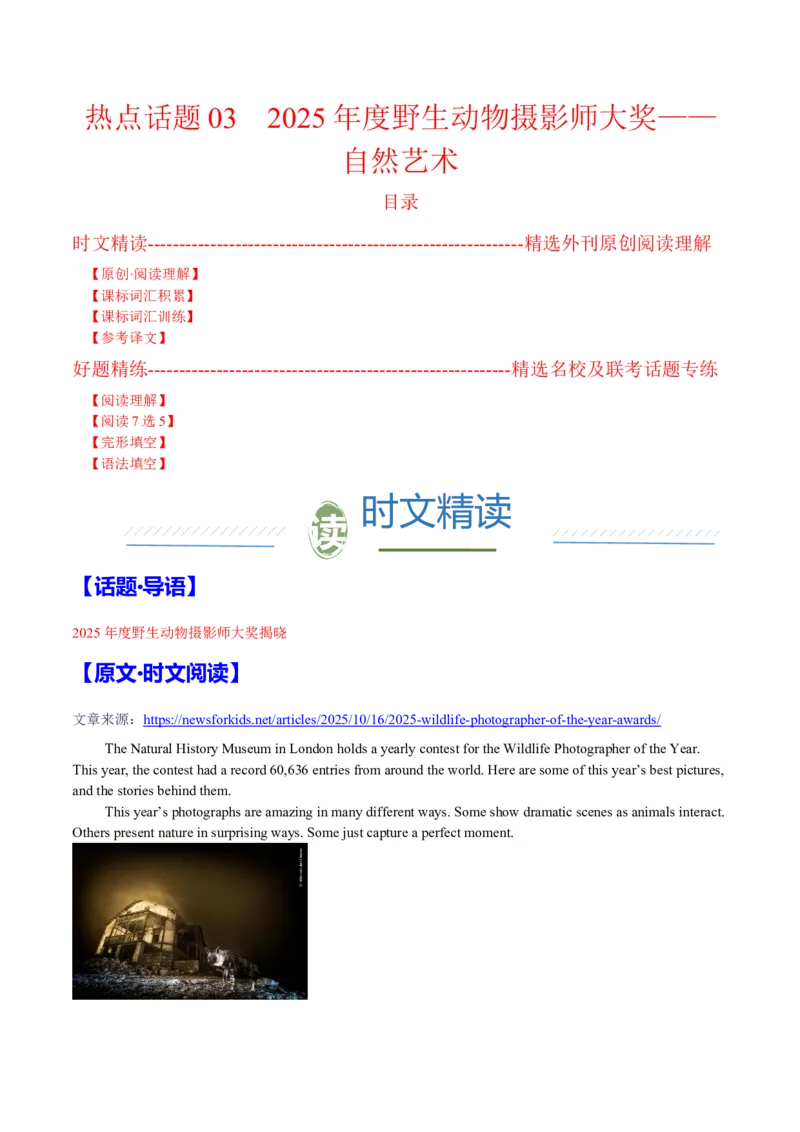
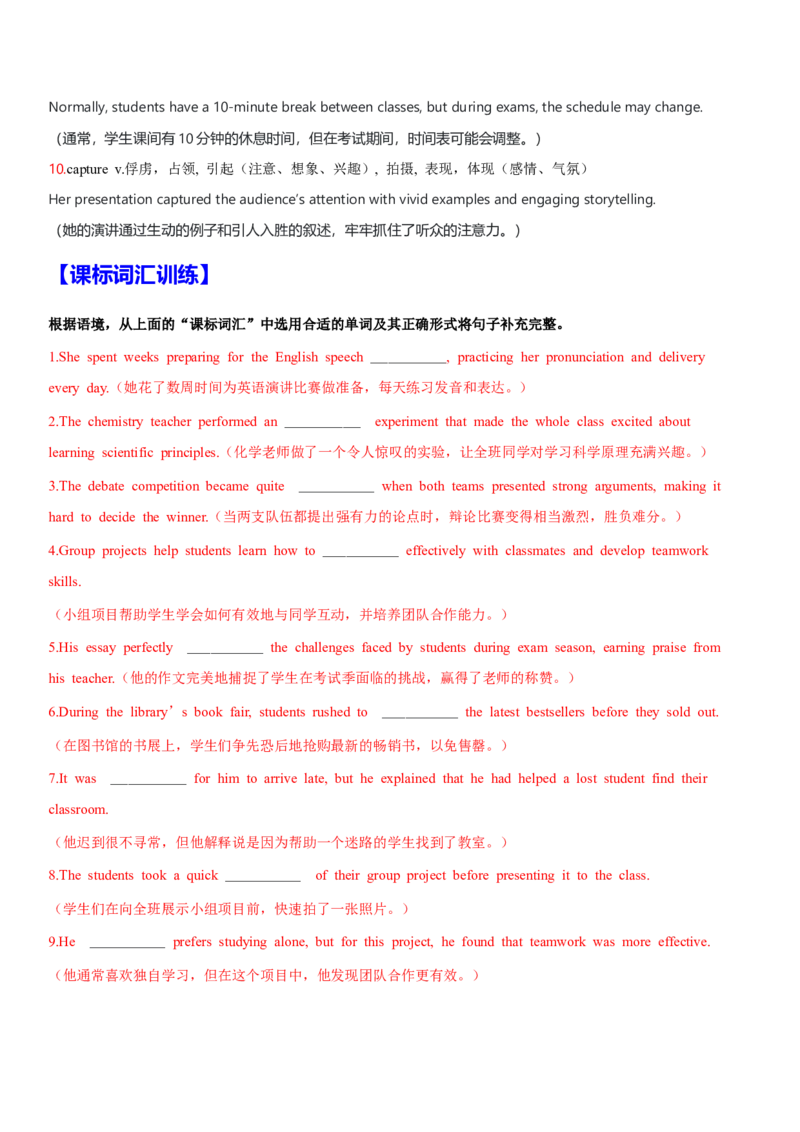
The grand prize this year was won by Wim van den Heever of South Africa for an image called “Ghost Town
Visitor”. The picture shows a rare brown hyena in front of an empty house in a town in Namibia where no one has
lived for 70 years. With humans gone, animals have come back to this desert town. Mr. van der Heever set up a
“camera trap” in the location, but it took him years to capture the perfect image.
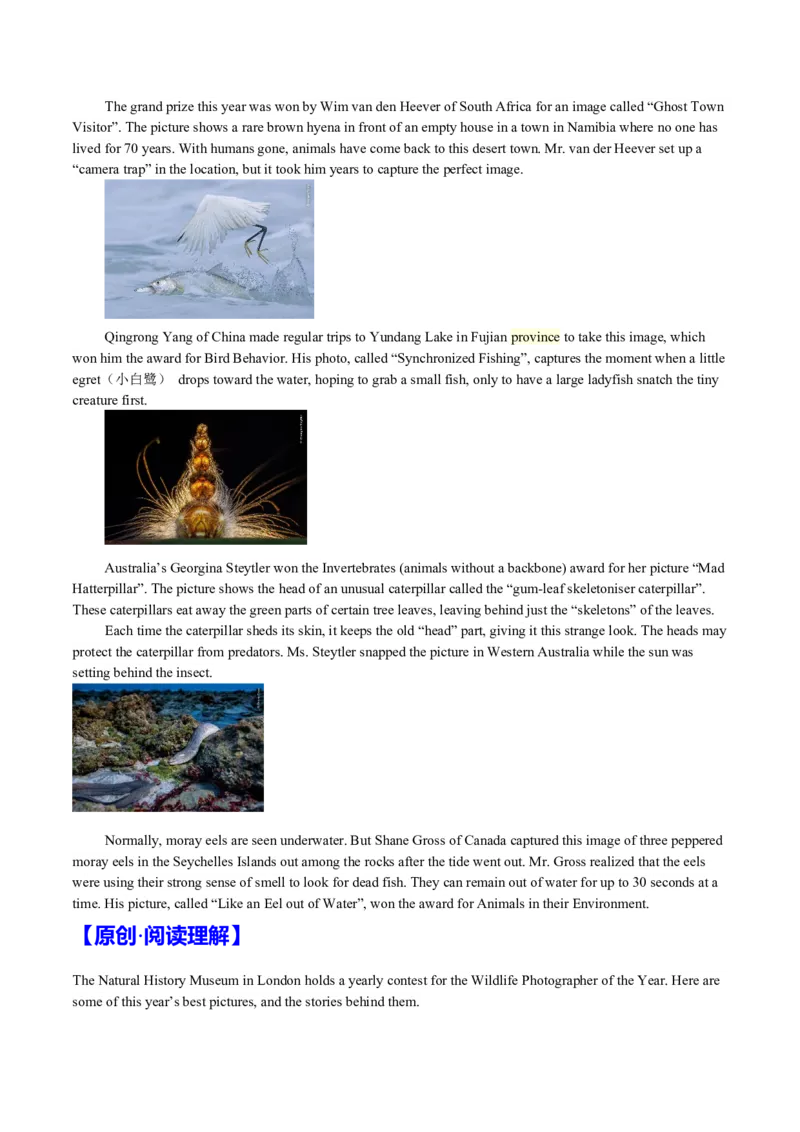
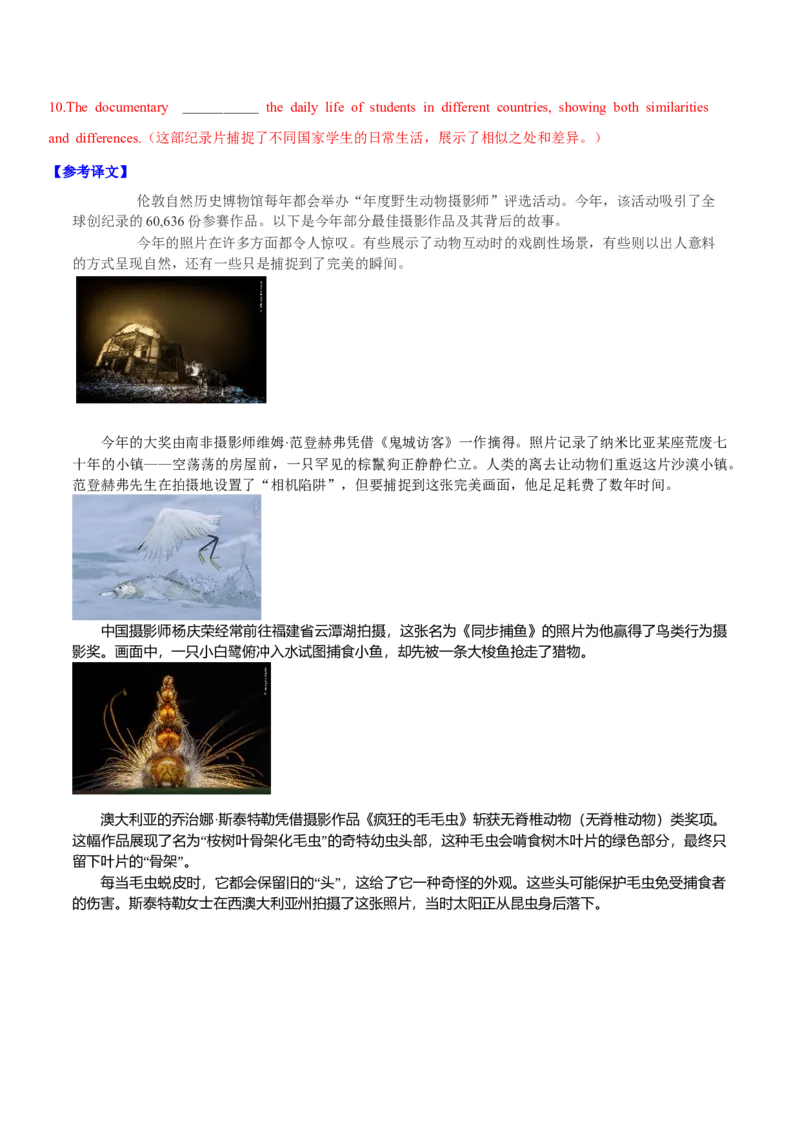
Qingrong Yang of China made regular trips to Yundang Lake in Fujian province to take this image, which
won him the award for Bird Behavior. His photo, called “Synchronized Fishing”, captures the moment when a little
egret(小白鹭) drops toward the water, hoping to grab a small fish, only to have a large ladyfish snatch the tiny
creature first.
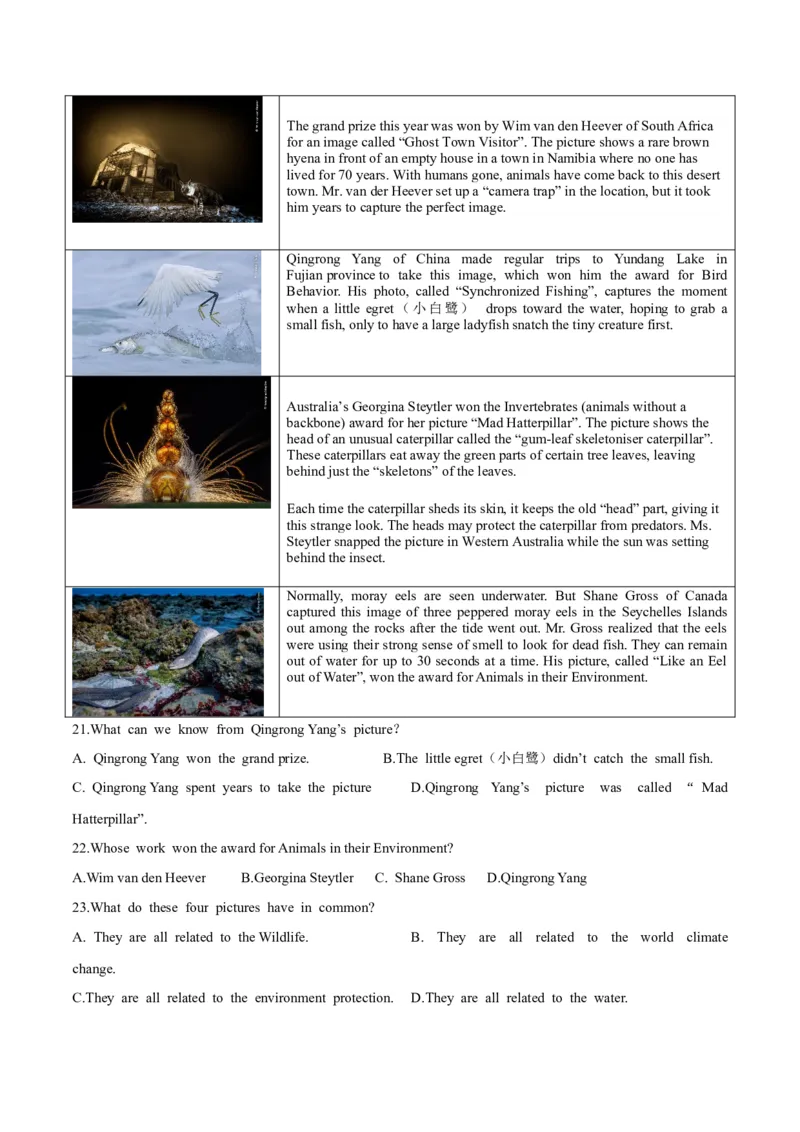
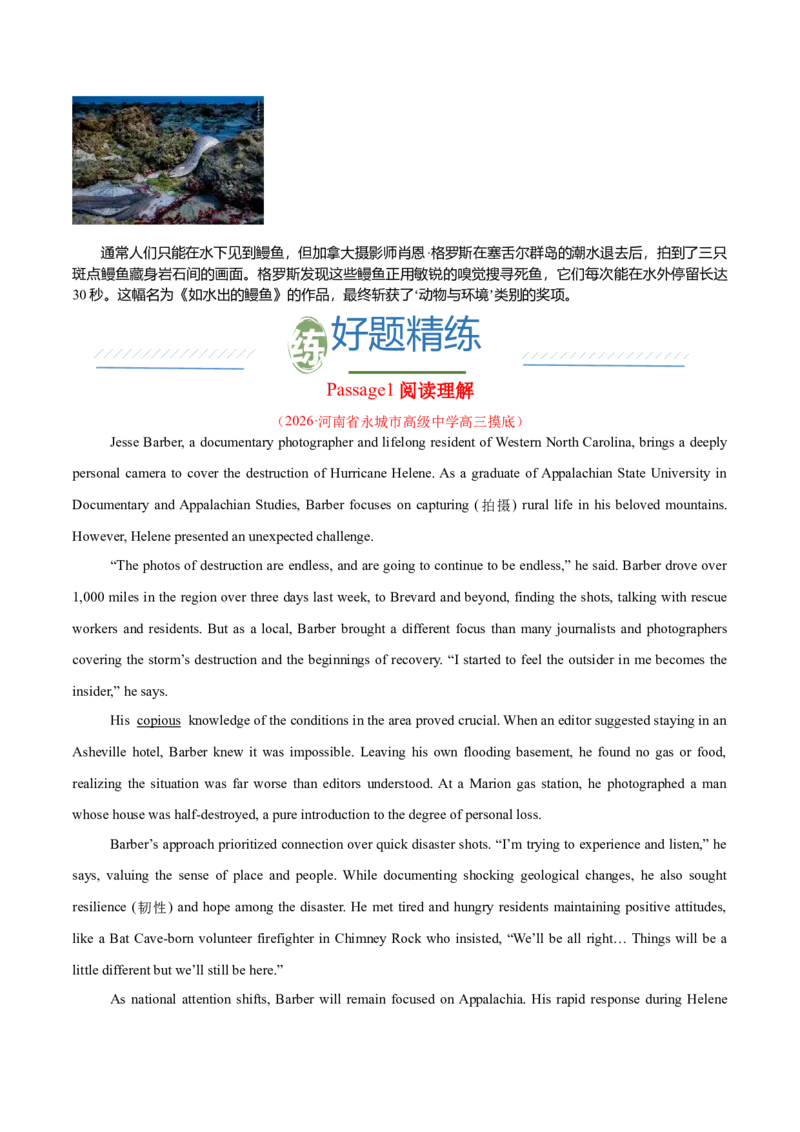
Australia’s Georgina Steytler won the Invertebrates (animals without a backbone) award for her picture “Mad
Hatterpillar”. The picture shows the head of an unusual caterpillar called the “gum-leaf skeletoniser caterpillar”.
These caterpillars eat away the green parts of certain tree leaves, leaving behind just the “skeletons” of the leaves.
Each time the caterpillar sheds its skin, it keeps the old “head” part, giving it this strange look. The heads may
protect the caterpillar from predators. Ms. Steytler snapped the picture in Western Australia while the sun was
setting behind the insect.
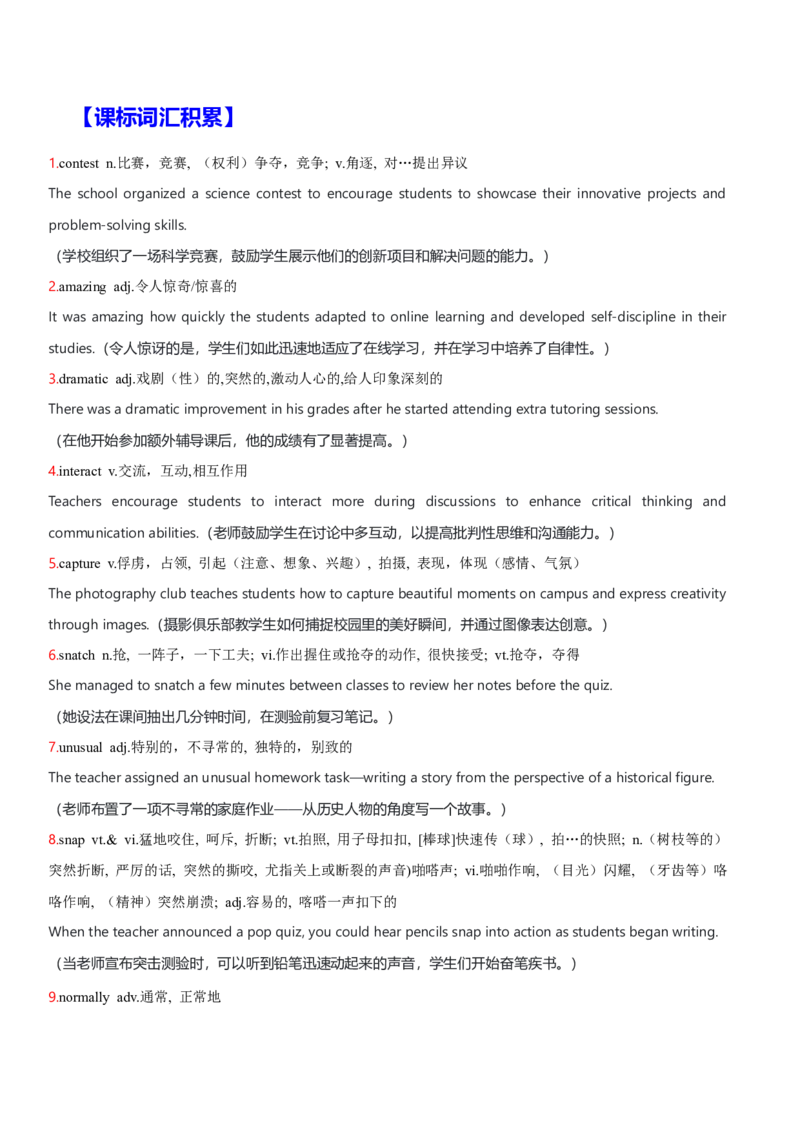
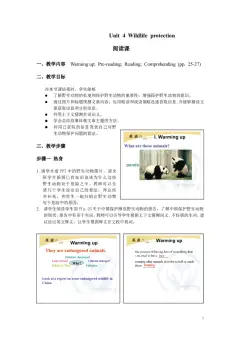
Normally, moray eels are seen underwater. But Shane Gross of Canada captured this image of three peppered
moray eels in the Seychelles Islands out among the rocks after the tide went out. Mr. Gross realized that the eels
were using their strong sense of smell to look for dead fish. They can remain out of water for up to 30 seconds at a
time. His picture, called “Like an Eel out of Water”, won the award for Animals in their Environment.
【原创·阅读理解】
The Natural History Museum in London holds a yearly contest for the Wildlife Photographer of the Year. Here are
some of this year’s best pictures, and the stories behind them.
The grand prize this year was won by Wim van den Heever of South Africa
for an image called “Ghost Town Visitor”. The picture shows a rare brown
hyena in front of an empty house in a town in Namibia where no one has
lived for 70 years. With humans gone, animals have come back to this desert
town. Mr. van der Heever set up a “camera trap” in the location, but it took
him years to capture the perfect image.
Qingrong Yang of China made regular trips to Yundang Lake in
Fujian province to take this image, which won him the award for Bird
Behavior. His photo, called “Synchronized Fishing”, captures the moment
when a little egret (小白鹭) drops toward the water, hoping to grab a
small fish, only to have a large ladyfish snatch the tiny creature first.
Australia’s Georgina Steytler won the Invertebrates (animals without a
backbone) award for her picture “Mad Hatterpillar”. The picture shows the
head of an unusual caterpillar called the “gum-leaf skeletoniser caterpillar”.
These caterpillars eat away the green parts of certain tree leaves, leaving
behind just the “skeletons” of the leaves.
Each time the caterpillar sheds its skin, it keeps the old “head” part, giving it
this strange look. The heads may protect the caterpillar from predators. Ms.
Steytler snapped the picture in Western Australia while the sun was setting
behind the insect.
Normally, moray eels are seen underwater. But Shane Gross of Canada
captured this image of three peppered moray eels in the Seychelles Islands
out among the rocks after the tide went out. Mr. Gross realized that the eels
were using their strong sense of smell to look for dead fish. They can remain
out of water for up to 30 seconds at a time. His picture, called “Like an Eel
out of Water”, won the award for Animals in their Environment.
21.What can we know from Qingrong Yang’s picture?
A. Qingrong Yang won the grand prize.
B.The little egret(小白鹭)didn’t catch the small fish.
C. Qingrong Yang spent years to take the picture
D.Qingrong Yang’s picture was called “ Mad
Hatterpillar”.
22.Whose work won the award for Animals in their Environment?
A.Wim van den Heever     B.Georgina Steytler   C. Shane Gross   D.Qingrong Yang
23.What do these four pictures have in common?
A. They are all related to the Wildlife.
B. They are all related to the world climate
change.
C.They are all related to the environment protection. D.They are all related to the water.
【课标词汇积累】
1.contest n.比赛,竞赛, (权利)争夺,竞争; v.角逐, 对…提出异议
The school organized a science contest to encourage students to showcase their innovative projects and
problem-solving skills.
(学校组织了一场科学竞赛,鼓励学生展示他们的创新项目和解决问题的能力。)
2.amazing adj.令人惊奇/惊喜的
It was amazing how quickly the students adapted to online learning and developed self-discipline in their
studies.(令人惊讶的是,学生们如此迅速地适应了在线学习,并在学习中培养了自律性。)
3.dramatic adj.戏剧(性)的,突然的,激动人心的,给人印象深刻的
There was a dramatic improvement in his grades after he started attending extra tutoring sessions.
(在他开始参加额外辅导课后,他的成绩有了显著提高。)
4.interact v.交流,互动,相互作用
Teachers encourage students to interact more during discussions to enhance critical thinking and
communication abilities.(老师鼓励学生在讨论中多互动,以提高批判性思维和沟通能力。)
5.capture v.俘虏,占领, 引起(注意、想象、兴趣), 拍摄, 表现,体现(感情、气氛)
The photography club teaches students how to capture beautiful moments on campus and express creativity
through images.(摄影俱乐部教学生如何捕捉校园里的美好瞬间,并通过图像表达创意。)
6.snatch n.抢, 一阵子,一下工夫; vi.作出握住或抢夺的动作, 很快接受; vt.抢夺,夺得
She managed to snatch a few minutes between classes to review her notes before the quiz.
(她设法在课间抽出几分钟时间,在测验前复习笔记。)
7.unusual adj.特别的,不寻常的, 独特的,别致的
The teacher assigned an unusual homework task—writing a story from the perspective of a historical figure.
——
(老师布置了一项不寻常的家庭作业
从历史人物的角度写一个故事。)
8.snap vt.& vi.猛地咬住, 呵斥, 折断; vt.拍照, 用子母扣扣, [棒球]快速传(球), 拍…的快照; n.(树枝等的)
突然折断, 严厉的话, 突然的撕咬, 尤指关上或断裂的声音)啪嗒声; vi.啪啪作响, (目光)闪耀, (牙齿等)咯
咯作响, (精神)突然崩溃; adj.容易的, 喀嗒一声扣下的
When the teacher announced a pop quiz, you could hear pencils snap into action as students began writing.
(当老师宣布突击测验时,可以听到铅笔迅速动起来的声音,学生们开始奋笔疾书。)
9.normally adv.通常, 正常地
Normally, students have a 10-minute break between classes, but during exams, the schedule may change.
(通常,学生课间有10 分钟的休息时间,但在考试期间,时间表可能会调整。)
10.capture v.俘虏,占领, 引起(注意、想象、兴趣), 拍摄, 表现,体现(感情、气氛)
Her presentation captured the audience’s attention with vivid examples and engaging storytelling.
(她的演讲通过生动的例子和引人入胜的叙述,牢牢抓住了听众的注意力。)
【课标词汇训练】
根据语境,从上面的“课标词汇”中选用合适的单词及其正确形式将句子补充完整。
1.She spent weeks preparing for the English speech _____________, practicing her pronunciation and delivery
every day.(她花了数周时间为英语演讲比赛做准备,每天练习发音和表达。)
2.The chemistry teacher performed an _____________  experiment that made the whole class excited about
learning scientific principles.(化学老师做了一个令人惊叹的实验,让全班同学对学习科学原理充满兴趣。)
3.The debate competition became quite  _____________ when both teams presented strong arguments, making it
hard to decide the winner.(当两支队伍都提出强有力的论点时,辩论比赛变得相当激烈,胜负难分。)
4.Group projects help students learn how to _____________ effectively with classmates and develop teamwork
skills.
(小组项目帮助学生学会如何有效地与同学互动,并培养团队合作能力。)
5.His essay perfectly  _____________ the challenges faced by students during exam season, earning praise from
his teacher.(他的作文完美地捕捉了学生在考试季面临的挑战,赢得了老师的称赞。)
6.During the library’s book fair, students rushed to  _____________ the latest bestsellers before they sold out.
(在图书馆的书展上,学生们争先恐后地抢购最新的畅销书,以免售罄。)
7.It was  _____________ for him to arrive late, but he explained that he had helped a lost student find their
classroom.
(他迟到很不寻常,但他解释说是因为帮助一个迷路的学生找到了教室。)
8.The students took a quick _____________  of their group project before presenting it to the class.
(学生们在向全班展示小组项目前,快速拍了一张照片。)
9.He  _____________ prefers studying alone, but for this project, he found that teamwork was more effective.
(他通常喜欢独自学习,但在这个项目中,他发现团队合作更有效。)
10.The documentary  _____________ the daily life of students in different countries, showing both similarities
and differences.(这部纪录片捕捉了不同国家学生的日常生活,展示了相似之处和差异。)
【参考译文】
伦敦自然历史博物馆每年都会举办“年度野生动物摄影师”评选活动。今年,该活动吸引了全
球创纪录的60,636 份参赛作品。以下是今年部分最佳摄影作品及其背后的故事。
今年的照片在许多方面都令人惊叹。有些展示了动物互动时的戏剧性场景,有些则以出人意料
的方式呈现自然,还有一些只是捕捉到了完美的瞬间。
今年的大奖由南非摄影师维姆·范登赫弗凭借《鬼城访客》一作摘得。照片记录了纳米比亚某座荒废七
十年的小镇——空荡荡的房屋前,一只罕见的棕鬣狗正静静伫立。人类的离去让动物们重返这片沙漠小镇。
范登赫弗先生在拍摄地设置了“相机陷阱”,但要捕捉到这张完美画面,他足足耗费了数年时间。
中国摄影师杨庆荣经常前往福建省云潭湖拍摄,这张名为《同步捕鱼》的照片为他赢得了鸟类行为摄
影奖。画面中,一只小白鹭俯冲入水试图捕食小鱼,却先被一条大梭鱼抢走了猎物。
澳大利亚的乔治娜·斯泰特勒凭借摄影作品《疯狂的毛毛虫》斩获无脊椎动物(无脊椎动物)类奖项。
“
”
这幅作品展现了名为桉树叶骨架化毛虫的奇特幼虫头部,这种毛虫会啃食树木叶片的绿色部分,最终只
“
”
留下叶片的骨架。
“
”
每当毛虫蜕皮时,它都会保留旧的头,这给了它一种奇怪的外观。这些头可能保护毛虫免受捕食者
的伤害。斯泰特勒女士在西澳大利亚州拍摄了这张照片,当时太阳正从昆虫身后落下。
通常人们只能在水下见到鳗鱼,但加拿大摄影师肖恩·格罗斯在塞舌尔群岛的潮水退去后,拍到了三只
斑点鳗鱼藏身岩石间的画面。格罗斯发现这些鳗鱼正用敏锐的嗅觉搜寻死鱼,它们每次能在水外停留长达
30
‘
’
秒。这幅名为《如水出的鳗鱼》的作品,最终斩获了动物与环境类别的奖项。
Passage1 阅读理解
(2026·河南省永城市高级中学高三摸底)
Jesse Barber, a documentary photographer and lifelong resident of Western North Carolina, brings a deeply
personal camera to cover the destruction of Hurricane Helene. As a graduate of Appalachian State University in
Documentary and Appalachian Studies, Barber focuses on capturing (拍摄) rural life in his beloved mountains.
However, Helene presented an unexpected challenge.
“The photos of destruction are endless, and are going to continue to be endless,” he said. Barber drove over
1,000 miles in the region over three days last week, to Brevard and beyond, finding the shots, talking with rescue
workers and residents. But as a local, Barber brought a different focus than many journalists and photographers
covering the storm’s destruction and the beginnings of recovery. “I started to feel the outsider in me becomes the
insider,” he says.
His copious knowledge of the conditions in the area proved crucial. When an editor suggested staying in an
Asheville hotel, Barber knew it was impossible. Leaving his own flooding basement, he found no gas or food,
realizing the situation was far worse than editors understood. At a Marion gas station, he photographed a man
whose house was half-destroyed, a pure introduction to the degree of personal loss.
Barber’s approach prioritized connection over quick disaster shots. “I’m trying to experience and listen,” he
says, valuing the sense of place and people. While documenting shocking geological changes, he also sought
resilience (韧性) and hope among the disaster. He met tired and hungry residents maintaining positive attitudes,
like a Bat Cave-born volunteer firefighter in Chimney Rock who insisted, “We’ll be all right… Things will be a
little different but we’ll still be here.”
As national attention shifts, Barber will remain focused on Appalachia. His rapid response during Helene
练好题精练
“confirmed my investment in staying rooted in place,” he says, ensuring his choice to live in Morganton over larger
art centres. “I do feel like my work and my instruction are worthwhile. I just want to do my people good.”
1.What prepared Barber to cover Hurricane Helene?
A.His studies in big cities.
B.His local life experience.
C.Special disaster training.
D.Work with national media.
2.What does the underlined word “copious” in paragraph 3 mean?
A.Limited.
B.Enormous.
C.Advanced.
D.Further.
3.What makes Barber’s photos different from others?
A.Centering on destruction.
B.Ignoring people’s suffering.
C.Focusing on people’s spirits.
D.Avoiding geological change.
4.What does Barber’s story show?
A.Social responsibilities matter.
B.Disaster shots define impact.
C.Big cities offer better growth.
D.Teamwork is crucial in media.
【词汇积累】
1.photographer n.摄影爱好者 2.lifelong adj.毕生的,终身的, 永生不渝的 3.destruction n.破坏, 毁灭
4.unexpected adj.出乎意料的 5.worthwhile adj.有价值的, 令人愉快的, 值得花费时间/金钱/精力的
6.prioritize vt.按重要性排列,划分优先顺序, 优先处理 7.geological adj.地质(学)的 8.crucial adj.至关重
要的,关键性的
Passage2 阅读理解
(2026·山东省日照市五莲县第一中学模拟)
Ladakh, in the trans-Himalayas, with its vast, uninhabited and stunning landscapes, has fascinated me since
my first visit 20 years ago. In 2011, my fifth time in Ladakh, the region’s raw beauty held an entirely different pull
— one that seemed to hum with an ancient energy, a force I hadn’t noticed before.
In the very bones of the land lay a collection of prehistoric carvings known as petroglyphs, the only remains
of prehistoric human presence in the area. Seeing these carvings, I couldn’t shake the feeling that I was witnessing
something far deeper than I had imagined. There was an urgency to document them, as centuries-old carvings were
being destroyed under the pressures of development. As a mountain enthusiast always seeking adventures, this
attractive art drew me in, like a moth to a flame, beginning a decade-long journey of discovery and documentation.
These markings were not just carvings on rock but reflections of an ancient culture we know little about.
Despite tough living conditions, these huntergatherers still found ways to convey their beliefs and observations
through highly stylized forms, reflecting the deep artistic desire that has always been a part of the human — long
before the rise of civilized society. As artist and anthropologist Desmond Morris put it, “It is as if the human species
were incapable of being artless regardless of material circumstances.”
To bring these open-air art galleries to a wider audience, I wanted to create something that had not been
attempted before by using specialized photography techniques with my focus being on distribution, styles and
creative range. It was no small matter, given the vastness of Ladakh, my ambition to capture art from every region,
the limited windows of opportunity, and the harsh conditions I faced. Not to mention, all my trips were personally
funded. When the book — Speaking Stones: Rock Art of Ladakh — was named a finalist for the Banff Mountain
Book Award in 2024, I was honored, but the recognition was secondary. My true reward was a deeper connection
with time and nature through a vast unbroken string, binding us all together.
5.What drove the author to document the petroglyphs?
A.The threat of regional progress.
B.The appeal of amazing scenery.
C.A search for thrilling experiences.
D.A childhood bond with ancient art.
6.What can we learn from Morris’s quote in paragraph 3?
A.Art is the mirror of nature.
B.Art inspires human wisdom.
C.Art is deeply rooted in humans.
D.Art can’t exist without materials.
7.Which can best describe the process of creating the book?
A.Systematic.
B.Brain-tearing.
C.Painstaking.
D.Eventful.
8.Which of the following can be a suitable title for the text?
A.Tasting the Past: The Analysis of Petroglyph
B.Written in Stone: Ladakh’s Timeless Artistry
C.Guarding the Rocks: A Saver of Ladakh’s Heritage
D.Carved by Time: A Record of Himalayan Geography
【长难句分析】
【文章原句】To bring these open-air art galleries to a wider audience, I wanted to create something that had not
been attempted before by using specialized photography techniques with my focus being on distribution, styles and
creative range.
【句式分析】 这个句子是一个复合句。To bring these open-air art galleries to a wider audience 是不定式短语作
定语,that had not been attempted before by using specialized photography techniques with my focus being on
distribution, styles and creative range.是定语从句修饰先行词something。
【翻译】为了让这些露天艺术画廊吸引更广泛的观众,我想尝试一些前所未有的东西,使用专业的摄影技术,
重点放在发行、风格和创意范围上。
Passage 3 阅读七选五
(2026·河北省保定市十校高三月考)
阅读下面短文,在空白处填入1 个适当的单词或括号内单词的正确形式。
Photography is more than an art form; it can also serve as a powerful therapeutic (治疗) tool. Photo Therapy
and therapeutic photography are gaining recognition for their potential to support emotional processing, self-
expression, and mental health.

 1

 .
Photo Therapy refers to the structured use of photographs in a professional counseling ( 咨询) setting.
Therapists guide clients through interactions with personal images, including family photographs, self-portraits, or
even abstract visuals, to explore emotions and experiences. The therapeutic process might include interpreting the
symbolic meaning of a photo, discussing how it makes the client feel, or using it to explore relationships.

 2
, as photographs can act as mediators ( 中介), allowing them to touch on challenging topics from a more
comfortable distance and helping them uncover feelings and memories.
Unlike Photo Therapy, which requires a trained professional, therapeutic photography is an independent or
group activity that anyone can engage in to support mental health.

 3

 . As noted on the Photo Therapy
Centre website, capturing images encourages mindfulness, as it draws individuals into the present moment and
helps them focus on their environment.
The act of creating can also help people process their emotions and tell their stories.

 4

 , which
allows individuals to share feelings they may struggle to express in words. Engaging in photography can build
confidence and self-awareness, giving individuals a sense of achievement as they create something visible and
meaningful.
Whether guided by a therapist or pursued independently, photography is an accessible way to support
wellbeing.

 5

 . For those looking to explore their emotions or seek new paths to self-discovery, picking up
a camera might be the first step toward a brighter and healthier future.
A.These approaches are closely related.
B.Some clients tend to hide their memories.
C.It bridges the gap between art and mental health.
D.Using a photo for conversations gives clients a sense of safety.
E.A famous blog highlights how photography can serve as a visual journal.
F.This approach involves taking photographs or creating photo-based projects.
G.While they sound similar, they have distinct applications that make them uniquely beneficial.
Passage 4 完形填空
(2026·河北省邢台市NT20 名校联合体高三月考)
Several years ago, I faced tough times — loneliness, marriage struggles, and endless home repairs. To top it
all off, my cancer became severe,

 1

  me in the hospital for a week with a life-threatening coma (昏迷).
After an incredible escape from death, it dawned on me: my number should have been called, but I was still here.
There must be a

 2

 . I needed to set my life on a better path.
Then, a thought

 3

  through my mind. The only thing I had control over was my

 4

  to
situations. It was my

 5

  whether I saw troubles as defeats or challenges, as shames or as opportunities for
growth. Instead of letting failures beat me up, I could

 6

  the good things. I could accept my life as a work
in

 7

  and concentrate on the pleasant moments, no matter how small.
I’d always enjoyed photography, but I had pushed it aside. I brought my camera back out and decided to
capture (捕捉) one

 8

  moment every day. By the end of the year, I would have 365 memories recorded.
Some days I

 9

 , but many days I found something worth recording.
As I looked at the growing number of pictures, new patterns emerged. I had proof of joyful moments, photos
of the people and things I

 10


 . The images encouraged me to focus on the

 11


  aspects and
reminded me of the good happening all around me.
In the

 12


 , I saw sunrises, family gatherings, new recipes and rescued animals. By the end of the
year, I

 13


  the photos in an online photo book and had it printed. I kept it beside my desk and regularly
14


  it, feeling grateful for the little joys in life. Seeing all the moments together reminds me to

 15

life. One photo at a time, that made the difference.
1.A.hosting
B.landing
C.flooding
D.packing
2.A.reason
B.chance
C.sign
D.result
3.A.wandered
B.jumped
C.flashed
D.shined
4.A.access
B.response
C.solution
D.resistance
5.A.duty
B.habit
C.goal
D.option
6.A.celebrate
B.imagine
C.ignore
D.predict
7.A.exchange
B.silence
C.progress
D.harmony
8.A.rough
B.proud
C.awkward
D.special
9.A.stopped
B.missed
C.waited
D.quit
10.A.valued
B.helped
C.ordered
D.demanded
11.A.creative
B.effective
C.competitive
D.positive
12.A.photos
B.videos
C.letters
D.diaries
13.A.sheltered
B.recognized
C.arranged
D.promoted
14.A.showed off
B.paged through
C.glanced at
D.pointed to
15.A.sustain
B.protect
C.appreciate
D.challenge
Passage 5 语法填空
(2026·黑龙江省高三月考)
阅读下面短文,在空白处填入1 个适当的单词或括号内单词的正确形式。
In the early spring of 1980, Mike Emery

 1

 (step) onto the land of China for the very first time. As a
crew member of a cruise ship and a photographer, Emery, 23, wandered with a camera through the streets

 2


captured ( 拍摄) images of people’s daily lives in several major cities such as Shanghai, Beijing and Tianjin,
framing many lively and colorful moments of China’s early transformative era.


 3

 (bear) in Staffordshire, England, and later settling down in Sydney, Australia, Emery

 4
(vivid) remembers his first trip to China 45 years ago,

 5

  he describes as exciting, lucky, and full of new
discoveries. Over the course of about three months, Emery observed changes of the nation brought by its reform
and opening-up. He saw people start to become

 6

 (individual) than before, most of whom tended to express
7

 (they) with new clothes and more adventurous hairstyles. Luxury goods, such as black-and-white TVs, started
to appear in the shop windows in Shanghai,

 8

 (signal) a complete change on the horizon.
It was long after Emery’s cruise trip days ended that he realized

 9

  significance of these old photos.
His photography book, China 1980, was published in 2019, and an exhibition, “Nice to Meet You”, running until
Tuesday in Shanghai, displays over 100 photos from the book. Emery’s imagery not only documents the vitality of
Chinese street life, but also plays a crucial role in preserving memories of those days and Chinese culture

 10

future generations.