北京曲一线图书策划有限公司 高考项目部
主题十三 生态保护
组合练1 阅读(2)&七选五
1.五年高考(2025全国一,A) 主
题 环境保护
The greening of planes, trains and automobiles
Moving goods and people around the world is responsible for a large part of global CO emissions(排放).
2
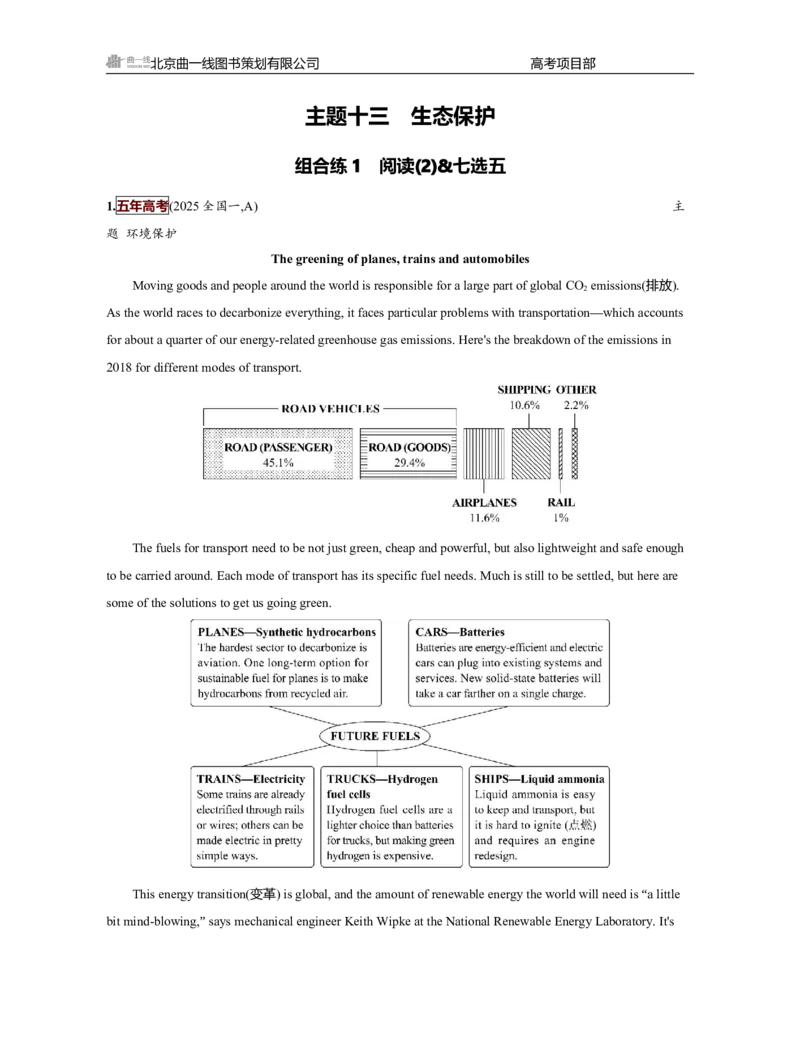
As the world races to decarbonize everything, it faces particular problems with transportation—which accounts
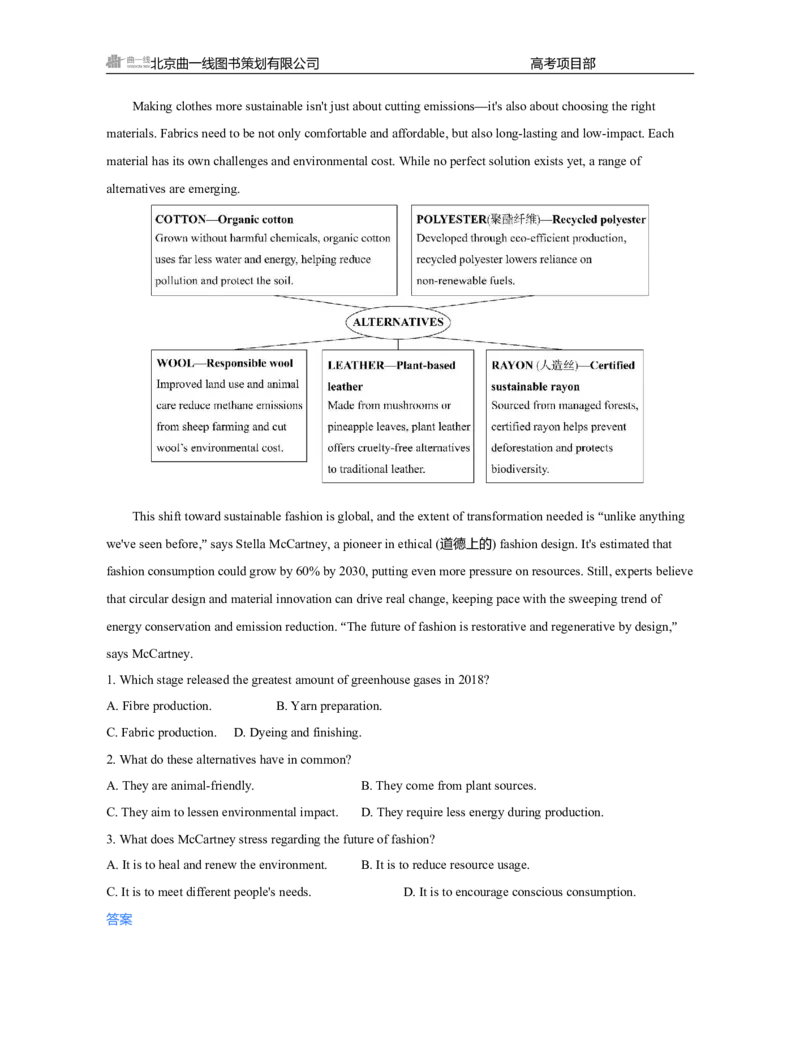
for about a quarter of our energy-related greenhouse gas emissions. Here's the breakdown of the emissions in
2018 for different modes of transport.
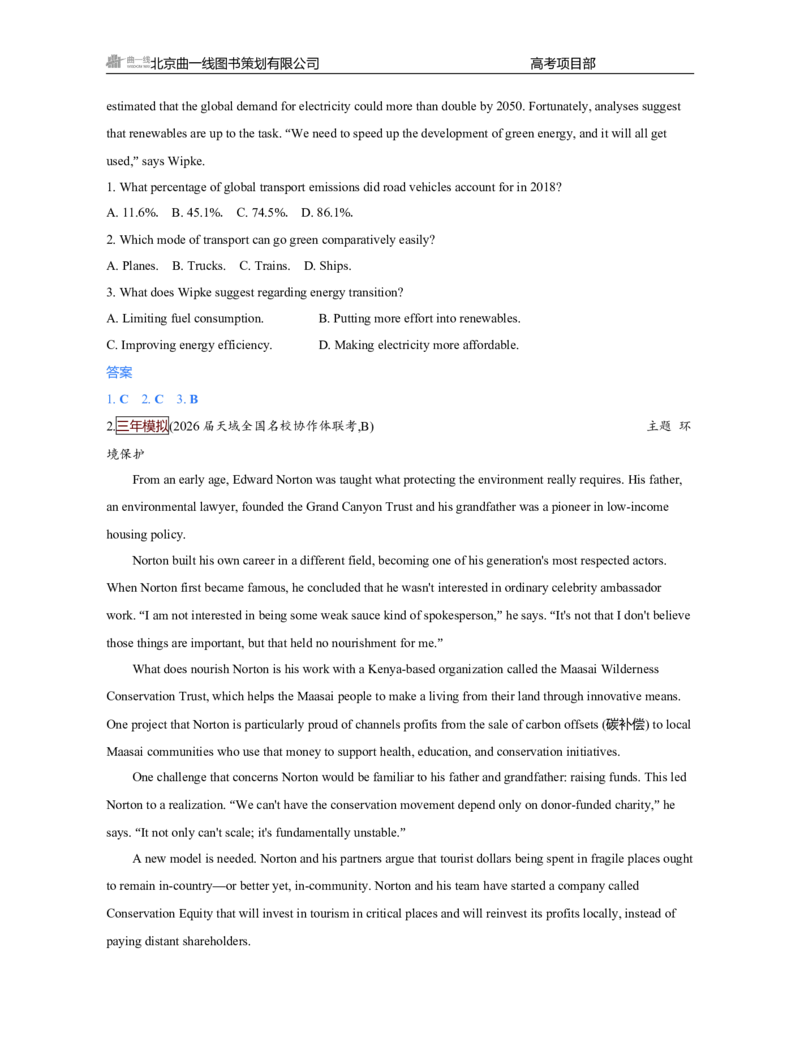
The fuels for transport need to be not just green, cheap and powerful, but also lightweight and safe enough
to be carried around. Each mode of transport has its specific fuel needs. Much is still to be settled, but here are
some of the solutions to get us going green.
This energy transition(变革) is global, and the amount of renewable energy the world will need is “a little
bit mind-blowing,” says mechanical engineer Keith Wipke at the National Renewable Energy Laboratory. It's北京曲一线图书策划有限公司 高考项目部
estimated that the global demand for electricity could more than double by 2050. Fortunately, analyses suggest
that renewables are up to the task. “We need to speed up the development of green energy, and it will all get
used,” says Wipke.
1. What percentage of global transport emissions did road vehicles account for in 2018?
A. 11.6%. B. 45.1%. C. 74.5%. D. 86.1%.
2. Which mode of transport can go green comparatively easily?
A. Planes. B. Trucks. C. Trains. D. Ships.
3. What does Wipke suggest regarding energy transition?
A. Limiting fuel consumption. B. Putting more effort into renewables.
C. Improving energy efficiency. D. Making electricity more affordable.
答案
1. C 2. C 3. B
2.三年模拟(2026届天域全国名校协作体联考,B) 主题 环
境保护
From an early age, Edward Norton was taught what protecting the environment really requires. His father,
an environmental lawyer, founded the Grand Canyon Trust and his grandfather was a pioneer in low-income
housing policy.
Norton built his own career in a different field, becoming one of his generation's most respected actors.
When Norton first became famous, he concluded that he wasn't interested in ordinary celebrity ambassador
work. “I am not interested in being some weak sauce kind of spokesperson,” he says. “It's not that I don't believe
those things are important, but that held no nourishment for me.”
What does nourish Norton is his work with a Kenya-based organization called the Maasai Wilderness
Conservation Trust, which helps the Maasai people to make a living from their land through innovative means.
One project that Norton is particularly proud of channels profits from the sale of carbon offsets (碳补偿) to local
Maasai communities who use that money to support health, education, and conservation initiatives.
One challenge that concerns Norton would be familiar to his father and grandfather: raising funds. This led
Norton to a realization. “We can't have the conservation movement depend only on donor-funded charity,” he
says. “It not only can't scale; it's fundamentally unstable.”
A new model is needed. Norton and his partners argue that tourist dollars being spent in fragile places ought
to remain in-country—or better yet, in-community. Norton and his team have started a company called
Conservation Equity that will invest in tourism in critical places and will reinvest its profits locally, instead of
paying distant shareholders.北京曲一线图书策划有限公司 高考项目部
Norton is optimistic about the model's prospects. He says, “I think what we are doing has no previous
example to follow. The needs of people are not going to take a lower priority to the spiritual value of nature. If
protecting and restoring nature can't produce a stronger and more reliable economy, the effort will fail.”
1. How does Norton feel about being a typical celebrity spokesperson?
A. Enthusiastic. B. Tolerant. C. Dissatisfied. D. Confused.
2. What is Norton's main concern about the conservation movement?
A. Expansion of its public influence.
B. Lack of a stable source of funding.
C. Failure to meet the needs of local communities.
D. Repetition of the faults of previous generations.
3. What is special about Norton's new model of conservation?
A. Downplaying the value of nature.
B. Raising funds from distant donors.
C. Focusing on local children's education.
D. Benefiting local economic development.
4. Which of the following words best describe Norton?
A. Confident and honest. B. Generous and talented.
C. Practical and pioneering. D. Ambitious and conventional.
答案
1. C 2. B 3. D 4. C
3.五年高考(2024新课标Ⅱ) 主
题 过度旅游
Overtourism Is For Real: How Can You Help?
Travel promotes understanding, expands our minds, makes us better people, and boosts local economies and
communities, but the rapid growth of travel has led to overtourism in certain regions and destinations. 1 .
Certainly not. The loss of what travel offers would be unacceptable in today's world. Here are some tips on
making wise decisions to minimize pressure on the places we visit and improve our experience.
•Choose mindfully. Overvisited destinations are that way for a reason: they're special. With so many online
posts featuring the same places, it's easy to feel like you're missing out. Go somewhere only when the landscape,
culture or food deeply draws you. 2.
•Get creative. The best way to ease pressure on over-touristed destinations is to go somewhere else. Though
overtourism is described as a problem affecting the entire world, it's actually concentrated to a small number of北京曲一线图书策划有限公司 高考项目部
extremely popular spots. That means you have tons of less-visited options to choose from. 3 . Why not try
a regional alternative or check out a popular destination's lesser-known sights?
• 4 . Minimize impact and maximize experience by skipping major holidays or rush hour. You'll
compete with fewer tourists, save money, experience a different side of a popular place, and boost the economy
when tourism is traditionally slower.
Visiting a place that others call home is a privilege(荣幸). Do your part to preserve what makes a
destination special in the first place. 5 . You may be amazed how much closer you'll feel to the people
there.
A. Visit during off-peak times.
B. So, should we stop traveling?
C. Travel for you and no one else.
D. Can overtourism be avoided then?
E. You can still find relatively undiscovered places.
F. You'll find yourself virtually alone, or close to it.
G. Consider giving back to the communities you're visiting.
答案
1. B 2. C 3. E 4. A 5. G
组合练2 阅读(2)&语法填空
1.三年模拟(2026届山东青岛开学考,A) 主题
环境保护
Producing and consuming clothing is a major source of global CO emissions (排放). The fashion industry
2
is estimated to account for 8% to 10% of global greenhouse gas emissions—more than all international flights
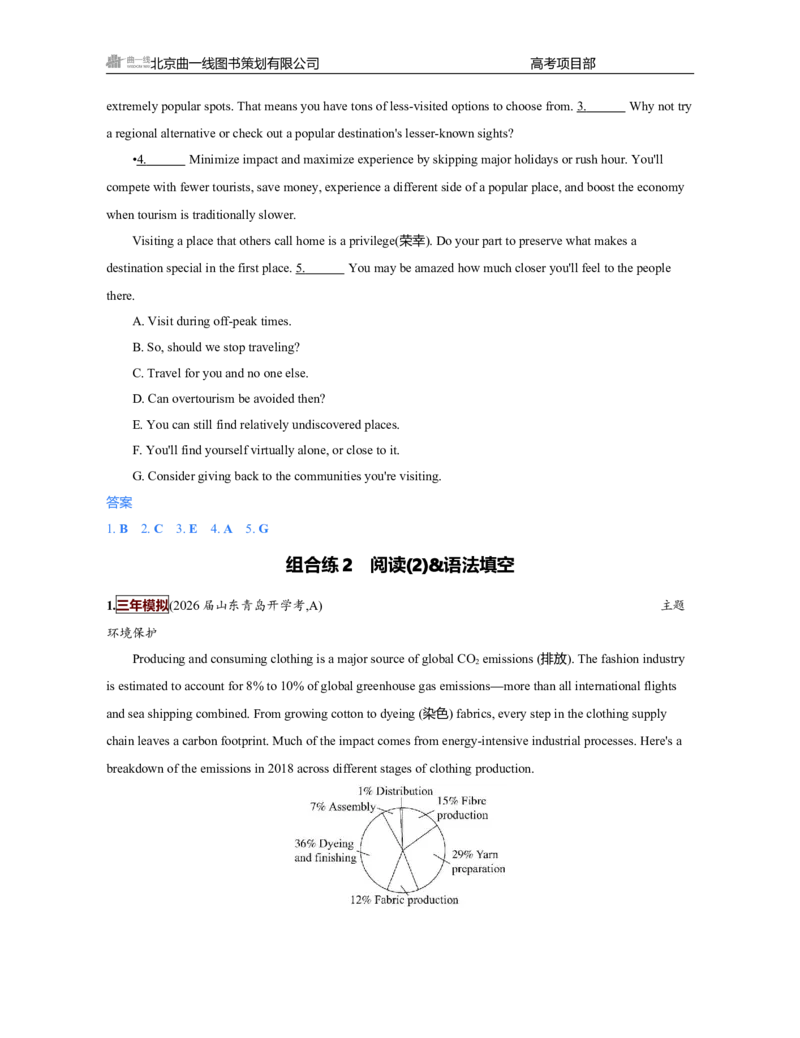
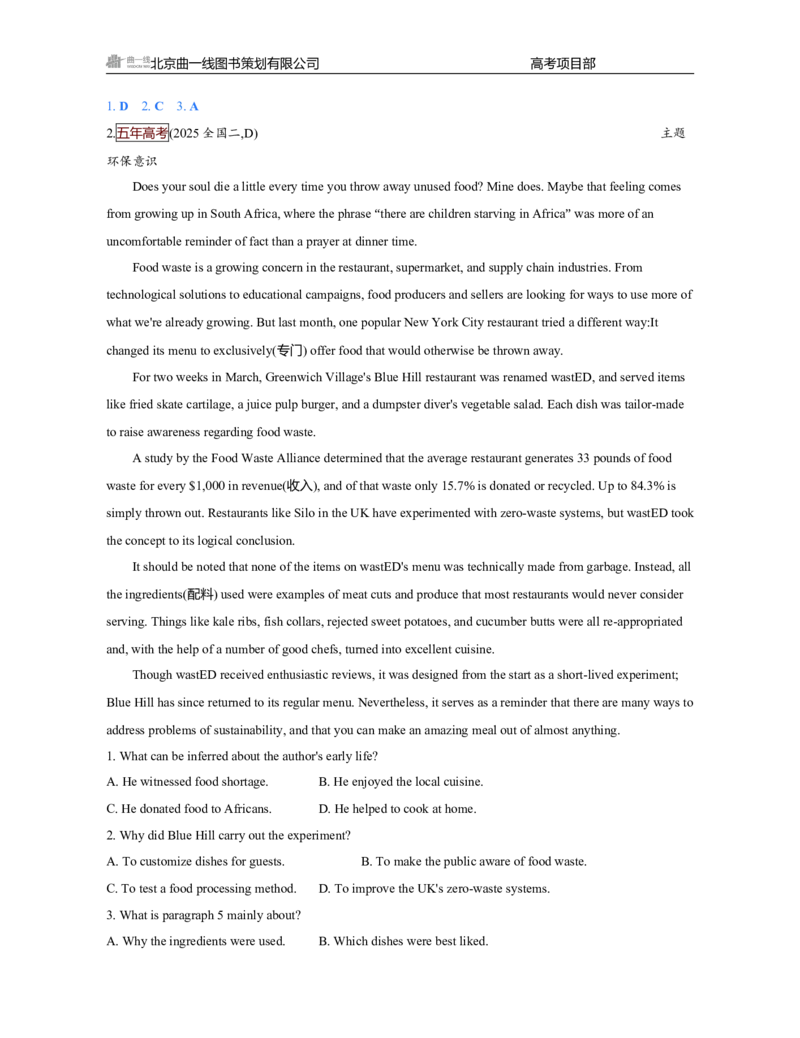
and sea shipping combined. From growing cotton to dyeing (染色) fabrics, every step in the clothing supply
chain leaves a carbon footprint. Much of the impact comes from energy-intensive industrial processes. Here's a
breakdown of the emissions in 2018 across different stages of clothing production.北京曲一线图书策划有限公司 高考项目部
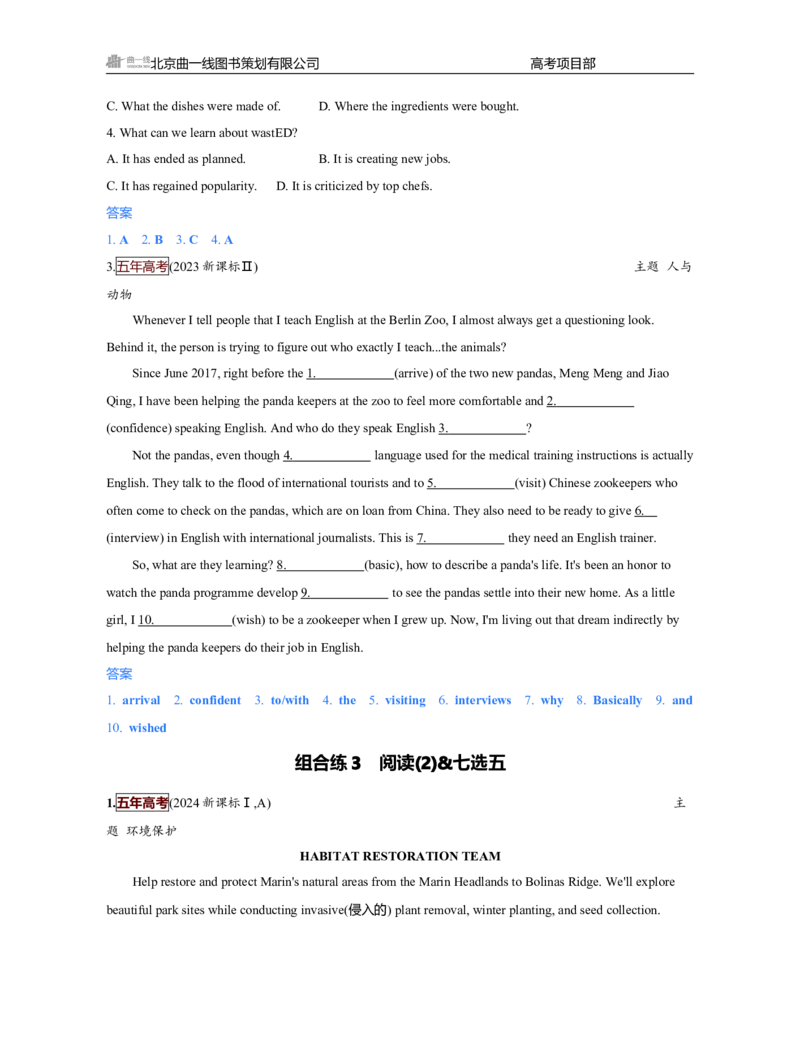
Making clothes more sustainable isn't just about cutting emissions—it's also about choosing the right
materials. Fabrics need to be not only comfortable and affordable, but also long-lasting and low-impact. Each
material has its own challenges and environmental cost. While no perfect solution exists yet, a range of
alternatives are emerging.
This shift toward sustainable fashion is global, and the extent of transformation needed is “unlike anything
we've seen before,” says Stella McCartney, a pioneer in ethical (道德上的) fashion design. It's estimated that
fashion consumption could grow by 60% by 2030, putting even more pressure on resources. Still, experts believe
that circular design and material innovation can drive real change, keeping pace with the sweeping trend of
energy conservation and emission reduction. “The future of fashion is restorative and regenerative by design,”
says McCartney.
1. Which stage released the greatest amount of greenhouse gases in 2018?
A. Fibre production. B. Yarn preparation.
C. Fabric production. D. Dyeing and finishing.
2. What do these alternatives have in common?
A. They are animal-friendly. B. They come from plant sources.
C. They aim to lessen environmental impact. D. They require less energy during production.
3. What does McCartney stress regarding the future of fashion?
A. It is to heal and renew the environment. B. It is to reduce resource usage.
C. It is to meet different people's needs. D. It is to encourage conscious consumption.
答案北京曲一线图书策划有限公司 高考项目部
1. D 2. C 3. A
2.五年高考(2025全国二,D) 主题
环保意识
Does your soul die a little every time you throw away unused food? Mine does. Maybe that feeling comes
from growing up in South Africa, where the phrase “there are children starving in Africa” was more of an
uncomfortable reminder of fact than a prayer at dinner time.
Food waste is a growing concern in the restaurant, supermarket, and supply chain industries. From
technological solutions to educational campaigns, food producers and sellers are looking for ways to use more of
what we're already growing. But last month, one popular New York City restaurant tried a different way:It
changed its menu to exclusively(专门) offer food that would otherwise be thrown away.
For two weeks in March, Greenwich Village's Blue Hill restaurant was renamed wastED, and served items
like fried skate cartilage, a juice pulp burger, and a dumpster diver's vegetable salad. Each dish was tailor-made
to raise awareness regarding food waste.
A study by the Food Waste Alliance determined that the average restaurant generates 33 pounds of food
waste for every $1,000 in revenue(收入), and of that waste only 15.7% is donated or recycled. Up to 84.3% is
simply thrown out. Restaurants like Silo in the UK have experimented with zero-waste systems, but wastED took
the concept to its logical conclusion.
It should be noted that none of the items on wastED's menu was technically made from garbage. Instead, all
the ingredients(配料) used were examples of meat cuts and produce that most restaurants would never consider
serving. Things like kale ribs, fish collars, rejected sweet potatoes, and cucumber butts were all re-appropriated
and, with the help of a number of good chefs, turned into excellent cuisine.
Though wastED received enthusiastic reviews, it was designed from the start as a short-lived experiment;
Blue Hill has since returned to its regular menu. Nevertheless, it serves as a reminder that there are many ways to
address problems of sustainability, and that you can make an amazing meal out of almost anything.
1. What can be inferred about the author's early life?
A. He witnessed food shortage. B. He enjoyed the local cuisine.
C. He donated food to Africans. D. He helped to cook at home.
2. Why did Blue Hill carry out the experiment?
A. To customize dishes for guests. B. To make the public aware of food waste.
C. To test a food processing method. D. To improve the UK's zero-waste systems.
3. What is paragraph 5 mainly about?
A. Why the ingredients were used. B. Which dishes were best liked.北京曲一线图书策划有限公司 高考项目部
C. What the dishes were made of. D. Where the ingredients were bought.
4. What can we learn about wastED?
A. It has ended as planned. B. It is creating new jobs.
C. It has regained popularity. D. It is criticized by top chefs.
答案
1. A 2. B 3. C 4. A
3.五年高考(2023新课标Ⅱ) 主题 人与
动物
Whenever I tell people that I teach English at the Berlin Zoo, I almost always get a questioning look.
Behind it, the person is trying to figure out who exactly I teach...the animals?
Since June 2017, right before the 1 . (arrive) of the two new pandas, Meng Meng and Jiao
Qing, I have been helping the panda keepers at the zoo to feel more comfortable and 2 .
(confidence) speaking English. And who do they speak English 3 . ?
Not the pandas, even though 4 . language used for the medical training instructions is actually
English. They talk to the flood of international tourists and to 5 . (visit) Chinese zookeepers who
often come to check on the pandas, which are on loan from China. They also need to be ready to give 6 .
(interview) in English with international journalists. This is 7 . they need an English trainer.
So, what are they learning? 8 . (basic), how to describe a panda's life. It's been an honor to
watch the panda programme develop 9 . to see the pandas settle into their new home. As a little
girl, I 10 . (wish) to be a zookeeper when I grew up. Now, I'm living out that dream indirectly by
helping the panda keepers do their job in English.
答案
1. arrival 2. confident 3. to/with 4. the 5. visiting 6. interviews 7. why 8. Basically 9. and
10. wished
组合练3 阅读(2)&七选五
1.五年高考(2024新课标Ⅰ,A) 主
题 环境保护
HABITAT RESTORATION TEAM
Help restore and protect Marin's natural areas from the Marin Headlands to Bolinas Ridge. We'll explore
beautiful park sites while conducting invasive(侵入的) plant removal, winter planting, and seed collection.北京曲一线图书策划有限公司 高考项目部
Habitat Restoration Team volunteers play a vital role in restoring sensitive resources and protecting endangered
species across the ridges and valleys.
GROUPS
Groups of five or more require special arrangements and must be confirmed in advance. Please review the
List of Available Projects and fill out the Group Project Request Form.
AGE, SKILLS, WHAT TO BRING
Volunteers aged 10 and over are welcome. Read our Youth Policy Guidelines for youth under the age of 15.
Bring your completed Volunteer Agreement Form. Volunteers under the age of 18 must have the
parent/guardian approval section signed.
We'll be working rain or shine. Wear clothes that can get dirty. Bring layers for changing weather and a
raincoat if necessary.
Bring a personal water bottle, sunscreen, and lunch.
No experience necessary. Training and tools will be provided. Fulfills(满足) community service
requirements.
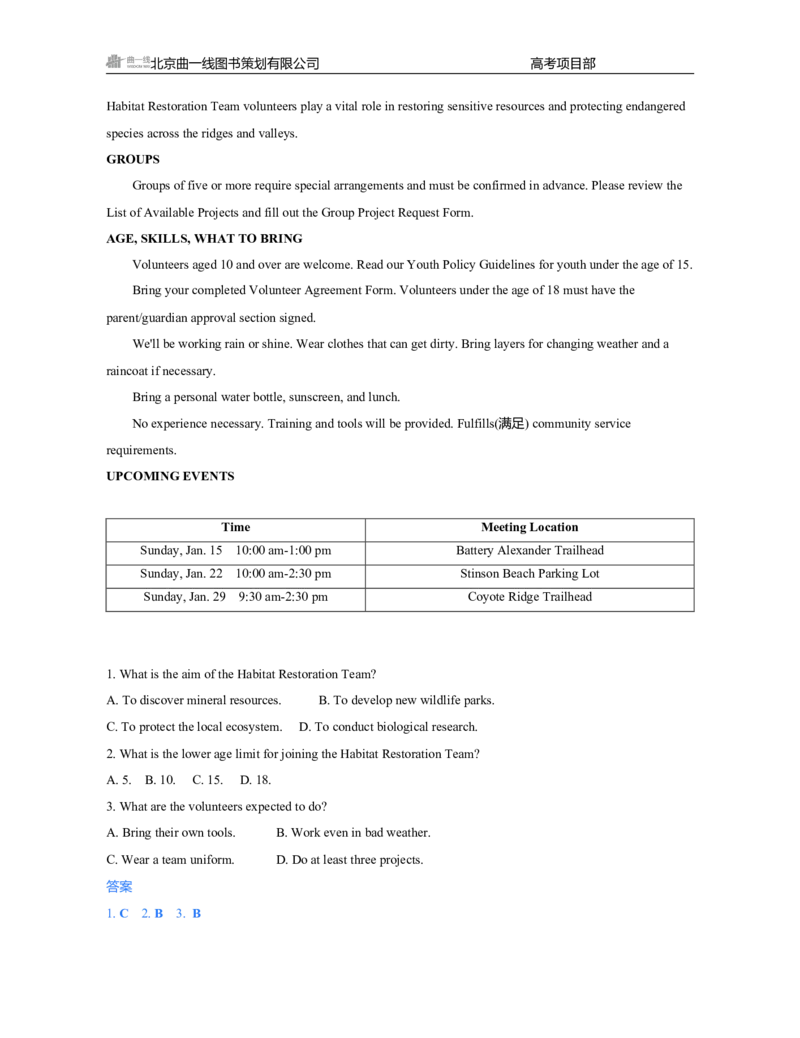
UPCOMING EVENTS
Time Meeting Location
Sunday, Jan. 15 10:00 am-1:00 pm Battery Alexander Trailhead
Sunday, Jan. 22 10:00 am-2:30 pm Stinson Beach Parking Lot
Sunday, Jan. 29 9:30 am-2:30 pm Coyote Ridge Trailhead
1. What is the aim of the Habitat Restoration Team?
A. To discover mineral resources. B. To develop new wildlife parks.
C. To protect the local ecosystem. D. To conduct biological research.
2. What is the lower age limit for joining the Habitat Restoration Team?
A. 5. B. 10. C. 15. D. 18.
3. What are the volunteers expected to do?
A. Bring their own tools. B. Work even in bad weather.
C. Wear a team uniform. D. Do at least three projects.
答案
1. C 2. B 3. B北京曲一线图书策划有限公司 高考项目部
2.五年高考(2025全国一,D) 主题
人与环境
Microplastics have become a common source of pollution across the Earth—they have settled in the deep
sea and on the Himalayas, stuck inside volcanic rocks, filled the stomachs of seabirds and even fallen in fresh
Antarctic snow. They are even appearing inside humans.
Now, new research suggests that a simple, cheap measure may significantly reduce the level of
microplastics in water from your tap(水龙头): boiling and filtering(过滤) it. In a study published Wednesday in
Environmental Science & Technology Letters, researchers from China found that boiling tap water for just five
minutes—then filtering it after it cools—could remove at least 80 percent of its microplastics.
Crucially, this process relies on the water containing enough calcium carbonate(碳酸钙) to trap the plastics.
In the study, boiling hard water containing 300 milligrams of calcium carbonate led to an almost 90 percent drop
in plastics. But in samples with less than 60 milligrams of calcium carbonate, boiling reduced the level of
plastics by just 25 percent. Additionally, the research didn't include all types of plastics. The team focused only
on three common types—polystyrene, polyethylene and polypropylene—and they didn't study other chemicals
previously found in water such as vinyl chloride.
Still, the findings show a potential path forward for reducing microplastic exposure—a task that's becoming
increasingly difficult. Even bottled water, scientists found earlier this year, contains 10 to 1,000 times more
microplastics than originally thought.
Scientists are still trying to determine how harmful microplastics are—but what they do know has raised
concerns. The new study suggests boiling tap water could be a tool to limit intake. “The way they demonstrated
how microplastics were trapped through the boiling process was nice,” Caroline Gauchotte-Lindsay, an
environmental engineer at the University of Glasgow in Scotland who was not involved in the research, tells
New Scientist. “We should be looking into upgrading drinking water treatment plants so they remove
microplastics.”
1. How does the author present the issue in the first paragraph?
A. By quoting an expert. B. By defining a concept.
C. By giving examples. D. By providing statistics.
2. What determines the effectiveness of trapping microplastics in water?
A. The hardness of water. B. The length of cooling time.
C. The frequency of filtering. D. The type of plastic in water.
3. What does the author try to illustrate by mentioning bottled water in paragraph 4?
A. The importance of plastic recycling. B. The severity of the microplastic problem.北京曲一线图书策划有限公司 高考项目部
C. The danger in overusing pure water. D. The difficulty in treating polluted water.
4. What is Gauchotte-Lindsay's suggestion about?
A. Choice of new research methods.
B. Possible direction for further study.
C. Need to involve more researchers.
D. Potential application of the findings.
答案
1. C 2. A 3. B 4. D
3.五年高考(2021全国甲) 主题
环境保护
Swap, Don't Shop!
You keep hearing about recycling, right?But it doesn't end with bottles, cans, and paper. Clothing takes a
huge amount of natural resources(资源)to make, and buying loads of new clothing(or throwing out old
clothing)is not healthy for the environment. So what to do with all those perfectly-good-but-you're-maybe-a-
little-sick-of-them clothes piled on your bedroom floor? 1 . . It's the best way to get rid of your used
clothes, score clothes from your friends, and have a party all at the same time.
A successful swap depends on the selection of clothes, the organization of the event, and, obviously, how
much fun is had. It's really easy to do! Here are a few pointers.
•Invite 5-10 people so you have a nice selection. 2 . , and there may not be enough things to choose
from;more than that, and it becomes uncontrollable.
• 3 . . They should also prepare plenty of reusable bags to carry their “new” clothes home.
•Put different types of clothing on different surfaces in the room. 4 . . Place a few mirrors around your
room so people can see how things look when they try them on. One of the ground rules of the swap should be
that everyone must try on the clothes before they take them—things always look different when you put them
on.
•Set a starting time. Maybe you say “go,” or turn on a certain song, or whatever. 5 . . And don't forget
to put out some cookies and fruits. Remember, it's a party!
A. Less people than that
B. Hold a clothing swap北京曲一线图书策划有限公司 高考项目部
C. If two people are competing
D. Just keep music playing throughout
E. Donate whatever clothes are left over
F. Have everyone put their clothes in the right spots
G. Tell everyone to bring clean clothes in good condition
答案
1. B 2. A 3. G 4. F 5. D
组合练4 阅读(2)&语法填空
1.三年模拟(2026届山东潍坊开学考,B) 主题
环境保护
For twenty years, the internet has been my second home while communicating science. Recently, I came
across an image: a crying Earth surrounded by fallen trees, declaring, “No intelligent species would destroy their
own home.” This image troubled me deeply. I refuse to let my eight-year-old son believe humans are stupid or
evil—because it's obviously untrue. But I often find myself quite lonely. I'm wondering if, perhaps, there are
other folks out there who feel the same as I do.
We didn't cause climate change through being stupid, but through being extremely smart. Our ancestors
burned coal to solve urgent problems: growing more food, heating and lighting homes. We want to provide a
good life for ourselves and our children. The results have been astonishing. In the U.S. in 1895, one quarter
of people died before age five. Today it's under 1 percent, and we will keep pushing until it hits zero. Imagine
the essays Ben Franklin or Mark Twain would write about this level of advancement. How would they keep tears
from their eyes if they saw what we've achieved?
So much of that achievement has been based on the fossil fuels we've burned to generate it, whether
coal, natural gas or oil. We've learned that this harms both the environment and people, and to our credit we
aren't always bad at addressing this. It was not long ago that London cleaned its smoke-blackened air. When rain
becomes acidic, the world changes its policies. When harm is done locally, we tend to be pretty good at cleaning
things up. Here's where I feel hope: we have already done this, and we know it is possible.北京曲一线图书策划有限公司 高考项目部
I don't want my son growing up thinking that his species is in some way evil. I want him thinking
humans are problem solvers, and whatever strategies we take to fix global warming will create more new
problems, too. This is a pretty normal story for intelligent species.
1. How did the author feel seeing the picture online?
A. Disturbed. B. Ashamed. C. Frightened. D. Confused.
2. What is implied by mentioning Ben Franklin and Mark Twain?
A. The warning of the warming Earth. B. The progress in society.
C. The praise for human modesty. D. The demand for greener energy.
3. Why does the author feel hopeful about humans?
A. We will make more policies. B. We have discovered more fossil fuels.
C. We highly value the role of the earth. D. We can repair the damage to the environment.
4. What does the underlined word “story” refer to in the last paragraph?
A. The cycle of causing and tackling problems. B. The ability to create a bright future.
C. The evil nature of human beings. D. The positive attitude to life.
答案
1. A 2. B 3. D 4. A
2.五年高考(2024新课标Ⅰ,D) 主题 人
与动植物
In the race to document the species on Earth before they go extinct, researchers and citizen scientists have
collected billions of records. Today, most records of biodiversity are often in the form of photos, videos, and
other digital records. Though they are useful for detecting shifts in the number and variety of species in an area, a
new Stanford study has found that this type of record is not perfect.
“With the rise of technology it is easy for people to make observations of different species with the aid of a
mobile application,” said Barnabas Daru, who is lead author of the study and assistant professor of biology in the
Stanford School of Humanities and Sciences. “These observations now outnumber the primary data that comes
from physical specimens(标本), and since we are increasingly using observational data to investigate how
species are responding to global change, I wanted to know: Are they usable?”
Using a global dataset of 1.9 billion records of plants, insects, birds, and animals, Daru and his team tested
how well these data represent actual global biodiversity patterns.
“We were particularly interested in exploring the aspects of sampling that tend to bias(使有偏差) data, like
the greater likelihood of a citizen scientist to take a picture of a flowering plant instead of the grass right next to
it,” said Daru.北京曲一线图书策划有限公司 高考项目部
Their study revealed that the large number of observation-only records did not lead to better global
coverage. Moreover, these data are biased and favor certain regions, time periods, and species. This makes sense
because the people who get observational biodiversity data on mobile devices are often citizen scientists
recording their encounters with species in areas nearby. These data are also biased toward certain species with
attractive or eye-catching features.
What can we do with the imperfect datasets of biodiversity?
“Quite a lot,” Daru explained. “Biodiversity apps can use our study results to inform users of oversampled
areas and lead them to places—and even species—that are not well-sampled. To improve the quality of
observational data, biodiversity apps can also encourage users to have an expert confirm the identification of
their uploaded image.”
1. What do we know about the records of species collected now?
A. They are becoming outdated. B. They are mostly in electronic form.
C. They are limited in number. D. They are used for public exhibition.
2. What does Daru's study focus on?
A. Threatened species. B. Physical specimens.
C. Observational data. D. Mobile applications.
3. What has led to the biases according to the study?
A. Mistakes in data analysis. B. Poor quality of uploaded pictures.
C. Improper way of sampling. D. Unreliable data collection devices.
4. What is Daru's suggestion for biodiversity apps?
A. Review data from certain areas. B. Hire experts to check the records.
C. Confirm the identity of the users. D. Give guidance to citizen scientists.
答案
1. B 2. C 3. C 4. D
3.五年高考(2024全国甲) 主题
人与环境
Although parks of all sizes and types exist at any level,the national parks,in particular,tend 1 .
(catch)our attention because of their large size and variety.They are 2 . (treasure) of American
heritage(遗产). How did the national park system come about?北京曲一线图书策划有限公司 高考项目部
On a cool,starry night in mid-September 1870,four men relaxed before a campfire along the Firehole River
in 3 . is now northwestern Wyoming. They 4 . (be) part of a 15-member exploring
party that had spent almost five awesome weeks in witness of the natural beauties there.
What should 5 . (do) with such a beautiful place? They wondered out loud. This area, with 6.
(it) unique and breathtaking natural beauty, must be well preserved 7 . all people of the nation to
enjoy—as a national park. They all agreed and vowed (承诺) to promote the idea at the 8 .
(complete) of their journey. Their promotional work paid off. Two years later,18 years before Wyoming became
a state, Yellowstone became the first national park in the United States and the world. Yellowstone was the 9 .
(large) United States national park—2.2 million acres—until Wrangell-Saint Elias in southern Alaska, 10 .
became a national monument in 1978,took the honors as a national park in 1980 with 12.3 million acres.
答案
1. to catch 2. treasures 3. what 4. were 5. be done 6. its 7. for 8. completion 9. largest 10.
which
组合练5 阅读(2)&语法填空
1.五年高考(2022新高考Ⅰ,B) 主题
环境保护
Like most of us, I try to be mindful of food that goes to waste. The arugula(芝麻菜) was to make a nice
green salad, rounding out a roast chicken dinner. But I ended up working late. Then friends called with a dinner
invitation. I stuck the chicken in the freezer. But as days passed, the arugula went bad. Even worse, I had
unthinkingly bought way too much;I could have made six salads with what I threw out.
In a world where nearly 800 million people a year go hungry, “food waste goes against the moral grain,” as
Elizabeth Royte writes in this month's cover story. It's jaw-dropping how much perfectly good food is thrown
away—from “ugly” (but quite eatable) vegetables rejected by grocers to large amounts of uneaten dishes thrown
into restaurant garbage cans.
Producing food that no one eats wastes the water, fuel, and other resources used to grow it. That makes food
waste an environmental problem. In fact, Royte writes, “if food waste were a country, it would be the third
largest producer of greenhouse gases in the world.”
If that's hard to understand, let's keep it as simple as the arugula at the back of my refrigerator. Mike Curtin
sees my arugula story all the time—but for him, it's more like 12 boxes of donated strawberries nearing their last
days. Curtin is CEO of DC Central Kitchen in Washington, D.C., which recovers food and turns it into healthy
meals. Last year it recovered more than 807,500 pounds of food by taking donations and collecting blemished(有北京曲一线图书策划有限公司 高考项目部
瑕疵的) produce that otherwise would have rotted(腐烂) in fields. And the strawberries? Volunteers will wash,
cut, and freeze or dry them for use in meals down the road.
Such methods seem obvious, yet so often we just don't think. “Everyone can play a part in reducing waste,
whether by not purchasing more food than necessary in your weekly shopping or by asking restaurants to not
include the side dish you won't eat,” Curtin says.
1. What does the author want to show by telling the arugula story?
A. We pay little attention to food waste. B. We waste food unintentionally at times.
C. We waste more vegetables than meat. D. We have good reasons for wasting food.
2. What is a consequence of food waste according to the text?
A. Moral decline. B. Environmental harm.
C. Energy shortage. D. Worldwide starvation.
3. What does Curtin's company do?
A. It produces kitchen equipment. B. It turns rotten arugula into clean fuel.
C. It helps local farmers grow fruits. D. It makes meals out of unwanted food.
4. What does Curtin suggest people do?
A. Buy only what is needed. B. Reduce food consumption.
C. Go shopping once a week. D. Eat in restaurants less often.
答案
1. B 2. B 3. D 4. A
2.五年高考(2021全国乙,C) 主题
环境保护
You've heard that plastic is polluting the oceans—between 4.8 and 12.7 million tonnes enter ocean
ecosystems every year. But does one plastic straw or cup really make a difference? Artist Benjamin Von Wong
wants you to know that it does. He builds massive sculptures out of plastic garbage, forcing viewers to re-
examine their relationship to single-use plastic products.
At the beginning of the year, the artist built a piece called “Strawpocalypse,”a pair of 10-foot-tall plastic
waves, frozen mid-crash. Made of 168,000 plastic straws collected from several volunteer beach cleanups, the
sculpture made its first appearance at the Estella Place shopping center in Ho Chi Minh City, Vietnam.
Just 9% of global plastic waste is recycled. Plastic straws are by no means the biggest source(来源) of
plastic pollution, but they've recently come under fire because most people don't need them to drink with and,
because of their small size and weight, they cannot be recycled. Every straw that's part of Von Wong's artwork北京曲一线图书策划有限公司 高考项目部
likely came from a drink that someone used for only a few minutes. Once the drink is gone,the straw will take
centuries to disappear.
In a piece from 2018,Von Wong wanted to illustrate(说明) a specific statistic: Every 60 seconds,a
truckload's worth of plastic enters the ocean. For this work, titled “Truckload of Plastic,” Von Wong and a group
of volunteers collected more than 10,000 pieces of plastic, which were then tied together to look like they'd been
dumped(倾倒) from a truck all at once.
Von Wong hopes that his work will also help pressure big companies to reduce their plastic footprint.
1. What are Von Wong's artworks intended for?
A. Beautifying the city he lives in. B. Introducing eco-friendly products.
C. Drawing public attention to plastic waste. D. Reducing garbage on the beach.
2. Why does the author discuss plastic straws in paragraph 3?
A. To show the difficulty of their recycling. B. To explain why they are useful.
C. To voice his views on modern art. D. To find a substitute for them.
3. What effect would “Truckload of Plastic” have on viewers?
A. Calming. B. Disturbing.
C. Refreshing. D. Challenging.
4. Which of the following can be the best title for the text?
A. Artists' Opinions on Plastic Safety
B. Media Interest in Contemporary Art
C. Responsibility Demanded of Big Companies
D. Ocean Plastics Transformed into Sculptures
答案
1. C 2. A 3. B 4. D
3.五年高考(2022浙江一考) 主题
环境保护
Kim Cobb, a professor at the Georgia Institute of Technology in Atlanta, is one of a small but growing
minority of academics 1 . are cutting back on their air travel because of climate change. Travelling
to conferences, lectures, workshops, and the like—frequently by plane— 2 . (view) as important for
scientists to get together and exchange information. But Cobb and others 3 . (be) now questioning
that idea—pushing conferences to provide more chances to participate remotely and 4 . (change)
their personal behavior to do their part in dealing with the climate change crisis. On a website called No Fly北京曲一线图书策划有限公司 高考项目部
Climate Sci, for example, 5 . (rough) 200 academics—many of them climate scientists— 6 .
(promise) to fly as little as possible since the effort started two years ago.
Cobb, for her part, started to ask conference organizers who invited her to speak 7 . she could
do so remotely; about three-quarters of 8 . time, they agreed. When the answer was no, she
declined the 9 . (invite). That approach brought Cobb's air travel last year down by 75%, and she
plans 10 . (continue) the practice. “It has been fairly rewarding,” she says—“a really positive
change.”
答案
1. who/that 2. is viewed/has been viewed 3. are 4. changing 5. roughly 6. have promised 7.
whether/if 8. the 9. invitation 10. to continue
组合练6 阅读(2)&应用文写作
1.五年高考(2021新高考Ⅱ,B) 主题
人与动物
I have worked as a keeper at the National Zoo for 11 years. Spot and Stripe are the first tiger cubs(幼兽)
that have ever been born here. Globally, a third of Sumatran cubs in zoos don't make it to adulthood, so I decided
to give them round-the-clock care at home.
I've got two children—the younger one, Kynan, was extremely happy about the tigers arriving—but all of
us really looked forward to being part of their lives and watching them grow. I wasn't worried about bringing
them into my home with my wife and kids. These were cubs. They weighed about 2.5 kg and were so small that
there was absolutely no risk.
As they grew more mobile, we let them move freely around the house during the day, but when we were
asleep we had to contain them in a large room, otherwise they'd get up to mischief . We'd come down in the
morning to find they'd turned the room upside down, and left it looking like a zoo.
Things quickly got very intense due to the huge amount of energy required to look after them. There were
some tough times and I just felt extremely tired. I was grateful that my family was there to help. We had to have
a bit of a production line going, making up “tiger milk”, washing baby bottles, and cleaning the floors.
When Spot and Stripe were four months old, they were learning how to open doors and jump fences, and we
knew it really was time for them to go. It was hard for us to finally part with them. For the first few days, Kynan
was always a bit disappointed that the cubs weren't there.
I'm not sad about it. I'm hands-on with them every day at the zoo, and I do look back very fondly on the
time that we had them.北京曲一线图书策划有限公司 高考项目部
1. Why did the author bring the tiger cubs home?
A. To ensure their survival.
B. To observe their differences.
C. To teach them life skills.
D. To let them play with his kids.
2. What do the underlined words “get up to mischief” mean in paragraph 3?
A. Behave badly. B. Lose their way.
C. Sleep soundly. D. Miss their mom.
3. What did the author think of raising the tiger cubs at home?
A. Boring. B. Tiring. C. Costly. D. Risky.
4. Why did the author decide to send Spot and Stripe back to the zoo?
A. They frightened the children.
B. They became difficult to contain.
C. They annoyed the neighbours.
D. They started fighting each other.
答案
1. A 2. A 3. B 4. B
2.五年高考(2021新高考Ⅰ,C) 主
题 环境保护
When the explorers first set foot upon the continent of North America, the skies and lands were alive with
an astonishing variety of wildlife. Native Americans had taken care of these precious natural resources wisely.
Unfortunately, it took the explorers and the settlers who followed only a few decades to decimate a large part of
these resources. Millions of waterfowl(水禽) were killed at the hands of market hunters and a handful of overly
ambitious sportsmen. Millions of acres of wetlands were dried to feed and house the ever-increasing populations,
greatly reducing waterfowl habitat(栖息地).
In 1934,with the passage of the Migratory Bird Hunting Stamp Act (Act), an increasingly concerned nation
took firm action to stop the destruction of migratory(迁徙的)waterfowl and the wetlands so vital to their
survival. Under this Act, all waterfowl hunters 16 years of age and over must annually purchase and carry a
Federal Duck Stamp. The very first Federal Duck Stamp was designed by J.N. “Ding” Darling, a political
cartoonist from Des Moines, Iowa, who at that time was appointed by President Franklin Roosevelt as Director
of the Bureau of Biological Survey. Hunters willingly pay the stamp price to ensure the survival of our natural
resources.北京曲一线图书策划有限公司 高考项目部
About 98 cents of every duck stamp dollar goes directly into the Migratory Bird Conservation Fund to
purchase wetlands and wildlife habitat for inclusion into the National Wildlife Refuge System—a fact that
ensures this land will be protected and available for all generations to come. Since 1934, better than half a billion
dollars has gone into that Fund to purchase more than 5 million acres of habitat. Little wonder the Federal Duck
Stamp Program has been called one of the most successful conservation programs ever initiated.
1. What was a cause of the waterfowl population decline in North America?
A. Loss of wetlands. B. Popularity of water sports.
C. Pollution of rivers. D. Arrival of other wild animals.
2. What does the underlined word “decimate” mean in the first paragraph?
A. Acquire. B. Export.
C. Destroy. D. Distribute.
3. What is a direct result of the Act passed in 1934?
A. The stamp price has gone down.
B. The migratory birds have flown away.
C. The hunters have stopped hunting.
D. The government has collected money.
4. Which of the following is a suitable title for the text?
A. The Federal Duck Stamp Story B. The National Wildlife Refuge System
C. The Benefits of Saving Waterfowl D. The History of Migratory Bird Hunting
答案
1. A 2. C 3. D 4. A
3.三年模拟(2026届山东大联考)
说明介绍假定你是校英语俱乐部主席李华,你校将参加国际青年环保展览。你作为贵校代表,需要提
交一份以“绿色城市”为主题的英文海报,并附以简要说明,说明内容包括:
1. 海报简介(主题、设计理念等);
2. 海报要传达的信息。
注意:写作词数应为80个左右。北京曲一线图书策划有限公司 高考项目部
答案
One possible version:
This poster, designed for the International Youth Environmental Exhibition, takes “Green City” as its
theme.
In terms of design, we adopt green as the main color to symbolize nature. It includes images of green trees,
clear rivers and clean parks—these elements vividly show what a green city looks like: a place with fresh air and
reduced pollution.
The poster expresses our expectation for a more livable environment. Through it, we aim to convey a
simple message: protecting the environment is not hard. Small actions like saving water can help us build a green
city together.
组合练7 阅读(2)&应用文写作
1.五年高考(2023新课标Ⅱ,D) 主题
人与环境
As cities balloon with growth, access to nature for people living in urban areas is becoming harder to find.
If you're lucky, there might be a pocket park near where you live, but it's unusual to find places in a city that are
relatively wild.
Past research has found health and wellness benefits of nature for humans, but a new study shows that
wildness in urban areas is extremely important for human well-being.
The research team focused on a large urban park. They surveyed several hundred park-goers, asking them to
submit a written summary online of a meaningful interaction they had with nature in the park. The researchers
then examined these submissions, coding(编码) experiences into different categories. For example, one北京曲一线图书策划有限公司 高考项目部
participant's experience of “We sat and listened to the waves at the beach for a while” was assigned the
categories “sitting at beach” and “listening to waves.”
Across the 320 submissions, a pattern of categories the researchers call a “nature language” began to
emerge. After the coding of all submissions, half a dozen categories were noted most often as important to
visitors. These include encountering wildlife, walking along the edge of water, and following an established trail.
Naming each nature experience creates a usable language, which helps people recognize and take part in the
activities that are most satisfying and meaningful to them. For example, the experience of walking along the
edge of water might be satisfying for a young professional on a weekend hike in the park. Back downtown
during a workday, they can enjoy a more domestic form of this interaction by walking along a fountain on their
lunch break.
“We're trying to generate a language that helps bring the human-nature interactions back into our daily
lives. And for that to happen, we also need to protect nature so that we can interact with it,” said Peter Kahn, a
senior author of the study.
1. What phenomenon does the author describe at the beginning of the text?
A. Pocket parks are now popular. B. Wild nature is hard to find in cities.
C. Many cities are overpopulated. D. People enjoy living close to nature.
2. Why did the researchers code participant submissions into categories?
A. To compare different types of park-goers. B. To explain why the park attracts tourists.
C. To analyze the main features of the park. D. To find patterns in the visitors' summaries.
3. What can we learn from the example given in paragraph 5?
A. Walking is the best way to gain access to nature.
B. Young people are too busy to interact with nature.
C. The same nature experience takes different forms.
D. The nature language enhances work performance.
4. What should be done before we can interact with nature according to Kahn?
A. Language study. B. Environmental conservation.
C. Public education. D. Intercultural communication.
答案
1. B 2. D 3. C 4. B
2.五年高考(2023浙江一考,D) 主题
人与环境北京曲一线图书策划有限公司 高考项目部
According to the Solar Energy Industry Association, the number of solar panels installed(安装) has grown
rapidly in the past decade, and it has to grow even faster to meet climate goals. But all of that growth will take up
a lot of space, and though more and more people accept the concept of solar energy, few like large solar panels
to be installed near them.
Solar developers want to put up panels as quickly and cheaply as possible, so they haven't given much
thought to what they put under them. Often, they'll end up filling the area with small stones and using chemicals
to control weeds. The result is that many communities, especially in farming regions, see solar farms as
destroyers of the soil.
“Solar projects need to be good neighbors,” says Jordan Macknick,the head of the Innovative Site
Preparation and Impact Reductions on the Environment (InSPIRE) project. “They need to be protectors of the
land and contribute to the agricultural economy.” InSPIRE is investigating practical approaches to “low-impact”
solar development,which focuses on establishing and operating solar farms in a way that is kinder to the land.
One of the easiest low-impact solar strategies is providing habitat for pollinators (传粉昆虫).
Habitat loss, pesticide use, and climate change have caused dramatic declines in pollinator populations over
the past couple of decades, which has damaged the U.S. agricultural economy. Over 28 states have passed laws
related to pollinator habitat protection and pesticide use. Conservation organizations put out pollinator-
friendliness guidelines for home gardens, businesses, schools, cities—and now there are guidelines for solar
farms.
Over the past few years, many solar farm developers have transformed the space under their solar panels
into a shelter for various kinds of pollinators, resulting in soil improvement and carbon reduction. “These
pollinator-friendly solar farms can have a valuable impact on everything that's going on in the landscape,” says
Macknick.
1. What do solar developers often ignore?
A. The decline in the demand for solar energy.
B. The negative impact of installing solar panels.
C. The rising labor cost of building solar farms.
D. The most recent advances in solar technology.
2. What does InSPIRE aim to do?
A. Improve the productivity of local farms. B. Invent new methods for controlling weeds.
C. Make solar projects environmentally friendly. D. Promote the use of solar energy in rural areas.
3. What is the purpose of the laws mentioned in paragraph 4?
A. To conserve pollinators. B. To restrict solar development.北京曲一线图书策划有限公司 高考项目部
C. To diversify the economy. D. To ensure the supply of energy.
4. Which of the following is the best title for the text?
A. Pollinators: To Leave or to Stay B. Solar Energy: Hope for the Future
C. InSPIRE: A Leader in Agriculture D. Solar Farms: A New Development
答案
1. B 2. C 3. A 4. D
3.五年高考(2022全国甲)
倡议你校将以六月八日世界海洋日为主题,举办英语征文比赛。请你写一篇短文投稿,内容包括:
1. 海洋的重要性;
2. 保护海洋的倡议。
注意:
1. 词数100左右;
2. 短文的题目和首句已为你写好。
Our Oceans, Our Responsibility
June 8th was officially named by the UN in 2009 as World Oceans Day.
答案
One possible version:
Our Oceans, Our Responsibility
June 8th was officially named by the UN in 2009 as World Oceans Day. It aims to raise people's awareness
of protecting oceans.
Why should we protect the ocean? The reason is that it provides various benefits. To begin with, the sea is a
significant source of food. With the world population growing, we are relying on the ocean more and more for
survival. In addition, not only does the ocean produce much oxygen, but it also absorbs much carbon dioxide,
which remarkably contributes to regulating the Earth's climate. Also,vast amounts of medicinal products come
from the ocean, including ingredients that help fight cancer and heart disease.
However, the sea is being damaged. Huge as it is, it is more sensitive than we think. Thus, it is high time
that we took effective measures to protect it. Otherwise, future generations will not forgive us.北京曲一线图书策划有限公司 高考项目部
组合练8 语法填空(2)&读后续写
1.五年高考(2021新高考Ⅱ) 主题
环境保护
I've always loved the ocean. In the 1 . (seven) grade, I started volunteering at the Monterey
Bay Aquarium in California. I was upset to learn that many sea animals eat plastic garbage, 2 .
(think) it is food.
I decided to do something 3 . (educate) people about this problem. I held presentations at
schools to teach kids about plastic waste. I wanted to reach businesses too. I decided that if I learned of a
company 4 . used a lot of plastic, I'd send it an email urging it to cut back.
One day, I saw a commercial for a health-care company. People in the ad were using plastic straws(吸管). I
found the contact information of the company 5 . emailed its president. I told him how 6 .
(harm) plastic could be to the environment and asked him to consider using more eco-friendly options. I was so
7 . (excite) when he wrote back to me. He said he would make sure that the company cut its use of
plastic straws in half.
I kept going. Whenever I heard of businesses using plastic, I'd send an email. One of the biggest companies
I wrote to 8 . (be) Alaska Airlines. A company 9 . (represent) wrote back and told me
the airline was switching over 10 . plastic to paper cups on all of its 1,200 daily flights.
答案
1. seventh 2. thinking 3. to educate 4. that/which 5. and 6. harmful 7. excited 8. was 9.
representative 10. from
2.五年高考(2022新高考Ⅰ)
主题 动物保护
The Chinese government recently finalized a plan to set up a Giant Panda National Park(GPNP). 1 .
(cover) an area about three times 2 . size of Yellowstone National Park, the GPNP will be one of
the first national parks in the country. The plan will extend protection to a significant number of areas that 3 .
(be) previously unprotected, bringing many of the existing protected areas for giant pandas under one authority
4 . (increase) effectiveness and reduce inconsistencies in management.
After a three-year pilot period, the GPNP will be officially set up next year. The GPNP 5 .
(design) to reflect the guiding principle of “protecting the authenticity(原真性) and integrity of natural
ecosystems, preserving biological diversity, protecting ecological buffer zones, 6 . leaving behind
precious natural assets(资产) for future generations”. The GPNP's main goal is to improve connectivity between北京曲一线图书策划有限公司 高考项目部
separate 7 . (population) and homes of giant pandas, and 8 . (eventual) achieve a
desired level of population in the wild.
Giant pandas also serve 9 . an umbrella species, bringing protection to a host of plants and
animals in the southwestern and northwestern parts of China. The GPNP is intended to provide stronger
protection for all the species 10 . live within the Giant Panda Range and significantly improve the
health of the ecosystem in the area.
答案
1. Covering 2. the 3. were 4. to increase 5. is designed 6. and 7. populations 8. eventually
9. as 10. that
3.五年高考(2023浙江一考) 主
题 人与动物
阅读下面材料,根据其内容和所给段落开头语续写两段,使之构成一篇完整的短文。
I was invited to a cookout on an old friend's farm in western Washington. I parked my car outside the farm
and walked past a milking house which had apparently not been used in many years. A noise at a window caught
my attention, so I entered it. It was a hummingbird(蜂鸟), desperately trying to escape. She was covered in
spider-webs(蛛网) and was barely able to move her wings. She ceased her struggle the instant I picked her up.
With the bird in my cupped hand, I looked around to see how she had gotten in. The broken window glass
was the likely answer. I stuffed a piece of cloth into the hole and took her outside, closing the door securely
behind me.
When I opened my hand, the bird did not fly away; she sat looking at me with her bright eyes. I removed
the sticky spider-webs that covered her head and wings. Still, she made no attempt to fly. Perhaps she had been
struggling against the window too long and was too tired? Or too thirsty?
As I carried her up the blackberry-lined path toward my car where I kept a water bottle, she began to move.
I stopped, and she soon took wing but did not immediately fly away. Hovering(悬停), she approached within six
inches of my face. For a very long moment, this tiny creature looked into my eyes, turning her head from side to
side. Then she flew quickly out of sight.
During the cookout, I told my hosts about the hummingbird incident. They promised to fix the window. As
I was departing, my friends walked me to my car. I was standing by the car when a hummingbird flew to the
center of our group and began hovering. She turned from person to person until she came to me. She again
looked directly into my eyes, then let out a squeaking call and was gone. For a moment, all were speechless.
Then someone said, “She must have come to say good-bye.”北京曲一线图书策划有限公司 高考项目部
注意:续写词数应为 150 左右。
A few weeks later, I went to the farm again.
I was just about to leave when the hummingbird appeared.
答案
One possible version:
A few weeks later, I went to the farm again. As my car neared it, my thoughts drifted back to the moment
when I rescued the hummingbird from spider-webs. I rushed back to the deserted house. It was a great comfort
that the original hole in the window was nowhere to be found. Leaving the house, I couldn't help wondering how
she was getting on now. Had she managed to find her way back home, or was she still out there somewhere
struggling to survive?
I was just about to leave when the hummingbird appeared. A flash of movement caught my attention. I
turned around to see the same hummingbird hovering in the air. It seemed that the bird was waiting for me, and
her beady eyes were on mine as if trying to convey some deep and unspoken gratitude. I felt a surge of relief and
awe at the sight of this sound and grateful creature, and I knew that I would always cherish the memories we
shared as I climbed into my car and drove away.