专题 15 如何有效衔接内容
语篇结构的“连贯性”在语言表达中起着非常重要的作用。“连贯性”主要是就句子之间的
衔接和文章段落的过渡而言的。它要求段落中句与句之间、全文段落与段落之间的组织与安排以
一种明晰的、合乎逻辑的顺序进行,做到条理清楚、层次分明。这样的篇章结构才能让评卷老师
迅速而准确地捕捉文章信息。反之,叙述顺序混乱、前言不搭后语的文章会因“缺乏可读性”而
被判为较低的得分档次。因此,英语读后续写中,考生就必然要关注促进语篇连贯的衔接方式的
使用。
一、如何自然地衔接
如何迅速衔接故事情节
在续写故事时通过复现前文的事物,延续故事的情境,通过复现的事物,呼应前文的故事情
节,以达到故事情节前后衔接顺畅的写作要求。
范文中复现前文的 camera, stream, animal 这类词,读起来明显感觉故事情境延续自然,不
会造成与前文故事明显的脱离感。
如何在“读”中做笔记
1.重点标注故事中出现的具体事物,通过事物来提醒你故事情节。
2.注意标注一些能表达情感态度的形容词
3.重点标注有价值观输出的句子,以确定主题
如何根据两段开头填补故事的发展和结尾
1.把握 para.1 和para.2 开头句出现的人、事、物,能在写作中复现。
2.para.2 开头句定 para.1 结尾句,做好衔接。
3.para.2 结尾要有主题价值观输出。
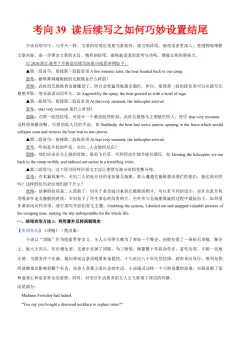
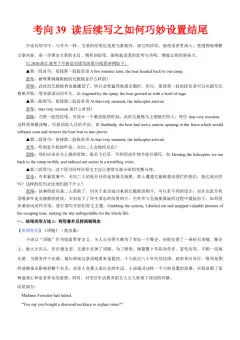
2020浙江高考7月卷
【第一段首句】衔接第一段段首语 A few minutes later, the bear headed back to our camp.
【思考】被喷雾刺痛眼睛的北极熊是什么样的?
【思路】此时的北极熊肯定被激怒了,所以会更猛烈地袭击围栏。所以,衔接第一段的段首语可
以从描写北极熊开始,用非谓语动词开头,如 Angered by the spray, the bear greeted us with
a howl of rage.
【第一段尾句】衔接第二段段首语 At that very moment, the helicopter arrived.【思考】that very moment 是什么时刻?
【思路】在第一段的结尾,可设计一个最危险的时刻,此时北极熊马上要破栏而入,呼应 that
very moment,这样衔接最流畅。可借助拟人化的手法,如 Suddenly, the bear had torn a
narrow opening in the fence which would collapse soon and witness the bear tear us into
pieces.
【第二段首句】衔接第二段段首语 At that very moment, the helicopter arrived.
【思考】听到直升机的声音,夫妇二人会做何反应?
【思路】他们应该会马上跑回营地,联系飞行员。可利用动作细节进行描写,如 Hearing the
helicopter, we ran back to the camp swiftly, and radioed our savior in a trembling voice.
【第二段尾句】这个尾句应呼应原文主旨以使续写部分结构完整合理。
【思考】在本篇故事中,夫妇二人的旅行目的是拍摄北极熊,那么遭遇北极熊袭击围栏的他们,
能达到目的吗?这样的经历会给他们留下什么?
【思路】故事的结局是二人获救了,但关于是否成功拿到北极熊的照片,可以有不同的设计:也
许在直升机用噪音吓走北极熊的时候,夫妇拍下了终生难忘的珍贵照片;也许在与北极熊周旋的
过程中冒险拍下。如利用非谓语动词作状语,进行描写并回扣原文主题。Grabbing the camera,
I dashed out and snapped valuable pictures of the escaping bear, making the trip
unforgettable for the whole life.
二、衔接策略
整体审视语篇,确定话题主题
【第1步:审读情景材料】
对试题所提供的“情景” (包括目的、对象、时间、地点、内容等)及其“形式”予以全面的
了解。
【第2步:提取主题思想】
在审题的同时,要注意从所给材料中提炼出一个主题,即作文的中心。它是全文成败的关键所
在,因为“评分说明”明确指出: “对紧扣主题的适当发挥不予扣分”。
【第3步:筛选获取的信息】
确定主题之后,就要依据所需文体(多为应用文、记叙文或说明文),围绕中心对所获取的信息
进行筛选,以突出重点。
【第4步:列举表述要点】动笔写作之前,最好在草稿纸上列出要点,以免因时间紧等原因而遗漏。
【第5步:确定主题句】
段落通常由一个表示段落中心思想的主题句和一些用来说明、描写、论证该主题的发展句构
成。段落的主题句非常重要,对段落的各句起到提纲挈领的作用。一般情况下,主题旬的位置都在
段落的开头,清楚明了地告诉读者该段落将要陈述的内容。
拓展主题语句,注意语篇连贯
【第1步:巧用过渡词语】
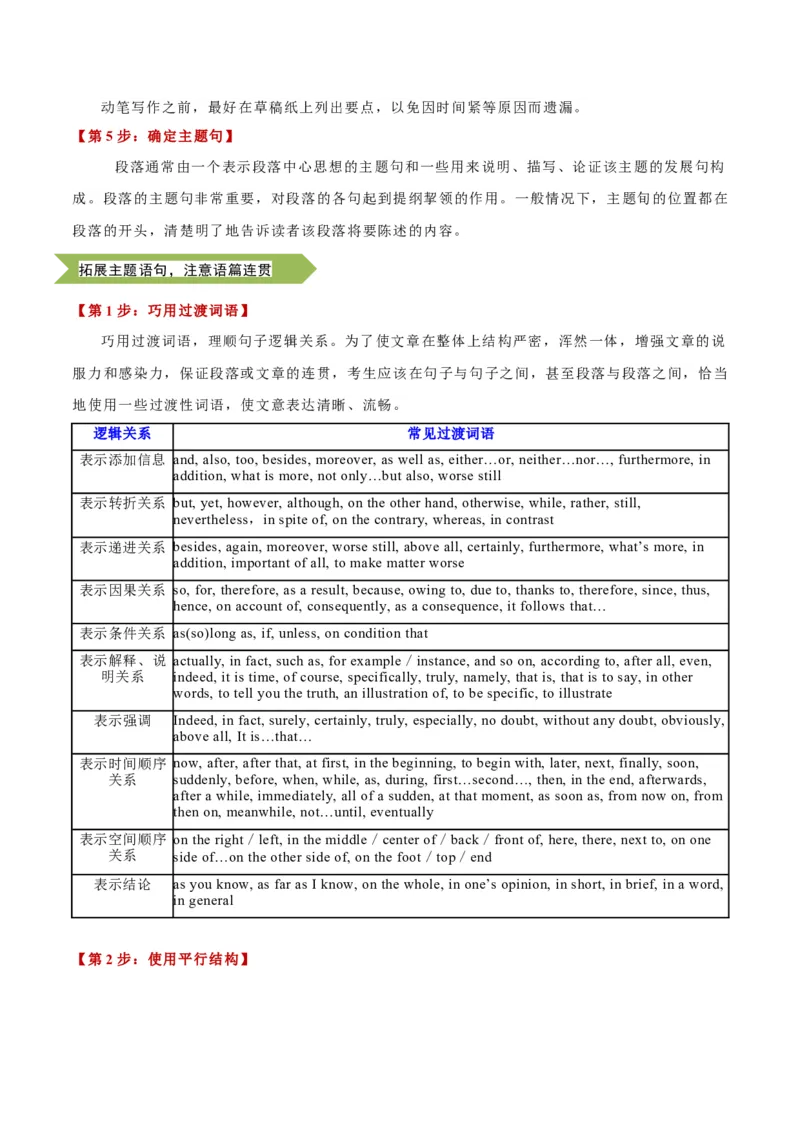
巧用过渡词语,理顺句子逻辑关系。为了使文章在整体上结构严密,浑然一体,增强文章的说
服力和感染力,保证段落或文章的连贯,考生应该在句子与句子之间,甚至段落与段落之间,恰当
地使用一些过渡性词语,使文意表达清晰、流畅。
逻辑关系 常见过渡词语
表示添加信息 and, also, too, besides, moreover, as well as, either…or, neither…nor…, furthermore, in
addition, what is more, not only…but also, worse still
表示转折关系 but, yet, however, although, on the other hand, otherwise, while, rather, still,
nevertheless,in spite of, on the contrary, whereas, in contrast
表示递进关系 besides, again, moreover, worse still, above all, certainly, furthermore, what’s more, in
addition, important of all, to make matter worse
表示因果关系 so, for, therefore, as a result, because, owing to, due to, thanks to, therefore, since, thus,
hence, on account of, consequently, as a consequence, it follows that…
表示条件关系 as(so)long as, if, unless, on condition that
表示解释、说 actually, in fact, such as, for example/instance, and so on, according to, after all, even,
明关系 indeed, it is time, of course, specifically, truly, namely, that is, that is to say, in other
words, to tell you the truth, an illustration of, to be specific, to illustrate
表示强调 Indeed, in fact, surely, certainly, truly, especially, no doubt, without any doubt, obviously,
above all, It is…that…
表示时间顺序 now, after, after that, at first, in the beginning, to begin with, later, next, finally, soon,
关系 suddenly, before, when, while, as, during, first…second…, then, in the end, afterwards,
after a while, immediately, all of a sudden, at that moment, as soon as, from now on, from
then on, meanwhile, not…until, eventually
表示空间顺序 on the right/left, in the middle/center of/back/front of, here, there, next to, on one
关系 side of…on the other side of, on the foot/top/end
表示结论 as you know, as far as I know, on the whole, in one’s opinion, in short, in brief, in a word,
in general
【第2步:使用平行结构】使用平行结构,增强语感节奏和顺畅度。平行结构的使用是一种修辞手法,其中既有词汇的
重复,又有纯粹的语法结构的重复。重复使用相同的结构,不仅能使句子或段落节奏匀称,还可以
起到强调或承上启下的作用,从而引起评卷老师的注意。
词的重复是常用的连接手法,它可强调你所要表达的意思,也必然让人把眼前的句子与前面
的句子联系起来,如同用一根线将整个段落贯穿成一个整体,从而增强句子的语感节奏,使句与句
之间的衔接更加紧密、顺畅。
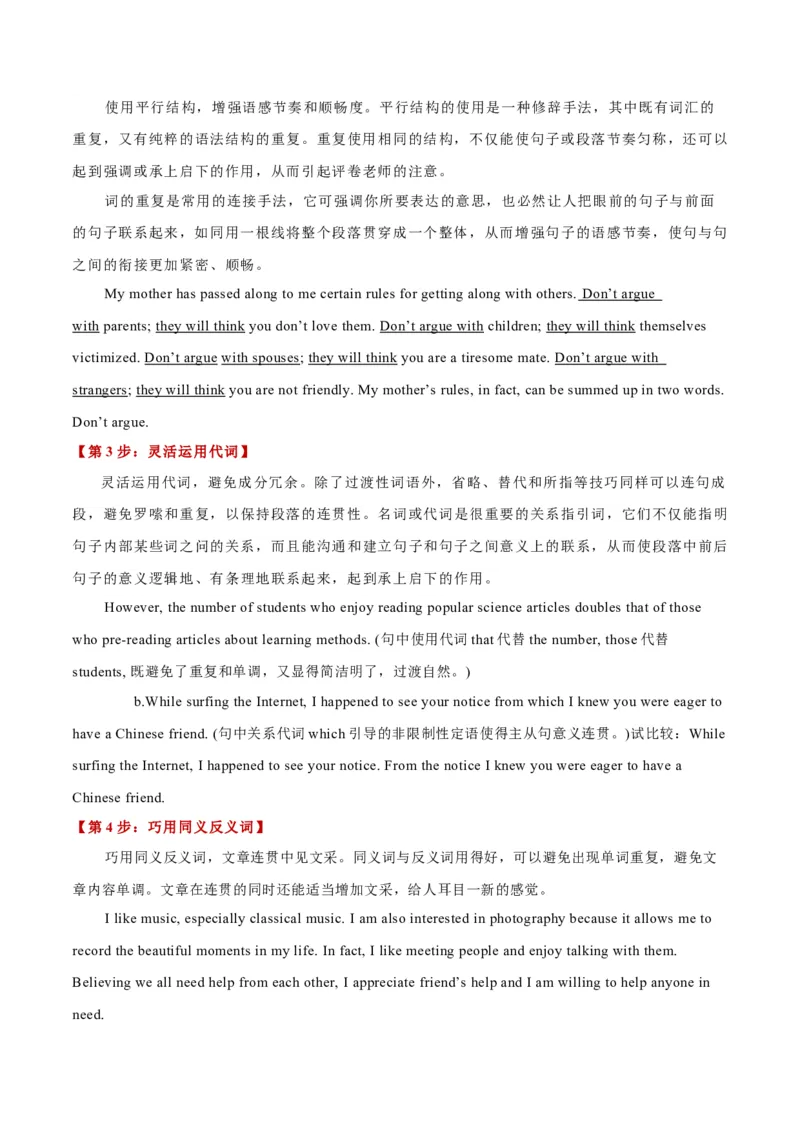
My mother has passed along to me certain rules for getting along with others. Don’t argue
with parents; they will think you don’t love them. Don’t argue with children; they will think themselves
victimized. Don’t argue with spouses ; they will think you are a tiresome mate. Don’t argue with
strangers ; they will think you are not friendly. My mother’s rules, in fact, can be summed up in two words.
Don’t argue.
【第3步:灵活运用代词】
灵活运用代词,避免成分冗余。除了过渡性词语外,省略、替代和所指等技巧同样可以连句成
段,避免罗嗦和重复,以保持段落的连贯性。名词或代词是很重要的关系指引词,它们不仅能指明
句子内部某些词之问的关系,而且能沟通和建立句子和句子之间意义上的联系,从而使段落中前后
句子的意义逻辑地、有条理地联系起来,起到承上启下的作用。
However, the number of students who enjoy reading popular science articles doubles that of those
who pre-reading articles about learning methods. (句中使用代词that代替the number, those代替
students, 既避免了重复和单调,又显得简洁明了,过渡自然。)
b.While surfing the Internet, I happened to see your notice from which I knew you were eager to
have a Chinese friend. (句中关系代词which引导的非限制性定语使得主从句意义连贯。)试比较:While
surfing the Internet, I happened to see your notice. From the notice I knew you were eager to have a
Chinese friend.
【第4步:巧用同义反义词】
巧用同义反义词,文章连贯中见文采。同义词与反义词用得好,可以避免出现单词重复,避免文
章内容单调。文章在连贯的同时还能适当增加文采,给人耳目一新的感觉。
I like music, especially classical music. I am also interested in photography because it allows me to
record the beautiful moments in my life. In fact, I like meeting people and enjoy talking with them.
Believing we all need help from each other, I appreciate friend’s help and I am willing to help anyone in
need.【第5步:巧用分词短语或独立结构】
简化句子结构可以增强表达效果。巧妙利用分词短语或独立主格结构能使句子化繁为简,把复合
句变为简单句;恰当使用独立成分可以使句子的表达形式丰富多样,从而起到增强语言表达效果的作
用。它们各有特点:分词要坚持逻辑主语一致原则,而独立主格结构要坚持主语不一致原则;独立成
分为约定成俗的固定形式,不受逻辑主语限制。如:Judging from…, Frankly speaking (To be frank)
等。试看下列句子:
(1)Compared with other teachers, Mr. Moore pays more attention to his way of teaching. (分词短语)
(2)Weather permitting, we are going to visit you tomorrow. =If weather permits we are going to visit
you tomorrow. (独立主格结构)
试比较以下两个例句:
(原句)The driver escaped; he left the old man lying on the road.
(修正句)The driver escaped, leaving the old man lying on the road. (分词短语)
【第6步:使用同位语】
避免重复,明晰句意。同位语的应用不仅能避免重复,还可以使文章表述自然、流畅,起到很好
的连接作用。
Also we can both write and talk to each 0theT on the Skype, a program that can carry sounds as well
as words.
I am Wangshan, a girl of sixteen, presently attending Beijing Yangguang Middle school.
【第7步:使用过渡句】
使用过渡句,自然衔接句子和段落。过渡句在句子与句子、段落与段落之间起到承上启下的作
用,使句子或段落之间的衔接自然、连贯,逻辑合理,结构严谨,故极为重要。
The summer holiday is coming. Our class have had a discussion about what to do during the
holiday…Some are in favor of staying at home…
However, others prefer to go out for traveling since it can increase their knowledge and broaden
their horizons . But they will lose the chance of getting to know the outside world.
三、段首衔接
提取段首语中的名词(包括代词)
【2023.01 浙江首考】人鸟情未了Paragraph l: A few weeks later, I went to the farm again.
Paragraph 2: I was just about to leave when the hummingbird appeared.
Paragraph l: I, the farm
Paragraph 2: I, the hummingbird
抓住这些名词和人称顺着往下写 Ta 的一系列反应
【第一段第1句】延续段首句 I, the farm:
Paragraph l: A few weeks later, I went to the farm again. Having parked car outside the
farm, I stepping on the blackberry-lined path and passed the milking house. (path和
milking house也是农场的一部分)
【第二段第1句】延续段首句 the hummingbird:
Paragraph 2: I was just about to leave when the hummingbird appeared. She was flying
over and hovering in front of me.
【2022 年10 月浙江十校联盟】辅导贫困小伙伴
Paragraph 1: The moment the gentleman left, Mr. Rose went in search of his son.
Paragraph 2: The next day, his father took him to town, and gave him books for himself
and Joe, with writing paper, pens, and ink.
Paragraph l: Mr. Rose
Paragraph 2: his father
考虑与【第一段最后 1句】的顺承关系
【第一段第1句】延续段首句 Mr. Rose:
Paragraph l: .. Charles was a little confused. He feared his father might not be pleased;
But he had no need to be uneasy, for his father was delighted.
【第二段第1句】延续段首句 his father:
Paragraph 2:The next day, his father took him to town, and gave him books for himself
and Joe, with writing paper, pens, and ink.
提取段首语中的关键时刻
时间状语中的关键时刻通常有just then, suddenly, at the very moment, finally, this time等等那么在进行
情节衔接的时候,如果是向上推理,则上一个情节有可能是负面时刻,例如危机时,失败时,沮丧时,艰
苦时。如果是向下推理,则下一个情节可能是积极时刻,例如得偿所愿,出现救援、希望等。
【2020.07 浙江卷】拍摄北极熊Paragraph 1: A few minutes later, the bear headed back to our camp.
Paragraph 2: At that very moment, the helicopter arrived.
关键时刻: at that very moment
【第一段最后1句】出现负面时刻:
Paragraph l: .. Unfortunately, this time it (喷辣椒水) didn’t work and the beast became
more frantic, close to tearing down the fence.
【第二段第1句】出现转机(积极时刻):
Paragraph 2:Down the helicopter came a rope to haul us up.
提取段首语中的地点位置
【2022 年6月高二期末统测】雀斑女孩
Paragraph l: My mother called me to the dinner table, but I ignored her.
Paragraph 2: After what seemed a century, I heard a gentle knock on my bedroom’s door.
第一段段首句中出现地点位置:dinner table
第二段段首句中出现地点位置:on my bedroom’s door
【第一段最后1句】出现地点的切换:
Paragraph l: My mother called me to the dinner table, but I ignored her. Having hurried
me to join them for several times but in vain, she came to the bathroom, only to see my
tear-stained face.
……
Her response throwing me into a thick haze of anger, sadness and despair, I stormed into
my room, slamming the door behind.
【第二段第1句】洗手间 我的卧室:
Paragraph 2:After what seemed a century, I heard a gentle knock on my bedroom’s
door.
四、8种首句接话技巧
1.用副词显现做出动作反应时的时间特征等
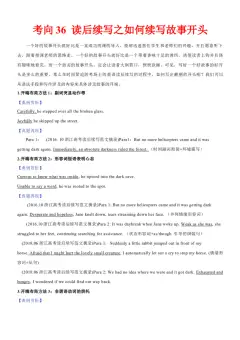
【2016. 10 浙江卷】Para1:But no more helicopters came and it was getting dark again. Immediately, an
absolute darkness ruled the forest.
【分析】用时间时间副词承接所给首句中的“it getting dark again”,同时衔接后文的环境描写
“the darkness ruled the forest”。副词衔接自然、顺畅。
2.用形容词(短语)凸显人物的情感情绪
【2016.10 浙江卷】
Para 1: But no more helicopters came and it was getting dark again. Desperate and
hopeless, Jane knelt down, tears streaming down her face.
【分析】用形容词短语“ Desperate and hopeless”凸显了人物的情绪状态,与后面的动作
“knelt down”一起再现了情境中的人物的精神状态。
Para 2: It was daybreak when Jane woke up. Weak as she was, she struggled to her feet,
continuing searching for assistance.
【分析】用“状态形容词+as/though 引导的倒装句”结构体现了人物早上起来后的精神状态。
【2018.06 浙江卷】
Para 1: Suddenly a little rabbit jumped out in front of my horse. Afraid that I might hurt
the lovely small creature, I automatically let out a cry to stop my horse.
【分析】用“情绪形容词+从句”结构阐释了人物见到兔子后的心理反应。
Para 2: We had no idea where we were and it got dark. Exhausted and hungry, I wondered
if we could find our way back.
【分析】用并列的表示心理状态的形容词,体现了人物心力交瘁的状态。
3. 用分词(短语)体现人物的心理变化等
【2016.10 浙江卷】
Para1: But no more helicopters came and it was getting dark again. Feeling disappointed,
Jane had to stay alone for another night.
【分析】用“现在分词+情绪形容词”结构体现了人物失望的心理状态。
Para 2: It was daybreak when Jane woke up. Feeling refreshed, she continued to walk
along the stream to find the way out.
【分析】用“现在分词+状态形容词”结构传递了人物早上醒来后的精神状态。
4. 用直接引语增强情境效果【2017.06 浙江卷】
Para 1: The car abruptly stopped in front of him. "Get into the car." Paul shouted at Mac.
【分析】用含有祈使句的直接引语与首句提示中的“abruptly stopped”形成呼应,进一步烘托了
紧张的情境。
5. 添加背景描写以烘托场景
【2017.11 浙江卷】
Para 2: We drove through several states and saw lots of great sights along the way. I
looked out of the car window, winding rivers, lofty mountains, sunny beaches and deep
valleys holding me entirely in their fascination.
【分析】用“视觉+环境描写+拟人修辞”结构与首句提示语中的“lots of great sights”遥相呼
应,再现了美丽风景对视觉的冲击效果。
6.引入新动作创造新的情境
【2017.11 浙江卷】
Para 1: The next day we remembered the brand-new tent we had brought with us. Dad
exchanged a glance with me. Why not camp to satisfy Mom?
【分析】用“动作描写+问句衔接”结构承接首句提示语创造了一个新的情境,即“露营”。
7. 借助声音效果增强描写功效
BOOM, CRASH! The wind was howling outside of my house. We were having a
terrible thunder storm. I was very scared.
【分析】用“ howling”这一声效进一步拓展了首句所设定的情境效果。
8.用疑问句引出新的话题或对事件的新的看法
Why does trouble always follow me around? Do I have a "kick me" sign on my back or
something?
【分析】用一般疑问句承接首句的特殊疑问句,进一步凸显了作者对“trouble”的看法。