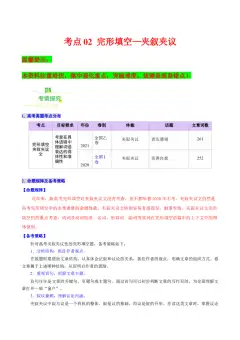
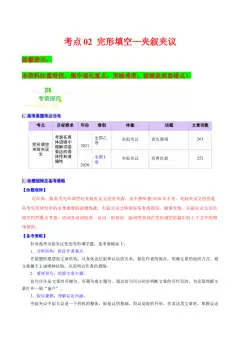
清单 02 完形填空之夹叙夹议文
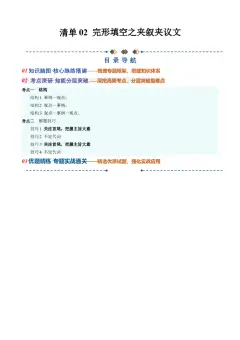
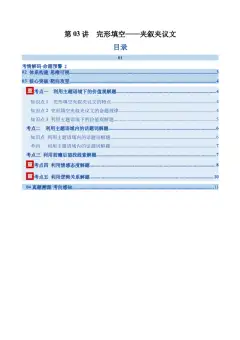
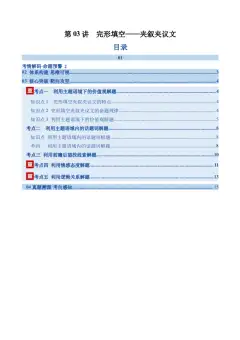
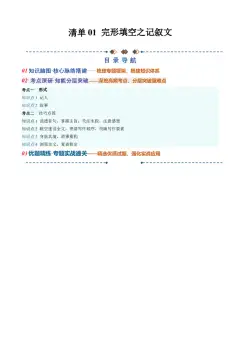
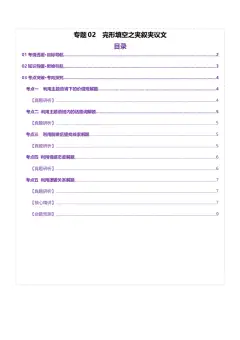
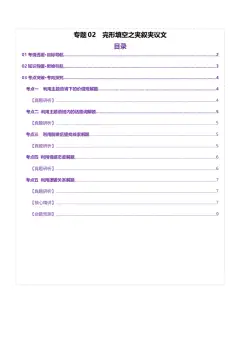
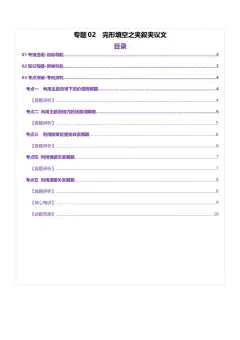
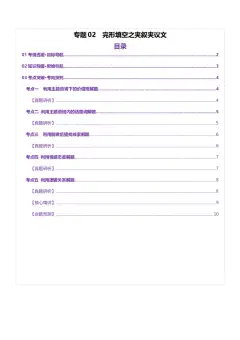
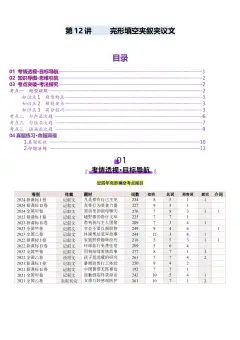
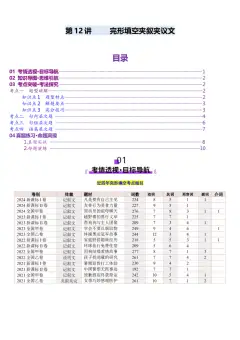
目 录 导 航
01知识脑图·核心脉络搭建——梳理专题框架,搭建知识体系
02 考点深研·知能分层突破——深挖高频考点,分层突破重难点
考点一 结构
结构1 事例一观点;
结构2 观点一事例;
结构3 观点一事例一观点。
考点二 解题技巧
技巧1 关注首尾,把握主旨大意
技巧2 不定代词
技巧3 关注首尾,把握主旨大意
技巧4 不定代词
03优题精练·专题实战通关——精选优质试题,强化实战应用知识脑图·核心脉络搭建
考点深研●知能分层突破
夹叙夹议文类的完形填空所选文章常常在平淡的故事中蕴含着丰富的哲理,作者既可以让读者从一个
简单的故事中体会到生活的意义,又能引起作者对人生、生活、社会价值的思考及对人际关系等话题的自
省反思。这类文章的组织方式一般有以下三种结构:事例一观点;观点一事例;观点一事例一观点。
考点1关注首尾,把握主旨大意
这里的“首尾”包括(语篇的)首段尾段、(段落的)首句尾句。通过首句/首段可明确文章话题,了解篇章
结构,窥一斑而知全豹(把握主旨大意,即“文意”)。尾句往往是作者的点睛之笔,通过尾段/尾句一般可
以更加真实、确切地体会到作者的写作意图、对待事件的真实态度等核心内容。
例1: In the 1980s, I first encountered tai chi in Dundonald Park. I watched people move in loose formation
at an unhurried pace. The 1 of their movements was like a water lily(睡莲) opening in slow motion.
I found tai chi as 2 , but I couldn’t see its point. I defined fitness 3 and strength. Moving
slowly did not build muscles, so I chose to 4 myself from the practice. Still, the 5 stayed with
me, a seed planted.
After retirement, with a doctor’s 6 , I returned to that park, no longer a watcher but inside the group,
awkwardly moving toward the growth once seeded long ago. My early 7 were discouraging. I joined one
class, then left; joined another, and 8 , failing to complete the routines. I assumed that mastering tai chi
meant memorizing all the 9 . But I soon learned otherwise: What needed mastering were my own habits
— impatience, resistance to correction.
Everything changed in my first expert-led class. Surrounded by advanced 10 , I felt like a
beginner when the instructor 11 singled me out for instruction. Embarrassed, I listened attentively,
watched closely and 12 my body to move by copying him. Ultimately, this focus helped 13
my embarrassment.
In that instant, my emotion 14 , from embarrassment to empowerment.
I learned not just a move, but a patient and open way of being. I became that lily unfolding, awakened not by
force, but by this 15 martial art.
1. A. order B. power C. grace D. precision
2. A. reliable B. fascinating C. familiar D. strange
3. A. flexibility B. tolerance C. balance D. speed4. A. distance B. protect C. isolate D. free
5. A. answer B. response C. presence D. image
6. A. treatment B. recommendation C. assessment D. announcement
7. A. observations B. memories C. attempts D. mistakes
8. A. struggled B. hesitated C. panicked D. followed
9. A. positions B. settings C. rules D. moves
10. A. instructors B. learners C. athletes D. performers
11. A. reluctantly B. casually C. unexpectedly D. briefly
12. A. willed B. trained C. urged D. allowed
13. A. hide away B. bring about C. build up D. crowd out
14. A. settled B. shifted C. progressed D. softened
15. A. traditional B. demanding C. gentle D. complex
考点2. 抓住主线,理清情节发展
抓住故事的主线(篇章的“文脉”和段落的“文脉”),顺着这些主线,理清短文各段情节发展的脉络。
考生要关注写人叙事的方法(对比、强调、举例、解释、递进等等),结合文章的结构特点,依据衔接词来
正确理解故事情节的发展。
例2: We usually feel the desire to civilize teenagers, but maybe that’s wrong. We should think about how we
could fruitfully be more like them.
I have always taken the 1 view that it is my job to 2 my teenager, but now I am
thinking maybe it is his job to disorganize me. I am the 3 who arrives at airports four hours in advance.
My teenager, however, is very Zen(放松). He 4 his eyebrows at my excessive worrying. I can suddenly
5 myself through his eyes, needlessly anxious, absurdly concerned with 6 . His way of moving
through the airport seems 7 , wearing headphones, sliding indifferently, even if there is the slightest 8
that, left to his own devices, he would miss a flight.
My son recently wrote a speech based on Emerson’s idea about living “above time” — not thinking about
either the past or the future, 9 to-do lists and existential(存在主义的) worries. As he was practicing, I
was 10 by the energy of his speech. I thought to myself, why is this so good? He actually 11
the idea, which is a teenage thing.
We should view their way of life as gentle but powerful 12 of our own. He had totally 13
with this entirely new view of how life could be. He was also able to imagine casting aside all kinds of rooted 14
and behaviors.
As a writer and professor, I like to think I am open to new ideas, but am I genuinely prepared to adopt the
fresh 15 on life? I would like to be.
1. A. strict B. conventional C. academic D. different
2. A. tend B. tolerate C. accept D. organize
3. A. model B. subject C. type D. fool
4. A. raises B. shaves C. draws D. shapes
5. A. see B. compose C. express D. kill
6. A. details B. rules C. timelines D. trips7. A. preferable B. logical C. dynamic D. cautious
8. A. problem B. chance C. sign D. delay
9. A. looking for B. taking up C. focusing on D. leaving behind
10. A. built B. challenged C. struck D. defeated
11. A. doubted B. embraced C. justified D. exploded
12. A. support B. rejection C. praise D. criticism
13. A. engaged B. faced C. collaborated D. wrestled
14. A. fears B. differences C. habits D. plants
15. A. narratives B. regulations C. measures D. perspectives
考点3. 注重语境,理解行文逻辑
夹叙夹议文以叙述为主,大部分篇幅在描述人物、事件,作者的观点及态度有时就隐含在其中;少部
分篇幅发表议论,议论部分与叙述部分衔接紧密、逻辑严谨(通过“文法”来体现)。这就要求考生增强语
篇逻辑意识,弄清文章内在逻辑关系,根据上下文内容,并适当进行逻辑推理来做出选择。
例 3: Often, science and art are described as quite different things. As a professor of acting, I’d never
thought much about STEM fields until I received a fund to 1 the arts into STEM educational models. I
decided to use the 2 to write and direct a play for elementary schoolers that 3 how the arts can
improve upon and extend work in STEM fields.
It wasn’t an easy process. I lacked a(n) 4 in most of the disciplines included in STEM. And I 5
to find a project that inspired me. After lots of research, I began 6 on five one-act plays, called “The
STEAM Plays: Using the Arts to Talk about STEM.” Each 7 a category of STEAM education. Eventually
I wrote the first 8 of the show. Then I made some revisions to it.
The new version that 9 Michigan elementary schools last fall was well-received. It contains 20
bite-sized comedic scenes and songs that dramatize how the arts are 10 to many STEM fields. These
include how engineering skills go into 11 a celebrity’s evening dress, how bakers need to know some
basic chemistry, and how the mathematical algorithms(算法) of TikTok find new 12 for each user. In
each of the scenes, students can see how artistic imagination and creative thinking 13 STEM education.
These themes emerge from a wider scholarly 14 that STEM isn’t done in a creativity vacuum(真
空), and 15 students’ artistic thinking will help them both in the science classroom and the art studio.
1. A. integrate B. transform C. divide D. stuff
2. A. hobby B. donation C. break D. opportunity
3. A. witnessed B. showed C. explained D. questioned
4. A. degree B. interest C. background D. objective
5. A. managed B. struggled C. decided D. continued
6. A. reflection B. work C. experiment D. discussion
7. A. focused on B. searched for C. resulted from D. applied to
8. A. chapter B. article C. draft D. report
9. A. covered B. featured C. advertised D. toured
10. A. superior B. essential C. limited D. equal
11. A. replacing B. purchasing C. designing D. selling12. A. reviews B. blogs C. videos D. records
13. A. challenge B. form C. intervene D. expand
14. A. understanding B. achievement C. discovery D. comment
15. A. controlling B. accepting C. evaluating D. stimulating
优题精练●专题实战通关
Passage 1
(2025-2026学年福建省福清第一中学高三第一学期12月适应性练习)Several years ago, a neighbor’s kid
kicked a football and broke a basement window of my house. Due to financial problems, I 1 it up,
thinking I’d get to it someday.
Over the years, I had planned to upgrade to energy-efficient windows. But with the frame rusted(生锈的)
and firmly 2 in the foundation, whoever did it would need to chisel(凿) it out by hand. It would be a(an)
3 process since there were six of those windows in the house. And the cost was estimated at $ 15,000. It was
simply 4 .
Honestly, the thought of that window 5 me for years. I knew I needed to fix it, but I had built up
the 6 so much in my mind that I put it off again and again.
Then I had a job change and needed to sell the house before moving away. But it was almost 7 to
find a buyer if there was a broken window. So I pulled off the boards to face this thing head-on. I grabbed some rust
remover, 8 it on the frame of the window, and gave it a pull. To my astonishment, it easily 9 . I
took the window downtown. It only cost me $12. I could have 10 the problem for only $ 12 when it
occurred, but I let it bother me for five years!
11 , this isn’t just about my window. Many of us live with broken windows of one type or another.
They are things that seriously affect our 12 of life. If you recognize your broken window, don’t 13
to mend it. It may turn out to be 14 than expected. Usually, we suffer more in 15 than in
reality.
1. A. mended B. boarded C. made D. left
2. A. mixed B. buried C. fixed D. stuck
3. A. brain-burning B. fuel-consuming C. labor-intensive D. energy-efficient
4. A. in a mess B. out of reach C. at a loss D. beyond control
5. A. stood out for B. went against C. ate away at D. appealed to
6. A. trouble B. attitude C. confusion D. delay
7. A. unfair B. impossible C. pointless D. shameful
8. A. blew B. turned C. passed D. spread
9. A. broke B. moved C. fell D. replaced
10. A. addressed B. ignored C. delayed D. faced
11. A. Similarly B. Consequently C. Eventually D. Actually
12. A. quality B. equipment C. way D. meaning
13. A. forget B. hesitate C. refuse D. guarantee
14. A. easier B. tougher C. fewer D. lighter15. A. practice B. memory C. imagination D. principle
Passage 2
(2026届河南省三门峡市部分名校考前模拟英语试题)Sam Schreim has been his own boss for 20 years.
He opened a consultancy and launched start-ups. But the 54-year-old now admits: “If I could turn back time, I
might not have taken the leap.”
1 your job to become your own boss has rarely been more popular. In 2022, new U.S. business
applications hit a 2004-high, with over five million new firms. But when Silicon Valley Bank fell in 2023, small
businesses lost access to their 2 , revealing the tough side of running a business.
Schreim learned this the hard way during the 2008 crisis. He paid 15 staff from savings, suffered sleepless
nights and 3 . His later start-ups failed. “It was like trying to climb a mountain with no safety net,” he
reflects. Even now, he regrets not to have 4 with his big consultancy job.
It isn’t 5 for business realities to conflict with expectations, says U.K. career coach Ayesha
Murray: “As owners, we want success but often have 6 expectations. If you had a successful career first,
there may be a(n) 7 next ventures will be smooth sailing.”
Catherine Warrilow, who founded her PR agency in 2006, also faced this. From outside, it seemed a 8
move. The agency thrived, with 7 employees and top clients. “But I felt 9 always. Nothing felt good
enough,” she says. The 10 made her a “control oddball”, micro-managing her team. It wasn’t what she
11 . “I thought running a business meant 12 — setting your own hours,” she admits. Reality?
“Clients demand availability.”
So in 2015. the mother of two chose to 13 the company. “Quitting self-employment was my
proudest professional moment,” she says. “A weight lifted off my shoulders.”
Of course, there are success stories; many who strike out on their own never look back. Still, Schreim warns
against 14 others: “Entrepreneurship, innovation or excellence-creating can be a roller-coaster; therefore,
you must be 15 of highs and lows.”
1. A. Keeping B. Getting C. Quitting D. Changing.
2. A. schedules B. accounts C. markets D. contracts
3. A. cash B. debt C. energy D. information
4. A. stuck B. dealt C. begun D. interacted
5. A. unacceptable B. unfair C. unfortunate D. uncommon
6. A. enthusiastic B. romantic C. unrealistic D. inefficient
7. A. assumption B. competition C. demonstration D. explanation
8. A. alternative B. positive C. objective D. conservative
9. A. content B. curious C. anxious D. hopeless
10. A. stress B. boredom C. sorrow D. affection
11. A. prepared B. experienced C. mastered D. imagined
12. A. motion B. freedom C. innovation D. responsibility
13. A. take over B. look into C. give up D. rely on
14. A. making an appeal to B. making a compromise with
C. throwing the towel on D. giving your word to15. A. confident B. fond C. proud D. aware
Passage 3
(2025-2026学年度江苏宿迁青华中学第二学期高三热身最后一卷)I remember opening my iPad one day
in fifth grade, inspired by a light-hearted conversation with my cousin about scary stories. Hours later, I had 1
my first short story. Writing 2 became a beloved hobby, but as I grew older, the 3 began to fade. I
started reading more books, encountering critiques online, and comparing my work to others. Self-doubt crept in,
and what once felt like a creative outlet became a source of 4 . I felt I had to be “good” at writing to share it.
This 5 happens often. Hobbies start as a form of 6 , a way to relax ourselves. Yet, over time,
societal pressures to 7 can change how we view them. Whether it’s painting, playing an instrument, or any
other 8 , there’s an expectation to perform at a high level. When we don’t meet that standard, the joy fades,
replaced by feelings of inadequacy.
For me, writing has been the one hobby I’ve regularly returned to, 9 moments of self-doubt. I’ve
taken creative writing classes and seen significant improvement, but the constant 10 for perfection turns
writing from a 11 into a chore. I’ve come to realize that this mindset 12 me of the joy I once found
in it.
We need to recognize that it’s 13 not to be great at something. Perfection is often 14 , and
more often than not, we are our toughest critics. The challenge, then, is finding balance between enjoyment and
15 . Embrace imperfection, and enjoy the process, even if you’re not “great” at it.
1. A. showed off B. pulled over C. cut off D. wrapped up
2. A. merely B. openly C. quickly D. carefully
3. A. hope B. surprise C. curiosity D. excitement
4. A. relief B. truth C. inspiration D. stress
5. A. shift B. accident C. blessing D. adjustment
6. A. growth B. escape C. focus D. commitment
7. A. live B. struggle C. excel D. contribute
8. A. ideas B. pursuits C. distraction D. ambition
9. A. by means of B. with respect to C. in spite of D. in search of
10. A. drive B. doubt C. supply D. imagination
11. A. story B. passion C. challenge D. possibility
12. A. robs B. reminds C. warns D. informs
13. A. sad B. okay C. intolerable D. awesome
14. A. random B. temporary C. subjective D. magical
15. A. joy B. overwork C. enthusiasm D. expectation
Passage 4
(2026届山东省九五高中协作体高考最后一卷英语试题)Over 30 years ago, I started to build my dream
house in a rural town. It was a 1 process, worsened by a demanding career that kept me traveling across
Asia and the Pacific. 2 work, parenting, and the house often felt too much for me.
One day I walked into a lighting shop. The shopkeeper wasn’t exactly 3 but, as it was the only
furniture shop around, she won my 4 . I asked her some questions and received only one-or two-wordanswers. After 5 some lighting fittings, I was about to leave when she looked me firmly in the eyes and
said, “However 6 your life seems, someone always has it far worse.” Then she went into the back of the
shop.
I was taken aback by her 7 and vividly remember getting into my truck and thinking how 8
and out of line she was. But as I returned home I 9 her words. Then it hit me — she was 10
right.
The shopkeeper wasn’t offering those words with kindness but that is 11 . What she said deeply
impacted my life. She must have seen something in me that 12 her comment, and it helped me 13
the vital truth: perspective (视角) is everything.
I don’t think that woman could have 14 how much I would take her words on board. Years later, I
found myself with two types of cancer. Yet I’ve gone through various treatments, and now I feel 15
simply because I can wake up each morning with the opportunity to enjoy my life as it is.
1. A. lonely B. stressful C. gradual D. regular
2. A. Balancing B. Integrating C. Skipping D. Choosing
3. A. silent B. serious C. friendly D. honest
4. A. business B. trust C. admiration D. approval
5. A. replacing B. fixing C. examining D. purchasing
6. A. plain B. fruitless C. tough D. changeable
7. A. strategy B. comment C. complaint D. advice
8. A. rude B. selfish C. strict D. wise
9. A. believed in B. reflected on C. worried about D. benefited from
10. A. absolutely B. slightly C. barely D. temporarily
11. A. evident B. meaningless C. irrelevant D. typical
12. A. indicated B. interrupted C. confirmed D. motivated
13. A. declare B. analyze C. expose D. realize
14. A. forgotten B. imagined C. recorded D. proved
15. A. calm B. surprised C. fortunate D. confused
Passage 5
(2026年6月湖北十校高三下学期核心素养测评英语试题)I have always been indecisive when it came to
travel. I’d watch endless videos of destinations and read scores of 1 online. But more often than not,
2 fell far short of what was promised. The colourful images I’d come across online would turn out to be totally
disappointing in real life.
So, a year ago, I made a change. I banned myself from too much 3 for a trip. Instead, I chose an
area I wanted to 4 . I couldn’t rely on my phone. It wasn’t easy at first. I felt rudderless(漫无目的的)
without my phone to guide me while wandering through 5 neighbourhoods. I was so accustomed to 6
every detail about each place I visited and without that, I was exposed.
But that’s exactly why it’s so fun. Going in unprepared opens you up to 7 . Without being glued to
directions on my phone, I was 8 so much more of my surroundings, noticing details that would otherwise
have 9 passed me by.Travelling without planning has made me more 10 with making decisions. I no longer 11
if the view isn’t as breathtaking as in the photos — because I’m not comparing my 12 to anyone else’s.
Trying to have the 13 holiday is no longer the point for me; it’s about living in the present and
making good 14 . And in an era where we can see the best of everything through our phones, it’s been
totally 15 to have an experience that’s entirely mine.
1. A. newsletters B. reviews C. ebooks D. notices
2. A. reality B. bookings C. demand D. objectives
3. A. budget B. longing C. planning D. luggage
4. A. conserve B. occupy C. explore D. rejuvenate
5. A. unfriendly B. ethnic C. peaceful D. unknown
6. A. creating B. knowing C. assessing D. modifying
7. A. surprises B. routines C. duties D. traps
8. A. laying out B. relying on C. taking in D. cleaning up
9. A. purposely B. fortunately C. completely D. temporarily
10. A. comfortable B. stuck C. patient D. concerned
11. A. bear B. care C. feel D. see
12. A. wealth B. experience C. achievement D. health
13. A. luxurious B. secure C. casual D. perfect
14. A. excuses B. investments C. predictions D. memories
15. A. hesitant B. freeing C. plain D. demanding
Passage 6
(2026届陕西省西安市第八十三中学高三年级第九次模拟考试英语试题)When I was a teenager, I lost
interest in study and often felt upset. I thought hard work would never bring good results, so I gave up easily
whenever meeting 1 . My head teacher noticed my bad state and decided to help me out.
One afternoon, she took me to the school garden. There stood many small trees struggling against strong
winds. Some bent low, but few 2 down completely. She told me that growth was never smooth and every
difficulty was a chance to become 3 .
She shared her own story. She once failed in important exams and almost lost heart. Yet she chose to keep
moving instead of 4 . Gradually, her efforts finally 5 off and she achieved her dream. Her
words touched my heart deeply.
From that day on, I made up my mind to 6 my bad habits. I began to listen carefully in class and
finish homework on time. When I felt tired or hopeless, I would 7 those small trees in my mind to cheer
myself up.
Slowly but surely, my grades began to 8 . More importantly, I built up strong confidence. I realized
that success never comes 9 . It always requires continuous effort and firm belief.
Now I fully understand that life is full of challenges. We can’t avoid them, but we can choose how to 10
them. Giving up is easy, but sticking to our goals is what truly 11 .
In the process of fighting for dreams, we may experience pain and loneliness. However, all the hardships will
12 become valuable wealth in our life. Never doubt your own power, and never 13 hope easily.As long as we hold on to our faith and keep working hard, we are sure to walk out of darkness and 14
the bright future we expect. The road ahead may be long, but every step forward will bring us 15 to our
dreams.
1. A. choices B. difficulties C. secrets D. wishes
2. A. fell B. broke C. turned D. calmed
3. A. weaker B. quieter C. stronger D. softer
4. A. giving up B. showing off C. speeding up D. taking apart
5. A. put B. took C. paid D. set
6. A. keep B. change C. copy D. accept
7. A. ignore B. forget C. imagine D. doubt
8. A. drop B. rise C. freeze D. hide
9. A. slowly B. naturally C. suddenly D. easily
10. A. face B. refuse C. miss D. watch
11. A. matters B. harms C. hurts D. fails
12. A. never B. soon C. seldom D. hardly
13. A. hold B. grasp C. lose D. gain
14. A. miss B. reach C. waste D. regret
15. A. farther B. closer C. higher D. deeper