1
1998 年考研英语阅读真题
Text 1
Few creations of big technology capture the imagination like giant dams. Perhaps it is
humankind’s long suffering at the mercy of flood and drought that makes the idea of forcing the waters
to do our bidding so fascinating. But to be fascinated is also, sometimes, to be blind. Several giant dam
projects threaten to do more harm than good.
The lesson from dams is that big is not always beautiful. It doesn’t help that building a big,
powerful dam has become a symbol of achievement for nations and people striving to assert
themselves. Egypt’s leadership in the Arab world was cemented by the Aswan High Dam. Turkey’s bid
for First World status includes the giant Ataturk Dam.
But big dams tend not to work as intended. The Aswan Dam, for example, stopped the Nile
flooding but deprived Egypt of the fertile silt that floods left -- all in return for a giant reservoir of
disease which is now so full of silt that it barely generates electricity.
And yet, the myth of controlling the waters persists. This week, in the heart of civilized Europe,
Slovaks and Hungarians stopped just short of sending in the troops in their contention over a dam on
the Danube. The huge complex will probably have all the usual problems of big dams. But Slovakia is
bidding for independence from the Czechs, and now needs a dam to prove itself.
Meanwhile, in India, the World Bank has given the go-ahead to the even more wrong-headed
Narmada Dam. And the bank has done this even though its advisors say the dam will cause hardship
for the powerless and environmental destruction. The benefits are for the powerful, but they are far
from guaranteed.
Proper, scientific study of the impacts of dams and of the cost and benefits of controlling water
can help to resolve these conflicts. Hydroelectric power and flood control and irrigation are possible
without building monster dams. But when you are dealing with myths, it is hard to be either proper, or
scientific. It is time that the world learned the lessons of Aswan. You don’t need a dam to be saved.
2
11. The third sentence of Paragraph 1 implies that ________.
[A] people would be happy if they shut their eyes to reality
[B] the blind could be happier than the sighted
[C] over-excited people tend to neglect vital things
[D] fascination makes people lose their eyesight
12. In Paragraph 5, “the powerless” probably refers to ________.
[A] areas short of electricity
[B] dams without power stations
[C] poor countries around India
[D] common people in the Narmada Dam area
13. What is the myth concerning giant dams?
[A] They bring in more fertile soil.
[B] They help defend the country.
[C] They strengthen international ties.
[D] They have universal control of the waters.
14. What the author tries to suggest may best be interpreted as ________.
[A] “It’s no use crying over spilt milk”
[B] “More haste, less speed”
[C] “Look before you leap”
[D] “He who laughs last laughs best”
3
Text 2
Well, no gain without pain, they say. But what about pain without gain? Everywhere you go in
America, you hear tales of corporate revival. What is harder to establish is whether the productivity
revolution that businessmen assume they are presiding over is for real.
The official statistics are mildly discouraging. They show that, if you lump manufacturing and
services together, productivity has grown on average by 1.2% since 1987. That is somewhat faster than
the average during the previous decade. And since 1991, productivity has increased by about 2% a year,
which is more than twice the 1978-87 average. The trouble is that part of the recent acceleration is due
to the usual rebound that occurs at this point in a business cycle, and so is not conclusive evidence of a
revival in the underlying trend. There is, as Robert Rubin, the treasury secretary, says, a “disjunction”
between the mass of business anecdote that points to a leap in productivity and the picture reflected by
the statistics.
Some of this can be easily explained. New ways of organizing the workplace -- all that
re-engineering and downsizing -- are only one contribution to the overall productivity of an economy,
which is driven by many other factors such as joint investment in equipment and machinery, new
technology, and investment in education and training. Moreover, most of the changes that companies
make are intended to keep them profitable, and this need not always mean increasing productivity:
switching to new markets or improving quality can matter just as much.
Two other explanations are more speculative. First, some of the business restructuring of recent
years may have been ineptly done. Second, even if it was well done, it may have spread much less
widely than people suppose.
Leonard Schlesinger, a Harvard academic and former chief executive of Au Bong Pain, a rapidly
growing chain of bakery cafes, says that much “re-engineering” has been crude. In many cases, he
believes, the loss of revenue has been greater than the reductions in cost. His colleague, Michael Beer,
says that far too many companies have applied re-engineering in a mechanistic fashion, chopping out
costs without giving sufficient thought to long-term profitability. BBDO’s Al Rosenshine is blunter. He
dismisses a lot of the work of re-engineering consultants as mere rubbish -- “the worst sort of
ambulance chasing.”
4
15. According to the author, the American economic situation is ________.
[A] not as good as it seems
[B] at its turning point
[C] much better than it seems
[D] near to complete recovery
16. The official statistics on productivity growth ________.
[A] exclude the usual rebound in a business cycle
[B] fall short of businessmen’s anticipation
[C] meet the expectation of business people
[D] fail to reflect the true state of economy
17. The author raises the question “what about pain without gain?” because ________.
[A] he questions the truth of “no gain without pain”
[B] he does not think the productivity revolution works
[C] he wonders if the official statistics are misleading
[D] he has conclusive evidence for the revival of businesses
18. Which of the following statements is NOT mentioned in the passage?
[A] Radical reforms are essential for the increase of productivity.
[B] New ways of organizing workplaces may help to increase productivity.
[C] The reduction of costs is not a sure way to gain long-term profitability.
[D] The consultants are a bunch of good-for-nothings.
5
Text 3
Science has long had an uneasy relationship with other aspects of culture. Think of Gallileo’s
17th-century trial for his rebelling belief before the Catholic Church or poet William Blake’s harsh
remarks against the mechanistic worldview of Isaac Newton. The schism between science and the
humanities has, if anything, deepened in this century.
Until recently, the scientific community was so powerful that it could afford to ignore its critics --
but no longer. As funding for science has declined, scientists have attacked “anti-science” in several
books, notably Higher Superstition, by Paul R. Gross, a biologist at the University of Virginia, and
Norman Levitt, a mathematician at Rutgers University; and The Demon-Haunted World, by Carl Sagan
of Cornell University.
Defenders of science have also voiced their concerns at meetings such as “The Flight from
Science and Reason,” held in New York City in 1995, and “Science in the Age of (Mis) information,”
which assembled last June near Buffalo.
Anti-science clearly means different things to different people. Gross and Levitt find fault
primarily with sociologists, philosophers and other academics who have questioned science’s
objectivity. Sagan is more concerned with those who believe in ghosts, creationism and other
phenomena that contradict the scientific worldview.
A survey of news stories in 1996 reveals that the anti-science tag has been attached to many other
groups as well, from authorities who advocated the elimination of the last remaining stocks of
smallpox virus to Republicans who advocated decreased funding for basic research.
Few would dispute that the term applies to the Unabomber, whose manifesto, published in 1995,
scorns science and longs for return to a pre-technological utopia. But surely that does not mean
environmentalists concerned about uncontrolled industrial growth are anti-science, as an essay in US
News & World Report last May seemed to suggest.
The environmentalists, inevitably, respond to such critics. The true enemies of science, argues
Paul Ehrlich of Stanford University, a pioneer of environmental studies, are those who question the
evidence supporting global warming, the depletion of the ozone layer and other consequences of
industrial growth.
Indeed, some observers fear that the anti-science epithet is in danger of becoming meaningless.
“The term ‘anti-science’ can lump together too many, quite different things,” notes Harvard University
philosopher Gerald Holton in his 1993 work Science and Anti-Science. “They have in common only
one thing that they tend to annoy or threaten those who regard themselves as more enlightened.”
6
19. The word “schism” (Line 3, Paragraph 1) in the context probably means ________.
[A] confrontation
[B] dissatisfaction
[C] separation
[D] contempt
20.
Paragraphs 2 and 3 are written to ________.
[A] discuss the cause of the decline of science’s power
[B] show the author’s sympathy with scientists
[C] explain the way in which science develops
[D] exemplify the division of science and the humanities
21. Which of the following is true according to the passage?
[A] Environmentalists were blamed for anti-science in an essay.
[B] Politicians are not subject to the labeling of anti-science.
[C] The “more enlightened” tend to tag others as anti-science.
[D] Tagging environmentalists as “anti-science” is justifiable.
22. The author’s attitude toward the issue of “science vs. anti-science” is ________.
[A] impartial
[B] subjective
[C] biased
[D] puzzling
7
Text 4
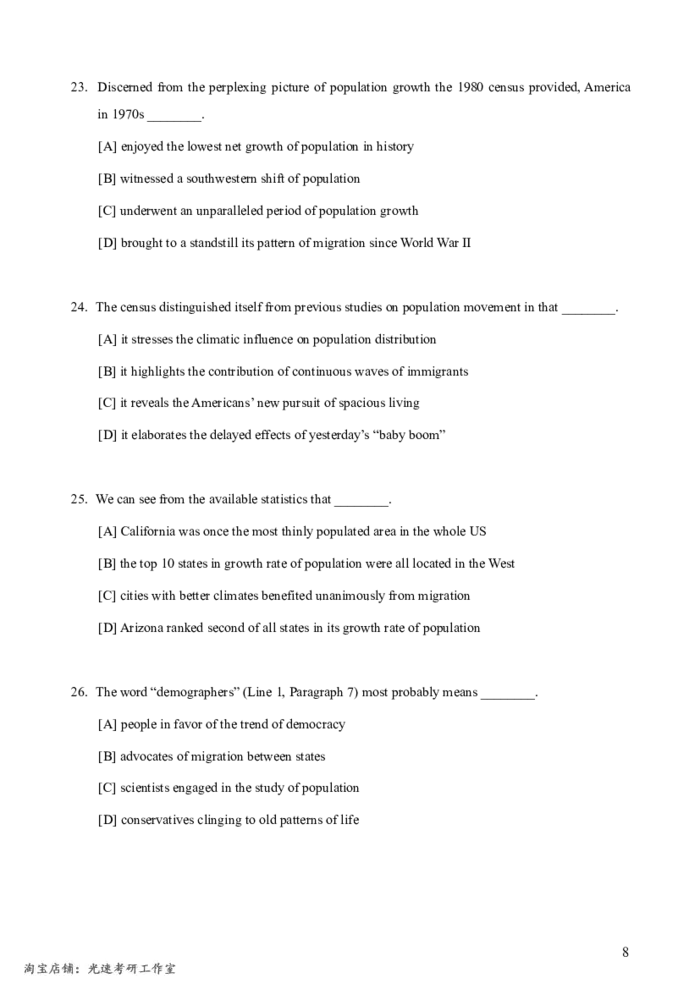
Emerging from the 1980 census is the picture of a nation developing more and more regional
competition, as population growth in the Northeast and Midwest reaches a near standstill.
This development -- and its strong implications for US politics and economy in years ahead -- has
enthroned the South as America’s most densely populated region for the first time in the history of the
nation’s head counting.
Altogether, the US population rose in the 1970s by 23.2 million people -- numerically the
third-largest growth ever recorded in a single decade. Even so, that gain adds up to only 11.4 percent,
lowest in American annual records except for the Depression years.
Americans have been migrating south and west in larger numbers since World War II, and the
pattern still prevails.
Three sun-belt states -- Florida, Texas and California -- together had nearly 10 million more
people in 1980 than a decade earlier. Among large cities, San Diego moved from 14th to 8th and San
Antonio from 15th to 10th -- with Cleveland and Washington. D. C., dropping out of the top 10.
Not all that shift can be attributed to the movement out of the snow belt, census officials say.
Nonstop waves of immigrants played a role, too -- and so did bigger crops of babies as yesterday’s
“baby boom” generation reached its child bearing years.
Moreover, demographers see the continuing shift south and west as joined by a related but newer
phenomenon: More and more, Americans apparently are looking not just for places with more jobs but
with fewer people, too. Some instances—
■Regionally, the Rocky Mountain states reported the most rapid growth rate -- 37.1 percent since
1970 in a vast area with only 5 percent of the US population.
■Among states, Nevada and Arizona grew fastest of all: 63.5 and 53.1 percent respectively.
Except for Florida and Texas, the top 10 in rate of growth is composed of Western states with 7.5
million people -- about 9 per square mile.
The flight from overcrowdedness affects the migration from snow belt to more bearable climates.
Nowhere do 1980 census statistics dramatize more the American search for spacious living than
in the Far West. There, California added 3.7 million to its population in the 1970s, more than any other
state.
In that decade, however, large numbers also migrated from California, mostly to other parts of the
West. Often they chose -- and still are choosing -- somewhat colder climates such as Oregon, Idaho
and Alaska in order to escape smog, crime and other plagues of urbanization in the Golden State.
As a result, California’s growth rate dropped during the 1970s, to 18.5 percent -- little more than
two thirds the 1960s’ growth figure and considerably below that of other Western states.
8
23. Discerned from the perplexing picture of population growth the 1980 census provided, America
in 1970s ________.
[A] enjoyed the lowest net growth of population in history
[B] witnessed a southwestern shift of population
[C] underwent an unparalleled period of population growth
[D] brought to a standstill its pattern of migration since World War II
24. The census distinguished itself from previous studies on population movement in that ________.
[A] it stresses the climatic influence on population distribution
[B] it highlights the contribution of continuous waves of immigrants
[C] it reveals the Americans’ new pursuit of spacious living
[D] it elaborates the delayed effects of yesterday’s “baby boom”
25. We can see from the available statistics that ________.
[A] California was once the most thinly populated area in the whole US
[B] the top 10 states in growth rate of population were all located in the West
[C] cities with better climates benefited unanimously from migration
[D] Arizona ranked second of all states in its growth rate of population
26. The word “demographers” (Line 1, Paragraph 7) most probably means ________.
[A] people in favor of the trend of democracy
[B] advocates of migration between states
[C] scientists engaged in the study of population
[D] conservatives clinging to old patterns of life
9
Text 5
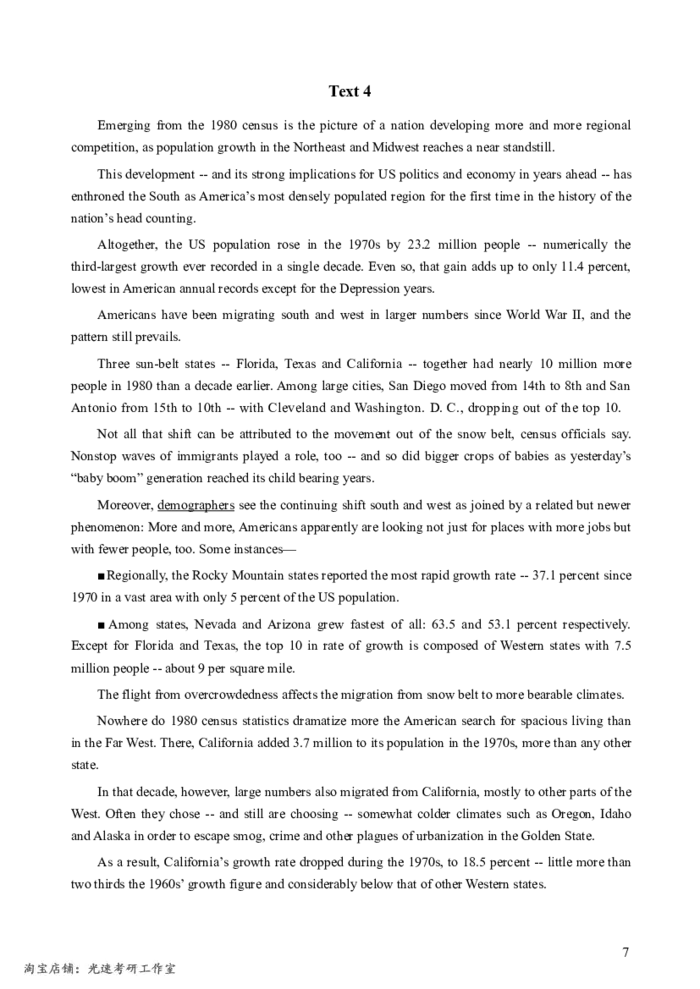
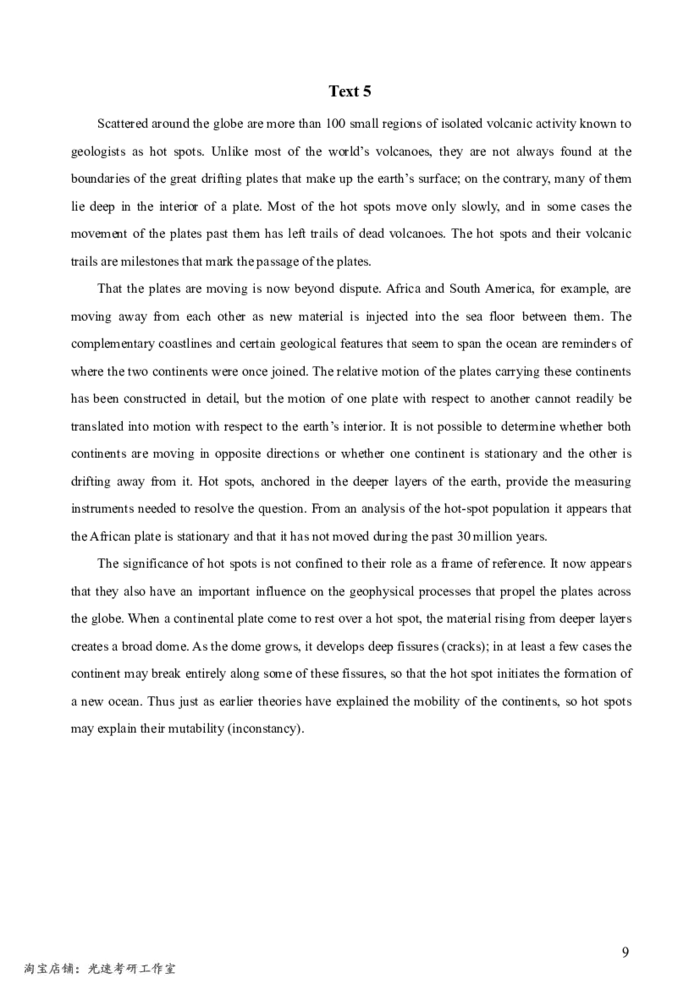
Scattered around the globe are more than 100 small regions of isolated volcanic activity known to
geologists as hot spots. Unlike most of the world’s volcanoes, they are not always found at the
boundaries of the great drifting plates that make up the earth’s surface; on the contrary, many of them
lie deep in the interior of a plate. Most of the hot spots move only slowly, and in some cases the
movement of the plates past them has left trails of dead volcanoes. The hot spots and their volcanic
trails are milestones that mark the passage of the plates.
That the plates are moving is now beyond dispute. Africa and South America, for example, are
moving away from each other as new material is injected into the sea floor between them. The
complementary coastlines and certain geological features that seem to span the ocean are reminders of
where the two continents were once joined. The relative motion of the plates carrying these continents
has been constructed in detail, but the motion of one plate with respect to another cannot readily be
translated into motion with respect to the earth’s interior. It is not possible to determine whether both
continents are moving in opposite directions or whether one continent is stationary and the other is
drifting away from it. Hot spots, anchored in the deeper layers of the earth, provide the measuring
instruments needed to resolve the question. From an analysis of the hot-spot population it appears that
the African plate is stationary and that it has not moved during the past 30 million years.
The significance of hot spots is not confined to their role as a frame of reference. It now appears
that they also have an important influence on the geophysical processes that propel the plates across
the globe. When a continental plate come to rest over a hot spot, the material rising from deeper layers
creates a broad dome. As the dome grows, it develops deep fissures (cracks); in at least a few cases the
continent may break entirely along some of these fissures, so that the hot spot initiates the formation of
a new ocean. Thus just as earlier theories have explained the mobility of the continents, so hot spots
may explain their mutability (inconstancy).
10
27. The author believes that ________.
[A] the motion of the plates corresponds to that of the earth’s interior
[B] the geological theory about drifting plates has been proved to be true
[C] the hot spots and the plates move slowly in opposite directions
[D] the movement of hot spots proves the continents are moving apart
28. That Africa and South America were once joined can be deduced from the fact that ________.
[A] the two continents are still moving in opposite directions
[B] they have been found to share certain geological features
[C] the African plate has been stable for 30 million years
[D] over 100 hot spots are scattered all around the globe
29. The hot spot theory may prove useful in explaining ________.
[A] the structure of the African plates
[B] the revival of dead volcanoes
[C] the mobility of the continents
[D] the formation of new oceans
30. The passage is mainly about ________.
[A] the features of volcanic activities
[B] the importance of the theory about drifting plates
[C] the significance of hot spots in geophysical studies
[D] the process of the formation of volcanoes
11
1999 年考研英语阅读真题
Text 1
It’s a rough world out there. Step outside and you could break a leg slipping on your doormat.
Light up the stove and you could burn down the house. Luckily, if the doormat or stove failed to warn
of coming disaster, a successful lawsuit might compensate you for your troubles. Or so the thinking
has gone since the early 1980s, when juries began holding more companies liable for their customers’
misfortunes.
Feeling threatened, companies responded by writing ever longer warning labels, trying to
anticipate every possible accident. Today, stepladders carry labels several inches long that warn,
among other things, that you might—surprise!—fall off. The label on a child’s Batman cape cautions
that the toy “does not enable user to fly”.
While warnings are often appropriate and necessary—the dangers of drug interactions, for
example—and many are required by state or federal regulations, it isn’t clear that they actually protect
the manufacturers and sellers from liability if a customer is injured. About 50 percent of the companies
lose when injured customers take them to court.
Now the tide appears to be turning. As personal injury claims continue as before, some courts are
beginning to side with defendants, especially in cases where a warning label probably wouldn’t have
changed anything. In May, Julie Nimmons, president of Schutt Sports in Illinois, successfully fought a
lawsuit involving a football player who was paralyzed in a game while wearing a Schutt helmet.
“We’re really sorry he has become paralyzed, but helmets aren’t designed to prevent those kinds of
injuries, ” says Nimmons. The jury agreed that the nature of the game, not the helmet, was the reason
for the athlete’s injury. At the same time, the American Law Institute—a group of judges, lawyers, and
academics whose recommendations carry substantial weight—issued new guidelines for tort law
stating that companies need not warn customers of obvious dangers or bombard them with a lengthy
list of possible ones. “Important information can get buried in a sea of trivialities, ” says a law
professor at Cornell Law School who helped draft the new guidelines. If the moderate end of the legal
community has its way, the information on products might actually be provided for the benefit of
customers and not as protection against legal liability.
12
11. What were things like in 1980s when accidents happened?
[A]Customers might be relieved of their disasters through lawsuits.
[B]Injured customers could expect protection from the legal system.
[C]Companies would avoid being sued by providing new warnings.
[D]Juries tended to find fault with the compensations companies promised.
12. Manufacturers as mentioned in the passage tend to
.
[A]satisfy customers by writing long warnings on products.
[B]become honest in describing the inadequacies of their products.
[C]make the best use of labels to avoid legal liability.
[D]feel obliged to view customers’ safety as their first concern.
13. The case of Schutt helmet demonstrated that
.
[A]some injury claims were no longer supported by law.
[B]helmets were not designed to prevent injuries.
[C]product labels would eventually be discarded.
[D]some sports games might lose popularity with athletes.
14. The author’s attitude towards the issue seems to be
.
[A]biased
[B]indifferent
[C]puzzling
[D]objective
13
Text 2
In the first year or so of Web business, most of the action has revolved around efforts to tap the
consumer market. More recently, as the Web proved to be more than a fashion, companies have started
to buy and sell products and services with one another. Such business to business sales make sense
because business people typically know what product they’re looking for.
Nonetheless, many companies still hesitate to use the Web because of doubts about its reliability.
“Businesses need to feel they can trust the pathway between them and the supplier,” says senior
analyst Blane Erwin of Forrester Research. Some companies are limiting the risk by conducting online
transactions only with established business partners who are given access to the company’s private
intranet.
Another major shift in the model for Internet commerce concerns the technology available for
marketing. Until recently, Internet marketing activities have focused on strategies to “pull” customers
into sites. In the past year, however, software companies have developed tools that allow companies to
“push” information directly out to consumers, transmitting marketing messages directly to targeted
customers. Most notably, the Pointcast Network uses a screen saver to deliver a continually updated
stream of news and advertisements to subscribers’ computer monitors. Subscribers can customize the
information they want to receive and proceed directly to a company’s Web site. Companies such as
Virtual Vineyards are already starting to use similar technologies to push messages to customers about
special sales, product offerings, or other events. But push technology has earned the contempt of many
Web users. Online culture thinks highly of the notion that the information flowing onto the screen
comes there by specific request. Once commercial promotion begins to fill the screen uninvited, the
distinction between the Web and television fades. That’s a prospect that horrifies Net purists.
But it is hardly inevitable that companies on the Web will need to resort to push strategies to
make money. The examples of Virtual Vineyards, Amazon .com, and other pioneers show that a Web
site selling the right kind of products with the right mix of interactivity, hospitality, and security will
attract online customers. And the cost of computing power continues to free fall, which is a good sign
for any enterprise setting up shop in silicon. People looking back 5 or 10 years from now may well
wonder why so few companies took the online plunge.
14
15. We learn from the beginning of the passage that Web business
.
[A]has been striving to expand its market.
[B]intended to follow a fanciful fashion.
[C]tried but in vain to control the market.
[D]has been booming for one year or so.
16. Speaking of the online technology available for marketing, the author implies that
.
[A]the technology is popular with many Web users.
[B]businesses have faith in the reliability of online transactions.
[C]there is a radical change in strategy.
[D]it is accessible limitedly to established partners.
17. In the view of Net purists,
.
[A]there should be no marketing messages in online culture.
[B]money making should be given priority to on the Web.
[C]the Web should be able to function as the television set.
[D]there should be no online commercial information without requests.
18. We learn from the last paragraph that
.
[A]pushing information on the Web is essential to Internet commerce.
[B]interactivity, hospitality and security are important to online customers.
[C]leading companies began to take the online plunge decades ago.
[D]setting up shops in silicon is independent of the cost of computing power.
15
Text 3
An invisible border divides those arguing for computers in the classroom on the behalf of
students’ career prospects and those arguing for computers in the classroom for broader reasons of
radical educational reform. Very few writers on the subject have explored this distinction—indeed,
contradiction—which goes to the heart of what is wrong with the campaign to put computers in the
classroom.
An education that aims at getting a student a certain kind of job is a technical education, justified
for reasons radically different from why education is universally required by law. It is not simply to
raise everyone’s job prospects that all children are legally required to attend school into their teens.
Rather, we have a certain conception of the American citizen, a character who is incomplete if he
cannot competently assess how his livelihood and happiness are affected by things outside of himself.
But this was not always the case; before it was legally required for all children to attend school until
a certain age, it was widely accepted that some were just not equipped by nature to pursue this
kind of education. With optimism characteristic of all industrialized countries, we came to accept
that everyone is fit to be educated.
Computer-education advocates forsake this optimistic
notion for a pessimism that betrays their otherwise cheery outlook. Banking on the confusion between
educational and vocational reasons for bringing computers into schools, computered advocates often
emphasize the job prospects of graduates over their educational achievement.
There are some good arguments for a technical education given the right kind of student. Many
European schools introduce the concept of professional training early on in order to make sure children
are properly equipped for the professions they want to join. It is, however, presumptuous to insist that
there will only be so many jobs for so many scientists, so many businessmen, so many accountants.
Besides, this is unlikely to produce the needed number of every kind of professional in a country as
large as ours and where the economy is spread over so many states and involves so many international
corporations.
But, for a small group of students, professional training might be the way to go since
well-developed skills, all other factors being equal, can be the difference between having a job and not.
Of course, the basics of using any computer these days are very simple. It does not take a lifelong
acquaintance to pick up various software programs. If one wanted to become a computer engineer, that
is, of course, an entirely different story. Basic computer skills take—at the very longest—a couple of
months to learn. In any case, basic computer skills are only complementary to the host of real skills
that are necessary to becoming any kind of professional. It should be observed, of course, that no
school, vocational or not, is helped by a confusion over its purpose.
16
19. The author thinks the present rush to put computers in the classroom is
.
[A]far reaching
[B]dubiously oriented
[C]self contradictory
[D]radically reformatory
20. The belief that education is indispensable to all children
.
[A]is indicative of a pessimism in disguise.
[B]came into being along with the arrival of computers.
[C]is deeply rooted in the minds of computer-ed advocates.
[D]originated from the optimistic attitude of industrialized countries.
21. It could be inferred from the passage that in the author’s country the European model of
professional training is
.
[A]dependent upon the starting age of candidates.
[B]worth trying in various social sections.
[C]of little practical value.
[D]attractive to every kind of professional.
22. According to the author, basic computer skills should be
.
[A]included as an auxiliary course in school.
[B]highlighted in acquisition of professional qualifications.
[C]mastered through a life-long course.
[D]equally emphasized by any school, vocational or otherwise.
17
Text 4
When a Scottish research team startled the world by revealing 3 months ago that it had cloned an
adult sheep, President Clinton moved swiftly. Declaring that he was opposed to using this unusual
animal husbandry technique to clone humans, he ordered that federal funds not be used for such an
experiment—although no one had proposed to do so—and asked an independent panel of experts
chaired by Princeton President Harold Shapiro to report back to the White House in 90 days with
recommendations for a national policy on human cloning. That group — the National Bioethics
Advisory Commission (NBAC)—has been working feverishly to put its wisdom on paper, and at a
meeting on 17 May, members agreed on a near final draft of their recommendations.
NBAC will ask that Clinton ’s 90 day ban on federal funds for human cloning be extended
indefinitely, and possibly that it be made law. But NBAC members are planning to word the
recommendation narrowly to avoid new restrictions on research that involves the cloning of human
DNA or cells—routine in molecular biology. The panel has not yet reached agreement on a crucial
question, however, whether to recommend legislation that would make it a crime for private funding to
be used for human cloning.
In a draft preface to the recommendations, discussed at the 17 May meeting, Shapiro suggested
that the panel had found a broad consensus that it would be “morally unacceptable to attempt to create
a human child by adult nuclear cloning.” Shapiro explained during the meeting that the moral doubt
stems mainly from fears about the risk to the health of the child. The panel then informally accepted
several general conclusions, although some details have not been settled.
NBAC plans to call for a continued ban on federal government funding for any attempt to clone
body cell nuclei to create a child. Because current federal law already forbids the use of federal funds
to create embryos (the earliest stage of human offspring before birth) for research or to knowingly
endanger an embryo’s life, NBAC will remain silent on embryo research.
NBAC members also indicated that they would appeal to privately funded researchers and clinics
not to try to clone humans by body cell nuclear transfer. But they were divided on whether to go
further by calling for a federal law that would impose a complete ban on human cloning. Shapiro and
most members favored an appeal for such legislation, but in a phone interview, he said this issue was
still “up in the air”.
18
23. We can learn from the first paragraph that
.
[A]federal funds have been used in a project to clone humans.
[B]the White House responded strongly to the news of cloning.
[C]NBAC was authorized to control the misuse of cloning technique.
[D]the White House has got the panel’s recommendations on cloning.
24. The panel agreed on all of the following except that
.
[A]the ban on federal funds for human cloning should be made a law.
[B]the cloning of human DNA is not to be put under more control.
[C]it is criminal to use private funding for human cloning.
[D]it would be against ethical values to clone a human being.
25. NBAC will leave the issue of embryo research undiscussed because
.
[A]embryo research is just a current development of cloning.
[B]the health of the child is not the main concern of embryo research.
[C]an embryo’s life will not be endangered in embryo research.
[D]the issue is explicitly stated and settled in the law.
26. It can be inferred from the last paragraph that
.
[A]some NBAC members hesitate to ban human cloning completely.
[B]a law banning human cloning is to be passed in no time.
[C]privately funded researchers will respond positively to NBAC’s appeal .
[D]the issue of human cloning will soon be settled.
19
Text 5
Science, in practice, depends far less on the experiments it prepares than on the preparedness of
the minds of the men who watch the experiments. Sir Isaac Newton supposedly discovered gravity
through the fall of an apple. Apples had been falling in many places for centuries and thousands of
people had seen them fall. But Newton for years had been curious about the cause of the orbital motion
of the moon and planets. What kept them in place? Why didn’t they fall out of the sky? The fact that
the apple fell down toward the earth and not up into the tree answered the question he had been asking
himself about those larger fruits of the heavens, the moon and the planets.
How many men would have considered the possibility of an apple falling up into the tree?
Newton did because he was not trying to predict anything. He was just wondering. His mind was ready
for the unpredictable. Unpredictability is part of the essential nature of research. If you don’t have
unpredictable things, you don’t have research. Scientists tend to forget this when writing their cut and
dried reports for the technical journals, but history is filled with examples of it.
In talking to some scientists, particularly younger ones, you might gather the impression that they
find the “scientific method” a substitute for imaginative thought. I’ve attended research conferences
where a scientist has been asked what he thinks about the advisability of continuing a certain
experiment. The scientist has frowned, looked at the graphs, and said, “the data are still inconclusive.”
“We know that,” the men from the budget office have said, “but what do you think? Is it worthwhile
going on? What do you think we might expect?” The scientist has been shocked at having even been
asked to speculate.
What this amounts to, of course, is that the scientist has become the victim of his own writings.
He has put forward unquestioned claims so consistently that he not only believes them himself, but has
convinced industrial and business management that they are true. If experiments are planned and
carried out according to plan as faithfully as the reports in the science journals indicate, then it is
perfectly logical for management to expect research to produce results measurable in dollars and cents.
It is entirely reasonable for auditors to believe that scientists who know exactly where they are going
and how they will get there should not be distracted by the necessity of keeping one eye on the cash
register while the other eye is on the microscope. Nor, if regularity and conformity to a standard
pattern are as desirable to the scientist as the writing of his papers would appear to reflect, is
management to be blamed for discriminating against the “odd balls” among researchers in favor of
more conventional thinkers who “work well with the team”.
20
27. The author wants to prove with the example of Isaac Newton that
.
[A]inquiring minds are more important than scientific experiments
[B]science advances when fruitful researches are conducted
[C]scientists seldom forget the essential nature of research
[D]unpredictability weighs less than prediction in scientific research
28. The author asserts that scientists
.
[A]shouldn’t replace “scientific method” with imaginative thought
[B]shouldn’t neglect to speculate on unpredictable things
[C]should write more concise reports for technical journals
[D]should be confident about their research findings
29. It seems that some young scientists
.
[A]have a keen interest in prediction
[B]often speculate on the future
[C]think highly of creative thinking
[D]stick to “scientific method”
30. The author implies that the results of scientific research
.
[A]may not be as profitable as they are expected
[B]can be measured in dollars and cents
[C]rely on conformity to a standard pattern
[D]are mostly underestimated by management
21
2000 年考研英语阅读真题
Text 1
A history of long and effortless success can be a dreadful handicap, but, if properly handled, it
may become a driving force. When the United States entered just such a glowing period after the end
of the Second World War, it had a market eight times larger than any competitor, giving its industries
unparalleled economies of scale. Its scientists were the world’s best; its workers the most skilled.
America and Americans were prosperous beyond the dreams of the Europeans and Asians whose
economies the war had destroyed.
It was inevitable that this primacy should have narrowed as other countries grew richer. Just as
inevitably, the retreat from predominance proved painful. By the mid-1980s Americans had found
themselves at a loss over their fading industrial competitiveness. Some huge American industries, such
as consumer electronics, had shrunk or vanished in the face of foreign competition. By 1987 there was
only one American television maker left, Zenith. (Now there is none: Zenith was bought by South
Korea’s LG Electronics in July.) Foreign-made cars and textiles were sweeping into the domestic
market. America’s machine-tool industry was on the ropes. For a while it looked as though the making
of semiconductors, which America had invented and which sat at the heart of the new computer age,
was going to be the next casualty.
All of this caused a crisis of confidence. Americans stopped taking prosperity for granted. They
began to believe that their way of doing business was failing, and that their incomes would therefore
shortly begin to fall as well.The mid-1980s brought one inquiry after another into the causes of
America’s industrial decline. Their sometimes sensational findings were filled with warnings about
the growing competition from overseas.
How things have changed! In 1995 the United States can look back on five years of solid growth
while Japan has been struggling. Few Americans attribute this solely to such obvious causes as a
devalued dollar or the turning of the business cycle. Self-doubt has yielded to blind pride. American
industry has changed its structure, has gone on a diet, has learnt to be more quick-witted,” according
to Richard Cavanaugh, executive dean of Harvard’s Kennedy School of Government. “It makes me
proud to be an American just to see how our businesses are improving their productivity,”says Stephen
Moore of the Cato Institute, a think-tank in Washington, DC. And William Sahlman of the Harvard
Business School believes that people will look back on this period as “ a golden age of business
management in the United States.”
22
11. The U.S. achieved its predominance after World War II because
.
[A]it had made painstaking efforts towards this goal.
[B]its domestic market was eight times larger than before.
[C]the war had destroyed the economies of most potential competitors.
[D]the unparalleled size of its workforce had given an impetus to its economy.
12. The loss of U.S. predominance in the world economy in the 1980s is manifested in the fact that the
American
.
[A]TV industry had withdrawn to its domestic market.
[B]semiconductor industry had been taken over by foreign enterprises.
[C]machine-tool industry had collapsed after suicidal actions.
[D]auto industry had lost part of its domestic market.
13. What can be inferred from the passage?
[A]It is human nature to shift between self-doubt and blind pride.
[B]Intense competition may contribute to economic progress.
[C]The revival of the economy depends on international cooperation.
[D]A long history of success may pave the way for further development.
14. The author seems to believe the revival of the U.S. economy in the 1990s can be attributed to
the
.
[A]turning of the business cycle
[B]restructuring of industry
[C]improved business management
[D]success in education
23
Text 2
Being a man has always been dangerous. There are about 105 males born for every 100 females,
but this ratio drops to near balance at the age of maturity, and among 70-year-olds there are twice as
many women as men. But the great universal of male mortality is being changed. Now, boy babies
survive almost as well as girls do. This means that, for the first time, there will be an excess of boys in
those crucial years when they are searching for a mate. More important, another chance for natural
selection has been removed. Fifty years ago, the chance of a baby (particularly a boy baby) surviving
depended on its weight. A kilogram too light or too heavy meant almost certain death. Today it makes
almost no difference. Since much of the variation is due to genes, one more agent of evolution has
gone.
There is another way to commit evolutionary suicide: stay alive, but have fewer children. Few
people are as fertile as in the past. Except in some religious communities, very few women have 15
children. Nowadays the number of births, like the age of death, has become average. Most of us have
roughly the same number of offspring. Again, differences between people and the opportunity for
natural selection to take advantage of it have diminished. India shows what is happening. The country
offers wealth for a few in the great cities and poverty for the remaining tribal peoples. The grand
mediocrity of today — everyone being the same in survival and number of offspring — means that
natural selection has lost 80% of its power in upper-middle-class India compared to the tribes.
For us, this means that evolution is over; the biological Utopia has arrived.Strangely, it has
involved little physical change. No other species fills so many places in nature. But in the past 100,
000 years—even the past 100 years—our lives have been transformed but our bodies have not. We did
not evolve, because machines and society did it for us. Darwin had a phrase to describe those ignorant
of evolution: they “ look at an organic being as a savage looks at a ship, as at something wholly
beyond his comprehension. ” No doubt we will remember a 20th century way of life beyond
comprehension for its ugliness. But however amazed our descendants may be at how far from Utopia
we were, they will look just like us.
24
15. What used to be the danger in being a man according to the first paragraph?
[A]A lack of mates.
[B]A fierce competition.
[C]A lower survival rate.
[D]A defective gene.
16. What does the example of India illustrate?
[A]Wealthy people tend to have fewer children than poor people.
[B]Natural selection hardly works among the rich and the poor.
[C]The middle class population is 80% smaller than that of the tribes.
[D]India is one of the countries with a very high birth rate.
17. The author argues that our bodies have stopped evolving because
.
[A]life has been improved by technological advance
[B]the number of female babies has been declining
[C]our species has reached the highest stage of evolution
[D]the difference between wealth and poverty is disappearing
18. Which of the following would be the best title for the passage?
[A]Sex Ratio Changes in Human Evolution.
[B]Ways of Continuing Man’s Evolution.
[C]The Evolutionary Future of Nature.
[D]Human Evolution Going Nowhere.
25
Text 3
When a new movement in art attains a certain fashion, it is advisable to find out what its
advocates are aiming at, for, however farfetched and unreasonable their principles may seem today, it
is possible that in years to come they may be regarded as normal. With regard to Futurist poetry,
however, the case is rather difficult, for whatever Futurist poetry may be —even admitting that the
theory on which it is based may be right—it can hardly be classed as Literature.
This, in brief, is what the Futurist says: for a century, past conditions of life have been
conditionally speeding up, till now we live in a world of noise and violence and speed.Consequently,
our feelings, thoughts and emotions have undergone a corresponding change.
This speeding up of
life, says the Futurist, requires a new form of expression. We must speed up our literature too, if we
want to interpret modern stress. We must pour out a large stream of essential words, unhampered by
stops, or qualifying adjectives, or finite verbs. Instead of describing sounds we must make up words
that imitate them; we must use many sizes of type and different colored inks on the same page, and
shorten or lengthen words at will.
Certainly their descriptions of battles are confused. But it is a little upsetting to read in the
explanatory notes that a certain line describes a fight between a Turkish and a Bulgarian officer on a
bridge off which they both fall into the river —and then to find that the line consists of the noise of
their falling and the weights of the officers: “Pluff! Pluff! A hundred and eighty-five kilograms.”
This, though it fulfills the laws and requirements of Futurist poetry, can hardly be classed as
Literature. All the same, no thinking man can refuse to accept their first proposition: that a great
change in our emotional life calls for a change of expression. The whole question is really this: have
we essentially changed?
26
19. This passage is mainly
.
[A]a survey of new approaches to art
[B]a review of Futurist poetry
[C]about merits of the Futurist movement
[D]about laws and requirements of literature
20. When a novel literary idea appears, people should try to
.
[A]determine its purposes
[B]ignore its flaws
[C]follow the new fashions
[D]accept the principles
21. Futurists claim that we must
.
[A]increase the production of literature
[B]use poetry to relieve modern stress
[C]develop new modes of expression
[D]avoid using adjectives and verbs
22. The author believes that Futurist poetry is
.
[A]based on reasonable principles
[B]new and acceptable to ordinary people
[C]indicative of a basic change in human nature
[D]more of a transient phenomenon than literature
27
Text 4
Aimlessness has hardly been typical of the postwar Japan whose productivity and social harmony
are the envy of the United States and Europe. But increasingly the Japanese are seeing a decline of the
traditional work-moral values. Ten years ago young people were hardworking and saw their jobs as
their primary reason for being, but now Japan has largely fulfilled its economic needs, and young
people don’t know where they should go next.
The coming of age of the postwar baby boom and an entry of women into the male-dominated job
market have limited the opportunities of teen-agers who are already questioning the heavy personal
sacrifices involved in climbing Japan’s rigid social ladder to good schools and jobs. In a recent survey,
it was found that only 24.5 percent of Japanese students were fully satisfied with school life, compared
with 67.2 percent of students in the United States. In addition, far more Japanese workers expressed
dissatisfaction with their jobs than did their counterparts in the 10 other countries surveyed.
While often praised by foreigners for its emphasis on the basics, Japanese education tends to
stress test taking and mechanical learning over creativity and self-expression. “Those things that do
not show up in the test scores—personality, ability, courage or humanity—are completely ignored,”
says Toshiki Kaifu, chairman of the ruling Liberal Democratic Party ’ s education committee.
“ Frustration against this kind of thing leads kids to drop out and run wild. ”
Last year Japan
experienced 2,125 incidents of school violence, including 929 assaults on teachers. Amid the outcry,
many conservative leaders are seeking a return to the prewar emphasis on moral education. Last year
Mitsuo Setoyama, who was then education minister, raised eyebrows when he argued that liberal
reforms introduced by the American occupation authorities after World War II had weakened the
“Japanese morality of respect for parents.”
But that may have more to do with Japanese life-styles. “In Japan,” says educator Yoko Muro,
“ it ’s never a question of whether you enjoy your job and your life, but only how much you can
endure. ” With economic growth has come centralization; fully 76 percent of Japan ’s 119 million
citizens live in cities where community and the extended family have been abandoned in favor of
isolated, two-generation households. Urban Japanese have long endured lengthy commutes (travels to
and from work) and crowded living conditions, but as the old group and family values weaken, the
discomfort is beginning to tell. In the past decade, the Japanese divorce rate, while still well below that
of the United States, has increased by more than 50 percent, and suicides have increased by nearly
one-quarter.
28
23. In the Westerners’ eyes, the postwar Japan was
.
[A]under aimless development
[B]a positive example
[C]a rival to the West
[D]on the decline
24. According to the author, what may chiefly be responsible for the moral decline of Japanese
society?
[A]Women’s participation in social activities is limited.
[B]More workers are dissatisfied with their jobs.
[C]Excessive emphasis has been placed on the basics.
[D]The life-style has been influenced by Western values.
25. Which of the following is true according to the author
?
[A]Japanese education is praised for helping the young climb the social ladder.
[B]Japanese education is characterized by mechanical learning as well as creativity.
[C]More stress should be placed on the cultivation of creativity.
[D]Dropping out leads to frustration against test taking.
26. The change in Japanese life-style is revealed in the fact that
.
[A]the young are less tolerant of discomforts in life
[B]the divorce rate in Japan exceeds that in the U.S.
[C]the Japanese endure more than ever before
[D]the Japanese appreciate their present life
29
Text 5
If ambition is to be well regarded, the rewards of ambition—wealth, distinction, control over one’
s destiny—must be deemed worthy of the sacrifices made on ambition’s behalf. If the tradition of
ambition is to have vitality, it must be widely shared; and it especially must be highly regarded by
people who are themselves admired, the educated not least among them. In an odd way, however, it is
the educated who have claimed to have given up on ambition as an ideal. What is odd is that they have
perhaps most benefited from ambition — if not always their own then that of their parents and
grandparents. There is a heavy note of hypocrisy in this, a case of closing the barn door after the horses
have escaped—with the educated themselves riding on them.
Certainly people do not seem less interested in success and its signs now than formerly. Summer
homes, European travel, BMWs—the locations, place names and name brands may change, but such
items do not seem less in demand today than a decade or two years ago.What has happened is that
people cannot confess fully to their dreams, as easily and openly as once they could, lest they be
thought pushing, acquisitive and vulgar. Instead, we are treated to fine hypocritical spectacles, which
now more than ever seem in ample supply: the critic of American materialism with a Southampton
summer home; the publisher of radical books who takes his meals in three-star restaurants; the
journalist advocating participatory democracy in all phases of life, whose own children are enrolled in
private schools. For such people and many more perhaps not so exceptional, the proper formulation is,
“Succeed at all costs but avoid appearing ambitious.”
The attacks on ambition are many and come from various angles; its public defenders are few and
unimpressive, where they are not extremely unattractive. As a result, the support for ambition as a
healthy impulse, a quality to be admired and fixed in the mind of the young, is probably lower than it
has ever been in the United States. This does not mean that ambition is at an end, that people no longer
feel its stirrings and promptings, but only that, no longer openly honored, it is less openly professed.
Consequences follow from this, of course, some of which are that ambition is driven underground, or
made sly. Such, then, is the way things stand: on the left angry critics, on the right stupid supporters,
and in the middle, as usual, the majority of earnest people trying to get on in life.
30
27. It is generally believed that ambition may be well regarded if
.
[A]its returns well compensate for the sacrifices
[B]it is rewarded with money, fame and power
[C]its goals are spiritual rather than material
[D]it is shared by the rich and the famous
28. The last sentence of the first paragraph most probably implies that it is
.
[A]customary of the educated to discard ambition in words
[B]too late to check ambition once it has been let out
[C]dishonest to deny ambition after the fulfillment of the goal
[D]impractical for the educated to enjoy benefits from ambition
29. Some people do not openly admit they have ambition because
.
[A]they think of it as immoral
[B]their pursuits are not fame or wealth
[C]ambition is not closely related to material benefits
[D]they do not want to appear greedy and contemptible
30. From the last paragraph the conclusion can be drawn that ambition should be maintained
.
[A]secretly and vigorously
[B]openly and enthusiastically
[C]easily and momentarily
[D]verbally and spiritually
31
2001 年考研英语阅读真题
Text 1
Specialisation can be seen as a response to the problem of an increasing accumulation of scientific
knowledge. By splitting up the subject matter into smaller units,one man could continue to handle the
information and use it as the basis for further research. But specialisation was only one of a series of
related developments in science affecting the process of communication. Another was the growing
professionalisation of scientific activity.
No clear-cut distinction can be drawn between professionals and amateurs in science: exceptions
can be found to any rule. Nevertheless, the word “amateur” does carry a connotation that the person
concerned is not fully integrated into the scientific community and, in particular, may not fully share
its values. The growth of specialisation in the nineteenth century, with its consequent requirement of a
longer, more complex training, implied greater problems for amateur participation in science. The
trend was naturally most obvious in those areas of science based especially on a mathematical or
laboratory training, and can be illustrated in terms of the development of geology in the United
Kingdom.
A comparison of British geological publications over the last century and a half reveals not simply
an increasing emphasis on the primacy of research, but also a changing definition of what constitutes
an acceptable research paper. Thus, in the nineteenth century, local geological studies represented
worthwhile research in their own right; but, in the twentieth century, local studies have increasingly
become acceptable to professionals only if they incorporate, and reflect on, the wider geological
picture. Amateurs, on the other hand, have continued to pursue local studies in the old way. The overall
result has been to make entrance to professional geological journals harder for amateurs, a result that
has been reinforced by the widespread introduction of refereeing, first by national journals in the
nineteenth century and then by several local geological journals in the twentieth century. As a logical
consequence of this development, separate journals have now appeared aimed mainly towards either
professional or amateur readership. A rather similar process of differentiation has led to professional
geologists coming together nationally within one or two specific societies, whereas the amateurs have
tended either to remain in local societies or to come together nationally in a different way.
Although the process of professionalisation and specialisation was already well under way in
British geology during the nineteenth century, its full consequences were thus delayed until the
twentieth century. In science generally, however, the nineteenth century must be reckoned as the
crucial period for this change in the structure of science.
32
21. The growth of specialisation in the 19th century might be more clearly seen in sciences such as
_______ .
[AJ sociology and chemistry
[B] physics and psychology
[C] sociology and psychology
[D] physics and chemistry
22. We can infer from the passage that _______.
[A] there is little distinction between specialisation and professionalisation
[B] amateurs can compete with professionals in some areas of science
[C] professionals tend to welcome amateurs into the scientific community
[D] amateurs have national academic societies but no local ones
23. The author writes of the development of geology to demonstrate ______
.
[A] the process of specialisation and professionalisation
[B] the hardship of amateurs in scientific study
[C] the change of policies in scientific publications
[D] the discrimination of professionals against amateurs
24. The direct reason for specialisation is _______.
[A] the development in communication
[B] the growth of professionalisation
[C] the expansion of scientific knowledge
[D] the splitting up of academic societies
33
Text 2
A great deal of attention is being paid today to the so-called digital divide-the division of the
world into the info (information) rich and the info poor. And that divide does exist today. My wife and
I lectured about this looming danger twenty years ago. What was less visible then, however, were the
new, positive forces that work against the digital divide. There are reasons to be optimistic.
There are technological reasons to hope the digital divide will narrow. As the Internet becomes
more and more commercialized, it is in the interest of business to universalize access-after all, the
more people online, the more potential customers there are. More and more governments, afraid their
countries will be left behind, want to spread Internet access. Within the next decade or two, one to two
billion people on the planet will he netted together. As a result, I now believe the digital divide will
narrow rather than widen in the years ahead. And that is very good news because the Internet may well
be the most powerful tool for combating world poverty that we’ve ever had.
Of course, the use of the Internet isn’t the only way to defeat poverty. And the Internet is not the
only tool we have. But it has enormous potential.
To take advantage of this tool, some impoverished countries will have to get over their outdated
anti-colonial prejudices with respect to foreign investment. Countries that still think foreign investment
is an invasion of their sovereignty might well study the history of infrastructure(the basic structural
foundations of a society)in the United States. When the United States built its industrial infrastructure,
it didn’t have the capital to do so. And that is why America’s Second Wave infrastructure-including
roads, harbors, highways, ports and so on-were built with foreign investment. The English, the
Germans, the Dutch and the French were investing in Britain’s former colony. They financed them.
Immigrant Americans built them. Guess who owns them now? The Americans. I believe the same
thing would be true in places like Brazil or anywhere else for that matter. The more foreign capital you
have helping you build your Third Wave infrastructure, which today is an electronic infrastructure, the
better off you’re going to be. That doesn't mean lying down and becoming fooled, or letting foreign
corporations run uncontrolled. But it does mean recognizing how important they can be in building the
energy and telecom infrastructures needed to take full advantage of the Internet.
34
25. Digital divide is something _______.
[A] getting worse because of the Internet
[B] the rich countries are responsible for
[C] the world must guard against
[D] considered positive today
26. Governments attach importance to the Internet because it _______.
[A] offers economic potentials
[B] can bring foreign funds
[C] can soon wipe out world poverty
[D] connects people all over the world
27. The writer mentioned the case of the United States to justify the policy of _______.
[A] providing financial support overseas
[B] preventing foreign capital’s control
[C] building industrial infrastructure
[D] accepting foreign investment
28.
It seems that now a country’s economy depands much on ______.
[A] how well-developed it is electronically
[B] whether it is prejudiced against immigrants
[C] whether it adopts America’s industrial pattern
[D] how much control it has over foreign corporations
35
Text 3
Why do so many Americans distrust what they read in their newspapers? The American Society of
Newspaper Editors is trying to answer this painful question. The organization is deep into a long
self-analysis known as the journalism credibility project.
Sad to say, this project has turned out to be mostly low-level findings about factual errors and
spelling and grammar mistakes, combined with lots of headscratching puzzlement about what in the
world those readers really want.
But the sources of distrust go way deeper. Most journalists learn to see the world through a set of
standard templates (patterns) into which they plug each day’s events. In other words, there is a
conventional story line in the newsroom culture that provides a backbone and a ready-made narrative
structure for otherwise confusions news.
There exists a social and cultural disconnect between journalists and their readers which helps
explain why the “standard templates”of the newsroom seem alien many readers. In a recent survey,
questionnaires were sent to reporters in five middle size cities around the country, plus one large
metropolitan area. Then residents in these communities were phoned at random and asked the same
questions.
Replies show that compared with other Americans, journalists are more likely to live in upscale
neighborhoods, have maids, own Mercedeses, and trade stocks, and they’re less likely to go to church,
do volunteer work, or put down roots in community.
Reporters tend to be part of a broadly defined social and cultural elite, so their work tends to
reflect the conventional values of this elite. The astonishing distrust of the news media isn’t rooted in
inaccuracy or poor reportorial skills but in the daily clash of world views between reporters and their
readers.
This is an explosive situation for any industry, particularly a declining one. Here is a troubled
business that keeps hiring employees whose attitudes vastly annoy the customers. Then it sponsors lots
of symposiums and a credibility project dedicated to wondering why customers are annoyed and
fleeing in large numbers. But it never seems to get around to noticing the cultural and class biases that
so many former buyers are complaining about. If it did, it would open up its diversity program, now
focused narrowly on race and gender, and look for reporters who differ broadly by outlook, values,
education, and class.
36
29. What is the passage mainly about?
[A] needs of the readers all over the world.
[B] causes of the public disappointment about newspapers.
[C] origins of the declining newspaper industry.
[D] aims of a journalism credibility project.
30. The results of the journalism credibility project turned out to be ______.
[A] quite trustworthy
[B] somewhat contradictory
[C] very illuminating
[D] rather superficial
31. The basic problem of journalists as pointed out by the writer lies in their ______.
[A] working attitude
[B] conventional lifestyle
[C] world outlook
[D] educational background
32. Despite its efforts, the newspaper industry still cannot satisfy the readers owing to its_______.
[A] failure to realize its real problem
[B] tendency to hire annoying reporters
[C] likeliness to do inaccurate reporting
[D] prejudice in matters of race and gender
37
Text 4
The world is going through the biggest wave of mergers and acquisitions ever witnessed. The
process sweeps from hyperactive America to Europe and reaches the emerging countries with
unsurpassed might. Many in these countries are looking at this process and worrying: "Won't the wave
of business concentration turn into an uncontrollable anti-competitive force?"
There's no question that the big are getting bigger and more powerful. Multinational corporations
accounted for less than 20% of international trade in 1982. Today the figure is more than 25% and
growing rapidly. International affiliates account for a fast-growing segment of production in
economies that open up and welcome foreign investment. In Argentina, for instance, after the reforms
of the early 1990s, multinationals went from 43% to almost 70% of the industrial production of the
200 largest firms. This phenomenon has created serious concerns over the role of smaller economic
firms, of national businessmen and over the ultimate stability of the world economy.
I believe that the most important forces behind the massive M&A wave are the same that underlie
the globalization process: falling transportation and communication costs, lower trade and investment
barriers and enlarged markets that require enlarged operations capable of meeting customers' demands.
All these are beneficial, not detrimental, to consumers. As productivity grows, the world's wealth
increases.
Examples of benefits or costs of the current concentration wave are scanty. Yet it is hard to
imagine that the merger of a few oil firms today could re-create the same threats to competition that
were feared nearly a century ago in the U.S., when the Standard Oil trust was broken up. The mergers
of telecom companies, such as WorldCom, hardly seem to bring higher prices for consumers or a
reduction in the pace of technical progress. On the contrary, the price of communications is coming
down fast. In cars, too, concentration is increasing-witness Daimler and Chrysler, Renault and
Nissan-but it does not appear that consumers are being hurt.
Yet the fact remains that the merger movement must be watched. A few weeks ago, Alan
Greenspan warned against the megamergers in the banking industry. Who is going to supervise,
regulate and operate as lender of last resort with the gigantic banks that are being created? Won't
multinationals shift production from one place to another when a nation gets too strict about
infringements to fair competition? And should one country take upon itself the role of “defending
competition” on issues that affect many other nations, as in the U S. vs. Microsoft case ?
38
33. What is the typical trend of businesses today?
[A] to take in more foreign funds.
[B] to invest more abroad.
[C] to combine and become bigger.
[D] to trade with more countries.
34. According to the author, one of the driving forces behind M&A wave is ______ .
[A] the greater customer demands.
[B] a surplus supply for the market.
[C] a growing productivity.
[D] the increase of the world's wealth.
35. From paragraph 4 we can infer that ______
.
[A] the increasing concentration is certain to hurt consumers
[B] WorldCom serves as a good example of both benefits and costs
[C] the costs of the globalization process are enormous
[D] the Standard Oil trust might have threatened competition
36. Toward the new business wave, the writer's attitude can he said to be _______.
[A] optimistic
[B] objective
[C] pessimistic
[D] biased
39
Text 5
When I decided to quit my full time employment it never occurred to me that I might become a
part of a new international trend. A lateral move that hurt my pride and blocked my professional
progress prompted me to abandon my relatively high profile career although, in the manner of a
disgraced government minister, I covered my exit by claiming “I wanted to spend more time with my
family”.
Curiously, some two-and-a-half years and two novels later, my experiment in what the Americans
term “downshifting”has turned my tired excuse into an absolute reality. I have been transformed from
a passionate advocate of the philosophy of “having it all”, preached by Linda Kelsey for the past
seven years in the pages of She magazine, into a woman who is happy to settle for a bit of everything.
I have discovered, as perhaps Kelsey will after her much-publicized resignation from the
editorship of She after a build-up of stress, that abandoning the doctrine of “juggling your life”, and
making the alternative move into “downshifting” brings with it far greater rewards than financial
success and social status. Nothing could persuade me to return to the kind of life Kelsey used to
advocate and I once enjoyed: 12-hour working days, pressured deadlines, the fearful strain of office
politics and the limitations of being a parent on “quality time”.
In America, the move away from juggling to a simpler, less materialistic lifestyle is a
well-established trend. Downshifting-also known in America as “voluntary simplicity” has, ironically,
even bred a new area of what might be termed anticonsumerism. There are a number of bestselling
downshifting self-help books for people who want to simplify their lives; there are newsletter's, such
as The Tightwad Gazette, that give hundreds of thousands of Americans useful tips on anything from
recycling their cling-film to making their own soap; there are even support groups for those who want
to achieve the mid- '90s equivalent of dropping out.
While in America the trend started as a reaction to the economic decline — after the mass
redundancies caused by downsizing in the late’80s — and is still linked to the politics of thrift, in
Britain, at least among the middle-class downshifters of my acquaintance, we have different reasons
for seeking to simplify our lives.
For the women of my generation who were urged to keep juggling through the’80s, downshifting
in the mid-'90s is not so much a search for the mythical good life — growing your own organic
vegetables, and risking turning into one—as a personal recognition of your limitations.
40
37. Which of the following is true according to paragraph 1?
[A] Full-time employment is a new international trend.
[B] The writer was compelled by circumstances to leave her job.
[C] “A lateral move” means stepping out of full-time employment.
[D] The writer was only too eager to spend more time with her family.
38. The writer’s experiment shows that downshifting
.
[A] enables her to realize her dream
[B] helps her mold a new philosophy of life
[C] prompts her to abandon her high social status
[D] leads her to accept the doctrine of She magazine
39. “Juggling one’s life” probably means living a life characterized by
.
[A] non-materialistic lifestyle
[B] a bit of everything
[C] extreme stress
[D] anti-consumerism
40. According to the passage, downshifting emerged in the U.S. as a result of
.
[A] the quick pace of modern life
[B] man’s adventurous spirit
[C] man’s search for mythical experiences
[D] the economic situation
41
2002 年考研英语阅读真题
Text 1
If you intend using humor in your talk to make people smile, you must know how to identify
shared experiences and problems. Your humor must be relevant to the audience and should help to
show them that you are one of them or that you understand their situation and are in sympathy with
their point of view.
Depending on whom you are addressing, the problems will be different. If you
are talking to a group of managers, you may refer to the disorganized methods of their secretaries;
alternatively if you are addressing secretaries, you may want to comment on their disorganized bosses.
Here is an example, which I heard at a nurses’ convention, of a story which works well because
the audience all shared the same view of doctors. A man arrives in heaven and is being shown around
by St. Peter. He sees wonderful accommodations, beautiful gardens, sunny weather, and so on.
Everyone is very peaceful, polite and friendly until, waiting in a line for lunch, the new arrival is
suddenly pushed aside by a man in a white coat, who rushes to the head of the line, grabs his food and
stomps over to a table by himself. “Who is that?” the new arrival asked St. Peter.
“Oh, that’s God,”
came the reply, “but sometimes he thinks he’s a doctor.”
If you are part of the group which you are addressing, you will be in a position to know the
experiences and problems which are common to all of you and it’ll be appropriate for you to make a
passing remark about the inedible canteen food or the chairman’s notorious bad taste in ties. With other
audiences you mustn’t attempt to cut in with humor as they will resent an outsider making disparaging
remarks about their canteen or their chairman.
You will be on safer ground if you stick to scapegoats
like the Post Office or the telephone system.
If you feel awkward being humorous, you must practice so that it becomes more natural. Include
a few casual and apparently off-the-cuff remarks which you can deliver in a relaxed and unforced
manner. Often it’s the delivery which causes the audience to smile, so speak slowly and remember that
a raised eyebrow or an unbelieving look may help to show that you are making a light-hearted remark.
Look for the humor. It often comes from the unexpected. A twist on a familiar quote “If at first
you don’t succeed, give up” or a play on words or on a situation. Search for exaggeration and
understatement. Look at your talk and pick out a few words or sentences which you can turn about and
inject with humor.
42
21. To make your humor work, you should
.
[A] take advantage of different kinds of audience
[B] make fun of the disorganized people
[C] address different problems to different people
[D] show sympathy for your listeners
22. The joke about doctors implies that, in the eyes of nurses, they are
.
[A] impolite to new arrivals
[B] very conscious of their godlike role
[C] entitled to some privileges
[D] very busy even during lunch hours
23. It can be inferred from the text that public services
.
[A] have benefited many people
[B] are the focus of public attention
[C] are an inappropriate subject for humor
[D] have often been the laughing stock
24. To achieve the desired result, humorous stories should be delivered
.
[A] in well-worded language
[B] as awkwardly as possible
[C] in exaggerated statements
[D] as casually as possible
25. The best title for the text may be
.
[A] Use Humor Effectively
[B] Various Kinds of Humor
[C] Add Humor to Speech
[D] Different Humor Strategies
43
Text 2
Since the dawn of human ingenuity, people have devised ever more cunning tools to cope with
work that is dangerous, boring, burdensome, or just plain nasty. That compulsion has resulted in
robotics—the science of conferring various human capabilities on machines. And if scientists have yet
to create the mechanical version of science fiction, they have begun to come close.
As a result, the modern world is increasingly populated by intelligent gizmos whose presence we
barely notice but whose universal existence has removed much human labor. Our factories hum to the
rhythm of robot assembly arms. Our banking is done at automated teller terminals that thank us with
mechanical politeness for the transaction. Our subway trains are controlled by tireless robot-drivers.
And thanks to the continual miniaturization of electronics and micro-mechanics, there are already
robot systems that can perform some kinds of brain and bone surgery with submillimeter accuracy—
far greater precision than highly skilled physicians can achieve with their hands alone.
But if robots are to reach the next stage of laborsaving utility, they will have to operate with less
human supervision and be able to make at least a few decisions for themselves—goals that pose a real
challenge. “While we know how to tell a robot to handle a specific error," says Dave Lavery, manager
of a robotics program at NASA, “we can't yet give a robot enough ‘common sense’ to reliably interact
with a dynamic world.”
Indeed the quest for true artificial intelligence has produced very mixed results. Despite a spell of
initial optimism in the 1960s and 1970s when it appeared that transistor circuits and microprocessors
might be able to copy the action of the human brain by the year 2010, researchers lately have begun to
extend that forecast by decades if not centuries.
What they found, in attempting to model thought, is that the human brain's roughly one hundred
billion nerve cells are much more talented — and human perception far more complicated — than
previously imagined. They have built robots that can recognize the error of a machine panel by a
fraction of a millimeter in a controlled factory environment. But the human mind can glimpse a rapidly
changing scene and immediately disregard the 98 percent that is irrelevant, instantaneously focusing
on the monkey at the side of a winding forest road or the single suspicious face in a big crowd. The
most advanced computer systems on Earth can't approach that kind of ability, and neuroscientists still
don’t know quite how we do it.
44
26. Human ingenuity was initially demonstrated in
.
[A] the use of machines to produce science fiction.
[B] the wide use of machines in manufacturing industry.
[C] the invention of tools for difficult and dangerous work.
[D] the elite’s cunning tackling of dangerous and boring work.
27. The word “gizmos” (line 1, paragraph 2) most probably means
.
[A] programs
[B] experts
[C] devices
[D] creatures
28. According to the text, what is beyond man's ability now is to design a robot that can
.
[A] fulfill delicate tasks like performing brain surgery.
[B] interact with human beings verbally.
[C] have a little common sense.
[D] respond independently to a changing world.
29. Besides reducing human labor, robots can also
.
[A] make a few decisions for themselves.
[B] deal with some errors with human intervention.
[C] improve factory environments.
[D] cultivate human creativity.
30. The author uses the example of a monkey to argue that robots are
.
[A] expected to copy human brain in internal structure.
[B] able to perceive abnormalities immediately.
[C] far less able than human brain in focusing on relevant information.
[D] best used in a controlled environment.
45
Text 3
Could the bad old days of economic decline be about to return? Since OPEC agreed to
supply-cuts in March, the price of crude oil has jumped to almost $26 a barrel, up from less than $10
last December. This near-tripling of oil prices calls up scary memories of the 1973 oil shock, when
prices quadrupled, and 1979-1980, when they also almost tripled. Both previous shocks resulted in
double-digit inflation and global economic decline. So where are the headlines warning of gloom and
doom this time?
The oil price was given another push up this week when Iraq suspended oil exports.
Strengthening economic growth, at the same time as winter grips the northern hemisphere, could push
the price higher still in the short term.
Yet there are good reasons to expect the economic consequences now to be less severe than in the
1970s. In most countries the cost of crude oil now accounts for a smaller share of the price of petrol
than it did in the 1970s. In Europe, taxes account for up to four-fifths of the retail price, so even quite
big changes in the price of crude have a more muted effect on pump prices than in the past.
Rich economies are also less dependent on oil than they were, and so less sensitive to swings in
the oil price. Energy conservation, a shift to other fuels and a decline in the importance of heavy,
energy-intensive industries have reduced oil consumption. Software, consultancy and mobile
telephones use far less oil than steel or car production. For each dollar of GDP (in constant prices) rich
economies now use nearly 50% less oil than in 1973. The OECD estimates in its latest Economic
Outlook that, if oil prices averaged $22 a barrel for a full year, compared with $13 in 1998, this would
increase the oil import bill in rich economies by only 0.25-0.5% of GDP. That is less than one-quarter
of the income loss in 1974 or 1980. On the other hand, oil-importing emerging economies—to which
heavy industry has shifted — have become more energy-intensive, and so could be more seriously
squeezed.
One more reason not to lose sleep over the rise in oil prices is that, unlike the rises in the 1970s, it
has not occurred against the background of general commodity-price inflation and global excess
demand. A sizable portion of the world is only just emerging from economic decline. The Economist’s
commodity price index is broadly unchanging from a year ago. In 1973 commodity prices jumped by
70%, and in 1979 by almost 30%.
46
31. The main reason for the latest rise of oil price is_______
[A] global inflation.
[B] reduction in supply.
[C]fast growth in economy.
[D] Iraq’s suspension of exports.
32. It can be inferred from the text that the retail price of petrol will go up dramatically if______.
[A] price of crude rises.
[B] commodity prices rise.
[C] consumption rises.
[D] oil taxes rise.
33. The estimates in Economic Outlook show that in rich countries_______.
[A]heavy industry becomes more energy-intensive.
[B]income loss mainly results from fluctuating crude oil prices.
[C]manufacturing industry has been seriously squeezed.
[D]oil price changes have no significant impact on GDP.
34. We can draw a conclusion from the text that_______.
[A]oil-price shocks are less shocking now.
[B]inflation seems irrelevant to oil-price shocks.
[C]energy conservation can keep down the oil prices.
[D]the price rise of crude leads to the shrinking of heavy industry.
35. From the text we can see that the writer seems
.
[A]optimistic.
[B]sensitive.
[C]gloomy.
[D]scared
47
Text 4
The Supreme Court’s decisions on physician-assisted suicide carry important implications for
how medicine seeks to relieve dying patients of pain and suffering.
Although it ruled that there is no constitutional right to physician-assisted suicide, the Court in
effect supported the medical principle of “double effect”, a centuries-old moral principle holding that
an action having two effects — a good one that is intended and a harmful one that is foreseen—is
permissible if the actor intends only the good effect.
Doctors have used that principle in recent years to justify using high doses of morphine to control
terminally ill patients’pain, even though increasing dosages will eventually kill the patient.
Nancy Dubler, director of Montefiore Medical Center, contends that the principle will shield
doctors who “until now have very, very strongly insisted that they could not give patients sufficient
medication to control their pain if that might hasten death”.
George Annas, chair of the health law department at Boston University, maintains that, as long as
a doctor prescribes a drug for a legitimate medical purpose, the doctor has done nothing illegal even if
the patient uses the drug to hasten death. “It’s like surgery,” he says. “We don’t call those deaths
homicides because the doctors didn’t intend to kill their patients, although they risked their death. If
you’re a physician, you can risk your patient’s suicide as long as you don’t intend their suicide.”
On another level, many in the medical community acknowledge that the assisted-suicide debate
has been fueled in part by the despair of patients for whom modern medicine has prolonged the
physical agony of dying.
Just three weeks before the Court’s ruling on physician-assisted suicide, the National Academy of
Science (NAS) released a two-volume report, Approaching Death: Improving Care at the End of Life.
It identifies the undertreatment of pain and the aggressive use of “ineffectual and forced medical
procedures that may prolong and even dishonor the period of dying” as the twin problems of
end-of-life care.
The profession is taking steps to require young doctors to train in hospices, to test knowledge of
aggressive pain management therapies, to develop a Medicare billing code for hospital-based care, and
to develop new standards for assessing and treating pain at the end of life.
Annas says lawyers can play a key role in insisting that these well-meaning medical initiatives
translate into better care. “Large numbers of physicians seem unconcerned with the pain their patients
are needlessly and predictably suffering”, to the extent that it constitutes “systematic patient abuse”.
He says medical licensing boards “must make it clear...that painful deaths are presumptively ones that
are incompetently managed and should result in license suspension”.
48
36. From the first three paragraphs, we learn that
.
[A] doctors used to increase drug dosages to control their patients’pain
[B] it is still illegal for doctors to help the dying end their lives
[C] the Supreme Court strongly opposes physician-assisted suicide
[D] patients have no constitutional right to commit suicide
37. Which of the following statements its true according to the text?
[A] Doctors will be held guilty if they risk their patients’death.
[B] Modern medicine has assisted terminally ill patients in painless recovery.
[C] The Court ruled that high-dosage pain-relieving medication can be prescribed.
[D] A doctor’s medication is no longer justified by his intentions.
38. According to the NAS’s report, one of the problems in end-of-life care is
.
[A] prolonged medical procedures
[B] inadequate treatment of pain
[C] systematic drug abuse
[D] insufficient hospital care
39. Which of the following best defines the word “aggressive” (line 3, paragraph 7)?
[A] Bold.
[B] Harmful.
[C] Careless.
[D] Desperate
40. George Annas would probably agree that doctors should be punished if they
.
[A] manage their patients incompetently
[B] give patients more medicine than needed
[C] reduce drug dosages for their patients
[D] prolong the needless suffering of the patients
49
2003 年考研英语阅读真题
Text 1
Wild Bill Donovan would have loved the Inter net. The American spymaster who built the Office
of Strategic Services in the World War Ⅱand later laid the roots for the CIA was
fascinated with
information. Donovan believed in using whatever tools came to hand in the “great game” of espionage
—spying as a “profession.” These days the Net, which has already re-made such everyday pastimes as
buying books and sending mail, is reshaping Donovan’s vocation as well.
The latest revolution isn’t simply a matter of gentlemen reading other gentlemen’s e-mail. That
kind of electronic spying has been going on for decades. In the past three or four years, the World
Wide Web has given birth to a whole industry of point-and-click spying. The spooks call it “open
source intelligence,” and as the Net grows, it is becoming increasingly influential. In 1995 the CIA
held a contest to see who could compile the most data about Burundi. The winner, by a large margin,
was a tiny Virginia company called Open-Source Solutions,whose clear advantage was its mastery of
the electronic world.
Among the firms making the biggest splash in the new world is Straitford, Inc., a private
intelligence-analysis firm based in Austin, Texas. Straitford makes money by selling the results of
spying (covering nations from Chile to Russia) to corporations like energy-services firm McDermott
International. Many of its predictions are available online at www.Straitford.com.
Straiford president George Friedman says he sees the online world as a kind of mutually
reinforcing tool for both information collection and distribution, a spymaster’s dream. Last week his
firm was busy vacuuming up data bits from the far corners of the world and predicting a crisis in
Ukraine. “As soon as that report runs, we’ll suddenly get 500 new internet sign-ups from Ukraine,”
says Friedman, a former political science professor. “And we’ll hear back from some of them.”
Open-source spying does have its risks, of course, since it can be difficult to tell good information
from bad. That’s where Straitford earns its keep.
Friedman relies on a lean staff of 20 in Austin. Several of his staff members have
military-intelligence backgrounds. He sees the firm’s outsider status as the key to its success.
Straitford’s briefs don’t sound like the usual Washington back-and-forthing, whereby agencies avoid
dramatic declarations on the chance they might be wrong. Straitford, says Friedman, takes
pride in its independent voice.
50
21. The emergence of the Net has
.
[A] received support from fans like Donovan
[B] remolded the intelligence services
[C] restored many common pastimes
[D] revived spying as a profession
22. Donovan’s story is mentioned in the text to
.
[A] introduce the topic of online spying
[B] show how he fought for the US
[C] give an episode of the information war
[D] honor his unique services to the CIA
23. The phrase “making the biggest splash” (line 1,paragraph 3) most probably means
.
[A] causing the biggest trouble
[B] exerting the greatest effort
[C] achieving the greatest success
[D] enjoying the widest popularity
24. It can be learned from paragraph 4 that
.
[A] straitford’s prediction about Ukraine has proved true
[B] straitford guarantees the truthfulness of its information
[C] straitford’s business is characterized by unpredictability
[D] straitford is able to provide fairly reliable information
25. Straitford is most proud of its
.
[A] official status
[B] nonconformist image
[C] efficient staff
[D] military background
51
Text 2
To paraphrase 18th-century statesman Edmund Burke, “all that is needed for the triumph of a
misguided cause is that good people do nothing.” One such cause now seeks to end biomedical
research because of the theory that animals have rights ruling out their use in research. Scientists need
to respond forcefully to animal rights advocates, whose arguments are confusing the public and
thereby threatening advances in health knowledge and care. Leaders of the animal rights movement
target biomedical research because it depends on public funding, and few people understand the
process of health care research. Hearing allegations of cruelty to animals in research settings, many are
perplexed that anyone would deliberately harm an animal.
For example, a grandmotherly woman staffing an animal rights booth at a recent street fair was
distributing a brochure that encouraged readers not to use anything that comes from or is tested in
animals—no meat, no fur, no medicines. Asked if she opposed immunizations, she wanted to know if
vaccines come from animal research. When assured that they do, she replied, “Then I would have to
say yes.” Asked what will happen when epidemics return, she said, “Don’t worry, scientists will find
some way of using computers.” Such well-meaning people just don’t understand.
Scientists must communicate their message to the public in a compassionate, understandable way—in
human terms, not in the language of molecular biology. We need to make clear the connection between
animal research and a grandmother’s hip replacement, a father’s bypass operation, a baby’s
vaccinations, and even a pet’s shots. To those who are unaware that animal research was needed to
produce these treatments, as well as new treatments and vaccines, animal research seems wasteful at
best and cruel at worst.
Much can be done. Scientists could “adopt” middle school classes and present their own research.
They should be quick to respond to letters to the editor, lest animal rights misinformation go
unchallenged and acquire a deceptive appearance of truth. Research institutions could be opened to
tours, to show that laboratory animals receive humane care. Finally, because the ultimate stakeholders
are patients, the health research community should actively recruit to its cause not only well-known
personalities such as Stephen Cooper, who has made courageous statements about the value of animal
research, but all who receive medical treatment. If good people do nothing, there is a real possibility
that an uninformed citizenry will extinguish the precious embers of medical progress.
52
26. The author begins his article with Edmund Burke’s words to
.
[A] call on scientists to take some actions
[B] criticize the misguided cause of animal rights
[C] warn of the doom of biomedical research
[D] show the triumph of the animal rights movement
27. Misled people tend to think that using an animal in research is
.
[A] cruel but natural
[B] inhuman and unacceptable
[C] inevitable but vicious
[D] pointless and wasteful
28. The example of the grandmotherly woman is used to show the public’s
.
[A] discontent with animal research
[B] ignorance about medical science
[C] indifference to epidemics
[D] anxiety about animal rights
29. The author believes that, in face of the challenge from animal rights advocates, scientists
should
.
[A] communicate more with the public
[B] employ hi-tech means in research
[C] feel no shame for their cause
[D] strive to develop new cures
30. From the text we learn that Stephen Cooper is
.
[A] a well-known humanist
[B] a medical practitioner
[C] an enthusiast in animal rights
[D] a supporter of animal research
53
Text 3
In recent years, railroads have been combining with each other, merging into supersystems,
causing heightened concerns about monopoly. As recently as 1995, the top four railroads accounted for
under 70 percent of the total ton-miles moved by rails. Next year, after a series of mergers is
completed, just four railroads will control well over 90 percent of all the freight moved by major rail
carriers.
Supporters of the new supersystems argue that these mergers will allow for substantial cost
reductions and better coordinated service. Any threat of monopoly, they argue, is removed by fierce
competition from trucks. But many shippers complain that for heavy bulk commodities traveling long
distances, such as coal, chemicals, and grain, trucking is too costly and the railroads therefore have
them by the throat.
The vast consolidation within the rail industry means that most shippers are served by only one
rail company. Railroads typically charge such“captive”shippers 20 to 30 percent more than they do
when another railroad is competing for the business. Shippers who feel they are being overcharged
have the right to appeal to the federal government's Surface Transportation Board for rate relief, but
the process is expensive, time consuming, and will work only in truly extreme cases.
Railroads justify rate discrimination against captive shippers on the grounds that in the long run it
reduces everyone's cost. If railroads charged all customers the same average rate, they argue, shippers
who have the option of switching to trucks or other forms of transportation would do so, leaving
remaining customers to shoulder the cost of keeping up the line. It's theory to which many economists
subscribe, but in practice it often leaves railroads in the position of determining which companies will
flourish and which will fail.“Do we really want railroads to be the arbiters of who wins and who loses
in the marketplace?”asks Martin Bercovici, a Washington lawyer who frequently represents shipper.
Many captive shippers also worry they will soon be hit with a round of huge rate increases. The
railroad industry as a whole, despite its brightening fortuning fortunes, still does not earn enough to
cover the cost of the capital it must invest to keep up with its surging traffic. Yet railroads continue to
borrow billions to acquire one another, with Wall Street cheering them on. Consider the $10.2 billion
bid by Norfolk Southern and CSX to acquire Conrail this year. Conrail's net railway operating income
in 1996 was just $427 million, less than half of the carrying costs of the transaction. Who's going to
pay for the rest of the bill? Many captive shippers fear that they will, as Norfolk Southern and CSX
increase their grip on the market.
54
31. According to those who support mergers, railway monopoly is unlikely because
.
[A] cost reduction is based on competition.
[B] services call for cross-trade coordination.
[C] outside competitors will continue to exist.
[D] shippers will have the railway by the throat.
32. What is many captive shippers' attitude towards the consolidation in the rail industry?
[A] Indifferent.
[B] Supportive.
[C] Indignant.
[D] Apprehensive.
33. It can be inferred from paragraph 3 that
.
[A] shippers will be charged less without a rival railroad.
[B] there will soon be only one railroad company nationwide.
[C] overcharged shippers are unlikely to appeal for rate relief.
[D] a government board ensures fair play in railway business.
34. The word “arbiters”(line 6,paragraph 4)most probably refers to those
.
[A] who work as coordinators.
[B] who function as judges.
[C] who supervise transactions.
[D] who determine the price.
35. According to the text, the cost increase in the rail industry is mainly caused by
.
[A] the continuing acquisition.
[B] the growing traffic.
[C] the cheering Wall Street.
[D] the shrinking market.
55
Text 4
It is said that in England death is pressing, in Canada inevitable and in California optional. Small
wonder. Americans’ life expectancy has nearly doubled over the past century. Failing hips can be
replaced, clinical depression controlled, cataracts removed in a 30-minute surgical procedure. Such
advances offer the aging population a quality of life that was unimaginable when I entered medicine 50
years ago. But not even a great health-care system can cure death—and our failure to confront that
reality now threatens this greatness of ours.
Death is normal; we are genetically programmed to disintegrate and perish, even under ideal
conditions. We all understand that at some level, yet as medical consumers we treat death as a problem
to be solved. Shielded by third-party payers from the cost of our care, we demand everything that can
possibly be done for us, even if it’s useless. The most obvious example is late-stage cancer care.
Physicians—frustrated by their inability to cure the disease and fearing loss of hope in the patient—too
often offer aggressive treatment far beyond what is scientifically justified.
In 1950, the US spent $12.7 billion on health care. In 2002, the cost will be $1,540 billion.
Anyone can see this trend is unsustainable. Yet few seem willing to try to reverse it. Some scholars
conclude that a government with finite resources should simply stop paying for medical care that
sustains life beyond a certain age—say 83 or so. Former Colorado governor Richard Lamm has been
quoted as saying that the old and infirm “have a duty to die and get out of the way”, so that younger,
healthier people can realize their potential.
I would not go that far. Energetic people now routinely work through their 60s and beyond, and
remain dazzlingly productive. At 78, Viacom chairman Sumner Redstone jokingly claims to be 53.
Supreme Court Justice Sandra Day O’Connor is in her 70s, and former surgeon general C. Everett
Koop chairs an Internet start-up in his 80s.These leaders are living proof that prevention works and
that we can manage the health problems that come naturally with age. As a mere 68-year-old, I wish to
age as productively as they have.
Yet there are limits to what a society can spend in this pursuit. As a physician, I know the most
costly and dramatic measures may be ineffective and painful. I also know that people in Japan and
Sweden, countries that spend far less on medical care, have achieved longer, healthier lives than we
have. As a nation, we may be overfunding the quest for unlikely cures while underfunding research on
humbler therapies that could improve people’s lives.
56
36. What is implied in the first sentence?
[A] Americans are better prepared for death than other people.
[B] Americans enjoy a higher life quality than ever before.
[C] Americans are over-confident of their medical technology.
[D] Americans take a vain pride in their long life expectancy.
37. The author uses the example of caner patients to show that
.
[A] medical resources are often wasted
[B] doctors are helpless against fatal diseases
[C] some treatments are too aggressive
[D] medical costs are becoming unaffordable
38. The author’s attitude toward Richard Lamm’s remark is one of.
[A] strong disapproval
[B] reserved consent
[C] slight contempt
[D] enthusiastic support
39. In contras to the US, Japan and Sweden are funding their medical care.
[A] more flexibly
[B] more extravagantly
[C] more cautiously
[D] more reasonably
40. The text intends to express the idea that.
[A]medicine will further prolong people’s lives
[B]life beyond a certain limit is not worth living
[C] death should be accepted as a fact of life
[D] excessive demands increase the cost of health care
57
2004 年考研英语阅读真题
Text 1
Hunting for a job late last year, lawyer Gant Redmon stumbled across CareerBuilder, a job
database on the Internet. He searched it with no success but was attracted by the site’s “personal search
agent”. It’s an interactive feature that lets visitors key in job criteria such as location, title, and salary,
then E-mails them when a matching position is posted in the database. Redmon chose the keywords
legal, intellectual property and Washington, D.C. Three weeks later, he got his first notification of an
opening. “I struck gold,” says Redmon, who E-mailed his resume to the employer and won a position
as in-house counsel for a company.
With thousands of career-related sites on the Internet, finding promising openings can he
time-consuming and inefficient. Search agents reduce the need for repeated visits to the databases. But
although a search agent worked for Redmon, career experts see drawbacks. Narrowing your criteria,
for example, may work against you: “Every time you answer a question you eliminate a possibility,”
says one expert.
For any job search, you should start with a narrow concept—what you think you want to
do—then broaden it. “None of these programs do that,” says another expert. “There’s no career
counseling implicit in all of this.” Instead, the best strategy is to use the agent as a kind of tip service to
keep abreast of jobs in a particular database; when you get E-mail, consider it a reminder to check the
database again. “I would not rely on agents for finding everything that is added to a database that
might interest me,” says the author of a job-searching guide.
Some sites design their agents to tempt job hunters to return. When CareerSite’s agent sends out
messages to those who have signed up for its service, for example, it includes only three potential
jobs—those it considers the best matches. There may be more matches in the database; job hunters will
have to visit the site again to find them—and they do. “On the day after we send our messages, we see
a sharp increase in our traffic,” says Seth Peets, vice president of marketing for CareerSite.
Even those who aren’t hunting for jobs may find search agents worthwhile. Some use them to
keep a close watch on the demand for their line of work or gather information on compensation to arm
themselves when negotiating for a raise. Although happily employed, Redmon maintains his agent at
CareerBuilder. “You always keep your eyes open,” he says. Working with a personal search agent
means having another set of eyes looking out for you.
58
21. How did Redmon find his job?
[A] By searching openings in a job database.
[B] By posting a matching position in a database.
[C] By using a special service of a database.
[D] By E-mailing his resume to a database.
22. Which of the following can be a disadvantage of search agents?
[A] Lack of counseling.
[B] Limited number of visits.
[C] Lower efficiency.
[D] Fewer successful matches.
23. The expression “tip service” (Line 3, Paragraph 3) most probably means
.
[A] advisory.
[B] compensation.
[C] interaction.
[D] reminder.
24. Why does CareerSite’s agent offer each job hunter only three job options?
[A] To focus on better job matches.
[B] To attract more returning visits.
[C] To reserve space for more messages.
[D] To increase the rate of success.
25. Which of the following is true according to the text?
[A] Personal search agents are indispensable to job-hunters.
[B] Some sites keep E-mailing job seekers to trace their demands.
[C] Personal search agents are also helpful to those already employed.
[D] Some agents stop sending information to people once they are employed.
59
Text 2
Over the past century, all kinds of unfairness and discrimination have been condemned or made
illegal. But one insidious form continues to thrive: alphabetism. This, for those as yet unaware of such
a disadvantage, refers to discrimination against those whose surnames begin with a letter in the lower
half of the alphabet.
It has long been known that a taxi firm called AAAA cars has a big advantage over Zodiac cars
when customers thumb through their phone directories. Less well known is the advantage that Adam
Abbott has in life over Zoë Zysman. English names are fairly evenly spread between the halves of the
alphabet. Yet a suspiciously large number of top people have surnames beginning with letters between
A and K.
Thus the American president and vice-president have surnames starting with B and C respectively;
and 26 of George Bush’s predecessors (including his father) had surnames in the first half of the
alphabet against just 16 in the second half. Even more striking, six of the seven heads of government
of the G7 rich countries are alphabetically advantaged (Berlusconi, Blair, Bush, Chirac, Chrétien and
Koizumi). The world’s three top central bankers (Greenspan, Duisenberg and Hayami) are all close to
the top of the alphabet, even if one of them really uses Japanese characters. As are the world's five
richest men (Gates, Buffett, Allen, Ellison and Albrecht).
Can this merely be coincidence? One theory, dreamt up in all the spare time enjoyed by the
alphabetically disadvantaged, is that the rot sets in early. At the start of the first year in infant school,
teachers seat pupils alphabetically from the front, to make it easier to remember their names. So
short-sighted Zysman junior gets stuck in the back row, and is rarely asked the improving questions
posed by those insensitive teachers. At the time the alphabetically disadvantaged may think they have
had a lucky escape. Yet the result may be worse qualifications, because they get less individual
attention, as well as less confidence in speaking publicly.
The humiliation continues. At university graduation ceremonies, the ABCs proudly get their
awards first; by the time they reach the Zysmans most people are literally having a ZZZ. Shortlists for
job interviews, election ballot papers, lists of conference speakers and attendees: all tend to be drawn
up alphabetically, and their recipients lose interest as they plough through them.
60
26. What does the author intend to illustrate with AAAA cars and Zodiac cars?
[A] A kind of overlooked inequality.
[B] A type of conspicuous bias.
[C] A type of personal prejudice.
[D] A kind of brand discrimination.
27. What can we infer from the first three paragraphs?
[A] In both East and West, names are essential to success.
[B] The alphabet is to blame for the failure of Zoë Zysman.
[C] Customers often pay a lot of attention to companies’ names.
[D] Some form of discrimination is too subtle to recognize.
28. The 4th paragraph suggests that
.
[A] questions are often put to the more intelligent students
[B] alphabetically disadvantaged students often escape from class
[C] teachers should pay attention to all of their students
[D] students should be seated according to their eyesight
29. What does the author mean by “most people are literally having a ZZZ” (Lines 2, Paragraph 5)?
[A] They are getting impatient.
[B] They are noisily dozing off.
[C] They are feeling humiliated.
[D] They are busy with word puzzles.
30.
Which of the following is true according to the text?
[A] People with surnames beginning with N to Z are often ill-treated.
[B] VIPs in the Western world gain a great deal from alphabetism.
[C] The campaign to eliminate alphabetism still has a long way to go.
[D] Putting things alphabetically may lead to unintentional bias.
61
Text 3
When it comes to the slowing economy, Ellen Spero isn't biting her nails just yet. But the
47-year-old manicurist isn't cutting, filing or polishing as many nails as she'd like to, either. Most of
her clients spend $12 to $50 weekly, but last month two longtime customers suddenly stopped showing
up. Spero blames the softening economy. “I'm a good economic indicator,” she says. “I provide a
service that people can do without when they're concerned about saving some dollars.” So Spero is
downscaling, shopping at middle-brow Dillard's department store near her suburban Cleveland home,
instead of Neiman Marcus. “I don't know if other clients are going to abandon me, too,” she says.
Even before Alan Greenspan's admission that America's red-hot economy is cooling, lots of
working folks had already seen signs of the slowdown themselves. From car dealerships to Gap outlets,
sales have been lagging for months as shoppers temper their spending. For retailers, who last year took
in 24 percent of their revenue between Thanksgiving and Christmas, the cautious approach is coming
at a crucial time. Already, experts say, holiday sales are off 7 percent from last year's pace. But don't
sound any alarms just yet. Consumers seem only mildly concerned, not panicked, and many say they
remain optimistic about the economy's long-term prospects even as they do some modest
belt-tightening.
Consumers say they're not in despair because, despite the dreadful headlines, their own fortunes
still feel pretty good. Home prices are holding steady in most regions. In Manhattan, “there's a new
gold rush happening in the $4 million to $10 million range, predominantly fed by Wall Street
bonuses,” says broker Barbara Corcoran. In San Francisco, prices are still rising even as frenzied
overbidding quiets. “Instead of 20 to 30 offers, now maybe you only get two or three," says John
Tealdi, a Bay Area real-estate broker. And most folks still feel pretty comfortable about their ability to
find and keep a job.
Many folks see silver linings to this slowdown. Potential home buyers would cheer for lower
interest rates. Employers wouldn't mind a little fewer bubbles in the job market. Many consumers seem
to have been influenced by stock-market swings, which investors now view as a necessary ingredient
to a sustained boom. Diners might see an upside, too. Getting a table at Manhattan's hot new Alain
Ducasse restaurant used to be impossible. Not anymore. For that, Greenspan & Co. may still be worth
toasting.
62
31. By “Ellen Spero isn’t biting her nails just yet” (Line 1, Paragraph 1), the author means_____.
[A] Spero can hardly maintain her business.
[B] Spero is too much engaged in her work.
[C] Spero has grown out of her bad habit.
[D] Spero is not in a desperate situation.
32. How do the public feel about the current economic situation?
[A] Optimistic.
[B] Confused.
[C] Carefree.
[D] Panicked.
33. When mentioning “the $4 million to $10 million range”(Lines 3, Paragraph 3), the author is talking
about _______.
[A] gold market.
[B] real estate.
[C] stock exchange.
[D] venture investment.
34. Why can many people see “silver linings” to the economic slowdown?
[A] They would benefit in certain ways.
[B] The stock market shows signs of recovery.
[C] Such a slowdown usually precedes a boom.
[D] The purchasing power would be enhanced.
35. To which of the following is the author likely to agree?
[A] A new boom, on the horizon.
[B] Tighten the belt, the single remedy.
[C] Caution all right, panic not.
[D] The more ventures, the more chances.
63
Text 4
Americans today don't place a very high value on intellect. Our heroes are athletes, entertainers,
and entrepreneurs, not scholars. Even our schools are where we send our children to get a practical
education—not to
pursue knowledge
for
the sake of
knowledge.
Symptoms
of pervasive
anti-intellectualism in our schools aren't difficult to find.
“Schools have always been in a society where practical is more important than intellectual,” says
education writer Diane Ravitch. “Schools could be a counterbalance.” Ravitch's latest book. Left Back:
A Century of Failed School Reforms, traces the roots of anti-intellectualism in our schools, concluding
they are anything but a counterbalance to the American distaste for intellectual pursuits.
But they could and should be. Encouraging kids to reject the life of the mind leaves them
vulnerable to exploitation and control. Without the ability to think critically, to defend their ideas and
understand the ideas of others, they cannot fully participate in our democracy. Continuing along this
path, says writer Earl Shorris, “We will become a second-rate country. We will have a less civil
society.”
“Intellect is resented as a form of power or privilege,” writes historian and professor Richard
Hofstadter in Anti-intellectualism in American Life, a Pulitzer-Prize winning book on the roots of
anti-intellectualism in US politics, religion, and education. From the beginning of our history, says
Hofstadter, our democratic and populist urges have driven us to reject anything that smells of elitism.
Practicality, common sense, and native intelligence have been considered more noble qualities than
anything you could learn from a book.
Ralph Waldo Emerson and other Transcendentalist philosophers thought schooling and rigorous
book learning put unnatural restraints on children: “We are shut up in schools and college recitation
rooms for 10 or 15 years and come out at last with a bellyful of words and do not know a thing.”Mark
Twain's
Huckleberry
Finn
exemplified American
anti-intellectualism.
Its
hero avoids
being
civilized—going to school and learning to read—so he can preserve his innate goodness.
Intellect, according to Hofstadter, is different from native intelligence, a quality we reluctantly
admire. Intellect is the critical, creative, and contemplative side of the mind. Intelligence seeks to grasp,
manipulate, re-order, and adjust, while intellect examines, ponders, wonders, theorizes, criticizes, and
imagines.
School remains a place where intellect is mistrusted. Hofstadter says our country's educational
system is in the grips of people who “joyfully and militantly proclaim their hostility to intellect and
their eagerness to identify with children who show the least intellectual promise.”
64
36. What do American parents expect their children to acquire in school?
[A] The habit of thinking independently.
[B] Profound knowledge of the world.
[C] Practical abilities for future career.
[D] The confidence in intellectual pursuits.
37. We can learn from the text that Americans have a history of________.
[A] undervaluing intellect.
[B] favoring intellectualism.
[C] supporting school reform.
[D] suppressing native intelligence.
38. The views of Raviteh and Emerson on schooling are ______.
[A] identical.
[B] similar.
[C] complementary.
[D] opposite.
39. Emerson, according to the text, is probably _________.
[A] a pioneer of education reform.
[B] an opponent of intellectualism.
[C] a scholar in favor of intellect.
[D] an advocate of regular schooling.
40. What does the author think of intellect?
[A] It is second to intelligence.
[B] It evolves from common sense.
[C] It is to be pursued.
[D] It underlies power