浙江省A9 协作体暑假返校联考 高二英语试题卷  第 1 页 共 8 页
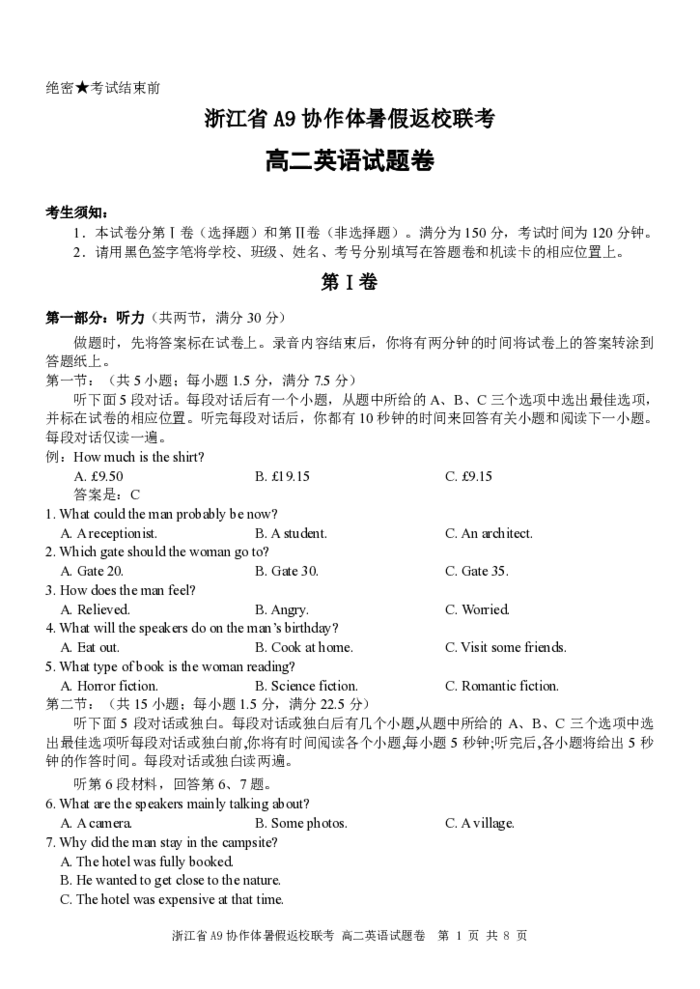
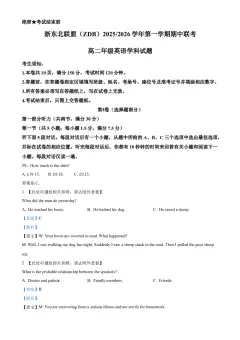
绝密★考试结束前
浙江省A9 协作体暑假返校联考
高二英语试题卷
考生须知:
1.本试卷分第Ⅰ卷(选择题)和第Ⅱ卷(非选择题)。满分为150 分,考试时间为120 分钟。
2.请用黑色签字笔将学校、班级、姓名、考号分别填写在答题卷和机读卡的相应位置上。
第Ⅰ卷
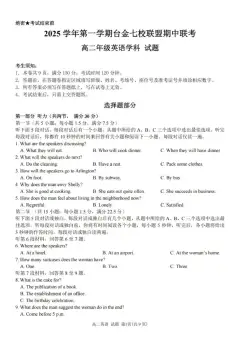
第一部分:听力(共两节,满分30 分)
做题时,先将答案标在试卷上。录音内容结束后,你将有两分钟的时间将试卷上的答案转涂到
答题纸上。
第一节:(共5 小题;每小题1.5 分,满分7.5 分)
听下面5 段对话。每段对话后有一个小题,从题中所给的A、B、C 三个选项中选出最佳选项,
并标在试卷的相应位置。听完每段对话后,你都有10 秒钟的时间来回答有关小题和阅读下一小题。
每段对话仅读一遍。
例:How much is the shirt?
A. £9.50
B. £19.15
C. £9.15
答案是:C
1. What could the man probably be now?
A. A receptionist.
B. A student.
C. An architect.
2. Which gate should the woman go to?
A. Gate 20.
B. Gate 30.
C. Gate 35.
3. How does the man feel?
A. Relieved.
B. Angry.
C. Worried.
4. What will the speakers do on the man’s birthday?
A. Eat out.
B. Cook at home.
C. Visit some friends.
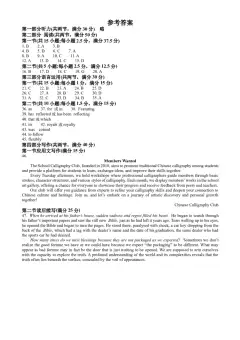
5. What type of book is the woman reading?
A. Horror fiction.
B. Science fiction.
C. Romantic fiction.
第二节:(共15 小题;每小题1.5 分,满分22.5 分)
听下面5 段对话或独白。每段对话或独白后有几个小题,从题中所给的A、B、C 三个选项中选
出最佳选项听每段对话或独白前,你将有时间阅读各个小题,每小题5 秒钟;听完后,各小题将给出5 秒
钟的作答时间。每段对话或独白读两遍。
听第6 段材料,回答第6、7 题。
6. What are the speakers mainly talking about?
A. A camera.
B. Some photos.
C. A village.
7. Why did the man stay in the campsite?
A. The hotel was fully booked.
B. He wanted to get close to the nature.
C. The hotel was expensive at that time.
{#{QQABDQS5xwKYkBZACB67QwVcCEiQkJORJQouRRAUuAQLyQNABAA=}#}
浙江省A9 协作体暑假返校联考 高二英语试题卷  第 2 页 共 8 页
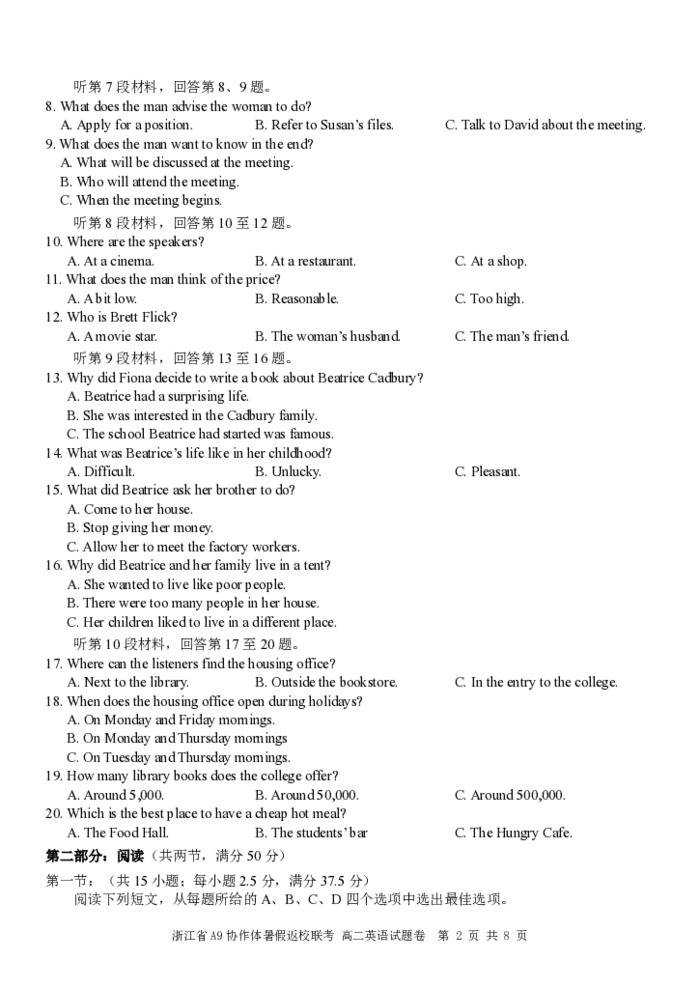
听第7 段材料,回答第8、9 题。
8. What does the man advise the woman to do?
A. Apply for a position.
B. Refer to Susan’s files.
C. Talk to David about the meeting.
9. What does the man want to know in the end?
A. What will be discussed at the meeting.
B. Who will attend the meeting.
C. When the meeting begins.
听第8 段材料,回答第10 至12 题。
10. Where are the speakers?
A. At a cinema.
B. At a restaurant.
C. At a shop.
11. What does the man think of the price?
A. A bit low.
B. Reasonable.
C. Too high.
12. Who is Brett Flick?
A. A movie star.
B. The woman’s husband.
C. The man’s friend.
听第9 段材料,回答第13 至16 题。
13. Why did Fiona decide to write a book about Beatrice Cadbury?
A. Beatrice had a surprising life.
B. She was interested in the Cadbury family.
C. The school Beatrice had started was famous.
14. What was Beatrice’s life like in her childhood?
A. Difficult.
B. Unlucky.
C. Pleasant.
15. What did Beatrice ask her brother to do?
A. Come to her house.
B. Stop giving her money.
C. Allow her to meet the factory workers.
16. Why did Beatrice and her family live in a tent?
A. She wanted to live like poor people.
B. There were too many people in her house.
C. Her children liked to live in a different place.
听第10 段材料,回答第17 至20 题。
17. Where can the listeners find the housing office?
A. Next to the library.
B. Outside the bookstore.
C. In the entry to the college.
18. When does the housing office open during holidays?
A. On Monday and Friday mornings.
B. On Monday and Thursday mornings
C. On Tuesday and Thursday mornings.
19. How many library books does the college offer?
A. Around 5,000.
B. Around 50,000.
C. Around 500,000.
20. Which is the best place to have a cheap hot meal?
A. The Food Hall.
B. The students’ bar
C. The Hungry Cafe.
第二部分:阅读(共两节,满分50 分)
第一节:(共15 小题;每小题2.5 分,满分37.5 分)
阅读下列短文,从每题所给的A、B、C、D 四个选项中选出最佳选项。
{#{QQABDQS5xwKYkBZACB67QwVcCEiQkJORJQouRRAUuAQLyQNABAA=}#}
浙江省A9 协作体暑假返校联考 高二英语试题卷  第 3 页 共 8 页
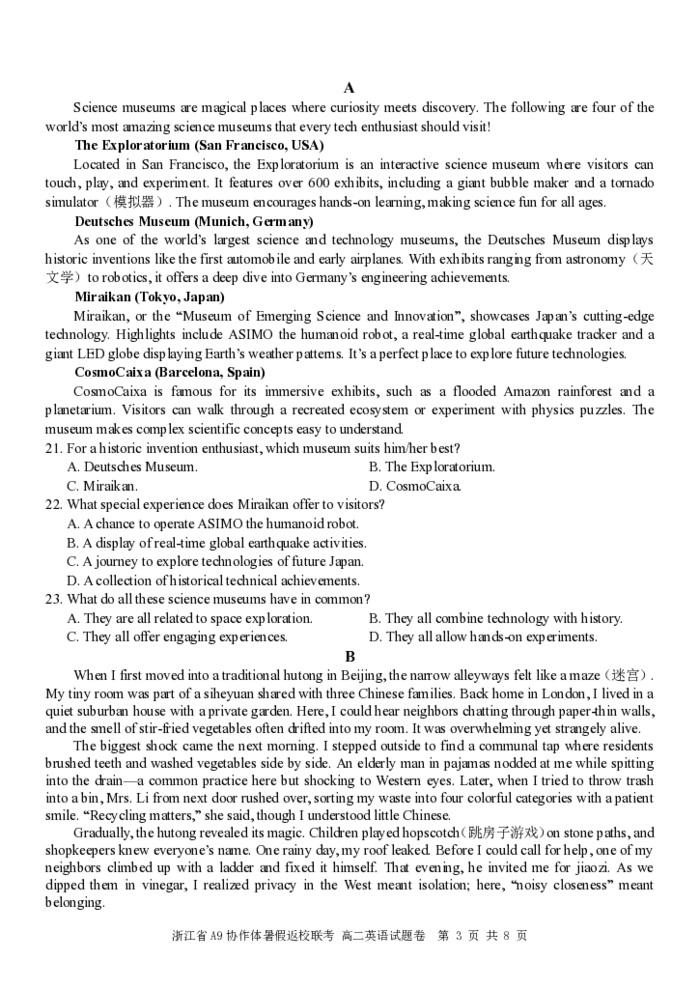
A
Science museums are magical places where curiosity meets discovery. The following are four of the
world’s most amazing science museums that every tech enthusiast should visit!
The Exploratorium (San Francisco, USA)
Located in San Francisco, the Exploratorium is an interactive science museum where visitors can
touch, play, and experiment. It features over 600 exhibits, including a giant bubble maker and a tornado
simulator(模拟器). The museum encourages hands-on learning, making science fun for all ages.
Deutsches Museum (Munich, Germany)
As one of the world’s largest science and technology museums, the Deutsches Museum displays
historic inventions like the first automobile and early airplanes. With exhibits ranging from astronomy(天
文学)to robotics, it offers a deep dive into Germany’s engineering achievements.
Miraikan (Tokyo, Japan)
Miraikan, or the “Museum of Emerging Science and Innovation”, showcases Japan’s cutting-edge
technology. Highlights include ASIMO the humanoid robot, a real-time global earthquake tracker and a
giant LED globe displaying Earth’s weather patterns. It’s a perfect place to explore future technologies.
CosmoCaixa (Barcelona, Spain)
CosmoCaixa is famous for its immersive exhibits, such as a flooded Amazon rainforest and a
planetarium. Visitors can walk through a recreated ecosystem or experiment with physics puzzles. The
museum makes complex scientific concepts easy to understand.
21. For a historic invention enthusiast, which museum suits him/her best?
A. Deutsches Museum.

B. The Exploratorium.
C. Miraikan.
D. CosmoCaixa.
22. What special experience does Miraikan offer to visitors?
A. A chance to operate ASIMO the humanoid robot.
B. A display of real-time global earthquake activities.
C. A journey to explore technologies of future Japan.
D. A collection of historical technical achievements.
23. What do all these science museums have in common?
A. They are all related to space exploration.
B. They all combine technology with history.
C. They all offer engaging experiences.
D. They all allow hands-on experiments.
B
When I first moved into a traditional hutong in Beijing, the narrow alleyways felt like a maze(迷宫).
My tiny room was part of a siheyuan shared with three Chinese families. Back home in London, I lived in a
quiet suburban house with a private garden. Here, I could hear neighbors chatting through paper-thin walls,
and the smell of stir-fried vegetables often drifted into my room. It was overwhelming yet strangely alive.
The biggest shock came the next morning. I stepped outside to find a communal tap where residents
brushed teeth and washed vegetables side by side. An elderly man in pajamas nodded at me while spitting
into the drain—a common practice here but shocking to Western eyes. Later, when I tried to throw trash
into a bin, Mrs. Li from next door rushed over, sorting my waste into four colorful categories with a patient
smile. “Recycling matters,” she said, though I understood little Chinese.
Gradually, the hutong revealed its magic. Children played hopscotch(跳房子游戏)on stone paths, and
shopkeepers knew everyone’s name. One rainy day, my roof leaked. Before I could call for help, one of my
neighbors climbed up with a ladder and fixed it himself. That evening, he invited me for jiaozi. As we
dipped them in vinegar, I realized privacy in the West meant isolation; here, “noisy closeness” meant
belonging.
{#{QQABDQS5xwKYkBZACB67QwVcCEiQkJORJQouRRAUuAQLyQNABAA=}#}
浙江省A9 协作体暑假返校联考 高二英语试题卷  第 4 页 共 8 页
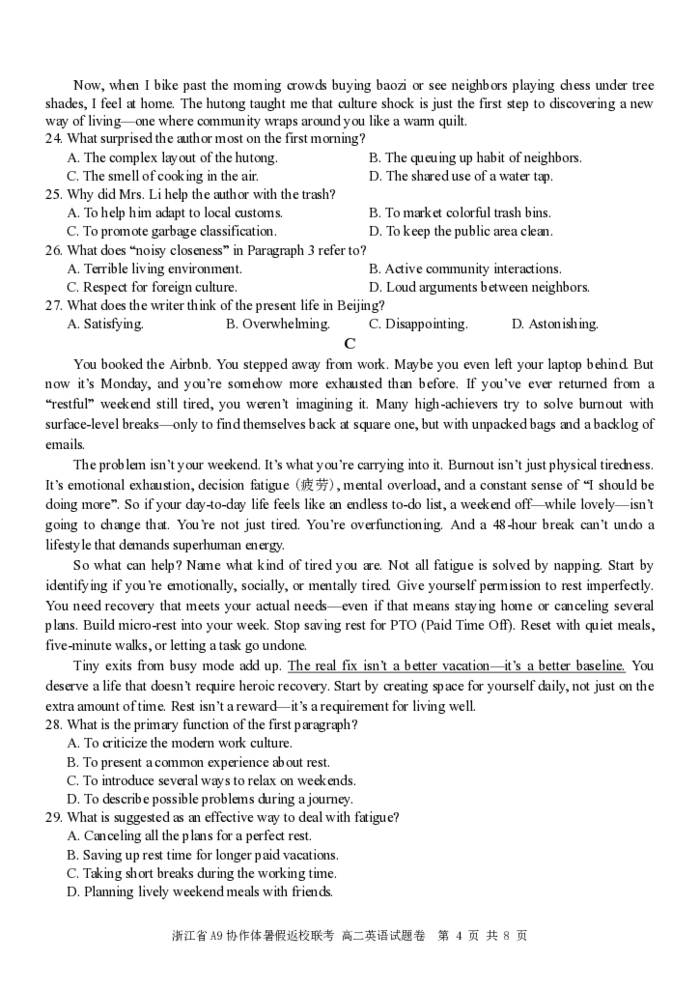
Now, when I bike past the morning crowds buying baozi or see neighbors playing chess under tree
shades, I feel at home. The hutong taught me that culture shock is just the first step to discovering a new
way of living—one where community wraps around you like a warm quilt.
24. What surprised the author most on the first morning?
A. The complex layout of the hutong.
B. The queuing up habit of neighbors.
C. The smell of cooking in the air.
D. The shared use of a water tap.
25. Why did Mrs. Li help the author with the trash?
A. To help him adapt to local customs.
B. To market colorful trash bins.
C. To promote garbage classification.
D. To keep the public area clean.
26. What does “noisy closeness” in Paragraph 3 refer to?
A. Terrible living environment.
B. Active community interactions.
C. Respect for foreign culture.
D. Loud arguments between neighbors.
27. What does the writer think of the present life in Beijing?
A. Satisfying.
B. Overwhelming.
C. Disappointing.
D. Astonishing.
C
You booked the Airbnb. You stepped away from work. Maybe you even left your laptop behind. But
now it’s Monday, and you’re somehow more exhausted than before. If you’ve ever returned from a
“restful” weekend still tired, you weren’t imagining it. Many high-achievers try to solve burnout with
surface-level breaks—only to find themselves back at square one, but with unpacked bags and a backlog of
emails.
The problem isn’t your weekend. It’s what you’re carrying into it. Burnout isn’t just physical tiredness.
It’s emotional exhaustion, decision fatigue (疲劳), mental overload, and a constant sense of “I should be
doing more”. So if your day-to-day life feels like an endless to-do list, a weekend off—while lovely—isn’t
going to change that. You’re not just tired. You’re overfunctioning. And a 48-hour break can’t undo a
lifestyle that demands superhuman energy.
So what can help? Name what kind of tired you are. Not all fatigue is solved by napping. Start by
identifying if you’re emotionally, socially, or mentally tired. Give yourself permission to rest imperfectly.
You need recovery that meets your actual needs—even if that means staying home or canceling several
plans. Build micro-rest into your week. Stop saving rest for PTO (Paid Time Off). Reset with quiet meals,
five-minute walks, or letting a task go undone.
Tiny exits from busy mode add up. The real fix isn’t a better vacation—it’s a better baseline. You
deserve a life that doesn’t require heroic recovery. Start by creating space for yourself daily, not just on the
extra amount of time. Rest isn’t a reward—it’s a requirement for living well.
28. What is the primary function of the first paragraph?
A. To criticize the modern work culture.
B. To present a common experience about rest.
C. To introduce several ways to relax on weekends.
D. To describe possible problems during a journey.
29. What is suggested as an effective way to deal with fatigue?
A. Canceling all the plans for a perfect rest.
B. Saving up rest time for longer paid vacations.
C. Taking short breaks during the working time.
D. Planning lively weekend meals with friends.
{#{QQABDQS5xwKYkBZACB67QwVcCEiQkJORJQouRRAUuAQLyQNABAA=}#}
浙江省A9 协作体暑假返校联考 高二英语试题卷  第 5 页 共 8 页
30. What can be inferred from the underlined sentence in the last paragraph?
A. Longer vacations are better for recovery.
B. The solution lies in restructuring daily life.
C. People should pursue heroic recovery.
D. You could reward yourself with a better living space.
31. Which of the following would be the best title of the article?
A. What makes an energized long vacation?
B. Why do your weekends fail to recharge you?
C. What leads to your physical exhaustion?
D. How can we plan a perfect restful weekend?
D
For years, sugar has been labeled a primary cause behind the global rise in diabetes (糖尿病),
especially type 2 diabetes (T2D). However, groundbreaking research from Brigham Young University
challenges this broad assumption. A large-scale study reveals a crucial detail: the source and form of sugar
matter significantly when it comes to diabetes risk.
The findings paint a contrasting picture. On one hand, sugars consumed in liquid form – specifically
through sugar-sweetened beverages like soda and even 100% fruit juice – were consistently linked to a
sharply increased risk of developing T2D. On the other hand, sugars naturally present in or added to solid,
nutrient-dense whole foods (such as whole fruits, dairy products, or whole grains) appeared to be far less
harmful or potentially even protective.
Why is there such a big difference? Researchers point to metabolism(新陈代谢). Liquid sugars from
drinks act like isolated sugar floods entering the system. They cause rapid and large spikes in blood sugar,
overwhelming the liver. This metabolic disruption leads to increased liver fat and insulin resistance – key
factors in T2D development. Conversely, sugars added to solid foods are released much more slowly into
the bloodstream. The fiber, fat, protein, and other beneficial nutrients naturally accompanying the sugar in
these whole foods act as buffers, reducing the glycemic(血糖的) impact and preventing the liver from
being overloaded.
The study delivers a clear warning about fruit juice. Despite containing some vitamins, its high
concentration of liquid sugar makes it a poor substitute for whole fruit. The vital fiber present in whole fruit,
crucial for moderating blood sugar response, is largely missing in juice.
“This study emphasizes the need for even stricter recommendations for liquid sugars such as those in
sugar-sweetened beverages and fruit juice, as they appear to harmfully associate with metabolic health,”
said Della Corte, one of the lead researchers. “Rather than criticizing all added sugars, future dietary
guidelines might consider the different effects of sugar based on its source and form.”
32. Which form of sugar consumption brings a higher T2D risk?
A. Sugar from whole grains and dairy products.
B. Sugar naturally found in whole fruits.
C. Sugar added to nutrient-dense solid foods.
D. Sugar present in various liquid drinks.
33. What is Paragraph 3 mainly about?
A. The reasons for sugar metabolism.
B. The benefits of sugar metabolism.
C. The differences in sugar metabolism.
D. The significance of sugar metabolism.
34. To lower the risk of T2D, which practice is most likely supported by the study?
A. Avoiding dairy products containing sugar.
B. Replacing soda drinks with whole fruits.
C. Increasing consumption of 100% fruit juice.
D. Consuming as much fiber and fat as possible.
{#{QQABDQS5xwKYkBZACB67QwVcCEiQkJORJQouRRAUuAQLyQNABAA=}#}
浙江省A9 协作体暑假返校联考 高二英语试题卷  第 6 页 共 8 页
35. What can be inferred from Della Corte’s statement about future dietary guidelines?
A. They should reconsider the impact of sugar on metabolism.
B. They should remove fruit juice from recommendations.
C. They should not adopt a one-size-fits-all approach to sugar.
D. They should criticize sugars regardless of different effects.
第二节:(共5 小题;每小题2.5 分,满分12.5 分)
阅读下面短文,从短文后的选项中选出可以填入空白处的最佳选项。选项中有两项为多余选项。
How to Stay Calm No Matter Who Pushes Your Buttons
Have you ever felt like some people exist just to test your patience?   36   But guess what? You
don’t have to let such people bother you. The following are some suggestions on becoming untouchable
mentally, emotionally, and psychologically.
Master the Power of Not Caring
The first rule of never getting angry: realize that most people aren’t worth the energy it takes to get
upset. Think about it—when someone cuts you off in traffic or deliberately tries to provoke (挑衅)you,
what do you gain by reacting?   37
  38
Stop letting other people’s opinions occupy space in your mind. Here’s your new motto: Not
everyone’s opinion matters. Say it. Believe it. Live it. Unless someone is supporting you, feeding you, or
holds a legal agreement with you, their opinions hold no real power.
Expect People to Be Inconsiderate
Accept this difficult truth: many people simply lack basic life awareness. This isn’t about lacking
intelligence,   39  . They will cut you off in traffic. They will reply with one-word texts. They will talk
during movies. So change your approach: when someone says something rude, laugh. Not a forced, polite
laugh—but a genuine, amused chuckle. It throws people off. After all, they expect anger, rather than
amusement.
Build a High-Tolerance Mindset
Here’s the final step: train yourself to be unshakable. How? Practice. Stand in long lines without
sighing or complaining. Scroll through social media without reacting to every annoying post. Let someone
cut you off in traffic and simply nod.   40   Eventually, nothing will drive you mad.
Master these strategies, and you’ll walk through life with the calm of a Zen master and the confidence
of a leader.
A. Find Someone Supporting You
B. Choose Whose Voice You Hear
C. it’s because they need opportunities to express themselves.
D. Anger only exhausts you, while the other person moves on without caring.
E. but about not realizing how their actions affect others.
F. The slow walkers, the loud eaters, the overly dramatic ones—yes, them.
G.The more you experience annoyances without reacting, the calmer you will become.
第Ⅱ卷
第三部分:语言运用(共两节,满分30 分)
第一节:(共15 小题;每小题1 分,满分15 分)
阅读下面短文,从每题所给的A、B、C、D 四个选项中选出可以填入空白处的最佳选项。
Craig Grossi, a young US Marine(海军陆战队士兵), was on a dangerous   41   in Afghanistan in
2010. One day, during a break in a ruined village, he   42   a thin, injured yellow dog and it looked lost
{#{QQABDQS5xwKYkBZACB67QwVcCEiQkJORJQouRRAUuAQLyQNABAA=}#}
浙江省A9 协作体暑假返校联考 高二英语试题卷  第 7 页 共 8 页
and hungry. Craig felt   43   for it, so he shared his meatballs with it, who   44   followed Craig and
his unit back to their camp. Craig decided to   45   the dog, naming him Fred.
Fred quickly became more than just a pet; he became a vital   46   and the unit’s mascot(吉祥物). In the
harsh reality of war, Fred provided   47   comfort and joy. His presence not only lifted the soldiers’ spirits, but
also   48   them a sense of home and unconditional love amidst the chaos. For Craig, his   49   with Fred
was even closer. On night patrols, Fred always accompanied Craig and   50   never make a sound.
Considering how cruel the battlefield was, Craig decided to part with Fred temporarily.   51   a
crew of DHL workers, a   52   vet, and a military dog handler, Fred smuggled (偷运) the dog into in a
duffel bag and eventually made it to Craig’s family in Virginia.
Months later, Craig and Fred were   53  . Adapting to peaceful life had its   54   for both, but
they helped each other   55   the difficulties. Craig often says, “I rescued Fred, but truly, Fred rescued
me.”
41. A. vacation
B. mission
C. scene
D. protest
42. A. realized
B. cured
C. spotted
D. harmed
43. A. frightened
B. sympathetic
C. generous
D. inspired
44. A. honestly
B. reluctantly
C. immediately
D. nearly
45. A. abandon
B. approach
C. assist
D. adopt
46. A. burden
B. weapon
C. companion
D. enemy
47. A. unexpected
B. independent
C. determined
D. shallow
48. A. resulting
B. offering
C. contributing
D. enabling
49. A. bond
B. belonging
C. agreement
D. impact
50. A. wisely
B. politely
C. sincerely
D. easily
51. A. With the help of
B. On account of
C. In spite of
D. On the basis of
52. A. confident
B. kindhearted
C. selfish
D. humble
53. A. encountered
B. separated
C. reunited
D. identified
54. A. consequences
B. opportunities
C. benefits
D. challenges
55. A. break into
B. look for
C. get over
D. put up with
第二节:(共10 小题;每小题1.5 分,满分15 分)
阅读下面短文,在空白处填入1 个适当的单词或括号内单词的正确形式。
The guqin, or qin, is a seven-stringed classical instrument and has a history in China of about 5,000
years. Some scholars consider the qin as   56   only type of instrument that captures the essence of
traditional Chinese culture.
The guqin is usually about four feet   57   length, with a head, neck, shoulders and waist, and a tail
  58   resembles that of a phoenix(凤凰). The curved surface board represents Heaven,   59   the flat
underside represents the Earth.
With more than 1,000 different finger techniques, the guqin is one of the   60  (complicated)
instruments in the world to learn and requires great dedication to master. The hands are used in plucking,
picking, sliding, pushing, and vibrating the strings   61   (produce) a variety of sound, from   62
(flow) water to loud and bright tones.
The Chinese word zhiyin   63   (originate) from an ancient story about the qin. During the Spring and
Autumn period, Boya was a master in playing the qin. His friend Ziqi could understand him   64  (thorough)
and share the spiritual journey with him to different realms. Thus, they became kindred souls and zhiyin
  65   (use) widely to refer to soulmates since then.
In 2003, guqin music was recognized by UNESCO as one of the “Masterpieces of the Oral and
Intangible Heritage of Humanity”.

{#{QQABDQS5xwKYkBZACB67QwVcCEiQkJORJQouRRAUuAQLyQNABAA=}#}
浙江省A9 协作体暑假返校联考 高二英语试题卷  第 8 页 共 8 页
第四部分:写作(共两节,满分40 分)
第一节:(满分15 分)
假定你是李华,暑假期间你和父母一起参观了你理想的大学,请你写一封邮件给你的英国朋友
Leo 分享此次经历,内容包括:1. 参观经历;  2. 你的感受。
注意:1. 字数80 字左右;2. 可适当增加细节,使行文连贯。


第二节:(满分25 分)
阅读下面材料,根据其内容和所给段落开头语续写两段,使之构成一篇完整的短文。
My mother had a saying, “Fools names and fools faces always appear in public places.” I never fully
understood what it meant until one day in my sixth grade.
Karen, Judy and I were the last ones back in the school room after lunch. All of the other sixth graders
were already outside, playing marbles or hopscotch or jumping rope, since it was a pleasant spring day.
“Look what I found this morning in the storage cupboard when I was getting out several palette knives
(调色刀)and some other art supplies for Mrs. Eiffler!” With a conspiratorial grin on her face, Karen held
up a wooden box filled with short pieces of chalk (粉笔) in every color of the rainbow. “What fun it would
be to write on the chalkboard while everyone is outside.” Judy’s eyes twinkled with anticipation.
“But the next class belongs to Mrs. Eiffler. She doesn’t allow us to do that.” I responded, already
feeling guilty, although we had not yet done a thing.
“Don’t be such a ‘fraidy cat’, Janet. No one will ever know,” said Karen, reaching into the box and
drawing out a piece of chalk. “Right. Everyone is outside, so we’re safe.” Judy added.
I unwillingly joined them, wanting to be part of what was going on, but afraid of being caught. I knew
well that we were breaking not one, but two class rules. The second rule was that no one was allowed to
stay inside at noon without a written excuse from teachers if the weather was nice.
Then Judy proposed a challenge: writing our names with our left hands. They used colorful chalks,
while I picked up what I thought was a nice white chalk piece. My handwriting was a bit shaky, but no one
would doubt that it said “Janet.”
“We’d better get this board cleaned off before Mrs. Eiffler comes back,” said Judy, eyeing the clock.
She picked up an eraser and began erasing our handiwork from the board.
Everything came off... but my name! In disbelief, I looked at the chalk I held in my sweaty hand. On
closer examination, it wasn’t chalk at all.
注意:1. 续写词数应为150 左右;2. 请按如下格式作答。
“It’s a white color crayon!” Judy came closer and shouted.


Before we finished dealing with the tiny abrasion(磨损), the bell rang.


{#{QQABDQS5xwKYkBZACB67QwVcCEiQkJORJQouRRAUuAQLyQNABAA=}#}