ARTICLE · 1350320
高考英语阅读理解--态度观点态度类试题解题指导
高考英语


教育无他,唯爱与责任
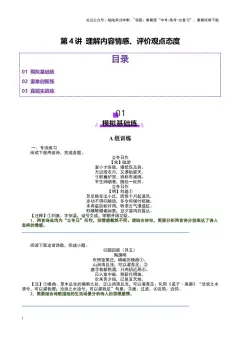
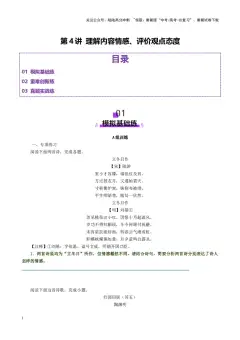
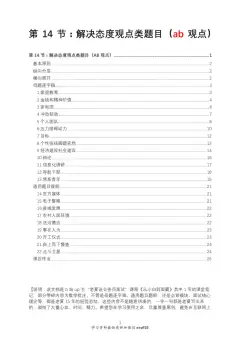
【态度观点态度类试题解题指导】
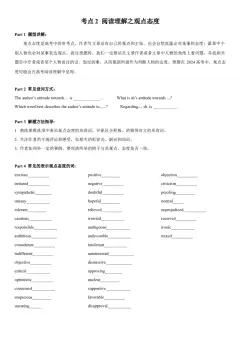
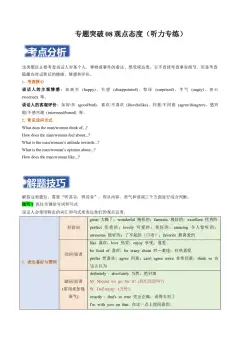
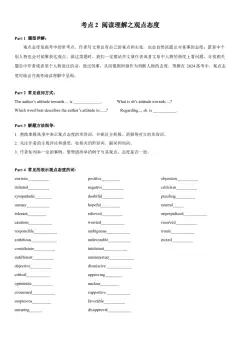
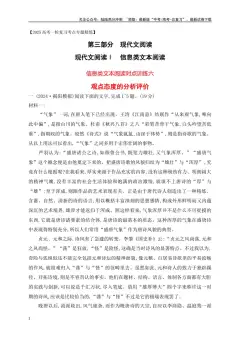
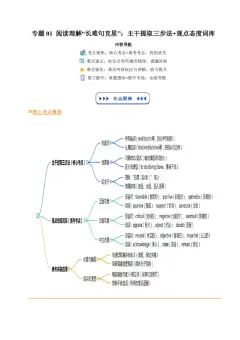
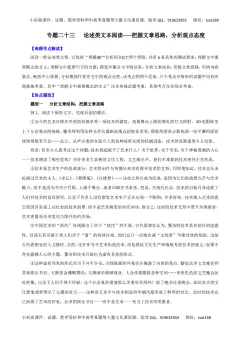
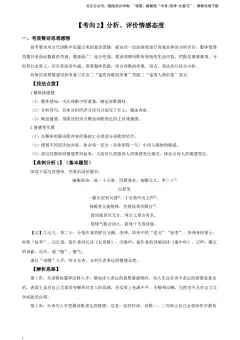
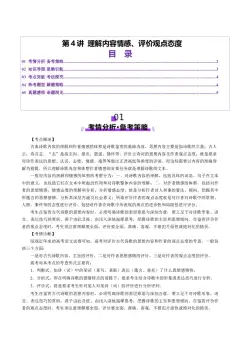
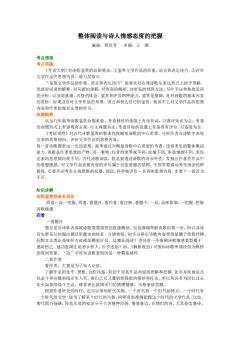
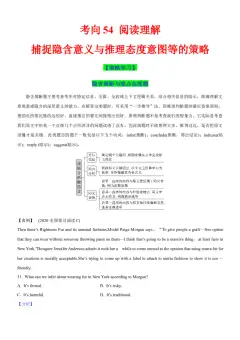
态度观点态度类试题的解题方法:
第一:结合题干人物和内容定位原文出现在哪一(些)段;然后仔细比对该句言外之意;
第二:加入自己的态度。要注意区分试题考查的是作者的态度还是作者引用别人的态度;
第三:态度没有明确提出时,要学会根据作者在文章中所运用词汇的褒贬性去判断作者的态度,尤其是动词、形容词和副词,如wonderfully, successfully, unfortunately, doubtfully 等。
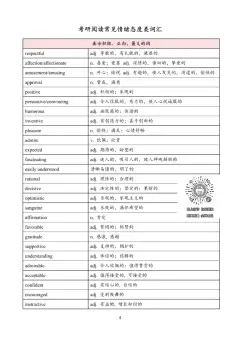
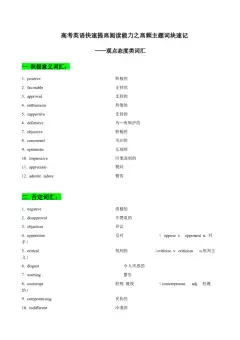
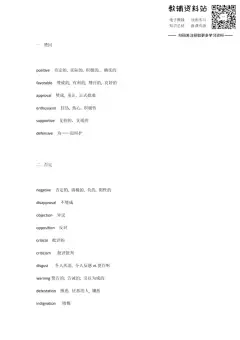
乐观支持类词汇:optimistic乐观的;positive肯定的;favorable 支持的,赞同的;supportive支持的;approving赞成的
客观中立类词汇:objective客观的;neutral中立的;cautious谨慎的
消极反对类词汇:negative否定的;opposite相反的;unfair公正的;doubtful怀疑的;indifferent漠不关心的;critical批评的;ironic讽刺的;skeptical质疑的;disappointed失望的;disapproving不赞同的;pessimistic悲观的;dismissive轻蔑的,不屑一顾的
考例1(2023年全国甲卷C篇)
I was about 13 when an uncle gave me a copy of Jostein Gaarder’s Sophie’s World. It was full of ideas that were new to me, so I spent the summer with my head in and out of that book. It spoke to me and brought me into a world of philosophy (哲学).
That love for philosophy lasted until I got to college. Nothing kills the love for philosophy faster than people who think they understand Foucault, Baudrillard, or Confucius better than you — and then try to explain them.
Eric Weiner’s The Socrates Express: In Search of Life Lessons from Dead Philosophers reawakened my love for philosophy. It is not an explanation, but an invitation to think and experience philosophy.
Weiner starts each chapter with a scene on a train ride between cities and then frames each philosopher’s work in the context (背景) of one thing they can help us do better. The end result is a read in which we learn to wonder like Socrates, see like Thoreau, listen like Schopenhauer, and have no regrets like Nietzsche. This, more than a book about understanding philosophy, is a book about learning to use philosophy to improve a life.
He makes philosophical thought an appealing exercise that improves the quality of our experiences, and he does so with plenty of humor. Weiner enters into conversation with some of the most important philosophers in history, and he becomes part of that crowd in the process by decoding (解读) their messages and adding his own interpretation.
The Socrates Express is a fun, sharp book that draws readers in with its apparent simplicity and gradually pulls them in deeper thoughts on desire, loneliness, and aging. The invitation is clear: Weiner wants you to pick up a coffee or tea and sit down with this book. I encourage you to take his offer. It’s worth your time, even if time is something we don’t have a lot of.
28. Who opened the door to philosophy for the author?
A. Foucault.B. Eric Weiner.
C. Jostein Gaarder.D. A college teacher.
29. Why does the author list great philosophers in paragraph 4?
A. To compare Weiner with them.
B. To give examples of great works.
C. To praise their writing skills.
D. To help readers understand Weiners book.
30. What does the author like about The Socrates Express?
A. Its views on history are well-presented.
B. Its ideas can be applied to daily life.
C. It includes comments from readers.
D. It leaves an open ending.
31. What does the author think of Weiners book?
A. Objective and plain.
B. Daring and ambitious.
C. Serious and hard to follow.
D. Humorous and straightforward.
考例2 (2021年新高考I卷D篇)
Popularization has in some cases changed the original meaning of emotional (情感的) intelligence. Many people now misunderstand emotional intelligence as almost everything desirable in a person’s makeup that cannot be measured by an IQ test, such as character, motivation, confidence, mental stability, optimism and “people skills.” Research has shown that emotional skills may contribute to some of these qualities, but most of them move far beyond skill-based emotional intelligence.
We prefer to describe emotional intelligence as a specific set of skills that can be used for either good or bad purposes. The ability to accurately understand how others are feeling may be used by a doctor to find how best to help her patients, while a cheater might use it to control potential victims. Being emotionally intelligent does not necessarily make one a moral person. Although popular beliefs regarding emotional intelligence run far ahead of what research can reasonably support, the overall effects of the publicity have been more beneficial than harmful.The most positive aspect of this popularization is a new and much needed emphasis (重视) on emotion by employers, educators and others interested in promoting social well-being. The popularization of emotional intelligence has helped both the public and researchers re-evaluate the functionality of emotions and how they serve people adaptively in everyday life.
32. What is a common misunderstanding of emotional intelligence?
A. It can be measured by an IQ test.
B. It helps to exercise a person's mind.
C. It includes a set of emotional skills.
D. It refers to a person’s positive qualities.
33. Why does the author mention “doctor” and “cheater” in paragraph 2?
A. To explain a rule.B. To clarify a concept.
C. To present a fact.D. To make a prediction.
34. What is the author's attitude to the popularization of emotional intelligence?
A. Favorable.B. Intolerant.C. Doubtful.D. Unclear.
35. What does the last paragraph mainly talk about concerning emotional intelligence?
A. Its appeal to the public.
B. Expectations for future studies.
C. Its practical application.
D. Scientists with new perspectives.
【参考答案】
考例 1(2023 全国甲卷 C 篇)答案 + 解析
答案:28.C 29.D 30.B 31.D**
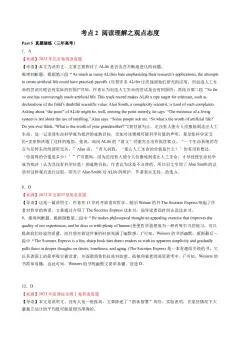
28. C
定位第一段:*I was about 13 when an uncle gave me a copy of Jostein Gaarder’s Sophie’s World…It spoke to me and brought me into a world of philosophy.*
是 Jostein Gaarder 的《苏菲的世界》把作者带入哲学世界,为作者打开哲学大门。
A(福柯)、B(Eric Weiner 是重新唤醒热爱)、D 文中未提大学老师。
29. D
第 4 段:这本书每一章结合哲学家,让我们像苏格拉底一样思考、梭罗一样观察……**这本书不是单纯讲解哲学,而是教我们用哲学改善生活**。
作者列举这些哲学家,是举例说明这本书的内容特点,帮助读者理解 Weiner 这本书。
A:不是对比 Weiner;B:不是介绍他们的著作;C:没有夸赞写作技巧。
30. B
定位第 4 段末尾:*This, more than a book about understanding philosophy, is a book about learning to use philosophy to improve a life.*
核心:这本书教我们运用哲学改善生活,也就是书中理念可以应用到日常生活。
A(历史观点)、C(读者评论)、D(开放式结尾)原文无依据。
31. D
第 5 段:*with plenty of humor*;第 6 段:*draws readers in with its apparent simplicity*(浅显直白)。
对应 **Humorous and straightforward(幽默、浅显直白)**
A 客观平淡;B 大胆有野心;C 严肃难懂,均错误。
考例 2(2021 新高考 I 卷 D 篇)答案 + 解析
答案:32.D 33.B 34.A 35.C
32. D
定位第一段:*Many people now misunderstand emotional intelligence as almost everything desirable in a person’s makeup that cannot be measured by an IQ test, such as character, motivation, confidence…*
大众误解:情商就是人身上所有好的、积极的品质。
A 错:原文说**不能**用智商测试衡量;
C 是作者对情商的正确定义,不是大众的误解。
33. B
第二段主旨:情商是一套技能,可以用好也可以用坏。
举医生(善意使用)和骗子(恶意使用)两个例子,**来阐明、解释这个概念**:情商本身不分善恶。
clarify a concept:阐明概念。
A 解释规则 / C 陈述事实 / D 做出预测,均不对。
34. A
定位第三段:*the overall effects of the publicity have been more beneficial than harmful*(整体利大于弊),后面讲诸多积极意义。
说明作者对情商概念的普及持**支持、赞同(Favorable)**态度。
B 无法容忍;C 怀疑;D 不清楚,排除。
35. C
最后一段:讲情商普及带来的积极作用,雇主、教育者重视情绪;帮助大众和研究者重新认识情绪的作用、情绪如何在日常生活中帮人们适应生活。
核心是情商的**实际应用、实用价值**,选 C Its practical application。
A 对公众的吸引力;B 对未来研究的期待;D 拥有新观点的科学家,都不是本段主旨。