2011 年 6 月大学英语六级阅读真题试卷
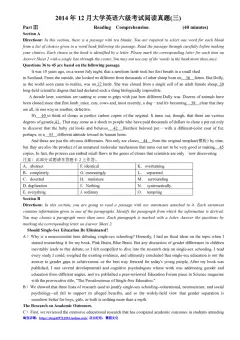
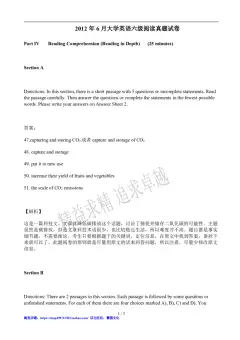
PartIV Reading Comprehension(Reading inDepth) (25minutes)
SectionA
Directions:In thissection, thereis ashortpassage with 5questions orincomplete statements.
Read thepassagecarefully. Then answer thequestionsor completethestatements in
thefewest possiblewords. Pleasewriteyour answers onAnswer Sheet 2.
Questions47to 51are basedon thefollowing passage.
Howgood are you at saying "no"? For many, it's surprisingly difficult. This is especially true
ofeditors, who bynature tend to beeager and engaged participants in everything they do.Consider
thesescenarios:
It's latein theday. That front-page package you'vebeen working onisnearly complete; one
lastedit and it's finished. Enter theexecutiveeditor, who makes a suggestion requiring a
more-than-modest rearrangement ofthedesign and theaddition ofan information box.You want to
scream:"No! It's done!" What doyou do?
The firstrule ofsaying noto theboss is doing sayno.Sheprobably has somethingin mind
whenshemakes suggestions, and it's uptoyou to find out what. The second rule is doingraise the
stakes bychallenging her authority. That issueis already decided. The thirdrule isto be ready to
citeoptionsand consequences. Theboss's suggestions might beappropriate, butthere are always
consequences. Shemight notknow about thepages backing upthat need attention, orabout the
designerwho had to go homesick. Tell her shecan havewhat shewants, but explainthe
consequences. Understand what she's trying toaccomplish andpropose aPlan B that willmake it
happen without destroying what you've donesofar.
Here's another case. Your least-favoritereporter suggestsa dumb story idea. This oneshould
beeasy, but it's not. If you say no,even politely, you risk inhibiting further ideas, not just from that
reporter, but from others who heard that you turned down the idea. This scenario is commonin
newsrooms that lack a systematicway tofilter story suggestions.
Two steps are necessary. First, you need a system forhowstories are proposed and reviewed.
Reporters can tolerate rejection oftheirideas ifthey believethey were given afair hearing.
Yourgut reaction (本能反应) and dismissiverejection, even ofaworthless idea, might notqualify
as systematic orfair.
Second, thepeople you work withneed to negotiatea "What if...?" agreement covering
"What ifmyidea is turned down?" Howare people expected to react? Is there an appeal process?
Canthey refine the idea and resubmit it? By anticipating "What if...?" situations before they happen,
you can reach understanding that will help ease you out ofconfrontations.
47.Instead ofdirectly saying notoyour boss, you should find out __________.
48.Theauthor's second warning isthat we should avoid running agreater risk by__________.
49.Oneway ofresponding to your boss's suggestion isto explain the__________to herand offer
an alternative solution.
50.Toensure fairness toreporters, it is important to setupa system forstories to __________.
51.Peoplewho learn toanticipate "What if...?"situationswill beable toreach understanding and
avoid __________.
SectionB
Directions:There are2passages in thissection. Each passage isfollowedby somequestions or
unfinished statements. For each of themthere arefour choices marked A), B), C)and
D). Youshould decide onthebest choice andmarkthecorresponding letter onAnswer
Sheet 2with asinglelinethrough thecentre.
Passage One
淘宝店铺:https://shop499712503.taobao.com/ 店主旺旺:慧园文化Questions52to 56are basedon thefollowing passage.
At theheart ofthedebate overillegal immigration lies one key question: are immigrants good
orbad for theeconomy? TheAmerican publicoverwhelmingly thinksthey're bad. Yet the
consensus among most economists isthat immigration, bothlegal andillegal, provides a smallnet
boostto theeconomy. Immigrants providecheap labor, lowerthe prices of everything from farm
produceto new homes, andleave consumers with alittlemore money intheirpockets. Sowhy is
theresuch adiscrepancy between theperception ofimmigrants' impact ontheeconomy andthe
reality?
There are a numberof familiartheories. Someargue that people are anxiousand feel
threatened byan inflowof newworkers. Others highlight thestrain that undocumented immigrants
placeonpublicservices, likeschools, hospitals, and jails. Still others emphasizetherole ofrace,
arguing that foreigners add to thenation's fears and insecurities. There's some truthto all these
explanations, but they aren't quitesufficient.
To get a betterunderstanding ofwhat's going on; consider theway immigration's impact is
felt. Though itsoverall effect may be positive, itscosts and benefits are distributed unevenly. David
Card, an economist at UC Berkeley, notes that the ones who profit most directly from immigrants'
low-cost laborare businesses and employers –meatpacking plants in Nebraska, forinstance, or
agricultural businesses inCalifornia. Granted, theseproducers' savings probably translate into
lowerprices at thegrocery store, but howmany consumers makethat mental connection at the
checkout counter? As forthe drawbacks ofillegal immigration, these, too, are concentrated. Native
low-skilledworkers suffer mostfrom the competitionof foreign labor. According toastudy by
George Boras, aHarvard economist, immigration reduced thewages ofAmerican high-school
dropouts by9%between 1980-2000.
Among high-skilled, better-educated employees, however, oppositionwas strongest in states
withboth high numbers ofimmigrants and relatively generous social services. What worried them
most,in otherwords, was thefiscal (财政的)burden ofimmigration. That conclusion was
reinforced byanother finding: that theiroppositionappeared tosoften when that fiscal burden
decreased, as occurred withwelfare reform in the1990s, which curbed immigrants' access to
certain benefits.
The ironyis that for all theoverexcited debate, thenet effect ofimmigration is minimal. Even
forthosemost acutely affected –say, low-skilled workers, orCaliforniaresidents –theimpact isn't
allthat dramatic. "The unpleasant voices have tended to dominateourperceptions," says Daniel
Michener, apolitical science professor at theUniversity ofOregon. "But when all thosefactors are
puttogether and theeconomists calculate thenumbers, it ends upbeing a net positive, buta small
one." Toobad most peopledon't realizeit.
注意:此部分试题请在答题卡 2上作答。
52. Whatcan welearn from the first paragraph?
A) Whether immigrants are good or bad forthe economy has been puzzling economists.
B) The American economy usedto thrive onimmigration but nowit's a different story.
C) The consensus among economists is that immigration should notbe encouraged.
D) Thegeneral publicthinks differently from most economists ontheimpact ofimmigration.
53. In what way does theauthor thinkordinary Americans benefit from immigration?
A) They can access all kinds ofpublicservices.
B) They canget consumer goods at lower prices.
C) They canmix with peopleofdifferent cultures.
D) They can avoid doing much ofthemanual labor.
54. Whydonativelow-skilled workers suffer most from illegal immigration?
A) They have greater difficulty getting welfare support.
B) They are morelikely toencounter interracial conflicts.
C) They haveaharder timegettinga jobwith decent pay.
淘宝店铺:https://shop499712503.taobao.com/ 店主旺旺:慧园文化D) They are nomatch for illegal immigrants in labor skills.
55. Whatis thechief concern of nativehigh-skilled, better-educated employees about theinflowof
immigrants?
A) It may change theexisting social structure.
B) It may posea threat to their economicstatus.
C) It may lead to social instability inthe country.
D) It may place agreat strain onthestatebudget.
56. Whatis theirony about thedebate over immigration?
A) Even economists can't reach aconsensus about itsimpact.
B) Thosewho are opposed to itturn out to benefit mostfrom it.
C) Peopleare making too big afuss about something ofsmall impact.
D) Thereis no essential difference between seemingly oppositeopinions.
Passage Two
Questions57to 61are basedon thefollowing passage.
Picturea typical MBA lecture theatretwenty years ago. In it themajority ofstudents will
haveconformed to thestandard model ofthetime: male, middleclass and Western. Walk intoa
class today, however, and you'll get a completely different impression. For astart, you willnowsee
plentymore women –theUniversity of Pennsylvania's Wharton School, forexample, boasts that
40%ofitsnew enrolment isfemale. You will also see awide range ofethnicgroups and nationals
ofpractically every country.
It might be tempting, therefore, to think that theold barriers have been broken down and
equal opportunity achieved. But, increasingly, thisapparent diversity is becoming amask for anew
type ofconformity. Behind thedifferences in sex,skin tones and mothertongues, there are
commonattitudes, expectations and ambitionswhich risk creating a set ofclones among the
businessleaders of thefuture.
Diversity, it seems, has nothelped to address fundamental weaknesses inbusiness leadership.
Sowhat can be doneto createmore effectivemanagers ofthecommercial world? According to
Valerie Gauthier, associate dean at HEC Paris, the key lies in theprocess bywhich MBA
programmers recruit their students. At themoment candidates are selected ona fairly narrow set of
criteria such as prior academic and career performance, and analytical and problem solving abilities.
Thisis thencoupled toa school's pictureof what a diverseclass should looklike, with theresult
thatpassport, ethnicorigin and sex can all become influencing factors. But schools rarely digdown
tofind out what really makes an applicant succeed, to createa class which also contains diversity of
attitudeand approach –arguably theonly diversity that, in abusiness context,really matters.
Professor Gauthier believes schools shouldnot justbe selecting candidates from traditional
sectors such as banking,consultancy and industry. They should also beseeking individualswho
havebackgrounds in areas such as political science, thecreative arts, history orphilosophy, which
willallowthem to put business decisions intoa widercontext.
Indeed,there does seem to beademand forthe morerounded leaders suchdiversity might
create. Astudy byManna, aleadership development company, suggests that, whilethebully-boy
chiefexecutive ofoldmay not have been eradicated completely, there is adefinite shiftin emphasis
towards less tough styles ofmanagement –at least in America and Europe. Perhaps most
significant, according toManna, is theincreasing interest large companies have in more
collaborativemanagement models, such as thoseprevalent in Scandinavia, which seek tointegrate
thehard and soft aspects ofleadership andencourage delegated responsibility and accountability.
注意:此部分试题请在答题卡 2上作答。
57. Whatcharacterizes thebusiness school student population oftoday?
A) Greaterdiversity. B) Intellectual maturity.
C)Exceptional diligence. D)Higher ambition.
58. Whatis theauthor's concern about current business school education?
A) It will arouse students' unrealistic expectations.
淘宝店铺:https://shop499712503.taobao.com/ 店主旺旺:慧园文化B) It willproduce business leaders ofauniform style.
C) It focuses ontheory rather than onpractical skills.
D) It stresses competition rather than cooperation.
59. Whataspect ofdiversity does Valerie Gauthierthink is mostimportant?
A) Age and educational background.
B) Social andprofessional experience.
C)Attitudeand approach to business.
D) Ethnicorigin and gender.
60. Whatapplicants does theauthorthink MBA programmers shouldconsider recruiting?
A) Applicants withprior experience in business companies.
B) Applicants with sound knowledgein math and statistics.
C) Applicants from outsidethetraditional sectors.
D) Applicants from less developed regions and areas.
61. Whatdoes Manna say about thecurrent management style?
A) It is eradicating the tough aspects ofmanagement.
B) It encourages maleandfemale executives to work sidebyside.
C) It adopts thebully-boy chief executivemodel.
D) It is shifting towards morecollaborativemodels.
淘宝店铺:https://shop499712503.taobao.com/ 店主旺旺:慧园文化