
































文档内容
同学们,关注微信公众号“教资资料箱”领取更多教资笔试资料
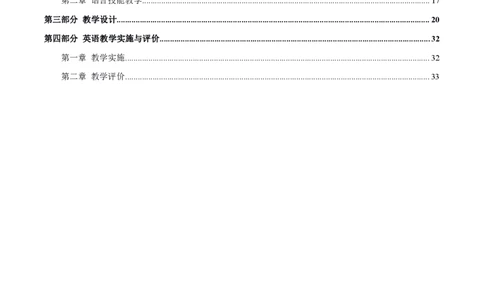
目 录
第一部分 语言知识与能力..........................................................................................................................................1
第一章 英语语法知识..........................................................................................................................................1
第二章 英语语言学..............................................................................................................................................8
第二部分 语言知识与技能教学................................................................................................................................13
第一章 语言知识教学........................................................................................................................................13
第二章 语言技能教学........................................................................................................................................17
第三部分 教学设计....................................................................................................................................................20
第四部分 英语教学实施与评价................................................................................................................................32
第一章 教学实施................................................................................................................................................32
第二章 教学评价................................................................................................................................................33同学们,关注微信公众号“教资资料箱”领取更多教资笔试资料
第一部分 语言知识与能力
第一章 英语语法知识
【高频考点1】another/theother/other(s)/theothers的用法
单数 复数 用法
成分 作定语、主语、宾语 作定语 作主语、宾语
泛指 another (另外一个) other…(别的) others (另外一些)
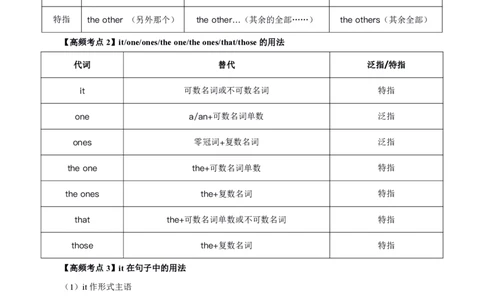
特指 the other (另外那个) the other…(其余的全部……) the others(其余全部)
【高频考点2】it/one/ones/theone/theones/that/those的用法
代词 替代 泛指/特指
it 可数名词或不可数名词 特指
one a/an+可数名词单数 泛指
ones 零冠词+复数名词 泛指
the one the+可数名词单数 特指
the ones the+复数名词 特指
that the+可数名词单数或不可数名词 特指
those the+复数名词 特指
【高频考点3】it在句子中的用法
(1)it作形式主语
例如:It’sdifficulttolearnaforeignlanguage. 学习一门外语是非常困难的。
(2)it作形式宾语
例如:IfinditeasytogetonwithJim. 我发现同吉姆和睦相处很容易。
【高频考点4】现在完成时高频句型
①This/Itisthe+序数词+that从句(从句中用现在完成时)
例如:ThisisthefirsttimethatIhaveheardhersing. 这是我第一次听她唱歌。
②This/Itisthe+形容词最高级+名词+that从句(从句中用现在完成时)
1同学们,关注微信公众号“教资资料箱”领取更多教资笔试资料
例如:ItisthebestfilmthatIhaveeverseen.这是我看过的最好看的电影。
【高频考点5】主动形式表示被动意义
(1)表示主语的某种属性特征的动词,如:wash,clean,cook,iron,cut,sell,read,wear,draw,
write等,用主动形式表示被动意义。例如:
Thebooksellswell. 这本书很畅销。
Thisknifecutseasily. 这刀子很好用。
(2)在need,require,want,worth(形容词),deserve后的动名词用主动形式表示被动意义。例如:
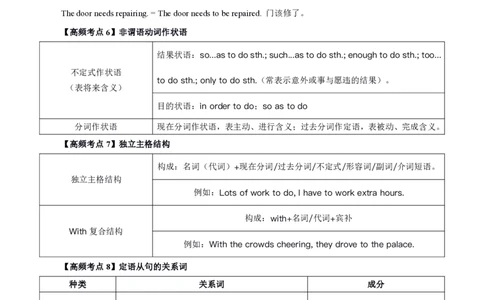
Thedoorneedsrepairing.=Thedoorneedstoberepaired. 门该修了。
【高频考点6】非谓语动词作状语
结果状语:so...astodosth.; such...as todosth.; enough todo sth.; too...
不定式作状语
to do sth.; only to do sth.(常表示意外或事与愿违的结果)。
(表将来含义)
目的状语:in order to do;so as to do
分词作状语 现在分词作状语,表主动、进行含义;过去分词作定语,表被动、完成含义。
【高频考点7】独立主格结构
构成:名词(代词)+现在分词/过去分词/不定式/形容词/副词/介词短语。
独立主格结构
例如:Lots of work to do, I have to work extra hours.
构成:with+名词/代词+宾补
With复合结构
例如:With the crowds cheering, they drove to the palace.
【高频考点8】定语从句的关系词
种类 关系词 成分
关系代词 which, that, who, whom, whose, as 作主要成分,有含义
关系副词 when, where, why 只作状语,有含义
【高频考点9】关系副词的用法
关系副词 成分 介词+which 特殊先行词
point,stage(程度,阶段),case,situation,scene
where 地点状语 in/at/on...+which
(情况、情形、情景)或job,activity,race,life
2同学们,关注微信公众号“教资资料箱”领取更多教资笔试资料
when 时间状语 in/at/on/during...+which occasion,stay,interval
【高频考点10】名词性从句的连接词辨析
种类 连接词 成分
从属连词 that,whether,if 不充当从句的任何成分
连接代词 what,whatever,who,whoever,whom,whose,which 作主要成分,有含义
连接副词 when, whenever, where, wherever, how, however,
只作状语,有含义
why
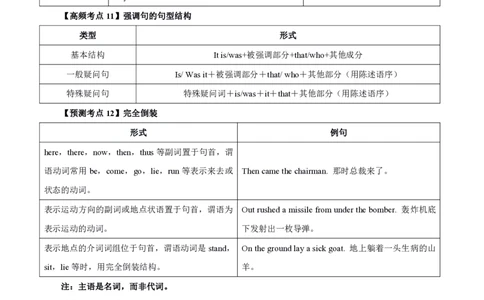
【高频考点11】强调句的句型结构
类型 形式
基本结构 Itis/was+被强调部分+that/who+其他成分
一般疑问句 Is/Wasit+被强调部分+that/who+其他部分(用陈述语序)
特殊疑问句 特殊疑问词+is/was+it+that+其他部分(用陈述语序)
【预测考点12】完全倒装
形式 例句
here,there,now,then,thus等副词置于句首,谓
语动词常用be,come,go,lie,run等表示来去或 Thencamethechairman. 那时总裁来了。
状态的动词。
表示运动方向的副词或地点状语置于句首,谓语为 Outrushedamissilefrom underthebomber. 轰炸机底
表示运动的动词。 下发射出一枚导弹。
表示地点的介词词组位于句首,谓语动词是stand, Onthegroundlayasickgoat. 地上躺着一头生病的山
sit,lie等时,用完全倒装结构。 羊。
注:主语是名词,而非代词。
【预测考点13】部分倒装
形式 例句
句首为否定或半否定的词语,如no,not,never,seldom, NeverhaveIseensuchaperformance.
little,hardly,atnotime,innoway,notuntil… 等。
前 倒 后 不 倒 结 构 如 : Not only…but also , Not only did he refuse the gift, but he also severely
Hardly/Scarcely…when,Nosooner…than。 criticizedthesender.
only+副词/介词短语/状语从句位于句首。 OnlyinthiswaycanyoulearnEnglishwell.
3同学们,关注微信公众号“教资资料箱”领取更多教资笔试资料
so,neither,nor 位于句首表示“也、也不” 的句子要部
Ifyouwon’tgo,neitherwillI.
分倒装。
【高频考点14】虚拟语气在if非真实条件句中的规则变化
从句 主句
与现在事实相反 did/were would(should/could/might)do
与过去事实相反 haddone would(should/could/might)havedone
与将来事实相反 did/were;weretodo;shoulddo would(should/could/might)do
【注意】在虚拟语气的从句中,动词“be”的过去时态一律用“were”,不用was。
【预测考点15】名词性从句中的虚拟语气
在表示命令、建议、要求等一类动词后面的名词性从句中,如demand,command,request,require,insist,
suggest,propose,order,recommend等,虚拟的情况为should(可省略)+ 动词原形。
例如:Isuggestthatwe(should)holdameetingnextweek.
【注意】特殊情况
suggest:意为“暗示,表明”时不虚拟,意为“建议”时虚拟。
insist:意为“坚持认为”时不虚拟,意为“坚持要某人做某事”时虚拟。
【题目演练】
1.Wewillhavetwofamilypartiesthisautumn.OneisatHalloweenand______isatThanksgiving.
A.other B.theother
C.another D.theothers
2.—CanIhelpyou?
—I’dliketobuyapresentformyfather’sbirthday,______ataproperprice,butofgreatvalue.
A.which B.that
C.one D.it
3.Ihate______whenpeopleeatwiththeirmouthsfull.
A.that B.these
C.it D.them
4. This isn’tthe first time the shareholders______ Zuckerberg to step down from his dual roles, which would
helphimfocusonrunningthecompany.
A.havewanted B.wanted
4同学们,关注微信公众号“教资资料箱”领取更多教资笔试资料
C.willwant D.want
5.Hisroomneeds______,sohemusthaveit______.
A.painting;painted B.painted;painting
C.painting;painting D.painted;painted
6.______theearlyflight,weorderedataxiinadvanceandgotupveryearly.
A.Catching B.Caught
C.Tocatch D.Catch
7.Withanexamination______,thestudentsfeltrelaxedandenjoyedthemselvesthewholenight.
A.totake B.beingtaken
C.taking D.taken
8.Manynurses,______wereretired,headedforaffectedareastohelp.
A.mostofwhich B.mostofwhom
C.mostofthem D.mostofwho
9.Self-drivingisanarea______Chinaandtherestoftheworldareonthesamestartingline.
A.that B.where
C.which D.when
10. The countries are supposed to work together to create ______ they hope will be the best approach to the
treatmentoftheepidemic.
A.which B.that
C.what D.who
11. It is in the hall ______ can house 10, 000 people ______ the opening ceremony of the Global 5G
TechnologySummitwillbeheld.
A.which;that B.where;that
C.which;who D.where;whom
12.Inthemiddleofthelake______whichlooksverybeautiful.
A.standatalltower B.lieatalltower
C.layatalltower D.standsatalltower
13.Jeanisaverybravegirl.Shealwaysasksquestionsinclassand______.
A.neitherhasMary B.sohasMary
5同学们,关注微信公众号“教资资料箱”领取更多教资笔试资料
C.neitherdoesMary D.sodoesMary
14.Whydidn’tyoutellmeaboutyourtroublelastweek?Ifyou______me,Icouldhavehelped.
A.told B.hadtold
C.weretotell D.wouldtell
15. Jane’s pale face suggested that she ______ ill, and her parents suggested that she ______ a medical
examination.
A.be;shouldhave B.was;have
C.shouldbe;had D.was;has
【参考答案及解析】
1.【答案】B
【解析】考查代词。句意:今年秋天我们将举行两次家庭聚会。一个在万圣节,另一个在感恩节。other
具有代词和形容词性质,既可指人,亦可指物,常与定冠词the、代词或名词连用,不能单独使用;theother
作形容词或代词,特指两者中或两部分的另一个或另一部分;another作形容词或代词,泛指三个或三个以
上不定数目中的另一个;theothers相当于theother+名词复数,表示剩下的,其余的,特指除此之外的全部
人或物。根据上文“Wewillhavetwofamilypartiesthisautumn.”可知这里是特指两者中的另一个。故选B。
2.【答案】C
【解析】考查指示代词。句意:“我能帮助你吗?”“我想要给我爸爸买一个生日礼物,一个价格合适
但是很有价值的礼物。”这里考查one代替前面的apresent,作同位语,泛指前面提到的名词同类当中的一
个,并非替代名词本身。而it由于指代上文出现过的特定事物,即同一事物,这里指的是礼物中的一个,
是泛指。故选C。
3.【答案】C
【解析】考查代词。句意:我讨厌人们吃东西时嘴里塞满东西。表示爱憎类的动词如:like/love/hate/dislike
或appreciate/relyon/seeto等其后加宾语从句时,此时一般先用it做其形式宾语,其后再接that/when等引导
的宾语从句。故选C。
4.【答案】A
【解析】考查动词的时态。句意:这并不是股东们第一次希望扎克伯格放弃他的双重角色,这将帮助
他专注于管理公司。句型“It/Thisisthefirsttime”后接从句,从句用现在完成时。故选A。
5.【答案】A
【解析】考查非谓语动词。句意:他的房间需要(被)粉刷,所以他请别人涂油漆。needdoingsth.(用
6同学们,关注微信公众号“教资资料箱”领取更多教资笔试资料
动名词主动表示被动)意为“需要被做”=needtobedone;而havesth.done意为“让/叫/使/请别人做某事”,
宾语sth,后面用过去分词作宾语补足语,说明sth.与过去分词表示的动作之间是被动关系。故选A。
6.【答案】C
【解析】考查非谓语动词作状语。句意:为了赶上早班的飞机,我们提前叫了出租车并且起得很早。
这里逻辑主语是we,空中用不定式作目的状语,表示提前叫出租车并且早起的目的。故选C。
7.【答案】D
【解析】考查非谓语动词。句意:考完试,孩子们感觉很放松,享受了通宵时光。with是介词,其后
不可以跟句子,复合结构做介词with的复合宾语,复合宾语中第一部分宾语由名词或代词充当,第二部分
补足语由形容词、副词、介词短语、动词不定式或分词充当,分词可以是现在分词,也可以是过去分词。
examination和take是被动关系,此空应该填入动词的过去分词。故选D。
8.【答案】B
【解析】考查定语从句。句意:许多护士前往灾区提供救援,其中大多数护士已经退休。分析句子结
构可知,空处引导一个非限制性定语从句,先行词是Manynurses,指人,关系词在从句中做介词的宾语,
故选mostofwhom。故选B。
9.【答案】B
【解析】考查定语从句。句意:自动驾驶是一个中国和世界其它国家都在同一起跑线的领域。句中先
行词为area,在从句中作地点状语,故用关系副词where,相当于inwhich。故选B。
10.【答案】C
【解析】考查宾语从句。句意:这些国家应该共同努力,想出一个能够缓解此次疫情的解决方案。______
theyhopewillbethebestapproachtothetreatmentoftheepidemic.是宾语从句,作create的宾语。宾语从句中
缺少主语,应用what引导。故选C。
11.【答案】A
【解析】考查定语从句和强调句。句意:全球5G技术峰会开幕式就是在可以容纳一万人的大厅举行。
______canhouse10,000people是限制性定语从句,修饰先行词thehall,在从句中作主语,故用which;整
个句子是强调句型,强调inthehall,其结构是itis+被强调部分+that/who+句子其它部分,只有强调人时,
才用who,其余情况均用that。故选A。
12.【答案】D
【解析】考查倒装句。句意:在湖中央矗立了一座高塔,看上去很漂亮。表示地点的介词短语位于句
首时,句子应用完全倒装,而stand意为“站立,矗立”;lie意为“躺,卧”,stand更符合句意,结合主语
7同学们,关注微信公众号“教资资料箱”领取更多教资笔试资料
atalltower,故谓语动词使用第三人称单数形式。故选D。
13.【答案】D
【解析】考查倒装句。句意:Jean是一个非常勇敢的女孩。她总是在课堂上问问题,玛丽也一样。当
前一句是否定句时,表示后者情况与前者一样,需用neither/nor引导的倒装句,其构成为:neither/nor+助动
词/情态动词/be动词+主语;若前一句是肯定句时,表示后者情况与前者一样,需用so引导的倒装句,其构
成为:so+助动词/情态动词/be动词+主语;由Shealwaysasksquestionsinclass可知,前一句是肯定句,所
以空处需用so引导的倒装句;由前一句谓语动词asks可知,空处谓语动词需用一般现在现在时,主语是
Mary,助动词需用does,表示问问题。故选D。
14.【答案】B
【解析】考查虚拟语气。句意:你上周为什么没有告诉我你遇到麻烦?如果你告诉我的话,我就会帮
助你了。表示对过去的虚拟,句型结构为“if+主语+haddone,主语+would/could/might/should+havedone”。
故选B。
15.【答案】B
【解析】考查虚拟语气。句意:Jane苍白的脸色说明她病了。她父母建议她去做一个检查。suggest表
示“说明,暗示”的时候,用陈述语气;表示“建议”的时候用虚拟语气should+动词原形。结合句意可知,
故选B。
第二章 英语语言学
【高频考点1】辅音的分类
1. 根据发音方式,英语的辅音可以分为:
爆破音(stops):发爆破音时,气流开始完全受阻,然后突然释放 [p],[b];[t],[d];[k],[ɡ]
摩擦音(fricatives):发摩擦音时,气流部分受阻,气流从狭窄的通道挤出,
[f],[v];[θ],[ð];[s],[z];[ʃ];[ʒ];[h]
产生摩擦
塞擦音(affricates):发塞擦音时,气流开始完全受阻,然后气流从狭窄的通
[tʃ],[dʒ]
道缓慢释放,并伴有摩擦发生
流音(liquids):在发流音时,受阻的气流从舌头与上部(roofofthemouth)
[l],[r]
形成的通道释放出
鼻音(nasals):发音时,气流从鼻腔释放出所发出的音为鼻音
[n],[m],[ŋ]
滑音(glides):滑音又称为半元音 [w],[j]
2. 根据发音部位,英语辅音可以分为:
8同学们,关注微信公众号“教资资料箱”领取更多教资笔试资料
双唇音(bilabial):气流受阻部位在双唇 [p],[b],[m],[w]
唇齿音(labio-dental):下唇与上齿接触使气流受阻 [f],[v]
齿音(dental):舌尖与上齿接触使气流受阻 [θ],[ð]
齿龈音(alveolar):舌尖与上齿龈隆骨接触使气流受阻 [t],[d],[s],[z],[n],[l],[r]
腭音(palatal):受阻部位发生在舌根与硬腭之间 [ʃ],[ʒ],[ʧ],[ʤ],[j]
软腭音(velar):舌根与软腭接触使气流受阻 [k],[g],[ŋ]
喉音(glottal):声带短时接触使气流受阻 [h]
3. 根据气流产生声音时声带振动的情况,可分为:
清辅音(voicelessconsonants)和浊辅音(voicedconsonants)
【高频考点2】词素
分类 特点 举例
屈折词素 不改变词类,不创造新词 dogs中的-s
派生词素 改变意思,或改变词类,或同时改变意思和词类 proper和improper
【高频考点3】构词法
分类 特点 举例
friend→befriend,friendly,
派生法(Derivation) 将词缀加到自由词素上
unfriendly,friendliness
两个或两个以上独立的词组合起来构
复合法(Compounding) greenhouse,pickpocket
成新词
不借助词缀,不改变词的形态,使词
转类法(Conversion) tobutterthebread
从一种词类转变成另一种词类
删掉一个或更多音节的方式缩短多音
截短法(Clipping) omnibus→bus
节词
将不同的非词素部分放在一起来构建
缩合法/混合法(Blending) smoke+fog=smog
新词
逆向构词法(Backformation) 删除单词真正的或假想的后缀 editor—edit
首字母缩合词及缩写词(Acronyms 首字母缩合词:把短语中的各个词的
NATO:['neitəu]
andAbbreviations) 首字母连在一起
9同学们,关注微信公众号“教资资料箱”领取更多教资笔试资料
缩写词:由另一个词或短语简缩而成 BBC
新造词(杜撰)(Coinage) 不是根据现存词素来构词的方法 kodak(柯达)
【高频考点4】词汇意义关系
词汇意义关系 分类 举例
方言同义词Dialectalsynonyms lift&elevator
文体同义词Stylisticsynonyms dad&father
同义关系 表情意义或评价意义相异的同义词
collaborator&accomplice
Synonymy Synonymsthatdifferintheiremotiveorevaluativemeaning
搭配相异同义词Collocationalsynonyms accuse&charge
语义相异的同义词Semanticallydifferentsynonyms rage&indignation
分级反义词gradableantonyms old—young
反义关系
互补反义词complementaryantonyms alive—dead
Antonymy
关系反义词relationalopposites above—below
上下义关系 上义词superordinate animal
Hyponymy 下义词hyponyms dog,cat
同音/形异义词 同音异义homophones night&knight
Homonymy 同形异义homographs tear[n.]vs.tear[v.]
【题目演练】
1.ThepairofEnglishphonemes______differinthemannerofarticulation.
A.[θ];[ð] B.[h];[f]
C.[g];[s] D.[n];[ŋ]
2.Whichofthefollowingwordscontainsaninflectionalmorpheme?
A.survival B.unload
C.handful D.disliked
3.Whichofthefollowingwordscontainsaderivationalmorpheme?
A.broaden B.spoon
C.ships D.helped
4.Thelexicalrelationbetweencoldandchillyis______.
A.hyponymy B.antonymy
10同学们,关注微信公众号“教资资料箱”领取更多教资笔试资料
C.synonym D.homonymy
5.Whichofthefollowingpairsofwordsaregradableantonyms?
A.odd—even B.give—receive
C.rich—poor D.innocent—guilty
6.Thelexicalrelationbetweenmeteandmeatis______.
A.antonymy B.hyponymy
C.homonymy D.synonym
7.Basketballisformedbyputtingthe wordsbasketandballtogether.The processofword-formation iscalled
______.
A.compounding B.derivation
C.blending D.clipping
8.Thelexicalrelationbetweenmeatandmuttonis______.
A.hyponymy B.antonymy
C.synonym D.polysemy
【参考答案及解析】
1.【答案】C
【解析】考查语音学。按照发音方式分类,[θ]和[ð]都属于摩擦音;[h]和[f]都属于摩擦音;[g]属于爆破
音,[s]属于摩擦音;[n]和[ŋ]都属于鼻音。故选C。
2.【答案】D
【解析】考查形态学。屈折词素表示名词的格或数,动词的时或体,形容词和副词的级。屈折词素包
括:表示名词的所属格、表示名词的复数形式、表示单数第三人称作主语的一般现在时态、表示动词的过
去时、表示动词的进行时、表示形容词和副词的比较级、表示形容词和副词的最高级。survival中的-al,unload
中的“un-”,handful中的“-ful”和disliked中的“dis-”均属于派生词素,但disliked中除了含有派生词
素“dis-”以外,还含有一个表示动词过去时的屈折词素“-ed”。故选D。
3.【答案】A
【解析】考查形态学。屈折词素表示名词的格或数,动词的时或体,形容词和副词的级。屈折词素包
括:表示名词的所属格、表示名词的复数形式、表示单数第三人称作主语的一般现在时态、表示动词的过
去时、表示动词的进行时、表示形容词和副词的比较级、表示形容词和副词的最高级。因此,ships中的“-s”
和helped中的“-ed”均属于屈折词素;spoon可以独立成词,属于自由词素,只有A项broaden中的“-en”
11同学们,关注微信公众号“教资资料箱”领取更多教资笔试资料
属于派生词素,改变了原词broad的词性。故选A。
4.【答案】C
【解析】考查语义学。hyponymy意为“上下义关系”;antonymy意为“反义词”;synonym意为“同
义词”;homonymy意为“同音/形异义词”。cold和chilly均有“寒冷”的语义,属于同义词。故选C。
5.【答案】C
【解析】考查语义学。odd意为“奇数的”,even意为“偶数的”,两者为互补反义词;give与receive
在方向上存在依赖关系,为关系反义词;rich与poor之间存在中间状态,即well-to-do(小康),因此两者
属于等级反义词;innocent意为“无辜的”;guilty意为“有罪的”,两者为互补反义词。故选C。
6.【答案】C
【解析】考查语义学。antonymy意为“反义词”;hyponymy意为“上下义关系”;homonymy意为“同
音/形异义词”;synonym意为“同义词”。mete意为“边界,界碑”,meat意为“肉”,二者发音均为/mi:t/,
属于同音异义词。故选C。
7.【答案】A
【解析】考查形态学。basketball是由basket和ball两个词组合而成,属于复合词的构词方式,即由两
个或两个以上独立的词组合起来构成新词。故选A。
8.【答案】A
【解析】考查语义学。hyponymy意为“上下义关系”;antonymy意为“反义词”;synonym意为“同
义词”;polysemy意为“一词多义”。meat意为“肉”,mutton意为“羊肉”,羊肉属于肉的一种,二者
之间为上下义关系,故选A。
12同学们,关注微信公众号“教资资料箱”领取更多教资笔试资料
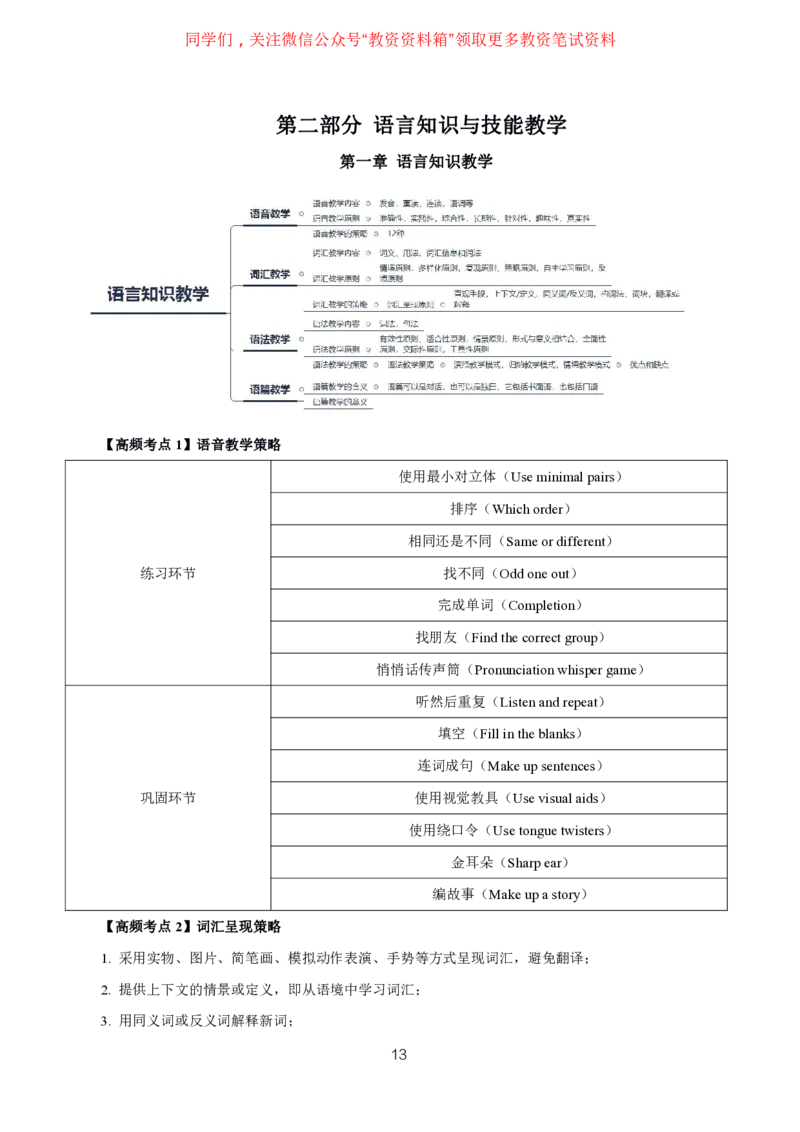
第二部分 语言知识与技能教学
第一章 语言知识教学
【高频考点1】语音教学策略
使用最小对立体(Useminimalpairs)
排序(Whichorder)
相同还是不同(Sameordifferent)
练习环节 找不同(Oddoneout)
完成单词(Completion)
找朋友(Findthecorrectgroup)
悄悄话传声筒(Pronunciationwhispergame)
听然后重复(Listenandrepeat)
填空(Fillintheblanks)
连词成句(Makeupsentences)
巩固环节 使用视觉教具(Usevisualaids)
使用绕口令(Usetonguetwisters)
金耳朵(Sharpear)
编故事(Makeupastory)
【高频考点2】词汇呈现策略
1. 采用实物、图片、简笔画、模拟动作表演、手势等方式呈现词汇,避免翻译;
2. 提供上下文的情景或定义,即从语境中学习词汇;
3. 用同义词或反义词解释新词;
13同学们,关注微信公众号“教资资料箱”领取更多教资笔试资料
4. 利用词根、词干、前缀、后缀、转化、合成(root/base,stem,prefixation,suffixation,conversion,
compounding)学习记忆扩充新单词;
5. 在词组语块中教学英语单词。
如教comeacross时,要将它们置于具体的句子中,用其他同义或近义的词汇解释,而不可单独解释其
中的任何一个词[例:Icameacrosssomething.(=metwith)];
6. 对于较抽象的词汇或专有名词可采用解释或翻译方式;
如X-ray意为“X射线”;virtue意为“美德”等;
7. 及时发现学生可能误解和疑惑的词汇,重点呈现和讲解。
【高频考点3】语法教学的策略
常用的英语语法教学方法有演绎法(thedeductivemethod)、归纳法(theinductivemethod)和指导发现
法(theguideddiscoverymethod)。
1. 演绎法(thedeductivemethod)
DeductiveGrammarTeaching
Benefits Drawbacks
Studentsarepassive,becausetheyjustlisten.
Full,clearexplanationscanbegiven. It’s easy for students to forget the rules, as they are not actively
involvedinworkingthemout.
There is a lot of “teacher talk” and little “student talk”. Young
Itcanbetime-saving.
learnersmayfeeldullandreactnegatively.
This style has been traditionally used in
China for a long time. Studentsare used to It teaches grammar in an isolated way. Little attention is paid to
it and it can increase students’ confidence meaning.Practiceisoftenmechanical.
inexams.
2. 归纳法(theinductivemethod)
InductiveMethodTeaching
Benefits Drawbacks
It can be more demanding on the teacher to produce enough
Students discover the grammar themselves
contexts and examples for the students’ needs. Preparing adequate
whileengagedinlanguageuse.
questions to guide the students in their process of discovery also
14同学们,关注微信公众号“教资资料箱”领取更多教资笔试资料
demandsmuchteachingskills.
Students have been much more involved in
Studentshavenopatienceinworkingthemoutforthemselves.
thediscoveryprocess.
The process can be much more time consuming, as students may
Remember the structure and their usage
need moretimeandmanymorecontextsandexamplesbeforethey
better.
canworkoutrulesforthemselves.
3. 指导发现法(theguideddiscoverymethod)
theGuidedDiscoveryMethod
Teachingprocedures characteristics
① Students are presented with
contextualized ( 情 景 化 的 ) examples
illustratingaspecificstructure. Similar to the inductive method in that students are induced to
②Students are guided to discover the discover rules by themselves. Different in that the process of the
underlying rule of the structure as well as its discovery is carefully guided and assisted by the teacher and the
meaningincontext. rulesarethenelicitedandtaughtexplicitly.
③ The teacher teaches the target
structureexplicitly.
【题目演练】
1. A teacher handed out a list of twenty “if” sentences and asked students to discuss and find out the
grammaticalrules.Whatistheteacher’sgrammarteachingmethod?
A.Deduction. B.Presentation.
C.Consolidation. D.Induction.
2. When you focus on “utterance function” and “expected response” by using examples like “apology/
acceptance,inform/acknowledge”,youareprobablyteachinglanguageatthe______.
A.lexicallevel B.discourselevel
C.storylevel D.grammaticallevel
3.AskingstudentstoexplainnewwordsinatextwithknownwordsisNOTanactof______.
A.elicitation B.reinforcement
15同学们,关注微信公众号“教资资料箱”领取更多教资笔试资料
C.management D.production
4. In teaching pronunciation, the teacher should tell the students that ______ can be used to convey more
importantmessages.
A.rhyme B.stress
C.devoicing D.rhythm
【参考答案及解析】
1.【答案】D
【解析】考查语法教学。句意:一位老师分发了一张含有20个“if”句子的表让学生讨论,并找出其
中的语法规则。deduction意为“推论”;presentation意为“呈现”;consolidation意为“巩固”;induction意
为“归纳”。学生先讨论例句后总结语法规则,用到的语法教学法是归纳法。故选D。
2.【答案】B
【解析】考查语篇教学。句意:当你通过像“道歉/接受,通知/告知知悉”这样的事例来集中探讨“言
语功能”以及“期待反应”问题时,你很可能是在从事哪个方面的语言教学。分析选项,lexicallevel意为
“词汇层面”;discourselevel意为“语篇层面”;storylevel意为“故事层面”;grammaticallevel意为“语法
层面”。道歉/接受,通知/告知知悉等属于展开交际的语言,所以是语篇层面。故选B。
3.【答案】B
【解析】考查词汇教学。句意:让学生用已知单词去解释新词,不属于下列哪一项?分析选项,elicitation
意为“启发诱导”;reinforcement意为“巩固加强”;management意为“处理”;production意为“生产”。新
词对学生而言是第一次出现,不存在巩固加强。故选B。
4.【答案】B
【解析】考查语音教学。句意:教学语音时,老师应该告诉学生______能用来强调更重要的信息。rhyme
意为“韵律”;stress意为“重音;重读”;devoicing意为“清音化”;rhythm意为“节奏”。英语中的重音可
以用来强调重点内容。故选B。
16同学们,关注微信公众号“教资资料箱”领取更多教资笔试资料
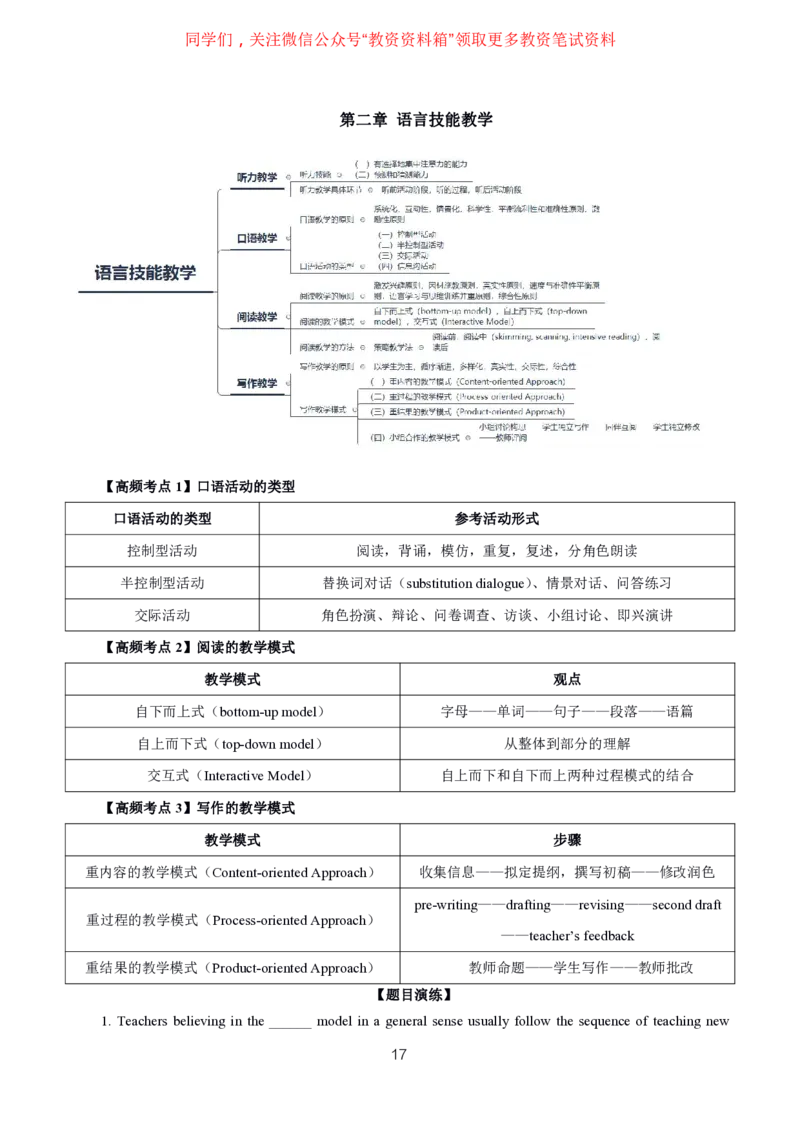
第二章 语言技能教学
【高频考点1】口语活动的类型
口语活动的类型 参考活动形式
控制型活动 阅读,背诵,模仿,重复,复述,分角色朗读
半控制型活动 替换词对话(substitutiondialogue)、情景对话、问答练习
交际活动 角色扮演、辩论、问卷调查、访谈、小组讨论、即兴演讲
【高频考点2】阅读的教学模式
教学模式 观点
自下而上式(bottom-upmodel) 字母——单词——句子——段落——语篇
自上而下式(top-downmodel) 从整体到部分的理解
交互式(InteractiveModel) 自上而下和自下而上两种过程模式的结合
【高频考点3】写作的教学模式
教学模式 步骤
重内容的教学模式(Content-orientedApproach) 收集信息——拟定提纲,撰写初稿——修改润色
pre-writing——drafting——revising——seconddraft
重过程的教学模式(Process-orientedApproach)
——teacher’sfeedback
重结果的教学模式(Product-orientedApproach) 教师命题——学生写作——教师批改
【题目演练】
1. Teachers believing in the ______ model in a general sense usually follow the sequence of teaching new
17同学们,关注微信公众号“教资资料箱”领取更多教资笔试资料
words,sentencesandthenthewholepassageinthereadingclass.
A.interactive B.top-down
C.bottom-up D.interactional
2.Whichofthefollowingisanaccuracy-orientedspeakingactivity?
A.Identifyingparticularphonemesonthetape.
B.Actingouttherolesintheclassroom.
C.Greetingpeopleinformallyinpairs.
D.Havingdiscussioningroups.
3.Whichofthefollowingisnotasuitablepre-listeningactivity?
A.Writingasimilartext. B.Discussingarelevantpicture.
C.Writingquestionsaboutthetopic. D.Learningvocabulariesaboutthetopic.
4.Theteacherwoulduse______tohelpstudentscommunicateinteachingspeaking.
A.substitutiondrills B.groupdiscussion
C.listeningandacting D.readingaloud
5. What activity are students engaged in when they read each other’s writings, provide feedback and make
suggestionsforrevisionbeforetheirteachergradesthem?
A.Discussing. B.Brainstorming.
C.Peerreviewing. D.Draftreviewing.
【参考答案及解析】
1.【答案】C
【解析】考查阅读教学。阅读教学的模式通常包括前三个选项。自下而上模式是遵循从小的语言单位
开始进行教学,直到最大的教学单位,即单词、句子和篇章。这也正是题目中所说的教学模式。故选C。
2.【答案】A
【解析】考查口语教学。句意:下列哪一项是以准确度为导向的口语活动。分析选项,A项意为“识
别磁带上的特定音素”;B项意为“在教室里角色扮演”,C项意为“两人一组问候”,D项意为“小组讨论”。
B项、C项和D项属于交际活动,以流畅度为导向,以准确度为导向的语言活动是A项。故选A。
3.【答案】A
【解析】考查听力教学。A项意为“写一篇相关的文章”;B项意为“讨论相关的图片”;C项意为“写
与话题相关的问题”;D项意为“读与话题相关的问题”。听前活动指的是在听材料之前让学生做好听音
18同学们,关注微信公众号“教资资料箱”领取更多教资笔试资料
准备的各种教学活动。一般有学习新单词、观看相关图片、提出启发性问题或介绍相关背景知识等活动。
写一篇相关的文章,时间太长,不属于听前准备活动。故选A。
4.【答案】B
【解析】考查口语教学。为了帮助学生在口语课堂上相互交流,教师可以采取小组讨论的形式来进行
课堂活动。另外三项(替换练习、大声朗读、听演)均属于机械性操练。故选B。
5.【答案】C
【解析】考查写作教学。在写作教学写后环节,可以自评、互评、师评,由题干表述可知强调的是同
伴之间的评价。故选C。
19同学们,关注微信公众号“教资资料箱”领取更多教资笔试资料
第三部分 教学设计
【高频考点1】阅读教学
教学环节 主要活动形式
提供背景知识或利用图片引导学生预测文章内容,带领学生解决生单词或让学生提前
读前
熟悉有关单词等
序题、连线题、表格题或者判断正误题等带领学生加深对文章内容的了解;解决文章
读中
中的生词、语法或长难句(W+H类信息及具体词句)
读后 复述课文、讨论、辩论、采访、角色扮演、做调查等
【高频考点2】听说教学
教学环节 主要活动形式
肢体动作和表情、图片/视频/单词卡/实物、创设情境、虚拟角色或真实人物引出本节
新授
课的目标语言
练习 听对话,创编对话,猜谜游戏
巩固 猜测性任务;解决问题任务;故事链任务;创造性任务
【高频考点3】写作教学
教学环节 主要活动形式
写前 讨论主题,搜集素材,语言准备,阅读范文,列写提纲
补全句子,看图写作,句子合并,句子段落重组,补全写作,平行写作,模仿阅读材
写中
料写作,小组合作写作,规划文章结构等
写后 自我修改,相互修改,个人或小组互批,制作海报或者墙报展示
【高频考点4】口语教学
教学环节 主要活动形式
说前 头脑风暴、情景对话、猜谜语
说时 全身反应法、视听法、角色扮演、情景对话
说后 看图说话;角色扮演;概括要点;复述或转述;表达简单的个人观点等
20同学们,关注微信公众号“教资资料箱”领取更多教资笔试资料
【题目演练】
第一篇
设计任务:请阅读下面学生信息和语言素材,设计一节英语阅读课的教案,教案没有固定格式,但须
包含下列要点:
teachingobjectives
teachingcontents
keyanddifficultpoints
majorstepsandtimeallocation
activitiesandjustification
教学时间:45分钟
学生概况:某城镇普通中学高中一年级第二学期学生,班级人数40人,多数学生已经达到《普通高中
英语课程标准(实验)》五级水平,学生课堂参与度与积极性一般。
语言素材:
The trick of eating healthily is remembering that no food in itself is good or bad; eating properly depends on
eating the right variety of food in the right amount. Too much of even the “healthiest” food can lead to illness and
disorders.
Ifyoulike a snack,avoidchocolate andcrisps andhead forfruit, filledrolls,soupandbaked potatoesinstead.
Sugar-freebreakfastcerealsarealsoagoodbet.
Recommendedservingsperday
FruitandVegetables Meat,Fish,Poultry,Eggs,andNuts
Good sources of vitamins A and C, also contain fiber, These provide protein, iron and B vitamins. Have 2 to 3
folic acid, vitamin E and iron. Aim for at least 5 servingsperdaywithplentyofvariety.
servingsperday.
Milk,CheeseandYoghurt Bread, Cereals, Pasta, Brown Rice, Noodles and
Potatoes
These provide protein, calcium and B vitamins. Have 2 These provide fiber, B vitamins (including folic acid)
to3servingsperdayandchooselowfatvarieties. and some iron. Choose wholegrain varieties and have at
least5to6servingsperday.
21同学们,关注微信公众号“教资资料箱”领取更多教资笔试资料
第二篇
设计任务:根据所提供的信息和语言素材设计一节听说课的教学方案。该方案没有固定格式,但须包
含下列要点:
teachingobjectives
teachingcontents
keyanddifficultpoints
majorstepsandtimeallocation
activitiesandjustification
教学时间:45分钟
学生概况:某城镇普通中学八年级(初二)学生,班级人数40人,多数学生已经达到《义务教育英语
课程标准(2022版)》相应水平,学生参与积极性一般。
语言素材:
Frank:Hi,Bob.Howisyourday?
Bob:It’sOK.IlikeMondaybecauseIhaveP.E.andhistory.They’remyfavoritesubjects.
Frank:Who’syourP.E.teacher?
Bob:Mr.Hu.Healwaysplaysgameswithus.
Frank:That’sgreat!Butdoyoulikehistory?It’sboring.
Bob:Oh,Ithinkhistoryisinteresting.What’syourfavoriteday?
Frank:Friday.
Bob:Why?
Frank:BecausethenextdayisSaturday.
Bob:Ha-ha!That’sforsure.IlikeFridaystoo.
22同学们,关注微信公众号“教资资料箱”领取更多教资笔试资料
第三篇
设计任务:请阅读下面学生信息和语言素材,设计一个20分钟的英语写作课的教学方案,教案没有固
定格式,但必须包含下列要点:
teachingobjectives
teachingcontents
keyanddifficultpoints
majorstepsandtimeallocation
activitiesandjustification
教学时间:20分钟
学生概况:某城镇普通中学高中一年级学生,班级40人,多数学生已达到相应水平,学生课堂参与积
极性一般。
语言素材:
Writeastoryaboutaspecialfamilymemory.
Whowasinthememory?
Whendidithappen?
Wheredidittakeplace?
Whathappened?
Whyisitspecialormemorable?
Usefulexpressions
Lastsummer,.../In2015,.../Manyyearsago,...
Iwasat...
Itmademefeelso...
Irememberthisbecause...
Ilearntthat...
23同学们,关注微信公众号“教资资料箱”领取更多教资笔试资料
第四篇
设计任务:请阅读下面学生信息和语言素材,设计一个20分钟的英语口语教学方案,教案没有固定格
式,但必须包含下列要点:
teachingobjectives
teachingcontents
keyanddifficultpoints
majorstepsandtimeallocation
activitiesandjustification
教学时间:20分钟
学生概况:某城镇中学七年级(初中一年级)学生,班级人数40人,多数学生已经达到《义务教育课
程标准(2011年版)》二级水平,学生课堂参与积极性一般。
语言素材:
Ms.Li:Hello,my nameisLiFang.I’m yourteacherandyouaremy students.I’mChinese. I’mfrom Wuhan.
What’syourname?
Lingling:MynameisWangLingling.
MSLi:Nicetomeetyou,Lingling.Whereareyoufrom?
Lingling:I’mfromBeijing.I’mChinese.
MSLi:Howoldareyou?
Lingling:I’mthirteenyearsold.
MSLi:Good.Hello,whataboutyou?
Daming:Hello,Ms.Li.MynameisLiDamingandI’mfromBeijing.I’mtwelveyearsold.
Ms.Li:Thanks.Hello,areyoufromAmerica?
Tony:No,I’mnot.I’mfromEngland.I’mTonySmith.
Ms.Li:Nicetomeetyou,Tony.Hi,areyouEnglish,too?
Betty:No,I’mnot.I’mAmericanandmynameisBettyKing.
Lingling:TonyandBettyareourfriends.
Ms.Li:Good.WelcometoClass4Grade7!
24同学们,关注微信公众号“教资资料箱”领取更多教资笔试资料
【参考答案及解析】
第一篇
【参考答案】
1.TeachingContents:Apassageaboutthemeaningandscientificwaysofeatinghealthilyandrecommended
servingsperday.
2.TeachingObjectives:
(1)KnowledgeObjectives:
①Studentscanunderstandthemainideadeliveredbythetext—healthywaysofeating.
②Students are able to learn and use the following words and expressions: healthy, healthily, amount, snack,
bake,recommend,provide,variety,leadto.
(2)AbilityObjectives:
①Studentscanpracticetheirreadingabilitybyskimming,scanningandreadingcomprehension.
②Studentscantalkabouttheirowndailydiet.
(3)EmotionalObjective:
Studentscanknowtheimportanceofhealthyeatinganddevelopscientificandhealthyeatinghabits.
3.TeachingKeyPoints:
①Studentscanunderstandthemainideadeliveredbythetext—healthywaysofeating.
②Students are able to learn and use the following words and expressions: healthy, healthily, amount, snack,
bake,recommend,provide,variety,leadto.
4.TeachingDifficultPoint:
Howtoapplywhattheyhavelearnedintoreallifeandhowtoformahabitofeatinghealthily.
5.TeachingProcedures:
Step1Leadin(5minutes)
Greeting and free talk: After greeting, the teacher asks students two questions “What do you do every day?
Listthefood.”“Doyoueathealthily?”andinvitessomestudentstoanswerthem.
【Justification:Studentsget excitedbysharing theirlifeexperiences, andthey discussthequestionsin groups
toactivatewhattheyalreadyknewabouthealthyeating,whichpavesthewayforfurtherlearning.】
Step2Pre-reading(3minutes)
Theteacherletsstudentsreadthetableinthetexttopredictwhatthepassageismainlyabout.
25同学们,关注微信公众号“教资资料箱”领取更多教资笔试资料
【Justification:Studentscanbecomemorefamiliarwiththepassagebyreadingthetableinthebook.】
Step3While-reading(20minutes)
1.Skimming
Readthetextquicklyandtrytochecktheirpredictionandfindoutthemainideasofeachpart.
2.Scanning
Readthroughthetextforthesecondtimeandfindoutsomeimportantdetailedinformation:suchas:
Whyisnofoodgoodorbadinitself?
Whatshouldbeavoidedifwelikesnacks?
Whyarefruitandvegetablesrecommendedperday?
3.Intensivereading
Talkaboutwhethertheyhavereachedtherecommendedamounteverydayandsharethereasons.
【Justification: Through reading step by step, students hone their different reading skills and their ability of
analyzingandcomparingisalsoimproved.】
Step4Post-reading(12minutes)
Groupdiscussion
T: Suppose you are a cook in our school canteen, what meal would you serve on Tuesday? List your menu,
andgiveyourreasonsforit.
Studentsworkingroupsandthensomerepresentativesreportfortheirgroups.
【Justification:Putwhattheyhavelearnedintouseandconsolidatetheknowledgeabouthealthyeatingway.】
Step5Summary(3minutes)
The teacherguides studentsto summarize what they have learnedabout different food’s nutrition in daily life.
Thentheteachermakesnecessarysupplementsandstressestheimportanceofhealthyeating.
【Justification:Studentscanreviewthemaincontentintheclassandknowtheimportanceofhealthyeating.】
Step6Homework(2minutes)
Writeahealthymenufortheirfamilymembersandshareitwithclassmatesnexttime.
【Justification:Studentscanreviewandexpandlearningopportunitiesafterclass.】
第二篇
【参考答案】
1.TeachingContents:Itisadialogueabouttheirfavoritedayandsubject.
26同学们,关注微信公众号“教资资料箱”领取更多教资笔试资料
2.TeachingObjectives:
(1)Studentscanlearntousethesewords:P.E.,history,favorite,andsubject.
(2)Studentscanimprovetheirlisteningandspeakingabilityandtalkabouttheirfavoriteclass.
(3)Studentscanexercisetheircreativethinkingability.
(4)StudentscanloveEnglishlearningandcaremoreabouttheirclassmates.
3.TeachingKeyandDifficultPoints:
(1)Studentscanlearntousethesewords:P.E.,history,favorite,andsubject.
(2) Students can use the language points in their real life and the pronunciation of “favorite” is a difficult
point.
4.TeachingProcedures:
Step1.Warm-upactivities(5minutes)
Showthepicturesofdifferentclassesandaskstudentstoguesswhatclasstheyare.
【Justification:Thisstepcanmakestudentsfamiliarwiththeclass,creatingarelaxinglearningatmosphere.】
Step2.Presentation(17minutes)
(1)Brainstorming:Askstudentstothinkaboutthenameofsubjectsasmanyastheycan.
(2) Guessing game: Ask students work in pairs. One student acts and the other guesses the name of the
subjects.
(3)Studentsworkingroupstopracticethepattern:
—Whatisyourfavoritesubject?
— ...ismyfavoritesubject.
(4)Asksomepairstopresentinfrontoftheclass.
【Justification: This step can practice students’ listening and speaking abilities and they can be more familiar
withthemaincontentintheclass.】
Step3.PracticeandConsolidation(20minutes)
Studentsworkingroupstodiscussthefollowingquestions:
—Whatisyourfavoritecolor?
—Whatisyourfavoritesport?
—Whatisyourfavoriteseason?
Name Whatisyourfavoritecolor? Whatisyourfavoritesport? Whatisyourfavoriteseason?
27同学们,关注微信公众号“教资资料箱”领取更多教资笔试资料
Each group finishes the table and chooses a representative. The representative makes a report about the result
infrontoftheclass.
【Justification:Thisstepcanimprovestudents’communicationandcooperationability.】
Step4.Summary(2minutes)
The teacher leads students to make a summary of the whole class and the teacher makes necessary
supplements.Theteacherstressestheemotionalobjective.
【Justification: In this step, students can review what they have learned in the class and know the importance
oflearning.】
Step5.Homework(1minute)
Homework1:Copythedialogueforthreetimes.
Homework2:Tellyourparentsyourfavoritedayandsubject.
【Justification:Thisstepcanmakestudentsconsolidatewhattheyhavelearnedintheclass.】
第三篇
【参考答案】
1.TeachingContents
It is a writing class. Students need to write a narrative passage to keep a record of special family memory.
Whilewriting,theyneedtopayattentiontothe5Wsofanarration.
2.TeachingObjectives
(1)Studentscanunderstandthe5Wsofanarration.
(2)Studentscantalkandwriteanarrationabouttheirspecialfamilymemories.
(3)Students’speakingandwritingabilitiescanbeimproved.
(4)Studentscancherishtheirtimewiththeirfamilies.
(5)Studentscandeveloptheircriticalthinkingabilitybywritingapassageaccordingtothetimeorder.
3.TeachingKeyPoint
Howtoguidestudentstowriteanarrationaccordingtothe5Wsprinciple.
4.TeachingDifficultPoint
Howtoimprovestudents’writingskills.
28同学们,关注微信公众号“教资资料箱”领取更多教资笔试资料
5.TeachingProcedures
Step1Lead-in(1min)
The teacher plays a short video clip of The Pursuit of Happiness. Then, ask students how they feel after
watchingthemovieclipandwhattheythinkoftherelationshipbetweentheboyandhisfather.
【Justification: A movie clip can arouse students’ learning interest and encourage students to express their
opinions.】
Step2Pre-writing(3mins)
Ask students whether they have similar experiences to the scenes they see in the movie clip. Then, divide
studentsintogroupsoffour.Theycansharetheirspecialfamilymemorieswithingroups.
【Justification:Improvestudents’spokenEnglishandlayafoundationforthefollowingwritingtasks.】
Step3While-writing(8mins)
(1)Studentsfillinthefollowingformaccordingtowhattheyhavetalkedabout.
Whowasinthememory?
Whendidithappen?
Wheredidittakeplace?
Whathappened?
Whyisitspecialormemorable?
(2)Studentswriteadraftaccordingtotheformtheysummarized.
(3) Students check the tense and time adverbials. Then, students add some conjunctions to make the plot
clearer.
【Justification:Helpstudentsconcludethe5Wsofnarration andguidestudentstoutilizethe5Wsprincipleto
writeanarration】
Step4Post-writing(6mins)
(1) Students exchange their compositions within groups and revise for each other. They need to pay attention
tothetense,spellingmistakes,pronounsandconjunctions,thebasicelementsofnarration,etc.
(2)Studentschoosethemostinterestingstoryintheirgroupsandshareitwiththeclass.
【Justification:Enhancestudents’writingskillsandencouragestudentstosharetheirmemorieswiththeclass.】
Step5Summary(1min)
Students summarize what they have learned in this lesson and the teacher reminds students to cherish their
29同学们,关注微信公众号“教资资料箱”领取更多教资笔试资料
timeandmemorieswiththeirfamilies.
【Justification:Checkstudents’learningresults.Permeatetoday’semotionalobjective.】
Step6Homework(1min)
Studentswatchamovierelatedtofamilyandwriteashortpassagetotelltheirfeelingsaboutthemovie.
【Justification:Enrichstudents’extracurricularactivitiesandfurtherimprovestudents’writingability.】
第四篇
【参考答案】
1. Teaching Contents: A dialogue about asking for and giving information about one’s basic information,
whichisaverycommontopicinjuniorhighschooltohelpstudentstogreetotherpeopleinrealsituations.
2.TeachingObjectives:
(1)KnowledgeObjective
Students can understand, listen to and say the key words of different countries and sentence patterns to
introduceone’sbasicinformation:—Whereareyoufrom?—I’mfrom…
(2)AbilityObjective
By introducing and asking for one’s hometown in real situation, students can improve their listening and
speakingability.
(3)EmotionalObjective
Studentscanbeeagertoknoweachotherandmakefriends.
3.TeachingKeyandDifficultPoint:
Learntoshareone’sbasicinformationwhengreetingotherpeopleinrealsituations.
4.TeachingProcedures:
Step1Lead-in(2mins)
Singasonginrelationtothetopicoffriends.
Song:Iamaboyandyou’reagirl.I’mfromChinaandyou’refromJapan.
Doyouwanttobemyfriend?Doyouwanttobemyfriend?
【Justification: Students’ learning interests can be aroused by singing a song together, and the song is about
friendship,whichhelpsstudentstoreviewsomelanguagepoints.】
Step2Pre-speaking(3minutes)
The teacher shows students some pictures of national flags from different countries and asks them to guess
30同学们,关注微信公众号“教资资料箱”领取更多教资笔试资料
whichonesofthemwillbementionedinthetext.
【Justification:Studentscanbeinterestedinthenationalflagsandpredictthemaincontent.】
Step3While-speaking(8minutes)
(1)Studentslistentotheconversationofthetextandfindoutplacesmentionedinthetext.
(2)Studentslistenagainandmatchpeople’snameswiththeirhometowns.
(3)Theteacherpresentskeysentencepatternsandwordsbycheckinganswerswithstudents.
(4)Studentslistentothetapeandreadafterit,andtheteacherhelpsthemwithpronunciationwhennecessary.
【Justification: Students get familiar with the conversation by listening for the gist and detailed information
and reading, which helps them to understand, recognize and speak with the key words and patterns in the text and
preparesthemforfurtheruseofthelanguage.】
Step4Post-speaking(5minutes)
(1) Students each are given cards of different countries and walk around the classroom to find their friends if
they’re from the same country. Students need to practice the sentence patterns and key words to confirm the
informationofeachother.
(2)Roleplay
Set the scene that students are going to attend a cultural festival in which a lot of celebrities around the world
willparticipate. Studentsareaskedto invitesomeof themto joinin theirgroup activity.In ordertoaccomplish the
task,studentsneedtointroducethemselvesclearlyandaskthecelebritiesfortheirbasicinformation.
【Justification: By trying to put what they have learnt into practical use, students can better consolidate the
knowledgetheylearntinclass.】
Step5Summary(1minute)
Students make a summary of what they have learned and the teacher makes proper supplements that students
shouldmakemorefriends.
【Justification: Students can review the topic and knowledge they learned and the emotional objective can be
achievedinthisstep.】
Step6Homework(1minute)
Afterclass,studentsintroducethemselvestoparentsandfriends.
【Justification:Studentscanpracticethetopicofintroductionandapplytheknowledgeintoactualuse.】
31同学们,关注微信公众号“教资资料箱”领取更多教资笔试资料
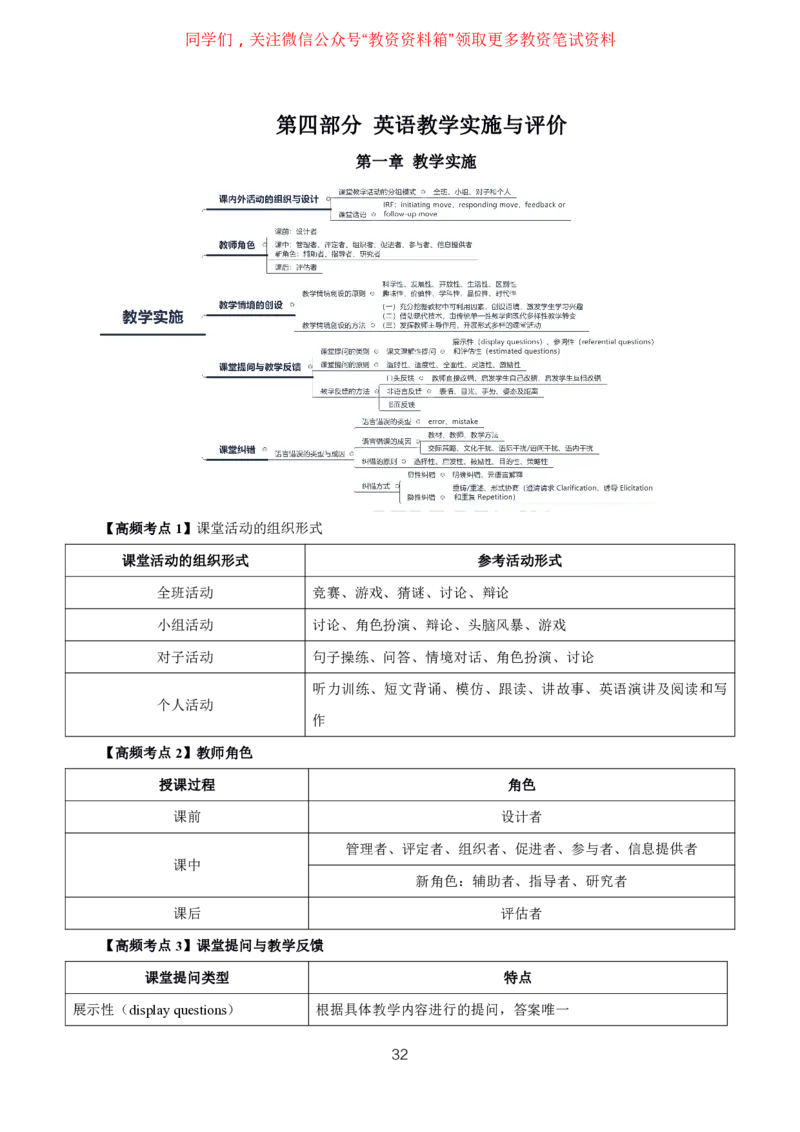
第四部分 英语教学实施与评价
第一章 教学实施
【高频考点1】课堂活动的组织形式
课堂活动的组织形式 参考活动形式
全班活动 竞赛、游戏、猜谜、讨论、辩论
小组活动 讨论、角色扮演、辩论、头脑风暴、游戏
对子活动 句子操练、问答、情境对话、角色扮演、讨论
听力训练、短文背诵、模仿、跟读、讲故事、英语演讲及阅读和写
个人活动
作
【高频考点2】教师角色
授课过程 角色
课前 设计者
管理者、评定者、组织者、促进者、参与者、信息提供者
课中
新角色:辅助者、指导者、研究者
课后 评估者
【高频考点3】课堂提问与教学反馈
课堂提问类型 特点
展示性(displayquestions) 根据具体教学内容进行的提问,答案唯一
32同学们,关注微信公众号“教资资料箱”领取更多教资笔试资料
参阅性(referentialquestions) 没有现成的答案,要结合个人的知识和课文所提供的信息
评估性(estimatedquestions) 开放性问题,在理解课文的基础上进行深层次的逻辑思考
教学反馈的方法 具体方法
教师直接改错
口头反馈 启发学生自己改错 口头活动、有些书面作业或者测试提供的信息
启发学生互相改错
非语言反馈 表情、目光、手势、姿态及距离等非语言因素
书面反馈 计分法、画“正字”法、插红旗或送奖励红花法
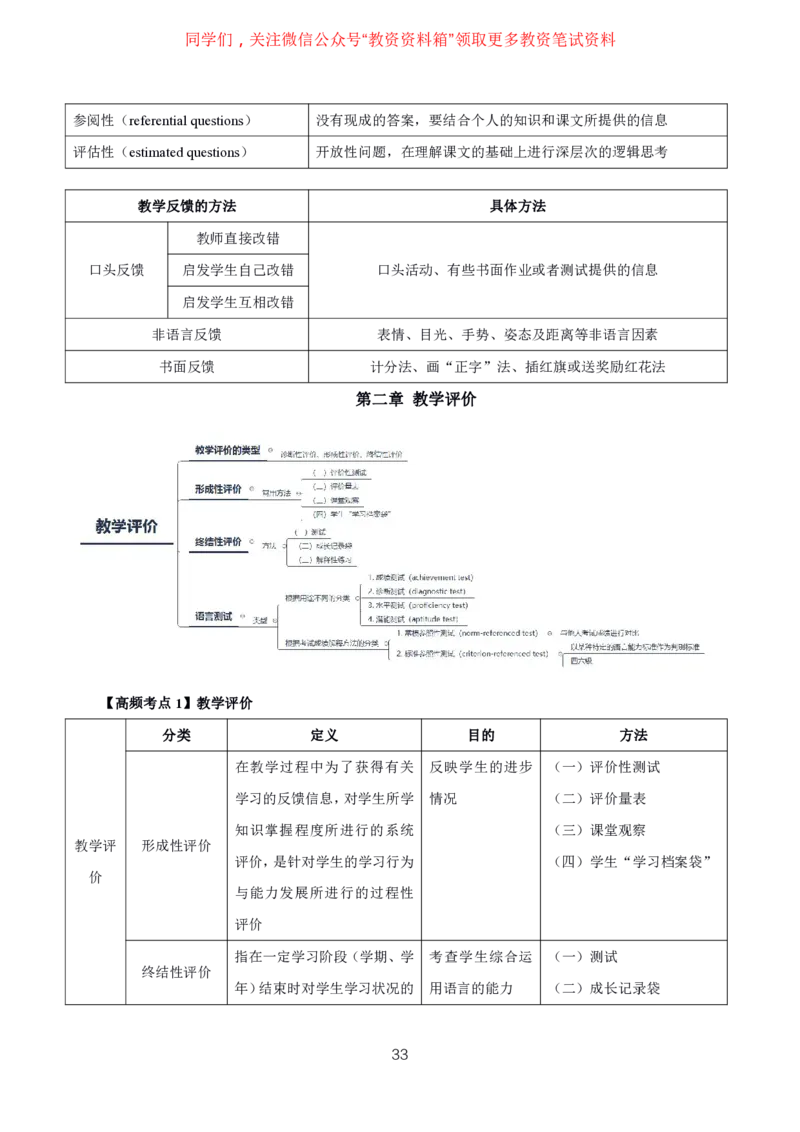
第二章 教学评价
【高频考点1】教学评价
分类 定义 目的 方法
在教学过程中为了获得有关 反映学生的进步 (一)评价性测试
学习的反馈信息,对学生所学 情况 (二)评价量表
知识掌握程度所进行的系统 (三)课堂观察
教学评 形成性评价
评价,是针对学生的学习行为 (四)学生“学习档案袋”
价
与能力发展所进行的过程性
评价
指在一定学习阶段(学期、学 考查学生综合运 (一)测试
终结性评价
年)结束时对学生学习状况的 用语言的能力 (二)成长记录袋
33同学们,关注微信公众号“教资资料箱”领取更多教资笔试资料
全面评价 (三)解释性练习
【高频考点2】语言测试
分类标准 分类
成绩测试(achievementtest)
诊断测试(diagnostictest)
用途不同
语言测试 水平测试(proficiencytest)
潜能测试(aptitudetest)
常模参照性测试(norm-referencedtest)
考试成绩解释方法
标准参照性测试(criterion-referencedtest)
【题目演练】
1. Which of the following is most effective for a teacher when students do not understand how to do an
activitythathe/shehasdescribed?
A.Demonstratinghowtodoit.
B.Askingstudentstotalkfreely.
C.Encouragingstudentstosharetheirideas.
D.Walkingaroundtheclassroomandansweringquestions.
2. What role does he/she play when a teacher explains the purpose of a task, the steps to do it and its time
limit?
A.Anorganizer. B.Anobserver.
C.Anevaluator. D.Aprompter.
3.Whichofthefollowingisadisplayquestion?
A.Whatpartofspeechis“immense”?
B.Howwouldyoucommentonthisreport?
C.WhydoyouthinkHemingwayisagoodwriter?
D.Whatdoyouthinkofthecharactersinthisnovel?
4.______assessmentisusedtomeasurehowtheperformanceofaparticularstudentorgroupofstudentswith
thatofanother.
A.Criterion-referenced B.Norm-referenced
C.Formative D.Summative
34同学们,关注微信公众号“教资资料箱”领取更多教资笔试资料
5.Davidtookatestandhisscorewasatthetop10percentinhisclass.Thisisaninterpretationoftheresultof
a______test.
A.diagnostic B.formative
C.norm-referenced D.criterion-referenced
6. 课堂提问是一种了解学生学习效果的方法,请说明课文理解性提问有几种类型,并简述自己的理解。
【参考答案及解析】
1.【答案】A
【解析】考查英语教学实施与评价。句意:当学生不明白如何进行所描述的活动时,老师采取下列哪
项措施最有效?A项意为“示范如何做”;B项意为“叫学生自由交谈”;C项意为“鼓励学生分享想法”;
D项意为“在教室走动并回答问题”。根据题干可知,B项、C项和D项均不合适,当学生不明白如何进行
接下来的活动时,教师应该示范。故选A。
2.【答案】A
【解析】考查教师角色。题干中教师向学生说明任务目的、步骤和时间限制,说明教师在组织课堂活
动,应为组织者。故选A。
3.【答案】A
【解析】考查课堂问题的类型。课堂问题主要分为展示型问题(display questions)和参考型问题
(referentialquestions)两种。展示性问题是指教师已经知道答案或者答案能在相关工具书中找到的问题,提
问只是为了考查学生对语言知识的掌握情况。参考性问题是指没有预设的答案的问题,提问的目的是使学
生发散思维,进而寻求信息。A项“‘immense’是什么词性?”属于展示性问题;B、C、D三项都是参考性
问题。故选A。
4.【答案】B
【解析】考查语言测试。常模参照性测试是指通过与他人考试成绩进行对比,从而对考试成绩进行评
价的测试方式。这种测试形式在选拔学生的时候是比较常用的。标准参照性测试指的是以某种特定的语言
能力标准作为判别标准的测试,而不是与其他考生相比较。从题干来看,是把一个或一群学生与另一个或
一群学生相比较。故选B。
5.【答案】C
【解析】考查英语教学实施与评价。句意:大卫参加了一次考试,他的分数在班上前10%。这是对______
35同学们,关注微信公众号“教资资料箱”领取更多教资笔试资料
测试结果的解释。A项意为“诊断性”,指的是在课程进展一段时间之后,用以检验学生到目前为止的学习
情况的一种测试方式。目的是发现教与学的问题以及学生知识与技能掌握的不足之处,以便因人而异,对
症下药,调整教学计划,改进教学,和题干中的结果描述不相干;B项意为“形成性”,考试是终结性评价
中的一种形式;C项意为“常模参照性”,是指通过与他人考试成绩进行对比,从而对考试成绩进行评价的
测试方式;D项意为“标准参照性测试”,指的是以某种特定的语言能力标准作为判别标准的测试,而不是
与其他考生相比较。题干中大卫的成绩在班级前10%,需要和其他同学的成绩做对比,C项符合。故选C。
6.【参考答案】
课文理解性提问有三种类型:展示性(displayquestions)、参阅性(referentialquestions)和评估性(estimated
questions)。展示性提问是教师根据具体教学内容进行的提问。这类问题只要求学生对课文进行事实性的表
层理解,并根据短时记忆或者查看课文找到答案。参阅性提问是根据课文相关信息提问。这类问题没有现
成的答案,学生要结合个人的知识和课文所提供的信息进行综合分析。评估性提问要求学生在理解课文的
基础上进行深层次的逻辑思维,运用所学语言知识就课文的某个事件或观点发表自己的看法。
36