PartⅠ Listening Comprehension (30 marks)
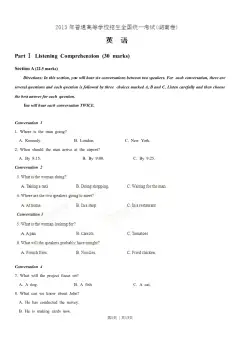
Section A (22.5 marks)
Directions: In this section, you will hear six conversations between two speakers. For each conversation, there are
several questions and each question is followed by three choices marked A, B and C. Listen carefully and then choose
the best answer for each question.
You will hear each conversation TWICE.
Conversation 1
1. Where is the man going?
A. Kennedy. B. London. C. New York.
2. When should the man arrive at the airport?
A. By 8:15. B. By 9:00. C. By 9:25.
Conversation 2
Conversation 4
7. What will the project focus on?
A. A dog. B. A fish. C. A cat.
8. What can we know about John?
A. He has conducted the survey.
B. He is making cards now.
第1页 | 共13页C. He will do the introduction.
9. Who can handle the summarizing?
A. Carol. B. Tom. C. Mary.
Conversation 5
Section B (7.5 marks)
Directions: In this section, you will hear a short passage. Listen carefully and then fill in the numbered blanks
with the information you have heard. Fill in each blank with NO MORE THAN THREE WORDS.
You will hear the short passage TWICE.
第2页 | 共13页Part II Language Knowledge (45 marks)
Section A (15 marks)
Directions: For each of the following unfinished sentences there are four choices marked A, B, C and D.
Choose the one that best completes the sentence.
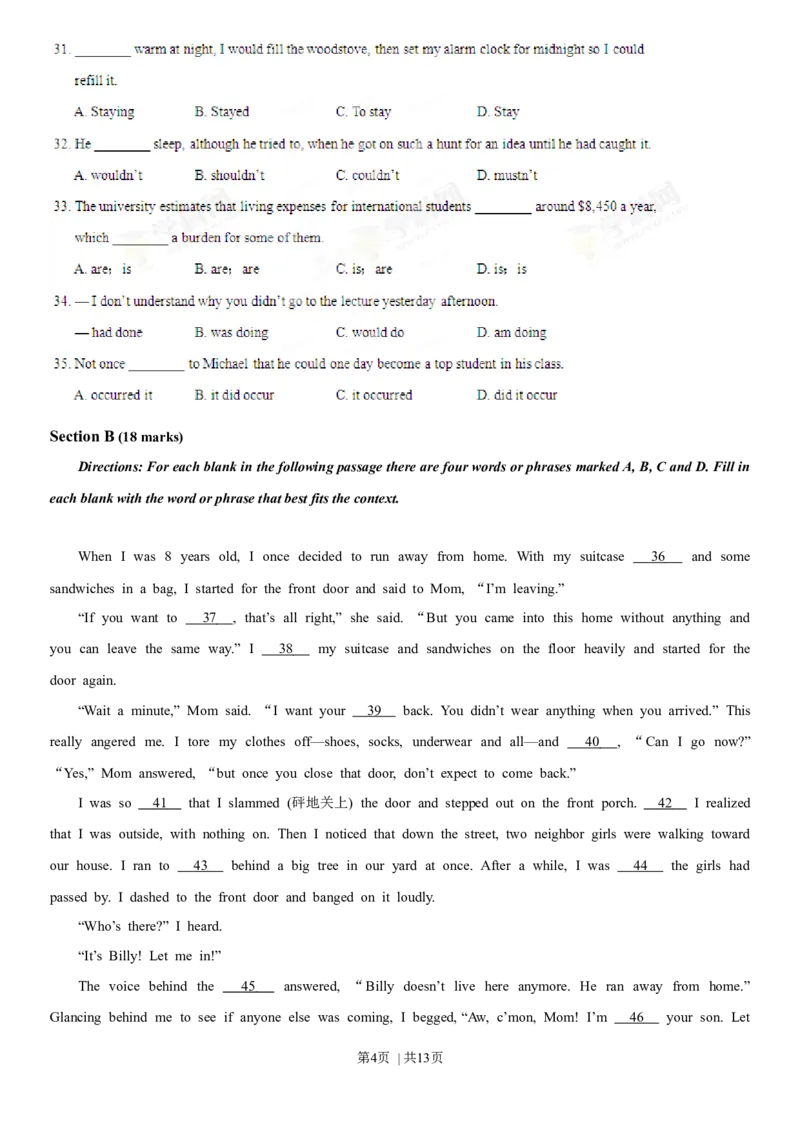
26. If nothing ________, the oceans will turn into fish deserts.
A. does B. had been done C. will do D. is done
27. — Have you heard about the recent election?
— Sure, it ________ the only thing on the news for the last three days.
A. would be B. is C. has been D. will be
28. Do not let any failures discourage you, for you can never tell ________ close you may be to victory.
A. how B. that C. which D. where
29. You cannot accept an opinion ________ to you unless it is based on facts.
A. offering B. to offer C. having offered D. offered
30. Every day ________ a proverb aloud several times until you have it memorized.
A. read B. reading C. to read D. reads
第3页 | 共13页Section B (18 marks)
Directions: For each blank in the following passage there are four words or phrases marked A, B, C and D. Fill in
each blank with the word or phrase that best fits the context.
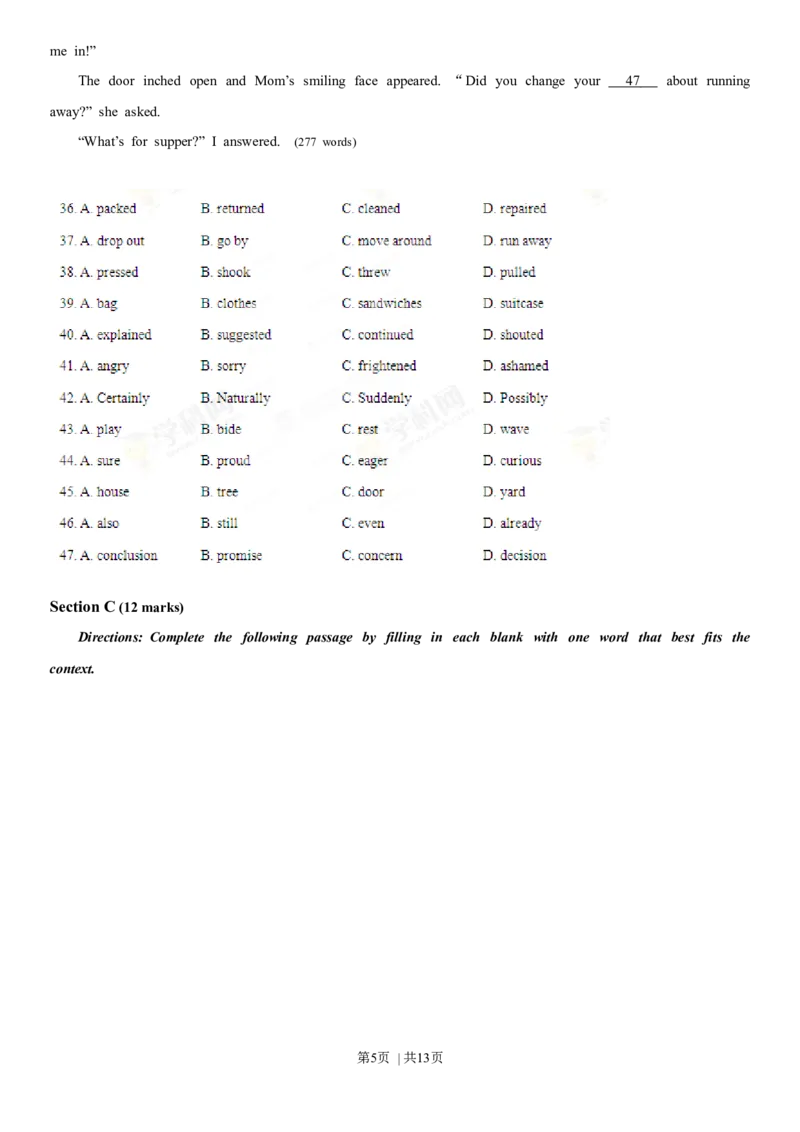
When I was 8 years old, I once decided to run away from home. With my suitcase 36 and some
sandwiches in a bag, I started for the front door and said to Mom, “I’m leaving.”
“If you want to 37 , that’s all right,” she said. “But you came into this home without anything and
you can leave the same way.” I 38 my suitcase and sandwiches on the floor heavily and started for the
door again.
“Wait a minute,” Mom said. “I want your 39 back. You didn’t wear anything when you arrived.” This
really angered me. I tore my clothes off—shoes, socks, underwear and all—and 40 , “Can I go now?”
“Yes,” Mom answered, “but once you close that door, don’t expect to come back.”
I was so 4 1 that I slammed (砰地关上) the door and stepped out on the front porch. 4 2 I realized
that I was outside, with nothing on. Then I noticed that down the street, two neighbor girls were walking toward
our house. I ran to 43 behind a big tree in our yard at once. After a while, I was 44 the girls had
passed by. I dashed to the front door and banged on it loudly.
“Who’s there?” I heard.
“It’s Billy! Let me in!”
The voice behind the 45 answered, “Billy doesn’t live here anymore. He ran away from home.”
Glancing behind me to see if anyone else was coming, I begged, “Aw, c’mon, Mom! I’m 46 your son. Let
第4页 | 共13页me in!”
The door inched open and Mom’s smiling face appeared. “Did you change your 47 about running
away?” she asked.
“What’s for supper?” I answered. (277 words)
Section C (12 marks)
Directions: Complete the following passage by filling in each blank with one word that best fits the
context.
第5页 | 共13页Part III Reading Comprehension (30 marks)
Directions: Read the following three passages. Each passage is followed by several questions or unfinished
statements. For each of them there are four choices marked A, B, C and D. Choose the one that fits best according to
the information given in the passage.
A
Planning a visit to the UK? Here we help with ways to cut your costs.
AVOID BIG EVENTS Big sporting events, concerts and exhibitions can increase the cost of
accommodation and make it harder to find a room. A standard double room at the Thistle Brighton on the final
Friday of the Brighton Comedy Festival (19 Oct.) cost £169.15 at Booking.com. A week later, the same room
cost £118.15.
If you can be flexible and want to know dates to avoid—or you’re looking for a big event to pass your
time—check out sites such as Whatsonwhen.com, which allow you to search for events in the UK by city, date
and category.
STAYAWAY FROM THE STATION If traveling to your destination by train, you may want to find a good
base close to the station, but you could end up paying more for the sake of convenience at the start of your
holiday.
Don’t be too choosy about the part of town you stay in. Booking two months in advance, the cheapest
room at Travelodge’s Central Euston hotel in London for Saturday 22 September was £95.95. A room just a tube
journey away at its Covent Garden hotel was £75.75. And at Farringdon, a double room cost just £ 62.95.
LOOK AFTER YOURSELF Really central hotels in cities such as London, Edinburgh and Cardiff can cost
第6页 | 共13页a fortune, especially at weekends and during big events. As an alternative consider checking into a self-catering
flat with its own kitchen. Often these flats are hidden away on the top floors of city centre buildings. A great
example is the historic O’Neill Flat on Edinburgh’s Royal Mile, available for £420 for five days in late
September, with room for four adults.
GET ON A BIKE London’s ‘Boris bikes’ have attracted the most attention, but other cities also have
similar programmes that let you rent a bicycle and explore at your own pace, saving you on public transport or
car parking costs.
Among the smaller cities with their own programmes are Newcastle (casual members pay around £1.50 for
two hours) and Cardiff (free for up to 30 minutes, or £5 per day). (358 words)
60. The main purpose of the passage is __________.
A. to tell visitors how to book in advance
B. to supply visitors with hotel information
C. to show visitors the importance of self-help
D. to offer visitors some money-saving tips
B
In my living room, there is a plaque (匾) that advises me to “Bloom (开花) where you are planted.” It
reminds me of Dorothy. I got to know Dorothy in the early 1980s, when I was teaching Early Childhood
Development through a program with Union College in Barbourville, Kentucky. The job responsibilities required
occasional visits to the classroom of each teacher in the program. Dorothy stands out in my memory as one who
第7页 | 共13页“bloomed” in her remote area.
61. “Early Childhood Development” in Paragraph 1 refers to __________.
A. a program directed by Dorothy B. a course given by the author
C. an activity held by the students D. an organization sponsored by Union college
62. In the journey, the author was most disappointed at seeing __________.
A. the long track B. the poor houses
C. the same train D. the winding road
63. Upon arriving at the classroom, the author was cheered up by __________.
A. a warm welcome B. the sight of poke greens
C. Dorothy’s latest projects D. a big dinner made for her
64. What can we know about Dorothy from the last paragraph?
A. She was invited to a celebration at a restaurant.
B. She got a pen as a gift from the author.
C. She passed the required assessment.
D. She received her Ph. D. degree.
65. What does the author mainly intend to tell us?
A. Whatever you do, you must do it carefully.
第8页 | 共13页B. Whoever you are, you deserve equal treatment.
C. However poor you are, you have the right to education,
D. Wherever you are, you can accomplish your achievement.
C
Since then, the collection keeps replenishing (补充) itself, thanks to ongoing donations from borrowers. The
library now gets an average of five visits a day.
The project’s best payoff, says Peter, are the thank-you notes left behind. “We had no idea in the
beginning that it would be so popular.” (317 words)
第9页 | 共13页Part IV Writing (45 marks)
Section A (10 marks)
Directions: Read the following passage. Fill in the numbered blanks by using the information from the passage.
Write NO MORE THAN THREE WORDS for each answer.
While there is no widely accepted definition of MOOCs, their key features are open access:they are
currently free to participants, no entry qualifications are required, they support an unlimited number of
participants and as yet, very few include any form of accreditation (认证).
Currently offered by some famous universities, MOOCs are attractive to people who do not have the
financial resources to meet the growing costs of university education, or who do not have formal qualifications.
They also allow participants to study at their own pace.
The potential for MOOCs to deliver education is obviously vast—they could be considered as a huge step
forwards in widening participation. They also have the potential to provide a unique window on universities that
offer popular and valuable courses, they may attract some participants to register for formal fee-paying
第10页 | 共13页programmes at the same or other universities and are likely to promote new ways of on-line education.
However, it is still very early days for MOOCs. The quality of the education provision is highly variable,
with many courses offering only recordings of lectures, and delivery is particularly difficult in some special fields
that require practical classes, research projects or extensive library access. Besides, wider engagement with
participants requires very considerable resource. Even limited feedback or examination becomes a major task if
there are several thousand students in the class.
Considering the challenges, some people argue MOOCs will soon evaporate (蒸发). But they certainly
provide good opportunity for widening higher education, are a means of raising awareness of universities to
audiences of tens or hundreds of thousands, and are well worthy of serious consideration. (271 words)
Section B (10 marks)
Directions: Read the following passage. Answer the questions according to the information given in the passage.
“Let’s Talk”:The Free Advice Project
第11页 | 共13页A few weeks ago, I took a walk around Washington Square Park. I met all the usual people:street
performers, the Pigeon Guy, a group of guitarists singing in harmony. But off to the side, sitting on a bench was
a woman doing something vastly different—giving free advice.
A week or two later, I set up an interview with her and we discussed her project at length.
Lisa Podell, 32, started the Free Advice Project this past May. It began as an experiment;she sat in
Washington Square Park for a day with a sign that read “Free Advice” as a simple way to reach out to people.
Podell was astonished at the strong response.
81. In what way was Podell different from other people in the park? (No more than 6 words) (2 marks)
___________________________________________________________________________________
82. What do people in need expect Podell to do? (No more than 10 words) (3 marks)
___________________________________________________________________________________
83. According to Podell, what should people do when making decisions?
(No more than 6 words) (2 marks)
___________________________________________________________________________________
84. How would Podell promote her project in New York? (No more than 15 words) (3 marks)
___________________________________________________________________________________
Section C (25 marks)
Directions: Write an English composition according to the instructions given below.
第12页 | 共13页请以下列词语为关键词写一篇英语短文。
第13页 | 共13页