六级通关模拟卷(第四套)
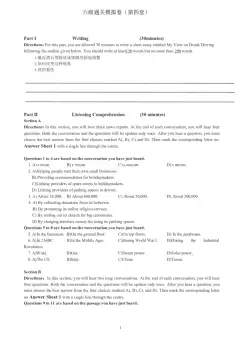
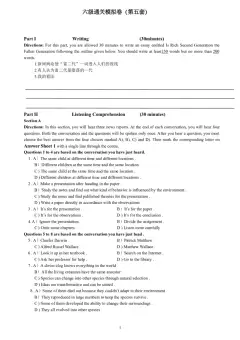
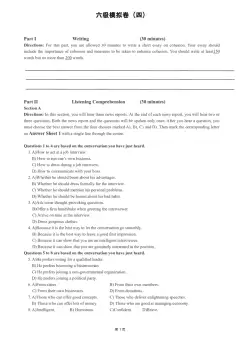
Part I Writing (30minutes)
Directions: For this part, you are allowed 30 minutes to write a short essay entitled My View on Drunk Driving
following the outline given below. You should write at least150 words but no more than 200 words.
1.最近酒后驾驶造成惨剧的报道频繁
2.如何改变这种现象
3.我的看法
PartII ListeningComprehension (30minutes)
SectionA
Directions: In this section, you will hear three news reports.At the end of each conversation, you will hear four
questions. Both the conversation and the questions will be spoken only once.After you hear a question, you must
choose the best answer from the four choices marked A), B), C) and D). Then mark the corresponding letter on
AnswerSheet 1withasinglelinethroughthecentre.
Questions1to4arebasedontheconversationyouhavejustheard.
1.A)£80,000. B)£100,000. C)£4000,000. D)£800,000.
2.A)Helpingpeoplestarttheirownsmallbusinesses.
B)Providingaccommodationforholidaymakers.
C)Linkingprovidersofspareroomstoholidaymakers.
D)Linkingprovidersofparkingspacestodrivers.
3.A)About34,000. B)About800,000. C)About20,000. D)About200,000.
4.A)Bycollectingdonationsfromitsbelievers.
B)Bypromotingitsonlinereligionservices.
C)Byrentingoutitschurchforbigceremonies.
D)Bychargingtravelersmoneyforusingitsparkingspaces.
Questions5to8arebasedontheconversationyouhavejustheard.
5.A)Inthebasement. B)Onthegroundfloor. C)Ontopfloors. D)Inthepenthouse.
6.A)In236BC. B)IntheMiddleAges. C)DuringWorldWarI. D)During the Industrial
Revolution.
7.A)Wind. B)Gas. C)Steampower. D)Solarpower.
8.A)TheUS. B)Italy. C)China. D)Tussia.
SectionB
Directions:In this section, you will hear two long conversations.At the end of each conversation, you will hear
four questions. Both the conversation and the questions will be spoken only once.After you hear a question, you
must choosethe bestanswer fromthe four choices markedA), B), C), andD).Then mark thecorresponding letter
onAnswerSheet 1withasinglelinethroughthecentre.
Questions9to11arebasedonthepassageyouhavejustheard.
19.A)Howtosafeguardthecomputernetwork.
B)Howtostealtopsecretfilesfromamilitarybase.
C)Howtomakemoderndevicesbroadcastinvisible,inaudiblesignals.
D)HowtouseanFMradiotodetecttheinvisible,inaudiblesignals.
10.A)Becauseitcosts$77billiontodevelopfurther.
B)Becauseitevenputsdatainofflinedevicesindanger.
C)Becauseitaimsatnuclearfacilitiesandmilitarybases.
D)Becauseitrevealedtoreportersandthepublic.
11.A)BygettingallthedevicesofftheInternet.
B)Bystoppingusingalltheadvancedlaserprinters.
C)Byinstallinghigh-techanti-hackingsoftwares.
D)ByusinganAMradiotodetectthesignals.
PassageTwo
Questions12to15arebasedonthepassageyouhavejustheard.
12.A)ToshortenthegapbetweentheruralcommunityandtheSiliconValley.
B)Toprovidesomepropertrainingforstudentsinaruralcommunity.
C)TorecruitcompetentemployeesfromcommunitiesaroundtheSiliconValley.
D)Toofferinternshippositionsforoutstandingstudentsfromruralcommunities.
13.A)10hours. B)1week. C)1month. D)10months.
14.A)Studentsstudyinginathree-yearcollege.
B)Studentswhosefathersarefarmers.
C)Studentsmajoringinagriculture.
D)Studentswhohaveademonstratedabilityinmathorscience.
15.A)Fromhisfather. B)FromAT&T. C)Fromhisuniversity. D)FromaCNNreport.
SectionC
Directions: In this section, you will hear three recordings of lectures or talks followed by three or four questions.
Therecordingswillbeplayedonlyonce.Afteryouhearaquestion,youmustchoosethebestanswerfromthefour
choices marked A), B), C), D). Then mark the corresponding letter on Answer Sheet 1 with a single line
throughthecentre.
Questions16to19arebasedontherecordingyouhavejustheard.
16.A)Itisthemajoringredientforhumanevolution.
B)Itisamediumthatbindsallhumanbeings.
C)Itisthemostpopularmeansforcommunication.
D)Itisonlyusedforthepurposeofenrichingknowledge.
17.A)Bychangingthespeedofspeaking. B)Byusingdifferentdialects.
C)Bychangingthetoneatthepropertime. D)Bymakingfaces.
18.A)Itwillmakeyourspeechconcise. C)Itwillmaketherecitationofthespeecheasy.
B)Itwillsaveyourtime. D)Itwillavoidgrammaticalmistakes.
19.A)Makeajokeaboutitandmoveon. B)Explainwhyandhowithappens.
C)Keepcalm,apologizeandcontinue. D)Pretendnottonoticeitandgoon.
Questions20to22arebasedontherecordingyouhavejustheard.
20.A)Itwillcontinuetodeclinegradually. C)Itwillbegintomoveuptowardtwopercent.
B)Itwillexpandatasomewhatfasterpace. D)Itwillintensifyproblemsindevelopingcountries.
21.A)$85billion. B)$45billion. C)$40billion. D)$50billion.
222.A)Thejobgrowthwasconsideredveryslow. B)Thejobsarenotpushinguphourlywages.
C)Thejobgainswereworsethanexpected. D)Theincomegainsweresatisfying.
Questions23to25arebasedontherecordingyouhavejustheard.
23.A)Changingtheobstaclesintoopportunities. B)Findinghopethroughparents.
C)Spottingeveryopportunity. D)Overcomingallthedifficulties.
24.A)Itismoreimportantthanmoney. C)Peopleuseittogetthroughdifficulties.
B)Peoplewerebornwithit. D)Itcanhealthesoul.
25.A)Hegetsamiracle. C)Hewasbornwithhope.
B)Heisasuperhero. D)Hetriestomakehislifeamiracleforothers.
PartⅢ Reading Comprehension (40minutes )
SectionA
Directions: In this section, there is a passage with ten blanks.You are required to select one word for each blank
from a list of choices given in a word bank following the passage. Read the passage through carefully before
making your choices. Each choice in the bank is identified by a letter. Please mark the corresponding letter for
each item on Answer Sheet 2 with a single line through the centre. You may not use any of the words in the
bankmorethanonce.
Questions26to35arebasedonthefollowingpassage.
Uber has hired a former NASA engineer to head its aviation department in an effort to push forward its
ambitionstobuildaflyingcar.
Mark Moore—who has 30 years of experience at NASA—will join the ride-hailing service as director of
engineeringforaviationatUberElevate.
Uber’s__26__vision of autonomous drone-filled skies was detailed in a 99-page white paper, published last
yearbyJeffHolden,Uber’schiefproductofficer.
The “Elevate” network proposes to make use of vertical takeoff and landing(VTOL) vehicles, which are
comparabletohelicoptersinthewaytheymaneuverbutareless__27__,noisyandinefficient.
“Recently,technologyadvanceshavemadeit__28_tobuildthisnewclassofVTOLaircraft,”Holden’spaper
states. “Over a dozen companies, with as manydifferentdesign approaches,are__29__working tomake VTOLs a
reality.
Among the biggest__30__cirrently preventing VTOLs from coming to market are regulation, battery
technology,reliabilityandsafety.
With Moore onboard, Uber will hope to overcome these obstacles and__31__the world’s first fleet of
on-demandflyingcars.
Moore’sLinkedIn profiledescribesthepotentialofsuchtechnologyas havingtheability to“__32__achange
inaviationthatwithinthenext20yearscouldbebreathtakingintermsofimpactandmarketcap.”
Thisideawas__33__uponfurtherbyMooreinaresearchpaperhepublishedduringhistimeatNASA.
In it, he describes how: “A zero emission, highly__34__,highly reliable, ultra low noise VTOL capability
wouldbeagame changercomparedwithexistingcloseproximity(接近)flightcapabilities,forbothunmannedand
manned__35__.”
A)adjust I)extensive
B)applications J)facilitate
C)arduously K)futuristic
D)barriers L)limitations
E)efficient M)passionately
F)established N)pioneer
G)expanded O)practical
H)expensive
3SectionB
Directions: In this section, you are going to read a passage with ten statements attached to it. Each statement
containsinformationgiveninoneoftheparagraphs.Identifytheparagraphfromwhichtheinformationisderived.
You may choose a paragraph more than once. Each paragraph is marked with a letter. Answer the questions by
markingthecorrespondingletteronAnswerSheet2.
BossesSay“Yes”toHomeWork
[A]Rising costs of office space, time lost to stressful commuting, and a slow recognition that workers have
livesbeyondthe office—allarestrongarguments for lettingstaffworkfrom home. For thesmallbusinesses,there
are additional benefits too—staff are more productive, and happier, enabling firms to keep their headcounts(员工
数)and their recruitment costs to a minimum. It can also provide competitive advantage, especially when small
businesseswanttoattractnewstaffbutdon’thavethebudgettoofferhugesalaries.
[B]While company managers have known about the benefits for a long time, many have done little about it,
skeptical of whether they could trust their employees to work to full capacity without supervision, or concerned
abouttheadditionalexpensesteleworking policies might incur as staffstart charging their home phone bills to the
business.
[C]Yetthisisnowchanging.WhencommunicationsproviderInter-Telresearchedtheuseofremoteworking
solutions among small-and medium-sized U.K. businesses in April this year, it found that 28% more companies
claimedtohaveintroducedflexibleworkingpracticesthanayearago.
[D]The U.K. network of Business Links confirms that it too has seen a growing interest in remote working
solutions from small businesses seeking its advice, and claims that as many as 60%-70% of the businesses that
comethroughitsdoorsnowoffersomeformofremoteworkingsupporttotheirworkforces.
[E]Technology advances, including the widespread availability of broadband, are making the introduction of
remoteworkingapieceofcake.“Ifsystemsaresetupproperly,staffcanhaveaccesstoalltheresourcestheyhave
intheofficewherevertheyhaveaninternetconnection,” saysAndyPoulton,e-businessadvisoratBusinessLink
forBerkshireandWiltshire.“Therearesomeveryexcitingdevelopmentswhichhaveenabledthis.
[F]One is the availability of broadband everywhere, which now covers almost all of the country(BT claims
that, by July,99.8% of its exchanges will be broadband enabled, with alternative plans in place for even the most
remote exchanges). “This is the enabler,” Poulton says. Yet while broadband has come down in price too, those
service providers targeting the business market wan against consumer services masquerading( 伪 装 )as
business-friendlybroadband.
[G]”Broadband is available for as little as £15 a month, but many businesses fail to appreciate the hidden
costs of such a service,” says Neil Stephenson, sales and marketing director at Onyx Internet, an internet service
provider based in the north-east of England. “Providers offering broadband for rock-bottom prices are notorious
for poor service, with regular breakdowns and heavily congested(拥堵的)networks. It is always advisable for
businesses to look beyond the price tag and look for a business-only provider that can offer more reliability, with
good support.” Such services don’t cost too much—quality services can be found for upwards of £30 a month.
Thebenefits ofbroadband to the occasionalhome worker are thatthey canaccess email in realtime, and take full
advantageofservicessuchasinternet-basedbackuporeveninternet-basedphoneservices.
[H]Internet-based telecoms, or VoIP(Voice over IP)to give it its technical title, is an interesting tool to any
business supporting remote working. Not necessarily because of the promise of free or reduced price phone
calls(which experts point out is misleading for the average business), but because of the sophisticated voice
services that can be exploited by the remote worker—facilities such as voicemail and call forwarding, which
provideacontinuityofthecompanyimageforcustomersandbusinesspartners.
[I] By law, companies must “consider seriously” requests to work flexibly made by a parent with a child
undertheageofsix,oradisabledchildunder18.Itwastheneedtoaccommodateemployeeswithyoungchildren
that motivated accountancy firm Wright Vigar to begin promoting teleworking recently. The company, which
needed to upgrade its IT infrastructure(基础设施)to provide connectivity with a new, second office, decided to
4introducesupportforremoteworkingatthesametime.
[J]Marketing director Jack O’Hern explains that the company has a relatively young workforce, many of
whomareparents:“Oneofthetriggerswaswhenoneofourtaxmanagersreturnedfrommaternity leave.Shewas
intending to work part time, but could manage one day a week in the office due to childcare. By offering her the
ability to work from home, we have doubled her capacity—now sheworks a daya week from home, anda day in
theoffice.Thisisgreatforher,andforusasweretainsomeonehighlyqualified.”
[K]For Wright Vigar, which has now equipped all of its fee-earners to be able to work at maximum
productivity when away from the offices(whether that’s from home, or while on the road), this strategy is not just
about saving on commute time or cutting them loose from the office, but enabling them to work more flexible
hoursthatfitaroundtheirhomelife.
[L]O’Hernsays:“Althoughmostofourworkisclient-basedandmustfitaroundthis,wecan’tseeanyreason
why a parent can’t be on hand to deal with something important at home, if they have the ability to complete a
projectlaterintheday.”
[M]Supporting this new way of working came with a price, though. Although the firm was updating its
systems anyway, the company spent 10%-15% more per user to equip them with a laptop rather than a PC, and
about the same to upgrade to a server that would enable remote staff to connect to the company networks and
accessalltheirusualresources.
[N]AlthoughWrightVigar hasn’t yet quantified the business benefits, it claims that, in addition to being able
to retain key staff with young families, it is able to save fee-earners a substantial amount of “dead” time in their
workingdays.Thatstaffcandothis withoutneedingafixedtelephonelineprovidesevenmoreefficiencysavings.
“With Wi-Fi(fast, wireless internet connections)popping up all over the place, even on trains, our fee-earners can
be productive as they travel, and between meetings, instead of having to kill time at the shops,” he adds. The
company will also be able to avoid the expense of having to relocate staff to temporary offices for several weeks
whenitbeginsdisruptiveofficerenovationssoon.
[O]Financial recruitment specialist Lynne Hargreaves knows exactly how much her firm has saved by
adopting a teleworking strategy, which has involved handing her company’s data management over to a remote
hosting company, Datanet, so it can be accessible by all the company’s consultants over broadband internet
connections. It has enabled the company to dispense with its business premises altogether, following the
realization that it just didn’t need them any more. “The main motivation behind adopting home working was to
increase my own productivity, as a single mum to an 11-year-old,” says Hargreaves. “But I soon realized that, as
most of our business is done on the phone, email and at off-site meetings, we didn’t need our offices at all. We’re
now saving £ 16,000 a year on rent, plus the cost of utilities, not to mention what would have been spent on
commuting.”
36. Internet-based telecoms facilities remote working by offering sophisticated voice services like voicemail
andforwarding.
37.According to marketing director Jack O’Hern, teleworking enabled the company to keep highly qualified
staff.
38.Wright Vigar claims that with an access to fast and wireless internet connections, its employees can still be
productivewhiletravelingandbeforemeetings.
39.According toAndy Poulton, remote working practices have become possible owing to technology advances
liketheeasieraccesstobroadband.
40. Neil Stephenson suggests that those firms contracting internet services choose more reliable business-only
providerswithgoodsupport.
41.SinglemotherLynneHargreavesdecidedtoworkathomemainlytoimproveherownproductivity.
42.Thepracticeof teleworkingmayhelpsmallbusinessestocutdowntheir recruitmentcostsandimprove their
competitiveness.
543.WrightVigar’spracticeofallowingformoreflexibleworkinghoursnotonlybenefitsthecompanybuthelps
improveemployees’homelife.
44.The accountancy form Wright Vigar promoted teleworking initially in order to support its employees with
childrentotakecareof.
45.From the research conducted by the communications provider Inter-Tel, we learn that more businesses have
introducedflexibleworkingpractices.
SectionC
Directions: There are 2 passages in this section. Each passage is followed by some questions or unfinished
statements. For each of them there are four choices marked A), B), C) and D). You should decide on the best
choiceandmarkthecorrespondingletteronAnswerSheet 2withasinglelinethroughthecentre.
PassageOne
Questions46and50arebasedonthefollowingpassage.
For much of the past decade,American and British scientists have been annoyed by the phenomenon known
as the French Paradox. Nutritionally speaking, the French have been getting away with murder: They eat all the
butter, cream, foie gras, pastry and cheese that their hearts desire, and yet their rates of obesity and heart disease
are much lower than ours. The French eat three times as much saturated animal fat as Americans do, and only a
thirdasmanydieofheartattacks.It’smaddening.
Baffled,scientistsstruggledtocomeupwithafewhypotheses:Maybeitwassomethingintheredwine,they
said. But while winemakers worldwide celebrated that news, more sober research has suggested that any
alcohol—whether Lafite Rothschild, a banana daiquiri or a cold Bud—pretty much has the same nice, relaxing
effect. So while a little wine is apt do you good, the French aren’t so special in having a drink now and then
though the factthat they wine moderately andslowly with meals, instead ofdowning shots atthe bar,couldmake
adifference.
After the wine argument, scientists ventured that it must be the olive oil that keeps the French healthy. But
this doesn’t explain the butter or brie. Then, French scientist Serge Renaud(made famous on “60 Minutes” as an
expert on the French Paradox) said it’s the foie gras that melts away cholesterol.This, too, is dicey: While people
in Toulouse—the fattened force-fed duck-liver-eating area of France—do indeed have one of the lowest rates of
heart disease in the developed world, they actually only eat the delicacy about six times a year.And they’re a lot
morelikelytodieofstrokethanweareanyway.
Other researchers, perhaps sponsored by the garlic and onion industry, suggested that the French Paradox
effect is due to garlic and onions. Claude Fischler, a nutritional sociologist at INSERM, says all these single
hypothesesaremorewishfulthinkingthanscience.
LastMay,researcherswritingintheBritishMedicalJournalcameupwiththeleastcheerfulhypothesisofall.
Theyargued thatit’s just a matter oftime beforethe French—whoare in fact eatingmore hamburgers andFrench
friesthesedays—catchupwithAmericans,andbeginsufferingthesamehighratesofcardiovasculardisease.
These researchers, Malcolm Law and Nicholas Wald, call this the “time lag explanation” for the French
Paradox.As far as they are concerned, the McDonaldization(this is a French catch—all terms for the importation
of fast food and other American cultural horrors)of France will continue at a frantic pace, and it is as inevitable
that Frenchmen will start keeling(翻身)over of heart attacks as it is that French women will eventually wear jean
shortsandmarshmallowtennisshoesonthestreetsofParis.
46.WhatistheFrenchParadoxaccordingtothepassage?
A)TheFrencheatmorenutritiousfoodthanAmericans.
B)FewFrenchdieofheartattackseachyear.
C)TheFrencharemuchlesslikelytosufferfromheartdiseasealthoughtheyeatlotsoffattyfood.
D)TheFrenchareaslikelytodieofheartattacksasAmericansalthoughtheyeatlessfattyfood.
647.Whatcanbelearnedfromthesecondparagraph?
A.TheFrenchdrinkasmuchwineasthepeopleelsewhere.
B)TheFrenchwinehasdifferentrelaxingeffectcomparedwithanyotherwine.
C)Drinkingredwinenowandthenwillbenefitpeoplealot.
D)TheFrenchdrinkwineindifferentwaysfrompeopleofothercountries.
48.Theword“dicey”(Line4,Para.3)probablymeans________.
A)uncertain B)strange C)satisfactory D)interesting
49.Intheauthor’sopinion,theFrenchParadoxhassomethingtodowith________.
A)redwine B)oliveoil C)garlicandonion D)somethingunknown
50.Whatcanweinferfromthepassage?
A)TheFrenchParadoxisduetotheinfluenceofAmericanvalues.
B)TheFrenchParadoxwilldisappearintime.
C)TheMcdonaldizationofFrancehaslittleeffectontheFrench’shealth.
D)ThereisnosuchthingasFrenchParadox.
PassageTwo
Questions51to55arebasedonthefollowingpassage.
Many of us are fearful of making changer is our work lives—fear is a natural human condition.We feel less
threatenedwhenwestickwiththefamiliar.Aslongaswearereceivingapaycheck,wetoleratethedissatisfaction.
Bettertojustplayitsafe.
But the safety net we preserve requires a big trade-off. It often denies us the opportunity to experience work
that makes us happy, that is consistent with our desires while still meeting our monetary needs. Yet many of us
strapourselvesintojobsinwhichtheonlyrewardismoney.
We breed cynicism when we treat our work as noting more than a financial equation, a necessity we tolerate
inordertoacquirefundstolive,withthehopeofsomehowachievingsuccessandhappinessalongtheway.That’s
really true most of us want to be happy. We spend 80,000 hours of our lives at work. Yet, we view happiness as
something to be achieved “outside” of work. We hire ourselves out on Monday through Friday and “live” for the
weekends.
Most of us didn’t choose our careers to fulfill a purpose or mission. On the contrary, we just looked for “a
good job with a good company”, reflecting such criteria as pay, title and security. We reasoned that if we could
“getafootinthedoor”andworkhard,ourcareerswouldgrowover time,actually,thatourcareersandworklives
wouldjusthappen“byaccident”.Becauseofthis,manyofushavecareerstodaythatarejust“accidentswaitingto
happen”. Everyday business decisions, a reorganization plan, an acquisition by another company, a relocation out
ofthecountry,canthrowourworklivesintodanger.Butdespitethisuncertainty,someofusstillclingtoourjobs,
dissatisfyingastheymaybe.Can’ttakethatrisk!
“Hanging on “ involves risk too. For when we sacrifice pleasure for pay, our work lacks dignity, uses our
energy and, ultimately, breaks our spirit.An unhappy, unfulfilled work life contributes to an unhappy, unfulfilled
personallife.Happinessinwork,ashappinessinlive,demandsameasureofrisk.
Author Marsha Simetar suggests that if you “do what you love, the money will follow”. Certainly this may
seemabitrisky,perhapsidealistic,butitisundoubtedlytruethatpeoplewholovewhattheydofindwaystomake
themostmoney.
51.Fromthefirstparagraphwecanlearnthat_______.
A)fearisoneofthefundamentaldefectsinhumancharacter
B)peopletendtokeepstableworktoavoidthefearofchanges
C)thepaycheckmakespeoplefeelsafeabouttheirwork
D)peoplefeellessfearfulunderanaturalhumancondition
752.By“thesafetynetwepreserverequiresabigtrade-off”(Line1,Para.2),theauthormeans_______.
A)peopleneedtodobusinesswhenmanagingworkandlife
B)mencanfeelsafewhenreceivingmoney,themajorrewardofjob
C)safetymeanssacrificingthebalancebetweenmonetaryneedsandhappinessofwork
D)safetycanbeachievedbymeetingbothourdesireandmonetaryneeds
53.Wecanlearnfromthetextthat______.
A)peoplestrugglebetweentheidealworkandmonetaryneeds
B)peopledonothaveasenseofmissionnowadaysbutfancyaboutmoney
C)happinessandmoneycanbebothachievedduringworkinmostcases
D)thedevelopmentofourcareerisdoomedtohappen
54.Accordingtothetext,whenthechangesthrowourworklivesintodanger,wewillusually______.
A)expressgreatdissatisfactionatthejob
B)takeanotherworkopportunity
C)feeluncertainabouttherisk
D)remainatthepreviousworkposition
55.Thepurposeoftheauthorinwritingthetextisto_______.
A)persuadepeopletochoosecareerstofulfillapurpose
B)criticizethephenomenonofworkingformoney
C)elaboratepeople’sattitudestowardswork
D)illustratehowtoachievesafetyofworklife
PartⅣ Translation (30 minutes)
Directions:Forthispart,youareallowed30minutestotranslateapassagefromChineseinto
English.YoushouldwriteyouransweronAnswerSheet 2.
赛龙舟(DragonBoatRace)的习俗起源于中国南方。他们选择五月初五进行图腾庆典(totemceremony)。
图腾上最主要的象征是龙,因为中国人认为自己是龙的传人,因此他们还做了龙舟。后来中国人将这一习
俗与端午节联系起来。这是唯一一个源自中国南方的活动,这也许就是为什么今天龙舟比赛并不是在全中
国都盛行的原因。现在,龙舟比赛已经成为一项国际运动。这项运动在美国、加拿大、澳大利亚和新加坡
等地都很流行。
8