姓名: 班级
Unit 10 I like music that I can dance to.
Section B
本课重点 学习一些见面礼仪,生活习俗和对时间的看法
了解西方国家的风土人情和习俗。
掌握be supposed to句型的用法。
本课难点 掌握be supposed to句型的用法。
常考句型 1. It’s polite/impolite to…
2. You’re supposed/not supposed to…
3. You should…
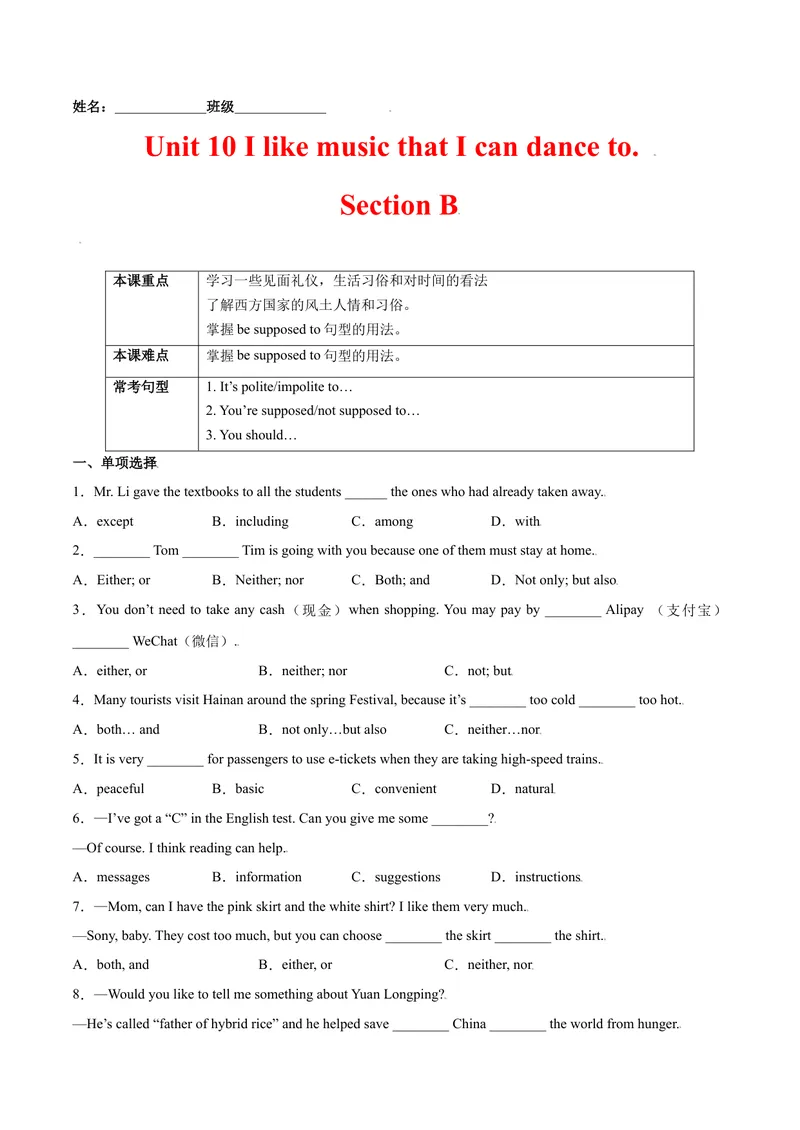
一、单项选择
1.Mr. Li gave the textbooks to all the students ______ the ones who had already taken away.
A.except B.including C.among D.with
2.________ Tom ________ Tim is going with you because one of them must stay at home.
A.Either; or B.Neither; nor C.Both; and D.Not only; but also
3.You don’t need to take any cash(现金)when shopping. You may pay by ________ Alipay (支付宝)
________ WeChat(微信).
A.either, or B.neither; nor C.not; but
4.Many tourists visit Hainan around the spring Festival, because it’s ________ too cold ________ too hot.
A.both… and B.not only…but also C.neither…nor
5.It is very ________ for passengers to use e-tickets when they are taking high-speed trains.
A.peaceful B.basic C.convenient D.natural
6.—I’ve got a “C” in the English test. Can you give me some ________?
—Of course. I think reading can help.
A.messages B.information C.suggestions D.instructions
7.—Mom, can I have the pink skirt and the white shirt? I like them very much.
—Sony, baby. They cost too much, but you can choose ________ the skirt ________ the shirt.
A.both, and B.either, or C.neither, nor
8.—Would you like to tell me something about Yuan Longping?
—He’s called “father of hybrid rice” and he helped save ________ China ________ the world from hunger.A.not only; but also B.either; or C.neither; nor
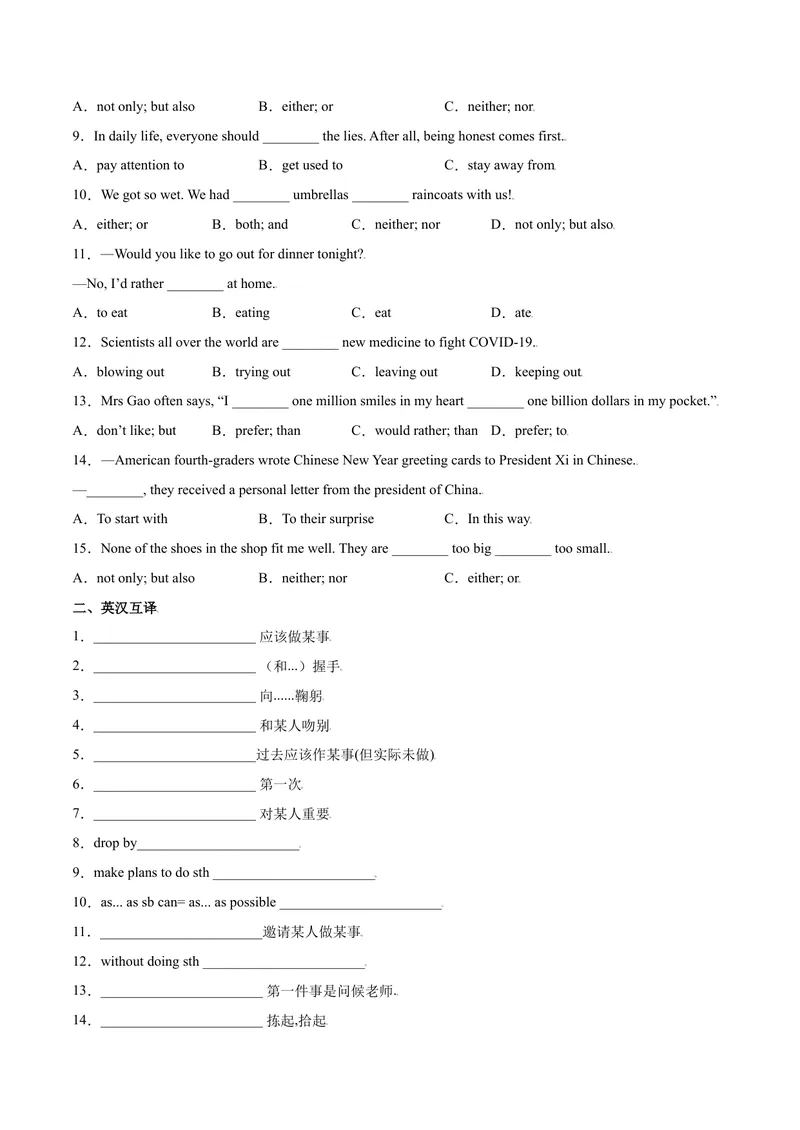
9.In daily life, everyone should ________ the lies. After all, being honest comes first.
A.pay attention to B.get used to C.stay away from
10.We got so wet. We had ________ umbrellas ________ raincoats with us!
A.either; or B.both; and C.neither; nor D.not only; but also
11.—Would you like to go out for dinner tonight?
—No, I’d rather ________ at home.
A.to eat B.eating C.eat D.ate
12.Scientists all over the world are ________ new medicine to fight COVID-19.
A.blowing out B.trying out C.leaving out D.keeping out
13.Mrs Gao often says, “I ________ one million smiles in my heart ________ one billion dollars in my pocket.”
A.don’t like; but B.prefer; than C.would rather; than D.prefer; to
14.—American fourth-graders wrote Chinese New Year greeting cards to President Xi in Chinese.
—________, they received a personal letter from the president of China.
A.To start with B.To their surprise C.In this way
15.None of the shoes in the shop fit me well. They are ________ too big ________ too small.
A.not only; but also B.neither; nor C.either; or
二、英汉互译
1._______________________ 应该做某事
2._______________________ (和...)握手
3._______________________ 向......鞠躬
4._______________________ 和某人吻别
5._______________________过去应该作某事(但实际未做)
6._______________________ 第一次
7._______________________ 对某人重要
8.drop by_______________________
9.make plans to do sth _______________________
10.as... as sb can= as... as possible _______________________
11._______________________邀请某人做某事
12.without doing sth _______________________
13._______________________ 第一件事是问候老师.
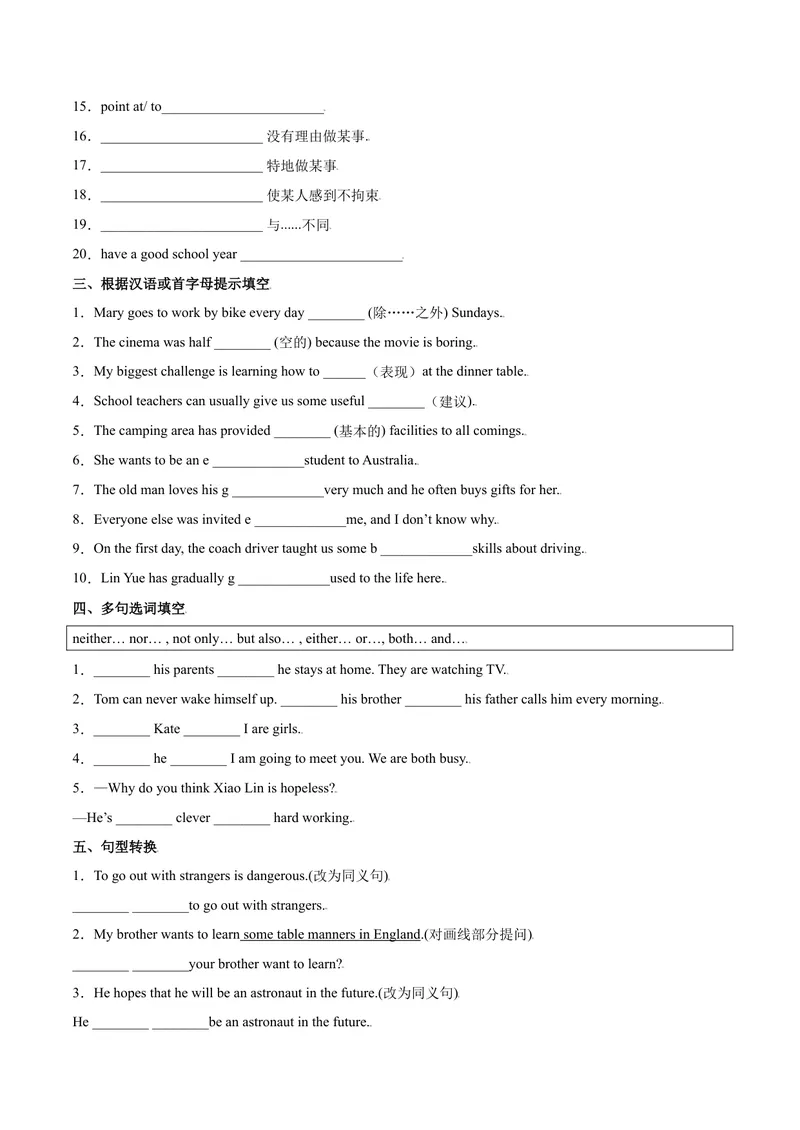
14._______________________ 拣起,拾起15.point at/ to_______________________
16._______________________ 没有理由做某事.
17._______________________ 特地做某事
18._______________________ 使某人感到不拘束
19._______________________ 与......不同
20.have a good school year _______________________
三、根据汉语或首字母提示填空
1.Mary goes to work by bike every day ________ (除……之外) Sundays.
2.The cinema was half ________ (空的) because the movie is boring.
3.My biggest challenge is learning how to ______(表现)at the dinner table.
4.School teachers can usually give us some useful ________(建议).
5.The camping area has provided ________ (基本的) facilities to all comings.
6.She wants to be an e _____________student to Australia.
7.The old man loves his g _____________very much and he often buys gifts for her.
8.Everyone else was invited e _____________me, and I don’t know why.
9.On the first day, the coach driver taught us some b _____________skills about driving.
10.Lin Yue has gradually g _____________used to the life here.
四、多句选词填空
neither… nor… , not only… but also… , either… or…, both… and…
1.________ his parents ________ he stays at home. They are watching TV.
2.Tom can never wake himself up. ________ his brother ________ his father calls him every morning.
3.________ Kate ________ I are girls.
4.________ he ________ I am going to meet you. We are both busy.
5.—Why do you think Xiao Lin is hopeless?
—He’s ________ clever ________ hard working.
五、句型转换
1.To go out with strangers is dangerous.(改为同义句)
________ ________to go out with strangers.
2.My brother wants to learn some table manners in England.(对画线部分提问)
________ ________your brother want to learn?
3.He hopes that he will be an astronaut in the future.(改为同义句)
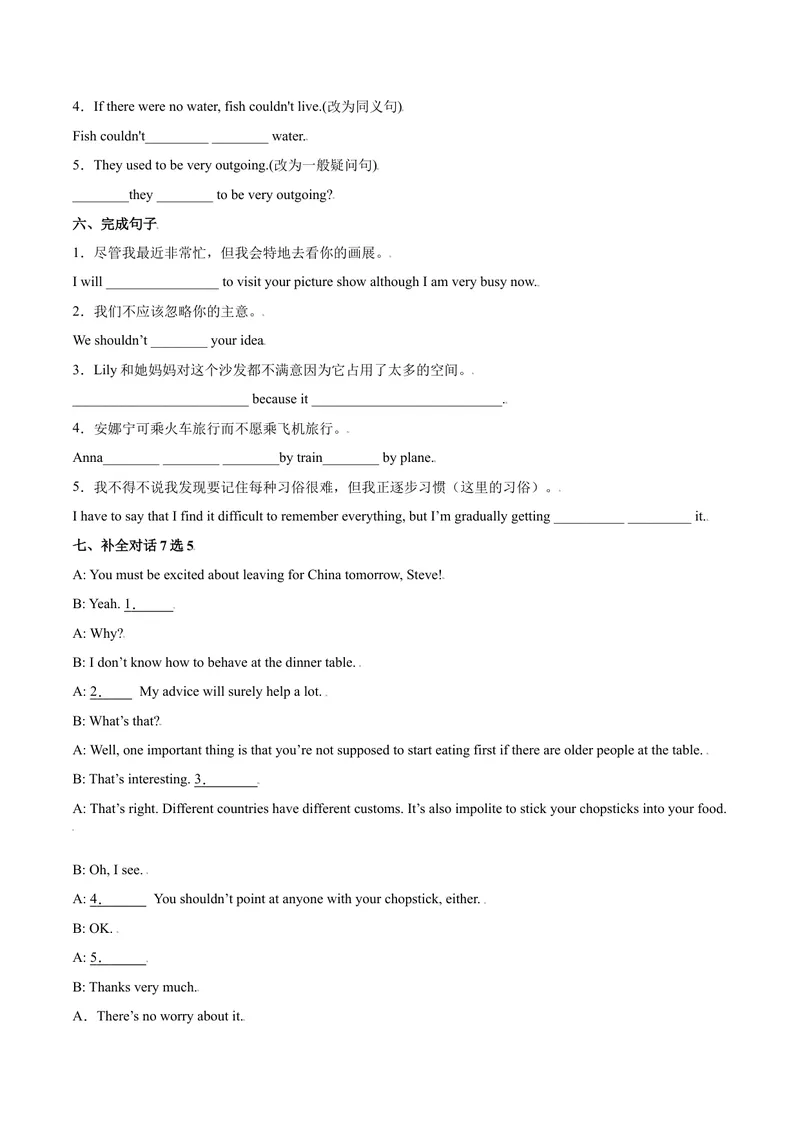
He ________ ________be an astronaut in the future.4.If there were no water, fish couldn't live.(改为同义句)
Fish couldn't_________ ________ water.
5.They used to be very outgoing.(改为一般疑问句)
________they ________ to be very outgoing?
六、完成句子
1.尽管我最近非常忙,但我会特地去看你的画展。
I will ________________ to visit your picture show although I am very busy now.
2.我们不应该忽略你的主意。
We shouldn’t ________ your idea
3.Lily和她妈妈对这个沙发都不满意因为它占用了太多的空间。
_________________________ because it ___________________________.
4.安娜宁可乘火车旅行而不愿乘飞机旅行。
Anna________ ________ ________by train________ by plane.
5.我不得不说我发现要记住每种习俗很难,但我正逐步习惯(这里的习俗)。
I have to say that I find it difficult to remember everything, but I’m gradually getting __________ _________ it.
七、补全对话7选5
A: You must be excited about leaving for China tomorrow, Steve!
B: Yeah. 1 .
A: Why?
B: I don’t know how to behave at the dinner table.
A: 2 . My advice will surely help a lot.
B: What’s that?
A: Well, one important thing is that you’re not supposed to start eating first if there are older people at the table.
B: That’s interesting. 3 .
A: That’s right. Different countries have different customs. It’s also impolite to stick your chopsticks into your food.
B: Oh, I see.
A: 4 . You shouldn’t point at anyone with your chopstick, either.
B: OK.
A: 5 .
B: Thanks very much.
A.There’s no worry about it.B.That’s usual!
C.And there’s one more thing you need to know.
D.But I’m a little nervous, too.
E. Hope that you’ll enjoy your stay in China.
F. When you’re invited for 7:00, you’re expected to come later.
G. However, in the United States, it doesn’t matter.
八、阅读单选
When it comes to Chinese and Western restaurants, the differences are big. One difference is in the menus.
In Western restaurants, the menus are usually very descriptive(描述的). They tell you what is in each dish.
They also tell you how those dishes are cooked. For example, the menu might tell you that a burger has cheese and
ketchup(苦番茄). You can also know if a dish is fried or steamed.
Chinese menus don’t usually tell you these things. But you can see a lot of pictures in them. Most Western
restaurant menus do not have as many pictures as Chinese ones. In some good Western restaurants, the menus
might not have any pictures at all.
The names of Chinese dishes are usually not very descriptive. Disanxian is a pretty-sounding(好听的)
name. However, it doesn’t tell you anything about this dish. But with a picture, you can tell what’s in this dish. This
dish has potatoes, green peppers and eggplant.
Having more photos also makes the menus more attractive to people. It can make you feel good about eating
in the restaurant.
1.You can’t know ________ from a Western menu.
A.what is in the dishes B.how the dishes are cooked
C.when your dishes will be ready D.whether a burger has ketchup
2.What can you see in a Chinese menu?
A.Information about the dishes. B.A lot of pictures.
C.Descriptive names of the dishes. D.Detailed descriptions of the dishes.
3.The writer thinks that the pictures in Chinese menus are ________.
A.useful B.useless C.beautiful D.real
4.The passage is mainly about ________.
A.menus in Chinese and Western restaurants
B.eating habits in China and Western countries
C.table manners in China and Western countriesD.names of dishes in Chinese and Western restaurants