Unit 2 阶段测试二
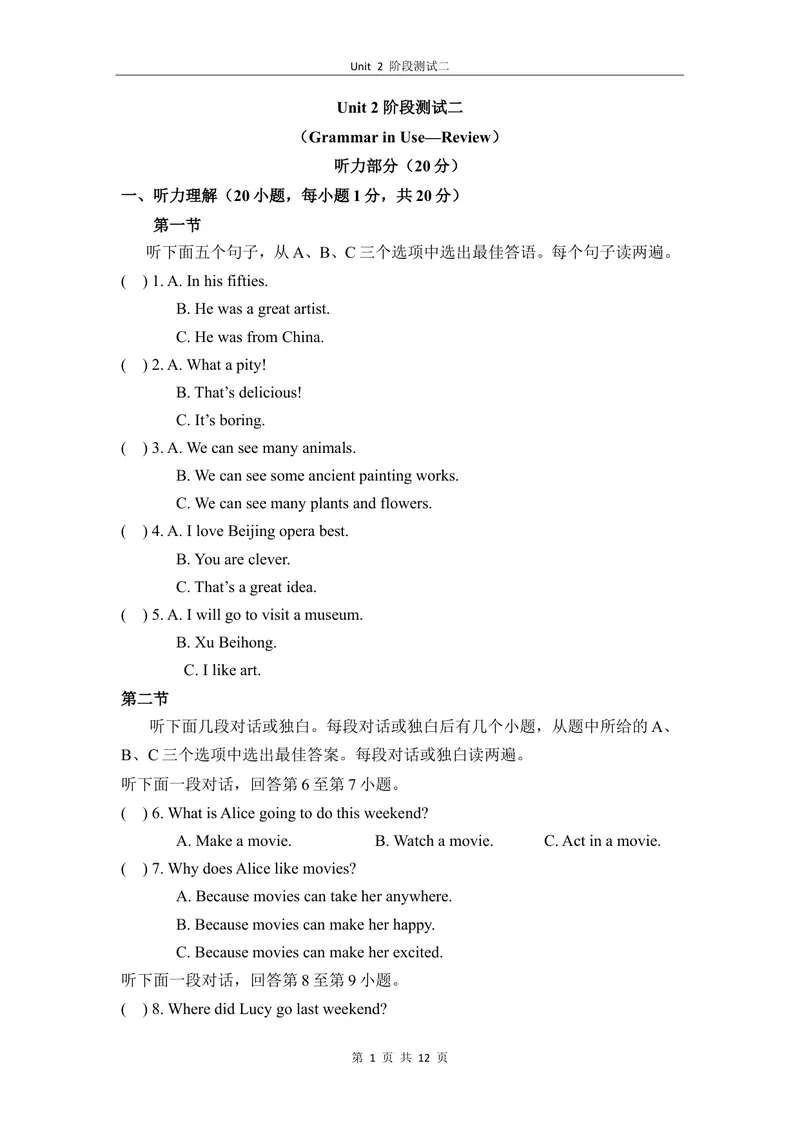
Unit 2 阶段测试二
(Grammar in Use—Review)
听力部分(20分)
一、听力理解(20小题,每小题1分,共20分)
第一节
听下面五个句子,从A、B、C三个选项中选出最佳答语。每个句子读两遍。
( ) 1. A. In his fifties.
B. He was a great artist.
C. He was from China.
( ) 2. A. What a pity!
B. That’s delicious!
C. It’s boring.
( ) 3. A. We can see many animals.
B. We can see some ancient painting works.
C. We can see many plants and flowers.
( ) 4. A. I love Beijing opera best.
B. You are clever.
C. That’s a great idea.
( ) 5. A. I will go to visit a museum.
B. Xu Beihong.
C. I like art.
第二节
听下面几段对话或独白。每段对话或独白后有几个小题,从题中所给的A、
B、C三个选项中选出最佳答案。每段对话或独白读两遍。
听下面一段对话,回答第6至第7小题。
( ) 6. What is Alice going to do this weekend?
A. Make a movie. B. Watch a movie. C. Act in a movie.
( ) 7. Why does Alice like movies?
A. Because movies can take her anywhere.
B. Because movies can make her happy.
C. Because movies can make her excited.
听下面一段对话,回答第8至第9小题。
( ) 8. Where did Lucy go last weekend?
第 1 页 共 12 页Unit 2 阶段测试二
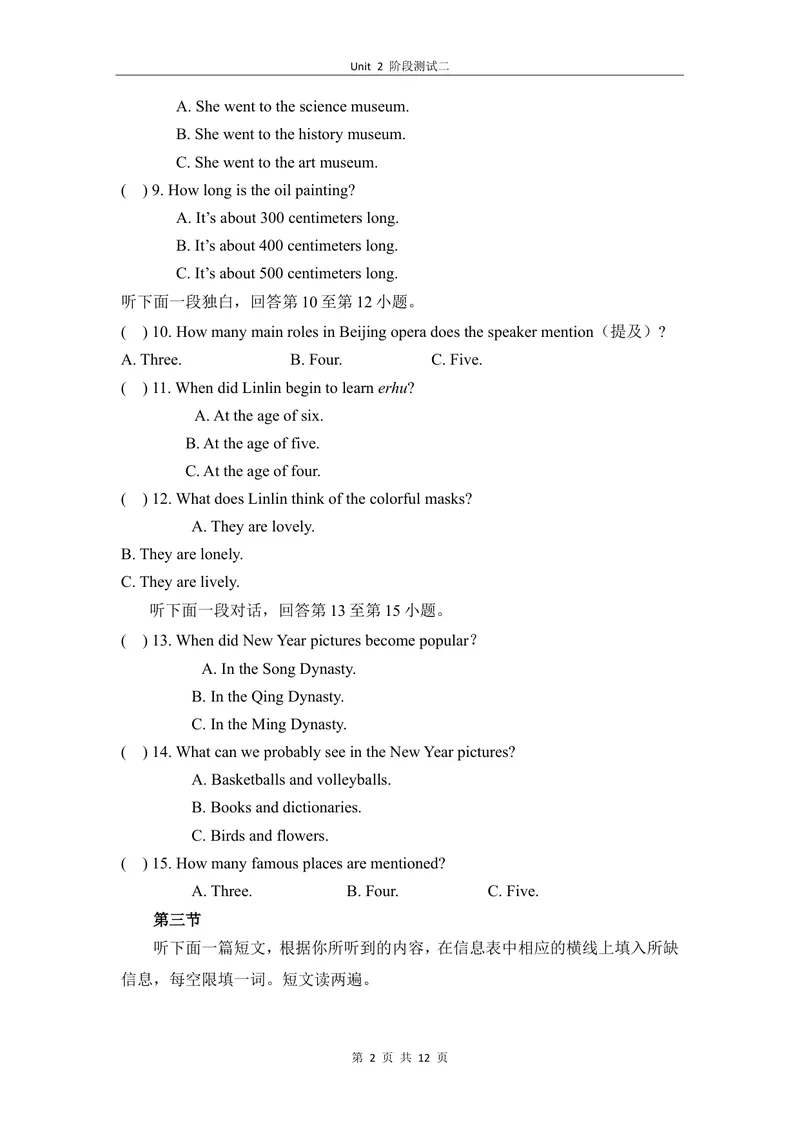
A. She went to the science museum.
B. She went to the history museum.
C. She went to the art museum.
( ) 9. How long is the oil painting?
A. It’s about 300 centimeters long.
B. It’s about 400 centimeters long.
C. It’s about 500 centimeters long.
听下面一段独白,回答第10至第12小题。
( ) 10. How many main roles in Beijing opera does the speaker mention(提及)?
A. Three. B. Four. C. Five.
( ) 11. When did Linlin begin to learn erhu?
A. At the age of six.
B. At the age of five.
C. At the age of four.
( ) 12. What does Linlin think of the colorful masks?
A. They are lovely.
B. They are lonely.
C. They are lively.
听下面一段对话,回答第13至第15小题。
( ) 13. When did New Year pictures become popular?
A. In the Song Dynasty.
B. In the Qing Dynasty.
C. In the Ming Dynasty.
( ) 14. What can we probably see in the New Year pictures?
A. Basketballs and volleyballs.
B. Books and dictionaries.
C. Birds and flowers.
( ) 15. How many famous places are mentioned?
A. Three. B. Four. C. Five.
第三节
听下面一篇短文,根据你所听到的内容,在信息表中相应的横线上填入所缺
信息,每空限填一词。短文读两遍。
第 2 页 共 12 页Unit 2 阶段测试二
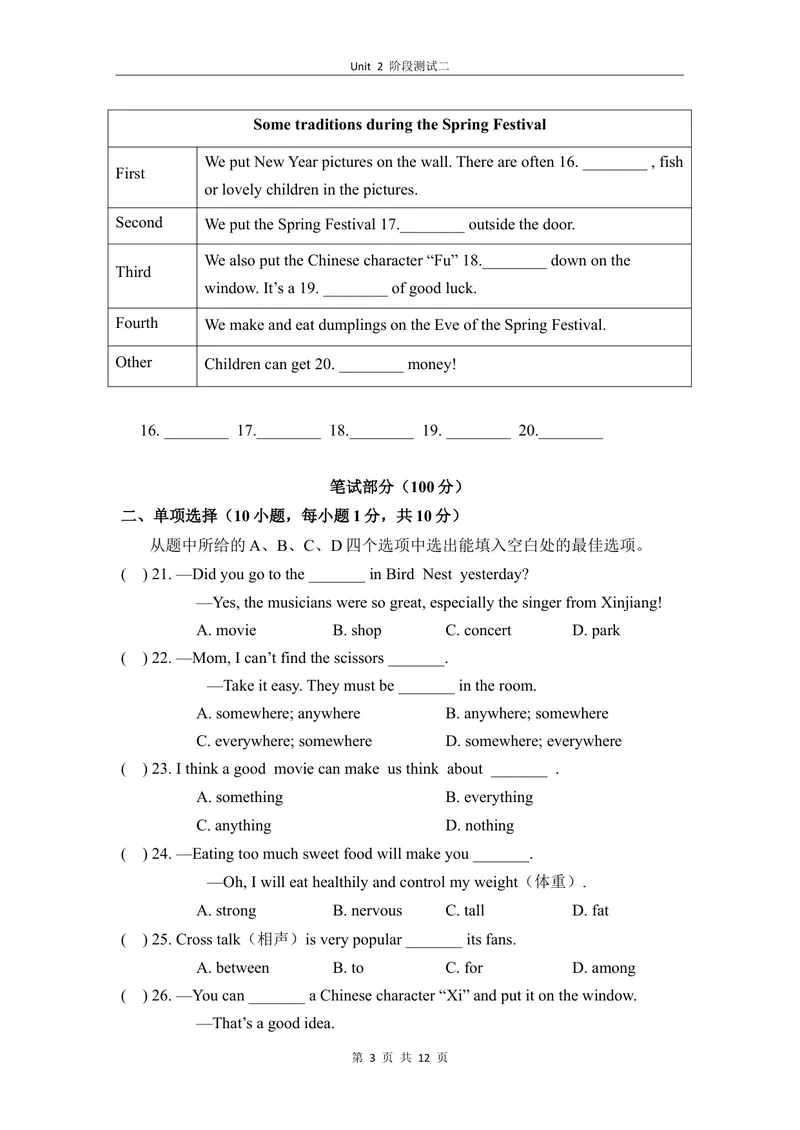
Some traditions during the Spring Festival
We put New Year pictures on the wall. There are often 16. ________ , fish
First
or lovely children in the pictures.
Second We put the Spring Festival 17.________ outside the door.
We also put the Chinese character “Fu” 18.________ down on the
Third
window. It’s a 19. ________ of good luck.
Fourth We make and eat dumplings on the Eve of the Spring Festival.
Other Children can get 20. ________ money!
16. ________ 17.________ 18.________ 19. ________ 20.________
笔试部分(100分)
二、单项选择(10小题,每小题1分,共10分)
从题中所给的A、B、C、D四个选项中选出能填入空白处的最佳选项。
( ) 21. —Did you go to the _______ in Bird Nest yesterday?
—Yes, the musicians were so great, especially the singer from Xinjiang!
A. movie B. shop C. concert D. park
( ) 22. —Mom, I can’t find the scissors _______.
—Take it easy. They must be _______ in the room.
A. somewhere; anywhere B. anywhere; somewhere
C. everywhere; somewhere D. somewhere; everywhere
( ) 23. I think a good movie can make us think about _______ .
A. something B. everything
C. anything D. nothing
( ) 24. —Eating too much sweet food will make you _______.
—Oh, I will eat healthily and control my weight(体重).
A. strong B. nervous C. tall D. fat
( ) 25. Cross talk(相声)is very popular _______ its fans.
A. between B. to C. for D. among
( ) 26. —You can _______ a Chinese character “Xi” and put it on the window.
—That’s a good idea.
第 3 页 共 12 页Unit 2 阶段测试二
A. work out B. cut out C. put out D. come out
( ) 27. Many foreigners fall in love _______ Chinese culture through movies.
A. from B. on C. with D. in
( ) 28. Writing and drawing are both _______ work.
A. creative B. electronic C. impossible D. real
( ) 29. We are making a New Year picture and the work _______.
A. belongs to B. goes well
C. pays off D. checks out
( ) 30. —Why do you put “Fu” _______ on the window?
—Because it means “Fu” arrives.
A. side by side B. upside down
C. from top to bottom D. inside and out
三、完形填空(10小题,每小题1分,共10分)
先通读原文,掌握其大意,然后从A、B、C、D四个选项中选出一个可以填入
相应空白处的最佳选项。
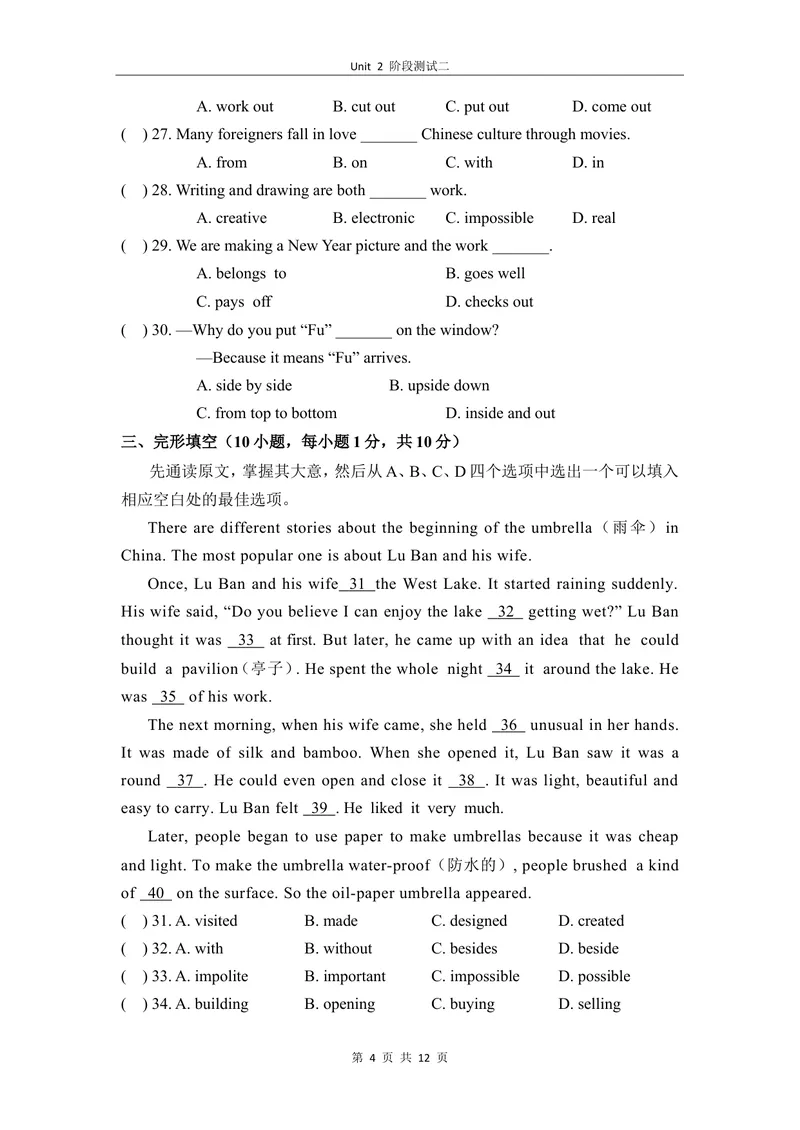
There are different stories about the beginning of the umbrella(雨伞)in
China. The most popular one is about Lu Ban and his wife.
Once, Lu Ban and his wife 31 the West Lake. It started raining suddenly.
His wife said, “Do you believe I can enjoy the lake 32 getting wet?” Lu Ban
thought it was 33 at first. But later, he came up with an idea that he could
build a pavilion(亭子). He spent the whole night 34 it around the lake. He
was 35 of his work.
The next morning, when his wife came, she held 36 unusual in her hands.
It was made of silk and bamboo. When she opened it, Lu Ban saw it was a
round 37 . He could even open and close it 38 . It was light, beautiful and
easy to carry. Lu Ban felt 39 . He liked it very much.
Later, people began to use paper to make umbrellas because it was cheap
and light. To make the umbrella water-proof(防水的), people brushed a kind
of 40 on the surface. So the oil-paper umbrella appeared.
( ) 31. A. visited B. made C. designed D. created
( ) 32. A. with B. without C. besides D. beside
( ) 33. A. impolite B. important C. impossible D. possible
( ) 34. A. building B. opening C. buying D. selling
第 4 页 共 12 页Unit 2 阶段测试二
( ) 35. A. sad B. proud C. interested D. curious
( ) 36. A. anything B. something C. nothing D. everything
( ) 37. A. picture B. flag C. board D. shape
( ) 38. A. clearly B. deeply C. happily D. easily
( ) 39. A. relaxed B. angry C. amazed D. afraid
( ) 40. A. oil B. water C. drink D. juice
四、阅读理解(20小题,每小题2分,共40分)
阅读下面四篇语言材料,然后按文后要求做题。
A
Culture shapes people a lot. Our characters(性格)are influenced by the culture
of our nation. They are also influenced by the art we see, the stories and music we
hear, and the traditions we share. Here are some popular traditional forms of culture
around us.
Traditional Chinese painting is one of the oldest art forms in the world. It usually
shows the painters’ love for nature and life. It mainly includes three kinds of elements
(元素): landscapes(山水), flowers and birds, figures(人物). People think
landscape painting is the highest form of Chinese painting.
Traditional Chinese folk stories are part of our history. They usually carry some
information about Chinese beliefs(信念). Many traditional folk stories such as Yu
Gong Moves the Mountains, Hou Yi Shoots the Suns, and Chang’e Flies to the Moon,
are passed down from one generation to the nex(t 代代相传). People tell these stories
to educate(教育)people, to remember the past or just to kill some time.
Traditional Chinese music is a treasure of the Chinese nation. It is a medium for
the ancient people to express their feelings, experiences and thoughts and people still
love it now.
When a certain culture is always around you, it’ll be a part of you.
根据材料内容选择最佳答案。
( ) 41. What does the underlined word “influenced” mean in Chinese?
A. 影响 B. 改变 C. 发展 D. 训练
( ) 42. What do people think is the highest form of Chinese painting?
A. Painting of flowers.B. Painting of birds.
C. Painting of landscapes. D. Painting of figures.
第 5 页 共 12 页Unit 2 阶段测试二
( ) 43. Which form of culture carries information about Chinese beliefs according to
the text?
A. Traditional Chinese painting.
B. Traditional Chinese folk stories.
C. Traditional Chinese music.
D. Traditional Chines skills.
( ) 44. Why do people tell the traditional folk stories?
① To educate people. ② To remember the past.
③ To kill some time. ④ To give performances.
A. ①③④ B. ②③④ C. ①②④ D. ①②③
( ) 45. Which of the following is TRUE according to the text?
A. Culture only comes from your family.
B. Culture means traditional Chinese festivals.
C. When you are in a culture, it will be a part of you.
D. We can’t understand traditional Chinese music now.
B
In the early morning, we can see people doing Tai Chi at parks and other public
places. Some people think it is a sport, while others call it a martial art(武术). So
what is true about Tai Chi?
Tai Chi is one of the most famous traditional martial art forms. It doesn’t develop
physical strength(力量)or attacking(攻击)speed like Shaolin Kungfu. It focuses on
(专注于)relaxing movements. If you are good at Tai Chi, you can move easily, just
like water. And you can always stay away from attacks quickly.
There are different styles of Tai Chi. For example, it is said(据说)that Zhang
Sanfeng created Wudang Tai Chi. According to some ancient stories, he once watched
a fight between a snake and a bird. He learned the skills of each animal while they
were moving, and then he created his own martial art.
Now Tai Chi is one of the national sports of China. It is also popular all over the
world because it is good for people’s health and helps relieve stress(减轻压力). If
there is danger, people can also use Tai Chi to protect themselves.
Why not have a try with your classmates during breaks at school?
根据材料内容选择最佳答案。
( ) 46. Tai Chi is ________ according to the text.
第 6 页 共 12 页Unit 2 阶段测试二
A. a dance B. a martial art C. a game D. a skill
( ) 47. What does Tai Chi focus on?
A. Attacking speed. B. Physical strength.
C. Relaxing movements. D. Watching animals.
( ) 48. How does the writer introduce the styles of Tai Chi in Paragraph 3?
A. By listing numbers.
B. By listing facts.
C. By asking questions.
D. By giving an example.
( ) 49. What’s the main idea of Paragraph 4?
A. The advantages of doing Tai Chi.
B. The advice of doing Tai Chi.
C. The different styles of Tai Chi.
D. The forms of Martial Art.
( ) 50. Which is the right structure of the text?
A. ①/②③/④⑤
B. ①/②③④/⑤
C. ①②/③④/⑤
D. ①/②/③④/⑤
C
Chinese calligraphy is an important part of traditional
Chinese culture. It started in China and spread(传播)to
other parts of Asia. It has a history of 4,000 to 5,000 years.
Calligraphy is the art of writing Chinese characters(汉字).
When you practice calligraphy, it is important to pay
attention to the changes of the strokes(笔画)and the space
between characters. There are different rules of writing. You can follow the
rules at first and create your own rules when you are really good at them.
There are many famous calligraphers in history, such as Wang Xizhi and Liu
Gongquan. Different calligraphy works can show different calligraphers’
feelings and personalities. Today, we can see them on the walls of offices,
shops, hotels and many other places.
第 7 页 共 12 页Unit 2 阶段测试二
The tool for practicing calligraphy is calligraphy brushes. They are usually
made from the hair of different animals. Practicing calligraphy takes a lot of
time, and many people take lessons to learn it. During the lessons, they can
learn how to write different strokes of Chinese characters. If you’re interested
in it, you may start practicing with a teacher right away.
Calligraphy, an amazing traditional art form, shows the love that all Chinese
people have for culture and beauty. Many Chinese people often practice
calligraphy, not to be a calligrapher, but to enjoy the peaceful mind.
根据材料内容选择最佳答案。
( ) 51. How long is the history of Chinese calligraphy?
A. 1,000 to 2,000 years. B. 2,000 to 3,000 years.
C. 3,000 to 4,000 years. D. 4,000 to 5,000 years.
( ) 52. What do we need to pay attention to when we practice calligraphy?
A. The changes of the characters.
B. The changes of the strokes.
C. The space between strokes.
D. The space between lines.
( ) 53. The underlined word “them” refers to different calligraphers’ _____.
A. works B. feelings C. values D. personalities
( ) 54. Which of the following is TRUE according to Paragraph 3?
A. We use calligraphy pencils to practice writing.
B. It takes a lot of energy to practice calligraphy.
C. Many people take lessons to learn calligraphy.
D. We learn to write some shapes of the characters.
( ) 55. Why do many Chinese people often practice calligraphy?
A. To practice speaking Chinese.
B. To be a great calligrapher.
C. To enjoy the peaceful mind.
D. To spread culture to foreigners.
D
Zhu Guoqiang, a shadow puppetry(皮影戏)artist, is over 60 years old. He comes
from Hunan Province. 56 He can sing, play the erhu, and control as many as ten
puppets at one time.
第 8 页 共 12 页Unit 2 阶段测试二
In the past, he worked with other four performers to make a shadow puppetry
show. However, most of his partners changed to other business. 57
When he was 15, Zhu started to learn the skills from his father. He worked hard
and was good at all the special skills, from making puppets to performing the plays.
His father only trained him for three years. 58 He learned how to be a good shadow
puppetry player and thought the traditional art as important as his life.
Zhu collected more than 300 books of lost plays. 59 In the book, he explained
the skills with pictures. In 2009, he raised money to set up a shadow puppet art
museum in his hometown. People could enjoy exhibitions(展览)and have class for
free there. To do all these things, Zhu not only spent all his money, but also borrowed
much money.
60 “Shadow puppetry is the most valuable in my life,” Zhu said. “I will pass it
down.”
根据材料内容,从下面五个选项中选出能填入文中空缺处的最佳答案,使文
章意思通顺、内容完整,并将选项填入下列横线上。
A. In Zhu’s life, there is nothing more important than shadow puppets.
B. He had to do the work of a whole group.
C. He can perform shadow plays all by himself.
D. He also wrote a book about Chinese shadow puppetry.
E. However, he learned a lot from his father.
56. _______ 57. _______ 58. ________ 59. _______ 60. _______
五、语篇填空(15小题,每小题1分,共15分)
第一节
阅读短文,从方框中选择适当的词并用其正确形式填空,使短文顺畅、意思
完整。每空限填一词,每词限用一次。
build tall like part when at however something enjoy tourist
The Eiffel Tower, one of the most famous buildings in the world, is also a 61
of French culture. The engineer Gustave Eiffel built it for the
1889 World’s Fair.
Standing at 324 meters 62 , the Eiffel Tower is an
第 9 页 共 12 页Unit 2 阶段测试二
amazing piece of engineering work. It was the tallest 63 in the world at that time.
They used 6 4 special to build the tower. The special material gives the tower a
perfect look.
6 5 it was first built, not everyone 66 the Eiffel Tower. Some people thought
it was ugly. 67 , over time, it becomes a symbol of Paris and France. Every year,
millions of 68 from all over the world visit the Eiffel Tower. They can reach the top
to enjoy the wonderful view of Paris. There are also restaurants on different levels.
People can have a delicious meal while 69 the scenery.
The Eiffel Tower is especially beautiful 70 night. The lights on the tower make
you think that you are in a magical world. It is truly a must-see place for anyone
visiting Paris.
61. ________ 62. ________ 63. ________ 64. ________ 65. ________
66. ________ 67. ________ 68. ________ 69. ________ 70. ________
第二节
阅读短文,根据语篇要求填空,使短文通畅、意思完整。每空限填一词。
The Great Wall, one of the most famous landmarks in the world, is a symbol of
China. It runs 71 many mountains and deserts.
The Great Wall has 72 long history. It was mainly built to
protect the country from different enemies. It was firstly built
in the 7th century B.C.
This amazing building is made of bricks, stones 73
earth. It’s not just one wall, but also an important fortification(防御工事). The
length(长度)of all the walls
74 more than 20,000 kilometers.
Millions of tourists visit the Great Wall every year. Some parts like Badaling are
very popular. 75 you stand on it, you can feel its long history.
71.________ 72.________ 73.________ 74.________ 75.________
六、补全对话(5小题,每小题2分,共10分)
根据下面的对话情景,在每个空白处填上一个适当的句子,使对话的意思连贯、
完整。
A: Kangkang, are you free this Saturday?
B: 76 . What’s up, Li Hong?
A: I want to go to the art museum. 77 ?
第 10 页 共 12 页Unit 2 阶段测试二
B: Sure, I’d love to. 78 ?
A: We can see the calligraphy works, photography works and many others there.
B: That’s amazing. I think we will learn a lot there.
A: That’s right.
B: 79 ?
A: Mm... there is something special. Many ancient money will be on show.
Do you have an interest in it?
B: Yes, I can’t wait to go with you.
A: OK. 80 .
B: See you.
76. __________________________________________________________.
77. __________________________________________________________?
78. __________________________________________________________?
79. __________________________________________________________?
80. __________________________________________________________.
七、完成句子(10小题,每小题1分,共10分)
第一节 根据句意,用括号内所给词的适当形式填空。
81. How ___________ the light music is! (relax)
82. The performer is ___________ the puppets carefully. (operate)
83. Painting is a ___________ activity. (create)
84. The different ___________ in Beijing opera are really amazing. (role)
85. The dogs ___________ loudly last night, so I didn’t sleep well. (shout)
第二节 将下列句子中汉语部分译成英语,注意使用适当形式。
86. Doing housework is ________________ homework.(一种不同形式的)
87. ________________, she became a young teacher.(在她二十几岁时)
88. She ________________ ballet when she watched Swan Lake.(爱上)
89. We all know that Taiwan ________________ China.(属于)
90. Art is ________________ our life.(一部分)
八、书面表达(10分)
假如你是李强,你校作为剪纸特色校,将迎接一组英国学生来校参观。他们将学
习剪纸艺术,感受中国传统文化之美。请你准备一篇英语发言稿,内容包括:
1. 表示欢迎;
第 11 页 共 12 页Unit 2 阶段测试二
2. 介绍剪纸,告知活动内容;
3. 表达期待和祝愿。
写作要求:
1. 文中须包含所有的要点提示,可以适当发挥;
2. 文中不得出现真实姓名和学校名称;
3. 可适当增加细节,使行文连贯;
4. 词数80—100词。(开头和结尾已给出,不计入总词数)
参考词汇:pattern图案
Dear friends,
I’m Li Qiang. _____________________________________________________
_____________________________________________________________________
_____________________________________________________________________
_____________________________________________________________________
_____________________________________________________________________
_____________________________________________________________________
_____________________________________________________________________
Thank you.
第 12 页 共 12 页