Unit 6 单元测试
Unit 6 单元测试
听力部分(20分)
一、听力理解(20小题,每小题1分,共20分)
第一节
听下面五段对话。每段对话后有一个小题,从题中所给的A、B、C三个选项中选出最
佳答案。每段对话读两遍。
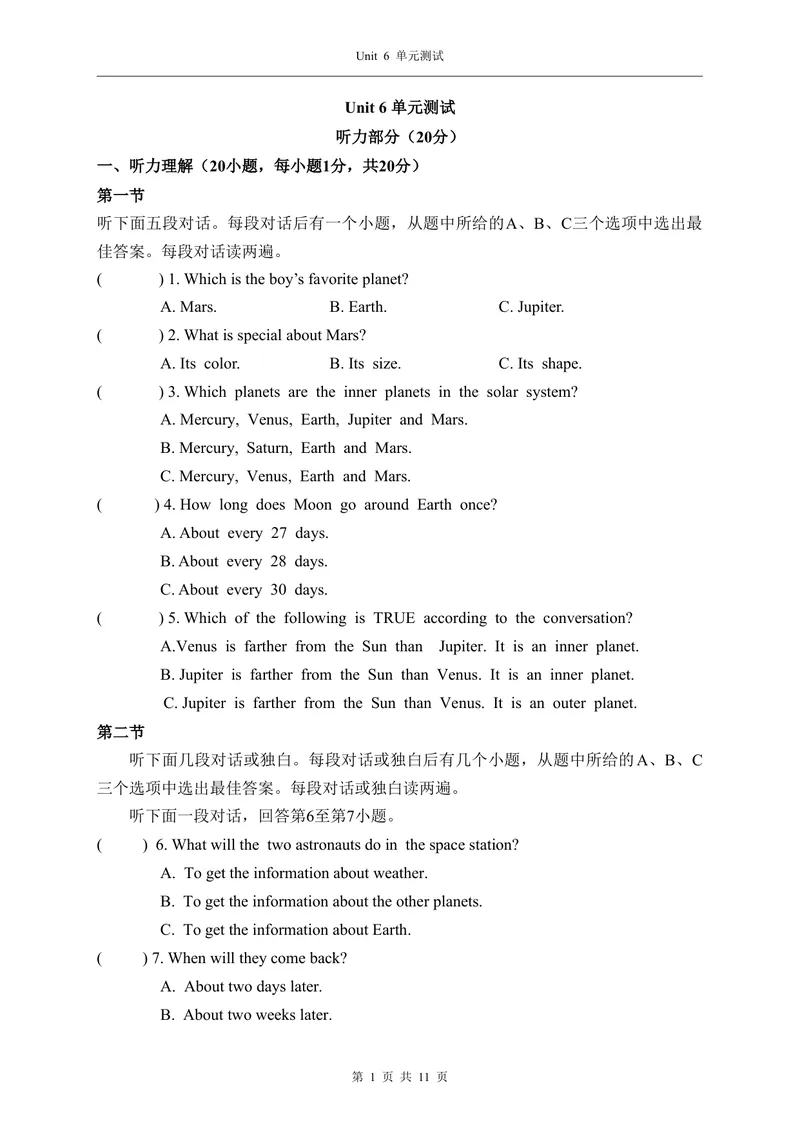
( ) 1. Which is the boy’s favorite planet?
A. Mars. B. Earth. C. Jupiter.
( ) 2. What is special about Mars?
A. Its color. B. Its size. C. Its shape.
( ) 3. Which planets are the inner planets in the solar system?
A. Mercury, Venus, Earth, Jupiter and Mars.
B. Mercury, Saturn, Earth and Mars.
C. Mercury, Venus, Earth and Mars.
( ) 4. How long does Moon go around Earth once?
A. About every 27 days.
B. About every 28 days.
C. About every 30 days.
( ) 5. Which of the following is TRUE according to the conversation?
A.Venus is farther from the Sun than Jupiter. It is an inner planet.
B. Jupiter is farther from the Sun than Venus. It is an inner planet.
C. Jupiter is farther from the Sun than Venus. It is an outer planet.
第二节
听下面几段对话或独白。每段对话或独白后有几个小题,从题中所给的A、B、C
三个选项中选出最佳答案。每段对话或独白读两遍。
听下面一段对话,回答第6至第7小题。
( ) 6. What will the two astronauts do in the space station?
A. To get the information about weather.
B. To get the information about the other planets.
C. To get the information about Earth.
( ) 7. When will they come back?
A. About two days later.
B. About two weeks later.
第 1 页 共 11 页Unit 6 单元测试
C. About two months later.
听下面一段独白,回答第8至第10小题。
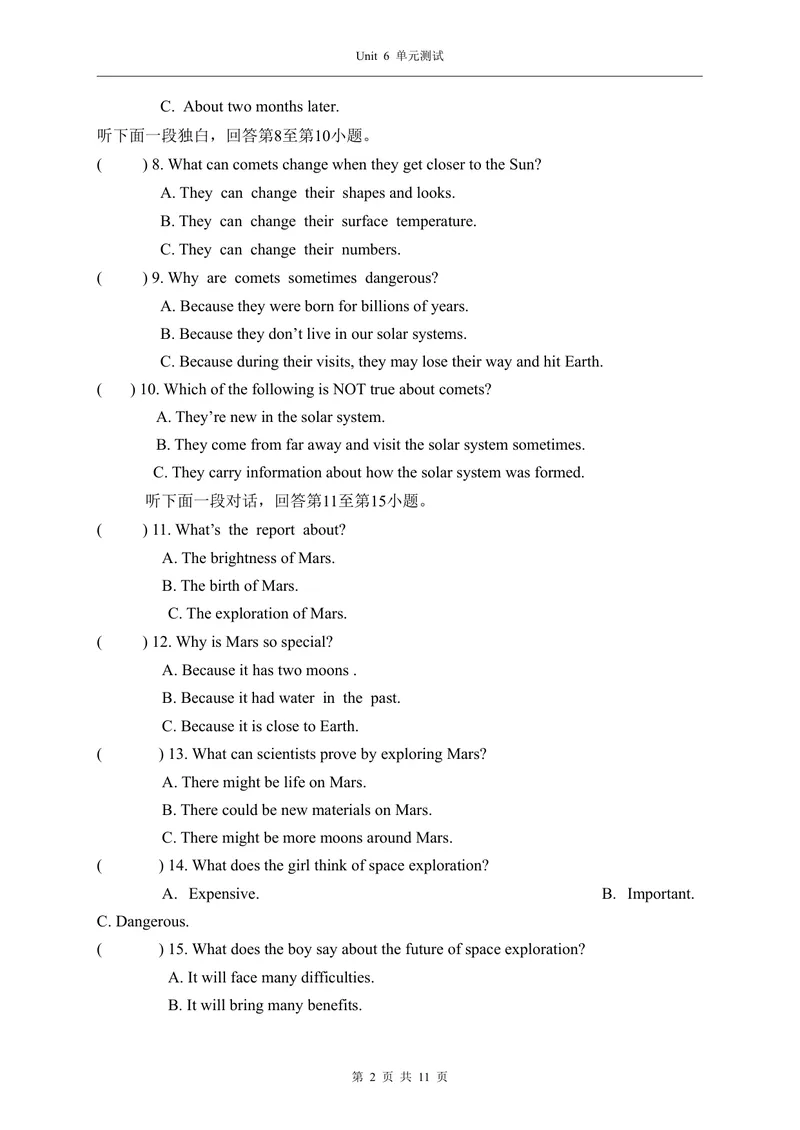
( ) 8. What can comets change when they get closer to the Sun?
A. They can change their shapes and looks.
B. They can change their surface temperature.
C. They can change their numbers.
( ) 9. Why are comets sometimes dangerous?
A. Because they were born for billions of years.
B. Because they don’t live in our solar systems.
C. Because during their visits, they may lose their way and hit Earth.
( ) 10. Which of the following is NOT true about comets?
A. They’re new in the solar system.
B. They come from far away and visit the solar system sometimes.
C. They carry information about how the solar system was formed.
听下面一段对话,回答第11至第15小题。
( ) 11. What’s the report about?
A. The brightness of Mars.
B. The birth of Mars.
C. The exploration of Mars.
( ) 12. Why is Mars so special?
A. Because it has two moons .
B. Because it had water in the past.
C. Because it is close to Earth.
( ) 13. What can scientists prove by exploring Mars?
A. There might be life on Mars.
B. There could be new materials on Mars.
C. There might be more moons around Mars.
( ) 14. What does the girl think of space exploration?
A. Expensive. B. Important.
C. Dangerous.
( ) 15. What does the boy say about the future of space exploration?
A. It will face many difficulties.
B. It will bring many benefits.
第 2 页 共 11 页Unit 6 单元测试
C. It may stop in the future.
第三节
听下面一篇短文,根据你所听到的内容,在信息表中相应的横线上填入所缺信息
每空限填一词。短文读两遍。
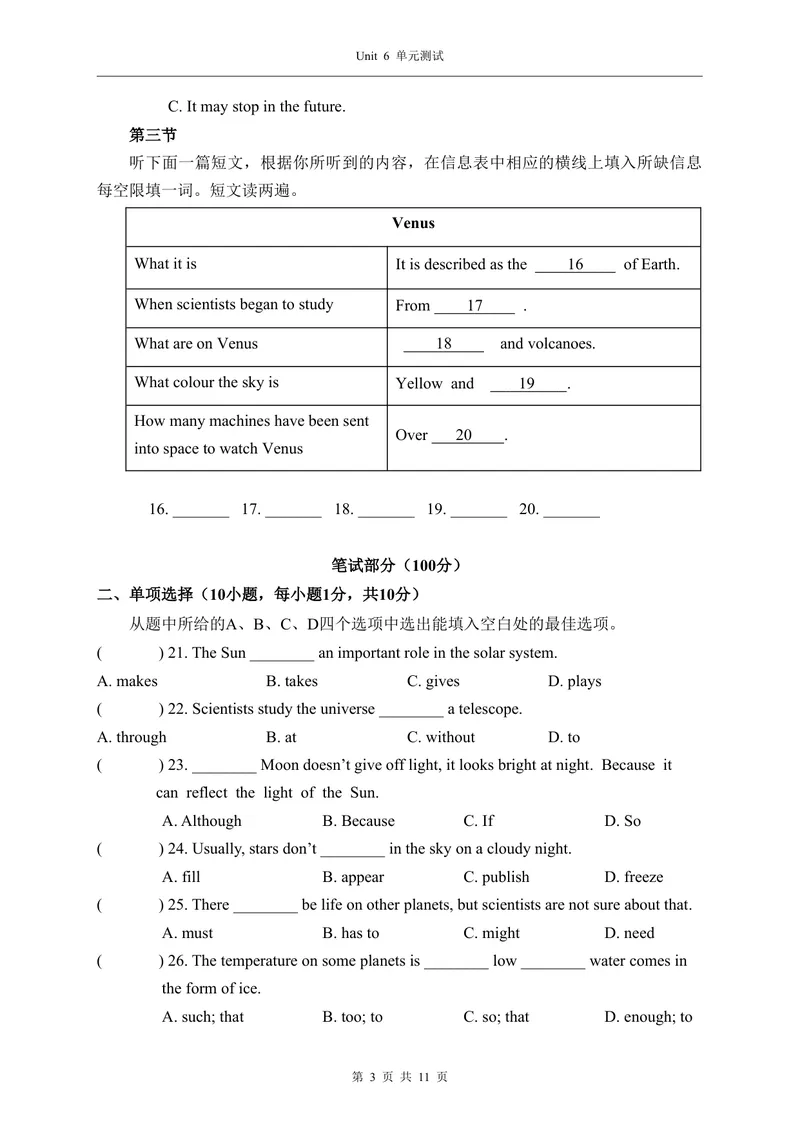
Venus
What it is It is described as the 1 6 of Earth.
When scientists began to study From 1 7 .
What are on Venus 1 8 and volcanoes.
What colour the sky is Yellow and 19 .
How many machines have been sent
Over 20 .
into space to watch Venus
16. _______ 17. _______ 18. _______ 19. _______ 20. _______
笔试部分(100分)
二、单项选择(10小题,每小题1分,共10分)
从题中所给的A、B、C、D四个选项中选出能填入空白处的最佳选项。
( ) 21. The Sun ________ an important role in the solar system.
A. makes B. takes C. gives D. plays
( ) 22. Scientists study the universe ________ a telescope.
A. through B. at C. without D. to
( ) 23. ________ Moon doesn’t give off light, it looks bright at night. Because it
can reflect the light of the Sun.
A. Although B. Because C. If D. So
( ) 24. Usually, stars don’t ________ in the sky on a cloudy night.
A. fill B. appear C. publish D. freeze
( ) 25. There ________ be life on other planets, but scientists are not sure about that.
A. must B. has to C. might D. need
( ) 26. The temperature on some planets is ________ low ________ water comes in
the form of ice.
A. such; that B. too; to C. so; that D. enough; to
第 3 页 共 11 页Unit 6 单元测试
( ) 27. Space ________ has come a long way, and we now hope to discover other
planets that are suitable enough to support life.
A. surface B. exploration C. power D. death
( ) 28. Neptune is the farthest planet to the Sun, ________ a distance of 4.5 billion
kilometers.
A. at B. on C. in D. to
( ) 29. Many years ago, scientists ________ that Earth is not the center of the
universe. It’s just one of planets in the solar system.
A. survived B. proved C. included D. separated
( ) 30. When the Sun ________, everything on Earth gets light and warmth.
A. rises B. travels C. checks D. fails
三、完形填空(10小题,每小题1分,共10分)
先通读原文,掌握其大意,然后从A、B、C、D四个选项中选出一个可以填入相
应空白处的最佳选项。
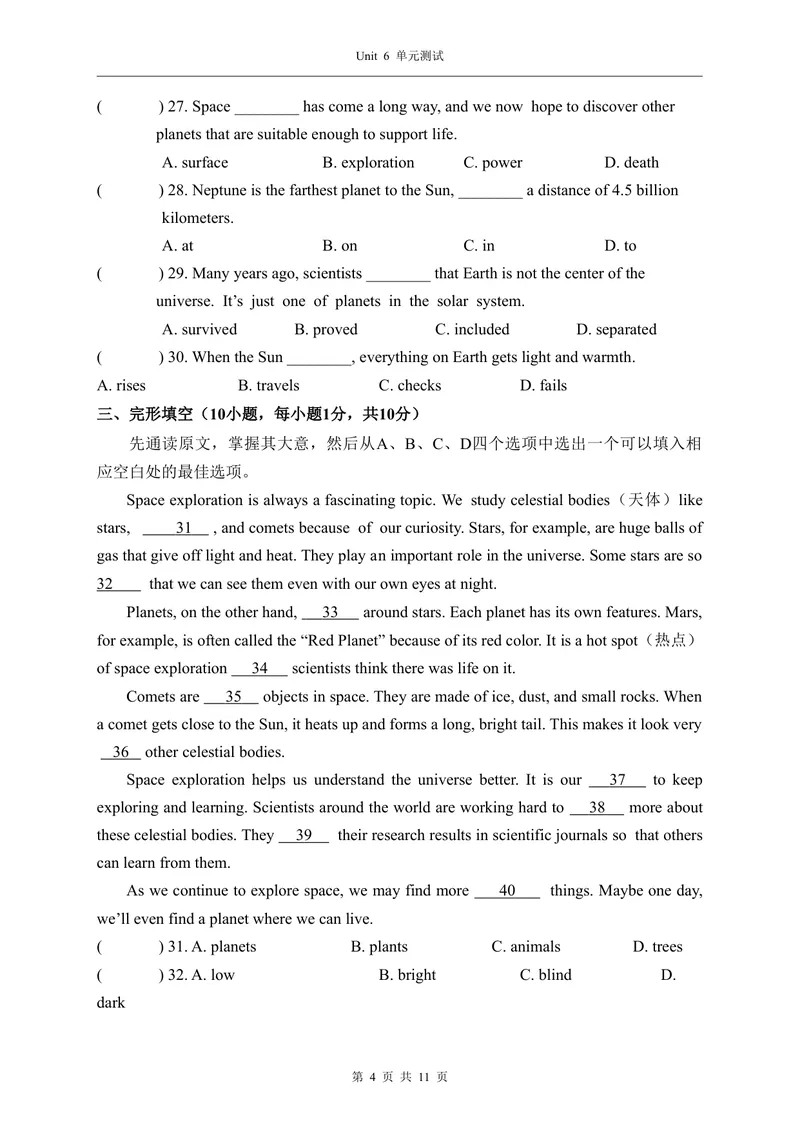
Space exploration is always a fascinating topic. We study celestial bodies(天体)like
stars, 3 1 , and comets because of our curiosity. Stars, for example, are huge balls of
gas that give off light and heat. They play an important role in the universe. Some stars are so
32 that we can see them even with our own eyes at night.
Planets, on the other hand, 33 around stars. Each planet has its own features. Mars,
for example, is often called the “Red Planet” because of its red color. It is a hot spot(热点)
of space exploration 34 scientists think there was life on it.
Comets are 35 objects in space. They are made of ice, dust, and small rocks. When
a comet gets close to the Sun, it heats up and forms a long, bright tail. This makes it look very
36 other celestial bodies.
Space exploration helps us understand the universe better. It is our 3 7 to keep
exploring and learning. Scientists around the world are working hard to 3 8 more about
these celestial bodies. They 3 9 their research results in scientific journals so that others
can learn from them.
As we continue to explore space, we may find more 40 things. Maybe one day,
we’ll even find a planet where we can live.
( ) 31. A. planets B. plants C. animals D. trees
( ) 32. A. low B. bright C. blind D.
dark
第 4 页 共 11 页Unit 6 单元测试
( ) 33. A. run B. rise C. move D. prove
( ) 34. A. although B. because C. so D. if
( ) 35. A. small B. alive C. lonely D. new
( ) 36. A. different from B. alive with C. similar to
D. short of
( ) 37. A. responsibility B. truth C. ability
D. death
( ) 38. A. make B. learn C. publish D. worry
( ) 39. A. publish B. prove C. produce D. prefer
( ) 40. A. natural B. common C. strange D. normal
四、阅读理解(20小题,每小题2分,共40分)
阅读下面四篇语言材料,然后按文后要求做题。
A
www.s pace e xploration .com
Li Hua 15 May 2024
I’m really interested in space exploration. I want to know more about the planets in
our solar system. What are the latest discoveries?
LIKE·COMMENT·SHARE
John Smith an hour ago
Recently, we’ve found evidence(痕迹)of water on Mars. This discovery has
increased the possibility of finding life on the planet. We are also studying the rings of
Saturn more closely with other scientists. We’ve found that the rings are much more
complex than we thought.
Jane Green yesterday
There’s a new theory about Jupiter’s Great Red Spot(大红斑). Some scientists
think it might be shrinking(缩小). They’re using powerful telescopes to monitor its
sizes, colors and changes in its behavior.
Tom Ruskin two days ago
The James Webb Space Telescope has been sending back amazing images from
distant stars and galaxies. It might also help us learn more about the outer planets in
our solar system, like Uranus and Neptune.
第 5 页 共 11 页Unit 6 单元测试
根据材料内容选择最佳答案。
( ) 41. What’s Li Hua really interested in?
A. Space travel. B. Space exploration.
C. The latest discoveries in physics. D. Research about space.
( ) 42. What does John probably do?
A. A student. B. A driver.
C. A scientist. D. A teacher.
( ) 43. What are scientists using powerful telescopes to monitor?
A. The rings on Mars.
B. The Great Red Spot’s sizes, colors and changes in its behavior on Jupiter.
C. The amazing images from distant stars and galaxies.
D. The changes of Uranus and Neptune.
( ) 44. Which of the following is TRUE about the new discovery on Mars?
A. Scientists have found signs of life.
B. Scientists have found a new mountain.
C. Scientists have found evidence of water.
D. Scientists have found a large lake.
( ) 45. Where can we probably read the text?
A. On a school notice board. B. On the website.
C. In a health magazine. D. In a history book.
B
Mercury is the closest planet to the Sun. It is also the smallest planet in the solar
system. Because it is so close to the Sun, it has extreme(极端的) temperatures. During
the day, the temperature on Mercury can reach up to 430°C, but at night, it can drop to
-180°C.
Mercury has a very thin atmosphere. It is mostly made up of helium and sodium(氦和
钠). It has a rocky surface with many craters(陨石坑), similar to Moon. These craters
were formed when asteroids(小行星) or meteoroids(流星体) hit the planet.
Mercury has a very slow rotation(自转). It means a day on Mercury is much longer
than a day on Earth. In fact, a day on Mercury is about 59 Earth days long. However, its orbit
(公转) around the Sun is very fast, taking only about 88 Earth days to complete one.
Scientists sent probes(探测器) to Mercury to study it more closely. These probes
helped us learn about its magnetic field(磁场), surface composition, and other features.
第 6 页 共 11 页Unit 6 单元测试
根据材料内容选择最佳答案。
( ) 46. What is the first paragraph mainly about?
A. Mercury’s distance from the Sun.
B. Mercury’s extreme temperatures.
C. Mercury’s position and basic information.
D. Mercury’s size compared to other planets.
( ) 47. What is the atmosphere of Mercury mainly made of ?
A. Oxygen and nitrogen. B. Helium and sodium.
C. Hydrogen and helium. D. Carbon dioxide and methane.
( ) 48. How are the craters on Mercury formed?
A. By volcanic eruptions.
B. By the planet’s rotation.
C. By the impact of asteroids or meteoroids.
D. By the pressure of its thin atmosphere.
( ) 49. Which of the following is TRUE about Mercury’s rotation and orbit?
A. It has a fast rotation and a slow orbit.
B. It has a slow rotation and a fast orbit.
C. Both its rotation and orbit are slow.
D. Both its rotation and orbit are fast.
( ) 50. What can probes help us learn about Mercury?
A. Its distance from other planets.
B. Its magnetic field and surface composition.
C. Its potential for life.
D. Its future changes.
C
Pluto is a fascinating dwarf planet(矮行星) in our solar system. It’s known for being
one of the farthest objects from the Sun. It takes Pluto about 248 years to go around the Sun
once and it takes the light more than 5 hours to travel from the Sun to Pluto.
Pluto is very cold, with temperatures reaching as low as -230°C. It is made of rock and
ice. Its surface is covered with mountains and plains. Although it’s small in size, Pluto has
five known moons.
Pluto was once the ninth planet in our solar system. However, in 2006, it was reclassified
(重新归类) as a “dwarf planet” because of its small size and unusual orbit.
第 7 页 共 11 页Unit 6 单元测试
Scientists are still interested in Pluto. They want to learn more about its origin(起源)
and how it formed. In 2015, scientists sent a space probe called New Horizons to explore
Pluto and provide us with valuable information. It took many pictures of the planet and
brought them back to Earth.
根据材料内容选择最佳答案。
( ) 51. Which of the following is TRUE about the temperature on Pluto?
A. It’s very high. B. It changes a lot.
C. It’s similar to Earth’s. D. It’s very low.
( ) 52. What is Pluto made of ?
A. Only rock. B. Only ice.
C. Rock and ice. D. Gas and dust.
( ) 53. When was Pluto reclassified as a “dwarf planet”?
A. In 2006. B. In 2008.
C. In 2009. D. In 2016.
( ) 54. Why was Pluto reclassified?
A. Because it is very cold.
B. Because it has a lot of moons.
C. Because of its small size and unusual orbit.
D. Because it is made of rock and ice.
( ) 55. What did scientists do to explore Pluto?
A. They looked for information online.
B. They published many books.
C. They sent a probe to take pictures.
D. They named a space probe.
D
We can see many stars in the night sky. They come in different sizes, colors, and
temperatures. The color of a star is related to its temperature. Blue and white stars are the
hottest, while red stars are the coolest.
Stars are born in huge clouds of gas and dust called nebulae(星云). Gravity causes
the gas and dust to come together and form a dense core(核心). As the core gets hotter
and denser, nuclear fusion(核聚变) starts, and a star is born.
第 8 页 共 11 页Unit 6 单元测试
Stars have a lifespan(寿命). When a star runs out of fuel(燃料), it goes through
different stages of death. Some stars explode in a huge supernova(超新星), while others
gradually cool down and become white dwarfs(白矮星).
根据材料内容,简略回答问题。
56. What is related to the color of a star?
________________________________________________________________
57. Where are stars born ?
________________________________________________________________
58. What causes the gas and dust to come together to form a star?
________________________________________________________________
59. What happens when a star runs out of fuel?
________________________________________________________________
60. How will a star die?
________________________________________________________________
五、语篇填空(10小题,每小题1分,共10分)
阅读下面短文,在每个空格内填入一个恰当的词。(有提示词的,填入所给单词
的正确形式)
Space is full of mysteries. Celestial bodies(天体) are the key to understanding the
universe. They 61 (be) very important to life on Earth. The Sun, as we know, is a star. It
gives off light and heat.
Planets are different 62 stars. They don’t give off light. Each planet has its own
characteristics(特点). For example, Earth has water and atmosphere(大气层). And this
makes 63 possible for us to exist.
Comets are interesting 64 (object). They are made up of ice, dust, and small rocks.
When they get 65 to the Sun, they form a tail. This is due to the heat from the Sun.
Space exploration is a long-term task. Scientists have the 66 (responsible) to study
these celestial bodies. They use telescopes and space probes 67 (collect) information.
In the future, we hope to find out more about the universe. We can even build spaceships
and they will have the 68 to drive us to other planets. But for now, we need to keep
learning and 69 (explore) space. After all, the universe is so vast 70 there is still so
much we don’t know.
61. ________ 62. ________ 63. ________ 64. ________ 65. ________
66. ________ 67. ________ 68. ________ 69. ________ 70. ________
第 9 页 共 11 页Unit 6 单元测试
六、情景交际(5小题,每小题2分,共10分)
根据情景提示,用得体的英语完成下列各题。
71. 你想知道对方是否了解彗星,可以这样问:
_______________________________________________________________?
72. 你想知道太阳系有多少颗行星,可以这样问:
_______________________________________________________________?
73. 你想知道太阳为什么这么重要,可以这样问:
_______________________________________________________________?
74. 你想知道对方对太空探索的看法,可以这样问:
_______________________________________________________________?
75. 你想问对方地球到太阳的距离有多远,可以这样问:
_______________________________________________________________?
七、词汇运用(10小题,每小题1分,共10分)
第一节 根据句意,用括号内所给词的适当形式填空。
76. Living things on Earth can get light and _______ from the Sun. (warm)
77. The _______ of stars is different from each other. (bright)
78. It’s common for planets in the solar system _______ around the Sun. (move)
79. Scientists are working hard to _______ the universe. (exploration)
80. Liu Cixin _______ his book Three-Body Problem many years ago. (publish)
第二节 将下列句子中汉语部分译成英语,注意使用适当的形式
81. Ants ______________ when rain drops fall on the ground.(逃跑;跑开)
82. We can see ______________ millions of stars on a clear night sky.(至少)
83. On the one hand, the Sun is at the center of the solar system. ______________, it is only
a star in the universe.(另一方面)
84. Although planets are different, they still ______________.(有共同之处)
85. The study of comets is ______________ the birth of the solar system.(与……有关)
八、书面表达(10分)
学校航空爱好者社团正在举办一场展演,他们请你写一篇关于木星的英文介绍,用于
展出。请以“My Favorite Planet—Jupiter”为题,根据下面的提示内容,用英语写一篇
介绍木星的短文。
提示内容:
1. 木星是太阳系中最大的行星,比其他所有行星加起来还要大;
2. 它有一个著名的大红斑,是一场巨大的风暴(storm);
第 10 页 共 11 页Unit 6 单元测试
3. 木星有很多卫星(moon),其中一些卫星很特别,像木卫二(Europa)可能存
在液态水(liquid water);
4. 科学家们对木星很感兴趣,一直在研究它。
写作要求:
1. 短文中不得出现真实的地名、校名和人名;
2. 词数80—100词。
My Favorite Planet—Jupiter
—————————————————————————————————————
—————————————————————————————————————
—————————————————————————————————————
—————————————————————————————————————
—————————————————————————————————————
—————————————————————————————————————
—————————————————————————————————————
第 11 页 共 11 页