Unit 6 阶段测试二
Unit 6 阶段测试二
(Grammar in Use—Review)
听力部分(20分)
一、听力理解(20小题,每小题1分,共20分)
第一节
听下面五个句子,从A、B、C三个选项中选出能回答问题的最佳答案。每个
句子读两遍。
( ) 1. A. Jupiter. B. Moon. C. Stars.
( ) 2. A. In October 1986. B. 50 years ago. C. 165 years.
( ) 3. A. It’s beautiful. B. They all have seasons. C. It’s not a planet.
( ) 4. A. Because it’s the closest to the Sun.
B. When it has thin clouds.
C. Earth, Mars and Saturn.
( ) 5. A. About 150 million kilometers.
B. At night.
C. In a month.
第二节
听下面几段对话或独白。每段对话或独白后有几个小题,从题中所给的A、
B、C三个选项中选出最佳答案。每段对话或独白读两遍。
听下面一段对话,回答第6至第7小题。
( ) 6. What’s the rainfall on Venus like?
A. Cold. B. Beautiful. C. Dangerous.
( ) 7. What did scientists say about Mars?
A. There was water on it before.
B. It has life living on it now.
C. People would move to Mars in the future.
听下面一段对话,回答第8至第9小题。
( ) 8. Why do comets look like snowballs?
A. Because they are close to the Sun.
B. Because they are made of ice and dust.
C. Because people like to see them.
第 1 页 共 12 页Unit 6 阶段测试二
( ) 9. How long did the Rosetta mission take to reach the comet?
A. 5 years. B. 9 years. C. Over 10 years.
听下面一段独白,回答第10至第12小题。
( ) 10. Which planet is the speaker talking about?
A. Saturn. B. Jupiter. C. Mars.
( ) 11. What did Jupiter do in Roman stories as a god?
A. He helped bring fire to people.
B. He checked the Sun every morning.
C. He made sure everything in the sky was okay.
( ) 12. What does the speaker think of Jupiter?
A. A big brother in the solar system.
B. A small sister in the solar system.
C. A friend far from the solar system.
听下面一段对话,回答第13至第15小题。
( ) 13. When was Pluto no longer a planet in the solar system?
A. Since 1996. B. Since 2006. C. Since 2016.
( ) 14. What is the weather like on Pluto?
A. Cold. B. Warm. C. Hot.
( ) 15. How many moons does Pluto have?
A. Four. B. Five. C. Six.
第三节
听下面一篇短文,根据你所听到的内容,完成以下表格,每空填一词。短文读
两遍。
Eight 16. ________ in the Solar System
●Mercury is the 17. ________ to the Sun. It’s very hot there
The inner planets due to its nearness to the Sun.
●Venus is bright and looks beautiful in the sky.
●Earth plays an important role in supporting 18. ________.
●Mars is often called the “Red Planet” because of its strange
red color.
●Jupiter is the largest planet.
第 2 页 共 12 页Unit 6 阶段测试二
The outer planets ●Saturn has beautiful 19. ________ around it.
●Uranus is very cold.
●Neptune is so far from the Sun that it almost 20. ________.
笔试部分(100分)
二、单项选择(10小题,每小题1分,共10分)
从题中所给的A、B、C、D四个选项中选出能填入空白处的最佳选项。
( ) 21. In the solar system, Mercury is the _____ planet to the Sun.
A. close B. closer C. closest D. closed
( ) 22. _____ Mercury is the closest planet to the Sun, it is not the hottest.
A. When B. Because C. Although D. So
( ) 23. It _____ taikonauts less than 9 days to get to Moon by spaceship.
A. pays B. costs C. spends D. takes
( ) 24. We can ______ our ideas by studying the photos from the space.
A. explore B. protect C. prove D. prepare
( ) 25. The size of Venus is _____ than that of Mercury.
A. large B. larger C. the largest D. the larger
( ) 26. The documentary _____ talks about the history of universe.
A. mostly B. happily C. immediately D. mainly
( ) 27. Moon is _____ colder than Earth.
A. very B. much C. quite D. so
( ) 28. Earth is our only home. It is ______ too close ______ too far from the Sun.
A. neither; nor B. either; or
C. both; and D. not only; but also
( ) 29. The surface temperature on Mercury can drop down to -173°C ______its thin
air.
A. due to B. thanks to C. in order to D. along with
( ) 30. Mars is the closest and most ______ planet to Earth. Mars also has seasons
with different weather.
A. different B. similar C. far D. bright
三、完形填空(10小题,每小题1分,共10分)
第 3 页 共 12 页Unit 6 阶段测试二
先通读原文,掌握其大意,然后从A、B、C、D四个选项中选出一个可以填入
相应空白处的最佳选项。
Mars is often called the “Red Planet” because of its 31 . It is 32 of the most
fascinating planets for scientists.
The surface of Mars is 33 with huge deserts, high mountains, and deep valleys.
Some mountains on Mars are much 34 than those on Earth. Mars also has seasons
like Earth, 35 the seasons on Mars are much longer.
The ice cap on the polar of Mars is one of the 3 6 things about Mars. It is
mainly made of water ice and carbon dioxide ice(干冰). In winter, the temperature
on Mars can be so 3 7 that even the carbon dioxide in the air can freeze.
Scientists are 3 8 Mars with much interest. They want to find out if there was
ever life on this 3 9 . However, they have found no signs of 40 until now, but the
exploration continues.
( ) 31. A. color B. size C. distance D. shape
( ) 32. A. none B. neither C. one D. no
( ) 33. A. happy B. full C. filled D. related
( ) 34. A. larger B. deeper C. longer D. greener
( ) 35. A. while B. although C. so D. because
( ) 36. A. highest B. flattest C. strangest D. brightest
( ) 37. A. little B. common C. low D. high
( ) 38. A. surviving B. exploring C. saving D. planning
( ) 39. A. space B. universe C. valley D. planet
( ) 40. A. deaths B. beings C. rainfalls D. snowballs
四、阅读理解(20小题,每小题2分,共40分)
阅读下面四篇语言材料,然后按文后要求做题。
A
The solar system is full of amazing planets. Here are four of them.
Mercury is the closest planet to the Sun and very small. A day
on Mercury is much longer than that on Earth. It takes about two
Earth months to turn around once.
第 4 页 共 12 页Unit 6 阶段测试二
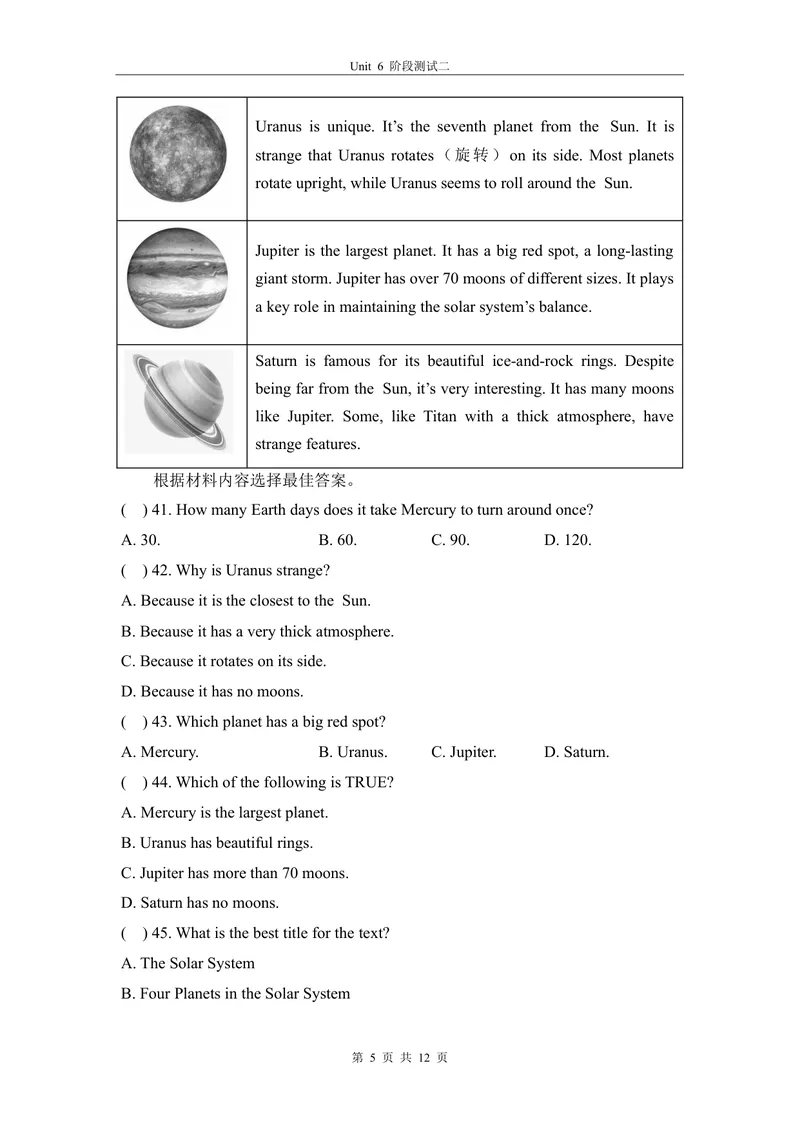
Uranus is unique. It’s the seventh planet from the Sun. It is
strange that Uranus rotates(旋转)on its side. Most planets
rotate upright, while Uranus seems to roll around the Sun.
Jupiter is the largest planet. It has a big red spot, a long-lasting
giant storm. Jupiter has over 70 moons of different sizes. It plays
a key role in maintaining the solar system’s balance.
Saturn is famous for its beautiful ice-and-rock rings. Despite
being far from the Sun, it’s very interesting. It has many moons
like Jupiter. Some, like Titan with a thick atmosphere, have
strange features.
根据材料内容选择最佳答案。
( ) 41. How many Earth days does it take Mercury to turn around once?
A. 30. B. 60. C. 90. D. 120.
( ) 42. Why is Uranus strange?
A. Because it is the closest to the Sun.
B. Because it has a very thick atmosphere.
C. Because it rotates on its side.
D. Because it has no moons.
( ) 43. Which planet has a big red spot?
A. Mercury. B. Uranus. C. Jupiter. D. Saturn.
( ) 44. Which of the following is TRUE?
A. Mercury is the largest planet.
B. Uranus has beautiful rings.
C. Jupiter has more than 70 moons.
D. Saturn has no moons.
( ) 45. What is the best title for the text?
A. The Solar System
B. Four Planets in the Solar System
第 5 页 共 12 页Unit 6 阶段测试二
C. The Mysterious Jupiter
D. The Beautiful Saturn
B
Now satellites are helping to forecast(预报)the weather. They are in space and
can reach any part of the world. The satellites take pictures of the atmosphere(大气)
because this is where the weather forms. They send these pictures to the weather
station. So meteorologists(气象专家)can see the weather of any part of the world.
From the pictures, the scientists can often say how the weather will change.
Today, nearly five hundred weather stations in sixty countries receive satellite
pictures. When they receive new pictures, the meteorologists compare them with
earlier ones. Perhaps they may find that the clouds have changed during the last few
hours. This may mean the weather on the ground may soon change, too. In their next
weather forecast, the meteorologists can say this.
So the weather satellites are a great help to the meteorologists. Before satellites
were invented, the scientists could forecast the weather for about 24 or 48 hours. Now
they can make good forecasts for 3 to 5 days. Soon they may be able to forecast the
weather for a week or more ahead(提前).
根据材料内容选择最佳答案。
( ) 46. Why do we use the weather satellites to take pictures of the atmosphere?
A. The weather satellites can do it easily.
B. Clouds form there.
C. The weather forms there.
D. The pictures can forecast the weather.
( ) 47. When do meteorologists forecast the weather?
A. When they have received satellite pictures.
B. After they have compared new satellite pictures with earlier ones.
C. Before they receive satellite pictures.
D. While they study satellite pictures.
( ) 48. How long will we possibly be able to forecast the weather?
A. For one day. B. For two days.
第 6 页 共 12 页Unit 6 阶段测试二
C. For five days. D. For seven days or even longer.
( ) 49. What are satellites mainly used for according to the text?
A. Protecting Earth.
B. Receiving pictures of the atmosphere.
C. Weather forecasting.
D. Doing other work in many ways.
( ) 50. Which of the following is NOT true according to the text?
A. Satellites can reach any part of the world.
B. Meteorologists can see the weather of any part of the world from the
pictures taken by satellites.
C. Meteorologists can only forecast the weather for 24 or 48 hours now.
D. Weather satellites are a great help to meteorologists.
C
On April 10th, 2019, the first picture of a black hole was shown to people. Here
are some interesting facts about black holes.
What’s a black hole? Albert Einstein first raised the idea in his Theory of General
Relativity(《广义相对论》)in 1915. A black hole is a place in space where the gravity
is so strong that even light cannot get out. Some scientists think the smallest black
holes formed when the universe began.
How big is a black hole? Black holes can be big or small. Scientists think the
smallest black holes are as small as just one atom(原子). Unlike small black holes,
the mass of a big black hole can be more than one million suns together.
If black holes are “black”, how do scientists know they are there? A black hole
cannot be seen, because strong gravity pulls all of the light into the middle of the
black hole. But scientists can see how the strong gravity affects(影响)the stars and
gas around the black hole. Scientists can study stars to find out if they’re moving
around a black hole.
Could a black hole destroy(摧毁)Earth? The answer is no. Earth will not fall
into a black hole because no black hole is close enough to the solar system for Earth
to do that.
第 7 页 共 12 页Unit 6 阶段测试二
根据材料内容选择最佳答案。
( ) 51. When was the idea of a black hole first raised?
A. In 1915. B. In 2019.
C. When the universe began. D. We don’t know.
( ) 52. What is a black hole?
A. A place with weak gravity.
B. A place where light can easily get out.
C. A place in space with very strong gravity.
D. A small star.
( ) 53. How can scientists know about a black hole?
A. See the black hole directly.
B. See how the gravity affects the stars and gas around it.
C. Feel the strong gravity.
D. Use special tools to touch it.
( ) 54. What’s the smallest black hole like?
A. As big as the Sun. B. As small as an atom.
C. As big as Earth. D. As small as a star.
( ) 55. Can a black hole destroy Earth?
A. Yes, it can.
B. Maybe, but we are not sure.
C. No, because no black hole is close to the solar system.
D. No, because Earth is too strong.
D
Venus is one of the eight planets in the solar system. It is the second planet from
the Sun at the center of the solar system. 5 6
● Extreme Temperature(极端的温度)
57 Although it is not the closest planet to the Sun, its thick atmosphere
makes the surface temperature extremely high.
● Unique Rotation(独特的自转)
Venus has a very special rotation pattern. While most planets rotate counter-
第 8 页 共 12 页Unit 6 阶段测试二
clockwise, Venus rotates clockwise. 58
● Bright Appearance
59 Venus is one of the brightest objects in the sky after the Sun and Moon. It
can often be seen even in the daytime under certain conditions because of the bright
appearance.
● Exploration
The exploration of Venus has been an important responsibility for the scientific
community. 60 These missions have helped us prove some theories related to
the planet and learn more about its atmosphere, surface, and other features.
根据材料内容,从下面五个选项中选出能填入文中空缺处的最佳选项,使文
章意思通顺、内容完整。
A. This strange rotation makes the Sun rise in the west and set in the east on
Venus.
B. Here are some interesting facts about it.
C. Many space agencies have sent probes to Venus for exploration.
D. The high temperature on Venus is a result of its unique atmospheric
conditions.
E. Venus is very bright in the night sky.
56. ________ 57. ________ 58. ________ 59. ________ 60. ________
五、语篇填空(10小题,每题1分,共10分)
阅读下面短文,在每个空格内填入一个恰当的词。(有提示词的,填入所给单
词的正确形式)
Dear Tom,
I’ve always been interested in space because the stars seem so strange and
fascinating. Recently, I’ve been reading a lot about planets.
61 Pluto is no longer considered as a planet, it still holds a special place in my
heart.
the Sun, at the center of our solar system, is the 6 2 (bright) star we can see.
It’s so bright 6 3 it can light up the whole solar system. However, some planets have
very low temperatures. It makes me wonder if there is any 6 4 (live) beings on those
第 9 页 共 12 页Unit 6 阶段测试二
planets.
Planets have many things 6 5 common. Many planets have air and earth. But
they are also 6 6 from each other. Mars, for example, has a very thin atmosphere,
while Venus has a very thick one.
Scientists did a lot of explorations and they are all 6 7 (relate) to the planets.
They believe that each planet plays an 6 8 (importance) role in the universe. Space
exploration is also full of 69 (responsibility). We need to prove our knowledge
about the planets and publish more research.
Maybe one day we’ll find out more amazing things about these planets. Because
our minds are 70 (fill) with so many curiosities, we’ll never stop our steps.
Yours,
Mike
61. ________ 62. ________ 63. ________ 64. ________ 65. ________
66. ________ 67. ________ 68. ________ 69. ________ 70. ________
六、补全对话(5小题,每小题2分,共10分)
根据下面的对话场景,在每个空白处填上一个适当的句子,使对话的意思连贯、
完整。
A: Hi, Tom! 7 1 ?
B: I’m reading a book about the solar system.
A: Really? I’m also interested in it. Could you tell me something about its
planets?
B: Sure. 7 2 ?
A: Jupiter. I heard of it in a movie.
B: Well. Jupiter is the largest planet in our solar system.
A: 7 3 . Could you tell me more?
B: Of course. Jupiter has at least 79 known moons. And it also has many
beautiful rings.
A: Many beautiful rings? 7 4 ?
B: Jupiter has three main rings.
A: 7 5 ? I also want to read it.
第 10 页 共 12 页Unit 6 阶段测试二
B: Sure. I’ll give it to you as soon as I finish reading.
A: Thank you very much.
71. ___________________________________________________?
72. ___________________________________________________?
73. ___________________________________________________.
74. ___________________________________________________?
75. ___________________________________________________?
七、完成句子(5小题,每小题2分,共10分)
根据所给提示,完成句子。第76—79题每空一词,含缩略词;第80题请将完
整的句子写在横线上。
76. There are eight planets in the solar system.(改为一般疑问句并作肯定回答)
—________ ________ eight planets in the solar system?
—Yes, ________ ________.
77. It takes the light five hours to travel to Pluto.(对画线部分提问)
________ ________ does it take the light to travel to Pluto?
78. The Sun is really important to the existence of life on Earth.(改为同义句)
The Sun ________ ________ ________ ________ ________ the existence of life on
Earth.
79. 木星很大。另一方面,它有强大的引力。(完成译句)
Jupiter is huge. ________ ________ ________ ________, it has a strong gravitational
pull.
80. are, planets, solar, in, there, system, eight, the(.)(连词成句)
八、书面表达(10分)
你们学校正在举办英语写作比赛,主题是“我对太空的好奇”。请你以“My
Curiosity about Space”为题,写一篇英语短文参赛。
写作提示:
1. 简单介绍太空里最让你好奇的事物,比如神秘的星球;
2. 说说你对这些事物感到好奇的原因;
第 11 页 共 12 页Unit 6 阶段测试二
3. 谈谈你希望通过对太空的好奇了解到什么。
写作要求:
1. 文中须包含写作提示的全部要点,可适当发挥;
2. 文中不得出现真实的校名或姓名;
3. 词数80—100。
My Curiosity about Space
第 12 页 共 12 页