Unit 2 阶段测试一
Unit 2 阶段测试一
(Listening & Speaking—Theme Reading)
听力部分(20分)
一、听力理解(20小题,每小题1分,共20分)
第一节
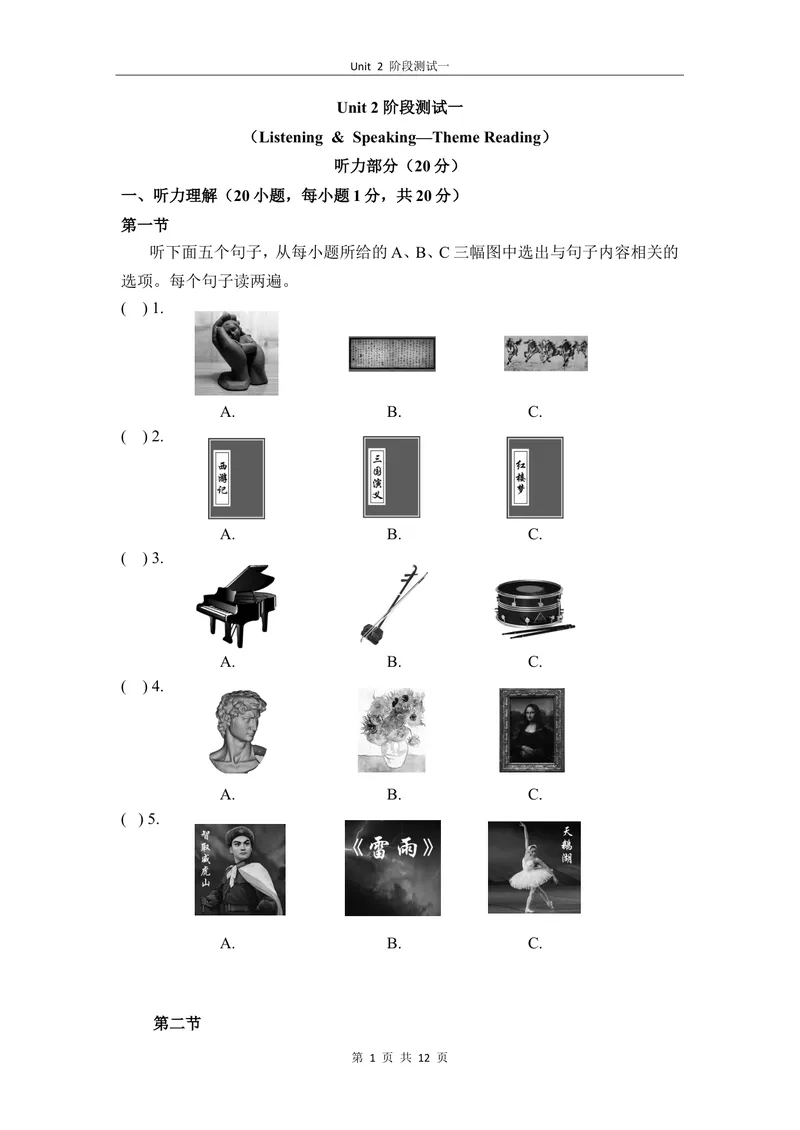
听下面五个句子,从每小题所给的A、B、C三幅图中选出与句子内容相关的
选项。每个句子读两遍。
( ) 1.
A. B. C.
( ) 2.
A. B. C.
( ) 3.
A. B. C.
( ) 4.
A. B. C.
( ) 5.
A. B. C.
第二节
第 1 页 共 12 页Unit 2 阶段测试一
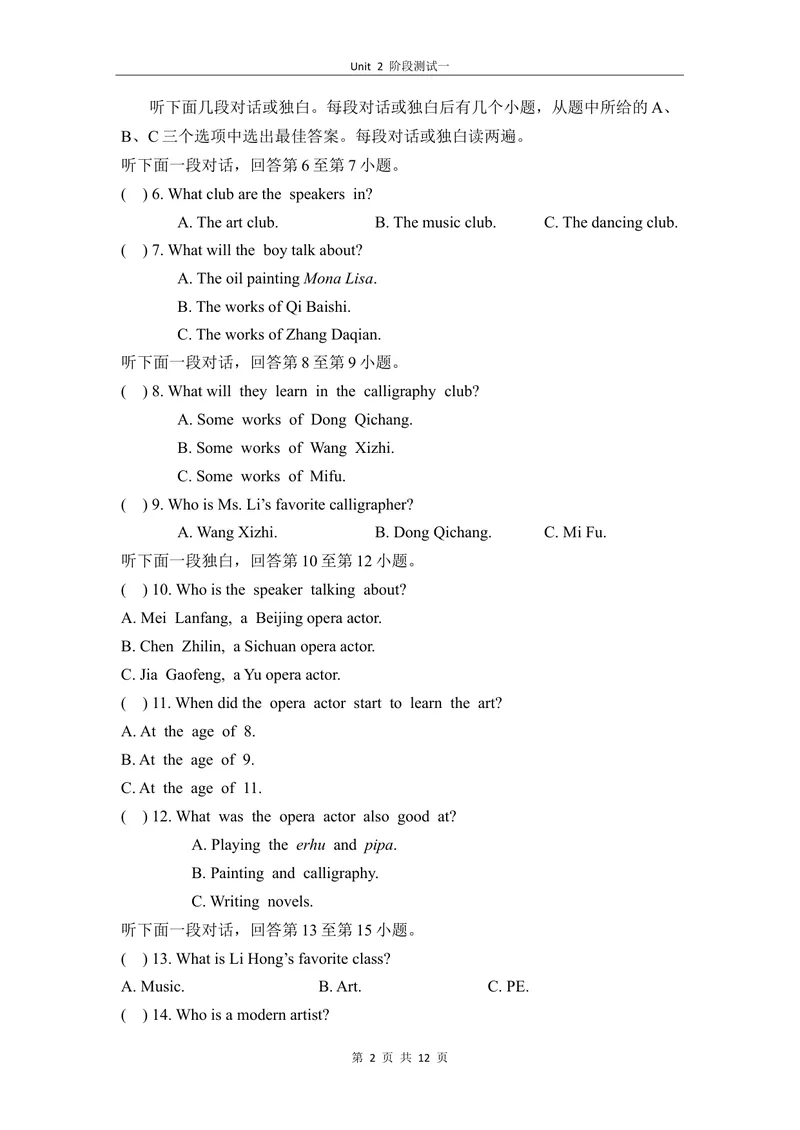
听下面几段对话或独白。每段对话或独白后有几个小题,从题中所给的A、
B、C三个选项中选出最佳答案。每段对话或独白读两遍。
听下面一段对话,回答第6至第7小题。
( ) 6. What club are the speakers in?
A. The art club. B. The music club. C. The dancing club.
( ) 7. What will the boy talk about?
A. The oil painting Mona Lisa.
B. The works of Qi Baishi.
C. The works of Zhang Daqian.
听下面一段对话,回答第8至第9小题。
( ) 8. What will they learn in the calligraphy club?
A. Some works of Dong Qichang.
B. Some works of Wang Xizhi.
C. Some works of Mifu.
( ) 9. Who is Ms. Li’s favorite calligrapher?
A. Wang Xizhi. B. Dong Qichang. C. Mi Fu.
听下面一段独白,回答第10至第12小题。
( ) 10. Who is the speaker talking about?
A. Mei Lanfang, a Beijing opera actor.
B. Chen Zhilin, a Sichuan opera actor.
C. Jia Gaofeng, a Yu opera actor.
( ) 11. When did the opera actor start to learn the art?
A. At the age of 8.
B. At the age of 9.
C. At the age of 11.
( ) 12. What was the opera actor also good at?
A. Playing the erhu and pipa.
B. Painting and calligraphy.
C. Writing novels.
听下面一段对话,回答第13至第15小题。
( ) 13. What is Li Hong’s favorite class?
A. Music. B. Art. C. PE.
( ) 14. Who is a modern artist?
第 2 页 共 12 页Unit 2 阶段测试一
A. Li Keran. B. Gu Kaizhi. C. Yan Liben.
( ) 15. What is Xu Beihong good at drawing?
A. Birds. B. Fish. C. Horses.
第三节
听下面一篇短文,根据你所听到的内容,在信息表中相应的横线上填入所缺
信息,每空限填一词。短文读两遍。
What is music?
★ Helps me speak out my mind.
Music is a 1 6 . ★ 17 me to communicate with others heart to
heart.
★ Helps relax myself.
Music is a tool of 1 8 .
★ Makes me feel happy, afraid or sad.
★ Takes us to a world of art.
Music is a 1 9 .
★ Brings together people all over the world.
My favorite musical 2 0 is erhu.
16. _______ 17. _______ 18. ________ 19. _______ 20. _______
笔试部分(100分)
二、单项选择(10小题,每小题1分,共10分)
从题中所给的A、B、C、D四个选项中选出能填入空白处的最佳选项。
( ) 21. Journey to the West is one of the four great classic novels of Chinese
_______.
A. literature B. music C. painting D. calligraphy
( ) 22. Beijing opera is popular in China for a few _______.
A. months B. centuries C. years D. seasons
( ) 23. —Do you know Huanghe Tower in Hubei Province?
—Yes. It’s a famous _______ building.
A. medical B. foreign C. ancient D. modern
( ) 24. —Many great artists and writers are very _______ with themselves.
—Yes. We should learn from them.
A. strict B. helpful C. kind D. patient
( ) 25. —Qi Baishi’s paintings became popular in his _______.
第 3 页 共 12 页Unit 2 阶段测试一
—Yes. He kept working for so many years.
A. fiftieth B. fifty C. fifth D. fifties
( ) 26. We _______ the works of ancient dynasties to learn about China’s
history.
A. allow B. relax C. pull D. explore
( ) 27. The workers are repairing the ancient tower carefully in order to keep the
work _______.
A. going back B. going out C. going well D. going off
( ) 28. —Did you go to the concert yesterday?
—Yes. The singer _______ the work song and made us excited.
A. shouted out B. worked out
C. put out D. found out
( ) 29. —In the Tang Dynasty, there were many other great poets _______ Li Bai.
—Yes, such as Du Fu, Wang Wei and so on.
A. between B. behind C. besides D. beside
( ) 30. —Look at the painting. _______ colorful Chinese people’s daily life is!
—Yes, it’s amazing. _______ wonderful painting it is!
A. How; What B. How; What a
C. What; How D. What a; How
三、完形填空(10小题,每小题1分,共10分)
先通读原文,掌握其大意,然后从A、B、C、D四个选项中选出一个可以填入相应
空白处的最佳选项。
Do you like flying kites? Do you know anything about kites? Now, please
follow me to 3 1 the world of kites.
The kite is one of the traditional folk(民俗的)arts in China. Now flying
kites is a 32 activity all over the world.
The kites have a history of over 2,000 years. At first, people used kites for
military purposes(军事目的). But in the Tang Dynasty, when the country began to
develop faster and people’s life was getting 3 3 , people flew kites for fun. In the
early Song Dynasty, making kites 34 a job. People made and sold kites to make
money. Then businessmen 35 the art of kites to western(西方的)countries.
Later, there were many different kinds of kites 36 in the east and west.
During kites’ development, people formed some special 37 about kites. The
第 4 页 共 12 页Unit 2 阶段测试一
kite makers had different skills of making kites. They painted flowers, birds and
animals on the kites. They 38 created some forms about Fu (luck) to express their
wishes for the lucky things in life. Besides these improvement, they 39 had more
materials(材料)for making kites. People used silk at first. Later, they used paper to
make kites 40 paper was light and popular. Now, some kites even have LED
lights for interesting light shows at night.
( ) 31. A. explore B. produce C. show D. provide
( ) 32. A. boring B. popular C. special D. difficult
( ) 33. A. worse B. slower C. harder D. better
( ) 34. A. became B. turned C. got D. grew
( ) 35. A. traveled B. left C. took D. moved
( ) 36. A. every B. each C. both D. all
( ) 37. A. cultures B. games C. activities D. reasons
( ) 38. A. never B. also C. already D. just
( ) 39. A. too B. just C. still D. even
( ) 40. A. when B. because C. if D. so
四、阅读理解(20小题,每小题2分,共40分)
阅读下面四篇语言材料,然后按文后要求做题。
A
Here are three ancient Chinese games. They’ll help you explore the ancient Chinese
culture and people’s wisdom(智慧).
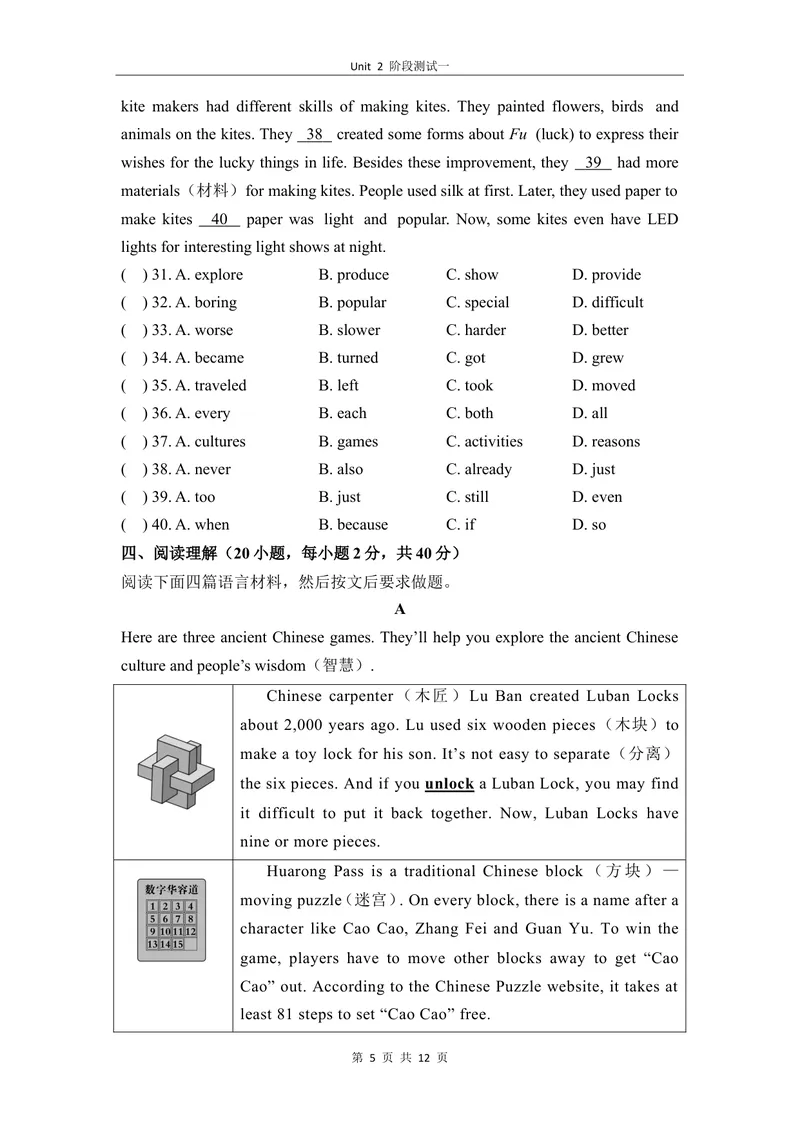
Chinese carpenter(木匠)Lu Ban created Luban Locks
about 2,000 years ago. Lu used six wooden pieces(木块)to
make a toy lock for his son. It’s not easy to separate(分离)
the six pieces. And if you unlock a Luban Lock, you may find
it difficult to put it back together. Now, Luban Locks have
nine or more pieces.
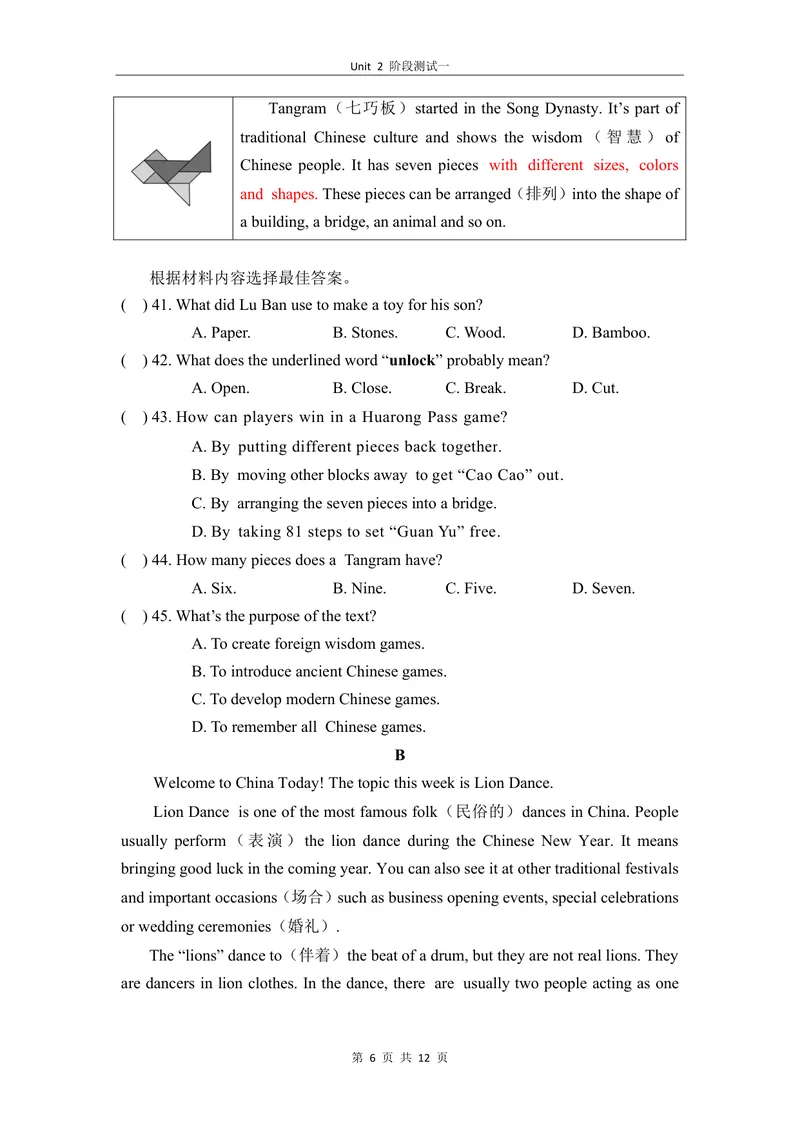
Huarong Pass is a traditional Chinese block(方块)—
moving puzzle(迷宫). On every block, there is a name after a
character like Cao Cao, Zhang Fei and Guan Yu. To win the
game, players have to move other blocks away to get “Cao
Cao” out. According to the Chinese Puzzle website, it takes at
least 81 steps to set “Cao Cao” free.
第 5 页 共 12 页Unit 2 阶段测试一
Tangram(七巧板)started in the Song Dynasty. It’s part of
traditional Chinese culture and shows the wisdom (智慧)of
Chinese people. It has seven pieces with different sizes, colors
and shapes. These pieces can be arranged(排列)into the shape of
a building, a bridge, an animal and so on.
根据材料内容选择最佳答案。
( ) 41. What did Lu Ban use to make a toy for his son?
A. Paper. B. Stones. C. Wood. D. Bamboo.
( ) 42. What does the underlined word “unlock” probably mean?
A. Open. B. Close. C. Break. D. Cut.
( ) 43. How can players win in a Huarong Pass game?
A. By putting different pieces back together.
B. By moving other blocks away to get “Cao Cao” out.
C. By arranging the seven pieces into a bridge.
D. By taking 81 steps to set “Guan Yu” free.
( ) 44. How many pieces does a Tangram have?
A. Six. B. Nine. C. Five. D. Seven.
( ) 45. What’s the purpose of the text?
A. To create foreign wisdom games.
B. To introduce ancient Chinese games.
C. To develop modern Chinese games.
D. To remember all Chinese games.
B
Welcome to China Today! The topic this week is Lion Dance.
Lion Dance is one of the most famous folk(民俗的)dances in China. People
usually perform(表演)the lion dance during the Chinese New Year. It means
bringing good luck in the coming year. You can also see it at other traditional festivals
and important occasions(场合)such as business opening events, special celebrations
or wedding ceremonies(婚礼).
The “lions” dance to(伴着)the beat of a drum, but they are not real lions. They
are dancers in lion clothes. In the dance, there are usually two people acting as one
第 6 页 共 12 页Unit 2 阶段测试一
lion: one holding the head and the other holding the body and tail; or one acting as a
cub(幼崽), while the other holding a silk ball to play with it.
In the past, lion dance was mostly in China. But it changed a lot today. It is
popular all over the world. Why not come to us and have a try? Here is a good
chance for you ...
根据材料内容选择最佳答案。
( ) 46. Why do people perform the Lion Dance during the Chinese New Year?
A. To take exercise and grow tall.
B. To bring good luck in the coming year.
C. To train the abilities and dance well.
D. To welcome the foreign guests.
( ) 47. Where can you probably see the Lion Dance?
①at business opening events ②at special celebrations
③at wedding ceremonies ④at parents meetings
A. ①②③ B. ①②④
C. ①③④ D. ②③④
( ) 48. What’s Paragraph 3 mainly about?
A. Changes in Lion Dance.
B. Real lions in Lion Dance.
C. How to perform a Lion Dance.
D. How to learn the Lion Dance.
( ) 49. What does the other do while one performer acts as a cub(幼崽)?
A. The other holds the lion head.
B. The other holds the lion body.
C. The other holds the lion tail.
D. The other holds a silk ball.
( ) 50. According to the last paragraph, what will the writer write about next?
A. An activity to learn the lion dance.
B. A fun story about the lion dance.
C. An accident about the lion dance.
D. An advantage of the lion dance.
C
Recently, a group of students from Russia experienced the beauty of traditional
第 7 页 共 12 页Unit 2 阶段测试一
Chinese paper-cutting in Harbin, Heilongjiang Province. These students are from
Northeast Forestry University(大学)and Harbin Medical University. They got an
invitation(邀请)to learn paper-cutting skills from Ni Xiumei. She is a national
intangible cultural inheritor(非物质文化传承人) of paper-cutting. The activity was
part of the second China-Russia Culture and Art Season in Heilongjiang Province.
During the activity, Ni showed the students how to cut paper and explained the
cultural meaning behind paper-cutting. Amazed by the magic of paper-cutting, the
students made their own works such as animals and fruits.
“I saw paper-cutting works from Heilongjiang at my school before,” said
Bystrova Anastasiia, a student from Northeast Forestry University. She found it
meaningful to learn about traditional Chinese paper-cutting art with her classmates
and to do it in person(亲自). Another student said, “It is a great joy when seeing a
piece of paper turn into a beautiful pattern(图案)through folding and cutting. I will
also tell my family and friends about Chinese paper-cutting, Chinese culture, and
Chinese stories.”
根据材料内容选择最佳答案。
( ) 51. Where is the group of students from?
A. China. B. Russia. C. France. D. England.
( ) 52. What is Ni Xiumei good at?
A. Paper-cutting. B. Oil painting.
C. Calligraphy. D. Gardening.
( ) 53. What did the students do during the activity?
A. They showed others how to cut paper.
B. They explained the cultural meaning.
C. They did their own paper cuts.
D. They told others about Russian culture.
( ) 54. Which of the following pictures can best show “folding”?
A. B. C. D.
第 8 页 共 12 页Unit 2 阶段测试一
( ) 55. According to another student’s words, we can infer that ________.
A. paper-cutting skills will become secrets
B. paper-cutting will be too difficult to learn
C. Chinese culture will be less in the future
D. Chinese stories will go more widely around the world
D
The classical Chinese gardens in Suzhou are very famous. 5 6 First,
Chinese people love the nature and feel relaxed in nature. Second, the gardens
encouraged arts like calligraphy, literature and painting. Here are some Chinese
gardens elements(元素).
Water
Water is the most important element and no Chinese gardens can go
without it. 5 7 Water also means communication, movement and dreams.
Rocks(岩石)
5 8 Large rocks can be seen as mountains. Smaller rocks are often on
show in the halls at a garden’s gate.
Plants
59 Bamboo, for example, means being strong. Flowers add colors to a
garden.
Pavilions(亭)
In Chinese gardens, pavilions are at the best viewing places. We can see
the reflection(倒影)of the moon at night on pavilions. 60
根据材料内容,从下面五个选项中选出能填入文中空缺处的最佳答案,使文
章意思通顺、内容完整,并将选项填入下列横线上。
A. Many of the rocks come from Lake Tai.
B. We can also listen to the sound of rain, paint and write poems.
C. Why do Chinese people enjoy the gardens?
D. The water in a garden usually makes a lake.
E. Different plants and flowers are in the gardens.
56. ______ 57. _______ 58. ________ 59. _______ 60. _______
五、语篇填空(10小题,每小题1分,共10分)
阅读下面短文,在每个空格内填入一个恰当的词。(有提示词的,填入所给单
词的正确形式)
第 9 页 共 12 页Unit 2 阶段测试一
Henan Yu opera is 61 kind of traditional Chinese opera. It is the main opera in
Henan Province and is popular with most people in China. It has a long history of
more than three 6 2 (century). There are four 6 3 (type) in Yu opera: Xiangfu,
Yudong, Yuxi and Shahe. The opera is famous for 6 4 (it) skillful melodies
(旋
, fluent tune and strong voice. It is 6 5 (amazed) to watch the actors speak out
律)
a lot of lines in a short time. Its simple performance and strong local taste
(表演)
are 6 6 (mark) of the opera.
The performers prepared their dresses 6 7 (careful). The colorful clothes make
the performance even more exciting. Traditional musical instruments such as suona
6 8 drums make a powerful atmosphere(气氛)when the performers are singing.
These plays cover themes(主题)such as love, war, heroes and family values. Over
the 69 , Yu opera became popular among the people of Henan and the whole
country.
There are more than 600 traditional plays in Yu opera. Some famous
performers 70 (be) Chang Xiangyu, Chen Suzhen and Ma Lin. They make great
contributions to the development of Yu opera.
(贡献)
61. ________ 62. ________ 63. ________ 64. ________ 65. ________
66. ________ 67. ________ 68. ________ 69. ________ 70. ________
六、补全对话(5小题,每小题2分,共10分)
根据下面的对话情景,在每个空白处填上一个适当的句子,使对话的意思连贯、
完整。
A: Li Hong, May Day is coming. Do you have any plans?
B: 7 1 . I will go to the art museum.
A: That’s a good choice. 7 2 ?
B: Yes, I know some traditional Chinese arts such as Chinese clay(陶土), paper-
cut and New Year picture.
A: Great! 7 3 ?
B: I like Chinese clay best.
A: 7 4 ?
B: Because it is lovely and beautiful.
A: You can make Chinese clays in the museum. 7 5 ?
B: Sure, I’d love to have a try. Can you go with me?
A: No problem. We can do it together.
第 10 页 共 12 页Unit 2 阶段测试一
71. ___________________________________________________.
72. ___________________________________________________?
73. ___________________________________________________?
74. ___________________________________________________?
75. ___________________________________________________?
七、完成句子(5小题,每小题2分,共10分)
根据所给提示,完成句子。第76—79小题每空一词(含缩略词);第80小题请
将完整的句子写在横线上。
76. My mom allowed me to go to the museum.(改为否定句)
My mom _______ ________ me to go to the museum.
77. Jim fell in love with the calligraphy works soon.(对画线部分提问)
________ did Jim fall in love ________?
78. The little girl finished the Chinese clay without help.(改为同义句)
The little girl finished the Chinese clay ________ ________ .
79. 小提琴属于弦乐器。(完成译句)
Violins ________ ________ string instruments.
80. the, piece of art, great, 528.7 centimeters, is, long (.)(连词成句)
______________________________________________________________
八、书面表达(10分)
“传播中国文化,讲好中国故事。”假如你是李红,你的英国朋友Mike想阅
读中国古典名著。请你根据以下提示,用英语写一封邮件,向他推荐《西游记》这
本名著。
写作提示:
1. 故事风趣幽默,人物深受喜爱;
2. 四人团队合作,历尽各种艰难;
3. 坚持追逐梦想,不言弃终成功。
写作要求:
1. 文中须包含所有的要点提示,可以适当发挥;
2. 文中不得出现真实姓名和学校名称;
3. 词数80—100词。(开头和结尾已给出,不计入总词数)
参考词汇:Monkey King美猴王,a magic stick金箍棒,overcome克服
第 11 页 共 12 页Unit 2 阶段测试一
Dear Mike,
_____________________________________________________________________
_____________________________________________________________________
_____________________________________________________________________
_____________________________________________________________________
_____________________________________________________________________
_____________________________________________________________________
_____________________________________________________________________
_____________________________________________________________________
_____________________________________________________________________
I wish you can enjoy this book.
Yours,
Li Hong
第 12 页 共 12 页