唀渀椀琀 㘀 㚖땫䭭햋Nഀ
Unit 6 阶段测试一
(Listening & Speaking—Theme Reading)
听力部分(20分)
一、听力理解(20小题,每小题1分,共20分)
第一节
听下面五个句子,从每小题所给的A、B、C三幅图中选出与句子内容相关的
选项。每个句子读两遍。
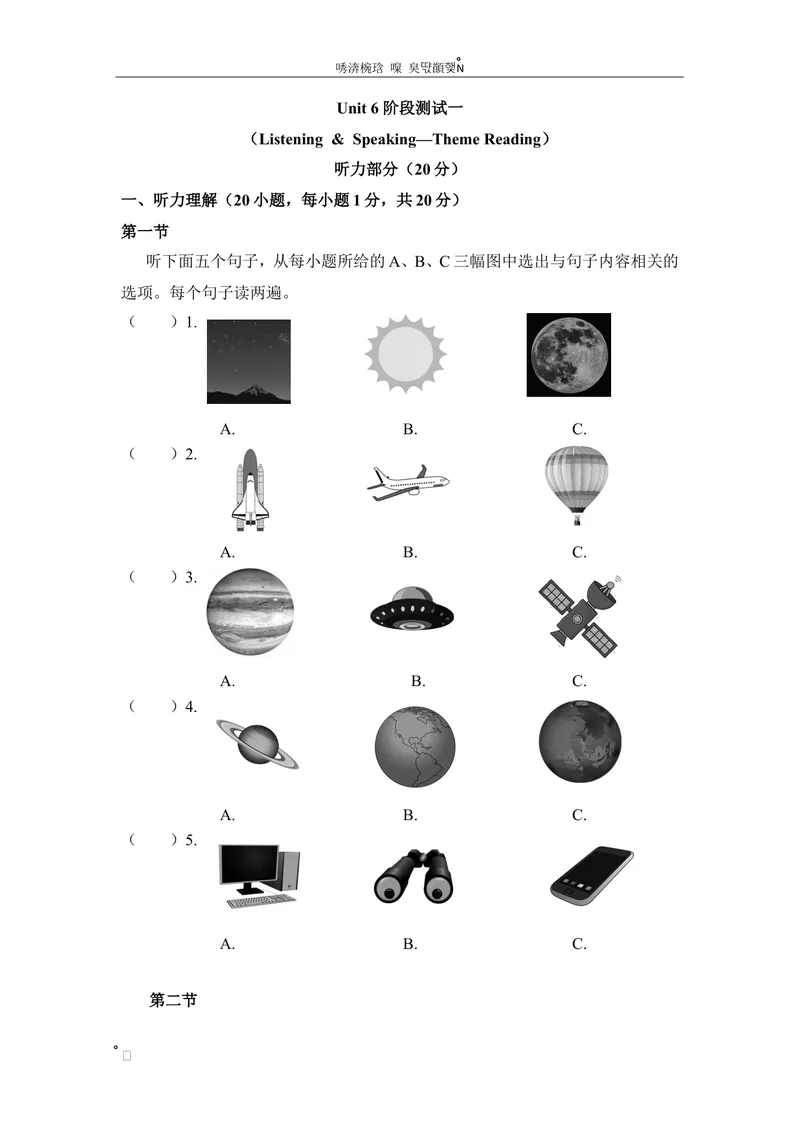
( )1.
A. B. C.
( )2.
A. B. C.
( )3.
A. B. C.
( )4.
A. B. C.
( )5.
A. B. C.
第二节
(cid:11)ഀ唀渀椀琀 㘀 㚖땫䭭햋Nഀ
听下面几段对话或独白。每段对话或独白后有几个小题,从题中所给的A、
B、C三个选项中选出最佳答案。每段对话或独白读两遍。
听下面一段对话,回答第6至第7小题。
( )6. Where is Lucy going?
A. To a museum. B. To a restaurant. C. To a school.
( )7. How will Lucy go there?
A. By bus. B. On foot. C. By bike.
听下面一段对话,回答第8至第9小题。
( )8. What will China send into space next week?
A. A spaceship. B. A rocket. C. A man-made satellite.
( )9. Where will China send taikonauts to?
A. Moon. B. Mars. C. Venus.
听下面一段独白,回答第10至第12小题。
( )10. What is the real color of the Sun?
A. White. B. Orange. C. Yellow.
( )11. Which is the largest object in the solar system?
A. Jupiter. B. The Sun. C. Saturn.
( )12. What does the Sun provide Earth with?
A. Energy, light and heat.
B. Energy, water and heat.
C. Air, light and heat.
听下面一段对话,回答第13至第15小题。
( )13. What are they talking about?
A. An astronaut. B. A planet. C. A movie.
( )14. Why do the astronauts go into space?
A. To find a new planet to live on.
B. To send more satellites into space.
C. To check the health of the Sun.
( )15. What do they learn in the end of their talk?
A. We should respect the astronauts.
(cid:11)ഀ唀渀椀琀 㘀 㚖땫䭭햋Nഀ
B. We should protect Earth.
C. We should find a new place to live.
第三节
听下面一篇短文。根据你所听到的短文内容,从A、B、C三个选项中选出正确
答案。短文读两遍。
( )16. What do Seth and Alex do?
A. Space scientists. B. Astronauts. C. Rocket builders.
( )17. What do they think of the universe?
A. New. B. Small. C. Huge.
( )18. What’s the first reason for Seth and Alex to believe that there is
intelligent life on other planets?
A. Time is long enough.
B. Stars are bright enough.
C. Planets are close enough.
( )19. How old is the universe?
A. About 11 billion years old.
B. About 12 billion years old.
C. About 20 billion years old.
( )20. How many stars are there in the Milky Way?
A. At least 100 billion.
B. At least 200 billion.
C. At least 300 billion.
笔试部分(100分)
二、单项选择(10小题,每小题1分,共10分)
从题中所给的A、B、C、D四个选项中选出能填入空白处的最佳选项。
( )21. Many countries are trying to send spaceships ________ the space to
explore the universe.
A. into B. on C. under D. at
( )22. In the solar system, Asteroid Belt ________ the inner planets from the
outer ones.
(cid:11)ഀ唀渀椀琀 㘀 㚖땫䭭햋Nഀ
A. divides B. puts C. leaves D. separates
( )23. ________ Moon ________ Venus gives light. They only reflec(t 反射)the
light from the Sun.
A. Either; or B. Neither; nor
C. Not only; but also D. Both; and
( )24. Nearly 71% of Earth’s ________ is covered by water.
A. object B. spoon C. surface D. diameter
( )25. It’s hard for people to ________ on a planet with no air.
A. create B. include C. survive D. choose
( ) 26. If a rainbow _______ in the morning, rainy weather will probably come.
A. looks B. appears C. explores D. lives
( )27. The Black Hole has the ________ to “eat” everything near it, including
the light.
A. distance B. degree C. power D. rocket
( )28. Earth is a special planet in the solar system because it ________
lives—people, animals , plants, and so on.
A. is helpful for B. is alive with C. is similar to D. is short of
( )29. The Sun is very important to Earth. It gives us light ________ heat.
A. as well as B. as soon as C. as much as D. as many as
( )30. Earth ________ the Sun, so we have four seasons in a year.
A. runs away B. gets off C. gets on D. moves around
三、完形填空(10小题,每小题1分,共10分)
Moon is an amazing object in the universe.
It is Earth’s only natural satellite. It is very important to
our Earth. It orbits(环绕……的轨道运行)around Earth at a
relatively stable(相对稳定的) 31 . This relationship
between Earth and Moon changes the tides(潮汐)on Earth.
Moon is like a big 32 ball in the sky. Moon 33 around Earth. It 34 about
one month for Moon to go around Earth once. When we look at it from Earth, we can
see different shapes or phases(时期). Moon has different names according to its
(cid:11)ഀ唀渀椀琀 㘀 㚖땫䭭햋Nഀ
different 35 . We call it a full Moon when it looks like a big, round plate. We call it a
crescent Moon(新月) 36 Moon is like a thin line. Moon also has some other
shapes. The changes of these shapes are very interesting.
Scientists 37 Moon to know more about the solar system. There are many
craters(陨石坑)on its 3 8 . Moon doesn’t give off light. It shines
3 9 it reflects the light 40 the Sun. On a clear night, it is very bright and
beautiful.
( )31. A. mess B. distance C. age D. loss
( )32. A. round B. square C. huge D. small
( )33. A. walks B. shows C. runs D. moves
( )34. A. takes B. pays C. spends D. costs
( )35. A. colors B. shapes C. sizes D. names
( )36. A. since B. when C. after D. before
( )37. A. enjoy B. study C. accept D. include
( )38. A. surface B. object C. rock D. warmth
( )39. A. because B. so C. but D. and
( )40. A. on B. at C. from D. in
四、阅读理解(20小题,每小题2分,共40分)
阅读下面四篇语言材料,然后按文后要求做题。
A
Do you want to know something about the solar system? Let me tell you. The
Sun is the center in the solar system. We can see eight planets move around the Sun.
Asteroid Belt separates the eight planets into two groups—the inner planets and the
outer planets.
The inner planets
The closest planet to the Sun is Mercury. It is very small and hot. Venus is the
second planet from the Sun. It is often called “Earth’s sister” because it is similar to
Earth in size. Earth is our home planet. It has water and air. They are very important
to life. Mars is the fourth planet and it looks red. Scientists are very interested in
exploring Mars because there is probably life on it.
The outer planets
(cid:11)ഀ唀渀椀琀 㘀 㚖땫䭭햋Nഀ
Jupiter is the largest planet in the solar system. It has a big red spot. Saturn is
famous for its beautiful rings. Uranus is a very cold planet. Neptune is the farthest
planet from the Sun. All these planets are in different places around the Sun and
they have their own unique features(独特的特征).
( )41. Which planet is the closest to the Sun?
A. Venus. B. Mercury. C. Mars. D. Earth.
( )42. What is Venus often called?
A. Earth’s brother. B. Earth’s sister.
C. Mars’s sister. D. Jupiter’s sister.
( )43. Why are scientists very interested in exploring Mars?
A. Because Mars is very beautiful.
B. Because there is probably life on Mars.
C. Because Mars is next to Earth.
D. Because Mars looks red.
( )44. How does the writer start the text?
A. By asking a question. B. By listing numbers.
C. By telling a story.D. By sharing an example.
( )45. What is the writer’s purpose in writing the text?
A. To compare the eight planets with each other.
B. To tell the importance of the eight planets.
C. To tell the difference of the eight planets.
D. To introduce the eight planets in the solar system.
B
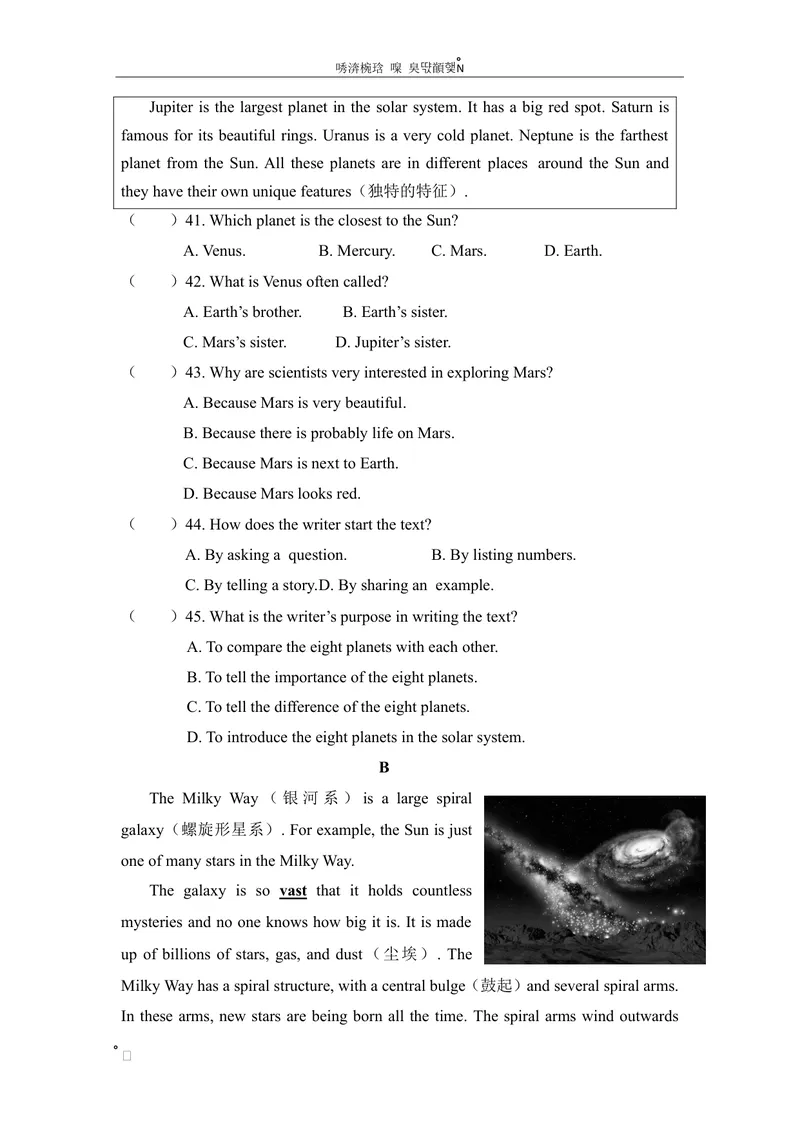
The Milky Way (银河系)is a large spiral
galaxy(螺旋形星系). For example, the Sun is just
one of many stars in the Milky Way.
The galaxy is so vast that it holds countless
mysteries and no one knows how big it is. It is made
up of billions of stars, gas, and dust(尘埃). The
Milky Way has a spiral structure, with a central bulge(鼓起)and several spiral arms.
In these arms, new stars are being born all the time. The spiral arms wind outwards
(cid:11)ഀ唀渀椀琀 㘀 㚖땫䭭햋Nഀ
from the center.
Among the many wonders of the Milky Way, some are mysterious celestial
bodies(神秘的天体). Black holes, for example, are objects with such strong
gravitational(重力的)pull that nothing can escape from them. They can swallow
(吞噬)everything on their way. Neutron(中子)stars are also interesting. They have
very strong magical fields.
Scientists are exploring the Milky Way to discover its secrets. They use powerful
telescopes to see the stars and study them.
根据材料内容选择最佳答案。
( ) 46. What does the Milky Way look like?
A. A long belt. B. A long river.
C. A whirlpool(漩涡). D. A round pool.
( ) 47. What does the underlined word “vast” mean in Paragraph 2?
A. Huge. B. Strange. C. Beautiful. D. Ancient.
( ) 48. What can we learn from the text?
A. Scientists know how big the Milky Way is.
B. The Milky Way is only made up of stars.
C. Neutron stars have very strong magical fields.
D. There are no new-born stars in the Milky Way.
( ) 49. Where can we probably read the text?
A. In a science magazine. B. In a story book.
C. In a guide book. D. In a diary.
( ) 50. What is the best title for the text?
A. The Milky Way B. The Black Hole
C. The Neutron star D. The Spiral Arms
C
Nine Earths side by side would almost go across Saturn’s diameter. That doesn’t
include Saturn’s rings. Saturn is the sixth planet from our Sun and orbits(沿轨道绕
行)at a distance of about 1.4 billion kilometers from the Sun.
(cid:11)ഀ唀渀椀琀 㘀 㚖땫䭭햋Nഀ
Saturn has beautiful rings. Of all the planets in the solar system, Saturn’s rings
are the biggest and brightest. According to scientists, however, these rings will
disappear one day.
How did Saturn get its rings in the first place? Scientists have no certain answer.
But there’s a popular theory(理论): Saturn had at least 60 moons(卫星). Some
comets(彗星)or small planets ran into Saturn’s moons. And this created a large
number of ice and rock pieces. These pieces were different in size. Some were as
small as grains(颗粒)of sand, but others were as large as houses.
These pieces began to travel around Saturn. Saturn’s gravity(引力)pulled them
towards it. At the same time, the speed of their orbit tried to throw them into space.
Over time, these pieces of ice and rock formed(形成)rings around Saturn.
根据材料内容选择最佳答案。
( )51. How wide is Saturn’s diameter?
A. Nine times as wide as Earth’s diameter.
B. Nine times as wide as Venus’ diameter.
C. Nine times as wide as Mars’ diameter.
D. Nine times as wide as Jupiter’s diameter.
( )52. What is the distance between Saturn and the Sun?
A. About 1,400,000,000 kilometers. B. About 140,000,000 kilometers.
C. About 14,000,000,000 kilometers. D. About 14,000,000 kilometers.
( )53. Which of the following is TRUE according to the text?
A. Saturn has less than 60 moons.
B. Saturn’s rings will disappear completely soon.
C. Saturn’s gravity played an important role in the form of Saturn’s rings.
D. Of all the planets in the solar system, only Saturn has rings.
( )54. What is the text mainly about?
A. Saturn’s size. B. Saturn’s rings.
C. Saturn’s moons. D. Saturn’s gravity.
( )55. Where can we probably read the text?
A. In a diary. B. In a tour guide book.
(cid:11)ഀ唀渀椀琀 㘀 㚖땫䭭햋Nഀ
C. In an advertisement. D. In a science book.
D
Venus travels around the Sun at a distance of about 108 million kilometers. It is
Earth’s closest planetary(行星的)neighbor. 56 Venus is so light and beautiful in
the sky at night that the planet was named after a story. 57
Venus is the sister of Earth. 58 But Venus is also different from Earth in many
ways. 59 Venus is so close to the sun that its temperature, between 465℃and
485℃, is far higher than that on Earth. The atmospheric pressure(大气压)of Venus is
90 times as high as Earth. 60 . The air of Venus is full of carbon dioxide(二氧化
碳).
根据材料内容,从下面五个选项中选出能填入文中空缺处的最佳选项,使文章意
思通顺、内容完整。
A. There is no water there.
B. Because Venus is similar to Earth in weight.
C. The name is from a Roman goddess of love and beauty.
D. It is the second planet from the Sun in the solar system.
E. It is not a good place for people to live on like Earth.
56. ________ 57. ________ 58. ________ 59. ________ 60. ________
五、语篇填空(10小题,每题1分,共10分)
根据下面短文内容及部分首字母提示,在短文的空格处填上一个最恰当的词
使短文完整、通顺。
In the universe, 6 1 we all know, there is the Sun, Moon, Earth, and a lot of
stars. We learned in class that the Sun is a s 6 2 , Earth is a planet and Moon is our
natural 6 3 . We also know Earth moves a 6 4 the Sun and Moon goes around Earth.
We have days and nights 6 5 of the rotation of Earth day and night. When some
parts of Earth 6 6 to the Sun, people living on Earth have daylight. If Earth stops
rotating again and again, there will be no days 67 nights. Life on Earth will not s
6 8 as well.
Moon looks much bigger than the Sun because it is 6 9 to Earth. Such a short
distance also gives Moon the p 70 to change the tides(潮汐)on Earth.
(cid:11)ഀ唀渀椀琀 㘀 㚖땫䭭햋Nഀ
61. ________ 62. ________ 63. ________ 64. ________ 65. ________
66. ________ 67. ________ 68. ________ 69. ________ 70. ________
六、补全对话(5小题,每小题2分,共10分)
根据下面的对话情景,从方框内的选项中选出能填入空白处的最佳选项,其中有
两个为多余选项。
A: Hi, Rose. 7 1
B: Hi, Tom. I’m thinking about what the life would be like if we live on Mars.
A: That sounds very interesting!
B: Unluckily, people have known little about Mars until now.
A: Oh, don’t worry. I have a new book named There Is Nothing to Do on Mars.
B: There Is Nothing to Do on Mars? 7 2
A: It tells a story about a boy named Martin. He has an experience on the red planet.
B: Really? 7 3
A: His family moved their nice home from Earth to Mars. He moves around in his
space shuttle to look for real Martians(火星人)with his robot dog.
B: 74
A: No, he doesn’t. But he discovers some water under the ground.
B: Aha, he becomes a hero!
A: I agree with you. Here is the book.
B: 7 5 Thanks a lot.
A. What’s it about?
B. I can’t wait to read it.
C. What are you up to?
D. What happens to him?
E. What do you think of it?
F. Does he discover Martians?
G. Have our scientists ever found anything yet?
71. ________ 72. ________ 73. ________ 74. ________ 75. ________
七、看图写话(5小题,每小题2分,共10分)
根据每小题所提供的画面情景和提示词,写出一个与画面情景相符的句子。
(cid:11)ഀ唀渀椀琀 㘀 㚖땫䭭햋Nഀ
㜀㘀⸀ ഀഀഀ ഀഀഀഀഀഀ 戀攀氀漀眀 稀攀爀漀 开开开开开开开开开开开
开开开开开开开开开开开开开开开开开开开开开开开开开开开开ഀ(cid:11)㜀㜀⸀ ഀഀഀ ഀഀഀഀഀഀ洀漀
瘀攀 愀爀漀甀渀搀 开开开开开开开开开开开开开开开开开开开开开开开开开
开开开开开开开开开开开ഀ(cid:11)㜀㠀⸀ ഀഀഀ ഀഀഀഀഀഀ挀氀漀猀攀 开开开开开开开开开开开开开开
开开开开开开开开开开开开开开开开开开开开开开开开开ഀ(cid:11)㜀㤀⸀ ഀഀഀ ഀഀഀഀഀഀ一攀瀀琀甀
渀攀Ⰰ 昀愀爀 开开开开开开开开开开开开开开开开开开开开开开开开开开开
开开开开开开开开开ഀഀ(cid:11)㠀 ⸀ ഀഀഀ ഀഀഀഀഀഀ猀洀愀氀氀 开开开开开开开开
开开开开开开开开开开开开开开开开开开开开开开开开开ഀ歑İ晎抗梈뺏ࣿ ْ(cid:1)辖
䁷텹聢葶ൎ굥(cid:4) 텓啜(cid:11)ꉣ≽⩙空ൎ(cid:4)赑 斐 葶Ꙩ(cid:11)ꎐ䡎恏㭠퍾N魎⩙空ꉣ≽葶 鱧
⽦ ၢ(cid:2)
(cid:11)햋䁷 (cid:11)N⩙空ꉣ≽拏멎筼ή㭭葶煟쵔(cid:11)癞拏⩧敧⩙ 空ꉣ≽䲈啜 (cid:11)Ȱ(cid:11)텓╣恏葶
႖
憌(cid:11)(cid:11)(cid:11)䔀砀瀀氀漀爀椀渀最 琀栀攀 匀瀀愀挀攀ᴠ㩎题(cid:11)⡵(cid:11)(cid:11)饑N읻蝥Ȱഀ
饑屏膉䉬ഀ⸀ 蝥ⵎ箘Փ⭔梈㱨ⵎ䁢큣㩹葶桑膉륰(cid:11)(cid:11)ʐ卟텓╣ഀ⸀ 蝥ⵎൎ(cid:4)靟祝끳ί鹛
㈀
葶Ⅸൔᙢ퍙ൔഀഀഀഀഀഀഀഀഀഀഀഀഀഀഀ⸀ 춋灥㠀 ᐠ Ȱഀ쉓(cid:11)춋䝬愀猀琀爀漀渀愀甀琀⠀猀⤀蝛⪂塔
㌀
猀瀀愀挀攀 猀琀愀琀椀漀渀 空愀挀栀椀攀瘀攀洀攀渀琀⠀猀 搀漀 猀
ၢ(cid:2)ㅜ
漀洀攀 琀攀猀琀猀 婐鹛貚ഀ䔀砀瀀氀漀爀椀渀最 琀栀攀 匀瀀愀挀
攀(cid:1)
ഀഀഀ ഀഀഀ ഀ
ഀഀഀ ഀഀഀ ഀ
ഀഀഀ ഀഀഀ ഀ
ഀഀഀ ഀഀഀ ഀ
ഀഀഀ ഀഀഀ ഀ
ഀഀഀ ഀഀഀ ഀ
ഀഀഀ ഀഀഀ ഀ
ഀഀഀ ഀഀഀഀ
(cid:11)ഀ