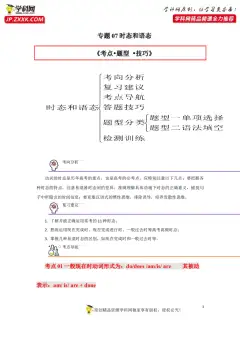
专题02 动词时态
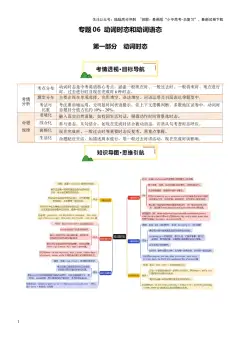
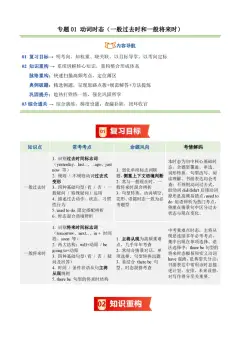
内容导航
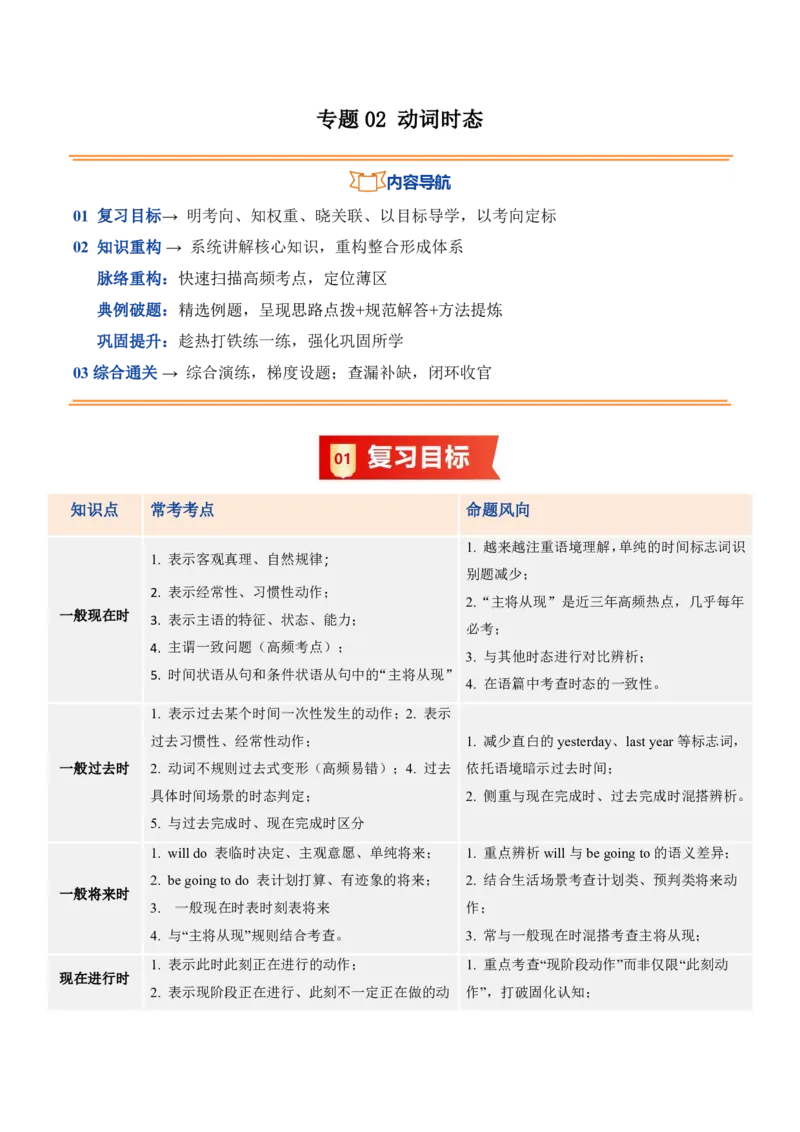
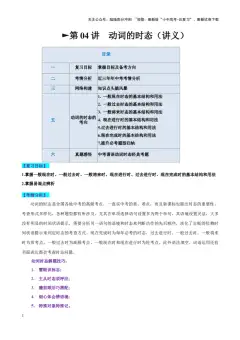
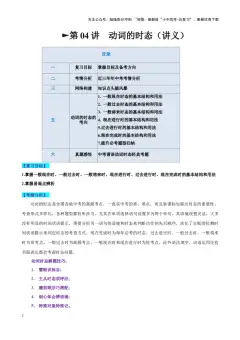
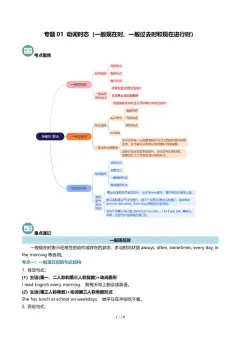
01 复习目标→明考向、知权重、晓关联、以目标导学,以考向定标
02 知识重构→系统讲解核心知识,重构整合形成体系
脉络重构:快速扫描高频考点,定位薄区
典例破题:精选例题,呈现思路点拨+规范解答+方法提炼
巩固提升:趁热打铁练一练,强化巩固所学
03 综合通关→综合演练,梯度设题;查漏补缺,闭环收官
知识点
常考考点
命题风向
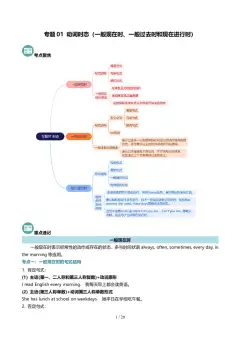
一般现在时
1. 表示客观真理、自然规律;
2. 表示经常性、习惯性动作;
3. 表示主语的特征、状态、能力;
4. 主谓一致问题(高频考点);
5. 时间状语从句和条件状语从句中的“主将从现”
1. 越来越注重语境理解,单纯的时间标志词识
别题减少;
2.“主将从现”是近三年高频热点,几乎每年
必考;
3. 与其他时态进行对比辨析;
4. 在语篇中考查时态的一致性。
一般过去时
1. 表示过去某个时间一次性发生的动作;2. 表示
过去习惯性、经常性动作;
2. 动词不规则过去式变形(高频易错);4. 过去
具体时间场景的时态判定;
5. 与过去完成时、现在完成时区分
1. 减少直白的yesterday、last year 等标志词,
依托语境暗示过去时间;
2. 侧重与现在完成时、过去完成时混搭辨析。
一般将来时
1. will do 表临时决定、主观意愿、单纯将来;
2. be going to do 表计划打算、有迹象的将来;
3.
一般现在时表时刻表将来
4. 与“主将从现”规则结合考查。
1. 重点辨析will 与be going to 的语义差异;
2. 结合生活场景考查计划类、预判类将来动
作;
3. 常与一般现在时混搭考查主将从现;
现在进行时
1. 表示此时此刻正在进行的动作;
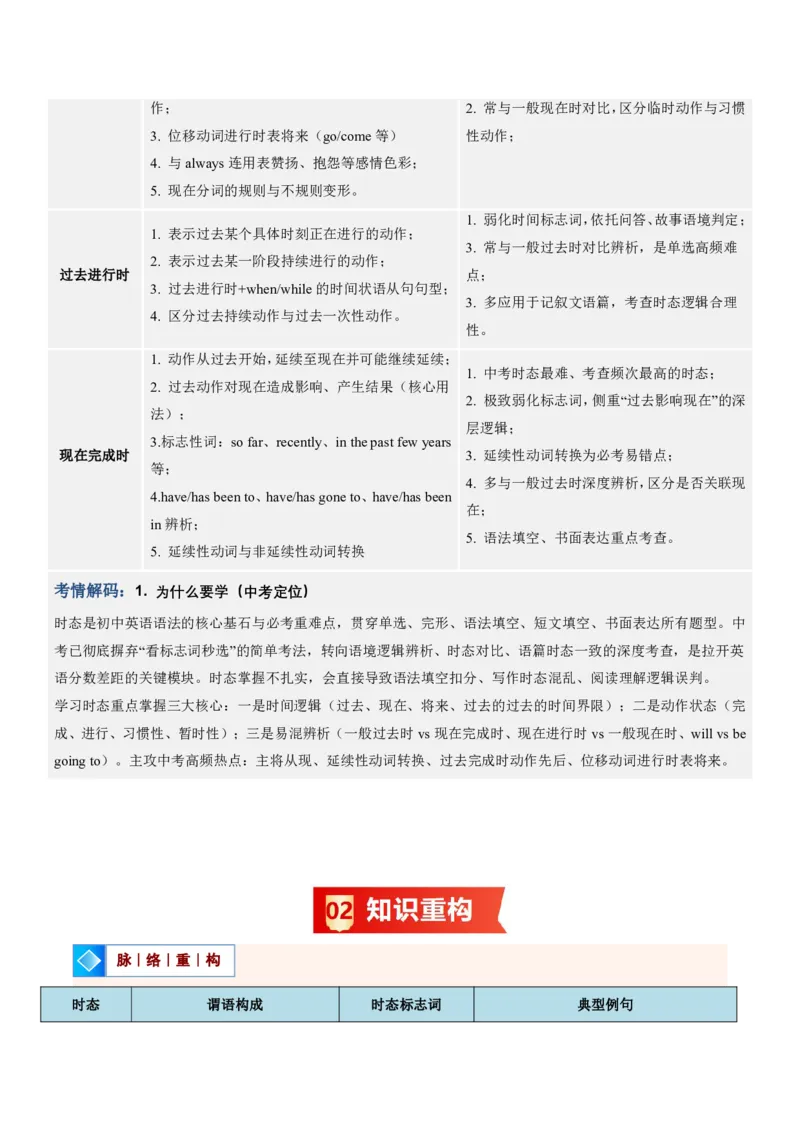
2. 表示现阶段正在进行、此刻不一定正在做的动
1. 重点考查“现阶段动作”而非仅限“此刻动
作”,打破固化认知;
作;
3. 位移动词进行时表将来(go/come 等)
4. 与always 连用表赞扬、抱怨等感情色彩;
5. 现在分词的规则与不规则变形。
2. 常与一般现在时对比,区分临时动作与习惯
性动作;
过去进行时
1. 表示过去某个具体时刻正在进行的动作;
2. 表示过去某一阶段持续进行的动作;
3. 过去进行时+when/while 的时间状语从句句型;
4. 区分过去持续动作与过去一次性动作。
1. 弱化时间标志词,依托问答、故事语境判定;
3. 常与一般过去时对比辨析,是单选高频难
点;
3. 多应用于记叙文语篇,考查时态逻辑合理
性。
现在完成时
1. 动作从过去开始,延续至现在并可能继续延续;
2. 过去动作对现在造成影响、产生结果(核心用
法);
3.标志性词:so far、recently、in the past few years
等;
4.have/has been to、have/has gone to、have/has been
in 辨析;
5. 延续性动词与非延续性动词转换
1. 中考时态最难、考查频次最高的时态;
2. 极致弱化标志词,侧重“过去影响现在”的深
层逻辑;
3. 延续性动词转换为必考易错点;
4. 多与一般过去时深度辨析,区分是否关联现
在;
5. 语法填空、书面表达重点考查。
考情解码:1. 为什么要学(中考定位)
时态是初中英语语法的核心基石与必考重难点,贯穿单选、完形、语法填空、短文填空、书面表达所有题型。中
考已彻底摒弃“看标志词秒选”的简单考法,转向语境逻辑辨析、时态对比、语篇时态一致的深度考查,是拉开英
语分数差距的关键模块。时态掌握不扎实,会直接导致语法填空扣分、写作时态混乱、阅读理解逻辑误判。
学习时态重点掌握三大核心:一是时间逻辑(过去、现在、将来、过去的过去的时间界限);二是动作状态(完
成、进行、习惯性、暂时性);三是易混辨析(一般过去时vs 现在完成时、现在进行时vs 一般现在时、will vs be
going to)。主攻中考高频热点:主将从现、延续性动词转换、过去完成时动作先后、位移动词进行时表将来。
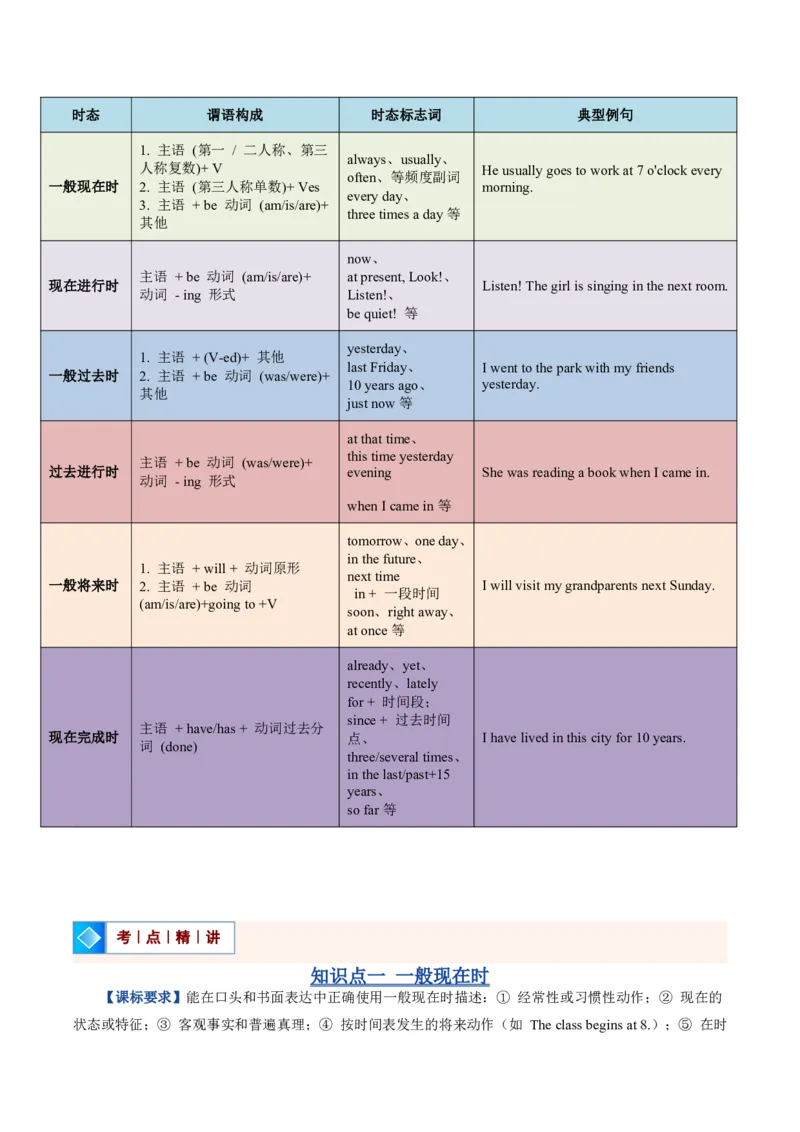
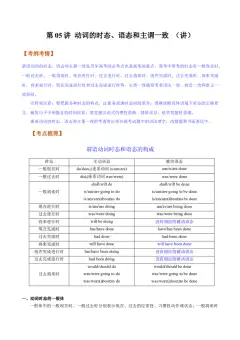
脉|络|重|构
时态
谓语构成
时态标志词
典型例句
时态
谓语构成
时态标志词
典型例句
一般现在时
1. 主语(第一/ 二人称、第三
人称复数)+ V
2. 主语(第三人称单数)+ Ves
3. 主语+ be 动词(am/is/are)+
其他
always、usually、
often、等频度副词
every day、
three times a day 等
He usually goes to work at 7 o'clock every
morning.
现在进行时
主语+ be 动词(am/is/are)+
动词- ing 形式
now、
at present, Look!、
Listen!、
be quiet! 等
Listen! The girl is singing in the next room.
一般过去时
1. 主语+ (V-ed)+ 其他
2. 主语+ be 动词(was/were)+
其他
yesterday、
last Friday、
10 years ago、
just now 等
I went to the park with my friends
yesterday.
过去进行时
主语+ be 动词(was/were)+
动词- ing 形式
at that time、
this time yesterday
evening
when I came in 等
She was reading a book when I came in.
一般将来时
1. 主语+ will + 动词原形
2. 主语+ be 动词
(am/is/are)+going to +V
tomorrow、one day、
in the future、
next time
in + 一段时间
soon、right away、
at once 等
I will visit my grandparents next Sunday.
现在完成时
主语+ have/has + 动词过去分
词(done)
already、yet、
recently、lately
for + 时间段;
since + 过去时间
点、
three/several times、
in the last/past+15
years、
so far 等
I have lived in this city for 10 years.
考|点|精|讲
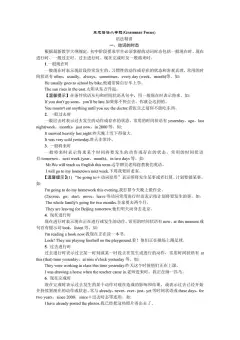
知识点一一般现在时
【课标要求】能在口头和书面表达中正确使用一般现在时描述:①经常性或习惯性动作;②现在的
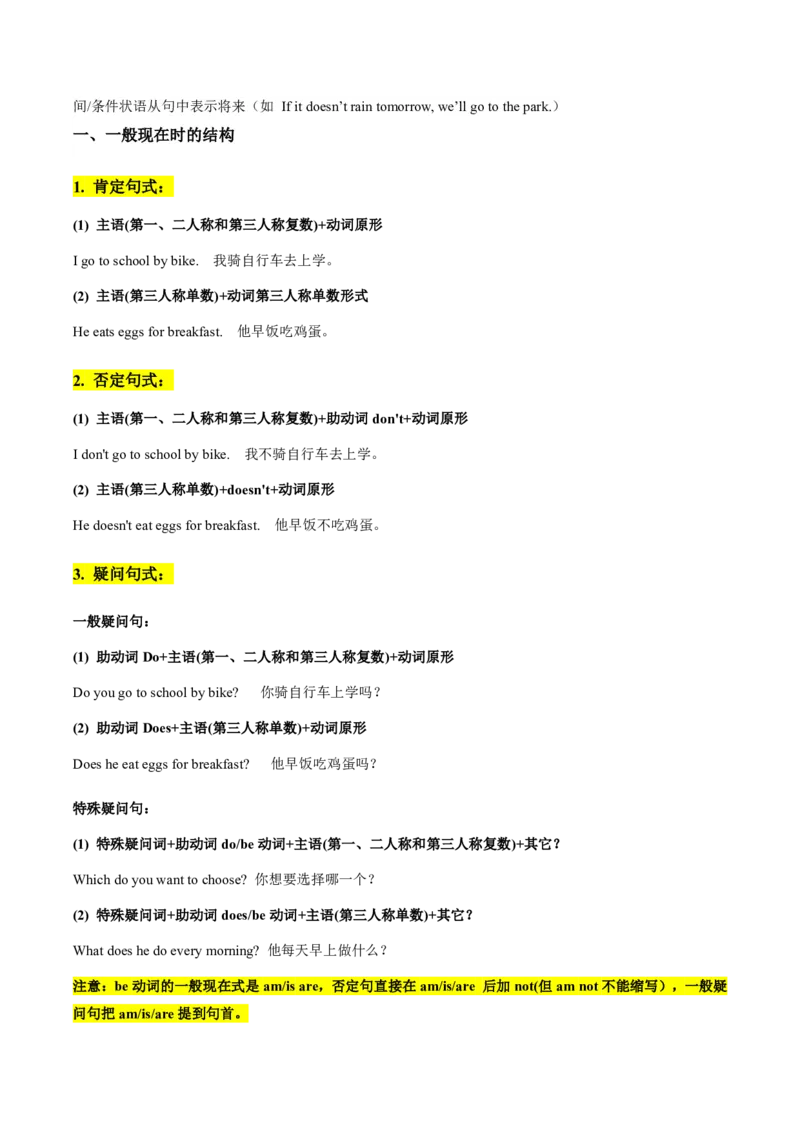
状态或特征;③客观事实和普遍真理;④按时间表发生的将来动作(如The class begins at 8.);⑤在时
间/条件状语从句中表示将来(如If it doesn’t rain tomorrow, we’ll go to the park.)
一、一般现在时的结构
1. 肯定句式:
(1) 主语(第一、二人称和第三人称复数)+动词原形
I go to school by bike.
我骑自行车去上学。
(2) 主语(第三人称单数)+动词第三人称单数形式
He eats eggs for breakfast.
他早饭吃鸡蛋。
2. 否定句式:
(1) 主语(第一、二人称和第三人称复数)+助动词don't+动词原形
I don't go to school by bike.
我不骑自行车去上学。
(2) 主语(第三人称单数)+doesn't+动词原形
He doesn't eat eggs for breakfast.
他早饭不吃鸡蛋。
3. 疑问句式:
一般疑问句:
(1) 助动词Do+主语(第一、二人称和第三人称复数)+动词原形
Do you go to school by bike?
你骑自行车上学吗?
(2) 助动词Does+主语(第三人称单数)+动词原形
Does he eat eggs for breakfast?
他早饭吃鸡蛋吗?
特殊疑问句:
(1) 特殊疑问词+助动词do/be 动词+主语(第一、二人称和第三人称复数)+其它?
Which do you want to choose? 你想要选择哪一个?
(2) 特殊疑问词+助动词does/be 动词+主语(第三人称单数)+其它?
What does he do every morning? 他每天早上做什么?
注意:be 动词的一般现在式是am/is are,否定句直接在am/is/are 后加not(但am not 不能缩写),一般疑
问句把am/is/are 提到句首。
be 动词例句:
肯定句:He is a doctor. 他是一名医生。
否定句:He is not a doctor. 他不是一名医生。
一般疑问句及回答:— Is he a doctor? 他是一名医生吗?— Yes, he is. (No, he isn’t.)
【典例破题】
He usually ______ to work at 7 o’clock every morning.
A. go
B. goes
C. went
D. will go
【命题解读】
本题考查一般现在时表习惯性动作。句中出现频度副词usually 和时间状语every morning,是一般现在时
的标志性词汇,排除过去式C、将来时D;主语He 是第三人称单数,谓语动词需用三单形式,go 的三单
形式为goes,因此选B。
【易错警示】
对于一般现在时,一定要主语主语是否为第三人称单数形式,要考虑主语为第三人称单数时,谓语动词+s
变形的问题。
【巩固提升1】
She ______ watching TV.
A. like
B. likes
C. liked
D. liking
【巩固提升2】
We ______ Chinese.
A. speaks
B. speak
C. spoke
D. will speak
【巩固提升3】
The earth ______ around the sun. (地球绕着太阳转)
A. go
B. goes
C. went
D. will go
知识点二一般过去时
【课标要求】能在口头和书面表达中正确使用一般过去时描述:①过去某个时间一次性发生的动作;②过
去经常性、习惯性的动作;③过去某段时间存在的状态或特征;④已经结束、与现在无关联的过往事件
与经历(如:He didn’t go to scholl yesterday.)
一、一般过去时的结构
1. 肯定句式:
(1) 主语+行为动词过去式+其他
He watched TV last night. 他昨晚看了电视。
(2) 主语+be 动词过去式(was/were)+其他
It was rainy yesterday. 昨天下雨了。
2. 否定句式:
(1) 主语+didn't+行为动词原形+其他
He didn't watch TV last night. 他昨晚没看电视。
(2) 主语+was/were not+其他
It wasn’t rainy yesterday. 昨天没有下雨。
3. 疑问句式:
一般疑问句:
(1) Did+主语+行为动词原形+其他?
Did he watch TV last night? 他昨晚看电视了吗?
(2) Was/Were+主语+其他?
Was it rainy yesterday? 昨天下雨了吗?
特殊疑问句:
(1) 特殊疑问词+did+主语+动词原形+其它?
What did you do last night? 你昨晚做了什么?
(2) 特殊疑问词+was/were+主语+其它?
Where were you just now? 你刚才在哪里?
注意:一般过去式分两种结构:行为动词变过去式;be 动词用was/were。行为动词变疑问、否定必须借助
助动词did,且动词要还原为原形;be 动词无需助动词,直接变化即可。
be 动词例句:
肯定句:It was rainy yesterday. 昨天下雨了。
否定句:It wasn’t rainy yesterday. 昨天没有下雨。
一般疑问句及回答:— Was it rainy yesterday? 昨天下雨了吗?— Yes, it was. (No, it wasn’t.)
实义动词例句:
肯定句:He watched TV last night. 他昨晚看了电视。
否定句:He didn't watch TV last night. 他昨晚没看电视。
一般疑问句及回答:— Did he watch TV last night? 他昨晚看电视了吗?— Yes, he did. (No, he didn’t.)
【典例破题】
He ______ TV last night.
A. watch
B. watches
C. watched
D. will watch
答案C
【命题解读】
本题考查一般过去时用法。句中有标志性过去时间状语last night(昨晚),表示过去发生的动作,需用一
般过去时。A、B 为一般现在时,D 为一般将来时,均排除;watch 的过去式为watched,因此选C。
【易错提示】
一般过去时疑问句、否定句中,借助did 后,动词一定要还原为原形,切忌出现“did + 过去式” 的错误形
式(如Did he watched… 为典型错误)。
【巩固提升1】
It ______ very cold yesterday.
A. is
B. was
C. are
D. were
【巩固提升2】
I ______ basketball every day when I was a boy.
A. play
B. played
C. plays
D. will play
【巩固提升3】
My mother ______ walk to school in the past.
A. use to
B. used to
C. uses to
D. will use to
知识点三一般将来时
【课标要求】
能在口头和书面表达中正确使用一般将来时描述:①将来某一时间将要发生的动作或存在的状态;②临
时决定即将发生的动作;③有计划、有准备的将来动作(如I am going to visit my teacher this weekend.);
④客观上即将发生、大概率发生的未来事件(如It will be a good day tomorrow.明天会是一个好天气)
一、一般将来时的结构
1. 肯定句式:
(1) 主语+willl+动词原形+其他
I will play basketball with you. 我将会和你一起打篮球。
(2) 主语+be(am/is/are) going to+动词原形+其他
I’m going to buy a computer this year. 我打算今年买一台电脑。
2. 否定句式:
(1) 主语+will not(won’t) not(shan’t)+动词原形+其他
I won’t play basketball with you. 我不会和你一起打篮球。
(2) 主语+be(am/is/are) not going to+动词原形+其他
I’m not going to buy a computer this year. 我今年不打算买电脑。
3. 疑问句式:
一般疑问句:
(1) Will+主语+动词原形+其他?
Will you play basketball with us? 你会和我们一起打篮球吗?
(2) Am/Is/Are+主语+going to+动词原形+其他?
Are you going to buy a computer this year? 你今年打算买电脑吗?
特殊疑问句:
(1) 特殊疑问词+will+主语+动词原形+其它?
What will you do tomorrow? 你明天将要做什么?
(2) 特殊疑问词+be 动词+主语+going to+动词原形+其它?
Where are you going to travel? 你打算去哪里旅行?
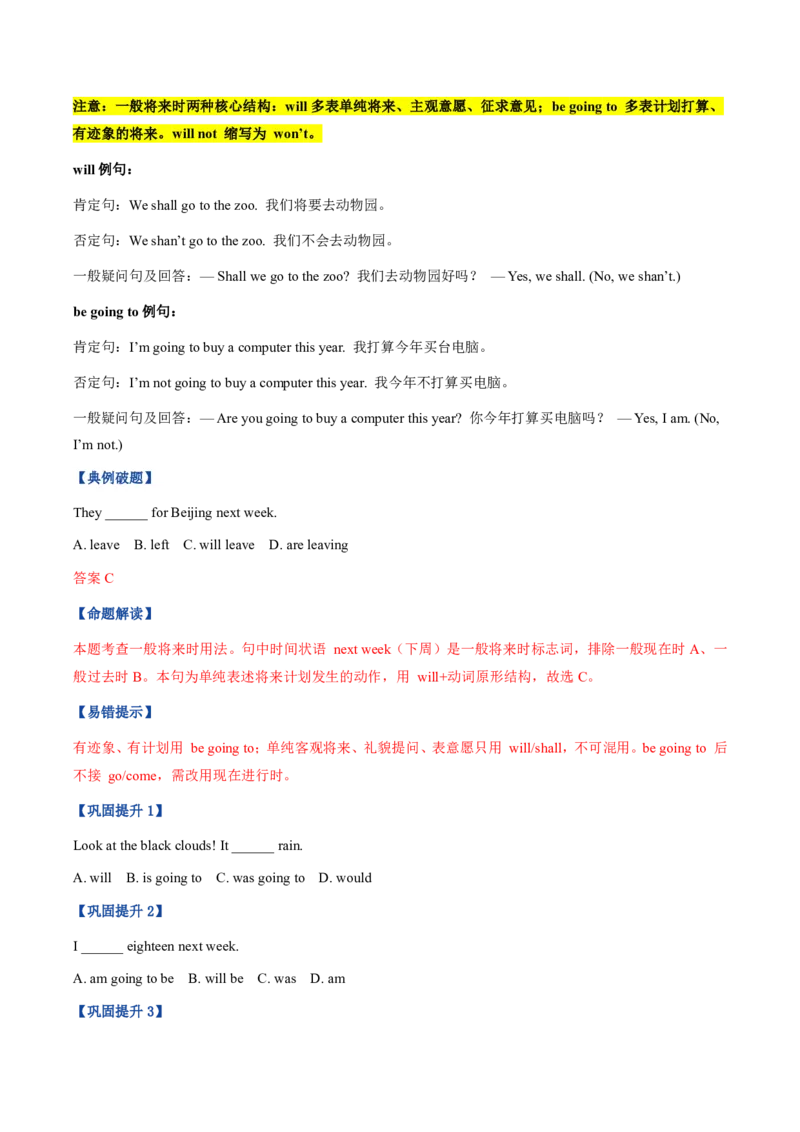
注意:一般将来时两种核心结构:will 多表单纯将来、主观意愿、征求意见;be going to 多表计划打算、
有迹象的将来。will not 缩写为won’t。
will 例句:
肯定句:We shall go to the zoo. 我们将要去动物园。
否定句:We shan’t go to the zoo. 我们不会去动物园。
一般疑问句及回答:— Shall we go to the zoo? 我们去动物园好吗?— Yes, we shall. (No, we shan’t.)
be going to 例句:
肯定句:I’m going to buy a computer this year. 我打算今年买台电脑。
否定句:I’m not going to buy a computer this year. 我今年不打算买电脑。
一般疑问句及回答:— Are you going to buy a computer this year? 你今年打算买电脑吗?— Yes, I am. (No,
I’m not.)
【典例破题】
They ______ for Beijing next week.
A. leave
B. left
C. will leave
D. are leaving
答案C
【命题解读】
本题考查一般将来时用法。句中时间状语next week(下周)是一般将来时标志词,排除一般现在时A、一
般过去时B。本句为单纯表述将来计划发生的动作,用will+动词原形结构,故选C。
【易错提示】
有迹象、有计划用be going to;单纯客观将来、礼貌提问、表意愿只用will/shall,不可混用。be going to 后
不接go/come,需改用现在进行时。
【巩固提升1】
Look at the black clouds! It ______ rain.
A. will
B. is going to
C. was going to
D. would
【巩固提升2】
I ______ eighteen next week.
A. am going to be
B. will be
C. was
D. am
【巩固提升3】
We’ll start if it ______ tomorrow.
A. doesn’t rain
B. won’t rain
C. didn’t rain
D. isn’t raining
知识点四现在进行时
【课标要求】
【课标要求】能在口头和书面表达中正确使用现在进行时描述:①此时此刻正在进行的动作;②现阶段
正在持续进行但此刻不一定在做的动作;③现阶段临时的状态或变化;④少数位移动词表近期计划、即
将发生的动作(如I’m leaving for Beijing tomorrow.)
一、现在进行时的结构
1. 肯定句式:
主语+be(am/is/are)+现在分词(V-ing)+其他
I am looking for my key now. 我现在正在找我的钥匙。
2. 否定句式:
主语+be(am/is/are) not+现在分词(V-ing)+其他
They aren’t having an English class. 他们没有在上英语课。
3. 疑问句式:
一般疑问句:
Am/Is/Are+主语+现在分词(V-ing)+其他?
Are they having an English class? 他们正在上英语课吗?
答句:Yes, they are. (No, they aren’t.)
特殊疑问句:
特殊疑问词+am/is/are+主语+现在分词(V-ing)+其它?
What are you doing now? 你现在正在做什么?
注意:现在进行时必须搭配be 动词+现在分词;状态动词、心理动词、瞬间动词、感官动词无进行时态,
无正在进行的含义。
完整例句:
肯定句:Look. Some children are playing games over there. 看!一些孩子正在那边做游戏。
否定句:Some children aren’t playing games over there. 那边没有孩子在做游戏。
一般疑问句及回答:— Are some children playing games over there? 那边有孩子在做游戏吗?— Yes, they are.
(No, they aren’t.)
【典例破题】
Look! Some children ______ games over there.
A. play
B. plays
C. are playing
D. played
答案:C
【命题解读】
本题考查现在进行时标志词用法。句首出现Look! 是现在进行时典型提示词,表此刻动作正在发生,需用
be+doing 结构,排除一般现在时A、B,一般过去时D,故选C。
【易错警示】see、like、have、know 等状态、心理动词,即使有now 也不能用于进行时,只能用一般现
在时。
【巩固提升1】
She ______ for Beijing tomorrow.
A. leave
B. left
C. is leaving
D. will leave
【巩固提升2】
He always ______ others. He is very kind.
A. help
B. helps
C. is helping
D. helped
【巩固提升3】
I ______ two brothers.
A. am having
B. have
C. had
D. will have
知识点五过去进行时
【课标要求】
能在口头和书面表达中正确使用过去进行时描述:①过去某个具体时刻正在进行的动作;②过去某段时
间内持续进行的动作;③过去正在进行的动作被另一动作突然打断(如I was reading when the phone rang.);
④过去同时发生的两个持续性动作
一、过去进行时的结构
1. 肯定句式:
主语+be(was/were)+现在分词(V-ing)+其他
He was waiting for me at that time. 那时他正在等我。
2. 否定句式:
主语+be(was/were) not+现在分词(V-ing)+其他
He was not waiting for me at that time. 那时他没有在等我。
3. 疑问句式:
一般疑问句:
Was/Were+主语+现在分词(V-ing)+其他?
Was he waiting for me at that time? 那时他正在等我吗?
答句:Yes, he was. (No, he wasn’t.)
特殊疑问句:
特殊疑问词+was/were+主语+现在分词(V-ing)+其它?
What were you doing at ten o’clock last night? 昨晚十点你在做什么?
注意:过去进行时侧重过去动作的持续性、未完成性;一般过去时侧重动作已完成、陈述事实。while 后常
接过去进行时,延续性动作;when 可接延续或瞬间动作。
完整例句:
肯定句:They were watching TV at ten o’clock last night. 昨晚十点他们正在看电视。
否定句:They weren’t watching TV at ten o’clock last night. 昨晚十点他们没有看电视。
一般疑问句及回答:— Were they watching TV at ten o’clock last night? 昨晚十点他们正在看电视吗?— Yes,
they were. (No, they weren’t.)
【典例破题】
I ______ dinner when my husband got home yesterday afternoon.
A. cook
B. cooked
C. was cooking
D. am cooking
答案:C
【命题解读】
本题考查过去进行时固定句型。when 引导瞬间过去动作,主句用过去进行时,表过去某个动作发生时,另
一个动作正在持续进行,结合时态故选C。
【易错警示】
过去进行时表动作未完成,一般过去时表动作已完成;做题需区分动作是持续过程还是完整事实。
【巩固提升1】
My mother was cooking while I ______ my homework.
A. do
B. did
C. was doing
D. am doing
【巩固提升2】
He ______ his homework in the afternoon.
A. was doing
B. did
C. is doing
D. does
【巩固提升3】
She told me she ______ for Beijing the next week.
A. leaves
B. left
C. was leaving
D. will leave
知识点六现在完成时
【课标要求】
能在口头和书面表达中正确使用现在完成时描述:①过去发生并持续到现在的动作或状态;②过去发生、
对现在造成影响或结果的动作;③从过去持续至今的经历、次数;④截止到目前为止完成的动作(如I have
finished my homework.);⑤含since/for 表动作持续的时间跨度
一、现在完成时的结构
1. 肯定句式:
主语+have/has+动词过去分词(done)+其他
He has eaten breakfast. 他已经吃过早饭了。
2. 否定句式:
主语+haven’t/hasn’t+动词过去分词(done)+其他
He hasn’t eaten breakfast. 他还没有吃早饭。
3. 疑问句式:
一般疑问句:
Have/Has+主语+动词过去分词(done)+其他?
Has he eaten breakfast? 他吃过早饭了吗?
答句:Yes, he has. (No, he hasn’t.)
特殊疑问句:
特殊疑问词+have/has+主语+动词过去分词(done)+其它?
How long have you lived here? 你在这里住多久了?
注意:主语三单用has,其余用have;现在完成时不与具体过去时间状语连用;瞬间动词不能与for/since
时间段连用,需转换为延续性动词。
完整例句:
肯定句:We have lived here since 1976. 从1976 年开始我们就住在这里。
否定句:We haven’t lived here since 1976. 从1976 年开始我们就没有住在这里。
一般疑问句及回答:— Have you lived here since 1976? 你们从1976 年就住在这里吗?— Yes, we have. (No,
we haven’t.)
【典例破题】
I ______ this film already.
A. see
B. saw
C. have seen
D. will see
答案:C
【命题解读】:本题考查现在完成时标志词。already(已经)是现在完成时典型标志词,表动作已完成且
对现在有影响,排除现在时、过去时、将来时,故选C。
【易错警示】:现在完成时侧重对现在的影响,一般过去时只侧重过去动作;瞬间动词不能接时间段,必
须转换对应延续性状态。
【巩固提升1】
The old man ______ for three years.
A. has died
B. died
C. has been dead
D. dies
【巩固提升2】
— Where is Tom? — He ______ to the Great Wall.
A. has been
B. has gone
C. went
D. goes
【巩固提升3】
I ______ here since I was a child.
A. lived
B. have lived
C. live
D. will live
一、单项选择
1.—You look exhausted. What on earth ______ all afternoon?
—I was helping my cousin move into his new flat.
A. did you do
B. have you done
C. were you doing
D. have you been doing
2.By the time the rescue team arrived at the mountain village, the heavy snow ______ several small wooden houses
already.
A. destroyed
B. had destroyed
C. has destroyed
D. was destroying
3.The old scientist ______ researching rare wild plants for over forty years and he still devotes most of his spare
time to field work now.
A. works
B. worked
C. has worked
D. had worked
4.Hurry up! The manager ______ at the office in ten minutes, and we can’t be late for the appointment.
A. arrives
B. is arriving
C. was arriving
D. has arrived
5.I ______ to call you last night, but an unexpected visitor dropped in and took up all my free time.
A. intended
B. have intended
C. had intended
D. was intended
6.Water ______ at 100 degrees Celsius under standard atmospheric pressure, which is basic physics knowledge.
A. boils
B. is boiling
C. boiled
D. will boil
7.No one can tell exactly when the ancient bridge ______, but local records suggest it dates back to the Ming
Dynasty.
A. built
B. was built
C. has been built
D. had been built
8.She won’t go on the hiking trip with us this weekend because she ______ her final papers these days.
A. writes
B. is writing
C. wrote
D. will write
9.We ______ three experimental reports so far this month, and the fourth one is due next Monday.
A. finished
B. are finishing
C. have finished
D. had finished
10.When I got to the stadium, my favorite players ______ the opening match, so I missed the whole first half.
A. finished
B. have finished
C. had finished
D. would finish
二、用所给单词的适当形式填空
1. We usually ______ (have) breakfast at seven every morning.
2. My sister often ______ (watch) cartoons in her free time.
3. There ______ (be) a book and two pens on the desk every day.
4. They ______ (visit) their grandparents next weekend.
5. Look! The students ______ (read) books in the classroom.
6. Luckily, a kind stranger ______ (help) the old man cross the road just now.
7. Though I ______ (not see) him for a long time, I still remember his face clearly.
8. When the teacher came in, we ______ (talk) loudly in class.
9. My father ______ (work) in this factory since he left school.
10. He said he ______ (take) part in the sports meeting if he was free.
三、语法填空
阅读下面短文,在空白处填入1 个适当的单词或括号内单词的正确形式。
A
If you ask people from different countries “Could you tell me the way ____24____ the post office?”, you will
get different answers.
In Japan, people use landmarks (路标) instead of street names. For example, the Japanese will say to travelers,
“Please ____25____
(go) straight down to the corner. Turn left at the big hotel and go past a fruit market. The
post office is ____26____ (cross) from the bus stop. ”
Sometimes if a person, like a New York, doesn’t know the answer to your question, he or she ____27____
(say), “Sorry, I have no idea.”
But one thing will help you everywhere. You might not understand a ____28____ (person) words, but maybe
you can understand his or her body language. He or she will usually point to the correct direction. Go on in that
direction and you may find the post office!
B
Recently, virtual self-study room (虚拟自习室) has become a warm and silent place for people who enjoy a
good learning atmosphere (氛围).
“At first, I was just looking for a partner ____29____
(prepare) for the exam together. I never expected it to
be so popular,” said Yue Yetu, who started an online steam. “It ____30____ (amaze) me that over 150 people were
online at the same time. The participants included teenagers and adults, most of whom ____31____ (prepare) for
their examinations. ”
“They don’t have to turn on the cameras in the room. However, many of them would prefer to fire up the web
camera because it ____32____ (remind) them not to be distracted (分心).” Yue said.
“I received a lot of support from it, and I was deeply ____33____ (move),” a participant Chen Yihan said, “It
helps me have a good grade.”